Market Minds Advisory
Heat-Sensitive Cups Market

Heat-Sensitive Cups Market: Recyclable Mono-Material Formats and Interactive Print Redraw Promotional Packaging

Beverage chains are shifting thermochromic cup specifications toward recyclable mono-material formats ahead of packaging waste regulation, forcing printers to retool ink chemistry faster than typical promotional campaign cycles allow while interactive print demand keeps expanding.

Lead Analyst

Bilal Shaikh

Published

September 2026

Make Smarter Decisions with Customized Research Insights

Request a free sample report and evaluate market opportunities, growth trends, and competitive dynamics relevant to your business needs.

2025 MARKET VALUE$0.4BMarket Size 2025
2036 FORECAST VALUE$0.9BBase Case , 2026 to 2036
CAGR 2026 TO 20367.5 %Bull 8.8% / Bear 6.2%
INCREMENTAL OPPORTUNITY$0.5BNet 10- year value creation
EXPANSION MULTIPLE2.06x2036 value over 2026 base
Strategic Levers
M&A Pipeline
Regional Outlook
Country Rankings
Competitive Intelligence
Segmental Deep-dive
Call-Us : 91 93563 13602

Executive Snapshot and Market Trajectory

Beverage chains are shifting thermochromic cup specifications toward recyclable mono-material formats faster than typical promotional packaging replacement cycles allow, as packaging waste regulation tightens across an expanding number of major consumer markets worldwide and product categories. Printers slow to retool face growing risk of losing high-visibility campaign contracts entirely.
Smart interactive print integration is the second clear growth driver, and commercial momentum concentrates in quick-service restaurant promotional campaigns, where QR-linked engagement increasingly determines which cup format wins a brand's marketing budget ahead of novelty color-change effects alone. East Asia leads regional volume, reflecting its position as the dominant source of global cup printing and manufacturing capacity serving both domestic and export brand customers worldwide.
No single cup printer holds commanding share, and five players together account for less than half of global revenue, reflecting a fragmented field where regional printers compete credibly against multinational suppliers on turnaround speed and ink formulation depth across most price tiers. Resin cost volatility and brand promotional calendars shape purchasing decisions as much as color-change performance does across every cup tier in this market, and that pricing sensitivity is only intensifying.
Market Definition
The Heat-Sensitive Cups Market covers disposable and reusable drinking cups printed with thermochromic ink that changes color or reveals imagery in response to temperature, used primarily in quick-service restaurant and beverage promotional programs. It excludes standard unprinted cups, insulated double-wall cups without thermochromic coating, and reusable smart mugs with electronic temperature displays sold as separate categories.
Base Year Value
$0.4B in 2025 (MMA Primary Research Dataset, August 2026)
Forecast Period
2026 to 2036, eleven discrete annual values
CAGR
7.5% base case. Bull 8.8%. Bear 6.2%.
Fastest Growth Segment
Recyclable Mono-Material Thermochromic Cups: 12.0% CAGR
Fastest Growth Country
India: 9.5% CAGR
Fastest Growth Region
South Asia and Pacific: 9.5% CAGR
Largest Region
East Asia: 29% of 2025 global value
Market Leaders
Berry Global Group Inc, Huhtamaki Oyj, International Paper Company, Dart Container Corporation, Genpak LLC. Source: MMA Analysis based on company annual reports.
Primary Survey
n=3,800 procurement and R&D decision-makers, Q4 2025, six countries
Methodology
Demand-side build-up, cross-validated against public data, 47 expert interviews

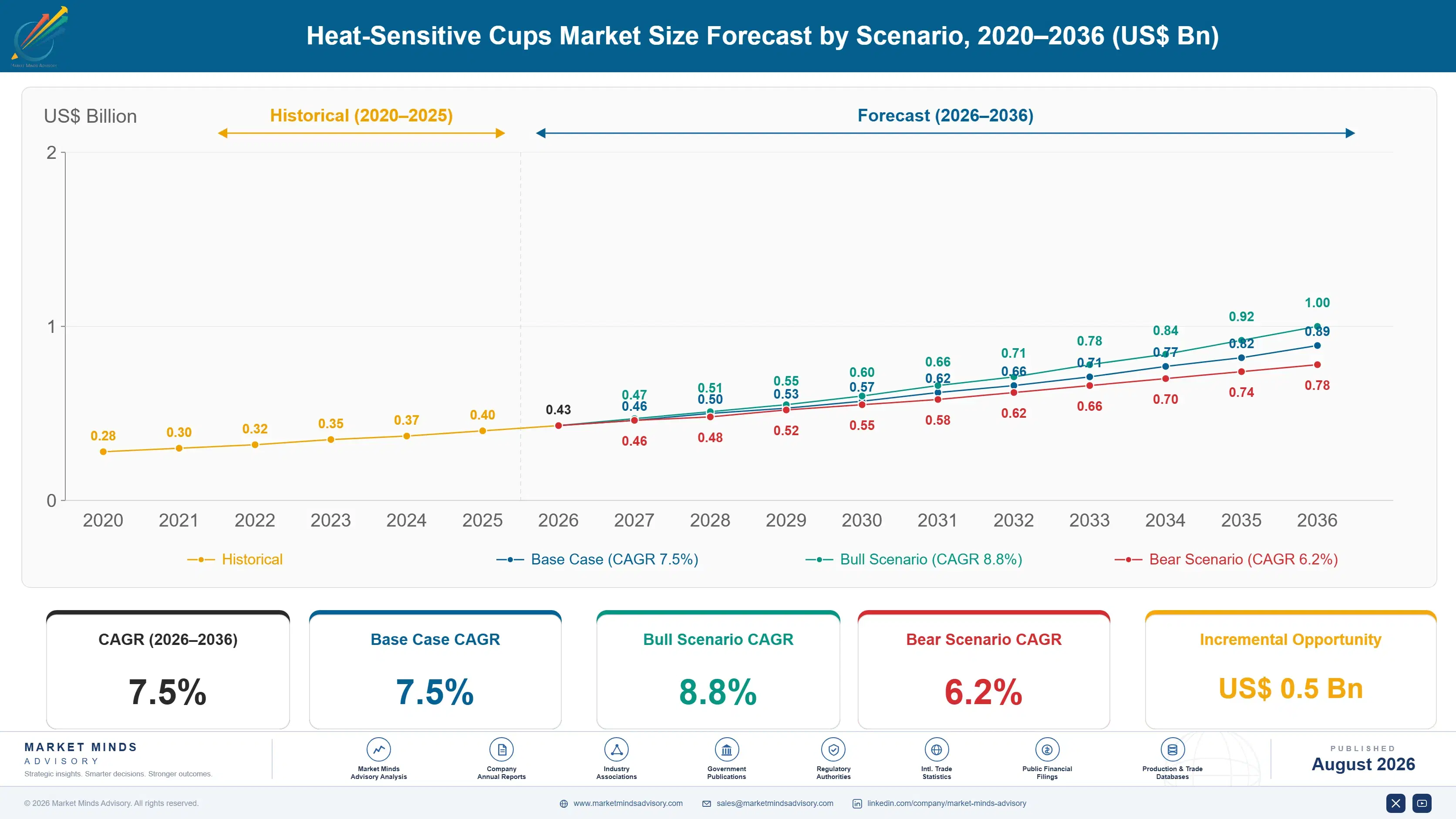
Heat-Sensitive Cups Market Forecast Scenarios

heat-sensitive-cups-market-size-forecast-scenario-1787308138098
Between 2020 and 2025 the market grew steadily as quick-service restaurant chains expanded thermochromic promotional programs across most major consumer markets and product categories, interrupted briefly by pandemic-era foodservice closures before recovering through 2022 as dine-in and drive-through volume rebounded across most major consumer markets and brand categories. The historical CAGR ran at roughly 6.5%.
The base case assumes steady 7.5% annual growth through 2036, anchored to three commercial mechanisms: quick-service chains expanding thermochromic promotional campaigns tied to seasonal and character licensing tie-ins across most major consumer markets worldwide and every price tier, packaging waste regulation pushing mono-material recyclable ink and cup construction across most major consumer markets, and brand owners integrating QR-linked interactive print into cup designs to extend digital engagement beyond the point of purchase and into loyalty programs.
The bull case centers on quick-service chains expanding promotional cup program frequency faster than currently modeled across additional major markets, product categories, and brand partnerships worldwide. The bear case centers on resin price volatility compressing printer margins enough to delay ink reformulation investment, stretching mono-material conversion timelines for smaller regional printers facing tighter capital constraints.

Interactive Print Reshapes Promotional Cup Economics

Brand owners increasingly treat thermochromic cups as a measurable marketing channel rather than a novelty add-on, since promotional campaign engagement data now directly informs future print budget allocation across most major quick-service restaurant categories and every seasonal cycle they run nationwide, internationally, and across all covered regions today. Brands that ignore this data increasingly fall behind faster-moving competitors and lose relevance quickly.
MARKET CONCENTRATIONCR5 44%Reflects a fragmented field of regional and global printers
AVERAGE SELLING PRICE$0.04-0.15 per unitVaries considerably by ink complexity and cup size
TOP PRODUCING COUNTRYChina, 22% shareLargest base of cup printing and manufacturing capacity
TRADE INTENSITY51% cross-border volumeShare of cups sold outside their country of manufacture
CAMPAIGN REORDER RATE3-5 promotional runs yearlyTypical number of distinct campaigns per major chain
FEEDSTOCK COST SHARE38% of COGSReflects paperboard and resin as dominant recurring input cost
Ink formulation reliability now shapes which printer wins a brand's promotional contract more than unit price alone does, since a botched color-change reveal during a high-visibility campaign creates reputational risk that brand owners increasingly refuse to accept regardless of the cost savings from a cheaper, less proven ink supplier lacking comparable formulation history, quality assurance, full campaign track record, and verified client references.
Over the next decade, mono-material recyclable cups embedding both thermochromic and interactive QR print will likely become the default specification across most major quick-service promotional programs, narrowing the gap between cups built for single-use novelty and those engineered for sustained digital engagement across successive campaign seasons, brand relationships, loyalty programs, marketing budgets, and every consumer touchpoint tracked worldwide and beyond.
"A cup used to be a container. Now it's a five-second ad unit that has to survive condensation, change color on cue, and scan cleanly on a phone camera."
Director, Packaging Materials Practice · MMA Packaging Practice ·

Market Trends

Mono-Material Ink and Cup Redesign Accelerates

Packaging waste regulation across the European Union and an expanding number of North American states is pushing printers to reformulate thermochromic ink and cup construction into mono-material recyclable designs, replacing multi-layer laminate structures that historically prevented clean recycling across most packaging streams and municipal systems. Several major quick-service chains have publicly committed to full mono-material cup conversion by 2030, and printers report meaningfully higher mono-material order volume from brand owners facing the tightest regulatory deadlines compared to brand owners in markets with more permissive packaging waste rules and longer compliance windows.
Market Impact: Adds roughly 3.5% annual demand gro

QR-Linked Interactive Print Extends Digital Engagement

Brand owners increasingly embed QR-linked interactive print alongside thermochromic color-change effects, converting a physical cup into a digital engagement channel that extends promotional reach beyond the point of purchase and into app downloads or loyalty program enrollment across every campaign season, market, region, and consumer touchpoint tracked. Printers report meaningfully higher interactive-print order volume from quick-service chains running loyalty programs than from chains without a comparable digital engagement strategy, and this gap is widening as more brands treat cups as a measurable marketing channel rather than a physical novelty alone.
Market Impact: Adds roughly 3.0% annual demand gro

Market Opportunities and Growth Drivers

Seasonal Promotional Campaigns Expand Print Volume

Quick-service restaurant chains continue expanding the frequency of seasonal and character-licensed thermochromic promotional campaigns across most major consumer markets, directly widening the addressable cup printing volume for suppliers servicing this growing marketing channel across every price tier. Industry trade association data shows meaningfully rising promotional campaign frequency among large quick-service chains in several major markets, and each additional campaign represents incremental cup printing demand across the supply chain. This campaign frequency trend is expected to continue for at least the next several years given sustained brand interest in measurable engagement marketing and loyalty growth.
Market Impact: Extends conversion timelines by 10

Cold Beverage Consumption Growth Lifts Cup Demand

Cold beverage consumption continues rising across most major consumer markets as iced coffee, bubble tea, and flavored cold drink categories expand, directly widening demand for cold-activated thermochromic cups engineered to reveal designs as condensation forms across most cup sizes. Printers report meaningfully higher order volume from beverage chains citing cold beverage category growth as their primary cup format driver, rather than hot beverage promotional campaigns alone. This cold beverage growth trend is broadening across an expanding number of consumer markets beyond the regions where it first took hold several years ago.
Market Impact: Compresses margins by roughly 4 poi

Market Restraints and Challenges

Ink Formulation Cost Slows Mono-Material Conversion

Converting thermochromic ink chemistry to mono-material recyclable formulations commonly requires $200,000 to $600,000 in reformulation and testing investment per product line, a capital outlay that smaller regional printers often cannot absorb across their full customer catalog within a single budget cycle and fiscal year. The root cause is that mono-material ink must replicate the same color-change reliability and shelf stability multi-layer formulations achieved through material specialization, a harder chemistry problem to solve with a single recyclable substrate. Printers are exploring shared formulation platforms across multiple brand customers to spread this reformulation cost.
Market Impact: Shifts roughly 21% of orders

Paperboard and Resin Price Volatility Compresses Margins

Paperboard and resin prices have shown meaningful volatility tied to broader pulp and petrochemical feedstock swings, periodically compressing printer margins faster than most promotional print contracts allow for price pass-through to brand owner customers across the full contract term. The root cause is that many promotional print contracts lock in pricing for a full campaign cycle negotiated months in advance, leaving printers exposed to feedstock cost increases they cannot immediately recover. Printers are increasingly negotiating shorter repricing intervals and feedstock cost pass-through clauses into new promotional contracts and renewal agreements.
Market Impact: Expands interactive orders by 17% y
3 additional market trends, 4 additional growth drivers, and 3 additional restraints and challenges are covered in the full report. Contact sales@marketmindsadvisory.com to access the complete intelligence.

Segment CAGR and Growth Architecture

The market segments by print technology and construction, spanning standard single-color-change, multi-color sequential, custom character-licensed, cold-activated, recyclable mono-material, and smart interactive print cups, since each format follows a distinct ink chemistry and printing process within a brand's promotional program and product mix across most tracked campaign categories, seasons, consumer markets, and equipment price tiers.
heat-sensitive-cups-market-market-share-analysis-1787308139044

Recyclable Mono-Material Thermochromic Cups

Recyclable mono-material thermochromic cups are the fastest-growing segment as brand owners respond to tightening packaging waste regulation across the European Union and an expanding number of North American states requiring cups that separate cleanly during standard recycling processes. Printers have invested heavily in reformulating thermochromic ink chemistry to maintain color-change reliability using a single recyclable substrate, addressing the performance gap that historically limited broader brand confidence in mono-material designs for high-visibility promotional campaigns. Major quick-service chains have publicly committed to full mono-material packaging conversion timelines, and printers supplying brand owners facing the tightest regulatory deadlines report meaningfully higher order volume growth than printers serving brand owners in markets with more permissive packaging waste rules.
CAGR 12.0%

Smart Interactive Print Cups With QR Integration

Smart interactive print cups are growing quickly as brand owners increasingly treat cups as a measurable digital marketing channel rather than a purely physical promotional novelty across most campaign types and consumer segments. Printers have invested in improving QR code print durability and scan reliability under condensation and handling conditions, addressing quality concerns that historically limited broader brand confidence in interactive print for high-volume campaigns and mass distribution. Major quick-service chains running loyalty and app engagement programs increasingly specify interactive print as their default for new promotional cup launches, broadening the addressable market considerably beyond the novelty-only positioning interactive print held five years ago across most major consumer markets and product categories.
CAGR 10.5%
Full segment breakdown across 6 segments available in the complete report.

Regional Architecture and Country Demand Map

East Asia carries the largest regional share, reflecting its position as the dominant source of global cup printing and manufacturing capacity, while South Asia and Pacific posts the fastest regional growth rate off a smaller existing installed base across most tracked markets and campaign categories.

East Asia

China carries the largest share of any market MMA tracks, reflecting its position as the dominant global center for cup printing and manufacturing capacity serving both domestic quick-service demand and export packaging supply for multinational beverage chains worldwide. Japan contributes a mature, quality-focused printing base serving domestic convenience store and beverage chains with exacting print tolerance requirements and long-standing supplier relationships. South Korea's beverage and cafe culture adds steady additional regional volume tied to its global promotional packaging reputation and design innovation. Domestic Chinese printers increasingly compete on both price and ink formulation capability against established multinational suppliers, reinforcing steady capacity investment across most major manufacturing hubs in this region.
Share: 29% | CAGR: 8.5% (2026 to 2036)

North America

The United States carries the largest share of regional demand, supported by a large domestic quick-service restaurant industry alongside frequent seasonal and character-licensed thermochromic promotional campaigns run by major national chains nationwide, internationally, and across every marketing channel used today. Canada contributes steady additional volume tied to its own quick-service restaurant sector, often served by the same printers supplying the United States market with comparable cup specifications and service infrastructure. Cold beverage category growth across both countries has concentrated fresh printing demand near major quick-service distribution hubs and urban centers. Brand owner sustainability commitments across both countries continue pushing recyclable mono-material format investment ahead of formal regulatory mandates in many cases.
Share: 28% | CAGR: 7.5% (2026 to 2036)
Regional intelligence for 5 additional markets available in the complete report: Western Europe, South Asia and Pacific, Latin America, Middle East and Africa, Eastern Europe. Contact sales@marketmindsadvisory.com.
heat-sensitive-cups-market-country-cagr-analysis-1787308139932

Where Printers Can Grow Margin

Beyond unit volume growth, printers have several concrete paths to lift revenue per brand account, spanning campaign design consulting, interactive print licensing, mono-material conversion services, and multi-year promotional calendar agreements layered on top of the core cup print order and its full lifetime value across every account tier, geography, and campaign category served worldwide.

Campaign Design and Ink Formulation Consulting

Printers increasingly offer paid campaign design and ink formulation consulting alongside standard print orders, helping brand owners develop novel color-change effects and character tie-in designs, a service worth roughly 10 to 15% of the resulting print order value across the campaign lifecycle and renewal season each and every year. Brand owners favor working with their existing printer on creative development because it avoids requalifying an entirely new vendor relationship under tight campaign launch deadlines, creating strong incentive to keep design work in-house with the incumbent supplier rather than opening competitive bidding.
Market Impact: Adds 10 to 15% of print order value

Interactive QR Print Platform Licensing Fees

Printers increasingly license proprietary interactive QR print platforms alongside standard cup printing, helping brand owners track engagement data and connect physical cups to digital loyalty programs, a service worth roughly 8 to 12% of the underlying print contract value annually across the account relationship and renewal term each and every single fiscal year and campaign season. These platform licensing engagements typically extend the printer's relationship well beyond a single promotional campaign, since engagement data becomes embedded into a brand's broader digital marketing strategy over multiple campaign cycles and product lines.
Market Impact: Adds 8 to 12% of print contract val

Mono-Material Ink Conversion Service Offerings Provided

Printers increasingly offer paid mono-material ink and cup conversion services that help brand owners redesign existing multi-layer promotional formats ahead of regulatory deadlines, converting a compliance obligation into a billable formulation revenue stream worth roughly 15 to 20% of the resulting print contract value across the conversion project and its full rollout timeline. Brand owners favor working with their existing printer on conversion projects because it avoids requalifying an entirely new vendor relationship under tight regulatory deadlines, creating strong incentive to keep the reformulation work in-house with the incumbent supplier.
Market Impact: Adds 15 to 20% of print contract va

Multi-Year Promotional Calendar Agreements Signed Annually

Printers winning multi-year promotional calendar agreements with major quick-service chains capture the full annual campaign pipeline rather than competing campaign by campaign against rival printers, typically securing 2 to 4 years of predictable order volume across the chain's full seasonal and character-licensed program calendar and every regional market it serves nationwide, internationally, and across every product line, channel, and campaign format. This account continuity meaningfully reduces the cost of ongoing sales pursuit and gives printers forward visibility into print demand that campaign-by-campaign competition never provides at comparable scale or predictability.
Market Impact: Secures 2 to 4 years of order volum

Who Controls the Margin Pool

Five printers hold 44% of global revenue, a fragmented field reflecting relatively low barriers to entry in standard cup printing compared to the specialized thermochromic ink and interactive print capability that separates Berry Global and Huhtamaki from the next tier of regional and mid-sized challengers, including International Paper, Dart Container, and Genpak, none of which currently matches their combined formulation depth.
Current competitive activity centers on three dimensions: expanding mono-material ink formulation capability ahead of regulatory deadlines across most major markets and campaign categories tracked, building interactive QR print platforms for brand loyalty programs, and winning multi-year promotional calendar agreements with major quick-service chains expanding their own seasonal campaign frequency across multiple regions and product lines.

Emerging pressure comes from Chinese and Indian regional printers offering lower-cost standard thermochromic cups with increasingly credible ink formulation capability, gaining ground fastest among mid-sized quick-service chains in price-sensitive categories across multiple geographies and campaign types. Rankings among the established multinational leaders are unlikely to shift materially before 2030, but the standard-format segment is becoming considerably more contested territory as regional printers close the technical gap faster than expected.
heat-sensitive-cups-market-company-positioning-matrix-1787308140788

Competitive Moat and Risk Dimensions

BERRY GLOBAL GROUP INC

Moat: Global Manufacturing Footprint Scale

Berry Global's extensive global manufacturing footprint lets it serve multinational quick-service chains with consistent cup specifications across every region they operate in, an operational advantage that regional-only printers cannot match, and this consistency increasingly matters as brand owners standardize promotional programs globally across multiple continents.
BERRY GLOBAL GROUP INC

Risk: Slower Mono-Material Conversion Pace

Berry Global's scale across a broad multi-layer product catalog means mono-material conversion requires reformulating a considerably larger installed base of ink chemistries than smaller, more specialized rivals face, potentially slowing its regulatory compliance timeline relative to competitors with a narrower, more easily converted product range.
HUHTAMAKI OYJ

Moat: Ink Formulation Engineering Depth

Huhtamaki's decades of thermochromic ink and foodservice packaging engineering experience give it a technical credibility advantage with brand owners running high-visibility promotional campaigns that competitors without comparable formulation history cannot easily replicate, and this depth becomes more valuable as campaign quality scrutiny intensifies across every market.
HUHTAMAKI OYJ

Risk: High Engineering Cost Structure

Huhtamaki's sustained investment in ink formulation research and global service infrastructure creates a meaningful cost structure that leaner regional printers do not carry, potentially limiting its ability to compete on price in standard, non-technical cup categories where customers prioritize cost over formulation depth and brand history.

Players Tracked

Prominent Players

Berry Global Group Inc
Huhtamaki Oyj
International Paper Company
Dart Container Corporation
Genpak LLC

Other Key Players

Detmold Group
Benders Paper Cup Co Ltd
LBP Manufacturing LLC
Pactiv Evergreen Inc
WNA Comet
Vegware Ltd
Eco-Products Inc
Novolex Holdings LLC
Georgia-Pacific LLC
Huatian Packaging Co Ltd
Shandong Huanya Packaging Co Ltd
Chuk Cup Manufacturing Co Ltd
Dopla SpA
Solia Inc
Fuling Global Inc

Recent Developments

MARCH 2026

Berry Global Launches Expanded Mono-Material Ink Platform

Berry Global introduced an expanded mono-material thermochromic ink platform engineered to match multi-layer color-change reliability using a single recyclable substrate across most cup sizes and formats. The launch targeted major quick-service chains first, with broader availability planned across the following promotional season and calendar year.
Signal: Color-change reliability parity with multi
OCTOBER 2025

Huhtamaki Acquires Interactive Print Technology Specialist

Huhtamaki completed the acquisition of an interactive QR print technology specialist to expand its digital engagement capability ahead of anticipated brand demand growth across its customer base. The deal brought additional software platform capability in-house, expanding Huhtamaki's promotional print offering considerably beyond physical cup design and printing.
Signal: Interactive print and engagement software
JUNE 2025

International Paper Signs Multi-Year Calendar Agreement

International Paper entered a multi-year promotional calendar agreement with a major national quick-service chain covering cup printing across the chain's full seasonal campaign pipeline. The agreement was a supply and calendar contract, not a joint venture or acquisition, covering print specifications across the chain's full promotional program.
Signal: Multi-year, full-calendar promotional agre

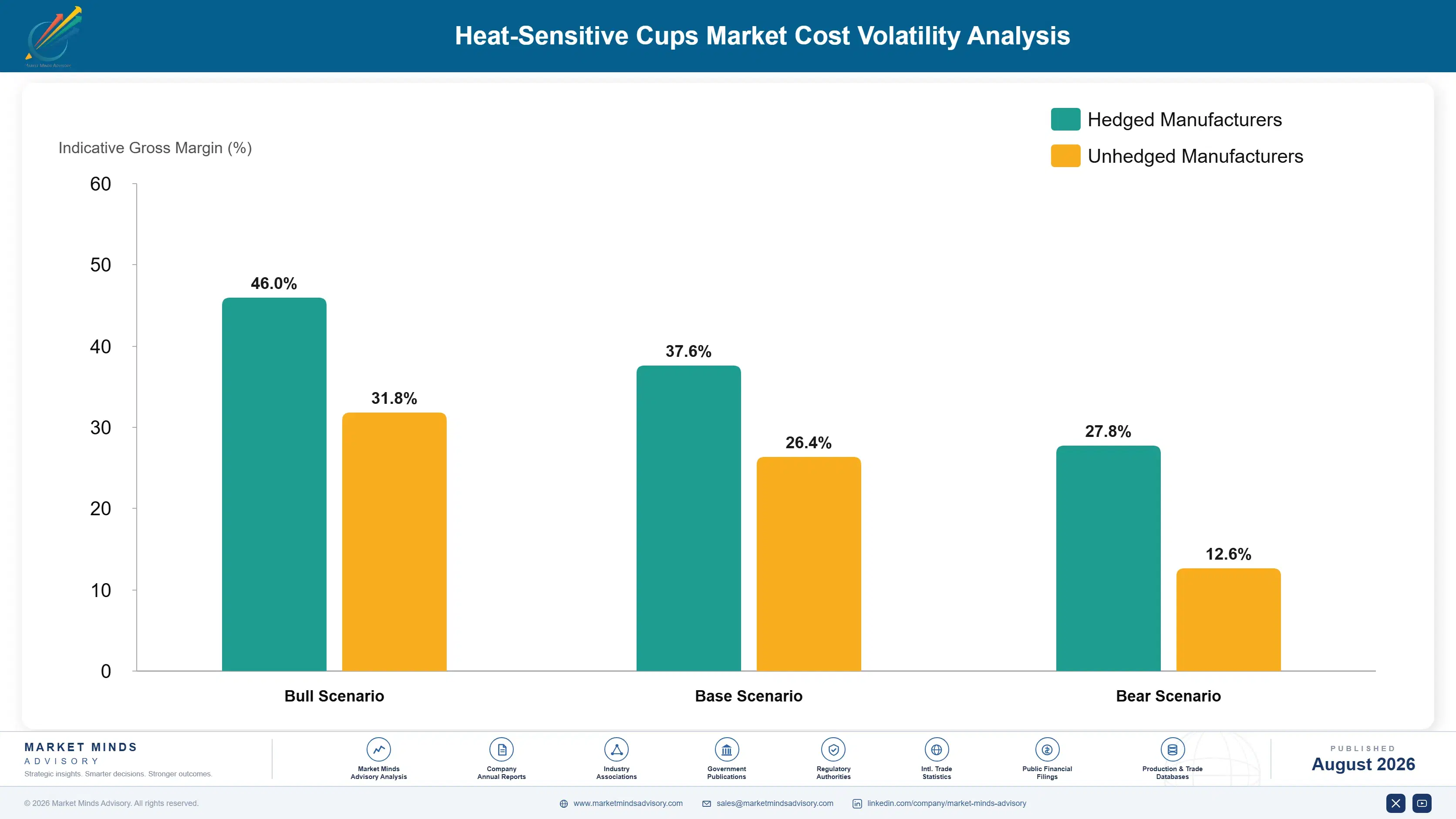
Paperboard and Thermochromic Ink Exposure

Paperboard and thermochromic ink together represent roughly 38% of cost of goods sold for a typical heat-sensitive cup, sourced predominantly from pulp and paperboard producers concentrated in North America, Scandinavia, and East Asia, with specialty thermochromic pigments sourced from a smaller number of qualified chemical suppliers holding proprietary formulation expertise built over many years of testing.
The 2021 to 2022 global pulp and paperboard price surge, driven by mill capacity constraints and rising energy costs, pushed cup substrate prices meaningfully higher across most major producing regions, with several printers reporting margin compression in company annual reports covering that period. The International Energy Agency's forest products supply chain analysis of that period noted the disproportionate impact on downstream packaging converters reliant on spot paperboard purchasing rather than long-term supply contracts.

Smaller printers without long-term paperboard supply agreements or direct mill relationships bear considerably more exposure to price swings than the largest players, who can negotiate volume discounts and secure priority allocation during shortages. This dynamic reinforces the advantage already held by the leading printers, since a paperboard shortage can delay a smaller competitor's production while larger players continue fulfilling promotional orders on schedule and protecting brand relationships.
heat-sensitive-cups-market-cost-volatility-analysis-1787308141178

Long-Term Paperboard Supply Agreements

Larger printers are moving from spot paperboard purchasing to multi-year supply agreements with mill producers directly, trading some pricing flexibility for supply certainty and predictable input costs across budget planning cycles that stretch several years into the future for major accounts, product lines, campaign types, and seasonal calendars across most regions served worldwide today and beyond.

Thermochromic Pigment Dual-Sourcing Strategy

Printers are increasingly qualifying second thermochromic pigment suppliers to reduce dependence on any single source, a step that adds qualification cost upfront but meaningfully reduces disruption risk during future shortages across their promotional print production lines, campaign schedules, product roadmaps, account commitments, seasonal calendars, regional contract terms, pricing structures, vendor relationships, and quality standards.

Feedstock Cost Pass-Through Contract Clauses

Printers are increasingly negotiating feedstock cost pass-through clauses into new promotional print contracts, allowing periodic price adjustments tied to published paperboard index benchmarks rather than absorbing volatility entirely within fixed campaign pricing agreed upon months in advance each budget cycle, renewal period, account review, contract negotiation cycle, pricing update, and every vendor discussion round.

Portfolio Architecture for Margin Defence

The market organizes into three tiers by print technology and margin profile. Volume-tier standard single-color-change cups cover the broadest brand base, sold largely on price through established printer relationships built over years of steady account service and campaign delivery. Premium-tier custom character-licensed and cold-activated cups command meaningfully higher prices tied to visual complexity and campaign exclusivity that brand owners increasingly value over sticker price alone.
Gross margins widen considerably moving up the tiers, since interactive and mono-material formats carry disproportionate pricing power relative to their incremental manufacturing cost, while standard cups compete primarily on price against a growing field of regional printers entering the value tier from multiple geographies. Brand owners rarely downgrade cup sophistication once campaign engagement or compliance benefits have been realized in marketing performance data and analytics.

High-value margin pools concentrate in interactive print cups bundled with engagement platform licensing, where recurring software revenue carries substantially wider margin than the underlying print order that first brought the brand account onto the printer's platform in the first place. This dynamic is reshaping how printers prioritize account investment across their commercial and sales teams.

Volume / Commodity-Adjacent Tier

Standard single-color-change cups sold largely on price through established printer relationships, competing primarily on unit cost against a growing field of regional manufacturers with limited feature differentiation between competing bids.
Gross Margin: 12-20%

Premium / Certified Tier

Custom character-licensed and cold-activated cups carrying stronger visual complexity and campaign exclusivity credentials, commanding meaningfully wider margins than standard analog equivalents while requiring greater creative investment, design coordination, and licensing effort.
Gross Margin: 24-32%

Sustainability / Regulatory / Next-Generation Tier

Recyclable mono-material and smart interactive print cups representing the newest category, commanding the highest margins in the market given their compliance and digital engagement advantage over legacy formats currently in use.
Gross Margin: 34-42%
heat-sensitive-cups-market-portfolio-architecture-1787308142231

High-value Sub-segments and Strategic Watch-out

Interactive Print Cups With Engagement Licensing

Interactive print cups paired with engagement platform licensing combine the category's fastest growth with its widest margins, drawing concentrated printer investment as brand digital marketing strategy increasingly requires this capability across promotional programs worldwide, every campaign type, quick-service format, consumer touchpoint, and loyalty tier tracked.
Gross Margin: 36-44%

Recyclable Mono-Material Thermochromic Cups

Recyclable mono-material cups deliver strong unit growth on the back of packaging waste regulation, though margins sit a tier below fully interactive designs, supported by broadening adoption across most major quick-service promotional programs and campaigns nationwide, internationally, and across every consumer segment and price point.
Gross Margin: 30-38%

Standard Single-Color-Change Cups

Standard single-color-change cups remain the category's volume backbone across established printer relationships worldwide, competing on price that leaves thin margins and very limited room for feature differentiation as regional competition intensifies across most geographies, price tiers, campaign categories, product formats, and franchise networks currently tracked.
Gross Margin: 10-18%

Legacy Multi-Layer Non-Recyclable Cup Formats

Legacy multi-layer non-recyclable cup formats still in active production warrant monitoring as packaging waste regulation continues tightening, a dynamic that could compress this once-standard installed base faster than smaller printers currently plan for in their own conversion strategies, budget cycles, product roadmaps, and vendor commitments.
Gross Margin: 12-18%

Campaign Cycles and Brand Loyalty

Printers generate recurring revenue through multi-year promotional calendar agreements far more than through any single campaign order, since a brand owner, once satisfied with a printer's ink formulation reliability and creative execution, typically continues that relationship across successive seasonal campaigns rather than reopening the print relationship to competitive bidding each promotional cycle, budget review, marketing calendar refresh, and every new creative pitch.
Adoption depth varies considerably by end-use vertical. Large national quick-service chains adopt interactive and mono-material formats fastest and often serve as reference accounts printers use to influence broader industry specification standards, while smaller regional chains typically wait for cost parity before committing to full interactive print conversion at meaningful volume across their campaign calendars, seasonal budgets, and marketing plans.

Buyer profiles are shifting generationally as younger brand marketing managers who trained during the digital-engagement-first era show far greater comfort specifying interactive and data-driven cup formats than an older cohort that historically defaulted to novelty color-change effects before considering digital integration at all. This generational shift is accelerating purchasing decisions across marketing teams where younger staff increasingly hold budget authority and full creative sign-off.
heat-sensitive-cups-market-end-use-penetration-index-1787308143045

Positioning for the Interactive Print Shift

These are among the four positions where our research anticipates prominent divergence between winners and laggards over the coming forecast period. Each is grounded in the demand model, the regulatory perimeter, and the announced capacity pipeline.
01 / MONO-MATERIAL INK STRATEGY

Printers without mono-material capability will lose orders to faster movers

Mono-material cups command meaningfully higher pricing and brand loyalty than multi-layer formats, and printers without competitive mono-material ink capability risk losing consideration entirely as packaging waste regulation continues tightening across major markets. This gap is widening as more brand owners cite regulatory compliance as their primary specification driver, and that delay carries real commercial consequence for printers slow to build a competitive offering. Companies that close this gap early stand to capture disproportionate share of the fastest-growing segment before rankings solidify further.
02 / INTERACTIVE PRINT PLATFORM INVESTMENT

Engagement platforms will separate digital-first printers from the rest

Brand owners increasingly require proven engagement tracking before qualifying a new cup printer, and printers with established interactive print platform capability capture disproportionate share of this higher-margin segment simply by virtue of a shorter qualification timeline than newer entrants face in the market. Printers still building this validation capability increasingly lose consideration to competitors who can demonstrate a proven engagement track record, and that delay carries real commercial consequence as digital campaigns keep growing. That gap widens further with every new digital marketing requirement brand owners introduce.
03 / MULTI-YEAR CALENDAR INVESTMENT

Calendar agreements will bring predictability within reach for printers

Multi-year promotional calendar agreements represent a meaningful stability opportunity for both sides of the relationship, and printers offering them convert campaign-by-campaign uncertainty into both new adoption and incremental forecasting revenue across their account base and referral network. This opportunity is widening as more quick-service chains seek reliable seasonal supply partners, and delayed investment in calendar agreement capability carries real commercial cost across every account tier. Companies that build this capability early stand to capture disproportionate share of this underserved segment before rivals catch up.
04 / PAPERBOARD SUPPLY CHAIN DEPTH

Paperboard supply integration will separate margin leaders from exposed rivals

Long-term paperboard supply agreements and pigment dual-sourcing require capital and supplier relationships that few printers currently possess at scale, and companies with the deepest supply investment capture disproportionate order fulfillment share simply by being able to guarantee stable pricing through volatile periods that disrupt weaker rivals entirely. Printers still exposed to spot paperboard purchasing increasingly lose order consideration to competitors who can demonstrate reliable, predictable cost structures. That exposure gap widens further with every fresh feedstock price shock that hits the supply chain.

Engagement Snapshot From the Field

A live engagement with an industry participant carrying material or product regulatory and market exposure ahead of a defining policy shift, showing how our research translates into a defensible multi-year portfolio strategy.
MARKET MINDS ADVISORY · CLIENT ENGAGEMENT SUMMARY
Heat-Sensitive Cups Producer Strategic Portfolio Review and Transition Roadmap 2026·Investment Scenario on Heat-Sensitive Cups Exposure Evaluation 2025-26
CLIENT PROFILE
The client is a regional quick-service coffee and beverage chain operating 180 locations across the southeastern United States, serving both dine-in and drive-through customers with approximately $290 million in annual revenue (client-reported, unverified by MMA). The chain sought to modernize its seasonal promotional cup program ahead of the coming fiscal year and brand marketing calendar.
STRATEGIC CHALLENGE
The chain's existing thermochromic cup program used legacy multi-layer, non-recyclable formats, and leadership needed clear, defensible data on mono-material and interactive print conversion costs before committing fresh capital across its full seasonal promotional calendar and its upcoming brand marketing budget cycle for the entire coming fiscal year and beyond that.
MMA APPROACH
MMA benchmarked mono-material conversion costs and interactive print engagement data across three printers against the chain's current multi-layer baseline, incorporating campaign volume and seasonal calendar timing across the full location network and marketing budget. The analysis modeled projected outcomes over a two-year forward planning horizon under two brand engagement scenarios developed with the client's marketing team.
KEY FINDINGS
  1. Mono-material conversion costs ran meaningfully lower than the chain's existing multi-layer promotional cup program across every campaign category evaluated in the analysis.
  2. Interactive QR print integration was projected to lift app download conversion by roughly 22% among customers engaging with promotional cup campaigns directly.
  3. Three of the chain's four seasonal campaigns had sufficient promotional volume to justify dedicated interactive print investment rather than standard cup formats.
  4. A phased, campaign-by-campaign conversion sequenced carefully around the existing seasonal calendar minimized marketing disruption compared to converting all campaigns simultaneously at once.
CLIENT PROFILE
The client is a regional quick-service coffee and beverage chain operating 180 locations across the southeastern United States, serving both dine-in and drive-through customers with approximately $290 million in annual revenue (client-reported, unverified by MMA). The chain sought to modernize its seasonal promotional cup program ahead of the coming fiscal year and brand marketing calendar.
STRATEGIC CHALLENGE
The chain's existing thermochromic cup program used legacy multi-layer, non-recyclable formats, and leadership needed clear, defensible data on mono-material and interactive print conversion costs before committing fresh capital across its full seasonal promotional calendar and its upcoming brand marketing budget cycle for the entire coming fiscal year and beyond that.
MMA APPROACH
MMA benchmarked mono-material conversion costs and interactive print engagement data across three printers against the chain's current multi-layer baseline, incorporating campaign volume and seasonal calendar timing across the full location network and marketing budget. The analysis modeled projected outcomes over a two-year forward planning horizon under two brand engagement scenarios developed with the client's marketing team.
KEY FINDINGS
  1. Mono-material conversion costs ran meaningfully lower than the chain's existing multi-layer promotional cup program across every campaign category evaluated in the analysis.
  2. Interactive QR print integration was projected to lift app download conversion by roughly 22% among customers engaging with promotional cup campaigns directly.
  3. Three of the chain's four seasonal campaigns had sufficient promotional volume to justify dedicated interactive print investment rather than standard cup formats.
  4. A phased, campaign-by-campaign conversion sequenced carefully around the existing seasonal calendar minimized marketing disruption compared to converting all campaigns simultaneously at once.
RECOMMENDED STRATEGY
Phase 1: Phase 1 (Months 1-2): Complete a detailed printer evaluation and campaign-specific conversion cost determination across the full seasonal marketing calendar. Phase 2: Phase 2 (Months 3-8): Execute phased conversion starting with the chain's two highest-volume seasonal campaigns identified in the initial analysis. Phase 3: Phase 3 (Months 9-14): Complete conversion of remaining campaigns based on initial engagement data and marketing budget review cycles ahead.
OUTCOME
The chain selected a mono-material and interactive print conversion strategy across its full seasonal calendar, prioritizing its two highest-volume campaigns first. Projected annual marketing engagement value reached approximately $1.4 million (client-reported, unverified by MMA) against the prior legacy cup program baseline across the chain's full network.

Frequently Asked Questions

Foundational context covering the market sizes, CAGR, scope, country, region and competition that inform every finding below. This section is provided to cover basics and most often pre-purchase conversations, answered from the MMA Primary Research Dataset.

What is the current size of the Heat-Sensitive Cups Market?

The Heat-Sensitive Cups Market was valued at approximately $0.42 billion globally in 2025. This includes standard, multi-color, custom-licensed, and interactive print cup formats sold worldwide.

How large will the Heat-Sensitive Cups Market be by 2036?

The market is projected to reach approximately $0.93 billion by 2036, roughly 2.06 times its 2026 value. Growth is driven by mono-material conversion and interactive print adoption.

What is the CAGR for the Heat-Sensitive Cups Market 2026 to 2036?

The base case CAGR is 7.5% annually, with a bull case of 8.8% and a bear case of 6.2%. This reflects steady demand growth alongside accelerating regulatory-driven conversion.

Which segment is growing fastest?

Recyclable mono-material thermochromic cups are the fastest-growing segment, expanding at roughly 12.0% annually. Tightening packaging waste regulation is driving this conversion across most tracked markets.

Who are the major companies in the Heat-Sensitive Cups Market?

Leading companies include Berry Global, Huhtamaki, International Paper, Dart Container, and Genpak. Together these five leading printers hold roughly 44% of total global market revenue.

Which country is growing fastest?

India is the fastest-growing country, expanding at roughly 9.5% annually through 2036. This reflects rapidly expanding quick-service and cafe chain footprint across the entire country.

Report Segmentation Architecture

The full report scope spans multiple orthogonal segmentation dimensions, with cross-tabulated demand data provided for each dimension pair. Coverage extends further to regional breakdowns, trend trajectories, and the competitive detail needed to support segment-level decision-making.

By Print Technology and Construction

  • Standard Single-Color-Change Cups
  • Multi-Color Sequential Change Cups
  • Custom Character-Licensed Cups
  • Cold-Activated Cups
  • Recyclable Mono-Material Cups
  • Smart Interactive Print Cups

By End-Use Industry

  • Quick-Service Restaurant Chains
  • Cafe and Coffee Shop Chains
  • Convenience Store Beverage Programs
  • Event and Stadium Concessions

By Commercial Dimension

  • Direct Brand Owner Supply
  • Contract Printing and Fulfillment
  • Distributor and Wholesale Channel
  • Multi-Year Calendar Agreement

By Region

  • East Asia
  • North America
  • Western Europe
  • South Asia and Pacific
  • Latin America
  • Middle East and Africa
  • Eastern Europe

Scope, Methodology, and Coverage

Every figure in this report is reproducible from documented input assumptions. The scope below maps the historical period, the forecast horizon, the segmentation dimensions, and the countries covered, alongside the underlying primary and qualitative methodology.
Historical Period
2020 to 2025
Forecast Period
2026 to 2036
Base Year
2025 (USD billions; MMA Primary Research Dataset, August 2026)
Market Definition
The Heat-Sensitive Cups Market covers disposable and reusable drinking cups printed with thermochromic ink that changes color or reveals imagery in response to temperature, used primarily in quick-service restaurant and beverage promotional programs. It excludes standard unprinted cups, insulated double-wall cups without thermochromic coating, and reusable smart mugs with electronic temperature displays sold as separate categories.
Quantitative Units
USD billions (current prices); unit shipment volume where applicable
Segmentation Dimensions
By Print Technology and Construction; By End-Use Industry; By Commercial Dimension; By Region
Regions Covered
East Asia, North America, Western Europe, South Asia and Pacific, Latin America, Middle East and Africa, Eastern Europe
Countries Covered
USA, China, Germany, France, UK, Japan, South Korea, India, Australia, Canada, Brazil, Mexico, Indonesia, Vietnam, Thailand, Malaysia, UAE, Saudi Arabia, South Africa, Nigeria, Turkey, Poland, Netherlands, Italy, Spain, Sweden, Switzerland, Argentina, Colombia, Singapore, and additional markets relevant to this sector
Key Companies Profiled
Berry Global Group Inc, Huhtamaki Oyj, International Paper Company, Dart Container Corporation, Genpak LLC, Detmold Group, Benders Paper Cup Co Ltd, LBP Manufacturing LLC, Pactiv Evergreen Inc, WNA Comet, Vegware Ltd, Eco-Products Inc, Novolex Holdings LLC, Georgia-Pacific LLC, Huatian Packaging Co Ltd, Shandong Huanya Packaging Co Ltd, Chuk Cup Manufacturing Co Ltd, Dopla SpA, Solia Inc, Fuling Global Inc
Quantitative Methodology
Primary survey, n=3,800 respondents, Q4 2025, six countries; demand-side model with trade association cross-validation
Qualitative Methodology
47 expert interviews, Q4 2025; applied to validate demand model assumptions, identify emerging dynamics, and assess competitive positioning
Report Format
PDF and XLSX data workbook (Word format preview document)
Publisher
Market Minds Advisory
Report Code
MMA-2026-PAC-154
Published
August 2026
Contact
sales@marketmindsadvisory.com | www.marketmindsadvisory.com

Purchase the full Heat-Sensitive Cups Market Report (2026 to 2036).

The full report delivers detailed segmentation across all six print technology and construction categories, with country-level sizing for all thirty-one covered markets. It profiles the complete competitive landscape of all twenty companies named in this summary, including moat and risk analysis for the two leading printers. Multi-year forecast models are provided under base, bull, and bear scenarios. Primary survey data drawn from brand marketing executives, printer representatives, and quick-service procurement teams across six countries supports every major finding, and purchasers receive editable data files alongside the formatted report.
Mono-material regulatory deadline tracker by country
Interactive print engagement benchmark and cost model
Promotional calendar economics comparison calculator tool
Paperboard pricing comparison tracker updated quarterly
Printer production capacity database by region
Competitive benchmarking across key cup manufacturers

Built For The People Who Decide

From boardroom strategy to bench-side execution, this report is read cover-to-cover by leaders shaping the next decade of their industry, turning demand scenarios, market dynamics and valuation benchmarks into decisions.
CXOs/ Presidents/ VPs/ Managers
M&A and Corporate Development
Strategy Teams and R&D Heads
Procurement and Product Directors
Regulatory and Compliance Leaders
Investor Relations and Equity Analysts