Market Minds Advisory
Heat Seal Pouch Market

Heat Seal Pouch Market: Sealing Windows, Contamination Tolerance and the Recyclability Problem Nobody Solved Cleanly

Barrier, print and shape count for nothing if the seal leaks, and the shift to recyclable single-polymer structures has narrowed the sealing window at precisely the moment lines are running faster than ever.

Lead Analyst

Bilal Shaikh

Published

September 2026

Make Smarter Decisions with Customized Research Insights

Request a free sample report and evaluate market opportunities, growth trends, and competitive dynamics relevant to your business needs.

2025 MARKET VALUE$18.6BMarket Size 2025
2036 FORECAST VALUE$38.4BBase Case , 2026 to 2036
CAGR 2026 TO 20366.8 %Bull 8.0% / Bear 5.6%
INCREMENTAL OPPORTUNITY$18.5BNet 10- year value creation
EXPANSION MULTIPLE1.93x2036 value over 2026 base
Strategic Levers
M&A Pipeline
Regional Outlook
Country Rankings
Competitive Intelligence
Segmental Deep-dive
Call-Us : 91 93563 13602

Executive Snapshot and Market Trajectory

A pouch has exactly one job that cannot be compromised, and it is the seal. Everything else the converter argues about is secondary, because a package that leaks has failed completely regardless of how good its barrier film or its printing happened to be. Nothing else matters once it leaks.
Sterile barrier medical device pouches compound at 10.2%, exactly 1.50 times the market, because ISO 11607 requires the sealing process itself to be validated rather than the pouch alone. East Asia holds 30% of demand, reflecting food processing volume and a medical device manufacturing base that has grown faster than any other region over the past decade. Device output has risen faster there than anywhere else. Food processing volume sets the regional baseline beneath that.
The top five converters hold 27%, which is fragmented even by flexible packaging standards. Sealant resin selection and sealing window width decide who can supply a fast line reliably, and that capability sits with film formulation rather than with converting scale. Recyclable structures have made the sealing problem considerably harder, and converters that pass purchased film through without solving it are losing conversions rather than winning them.
Market Definition
The market covers flexible pouches supplied unsealed to packers and closed by a heat sealing operation, spanning three-side-seal and pillow formats, stand-up pouches, vacuum and skin pack pouches, retort and sterilisable food pouches, sterile barrier medical device pouches, and peelable or reclosable constructions. Pre-formed rigid containers, form-fill-seal rollstock not converted into pouches, closures and sealing equipment are excluded.
Base Year Value
$18.6B in 2025 (MMA Primary Research Dataset, August 2026)
Forecast Period
2026 to 2036, eleven discrete annual values
CAGR
6.8% base case. Bull 8.0%. Bear 5.6%.
Fastest Growth Segment
Sterile Barrier Medical Device Pouches: 10.2% CAGR
Fastest Growth Country
India: 9.6% CAGR
Fastest Growth Region
South Asia and Pacific: 8.8% CAGR
Largest Region
East Asia: 30% of 2025 global value
Market Leaders
Amcor, Sealed Air, Berry Global, Mondi, Constantia Flexibles. Source: MMA Analysis based on company annual reports.
Primary Survey
n=3,800 procurement and R&D decision-makers, Q4 2025, six countries
Methodology
Demand-side build-up, cross-validated against public data, 47 expert interviews

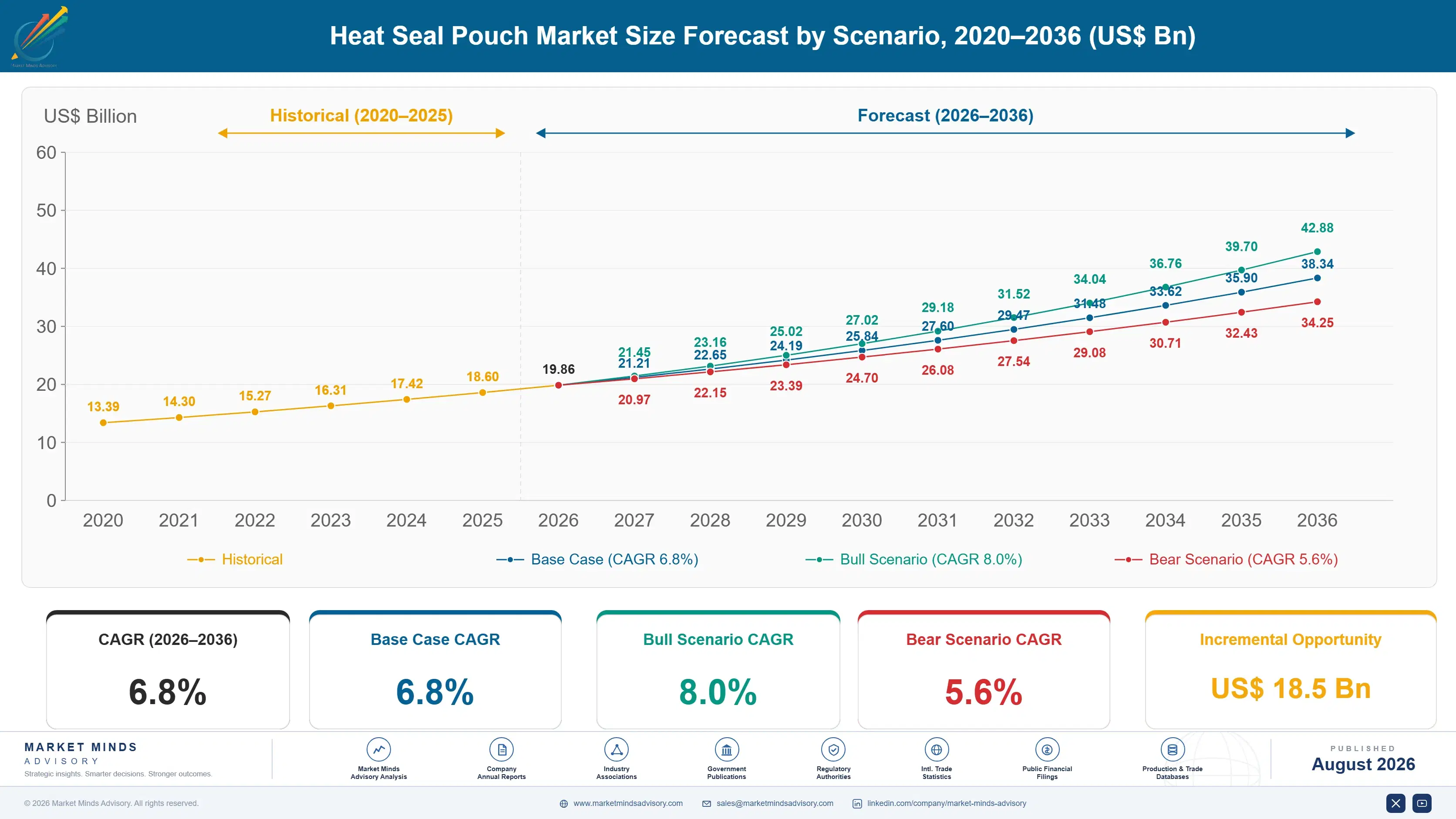
Heat Seal Pouch Market Forecast Scenarios

heat-seal-pouch-market-size-forecast-scenario-1787307923189
Growth ran at an implied 5.8% across 2020 to 2025 and the composition shifted markedly. Retail food packaging surged through 2020 and 2021 while food service volumes collapsed, then medical device manufacturing expanded strongly from 2022 as elective procedure backlogs cleared, and recyclability requirements began reshaping film specification across Europe from the same point. The mix shifted more than the total did.
The base case at 6.8% rests on three mechanisms. Medical device output keeps rising and every sterile device requires a validated barrier pouch, which is the most demanding and best-paid application in the category. Retort and shelf-stable formats continue taking volume from cans and jars on weight and convenience grounds. And recyclable mono-material structures command premiums while being genuinely harder to seal reliably. All three mechanisms operate independently of one another.
The bull case at 8.0% assumes recyclable structures reach performance parity faster than expected, letting brands convert whole portfolios rather than trialling single lines. The bear case at 5.6% follows from resin cost volatility and continued lightweighting compressing value per pouch, alongside reuse mandates under the European Packaging and Packaging Waste Regulation reaching further into single-use flexible formats. Neither scenario turns on converting cost.

Everything Depends on Two Hundred Milliseconds

A packer's sealing jaws close for around 220 milliseconds. In that time the sealant layers must reach temperature, flow together, and develop enough strength while still hot to survive the package dropping away from the jaws. Get the temperature wrong by a few degrees in either direction and the result is a seal that looks perfect and fails in distribution, which accounts for 71% of all pouch defects.
TOP FIVE CONCENTRATION27%Combined share held by the five largest global converters
SEALING WINDOW WIDTH22 degrees CelsiusTemperature range delivering acceptable seals on multilayer structures
MONO-MATERIAL WINDOW WIDTH9 degrees CelsiusEquivalent range on recyclable single-polymer pouch structures today
SEAL-RELATED DEFECT SHARE71% of failuresProportion of pouch defects originating at the seal itself
RESIN COST SHARE53% of COGSPolymer film inputs as proportion of total conversion cost
LINE DWELL TIME220 millisecondsTypical contact duration available on a modern filling line
The sealing window is what makes that manageable. A conventional multilayer structure gives operators roughly 22 degrees of temperature latitude, which absorbs the variation any real production line generates. Recyclable mono-material constructions cut that to about nine degrees, because a polyethylene sealant and a polyethylene substrate melt at uncomfortably similar temperatures, and that is the central unsolved problem of recyclable flexible packaging.
Contamination makes it worse. Powder, grease or liquid caught in the seal area is the most common real-world failure cause, and no amount of process control eliminates it on a line filling soup or ground coffee. Sealant chemistries that seal through contamination exist and cost more, and converters that understand which applications genuinely need them hold a real commercial advantage.
"Every packaging engineer I meet wants to talk about barrier and recyclability, and every plant manager wants to talk about why the seals failed on Tuesday. Those are the same conversation, and almost nobody in the industry runs them together in the same room."
Director, Flexible Packaging and Converting Technology Practice · MMA Flexible P

Market Trends

Recyclable Mono-Material Structures Halve the Sealing Window

European Packaging and Packaging Waste Regulation recyclability requirements are pushing brands toward single-polymer polyethylene and polypropylene pouch constructions. The technical difficulty is unavoidable: when sealant and substrate are the same polymer family they melt at similar temperatures, so the window narrows from roughly 22 degrees to about nine. Machine-direction oriented films and heat-resistant coated outer layers widen it partially at added cost. Lines running near their limits produce more seal defects on these structures, and converters supplying them without addressing the window generate complaints rather than conversions. Trials stall rather than fail outright.
Market Impact: Medical work at 14% of revenue
Sterile Barrier Validation Shifts Value Toward Process Support

ISO 11607 requires the sterile barrier system and the sealing process to be validated together, so a medical device manufacturer cannot simply buy a compliant pouch and seal it however it likes. Converters supplying validation protocols, seal strength data across the process window and support during installation qualification become part of the customer's regulatory file. That work compounds at 10.2% against a market at 6.8%, and it is genuinely difficult to displace afterwards because revalidation costs the customer far more than any price difference. Price alone rarely reopens a validated position.
Market Impact: Retort formats growing at 8.6%

Market Opportunities and Growth Drivers

Medical Device Output Requires a Validated Pouch for Every Unit

Every terminally sterilised medical device ships inside a sterile barrier system, and device output has risen steadily as elective procedure backlogs cleared and manufacturing capacity expanded across Asia, Europe and North America. These pouches use porous Tyvek or medical-grade paper on one face to permit ethylene oxide or steam penetration, with a peelable seal that opens without generating fibres in a sterile field. Roughly 14% of category revenue now comes from medical applications, at unit values several times food equivalents. Validation support is expected alongside the pouch. Unit values run several times food equivalents.
Market Impact: Seals causing 71% of defects

Retort Pouches Take Shelf-Stable Volume From Cans and Jars

A retort pouch reaches sterilisation temperature far faster than a can because the food layer is thin, which means less thermal damage and better retained texture and colour. It also weighs a fraction as much in distribution and needs no can opener. Adoption has been strongest in ready meals, pet food, soups and infant nutrition. The seal must survive 121 degrees Celsius under pressure for extended periods without delaminating, which narrows the field of converters able to supply the format credibly. Documented cycle evidence is what gets a converter quoted.
Market Impact: Resin at 53% of conversion cost

Market Restraints and Challenges

Seal Contamination Causes Failures Process Control Cannot Prevent

Product caught in the seal area is the most common real-world failure cause, and it is unavoidable on lines filling powders, granulates or anything with fat content. The root cause is mechanical rather than a process discipline problem: product moves during filling and some of it reaches the seal zone regardless of guarding. Seal-through-contamination sealant chemistries exist and cost meaningfully more. Converters mitigate by matching resin selection to the actual filling application rather than the specification sheet, which requires understanding the customer's line. Specification sheets rarely capture what happens during filling.
Market Impact: Window narrowing to 9 degrees

Resin Pass-Through Leaves Little Genuine Conversion Margin

Polymer film accounts for 53% of cost of goods, so most of what appears as revenue in this business is material moving through at cost. The root cause is that pouch conversion is mechanically straightforward once tooling exists, and there are many converters. Buyers negotiate against a resin index and treat conversion as the only variable. Converters mitigate by shifting mix toward medical, retort and contamination-tolerant applications where technical qualification rather than conversion cost sets the price. Technical qualification rather than conversion cost is the only durable escape from index-based negotiation.
Market Impact: Validated supply compounding at 10.
3 additional market trends, 4 additional growth drivers, and 2 additional restraints and challenges are covered in the full report. Contact sales@marketmindsadvisory.com to access the complete intelligence.

Segment CAGR and Growth Architecture

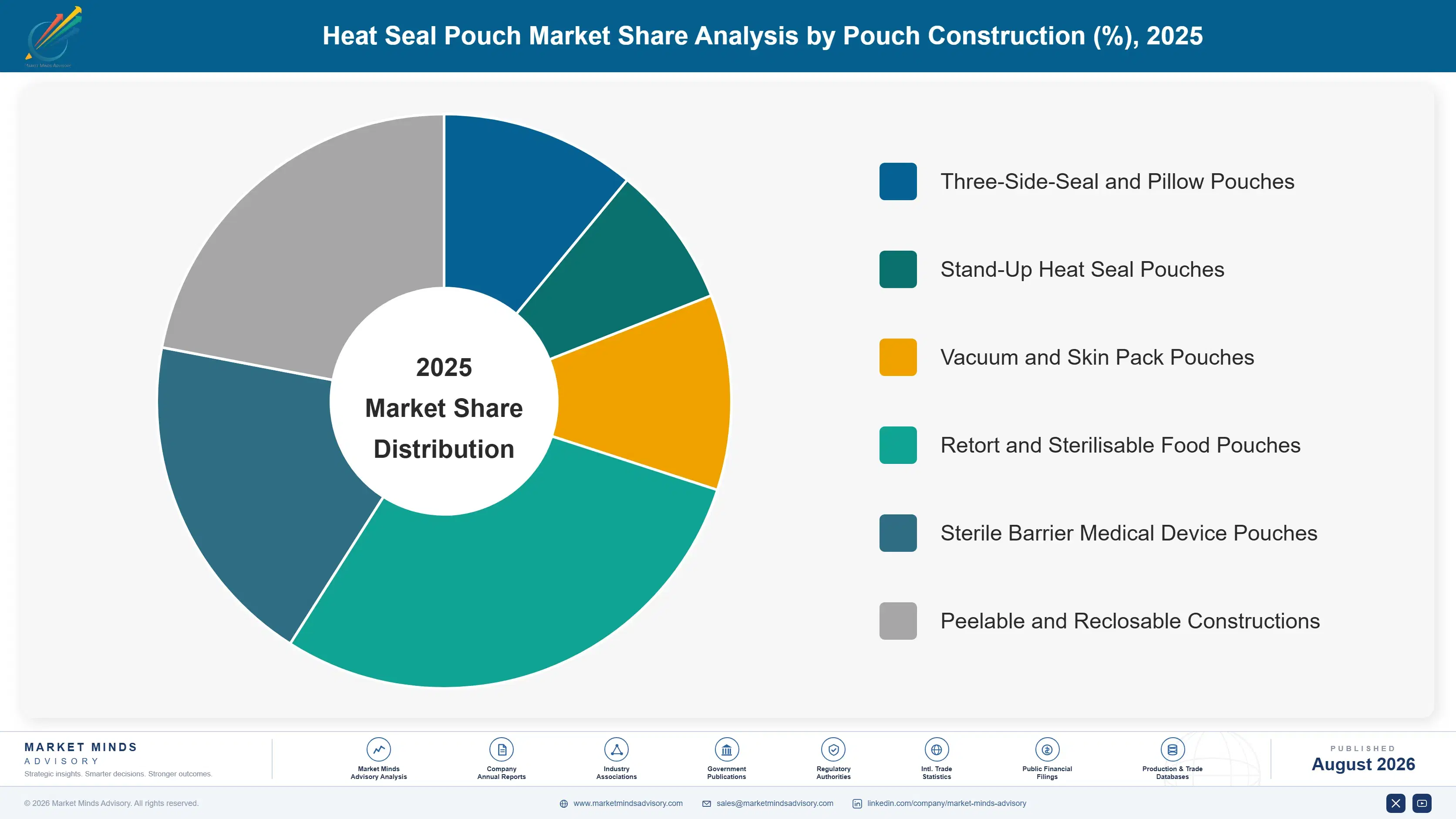
Segmentation follows pouch construction and application, because the seal requirement differs completely between them. A peelable sterile barrier seal, a retort seal surviving pressurised sterilisation and a standard food pouch seal are three distinct engineering problems using three different resin systems and qualification routes. No converter is automatically credible across all three of them.
heat-seal-pouch-market-market-share-analysis-1787307923724

Sterile Barrier Medical Device Pouches

Sterile barrier pouches compound at 10.2%, exactly 1.50 times the market rate, and they are the most technically demanding format in the category. One face must be porous, typically Tyvek or medical-grade paper, so ethylene oxide or steam can reach the device, and the seal must peel cleanly without shedding fibres into a sterile field. ISO 11607 requires the sealing process to be validated alongside the pouch itself, which pulls the converter into the customer's regulatory documentation. That involvement is the commercial point: revalidating a new supplier costs a device manufacturer far more than any plausible price saving, so qualified positions persist for the product's entire lifecycle. Unit values run several times food equivalents.
CAGR 10.2%

Retort and Sterilisable Food Pouches

Retort pouches grow at 8.6% by taking shelf-stable volume that cans and glass jars held for a century. The thin food layer reaches sterilisation temperature quickly, so texture, colour and nutrient retention are better than canning delivers, and the empty package weighs a fraction as much in distribution. The engineering demand sits in the seal: it must hold at 121 degrees Celsius under pressure for extended periods without delaminating or losing strength, and cast polypropylene sealants with the right additive package are what make that possible. Ready meals, pet food, soups and infant nutrition have adopted fastest. Converters unable to demonstrate retort seal performance simply do not get quoted. Evidence takes months to build.
CAGR 8.6%
Full segment breakdown across 6 segments available in the complete report.

Regional Architecture and Country Demand Map

Demand follows packing and filling capacity rather than consumption, since a pouch is sealed where the product is filled. Food processing volume sets the baseline while medical device manufacturing determines where the highest-value work concentrates within each region. Filling capacity rather than consumption is the map worth reading here.

East Asia

East Asia holds 30% of global demand, the largest regional share, on food processing volume that no other region approaches. Chinese packaged food, snack and ready meal production consumes pouches at enormous scale, and domestic converters serve most of it at delivered costs international suppliers cannot approach. The faster-growing element is medical: Chinese and Korean medical device manufacturing has expanded substantially, and every terminally sterilised device requires a validated sterile barrier pouch. Japanese retort adoption is the most advanced anywhere, with shelf-stable rice, curry and soup pouches occupying supermarket space that cans hold elsewhere. Regional growth of 7.8% reflects both food volume expansion and a genuine shift toward higher-specification formats.
Share: 30% | CAGR: 7.8% (2026 to 2036)

South Asia and Pacific

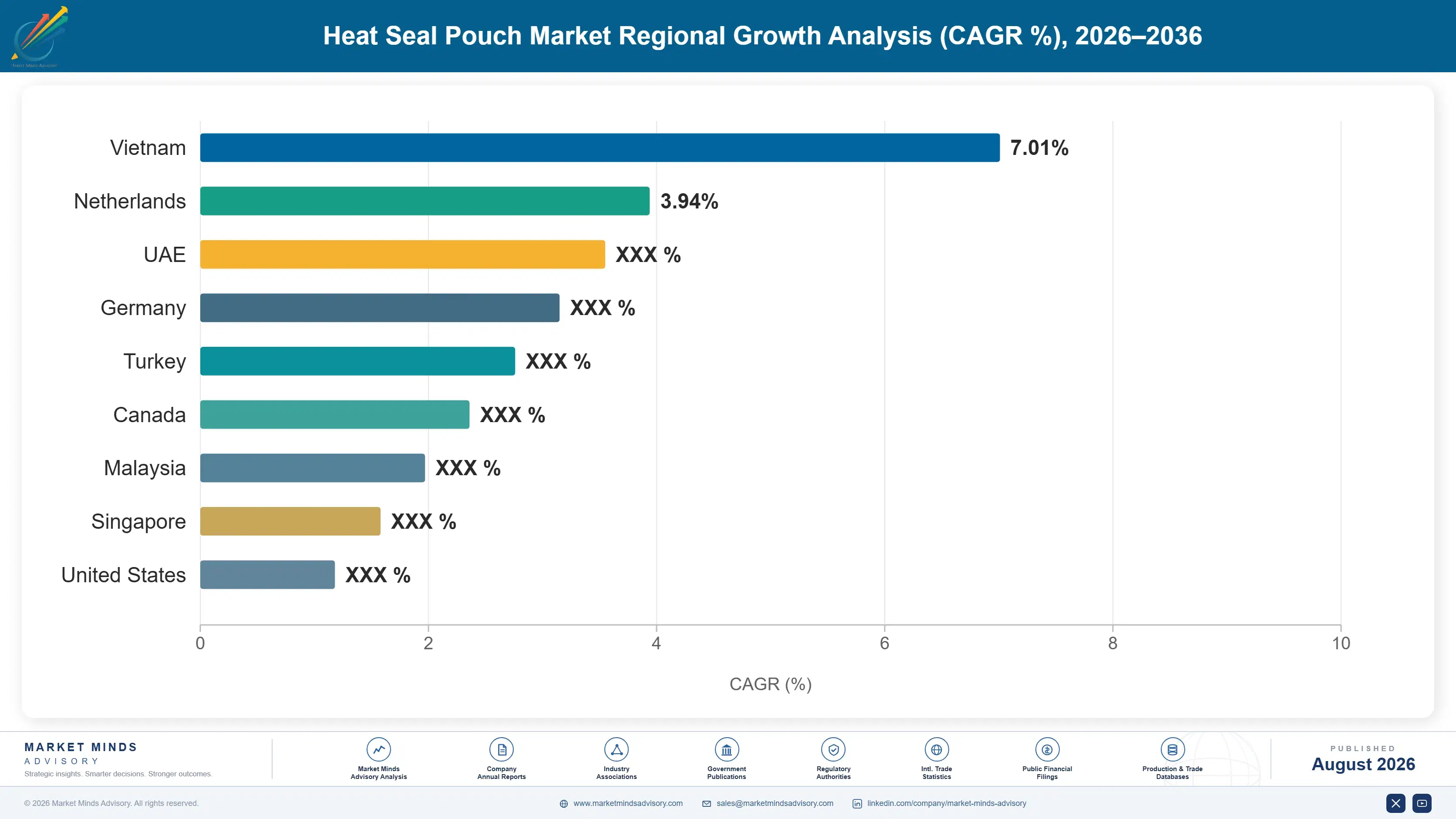
The fastest growing region at 8.8%, with India compounding at 9.6%, South Asia and Pacific accounts for 12% of demand. Indian packaged food penetration continues rising steadily from a low base, and organised retail expansion into smaller cities brings sealed pouch formats into households that previously bought loose. Indian pharmaceutical and medical device manufacturing adds sterile barrier volume serving both domestic and export markets. Southeast Asian food processing, particularly across Thailand, Vietnam and Indonesia, has grown strongly and exports heavily. Australian demand is smaller and resembles Western European patterns. Price sensitivity across the region keeps most volume in basic three-side-seal formats rather than premium constructions. Basic three-side-seal formats still dominate the regional mix.
Share: 12% | CAGR: 8.8% (2026 to 2036)
Regional intelligence for 5 additional markets available in the complete report: North America, Western Europe, Latin America, Middle East and Africa, Eastern Europe. Contact sales@marketmindsadvisory.com.
heat-seal-pouch-market-country-cagr-analysis-1787307924249

Escaping the Resin Index Trap

With polymer at 53% of cost and conversion mechanically simple, most pouch business is negotiated against a resin index with the converter arguing over the remainder. The positions worth holding are those where a validation requirement, a sealing difficulty or a process failure gives the buyer something else to think about entirely. None of them is about conversion cost.

Embed Validation Support in Sterile Barrier Supply

ISO 11607 requires the sealing process to be validated alongside the pouch, so a converter supplying seal strength data across the process window, validation protocols and installation qualification support becomes part of the customer's regulatory file. Revalidating a replacement supplier costs a device manufacturer far more than any plausible price saving, which is why these positions persist for a product's full lifecycle. The segment compounds at 10.2% and carries gross margins roughly 16 to 24 points above food pouch work. The investment is regulatory and technical staff rather than converting capacity.
Market Impact: Validated supply carrying 16 to 24

Solve the Mono-Material Sealing Window Before Customers Fail

Recyclable single-polymer constructions cut the sealing window from roughly 22 degrees to about nine, and lines running near their limits produce seal defects as a direct result. Converters supplying mono-material film without addressing that generate complaints instead of conversions. Machine-direction oriented films and heat-resistant coated outers widen the window at added cost, and converters that can demonstrate a workable window on a customer's actual line win the conversion rather than the trial. Recyclable structures already price 18 to 27% above conventional equivalents. Laboratory results do not settle it. Trials stall on line conditions rather than on film quality.
Market Impact: Recyclable structures priced 18 to

Match Sealant Chemistry to the Actual Filling Line

Contamination in the seal area causes most real-world failures, and no guarding prevents it on lines filling powders, granulates or fatty products. Seal-through-contamination resins cost meaningfully more and are frequently specified where they are unnecessary, or omitted where they are essential. Converters that visit the line and select chemistry against what actually happens during filling reduce defect rates measurably. It also converts a transactional supply into a technical relationship. Seals cause 71% of all pouch defects, and cutting that rate is worth far more to a packer than any plausible movement on pouch price.
Market Impact: Seals now causing 71% of every pouc

Build Retort Seal Performance Evidence Ahead of Enquiries

Retort seals must survive 121 degrees Celsius under pressure for extended periods without delaminating, and buyers will not quote a converter unable to demonstrate that performance on their own product and cycle. The evidence takes months to generate across the relevant fill types and retort profiles. Converters holding it quote work others cannot, in a segment growing at 8.6% as ready meals, pet food and infant nutrition move off cans. Cast polypropylene sealant formulation and a documented test history are the requirements rather than any unusual converting equipment. Equipment is rarely the constraint here.
Market Impact: Retort segment compounding at 8.6%

Who Controls the Margin Pool

The five largest converters hold 27% of the market measured on pouch conversion revenue, the basis applied consistently through this section. Fragmentation is extreme because pouch conversion is mechanically straightforward once tooling exists, and regional converters compete effectively on delivered cost. Amcor and Sealed Air lead, both on technical capability rather than converting scale. Converting scale confers surprisingly little advantage. Technical capability rather than plant size separa
Competition operates on three dimensions. Sealant formulation capability decides which sealing windows and contamination tolerances a converter can offer. Regulatory and validation support decides participation in sterile barrier work where the converter enters the customer's compliance file. And film extrusion integration decides whether a converter controls the structure or buys it from somebody who does. All three sit upstream of the converting line itself.

Two pressures are reshaping position. Recyclable mono-material conversion rewards converters with genuine film development capability and punishes those simply passing through purchased structures. Against that, regional converters in East Asia and South Asia compete hard on delivered cost in basic formats. Rankings will move toward whoever pairs film development with medical validation capability. Very few hold both capabilities today.
heat-seal-pouch-market-company-positioning-matrix-1787307924770

Competitive Moat and Risk Dimensions

AMCOR

Moat: Film development and medical depth

Amcor combines film structure development with a substantial healthcare packaging position, which matters because sterile barrier work requires both a validated structure and the regulatory support that puts the converter inside the customer's compliance documentation. Global converting reach also lets the company supply a multinational device manufacturer to one specification across several manufacturing sites.
AMCOR

Risk: Regional cost competition

Basic three-side-seal and pillow formats carry most of the category volume and face regional converters with materially lower delivered costs, particularly across Asia. Corporate overhead and quality systems sit above what a regional operation carries, and in a business where resin is 53% of cost that difference is visible in every quotation for standard work.
SEALED AIR

Moat: Vacuum and protein packaging systems

The company sells pouches alongside the sealing and vacuum equipment that closes them, which places it in the line design conversation rather than in a materials tender. That position matters most in protein and food service, where seal integrity under vacuum and through fat contamination is genuinely difficult, and where equipment and material are qualified together as a system.
SEALED AIR

Risk: Recyclable structure transition

Vacuum and skin pack structures rely on multilayer constructions that recyclability requirements are pressing against, and mono-material alternatives that hold vacuum and survive fat contact remain technically difficult. Converting that portfolio requires film development on a compressed timetable while competitors with broader polyethylene extrusion capability face a shorter path to the same specification.

Players Tracked

Prominent Players

Amcor
Sealed Air
Berry Global
Mondi
Constantia Flexibles

Other Key Players

Sonoco Products Company
ProAmpac
Winpak
Coveris
Wipak
Oliver Healthcare Packaging
Technipaq
Uflex
Huhtamaki
TC Transcontinental
Schur Flexibles
Glenroy
Printpack
American Packaging Corporation
Bischof und Klein

Recent Developments

MARCH 2025

Mono-material conversions expose sealing window limitations on fast lines

Brand owners converting to recyclable single-polymer pouch structures reported elevated seal defect rates on high-speed filling lines, tracing the cause to a narrowed process window rather than to film quality. These were technical findings from conversion trials rather than commercial developments, and they slowed several planned portfolio conversions.
Signal: Recyclability and line speed are pulling a
JULY 2025

Medical device manufacturers tighten sterile barrier supplier qualification

Device manufacturers extended supplier qualification requirements for sterile barrier systems to cover sealing process validation support alongside pouch specification, following regulatory scrutiny of packaging validation during inspections. These were customer procurement changes rather than any corporate transaction or regulatory rule. Qualification now covers process support rather than product specification alone.
Signal: The converter is being pulled into the cus
OCTOBER 2025

Retort pet food conversions accelerate away from metal cans

Pet food manufacturers expanded conversion from metal cans to retort pouches across further product ranges, citing distribution weight, shelf presentation and texture retention. This reflects category conversion rather than any acquisition or joint venture, and it favours converters holding documented retort seal performance evidence. Seal evidence decides who is quoted.
Signal: A century of canned shelf-stable format is

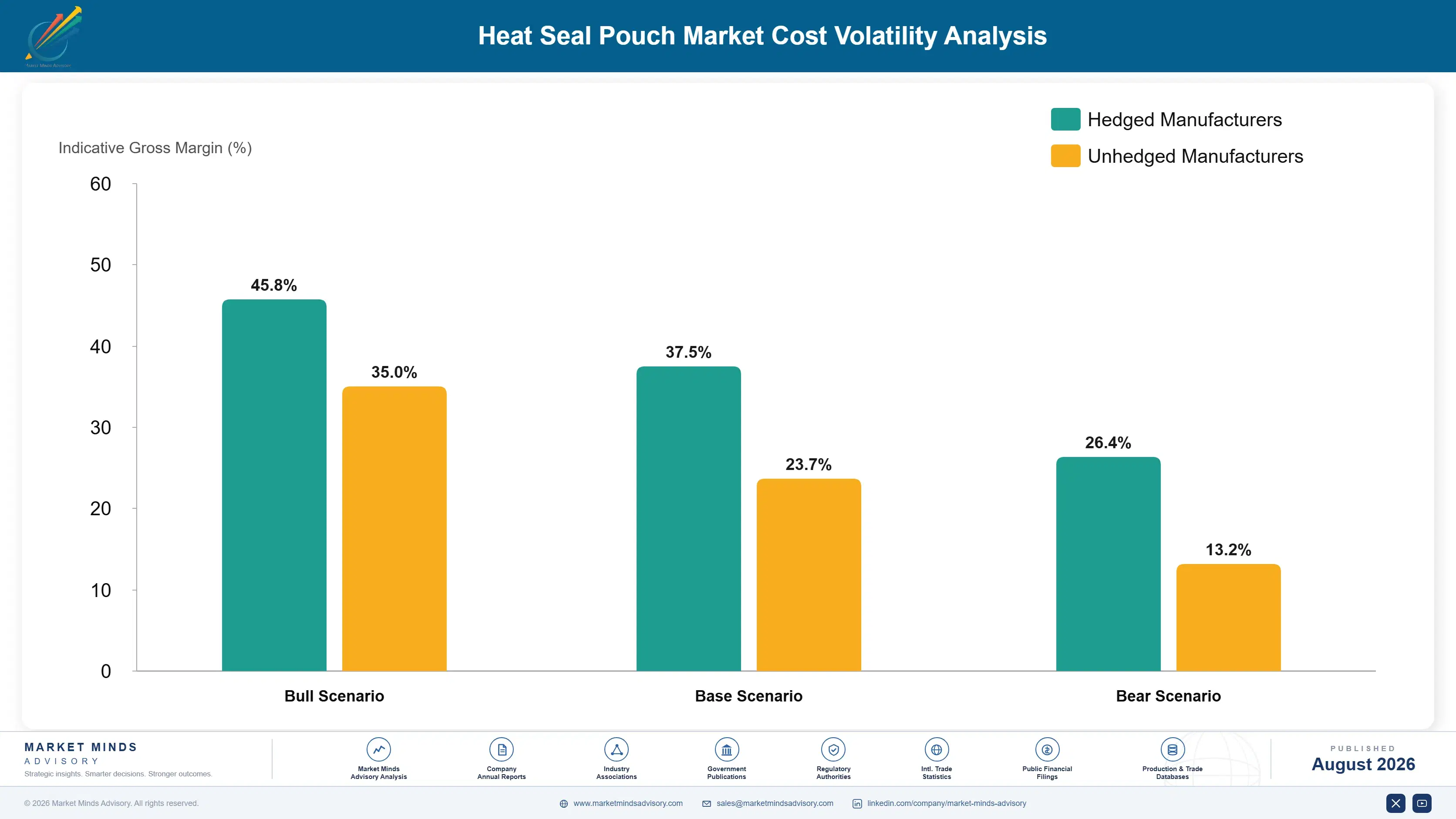
Polymer Above Everything Else

Polymer film accounts for roughly 53% of cost of goods, covering polyethylene, polypropylene, polyester and specialised sealant resins sourced from petrochemical producers and film extruders. Adhesives and coatings run a further 12%, with medical-grade porous substrates carrying disproportionate cost in sterile barrier work. Converting labour, tooling amortisation and quality systems make up the remainder, with validation support funded largely outside cost of goods.
Polymer pricing moved sharply through 2022 and 2023 as European energy disruption raised both feedstock and extrusion costs, and International Energy Agency reporting across that period documents the underlying movement. Speciality sealant resins tightened more than commodity grades because production capacity is narrower. Company annual reports covering flexible packaging segments disclose the resulting margin compression across several consecutive quarters and the pass-through delays involved. Recovery lagged by several quarters.

Exposure divides by contract structure and mix rather than by scale. Converters on resin index pass-through move most of the cost to the customer within weeks. Those quoting fixed annual pouch prices absorb it entirely for a year. The disadvantage falls hardest on mid-sized converters supplying basic formats, who lack the volume to negotiate indexation.
heat-seal-pouch-market-cost-volatility-analysis-1787307924966

Index pouch pricing to published polymer benchmarks

Indexing moves 53% of the cost base outside the converter's risk entirely, and large converters achieve it routinely while smaller ones frequently cannot. Where a customer resists formal indexation, shortening contract terms delivers much of the same protection with less negotiating friction, though it reduces the forward visibility both parties value in production planning.

Qualify second sources for speciality sealant resins

Seal-through-contamination and retort-grade sealant resins come from narrower production capacity than commodity polyethylene, and single sourcing became a genuine supply risk through the 2022 disruption. Qualifying an alternative grade costs one validation cycle per structure and removes that exposure. Medical structures require the most work here and carry the greatest consequence if supply fails.

Shift mix toward technically qualified applications

Sterile barrier, retort and contamination-tolerant work is priced against qualification and demonstrated performance rather than against a resin index plus conversion. Material cost forms a smaller share of a considerably higher unit value in those segments, so the same mix shift already justified on growth grounds also reduces input cost exposure materially. The benefit arrives as a side effect.

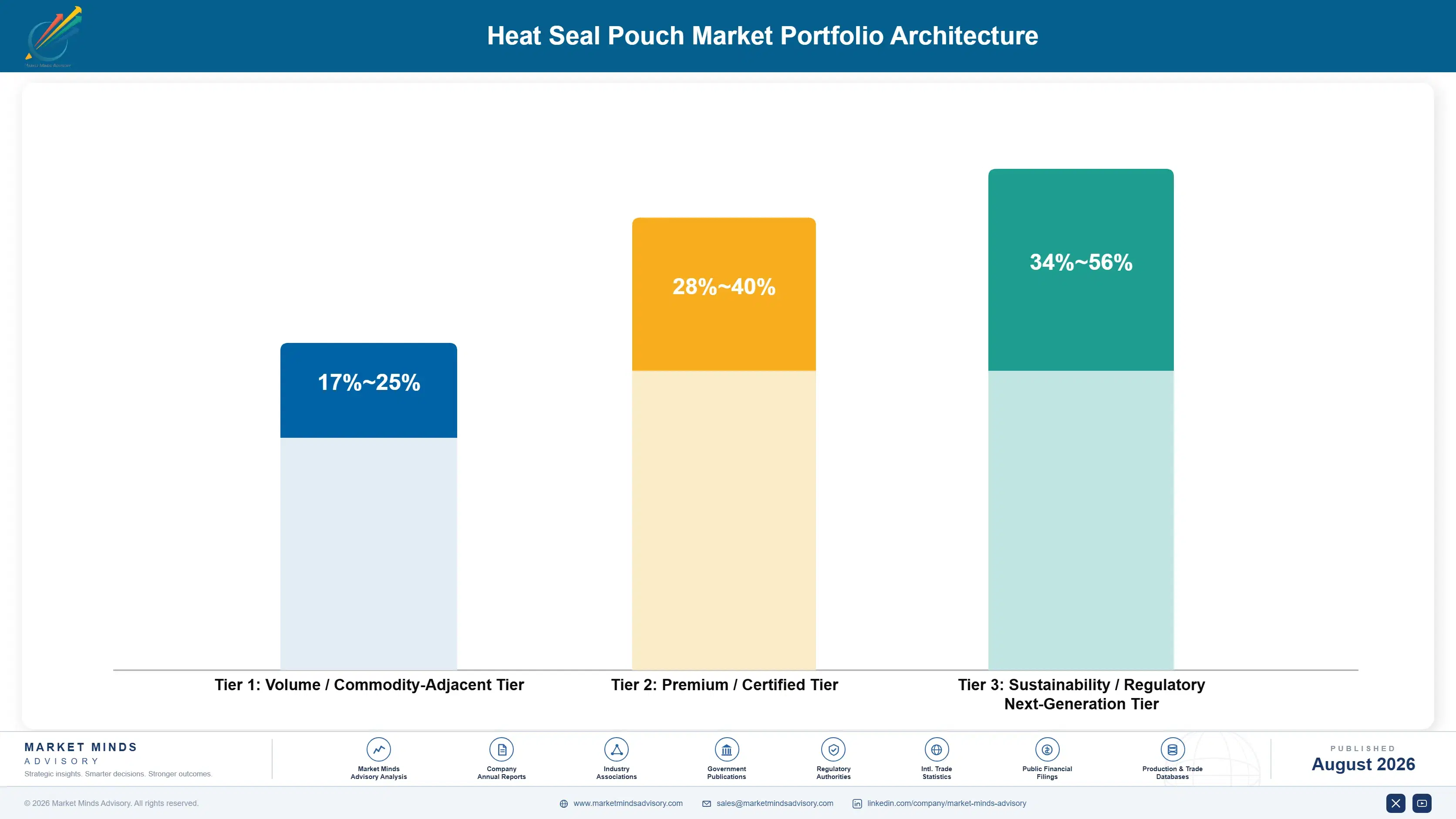
Portfolio Architecture for Margin Defence

The portfolio separates on whether the seal is difficult. Standard three-side-seal and pillow pouches on conventional structures are commodity conversion sold against a resin index, and regional converters compete hard for that work. Retort, vacuum and contamination-tolerant formats require sealant chemistry that not every converter holds. Sterile barrier work requires all of that plus regulatory documentation that enters the customer's compliance file. Seal difficulty draws the whole ladder.
The tension is that commodity formats fill the converting lines and carry the customer relationships from which technical work follows. A converter pursuing only medical and retort business finds its lines underutilised and loses accounts when a customer needs an ordinary snack pouch alongside its specialist formats. The successful operators run both and hold quite different margin expectations across them. Utilisation and margin are separate objectives here.

High-value pools concentrate where a regulation, a sterilisation cycle or a filling difficulty sets the specification. Sterile barrier pouches, retort formats and seal-through-contamination applications all qualify, and none of them is awarded on cost per thousand pouches alone. Technical evidence rather than price wins all three. None is awarded on cost per thousand.

Volume / Commodity-Adjacent Tier

Standard three-side-seal and pillow pouches on conventional multilayer structures for ambient dry goods. Sold against a resin index with conversion cost as the only negotiable variable, and regional converters compete effectively wherever freight and service permit.
Gross Margin: 17-25%

Premium / Certified Tier

Retort and sterilisable formats, vacuum and skin pack constructions, and seal-through-contamination applications requiring specific sealant chemistry and demonstrated performance evidence rather than simply a compliant specification sheet. Documented performance on the customer's own cycle is what gets a converter onto the bid list.
Gross Margin: 28-40%

Sustainability / Regulatory / Next-Generation Tier

Sterile barrier medical pouches with validation support, and recyclable mono-material structures with demonstrated sealing windows. The wide margin range reflects the gap between established medical positions and mono-material work still being proven on customer lines.
Gross Margin: 34-56%
heat-seal-pouch-market-portfolio-architecture-1787307925563

High-value Sub-segments and Strategic Watch-out

Sterile Barrier Medical Pouches

Compounding at 10.2% because ISO 11607 requires the sealing process to be validated alongside the pouch, which puts the converter inside the customer's regulatory file. Revalidating a replacement supplier costs far more than any plausible price saving, so positions persist for a full product lifecycle.
Gross Margin: 44-56%

Retort and Sterilisable Formats

Growing at 8.6% as ready meals, pet food and infant nutrition move off metal cans on weight and texture grounds. Seals must hold at 121 degrees Celsius under pressure, and converters without documented performance evidence on the relevant cycles never get quoted at all. Cans are losing this argument.
Gross Margin: 32-42%

Standard Three-Side-Seal Pouches

The volume core at 5.4%, negotiated against a resin index that leaves conversion as the only variable. Run for line utilisation and account access rather than margin, since a converter unable to supply ordinary formats loses the technical work alongside them. Lines have to be filled regardless.
Gross Margin: 17-25%

Recyclable Mono-Material Structures

The watch-out and the opportunity together. Structures price 18 to 27% above conventional equivalents but cut the sealing window from roughly 22 degrees to nine, so a converter supplying them without solving that generates complaints instead of conversions. Film development capability decides who wins. Passing film through is not enough.
Gross Margin: 26-52%

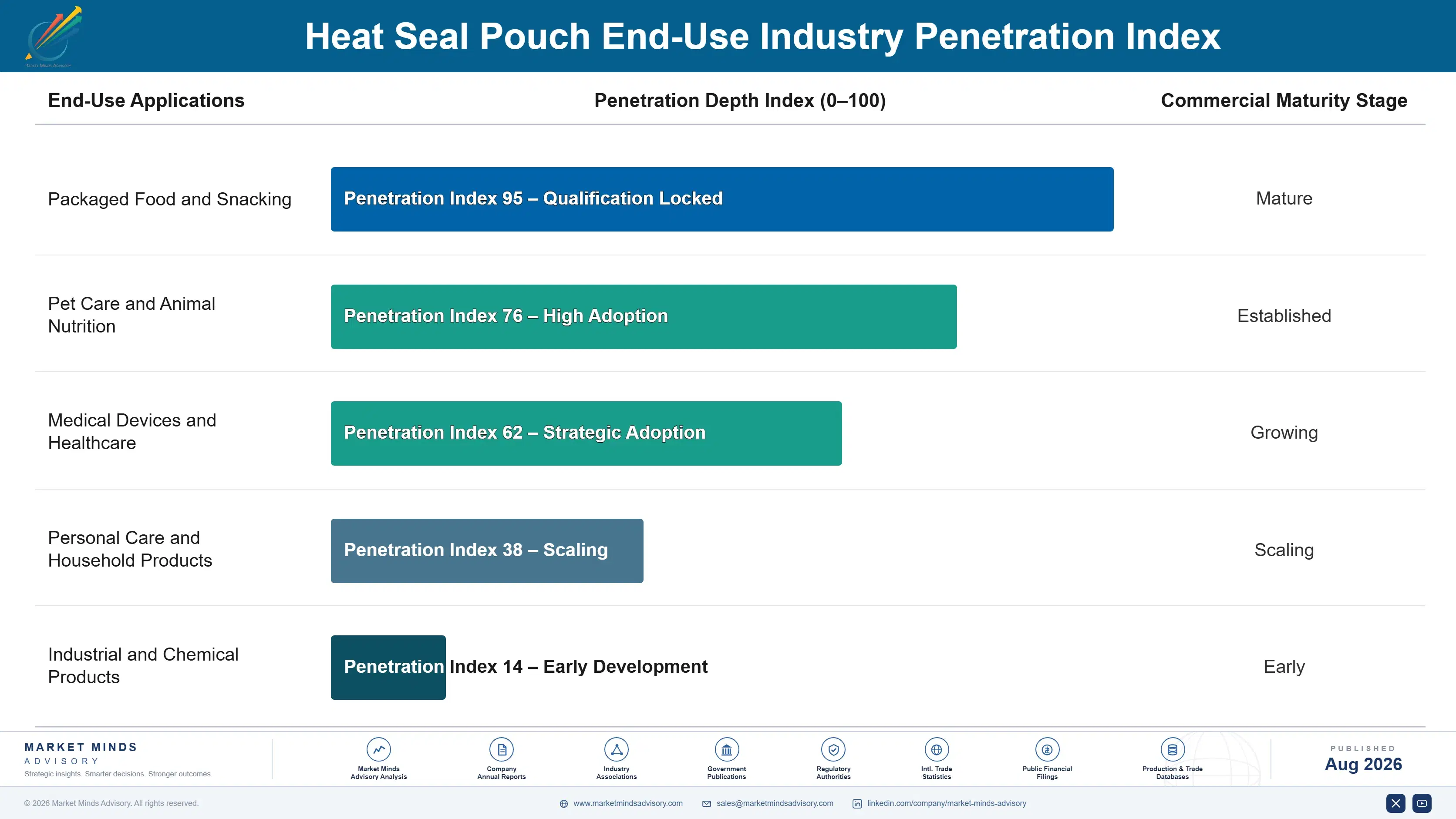
Qualification Outlives the Buyer

Recurring revenue here rests on qualification rather than contract. A pouch qualified on a customer's filling line, with sealing parameters established and validated, is not lightly replaced, because requalifying means re-establishing the process window and in medical applications rewriting part of a regulatory file. The switching cost sits with the customer rather than the converter, which is an unusually comfortable position for a supplier of a material that is 53% commodity polymer. The switc
Depth varies sharply by application. Medical device manufacturers buy deepest, involving the converter in validation and treating supplier change as a regulatory event. Retort food producers buy deeply on demonstrated seal performance across their specific cycles. Standard food packers buy on delivered price and retender routinely. Contract packers sit shallowest, switching whenever a resin index movement makes an alternative cheaper. Application demand rather than customer size sets depth.

The specifying population has widened uncomfortably. Pouch selection once sat with packaging engineering weighing barrier and cost. Now a sustainability function holds recyclability targets and an operations manager holds line efficiency, and those two participants frequently want incompatible things from the same specification. Reconciling them is now part of the sale.
heat-seal-pouch-market-end-use-penetration-index-1787307926546

Where Pouch Converters Hold Price

These are among the four positions where our research anticipates prominent divergence between winners and laggards over the coming forecast period. Each is grounded in the demand model, the regulatory perimeter, and the announced capacity pipeline.
01 / SEALING WINDOW ENGINEERING

Recyclability and line speed are pulling directly against each other

Recyclable mono-material constructions cut the usable sealing window from roughly 22 degrees to about nine, because the sealant and the substrate share a polymer family and melt at very similar temperatures. Lines running near their limits produce seal defects as a direct consequence, and seals already cause 71% of all pouch failures. Converters that demonstrate a workable window on a customer's own production line win the conversion outright, while those simply supplying compliant film generate complaints and stalled trials instead.
02 / REGULATORY FILE ENTRY

Validation support makes displacement a regulatory event, not a tender

ISO 11607 requires the sealing process and the sterile barrier system to be validated together, so a converter supplying seal strength data, validation protocols and qualification support becomes part of the device manufacturer's compliance documentation. Replacing that supplier means revalidating the process, which costs the manufacturer far more than any plausible price saving. The segment compounds at 10.2%, exactly 1.50 times the market, and carries margins 16 to 24 points above food work, funded by regulatory staff rather than by converting capacity.
03 / CONTAMINATION TOLERANCE MATCHING

Sell against what actually happens on the line, not the specification

Product caught in the seal area causes most real-world failures, and no amount of guarding prevents it on lines filling powders, granulates or fatty products. Seal-through-contamination resins cost more and are routinely specified where they are unnecessary, or omitted where they are essential, because nobody ever visited the line. Converters that select sealant chemistry against observed filling behaviour cut customer defect rates measurably, and that is worth considerably more to a packer than a percentage point on the pouch price.
04 / RESIN INDEX ESCAPE

Polymer at 53% of cost leaves nothing worth negotiating over

Pouch conversion is mechanically straightforward once the tooling exists, and buyers negotiate against a published resin index while treating conversion cost as the only genuine variable in the quotation. That arrangement leaves very little genuine margin in standard formats, regardless of how efficiently a converter runs its extrusion and laminating lines. The only durable escape available is a mix shift toward medical, retort and contamination-tolerant applications, where technical qualification rather than conversion cost sets the price a customer will accept.

Engagement Snapshot From the Field

A live engagement with an industry participant carrying material or product regulatory and market exposure ahead of a defining policy shift, showing how our research translates into a defensible multi-year portfolio strategy.
MARKET MINDS ADVISORY · CLIENT ENGAGEMENT SUMMARY
Heat Seal Pouch Producer Strategic Portfolio Review and Transition Roadmap 2026·Investment Scenario on Heat Seal Pouch Exposure Evaluation 2025-26
CLIENT PROFILE
A converter operating six extrusion and laminating lines across three plants with roughly EUR 420 million in revenue (client-reported, unverified by MMA), weighted heavily toward standard food pouches supplied to regional packers. Medical and retort work together represented under 11% of revenue (client-reported, unverified by MMA), despite the plants holding equipment capable of supporting both formats.
STRATEGIC CHALLENGE
Conversion margin on standard formats had fallen for four consecutive years under resin index pressure, and three mono-material conversion trials with major customers had stalled after seal defects appeared on their filling lines. Management proposed a cost reduction programme across extrusion. The technical director argued the failed trials, not the cost base, were the actual problem.
MMA APPROACH
MMA ran sealing window measurements on the client's mono-material structures across the actual line conditions of the three stalled customers rather than under laboratory conditions, then modelled the qualification requirements and margin economics of medical sterile barrier work against the client's existing equipment and quality systems. Resin indexation terms were benchmarked against competitor contracts.
KEY FINDINGS
  1. The client's mono-material structures delivered a nine degree sealing window under laboratory conditions and under six degrees on two of the three customer lines, which explained every stalled trial without any reference to film quality.
  2. Machine-direction oriented film capability existed on one of the six lines but had never been applied to the mono-material development work, because extrusion and application development reported to different functions entirely.
  3. Medical sterile barrier work required quality system additions the client could complete in under a year, and two existing food customers had device manufacturing divisions buying pouches from competitors.
  4. Conversion cost was already competitive with regional rivals, and the margin gap in lost standard tenders came from resin indexation terms rather than from any manufacturing disadvantage.
CLIENT PROFILE
A converter operating six extrusion and laminating lines across three plants with roughly EUR 420 million in revenue (client-reported, unverified by MMA), weighted heavily toward standard food pouches supplied to regional packers. Medical and retort work together represented under 11% of revenue (client-reported, unverified by MMA), despite the plants holding equipment capable of supporting both formats.
STRATEGIC CHALLENGE
Conversion margin on standard formats had fallen for four consecutive years under resin index pressure, and three mono-material conversion trials with major customers had stalled after seal defects appeared on their filling lines. Management proposed a cost reduction programme across extrusion. The technical director argued the failed trials, not the cost base, were the actual problem.
MMA APPROACH
MMA ran sealing window measurements on the client's mono-material structures across the actual line conditions of the three stalled customers rather than under laboratory conditions, then modelled the qualification requirements and margin economics of medical sterile barrier work against the client's existing equipment and quality systems. Resin indexation terms were benchmarked against competitor contracts.
KEY FINDINGS
  1. The client's mono-material structures delivered a nine degree sealing window under laboratory conditions and under six degrees on two of the three customer lines, which explained every stalled trial without any reference to film quality.
  2. Machine-direction oriented film capability existed on one of the six lines but had never been applied to the mono-material development work, because extrusion and application development reported to different functions entirely.
  3. Medical sterile barrier work required quality system additions the client could complete in under a year, and two existing food customers had device manufacturing divisions buying pouches from competitors.
  4. Conversion cost was already competitive with regional rivals, and the margin gap in lost standard tenders came from resin indexation terms rather than from any manufacturing disadvantage.
RECOMMENDED STRATEGY
Phase 1: Phase 1 (months 1 to 7): Apply machine-direction oriented capability to mono-material development and re-run the three stalled conversions on customer line conditions. Phase 2: Phase 2 (months 7 to 18): Complete quality system work for sterile barrier supply and approach the two existing customers with device manufacturing divisions. Phase 3: Phase 3 (months 18 to 30): Renegotiate standard format contracts onto resin indexation terms and reprice against demonstrated technical service.
OUTCOME
Two of the three mono-material conversions completed within nine months at prices roughly 22% above the conventional structures they replaced (client-reported, unverified by MMA). The first sterile barrier qualification was secured in month fourteen. Blended conversion margin improved by approximately four points with no reduction in the cost base (client-reported, unverified by MMA).

Frequently Asked Questions

Foundational context covering the market sizes, CAGR, scope, country, region and competition that inform every finding below. This section is provided to cover basics and most often pre-purchase conversations, answered from the MMA Primary Research Dataset.

What is the current size of the Heat Seal Pouch Market?

The global market was worth USD 18.6 billion in 2025, reaching USD 19.86 billion in 2026. East Asia holds the largest regional share at 30% of demand.

How large will the Heat Seal Pouch Market be by 2036?

MMA forecasts USD 38.35 billion by 2036, an expansion multiple of 1.93 times the 2026 base. That represents roughly USD 18.49 billion of incremental value.

What is the CAGR for the Heat Seal Pouch Market 2026 to 2036?

The base case compounds at 6.8% annually, with a bull case of 8.0% and a bear case of 5.6%. Historical growth from 2020 to 2025 ran at 5.8%.

Which segment is growing fastest?

Sterile barrier medical device pouches compound at 10.2%, exactly 1.50 times the market rate. ISO 11607 requires the sealing process to be validated alongside the pouch itself.

Who are the major companies in the Heat Seal Pouch Market?

Amcor, Sealed Air, Berry Global, Mondi and Constantia Flexibles hold a combined 27% of the market. Fragmentation is extreme because pouch conversion is mechanically straightforward once tooling exists.

Which country is growing fastest?

India compounds at 9.6%, ahead of every other national market. Packaged food penetration, organised retail expansion and pharmaceutical manufacturing growth all contribute substantially to that rate.

Report Segmentation Architecture

The full report scope spans multiple orthogonal segmentation dimensions, with cross-tabulated demand data provided for each dimension pair. Coverage extends further to regional breakdowns, trend trajectories, and the competitive detail needed to support segment-level decision-making.

By Pouch Construction

  • Three-Side-Seal and Pillow Pouches
  • Stand-Up Heat Seal Pouches
  • Vacuum and Skin Pack Pouches
  • Retort and Sterilisable Food Pouches
  • Sterile Barrier Medical Device Pouches
  • Peelable and Reclosable Constructions

By End-Use Industry

  • Packaged Food and Snacking
  • Pet Care and Animal Nutrition
  • Medical Devices and Healthcare
  • Personal Care and Household Products
  • Industrial and Chemical Products

By Commercial Dimension

  • Direct Brand Owner Supply
  • Contract Packer and Co-Packer Supply
  • Medical Device Manufacturer Qualified Supply
  • Distributor and Converter Trade Channel

By Region

  • North America
  • Western Europe
  • East Asia
  • South Asia and Pacific
  • Latin America
  • Middle East and Africa
  • Eastern Europe

Scope, Methodology, and Coverage

Every figure in this report is reproducible from documented input assumptions. The scope below maps the historical period, the forecast horizon, the segmentation dimensions, and the countries covered, alongside the underlying primary and qualitative methodology.
Historical Period
2020 to 2025
Forecast Period
2026 to 2036
Base Year
2025 (USD billions; MMA Primary Research Dataset, August 2026)
Market Definition
The market covers flexible pouches supplied unsealed to packers and closed by a heat sealing operation at the point of filling, spanning three-side-seal and pillow formats, stand-up pouches, vacuum and skin pack constructions, retort and sterilisable food pouches, sterile barrier medical device pouches, and peelable or reclosable constructions. Pre-formed rigid containers, form-fill-seal rollstock not converted into discrete pouches, closures, fitments sold separately and heat sealing equipment are excluded. Sizing is measured at converter revenue in current prices, inclusive of resin pass-through.
Quantitative Units
USD billions (current prices); pouch units and square metres of converted structure where applicable
Segmentation Dimensions
By Pouch Construction; By End-Use Industry; By Commercial Dimension; By Region
Regions Covered
North America, Western Europe, East Asia, South Asia and Pacific, Latin America, Middle East and Africa, Eastern Europe
Countries Covered
USA, China, Germany, France, UK, Japan, South Korea, India, Australia, Canada, Brazil, Mexico, Indonesia, Vietnam, Thailand, Malaysia, UAE, Saudi Arabia, South Africa, Nigeria, Turkey, Poland, Netherlands, Italy, Spain, Sweden, Switzerland, Argentina, Colombia, Singapore, and additional markets relevant to this sector
Key Companies Profiled
Amcor, Sealed Air, Berry Global, Mondi, Constantia Flexibles, Sonoco Products Company, ProAmpac, Winpak, Coveris, Wipak, Oliver Healthcare Packaging, Technipaq, Uflex, Huhtamaki, TC Transcontinental, Schur Flexibles, Glenroy, Printpack, American Packaging Corporation, Bischof und Klein
Quantitative Methodology
Primary survey, n=3,800 respondents, Q4 2025, six countries; demand-side model with trade association cross-validation
Qualitative Methodology
47 expert interviews, Q4 2025; applied to validate demand model assumptions, identify emerging dynamics, and assess competitive positioning
Report Format
PDF and XLSX data workbook (Word format preview document)
Publisher
Market Minds Advisory
Report Code
MMA-2026-PAC-689
Published
August 2026
Contact
sales@marketmindsadvisory.com | www.marketmindsadvisory.com

Purchase the full Heat Seal Pouch Market Report (2026 to 2036).

The full report sizes heat seal pouches across six constructions, three commercial dimensions and seven regions, with annual forecasts to 2036 under base, bull and bear scenarios. Sealing window performance is measured by structure type and mapped against realistic line conditions rather than laboratory results, which is where mono-material conversions actually fail. Sterile barrier qualification requirements under ISO 11607 are set out in commercial detail, including what validation support customers now expect from converters. Retort seal performance evidence requirements are compared by fill type and cycle. Twenty converters are profiled on a consistent conversion revenue basis.
Sealing window performance mapped against realistic line conditions
Sterile barrier validation support requirements set out commercially
Retort seal evidence requirements compared by fill type
Seal-through-contamination resin economics by filling application
Resin indexation terms benchmarked across converter contract structures
Mono-material conversion pricing premiums tracked by structure

Built For The People Who Decide

From boardroom strategy to bench-side execution, this report is read cover-to-cover by leaders shaping the next decade of their industry, turning demand scenarios, market dynamics and valuation benchmarks into decisions.
CXOs/ Presidents/ VPs/ Managers
M&A and Corporate Development
Strategy Teams and R&D Heads
Procurement and Product Directors
Regulatory and Compliance Leaders
Investor Relations and Equity Analysts