Market Minds Advisory
Heat Seal Film Market

Heat Seal Film Market: Commodity Volume, Qualification Margin

Amcor and Berry Global compete on delivered cost in mature food film, while pharmaceutical blister lidding and compostable-format buyers pay a real premium for barrier consistency and regulatory-grade traceability that commodity extruders cannot easily match.

Lead Analyst

Bilal Shaikh

Published

September 2026

Make Smarter Decisions with Customized Research Insights

Request a free sample report and evaluate market opportunities, growth trends, and competitive dynamics relevant to your business needs.

2025 MARKET VALUE$4.8BMarket Size 2025
2036 FORECAST VALUE$9.5BBase Case , 2026 to 2036
CAGR 2026 TO 20366.4 %Bull 7.7% / Bear 5.2%
INCREMENTAL OPPORTUNITY$4.4BNet 10- year value creation
EXPANSION MULTIPLE1.86x2036 value over 2026 base
Strategic Levers
M&A Pipeline
Regional Outlook
Country Rankings
Competitive Intelligence
Segmental Deep-dive
Call-Us : 91 93563 13602

Executive Snapshot and Market Trajectory

Food and beverage packaging still pays the bills, but it is no longer where the growth is. Pharmaceutical blister lidding and e-commerce mailer films are pulling capital toward barrier consistency and puncture resistance that commodity food-film extrusion lines were never engineered to deliver reliably.
Pharmaceutical and medical packaging is the fastest-growing application at 8.9% CAGR, roughly 1.4 times the market average, as blister lidding and pouch converters chase tighter moisture-barrier and child-resistant sealing specifications that generic food-grade film cannot satisfy. Geographic concentration favors East Asia, where Chinese and Indian converters have scaled multilayer coextrusion capacity fastest, while North America and Western Europe retain the deepest pharmaceutical-grade qualification relationships with global drug makers.
Ownership is moderately concentrated among a handful of global film majors, yet none controls enough capacity to dictate price across every application in this market today. Sustainability regulation is reshaping specification faster than cost pressure alone would, as European extended producer responsibility rules push converters toward recyclable mono-material structures well ahead of schedule. Buyers increasingly specify barrier performance validated against real shelf-life data rather than a supplier's generic technical datasheet claims and marketing assertions.
Market Definition
The heat seal film market covers thermoplastic films engineered to bond to themselves or a substrate under applied heat and pressure, sold as monolayer or coextruded rollstock, lidding, or pouch-ready film for food, pharmaceutical, personal care, and industrial packaging use. It excludes finished flexible packages, pouches, or bags already converted and filled, and cold-seal or pressure-sensitive adhesive film that bonds without heat.
Base Year Value
$4.8B in 2025 (MMA Primary Research Dataset, August 2026)
Forecast Period
2026 to 2036, eleven discrete annual values
CAGR
6.4% base case. Bull 7.7%. Bear 5.2%.
Fastest Growth Segment
Pharmaceutical and Medical Packaging: 8.9% CAGR
Fastest Growth Country
India: 10.2% CAGR
Fastest Growth Region
South Asia and Pacific: 8.4% CAGR
Largest Region
East Asia: 28% of 2025 global value
Market Leaders
Amcor plc, Berry Global Inc., Toray Industries Inc., Uflex Ltd., Cosmo Films Ltd. Source: MMA Analysis based on company annual reports.
Primary Survey
n=3,800 procurement and R&D decision-makers, Q4 2025, six countries
Methodology
Demand-side build-up, cross-validated against public data, 47 expert interviews

Heat Seal Film Market Forecast Scenarios

heat-seal-film-market-size-forecast-scenario-1787552891207
Heat seal film demand grew steadily across 2020 to 2025, expanding at a 5.6% historical CAGR as pandemic-driven packaged food and e-commerce volume pulled demand forward in 2020 and 2021, followed by more normalized growth once inventory restocking cycles settled. Pharmaceutical packaging demand proved the most resilient sub-segment throughout, largely insulated from the broader consumer spending volatility that affected discretionary personal care packaging volumes.
The base case carries the market to a 6.4% CAGR through three mechanisms. First, pharmaceutical and medical packaging converters keep expanding blister lidding and pouch capacity as generic drug manufacturing scales across India and China. Second, e-commerce mailer and retail packaging volumes keep rising as online retail penetration deepens across South Asia. Third, European extended producer responsibility regulation pushes converters toward recyclable mono-material structures, keeping qualification-driven demand elevated in mature Western markets.
The bull case reaches 7.7% if generic pharmaceutical manufacturing capacity expansion in India accelerates faster than currently planned, pulling blister lidding demand sharply forward. The bear case falls to 5.2% if raw resin costs spike again the way they did in 2022, compressing converter margins enough to delay planned capacity investment and slow the recyclable mono-material transition that most majors have only begun.

Where Barrier Performance Beats Delivered Cost

Heat seal film sits between commodity extrusion economics and specification-driven barrier science. Food-grade film competes largely on delivered cost against a crowded field of regional extruders, while pharmaceutical and medical-grade film competes on validated barrier performance that only a handful of converters can consistently reproduce batch to batch. Both draw on the same polyolefin resin base, which is why the largest converters run both commodity and specialty lines within a single facility footprint.
MARKET CONCENTRATIONCR5: 42%Top five converters hold under half of capacity
AVERAGE SELLING PRICE$2.85/kgPharmaceutical-grade film commands a consistently wide price premium
TOP PRODUCER SHAREChina: 24%China supplies roughly a quarter of global output
CAPACITY UTILISATION76%Coextrusion lines run consistently near healthy operating levels
EXPORT TRADE INTENSITY31%Roughly a third of tonnage crosses a border
RESIN COST SHARE58% of COGSPolyolefin resin remains the dominant converter cost driver
Commercially, qualification cycles separate this market more than price does. Pharmaceutical customers requalify a converter's film against strict moisture-vapor transmission and seal-strength specifications before approving a source, and rarely switch suppliers once validated given the cost of repeating stability testing. Food and beverage buyers switch more readily, since most specifications are industry-standard rather than customer-specific, keeping that segment closer to a genuine commodity market.
Over the next decade, European and increasingly American extended producer responsibility regulation will matter as much as raw demand growth, since recyclable mono-material film requires real reformulation rather than a labeling change. Converters who invest in mono-material barrier technology now will capture premium recyclability-driven specifications before regulation forces the transition on slower competitors.
"Everyone talks about the resin cost line. The number that actually decides who wins a pharmaceutical contract is the requalification cost nobody puts in a spreadsheet."
Director, Packaging and Flexible Materials Practice · MMA Packaging / Flexible Packaging Films Practice · August 2026

Market Trends

EU Recyclability Rules Force Mono-Material Reformulation

The European Union's Packaging and Packaging Waste Regulation, finalized in 2024, sets recyclability design requirements that most multilayer heat seal film structures cannot meet without reformulation, since mixed polyolefin and barrier-layer laminates are difficult to mechanically recycle at scale. Converters are responding by developing mono-material polyethylene and polypropylene structures that retain adequate oxygen and moisture barrier performance using specialty coextrusion layers rather than laminated foil or EVOH barriers. Compliance deadlines phasing in through 2030 mean brand owners are already specifying mono-material film for new launches, and converters slow to develop qualified alternatives risk losing specification to faster-moving competitors.
Market Impact: Adds 12% to lidding film volume
E-Commerce Packaging Drives Puncture-Resistant Film Demand

Global e-commerce parcel volume keeps expanding, and mailer converters increasingly specify heat seal films engineered for puncture and tear resistance beyond what standard retail packaging film requires, since e-commerce packages travel through more handling touchpoints than in-store retail products typically face. Film producers have responded with higher-strength coextruded structures incorporating nylon or specialty polyethylene layers that resist puncture without adding excessive thickness or cost to the finished roll. Major retailers have also published packaging specifications favoring recyclable mono-material mailer film, adding a sustainability dimension to what began as a pure durability requirement across the industry.
Market Impact: E-commerce film demand grows 1.3x faster

Market Opportunities and Growth Drivers

Generic Pharmaceutical Manufacturing Expansion Lifts Blister Lidding Demand

Generic drug manufacturing capacity keeps expanding across India and China as patent expirations open new addressable markets and health systems push for lower-cost generic substitution, and every new tablet and capsule production line needs qualified blister lidding film matched to specific moisture-barrier and child-resistant sealing requirements. Indian generic manufacturers, serving domestic and United States export markets, have added substantial new solid-dose production capacity since 2023, and each facility requires its own film qualification cycle before commercial production can begin. This requirement, while slowing ramp-up, also creates durable multi-year supply relationships once established.
Market Impact: Margins fall 3 to 5 points

Online Retail Penetration Deepens Across Emerging Markets

E-commerce penetration keeps deepening across South Asia, Southeast Asia, and Latin America as smartphone adoption and digital payment infrastructure mature, and every online order requires flexible packaging film somewhere in its fulfillment chain, whether as a primary product pouch or protective mailer. Indian and Southeast Asian e-commerce platforms have scaled order volume substantially since 2022, and local converters are adding capacity specifically to serve this channel rather than relying entirely on imported film. This shift is also pulling investment toward puncture-resistant and tamper-evident film specifications that traditional in-store retail packaging never required at comparable volume.
Market Impact: Adds 12 to 18 months delay

Market Restraints and Challenges

Polyolefin Resin Price Volatility Squeezes Converter Margins

Heat seal film converters purchase polyethylene and polypropylene resin as their dominant raw material input, and resin prices track crude oil and naphtha benchmarks that converters do not control, a root cause that is fundamentally a petrochemical feedstock exposure rather than anything specific to converting itself. The commercial impact showed up clearly in 2022, when resin prices spiked sharply following crude oil volatility tied to the Russia-Ukraine conflict, compressing margins faster than most contracts allowed price pass-through. Converters are responding by negotiating shorter repricing intervals and by increasing the share of resin purchased under index-linked formulas.
Market Impact: Adds 15% mono-material film demand

Mono-Material Reformulation Requires Costly Requalification Testing

Converting an established multilayer barrier structure to a recyclable mono-material alternative is not a simple substitution, since the root cause is that barrier performance, seal strength, and machinability all shift when laminate structures change, requiring brand owners to rerun shelf-life and stability testing before approving the new film. The commercial impact is a multi-year transition timeline for major brand owners, who cannot risk product spoilage by rushing a barrier change across their full portfolio simultaneously. Converters are mitigating this by offering parallel qualification programs that let brand owners validate alternatives on a subset of products first.
Market Impact: Mailer film segment grows 18% annually
3 additional market trends, 3 additional growth drivers, and 3 additional restraints and challenges are covered in the full report. Contact sales@marketmindsadvisory.com to access the complete intelligence.

Segment CAGR and Growth Architecture

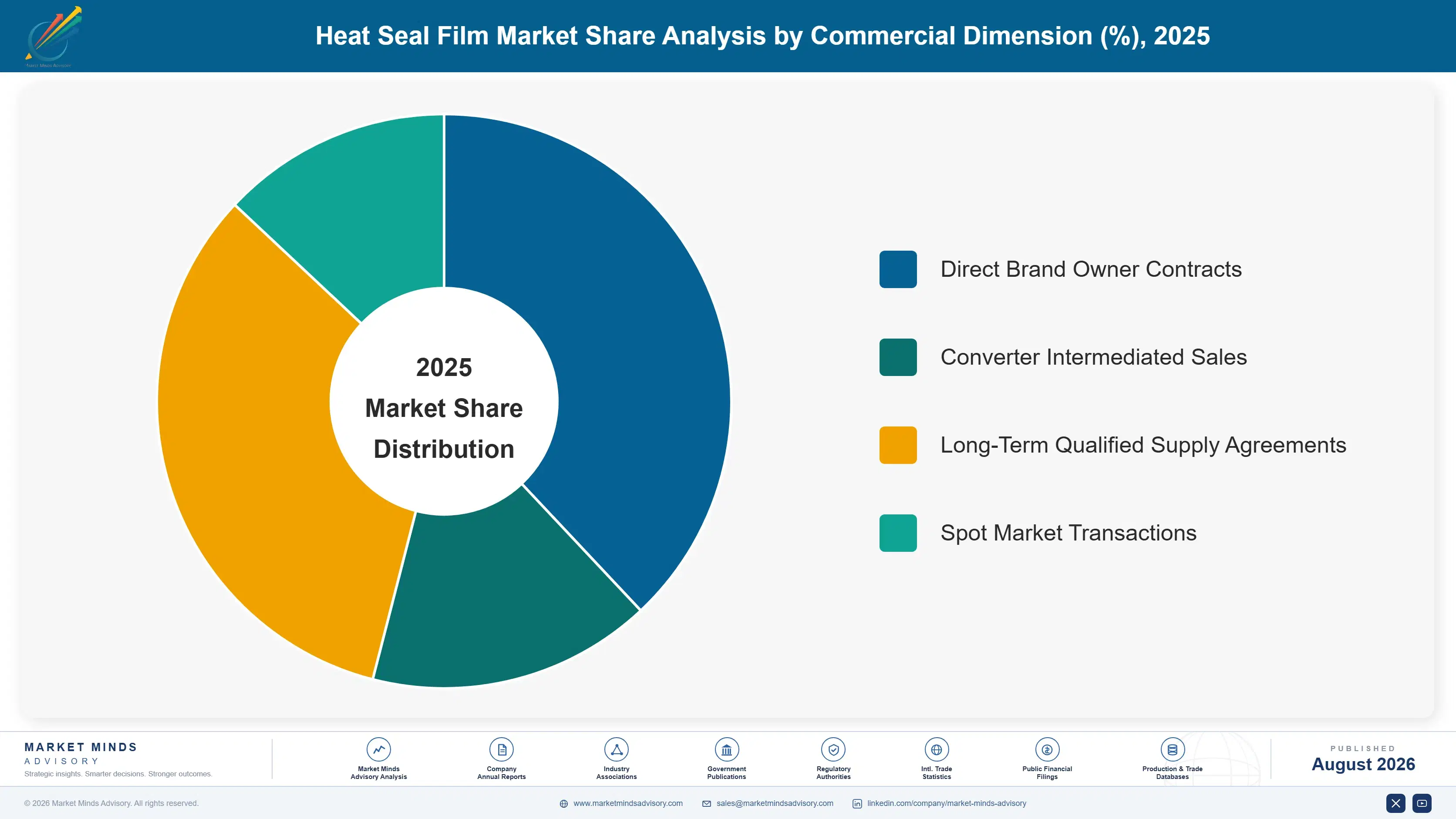
Segmentation follows end-use application, a single commercial logic tracking who specifies barrier performance, seal strength, and regulatory compliance requirements. Food and beverage, pharmaceutical and medical, personal care, lidding and peelable formats, industrial and agricultural, and e-commerce and retail packaging each demand distinct film structures, so commercial position tracks application-specific qualification rather than base resin chemistry alone.
heat-seal-film-market-market-share-analysis-1787552892600

Pharmaceutical and Medical Packaging

Pharmaceutical and medical packaging is the fastest-growing heat seal film application at 8.9% CAGR, roughly 1.4 times the overall market rate, driven by generic drug manufacturing expansion across India and China alongside tightening moisture-barrier and child-resistant sealing requirements that generic food-grade film cannot satisfy. Blister lidding film represents the largest sub-application, requiring precise seal-strength calibration so packages open reliably for patients while resisting accidental puncture during distribution. Qualification cycles run twelve to twenty-four months per drug product, since regulators treat packaging as part of the drug approval file itself, and once qualified, manufacturers rarely switch converters given the cost of repeating stability testing. That stickiness makes this segment's growth durable rather than cyclical, unlike consumer-facing categories tracking discretionary spending.
CAGR 8.9%

E-Commerce and Retail Packaging

E-commerce and retail packaging is the second-fastest segment at 8.1% CAGR, as global online order volume keeps expanding and mailer converters increasingly specify puncture-resistant, tamper-evident film structures beyond what standard in-store retail packaging requires. Major e-commerce platforms have published their own packaging specifications favoring recyclable mono-material mailer film, adding a sustainability dimension to what began as a pure durability requirement. Indian and Southeast Asian converters are adding capacity specifically to serve this channel rather than relying on imported film from established suppliers, reflecting genuinely new regional demand rather than a shift of existing volume between competing regions. Growth here tracks e-commerce penetration curves more closely than traditional packaged goods consumption, giving this segment a different demand driver.
CAGR 8.1%
Full segment breakdown across 6 segments available in the complete report.

Regional Architecture and Country Demand Map

East Asia leads at 28% of 2025 value on Chinese and Indian coextrusion capacity serving domestic and export converters, narrowly ahead of North America's pharmaceutical-grade production base. South Asia and Pacific posts the fastest regional growth as e-commerce and generic pharmaceutical demand scale beyond established East Asian centers.

North America

North America holds 26% of value, anchored by Amcor and Berry Global manufacturing operations serving pharmaceutical, food, and e-commerce packaging converters across the United States. The region retains the deepest pharmaceutical-grade qualification relationships with global drug makers, since FDA-regulated drug packaging approval processes favor established, already-qualified film suppliers over new entrants regardless of price. Growth of 6.7% sits close to the global base rate, reflecting a mature food packaging channel growing modestly alongside a faster-scaling pharmaceutical and e-commerce mailer segment. Extended producer responsibility legislation spreading state by state, following California and Colorado, is also beginning to push American converters toward the same mono-material reformulation already underway in Europe, adding a genuine growth driver beyond simple volume expansion.
Share: 26% | CAGR: 6.7% (2026 to 2036)

Western Europe

Western Europe underperforms the base rate meaningfully at 4.9%, reflecting both a shrinking food packaging volume base amid slow-growing consumer spending and the near-term cost of complying with the EU Packaging and Packaging Waste Regulation's mono-material recyclability requirements. Mondi, Constantia Flexibles, and Amcor's European operations are investing heavily in recyclable film reformulation, positioning the region as a technology leader even as raw volume growth lags East Asia and South Asia. German and French pharmaceutical packaging converters remain a steady premium-grade demand source, serving both domestic and export drug manufacturing customers. The region's growth trajectory depends significantly on how quickly mono-material film qualification proceeds relative to the regulation's phased 2030 compliance deadline.
Share: 20% | CAGR: 4.9% (2026 to 2036)
Regional intelligence for 5 additional markets available in the complete report: East Asia, South Asia and Pacific, Latin America, Middle East and Africa, Eastern Europe. Contact sales@marketmindsadvisory.com.
heat-seal-film-market-country-cagr-analysis-1787552894168

Where Film Converters Can Defend Margin

Margin in this market concentrates in validated barrier performance and regulatory qualification, not raw film extrusion. The framing below identifies four commercial moves that shift revenue toward pharmaceutical-grade qualification, mono-material reformulation, and contract structures that basic commodity film sale cannot capture, each grounded in where buyers already pay a premium: barrier consistency, recyclability, and supply security.

Build Pharmaceutical-Grade Qualification Ahead Of Generic Expansion

Pharmaceutical qualification takes twelve to twenty-four months per drug product, and converters who invest in moisture-barrier testing and child-resistant sealing capability ahead of generic manufacturing expansion can capture customers before competitors even begin qualification. Once qualified, drug manufacturers rarely switch converters, given the cost of repeating stability testing against an alternate film source. That stickiness means early qualification converts into multi-year revenue rather than a one-time premium, and the segment's 8.9% CAGR, roughly 1.4 times the market average, rewards whoever invests in barrier testing capacity before Indian and Chinese generic manufacturing capacity fully comes online.
Market Impact: Pharmaceutical-grade film commands roughly a 40% price premium

Convert Mono-Material Reformulation Into A First-Mover Advantage

European extended producer responsibility regulation is forcing every converter toward mono-material film eventually, but converters who develop qualified recyclable structures now, ahead of the 2030 compliance deadline, capture premium specification from brand owners racing to hit voluntary sustainability targets early rather than waiting for the mandate. Mondi and Constantia Flexibles have both marketed early mono-material capability as a competitive differentiator rather than a compliance cost, winning specification from brand owners who value being seen as sustainability leaders ahead of regulatory necessity. Early movers also build learning curves that let them price mono-material film closer to commodity levels sooner.
Market Impact: Early mono-material adopters capture an 8% share gain

Serve E-Commerce Converters With Index-Linked Supply Contracts

E-commerce mailer film demand is growing fast enough that supply security matters as much as price to converters serving this channel, and film producers who offer index-linked, multi-year supply contracts tied to published resin benchmarks can lock in volume while protecting margin against resin price volatility simultaneously. This works particularly well with e-commerce platforms and their contracted packaging suppliers, who value predictable input cost more than the lowest possible spot price given how quickly their own order volumes can scale. Producers offering this structure have reported securing three-year commitments at margins roughly 5% above spot-priced equivalent volume.
Market Impact: Index-linked contracts add roughly 5% margin protection overall

Monetize Trim Scrap And Post-Industrial Recycled Content

Film converting generates trim scrap and post-industrial waste that many converters currently sell as low-value regrind rather than processing into higher-value recycled content for their own or customers' film structures. Producers investing in in-house reclaim and pelletizing capability can incorporate post-industrial recycled content directly into new film structures, capturing both a cost saving on virgin resin purchase and a sustainability credential increasingly valued by brand owners. Some converters report recycled content programs now offsetting 6% to 9% of total resin cost, turning what was previously a disposal cost or low-value scrap sale into a genuine contribution margin.
Market Impact: Recycled content offsets 6% to 9% of resin cost

Who Controls the Margin Pool

Concentration is moderate: the top five converters hold an estimated 42% of global capacity, measured on a consistent basis of installed coextrusion and lamination capacity, leaving a long tail of regional converters to compete for the remainder. The gap between leader and challenger is real but not extreme.
Competitive activity currently runs along three lines. First, barrier qualification: converters invest in moisture-barrier and seal-strength testing to win pharmaceutical specification, since this is where pricing power now concentrates. Second, sustainability reformulation: converters race to develop qualified mono-material structures ahead of European regulatory deadlines. Third, geographic capacity expansion: several majors are adding coextrusion capacity in India and Southeast Asia to serve both pharmaceutical and e-commerce demand growth.

Pressure is building from regulatory-driven reformulation that rewards converters with barrier science depth over those competing purely on delivered cost. Converters slow to develop mono-material capability risk losing specification to faster-moving competitors as European deadlines approach, even ones with smaller overall capacity. Meanwhile, resin price volatility rewards converters with index-linked contract structures over those still pricing on fixed multi-year terms. Rankings over the next several years are likely to shift toward whichever five converters move fastest on both pharmaceutical qualification and mono-material reformulation.
heat-seal-film-market-company-positioning-matrix-1787552895344

Competitive Moat and Risk Dimensions

AMCOR PLC

Moat: Global Scale And Qualification Depth

Amcor operates coextrusion and lamination capacity across every major region, giving it qualification relationships with global pharmaceutical and food brand owners that smaller regional converters cannot match. Its scale also lets it absorb resin price volatility better than smaller competitors, spreading purchasing power across a much larger combined volume base.
AMCOR PLC

Risk: Slower To Move On Reformulation

Amcor's scale, while an advantage in qualification depth, can also slow decision-making on mono-material reformulation relative to smaller, more focused competitors like Mondi who have marketed early recyclable capability aggressively. Large multinational customer relationships also mean any misstep on sustainability commitments draws outsized public scrutiny.
BERRY GLOBAL INC.

Moat: Deep North American Manufacturing Footprint

Berry Global's extensive North American manufacturing footprint gives it logistics and lead-time advantages serving American pharmaceutical and food brand owners that offshore competitors cannot easily replicate, particularly for customers who value regional supply security following pandemic-era disruption memories still fresh across procurement teams today. Regional customers value that continuity.
BERRY GLOBAL INC.

Risk: High Leverage Limits Investment Flexibility

Berry Global carries higher financial leverage than several competitors following past acquisition activity, which can constrain the pace of capital investment in mono-material reformulation and new capacity relative to less-leveraged competitors moving faster on both fronts simultaneously across the broader industry landscape. That constraint compounds over multiple cycles.

Players Tracked

Prominent Players

Amcor plc
Berry Global Inc.
Toray Industries Inc.
Uflex Ltd.
Cosmo Films Ltd.

Other Key Players

Mondi plc
Sealed Air Corporation
Constantia Flexibles Group GmbH
Jindal Poly Films Ltd.
Taghleef Industries
Innovia Films Ltd.
Winpak Ltd.
ProAmpac LLC
Huhtamaki Oyj
Coveris Holdings S.A.
Klockner Pentaplast Group
Polyplex Corporation Ltd.
SRF Limited
4P Folie Forchheim GmbH
Vibac Group S.p.A.

Recent Developments

APRIL 2024

EU Finalizes Packaging and Packaging Waste Regulation

The European Union finalized its Packaging and Packaging Waste Regulation in April 2024, establishing binding recyclability design requirements phasing in through 2030. This was a regulatory action, not a corporate transaction, forcing converters across the region to begin mono-material reformulation programs well ahead of the compliance deadline.
Signal: A regulatory finalization, not a corporate deal, set the compliance clock running for every European converter.
SEPTEMBER 2024

Uflex Expands Pharmaceutical-Grade Film Capacity In India

Uflex announced an investment to expand pharmaceutical-grade blister lidding film capacity at its Indian operations in September 2024, targeting generic drug manufacturers scaling production for both domestic and export markets. The expansion was an organic capacity investment, not an acquisition or joint venture between two firms.
Signal: An organic capacity expansion confirms Indian converters are chasing the same pharmaceutical premium as Western incumbents.
JANUARY 2025

Mondi Launches Recyclable Mono-Material Lidding Film Range

Mondi launched a new recyclable mono-material lidding film range in January 2025, targeting food and personal care brand owners seeking early compliance with European recyclability requirements well ahead of schedule. This was a product launch, not a merger or acquisition, extending Mondi's existing sustainable packaging portfolio further.
Signal: A product launch, not a deal, shows incumbents racing to claim sustainability leadership ahead of regulatory deadlines.

Resin, Not Conversion, Drives Cost

Polyethylene and polypropylene resin represents 55% to 62% of processing cost of goods sold, since heat seal film is fundamentally a resin-intensive product with comparatively modest conversion value added. Coextrusion and lamination labor and equipment account for another 18% to 25%, while specialty barrier additives and printing add 8% to 12%. Packaging and logistics absorb the remainder of total delivered cost.
The 2022 resin price spike illustrated this exposure directly. EIA and ACC data recorded polyethylene and polypropylene prices climbing sharply following crude oil and naphtha volatility tied to the Russia-Ukraine conflict, and Amcor's 2022 annual report disclosed materially higher resin costs across its flexible packaging segment during that period. Converters with fixed-price contracts signed before the spike absorbed significant margin compression, while those with index-linked or shorter repricing intervals passed cost through more quickly.

Exposure varies sharply by contract structure and customer relationship. Converters with index-linked pricing formulas pass resin volatility through to customers relatively quickly, while those locked into fixed-price multi-year pharmaceutical contracts absorb volatility until the next repricing window. Smaller regional converters without resin purchasing scale face the steepest competitive disadvantage against larger global converters who negotiate volume-based supply agreements directly with resin producers.
heat-seal-film-market-cost-volatility-analysis-1787552895656

Negotiate Index-Linked Pricing Formulas With Major Customers

Converters who negotiate index-linked pricing formulas tied to published resin benchmarks, rather than fixed multi-year prices, pass resin volatility through to customers automatically rather than absorbing it until a scheduled renegotiation point arrives. This structure has become increasingly standard among the largest converters serving e-commerce and industrial customers accepting the tradeoff for supply security.

Diversify Resin Sourcing Across Multiple Suppliers

Converters purchasing resin from multiple qualified suppliers rather than a single source reduce exposure to any one producer's pricing or allocation decisions during periods of tight supply across the market. This diversification also provides negotiating leverage during contract renewal, since resin producers compete more actively for volume when a converter has credible alternatives available.

Increase Recycled Content To Reduce Virgin Resin Dependence

Converters investing in post-industrial and post-consumer recycled content reduce their overall exposure to virgin resin price volatility, since recycled content pricing tends to track virgin resin less tightly during acute supply disruptions across the industry. This also supports compliance with European recyclability and recycled-content regulations across the wider packaging portfolio over time. Programs typically pay back within roughly two years.

Portfolio Architecture for Margin Defence

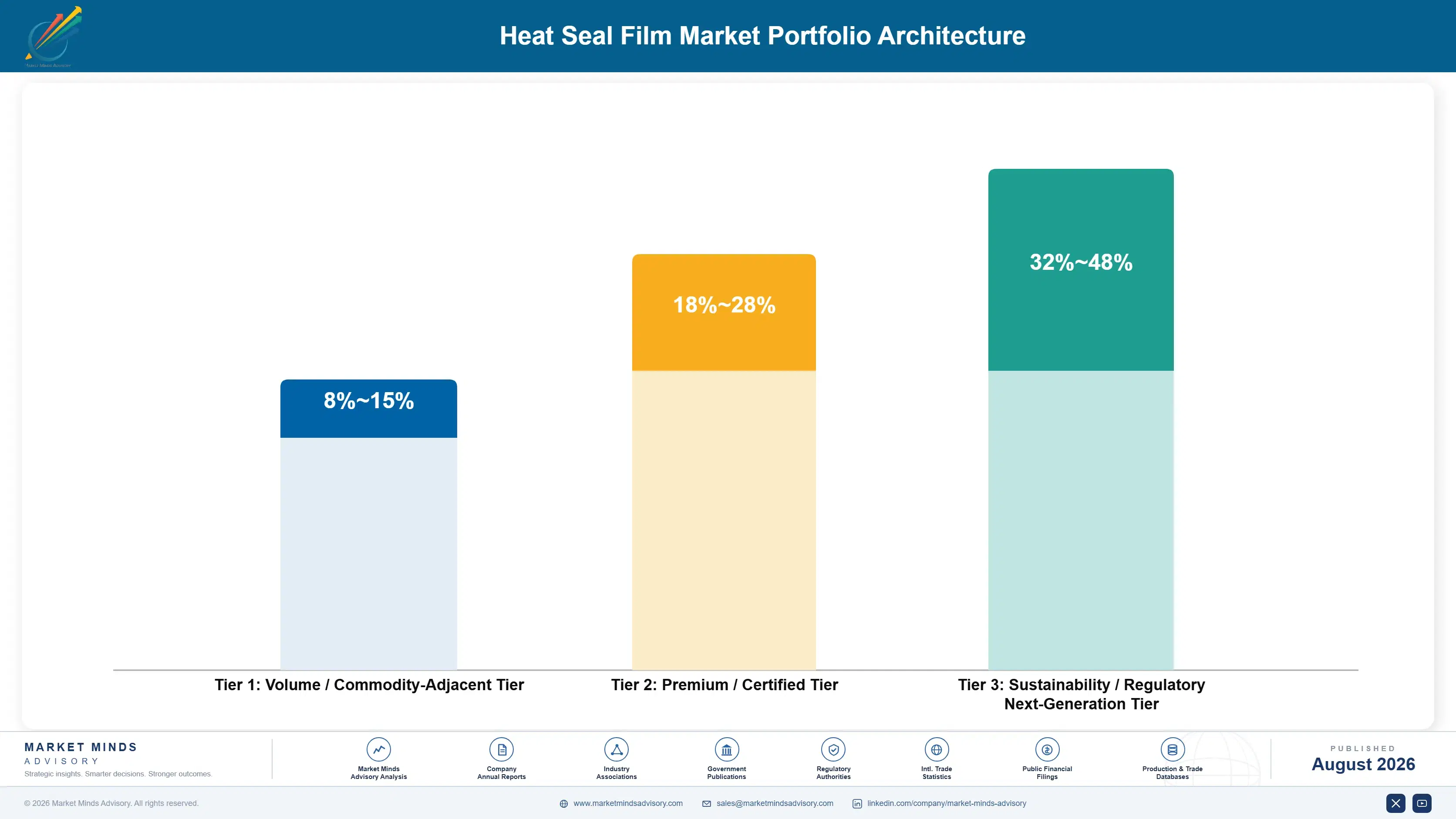
The heat seal film portfolio splits into three tiers with meaningful margin separation. Basic food-grade commodity film competes largely on delivered cost and forms the volume base of the market. Certified personal care and industrial-grade film commands a moderate premium tied to tighter specification consistency. Pharmaceutical-grade and mono-material recyclable film earns the highest margins, reflecting qualification barriers and limited converting capacity able to consistently meet the tightest barrier and regulatory specifications.
The tension running through this portfolio is between steady volume and thin margin on one side, and genuine qualification-driven scarcity value on the other. Food-grade tonnage remains necessary to fund the coextrusion infrastructure that everything else depends on, yet it faces continuous price pressure from buyers who treat it as a substitutable commodity input. Pharmaceutical-grade material faces no such substitution pressure today, but the volumes involved remain small relative to total market tonnage.

High-value pools concentrate specifically where qualification barriers, not raw extrusion capacity, determine competitive position. A converter with modest capacity but proven pharmaceutical-grade qualification captures more margin than a much larger commodity food-film producer. That inversion is reshaping where investment capital in this space actually flows across the industry.

Volume / Commodity-Adjacent Tier

Basic food-grade and industrial commodity film sold primarily on delivered price to packaged food and general consumer goods converters, competing directly against a crowded field of regional extruders on cost alone.
Gross Margin: 8-15%

Premium / Certified Tier

Certified personal care, cosmetics, and industrial specialty film serving customers who specify tighter seal-strength and print-quality tolerances than basic food-grade buyers require across their annual purchasing and qualification programs each cycle.
Gross Margin: 18-28%

Sustainability / Regulatory / Next-Generation Tier

Pharmaceutical-grade lidding film and qualified mono-material recyclable structures serving drug manufacturers and sustainability-focused brand owners, where scarce qualification capability determines who captures the resulting premium pricing consistently. Barriers remain durable across cycles.
Gross Margin: 32-48%
heat-seal-film-market-portfolio-architecture-1787552896201

High-value Sub-segments and Strategic Watch-out

Pharmaceutical and Medical Packaging

The fastest-growing and highest-margin segment, at 8.9% CAGR and gross margins reaching the mid-40s, driven by generic drug manufacturing expansion across India and China that only a handful of pharmaceutical-grade qualified converters worldwide can currently serve at scale and with consistent regulatory compliance. Qualification cycles reward early movers consistently.
Gross Margin: 32-48%

E-Commerce and Retail Packaging

Second-fastest at 8.1% CAGR, using puncture-resistant and increasingly mono-material film structures for mailer and flexible packaging, commanding pricing between commodity food-grade and premium pharmaceutical-grade material across most buyer programs, geographic markets, and retailer specification standards today. Retailer specification standards keep tightening steadily. Growth tracks online order volume closely.
Gross Margin: 20-30%

Food and Beverage Packaging

The largest segment by tonnage, growing near 5.8%, supplying basic packaging film to packaged food and beverage manufacturers on multi-year contracts, priced competitively against a crowded field of regional commodity extruders across nearly every market and geography served. Contracts renew predictably each cycle. Volume stays large but unglamorous.
Gross Margin: 8-15%

Industrial and Agricultural Packaging

The slowest-growing visible category, facing steady price pressure from regional low-cost extruders and limited differentiation opportunity, leaving this segment's growth tied closely to broader industrial production volume rather than any specification-driven premium available currently. Few converters differentiate meaningfully here. Investment here remains genuinely limited overall.
Gross Margin: 10-18%

Qualification, Not Price, Governs Demand

Demand here splits sharply between commodity purchasing and qualification-locked relationships. Food-grade buyers negotiate largely on price and switch suppliers relatively freely when a competitor offers better terms, since most specifications are industry-standard rather than customer-specific. Pharmaceutical buyers commit for the life of a drug product, often a decade or more, since any film change triggers a fresh regulatory stability testing requirement that manufacturers actively avoid repeating.
Adoption depth varies sharply by end-use vertical. Pharmaceutical manufacturers show the deepest stickiness of all, given the multi-year, multi-million-dollar cost of requalifying an approved drug package against an alternate film source. E-commerce and personal care buyers show moderate stickiness, valuing supply consistency but willing to requalify a new supplier over twelve to eighteen months if terms improve meaningfully. Food and beverage buyers sit at the loosest end, treating film largely as a substitutable commodity input.

Buyer profiles are shifting as procurement moves from purely cost-driven purchasing toward sustainability-weighted decision-making, particularly across Europe. Younger procurement teams increasingly factor in recyclability credentials and regulatory compliance timelines, not just delivered price, following the EU Packaging and Packaging Waste Regulation. That shift favors converters who can demonstrate qualified mono-material capability over those competing purely on unit cost.
heat-seal-film-market-end-use-penetration-index-1787552896976

Where MMA Sees Heat Seal Diverging

These are among the four positions where our research anticipates prominent divergence between winners and laggards over the coming forecast period. Each is grounded in the demand model, the regulatory perimeter, and the announced capacity pipeline.
01 / PHARMACEUTICAL QUALIFICATION PRIORITY

Blister lidding qualification will separate winners from commodity film sellers

Raw extrusion capacity no longer determines competitive position in this market the way it once did for pharmaceutical-grade demand specifically. Converters capable of consistently passing moisture-barrier and child-resistant sealing qualification for generic drug manufacturers are capturing margin that dwarfs anything available from commodity food-film sale, regardless of how large their underlying capacity base is. Over the next decade, we expect capital to flow disproportionately toward pharmaceutical-grade qualification testing, and converters who delay that investment risk becoming volume suppliers to better-capitalized competitors.
02 / MONO-MATERIAL REFORMULATION TIMING

Early recyclable qualification will compound into lasting specification advantage

European regulation is forcing every converter toward mono-material film eventually, and converters who develop qualified recyclable structures now are capturing specification from brand owners racing to hit voluntary sustainability targets ahead of the 2030 compliance deadline. Mondi and Constantia Flexibles have both demonstrated that early mono-material capability functions as a genuine competitive differentiator rather than simply a compliance cost absorbed reluctantly. We expect this advantage to compound further as regulatory deadlines approach, rewarding converters who invested in reformulation years before it became commercially unavoidable across the broader European market.
03 / E-COMMERCE CHANNEL INVESTMENT

Puncture-resistant mailer film will outgrow traditional retail packaging sharply

E-commerce mailer film already grows at roughly 1.3 times the overall market rate, and that gap should widen rather than close as online retail penetration deepens across South Asia and Latin America through the forecast period. Traditional in-store retail packaging demand remains dependable but consistently slower, growing with consumer spending that is itself decelerating in mature Western markets even as it continues elsewhere. Converters serving both channels, with genuine puncture-resistant and mono-material capability, will command pricing power pure commodity suppliers increasingly cannot match.
04 / RESIN COST EXPOSURE

Index-linked pricing will separate resilient converters from exposed ones

Converters without index-linked pricing formulas remain directly exposed to polyethylene and polypropylene price volatility that competitors with automatic repricing mechanisms do not share to the same degree. That exposure already compressed margins meaningfully during the 2022 resin spike and shows no sign of fully disappearing as petrochemical feedstock costs remain inherently cyclical. We expect converters to continue migrating contract structures toward index-linked formulas over the coming decade, leaving those still relying on fixed-price multi-year contracts increasingly dependent on favorable timing rather than negotiated resilience.

Engagement Snapshot From the Field

A live engagement with an industry participant carrying material or product regulatory and market exposure ahead of a defining policy shift, showing how our research translates into a defensible multi-year portfolio strategy.
MARKET MINDS ADVISORY · CLIENT ENGAGEMENT SUMMARY
Heat Seal Film Producer Strategic Portfolio Review and Transition Roadmap 2026·Investment Scenario on Heat Seal Film Exposure Evaluation 2025-26
CLIENT PROFILE
A generic pharmaceutical manufacturer expanding solid-dose production capacity across India approached MMA while evaluating blister lidding film suppliers ahead of a planned facility commissioning. The client reported planned annual packaging spend exceeding USD 18 million, with an internal target of completing film qualification within nine months to avoid delaying its facility launch timeline (client-reported, unverified by MMA).
STRATEGIC CHALLENGE
Management needed to select a lidding film supplier capable of meeting moisture-barrier and child-resistant sealing specifications for multiple drug products simultaneously, while ensuring qualification testing did not delay the facility's planned commissioning date. No internal team had directly compared qualification timelines and total cost of ownership across the shortlisted converter options available.
MMA APPROACH
MMA benchmarked qualification timelines and total delivered cost across four shortlisted converters, modeled the facility launch delay risk under each qualification scenario, and assessed each converter's existing regulatory track record with comparable generic drug products. We also evaluated contract pricing structures to identify which suppliers offered genuine resin cost pass-through protection versus fixed pricing that could compress margin later.
KEY FINDINGS
  1. The fastest-qualifying converter carried a modest price premium but would complete testing five months faster than the lowest-cost option, avoiding a costly facility launch delay (client-reported, unverified by MMA).
  2. Two of the four shortlisted converters lacked direct prior qualification experience with the client's specific drug product category, adding meaningful undisclosed regulatory risk to their proposals.
  3. Index-linked pricing structures offered by two converters would have saved an estimated 4% on total packaging spend compared with the fixed-price alternative over a five-year contract term.
  4. The client's original supplier shortlist had not adequately weighted qualification timeline risk against facility commissioning deadlines, a gap that could have caused a significant launch delay.
CLIENT PROFILE
A generic pharmaceutical manufacturer expanding solid-dose production capacity across India approached MMA while evaluating blister lidding film suppliers ahead of a planned facility commissioning. The client reported planned annual packaging spend exceeding USD 18 million, with an internal target of completing film qualification within nine months to avoid delaying its facility launch timeline (client-reported, unverified by MMA).
STRATEGIC CHALLENGE
Management needed to select a lidding film supplier capable of meeting moisture-barrier and child-resistant sealing specifications for multiple drug products simultaneously, while ensuring qualification testing did not delay the facility's planned commissioning date. No internal team had directly compared qualification timelines and total cost of ownership across the shortlisted converter options available.
MMA APPROACH
MMA benchmarked qualification timelines and total delivered cost across four shortlisted converters, modeled the facility launch delay risk under each qualification scenario, and assessed each converter's existing regulatory track record with comparable generic drug products. We also evaluated contract pricing structures to identify which suppliers offered genuine resin cost pass-through protection versus fixed pricing that could compress margin later.
KEY FINDINGS
  1. The fastest-qualifying converter carried a modest price premium but would complete testing five months faster than the lowest-cost option, avoiding a costly facility launch delay (client-reported, unverified by MMA).
  2. Two of the four shortlisted converters lacked direct prior qualification experience with the client's specific drug product category, adding meaningful undisclosed regulatory risk to their proposals.
  3. Index-linked pricing structures offered by two converters would have saved an estimated 4% on total packaging spend compared with the fixed-price alternative over a five-year contract term.
  4. The client's original supplier shortlist had not adequately weighted qualification timeline risk against facility commissioning deadlines, a gap that could have caused a significant launch delay.
RECOMMENDED STRATEGY
Phase 1: Phase 1 (0 to 3 months): Select the fastest-qualifying converter with direct prior experience in the client's specific drug product category to minimize commissioning delay risk. Phase 2: Phase 2 (3 to 9 months): Complete film qualification testing in parallel with facility construction, negotiating index-linked pricing terms into the final supply agreement. Phase 3: Phase 3 (9 to 24 months): Monitor resin cost pass-through performance and evaluate a second qualified converter as backup supply security ahead of future capacity expansion.
OUTCOME
The client completed film qualification eight months after supplier selection, ahead of its facility commissioning date, avoiding a launch delay estimated at several months under the original supplier shortlist. Reported packaging cost savings versus the fixed-price alternative reached approximately 4% annually (client-reported, unverified by MMA). The client has since qualified a second backup converter for supply security.

Frequently Asked Questions

Foundational context covering the market sizes, CAGR, scope, country, region and competition that inform every finding below. This section is provided to cover basics and most often pre-purchase conversations, answered from the MMA Primary Research Dataset.

What is the current size of the Heat Seal Film Market?

The global heat seal film market stands at USD 4.8 billion in 2025, according to MMA Primary Research. Food and beverage packaging accounts for the largest share of current revenue.

How large will the Heat Seal Film Market be by 2036?

MMA projects the market will reach USD 9.50 billion by 2036, up from USD 5.11 billion in 2026, an expansion multiple of roughly 1.86 times over the forecast period.

What is the CAGR for the Heat Seal Film Market 2026 to 2036?

The base case CAGR is 6.4% across 2026 to 2036. MMA's bull scenario reaches 7.7% and the bear scenario falls to 5.2%, depending on resin prices and pharmaceutical capacity expansion.

Which segment is growing fastest?

Pharmaceutical and medical packaging grows fastest at 8.9% CAGR, roughly 1.4 times the overall market rate, driven by generic drug manufacturing expansion across India and China.

Who are the major companies in the Heat Seal Film Market?

Leading producers include Amcor, Berry Global, Toray Industries, Uflex, and Cosmo Films. Together these five account for an estimated 42% of global converting capacity across pharmaceutical and food packaging.

Which country is growing fastest?

India posts the fastest national growth at approximately 10.2% CAGR, supported by generic pharmaceutical manufacturing expansion and rapidly scaling e-commerce packaging demand across major metro regions.

Report Segmentation Architecture

The full report scope spans multiple orthogonal segmentation dimensions, with cross-tabulated demand data provided for each dimension pair. Coverage extends further to regional breakdowns, trend trajectories, and the competitive detail needed to support segment-level decision-making.

By Application

  • Food and Beverage Packaging
  • Pharmaceutical and Medical Packaging
  • Personal Care and Cosmetics
  • Lidding and Peelable Formats
  • Industrial and Agricultural Packaging
  • E-Commerce and Retail Packaging

By End-Use Industry

  • Food and Beverage
  • Pharmaceuticals and Healthcare
  • Personal Care and Cosmetics
  • Industrial and Agriculture
  • Retail and E-Commerce

By Commercial Dimension

  • Direct Brand Owner Contracts
  • Converter Intermediated Sales
  • Long-Term Qualified Supply Agreements
  • Spot Market Transactions

By Region

  • North America
  • Western Europe
  • East Asia
  • South Asia and Pacific
  • Latin America
  • Middle East and Africa
  • Eastern Europe

Scope, Methodology, and Coverage

Every figure in this report is reproducible from documented input assumptions. The scope below maps the historical period, the forecast horizon, the segmentation dimensions, and the countries covered, alongside the underlying primary and qualitative methodology.
Historical Period
2020 to 2025
Forecast Period
2026 to 2036
Base Year
2025 (USD billions; MMA Primary Research Dataset, August 2026)
Market Definition
The heat seal film market covers thermoplastic films engineered to bond to themselves or a substrate under applied heat and pressure, sold as monolayer or coextruded rollstock, lidding, or pouch-ready film for food, pharmaceutical, personal care, and industrial packaging use. It excludes finished flexible packages, pouches, or bags already converted and filled, and cold-seal or pressure-sensitive adhesive film that bonds without heat.
Quantitative Units
USD billions (current prices); metric tonnes of film where applicable
Segmentation Dimensions
By Application; By End-Use Industry; By Commercial Dimension; By Region
Regions Covered
North America, Western Europe, East Asia, South Asia and Pacific, Latin America, Middle East and Africa, Eastern Europe
Countries Covered
USA, China, Germany, France, UK, Japan, South Korea, India, Australia, Canada, Brazil, Mexico, Indonesia, Vietnam, Thailand, Malaysia, UAE, Saudi Arabia, South Africa, Nigeria, Turkey, Poland, Netherlands, Italy, Spain, Sweden, Switzerland, Argentina, Colombia, Singapore, and additional markets relevant to this sector
Key Companies Profiled
Amcor plc, Berry Global Inc., Toray Industries Inc., Uflex Ltd., Cosmo Films Ltd., Mondi plc, Sealed Air Corporation, Constantia Flexibles Group GmbH, Jindal Poly Films Ltd., Taghleef Industries, Innovia Films Ltd., Winpak Ltd., ProAmpac LLC, Huhtamaki Oyj, Coveris Holdings S.A., Klockner Pentaplast Group, Polyplex Corporation Ltd., SRF Limited, 4P Folie Forchheim GmbH, Vibac Group S.p.A.
Quantitative Methodology
Primary survey, n=3,800 respondents, Q4 2025, six countries; demand-side model with trade association cross-validation
Qualitative Methodology
47 expert interviews, Q4 2025; applied to validate demand model assumptions, identify emerging dynamics, and assess competitive positioning
Report Format
PDF and XLSX data workbook (Word format preview document)
Publisher
Market Minds Advisory
Report Code
MMA-2026-PAC-103
Published
August 2026
Contact
sales@marketmindsadvisory.com | www.marketmindsadvisory.com

Purchase the full Heat Seal Film Market Report (2026 to 2036).

The full MMA Heat Seal Film Market report sizes global demand across six application segments, five end-use industries, four commercial models, and seven regions through 2036. It profiles twenty participants on a consistent installed-capacity basis, scoring each on barrier qualification depth, mono-material readiness, and geographic footprint. Scenario models quantify how generic pharmaceutical expansion, EU recyclability regulation, and e-commerce penetration move both volume and realizable price across the forecast period. The report also includes delivered-cost modelling by application, a resin price sensitivity analysis, a mono-material reformulation timeline benchmark, and a qualification-depth competitive scorecard built for procurement, strategy, and investment teams.
Application-Level Demand Sizing Across Six Segments
Twenty-Company Competitive Benchmarking On Qualification Depth
EU Regulation And Mono-Material Timeline Scenario Modelling
Resin Price Sensitivity And Margin Impact Analysis
Regional Trade Flow And Country Growth Mapping
Pharmaceutical Qualification Pipeline And Capacity Tracking

Built For The People Who Decide

From boardroom strategy to bench-side execution, this report is read cover-to-cover by leaders shaping the next decade of their industry, turning demand scenarios, market dynamics and valuation benchmarks into decisions.
CXOs/ Presidents/ VPs/ Managers
M&A and Corporate Development
Strategy Teams and R&D Heads
Procurement and Product Directors
Regulatory and Compliance Leaders
Investor Relations and Equity Analysts