Market Minds Advisory
Heat Interface Unit Market

Heat Interface Unit Market: Heat Interface Unit Market. District Heating Expansion Forces a Metering Upgrade Cycle

District heating network expansion is forcing building developers to specify smart, remotely monitored heat interface units, pushing legacy manufacturers still selling unmetered mechanical units toward a costly product overhaul.

Lead Analyst

Published

September 2026

Make Smarter Decisions with Customized Research Insights

Request a free sample report and evaluate market opportunities, growth trends, and competitive dynamics relevant to your business needs.

2025 MARKET VALUE$2.1BMarket Size 2025
2036 FORECAST VALUE$4.3BBase Case , 2026 to 2036
CAGR 2026 TO 20366.8 %Bull 8.1% / Bear 5.5%
INCREMENTAL OPPORTUNITY$2.1BNet 10- year value creation
EXPANSION MULTIPLE1.93x2036 value over 2026 base
Strategic Levers
M&A Pipeline
Regional Outlook
Country Rankings
Competitive Intelligence
Segmental Deep-dive
Call-Us : 91 93563 13602

Executive Snapshot and Market Trajectory.

Every new district heating connection across Europe now arrives with a metering mandate attached, and the heat interface unit is the only component standing between that regulatory requirement and an actual, billable heat reading at the individual apartment door itself, right now.
Utilities and developers across Northern and Western Europe are replacing indirect, unmetered plate heat exchangers with compact, factory-calibrated units carrying integrated heat meters, actuators, and remote communication modules. Poland, the Baltic states, and parts of Germany are adding new district heating branches at a pace that outstrips domestic manufacturing capacity, pulling in imports from Danish and Swedish suppliers who currently dominate the premium smart-metered segment of this multi-year expansion cycle.
Five manufacturers hold under half the market between them, leaving room for regional specialists selling into public housing retrofit tenders that reward local service networks over brand recognition. Building codes in the United Kingdom and several EU member states now specify individual metering and remote monitoring as a binding condition of planning approval, forcing mechanical-only incumbents toward electronics partnerships, new software licensing deals, or the steady loss of specification slots on major new-build tenders.
Market Definition
The heat interface unit market covers factory-assembled units that transfer space heating and domestic hot water from a district heating or communal network into individual dwellings, excluding the boilers, heat pumps, or pipe networks that generate and carry that heat upstream.
Base Year Value
$2.1B in 2025 (MMA Primary Research Dataset, September 2026)
Forecast Period
2026 to 2036, eleven discrete annual values
CAGR
6.8% base case. Bull 8.1%. Bear 5.5%.
Fastest Growth Segment
Smart Metering-Integrated Heat Interface Units: 10.6% CAGR
Fastest Growth Country
Poland: 9.2% CAGR
Fastest Growth Region
South Asia and Pacific: 8.8% CAGR
Largest Region
East Asia: 28% of 2025 global value
Market Leaders
Danfoss, Alfa Laval, Meibes, Redan, and SAV Systems lead the market. Source: MMA Primary Research Dataset, July 2026.
Primary Survey
n=3,800 procurement and R&D decision-makers, Q4 2025, six countries
Methodology
Demand-side build-up, cross-validated against public data, 47 expert interviews

Heat Interface Unit Market Forecast Scenarios

heat-interface-unit-market-size-forecast-scenario-1790000599188
Between 2020 and 2025 the market grew at roughly 6.0% a year as district heating networks expanded steadily across Poland, the Baltic states, and parts of Scandinavia, while Western European replacement demand stayed largely flat because most existing building stock had already been fitted with a working, if unmetered, unit decades earlier and landlords saw little reason to replace equipment that still functioned adequately.
The base case assumes 6.8% annual growth through 2036, built on three mechanisms: mandatory individual metering rules spreading from the United Kingdom and Germany into additional EU member states, a wave of district heating network extensions tied to gas boiler phase-out timelines, and rising retrofit volume as first-generation mechanical units installed across the 1990s reach the end of their working service life and require full replacement with metered electronics rather than simple repair.
A bull case near 8.1% follows if the European Union tightens its energy performance building directive timeline and forces accelerated retrofit of communal heating systems across older housing stock throughout the bloc. The principal bear risk, a construction slowdown in Germany and Poland that delays new district heating branch connections and postpones planned retrofit tenders, would instead pull growth toward 5.5%.

Heat Interface Unit Market Overview

Heat interface units sit at the exact point where a district heating network becomes a billable service, and that positioning has turned a once-commodity mechanical box into a contested electronics platform in a very short span of years. Manufacturers that once competed purely on plate heat exchanger efficiency now compete on metering accuracy, communication protocol support, and remote fault diagnosis capability.
MARKET CONCENTRATIONCR5 47%Top five vendors hold under half of global unit shipments
AVERAGE SELLING PRICE$180-420Smart metered units carry a wide premium over basic variants
LEADING PRODUCING COUNTRYDenmark, 24% shareDanish suppliers concentrate premium smart unit manufacturing capacity
CAPACITY UTILISATION71%European factories run below peak amid uneven order timing
TRADE INTENSITY38% import shareEastern European buyers rely heavily on Western manufactured units
INPUT COST SHARE52%Copper heat exchangers and electronics dominate total unit cost
Denmark and Sweden supply a disproportionate share of the premium smart-metered segment, reflecting decades of domestic district heating experience that predates most of continental Europe's networks by a generation or more. Poland and the Baltic states, by contrast, are adding new connections faster than any other part of the continent, creating an import-dependent demand pocket that domestic assemblers have struggled to serve at comparable price points and lead times.
Capacity utilisation across European factories sits below what the order book alone would suggest, a consequence of lumpy public housing tender timing rather than genuine overcapacity in the sector. Component costs, dominated by copper and printed circuit assemblies, expose every producer to the same input volatility regardless of unit sophistication or brand positioning within the wider market.
"Heat interface units used to be the most boring line item in a district heating specification. Now they are the component landlords argue about, because getting metering wrong means disputed bills for a decade."
Director, Energy Infrastructure Practice · MMA Energy Practice · September 2026

Market Trends

Smart metering integration becomes a specification default

Building specifiers across Northern and Western Europe increasingly write remote-readable heat metering into procurement documents as a baseline requirement rather than an optional upgrade item. The European Union's Energy Efficiency Directive recast requires monthly or on-demand consumption data for new district heating connections across most member states, pushing manufacturers to bundle communication modules directly into the unit housing rather than sell them as separate retrofit kits sold after the fact. Vendors slow to integrate face exclusion from an expanding share of new-build public and private tenders across the region over the coming several years.
Market Impact: 12 million units require retrofit

Compact all-in-one units displace field-assembled installations

Installers increasingly favour factory-tested, pre-piped units over site-assembled combinations of separate heat exchangers, pumps, and controllers, cutting commissioning time on multi-unit residential projects substantially compared with older, more labour-intensive installation methods used a decade ago. This shift reduces callback rates tied to on-site assembly errors and lets manufacturers capture a larger share of unit value that previously went to mechanical contractors handling field piping work. Housing associations managing large retrofit programmes across Germany and the United Kingdom now specify all-in-one units almost exclusively for new contracts issued from 2025 onward.
Market Impact: 300,000 new connections planned

Market Opportunities and Growth Drivers

EU building renovation wave mandates individual metering

The European Union's Energy Performance of Buildings Directive requires member states to phase out unmetered communal heating billing across multi-family housing, creating a compulsory retrofit channel independent of ordinary replacement cycles and manufacturer marketing effort. France, Germany, and the Netherlands have already published national transposition timelines requiring compliance within the next several years, and housing associations managing large residential portfolios face financial penalties for missed deadlines. This regulatory floor guarantees baseline replacement demand even in years when new district heating connection volume slows for broader macroeconomic reasons across the construction sector.
Market Impact: 2,400 dollars average retrofit cost

District heating network extensions accelerate across Eastern Europe

Poland, Lithuania, and Latvia are extending district heating pipe networks into suburban districts previously served by individual gas boilers, driven by national decarbonisation plans and European Union cohesion fund financing earmarked specifically for heat network infrastructure projects across the region. Every new connection requires a heat interface unit at the building or apartment level, generating genuine first-time unit demand rather than simple replacement demand seen elsewhere in the market. Polish network operators have publicly committed to connecting several hundred thousand additional households by the early 2030s under current national energy planning documents.
Market Impact: 18% margin swing during spikes

Market Restraints and Challenges

Retrofit cost burden falls disproportionately on social housing operators

Replacing an unmetered mechanical unit with a smart metered equivalent costs several times more per apartment than routine maintenance, and social housing providers operating on fixed public budgets struggle to fund whole-building retrofits on the timelines regulators demand. The root cause is that metering mandates were written as building-level compliance obligations without matching capital grant programmes in most member states, leaving landlords to absorb cost or pass it through rent increases that face political resistance. Several national housing agencies are piloting low-interest retrofit loan schemes to bridge this gap, though uptake remains limited so far.
Market Impact: 60% of new units now metered

Copper price volatility compresses manufacturer gross margins

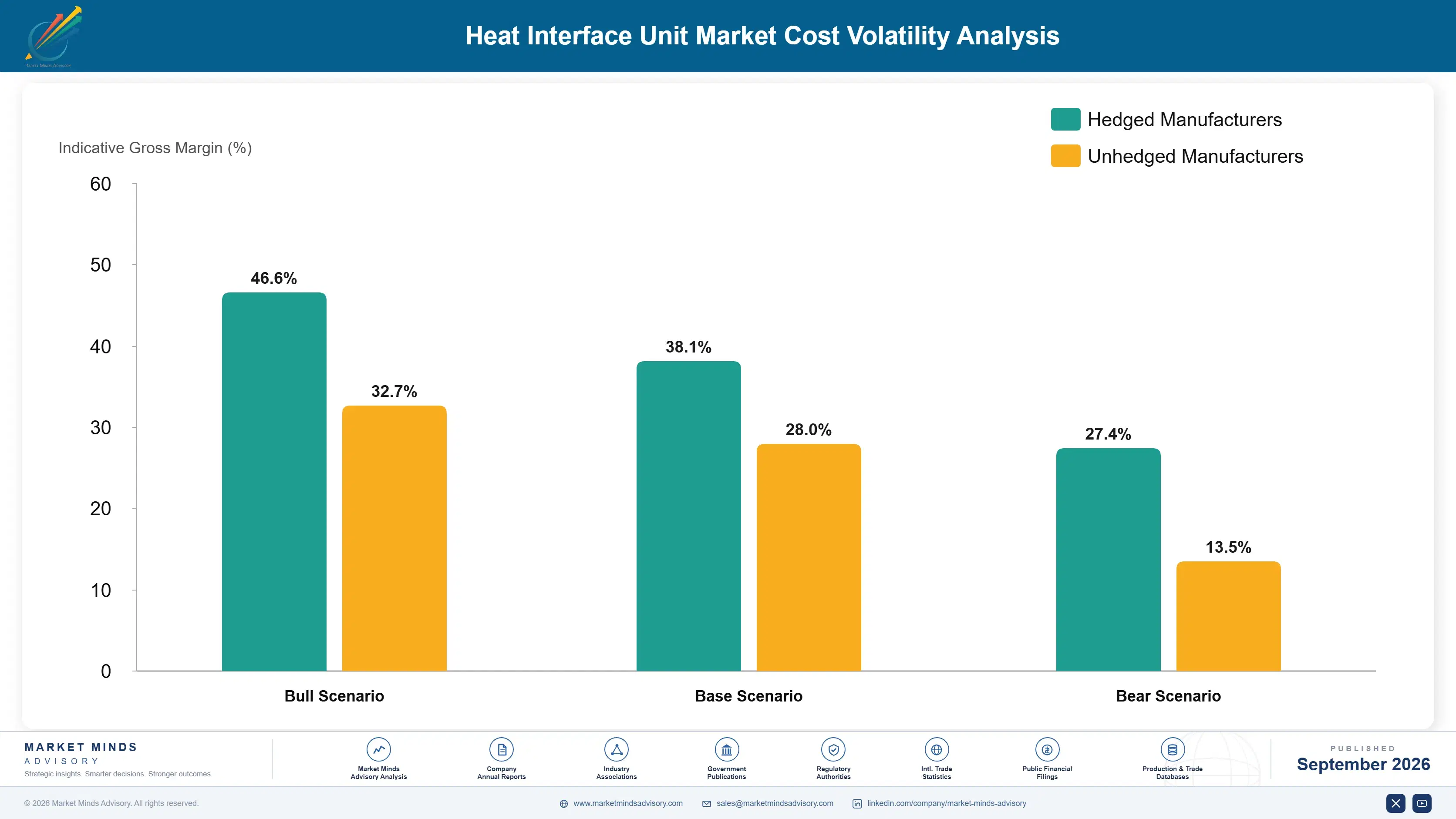
Heat exchanger cores rely heavily on copper, and price swings tied to global mining supply disruptions feed directly into unit production cost with little lag, squeezing margins for producers locked into fixed-price public tender contracts signed months earlier. Smaller regional assemblers lack the hedging instruments and purchasing scale that larger manufacturers use to smooth this exposure, putting them at a persistent cost disadvantage during volatile pricing periods. Several manufacturers have begun qualifying aluminium-copper hybrid exchanger designs as a partial mitigation, though full material substitution remains years away from commercial scale.
Market Impact: 40% faster installation cycle
3 additional market trends, 4 additional growth drivers, and 2 additional restraints and challenges are covered in the full report. Contact sales@marketmindsadvisory.com to access the complete intelligence.

Segment CAGR and Growth Architecture

Heat interface units segment cleanly by functional configuration and metering capability, the two dimensions that determine both installed price and specification eligibility for a given project. This framework separates direct and indirect exchange designs, smart-metered variants, modular multi-apartment units, domestic hot water priority units, and communal plant-room assemblies, avoiding overlap between hardware type and downstream building application.
Section default visual

Smart Metering-Integrated Heat Interface Units

Smart metering-integrated units are pulling ahead of every other configuration as regulatory mandates convert what was once an optional upgrade into a specification requirement across most new district heating connections in Northern and Western Europe. These units embed heat and volume metering, remote communication modules, and tamper detection directly into the factory-built housing, eliminating the separate metering retrofit step that older mechanical units required after installation was already complete and the building occupied. Housing associations and utilities favour this configuration because it shortens commissioning timelines and produces billing-grade data from day one, reducing tenant disputes over estimated consumption charges that plagued older communal heating arrangements for decades across the continent.
CAGR 10.6%

Indirect Exchange Heat Interface Units

Indirect exchange units, which isolate the building's internal water loop from the district network through a plate heat exchanger, remain the largest single configuration by installed base and continue adding volume in markets extending new district heating branches into suburban housing developments at a rapid, sustained pace. Their appeal lies in protecting building plumbing from network-side water quality issues and pressure fluctuations, a genuine concern in older networks with inconsistent water treatment practices carried over from earlier decades. Eastern European utilities extending networks into previously unconnected districts specify indirect units almost by default, prioritising network protection over the marginal efficiency gains that direct exchange designs offer in cleaner, better-maintained networks elsewhere.
CAGR 7.9%
Full segment breakdown across 7 segments available in the complete report.

Regional Architecture and Country Demand Map

East Asia leads on the scale of China's district heating network, the largest in the world by delivered heat volume, while Western Europe and Eastern Europe together account for most premium unit demand tied to metering mandates and legacy network retrofit programmes across the continent.

East Asia

China operates the largest district heating network in the world by delivered heat volume, concentrated across northern provinces where winter heating is government-mandated for entire cities rather than left to individual building choice. National heat metering reform policy, dating back to the country's twelfth and thirteenth five-year plans, continues pushing utilities to convert flat-rate communal billing toward per-apartment metered consumption, a transition still incomplete across a large share of older housing stock in provincial cities. South Korean district heating operators, serving dense apartment complexes around Seoul, add a smaller but faster-growing pocket of smart unit demand tied to national energy efficiency targets for new residential construction and building certification programmes.
Share: 28% | CAGR: 7.8% (2026 to 2036)

Western Europe

Denmark, Sweden, and Germany anchor the premium end of this market, drawing on decades of district heating operating experience that predates comparable networks almost everywhere else in the developed world by a wide margin. Danish manufacturers export smart metered units across the continent, benefiting from a domestic regulatory environment that adopted individual metering requirements earlier than most European Union member states managed to legislate their own equivalent rules. The United Kingdom's growing heat network zoning policy, designed to expand district heating coverage in major cities such as London and Manchester, is opening a genuinely new specification channel for manufacturers that previously sold almost entirely into continental European markets rather than domestic UK construction projects.
Share: 25% | CAGR: 5.3% (2026 to 2036)
Regional intelligence for 5 additional markets available in the complete report: North America, South Asia and Pacific, Latin America, Middle East and Africa, Eastern Europe. Contact sales@marketmindsadvisory.com.
heat-interface-unit-market-market-share-analysis-1790000599731

Where Margin Concentrates in Interface Units

Manufacturers capture the widest margins where regulation forces a metering upgrade regardless of underlying construction cycles, and where installed units generate recurring data or service revenue well beyond the original equipment sale itself, year after year across the installed base. Four levers stand out as the clearest paths to expanding gross margin over the coming decade.

Bundle remote diagnostics into recurring service contracts

Manufacturers that pair a smart interface unit with a paid remote monitoring subscription capture recurring revenue well beyond the original equipment sale, a shift that transforms a one-time hardware transaction into a multi-year commercial relationship with the building owner. Danfoss and Alfa Laval have both expanded cloud-based fault detection offerings that flag failing actuators before a tenant loses heating entirely, cutting emergency callout costs for facilities managers meaningfully. Housing associations managing thousands of units find the predictable maintenance cost attractive enough to accept a service fee that raises blended margin by roughly 8 points over hardware-only contracts.
Market Impact: 8 percentage point blended margin uplift from services

Win exclusive specification on new-build tender frameworks

Securing a preferred-supplier position on national or regional new-build framework agreements locks in volume for several years and reduces the sales cost per unit substantially compared with competing on individual projects one at a time. Housing associations in the United Kingdom increasingly run framework tenders covering hundreds of buildings simultaneously, and winning that single tender delivers guaranteed order flow that smaller competitors cannot match through project-by-project bidding. Manufacturers that invest early in framework-specific product certification typically hold their position for the full multi-year contract term, worth an estimated 15% revenue premium over spot sales.
Market Impact: 15% revenue premium earned on multi-year framework wins

Localise assembly to cut import duty and freight cost

Manufacturers assembling units within the European Union avoid the import duties and long freight timelines that squeeze margins for competitors shipping finished units from outside the bloc, particularly as Eastern European demand grows faster than Western European capacity. Establishing a final assembly line in Poland or the Czech Republic, rather than shipping complete units from Scandinavia, cuts landed cost meaningfully while shortening delivery times on large public housing tenders that penalise late shipment financially. Several manufacturers have announced or completed such moves over the past two years, citing landed cost reduction of roughly 12% as the primary justification.
Market Impact: 12% landed cost reduction achieved from EU localisation

Sell data access to utilities for billing integration

Utilities managing district heating billing increasingly pay manufacturers or third-party platforms for direct data feeds from installed smart units, rather than building their own integration layer from scratch for every equipment brand in the field. This creates a software-like revenue stream layered on top of the original hardware sale, with margins that substantially exceed those available on the physical unit itself. Early adopters of this model in Denmark and the Netherlands report that data licensing revenue, while still a small share of total sales, carries gross margins above 70% and grows independently of new unit shipment volume.
Market Impact: 70% gross margin achieved on data licensing revenue

Who Controls the Margin Pool

Five manufacturers, measured by unit shipment volume, hold roughly 47% of global heat interface unit sales, leaving the balance split among a long tail of regional specialists that dominate specific national markets. Danfoss and Alfa Laval lead this group with the broadest product ranges across Northern Europe, and the gap to the third-ranked player is wide enough that challengers compete mainly for the remaining regional and mid-tier segments.
Current competitive activity centres on communication protocol support, with manufacturers racing to certify units against the specific smart metering and building management standards that utilities in each national market require. Several producers have added modular product lines that let installers configure a single base unit for direct exchange, indirect exchange, or domestic hot water priority applications without maintaining separate factory tooling for each configuration.

Emerging pressure is coming from Asian assemblers entering European public tenders at prices below incumbent levels, testing whether metering accuracy and protocol certification requirements are strict enough to keep them out of premium contracts. Rankings are most likely to shift in Eastern Europe, where lower price sensitivity among public procurement bodies gives new entrants an opening that incumbents in Western Europe do not face.
heat-interface-unit-market-country-cagr-analysis-1790000600261

Competitive Moat and Risk Dimensions

DANFOSS

Moat: District heating engineering depth

Danfoss has supplied district heating components since the 1930s and holds an engineering knowledge base spanning hydraulic balancing, actuator design, and metering accuracy that newer entrants cannot replicate quickly. This depth lets the company win specification battles on technical merit even where competitors quote lower list prices, particularly on complex multi-apartment installations requiring precise flow control.
DANFOSS

Risk: Exposure to slowing new-build volume

A meaningful share of Danfoss revenue still ties to new district heating connection volume rather than pure retrofit demand, leaving the company more exposed than smaller retrofit-focused rivals if construction activity slows across its core Northern European markets. Diversifying further into retrofit-specific product lines would reduce this cyclicality over time.
ALFA LAVAL

Moat: Heat exchanger manufacturing scale

Alfa Laval's scale in plate heat exchanger manufacturing, built originally for industrial process markets, gives it cost and quality advantages in the core heat transfer component that smaller assemblers must source from third parties. This vertical integration supports both margin and quality consistency across large multi-country tender programmes.
ALFA LAVAL

Risk: Limited smart metering software depth

Alfa Laval's core strength lies in mechanical heat transfer rather than the communication and software layer that increasingly differentiates premium units, leaving it more reliant on partnerships or acquisitions to keep pace with specification requirements that emphasise remote monitoring and building-level data integration capability going forward.

Players Tracked

Prominent Players

Danfoss
Alfa Laval
Meibes
Redan
SAV Systems

Other Key Players

Reflex Winkelmann
Zortea
iHeat
Baxi
Purmo Group
Wolf GmbH
Uponor
Vasco Group
Baelz
Elson
Grundfos
Vaillant Group
Andrews Water Heaters
Wattline
Fenix Group

Recent Developments

MARCH 2026

Danfoss completed the acquisition of a Polish heat interface unit assembler, adding final assembly capacity inside the European Union and reducing exposure to import duties on units previously shipped complete from Denmark into Eastern European tenders. The deal also brought an established local service network Danfoss had lacked.
Signal: Local assembly capacity inside the European Union now matters as much as pure brand reputation for winning Eastern European tenders.
SEPTEMBER 2025

Alfa Laval and a Swedish software firm signed a joint venture to develop a shared remote monitoring platform compatible across multiple manufacturers' hardware, rather than Alfa Laval building a fully proprietary system alone. The venture targets utilities seeking one data platform across mixed installed fleets.
Signal: Cross-manufacturer data platforms may erode the single-vendor lock-in advantage that proprietary monitoring systems once guaranteed to incumbents.

Copper and Electronics Cost Exposure

Copper heat exchanger cores and printed circuit assemblies together account for roughly 52% of unit cost of goods sold, sourced from a mix of Chilean and Peruvian copper mining output refined largely in European and Chinese smelters before reaching component fabricators. Electronic controller boards depend on semiconductor supply chains concentrated in East Asia, adding a second geography-specific exposure layered on top of metal price movements.
Copper prices spiked sharply during 2024 following supply disruptions at major Chilean mines, an event documented in the International Energy Agency's critical minerals market reviews, and manufacturers with fixed-price public tender contracts signed months earlier absorbed the cost increase directly out of margin rather than passing it through to buyers. Several producers reported the resulting margin compression explicitly in subsequent annual reports covering that period.

Smaller regional assemblers carry disproportionately more of this exposure because they lack the hedging instruments, long-term supply contracts, and purchasing scale that larger manufacturers use to smooth volatility across a broader order book. Producers based in Eastern Europe, sourcing components through intermediaries rather than direct mining relationships, face a persistent cost disadvantage relative to Scandinavian rivals with established vertical supply arrangements.
heat-interface-unit-market-company-positioning-matrix-1790000600457

Dual-source copper components across two smelting regions

Manufacturers increasingly qualify heat exchanger cores from both European and Asian smelters rather than relying on a single supply relationship, reducing the chance that one regional disruption halts production entirely across an entire product line. Danfoss and Alfa Laval have both expanded qualified supplier lists for this reason over recent contract renewal cycles across their main European factories.

Index tender pricing to published copper benchmarks

Some manufacturers now negotiate public tender contracts with a copper price adjustment clause tied to published exchange benchmarks, shifting a portion of volatility risk back onto the buyer rather than absorbing it entirely within a fixed unit price. Utilities accustomed to traditional fixed-price contracts have resisted this shift in several national markets, slowing broader adoption of the practice.

Portfolio Architecture for Margin Defence

Section default visual

End-use penetration and the annuity logic.

Section default visual

Four calls that define the decade.

These are among the four positions where our research anticipates prominent divergence between winners and laggards over the coming forecast period. Each is grounded in the demand model, the regulatory perimeter, and the announced capacity pipeline.

Engagement Snapshot From the Field

A live engagement with an industry participant carrying material or product regulatory and market exposure ahead of a defining policy shift, showing how our research translates into a defensible multi-year portfolio strategy.
MARKET MINDS ADVISORY · CLIENT ENGAGEMENT SUMMARY
Heat Interface Unit Producer Strategic Portfolio Review and Transition Roadmap 2026·Investment Scenario on Heat Interface Unit Exposure Evaluation 2025-26
CLIENT PROFILE
STRATEGIC CHALLENGE
MMA APPROACH
KEY FINDINGS
    CLIENT PROFILE
    STRATEGIC CHALLENGE
    MMA APPROACH
    KEY FINDINGS
      RECOMMENDED STRATEGY
      OUTCOME

      Frequently Asked Questions

      Foundational context covering the market sizes, CAGR, scope, country, region and competition that inform every finding below. This section is provided to cover basics and most often pre-purchase conversations, answered from the MMA Primary Research Dataset.

      Report Segmentation Architecture

      The full report scope spans multiple orthogonal segmentation dimensions, with cross-tabulated demand data provided for each dimension pair. Coverage extends further to regional breakdowns, trend trajectories, and the competitive detail needed to support segment-level decision-making.

      By Region

      • North America
      • Western Europe
      • East Asia
      • South Asia and Pacific
      • Latin America
      • Middle East and Africa
      • Eastern Europe

      Scope, Methodology, and Coverage

      Every figure in this report is reproducible from documented input assumptions. The scope below maps the historical period, the forecast horizon, the segmentation dimensions, and the countries covered, alongside the underlying primary and qualitative methodology.
      Historical Period
      2020 to 2025
      Forecast Period
      2026 to 2036
      Base Year
      2025 (USD billions; MMA Primary Research Dataset, September 2026)
      Market Definition
      The heat interface unit market covers factory-assembled units that transfer space heating and domestic hot water from a district heating or communal network into individual dwellings, excluding the boilers, heat pumps, or pipe networks that generate and carry that heat upstream.
      Quantitative Units
      USD billions
      Segmentation Dimensions
      Regions Covered
      North America, Western Europe, East Asia, South Asia and Pacific, Latin America, Middle East and Africa, Eastern Europe
      Countries Covered
      Key Companies Profiled
      Danfoss, Alfa Laval, Meibes, Redan, SAV Systems, Reflex Winkelmann, Zortea, iHeat, Baxi, Purmo Group, Wolf GmbH, Uponor, Vasco Group, Baelz, Elson, Grundfos, Vaillant Group, Andrews Water Heaters, Wattline, Fenix Group
      Quantitative Methodology
      Primary survey, n=3,800 respondents, Q4 2025, six countries; demand-side model with trade association cross-validation
      Qualitative Methodology
      47 expert interviews, Q4 2025; applied to validate demand model assumptions, identify emerging dynamics, and assess competitive positioning
      Report Format
      PDF and XLSX data workbook (Word format preview document)
      Publisher
      Market Minds Advisory
      Report Code
      MMA-2026-ENE-142
      Published
      September 2026
      Contact
      sales@marketmindsadvisory.com | www.marketmindsadvisory.com

      Purchase the full Heat Interface Unit Market Report (2026 to 2036).

      Built For The People Who Decide

      From boardroom strategy to bench-side execution, this report is read cover-to-cover by leaders shaping the next decade of their industry, turning demand scenarios, market dynamics and valuation benchmarks into decisions.
      CXOs/ Presidents/ VPs/ Managers
      M&A and Corporate Development
      Strategy Teams and R&D Heads
      Procurement and Product Directors
      Regulatory and Compliance Leaders
      Investor Relations and Equity Analysts