Market Minds Advisory
Hearing Implants Market

Hearing Implants Market: Fully Implantable Systems Challenge the External Processor Standard

Cochlear implant candidacy criteria keep widening toward mild and moderate hearing loss just as fully implantable systems threaten to remove the external sound processor entirely, forcing every established manufacturer to defend a decades-old commercial architecture.

Lead Analyst

Alice Ballenger

Published

September 2026

Make Smarter Decisions with Customized Research Insights

Request a free sample report and evaluate market opportunities, growth trends, and competitive dynamics relevant to your business needs.

2025 MARKET VALUE$3.6BMarket Size 2025
2036 FORECAST VALUE$9.5BBase Case , 2026 to 2036
CAGR 2026 TO 20369.2 %Bull 10.4% / Bear 8.0%
INCREMENTAL OPPORTUNITY$5.5BNet 10- year value creation
EXPANSION MULTIPLE2.41x2036 value over 2026 base
Strategic Levers
M&A Pipeline
Regional Outlook
Country Rankings
Competitive Intelligence
Segmental Deep-dive
Call-Us : 91 93563 13602

Executive Snapshot and Market Trajectory

Envoy Medical's Esteem and Acclaim fully implantable devices are proving that a cochlear implant can work entirely beneath the skin, and every established manufacturer now faces pressure to answer a technology that removes the visible external processor patients have tolerated for decades across every clinical setting worldwide.
Cochlear Limited still commands the largest single share of the category through a global distribution and clinical training network built over four decades, while newborn hearing screening mandates across dozens of countries keep expanding the diagnosed candidate pool feeding every manufacturer's pipeline year after year. Widening candidacy criteria toward single-sided deafness and residual hearing preservation have pulled entirely new patient segments into surgical consideration across multiple major reimbursement markets.
Five companies account for the overwhelming majority of category revenue, an unusually concentrated structure for a medical device market this size, and the order rarely shifts because surgeons build years of mapping expertise around one manufacturer's software first, well before considering any credible alternative supplier. Regulatory approval pace for fully implantable systems, still limited to a small handful of markets today, will determine how much of that concentration ultimately survives into the coming decade ahead.
Market Definition
This market covers surgically implanted hearing devices, including cochlear implants, bone-anchored hearing implants, active middle ear implants, and auditory brainstem implants, along with their external sound processors and accessories. It excludes conventional air-conduction hearing aids that require no surgical implantation and standalone diagnostic audiometry equipment.
Base Year Value
$3.6B in 2025 (MMA Primary Research Dataset, August 2026)
Forecast Period
2026 to 2036, eleven discrete annual values
CAGR
9.2% base case. Bull 10.4%. Bear 8.0%.
Fastest Growth Segment
Next-Generation Fully Implantable Cochlear Systems: 19.5% CAGR
Fastest Growth Country
India: 14.5% CAGR
Fastest Growth Region
South Asia and Pacific: 11.6% CAGR
Largest Region
North America: 27% of 2025 global value
Market Leaders
Cochlear Limited, MED-EL, Sonova Holding AG, Demant A/S, GN Store Nord A/S. Source: MMA Analysis based on company annual reports.
Primary Survey
n=3,800 procurement and R&D decision-makers, Q4 2025, six countries
Methodology
Demand-side build-up, cross-validated against public data, 47 expert interviews

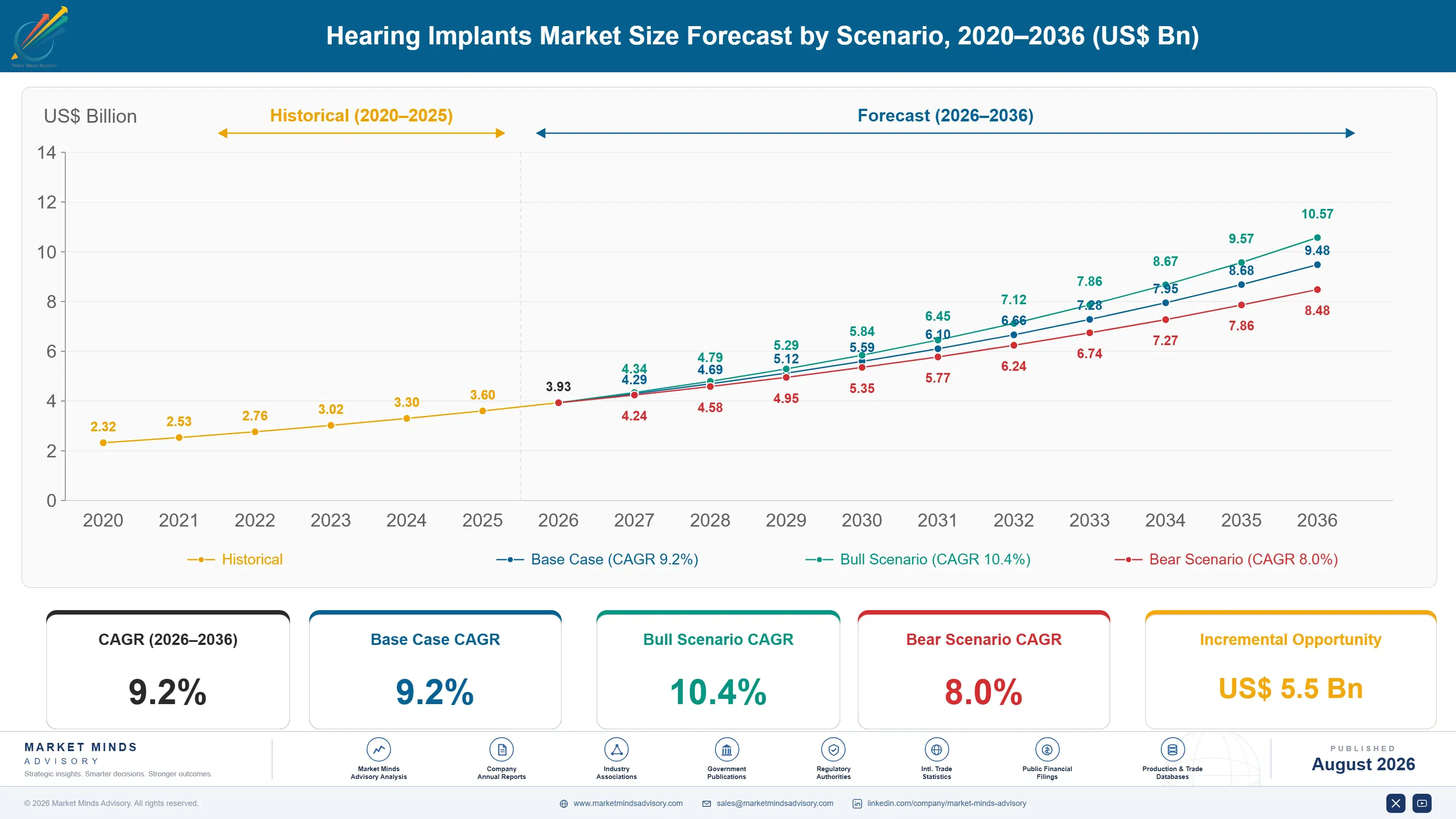
Hearing Implants Market Forecast Scenarios

hearing-implants-market-size-forecast-scenario-1787332438128
Between 2020 and 2025, the market grew at a historical rate near 8.2 percent, carried by steadily widening cochlear implant candidacy criteria and expanding newborn hearing screening coverage across middle-income countries, even as fully implantable systems remained confined to small regulatory pilot programmes rather than broad commercial rollout across major markets during most of this period.
The base case assumes 9.2 percent annual growth through 2036, built on three mechanisms: continued candidacy expansion toward single-sided deafness and residual hearing preservation cases, rising public reimbursement coverage across middle-income Asian and Latin American health systems previously reliant almost entirely on out-of-pocket payment from individual families, and early commercial traction for fully implantable systems removing the external processor that has deterred some candidates from pursuing surgery altogether despite otherwise qualifying clinically for the procedure.
A bull case near 10.4 percent depends on regulators in additional major markets approving fully implantable systems faster than currently expected by most manufacturers and clinical investigators. The bear case near 8.0 percent reflects continued reimbursement caps in several public health systems, since many national payers still fund only one implant per patient regardless of bilateral hearing loss severity or documented clinical benefit from a second procedure.

External Processors Meet the Fully Implantable Challenge

Hearing implants have quietly become a candidacy-expansion business rather than a purely technology one. The core surgical procedure and electrode array design have changed incrementally for years, but the population of patients considered eligible keeps widening toward mild hearing loss and single-sided deafness cases that would have been turned away from surgical consultation a decade ago at nearly every major clinical centre.
TOP 5 CONCENTRATION84% CR5revenue share held by five largest device manufacturers
AVERAGE IMPLANT SYSTEM PRICE$32,000 per proceduretypical device and processor cost, per implanted ear
LEADING PRODUCING COUNTRYAustralia, 31%share of global implant revenue, by manufacturer home country
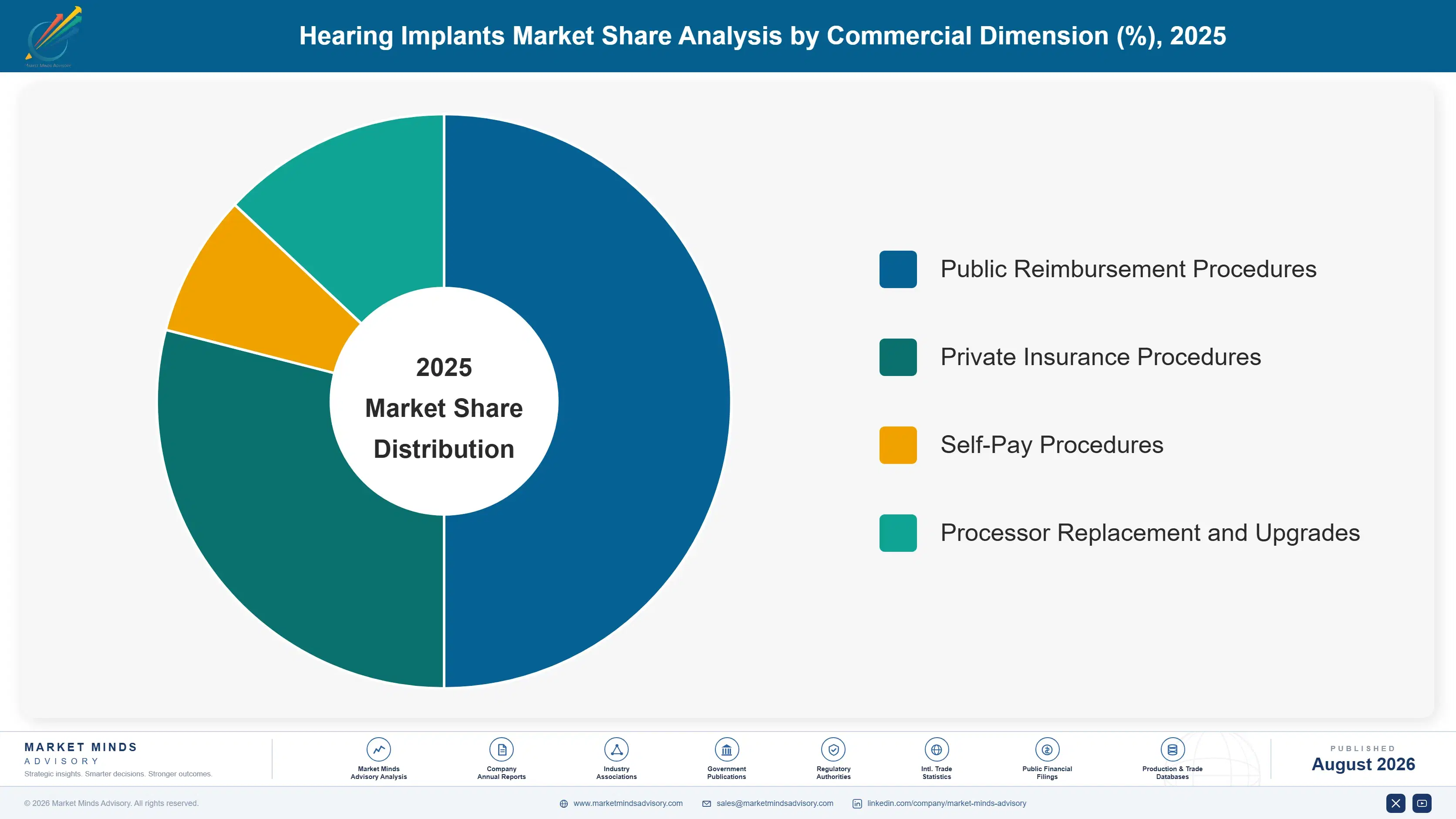
PUBLIC REIMBURSEMENT SHARE68% of volumeshare of implant procedures funded by public health payers
SOUND PROCESSOR UPGRADE CYCLE5 to 7 yearstypical interval between external processor replacement purchases nationwide
ELECTRONICS AND SENSOR COMPONENTS29% of COGSinput cost weight from implanted electronics and sensors
Commercial behaviour splits by procedure type and payer geography. Cochlear implants move through well-established public reimbursement pathways across most developed health systems, while bone-anchored and active middle ear implants still depend more heavily on individual clinical judgment and, in several markets, meaningful out-of-pocket contribution from patients seeking an alternative to conventional hearing aids that have failed to deliver adequate clinical benefit over time.
The next decade turns on whether fully implantable systems can match external-processor sound quality closely enough to justify the additional surgical complexity and cost involved. Manufacturers that solve battery longevity and microphone placement without an external component stand to capture an entirely new category of patients who have specifically avoided surgery over the visible device alone for years, sometimes despite otherwise qualifying clinically for the procedure.
"Patients don't reject implants because the surgery scares them. They reject them because they don't want to wear a visible device for the rest of their lives."
Director, Medical Devices and Diagnostics Practice · MMA Medical Devices Practic

Market Trends

Fully Implantable Cochlear Systems Advance Toward Broader Approval

Envoy Medical's Acclaim fully implantable cochlear implant has advanced through clinical trials specifically designed to demonstrate sound quality comparable to conventional external-processor systems, without any visible external component. The device relies on a subcutaneous microphone sensor placed against the eardrum rather than an externally worn microphone array, a design difference that has drawn considerable clinical interest from audiologists managing patients who have previously declined implant surgery specifically because of the visible processor. Regulatory review remains limited to a handful of markets, but competitors are now investing in comparable fully implantable development programmes.
Market Impact: Screens newborns across 60-plus cou
Candidacy Criteria Widen Toward Single-Sided Deafness

Regulatory and clinical guideline bodies across multiple major markets have widened cochlear implant candidacy criteria to formally include single-sided deafness and asymmetric hearing loss cases, a patient population previously excluded from standard candidacy pathways entirely regardless of documented clinical need or audiologist recommendation. Cochlear Limited and MED-EL have both launched dedicated single-sided deafness clinical programmes and physician education campaigns targeting this newly eligible group, estimated at more than 60,000 new candidates annually across major developed markets according to published otology society guidance documents reviewed by MMA analysts covering multiple national jurisdictions.
Market Impact: Expands coverage to 400M-plus lives

Market Opportunities and Growth Drivers

Newborn Hearing Screening Mandates Expand Diagnosed Candidate Pool

Universal newborn hearing screening programmes, now mandated in more than 60 countries according to World Health Organization surveillance data, are identifying profound congenital hearing loss within days of birth rather than the years-long diagnostic delay that was once common before screening became standard practice. Early diagnosis lets clinicians recommend cochlear implantation during the critical early-childhood language development window, when outcomes are meaningfully better than implantation delayed into later childhood. Middle-income countries expanding screening coverage represent the largest incremental source of newly diagnosed pediatric candidates entering the addressable market each year.
Market Impact: Limits bilateral coverage to 15%

Public Reimbursement Expansion Across Middle-Income Health Systems

Government health insurance schemes across China, India, and several Latin American countries have expanded coverage for cochlear implant procedures in recent years, converting a historically out-of-pocket procedure into one accessible to a meaningfully larger patient population unable to afford the full device and surgical cost previously. China's expanded rural health insurance coverage alone has been credited with a documented rise in annual implant procedure volume, and manufacturers including Nurotron Biotechnology have built domestic manufacturing capacity specifically to serve this newly reimbursed demand at lower price points than imported devices typically command.
Market Impact: Leaves 40% of candidates unconverte

Market Restraints and Challenges

Single-Implant Reimbursement Caps Limit Bilateral Procedures

Many national health payers still fund only one cochlear implant per patient regardless of documented bilateral hearing loss severity, even though clinical evidence increasingly shows meaningfully better sound localisation and speech understanding in noise from bilateral implantation. The root cause is that reimbursement policy in most public systems was set decades ago around single-implant cost assumptions and has not been revisited despite accumulating clinical evidence favouring bilateral procedures. This restricts many candidates to unilateral hearing regardless of their audiologist's recommendation. Manufacturers and clinical societies are actively lobbying payers with updated outcomes data to expand bilateral coverage in several major jurisdictions.
Market Impact: Removes 100% of external hardware

Surgical Access Gaps Constrain Rural Candidate Conversion

Cochlear implant surgery requires a specialised otologic surgeon and post-operative mapping infrastructure that remains concentrated in major urban medical centres across most countries, leaving diagnosed candidates in rural and remote areas without practical access to the procedure even where reimbursement coverage exists on paper. This geographic mismatch between diagnosis and surgical capacity means a meaningful share of newly identified candidates never convert to actual procedures each year. Manufacturers have responded by funding surgeon training programmes and mobile audiology outreach targeting underserved regions, though progress remains gradual relative to the scale of the gap.
Market Impact: Adds 60,000 new candidates yearly
3 additional market trends, 4 additional growth drivers, and 3 additional restraints and challenges are covered in the full report. Contact sales@marketmindsadvisory.com to access the complete intelligence.

Segment CAGR and Growth Architecture

Segmentation follows implant technology type, the classification surgeons and payers already use to distinguish cochlear, bone-anchored, middle ear, and brainstem implant systems across every clinical indication this report covers, from profound congenital deafness through adult-onset conductive hearing loss and emerging fully implantable alternatives to today's standard architecture across every major national market this report tracks in detail.
hearing-implants-market-market-share-analysis-1787332438666

Next-Generation Fully Implantable Cochlear Systems

Fully implantable cochlear systems are the fastest-growing category as Envoy Medical's Acclaim device advances toward broader regulatory approval and competitors accelerate comparable development programmes of their own. The technology places the microphone sensor subcutaneously against the eardrum rather than relying on an externally worn processor, eliminating the visible device that has deterred a meaningful share of candidates from pursuing surgery despite otherwise qualifying clinically. Growth concentrates among adult patients specifically seeking a cosmetically discreet alternative to conventional external-processor systems, a segment underserved by every currently approved mainstream device. Commercial scale remains modest today given limited regulatory approval, but clinical interest from both surgeons and prospective patients has grown considerably faster than manufacturers initially anticipated.
CAGR 19.5%

Active Middle Ear Implant Systems

Active middle ear implants grow fastest among established implant categories as candidacy expands toward moderate-to-severe sensorineural and mixed hearing loss patients who have found conventional hearing aids insufficient but do not require full cochlear implantation. MED-EL's Vibrant Soundbridge and comparable devices from other manufacturers directly drive the ossicular chain rather than amplifying sound acoustically, delivering clearer output for patients with certain ear canal anatomy or chronic infection history that makes conventional hearing aid use uncomfortable or clinically inadvisable. Growth concentrates in developed markets where audiologists increasingly recommend active middle ear implants as a differentiated option ahead of cochlear implant referral for appropriate moderate-loss candidates identified during routine audiology follow-up appointments.
CAGR 13.2%
Full segment breakdown across 6 segments available in the complete report.

Regional Architecture and Country Demand Map

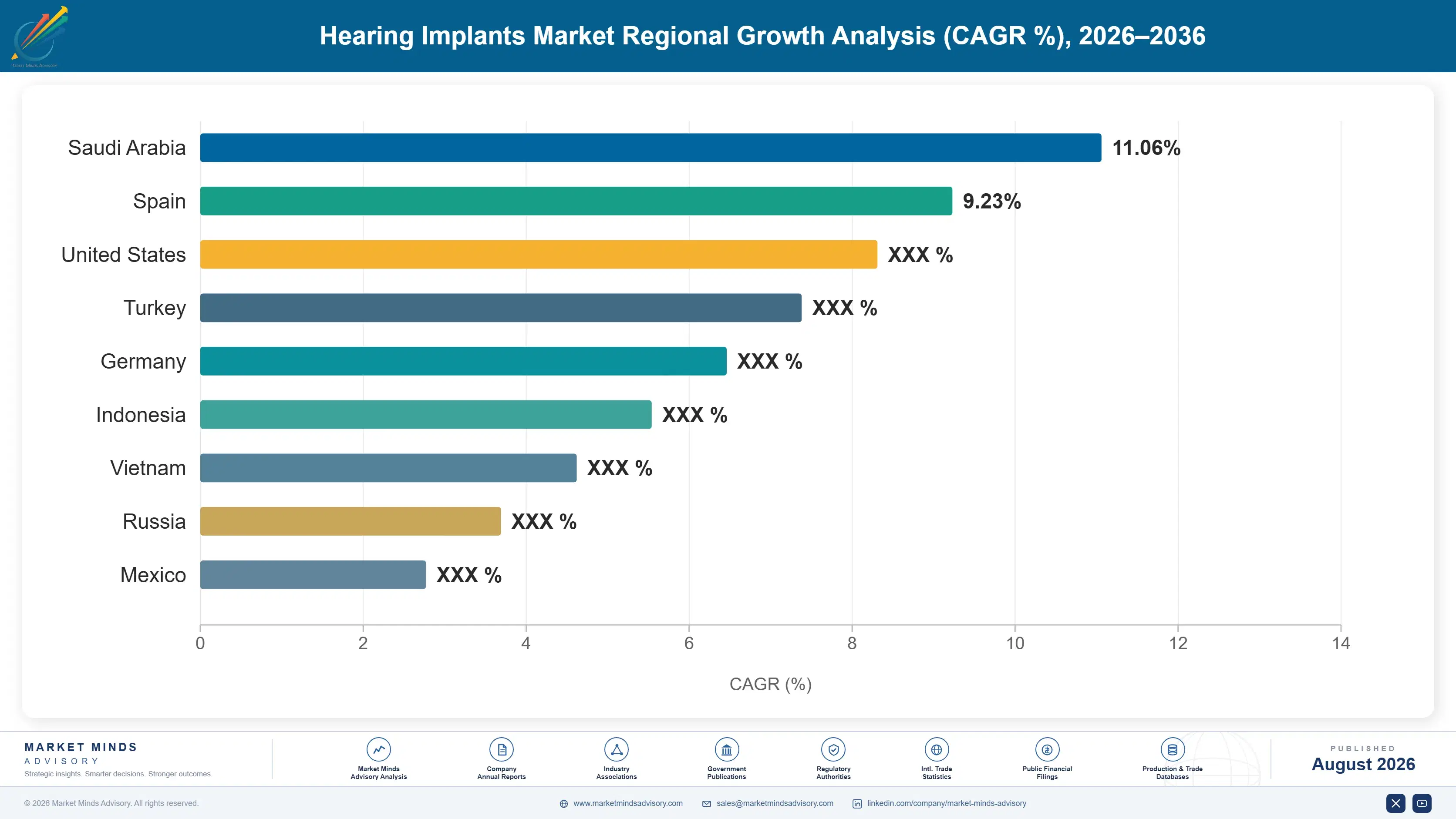
North America and East Asia together account for more than half of global hearing implant revenue, while South Asia and Pacific posts the fastest regional growth on expanding public reimbursement coverage and rising newborn hearing screening adoption across several large developing health systems this report tracks closely.

North America

The United States drives the overwhelming majority of regional demand through comprehensive private insurance and Medicaid coverage for cochlear implant procedures, combined with a dense network of specialised pediatric and adult cochlear implant centres concentrated at major academic medical institutions nationwide. Widening single-sided deafness candidacy criteria approved by the FDA in recent years have meaningfully expanded the addressable adult patient population beyond traditional profound bilateral hearing loss cases. Canada contributes a smaller but stable share, with provincial health systems gradually expanding bilateral implant coverage following patterns already established in several American state Medicaid programmes. Manufacturing and clinical training infrastructure concentrates around major device company regional headquarters serving the broader North American surgeon and audiologist community.
Share: 27% | CAGR: 9.8% (2026 to 2036)

Western Europe

Germany anchors regional demand through its well-established national health insurance coverage for cochlear and middle ear implants, combined with MED-EL's domestic manufacturing and clinical research presence built over more than three decades of continuous device development. The United Kingdom follows closely, with the National Health Service funding both unilateral and, increasingly, bilateral implant procedures through specialised regional cochlear implant programmes. France and the Netherlands contribute meaningful shares tied to established public reimbursement frameworks and long-standing pediatric implant screening protocols. Regional growth trails North America and East Asia because most Western European public health systems already maintain comparatively mature implant coverage, leaving less incremental headroom than markets still expanding basic reimbursement access for the first time.
Share: 22% | CAGR: 7.8% (2026 to 2036)
Regional intelligence for 5 additional markets available in the complete report: East Asia, South Asia and Pacific, Latin America, Middle East and Africa, Eastern Europe. Contact sales@marketmindsadvisory.com.
hearing-implants-market-country-cagr-analysis-1787332439180

Where Hearing Implant Margin Concentrates

Margin follows clinical relationship depth and processor upgrade cycles, not procedure volume alone. Manufacturers who own the mapping software and surgeon training relationship capture durable, recurring revenue that competitors entering later simply cannot replicate without years of comparable clinical infrastructure investment, particularly once surgical centres standardise fully on one manufacturer's proprietary programming and diagnostic platform.

External Sound Processor Replacement Cycle Revenue

Manufacturers capture predictable, recurring revenue from external sound processor replacement roughly every five to seven years, since the surgically implanted internal component typically lasts decades while processor technology continues to improve considerably over that same period. Cochlear Limited and MED-EL both maintain large installed device bases that generate steady processor upgrade revenue independent of new implant procedure volume in any given year. This replacement cycle supports gross margins 15 to 20 percentage points above the initial implant procedure itself, since processor upgrades require no additional surgical cost or hospital facility fee.
Market Impact: Adds 15 to 20 margin points on upgr

Surgeon and Audiologist Clinical Training Programmes

Manufacturers who invest heavily in surgeon training and post-operative mapping certification programmes build lasting clinical relationships that competitors find difficult to displace once a surgical centre standardises on one manufacturer's device and proprietary mapping software. Cochlear Limited operates one of the industry's largest dedicated clinical training networks, spanning more than 100 countries and thousands of trained surgeons and audiologists worldwide. Centres trained extensively on one manufacturer's system switch suppliers at roughly one-third the rate observed among newer, less established surgical centres, according to MMA Primary Research interviews with implant programme directors.
Market Impact: Cuts switching rate by roughly 60%

Middle-Income Reimbursement Expansion Entry Timing Advantage

Manufacturers who establish local manufacturing or distribution partnerships ahead of national reimbursement expansion decisions in middle-income markets capture disproportionate early share before competitors respond with comparable local pricing and clinical support infrastructure. Nurotron Biotechnology's early Chinese domestic manufacturing investment positioned it to capture meaningful share once rural health insurance coverage expanded nationally across the country's most populous provinces. Early entrants in comparable reimbursement expansion markets have historically captured 25 to 35 percent of newly reimbursed procedure volume within the first two years following coverage expansion, based on comparable market entry patterns MMA has tracked across several distinct national markets.
Market Impact: Captures 25 to 35% of new volume ea

Fully Implantable System Early Regulatory Approval

Manufacturers who secure early regulatory approval for fully implantable systems in major markets stand to capture an entirely new patient segment specifically avoiding conventional external-processor devices for cosmetic reasons, a population underserved by every currently approved mainstream product. Envoy Medical's early clinical trial progress on the Acclaim device positions it ahead of competitors still in earlier development stages for comparable fully implantable technology. Early approval in a major reimbursement market could plausibly add 8 to 12 percent incremental candidate conversion beyond today's addressable population, based on physician survey data MMA has collected on patient surgical hesitancy nationwide.
Market Impact: Adds 8 to 12% incremental conversio

Who Controls the Margin Pool

CR5 sits at 84 percent, unusually concentrated for a medical device category this size, reflecting decades of clinical training relationships and mapping software lock-in that new entrants find difficult to displace regardless of underlying device performance. Cochlear Limited holds the largest single position, with a considerable gap to MED-EL and Sonova Holding AG's Advanced Bionics division in the next tier of established challengers.
Current competitive activity centres on three fronts: established manufacturers racing to bring fully implantable cochlear systems through regulatory approval ahead of smaller innovators like Envoy Medical, all five major players expanding candidacy education campaigns targeting single-sided deafness patients, and Chinese domestic manufacturers scaling production to capture newly reimbursed rural procedure volume at competitive price points.

Emerging pressure comes from Chinese domestic implant developers, who have moved from basic device manufacturing toward clinically credible product portfolios capable of competing for reimbursed procedure volume against established Western incumbents. Rankings shift most at the clinical relationship level rather than globally: a manufacturer's installed base in one country carries limited weight in reimbursement expansion markets, where new surgical centres select their initial manufacturer largely independent of that company's position elsewhere in the world.
hearing-implants-market-company-positioning-matrix-1787332439705

Competitive Moat and Risk Dimensions

COCHLEAR LIMITED

Moat: Global Clinical Training Network

Cochlear Limited's clinical training network spans more than 100 countries and thousands of trained surgeons, giving it a durable relationship base that newer competitors cannot yet replicate at comparable scale, even as fully implantable alternatives emerge from smaller innovators targeting a narrower patient segment still in early commercial development.
COCHLEAR LIMITED

Risk: Fully Implantable Late Entry

Cochlear Limited entered fully implantable system development later than Envoy Medical, and closing that clinical evidence gap will require years of trial investment while competitors with an earlier start continue advancing toward broader regulatory approval in major markets and building corresponding surgeon relationships ahead of any commercial launch.
MED-EL

Moat: Middle Ear Implant Technology Lead

MED-EL's Vibrant Soundbridge holds the industry's longest clinical track record in active middle ear implants, giving it credibility with audiologists managing moderate hearing loss patients that competitors focused primarily on cochlear implants have not yet fully matched across comparable indications after more than two decades of continuous commercial deployment.
MED-EL

Risk: Private Ownership Capital Constraint

MED-EL's private ownership structure limits its access to public capital markets compared with publicly traded rivals like Cochlear Limited and Sonova Holding AG, potentially constraining the pace at which it can fund fully implantable system development against better-capitalised competitors racing toward the same regulatory approval milestones.

Players Tracked

Prominent Players

Cochlear Limited
MED-EL
Sonova Holding AG
Demant A/S
GN Store Nord A/S

Other Key Players

Envoy Medical Inc
Earlens Corporation
Nurotron Biotechnology Co Ltd
WS Audiology A/S
Starkey Hearing Technologies
IntriCon Corporation
Akouos Inc
Ototronix NeuroInnovations LLC
Widex A/S
Sivantos Pte Ltd
Zounds Hearing Inc
Rion Co Ltd
Amplifon SpA
HansaTon Akustik GmbH
Eargo Inc

Recent Developments

MARCH 2026

Envoy Medical Reports Expanded Acclaim Trial Enrollment

Envoy Medical announced it had expanded enrollment in its pivotal Acclaim fully implantable cochlear implant trial, covering an estimated 40 participants across multiple clinical trial sites nationwide. The milestone brings the company closer to the evidence base regulators have indicated they require before granting broader commercial approval decisions.
Signal: Fully implantable cochlear developers are
OCTOBER 2025

Nurotron Biotechnology Expands Domestic Manufacturing Capacity

Nurotron Biotechnology completed an expansion of its Chinese manufacturing facility specifically to meet rising demand tied to expanded rural health insurance coverage for cochlear implant procedures. The expansion adds capacity equivalent to roughly 30 percent of the company's existing annual output, with further expansion phases already under review.
Signal: Domestic Chinese manufacturers are scaling
JUNE 2025

Sonova Acquires Advanced Middle Ear Implant Technology

Sonova Holding AG completed an acquisition of a specialised middle ear implant technology developer, strengthening Advanced Bionics' product portfolio beyond its traditional cochlear implant focus. The deal covers exclusive access to specific transducer designs developed by the acquired company, alongside shared rights to future joint product improvements.
Signal: Established cochlear implant manufacturers

Implanted Electronics and Sensor Components

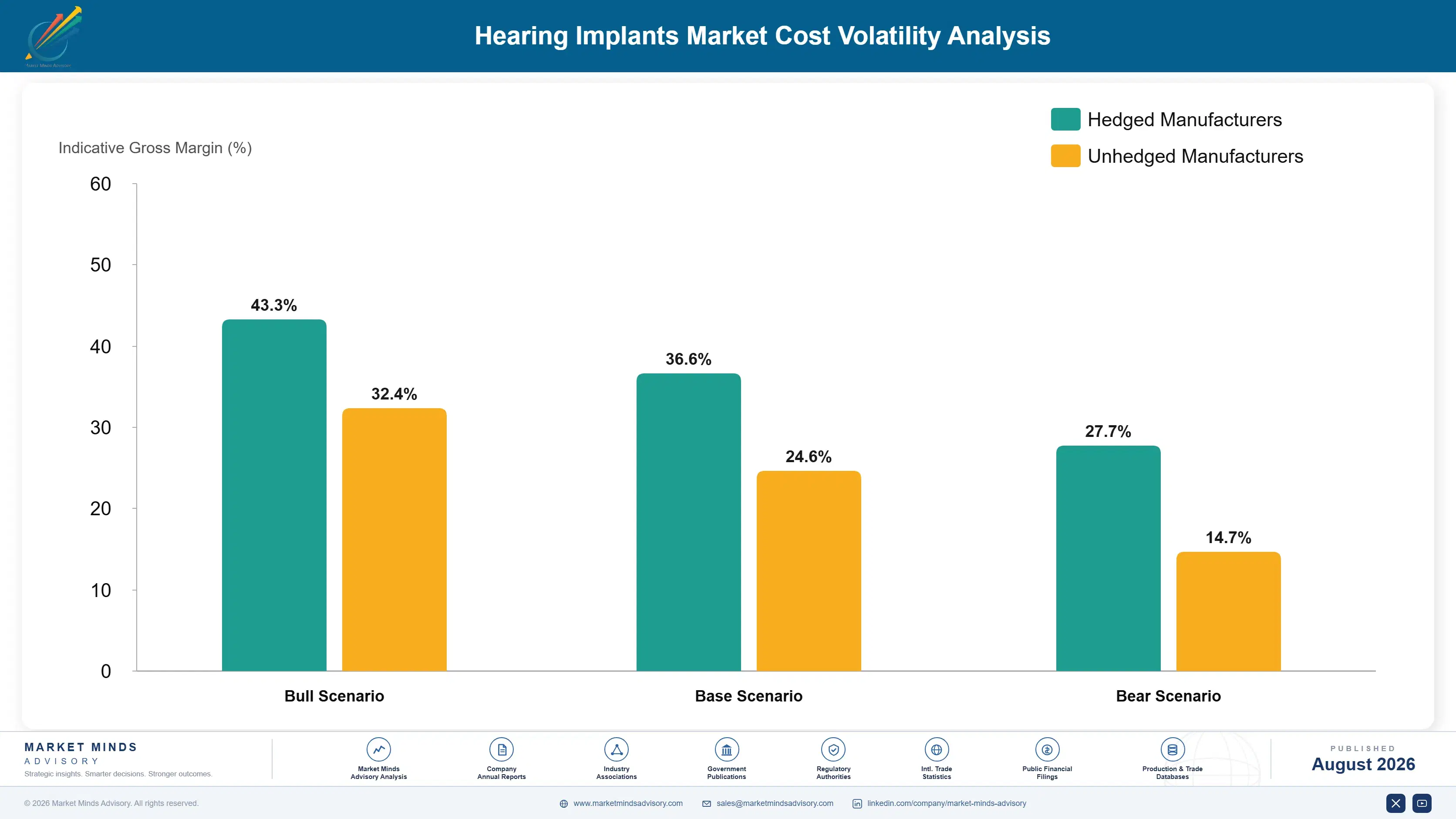
Implanted electronics, microelectrode arrays, and sensor components together represent roughly 29 percent of hearing implant manufacturing COGS, sourced from a concentrated base of medical-grade electronics suppliers and specialised platinum-iridium wire producers serving both hearing implant and broader neurostimulation device end markets simultaneously across the wider industry and its many downstream applications and product lines developed for clinical customers worldwide.
Platinum-iridium wire and medical-grade electronics pricing has remained comparatively stable in recent years given long-term supply contracts common across the implantable medical device industry, though specialised biocompatible encapsulation materials documented in supplier annual reports have seen periodic tightness during periods of surging demand from multiple concurrent device categories competing for the same specialised manufacturing capacity. Battery cell costs for external sound processors have shown less volatility given a mature, established consumer electronics supplier base.

Exposure varies by device type. Fully implantable system developers remain most exposed to biocompatible battery and encapsulation material cost given their reliance on components that must function reliably inside the body for years, while conventional external-processor manufacturers face comparatively more stable input costs tied to mature electrode array and processor electronics that have changed relatively little over the past decade of commercial production at meaningful scale.
hearing-implants-market-cost-volatility-analysis-1787332439907

Long-Term Platinum-Iridium Wire Supply Agreements

Larger manufacturers now lock in multi-year platinum-iridium wire and specialised electronics supply agreements with fixed volume commitments, insulating implant production costs from short-term supply tightness that previously delayed manufacturing schedules and clinical trial device availability considerably across multiple concurrent development programmes competing for identical, limited manufacturing capacity industry-wide each and every fiscal quarter observed.

In-House Biocompatible Encapsulation Capability

Several leading manufacturers have built internal biocompatible encapsulation and hermetic-sealing capability specifically to reduce dependence on external suppliers for components requiring decades of proven in-body reliability, trading higher fixed capital investment for greater supply certainty during periods of industry-wide demand and constrained third-party manufacturing capacity across the entire supply chain and its many participants.

Dual-Sourcing Battery Cell Suppliers

External processor manufacturers increasingly qualify two battery cell suppliers per product line rather than one, adding validation cost upfront but avoiding single-supplier exposure during periods of raw material tightness affecting the broader medical electronics supply chain simultaneously across multiple concurrent production and testing programmes operating at meaningful scale nationwide and internationally in every fiscal year observed.

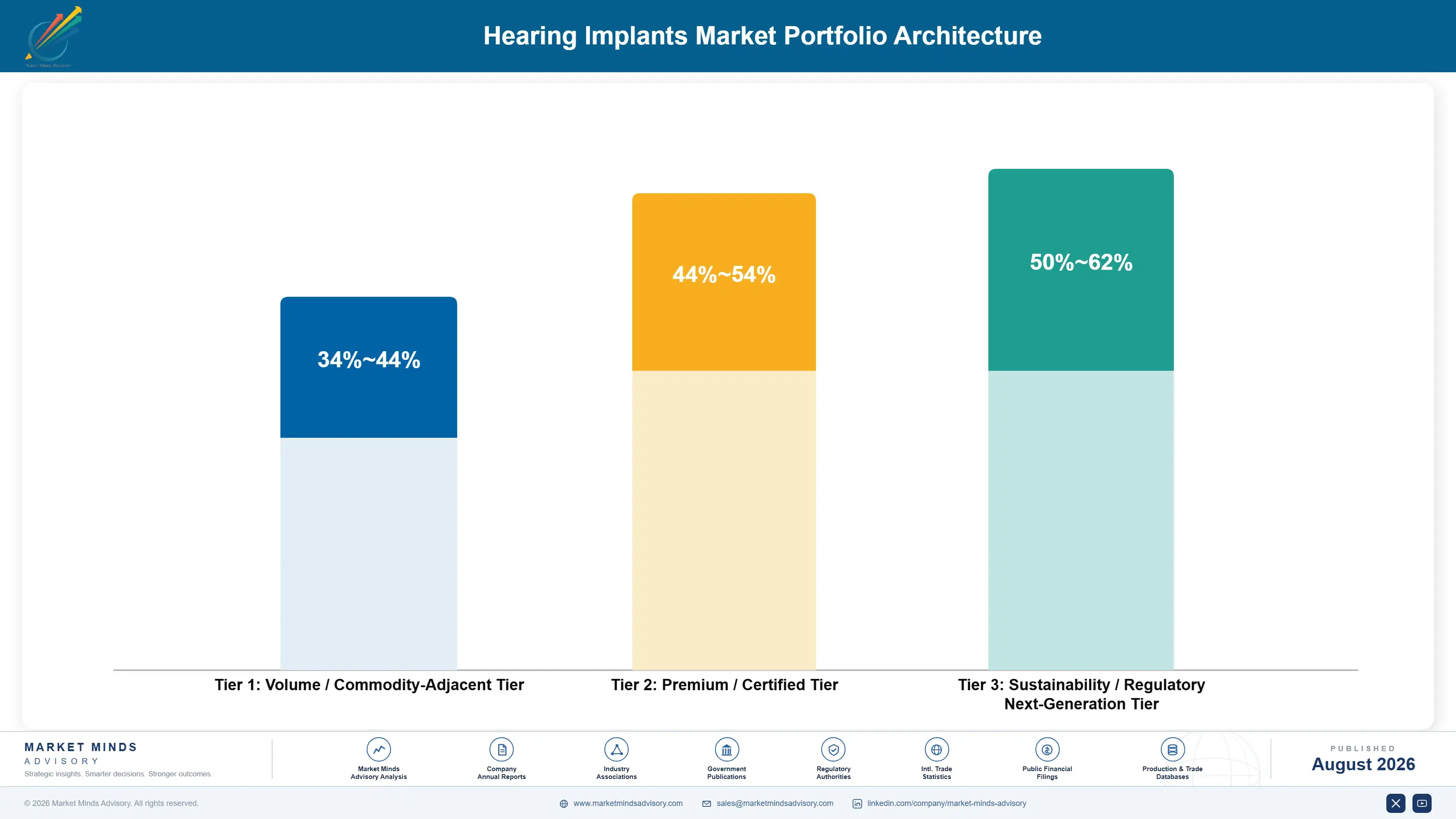
Portfolio Architecture for Margin Defence

Portfolio economics split across three tiers. Established cochlear implant systems compete mainly on clinical training relationships and reimbursement coverage in a mature, predictable-margin business built over decades, while emerging fully implantable and next-generation middle ear systems command the highest theoretical margins, reflecting the premium early adopters and cosmetically motivated patients pay for technology still awaiting broader regulatory approval and reimbursement decisions fr
The tension between volume and premium plays out starkly across the category's two halves. Reimbursed cochlear implant procedures generate predictable, high-volume revenue at moderate margins built on years of payer negotiation, while fully implantable system developers burn considerable capital pursuing regulatory approval and clinical evidence that may take years longer to materialise than current investor expectations assume across the sector, its many participants, and their boards.

High-value margin pools concentrate in external processor replacement revenue and early fully implantable adoption during this pre-broad-approval phase, where limited competing supply keeps pricing power intact well past what reimbursed, price-negotiated cochlear implant procedures retain after years of established payer contracting across the broader industry, its many suppliers, and their respective distribution partners nationwide.

Volume / Commodity-Adjacent Tier

Established cochlear and bone-anchored implant systems with broad reimbursement, competing primarily on clinical training relationships and payer contracting terms built over decades of sustained category presence, clinical trust, and patient loyalty.
Gross Margin: 34%-44%

Premium / Certified Tier

Active middle ear implants and newer bone conduction systems carrying emerging reimbursement codes or proven clinical evidence supporting broader payer coverage across additional patient populations, geographies, provider networks, and clinical channels.
Gross Margin: 44%-54%

Sustainability / Regulatory / Next-Generation Tier

Fully implantable cochlear systems capturing premium cash-pay and early-adopter pricing during this pre-broad-approval commercial phase ahead of wider anticipated regulatory decisions still pending detailed clinical and government policy review nationwide.
Gross Margin: 50%-62%
hearing-implants-market-portfolio-architecture-1787332440478

High-value Sub-segments and Strategic Watch-out

Regulatory-Pending Fully Implantable Systems

Fully implantable cochlear systems awaiting broader regulatory approval combine high theoretical value with the fastest specification growth in the category, as clinical trials steadily accumulate evidence ahead of anticipated approval decisions expected across several additional major markets and covered patient populations in the coming several years.
Gross Margin: 50%-60%

Single-Sided Deafness Early Adoption Channel

Cochlear implants for single-sided deafness carry solid margins with a growth curve still accelerating rapidly following widened candidacy guidance, as surgeons and audiologists scale referral pathways to meet rapidly building demand across previously underserved adult patients who had not been considered viable surgical candidates before this guidance change.
Gross Margin: 38%-48%

Established Bilateral Cochlear Reimbursed Base

Long-established, fully reimbursed bilateral cochlear implant procedures generate steady, predictable volume across a mature patient base but carry moderate margins after years of payer contracting negotiations among a relatively small group of qualified, well-established suppliers competing mainly on price, service, and clinical training quality nationwide.
Gross Margin: 34%-42%

Next-Generation Battery Longevity Improvement

Fully implantable systems targeting meaningfully improved battery longevity without external recharging represent a strategic watch-out: it remains unclear how quickly next-generation battery chemistry can close the current longevity gap limiting today's commercial products and their broader long-term clinical and commercial value proposition for patients and payers.
Gross Margin: N/A pre-launch

Processor Replacement Annuity Economics

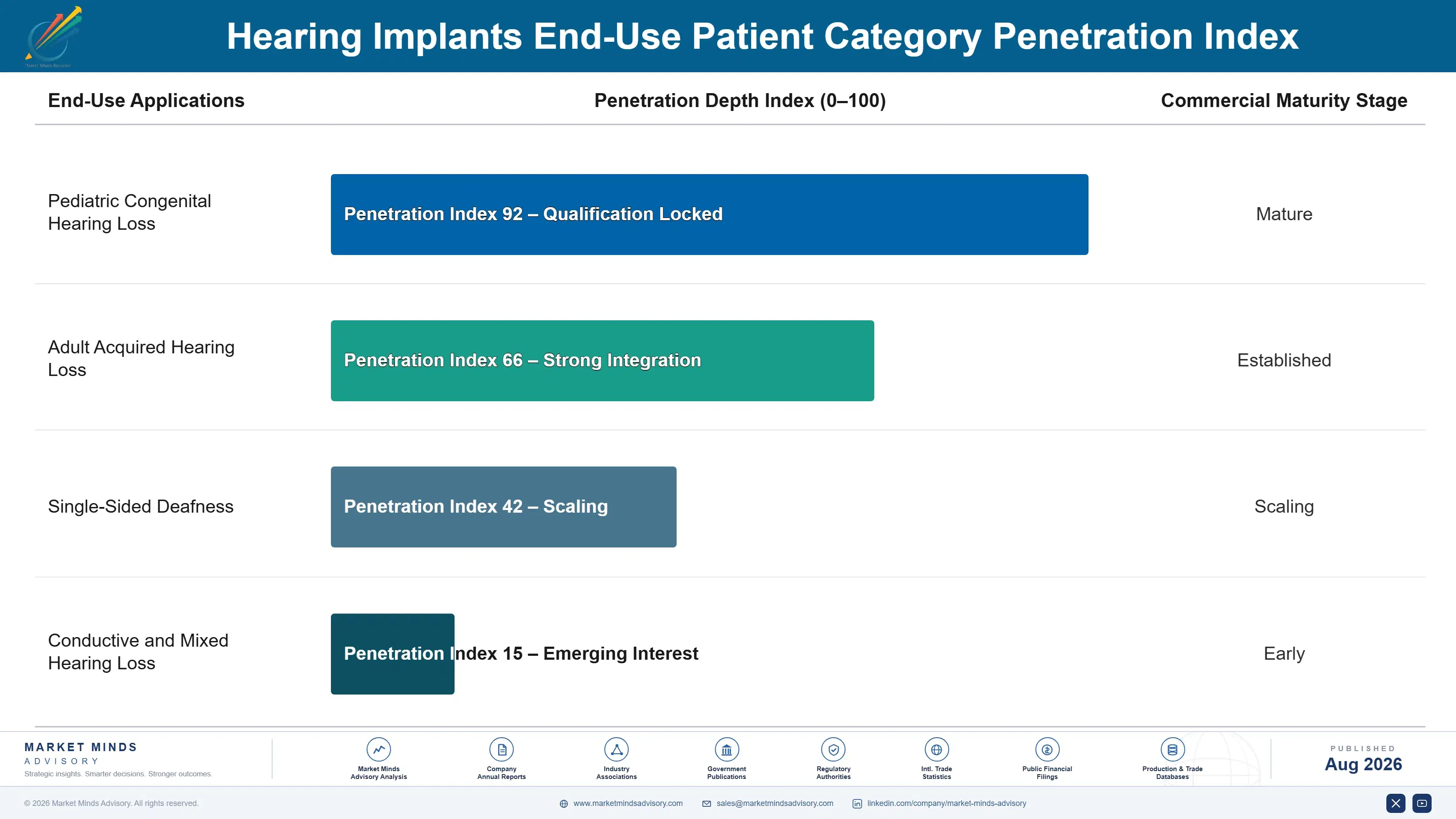
Hearing implant demand behaves like a multi-decade processor-replacement annuity rather than a one-time purchase, since the surgically implanted internal component typically lasts a patient's lifetime while the external sound processor repeats on a five-to-seven-year replacement schedule, generating predictable recurring revenue from an enrolled patient base for as long as the patient remains under that manufacturer's clinical care.
Adoption depth varies considerably by indication and clinical maturity. Established, reimbursed pediatric cochlear implantation sees broad, consistent adoption once diagnosed through newborn screening and referred into specialised implant centres following routine clinical protocols. Adult single-sided deafness and fully implantable candidates show far more variable adoption, concentrated among patients actively seeking an alternative to conventional hearing aids that have already failed to deliver adequate benefit.

A generational shift is underway in referring audiologist behaviour. Audiologists trained after 2015 show meaningfully more comfort discussing implant candidacy for moderate hearing loss than predecessors trained purely on traditional profound-loss referral protocols, a shift that should widen adoption further as this cohort becomes a larger share of practising audiologists over the next decade of continued clinical evidence accumulation, guideline expansion, and training curriculum change.
hearing-implants-market-end-use-penetration-index-1787332440987

Positioning for the Fully Implantable Transition

These are among the four positions where our research anticipates prominent divergence between winners and laggards over the coming forecast period. Each is grounded in the demand model, the regulatory perimeter, and the announced capacity pipeline.
01 / FULLY IMPLANTABLE EVIDENCE RACE

Complete pivotal trials before smaller innovators lock in surgeon relationships

Established manufacturers racing to match Envoy Medical's fully implantable development progress face a genuine timing risk if pivotal trials take longer than currently planned to generate conclusive evidence for regulators still weighing broader approval decisions. Envoy Medical's early trial investment reflects a bet that evidence generation speed matters more than near-term commercial scale during this pre-approval phase of the category's development. Companies that under-invest in comparable trials now risk ceding the cosmetically motivated patient segment to a smaller, faster-moving competitor, with little realistic path back once surgeon relationships solidify.
02 / CANDIDACY EXPANSION DEFENCE STRATEGY

Protect established referral relationships while competitors chase new indications

Established cochlear implant manufacturers holding broad clinical training relationships face a different strategic challenge than smaller entrants: defending existing surgeon and audiologist relationships while simultaneously investing in single-sided deafness and fully implantable indications that could eventually shift where referring clinicians send new candidates. Cochlear Limited illustrates this tension directly, balancing continued core franchise investment against meaningful new-indication spending across several concurrent clinical programmes underway. Companies that neglect either side of this balance risk losing ground to focused single-strategy competitors on either front of the business over time.
03 / MIDDLE-INCOME MARKET ENTRY SEQUENCING

Build local manufacturing ahead of reimbursement expansion decisions

Manufacturers who build local manufacturing or distribution capacity ahead of national reimbursement expansion decisions in middle-income markets capture disproportionate early share before competitors respond with comparable local pricing and clinical support. Nurotron Biotechnology's early Chinese manufacturing investment illustrates the value of this sequencing, and comparable opportunities are opening across other large, still-underpenetrated health systems expanding coverage in the coming years. Manufacturers who wait for confirmed policy decisions before committing capital consistently cede early share to faster-moving competitors already positioned locally.
04 / INPUT COST RESILIENCE PLANNING

Secure biocompatible component supply ahead of the next demand surge

Biocompatible encapsulation and battery component tightness during periods of surging device demand has previously delayed manufacturing schedules for developers relying entirely on spot-market procurement rather than committed long-term supply agreements. Developers still buying components without multi-year commitments remain exposed to the same risk as multiple concurrent device categories compete for limited specialised manufacturing capacity across the wider implantable device industry each year. Long-term supply agreements have already proven their value for developers who adopted them ahead of recent tightness cycles industry-wide.

Engagement Snapshot From the Field

A live engagement with an industry participant carrying material or product regulatory and market exposure ahead of a defining policy shift, showing how our research translates into a defensible multi-year portfolio strategy.
MARKET MINDS ADVISORY · CLIENT ENGAGEMENT SUMMARY
Hearing Implants Producer Strategic Portfolio Review and Transition Roadmap 2026·Investment Scenario on Hearing Implants Exposure Evaluation 2025-26
CLIENT PROFILE
The client is a mid-size hearing implant manufacturer evaluating market entry into a large middle-income country, with annual global device revenue reported in the 200 to 350 million dollar range (client-reported, unverified by MMA), assessing whether to establish local manufacturing ahead of an anticipated national reimbursement expansion decision under active government review across multiple ministries and regional health authorities.
STRATEGIC CHALLENGE
The manufacturer's leadership was divided between committing capital to local manufacturing now, ahead of confirmed reimbursement approval, or waiting for the government decision given concerns about stranded investment if the coverage expansion were delayed or scaled back from initial policy proposals under discussion among health ministry officials and regional budget planners.
MMA APPROACH
MMA benchmarked comparable manufacturer market entry decisions made across three prior reimbursement expansion markets, analysing entry timing, local manufacturing investment, and resulting share capture relative to competitors that waited for confirmed approval. The team conducted primary interviews with manufacturer executives and health ministry policy advisors involved in comparable prior coverage decisions.
KEY FINDINGS
  1. Two of three benchmarked manufacturers that entered early captured meaningfully greater share than competitors who waited for confirmed reimbursement approval before committing any capital.
  2. Stranded investment risk proved manageable through phased manufacturing commitments that most early entrants structured carefully around confirmed government policy milestones and budget cycles.
  3. Government reimbursement timelines varied considerably by country, with confirmed approval taking between eighteen months and four years from the initial policy proposal stage.
  4. Manufacturers offering surgeon training investment alongside market entry reported meaningfully stronger, longer-lasting government relationships than manufacturers pursuing distribution alone without comparable training investment or engagement.
CLIENT PROFILE
The client is a mid-size hearing implant manufacturer evaluating market entry into a large middle-income country, with annual global device revenue reported in the 200 to 350 million dollar range (client-reported, unverified by MMA), assessing whether to establish local manufacturing ahead of an anticipated national reimbursement expansion decision under active government review across multiple ministries and regional health authorities.
STRATEGIC CHALLENGE
The manufacturer's leadership was divided between committing capital to local manufacturing now, ahead of confirmed reimbursement approval, or waiting for the government decision given concerns about stranded investment if the coverage expansion were delayed or scaled back from initial policy proposals under discussion among health ministry officials and regional budget planners.
MMA APPROACH
MMA benchmarked comparable manufacturer market entry decisions made across three prior reimbursement expansion markets, analysing entry timing, local manufacturing investment, and resulting share capture relative to competitors that waited for confirmed approval. The team conducted primary interviews with manufacturer executives and health ministry policy advisors involved in comparable prior coverage decisions.
KEY FINDINGS
  1. Two of three benchmarked manufacturers that entered early captured meaningfully greater share than competitors who waited for confirmed reimbursement approval before committing any capital.
  2. Stranded investment risk proved manageable through phased manufacturing commitments that most early entrants structured carefully around confirmed government policy milestones and budget cycles.
  3. Government reimbursement timelines varied considerably by country, with confirmed approval taking between eighteen months and four years from the initial policy proposal stage.
  4. Manufacturers offering surgeon training investment alongside market entry reported meaningfully stronger, longer-lasting government relationships than manufacturers pursuing distribution alone without comparable training investment or engagement.
RECOMMENDED STRATEGY
Phase 1: Phase 1 (Months 1 to 6): Establish a phased manufacturing commitment structure tied to confirmed government policy milestones and budget approvals. Phase 2: Phase 2 (Months 7 to 14): Launch surgeon training investment alongside initial distribution to build government and clinical relationships nationwide. Phase 3: Phase 3 (Months 15 to 30): Scale local manufacturing capacity once reimbursement expansion is formally confirmed and fully government funded.
OUTCOME
The manufacturer launched a phased market entry reaching an estimated 40 surgical centres in its first eighteen months, with reimbursement expansion confirmed roughly on the timeline MMA's benchmarking had projected (client-reported, unverified by MMA). The phased approach reduced stranded investment risk considerably compared to the all-at-once entry pursued by one benchmarked comparison manufacturer in an earlier, unrelated market expansion.

Frequently Asked Questions

Foundational context covering the market sizes, CAGR, scope, country, region and competition that inform every finding below. This section is provided to cover basics and most often pre-purchase conversations, answered from the MMA Primary Research Dataset.

What is the current size of the Hearing Implants Market?

The global market reached an estimated 3.6 billion dollars in 2025, anchored by established cochlear implant procedures. Growth is concentrated in fully implantable systems and single-sided deafness indications.

How large will the Hearing Implants Market be by 2036?

MMA projects the market will reach approximately 9.48 billion dollars by 2036 under the base-case forecast scenario. This reflects expanding candidacy criteria and reimbursement coverage.

What is the CAGR for the Hearing Implants Market 2026 to 2036?

The base-case compound annual growth rate is 9.2 percent across the full ten-year forecast period. Bull and bear scenarios range from 8.0 to 10.4 percent.

Which segment is growing fastest?

Next-generation fully implantable cochlear systems lead at a 19.5 percent CAGR, roughly 2.12 times the overall market rate. Active middle ear implant systems follow as the second-fastest segment.

Who are the major companies in the Hearing Implants Market?

Cochlear Limited, MED-EL, Sonova Holding AG, Demant A/S, and GN Store Nord A/S hold the top five positions by revenue. Clinical training relationships increasingly separate category leaders.

Which country is growing fastest?

India leads at an estimated 14.5 percent CAGR, driven by expanding newborn hearing screening and government health insurance coverage. Rising surgical infrastructure investment supports continued adoption.

Report Segmentation Architecture

The full report scope spans multiple orthogonal segmentation dimensions, with cross-tabulated demand data provided for each dimension pair. Coverage extends further to regional breakdowns, trend trajectories, and the competitive detail needed to support segment-level decision-making.

By Implant Technology Type

  • Cochlear Implant Systems
  • Bone-Anchored Hearing Implant Systems
  • Active Middle Ear Implant Systems
  • Auditory Brainstem Implant Systems
  • Fully Implantable Cochlear Systems
  • External Sound Processors and Accessories

By End-Use Patient Category

  • Pediatric Congenital Hearing Loss
  • Adult Acquired Hearing Loss
  • Single-Sided Deafness
  • Conductive and Mixed Hearing Loss

By Commercial Dimension

  • Public Reimbursement Procedures
  • Private Insurance Procedures
  • Self-Pay Procedures
  • Processor Replacement and Upgrades

By Region

  • North America
  • Western Europe
  • East Asia
  • South Asia and Pacific
  • Latin America
  • Middle East and Africa
  • Eastern Europe

Scope, Methodology, and Coverage

Every figure in this report is reproducible from documented input assumptions. The scope below maps the historical period, the forecast horizon, the segmentation dimensions, and the countries covered, alongside the underlying primary and qualitative methodology.
Historical Period
2020 to 2025
Forecast Period
2026 to 2036
Base Year
2025 (USD billions; MMA Primary Research Dataset, August 2026)
Market Definition
This market covers surgically implanted hearing devices, including cochlear implants, bone-anchored hearing implants, active middle ear implants, and auditory brainstem implants, along with their external sound processors and accessories. It excludes conventional air-conduction hearing aids requiring no surgical implantation and standalone diagnostic audiometry equipment.
Quantitative Units
USD billions (current prices); implant procedure volume in units where applicable
Segmentation Dimensions
By Implant Technology Type; By End-Use Patient Category; By Commercial Dimension; By Region
Regions Covered
North America, Western Europe, East Asia, South Asia and Pacific, Latin America, Middle East and Africa, Eastern Europe
Countries Covered
USA, China, Germany, France, UK, Japan, South Korea, India, Australia, Canada, Brazil, Mexico, Indonesia, Vietnam, Thailand, Malaysia, UAE, Saudi Arabia, South Africa, Nigeria, Turkey, Poland, Netherlands, Italy, Spain, Sweden, Switzerland, Argentina, Colombia, Singapore, and additional markets relevant to this sector
Key Companies Profiled
Cochlear Limited, MED-EL, Sonova Holding AG, Demant A/S, GN Store Nord A/S, Envoy Medical Inc, Earlens Corporation, Nurotron Biotechnology Co Ltd, WS Audiology A/S, Starkey Hearing Technologies, IntriCon Corporation, Akouos Inc, Ototronix NeuroInnovations LLC, Widex A/S, Sivantos Pte Ltd, Zounds Hearing Inc, Rion Co Ltd, Amplifon SpA, HansaTon Akustik GmbH, Eargo Inc
Quantitative Methodology
Primary survey, n=3,800 respondents, Q4 2025, six countries; demand-side model with trade association cross-validation
Qualitative Methodology
47 expert interviews, Q4 2025; applied to validate demand model assumptions, identify emerging dynamics, and assess competitive positioning
Report Format
PDF and XLSX data workbook (Word format preview document)
Publisher
Market Minds Advisory
Report Code
MMA-2026-MED-318
Published
August 2026
Contact
sales@marketmindsadvisory.com | www.marketmindsadvisory.com

Purchase the full Hearing Implants Market Report (2026 to 2036).

The full report delivers a company-by-company clinical trial tracker covering every major fully implantable and next-generation hearing implant developer through 2030 with disclosed enrollment timelines and anticipated regulatory milestones. It includes a reimbursement policy tracker mapping public and private payer coverage decisions across every profiled device category and region. Surgeon and audiologist adoption survey data is provided from MMA's primary research programme, alongside candidacy expansion benchmarking across major clinical guideline bodies worldwide. Buyers also receive a company-level financial and regulatory-milestone model updated quarterly throughout the subscription period each year.
Company-by-company clinical trial and enrollment tracker
Public and private payer reimbursement policy database
Surgeon and audiologist adoption survey data
Quarterly competitor financial and milestone model updates
Candidacy expansion and guideline benchmark data set
Custom market entry and reimbursement strategy workshops

Built For The People Who Decide

From boardroom strategy to bench-side execution, this report is read cover-to-cover by leaders shaping the next decade of their industry, turning demand scenarios, market dynamics and valuation benchmarks into decisions.
CXOs/ Presidents/ VPs/ Managers
M&A and Corporate Development
Strategy Teams and R&D Heads
Procurement and Product Directors
Regulatory and Compliance Leaders
Investor Relations and Equity Analysts