Market Minds Advisory
Healthcare Mobile Computers Market

Healthcare Mobile Computers Market: Healthcare Mobile Computers Market: Device Classes, Workflow Seconds and Disinfection Economics 2026 to 2036

Every hospital has a drawer of abandoned devices. Almost none of them failed on features. They failed because scanning a wristband took eight seconds and the nursing workflow allowed three at most.

Lead Analyst

Published

September 2026

Make Smarter Decisions with Customized Research Insights

Request a free sample report and evaluate market opportunities, growth trends, and competitive dynamics relevant to your business needs.

2025 MARKET VALUE$2.7BMarket Size 2025
2036 FORECAST VALUE$7.2BBase Case , 2026 to 2036
CAGR 2026 TO 20369.4 %Bull 10.7% / Bear 8.1%
INCREMENTAL OPPORTUNITY$4.3BNet 10- year value creation
EXPANSION MULTIPLE2.45x2036 value over 2026 base
Strategic Levers
M&A Pipeline
Regional Outlook
Country Rankings
Competitive Intelligence
Segmental Deep-dive
Call-Us : 91 93563 13602

Executive Snapshot and Market Trajectory.

These devices are bought to prevent medication errors and they do exactly that, when nurses actually use them. Whether that happens turns on seconds rather than on features. A bedside scan taking eight seconds instead of three produces workarounds, and the safety benefit quietly disappears.
The market reaches USD 2.95 billion in 2026 and USD 7.24 billion by 2036, a 2.45 times expansion at 9.4%. Wearable and hands-free devices grow at 14.1%, half again the market rate of 9.4%, because a nurse with both hands occupied cannot operate anything requiring a screen. North America holds 36% of shipment revenue on medication safety regulation, and Saudi Arabia grows fastest at 16.2% on new greenfield hospital construction.
Five suppliers hold 63% of device shipment revenue, which is concentrated because healthcare certification and disinfection tolerance are genuine engineering barriers rather than marketing claims. Zebra Technologies and Honeywell brought rugged enterprise scale into clinical settings. Ascom and Stryker reached the same wards through clinical communication rather than through hardware. Advantech supplies the specialist medical computing platforms sitting underneath a great deal of it. Nobody else has assembled both halves of that at once.
Market Definition
This report covers purpose-built mobile computing devices deployed in clinical care settings: clinical smartphones and handhelds, medical grade tablets, mobile clinical workstations, wearable and hands-free devices, dedicated scanning terminals, and vital signs integrated mobile devices. It excludes diagnostic and therapeutic medical devices, patient monitoring systems, electronic health record software, consumer smartphones without healthcare certification, and fixed nursing station computing equipment.
Base Year Value
$2.7B in 2025 (MMA Primary Research Dataset, September 2026)
Forecast Period
2026 to 2036, eleven discrete annual values
CAGR
9.4% base case. Bull 10.7%. Bear 8.1%.
Fastest Growth Segment
Wearable And Hands-Free Devices: 14.1% CAGR
Fastest Growth Country
Saudi Arabia: 16.2% CAGR
Fastest Growth Region
South Asia and Pacific: 11.5% CAGR
Largest Region
North America: 36% of 2025 global value
Market Leaders
Zebra Technologies, Honeywell, Ascom, Stryker and Advantech lead on healthcare mobile computing device shipment revenue. Source: MMA Analysis.
Primary Survey
n=3,800 procurement and R&D decision-makers, Q4 2025, six countries
Methodology
Demand-side build-up, cross-validated against public data, 47 expert interviews

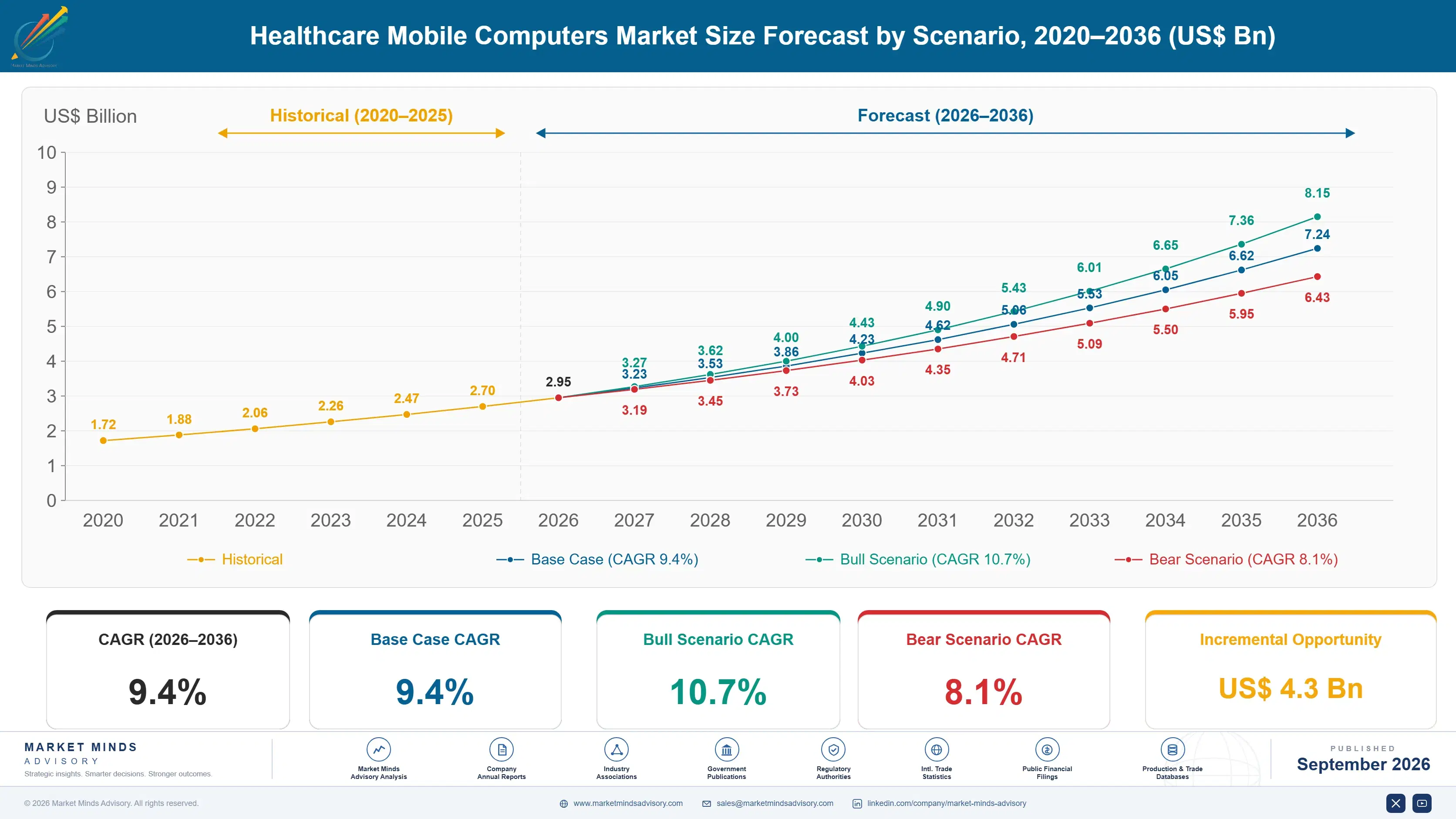
Healthcare Mobile Computers Market Forecast Scenarios

healthcare-mobile-computers-market-size-forecast-scenario-1789990615643
Between 2020 and 2025 the category compounded at 8.2%, and a great deal of that arrived in a rush nobody had planned. Pandemic conditions forced device deployment into wards that had resisted it for years, then the devices stayed because the workflows had changed around them. Replacement demand from that cohort now arrives on a 3.2 year cycle most health systems underestimate.
The base case holds 9.4% on three mechanisms. Medication safety regulation keeps extending barcode verification into settings beyond acute inpatient wards, including outpatient infusion, aged care and community nursing. Nursing shortages make every saved second across a shift genuinely valuable, which pushes hands-free and wearable formats forward. And hospital construction across the Gulf and Asia is equipping greenfield facilities from the start, which is far easier than retrofitting an existing estate.
The bull case at 10.7% assumes fast user switching becomes reliable enough that shared devices behave like personal ones, which would remove the largest adoption obstacle in nursing. The bear case at 8.1% is health system capital pressure deferring replacement past the point where disinfection chemistry has already degraded the fleet, which shifts spending later and increases failure rates in the interim.

Deployments Fail On Seconds, Not Features

Barcode medication administration prevents errors and the evidence for it is unambiguous, which is why health systems keep buying these devices. Whether a deployment works turns on something no datasheet reports. A bedside verification has to complete in around three seconds, because that is what a medication round allows. At eight seconds nurses batch scans or skip the step, and the benefit vanishes.
TOP FIVE CONCENTRATION63%Concentrated among rugged device makers holding healthcare certification
MEDICATION SCAN TIME3 secondsWristband to medication verification completed at the bedside
USERS PER SHARED DEVICE5Clinicians using the same unit across daily nursing shifts
DEVICE REPLACEMENT CYCLE3.2 yearsShortened by disinfection chemistry rather than by any obsolescence
DISINFECTION WIPE FREQUENCY14 dailyCleaning events per device under hospital infection control protocols
DEVICES PER HUNDRED BEDS42Deployed mobile computing units across inpatient nursing units
Disinfection destroys more of these devices than dropping ever has. Infection control protocols require wiping around 14 times a day with quaternary ammonium and bleach compounds that attack plastics, seals and screen coatings. A lightly ruggedised device fails within months of that regime. Medical grade housings cost several times an enterprise unit for that reason, and replacement runs at 3.2 years.
Shared use breaks every assumption consumer mobile management makes. Around five clinicians use the same unit across a day, which turns battery, authentication, personalisation and hygiene into problems no personal device faces. Fast user switching in under three seconds decides adoption more reliably than processor or screen specifications do. That is a software problem, and hardware suppliers keep answering it with hardware.
"Ask a chief nursing officer why the last deployment failed and you will not hear about the device. You will hear about the login. Somebody specified a fleet on ruggedness and battery life, and it died on the four seconds it took to authenticate a different nurse."
Principal, Clinical Technology and Care Delivery Systems Practice · MMA Healthcare Practice · September 2026

Market Trends

Hands-Free Formats Answer A Nursing Time Problem

A nurse repositioning a patient, managing an infusion line or assisting with a transfer has both hands occupied and cannot operate anything requiring a screen at that moment. Wearable badges, voice-operated communication devices and hands-free scanning rings remove the interaction entirely rather than making it faster. Wearable and hands-free devices compound at 14.1% against 9.4% for the market on exactly this. Nursing shortages made every saved second across a twelve hour shift a genuine operational argument, which is a very different case from the one screen based devices have to make.
Market Impact: Handhelds compound at 11.8% yearly
Disinfection Chemistry Sets The Replacement Cycle

Infection control protocols require these devices to be wiped around 14 times daily with quaternary ammonium and bleach based compounds that degrade plastics, seals and screen coatings steadily. That chemistry rather than dropping or obsolescence determines when a device fails, and it produces a replacement cycle near 3.2 years that health system finance departments consistently budget as five. Medical grade housings resist it at several times the cost of comparable enterprise hardware, which is a premium buyers dispute until they have replaced a lightly ruggedised fleet twice. Buyers dispute the premium until a cheap fleet fails twice.
Market Impact: New builds pass 42 per hundred

Market Opportunities and Growth Drivers

Medication Verification Is Extending Beyond Acute Wards

Barcode medication administration began in acute inpatient settings and regulators and accreditation bodies are steadily extending equivalent verification requirements into outpatient infusion, aged residential care, community nursing and increasingly into operating theatre medication handling. Each of those settings has different mobility, connectivity and hygiene conditions from a hospital ward, which means different device requirements rather than simply more units of the same thing. Clinical smartphones and handhelds compound at 11.8% on this expansion, and the settings involved have far lower existing device density to start from. Nobody starts those settings from an equipped position.
Market Impact: About 5 users share each device

Greenfield Hospital Construction Equips From The Start

Building a hospital and specifying mobile computing from the outset avoids every obstacle a retrofit faces: wireless coverage designed for the devices, workflows written around them, and clinicians trained before habits form. Gulf construction programmes are delivering greenfield capacity at considerable scale, and Saudi Arabia compounds at 16.2% on exactly that. Asian hospital building follows similar logic. Device density in a new facility routinely exceeds 42 units per hundred beds because nobody has to argue for retrofitting anything into an existing estate. Retrofit arguments never have to be made at all, which changes the whole economics of a deployment.
Market Impact: Devices last only 3.2 years

Market Restraints and Challenges

Shared Use Defeats Standard Mobile Device Management

Around five clinicians use the same device across a day, which breaks the personal device assumptions that every mobile management platform was designed around. The root cause is that authentication, personalisation, battery management and hygiene all assume one user, and none of those assumptions survive shift handover in a nursing unit. Commercially this produces deployments that fail on login time rather than on hardware capability. Mitigation runs through fast user switching under three seconds, badge tap authentication and session handoff that most device suppliers treat as somebody else's software problem.
Market Impact: Wearables compound at 14.1% annually

Capital Approval Cycles Outlast The Devices Themselves

Health system capital planning runs on multi-year cycles while disinfection chemistry produces a replacement need near 3.2 years, so fleets routinely degrade past reliable service before funding arrives. The root cause is that these devices are procured as capital equipment rather than as consumable infrastructure, which is how the accounting treats them and not how they actually behave. Commercially this delays replacement and increases in-service failure. Mitigation runs through device as a service arrangements, operating expenditure models and honest lifecycle costing that few suppliers present clearly. Accounting treatment and physical behaviour have diverged completely here.
Market Impact: Replacement runs at 3.2 years
3 additional market trends, 4 additional growth drivers, and 2 additional restraints and challenges are covered in the full report. Contact sales@marketmindsadvisory.com to access the complete intelligence.

Segment CAGR and Growth Architecture

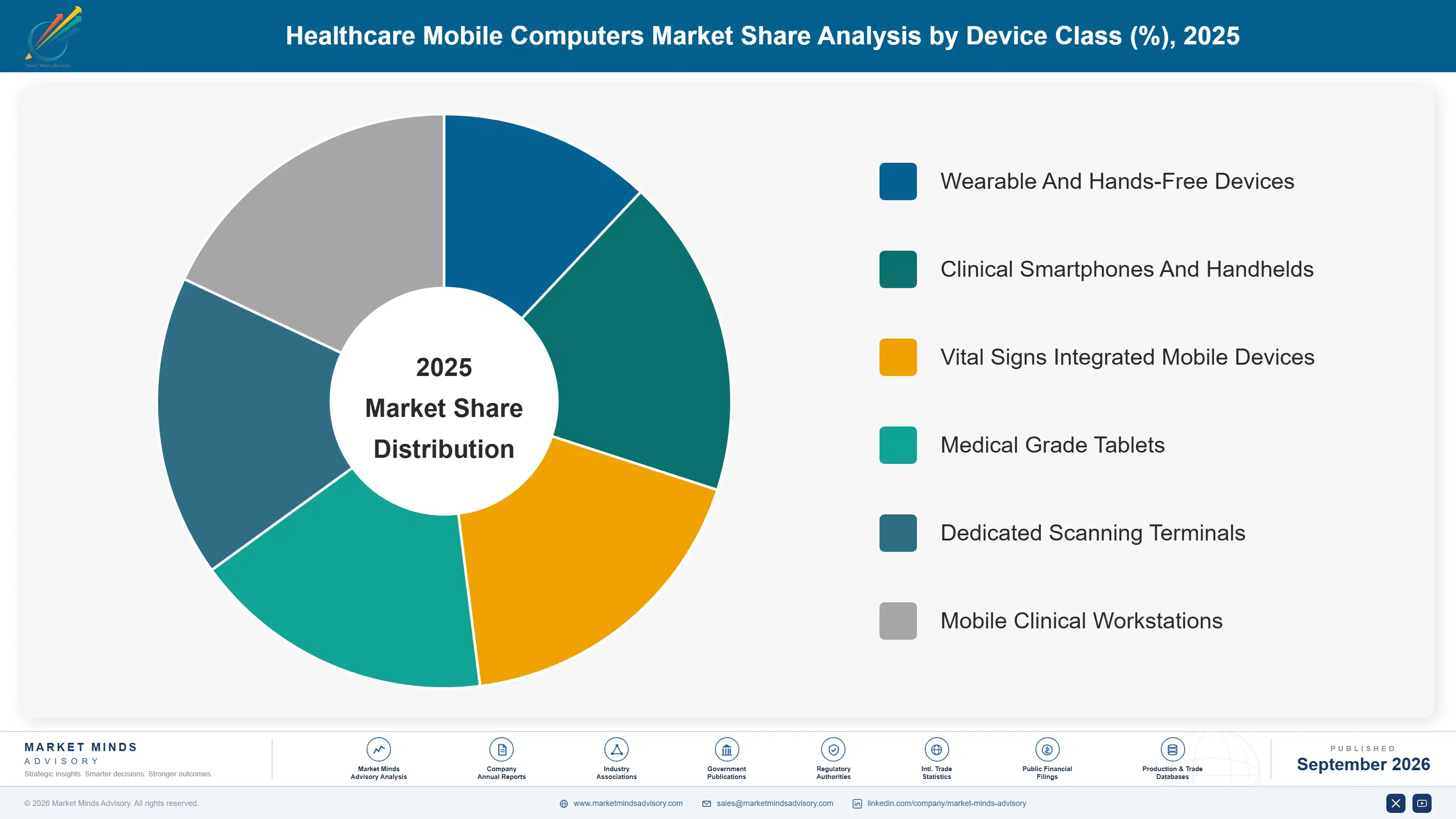
Segmentation follows device class, since form factor determines which clinical tasks a device supports, how it survives disinfection and who inside the health system approves it. Six classes cover the market: wearable and hands-free devices, clinical smartphones and handhelds, vital signs integrated devices, medical grade tablets, dedicated scanning terminals, and mobile clinical workstations. Care setting is a separate dimension.
healthcare-mobile-computers-market-market-share-analysis-1789990616210

Wearable And Hands-Free Devices

Wearable and hands-free devices grow at 14.1%, half again the market rate of 9.4%, because they answer a problem screens cannot. A nurse repositioning a patient or managing an infusion line has both hands occupied and cannot operate a handheld at that moment, however fast it is. Voice badges, hands-free scanning rings and wearable communication devices remove the interaction rather than accelerating it. Nursing shortages turned every saved second across a twelve hour shift into a genuine operational argument that finance departments accept. The format also sidesteps the shared device login problem entirely, since a badge belongs to the person rather than to the ward. Nursing leadership rather than procurement drives this purchase.
CAGR 14.1%

Clinical Smartphones And Handhelds

Clinical smartphones and handhelds compound at 11.8% as medication verification requirements extend beyond acute inpatient wards into outpatient infusion, aged residential care, community nursing and theatre medication handling. Those settings start from far lower device density than hospitals do, so the growth is new deployment rather than replacement. Each has different mobility, connectivity and hygiene conditions, which means genuinely different specifications rather than more of the same unit. The recurring failure mode remains speed at the bedside: a verification completing in around three seconds gets used, and one taking eight produces the workarounds that make the whole investment pointless. Density in those settings starts far below hospital levels, so the growth is genuinely new deployment.
CAGR 11.8%
Full segment breakdown across 6 segments available in the complete report.

Regional Architecture and Country Demand Map

North America leads at 36% of device shipment revenue, above the standard band, because medication safety regulation arrived here first and device density per bed is the highest anywhere. Western Europe follows at 24% on comparable clinical standards paired with considerably tighter capital budgets throughout.

North America

North America holds 36% of device shipment revenue, above the 32% band ceiling, because barcode medication administration became an expectation here well before anywhere else and accreditation bodies made it effectively compulsory in acute care. Device density runs above 42 units per hundred beds across most large systems, which is higher than any other region approaches. Zebra Technologies, Honeywell and Stryker all operate from here and the clinical communication market matured alongside the hardware. Litigation exposure around medication errors gives the safety argument commercial force that no other region matches. Growth at 8.4% sits below the global rate on a market already deeply equipped. Litigation exposure gives the safety argument commercial force found nowhere else.
Share: 36% | CAGR: 8.4% (2026 to 2036)

Western Europe

Twenty-four percent of device shipment revenue reaches Western Europe, where clinical standards match North America and capital budgets do not. National health systems procure centrally and negotiate hard, which suppresses unit pricing without suppressing volume. Ascom operates from Switzerland and Barco from Belgium, both holding genuine clinical communication positions. Nordic and Dutch systems adopted hands-free and wearable formats earlier than most, driven by nursing shortages that arrived here before they arrived elsewhere. Growth at 8.0% is the slowest of any region on mature deployment and procurement that treats these devices as commodity infrastructure rather than clinical equipment. Nursing shortages arrived here before they arrived elsewhere, which pulled hands-free formats forward considerably. Central procurement suppresses pricing without suppressing volume.
Share: 24% | CAGR: 8.0% (2026 to 2036)
Regional intelligence for 5 additional markets available in the complete report: East Asia, South Asia and Pacific, Latin America, Middle East and Africa, Eastern Europe. Contact sales@marketmindsadvisory.com.
healthcare-mobile-computers-market-country-cagr-analysis-1789990616743

What Makes These Deployments Succeed

Devices in this particular market fail on seconds rather than on specifications, disinfection chemistry rather than obsolescence decides how long any of them actually last, and the person approving the purchase order is rarely the same person who quietly abandons the fleet. Each of the four levers below addresses one of those realities directly.

Optimise For The Bedside Second, Not The Datasheet

A medication verification has to complete in around three seconds because that is what a medication round genuinely allows, and at 8 seconds nurses batch scans, pre-scan labels at the desk or skip the step entirely. Every deployment that failed did so on that arithmetic rather than on ruggedness or battery life. Measuring and publishing end to end task time, from wake to scan to confirmation, addresses the thing that actually decides adoption. Suppliers competing on processor and display specifications are describing something no clinician has ever cared about. Nothing on a datasheet predicts that outcome.
Market Impact: Verification has to complete inside just 3 seconds

Solve Fast User Switching As A Product

Around five clinicians share each device across a day, and every mobile management assumption about authentication, personalisation and session state was built for one user with one phone. Badge tap authentication completing a handover in under 3 seconds converts a shared device into something that behaves personally. Hardware suppliers consistently treat this as somebody else's software problem, which is why deployments keep failing at the login rather than at the device. Whoever owns that experience end to end owns the clinical relationship as well. Whoever owns the login owns the deployment outcome.
Market Impact: Handover across all 5 users decides adoption here

Price The Disinfection Premium Honestly Upfront

Infection control requires wiping these devices around 14 times daily with compounds that degrade plastics, seals and screen coatings, producing a replacement cycle near 3.2 years rather than the five that finance departments assume. Medical grade housings cost several times comparable enterprise hardware and buyers dispute that premium until a lightly ruggedised fleet has failed twice. Presenting full lifecycle cost rather than unit price wins the argument once, and losing on unit price to a competitor whose fleet fails in eighteen months wins it permanently afterwards. The argument only has to be won once.
Market Impact: A 3.2 year cycle changes the lifecycle cost

Follow Construction Into Greenfield Hospital Facilities

Specifying mobile computing while a hospital is being built avoids every obstacle retrofit faces: wireless coverage designed around the devices, workflows written with them and clinicians trained before any habits form. New facilities routinely exceed 42 devices per hundred beds because nobody has to argue for retrofit funding at all. Saudi Arabia compounds at 16.2% on precisely this, and Gulf and Asian construction pipelines are visible years ahead in public tender documents that very few device suppliers actually track. Those pipelines are visible years ahead in public tender documents that very few device suppliers actually bother to track at all.
Market Impact: Greenfield sites exceed 42 devices per hundred beds

Who Controls the Margin Pool

Five suppliers hold 63% of healthcare mobile computing device shipment revenue, concentrated because healthcare certification and disinfection tolerance are genuine engineering barriers rather than marketing positions. Zebra Technologies and Honeywell brought rugged enterprise manufacturing scale into clinical settings. Ascom and Stryker arrived through clinical communication rather than through hardware. Advantech supplies specialist medical computing platforms underneath much of the category. All participants are assessed on device shipment revenue.
Competition runs on workflow integration rather than on device specification, which is uncomfortable for manufacturers organised around hardware. A device that scans in three seconds and hands over between nurses in another three wins against a technically superior unit that takes eight, every time and without argument. That integration work involves the electronic health record vendor, the identity system and the wireless network, none of which the device supplier controls.

Rankings shift toward suppliers who own the clinical communication layer rather than only the hardware, since that is where workflow integration actually happens. The second pressure is device as a service arrangements, which suit health systems whose capital cycles outlast a 3.2 year replacement need and disadvantage suppliers whose commercial model assumes an outright purchase.
healthcare-mobile-computers-market-company-positioning-matrix-1789990617266

Competitive Moat and Risk Dimensions

ZEBRA TECHNOLOGIES

Moat: Rugged Manufacturing And Scale

Zebra manufactures ruggedised mobile computing at volumes drawn from retail and logistics, which supports engineering investment in housings, seals and scanning performance that a healthcare-only supplier could not justify alone. Healthcare certification and disinfection tolerance then build on that platform. Competitors serving only clinical settings carry the same engineering cost across far smaller volume.
ZEBRA TECHNOLOGIES

Risk: Workflow Integration Distance

Deployments succeed or fail on task seconds and user handover, which depend on the electronic health record, the identity system and the wireless network rather than on the device. A hardware supplier without control of that layer is judged on outcomes it cannot deliver alone. Clinical communication specialists sit considerably closer to the decision.
ASCOM

Moat: Clinical Communication Workflow Position

Ascom built its position on clinical communication and alarm management rather than on hardware, which places it inside the nursing workflow where adoption is actually decided. That relationship extends across nurse call, alerting and mobility together, so devices arrive as part of a system rather than as procurement line items. Hardware suppliers start considerably further away.
ASCOM

Risk: Hardware Scale Disadvantage

Manufacturing ruggedised devices for clinical settings alone means carrying housing, sealing and scanning engineering cost across volumes far below what enterprise suppliers achieve. Disinfection tolerance is expensive to engineer and does not become cheaper with a smaller order book. Competing on device price against a supplier amortising across retail and logistics volume is not winnable.

Players Tracked

Prominent Players

Zebra Technologies
Honeywell
Ascom
Stryker
Advantech

Other Key Players

Getac
Panasonic
Datalogic
Cybernet Manufacturing
Onyx Healthcare
Teguar
Ergotron
Capsa Healthcare
Metro
Enovate Medical
Spectralink
Janam Technologies
TouchPoint Medical
Barco
Elo Touch Solutions

Recent Developments

FEBRUARY 2025

Zebra Extends Healthcare Device Range For Disinfection Tolerance

Zebra Technologies extended its healthcare device range with housings engineered for higher disinfection chemistry exposure, an organic product development rather than an acquisition or joint venture. Infection control protocols require wiping around 14 times daily with compounds that degrade plastics and seals faster than any other failure mode does.
Signal: Chemistry rather than dropping or obsolescence is what actually ends the working life of these devices.
AUGUST 2024

Ascom Adds Faster Clinical Handover Between Shared Device Users

Ascom added faster user handover capability to its clinical mobility platform, an organic engineering development rather than any transaction. Around five clinicians share each device across a day, and authentication time at shift handover decides adoption considerably more reliably than any hardware specification a supplier can quote.
Signal: Deployments keep failing at the login screen rather than at anything the hardware datasheet actually describes.
MAY 2025

Stryker Expands Hands-Free Communication Devices For Nursing Units

Stryker expanded its hands-free clinical communication device range for inpatient nursing units, an organic product expansion rather than a partnership or merger. A nurse repositioning a patient cannot operate a screen at that moment, and nursing shortages made every saved second across a shift a genuine operational argument.
Signal: Removing the interaction beats accelerating it whenever both of a clinician's hands are already fully occupied.

What A Clinical Device Costs

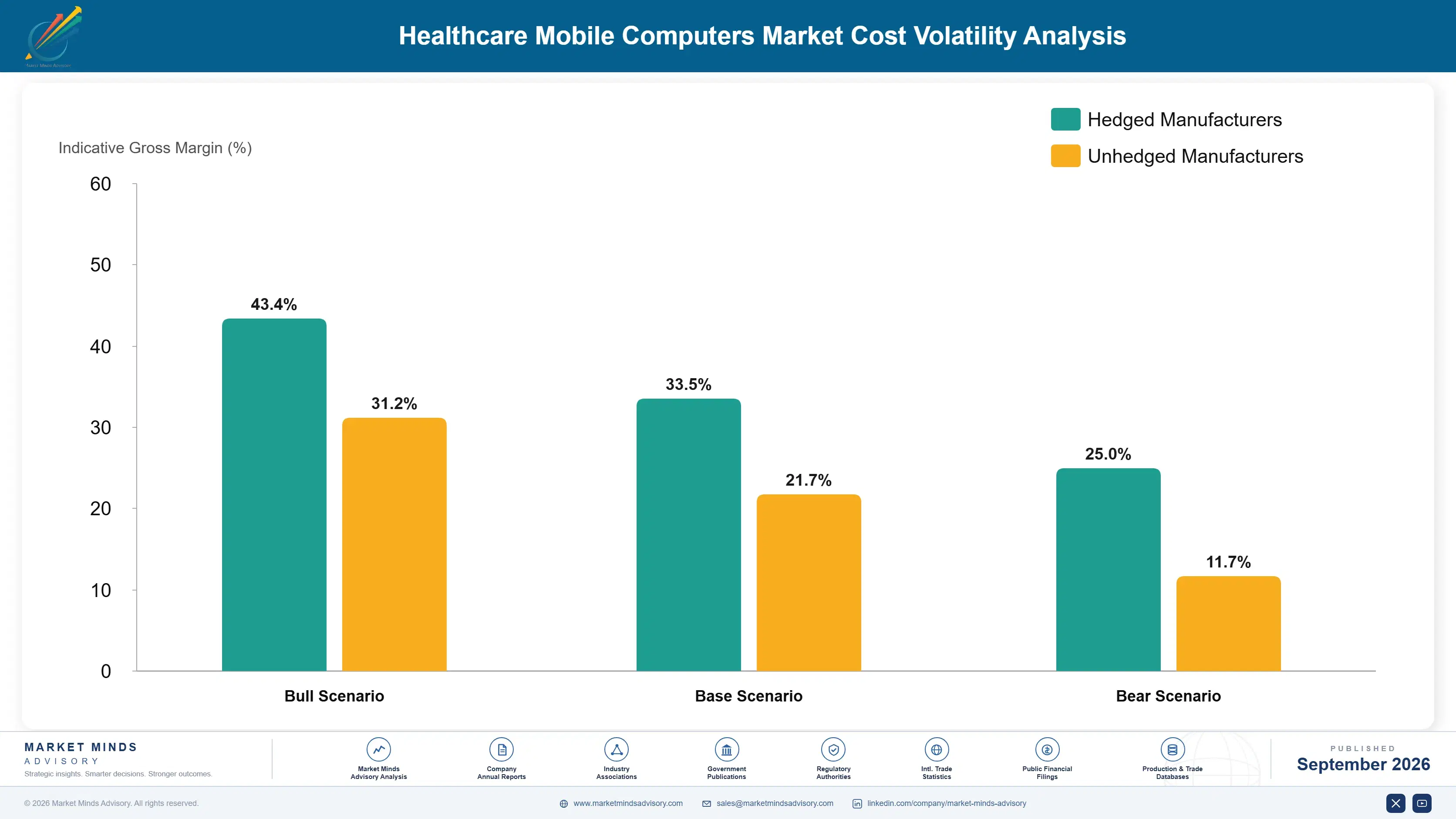
Electronic components account for roughly 38% of device cost, comparable to any enterprise handheld and offering no particular advantage or disadvantage. Medical grade housing, sealing and screen coating carry around 18%, which is the premium disinfection tolerance actually costs. Regulatory certification and clinical validation absorb about 12%, and channel margin plus deployment support take most of the remaining balance.
Component availability tightened across displays and scanning modules through 2022 and 2023, and healthcare volumes competed against retail and logistics customers ordering far more units. Zebra Technologies Annual Report 2024 and Honeywell Annual Report 2024 both record component sourcing and healthcare certification cost as operating variables. Suppliers on multi-year health system contracts absorbed increases directly, since pricing agreed against a national framework does not reprice when component costs move upward.

The competitive disadvantage mechanism is manufacturing volume rather than any clinical requirement. Housing, sealing and scanning engineering costs roughly the same to develop whether a supplier ships fifty thousand units or five million, so a healthcare-only manufacturer carries that development across far smaller volume. Exposure varies by portfolio breadth as well, since suppliers amortising across retail and logistics reach clinical price points that specialists cannot approach at all.
healthcare-mobile-computers-market-cost-volatility-analysis-1789990617462

Build Clinical Devices On Shared Enterprise Platforms

Electronic components run about 38% of device cost and the underlying computing platform is functionally identical to an enterprise handheld. Developing a clinical device on a shared platform with healthcare-specific housing and certification layered on top spreads engineering across far greater volume. Suppliers designing healthcare devices from a clean sheet carry development cost that the addressable volume genuinely cannot support.

Certify Once Across A Whole Device Family

Regulatory certification and clinical validation run around 12% of device cost, and suppliers frequently repeat that work for each variant because the products were architected separately. Designing a family around one certified platform lets a single validation effort cover several form factors. The discipline is architectural planning rather than regulatory expertise, and teams treat certification downstream.

Offer Device As A Service Against Capital Cycles

Health system capital planning runs on cycles considerably longer than the 3.2 year replacement need that disinfection chemistry creates, so fleets degrade before funding arrives. Converting the purchase into an operating expense with refresh built in matches how the devices actually behave. Suppliers structured entirely around outright sale keep losing to competitors offering the arrangement finance directors can actually approve.

Portfolio Architecture for Margin Defence

Margin architecture separates on how far a supplier sits from the clinical workflow. Mobile clinical workstations and dedicated scanning terminals earn least, since both are essentially furniture and commodity hardware competing on price. Medical grade tablets sit in the middle on certification barriers. Wearables, clinical handhelds and vital signs integrated devices earn most, because each is bought as part of a workflow rather than as a specification comparison.
The volume versus premium tension is about who a supplier is organised to sell to. Procurement buys devices against a specification and negotiates on unit price, which favours enterprise manufacturers with scale. Chief nursing officers buy workflow outcomes and care about seconds, which favours clinical communication suppliers. Manufacturers built for the first buyer keep winning tenders and then watching the fleets end up in drawers.

High-value pools concentrate in hands-free formats and in workflow integrated handhelds, and neither is reached by better hardware. Hands-free requires voice recognition tuned for clinical vocabulary in noisy wards. Workflow integration requires relationships with electronic health record and identity vendors the device supplier does not control. Both sit outside manufacturing, which is exactly why the margin has settled there.

Volume / Commodity-Adjacent

Mobile clinical workstations and dedicated scanning terminals, competing largely on price as furniture and commodity hardware against many substitutable alternatives. The eight point spread separates suppliers with manufacturing scale from those assembling small volumes at considerably higher unit cost.
Gross Margin: 24% to 32%

Premium / Certified

Medical grade tablets and vital signs integrated devices sold on certification, disinfection tolerance and clinical validation rather than on raw specification. The ten point spread tracks how much of a supplier's volume arrives through multi-year health system agreements rather than through individually tendered departmental purchases.
Gross Margin: 38% to 48%

Sustainability / Regulatory / Next-Generation

Wearable and hands-free devices plus workflow integrated clinical handhelds, bought as part of a nursing workflow rather than as a specification comparison. The twelve point spread reflects depth of electronic health record and identity system integration, which decides whether a deployment is adopted.
Gross Margin: 54% to 66%
healthcare-mobile-computers-market-portfolio-architecture-1789990617957

High-value Sub-segments and Strategic Watch-out

Wearable And Hands-Free Devices

Grows at 14.1% because a nurse with both hands occupied cannot operate a screen however fast that screen happens to be. The twelve point spread reflects voice recognition quality. Badges belong to a person, which sidesteps the shared device login problem entirely. Attachment forms quickly here.
Gross Margin: 54% to 66%

Clinical Smartphones And Handhelds

Grows at 11.8% as medication verification extends into outpatient infusion, aged care, community nursing and theatre medication handling. The twelve point spread reflects workflow integration. Bedside verification completing in 3 seconds gets used, and eight seconds produces workarounds instead. New settings start from nothing entirely.
Gross Margin: 54% to 66%

Vital Signs Integrated Mobile Devices

Grows at 10.2% as observation recording moves from paper charts to devices that capture measurements directly without transcription. The ten point spread reflects monitoring integration depth. Transcription errors disappear, which is a safety argument nursing leadership accepts immediately and readily. Nursing leadership accepts that case without argument.
Gross Margin: 38% to 48%

Mobile Clinical Workstations

Grows at 3.4%, slowest of the six classes, as handhelds and wearables take tasks that previously required wheeling a cart to the bedside. The eight point spread reflects manufacturing scale. Battery and cart hardware remain genuinely commodity products competing almost entirely on price. Handhelds keep taking tasks from it.
Gross Margin: 24% to 32%

Why Fleets Stay Or Get Abandoned

The annuity is the workflow rather than the hardware contract. Once medication verification, nurse call and clinical alerting all run through one device platform, replacing the supplier means revalidating integrations with the electronic health record, the identity system and the monitoring estate together. Health systems avoid that unless something has genuinely failed. The reverse is less comfortable: a fleet nurses will not use gets abandoned quietly.
Depth varies by how many workflows the device carries. A platform handling medication administration, clinical alerting and nurse call is embedded in daily practice across every shift and effectively permanent. A device used only for barcode scanning is replaced at the next tender on price with no clinical consequence. Wearables sit oddly here, since clinicians form real attachment to a badge that works.

The buyer changed and most suppliers still address the previous one. A decade ago this was an information technology purchase judged on manageability, security and unit cost. It is now increasingly a nursing leadership decision judged on task seconds and workflow fit, with information technology validating rather than choosing. Suppliers leading with device management answer the signatory rather than the decider.
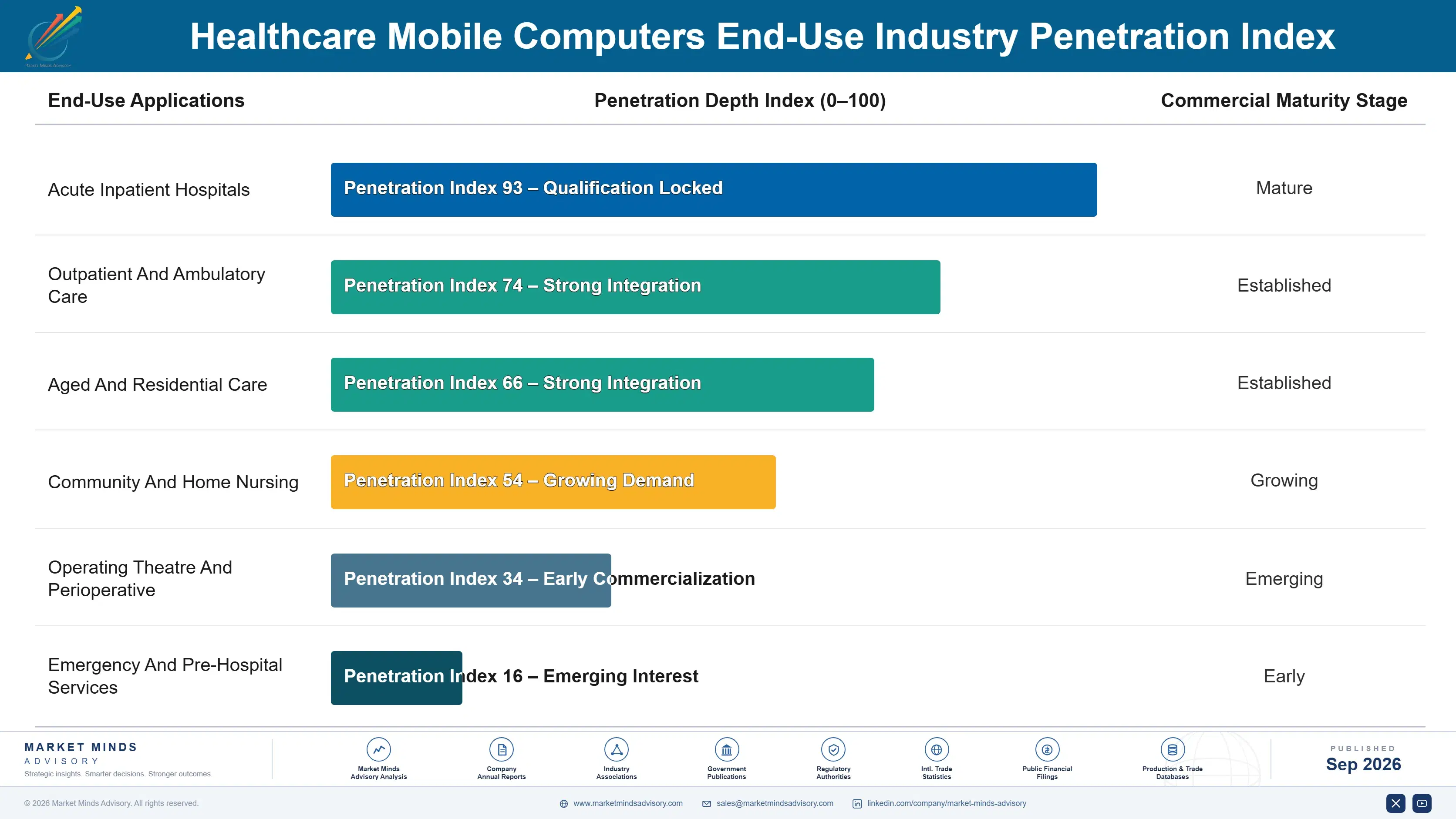
healthcare-mobile-computers-market-end-use-penetration-index-1789990618451

What Decides Clinical Adoption

These are among the four positions where our research anticipates prominent divergence between winners and laggards over the coming forecast period. Each is grounded in the demand model, the regulatory perimeter, and the announced capacity pipeline.
01 / BEDSIDE TASK TIMING

Win The Three Seconds Or Lose Everything

A medication verification at the bedside has to complete in around three seconds because that is what a medication round genuinely allows across a full patient list. At eight seconds nurses batch their scans, pre-scan labels at the desk or skip the step altogether, and the safety benefit disappears while every device remains fully paid for. Suppliers competing on processor speed and display quality are describing attributes no clinician has ever cared about in any deployment anywhere, and the datasheet predicts nothing about the outcome.
02 / SHARED SESSION HANDOVER

Make Five Users Feel Like One

Around five clinicians share each device across a working day, and every mobile management assumption about authentication, personalisation and session state was designed for one person carrying one phone all day. Badge tap authentication completing a handover in under three seconds turns a shared device into something that behaves personally for each user. Hardware suppliers consistently treat this as somebody else's software problem, which is precisely why so many otherwise sound deployments end up failing at the login screen instead.
03 / LIFECYCLE COST HONESTY

Sell The Chemistry, Not The Unit Price

Infection control protocols require wiping these devices around 14 times daily with quaternary ammonium and bleach compounds that degrade plastics, seals and screen coatings continuously. That produces a replacement cycle near 3.2 years rather than the five years health system finance departments routinely assume when budgeting. Presenting honest lifecycle cost rather than unit price wins the argument once, and losing on price to a competitor whose fleet fails within eighteen months wins that same argument permanently for everybody who comes afterwards.
04 / GREENFIELD PIPELINE COVERAGE

Specify While The Building Goes Up

Specifying mobile computing during hospital construction avoids every obstacle a retrofit faces: wireless coverage designed around the devices, workflows written with them included, and clinicians trained before any competing habits form. New facilities routinely exceed 42 devices per hundred beds because nobody has to argue for retrofit funding from an existing operating budget. Saudi Arabia compounds at 16.2% on precisely this mechanism alone, and Gulf and Asian construction pipelines are visible years ahead in public tender documents almost nobody tracks.

Engagement Snapshot From the Field

A live engagement with an industry participant carrying material or product regulatory and market exposure ahead of a defining policy shift, showing how our research translates into a defensible multi-year portfolio strategy.
MARKET MINDS ADVISORY · CLIENT ENGAGEMENT SUMMARY
Healthcare Mobile Computers Producer Strategic Portfolio Review and Transition Roadmap 2026·Investment Scenario on Healthcare Mobile Computers Exposure Evaluation 2025-26
CLIENT PROFILE
A hospital group operating seven acute sites with 2,400 beds, eighteen months into a mobile computing deployment intended to support barcode medication administration across all inpatient wards. Scanning compliance was sitting well below target and nursing feedback was uniformly negative. The information technology department reported the devices as functioning correctly, which by their own measures they were.
STRATEGIC CHALLENGE
Clinical leadership wanted the deployment reversed and the devices returned. Information technology defended the specification, which had been tendered properly and met every requirement written into it. Nobody had measured actual task completion time at the bedside, and the group was preparing to write off the investment and retender against substantially the same requirement document.
MMA APPROACH
MMA timed medication verification end to end across four wards, from device wake through authentication, patient scan, medication scan and confirmation, and compared that against the time a medication round actually allows per patient. We observed workaround behaviour directly and traced each delay to its source. The work drew on 47 expert interviews conducted in Q4 2025 with clinicians, suppliers and comparable hospital groups.
KEY FINDINGS
  1. End to end verification averaged 11 seconds against the 3 seconds a medication round allows, and authentication accounted for most of that gap.
  2. Nurses were pre-scanning medication labels at the desk in 64% of observed rounds, which removed the safety benefit while leaving compliance figures intact.
  3. The devices themselves performed to specification, and the delay sat almost entirely in identity system handover between shift users (client-reported, unverified by MMA).
  4. Two wards using badge tap authentication achieved verification in about 4 seconds with compliance above 90%, and nobody had noticed the difference.
CLIENT PROFILE
A hospital group operating seven acute sites with 2,400 beds, eighteen months into a mobile computing deployment intended to support barcode medication administration across all inpatient wards. Scanning compliance was sitting well below target and nursing feedback was uniformly negative. The information technology department reported the devices as functioning correctly, which by their own measures they were.
STRATEGIC CHALLENGE
Clinical leadership wanted the deployment reversed and the devices returned. Information technology defended the specification, which had been tendered properly and met every requirement written into it. Nobody had measured actual task completion time at the bedside, and the group was preparing to write off the investment and retender against substantially the same requirement document.
MMA APPROACH
MMA timed medication verification end to end across four wards, from device wake through authentication, patient scan, medication scan and confirmation, and compared that against the time a medication round actually allows per patient. We observed workaround behaviour directly and traced each delay to its source. The work drew on 47 expert interviews conducted in Q4 2025 with clinicians, suppliers and comparable hospital groups.
KEY FINDINGS
  1. End to end verification averaged 11 seconds against the 3 seconds a medication round allows, and authentication accounted for most of that gap.
  2. Nurses were pre-scanning medication labels at the desk in 64% of observed rounds, which removed the safety benefit while leaving compliance figures intact.
  3. The devices themselves performed to specification, and the delay sat almost entirely in identity system handover between shift users (client-reported, unverified by MMA).
  4. Two wards using badge tap authentication achieved verification in about 4 seconds with compliance above 90%, and nobody had noticed the difference.
RECOMMENDED STRATEGY
Phase 1: Phase one: deploy badge tap authentication across all wards before replacing any hardware, since the devices were never the actual problem here. Phase 2: Phase two: measure and report end to end task seconds by ward monthly, rather than reporting device availability and uptime as at present. Phase 3: Phase three: write task completion time into every future tender as a scored requirement, alongside the specification language already used.
OUTCOME
The group deployed badge authentication and retained the existing hardware entirely (client-reported, unverified by MMA). Verification time fell to around four seconds and scanning compliance rose above ninety percent within a quarter. Task seconds are now a reported clinical metric rather than an information technology one, which is the change that outlasted the engagement.

Frequently Asked Questions

Foundational context covering the market sizes, CAGR, scope, country, region and competition that inform every finding below. This section is provided to cover basics and most often pre-purchase conversations, answered from the MMA Primary Research Dataset.

What is the current size of the Healthcare Mobile Computers Market?

Global value reaches USD 2.95 billion in 2026, measured as healthcare mobile computing device shipment revenue across all six device classes. The 2025 base is USD 2.7 billion.

How large will the Healthcare Mobile Computers Market be by 2036?

Device shipment revenue reaches USD 7.24 billion by 2036, an increase of USD 4.29 billion over the forecast period. That represents 2.45 times expansion from the 2026 base.

What is the CAGR for the Healthcare Mobile Computers Market 2026 to 2036?

The base case runs at 9.4% annually, with a bull case at 10.7% if fast user switching makes shared devices behave personally and a bear case at 8.1% if capital pressure defers replacement.

Which segment is growing fastest?

Wearable and hands-free devices grow at 14.1%, half again the market rate of 9.4%. A nurse repositioning a patient has both hands occupied and cannot operate a screen however fast it is.

Who are the major companies in the Healthcare Mobile Computers Market?

Zebra Technologies, Honeywell, Ascom, Stryker and Advantech lead on device shipment revenue, together holding 63%. Getac, Spectralink and Barco hold smaller positions in clinical settings.

Which country is growing fastest?

Saudi Arabia leads at 16.2%, because health system expansion is delivering greenfield hospitals specified with mobile computing from the outset rather than retrofitted. India and the United Arab Emirates follow.

Report Segmentation Architecture

The full report scope spans multiple orthogonal segmentation dimensions, with cross-tabulated demand data provided for each dimension pair. Coverage extends further to regional breakdowns, trend trajectories, and the competitive detail needed to support segment-level decision-making.

By Device Class

  • Wearable And Hands-Free Devices
  • Clinical Smartphones And Handhelds
  • Vital Signs Integrated Mobile Devices
  • Medical Grade Tablets
  • Dedicated Scanning Terminals
  • Mobile Clinical Workstations

By End-Use Industry

  • Acute Inpatient Hospitals
  • Outpatient And Ambulatory Care
  • Aged And Residential Care
  • Community And Home Nursing
  • Operating Theatre And Perioperative
  • Emergency And Pre-Hospital Services

By Commercial Dimension

  • Direct Health System Agreements
  • Group Purchasing Organisation Contracts
  • Systems Integrator Deployment
  • Device As A Service Arrangements
  • Distributor And Reseller Channel
  • Construction Project Specification

By Region

  • North America
  • Western Europe
  • East Asia
  • South Asia and Pacific
  • Latin America
  • Middle East and Africa
  • Eastern Europe

Scope, Methodology, and Coverage

Every figure in this report is reproducible from documented input assumptions. The scope below maps the historical period, the forecast horizon, the segmentation dimensions, and the countries covered, alongside the underlying primary and qualitative methodology.
Historical Period
2020 to 2025
Forecast Period
2026 to 2036
Base Year
2025 (USD billions; MMA Primary Research Dataset, September 2026)
Market Definition
This report covers purpose-built mobile computing devices deployed in clinical care settings: clinical smartphones and handhelds, medical grade tablets, mobile clinical workstations, wearable and hands-free devices, dedicated scanning terminals, and vital signs integrated mobile devices. It excludes diagnostic and therapeutic medical devices, patient monitoring systems, electronic health record software, consumer smartphones without healthcare certification, and fixed nursing station computing equipment.
Quantitative Units
USD millions, device shipment revenue basis; deployed units per hundred beds; task completion time in seconds; device replacement cycle in years; disinfection events per device daily.
Segmentation Dimensions
Device class; care setting; commercial procurement route; geography across seven regions.
Regions Covered
North America, Western Europe, East Asia, South Asia and Pacific, Latin America, Middle East and Africa, Eastern Europe
Countries Covered
United States, Canada, Mexico, Brazil, Chile, United Kingdom, Germany, France, Netherlands, Sweden, Switzerland, Poland, Czechia, Saudi Arabia, United Arab Emirates, South Africa, China, Japan, India, Australia.
Key Companies Profiled
Zebra Technologies, Honeywell, Ascom, Stryker, Advantech, Getac, Panasonic, Datalogic, Cybernet Manufacturing, Onyx Healthcare, Ergotron, Capsa Healthcare, Enovate Medical, Spectralink, Barco.
Quantitative Methodology
Primary survey, n=3,800 respondents, Q4 2025, six countries; demand-side model with trade association cross-validation
Qualitative Methodology
47 expert interviews, Q4 2025; applied to validate demand model assumptions, identify emerging dynamics, and assess competitive positioning
Report Format
PDF and XLSX data workbook (Word format preview document)
Publisher
Market Minds Advisory
Report Code
MMA-2026-HLT-141
Published
September 2026
Contact
sales@marketmindsadvisory.com | www.marketmindsadvisory.com

Purchase the full Healthcare Mobile Computers Market Report (2026 to 2036).

This report sizes the global healthcare mobile computers market from 2026 to 2036 across six device classes, six care settings and seven regions. It explains why deployments fail on the three seconds a bedside verification allows rather than on any specification, how disinfection chemistry sets a 3.2 year replacement cycle finance departments budget as five, and why five clinicians sharing one device breaks every mobile management assumption. Cost composition is sourced to company annual reports, with manufacturing volume analysed as the pricing constraint. Regional analysis explains why North America leads at 36% while Saudi Arabia grows at 16.2%. Competitive assessment covers 20 named suppliers.
Six clinical device classes sized through to 2036
Bedside task timing modelled as the adoption determinant
Disinfection lifecycle cost analysed from company annual filings
Twenty named suppliers assessed on device revenue
Four revenue levers with quantified commercial impact
Anonymised hospital group deployment recovery engagement included fully

Built For The People Who Decide

From boardroom strategy to bench-side execution, this report is read cover-to-cover by leaders shaping the next decade of their industry, turning demand scenarios, market dynamics and valuation benchmarks into decisions.
CXOs/ Presidents/ VPs/ Managers
M&A and Corporate Development
Strategy Teams and R&D Heads
Procurement and Product Directors
Regulatory and Compliance Leaders
Investor Relations and Equity Analysts