Market Minds Advisory
Healthcare and Laboratory Label Market in Western Europe

Healthcare and Laboratory Label Market in Western Europe: Qualification barriers, regulatory labelling and converter position to 2036

Regulatory labelling requirements arrived faster than converter qualification capacity, and Western European device makers now wait more than a year for label approvals that once took only a few weeks to obtain.

Lead Analyst

Bilal Shaikh

Published

September 2026

Make Smarter Decisions with Customized Research Insights

Request a free sample report and evaluate market opportunities, growth trends, and competitive dynamics relevant to your business needs.

2025 MARKET VALUE$9.6BMarket Size 2025
2036 FORECAST VALUE$18.6BBase Case , 2026 to 2036
CAGR 2026 TO 20366.2 %Bull 7.4% / Bear 5.0%
INCREMENTAL OPPORTUNITY$8.4BNet 10- year value creation
EXPANSION MULTIPLE1.82x2036 value over 2026 base
Strategic Levers
M&A Pipeline
Regional Outlook
Country Rankings
Competitive Intelligence
Segmental Deep-dive
Call-Us : 91 93563 13602

Executive Snapshot and Market Trajectory

Label qualification has become the bottleneck in European medical device launches. IVDR and MDR turned an adhesive purchase into a validated component, and the converters able to document biocompatibility and sterilisation performance now set both price and lead time across the region. That was not the intention behind either regulation.
Growth concentrates in cryogenic and ultra-low-temperature labels, expanding at 9.3% against a market at 6.2%, driven by biobanking capacity and cell therapy logistics rather than conventional pharmaceutical packaging. Western Europe holds 26% of global value, ahead of East Asia at 25%, because the regulatory regime pulls compliance labelling value into the region rather than because volumes are larger there. Volume and value have separated.
Five converters hold 42% of the market and the gap between them and everyone else is documentation depth, not printing capability. Any commercial printer can produce a healthcare label. Very few can produce the validation file that lets a notified body accept it, and that asymmetry has done more to shape competitive position over the past four years than any capacity investment. Printing was never really the barrier in this business at all.
Market Definition
This report covers pressure-sensitive, in-mould and direct-print labels applied to pharmaceutical primary and secondary packaging, medical devices, diagnostic reagents, specimen containers and laboratory consumables. Facestock, adhesive, liner and converted label supply are included at converter level. Excluded are RFID inlays sold as separate components, packaging substrates themselves, serialisation software licences, and general industrial or food labelling.
Base Year Value
$9.6B in 2025 (MMA Primary Research Dataset, August 2026)
Forecast Period
2026 to 2036, eleven discrete annual values
CAGR
6.2% base case. Bull 7.4%. Bear 5.0%.
Fastest Growth Segment
Cryogenic and Ultra-Low-Temperature Labels: 9.3% CAGR
Fastest Growth Country
India: 9.2% CAGR
Fastest Growth Region
South Asia and Pacific: 8.4% CAGR
Largest Region
Western Europe: 26% of 2025 global value
Market Leaders
Avery Dennison, CCL Industries, UPM Raflatac, Multi-Color Corporation and 3M lead the market. Source: MMA Primary Research Dataset, July 2026.
Primary Survey
n=3,800 procurement and R&D decision-makers, Q4 2025, six countries
Methodology
Demand-side build-up, cross-validated against public data, 47 expert interviews

Healthcare and Laboratory Label Market Forecast Scenarios

healthcare-and-laboratory-label-market-in-western--size-forecast-scenario-1787553162899
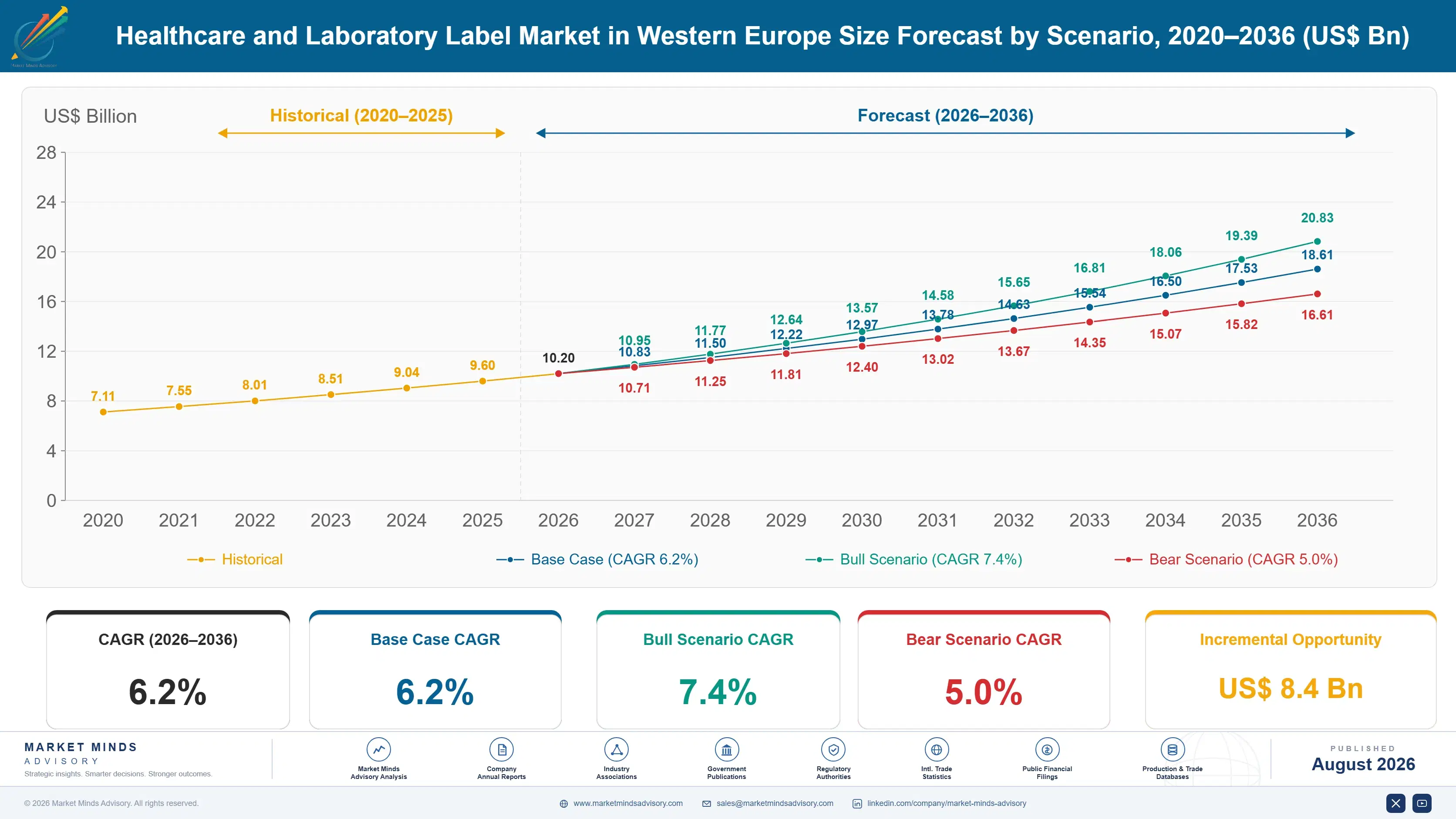
The period from 2020 to 2025 compounded at 5.0%, and almost none of that came from the growth anybody had forecast. Diagnostic labelling surged through 2020 and 2021 on testing volume, then collapsed. What replaced it was compliance work: MDR transition deadlines forced relabelling programmes across device portfolios that had been stable for a decade. Nobody had budgeted for that.
The 6.2% base case rests on three mechanisms. IVDR transition deadlines running to 2027 keep relabelling demand in the system for another two years at least. Biobanking and cell therapy expansion adds cryogenic label volume growing at 9.3%, half again the market rate. And unit price rises as validated constructions displace commodity paper labels in device applications, which lifts value independently of how many labels anybody actually prints. Volume growth is the smallest of the three.
The 7.4% bull case turns on European pharmaceutical reshoring: onshore fill-finish capacity would move primary labelling back into the region rather than leaving it wherever the product is packaged. The 5.0% bear case is simpler and more likely. Notified body capacity remains the constraint on device approvals, and labels that cannot be reviewed cannot be ordered. That queue has not shortened since 2023.

Where Healthcare Label Value Actually Sits

Healthcare labelling stopped being a printing business somewhere around 2021. What a converter sells now is a documented construction: facestock, adhesive and ink combination with biocompatibility data, sterilisation performance records and a change-control commitment that the customer can hand to an auditor. The printing is the easy part and it always was. Customers pay for the file.
TOP-FIVE CONCENTRATION42%Share held by the five largest healthcare label converters
UDI COVERAGE RATE91%European device labels now carrying unique device identification
CRYOGENIC FAILURE RATE3.1%Labels detaching from vials stored below biological freezing
FACESTOCK COST SHARE38%Portion of converter cost of goods from facestock
VALIDATION CYCLE LENGTH14 monthsTypical qualification period before a label enters pharmaceutical service
AVERAGE SELLING PRICEUSD 0.041Mean price per healthcare label across the region
That shift shows up in the numbers. Validation cycles now run around 14 months from first sample to approved component, which means a device maker changing label suppliers commits more than a year before seeing any saving. Average selling price sits near USD 0.041 per label, well above general packaging labels, and the premium is documentation rather than material. Facestock accounts for 38% of converter cost of goods, so the margin sits in qualification work.
Failure rates tell the other half of the story. Around 3.1% of labels on vials held below minus 150 degrees Celsius detach or become unreadable, and every one of those represents a sample that may no longer be traceable. Biobanks have started writing label performance into procurement specifications, which almost nobody did five years ago.
"The converters that win European healthcare label business are not the ones with the best presses. They are the ones whose regulatory affairs team can answer a notified body question in a week instead of a quarter."
Director, Packaging and Materials Compliance Practice · MMA Packaging Practice · August 2026

Market Trends

Cryogenic labelling moves from workaround to specified component

Biobanks and cell therapy manufacturers spent years solving label adhesion with wire ties, secondary pouches and handwritten backups. That stopped being acceptable once regulators started auditing sample chain of custody. European biobanking capacity has expanded considerably since 2021, and the procurement specifications now name adhesive performance at minus 196 degrees Celsius rather than leaving it to whoever applies the label. Converters that qualified cryogenic constructions early are winning contracts on technical grounds against competitors who never treated it as a distinct product at all. The gap took four years to open and will not close quickly.
Market Impact: Applies to 91% of labels

Expanded-content labels replace paper inserts across device packaging

MDR requires more information on device packaging than a single-layer label can carry, and paper inserts are expensive to translate, print and reconcile across 24 European languages. Multi-layer booklet constructions solve it by putting the leaflet on the container. Adoption has moved from a handful of orthopaedic implant lines to broad use across surgical instruments and diagnostic kits. The commercial effect is a unit price several times a conventional label, which is why converters push it hard even where a customer has not asked. Electronic instructions for use have not displaced it either.
Market Impact: Covers 27 member state markets

Market Opportunities and Growth Drivers

UDI enforcement forces relabelling across established device portfolios

Unique device identification under MDR applies to products that had shipped unchanged for years, and around 91% of European device labels now carry it. Getting there meant reopening artwork, requalifying constructions and reprinting inventory that was already in warehouses. That work generated label demand entirely disconnected from unit sales. IVDR extends the same requirement across diagnostics on a timetable running to 2027, so the effect has several years left in it. Manufacturers treating this as a one-off exercise have generally discovered it is not. Each portfolio revision brings the same work round again.
Market Impact: Locks supply for 14 months

Falsified Medicines Directive keeps serialised labelling volume rising

Every prescription pack sold in the European Union carries a unique identifier and a tamper-evident seal, and the verification system processes billions of scans annually. That obligation converted pharmaceutical secondary labelling from a printing decision into a data-integrity one. Converters now hold serialisation number ranges, manage aggregation records and take liability for misprints in ways general packaging suppliers never did. Contract manufacturers in particular find the reconciliation burden heavier than the printing cost, which pushes the work toward suppliers who have built systems for it. Very few smaller converters have made that investment.
Market Impact: Discards roughly 40% of material

Market Restraints and Challenges

Validation cycles lock customers to incumbent label suppliers

A device maker cannot change label supplier without revalidating, and that runs around 14 months. The root cause is that under MDR the label is a component of the device rather than packaging around it, so any material change triggers technical documentation updates and, for higher-risk classes, notified body review. Commercially this freezes pricing: incumbents know a customer will absorb an increase rather than restart qualification. Some larger manufacturers now dual-qualify constructions at two converters from the outset, which costs more upfront and restores negotiating position later. Smaller device firms rarely have the resource for it.
Market Impact: Segment growing at 9.3% annually

Liner waste has no European recycling route at scale

Every pressure-sensitive label leaves a silicone-coated release liner behind, and healthcare applications generate a great deal of it because label counts are high and formats are small. The root problem is that silicone contamination puts liner outside standard paper recovery streams, and the volumes at any single hospital or laboratory are too small to justify collection. Customers with sustainability reporting obligations increasingly ask about it and converters have little to offer. Liner take-back schemes exist in a handful of countries, and linerless constructions work for some laboratory formats but not for regulated primary containers.
Market Impact: Covers 24 required language versions
3 additional market trends, 2 additional growth drivers, and 4 additional restraints and challenges are covered in the full report. Contact sales@marketmindsadvisory.com to access the complete intelligence.

Segment CAGR and Growth Architecture

Labels are classified here by construction and the performance environment the construction must survive, since that is what determines qualification cost and price. Application market, printing technology and adhesive chemistry are treated separately in the framework rather than mixed into this hierarchy, because a single construction serves several end-uses. The distinction matters more commercially than it looks.
healthcare-and-laboratory-label-market-in-western--market-share-analysis-1787553163469

Cryogenic and Ultra-Low-Temperature Labels

Growing at 9.3%, half again the market rate, this is the fastest part of European healthcare labelling and the smallest in absolute terms. The construction problem is genuine: adhesives that hold at minus 196 degrees Celsius generally fail at room temperature application, and facestocks that stay legible through repeated thaw cycles cost several times conventional synthetic stock. Demand comes from biobanking expansion and from cell and gene therapy manufacturing, where a single unreadable vial can invalidate a patient-specific batch. Around 3.1% of cryogenic labels still fail, which is why procurement teams have started writing performance thresholds into contracts rather than trusting a datasheet. Very few converters can meet the thresholds being written.
CAGR 9.3%

Sterilisation-Resistant Device Labels

Steam autoclave, ethylene oxide and gamma irradiation each attack labels differently, and a construction that survives one will not necessarily survive another. Growth here runs at 8.1%, pulled by MDR requirements that put more permanent information on device packaging combined with a shift toward single-use instruments that carry their own identification. The technical demand is unglamorous and unforgiving: ink that does not shift colour under gamma, adhesive that does not migrate at 134 degrees Celsius, facestock that does not curl. Converters serving this segment run their own sterilisation testing rather than relying on material supplier claims, which is a capability barrier more than a cost one. Most competitors simply do not have the test capacity.
CAGR 8.1%
Full segment breakdown across 6 segments available in the complete report.

Regional Architecture and Country Demand Map

Western Europe leads on value rather than volume, holding 26% because the regulatory regime concentrates compliance labelling spend there. East Asia follows closely on manufacturing scale. The gap between the two is documentation cost, not label count, and it narrows every year. Nobody in the industry expects that to reverse.

North America

United States demand runs off FDA UDI requirements that predate the European equivalent by several years, so the relabelling wave there has largely passed and growth now tracks device and pharmaceutical output rather than compliance work. Laboratory labelling is the more interesting part: clinical diagnostics volume and a large academic research base sustain specimen label demand that grows independently of device approvals. Canadian demand is small and follows American specifications almost entirely. Converters serving the region compete on turnaround as much as on capability, because domestic device makers expect artwork changes inside a week rather than a month. That expectation shapes plant footprint decisions considerably. Speed is a real competitive dimension here.
Share: 24% | CAGR: 6.0% (2026 to 2036)

Western Europe

Nowhere else has regulation done this much to label economics. MDR and IVDR turned the label into a device component across Germany, France, Italy and the Nordic markets simultaneously, and the qualification burden that followed lifted average selling price well above what volume alone would support. German device manufacturing and Irish and Swiss pharmaceutical fill-finish capacity between them account for the majority of regional value. Growth at 4.6% looks modest and understates activity: the relabelling work is largely complete for devices and still running for diagnostics, so the mix keeps shifting toward higher-value constructions even where unit counts stay flat. Converters here hold the deepest compliance capability anywhere. That capability is now an export product.
Share: 26% | CAGR: 4.6% (2026 to 2036)
Regional intelligence for 5 additional markets available in the complete report: East Asia, South Asia and Pacific, Latin America, Middle East and Africa, Eastern Europe. Contact sales@marketmindsadvisory.com.
healthcare-and-laboratory-label-market-in-western--country-cagr-analysis-1787553163985

Where Label Margin Is Actually Available

Four moves generate returns in European healthcare labelling that printing efficiency does not. Each depends on capability that takes time to build rather than capital that can be deployed quickly, which is why the leaders have held position through a decade of price pressure. None of them involves running the presses faster than anybody else does.

Sell the validation file, not the label

Customers are buying documentation and most converters still price as though they are buying printed material. A construction sold with complete biocompatibility data, sterilisation validation and a change-control commitment carries average selling price around USD 0.041 against roughly a third of that for equivalent commodity stock. The work to produce that file is largely fixed: once done for one customer it supports many. Converters that separated qualification into a priced service line rather than absorbing it into unit cost have moved gross margin several points without touching press utilisation at all.
Market Impact: Supports pricing near USD 0.041 against commodity thirds

Qualify cryogenic constructions before customers write specifications

The cryogenic segment grows at 9.3% and the qualified supplier list is short. Biobanks and cell therapy manufacturers writing procurement specifications generally name the constructions they already know work, which means the converter who ran the testing first appears in the specification and everyone else appears nowhere. Testing at minus 196 degrees Celsius through repeated thaw cycles is neither cheap nor fast, but it is a one-time cost against a segment where 3.1% failure rates make customers willing to pay considerably above conventional label pricing for demonstrated performance. Position in a specification is very hard to dislodge.
Market Impact: Enters a specialist segment compounding at 9.3% each year

Convert paper inserts into multi-layer booklet labels

Device makers translating instructions into 24 European languages currently print, fold, reconcile and pack a separate leaflet, and every one of those steps carries cost and error risk. A booklet label puts the same content on the container at a unit price several times a conventional label while removing the insert line entirely. The commercial argument belongs with packaging operations rather than procurement, because the saving sits in labour and reconciliation rather than in the label budget. Converters that sell it to procurement alone generally lose on price comparison. That is a sales problem rather than a product one.
Market Impact: Removes separate insert handling across 24 language versions

Take serialisation data liability off contract manufacturers

Contract manufacturers running Falsified Medicines Directive obligations for multiple brand owners find the reconciliation work heavier than the printing, and most of them would rather not own it. A converter that manages serialisation number ranges, aggregation records and misprint reconciliation converts a transactional label supply into a service contract that renews annually. Pricing follows a managed-service model rather than a per-thousand one, and the switching cost is far higher because the data history moves with the supplier. Contracts structured this way have run 60 months or longer without competitive tender. Very few converters have built the systems.
Market Impact: Holds contracts spanning all 27 member state markets

Who Controls the Margin Pool

The five largest converters hold 42% of European healthcare label revenue, measured on label sales into healthcare and laboratory end-markets, the basis used throughout this section. Concentration is higher than general label converting and lower than most regulated packaging categories. The gap between the leaders and the next tier is not scale: several regional converters run comparable press capacity. It is regulatory affairs headcount and the accumulated validation library that comes with it.
Competition currently runs along three lines. Validation turnaround, where customers increasingly ask how quickly a converter can produce documentation for a notified body question. Geographic coverage, since a device maker selling across the region prefers one supplier for all language variants. And material innovation in cryogenic and sterilisation-resistant constructions, where the technical barrier is real. Price appears in tenders and decides less than it used to.

The pressure now comes from Indian and Chinese converters who built European compliance capability to serve their own exporting customers and have discovered they can sell it directly. Rankings will shift first in pharmaceutical secondary labelling, where the documentation requirement is standardised and the price gap is wide. Device primary labelling holds longer because proximity and response time matter.
healthcare-and-laboratory-label-market-in-western--company-positioning-matrix-1787553164510

Competitive Moat and Risk Dimensions

AVERY DENNISON

Moat: Material science depth

Avery Dennison develops facestock and adhesive chemistry in-house rather than buying it, which means cryogenic and sterilisation-resistant constructions can be engineered to a customer requirement instead of assembled from what suppliers happen to offer. That capability took decades and considerable research spending to build, and it is not available for purchase.
AVERY DENNISON

Risk: Broad portfolio dilutes focus

Healthcare is one of several end-markets for a business whose scale sits in general labelling and retail branding solutions. That breadth funds research but it also means healthcare-specific investment competes internally against larger opportunities, and specialist converters focused entirely on regulated applications can move faster on narrow technical requirements.
CCL INDUSTRIES

Moat: Regional plant coverage

CCL runs converting sites across most Western European markets, which lets a device maker source every language variant from one supplier under one quality agreement. For a customer managing MDR documentation across 24 languages that consolidation removes a genuine administrative burden, and rebuilding equivalent coverage would require acquisitions rather than organic construction.
CCL INDUSTRIES

Risk: Acquisition integration burden

Coverage assembled through acquisition leaves behind differing quality systems, press platforms and validation practices, and harmonising those across many sites is slow work. Customers auditing multiple plants sometimes find inconsistency, which undercuts the single-supplier argument that the footprint is supposed to deliver in the first place.

Players Tracked

Prominent Players

Avery Dennison
CCL Industries
UPM Raflatac
Multi-Color Corporation
3M

Other Key Players

Brady Corporation
Schreiner Group
Faubel & Co
Herma
Lintec Corporation
Fedrigoni Self-Adhesives
Mondi
Constantia Flexibles
Coveris
All4Labels
Sato Holdings
Zebra Technologies
Weber Packaging Solutions
Resource Label Group
Denny Bros

Recent Developments

MARCH 2025

Avery Dennison commissioned expanded medical-grade material capacity across its European network

Avery Dennison brought additional medical-grade adhesive and facestock capacity into service across its European operations, aimed specifically at sterilisation-resistant and cryogenic constructions. The investment was organic rather than acquisitive and followed customer qualification requests the existing capacity could not absorb. Demand had outrun the plant for two years.
Signal: Qualification capacity rather than printing capacity is now the real constraint European converters are spending against
SEPTEMBER 2025

CCL Industries acquired a specialist European healthcare label converter

CCL Industries completed the acquisition of a European converter focused on pharmaceutical and clinical trial labelling, adding validated capacity and an existing customer qualification base. The transaction was an acquisition rather than a joint venture, with full ownership transferring at completion. Clinical trial labelling was the stated attraction.
Signal: Buying an existing validation library remains faster than building one, which keeps consolidation pressure on smaller converters
JANUARY 2026

UPM Raflatac signed a cryogenic label supply agreement with a European biobanking network

UPM Raflatac entered a multi-year supply agreement with a European biobanking network covering ultra-low-temperature label constructions across several storage sites. This was a supply agreement rather than a joint venture, with no equity or shared governance involved. Performance thresholds were written directly into the contract terms.
Signal: Biobank procurement is now specifying label performance contractually, which turns a consumable purchase into a qualified supply relationship

What Moves Converter Cost

Facestock accounts for around 38% of converter cost of goods, adhesive and silicone release liner together another 24%, and ink and energy the balance alongside labour. Paper facestock comes largely from Finnish and Swedish mills, synthetic films from European and Asian polymer converters, and silicone from a handful of chemical suppliers concentrated in Germany and the United States.
European industrial energy prices rose sharply in 2022, and IEA data show European industrial gas costs running well above American levels at the peak. Paper mills pass energy through directly, so facestock prices moved with them. UPM's Annual Report 2022 records the pressure on European paper operations from energy and pulp costs then. Converters on annual contracts absorbed most of it, because a validated construction cannot be reformulated to a cheaper material inside a contract year.

That inability to reformulate is the disadvantage mechanism, and it falls unevenly. A converter serving regulated device customers is locked into qualified materials for the contract term. General label converters simply switch stock. Large groups hedge through volume agreements with mills; regional converters buying at merchant prices carry the full swing. Eastern European operations gain a partial offset from lower energy and labour costs.
healthcare-and-laboratory-label-market-in-western--cost-volatility-analysis-1787553164706

Dual-qualify facestock from two mills at the outset

Qualifying two facestock sources during initial validation costs modestly more in testing and removes the single-supplier exposure that makes price increases unarguable. The work is only economic if done before the construction is locked, because adding a second source afterwards triggers the same change-control burden as switching entirely. Very few converters plan for this.

Index customer contracts to published paper indices

Annual fixed pricing transfers all input volatility to the converter, which is a poor arrangement for both parties over a long qualification-locked relationship. Contracts indexed to published European paper and film benchmarks reset quarterly and remove the argument entirely. Customers resist it initially and generally accept once they understand the alternative is a mid-term renegotiation.

Move liner waste into a take-back collection scheme

Liner represents material bought and immediately discarded, and recovering it converts a disposal cost into a small credit while answering the sustainability question customers now ask in tenders. Collection only works at volume, so converters generally have to organise it across a customer group rather than site by site. Several European schemes now operate this way.

Portfolio Architecture for Margin Defence

Margin in European healthcare labelling separates almost entirely on qualification burden rather than on printing complexity. Volume pharmaceutical secondary labelling runs at gross margins in the high teens to low twenties, competitive with general packaging and priced accordingly. Validated device and primary container constructions run considerably higher because the customer cannot switch quickly and because few suppliers can produce the documentation at all.
The tension is that volume work fills presses and premium work fills profit, and the two need different organisations. A plant optimised for long pharmaceutical runs handles short validated device batches badly. Several converters have tried to serve both from the same footprint and found that the premium customers left over service and the volume customers left over price. Separating the operations costs capital and generally pays back.

High-value pools concentrate in cryogenic constructions, sterilisation-resistant device labels and managed serialisation services, and none of the three is large in volume terms. That is the uncomfortable arithmetic of this business: the profitable work is small and the large work is barely profitable. Press capacity defends almost nothing now. Very few boards have accepted that yet.

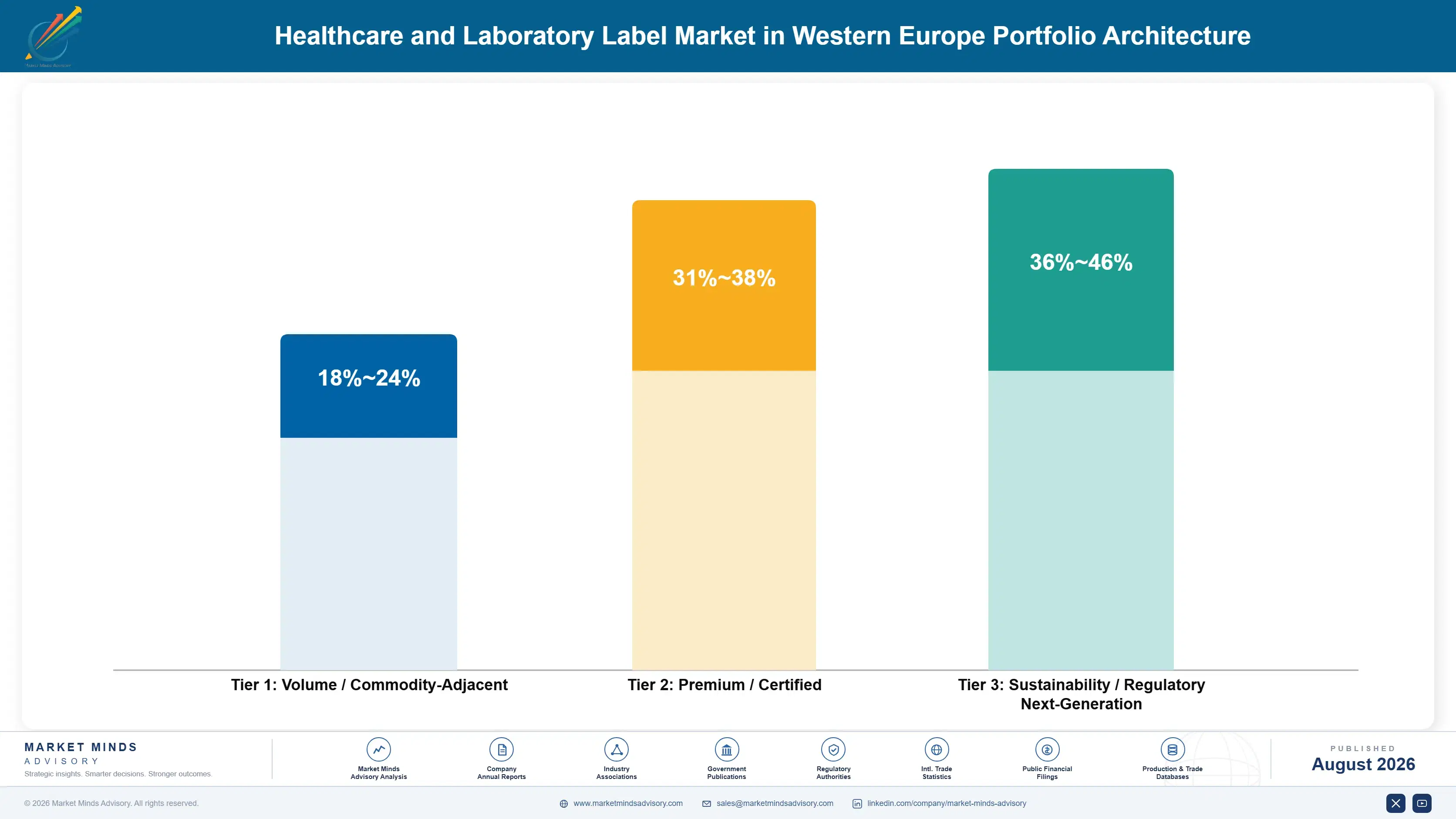
Volume / Commodity-Adjacent

Pharmaceutical secondary labelling and general laboratory consumable labels sold on price against general packaging converters. The six-point range reflects the difference between long serialised runs and short-order laboratory work at the same nominal specification.
Gross Margin: 18%-24%

Premium / Certified

Validated device and primary container constructions carrying biocompatibility and sterilisation documentation. The seven-point spread separates converters that price the validation file separately from those absorbing qualification cost into unit price and competing on the label alone.
Gross Margin: 31%-38%

Sustainability / Regulatory / Next-Generation

Cryogenic constructions, managed serialisation services and linerless laboratory formats. The ten-point range is genuinely wide because these are early markets where pricing reflects scarcity of qualified suppliers rather than any settled cost structure.
Gross Margin: 36%-46%
healthcare-and-laboratory-label-market-in-western--portfolio-architecture-1787553165207

High-value Sub-segments and Strategic Watch-out

Cryogenic and Ultra-Low-Temperature Labels

Growing at 9.3% with the shortest qualified supplier list in the market and procurement teams now writing performance thresholds into contracts. The 3.1% failure rate is the commercial opening: it makes buyers willing to pay for demonstrated performance rather than a datasheet claim. Nobody else can meet it.
Gross Margin: 38%-46%

Managed Serialisation Services

Contract manufacturers would rather not own Falsified Medicines Directive reconciliation, and converters that take it convert transactional supply into contracts running five years without tender. Growth is moderate because the addressable base is fixed, but retention is unmatched anywhere else in the portfolio. Very few converters have built it.
Gross Margin: 34%-42%

Pharmaceutical Secondary Labelling

The volume that fills presses and pays overhead, growing roughly with pharmaceutical output and priced against general packaging converters. Indian and Chinese suppliers with European compliance capability are the immediate threat here, because the documentation requirement is standardised and the price gap is wide. That gap will not narrow.
Gross Margin: 18%-24%

Release Liner Waste Exposure

Customers with sustainability reporting obligations increasingly ask what happens to silicone-coated liner and converters have little to answer. Linerless constructions work for laboratory formats and not for regulated primary containers, so the exposure sits precisely where the margin is. Somebody will solve this and take share with it.
Gross Margin: 12%-20%

How This Demand Renews

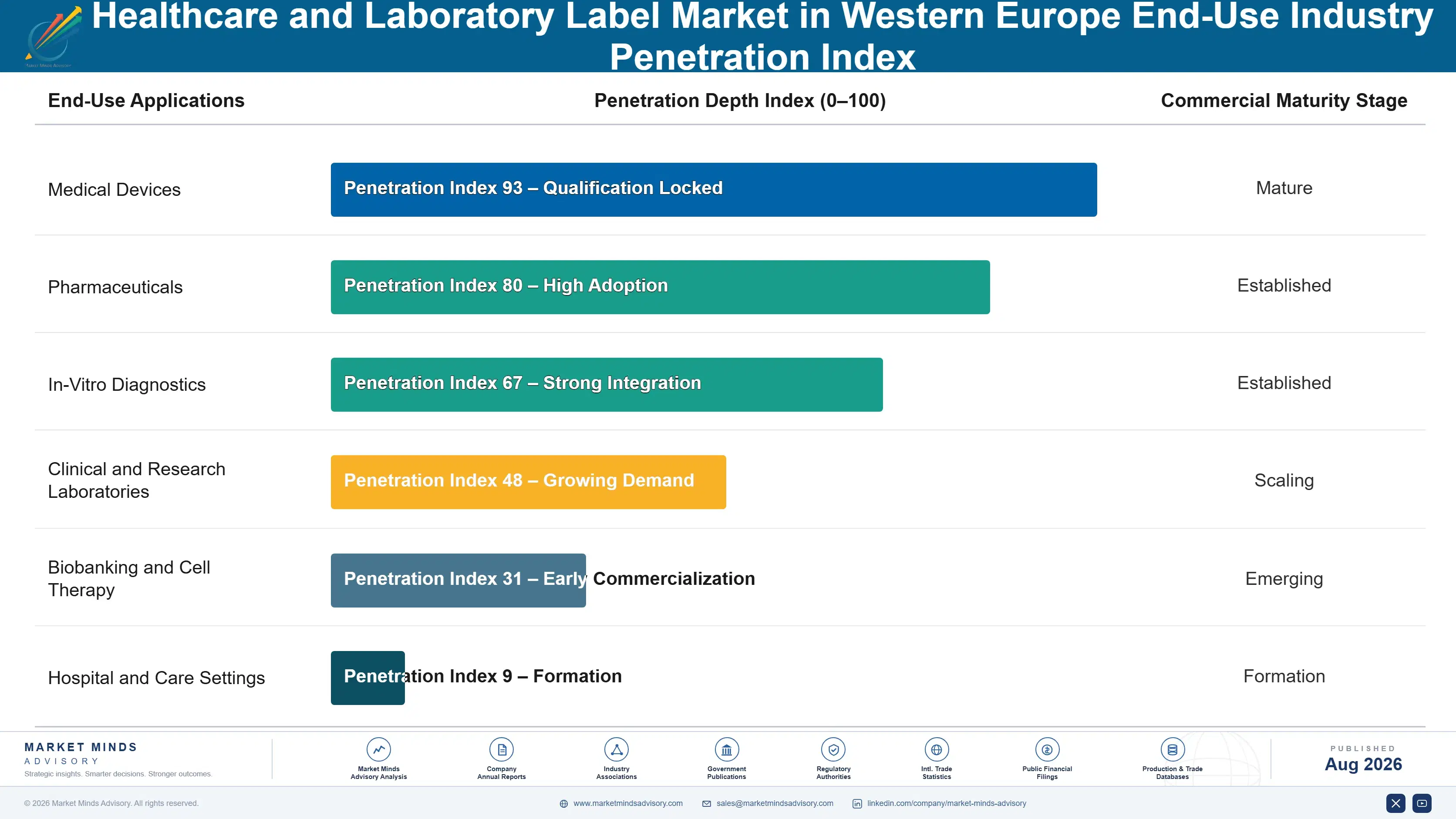
Healthcare label demand is annuity revenue in the strictest sense. Every unit of product shipped carries a label, so volume tracks customer output continuously rather than arriving in project waves. Once a construction is validated it stays in place for years, and the converter holds the position without competing for it again. Replacement demand is the whole business; there is no installed base to displace.
Stickiness varies sharply by vertical. Implantable device labelling is close to permanent, because revalidation risk outweighs almost any price saving. Pharmaceutical secondary labelling changes supplier readily, since qualification is lighter and the work is comparable across converters. Laboratory consumables sit between the two, sticky through distributor relationships rather than regulation. Depth follows the same pattern: device customers buy several constructions from one supplier while laboratory buyers spread across many.

The buyer has changed generationally. Label decisions once sat with packaging engineers who cared about run speed and registration. They now sit with regulatory affairs and quality functions who care about documentation and audit exposure, and increasingly with sustainability officers asking about liner recovery. Converters whose sales organisation still calls on packaging engineering are talking to somebody who no longer decides.
healthcare-and-laboratory-label-market-in-western--end-use-penetration-index-1787553165699

Where To Place The Bet

These are among the four positions where our research anticipates prominent divergence between winners and laggards over the coming forecast period. Each is grounded in the demand model, the regulatory perimeter, and the announced capacity pipeline.
01 / VALIDATION CAPABILITY INVESTMENT

Build regulatory affairs depth before adding press capacity

The gap between the five leaders holding 42% and everybody else is documentation capability rather than manufacturing scale, and several regional converters already run comparable press lines without winning any of the same work. Regulatory affairs headcount and an accumulated validation library take years to assemble and cannot be bought quickly at any price anybody would pay. Any capital plan that funds equipment ahead of qualification staff is solving a problem this market stopped having several years ago now entirely.
02 / CRYOGENIC SEGMENT ENTRY

Qualify ultra-low-temperature constructions ahead of specification writing

Cryogenic labelling compounds at 9.3% against a market at 6.2%, and biobank procurement teams increasingly name specific constructions in tender documents rather than describing a requirement and inviting proposals. A converter absent from that specification is absent from the contract, and dislodging an incumbent once written into a specification is close to impossible in practice. The testing cost is real and it is one-time, which makes the arithmetic favourable for anybody willing to spend it now rather than three years later.
03 / SERIALISATION SERVICE PRICING

Own the data burden contract manufacturers want removed

Contract manufacturers running Falsified Medicines Directive obligations across multiple brand owners find reconciliation heavier than printing and would generally hand it over to somebody else entirely. A converter holding number ranges and aggregation records turns a per-thousand transaction into a managed service that has held for five years or longer without competitive tender. Switching cost rises sharply because the data history moves with the supplier rather than staying inside the customer's own internal systems, which very few of them want back.
04 / SALES CHANNEL REDIRECTION

Call on regulatory affairs, not packaging engineering

The person deciding label supply has changed and most converter sales organisations have not followed it at all. Regulatory affairs and quality functions now hold the decision because the label is a validated device component rather than a packaging purchase, and sustainability officers are joining them over liner recovery questions increasingly often. A sales team calling on packaging engineering is presenting run speed and registration accuracy to somebody who stopped signing any of these contracts several years ago now entirely.

Engagement Snapshot From the Field

A live engagement with an industry participant carrying material or product regulatory and market exposure ahead of a defining policy shift, showing how our research translates into a defensible multi-year portfolio strategy.
MARKET MINDS ADVISORY · CLIENT ENGAGEMENT SUMMARY
Healthcare and Laboratory Label in Western Europe Producer Strategic Portfolio Review and Transition Roadmap 2026·Investment Scenario on Healthcare and Laboratory Label in Western Europe Exposure Evaluation 2025-26
CLIENT PROFILE
A mid-sized European orthopaedic and surgical instrument manufacturer with annual revenue around EUR 340 million (client-reported, unverified by MMA), selling across 18 European markets from two production sites. The company had completed MDR transition for its main portfolio and was preparing IVDR work for an associated diagnostics line. Label supply sat with a single incumbent converter.
STRATEGIC CHALLENGE
Label pricing had risen 19% across two contract renewals (client-reported, unverified by MMA) and procurement had no credible alternative to present, because revalidating a second supplier would take more than a year. Meanwhile the diagnostics line needed constructions the incumbent had not qualified. The board wanted to know whether the exposure was normal or badly managed.
MMA APPROACH
MMA benchmarked the client's label pricing and qualification arrangements against comparable European device manufacturers using the expert interview programme, then mapped which converters held qualified constructions matching the diagnostics requirement. Contract terms were reviewed against sector practice on indexation and dual sourcing. Interviews with three notified bodies established what a supplier change would actually require.
KEY FINDINGS
  1. The 19% increase sat within normal European range for validated device constructions over the period, so the pricing itself was not the problem the board assumed it was.
  2. Single sourcing was the actual exposure, and it had been created during original validation when nobody considered qualifying a second facestock source alongside the first.
  3. Three European converters already held qualified constructions matching the diagnostics requirement, which the client had not established because procurement had never asked the question directly.
  4. None of the client's contracts carried input cost indexation, which meant every paper and film price movement arrived as a renewal negotiation rather than a quarterly adjustment.
CLIENT PROFILE
A mid-sized European orthopaedic and surgical instrument manufacturer with annual revenue around EUR 340 million (client-reported, unverified by MMA), selling across 18 European markets from two production sites. The company had completed MDR transition for its main portfolio and was preparing IVDR work for an associated diagnostics line. Label supply sat with a single incumbent converter.
STRATEGIC CHALLENGE
Label pricing had risen 19% across two contract renewals (client-reported, unverified by MMA) and procurement had no credible alternative to present, because revalidating a second supplier would take more than a year. Meanwhile the diagnostics line needed constructions the incumbent had not qualified. The board wanted to know whether the exposure was normal or badly managed.
MMA APPROACH
MMA benchmarked the client's label pricing and qualification arrangements against comparable European device manufacturers using the expert interview programme, then mapped which converters held qualified constructions matching the diagnostics requirement. Contract terms were reviewed against sector practice on indexation and dual sourcing. Interviews with three notified bodies established what a supplier change would actually require.
KEY FINDINGS
  1. The 19% increase sat within normal European range for validated device constructions over the period, so the pricing itself was not the problem the board assumed it was.
  2. Single sourcing was the actual exposure, and it had been created during original validation when nobody considered qualifying a second facestock source alongside the first.
  3. Three European converters already held qualified constructions matching the diagnostics requirement, which the client had not established because procurement had never asked the question directly.
  4. None of the client's contracts carried input cost indexation, which meant every paper and film price movement arrived as a renewal negotiation rather than a quarterly adjustment.
RECOMMENDED STRATEGY
Phase 1: Phase one: qualify the diagnostics constructions with two converters simultaneously rather than one, accepting the additional testing cost to avoid repeating the current position. Phase 2: Phase two: renegotiate existing device label contracts onto published paper and film indexation, removing input volatility from the renewal conversation entirely. Phase 3: Phase three: run a staged second-source qualification across the three highest-volume device constructions over 24 months, funded from the indexation saving.
OUTCOME
The diagnostics line was qualified with two converters at an additional testing cost the client reported as roughly EUR 180,000 (client-reported, unverified by MMA). Indexation was accepted on renewal for the main device contracts. The second-source programme is running and the client reports the renewal conversation has changed character entirely.

Frequently Asked Questions

Foundational context covering the market sizes, CAGR, scope, country, region and competition that inform every finding below. This section is provided to cover basics and most often pre-purchase conversations, answered from the MMA Primary Research Dataset.

What is the current size of the Healthcare and Laboratory Label Market in Western Europe?

MMA sizes the global healthcare and laboratory label market at USD 9.6 billion in 2025, reaching USD 10.2 billion in 2026. Western Europe accounts for 26% of that value.

How large will the Healthcare and Laboratory Label Market in Western Europe be by 2036?

MMA forecasts USD 18.61 billion by 2036 under the base case, an expansion multiple of 1.82 times the 2026 value. That represents USD 8.41 billion of incremental value.

What is the CAGR for the Healthcare and Laboratory Label Market in Western Europe 2026 to 2036?

The base case runs at 6.2% compound annual growth between 2026 and 2036, with a bull case at 7.4% and a bear case at 5.0%. Historical growth from 2020 to 2025 was 5.0%.

Which segment is growing fastest?

Cryogenic and ultra-low-temperature labels lead at 9.3%, half again the market rate, driven by biobanking capacity and cell therapy manufacturing. Sterilisation-resistant device labels follow at 8.1%.

Who are the major companies in the Healthcare and Laboratory Label Market in Western Europe?

Avery Dennison, CCL Industries, UPM Raflatac, Multi-Color Corporation and 3M hold 42% between them. Material science depth and regional plant coverage sustain those positions rather than press capacity.

Which country is growing fastest?

India leads at 9.2%, driven by generic pharmaceutical export volume that carries destination-market labelling obligations. Indian converters have built European compliance capability to serve those customers and now compete directly.

Report Segmentation Architecture

The full report scope spans multiple orthogonal segmentation dimensions, with cross-tabulated demand data provided for each dimension pair. Coverage extends further to regional breakdowns, trend trajectories, and the competitive detail needed to support segment-level decision-making.

By Label Construction

  • Pressure-Sensitive Primary Container Labels
  • Cryogenic and Ultra-Low-Temperature Labels
  • Sterilisation-Resistant Device Labels
  • Multi-Layer Expanded-Content Labels
  • Specimen and Sample Identification Labels
  • In-Mould and Direct-Print Container Labels

By End-Use Industry

  • Medical Devices
  • Pharmaceuticals
  • In-Vitro Diagnostics
  • Clinical and Research Laboratories
  • Biobanking and Cell Therapy
  • Hospital and Care Settings

By Sales Model

  • Direct Contract Supply
  • Distributor Supply
  • Managed Service Contract
  • Clinical Trial Supply Programmes
  • Print-on-Demand Service

By Region

  • North America
  • Western Europe
  • East Asia
  • South Asia and Pacific
  • Latin America
  • Middle East and Africa
  • Eastern Europe

Scope, Methodology, and Coverage

Every figure in this report is reproducible from documented input assumptions. The scope below maps the historical period, the forecast horizon, the segmentation dimensions, and the countries covered, alongside the underlying primary and qualitative methodology.
Historical Period
2020 to 2025
Forecast Period
2026 to 2036
Base Year
2025 (USD billions; MMA Primary Research Dataset, August 2026)
Market Definition
The market comprises labels supplied for identification, compliance and information carriage on pharmaceutical primary and secondary packaging, medical devices, diagnostic reagents, specimen containers and laboratory consumables. Value is measured at converter level on printed and converted product across pressure-sensitive, in-mould and direct-print constructions. Unconverted facestock and liner laminate sold as material, label application equipment, printing presses, serialisation software licences, RFID inlays sold separately, and general industrial or food labelling fall outside scope.
Quantitative Units
USD billions (current prices); billion labels converted annually; USD per thousand labels by construction
Segmentation Dimensions
By Label Construction; By End-Use Industry; By Sales Model; By Region
Regions Covered
North America, Western Europe, East Asia, South Asia and Pacific, Latin America, Middle East and Africa, Eastern Europe
Countries Covered
Germany, France, United Kingdom, Italy, Spain, Netherlands, Belgium, Switzerland, Ireland, Sweden, Denmark, Austria, Poland, Czechia, Hungary, United States, Canada, Mexico, China, Japan, South Korea, Taiwan, India, Singapore, Australia, Brazil, Argentina, Saudi Arabia, United Arab Emirates, South Africa
Key Companies Profiled
Avery Dennison, CCL Industries, UPM Raflatac, Multi-Color Corporation, 3M, Brady Corporation, Schreiner Group, Faubel & Co, Herma, Lintec Corporation, Fedrigoni Self-Adhesives, Mondi, Constantia Flexibles, Coveris, All4Labels, Sato Holdings, Zebra Technologies, Weber Packaging Solutions, Resource Label Group, Denny Bros
Quantitative Methodology
Primary survey, n=3,800 respondents, Q4 2025, six countries; demand-side model with trade association cross-validation
Qualitative Methodology
47 expert interviews, Q4 2025; applied to validate demand model assumptions, identify emerging dynamics, and assess competitive positioning
Report Format
PDF and XLSX data workbook (Word format preview document)
Publisher
Market Minds Advisory
Report Code
MMA-2026-PAC-171
Published
August 2026
Contact
sales@marketmindsadvisory.com | www.marketmindsadvisory.com

Purchase the full Healthcare and Laboratory Label Market in Western Europe Report (2026 to 2036).

The full report covers the global healthcare and laboratory label market with Western Europe treated as the analytical centre, sized to 2036 across six construction segments and seven regions. It maps qualification requirements under MDR, IVDR and the Falsified Medicines Directive against converter capability, and identifies where validation barriers create defensible position. Competitive analysis covers 20 participants evaluated on healthcare and laboratory label revenue, with moat and risk assessment for the two leaders. Input cost exposure is traced from facestock and liner supply through to contract structure. The revenue lever section quantifies four commercial moves available to converters now.
Six-segment construction sizing with segment-level growth rates
Seven-region share and growth breakdown to 2036
Twenty-participant competitive map on one revenue basis
Qualification barrier analysis across MDR and IVDR requirements
Input cost exposure traced to facestock and liner
Four quantified revenue levers with commercial impact ranges

Built For The People Who Decide

From boardroom strategy to bench-side execution, this report is read cover-to-cover by leaders shaping the next decade of their industry, turning demand scenarios, market dynamics and valuation benchmarks into decisions.
CXOs/ Presidents/ VPs/ Managers
M&A and Corporate Development
Strategy Teams and R&D Heads
Procurement and Product Directors
Regulatory and Compliance Leaders
Investor Relations and Equity Analysts