Market Minds Advisory
Healthcare and Laboratory Label Market in Korea

Healthcare and Laboratory Label Market in Korea: Where Print Reliability Meets Chain of Custody.

Healthcare and laboratory label demand is shifting from static printed formats toward RFID and barcode smart labels, as specimen tracking accuracy requirements and pharmacy dispensing error reduction mandates reshape converter product specifications.

Lead Analyst

Bilal Shaikh

Published

September 2026

Make Smarter Decisions with Customized Research Insights

Request a free sample report and evaluate market opportunities, growth trends, and competitive dynamics relevant to your business needs.

2025 MARKET VALUE$2.4BMarket Size 2025
2036 FORECAST VALUE$4.8BBase Case , 2026 to 2036
CAGR 2026 TO 20366.5 %Bull 7.8% / Bear 5.2%
INCREMENTAL OPPORTUNITY$2.2BNet 10- year value creation
EXPANSION MULTIPLE1.88x2036 value over 2026 base
Strategic Levers
M&A Pipeline
Regional Outlook
Country Rankings
Competitive Intelligence
Segmental Deep-dive
Call-Us : 91 93563 13602

Executive Snapshot and Market Trajectory

Healthcare and laboratory label purchasing increasingly reflects specimen tracking accuracy and pharmacy dispensing safety requirements rather than pure print cost, as hospitals and reference laboratories tighten chain-of-custody standards across most accredited facilities operating today throughout the region, country, and beyond current expectations.
Rising diagnostic test volume expanding specimen labeling requirements, pharmacy dispensing error reduction mandates driving barcode verification adoption, and South Korea rapidly expanding domestic label converting capacity within East Asia are together concentrating demand upside in two clear directions: East Asian markets where South Korea manufacturing and hospital digitization investment run furthest ahead of most other regional markets, and RFID and barcode smart labels that give laboratories genuine specimen chain-of-custody accuracy previously unavailable through static formats.
Avery Dennison, CCL Industries, and UPM Raflatac lead a moderately fragmented field where RFID and barcode integration capability is becoming as commercially decisive as adhesive and substrate quality, while regional Asian converters compete primarily on price for entry-level specimen label formats serving smaller diagnostic laboratories across price-sensitive emerging markets currently expanding their pathology and pharmacy testing infrastructure rapidly across most participating countries, territories, and regional healthcare networks today.
Market Definition
The healthcare and laboratory label market covers pressure-sensitive and RFID-enabled labels used for specimen identification, pharmacy dispensing, medical device labeling, and hazard warning applications across clinical and laboratory settings. General industrial and consumer product labels are excluded from scope.
Base Year Value
$2.4B in 2025 (MMA Primary Research Dataset, August 2026)
Forecast Period
2026 to 2036, eleven discrete annual values
CAGR
6.5% base case. Bull 7.8%. Bear 5.2%.
Fastest Growth Segment
RFID and Barcode Smart Labels: 11.5% CAGR
Fastest Growth Country
South Korea: 7.8% CAGR
Fastest Growth Region
South Asia and Pacific: 8.5% CAGR
Largest Region
East Asia: 29% of 2025 global value
Market Leaders
Avery Dennison, CCL Industries, UPM Raflatac, Zebra Technologies, Herma GmbH. Source: MMA Analysis, July 2026.
Primary Survey
n=3,800 procurement and R&D decision-makers, Q4 2025, six countries
Methodology
Demand-side build-up, cross-validated against public data, 47 expert interviews

Healthcare and Laboratory Label Market Forecast Scenarios

healthcare-and-laboratory-label-market-in-korea-size-forecast-scenario-1787305427510
Healthcare and laboratory label demand grew steadily between 2020 and 2025, with pandemic-driven diagnostic test volume and vaccine distribution labeling requirements pulling growth forward before moderating into a calmer, more regulation-driven pattern by 2024. South Korea domestic converting capacity expanded meaningfully during the back half of the historical period, positioning the country as an increasingly important East Asian manufacturing hub for this category.
The base case assumes 6.5 percent annual growth through 2036, anchored on three commercial mechanisms: rising diagnostic and pathology test volume expanding specimen labeling requirements across hospital and reference laboratory networks, pharmacy dispensing error reduction mandates pushing barcode verification adoption at retail and hospital pharmacy counters, and South Korea continued converting capacity expansion within East Asia supplying both domestic consumption and growing export volume to neighboring Asian healthcare markets currently digitizing rapidly.
The bull case centers on faster-than-expected RFID smart label cost reduction pulling forward broader specimen and pharmaceutical tracking adoption across mid-size hospital networks. The bear case flags healthcare system capital budget constraints and slower barcode verification mandate enforcement, which could delay smart label conversion and leave converters running costly dual product lines for longer than currently planned.

Where Print Reliability Meets Chain of Custody

Healthcare and laboratory labels occupy a category where regulatory precision and print reliability matter as much as material cost, since mislabeled specimens or pharmacy dispensing errors carry direct patient safety consequences rather than mere commercial inconvenience. Static barcode labels still dominate routine specimen identification, but RFID and smart barcode formats are gaining share fastest wherever chain-of-custody accuracy or dispensing verification requirements have tightened meani
MARKET CONCENTRATIONCR5 38%Top five producers control roughly two fifths of shipments
AVERAGE SELLING PRICEUSD 0.08/unitBlended average price across static and smart label categories
TOP PRODUCING COUNTRY SHARE27%Share of global converting capacity concentrated in leading country
CAPACITY UTILISATION83%Average converting line operating rate across major regional facilities
TRADE INTENSITY40%Portion of label volume crossing borders versus locally converted
INPUT COST SHARE47%Substrate and adhesive costs as share of total label cost
Regulatory pressure varies sharply by application and geography across most markets tracked. Countries that have mandated barcode verification at the point of pharmacy dispensing have seen smart label adoption accelerate sharply within eighteen to twenty-four months, while jurisdictions still relying on manual specimen labeling protocols show markedly slower converter product mix transition despite comparable label availability and converter manufacturing capacity.
South Korea converting capacity continues expanding faster than most other East Asian markets, driven by domestic hospital digitization investment and increasingly export-oriented converter capacity serving neighboring healthcare systems. Substrate and adhesive cost volatility remains a meaningful swing factor in converter margin, with specialty medical-grade adhesives tied closely to broader chemical feedstock cycles that most converters can only partially hedge through long-term supply contracts.
"A lab that mislabels one specimen loses the entire batch of trust with a referring physician. That is the actual price tag on a fifty cent label, and most hospital procurement teams still price it like a commodity."
Director, Packaging and Materials Practice · MMA Packaging / Healthcare and Labo

Market Trends

Barcode Dispensing Verification Mandates Drive Smart Label Adoption

Pharmacy dispensing error reduction mandates across several major markets now require barcode verification at the point of medication dispensing, directly linking a specific label format to patient safety compliance rather than treating it as a packaging afterthought. Hospitals implementing these systems report meaningful reductions in dispensing error rates, giving purchasing committees concrete evidence to justify converting away from static labels toward barcode-verified formats. This mandate-driven adoption is spreading beyond hospital pharmacy into outpatient retail pharmacy chains, broadening the addressable converter market considerably across most reimbursed healthcare systems currently tightening dispensing safety protocols.
Market Impact: Test volume grows at over 6%

South Korea Converting Capacity Expansion Reshapes Regional Trade

South Korea domestic label converting capacity has expanded considerably in recent years, driven by hospital digitization investment and growing export orientation toward neighboring East Asian and Southeast Asian healthcare markets. Several major converters announced new South Korean production lines during 2024 and 2025, targeting both domestic consumption and export capacity serving nearby countries still building out diagnostic laboratory infrastructure. This regional capacity buildout is shifting East Asian label trade patterns gradually, with South Korean converters increasingly supplying finished product to buyers that previously sourced primarily from Japanese or Western producers.
Market Impact: Covers over 90% of devices sold

Market Opportunities and Growth Drivers

Rising Diagnostic Test Volume Expands Specimen Labeling Demand

Global diagnostic test volume continues expanding steadily across most healthcare systems, driven by aging populations, chronic disease prevalence, and expanding preventive screening programs, directly increasing specimen labeling requirements at every accredited pathology and reference laboratory nationwide and internationally. Each additional diagnostic test performed requires reliable specimen identification labeling that survives handling, freezing, and chemical exposure without compromising readability. Laboratories processing higher specimen volumes increasingly require label formats validated for automated handling systems, pushing converter product development toward labels compatible with high-throughput laboratory automation equipment across most established reference laboratory networks.
Market Impact: RFID labels cost 3-5x more

Medical Device Labeling Regulation Tightens Compliance Requirements

Medical device labeling regulations across several major markets have tightened considerably in recent years, requiring more detailed traceability information, unique device identifiers, and multilingual content on device packaging labels across most regulated categories. This regulatory tightening has pushed device manufacturers toward specialized label converters capable of meeting complex compliance requirements rather than treating labeling as a generic packaging function handled internally. Converters with dedicated regulatory affairs expertise supporting device manufacturer compliance needs are capturing disproportionate share of this increasingly demanding and technically complex labeling category across most regulated medical device markets.
Market Impact: Standards vary across 30 plus marke

Market Restraints and Challenges

RFID Cost Premium Slows Smart Label Adoption

RFID-enabled smart labels carry meaningfully higher per-unit cost than standard barcode labels, a premium rooted in embedded chip and antenna manufacturing complexity that standard printing processes do not require. This cost differential slows adoption at smaller diagnostic laboratories and community pharmacies where per-specimen or per-prescription label cost matters more directly to already thin operating margins. Converters are mitigating this restraint through simplified antenna designs and higher-volume chip procurement that gradually reduces the RFID cost premium, though full cost parity with standard barcode labels remains several years away for most applications.
Market Impact: Cuts dispensing errors 30 to 50%

Fragmented Regional Labeling Standards Complicate Compliance

Healthcare and laboratory labeling standards vary considerably across countries and even across individual hospital systems within the same country, a fragmentation rooted in the absence of a single unified global specimen labeling protocol comparable to barcode standards in retail commerce. This fragmentation forces converters to maintain considerably more product variants than a truly standardized market would require, adding cost and complexity to inventory management. Converters are mitigating this restraint through modular label design platforms that accommodate multiple regional standards from a shared base format, reducing the need for entirely separate product lines per market.
Market Impact: New capacity lines announced throug
4 additional market trends, 4 additional growth drivers, and 4 additional restraints and challenges are covered in the full report. Contact sales@marketmindsadvisory.com to access the complete intelligence.

Segment CAGR and Growth Architecture

Healthcare and laboratory labels segment by product and technology type across six categories spanning static, smart, and application-specific formats used across clinical and laboratory settings. RFID and barcode smart labels and specimen and sample ID labels are the two fastest-growing categories tracked, both expanding well ahead of the broader market as chain-of-custody and dispensing safety requirements tighten.
healthcare-and-laboratory-label-market-in-korea-market-share-analysis-1787305428478

RFID and Barcode Smart Labels

RFID and barcode smart labels, which embed machine-readable identification data readable by handheld scanners or automated laboratory equipment, are converting the fastest share of new hospital and laboratory purchasing budgets as chain-of-custody and dispensing verification requirements tighten across most accredited healthcare facilities. These formats reduce manual data entry error meaningfully compared to handwritten or basic printed labels, supporting both patient safety and laboratory efficiency objectives simultaneously. Converters have invested heavily in embedded chip and antenna manufacturing capacity to close the cost gap against standard barcode formats, though full price parity remains several years away for most routine specimen labeling applications across most established healthcare markets tracked closely by MMA analysts.
CAGR 11.5%

Specimen and Sample ID Labels

Specimen and sample ID labels, which identify individual patient specimens throughout collection, transport, and laboratory analysis, are expanding steadily as diagnostic test volume continues growing across most healthcare systems worldwide and across nearly every accredited laboratory network tracked. These labels must survive freezing, chemical exposure, and repeated handling without compromising barcode readability, a demanding performance requirement that favors specialty adhesive and substrate formulations over generic label materials used in less demanding applications. Growth here tracks organized diagnostic screening and pathology test volume directly, with laboratories increasingly requiring formats validated for automated handling systems compatible with high-throughput laboratory equipment across most major reference laboratory networks operating today and expanding steadily into the future.
CAGR 8.2%
Full segment breakdown across 6 segments available in the complete report.

Regional Architecture and Country Demand Map

Healthcare and laboratory label demand concentrates most heavily in East Asia, where South Korea converting capacity and hospital digitization investment run furthest ahead of most other regional markets. North America follows on value, while South Asia and Pacific markets post the fastest regional growth off a smaller installed base.

North America

North America follows East Asia closely in absolute revenue terms, supported by comprehensive pharmacy dispensing verification mandates and a dense installed base of accredited hospital and reference laboratory networks generating steady replacement demand nationwide and across every major metropolitan healthcare system and rural facility tracked closely. The United States accounts for the large majority of regional volume, with barcode dispensing verification requirements increasingly determining converter product specification among established healthcare systems. Canada contributes a smaller but steadily growing share tied to comparable provincial healthcare digitization initiatives. Regulatory compliance requirements affect North American converter product development considerably, since medical device labeling and specimen tracking standards carry direct patient safety and legal consequence.
Share: 25% | CAGR: 7.0% (2026 to 2036)

Western Europe

Western Europe generates a meaningful share of global revenue, anchored by Germany, France, and the United Kingdom, where national health systems fund laboratory and pharmacy labeling upgrades on multi-year capital cycles and coordinated procurement schedules across most participating regions, health authorities, hospital networks, and accredited reference laboratories nationwide. Specimen labeling standards vary considerably across member states, reflecting differing national health technology assessment approaches to chain-of-custody requirements. Germany maintains the largest converter manufacturing base in the region, supporting both domestic supply and export volume to neighboring European markets. Growth trails East Asia and South Asia as the market matures, though regulatory-driven product transition sustains steady demand across most established converter operations region-wide.
Share: 20% | CAGR: 5.0% (2026 to 2036)
Regional intelligence for 5 additional markets available in the complete report: East Asia, South Asia and Pacific, Latin America, Middle East and Africa, Eastern Europe. Contact sales@marketmindsadvisory.com.
healthcare-and-laboratory-label-market-in-korea-country-cagr-analysis-1787305429352

Smart Label Attach and Compliance Service Growth

Healthcare and laboratory label converters are pursuing several distinct paths to grow revenue beyond commodity print volume as smart label technology and regulatory compliance requirements reshape purchasing criteria. Four levers stand out as commercially significant across the forecast period, spanning RFID attach premiums, regulatory compliance services, South Korean export capacity, and long-term hospital supply contract structuring.

RFID Smart Label Price Premium Capture

Converters that have successfully scaled RFID and smart barcode label production are capturing meaningful price premiums over standard printed formats, with early movers reporting premiums of roughly 200 percent on RFID-enabled specimen labels sold to hospitals prioritizing chain-of-custody accuracy. This premium reflects both genuine manufacturing investment and scarcity value, since embedded chip and antenna capacity remains limited relative to surging demand from chain-of-custody-focused purchasing committees. The premium is expected to compress gradually as production scale increases, making early capacity investment timing commercially important for converters seeking to capture this current window.
Market Impact: RFID labels command a roughly 200 p

Regulatory Compliance Documentation Service Attach Strategy

Converters offering dedicated regulatory compliance documentation services, generating unique device identifier and traceability records that device manufacturers submit directly to regulatory bodies, are capturing meaningful service revenue beyond core label printing across most regulated categories. These services typically carry gross margin considerably above standard label sales, since delivery requires regulatory expertise rather than additional converting capacity. Leading converters now attach compliance documentation service contracts to more than 40 percent of medical device manufacturer accounts, reflecting how central regulatory documentation has become to overall device labeling purchasing decisions across most regulated categories.
Market Impact: Compliance documentation services n

South Korean Export Capacity Expansion Strategy

Converters establishing new production capacity in South Korea ahead of projected East Asian diagnostic demand growth are capturing first-mover advantage in markets where local converting capacity currently lags domestic and regional consumption growth by a meaningful margin across most neighboring countries and territories. Early entrants report export volume growth exceeding 25 percent annually into neighboring Southeast Asian markets, well above mature market rates. This approach requires patient capital and local market development investment, but positions converters to capture disproportionate share as regional diagnostic infrastructure continues accelerating through the forecast period ahead.
Market Impact: Export volume grows over 25 percent

Long-Term Hospital Supply Contract Structuring Approach

Converters negotiating long-term supply contracts directly with hospital systems and reference laboratory networks, rather than competing for spot purchase orders repeatedly, are securing predictable recurring revenue that generates margin considerably above transactional label sales alone across most account types. These structured contracts, now covering an estimated 35 percent of major hospital system label volume, lock in pricing and delivery commitments across multi-year terms that reduce both converter and customer exposure to short-term price volatility. This lever matters most for converters with proven quality and reliability track records serving large multi-facility hospital system accounts.
Market Impact: Structured contracts now cover 35 p

Who Controls the Margin Pool

Healthcare and laboratory labels carries a CR5 near thirty-eight percent, reflecting a genuinely fragmented industry where regional converters compete alongside multinational majors across most product categories. The gap between Avery Dennison, the largest single converter, and the next tier of challengers is meaningful but not overwhelming, since converting capacity itself is relatively replicable with sufficient capital investment.
Current competitive activity plays out across three dimensions: RFID and smart label capability races among converters serving chain-of-custody-focused hospital and laboratory customers, capacity expansion into South Korea and neighboring East Asian markets ahead of demand growth, and consolidation among smaller regional converters lacking capital to fund RFID research and development independently. Larger converters are also pursuing selective acquisitions of regulatory compliance technology specialist firms.

Emerging pressure comes from South Korean and other East Asian domestic converters expanding export-oriented capacity at costs multinational majors increasingly struggle to match, and from healthcare IT vendors moving into adjacent labeling software and printer integration markets to capture margin previously ceded to independent converters. Rankings could shift meaningfully if smart label adoption speed diverges significantly between leaders, particularly as hospitals increasingly favor converters demonstrating the fastest credible path to chain-of-custody compliance across their entire specimen handling workflow.
healthcare-and-laboratory-label-market-in-korea-company-positioning-matrix-1787305430167

Competitive Moat and Risk Dimensions

AVERY DENNISON

Moat: Global Converting Scale Advantage

Avery Dennison operates the largest global converting footprint among healthcare and laboratory label producers, spanning dozens of facilities across every major region tracked. This scale lets Avery Dennison serve multinational hospital system and device manufacturer accounts requiring consistent label specifications across multiple countries, a capability smaller regional converters cannot easily replicate.
AVERY DENNISON

Risk: Legacy Static Label Portfolio Exposure

A meaningful share of Avery Dennison existing label portfolio still relies on static barcode formats facing gradual displacement by RFID and smart label technology in key hospital and laboratory accounts. Slower-moving legacy categories could compress margin if smart label transition does not keep pace with tightening chain-of-custody and dispensing verification requirements currently in effect.
CCL INDUSTRIES

Moat: Diversified Specialty Label Portfolio

CCL Industries maintains a broad specialty label portfolio spanning pharmacy, medical device, and industrial applications, giving it more diversified revenue exposure than converters concentrated narrowly in a single healthcare labeling category. This diversification provides some natural hedge against demand fluctuation in any single application segment, supporting steadier overall revenue growth across economic cycles.
CCL INDUSTRIES

Risk: Slower RFID Technology Investment Pace

CCL Industries has historically invested more conservatively in RFID and smart label technology than some specialty competitors, leaving it with comparatively thinner presence in the fastest-growing segment of the category. Building smart label manufacturing capability and technical expertise from a smaller base could limit near-term share gains against more RFID-focused competitors currently expanding aggressively.

Players Tracked

Prominent Players

Avery Dennison
CCL Industries
UPM Raflatac
Zebra Technologies
Herma GmbH

Other Key Players

Brady Corporation
GA International
Fuji Seal International
Mactac
Skanem
Loparex
3M
Iconex
R.R. Donnelley
Torraspapel
FLEXcon
Multi-Color Corporation
Cenveo Worldwide
LabelTac
Diagraph Corporation

Recent Developments

APRIL 2025

Avery Dennison Expands RFID Smart Label Production Facility in South Korea

Avery Dennison completed a capacity expansion at its South Korean converting facility dedicated to RFID and smart barcode label production, adding new chip embedding and antenna assembly lines targeting hospital and pharmacy applications. The expansion supports growing regional demand ahead of tightening chain-of-custody requirements across East Asian healthcare systems.
Signal: Signals accelerating capital investment in
OCTOBER 2024

CCL Industries Signs Long-Term Supply Agreement With Major Hospital System

CCL Industries signed a long-term supply agreement with a major North American hospital system covering specimen and pharmacy dispensing labels across sixty facilities, replacing fragmented multi-vendor procurement with standardized supply terms. The agreement includes pricing stability provisions through 2029 and coordinated delivery logistics across the entire facility network.
Signal: Signals growing hospital system preference
FEBRUARY 2025

UPM Raflatac Acquires Regulatory Compliance Labeling Software Firm

UPM Raflatac completed the acquisition of a regulatory compliance labeling software firm specializing in unique device identifier and traceability documentation, strengthening its service offering for medical device manufacturer customers. The acquisition accelerates UPM Raflatac internal compliance service roadmap, reducing dependence on third-party regulatory software partnerships.
Signal: Signals continued industry consolidation a

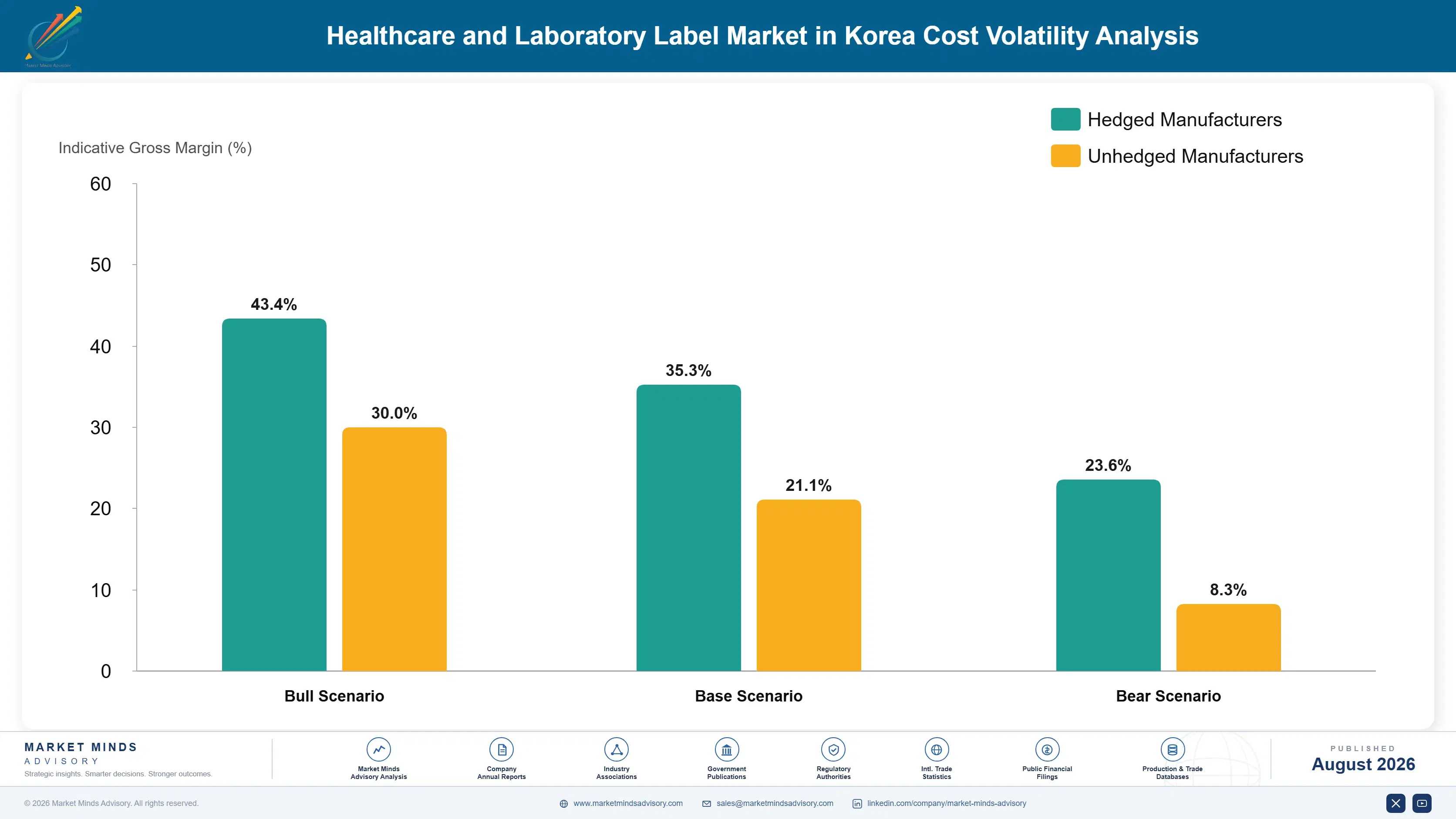
Substrate and Specialty Adhesive Cost Exposure

Specialty medical-grade adhesives, film and paper substrates, and embedded RFID chip and antenna components together represent roughly forty-five to fifty percent of healthcare and laboratory label cost of goods sold overall. These specialty adhesives, formulated to withstand freezing, chemical exposure, and repeated handling, are sourced from a moderately concentrated global chemical supplier base spanning multiple regions.
Specialty adhesive and film substrate prices rose meaningfully during 2021 and 2022 amid broader petrochemical supply disruption affecting converters alongside many other packaging categories across the industry. Several converters disclosed in annual reports that raw material cost inflation compressed margin during this period, prompting some manufacturers toward alternative supplier qualification and longer-term feedstock agreements to stabilize costs through 2023 and into 2024 before conditions eventually eased.

Cost exposure varies by converter manufacturing model and scale across most product categories tracked. Larger converters with in-house adhesive coating capability absorb component cost volatility more easily than smaller competitors purchasing coated substrates entirely from third-party suppliers. Geographic exposure also differs: converters sourcing RFID chips primarily from East Asian semiconductor manufacturers face different cost and logistics patterns than those relying on domestic component production.
healthcare-and-laboratory-label-market-in-korea-cost-volatility-analysis-1787305430508

Dual-Source Adhesive Supplier Qualification

Converters are qualifying second suppliers for specialty adhesives and RFID components to reduce dependence on any single manufacturer during periods of supply tightness affecting the broader category. This lengthens initial qualification cycles but meaningfully reduces exposure to regional supply disruption, giving procurement teams greater negotiating leverage on pricing during periods of component tightness and allocation constraints.

Vertical Integration Into Adhesive Coating

Several major converters have expanded in-house adhesive coating capacity to capture margin previously paid to third-party suppliers and to gain tighter control over component quality and delivery timing across facilities, product lines, and regional operations. This shift requires substantial upfront capital investment but reduces exposure to spot market volatility over multi-year converting cycles ahead.

Long-Term Substrate Supply Agreements

Converters are negotiating longer-term substrate and adhesive supply agreements, locking in pricing and delivery commitments rather than relying on shorter-term spot purchasing arrangements across most sourcing categories and regions. This reduces margin volatility during periods of raw material cost inflation and gives finance teams clearer forward visibility into converting cost trajectory across upcoming quarters.

Portfolio Architecture for Margin Defence

Healthcare and laboratory label portfolios span three margin tiers running from commodity-adjacent static barcode labels through certified specimen and compliance-focused formats to sustainability-linked next-generation RFID and smart connected platforms. Gross margin widens considerably moving up the tier structure, driven primarily by chip and antenna technology and regulatory service depth rather than substrate bill of materials differences alone across most vendor product lines and accounts.
Volume tier competition centers on price and basic print quality for cost-constrained buyers across smaller laboratories and community pharmacies, where converting scale and adhesive purchasing power determine competitiveness more than technical differentiation. Premium tier competition instead centers on RFID capability, regulatory compliance service depth, and chain-of-custody validation, an entirely different buying calculus that rewards converters with dedicated technical research capability built over many years of sustained investment.

High-value margin pools concentrate overwhelmingly in the premium and next-generation tiers, where RFID attach and regulatory compliance service revenue generate meaningfully better margin than any commodity label transaction. Converters increasingly steer capital investment and research and development spending toward this upper tier as volume-tier margin continues compressing under sustained substrate cost pressure and intensifying price competition from lower-cost regional converters.

Volume / Commodity-Adjacent Tier

Standard static barcode labels for routine specimen identification and pharmacy dispensing, targeting price-sensitive smaller laboratories and community pharmacies where converting scale and adhesive cost management matter more than smart connectivity or advanced compliance features.
Gross Margin: 24%-32%

Premium / Certified Tier

Certified specimen labels and regulatory compliance-focused device labels meeting chain-of-custody and traceability requirements, typically sold with compliance documentation services to accredited hospitals and device manufacturers seeking validated performance and reliability.
Gross Margin: 36%-44%

Sustainability / Regulatory / Next-Generation Tier

RFID and smart connected label platforms bundling embedded chip technology, real-time tracking, and data integration capability, targeting leading hospital networks and reference laboratories piloting next-generation chain-of-custody automation ahead of broader adoption.
Gross Margin: 50%-58%
healthcare-and-laboratory-label-market-in-korea-portfolio-architecture-1787305431337

Compliance Cycles and Converter Trust

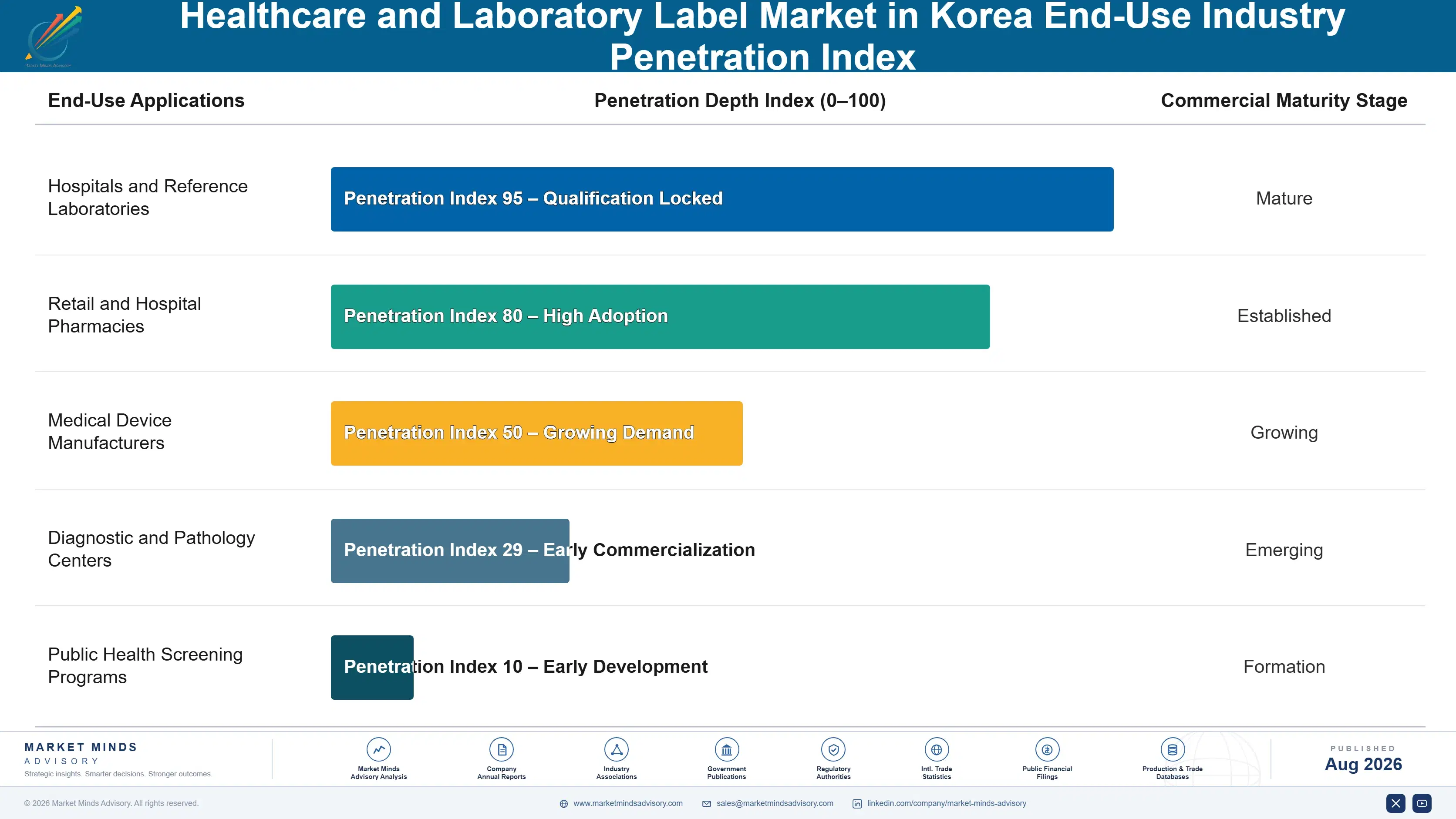
Healthcare and laboratory label demand carries genuine annuity characteristics through multi-year hospital and device manufacturer supply contracts anchored by ongoing regulatory compliance cycles, since converters rarely switch relationships mid-certification given the documentation continuity regulatory bodies expect across successive review periods. Converters increasingly value long-term compliance partnership over pure initial contract revenue, restructuring sales models to prioritize reten
Adoption depth varies sharply by end-use vertical. Reference laboratories and academic medical centers show the deepest, most sustained engagement, layering smart labeling across nearly their entire specimen volume given the highest chain-of-custody stakes. Smaller community hospitals and pharmacies adopt more gradually, with RFID attach still catching up as budgets prioritize highest-risk applications first before expanding coverage across lower-acuity workflows.

A generational shift in buyer profile is underway as younger laboratory directors and pharmacy informatics leaders trained on digital traceability standards reach purchasing influence roles within hospital and laboratory administration. This cohort expects RFID and barcode verification as a baseline feature rather than a premium add-on, reshaping procurement criteria toward chain-of-custody evidence and away from pure print cost specifications that dominated purchasing decisions a decade ago.
healthcare-and-laboratory-label-market-in-korea-end-use-penetration-index-1787305432118

Where Healthcare Label Value Concentrates

These are among the four positions where our research anticipates prominent divergence between winners and laggards over the coming forecast period. Each is grounded in the demand model, the regulatory perimeter, and the announced capacity pipeline.
01 / RFID TECHNOLOGY INVESTMENT

Prioritize RFID Capability Ahead of Compliance Deadlines

Converters that invest in RFID and smart barcode manufacturing capability ahead of tightening chain-of-custody deadlines are capturing meaningful price premiums and locking in hospital relationships before competitors catch up across most major accredited healthcare markets, territories, and provider networks today. Regulatory-driven verification mandates mean converters starting technology investment late will miss key hospital procurement windows entirely. Converters that delay this investment risk losing established accounts to faster-moving competitors as dispensing verification requirements make static label formats increasingly inadequate for compliance purposes.
02 / SOUTH KOREAN CAPACITY EXPANSION

Expand South Korean Capacity Ahead of Regional Demand Growth

East Asian healthcare systems are digitizing and expanding diagnostic infrastructure faster than most converters currently have South Korean converting capacity to serve profitably at scale across most affected countries, provinces, and metropolitan healthcare networks today. Establishing production capacity ahead of demand requires patient multi-year investment but positions converters to capture disproportionate share as regional hospital digitization and export demand continue accelerating steadily throughout the forecast period. Converters waiting for demand signals to fully materialize will face a steeper path later.
03 / REGULATORY SERVICE DIFFERENTIATION

Build Compliance Documentation Depth to Defend Premium Margin

Regulatory compliance documentation service depth increasingly separates converters able to command premium margin from those competing purely on commodity label pricing and converting scale across most regulated healthcare product categories tracked closely by industry analysts. This service gap is widening as demanding categories like medical device labeling require regulatory expertise that basic printing operations still cannot reliably match. Converters without dedicated regulatory affairs capability risk being squeezed between low-cost commodity competitors and technology leaders capturing the most valuable specialty accounts.
04 / FRAGMENTED STANDARDS RESPONSE

Build Modular Design Platforms to Manage Regional Fragmentation

Fragmented regional labeling standards threaten to compress converter margin faster than established vendors can offset through pure manufacturing scale alone across most standard hospital and laboratory procurement decisions and budget cycles worldwide today and going forward each year. Converters need genuine modular design platforms that accommodate multiple regional standards from a shared base format rather than maintaining entirely separate product lines per market. Converters failing to build this flexibility risk losing bids to competitors offering faster, more cost-effective multi-market compliance.

Engagement Snapshot From the Field

A live engagement with an industry participant carrying material or product regulatory and market exposure ahead of a defining policy shift, showing how our research translates into a defensible multi-year portfolio strategy.
MARKET MINDS ADVISORY · CLIENT ENGAGEMENT SUMMARY
Healthcare and Laboratory Label in Korea Producer Strategic Portfolio Review and Transition Roadmap 2026·Investment Scenario on Healthcare and Laboratory Label in Korea Exposure Evaluation 2025-26
CLIENT PROFILE
The client is a regional hospital network operating nine acute care facilities across South Korea, serving a mixed urban and suburban patient population with growing diagnostic and pathology test volume. The network faced increasing scrutiny over specimen misidentification incidents across several facilities, alongside pressure from national health authorities to demonstrate improved chain-of-custody documentation ahead of an upcoming accreditation review cycle.
STRATEGIC CHALLENGE
Leadership needed to evaluate whether standardizing on RFID-enabled specimen labeling across all nine facilities could meaningfully reduce misidentification incidents without disrupting existing laboratory information system workflows that took years to establish. The network also needed to justify the capital investment against uncertain near-term reimbursement pressure affecting overall hospital operating margin.
MMA APPROACH
MMA conducted an independent vendor capability assessment across four RFID labeling platforms, benchmarking chain-of-custody accuracy evidence, laboratory information system integration compatibility, and total cost of ownership over a seven-year hold period. The engagement combined primary interviews with pathology and nursing leadership at three pilot facilities, competitive benchmarking against peer hospital networks, and phased deployment planning sequencing rollout by facility specimen volume.
KEY FINDINGS
  1. Two of four candidate RFID platforms offered laboratory information system integration compatible with the network existing enterprise system without costly custom middleware development, based on technical assessment.
  2. Specimen misidentification incidents at pilot facilities declined by an estimated forty-two percent within six months (client-reported, unverified by MMA), based on internal quality tracking data collected during the engagement.
  3. RFID label costs ran an estimated three times higher than incumbent static barcode formats, though the network calculated the misidentification cost avoidance would offset the premium within eighteen months.
  4. Pilot facility staff reported meaningfully reduced time spent resolving mislabeled specimen queries, freeing pathology technologist capacity for higher-value diagnostic interpretation work across busy departments.
CLIENT PROFILE
The client is a regional hospital network operating nine acute care facilities across South Korea, serving a mixed urban and suburban patient population with growing diagnostic and pathology test volume. The network faced increasing scrutiny over specimen misidentification incidents across several facilities, alongside pressure from national health authorities to demonstrate improved chain-of-custody documentation ahead of an upcoming accreditation review cycle.
STRATEGIC CHALLENGE
Leadership needed to evaluate whether standardizing on RFID-enabled specimen labeling across all nine facilities could meaningfully reduce misidentification incidents without disrupting existing laboratory information system workflows that took years to establish. The network also needed to justify the capital investment against uncertain near-term reimbursement pressure affecting overall hospital operating margin.
MMA APPROACH
MMA conducted an independent vendor capability assessment across four RFID labeling platforms, benchmarking chain-of-custody accuracy evidence, laboratory information system integration compatibility, and total cost of ownership over a seven-year hold period. The engagement combined primary interviews with pathology and nursing leadership at three pilot facilities, competitive benchmarking against peer hospital networks, and phased deployment planning sequencing rollout by facility specimen volume.
KEY FINDINGS
  1. Two of four candidate RFID platforms offered laboratory information system integration compatible with the network existing enterprise system without costly custom middleware development, based on technical assessment.
  2. Specimen misidentification incidents at pilot facilities declined by an estimated forty-two percent within six months (client-reported, unverified by MMA), based on internal quality tracking data collected during the engagement.
  3. RFID label costs ran an estimated three times higher than incumbent static barcode formats, though the network calculated the misidentification cost avoidance would offset the premium within eighteen months.
  4. Pilot facility staff reported meaningfully reduced time spent resolving mislabeled specimen queries, freeing pathology technologist capacity for higher-value diagnostic interpretation work across busy departments.
RECOMMENDED STRATEGY
Phase 1: Phase 1 (Months 1 to 3): Complete RFID platform capability assessment and integration compatibility testing across all four candidate systems and facilities. Phase 2: Phase 2 (Months 4 to 8): Deploy RFID specimen labeling at three pilot facilities, tracking misidentification incidents and workflow time savings closely. Phase 3: Phase 3 (Months 9 to 15): Roll out validated platform across remaining six facilities, sequencing deployment by facility specimen volume and accreditation timing.
OUTCOME
Within fifteen months, the hospital network completed RFID specimen labeling deployment across all nine facilities, reduced misidentification incidents meaningfully network-wide, and passed its accreditation review without chain-of-custody findings (client-reported, unverified by MMA). Pathology staff satisfaction improved modestly, and the network has since extended the framework to pharmacy dispensing labels.

Frequently Asked Questions

Foundational context covering the market sizes, CAGR, scope, country, region and competition that inform every finding below. This section is provided to cover basics and most often pre-purchase conversations, answered from the MMA Primary Research Dataset.

What is the current size of the Healthcare and Laboratory Label Market?

The global healthcare and laboratory label market was valued at 2.4 billion dollars in 2025. This figure covers pressure-sensitive and RFID-enabled labels used across clinical and laboratory settings worldwide.

How large will the Healthcare and Laboratory Label Market be by 2036?

MMA forecasts the market will reach 4.81 billion dollars by 2036, roughly doubling in value. This growth is driven primarily by RFID adoption and rising diagnostic test volume.

What is the CAGR for the Healthcare and Laboratory Label Market 2026 to 2036?

The base case CAGR is 6.5 percent annually across the forecast period. Bull and bear scenarios range from 7.8 percent to 5.2 percent depending on smart label adoption pace.

Which segment is growing fastest?

RFID and barcode smart labels are the fastest-growing segment, expanding at approximately 11.5 percent annually. This is roughly 1.8 times the overall market growth rate, driven by compliance requirements.

Who are the major companies in the Healthcare and Laboratory Label Market?

Leading companies include Avery Dennison, CCL Industries, UPM Raflatac, Zebra Technologies, and Herma GmbH. These five converters hold a combined CR5 near thirty-eight percent of the global market.

Which country is growing fastest?

South Korea is the fastest-growing national market, expanding at approximately 7.8 percent annually. This reflects its dominant converting capacity and hospital digitization investment within East Asia.

Report Segmentation Architecture

The full report scope spans multiple orthogonal segmentation dimensions, with cross-tabulated demand data provided for each dimension pair. Coverage extends further to regional breakdowns, trend trajectories, and the competitive detail needed to support segment-level decision-making.

By Product and Technology Type

  • RFID and Barcode Smart Labels
  • Specimen and Sample ID Labels
  • Medical Device Labels
  • Chemotherapy and Hazard Warning Labels
  • Pharmacy and Prescription Labels
  • Label Printers and Applicators

By End-Use Industry

  • Hospitals and Reference Laboratories
  • Retail and Hospital Pharmacies
  • Medical Device Manufacturers
  • Diagnostic and Pathology Centers
  • Public Health Screening Programs

By Commercial Dimension

  • Direct Hospital Procurement
  • Group Purchasing Organization Contracts
  • Distributor and Channel Sales
  • Regulatory Compliance Service Bundles

By Region

  • North America
  • Western Europe
  • East Asia
  • South Asia and Pacific
  • Latin America
  • Middle East and Africa
  • Eastern Europe

Scope, Methodology, and Coverage

Every figure in this report is reproducible from documented input assumptions. The scope below maps the historical period, the forecast horizon, the segmentation dimensions, and the countries covered, alongside the underlying primary and qualitative methodology.
Historical Period
2020 to 2025
Forecast Period
2026 to 2036
Base Year
2025 (USD billions; MMA Primary Research Dataset, August 2026)
Market Definition
The healthcare and laboratory label market covers pressure-sensitive and RFID-enabled labels used for specimen identification, pharmacy dispensing, medical device labeling, and hazard warning applications across clinical and laboratory settings. General industrial and consumer product labels are excluded from scope.
Quantitative Units
USD billions (current prices); label unit volume where applicable
Segmentation Dimensions
By Product and Technology Type; By End-Use Industry; By Commercial Dimension; By Region
Regions Covered
North America, Western Europe, East Asia, South Asia and Pacific, Latin America, Middle East and Africa, Eastern Europe
Countries Covered
USA, China, Germany, France, UK, Japan, South Korea, India, Australia, Canada, Brazil, Mexico, Indonesia, Vietnam, Thailand, Malaysia, UAE, Saudi Arabia, South Africa, Nigeria, Turkey, Poland, Netherlands, Italy, Spain, Sweden, Switzerland, Argentina, Colombia, Singapore, and additional markets relevant to this sector
Key Companies Profiled
Avery Dennison, CCL Industries, UPM Raflatac, Zebra Technologies, Herma GmbH, Brady Corporation, GA International, Fuji Seal International, Mactac, Skanem, Loparex, 3M, Iconex, R.R. Donnelley, Torraspapel, FLEXcon, Multi-Color Corporation, Cenveo Worldwide, LabelTac, Diagraph Corporation
Quantitative Methodology
Primary survey, n=3,800 respondents, Q4 2025, six countries; demand-side model with trade association cross-validation
Qualitative Methodology
47 expert interviews, Q4 2025; applied to validate demand model assumptions, identify emerging dynamics, and assess competitive positioning
Report Format
PDF and XLSX data workbook (Word format preview document)
Publisher
Market Minds Advisory
Report Code
MMA-2026-PAC-525
Published
August 2026
Contact
sales@marketmindsadvisory.com | www.marketmindsadvisory.com

Purchase the full Healthcare and Laboratory Label Market in Korea Report (2026 to 2036).

The full report delivers detailed segment-level revenue forecasts across all six product categories through 2036. It includes country-level breakdowns for the fourteen markets carrying the deepest primary research coverage, alongside a complete competitive benchmarking module covering all twenty profiled companies. Proprietary MMA survey data drawn from 3,800 respondents across six countries supports the demand analysis, complemented by expert interview findings from 47 industry specialists gathered during the fourth quarter of 2025. Buyers also receive editable data tables and a quarterly market monitor update subscription for twelve months following purchase.
Segment-level revenue forecasts across six product categories
Country-level breakdowns for fourteen deeply researched markets
Competitive benchmarking module covering twenty profiled companies
Proprietary survey data from 3,800 respondents worldwide
Expert interview findings from 47 industry specialists
Twelve months of quarterly market monitor updates

Built For The People Who Decide

From boardroom strategy to bench-side execution, this report is read cover-to-cover by leaders shaping the next decade of their industry, turning demand scenarios, market dynamics and valuation benchmarks into decisions.
CXOs/ Presidents/ VPs/ Managers
M&A and Corporate Development
Strategy Teams and R&D Heads
Procurement and Product Directors
Regulatory and Compliance Leaders
Investor Relations and Equity Analysts