Market Minds Advisory
Japan Healthcare and Laboratory Label Market

Japan Healthcare and Laboratory Label Market: Incumbency Priced Into Every Change

Changing a pharmaceutical label in Japan takes nine months of approval work. That single fact makes incumbency worth more here than almost anywhere else, and it explains why so few positions ever move.

Lead Analyst

Bilal Shaikh

Published

September 2026

Make Smarter Decisions with Customized Research Insights

Request a free sample report and evaluate market opportunities, growth trends, and competitive dynamics relevant to your business needs.

2025 MARKET VALUE$0.6BMarket Size 2025
2036 FORECAST VALUE$1.0BBase Case , 2026 to 2036
CAGR 2026 TO 20364.8 %Bull 6.0% / Bear 3.6%
INCREMENTAL OPPORTUNITY$0.4BNet 10- year value creation
EXPANSION MULTIPLE1.60x2036 value over 2026 base
Strategic Levers
M&A Pipeline
Regional Outlook
Country Rankings
Competitive Intelligence
Segmental Deep-dive
Call-Us : 91 93563 13602

Executive Snapshot and Market Trajectory

Nothing about a label changes quickly in Japan. An artwork revision on a prescription product runs roughly nine months through regulatory variation, quality approval, and line validation, which makes incumbency worth considerably more here than in almost any other comparable market anywhere in the world.
The market reaches USD 0.62 billion in 2025 and compounds at 4.8% to USD 1.04 billion by 2036. Cryogenic and extreme-condition laboratory labels grow fastest at 7.2%, exactly 1.50 times the market rate, on automated analyser volumes and biobanking together. This is a single-country market by definition, so the regional table below shows where supply chain value originates rather than any distribution of demand across geographies at all.
Concentration sits high at 56% across the top five, all five of them domestic Japanese converters holding positions that imported suppliers have very rarely managed to displace at all. Japan took its own distinct path on coded identification rather than adopting European or American serialisation frameworks wholesale, so labels for this market are specified separately from any global artwork a multinational uses elsewhere. That separation is itself a lasting barrier to any outside entry.
Market Definition
The Japan healthcare and laboratory label market covers pressure-sensitive and applied labels used on pharmaceutical, medical device, diagnostic, and laboratory products within Japan, spanning primary container labels, secondary packaging and carton labels, serialisation-enabled variable data labels, specimen and sample identification labels, cryogenic and extreme-condition laboratory labels, and blood bag and transfusion labels. Printed cartons and folding boxes, blister foil printing, in-mould decoration, direct container printing, retail consumer health labelling, and label printing equipment are excluded.
Base Year Value
$0.6B in 2025 (MMA Primary Research Dataset, August 2026)
Forecast Period
2026 to 2036, eleven discrete annual values
CAGR
4.8% base case. Bull 6.0%. Bear 3.6%.
Fastest Growth Segment
Cryogenic And Extreme-Condition Laboratory Labels: 7.2% CAGR
Fastest Growth Country
Japan: 4.8% CAGR
Fastest Growth Region
South Asia and Pacific: 6.8% CAGR
Largest Region
East Asia: 88% of 2025 global value
Market Leaders
Lintec, Toppan Holdings, Dai Nippon Printing, Fuji Seal International, Osaka Sealing Printing. Source: MMA Primary Research Dataset, July 2026.
Primary Survey
n=3,800 procurement and R&D decision-makers, Q4 2025, six countries
Methodology
Demand-side build-up, cross-validated against public data, 47 expert interviews

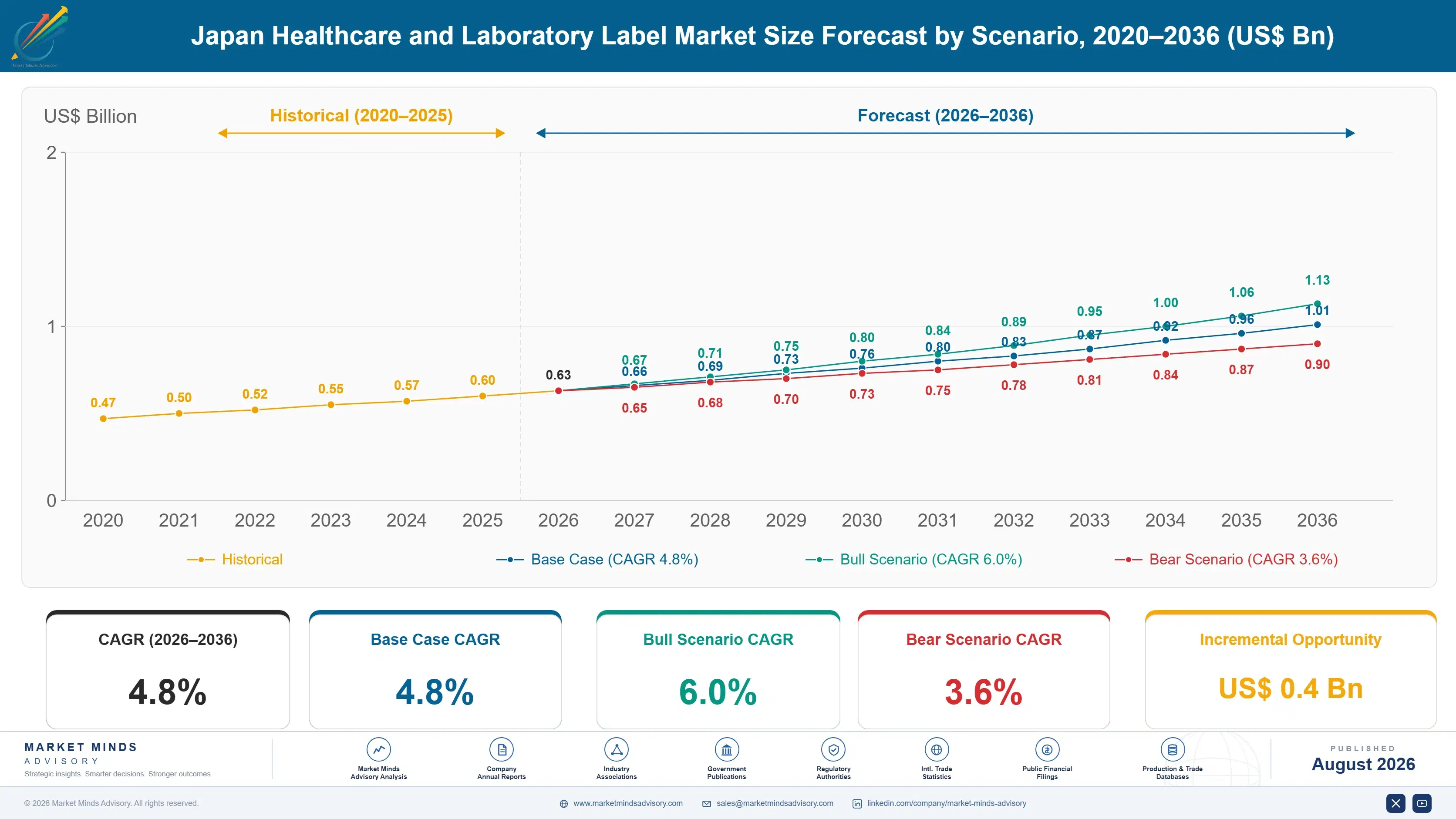
Japan Healthcare and Laboratory Label Market Forecast Scenarios

healthcare-and-laboratory-label-industry-in-japan-size-forecast-scenario-1787298469687
Between 2020 and 2025 this market grew on regulation and on laboratory automation rather than on any increase in pharmaceutical volume. Coded identification requirements extended down through pack levels, diagnostic testing volumes rose sharply and stayed elevated, and biobanking expanded steadily. A 3.7% historical CAGR reflects a mature domestic pharmaceutical market where label value grows through specification rather than through units shipped.
Three mechanisms carry the 4.8% base case. Laboratory automation is the largest, since analyser throughput demands labels that survive centrifugation, refrigeration, and robotic handling without lifting or jamming a line. Coded identification depth is the second, as barcode and two-dimensional code requirements reach further down pack hierarchies. And demographic pressure is the third, as an ageing population consumes more prescriptions and needs larger, clearer print on containers that have not grown at all.
The 6.0% bull case rests on radio frequency identification moving from pilot into routine pharmaceutical distribution, which would multiply label value per unit several times over while leaving volumes unchanged. The 3.6% bear case is domestic pharmaceutical price revision continuing to compress manufacturer margins, since label specification is one of the few places a Japanese pharmaceutical company can find cost when official pricing falls again.

Nine Months To Change A Label

Label change in Japanese pharmaceutical manufacturing is a regulatory event rather than a procurement one. An artwork revision moves through variation filing, internal quality approval, printing validation, and line trials over roughly nine months, and nobody undertakes that to save a few yen per thousand labels. The practical consequence is that an incumbent holds a position for the commercial life of the product.
TOP FIVE CONCENTRATION56%Domestic converters hold positions imported suppliers rarely displace
LABEL CHANGE APPROVAL9 monthsPeriod from artwork revision to approved commercial release
CRYOGENIC ADHESION REQUIREMENT-196 degreesTemperature a specimen label must survive without lifting
BARCODE COVERAGE REQUIREMENT100%Share of prescription pack levels carrying coded identification
ANALYSER JAM COSTUSD 2,600Cost of a laboratory line stoppage caused by label failure
ELDERLY POPULATION SHARE29%Portion of the Japanese population now aged over sixty-five
Coded identification took a distinctly Japanese route. Rather than adopting European or American serialisation frameworks, Japan built its own barcode requirements on prescription products with its own data content and its own timetable, which means labels for this market are specified separately from any global artwork a multinational uses elsewhere. Domestic converters understand those requirements natively. Foreign suppliers have to learn them from scratch.
Laboratory labels are an equipment compatibility question rather than a printing one, which surprises people. Japanese clinical laboratories are among the most automated anywhere, and a specimen label that lifts after centrifugation or jams a robotic track stops a line that processes thousands of samples an hour. A single stoppage costs around USD 2,600 in lost throughput and rework, so laboratories specify adhesive systems rather than shopping for labels.
"Overseas converters keep pitching on price and cannot understand why nobody moves. The customer is not comparing your quote with the incumbent's. They are comparing it with nine months of regulatory work they would rather not do."
Director, Healthcare Packaging And Identification Practice · MMA Packaging Pract

Market Trends

Laboratory Automation Turns Labels Into Equipment Components

Japanese clinical laboratories run analyser tracks processing thousands of specimens an hour, and a label that lifts after centrifugation or curls in refrigerated storage jams the line rather than merely looking untidy. One stoppage costs around USD 2,600 in throughput and rework, which dwarfs the price of any label involved. Laboratories therefore specify adhesive chemistry, facestock, and print durability against their specific analyser platforms rather than buying labels on price. Converters without documented compatibility data for the relevant platform cannot bid at all, whatever their price. Validation is the entry ticket rather than a differentiator.
Market Impact: 29% of population over sixty-five
Coded Identification Extends Deeper Through Pack Hierarchies

Barcode and two-dimensional code requirements on Japanese prescription products have now extended progressively from case and carton level down to individual primary containers, and each extension adds variable data printing, verification, and reconciliation to labels that previously carried static artwork. Print quality tolerances tighten accordingly, since a single unreadable code stops an entire packing line. Domestic converters built this capability alongside the regulation itself, which is one reason overseas suppliers find this market unusually difficult to enter on capability grounds rather than commercial ones. Verification and reconciliation add further complexity.
Market Impact: Labels survive minus 196 degrees

Market Opportunities and Growth Drivers

Demographic Ageing Drives Prescription Volume And Legibility

Roughly 29% of the Japanese population is over sixty-five, the highest share of any large economy, and older patients take more prescription medicines while reading them less easily. Regulators and manufacturers have both pushed toward larger type, clearer differentiation between similar products, and expanded information on containers that have not grown any bigger. That drives multi-layer, booklet, and extended content label formats carrying several times the printed area of a conventional label, at correspondingly higher converted value per unit. Application equipment compatibility narrows the supplier field further than the printing requirement alone would.
Market Impact: Change takes 9 months minimum

Biobanking And Cold Chain Storage Expand Steadily

Japanese biobanking, cell therapy manufacturing, and research specimen storage have all expanded, and every stored sample needs identification that survives liquid nitrogen at minus one hundred and ninety-six degrees for years without lifting or losing legibility. Conventional pressure-sensitive label constructions fail under those conditions outright and quickly. Cryogenic label systems carry adhesive and facestock chemistry developed specifically for the application, and they price at several times ordinary laboratory labels precisely because nothing else works at all. A failed label on a stored sample means the sample itself is effectively lost.
Market Impact: Price revision recurs every 2 years

Market Restraints and Challenges

Regulatory Change Cost Freezes Existing Supplier Positions

Revising a pharmaceutical label in Japan takes roughly nine months through variation filing, quality approval, printing validation, and line trials, and no manufacturer undertakes that to reduce label cost. The root cause is a regulatory culture treating labelling as part of the approved product rather than as packaging. Commercially this makes incumbency extremely durable and challenger entry nearly impossible outside new product launches. Participants without positions mitigate through new product introductions, through laboratory and diagnostic segments carrying lighter regulation, and through acquiring incumbent converters outright rather than competing with them.
Market Impact: One stoppage costs USD 2,600

Pharmaceutical Price Revision Compresses Every Input

Japan revises official pharmaceutical prices downward on a regular cycle, and manufacturers absorbing those cuts search every input for savings including packaging and labelling. The root cause is a healthcare cost containment policy that has run for decades and shows no sign of reversing. Commercially this caps label pricing even in cases where technical requirements are clearly rising. Mitigation runs toward laboratory and diagnostic segments outside the pricing mechanism, toward value-added formats where the manufacturer gains something measurable, and toward converting efficiency rather than any attempt at price defence that will not hold.
Market Impact: Coverage now reaches 100% of packs
3 additional market trends, 4 additional growth drivers, and 2 additional restraints and challenges are covered in the full report. Contact sales@marketmindsadvisory.com to access the complete intelligence.

Segment CAGR and Growth Architecture

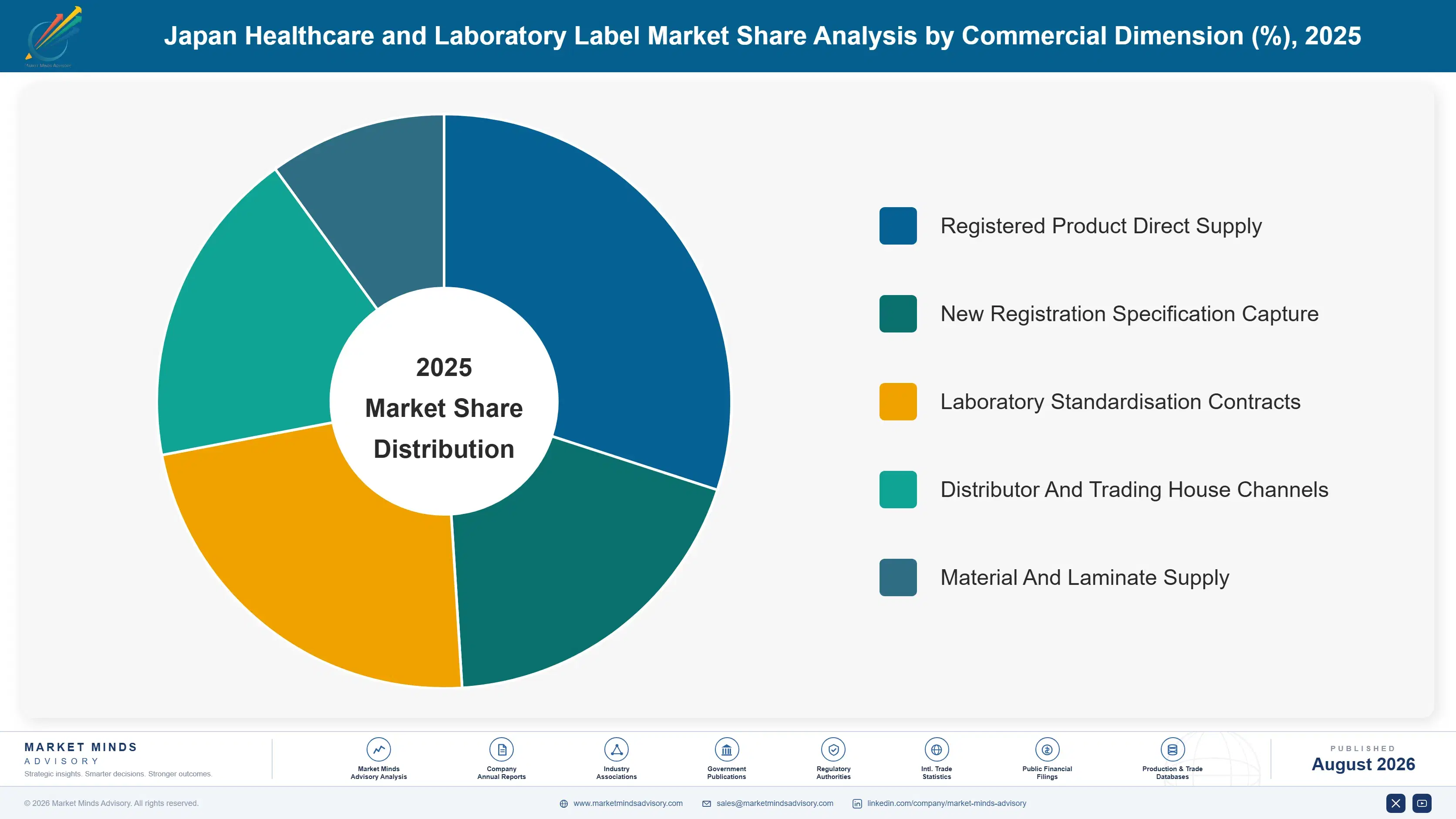
Segmentation follows the functional class of the label, because function determines the substrate and adhesive chemistry required, the regulatory pathway a change must travel, the equipment the label has to survive, and which converters hold validated capability. Product category, container type, and purchase route are handled in the framework and in commentary instead of here.
healthcare-and-laboratory-label-industry-in-japan-market-share-analysis-1787298470222

Cryogenic And Extreme-Condition Laboratory Labels

Cryogenic laboratory labels grow fastest at 7.2%, exactly 1.50 times the market rate, using adhesive and facestock chemistry engineered to hold at minus one hundred and ninety-six degrees for years without lifting, curling, or losing print legibility. Conventional pressure-sensitive constructions simply fail those conditions. Biobanking, cell therapy manufacturing, and long-term research specimen storage all drive this demand, and not one of them has any workable alternative available. Pricing runs at several times that of ordinary laboratory labels, because performance rather than cost decides the specification, and a failed label means a sample that cannot be identified or used again. Domestic converters with integrated adhesive material capability hold most of this segment.
CAGR 7.2%

Serialisation-Enabled Variable Data Labels

Serialisation-enabled variable data labels grow at 6.4%, carrying barcode and two-dimensional coded identification that Japanese requirements have progressively extended from case level down to individual primary containers. Each successive extension adds variable data printing, in-line verification, and reconciliation to labels that had previously carried entirely static artwork. Domestic converters built the capability as the rules arrived. Print tolerances tighten because an unreadable code halts a packing line rather than causing a cosmetic problem. Domestic converters developed this capability alongside the regulation itself, which is precisely why overseas suppliers find entry here so difficult on capability grounds rather than on price. Verification hardware and reconciliation software travel with the label specification.
CAGR 6.4%
Full segment breakdown across 6 segments available in the complete report.

Regional Architecture and Country Demand Map

This market is defined as a single country, so the seven-region architecture this framework applies cannot describe demand geography at all. The table below instead shows where value in the Japanese label supply chain originates, and every share and growth figure should be read on that basis.

East Asia

East Asia carries 88% of supply chain value against a 30% ceiling in this framework, which is simply what happens when a market is defined as one country inside the region. Japanese converters including Lintec, Toppan, Dai Nippon Printing, Fuji Seal, and Osaka Sealing produce the overwhelming majority of labels consumed domestically, and they hold positions that nine month regulatory change cycles make extremely difficult to displace. Facestock, adhesive, and release liner production is also largely domestic or at least regional in origin. The 5.3% growth figure shown here is nominal rather than meaningful, since this region effectively is the market and the headline rate of 4.8% describes it properly.
Share: 88% | CAGR: 5.3% (2026 to 2036)

Western Europe

Four percent of supply chain value originates in Western Europe, far below the framework floor, and it reflects specialty material inputs rather than any finished label supply at all. European producers supply particular adhesive chemistries, cryogenic facestock technology, and narrow web press equipment into Japanese converting operations that then produce the finished labels. UPM Raflatac and Herma both hold established material positions of exactly this kind. European artwork standards influence multinational pharmaceutical labelling globally, though Japanese requirements diverge far enough that entirely local specification is still needed. Cryogenic adhesive chemistry in particular flows from European development work. Growth at 3.6% reflects mature specialty material supply rather than any expansion in share.
Share: 4% | CAGR: 3.6% (2026 to 2036)
Regional intelligence for 5 additional markets available in the complete report: North America, South Asia and Pacific, Latin America, Middle East and Africa, Eastern Europe. Contact sales@marketmindsadvisory.com.
healthcare-and-laboratory-label-industry-in-japan-country-cagr-analysis-1787298470743

Winning Positions That Never Reopen

Existing pharmaceutical label positions almost never come up for tender, so every lever here works either at new product launch or in segments where the nine month approval cycle does not apply. Launch capture, analyser validation, extended content formats, and identification technology each do that. Four follow, and timing matters more than pricing in all of them.

Capture Positions At New Product Launch Only

An established pharmaceutical label changes supplier perhaps once a decade at most, because the nine month regulatory and validation cycle costs the manufacturer far more than any price difference could ever recover. New product launches are the sole exception, since artwork is being created from nothing at all and no incumbent supplier yet exists to displace. Engaging at development rather than at commercial launch costs perhaps USD 80,000 in technical support per programme and captures a position worth the product's entire commercial life, typically twelve to fifteen years of recurring supply.
Market Impact: Positions last 12 to 15 years each time

Validate Labels Against Specific Analyser Platforms

Japanese clinical laboratories select labels on whether they survive centrifugation, refrigerated storage, and robotic handling on their own particular analyser tracks, because a single jam costs around USD 2,600 in lost throughput and rework. Converters holding documented compatibility data for the major installed platforms get specified, while those without it cannot bid at all regardless of what price they offer. Validation programmes cost roughly USD 150,000 for each analyser platform and they effectively fence off every laboratory running that equipment from any competitor who has not done the same work.
Market Impact: Validation costs about USD 150,000 for each platform

Develop Extended Content Formats For Ageing Patients

An older population reading ever smaller print on containers that have not grown any larger has pushed both manufacturers and regulators toward booklet, multi-layer, and peel-reseal formats carrying several times the printed area of a conventional label. Converted value on extended content constructions runs 3 to 5 times that of a standard equivalent label. Regulators have encouraged the shift alongside manufacturers. The formats also demand application equipment compatibility that very few converters have actually proven, which narrows the competitive field considerably further than the printing requirement alone would ever suggest.
Market Impact: Converted value runs 3 to 5 times higher

Build Radio Frequency Identification Capability Ahead Of Demand

Japanese pharmaceutical distribution has now run radio frequency identification pilots for several years without ever moving to routine deployment, and the technology multiplies label value per unit by roughly 8 times on the day it finally does. Building inlay integration, encoding, and verification capability before that demand arrives costs USD 3 million to USD 8 million and positions a converter for a transition that regulatory or distribution pressure could trigger quickly. Waiting for the requirement to arrive means turning up after the specifications have already been written by somebody else.
Market Impact: Capability costs USD 3 to 8 million to build

Who Controls the Margin Pool

Concentration at 56% across the top five is high for label converting anywhere, and regulatory change cost rather than manufacturing scale explains it. All participants here are compared on measured revenue from healthcare and laboratory labels supplied into Japan, which requires separating that line from the very large commercial and industrial printing businesses that several of these companies also operate at considerably greater scale.
Competition happens at product launch and almost nowhere else, since established positions rarely reopen. Lintec holds strong pharmaceutical and laboratory material and converting positions built over decades. Toppan and Dai Nippon Printing bring enormous printing scale and serialisation capability from adjacent packaging businesses. Fuji Seal competes across pharmaceutical and diagnostic labelling. Osaka Sealing holds specialist positions in variable data and hospital applications.

Pressure comes from laboratory automation and from identification technology rather than from any new entrant. Analyser platform validation is becoming the deciding criterion in laboratory segments, and converters without documented compatibility are excluded before price is discussed. Rankings shift on new product launches and on whichever converter is ready when radio frequency identification finally moves out of pilot into routine distribution.
healthcare-and-laboratory-label-industry-in-japan-company-positioning-matrix-1787298471266

Competitive Moat and Risk Dimensions

LINTEC

Moat: Integrated Material And Converting Capability

Lintec produces adhesive materials and converts them into finished healthcare labels within one organisation, which gives it development control over exactly the chemistry that decides cryogenic and analyser performance. Converters buying material cannot influence how an adhesive behaves at minus one hundred and ninety-six degrees. That integration matters most in precisely the segments growing fastest.
LINTEC

Risk: Exposure To Pharmaceutical Price Revision

Japanese official pharmaceutical pricing is revised downward on a regular cycle, and manufacturers absorbing those cuts examine every packaging input including labels. The company's strongest positions sit with domestic pharmaceutical customers facing exactly that pressure. Technical requirements keep rising while the customer's ability to pay for them does not, which squeezes from both directions.
TOPPAN HOLDINGS

Moat: Serialisation And Printing Scale Depth

Toppan brings variable data printing, coded identification, and verification capability developed across a far larger packaging and security printing business into healthcare labelling, at a scale no specialist converter can match. As coded identification extends deeper through pack hierarchies, that capability becomes the deciding technical requirement rather than an advantage at the margin.
TOPPAN HOLDINGS

Risk: Healthcare Labels A Minor Line

Healthcare and laboratory labelling is a modest business inside a very large diversified printing and packaging group, which means it competes internally for capital against operations with quite different return profiles. Cryogenic chemistry and analyser validation both need sustained specialist investment. Focused competitors have moved faster in exactly the segments where growth is concentrated.

Players Tracked

Prominent Players

Lintec
Toppan Holdings
Dai Nippon Printing
Fuji Seal International
Osaka Sealing Printing

Other Key Players

Avery Dennison
CCL Industries
UPM Raflatac
3M
Sato Holdings
Iwata Label
Shinsei Industries
Nissha
Toyo Ink
Nitto Denko
Multi-Color Corporation
Herma
Brady Corporation
Ricoh
Kyodo Printing

Recent Developments

FEBRUARY 2025

Japanese Regulator Extends Coded Identification To Further Pack Levels

Japanese authorities extended barcode identification requirements to additional prescription product pack levels, adding variable data printing and verification to labels that previously carried only static artwork. The change is a regulatory requirement with a defined transition period rather than any voluntary industry standard being adopted.
Signal: Each extension of coded identification adds converted value without adding any label volume at all here
MAY 2025

Lintec Expands Cryogenic Label Material Production Capacity

Lintec added production capacity for cryogenic adhesive and facestock systems used in biobanking and cell therapy specimen identification. The investment was organic and internally funded, and the company cited domestic biobanking and regenerative medicine programme growth rather than any export opportunity as the underlying rationale.
Signal: Material integration matters most in exactly those segments where the adhesive chemistry alone decides the specification
SEPTEMBER 2025

Clinical Laboratory Group Standardises Label Specification Across Analysers

A large Japanese clinical laboratory group standardised its specimen label specification across every analyser platform it operates, requiring documented compatibility validation from any supplier. The decision followed internal analysis of line stoppages caused by label lifting and curling during refrigerated storage and repeated centrifugation cycles.
Signal: Laboratories now specify adhesive performance against their own analyser equipment rather than buying labels on price

Facestock, Adhesive And Liner

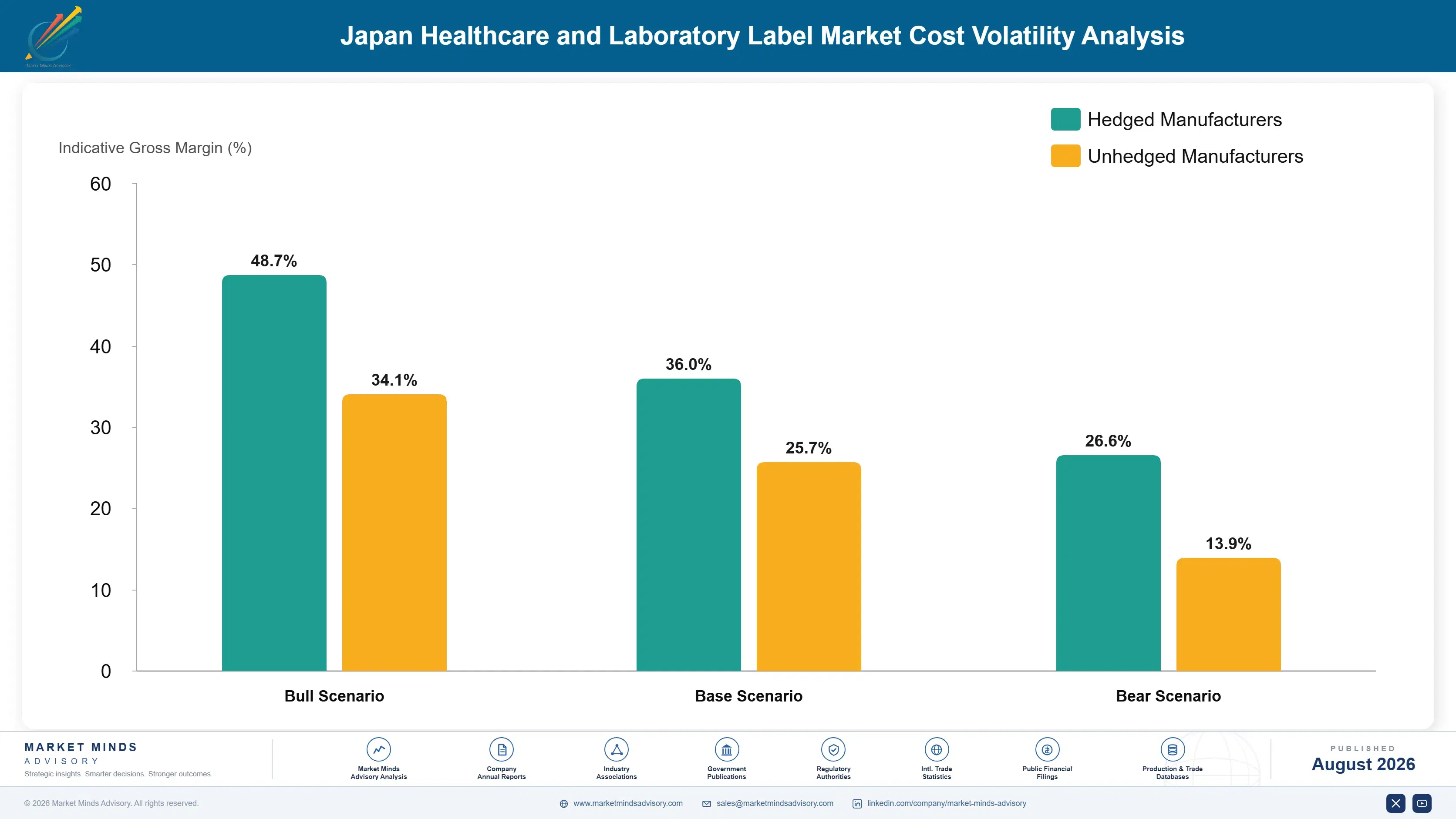
Facestock, whether paper or synthetic film, accounts for roughly 34% to 44% of converted label cost, with specialty films for cryogenic and chemical resistant applications running considerably higher again. Adhesive systems add 14% to 22%, and release liner carries 10% to 16%. Printing inks, varnishes, and specialty coatings account for most of the remainder, with converting labour and waste completing the picture.
Specialty synthetic facestock supply tightened noticeably through 2022 as European producers absorbed the energy cost shock the IEA documented that year and rationalised lower volume grades. Cryogenic and chemical resistant films were disproportionately affected, since those are exactly the low volume specialty grades a producer trims first. Lintec's 2022 annual reporting described raw material and energy cost pressure across its adhesive materials operations through the same period.

Exposure separates by material integration rather than by converting scale. A converter producing its own adhesive materials controls the chemistry that decides cryogenic and analyser performance and carries the input cost internally. One buying finished laminate on the open market competes for specialty grades against every other converter and has no development influence at all. Japanese pharmaceutical price revision then compresses whatever both of them can charge.
healthcare-and-laboratory-label-industry-in-japan-cost-volatility-analysis-1787298471471

Qualify Alternate Specialty Facestock Grades In Advance

Cryogenic and chemical resistant films are exactly the low volume specialty grades a materials producer rationalises first when energy costs rise, and requalifying a substitute inside a validated pharmaceutical label means returning to the nine month regulatory cycle. Qualifying alternates at original validation costs modest additional testing, and it avoids a change that no customer will absorb willingly.

Hold Buffer Inventory Against Validated Material Grades

Because a substrate change on a pharmaceutical label triggers regulatory variation rather than a simple procurement swap, a supply interruption stops production rather than merely delaying it. Holding nine to twelve months of cover on validated specialty grades ties up real working capital, and it protects positions worth the entire commercial life of a registered product.

Integrate Backward Into Adhesive Chemistry Development

Adhesive performance alone decides whether a label survives liquid nitrogen or a centrifuge cycle, and a converter buying finished laminate has no influence over that chemistry whatsoever. Developing adhesive systems internally costs sustained specialist investment and it creates capability in precisely those segments growing fastest, where performance rather than price determines the specification outright.

Portfolio Architecture for Margin Defence

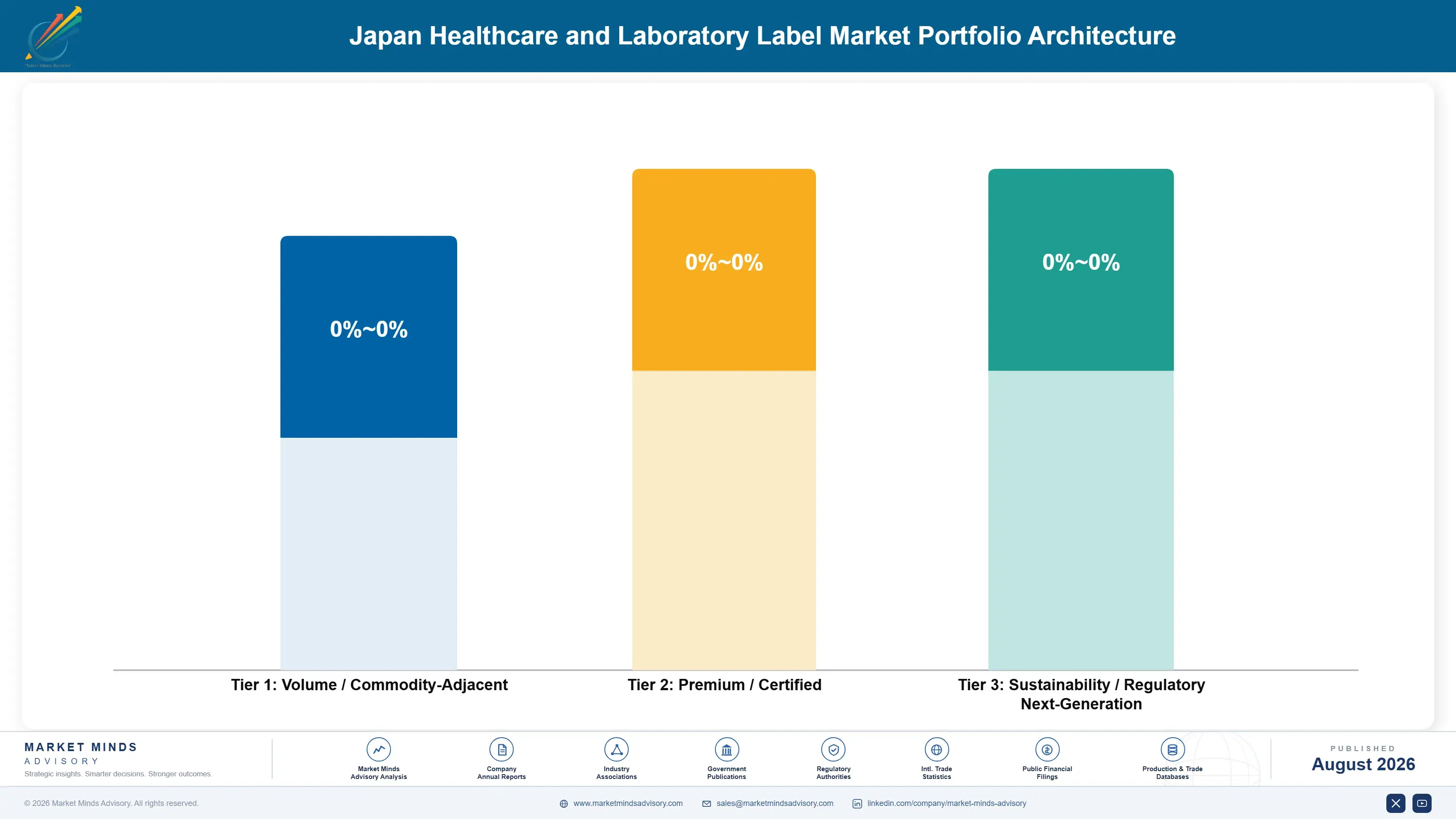
Margin architecture separates by whether performance or price decides the specification. Standard secondary packaging and carton labels earn 16% to 26%, tendered against domestic converters and squeezed further with every pharmaceutical price revision round. Cryogenic, extended content, and validated laboratory constructions earn 34% to 48%, because adhesive chemistry, analyser compatibility, and regulatory validation each take months to replicate at any alternative supplier.
The tension here is that the pharmaceutical segment holds all the volume while the laboratory segment holds all the pricing freedom. Pharmaceutical labels are protected by regulatory inertia and simultaneously squeezed by official price revision, which is an unusual combination: extremely durable positions earning steadily less. Laboratory and diagnostic segments sit entirely outside that pricing mechanism and reward technical performance properly instead.

High-value pools concentrate in cryogenic constructions, extended content formats, and analyser-validated laboratory labels. All three are specified on performance where failure carries a cost far exceeding the label price. Identification technology carries the widest margin range anywhere in this market, because radio frequency identification labels and conventional coded labels share a broad description and then differ enormously in what they actually earn per unit.

Volume / Commodity-Adjacent

Standard secondary packaging labels, carton identification, and routine hospital labelling tendered against domestic converters on delivered cost. The ten-point range separates integrated material producers from converters buying finished laminate on the open market at prevailing specialty prices.
Gross Margin: 16% to 26%

Premium / Certified

Cryogenic laboratory labels, extended content pharmaceutical formats, and analyser-validated specimen identification where performance rather than price decides the specification. The fourteen-point range separates validated laboratory work from cryogenic systems where no alternative construction exists at all.
Gross Margin: 34% to 48%

Sustainability / Regulatory / Next-Generation

Radio frequency identification enabled labels, linerless and reduced material constructions, and serialisation verification services. The thirty-four point range reflects genuine divergence: linerless formats compete on cost while identification technology prices on capability nobody else holds.
Gross Margin: 28% to 62%
healthcare-and-laboratory-label-industry-in-japan-portfolio-architecture-1787298471972

High-value Sub-segments and Strategic Watch-out

Cryogenic Laboratory Constructions

Highest growth and strongest margin, because nothing else survives liquid nitrogen for years and a failed label means a lost sample that cannot be recovered. Biobanking and cell therapy manufacturing both expand steadily, and adhesive chemistry rather than printing decides who can supply at all.
Gross Margin: 40% to 48%

Extended Content Pharmaceutical Formats

Strong growth driven by demographic pressure, carrying three to five times the converted value of a conventional label as booklet and multi-layer constructions accommodate larger print. Application equipment compatibility narrows the supplier field considerably further than the printing requirement on its own would ever suggest.
Gross Margin: 36% to 46%

Standard Pharmaceutical Container Labels

The volume core of this whole market, protected by regulatory change cost and yet squeezed continuously by official pharmaceutical price revision cycles. Positions in this tier almost never move at all, and the converters holding them earn steadily less across each successive official pricing round.
Gross Margin: 24% to 32%

Secondary Packaging And Carton Labels

Strategic watch-out here. This tier carries by far the least technical differentiation, faces the most direct domestic competition, and sits closest to substitution by direct carton printing. Price revision pressure lands on this tier first and hardest, with nothing in the specification available to defend it.
Gross Margin: 16% to 26%

Positions That Outlast Everything

The annuity here is the approved product rather than the customer relationship, and it is unusually long. A label specified into a pharmaceutical registration supplies that product for its entire commercial life, typically twelve to fifteen years, because changing it means a nine month regulatory and validation cycle nobody undertakes for cost reasons. Purchase orders recur monthly while the decision was made once, at registration, before the product ever reached a patient.
Depth varies by regulatory exposure rather than by customer size. Registered pharmaceutical primary container labels are the deepest by a wide margin. Analyser-validated laboratory labels are nearly as durable, because compatibility documentation took months to establish and no laboratory manager wants to repeat it. Hospital and secondary packaging labels are considerably shallower, retendered regularly on price. Research and academic laboratory supply is shallowest of all.

Buyer profiles have shifted in ways that reward technical depth. Pharmaceutical label decisions moved from packaging engineers toward cross-functional teams combining regulatory affairs, quality, and serialisation compliance who specify years before commercial launch. Laboratory groups now standardise specifications across every analyser platform they operate. Both changes favour converters engaging at development rather than at tender.
healthcare-and-laboratory-label-industry-in-japan-end-use-penetration-index-1787298472462

Where We Come Out

These are among the four positions where our research anticipates prominent divergence between winners and laggards over the coming forecast period. Each is grounded in the demand model, the regulatory perimeter, and the announced capacity pipeline.
01 / LAUNCH WINDOW DISCIPLINE

Established positions do not reopen, so target new registrations

Changing a label on an approved Japanese pharmaceutical product costs roughly nine months of variation filing, quality approval, printing validation, and line trials, which no manufacturer undertakes to save money on labels. Established positions therefore last the commercial life of the product, typically twelve to fifteen years, and challengers get essentially no opportunity to bid on them. Engaging at product development rather than at commercial launch is the only realistic route into this market for anybody who is not already in it.
02 / ANALYSER VALIDATION INVESTMENT

Laboratories buy compatibility documentation, not printed labels

A specimen label that lifts after centrifugation or curls in refrigerated storage jams an analyser track processing thousands of samples an hour, and one stoppage costs around two thousand six hundred dollars in throughput and rework. Laboratories consequently specify adhesive systems against their particular installed platforms and require documented compatibility before considering any supplier. Validation costs roughly one hundred and fifty thousand dollars per platform and effectively fences off every laboratory running that equipment from any competitor who chose to skip that investment.
03 / ADHESIVE CHEMISTRY OWNERSHIP

Performance segments are won in chemistry, not in printing

Cryogenic labels hold at minus one hundred and ninety-six degrees for years or they do not, and that outcome is decided entirely by adhesive and facestock chemistry rather than by anything happening on a printing press. A converter buying finished laminate on the open market has no influence over that performance and no development capability to offer a customer. Material integration matters most in exactly the segments growing fastest, and it cannot be assembled quickly by anybody who has not already invested in it.
04 / PRICE REVISION POSITIONING

Durable pharmaceutical positions still earn less every cycle

Japanese official pharmaceutical pricing is revised downward on a regular cycle and manufacturers absorbing those cuts examine every packaging input, which produces the unusual combination of extremely secure supplier positions earning steadily less over time. Technical requirements keep rising steadily while the customer's capacity to pay for any of them keeps falling with each revision round. Weighting the portfolio toward laboratory and diagnostic segments, which sit outside the pricing mechanism entirely, is the only durable answer available to a converter here.

Engagement Snapshot From the Field

A live engagement with an industry participant carrying material or product regulatory and market exposure ahead of a defining policy shift, showing how our research translates into a defensible multi-year portfolio strategy.
MARKET MINDS ADVISORY · CLIENT ENGAGEMENT SUMMARY
Japan Healthcare and Laboratory Label Producer Strategic Portfolio Review and Transition Roadmap 2026·Investment Scenario on Japan Healthcare and Laboratory Label Exposure Evaluation 2025-26
CLIENT PROFILE
A European specialty label converter with roughly EUR 210 million in global revenue (client-reported, unverified by MMA), holding strong pharmaceutical and laboratory positions across Europe and seeking entry into Japan. The company had competitive material technology, no Japanese converting presence, and had spent two years pitching Japanese pharmaceutical manufacturers on price and technical specification without winning a single position.
STRATEGIC CHALLENGE
Every approach had been politely received and had gone nowhere, and the board could not establish whether the barrier was price, quality perception, relationship convention, or something else entirely. A decision was needed on whether to invest in Japanese converting capacity, to acquire a domestic converter, or to abandon the market and redeploy the effort elsewhere.
MMA APPROACH
MMA mapped label change economics across eleven Japanese pharmaceutical manufacturers, interviewed twenty-two packaging engineers, regulatory affairs leads, and laboratory managers on supplier selection, and assessed which segments carried the nine month approval burden and which did not. Analyser validation requirements across the major Japanese clinical laboratory platforms were catalogued separately as an alternative entry route.
KEY FINDINGS
  1. Every manufacturer interviewed put the internal cost of a label supplier change at nine to fourteen months of regulatory and validation work, against price differences worth a fraction of that.
  2. None of the eleven manufacturers had changed a primary container label supplier on an established product within the previous five years, and none anticipated doing so.
  3. Laboratory and diagnostic segments carried no comparable approval burden, and eighteen of twenty-two laboratory contacts named analyser compatibility documentation as the deciding criterion.
  4. The client's cryogenic adhesive technology outperformed available domestic constructions in independent testing, and no Japanese converter held equivalent validated capability at the time.
CLIENT PROFILE
A European specialty label converter with roughly EUR 210 million in global revenue (client-reported, unverified by MMA), holding strong pharmaceutical and laboratory positions across Europe and seeking entry into Japan. The company had competitive material technology, no Japanese converting presence, and had spent two years pitching Japanese pharmaceutical manufacturers on price and technical specification without winning a single position.
STRATEGIC CHALLENGE
Every approach had been politely received and had gone nowhere, and the board could not establish whether the barrier was price, quality perception, relationship convention, or something else entirely. A decision was needed on whether to invest in Japanese converting capacity, to acquire a domestic converter, or to abandon the market and redeploy the effort elsewhere.
MMA APPROACH
MMA mapped label change economics across eleven Japanese pharmaceutical manufacturers, interviewed twenty-two packaging engineers, regulatory affairs leads, and laboratory managers on supplier selection, and assessed which segments carried the nine month approval burden and which did not. Analyser validation requirements across the major Japanese clinical laboratory platforms were catalogued separately as an alternative entry route.
KEY FINDINGS
  1. Every manufacturer interviewed put the internal cost of a label supplier change at nine to fourteen months of regulatory and validation work, against price differences worth a fraction of that.
  2. None of the eleven manufacturers had changed a primary container label supplier on an established product within the previous five years, and none anticipated doing so.
  3. Laboratory and diagnostic segments carried no comparable approval burden, and eighteen of twenty-two laboratory contacts named analyser compatibility documentation as the deciding criterion.
  4. The client's cryogenic adhesive technology outperformed available domestic constructions in independent testing, and no Japanese converter held equivalent validated capability at the time.
RECOMMENDED STRATEGY
Phase 1: Phase one: abandon pharmaceutical primary container pursuit entirely and redirect all commercial effort toward laboratory, biobanking, and diagnostic segments instead. Phase 2: Phase two: fund analyser compatibility validation across the four largest installed Japanese platforms, and lead every approach with that documentation rather than with price. Phase 3: Phase three: pursue pharmaceutical positions exclusively at new product registration, engaging development teams three to four years ahead of commercial launch.
OUTCOME
The client redirected its Japanese effort within two quarters and completed validation on three analyser platforms. It won laboratory supply positions at nine institutions in the following year having previously won none, and secured its first pharmaceutical specification at a product still in development (client-reported, unverified by MMA).

Frequently Asked Questions

Foundational context covering the market sizes, CAGR, scope, country, region and competition that inform every finding below. This section is provided to cover basics and most often pre-purchase conversations, answered from the MMA Primary Research Dataset.

What is the current size of the Japan Healthcare and Laboratory Label Market?

The Japanese healthcare and laboratory label market reached USD 0.62 billion in 2025, covering pressure-sensitive and applied labels on pharmaceutical, medical device, diagnostic, and laboratory products. Cartons, blister foil, and direct printing are excluded.

How large will the Japan Healthcare and Laboratory Label Market be by 2036?

MMA forecasts USD 1.04 billion by 2036, up from USD 0.65 billion in 2026, an increase of USD 0.39 billion. That represents an expansion multiple of 1.60 times across the forecast period.

What is the CAGR for the Japan Healthcare and Laboratory Label Market 2026 to 2036?

The base case CAGR is 4.8%, with a bull case of 6.0% and a bear case of 3.6%. Historical growth between 2020 and 2025 ran at 3.7%, driven by specification rather than by any increase in units shipped.

Which segment is growing fastest?

Cryogenic and extreme-condition laboratory labels grow fastest at 7.2%, exactly 1.50 times the market rate, on biobanking and cell therapy storage. Serialisation-enabled variable data labels follow at 6.4%.

Who are the major companies in the Japan Healthcare and Laboratory Label Market?

Lintec, Toppan Holdings, Dai Nippon Printing, Fuji Seal International, and Osaka Sealing Printing lead, together holding 56% of the market. All five are domestic converters that imported suppliers rarely displace.

Which country is growing fastest?

This market is defined as a single country, so Japan carries the entire 4.8% growth rate by definition. The regional table shows supply chain value origin rather than any demand geography.

Report Segmentation Architecture

The full report scope spans multiple orthogonal segmentation dimensions, with cross-tabulated demand data provided for each dimension pair. Coverage extends further to regional breakdowns, trend trajectories, and the competitive detail needed to support segment-level decision-making.

By Label Function

  • Pharmaceutical Primary Container Labels
  • Secondary Packaging And Carton Labels
  • Serialisation-Enabled Variable Data Labels
  • Specimen And Sample Identification Labels
  • Cryogenic And Extreme-Condition Laboratory Labels
  • Blood Bag And Transfusion Labels

By End-Use Industry

  • Pharmaceutical Manufacturing
  • Clinical Diagnostic Laboratories
  • Hospitals And Dispensing Pharmacies
  • Biobanking And Cell Therapy Facilities
  • Medical Device Manufacturing

By Commercial Dimension

  • Registered Product Direct Supply
  • New Registration Specification Capture
  • Laboratory Standardisation Contracts
  • Distributor And Trading House Channels
  • Material And Laminate Supply

By Region

  • East Asia
  • Western Europe
  • North America
  • South Asia and Pacific
  • Latin America
  • Middle East and Africa
  • Eastern Europe

Scope, Methodology, and Coverage

Every figure in this report is reproducible from documented input assumptions. The scope below maps the historical period, the forecast horizon, the segmentation dimensions, and the countries covered, alongside the underlying primary and qualitative methodology.
Historical Period
2020 to 2025
Forecast Period
2026 to 2036
Base Year
2025 (USD billions; MMA Primary Research Dataset, August 2026)
Market Definition
The Japan healthcare and laboratory label market covers pressure-sensitive and applied labels used on pharmaceutical products, medical devices, diagnostic reagents, and laboratory specimens within Japan. Scope spans pharmaceutical primary container labels, secondary packaging and carton labels, serialisation-enabled variable data labels, specimen and sample identification labels, cryogenic and extreme-condition laboratory labels, and blood bag and transfusion labels, together with associated validation and verification services. Printed cartons, blister foil printing, in-mould decoration, direct container printing, retail consumer health labelling, and label printing equipment are excluded.
Quantitative Units
USD billions at converter revenue level; labels produced annually; converted value per registered product.
Segmentation Dimensions
By label function; by end-use industry; by commercial dimension; by supply chain region.
Regions Covered
East Asia, Western Europe, North America, South Asia and Pacific, Latin America, Middle East and Africa, Eastern Europe
Countries Covered
Japan, with supply chain contributions traced to United States, Germany, Finland, United Kingdom, France, Netherlands, Italy, Poland, Czech Republic, China, South Korea, Taiwan, Thailand, Malaysia, India, Australia, Brazil, Mexico, Saudi Arabia, South Africa.
Key Companies Profiled
Lintec, Toppan Holdings, Dai Nippon Printing, Fuji Seal International, Osaka Sealing Printing, Avery Dennison, CCL Industries, UPM Raflatac, 3M, Sato Holdings, Iwata Label, Shinsei Industries, Nissha, Toyo Ink, Nitto Denko, Multi-Color Corporation, Herma, Brady Corporation, Ricoh, Kyodo Printing.
Quantitative Methodology
Primary survey, n=3,800 respondents, Q4 2025, six countries; demand-side model with trade association cross-validation
Qualitative Methodology
47 expert interviews, Q4 2025; applied to validate demand model assumptions, identify emerging dynamics, and assess competitive positioning
Report Format
PDF and XLSX data workbook (Word format preview document)
Publisher
Market Minds Advisory
Report Code
MMA-2026-PAC-883
Published
August 2026
Contact
sales@marketmindsadvisory.com | www.marketmindsadvisory.com

Purchase the full Japan Healthcare and Laboratory Label Market Report (2026 to 2036).

The full MMA report on the Japan healthcare and laboratory label market covers label function, supply chain, and competitive analysis in detail, with separate treatment of the regulatory change economics that make incumbency unusually durable here. It includes label change cost and timeline modelling across manufacturer types, analyser compatibility validation requirements by installed laboratory platform, coded identification requirement tracking through pack hierarchies, and extended content format economics against demographic pressure. Supply chain chapters trace material and technology origin across twenty countries. Competitive profiling spans twenty companies on a consistent revenue basis throughout.
Supply chain origin analysis across twenty contributing countries
Label change cost and timeline modelling by manufacturer
Analyser compatibility requirements by installed laboratory platform
Coded identification requirement tracking through pack hierarchies
Twenty company competitive profiles compared consistently
Extended content format economics against demographic pressure

Built For The People Who Decide

From boardroom strategy to bench-side execution, this report is read cover-to-cover by leaders shaping the next decade of their industry, turning demand scenarios, market dynamics and valuation benchmarks into decisions.
CXOs/ Presidents/ VPs/ Managers
M&A and Corporate Development
Strategy Teams and R&D Heads
Procurement and Product Directors
Regulatory and Compliance Leaders
Investor Relations and Equity Analysts