Market Minds Advisory
HDI Trimethylol Hexyllactone Crosspolymer Market

HDI Trimethylol Hexyllactone Crosspolymer Market: HDI Trimethylol Hexyllactone Crosspolymer: Sensory Specification, Japanese Supply Concentration and the European Restriction Horizon, 2026 to 2036

Formulators specify this powder for how a cream feels under a finger and then market it for optical blurring, while Europe has legislated an end date and Asia has not.

Lead Analyst

Published

September 2026

Make Smarter Decisions with Customized Research Insights

Request a free sample report and evaluate market opportunities, growth trends, and competitive dynamics relevant to your business needs.

2025 MARKET VALUE$0.5BMarket Size 2025
2036 FORECAST VALUE$1.1BBase Case , 2026 to 2036
CAGR 2026 TO 20368.4 %Bull 9.6% / Bear 7.2%
INCREMENTAL OPPORTUNITY$0.6BNet 10- year value creation
EXPANSION MULTIPLE2.20x2036 value over 2026 base
Strategic Levers
M&A Pipeline
Regional Outlook
Country Rankings
Competitive Intelligence
Segmental Deep-dive
Call-Us : 91 93563 13602

Executive Snapshot and Market Trajectory.

Around 64% of formulations carrying this polymer specify it for slip and sensory feel rather than for the soft focus effect the finished product advertises. The blur claim is real enough and it is not why the material is in the jar. That distinction matters commercially.
Surface-treated and coated grades grow at 12.6%, half again the market rate of 8.4%, because coating is the route to grades engineered to pass biodegradability testing and stay outside the European synthetic polymer microparticle restriction. Fine sub-ten-micron grades follow at 10.8%. Both routes are being pursued by the same small group of Japanese producers who make most of the world's supply. Standard grades grow at barely half the category rate.
Concentration here is extreme by any measure. Five producers hold 78% of revenue and roughly 71% of output comes from a handful of Japanese plants, which makes qualification slow and substitution genuinely difficult. Silica, starch, and cellulose alternatives all fail to match the combination of sphericity, monodispersity, and oil absorption that formulators actually rely on. Formulators attempting substitution fix one property and lose two others, then return to the original material. Qualification then starts over.
Market Definition
This market covers HDI Trimethylol Hexyllactone Crosspolymer supplied as a spherical polymer powder for cosmetic and personal care formulation, across standard spherical powder grades, fine particle sub-ten-micron grades, surface-treated and coated grades, porous high-absorption grades, pigment-loaded composite grades, and large particle texture grades. It excludes other spherical polymer powders such as nylon and acrylate chemistries, silica and mineral fillers, starch and cellulose based texturisers, and finished cosmetic products.
Base Year Value
$0.5B in 2025 (MMA Primary Research Dataset, September 2026)
Forecast Period
2026 to 2036, eleven discrete annual values
CAGR
8.4% base case. Bull 9.6%. Bear 7.2%.
Fastest Growth Segment
Surface-Treated And Coated Grades: 12.6% CAGR
Fastest Growth Country
China: 13.8% CAGR
Fastest Growth Region
South Asia and Pacific: 10.4% CAGR
Largest Region
East Asia: 44% of 2025 global value
Market Leaders
Toshiki Pharmaceutical, Kobo Products, Miyoshi Kasei, Daito Kasei Kogyo, and Nikko Chemicals lead the field. Source: MMA Primary Research Dataset, July 2026.
Primary Survey
n=3,800 procurement and R&D decision-makers, Q4 2025, six countries
Methodology
Demand-side build-up, cross-validated against public data, 47 expert interviews

HDI Trimethylol Hexyllactone Crosspolymer Market Forecast Scenarios

hdi-trimethylol-hexyllactone-crosspolymer-market-size-forecast-scenario-1790013385129
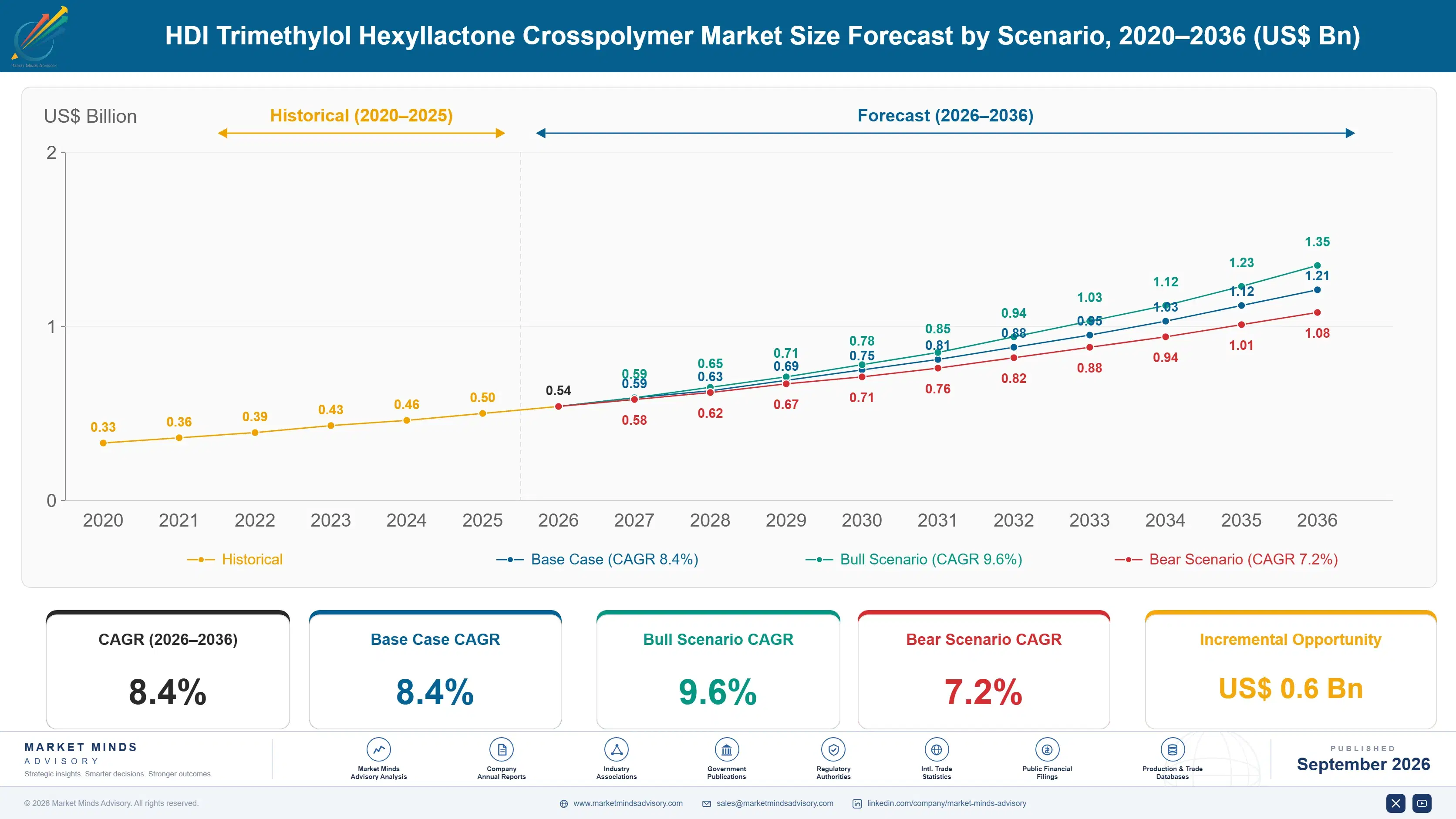
Between 2020 and 2025 the category grew at 7.4% on colour cosmetics recovery and on the spread of soft focus positioning across skincare primers and complexion products. European regulation arrived toward the end of that period and changed the planning horizon rather than the volumes, since compliance dates for leave-on products sit years out. Asian demand grew throughout without any equivalent constraint.
The base case at 8.4% rests on three mechanisms. Chinese and Korean colour cosmetics manufacture keeps expanding, and neither market faces a comparable restriction on synthetic polymer microparticles. Surface-treated grades engineered to meet biodegradability criteria preserve European access rather than surrendering it. And skincare adoption continues broadening the application base well beyond the colour products where the powder started. None of the three assumes European demand recovers after the restriction dates arrive.
The bull case at 9.6% depends on biodegradable-qualified grades being accepted under European testing, which would remove the restriction question entirely for compliant material. The bear case at 7.2% is supply concentration: roughly 71% of output comes from a handful of Japanese plants, and any disruption there has no near-term alternative because qualification runs around 14 months from first sample to approved specification.

What Formulators Actually Buy

The marketing story is optical. Monodisperse spheres scatter light in a way that softens the visual edge of a fine line, and the effect is genuine under controlled measurement. What actually gets the material specified is different: roughly 64% of formulations select it for the silky slip it gives under a finger, the way it carries pigment without dragging, and the dry feel after a rich emollient base. The blur is a bonus that the pack copy then leads with.
TOP FIVE CONCENTRATION78%Share of category revenue held by the leading producers
JAPANESE PRODUCTION SHARE71%Global output originating from a handful of domestic plants
SLIP SPECIFICATION RATE64%Formulations specifying it for feel rather than blur
OIL ABSORPTION CAPACITY118 mlAbsorbed per hundred grams under standard laboratory conditions
QUALIFICATION LEAD TIME14 monthsTypical period from sample request to approved specification
EUROPEAN RESTRICTION HORIZON2035Final compliance date for this class in leave-on products
Oil absorption is the second quiet reason. At around 118 millilitres per hundred grams the powder holds sebum through a wearing day, which is why it appears in complexion products aimed at oily skin and in primers designed to keep foundation from moving. Silica absorbs more and feels drying and angular. Starch absorbs less and swells. Neither works the same way in a finished formula.
Then there is the regulation, which is the fact that shapes every planning conversation. European rules on intentionally added synthetic polymer microparticles capture this chemistry, with leave-on cosmetic compliance dates running out to 2035. Producers are engineering grades to meet biodegradability criteria rather than abandoning the chemistry, and whether those qualify is the open question.
"Ask a formulator why the powder is in the formula and you get an answer about slip and pigment carry. Ask the brand and you get a paragraph about blurring fine lines. Both are true. Only one of them explains why the material is difficult to replace."
Practice Director, Cosmetic Ingredients and Formulation Science · MMA Chemicals and Materials Practice · September 2026

Market Trends

Coating Becomes The Route To Regulatory Survival

Surface-treated and coated grades grow at 12.6%, the fastest rate here, and the reason is regulatory rather than performance. Coating chemistry is the practical route to engineering a particle that meets biodegradability criteria while retaining the sphericity and monodispersity formulators depend on. Producers are treating this as the alternative to abandoning the chemistry in Europe entirely. Whether the resulting grades satisfy the required testing remains genuinely unsettled, and the commercial planning assumes they will. Formulators are qualifying coated grades on that assumption too. European formulators are qualifying coated grades on that same assumption.
Market Impact: Country grows at 13.8%
Skincare Adoption Broadens The Application Base

The powder originated in colour cosmetics and has moved steadily into primers, mattifying moisturisers, and sunscreen formulations where sensory feel and sebum control both matter commercially. That expansion matters because skincare volumes per unit are larger than colour and reorder cycles are more predictable. Formulators arriving from skincare specify on feel almost exclusively, which reinforces the pattern across the whole category and makes the optical argument even less central to how the material is actually chosen. Sunscreen formulation has been the slowest of the three to adopt, since regulatory files there are heavier.
Market Impact: Qualification runs 14 months

Market Opportunities and Growth Drivers

Chinese Colour Cosmetics Manufacture Expands Without Equivalent Restriction

Chinese growth of 13.8% leads every country covered, driven by domestic colour cosmetics manufacture expanding at a pace no other market approaches and by the absence of any restriction comparable to the European rules on synthetic polymer microparticles. Domestic brands specify the powder freely across complexion and primer products. Korean contract manufacturers serving brands headquartered elsewhere add further volume, since formulation happens where the manufacturing sits rather than where the brand does. Chinese producers have begun offering competitive grades domestically, which is compressing prices at the standard end while leaving fine and coated grades largely untouched so far.
Market Impact: Deadline falls by 2035

Substitution Fails On The Combination Rather Than Any Property

Silica absorbs more oil, starch is naturally derived, and cellulose beads are approaching acceptable sphericity, yet none matches this powder on sphericity, monodispersity, oil absorption, and refractive index together. Formulators attempting substitution typically fix one property and lose two others, then return to the original material. That difficulty is worth more commercially than any single performance claim, and it explains why qualification lead times of around 14 months are tolerated. Cellulose beads are the closest current alternative and they cost considerably more while carrying batch variance that spherical polymer producers resolved decades ago.
Market Impact: Concentrates 71% of output

Market Restraints and Challenges

European Restriction Sets A Compliance Deadline

European rules on intentionally added synthetic polymer microparticles capture this chemistry, with leave-on cosmetic compliance running to 2035, and the root cause is that the material is a durable synthetic polymer particle by any reasonable definition. Commercially it forces every European brand to plan a reformulation or a compliant grade well ahead of the date. Producers respond by engineering coated grades to meet biodegradability criteria and by testing them against the required protocols. Whether those grades satisfy the testing is not yet settled, and a great deal of planning assumes they will.
Market Impact: Segment grows at 12.6%

Supply Concentrates In A Handful Of Plants

Roughly 71% of world output originates from a small number of Japanese plants, and the root cause is that the polymerisation and classification process is specialised enough that few producers have ever attempted it. Commercially it means no rapid alternative exists if supply is interrupted, since qualification runs around 14 months. Formulators respond by dual-qualifying grades from different producers early, and by holding considerably more inventory than the value would normally justify. Very few formulators have actually quantified that exposure across their portfolios. Inventory carrying cost is trivial against a fourteen month gap in supply.
Market Impact: Covers 64% of specifications
3 additional market trends, 4 additional growth drivers, and 2 additional restraints and challenges are covered in the full report. Contact sales@marketmindsadvisory.com to access the complete intelligence.

Segment CAGR and Growth Architecture

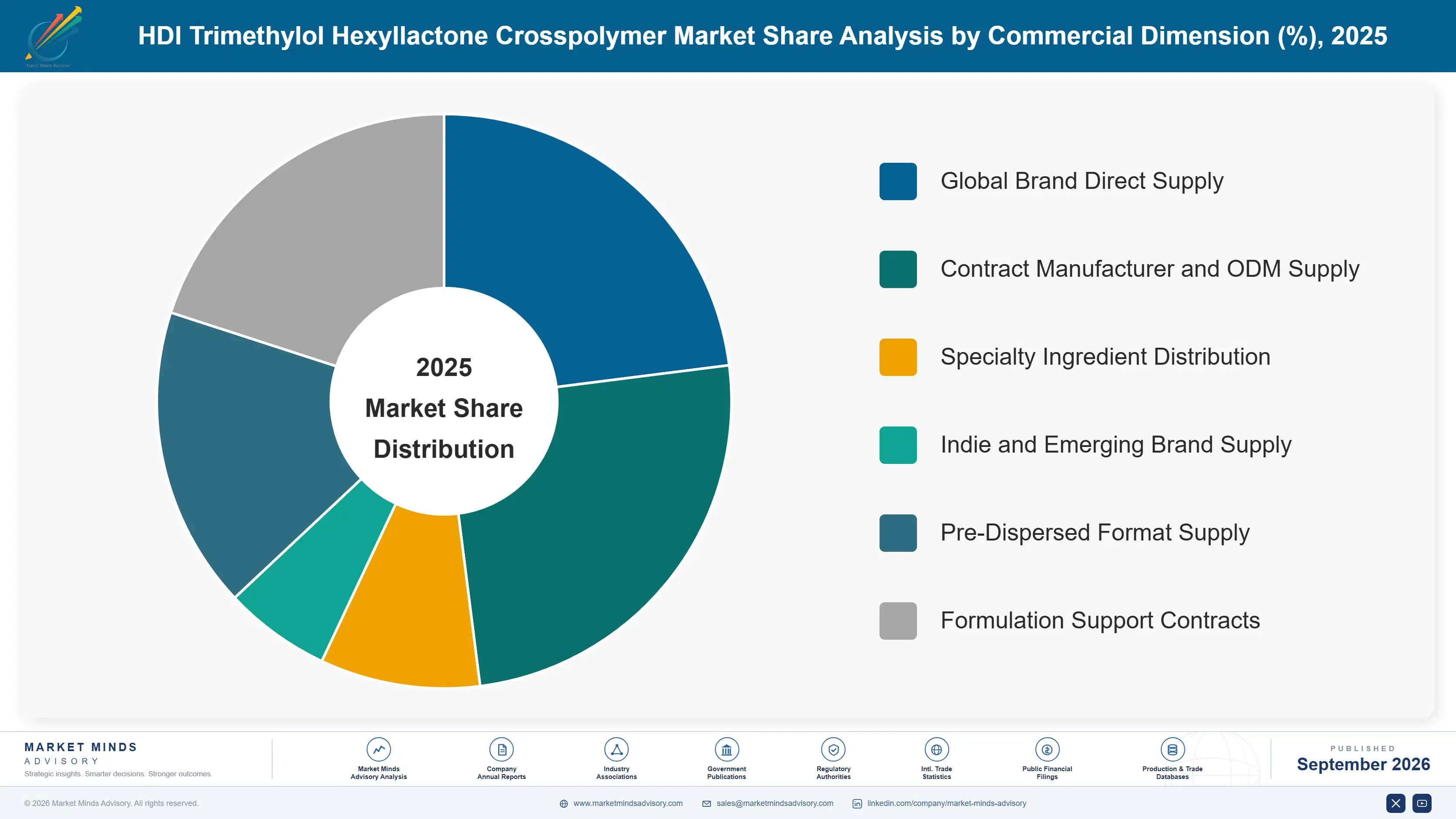
Segmentation follows particle specification across six grade families: standard spherical powder grades, fine particle sub-ten-micron grades, surface-treated and coated grades, porous high-absorption grades, pigment-loaded composite grades, and large particle texture grades. Application, supply format, and regional regulatory status are treated as separate dimensions entirely. Coating chemistry is counted within the grade family it modifies.
hdi-trimethylol-hexyllactone-crosspolymer-market-market-share-analysis-1790013386085

Surface-Treated And Coated Grades

Coated grades grow at 12.6%, half again the market rate of 8.4%, and regulation rather than performance is what drives it. Surface treatment has always been used to adjust dispersibility, hydrophobicity, and pigment interaction, and it is now the practical route to engineering particles that meet biodegradability criteria while keeping the sphericity and monodispersity formulators depend on. Producers view this as the alternative to leaving the European market with the chemistry intact. Whether coated grades satisfy the required testing protocols is unresolved, and the commercial planning across the industry currently assumes that they will. European formulators are qualifying against that assumption too. A great deal of reformulation planning rests on a testing outcome nobody has confirmed.
CAGR 12.6%

Fine Particle Sub-Ten-Micron Grades

Fine grades grow at 10.8% because smaller monodisperse spheres scatter light more effectively across the visible range, which improves the soft focus effect that finished products advertise. They also feel considerably silkier under a finger, which is what actually gets them specified in most formulations. Manufacturing them requires tighter classification, so yields are lower and prices higher than standard grades command. Dispersion is the practical difficulty: fine particles agglomerate readily in aqueous systems and need either surface treatment or a pre-wetted supply format to behave predictably. Producers supplying pre-dispersed formats remove much of that difficulty for the customer, which shortens qualification meaningfully and is worth considerably more than the price difference on the powder itself.
CAGR 10.8%
Full segment breakdown across 6 segments available in the complete report.

Regional Architecture and Country Demand Map

Regional shares here track where cosmetic formulation and manufacture actually occur rather than where the finished products are eventually sold, since this powder is specified at the formulation bench. Four regions sit outside the standard bands, for reasons named in their paragraphs and summarised for operator review.

East Asia

At 44% this region sits far above the standard band, and the justification is straightforward: roughly 71% of world output is manufactured in Japan, and Chinese, Korean, and Japanese colour cosmetics formulation together consume more of it than everywhere else combined. Chinese growth of 13.8% leads every country covered. No restriction comparable to the European rules applies anywhere in the region. Korean contract manufacturers formulating for brands headquartered elsewhere add substantial volume that the brand's own geography never records. Japanese producers hold the process depth that keeps particle size distribution consistent batch to batch, which is what formulators build their sensory specifications around. Batch consistency is the whole basis of the position.
Share: 44% | CAGR: 9.4% (2026 to 2036)

North America

Formulation demand here is driven by complexion and primer products where sebum control and sensory feel both matter, and specification practice mirrors the wider pattern of choosing on slip rather than on optical claims. Growth of 7.8% tracks close to the world rate. No federal restriction on synthetic polymer microparticles in cosmetics applies, though several state legislatures have examined comparable measures and brands with European ranges plan reformulation across both anyway. Contract manufacturers here formulate for indie and prestige brands alike, and specification practice varies enormously between those two groups. Prestige development teams run sensory panels; indie brands frequently accept whatever the contract manufacturer already holds in stock. Practice differs sharply between them.
Share: 23% | CAGR: 7.8% (2026 to 2036)
Regional intelligence for 5 additional markets available in the complete report: Western Europe, South Asia and Pacific, Latin America, Middle East and Africa, Eastern Europe. Contact sales@marketmindsadvisory.com.
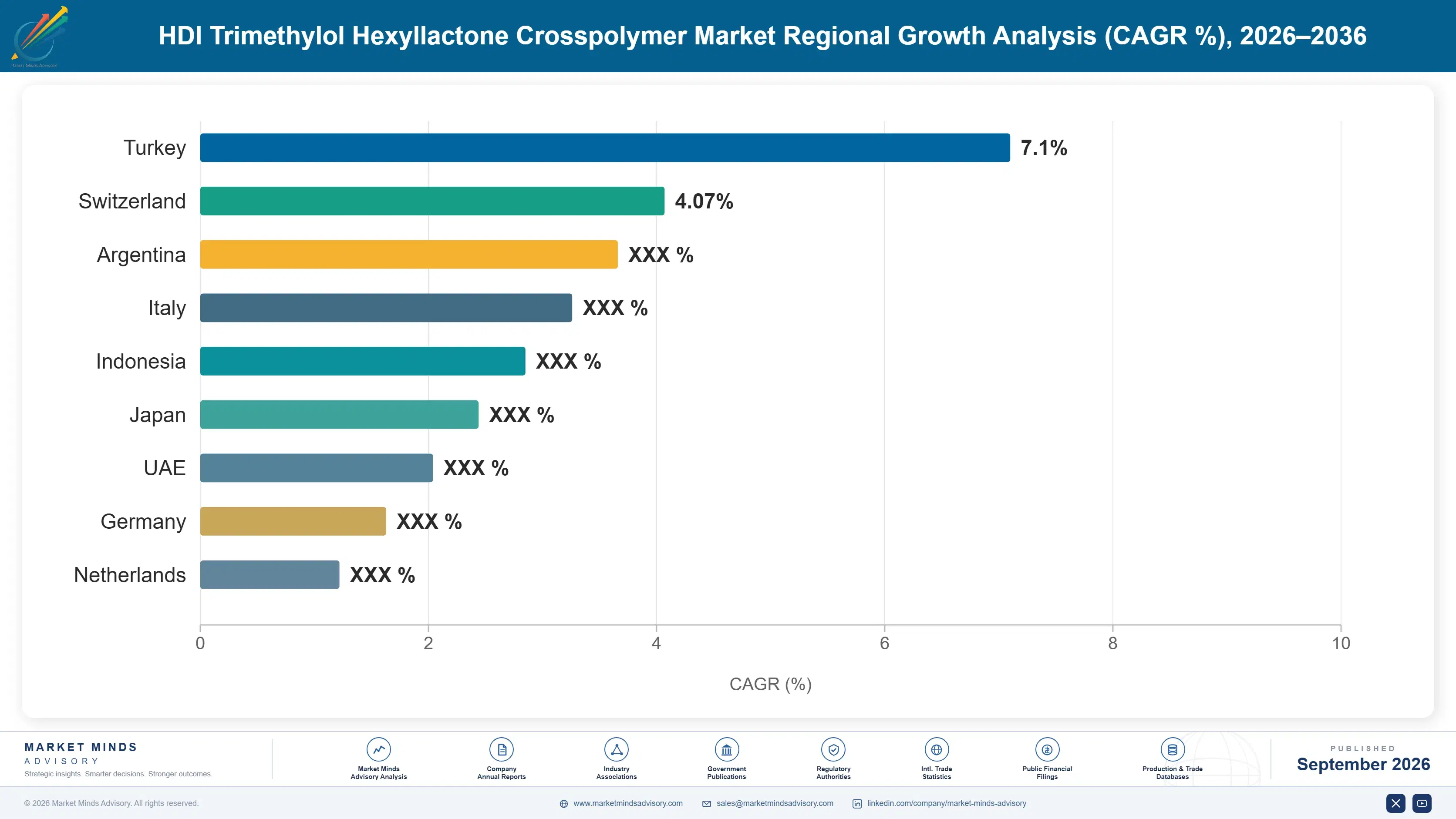
hdi-trimethylol-hexyllactone-crosspolymer-market-country-cagr-analysis-1790013386953

Where Producers Defend Their Positions

Four commercial moves separate producers who will hold this business through the European transition from those treating the restriction as a distant problem. Each addresses something specific: the regulatory deadline, the reason formulators actually specify, the supply concentration risk, and the long qualification cycle. Three of the four cost very little relative to the volume they protect.

Test Coated Grades Against Biodegradability Protocols Now

European compliance for leave-on products runs to 2035, and brands plan reformulation years ahead of any deadline rather than at it. Producers with grades already tested against the required protocols report qualification starts 2.7 times higher among European formulators than those promising future compliance. The testing itself is not expensive against the volume at risk, and arriving with data rather than intent is what separates a supplier still in the conversation from one being designed out. Brands designing an ingredient out rarely announce it in advance. Being designed out happens quietly and is discovered afterwards.
Market Impact: Raises new qualification starts to 2.7 times higher

Sell The Sensory Data, Not The Blur

About 64% of formulations specify this powder for slip, pigment carry, and dry after-feel rather than for optical blurring. Producers supplying instrumented sensory data alongside optical measurements report specification conversion 1.9 times higher with formulation teams. The blur claim belongs to the brand's marketing department and the specification decision belongs to a bench chemist, and most technical literature in this category is written for the wrong one of those two people. Instrumented friction and after-feel data speaks directly to the person choosing. Optical measurements alone address the wrong reader entirely.
Market Impact: Raises specification conversion rates to 1.9 times higher

Offer Dual-Source Qualification Support Quite Deliberately

Roughly 71% of output comes from a handful of Japanese plants, and qualification runs around 14 months, so a formulator with one approved source carries a risk they generally have not quantified. Producers actively supporting dual qualification alongside a second source report account values 2.2 times greater, because the formulator qualifies more grades and specifies more broadly. Helping a customer reduce dependence on you wins more volume than defending exclusivity does. Very few producers in this market behave that way at present. Defending exclusivity produces a narrower position than supporting the second source does.
Market Impact: Raises average account values to 2.2 times higher

Compress Qualification Through Pre-Wetted Supply Formats

Fine grades agglomerate in aqueous systems and much of the 14 month qualification cycle is spent solving dispersion problems the producer already knows how to solve. Producers supplying pre-wetted and pre-dispersed formats report qualification completed 4.1 months faster on average. Shorter qualification means the material reaches more launches within a development season, which matters enormously in Korean and Chinese formulation cycles that turn over far faster than Western ones. The producer already knows how to solve those problems. Solving them once for the customer costs the producer very little indeed.
Market Impact: Cuts qualification time by 4.1 months on average

Who Controls the Margin Pool

Concentration is exceptionally high. Five producers hold 78% of category revenue, measured consistently on that basis across all participants, and roughly 71% of physical output originates from a small number of Japanese plants. The polymerisation and classification process is specialised enough that very few producers have ever attempted it, which is why the field has stayed this narrow. Barriers to entry are technical rather than regulatory or commercial, which is unusual and makes the concentration durable.
Competition currently turns on three dimensions: biodegradability testing progress, which decides who remains specifiable in Europe after the deadline; grade breadth across particle size and surface treatment; and formulation support depth, particularly around dispersion problems that consume most of the qualification cycle. Supply continuity has become a fourth dimension as formulators begin quantifying their single source exposure.

Pressure builds from two directions. Korean and Chinese producers are entering with competitive grades at lower prices. Meanwhile cellulose and biopolymer alternatives improve steadily. Rankings will shift toward producers holding tested compliant grades, since regulatory qualification cannot be compressed once a deadline is close. Biodegradability data is the asset that separates the field now, and it cannot be produced at short notice.
hdi-trimethylol-hexyllactone-crosspolymer-market-company-positioning-matrix-1790013387751

Competitive Moat and Risk Dimensions

TOSHIKI PHARMACEUTICAL

Moat: Process Depth In Polymerisation

Decades of polymerisation and classification experience produce the particle size distribution consistency that formulators build their sensory specifications around, and batch-to-batch variability is what separates acceptable material from unusable material here. That process knowledge is genuinely difficult to replicate and it explains why so few producers have entered despite obvious demand.
TOSHIKI PHARMACEUTICAL

Risk: European Regulatory Exposure Concentrated

Depth in a single chemistry means full exposure to a restriction written specifically against durable synthetic polymer particles, with no adjacent portfolio to shift toward if coated grades fail biodegradability testing. Producers holding mineral and biopolymer texturisers alongside this chemistry carry considerably less risk through the same transition.
KOBO PRODUCTS

Moat: Surface Treatment And Dispersion

Capability in surface treatment and pre-dispersed supply formats addresses the dispersion difficulties that consume most of a fourteen month qualification cycle, which shortens development for the customer rather than merely supplying a powder. That service position also makes the business the natural partner for coated grades engineered to meet biodegradability criteria.
KOBO PRODUCTS

Risk: Dependence On Base Polymer Supply

Treatment and dispersion capability rests on base polymer produced elsewhere, largely in the same concentrated Japanese plant base that supplies competitors. Any interruption or reallocation upstream affects the business directly, and the value added sits downstream of a bottleneck it does not control. Building upstream polymerisation capability would take years and considerable capital.

Players Tracked

Prominent Players

Toshiki Pharmaceutical
Kobo Products
Miyoshi Kasei
Daito Kasei Kogyo
Nikko Chemicals

Other Key Players

Sumitomo Seika Chemicals
Ganz Chemical
Negami Chemical Industrial
Sunjin Beauty Science
KCC Beauty
Presperse
Grant Industries
Croda International
Evonik Industries
Cardre
Eckart
Ikeda Corporation
Sensient Technologies
Impact Colors
BioPowder

Recent Developments

FEBRUARY 2026

Toshiki Pharmaceutical Launches Biodegradability-Tested Grade For European Compliance

Toshiki Pharmaceutical released a surface-modified grade supplied with biodegradability test data against the protocols European rules specify, aiming to preserve specification access for leave-on cosmetics beyond the restriction dates. The grade retains the sphericity and monodispersity that formulators specify around, which earlier compliant candidates had generally surrendered in the process.
Signal: Producers are engineering around the restriction rather than abandoning the chemistry. Test data arrives years ahead of the deadline.
SEPTEMBER 2025

Daito Kasei Kogyo Expands Surface-Treated Grade Capacity

Daito Kasei Kogyo completed an organic capacity expansion for surface-treated spherical powder production, funded internally with no partner involved, after coating demand from European reformulation programmes outran available treatment and classification throughput. Treatment capacity rather than base polymer output had been limiting supply. Output serves European reformulation programmes directly.
Signal: Coating capacity rather than base polymer output is the current constraint. Coating is where the regulatory answer now sits.
JUNE 2025

Sunjin Beauty Science Signs Supply Agreement With Korean Contract Manufacturer

Sunjin Beauty Science entered a multi-year supply agreement covering spherical polymer powder grades with a Korean contract manufacturer, securing volume in the formulation base that serves brands headquartered across several regions. Volume was secured at the point where formulation decisions are actually taken rather than where brands are headquartered.
Signal: Korean producers are contesting supply where the formulation actually happens. Japanese producers no longer hold the field alone.

What The Powder Costs

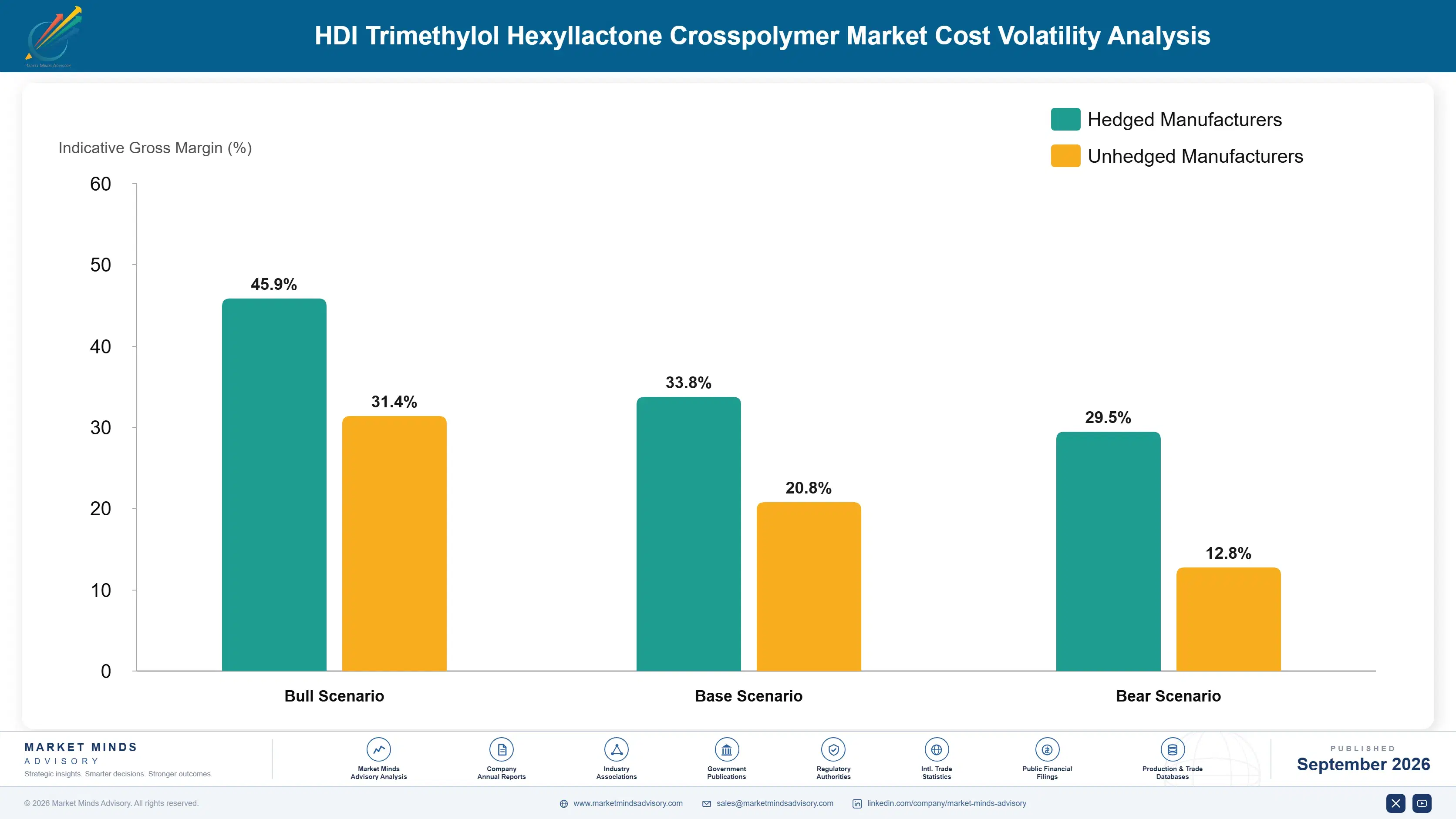
Three input groups dominate cost. Hexamethylene diisocyanate and lactone monomer feedstock runs 40% to 48% of cost of goods sold, and the eight-point range reflects grade complexity rather than any purchasing difference. Polymerisation process energy and reactor time take 18% to 24%. Surface treatment and particle classification add 14% to 20%, with fine and coated grades sitting firmly at the upper end.
Hexamethylene diisocyanate pricing moved through 2024 and 2025 as isocyanate capacity adjusted to demand across coatings and polyurethane applications entirely unrelated to cosmetics, and several producers described the resulting input pressure in their annual reports for those years. EIA energy price series document the underlying movement. Cosmetic grade volumes are far too small to influence isocyanate pricing in either direction. The application is a rounding error in that market.

The competitive disadvantage mechanism runs through classification yield rather than through feedstock. Fine monodisperse grades require tight classification, so a producer with poor size distribution control discards a larger fraction of every batch and carries that loss across the whole cost base. Exposure varies sharply by grade mix: standard grade producers face modest yield pressure while fine and coated grade specialists carry it acutely.
hdi-trimethylol-hexyllactone-crosspolymer-market-cost-volatility-analysis-1790013387950

Invest In Classification Yield Before Reactor Capacity

Fine monodisperse grades demand tight particle size control, and a producer discarding a large fraction of each batch carries that loss across the entire cost base regardless of reactor efficiency. Classification improvement usually returns more than added polymerisation capacity does, and it also improves the batch consistency formulators specify around. Batch consistency is what formulators specify around.

Contract Isocyanate Supply Against Coatings Demand Cycles

Cosmetic grade volumes are far too small to influence isocyanate pricing, which is set entirely by coatings and polyurethane demand on cycles that have nothing to do with this application. Contracting against those cycles rather than reacting to them removes most of the exposure at very modest cost. Reacting to isocyanate movements as they happen is the expensive alternative.

Run Biodegradability Testing Ahead Of Requirement

European compliance dates for leave-on products sit years ahead, and brands plan reformulation well before deadlines rather than at them. Testing coated grades against the required protocols now costs little relative to the volume at risk, and arriving with data rather than intentions decides whether a producer stays in the conversation. Intentions persuade nobody at this stage.

Portfolio Architecture for Margin Defence

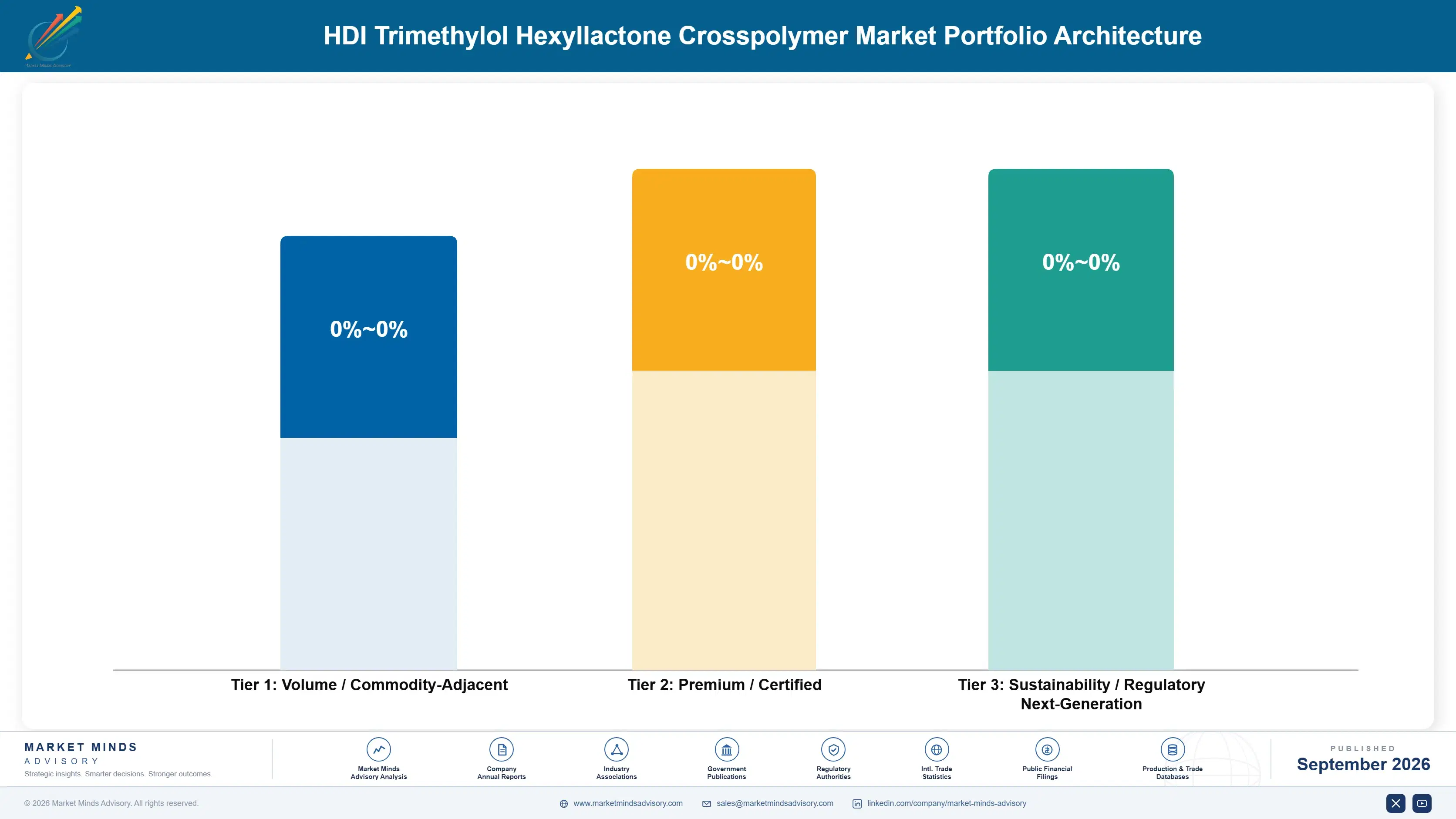
Margin follows grade complexity and regulatory position together. Standard spherical grades compete on price against Korean and Chinese entrants offering acceptable material. Porous and pigment-loaded composites earn better on manufacturing difficulty. Fine grades earn better still on classification yield economics, and coated grades carrying biodegradability data earn most, because they answer a question no competitor without the testing can answer at all. The spread across those four groups is wide for a single chemistry.
The tension between volume and premium runs through where the formulation is destined. A product formulated for Chinese or Korean sale faces no restriction and buys on price and sensory performance. A product formulated for a European range needs compliant material or a reformulation plan, and pays for the certainty that a tested grade provides across the whole development timeline.

High-value pools concentrate where two conditions meet: fine or coated grades with demanding particle specifications, and formulations destined for regulated markets where compliance evidence matters. Where the requirement is a standard grade for a domestic Asian complexion product, price decides and the newer regional producers compete perfectly well on it. That divide follows the destination market rather than the brand tier.

Volume / Commodity-Adjacent

Standard spherical and large particle texture grades supplied against established specifications with no treatment or compliance data attached. The ten-point range reflects classification yield and polymerisation scale rather than any property a formulator would pay extra to obtain.
Gross Margin: 26% to 36%

Premium / Certified

Fine sub-ten-micron, porous, and pigment-loaded composite grades requiring tight classification and specialised process control throughout. The twelve-point range separates producers with genuine size distribution consistency from those tolerating wider batch variation in their output.
Gross Margin: 40% to 52%

Sustainability / Regulatory / Next-Generation

Surface-treated and coated grades supplied with biodegradability test data against the protocols European rules specify for compliance. The fourteen-point range reflects whether testing is complete and published or the compliance claim rests on intention alone.
Gross Margin: 56% to 70%
hdi-trimethylol-hexyllactone-crosspolymer-market-portfolio-architecture-1790013388448

High-value Sub-segments and Strategic Watch-out

Biodegradability-Tested Coated Grades

Highest value in the category, answering the compliance question that decides European specification access beyond the restriction dates. The fourteen-point range reflects whether test data is complete and published or the producer is still promising future qualification. Nobody can produce this data at short notice.
Gross Margin: 58% to 72%

Fine Sub-Ten-Micron Grades

High value growing at 10.8% on optical scattering and silkier feel that standard grades cannot deliver at coarser sizes. The twelve-point range reflects classification yield, since discarded material from poor size control carries across the whole cost base. Agglomeration in aqueous systems is the practical difficulty.
Gross Margin: 44% to 56%

Pre-Dispersed And Treated Formats

Volume core removing the dispersion difficulties that consume most of a fourteen month qualification cycle for the customer. The twelve-point range reflects treatment capability held in house against formats bought in and simply resold onward. Shorter qualification is worth more than the price difference. Treatment held in house decides margin.
Gross Margin: 36% to 48%

Standard Uncoated Spherical Grades

The strategic watch-out. Korean and Chinese producers now offer acceptable material at lower prices, and nothing about a standard grade resists that comparison once qualification is complete. The ten-point range reflects classification yield and scale only. Qualification is the only remaining barrier here. Price competition presses hardest exactly here.
Gross Margin: 24% to 34%

How This Demand Repeats

Revenue here is unusually locked once a specification is approved. Qualification runs around 14 months from first sample through dispersion work, stability testing, and sensory panel confirmation, so a formulator who has completed it does not revisit the decision for a modest price difference. The material is then specified across the life of the formulation, which in skincare frequently means five years or more without any competitive review at all.
Attachment depth varies by grade demand. Fine and coated grades with tight particle specifications produce the deepest relationships, since the formulator's sensory profile depends on batch consistency that only some producers deliver reliably. Standard grades attach far less, and Asian formulators switch between qualified sources on price without much hesitation once two are approved.

The specifier profile has shifted with regulation. This was a bench chemistry decision made on sensory panels and is now a conversation involving regulatory affairs, because a European range needs compliance evidence rather than performance data alone. That change favours producers who can supply testing documentation alongside the powder, and it has caught out several who treated the deadline as distant.
hdi-trimethylol-hexyllactone-crosspolymer-market-end-use-penetration-index-1790013388941

Where This Market Rewards

These are among the four positions where our research anticipates prominent divergence between winners and laggards over the coming forecast period. Each is grounded in the demand model, the regulatory perimeter, and the announced capacity pipeline.
01 / COMPLIANCE EVIDENCE TIMING

Arrive with data, not with intentions

European compliance for leave-on cosmetics runs to 2035, and brands plan their reformulation work years ahead of a deadline rather than waiting until it actually arrives. Producers already holding grades tested against the required biodegradability protocols now report qualification starts 2.7 times higher among European formulators. Testing costs little against the volume at risk, and it decides whether a producer stays in the conversation or gets designed out quietly, and brands designing an ingredient out very rarely announce that decision in advance.
02 / SENSORY SPECIFICATION FOCUS

The bench chemist buys slip

Roughly 64% of formulations specify this powder for slip, pigment carry, and dry after-feel rather than for the optical blurring that finished products advertise on pack. Producers supplying instrumented sensory data alongside their optical measurements report specification conversion 1.9 times higher with formulation teams. Most technical literature in this category is written for the marketing department rather than the person who actually chooses the ingredient, which is a documentation error rather than a product one and costs nothing to correct.
03 / DUAL SOURCE FACILITATION

Help them reduce their dependence

About 71% of output comes from a handful of Japanese plants and qualification runs roughly 14 months, so a formulator holding one approved source carries unquantified risk. Producers actively supporting dual qualification report account values 2.2 times greater than those defending exclusivity, because the customer then qualifies more grades and specifies across more products. Reducing a customer's dependence wins more volume than protecting a single position does, and remarkably few producers in this market currently behave that way at all.
04 / QUALIFICATION CYCLE COMPRESSION

Dispersion problems eat the timeline

Fine grades agglomerate readily in aqueous systems, and most of a fourteen month qualification gets spent solving dispersion issues that the producer already knows perfectly well how to solve. Producers supplying pre-wetted and pre-dispersed formats report qualification completed 4.1 months faster on average across the accounts they serve. Shorter qualification means more launches reached within a season, which matters most in Korean and Chinese development cycles, where a season missed is a full year of volume lost to a competitor.

Engagement Snapshot From the Field

A live engagement with an industry participant carrying material or product regulatory and market exposure ahead of a defining policy shift, showing how our research translates into a defensible multi-year portfolio strategy.
MARKET MINDS ADVISORY · CLIENT ENGAGEMENT SUMMARY
HDI Trimethylol Hexyllactone Crosspolymer Producer Strategic Portfolio Review and Transition Roadmap 2026·Investment Scenario on HDI Trimethylol Hexyllactone Crosspolymer Exposure Evaluation 2025-26
CLIENT PROFILE
A global skincare brand with annual revenue near USD 920 million (client-reported, unverified by MMA), selling complexion, primer, and mattifying products across twenty-eight markets. Spherical polymer powder appeared in eleven formulations, all sourced from a single approved supplier, and the European restriction had reached the regulatory team's risk register. The board asked for options before committing to any reformulation programme at all.
STRATEGIC CHALLENGE
Regulatory affairs wanted every affected formulation reformulated to a mineral alternative on a three-year programme. The formulation team argued that no alternative matched the sensory profile, and nobody had tested whether coated biodegradable-qualified grades of the same chemistry would satisfy the requirement instead. Procurement had assumed the entire chemistry was restricted and had never asked producers about compliant grades.
MMA APPROACH
MMA benchmarked four candidate alternatives against the incumbent on sphericity, oil absorption, and instrumented sensory measures, reviewed biodegradability data available on coated grades from three producers, and modelled reformulation cost against a compliant-grade substitution across all eleven formulations. Supplier continuity was assessed alongside, since every affected formulation ran on a single approved source with no alternative qualified anywhere.
KEY FINDINGS
  1. No mineral or starch alternative matched the incumbent across sphericity, monodispersity, oil absorption, and after-feel together, though each matched on one or two of those properties individually.
  2. Two producers held coated grades with biodegradability data against the relevant protocols, and neither had been approached because procurement had assumed the whole chemistry was restricted.
  3. Full reformulation to mineral alternatives was costed at roughly nine times the qualification cost of substituting a compliant grade of the same chemistry.
  4. Single sourcing across all eleven formulations represented a continuity risk the brand had never quantified, with qualification of any alternative running well over a year.
CLIENT PROFILE
A global skincare brand with annual revenue near USD 920 million (client-reported, unverified by MMA), selling complexion, primer, and mattifying products across twenty-eight markets. Spherical polymer powder appeared in eleven formulations, all sourced from a single approved supplier, and the European restriction had reached the regulatory team's risk register. The board asked for options before committing to any reformulation programme at all.
STRATEGIC CHALLENGE
Regulatory affairs wanted every affected formulation reformulated to a mineral alternative on a three-year programme. The formulation team argued that no alternative matched the sensory profile, and nobody had tested whether coated biodegradable-qualified grades of the same chemistry would satisfy the requirement instead. Procurement had assumed the entire chemistry was restricted and had never asked producers about compliant grades.
MMA APPROACH
MMA benchmarked four candidate alternatives against the incumbent on sphericity, oil absorption, and instrumented sensory measures, reviewed biodegradability data available on coated grades from three producers, and modelled reformulation cost against a compliant-grade substitution across all eleven formulations. Supplier continuity was assessed alongside, since every affected formulation ran on a single approved source with no alternative qualified anywhere.
KEY FINDINGS
  1. No mineral or starch alternative matched the incumbent across sphericity, monodispersity, oil absorption, and after-feel together, though each matched on one or two of those properties individually.
  2. Two producers held coated grades with biodegradability data against the relevant protocols, and neither had been approached because procurement had assumed the whole chemistry was restricted.
  3. Full reformulation to mineral alternatives was costed at roughly nine times the qualification cost of substituting a compliant grade of the same chemistry.
  4. Single sourcing across all eleven formulations represented a continuity risk the brand had never quantified, with qualification of any alternative running well over a year.
RECOMMENDED STRATEGY
Phase 1: Phase one: qualify coated biodegradability-tested grades from two producers before committing to any reformulation programme at all. Two producers already held the necessary data. Phase 2: Phase two: reformulate only those products where compliant grades fail the sensory panel, rather than treating the whole chemistry as lost. Phase 3: Phase three: hold dual approved sources across every formulation to remove the single supplier continuity exposure permanently. Single sourcing had never been quantified as risk.
OUTCOME
Nine of eleven formulations qualified on compliant coated grades within three quarters (client-reported, unverified by MMA). Reformulation was confined to the two products where sensory panels failed. Programme cost came in at roughly a fifth of the original reformulation estimate. Dual sourcing was completed across the range within the same programme.

Frequently Asked Questions

Foundational context covering the market sizes, CAGR, scope, country, region and competition that inform every finding below. This section is provided to cover basics and most often pre-purchase conversations, answered from the MMA Primary Research Dataset.

What is the current size of the HDI Trimethylol Hexyllactone Crosspolymer Market?

The market was worth USD 0.5 billion in 2025 and stands at USD 0.5 billion in 2026. Value covers all grades of the crosspolymer supplied for cosmetic and personal care formulation.

How large will the HDI Trimethylol Hexyllactone Crosspolymer Market be by 2036?

MMA forecasts USD 1.1 billion by 2036, an increase of USD 0.6 billion across the forecast period. That represents 2.20 times the 2026 base of USD 0.5 billion.

What is the CAGR for the HDI Trimethylol Hexyllactone Crosspolymer Market 2026 to 2036?

The base case compound annual growth rate is 8.4%, with a bull case at 9.6% and a bear case at 7.2%. Historical growth from 2020 to 2025 ran at 7.4%.

Which segment is growing fastest?

Surface-treated and coated grades grow at 12.6%, half again the market rate of 8.4%. Coating is the practical route to grades engineered to meet European biodegradability criteria.

Who are the major companies in the HDI Trimethylol Hexyllactone Crosspolymer Market?

Toshiki Pharmaceutical, Kobo Products, Miyoshi Kasei, Daito Kasei Kogyo, and Nikko Chemicals lead. Together they hold 78% of revenue, making this among the most concentrated ingredient markets covered.

Which country is growing fastest?

China grows at 13.8%, driven by domestic colour cosmetics manufacture expanding rapidly and by the absence of any restriction comparable to the European microparticle rules.

Report Segmentation Architecture

The full report scope spans multiple orthogonal segmentation dimensions, with cross-tabulated demand data provided for each dimension pair. Coverage extends further to regional breakdowns, trend trajectories, and the competitive detail needed to support segment-level decision-making.

By Particle Specification

  • Standard Spherical Powder Grades
  • Fine Particle Sub-Ten-Micron Grades
  • Surface-Treated and Coated Grades
  • Porous High-Absorption Grades
  • Pigment-Loaded Composite Grades
  • Large Particle Texture Grades

By End-Use Industry

  • Complexion and Foundation Products
  • Primers and Base Preparations
  • Powder and Pressed Colour Products
  • Mattifying Skincare and Moisturisers
  • Sun Care Formulations
  • Colour Cosmetics for Eye and Lip

By Commercial Dimension

  • Global Brand Direct Supply
  • Contract Manufacturer and ODM Supply
  • Specialty Ingredient Distribution
  • Indie and Emerging Brand Supply
  • Pre-Dispersed Format Supply
  • Formulation Support Contracts

By Region

  • East Asia
  • North America
  • Western Europe
  • South Asia and Pacific
  • Latin America
  • Middle East and Africa
  • Eastern Europe

Scope, Methodology, and Coverage

Every figure in this report is reproducible from documented input assumptions. The scope below maps the historical period, the forecast horizon, the segmentation dimensions, and the countries covered, alongside the underlying primary and qualitative methodology.
Historical Period
2020 to 2025
Forecast Period
2026 to 2036
Base Year
2025 (USD billions; MMA Primary Research Dataset, September 2026)
Market Definition
This market covers HDI Trimethylol Hexyllactone Crosspolymer supplied as a spherical polymer powder for cosmetic and personal care formulation, across standard spherical, fine sub-ten-micron, surface-treated and coated, porous high-absorption, pigment-loaded composite, and large particle texture grades. It excludes other spherical polymer powders including nylon and acrylate chemistries, silica and mineral fillers, starch and cellulose texturisers, and finished cosmetic products.
Quantitative Units
USD billions, revenue at producer selling price
Segmentation Dimensions
Particle specification, end-use industry, commercial dimension, region
Regions Covered
East Asia, North America, Western Europe, South Asia and Pacific, Latin America, Middle East and Africa, Eastern Europe
Countries Covered
Japan, China, South Korea, Taiwan, United States, Canada, Mexico, France, Italy, Germany, United Kingdom, Spain, Netherlands, Switzerland, Poland, Czechia, India, Indonesia, Thailand, Vietnam, Australia, Brazil, Mexico, Colombia, Chile, Saudi Arabia, United Arab Emirates, Turkey, Egypt, South Africa
Key Companies Profiled
Toshiki Pharmaceutical, Kobo Products, Miyoshi Kasei, Daito Kasei Kogyo, Nikko Chemicals, Sumitomo Seika Chemicals, Ganz Chemical, Negami Chemical Industrial, Sunjin Beauty Science, KCC Beauty, Presperse, Grant Industries, Croda International, Evonik Industries, Cardre, Eckart, Ikeda Corporation, Sensient Technologies, Impact Colors, BioPowder
Quantitative Methodology
Primary survey, n=3,800 respondents, Q4 2025, six countries; demand-side model with trade association cross-validation
Qualitative Methodology
47 expert interviews, Q4 2025; applied to validate demand model assumptions, identify emerging dynamics, and assess competitive positioning
Report Format
PDF and XLSX data workbook (Word format preview document)
Publisher
Market Minds Advisory
Report Code
MMA-2026-CHM-241
Published
September 2026
Contact
sales@marketmindsadvisory.com | www.marketmindsadvisory.com

Purchase the full HDI Trimethylol Hexyllactone Crosspolymer Market Report (2026 to 2036).

The full report sizes the HDI Trimethylol Hexyllactone Crosspolymer market across six grade families, seven regions, and thirty countries, with forecasts to 2036 under base, bull, and bear cases. It establishes why most formulations specify the powder for sensory feel rather than optical blurring, maps the European microparticle restriction against coated grade compliance routes, and quantifies the supply concentration risk in Japanese plants. Competitive analysis covers twenty participants evaluated consistently on category revenue, with detailed treatment of biodegradability testing progress by producer. Cost structure, classification yield economics, and qualification cycle timing are analysed throughout. Primary research includes 3,800 survey responses and 47 expert interviews.
Six grade families sized and forecast separately
Twenty participants evaluated on category revenue consistently
European restriction timeline mapped against coated grade compliance routes
Substitute materials benchmarked across sphericity, absorption and sensory measures
Supply concentration and qualification lead times quantified by producer
Classification yield economics analysed across fine and standard grades

Built For The People Who Decide

From boardroom strategy to bench-side execution, this report is read cover-to-cover by leaders shaping the next decade of their industry, turning demand scenarios, market dynamics and valuation benchmarks into decisions.
CXOs/ Presidents/ VPs/ Managers
M&A and Corporate Development
Strategy Teams and R&D Heads
Procurement and Product Directors
Regulatory and Compliance Leaders
Investor Relations and Equity Analysts