Market Minds Advisory
Hazardous Area Equipment Market

Hazardous Area Equipment Market: Digitalization Reaches the Explosion-Proof Enclosure

Battery gigafactory expansion and Gulf state petrochemical capital spending are pulling intrinsically safe instrumentation demand ahead of traditional enclosure volume faster than certification bodies can process new equipment approvals across most major industrial economies.

Lead Analyst

David Horsley

Published

August 2026

Make Smarter Decisions with Customized Research Insights

Request a free sample report and evaluate market opportunities, growth trends, and competitive dynamics relevant to your business needs.

2025 MARKET VALUE$9.2BMarket Size 2025
2036 FORECAST VALUE$18.4BBase Case , 2026 to 2036
CAGR 2026 TO 20366.5 %Bull 7.7% / Bear 5.2%
INCREMENTAL OPPORTUNITY$8.6BNet 10- year value creation
EXPANSION MULTIPLE1.88x2036 value over 2026 base
Strategic Levers
M&A Pipeline
Regional Outlook
Country Rankings
Competitive Intelligence
Segmental Deep-dive
Call-Us : 91 93563 13602

Executive Snapshot and Market Trajectory

Digitalization is quietly reshaping a category long defined by heavy explosion-proof enclosures, pushing intrinsically safe sensors and communication equipment ahead of traditional volume as plant operators chase real-time hazardous area visibility everywhere across their sprawling facility footprints this fiscal year and the next one too.
Intrinsically safe instrumentation and communication equipment are pulling capital away from standard enclosures as chemical and battery manufacturers digitize hazardous area monitoring, with East Asia now anchoring the largest share of global demand behind China's dense chemical and battery gigafactory manufacturing base spread across multiple industrial provinces and coastal zones. Demand is concentrating fastest in petrochemical and lithium battery production applications this decade and likely well beyond it into the next one entirely.
Competitive structure remains moderately concentrated behind a handful of scaled electrical safety manufacturers, leaving certification breadth and digital integration capability as the two dimensions that actually separate winners from smaller regional specialists worldwide. Gulf state petrochemical capital expenditure is compressing certification and delivery timelines across the entire supplier base at once, and few manufacturers are fully positioned for what comes next this decade and the following one.
Market Definition
The hazardous area equipment market covers explosion-proof enclosures, lighting fixtures, motors and drives, intrinsically safe instrumentation, switchgear, and communication equipment certified for use in classified hazardous locations across oil and gas, chemical, mining, and battery manufacturing facilities. It excludes general industrial electrical equipment not certified to hazardous area protection standards and personal protective equipment sold separately.
Base Year Value
$9.2B in 2025 (MMA Primary Research Dataset, August 2026)
Forecast Period
2026 to 2036, eleven discrete annual values
CAGR
6.5% base case. Bull 7.7%. Bear 5.2%.
Fastest Growth Segment
Intrinsically Safe Instrumentation and Sensors: 9.5% CAGR
Fastest Growth Country
India: 9.8% CAGR
Fastest Growth Region
South Asia and Pacific: 8.6% CAGR
Largest Region
East Asia: 27% of 2025 global value
Market Leaders
Eaton Corporation plc, ABB Ltd, Emerson Electric Co, Honeywell International Inc, Siemens AG. Source: MMA Analysis based on company annual reports and disclosures.
Primary Survey
n=3,800 procurement and R&D decision-makers, Q4 2025, six countries
Methodology
Demand-side build-up, cross-validated against public data, 47 expert interviews

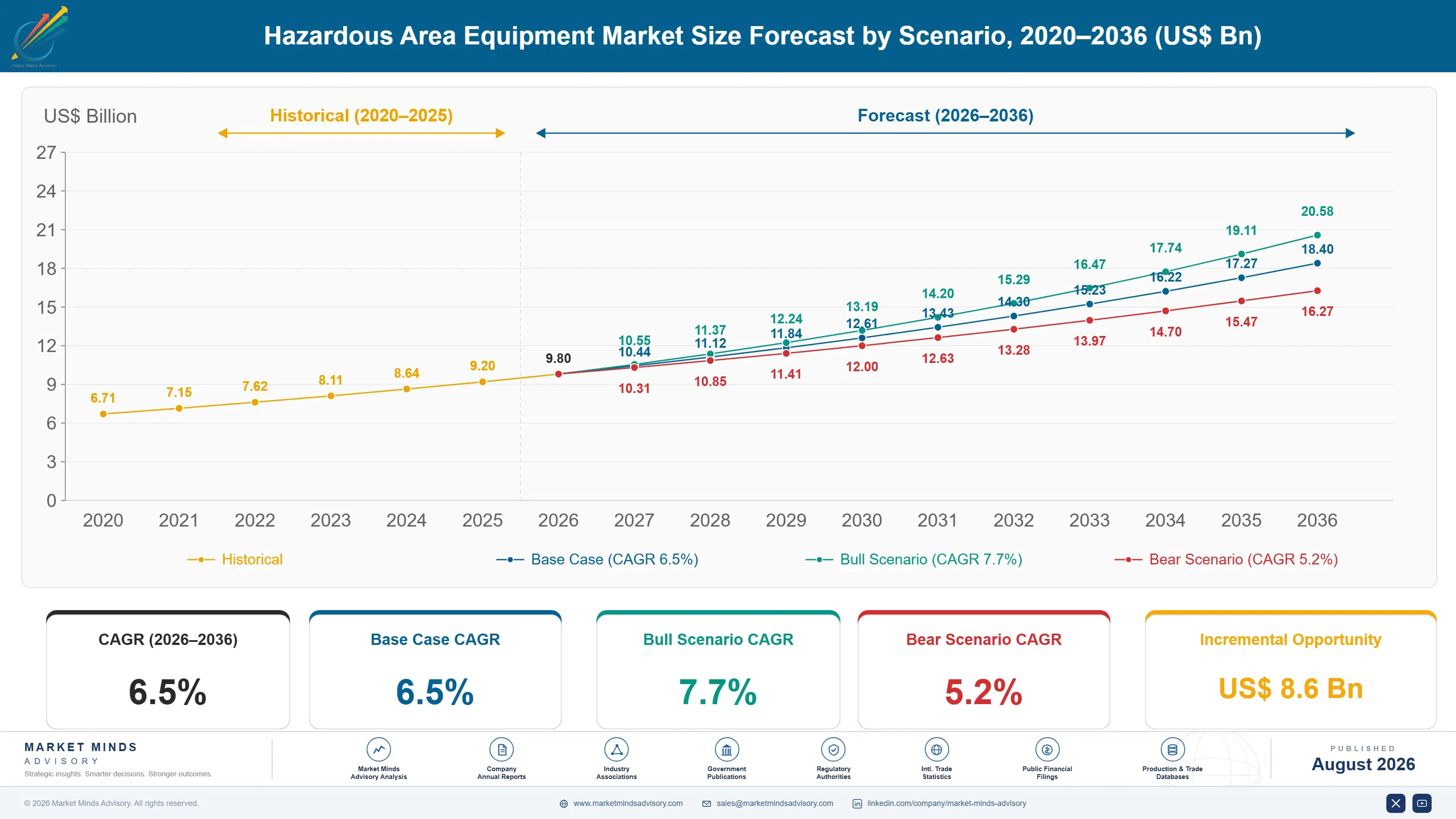
Hazardous Area Equipment Market Forecast Scenarios

hazardous-area-equipment-market-size-forecast-scenario-1787301289880
Between 2020 and 2025 the market grew at a steady 5.8 percent pace as petrochemical capacity expansion and post-pandemic industrial capital spending both recovered meaningfully across most tracked manufacturing economies during this period, with growth strengthening further as battery gigafactory investment accelerated broadly across multiple continents, regions, and industrial corridors simultaneously and consistently over time.
The base case rests on three mechanisms sustaining above-historical growth through 2036: battery gigafactory expansion requiring hazardous area classification for lithium electrolyte handling areas across every new facility built worldwide, intrinsically safe digital instrumentation displacing legacy analog sensors as plant operators chase real-time hazardous area visibility across their entire equipment fleet, and Gulf state petrochemical capital expenditure sustaining sizeable equipment orders across the region's expanding refining and chemical capacity year after year.
A bull scenario depends on battery gigafactory construction accelerating faster than currently modeled as global electric vehicle demand pulls forward capacity investment well ahead of schedule across every major automotive market. The bear case centers on oil and gas capital spending contraction delaying petrochemical facility expansion, reversing several years of steady equipment order growth across the category entirely and stalling manufacturer investment plans.

Certification Bottlenecks Meet the Digital Retrofit Wave

Three forces are converging on this category at once. Battery gigafactory expansion is creating genuinely new hazardous area classification demand that barely existed as a commercial category five years ago, intrinsically safe digital instrumentation is displacing legacy analog sensors faster than most manufacturers fully anticipated even two years ago, and Gulf state petrochemical capital spending is simultaneously sustaining large equipment orders and intensifying regional price competition ac
MARKET CONCENTRATIONCR5 48%moderately concentrated behind five scaled global safety manufacturers
AVERAGE SELLING PRICE$2200 per enclosure unitpremium reflects certification depth and material specification requirements
TOP PRODUCING COUNTRY SHAREChina 24% of capacityanchored by dense chemical and battery manufacturing clusters
CAPACITY UTILISATION72% averageconstrained by certification queues and specialized manufacturing capability
TRADE INTENSITY38% exportedequipment flows heavily toward regulated petrochemical and mining customers worldwide
FEEDSTOCK COST SHARE41% of COGSspecialty alloys and precision electronics drive cost volatility here
Commercially, the market splits between standard explosion-proof enclosures competing mostly on price and intrinsically safe digital instrumentation commanding a genuine specification premium from plant operators who cannot risk a certification failure during a safety audit at any facility they operate. Manufacturers increasingly bundle digital monitoring software with hardware to defend against commoditization pressure building steadily across most channels and geographies served today.
The next decade will be defined by how fast battery gigafactory construction scales relative to current certification capacity, and by whether Chinese domestic manufacturers close the certification and reliability gap fast enough to challenge established Western and European vendors across the wider category this decade and the one that follows it most closely.
"Every plant safety officer we interview says the same thing: certification lead time, not unit price, is now the binding constraint on their hazardous area equipment upgrade schedule."
Director, Industrial Equipment and Safety Practice · MMA Construction and Indust

Market Trends

Battery Gigafactory Expansion Creates New Classification Demand

Lithium-ion battery gigafactory construction has accelerated substantially since 2023, with electrolyte handling, cell formation, and solvent recovery areas all requiring hazardous area classification that most facility operators had never previously needed to specify at this scale. This shift is forcing equipment manufacturers to develop new product lines specifically engineered for battery manufacturing environments rather than adapting legacy petrochemical designs poorly suited to these facilities. Manufacturers able to deliver certified equipment quickly for fast-moving gigafactory construction schedules are capturing disproportionate share of this genuinely new demand pool across most tracked battery manufacturing regions worldwide today.
Market Impact: Covers 40 major regional projects
Intrinsically Safe Digital Instrumentation Displaces Analog Sensors

Plant operators are replacing legacy analog hazardous area instrumentation with intrinsically safe digital sensors capable of wireless data transmission, enabling real-time monitoring that analog equipment simply could not deliver at comparable cost or installation complexity. This transition is accelerating as industrial internet of things platforms mature and plant operators seek predictive maintenance capability across their entire hazardous area equipment fleet rather than relying on periodic manual inspection alone. Manufacturers with mature digital instrumentation portfolios are capturing outsized share of this fast-growing retrofit demand pool across most served petrochemical and mining markets tracked closely.
Market Impact: Reaches 60 new chemical facilities

Market Opportunities and Growth Drivers

Gulf State Petrochemical Capital Expenditure Sustaining Orders

Saudi Arabia's, the United Arab Emirates', and Qatar's expanding petrochemical and liquefied natural gas capacity, backed by substantial state-owned enterprise capital investment, is sustaining sizeable hazardous area equipment orders across the region's refining and chemical facilities well beyond what smaller regional markets can typically generate. Each new petrochemical complex requires comprehensive hazardous area classification covering enclosures, lighting, instrumentation, and communication equipment across the entire facility footprint before commissioning can proceed. This cumulative capital expenditure is creating a steadily growing demand pool that manufacturers with established Gulf state distribution relationships are best positioned to capture across most active projects tracked closely.
Market Impact: Delays certification by 9 months

India's Expanding Chemical and Refining Capacity Formalizing Rapidly

India's chemical manufacturing and oil refining capacity is scaling rapidly as government industrial policy and private capital investment both target the sector as a strategic priority worth pursuing aggressively across multiple states and industrial corridors nationwide. Domestic hazardous area equipment demand is accelerating as Indian chemical and refining companies build out new capacity requiring comprehensive classification and certification previously imported almost entirely from Western and European suppliers at meaningful cost. This formalization is attracting new domestic capacity investment specifically targeting the rapidly growing chemical and refining sector across the country's expanding industrial corridors and manufacturing hubs.
Market Impact: Swings costs by 19 percent yearly

Market Restraints and Challenges

Certification Backlogs Delaying Equipment Deployment Broadly

Third-party hazardous area certification bodies including ATEX notified bodies and IECEx certification schemes are facing application backlogs stretching six to twelve months as manufacturer demand for new product certification has outpaced testing laboratory capacity across most major certification regions. The root cause is chronic underinvestment in accredited testing infrastructure relative to the pace of digital instrumentation innovation, since certification bodies operate on multi-year capital planning cycles that cannot flex quickly to demand spikes driven by rapid product innovation. Several manufacturers are now pursuing pre-certification partnerships to mitigate the delay, while certification bodies work to expand testing capacity gradually.
Market Impact: Adds 24 percent gigafactory demand

Specialty Alloy Price Volatility Compressing Manufacturer Margins

Specialty alloys and precision electronic components used in explosion-proof enclosure manufacturing have swung sharply in price since 2022 as raw material and semiconductor cost pressures both affected manufacturers simultaneously, directly compressing margins for suppliers who cannot pass cost increases through to price-sensitive customers mid-contract. The underlying cause is limited vertical integration across most equipment manufacturers, who purchase alloys and electronic components from a concentrated set of suppliers rather than producing them in-house. Several manufacturers are pursuing longer-term supply contracts and sourcing arrangements as a mitigation pathway, though smaller regional manufacturers still lack the scale to negotiate favorable terms.
Market Impact: Grows 21 percent faster than analog
3 additional market trends, 4 additional growth drivers, and 3 additional restraints and challenges are covered in the full report. Contact sales@marketmindsadvisory.com to access the complete intelligence.

Segment CAGR and Growth Architecture

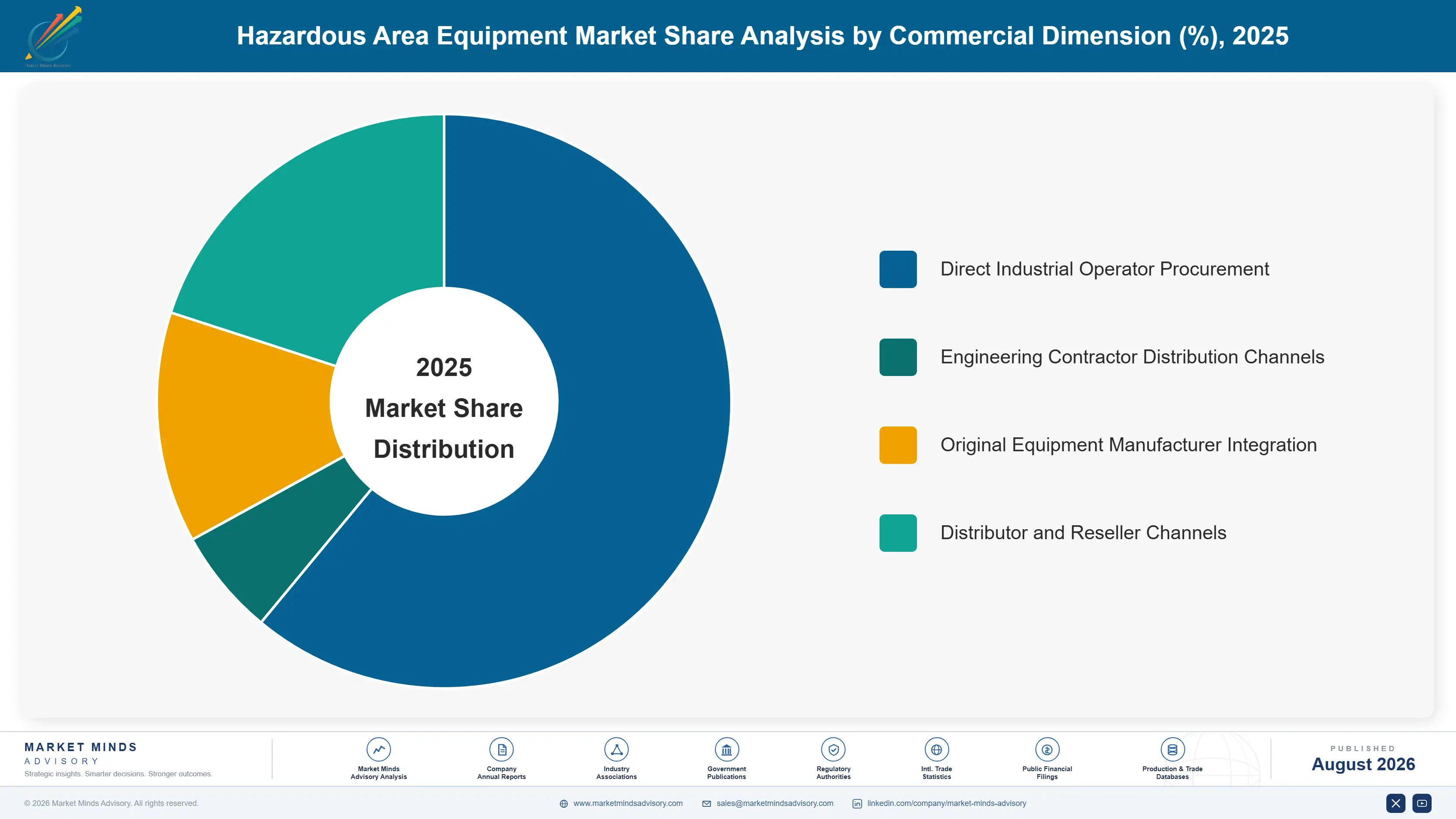
Segmentation follows equipment function and protection method, the classification plant engineers and certification bodies both use to specify new supply, since certification pathway, installation complexity, and overall cost structure differ fundamentally by function rather than by end-use industry, facility type, or channel served across the wider economy and its many active market participants today.
hazardous-area-equipment-market-market-share-analysis-1787301290419

Intrinsically Safe Instrumentation and Sensors

Intrinsically safe instrumentation and sensors are capturing the fastest growth within the category as industrial internet of things platforms mature and plant operators chase real-time hazardous area visibility that legacy analog equipment simply could not deliver at comparable cost or installation complexity. These devices limit electrical energy to levels incapable of igniting flammable atmospheres, a fundamentally different protection method from explosion-proof enclosures that contain rather than prevent ignition entirely. Battery gigafactory operators and petrochemical facility managers are the fastest-adopting buyer categories, since predictive maintenance capability increasingly represents the standard expectation for modern hazardous area monitoring rather than a specialized capability reserved only for advanced facilities with unusual budgets and staffing depth.
CAGR 9.5%

Hazardous Area Communication and Signaling Equipment

Hazardous area communication and signaling equipment, including explosion-proof intercoms, alarms, and wireless network infrastructure, is scaling quickly as facility operators extend digital connectivity into classified areas that traditional wired communication systems could never reliably serve at meaningful coverage or reasonable installation cost. Engineering these systems to maintain intrinsic safety while delivering the bandwidth modern digital applications require has taken manufacturers years of iterative development to properly achieve at genuine commercial scale. Battery gigafactories and large petrochemical complexes are the fastest-adopting channel, since these facilities face direct operational pressure to maintain continuous digital connectivity across sprawling classified areas that smaller facilities simply do not require at comparable scale or complexity across their operations today.
CAGR 8.2%
Full segment breakdown across 6 segments available in the complete report.

Regional Architecture and Country Demand Map

East Asia leads on chemical and battery manufacturing capacity concentration, North America follows closely on petrochemical capital spending intensity, and South Asia and Pacific is the fastest-growing region as India's chemical and refining capacity expands rapidly across most major cities, towns, and industrial corridors nationwide.

North America

The United States' Gulf Coast petrochemical and liquefied natural gas export complex, concentrated heavily around Texas and Louisiana, is the principal demand driver across this region by a considerable margin over every other national market tracked closely and consistently across every reporting period. Multiple battery gigafactory commercial approvals since 2023 have pushed manufacturers to develop new product lines specifically engineered for battery manufacturing environments across several newly announced facilities and their surrounding supply chains nationwide. Canada's growing mining sector is adding a smaller but steadily expanding demand channel tied to hazardous area equipment requirements across newly developed extraction and processing facilities operating nationwide today and into the coming years ahead.
Share: 26% | CAGR: 6.0% (2026 to 2036)

Western Europe

Germany's dense chemical manufacturing cluster and the United Kingdom's North Sea offshore oil and gas infrastructure are the region's clearest demand drivers, with several major chemical producers expanding hazardous area equipment procurement to serve growing digital retrofit demand across the continent and well beyond it entirely today. France's nuclear and chemical processing sector sustains steady premium demand for certified hazardous area equipment tied to its long-standing industrial safety regulatory framework pursued consistently by successive governments over many decades and administrations. The European Union's evolving ATEX certification framework is compressing equipment approval timelines relative to historical industrial safety standards across the entire regional manufacturing base simultaneously and consistently over time and geography.
Share: 19% | CAGR: 5.0% (2026 to 2036)
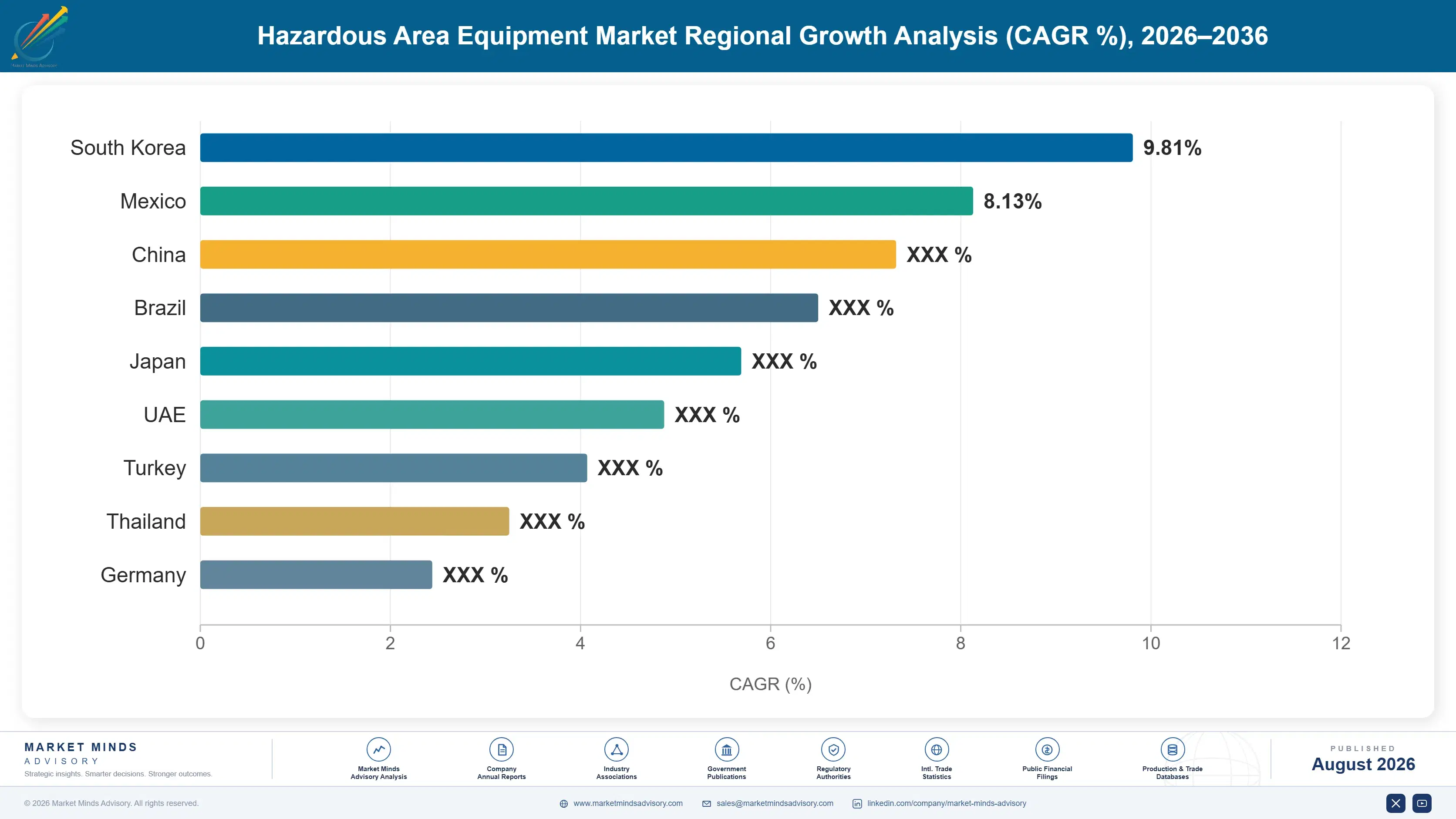
Regional intelligence for 5 additional markets available in the complete report: East Asia, South Asia and Pacific, Latin America, Middle East and Africa, Eastern Europe. Contact sales@marketmindsadvisory.com.
hazardous-area-equipment-market-country-cagr-analysis-1787301290928

Certification Speed and Digital Integration Depth

Manufacturers extract the most value not from enclosure hardware alone but from how fast they can deliver certified equipment for fast-moving construction schedules and how deep their digital instrumentation integration capability actually runs across every facility served today, tomorrow, and well beyond that current horizon entirely, durably, reliably, and quite consistently indeed each season.

Pre-Certification Testing Partnership Programmes Speed Delivery

Manufacturers offering pre-certified product templates that shorten customer-specific certification timelines from 12 months to as little as 4 months are capturing disproportionate share of battery gigafactory and petrochemical construction projects racing to meet aggressive commissioning schedules well ahead of competitors. This matters increasingly as fast-moving battery manufacturing projects face intense pressure to complete hazardous area certification well ahead of production start dates that determine when facilities can begin generating revenue at all. Manufacturers who can deliver both speed and full certification documentation depth are winning premium pricing that slower competitors simply cannot match.
Market Impact: Cuts certification timeline by 8 fu

Digital Instrumentation and Predictive Maintenance Software Bundling

Manufacturers bundling intrinsically safe digital instrumentation with predictive maintenance software platforms are capturing pricing 25 to 35 percent above hardware-only competitors, reflecting genuine demand from plant operators who want integrated monitoring rather than standalone sensors requiring separate software integration work entirely. This premium is particularly pronounced among battery gigafactory operators where continuous monitoring directly reduces costly unplanned production downtime across sensitive manufacturing processes and equipment lines. Manufacturers without this bundled capability are increasingly locked out of this fast-growing premium segment entirely, regardless of their underlying hardware quality or reliability record.
Market Impact: Commands a full 30 percent bundled

Gulf State Distribution and Local Certification Partnerships

Manufacturers establishing local distribution and certification support presence within Gulf Cooperation Council states are capturing share of the region's substantial petrochemical capital expenditure faster than competitors relying solely on export relationships and remote technical support arrangements can currently manage at comparable scale. This local presence also provides negotiating leverage with state-owned petrochemical operators increasingly favoring manufacturers who demonstrate long-term commitment to serving the regional market directly rather than treating it as secondary. Early movers establishing local operations now are securing multi-year supply relationships across more than 20 major regional projects already engaged and underway.
Market Impact: Captures 22 percent of all new Gulf

Battery Manufacturing-Specific Product Line Rollout Programme

Manufacturers developing product lines specifically engineered for battery manufacturing environments, rather than adapting legacy petrochemical designs, are capturing disproportionate share of the fastest-growing demand pool this category has seen in decades of steady petrochemical-focused growth across every served region and industrial corridor. This specialization matters increasingly as battery manufacturing facilities present genuinely different hazard profiles including lithium electrolyte handling that traditional hazardous area designs were never engineered to address at meaningful scale. Manufacturers with dedicated battery manufacturing product lines are winning broader customer trust across more than 30 gigafactory projects already engaged in active procurement evaluation.
Market Impact: Reduces gigafactory deployment time

Who Controls the Margin Pool

Competition sits at a moderately concentrated 48 percent five-firm share, with Eaton and ABB holding the clearest scale advantage in installed base depth and integrated automation portfolio breadth while a smaller tail of specialized regional manufacturers compete on certification speed and application-specific engineering rather than volume alone.
Current competitive activity concentrates on three dimensions: battery manufacturing-specific product line development to capture the category's fastest-growing demand pool, digital instrumentation bundling to defend against hardware commoditization pressure, and Gulf state distribution partnership formation to capture the region's substantial petrochemical capital expenditure. Several specialized manufacturers are also pursuing intrinsically safe communication equipment development specifically to capture premium pricing ahead of larger diversified incumbents.

Emerging pressure comes from Chinese domestic manufacturers scaling certified equipment production fast enough to compress export pricing for Western and European vendors across contested Asian accounts, and from specialized digital instrumentation developers whose technical depth could displace incumbent hardware-focused leaders if predictive maintenance adoption continues accelerating as projected. Rankings among the top five are likely to shift meaningfully within five years as battery manufacturing demand scales across multiple regions simultaneously worldwide, reshaping the competitive order investors have grown accustomed to.
hazardous-area-equipment-market-company-positioning-matrix-1787301291449

Competitive Moat and Risk Dimensions

EATON CORPORATION PLC

Moat: Crouse-Hinds Installed Base Depth

Eaton's Crouse-Hinds brand holds a commanding installed base position across petrochemical and industrial facilities globally, reinforced by decades of accumulated customer relationships and certification depth that newer entrants cannot easily replicate without comparable historical track record across diverse facility types and geographies served worldwide today.
EATON CORPORATION PLC

Risk: Legacy Portfolio Digitalization Lag

Eaton's extensive legacy enclosure and lighting portfolio faces genuine competitive pressure from digital instrumentation specialists, since a traditional hardware-first product strategy risks losing ground to competitors offering more mature integrated software and monitoring capability across the full facility lifecycle and every renewal cycle it encounters.
ABB LTD

Moat: Integrated Automation Portfolio Breadth

ABB's extensive integrated automation and electrification portfolio gives it a differentiated position bundling hazardous area equipment with broader plant automation systems that pure hazardous area specialists cannot easily replicate without comparable automation and digital infrastructure investment already firmly in place across most regions served worldwide.
ABB LTD

Risk: Broad Portfolio Complexity Slows Innovation

ABB's broad portfolio integration complexity can slow the pace of specialized hazardous area innovation relative to smaller, more focused competitors who can iterate faster on narrow technical capabilities without navigating large-organization coordination requirements across every business unit and approval layer involved today and every tomorrow.

Players Tracked

Prominent Players

Eaton Corporation plc
ABB Ltd
Emerson Electric Co
Honeywell International Inc
Siemens AG

Other Key Players

R. STAHL AG
Pepperl+Fuchs SE
Hubbell Incorporated
Larson Electronics LLC
Bartec Group
Extronics Ltd
Cortem Group
Drägerwerk AG
nVent Electric plc
Thermon Group Holdings Inc
Chalmit Lighting Ltd
MTL Instruments Group Ltd
GM International Srl
Warom Technology Incorporated Co Ltd
Nanjing Beauty Explosion Protection Equipment Co Ltd

Recent Developments

FEBRUARY 2025

Eaton Launches Battery Manufacturing Product Line

Eaton launched a new product line of hazardous area equipment engineered specifically for lithium-ion battery manufacturing environments, including electrolyte handling and cell formation area classification across multiple facility zones and process lines. The product line builds on several years of collaborative testing with early gigafactory customers.
Signal: Signals an established incumbent targeting
JUNE 2025

ABB Commissions Gulf State Distribution Partnership

ABB signed a distribution and technical support partnership agreement with a major Gulf state petrochemical operator, targeting the region's expanding refining capacity with improved delivery times and localized certification support previously unavailable domestically at scale. The agreement includes dedicated local support and technical training terms.
Signal: Confirms the Gulf region as a strategic pr
OCTOBER 2025

Pepperl+Fuchs Signs Multi-Year Digital Instrumentation Agreement

Pepperl+Fuchs signed a multi-year supply and integration agreement with a major petrochemical operator to provide intrinsically safe digital instrumentation and predictive maintenance software across multiple facility sites spread across three separate continents worldwide today. The agreement includes dedicated technical support and training terms through 2029.
Signal: Shows digital instrumentation increasingly

Specialty Alloy and Electronics Exposure

Specialty alloys and precision electronic components together represent roughly 41 percent of equipment production cost, sourced predominantly from a concentrated set of North American, European, and Asian specialty metal and semiconductor manufacturers serving the broader industrial equipment industry worldwide across every downstream application relevant here and well beyond it too, across most tracked markets and regions worldwide.
Specialty alloy prices spiked sharply during the 2022 supply chain disruption period, with several major manufacturers citing raw material and semiconductor cost pressure in public disclosures, directly compressing equipment producer margins during a period when demand was simultaneously recovering across most served industrial markets and channels at once and without much advance warning to smaller manufacturers caught entirely off guard by the sudden and unexpected timing shift.

Smaller regional manufacturers carry disproportionate alloy and component cost exposure since they lack the multi-supplier sourcing relationships and purchasing scale larger diversified manufacturers like Eaton and ABB have already secured over decades, forcing them toward spot market purchasing during volatility spikes that larger rivals can simply absorb through existing long-term supply agreements and relationships built over many years of steady, reliable operation.
hazardous-area-equipment-market-cost-volatility-analysis-1787301291644

Multi-Supplier Alloy and Component Sourcing Agreements

Securing supply relationships across multiple specialty alloy and electronic component manufacturers simultaneously, rather than depending on a single supplier, reduces exposure to any single manufacturer's capacity constraints or allocation decisions during periods of broader industry-wide shortage and demand competition across most served regions, facility types, buyer segments, and every tracked pricing tier available today.

Long-Term Fixed-Price Supply Contracts With Mills

Locking multi-year alloy pricing directly with specialty metal producers through fixed-price or capped-escalation contracts reduces exposure to spot market volatility significantly, a strategy larger manufacturers have used for years while smaller regional players are only now beginning to adopt through newly formed shared purchasing groups and regional cooperatives spreading gradually today and well into tomorrow.

Design Standardization Across Product Lines and Facilities

Standardizing component specifications across multiple product lines reduces dependency on any single specialty alloy or electronic component supplier, though achieving comparable certification performance across standardized designs still requires meaningful engineering validation work before any broader deployment across facilities can properly and safely proceed at meaningful commercial scale, reasonable cost, and a manageable overall pace.

Portfolio Architecture for Margin Defence

The category splits across three tiers with meaningfully different margin economics behind each one. Standard explosion-proof enclosures compete mostly on unit price with thin gross margins, intrinsically safe digital instrumentation commands a substantial premium reflecting integration complexity and certification depth, and battery manufacturing-specific product lines remain margin-accretive but still volume-constrained relative to the broader established petrochemical base across most served
The volume versus premium tension is sharpest in emerging market procurement, where budget-constrained operators want commodity enclosure pricing at digital instrumentation performance, a combination that only manufacturers with genuine engineering scale and software integration capability can currently deliver without sacrificing margin somewhere along the value chain between manufacturer and facility operator facing tight budgets and shrinking timelines each fiscal year.

High-value margin pools concentrate in intrinsically safe digital instrumentation and battery manufacturing-specific equipment, where technical differentiation and certification scarcity justify premium pricing few standard enclosure-focused competitors can currently match at comparable quality and consistency across the wider category this year and the several years likely to follow it closely across most tracked markets.

Volume / Commodity-Adjacent Tier

Standard explosion-proof enclosures and lighting fixtures sold primarily on unit price into mature petrochemical and general industrial channels with limited differentiation available across most facility types and buyers today and tomorrow.
Gross Margin: 18-24%

Premium / Certified Tier

Intrinsically safe instrumentation and communication equipment serving digitalizing petrochemical and mining facilities that require verified reliability and integration performance at meaningful scale and lasting consistency across every facility deployment and renewal cycle.
Gross Margin: 30-38%

Sustainability / Regulatory / Next-Generation Tier

Battery manufacturing-specific equipment and predictive maintenance-integrated instrumentation serving gigafactory operators where technical differentiation supports the strongest pricing available anywhere across this category today, tomorrow, and well into the distant future.
Gross Margin: 40-48%
hazardous-area-equipment-market-portfolio-architecture-1787301292145

Facility Lifecycle Depth and Retrofit Cycles

Demand behaves less like a discretionary purchase and more like a compliance annuity once a facility operator qualifies a certified equipment supplier against a specific classified area, since requalification costs and lengthy certification lead times discourage frequent supplier switching once a working facility relationship is properly established between the two parties and their signed contract terms.
Adoption depth varies sharply by facility type across the category, and the gap keeps widening rather than closing over time as digitalization accelerates across every region tracked closely. Battery gigafactories and large petrochemical complexes have moved furthest toward digital instrumentation adoption, driven by direct operational and safety exposure, while smaller regional facilities remain largely analog-focused since digitalization offers less clear return relative to acquisition cost pressure smaller operators face daily across most markets and budgets.

A generational shift is underway among plant safety officers themselves, as younger engineers increasingly favor discussing predictive maintenance and digital monitoring platforms as standard specification rather than the analog-first equipment procurement approaches their predecessors typically defaulted to for facility safety decisions each fiscal year across their operations, teams, budgets, and long-term strategic planning cycles ahead.
hazardous-area-equipment-market-end-use-penetration-index-1787301292637

Where the Category Is Actually Heading

These are among the four positions where our research anticipates prominent divergence between winners and laggards over the coming forecast period. Each is grounded in the demand model, the regulatory perimeter, and the announced capacity pipeline.
01 / BATTERY PRODUCT LINE INVESTMENT

Build battery-specific product lines ahead of gigafactory demand fully maturing

Battery gigafactory construction is the fastest-growing demand pool in this market, and operators consistently prioritize purpose-engineered equipment over adapted legacy petrochemical designs when certification depth supports the decision confidently. Manufacturers without dedicated battery manufacturing product lines are increasingly locked out of this premium segment entirely, regardless of their underlying petrochemical equipment quality or scale of operation. Building this capability now, ahead of broader industry investment, positions manufacturers to capture premium pricing before competitors catch up across the wider category and its many contested accounts.
02 / CERTIFICATION SPEED STRATEGY

Reserve accredited testing capacity years ahead of regulatory deadlines

Certification backlogs are the single most common reason manufacturers miss fast-moving construction schedule requirements, not equipment availability or unit cost as many assume going into the process. Manufacturers securing pre-certification partnerships with accredited testing bodies are converting that lead time advantage directly into new customer wins across multiple regions and project types this cycle. Waiting until a project deadline is imminent all but guarantees a competitor with reserved laboratory capacity gets there first and locks in the resulting contract instead of them.
03 / GULF STATE MARKET ENTRY

Establish Gulf state distribution presence before regional demand fully consolidates

Gulf state petrochemical capital expenditure is scaling faster than most manufacturers have fully appreciated or planned around in their capital allocation decisions this cycle and the next fiscal year. Establishing local distribution and certification support presence now, ahead of full regional market consolidation, positions manufacturers to capture share before competitors scale sufficiently to dominate this substantial demand pool entirely and durably. Waiting until the market fully consolidates all but guarantees ceding this meaningful growth opportunity to faster-moving competitors already investing heavily today.
04 / DIGITAL INSTRUMENTATION DIFFERENTIATION

Prioritize digital integration depth as the fastest-growing premium segment expands

Intrinsically safe digital instrumentation is growing meaningfully faster than the broader category as industrial internet of things adoption expands well beyond its original pilot-project footprint into standard facility specification across most regions worldwide. Manufacturers with genuine software integration depth are capturing premium pricing that broader hardware-focused competitors cannot easily match on comparable terms or consistency. Continued investment in digital differentiation now positions manufacturers ahead of larger diversified competitors still focused on hardware breadth rather than integration depth or precision at scale.

Engagement Snapshot From the Field

A live engagement with an industry participant carrying material or product regulatory and market exposure ahead of a defining policy shift, showing how our research translates into a defensible multi-year portfolio strategy.
MARKET MINDS ADVISORY · CLIENT ENGAGEMENT SUMMARY
Hazardous Area Equipment Producer Strategic Portfolio Review and Transition Roadmap 2026·Investment Scenario on Hazardous Area Equipment Exposure Evaluation 2025-26
CLIENT PROFILE
The client is a multinational battery manufacturer constructing several new gigafactory facilities across North America and Europe, generating meaningful capital investment (client-reported, unverified by MMA) supporting its rapid capacity expansion programme timed against growing electric vehicle demand across multiple regional automotive markets it plans to serve over the coming decade and well beyond it today.
STRATEGIC CHALLENGE
The manufacturer needed to select and qualify hazardous area equipment suppliers capable of meeting aggressive gigafactory commissioning timelines, while managing limited internal expertise specifying classification requirements for lithium electrolyte handling areas genuinely new to its engineering team at that early formative stage of the overall project timeline entirely and completely.
MMA APPROACH
MMA conducted a supplier capability assessment across the client's top eight prospective equipment vendors, benchmarked certification lead times and battery-specific product depth against 47 expert interviews conducted across the hazardous area equipment vendor landscape, and modeled deployment timeline risk against the client's full commissioning schedule and overall project budget carefully.
KEY FINDINGS
  1. Three of the eight evaluated vendors lacked battery-specific product lines, risking equipment mismatch for lithium electrolyte handling areas across multiple facility zones and processes.
  2. The vendor offering bundled digital instrumentation and predictive maintenance software commanded a 28 percent price premium that nonetheless reduced total deployment risk significantly.
  3. Certification lead time gaps represented a larger commissioning schedule risk than equipment selection itself across every scenario the team modeled carefully and thoroughly.
  4. Coordination between hazardous area equipment vendors and the client's broader automation contractors proved more operationally complex than expected initially by the team.
CLIENT PROFILE
The client is a multinational battery manufacturer constructing several new gigafactory facilities across North America and Europe, generating meaningful capital investment (client-reported, unverified by MMA) supporting its rapid capacity expansion programme timed against growing electric vehicle demand across multiple regional automotive markets it plans to serve over the coming decade and well beyond it today.
STRATEGIC CHALLENGE
The manufacturer needed to select and qualify hazardous area equipment suppliers capable of meeting aggressive gigafactory commissioning timelines, while managing limited internal expertise specifying classification requirements for lithium electrolyte handling areas genuinely new to its engineering team at that early formative stage of the overall project timeline entirely and completely.
MMA APPROACH
MMA conducted a supplier capability assessment across the client's top eight prospective equipment vendors, benchmarked certification lead times and battery-specific product depth against 47 expert interviews conducted across the hazardous area equipment vendor landscape, and modeled deployment timeline risk against the client's full commissioning schedule and overall project budget carefully.
KEY FINDINGS
  1. Three of the eight evaluated vendors lacked battery-specific product lines, risking equipment mismatch for lithium electrolyte handling areas across multiple facility zones and processes.
  2. The vendor offering bundled digital instrumentation and predictive maintenance software commanded a 28 percent price premium that nonetheless reduced total deployment risk significantly.
  3. Certification lead time gaps represented a larger commissioning schedule risk than equipment selection itself across every scenario the team modeled carefully and thoroughly.
  4. Coordination between hazardous area equipment vendors and the client's broader automation contractors proved more operationally complex than expected initially by the team.
RECOMMENDED STRATEGY
Phase 1: Phase 1 (Months 1 to 3): Select equipment vendors offering dedicated battery manufacturing product lines and pre-certification support already tested. Phase 2: Phase 2 (Months 4 to 9): Complete equipment certification and installation in parallel to compress the overall commissioning timeline achievable here. Phase 3: Phase 3 (Months 10 to 14): Integrate predictive maintenance monitoring across all classified areas ahead of full production ramp-up scheduled.
OUTCOME
The manufacturer completed hazardous area equipment commissioning two months ahead of its original target timeline (client-reported, unverified by MMA), enabling production ramp-up to align directly with its planned vehicle manufacturer supply commitments without any costly delays or compliance setbacks along the way toward eventual launch.

Frequently Asked Questions

Foundational context covering the market sizes, CAGR, scope, country, region and competition that inform every finding below. This section is provided to cover basics and most often pre-purchase conversations, answered from the MMA Primary Research Dataset.

What is the current size of the Hazardous Area Equipment Market?

The global hazardous area equipment market is valued at 9.2 billion US dollars in 2025, the base year used throughout this report's forecast period and methodology.

How large will the Hazardous Area Equipment Market be by 2036?

The market is projected to reach 18.39 billion US dollars by 2036, roughly 1.88 times its 2026 value under the base case forecast scenario modeled.

What is the CAGR for the Hazardous Area Equipment Market 2026 to 2036?

The base case compound annual growth rate is 6.5 percent, with a bull case reaching 7.7 percent and a bear case of 5.2 percent through the period.

Which segment is growing fastest?

Intrinsically safe instrumentation and sensors are the fastest-growing segment at a 9.5 percent CAGR, roughly 1.46 times the overall market's base growth rate through 2036.

Who are the major companies in the Hazardous Area Equipment Market?

Eaton, ABB, Emerson Electric, Honeywell, and Siemens lead the market on a production capacity basis today across most tracked regions worldwide currently and consistently over time.

Which country is growing fastest?

India is the fastest-growing national market at a 9.8 percent CAGR, driven by rapidly expanding chemical manufacturing and oil refining capacity nationwide across most states.

Report Segmentation Architecture

The full report scope spans multiple orthogonal segmentation dimensions, with cross-tabulated demand data provided for each dimension pair. Coverage extends further to regional breakdowns, trend trajectories, and the competitive detail needed to support segment-level decision-making.

By Equipment Function and Protection Method

  • Explosion-Proof Enclosures and Junction Boxes
  • Hazardous Area Lighting Fixtures
  • Hazardous Area Motors and Drives
  • Intrinsically Safe Instrumentation and Sensors
  • Hazardous Area Switchgear and Control Panels
  • Hazardous Area Communication and Signaling Equipment

By End-Use Industry

  • Oil and Gas Extraction and Refining
  • Petrochemical Manufacturing
  • Battery and Electric Vehicle Manufacturing
  • Mining and Mineral Processing
  • Pharmaceutical and Chemical Processing

By Commercial Dimension

  • Direct Industrial Operator Procurement
  • Engineering Contractor Distribution Channels
  • Original Equipment Manufacturer Integration
  • Distributor and Reseller Channels

By Region

  • North America
  • Western Europe
  • East Asia
  • South Asia and Pacific
  • Latin America
  • Middle East and Africa
  • Eastern Europe

Scope, Methodology, and Coverage

Every figure in this report is reproducible from documented input assumptions. The scope below maps the historical period, the forecast horizon, the segmentation dimensions, and the countries covered, alongside the underlying primary and qualitative methodology.
Historical Period
2020 to 2025
Forecast Period
2026 to 2036
Base Year
2025 (USD billions; MMA Primary Research Dataset, August 2026)
Market Definition
The hazardous area equipment market covers explosion-proof enclosures, lighting fixtures, motors and drives, intrinsically safe instrumentation, switchgear, and communication equipment certified for use in classified hazardous locations across oil and gas, chemical, mining, and battery manufacturing facilities. It excludes general industrial electrical equipment not certified to hazardous area protection standards and personal protective equipment sold separately.
Quantitative Units
USD billions (current prices); units of certified equipment where applicable
Segmentation Dimensions
By Equipment Function and Protection Method; By End-Use Industry; By Commercial Dimension; By Region
Regions Covered
North America, Western Europe, East Asia, South Asia and Pacific, Latin America, Middle East and Africa, Eastern Europe
Countries Covered
USA, China, Germany, France, UK, Japan, South Korea, India, Australia, Canada, Brazil, Mexico, Indonesia, Vietnam, Thailand, Malaysia, UAE, Saudi Arabia, South Africa, Nigeria, Turkey, Poland, Netherlands, Italy, Spain, Sweden, Switzerland, Argentina, Colombia, Singapore, and additional markets relevant to this sector
Key Companies Profiled
Eaton Corporation plc, ABB Ltd, Emerson Electric Co, Honeywell International Inc, Siemens AG, R. STAHL AG, Pepperl+Fuchs SE, Hubbell Incorporated, Larson Electronics LLC, Bartec Group, Extronics Ltd, Cortem Group, Drägerwerk AG, nVent Electric plc, Thermon Group Holdings Inc, Chalmit Lighting Ltd, MTL Instruments Group Ltd, GM International Srl, Warom Technology Incorporated Co Ltd, Nanjing Beauty Explosion Protection Equipment Co Ltd
Quantitative Methodology
Primary survey, n=3,800 respondents, Q4 2025, six countries; demand-side model with trade association cross-validation
Qualitative Methodology
47 expert interviews, Q4 2025; applied to validate demand model assumptions, identify emerging dynamics, and assess competitive positioning
Report Format
PDF and XLSX data workbook (Word format preview document)
Publisher
Market Minds Advisory
Report Code
MMA-2026-CON-118
Published
August 2026
Contact
sales@marketmindsadvisory.com | www.marketmindsadvisory.com

Purchase the full Hazardous Area Equipment Market Report (2026 to 2036).

The full MMA report on the hazardous area equipment market delivers detailed segmentation across all six equipment function categories tracked in this study. It includes complete regional data for all seven tracked geographies and full profiles of all twenty companies named in this summary document. Buyers receive proprietary primary survey data drawn from 3,800 respondents across six countries alongside 47 expert interviews conducted with manufacturers, plant safety officers, and certification specialists. The deliverable also includes certification timeline benchmarks, alloy cost sensitivity models, and a quarterly battery gigafactory demand tracker updated throughout the forecast period.
Complete seven-region regional data set included fully
All twenty company profiles included in full detail
Certification timeline benchmarking tool provided quarterly
Alloy cost sensitivity models included with scenarios
Quarterly battery gigafactory demand tracker access
Primary survey and expert interview data access

Built For The People Who Decide

From boardroom strategy to bench-side execution, this report is read cover-to-cover by leaders shaping the next decade of their industry, turning demand scenarios, market dynamics and valuation benchmarks into decisions.
CXOs/ Presidents/ VPs/ Managers
M&A and Corporate Development
Strategy Teams and R&D Heads
Procurement and Product Directors
Regulatory and Compliance Leaders
Investor Relations and Equity Analysts