Market Minds Advisory
Harsh Environments Fiber Optic Market

Harsh Environments Fiber Optic Market: Harsh Environments Fiber Optic Market: Component Classes, Failure Mechanisms and Qualification Economics 2026 to 2036

Glass fibre carries light beautifully until you put it down an oil well at 300 degrees, inside a reactor, or in orbit. Then it darkens, cracks and stops working, which is a market.

Lead Analyst

Published

September 2026

Make Smarter Decisions with Customized Research Insights

Request a free sample report and evaluate market opportunities, growth trends, and competitive dynamics relevant to your business needs.

2025 MARKET VALUE$2.6BMarket Size 2025
2036 FORECAST VALUE$6.4BBase Case , 2026 to 2036
CAGR 2026 TO 20368.6 %Bull 9.8% / Bear 7.4%
INCREMENTAL OPPORTUNITY$3.6BNet 10- year value creation
EXPANSION MULTIPLE2.28x2036 value over 2026 base
Strategic Levers
M&A Pipeline
Regional Outlook
Country Rankings
Competitive Intelligence
Segmental Deep-dive
Call-Us : 91 93563 13602

Executive Snapshot and Market Trajectory.

Ordinary optical fibre is a manufacturing marvel that fails quickly in any environment worth instrumenting. Heat degrades the coating. Radiation darkens the glass. Hydrogen diffuses in and attenuates the signal. Everything in this market exists to postpone one of those three failures for as long as a customer needs.
The market reaches USD 2.82 billion in 2026 and USD 6.43 billion by 2036, a 2.28 times expansion at 8.6%. Radiation-hardened optical fibre grows at 12.9%, half again the market rate of 8.6%, on satellite constellation volume and fusion programme instrumentation together. North America holds 30% of consumption on defence, space and oilfield services concentration, while China grows fastest at 11.8% on reactor construction and its own space programme. Nobody else comes close on either.
Five suppliers hold 64% of harsh environment product line revenue, concentrated because specialty fibre drawing capacity is expensive and the qualification cycles run 24 months. Corning and OFS Fitel lead on manufacturing scale. Exail and Fibercore hold positions in radiation-hardened and sensing fibre that scale alone does not threaten. Product qualified into a nuclear or aerospace programme is effectively unreplaceable for that programme's life.
Market Definition
This report covers optical fibre, cable and interconnect hardware engineered to survive conditions that destroy standard telecommunications products: radiation-hardened fibre, high-temperature coated fibre, ruggedised cable assemblies, harsh environment optical connectors, armoured downhole and subsea cable, and sealed splice and termination enclosures. It excludes standard telecommunications fibre and cable, interrogator instruments and sensing electronics, submarine trunk cable systems, and the optical transceivers those systems connect to.
Base Year Value
$2.6B in 2025 (MMA Primary Research Dataset, September 2026)
Forecast Period
2026 to 2036, eleven discrete annual values
CAGR
8.6% base case. Bull 9.8%. Bear 7.4%.
Fastest Growth Segment
Radiation-Hardened Optical Fibre: 12.9% CAGR
Fastest Growth Country
China: 11.8% CAGR
Fastest Growth Region
South Asia and Pacific: 10.6% CAGR
Largest Region
North America: 30% of 2025 global value
Market Leaders
Corning, OFS Fitel, Sumitomo Electric Industries, Exail and Fujikura lead on harsh environment product line revenue. Source: MMA Analysis.
Primary Survey
n=3,800 procurement and R&D decision-makers, Q4 2025, six countries
Methodology
Demand-side build-up, cross-validated against public data, 47 expert interviews

Harsh Environments Fiber Optic Market Forecast Scenarios

harsh-environments-fiber-optic-market-size-forecast-scenario-1788503719683
Between 2020 and 2025 the category compounded at 7.4% and oil and gas set the rhythm, as it had for two decades. The 2020 price collapse stopped downhole sensing installations almost completely, and the recovery through 2022 and 2023 restored them. What changed underneath was that satellite constellations and fusion programmes started buying radiation-hardened fibre in quantities nobody had modelled.
The base case holds 8.6% on three mechanisms. Satellite constellation launch volume keeps rising and every spacecraft carries fibre that must survive total ionising dose without darkening, which is why radiation-hardened product compounds at 12.9%. Nuclear construction and fusion instrumentation add a second demand source that behaves nothing like the oil price. And downhole distributed temperature sensing keeps expanding as operators instrument wells they previously ran blind, particularly across the Gulf. That diversification is new and it matters considerably.
The bull case at 9.8% assumes fusion programme construction accelerates, since instrumentation inside a tokamak requires fibre qualified to dose levels almost nothing else meets. The bear case at 7.4% is another oil price collapse: downhole remains the largest single application and a repeat of 2020 removes those installations for two years, as it did last time.

Three Ways Glass Fibre Fails

Standard optical fibre is coated in acrylate, which softens around 85 degrees and stops protecting the glass. Polyimide coating takes it to 300. Gold coating takes it to 700 and costs accordingly. That single material decision, made at the drawing tower, determines whether a fibre can go down a geothermal well or must stay in a telecommunications duct, and it is why this market prices at 40 times commodity fibre without anybody complaining much.
TOP FIVE CONCENTRATION64%Concentrated by specialty optical fibre manufacturing capacity worldwide
PEAK OPERATING TEMPERATURE700 degreesContinuous rating for gold coated downhole sensing fibre
RADIATION DOSE TOLERANCE1 MGyTotal ionising dose survived by radiation hardened fibre
QUALIFICATION LEAD TIME24 monthsSpecification to qualified supply on aerospace and nuclear programmes
PRICE VERSUS STANDARD FIBRE40 timesPremium over commodity single mode telecommunications fibre pricing
DOWNHOLE DEPLOYMENT DEPTH8000 metresMaximum depth for installed distributed temperature sensing arrays
Radiation is a different failure entirely. Ionising dose creates colour centres in the glass that absorb the light the fibre is supposed to carry, and attenuation rises until the link fails. Pure silica core designs with controlled dopant chemistry resist it, which is why satellite, nuclear and fusion programmes specify particular fibre from particular suppliers and will not accept a substitute at any price. Qualification takes 24 months.
Hydrogen is the failure nobody outside the industry has heard of. Downhole environments contain hydrogen that diffuses into the glass and creates absorption peaks that ruin a distributed temperature measurement over months rather than years. Carbon hermetic coatings block it, imperfectly and expensively, and the residual darkening rate is the number every oilfield customer actually negotiates about.
"Customers in this market do not buy fibre, they buy a survival guarantee with a number of years attached to it. That is why the qualification takes two years and why nobody switches supplier afterwards, however attractive the alternative pricing looks on a spreadsheet."
Director, Specialty Optical Materials Practice · MMA Technology Practice · September 2026

Market Trends

Satellite Constellation Volume Reshapes Radiation-Hardened Fibre Demand

Spacecraft used to be built in small numbers by a handful of organisations that qualified every component exhaustively. Constellation programmes launch hundreds of satellites a year on production lines, and each one carries fibre for data handling and sensing that has to survive total ionising dose without darkening past specification. The volume changed the commercial logic entirely: a supplier can now amortise radiation-hardened development across a production run rather than a single programme. Radiation-hardened optical fibre compounds at 12.9% against 8.6% for the market, and space is most of the difference.
Market Impact: Sensing arrays reach 8000 metres

Fusion Programme Instrumentation Creates A New Demand Class

Instrumentation inside a fusion device faces neutron flux and gamma dose at levels that nothing in commercial nuclear power approaches. ITER, the American and Chinese programmes and several private ventures all need diagnostic fibre that survives those conditions long enough to be useful, and the qualification work is being done now rather than later. The volumes are small and the specifications are the most demanding anywhere in the category, which suits suppliers holding radiation-hardened capability and excludes everybody else entirely. This demand behaves nothing like the oil price cycle that historically set the rhythm here.
Market Impact: Qualification runs 24 months minimum

Market Opportunities and Growth Drivers

Downhole Sensing Instruments Wells Operators Previously Ran Blind

A producing well used to be measured at the wellhead and inferred everywhere else. Distributed temperature and acoustic sensing along a fibre installed to 8000 metres gives an operator a continuous profile of what every zone is doing, which changes injection decisions and identifies losses that were previously invisible. Gulf operators in Saudi Arabia, the United Arab Emirates and Kuwait have installed these systems at a scale nobody else approaches. The fibre must survive 300 degrees and hydrogen ingress for the well's life, because retrieving it costs more than the entire installation did.
Market Impact: 2020 removed orders for 2 years

Nuclear Construction And Life Extension Both Specify Fibre

Reactors under construction in China, India, Korea and increasingly Europe all specify optical instrumentation that copper cabling cannot provide inside containment, because fibre carries no current and generates no electromagnetic interference. Life extension programmes on existing plants replace ageing instrumentation with fibre for the same reasons, and those programmes are running across most of the world's operating fleet. Both markets demand radiation tolerance documented across the design life rather than merely demonstrated, which is a documentation burden that keeps the supplier list short. Qualification cycles run 24 months before any revenue appears at all.
Market Impact: Cycles run 24 months typically

Market Restraints and Challenges

Oil Price Cycles Still Set The Rhythm

Downhole applications remain the largest single demand source and they stop entirely when operators cut capital spending. The root cause is that instrumentation is discretionary in a way production is not: an operator can run a well blind and still sell the oil, so sensing is cut first. The 2020 collapse removed those orders almost completely for two years. Commercially this makes revenue forecasting difficult and inventory planning worse. Mitigation runs through the demand sources that ignore the oil price entirely, meaning space, nuclear and fusion, which is exactly what the leading suppliers have been building toward.
Market Impact: Radiation-hardened fibre compounds at 12.9%

Qualification Cycles Lock Programmes For Their Whole Life

Getting a fibre qualified into an aerospace, nuclear or downhole programme takes 24 months of radiation testing, thermal cycling, hydrogen exposure and documentation review. The root cause is that the failure mode appears years after installation, so customers test for it rather than trusting a datasheet, and retrieving a failed fibre from 8000 metres costs more than the installation. Commercially this makes displacement effectively impossible once a programme is running and makes each qualification extremely valuable. Mitigation for a challenger runs through the next programme rather than the current one, which requires funding two years of testing against no revenue.
Market Impact: Dose tolerance beyond 1 MGy
3 additional market trends, 4 additional growth drivers, and 2 additional restraints and challenges are covered in the full report. Contact sales@marketmindsadvisory.com to access the complete intelligence.

Segment CAGR and Growth Architecture

Segmentation follows component class, because coating chemistry, glass composition and mechanical construction determine what a product survives and what it earns. Six classes cover the market: radiation-hardened fibre, high-temperature coated fibre, ruggedised cable assemblies, harsh environment optical connectors, armoured downhole and subsea cable, and sealed splice and termination enclosures. End-use industry and channel are separate dimensions.
harsh-environments-fiber-optic-market-market-share-analysis-1788503720267

Radiation-Hardened Optical Fibre

Radiation-hardened fibre grows at 12.9%, half again the market rate of 8.6%, and two unrelated programmes are driving it. Satellite constellations launch hundreds of spacecraft a year on production lines, each carrying fibre that must survive total ionising dose without the glass darkening past specification. Fusion instrumentation demands dose tolerance beyond 1 MGy, which is a level almost nothing else in the category meets. The engineering sits in pure silica core design and controlled dopant chemistry rather than in any manufacturing advantage, and the suppliers holding that capability are the same three or four names on every programme. Qualification runs 24 months and nobody switches afterwards. That is an unusually durable commercial position.
CAGR 12.9%

High-Temperature Coated Optical Fibre

High-temperature coated fibre grows at 10.4% and the coating decision made at the drawing tower determines everything downstream. Acrylate softens near 85 degrees and stops protecting the glass. Polyimide reaches 300, which covers most downhole and industrial applications. Gold reaches 700 and costs accordingly, which limits it to geothermal, aerospace propulsion and the hottest sections of a production well. Carbon hermetic layers block hydrogen ingress imperfectly, and the residual darkening rate over the well's life is the specification oilfield customers actually negotiate on. Gulf operators buy more of this product than anybody, and they buy it on documented survival rather than on price. Very few drawing towers can apply gold coating at all.
CAGR 10.4%
Full segment breakdown across 6 segments available in the complete report.

Regional Architecture and Country Demand Map

North America leads at 30% on defence, space and oilfield services all sitting in one place. Middle East and Africa takes 7%, above the standard band, because Gulf downhole sensing deployment has no equivalent anywhere. East Asia follows closely on nuclear construction. No region is negligible in this market.

North America

North America holds 30% of consumption because defence, space and oilfield services all concentrate here and all three buy this product. Satellite constellation manufacturing in California and Washington drives radiation-hardened fibre volume, and the production line model changed how that demand behaves entirely. Permian Basin operators install distributed sensing at scale, though at shallower depths and lower temperatures than the Gulf. National laboratory and fusion programme work adds small volumes at the most demanding specifications anywhere. Growth at 8.0% sits below the global rate because the installed base is large and mature. Corning and OFS Fitel both manufacture domestically, which matters under defence procurement rules. That domestic manufacturing position is worth more than it looks.
Share: 30% | CAGR: 8.0% (2026 to 2036)

East Asia

Reactor construction accounts for the larger part of East Asia's 26%, and China is building more nuclear capacity than the rest of the world combined. Every one of those plants specifies optical instrumentation inside containment, where copper cannot go. Chinese space programme volume adds radiation-hardened demand that domestic suppliers are increasingly serving themselves. Japanese and Korean shipbuilding consumes ruggedised assemblies and armoured cable for marine and subsea applications at meaningful volume. Fujikura and Sumitomo both manufacture specialty fibre here. China grows at 11.8%, faster than any other country in this market, on reactor and space demand together rather than either alone. Domestic substitution is proceeding faster here than Western suppliers acknowledge.
Share: 26% | CAGR: 9.8% (2026 to 2036)
Regional intelligence for 5 additional markets available in the complete report: Western Europe, South Asia and Pacific, Latin America, Middle East and Africa, Eastern Europe. Contact sales@marketmindsadvisory.com.
harsh-environments-fiber-optic-market-country-cagr-analysis-1788503720825

Where This Business Earns Money

Nothing here sells on price. A customer buys documented survival over a stated design life, and the qualification that produces that document takes 24 months and costs money before any revenue arrives. What separates suppliers is which qualifications they funded, which demand sources they diversified into, and whether they got there before the programme started. The levers below address that.

Fund Radiation Qualification Ahead Of Programme Awards

Radiation-hardened fibre compounds at 12.9% against 8.6% for the market, and the qualification takes 24 months of dose testing, thermal cycling and documentation review. A supplier holding a completed qualification when a satellite constellation or fusion programme places its first order gets evaluated; one starting the work afterwards is compared against a competitor already approved and rarely wins. Because programmes run for a decade or more, missing the entry point means missing the whole thing. The cost is two years of testing against no revenue, which is why most competitors keep deferring it indefinitely.
Market Impact: Qualification must precede the full 24 month cycle

Diversify Away From The Oil Price Cycle

Downhole applications remain the largest single demand source and they stopped almost completely for two years after the 2020 collapse, because instrumentation is discretionary in a way production is not. Space, nuclear and fusion demand behaves nothing like that: launch cadence and reactor construction schedules ignore the oil price entirely. Suppliers who built radiation-hardened capability during the last downturn are the ones now taking 12.9% growth while their oil-weighted competitors wait for the next cycle. The cost is development spending during exactly the period when cash is tightest. Almost nobody funds it at the right time.
Market Impact: Oil exposure removed almost 2 years of revenue

Sell Documented Survival, Not Attenuation Specifications

An oilfield customer installing sensing fibre to 8000 metres cannot retrieve it, so what is being bought is a statement about how the product behaves in year eight rather than in the test report. Suppliers who publish measured darkening rates over long exposure, with the test conditions stated honestly, win against competitors quoting better initial attenuation figures. Saudi Aramco and the other Gulf operators specify exactly this and do not negotiate much on price. The requirement is long-duration testing that ties up equipment for years and produces data most suppliers would rather not publish.
Market Impact: Wells run to 8000 metres and stay unretrievable

Hold Coating Capability Rather Than Drawing Scale

Drawing towers are expensive and several suppliers have them. Applying gold coating in line at production quality is a much shorter list, and it is the capability that separates a supplier serving 300 degree applications from one serving 700 degree applications at several times the price. Carbon hermetic layers for hydrogen blocking sit in the same category. The investment is process development on equipment that already exists rather than new capital, which makes it unusually good value, and the resulting position is defended by know-how rather than by any patent that expires.
Market Impact: Gold coating reaches 700 degrees on continuous rating

Who Controls the Margin Pool

Five suppliers hold 64% of harsh environment product line revenue, concentrated because drawing capacity is expensive and qualification runs 24 months. Corning and OFS Fitel lead on manufacturing scale and domestic production that matters under defence procurement rules. Sumitomo and Fujikura hold strong positions across Asian nuclear and marine programmes. Exail sits fifth on radiation-hardened specialisation rather than volume. The gap between leader and fifth-placed supplier is wide on revenue, narrow on capability.
Competition runs on qualification portfolios rather than on price or product specification. A supplier approved on a nuclear or aerospace programme faces no competition for its life, so the contest happens years earlier at specification. Fibercore, Coherent and Luna Innovations all compete effectively against much larger firms on specific applications, because capability rather than scale decides who gets qualified. All participants are assessed on harsh environment product line revenue.

Rankings shift where new demand appears rather than where existing demand moves. Fusion instrumentation is the clearest example, and the suppliers qualifying now will hold those positions for decades. The other pressure is domestic substitution in China, where reactor and space programmes increasingly specify local suppliers and Western firms are losing access to the fastest growing country here.
harsh-environments-fiber-optic-market-company-positioning-matrix-1788503721365

Competitive Moat and Risk Dimensions

CORNING

Moat: Drawing Capacity And Scale

Corning operates specialty drawing capacity at a scale nobody else matches and manufactures domestically, which matters under American defence procurement rules that exclude foreign-made product from many programmes. That combination means the company can serve a constellation production line and a defence programme from the same operation. Competitors with better fibre designs frequently cannot supply the volumes those customers require.
CORNING

Risk: Specialist Capability Gaps

Scale does not qualify a fibre into a fusion diagnostic or a downhole array with documented eight year survival. Smaller specialists holding particular coating and dopant capabilities win those positions repeatedly, and once qualified hold them for the programme's life. The highest margin pools sit precisely where volume matters least, which is awkward for a scale manufacturer.
OFS FITEL

Moat: Qualification Portfolio Breadth

OFS Fitel holds approved positions across aerospace, downhole and nuclear programmes accumulated over decades, each effectively permanent for that programme's life because requalifying costs more than the fibre will. A competitor cannot buy that portfolio or shorten the 24 month cycle needed to build an equivalent. A large Japanese parent funds qualification spending that smaller specialists struggle to sustain.
OFS FITEL

Risk: Oil And Gas Weighting

A substantial part of the qualification portfolio sits in downhole applications, which is the demand source that stops entirely when operators cut capital spending. The 2020 collapse removed those orders for two years and it will happen again. Suppliers weighted toward space and fusion carry no equivalent exposure, and their revenue behaves quite differently through a cycle.

Players Tracked

Prominent Players

Corning
OFS Fitel
Sumitomo Electric Industries
Exail
Fujikura

Other Key Players

Coherent
Fibercore
j-fiber
YOFC
AFL
Amphenol
TE Connectivity
Glenair
Radiall
Diamond SA
Luna Innovations
Silixa
Prysmian
Nexans
Hengtong Optic-Electric

Recent Developments

FEBRUARY 2025

Exail Expands Radiation-Hardened Fibre Capacity For Space Programmes

Exail expanded its radiation-hardened optical fibre manufacturing capacity, an organic capital investment rather than an acquisition or joint venture. The expansion targets satellite constellation programmes buying in production-line quantities rather than the single-spacecraft volumes the company was built around, and it reflects a demand pattern that changed within five years.
Signal: Constellation volumes let suppliers amortise radiation qualification across production runs rather than across single programmes at all.
OCTOBER 2024

Corning Extends Specialty Fibre Line For Downhole Sensing

Corning extended its specialty optical fibre range with higher-temperature coated products aimed at downhole distributed sensing, an organic product development rather than any transaction. The extension targets Gulf operators installing sensing arrays at depths and temperatures that shorten the life of existing polyimide coated products considerably.
Signal: Gulf downhole conditions, rather than aerospace, now define the upper specification limit for this whole category.
JULY 2025

Sumitomo Supplies Optical Instrumentation Fibre For Asian Reactor Programme

Sumitomo Electric Industries won a supply award for optical instrumentation fibre on an Asian reactor construction programme. The award is a competitive supply decision rather than a partnership or equity arrangement, and it follows a qualification process running well over two years covering radiation tolerance across the plant design life.
Signal: Asian reactor construction is where nuclear qualification positions are being set for the next whole decade.

What Specialty Fibre Costs To Make

High-purity synthetic silica preform material accounts for roughly 34% of finished product cost, sourced from very few suppliers in Japan, Germany and the United States. Coating chemistry, meaning polyimide, carbon and gold precursors, adds about 19%, with gold pricing alone moving that figure noticeably. Drawing tower energy and yield loss contribute around 22%, and qualification testing amortisation carries most of the balance.
Corning Incorporated Annual Report 2024 records energy cost and raw material pressure across its optical communications operations, with manufacturing yield cited as a recurring variable. Furukawa Electric Annual Report 2024 notes comparable pressure on specialty product lines. The 2022 European energy crisis raised drawing tower operating cost sharply, and suppliers with European capacity carried that cost through a period when they could not raise qualified product prices at all.

The competitive disadvantage mechanism is qualified pricing rigidity rather than input cost itself. A fibre approved into a programme sells under an agreement fixing price for years, so a supplier facing an energy or gold increase absorbs it entirely. Suppliers with low-cost energy or hedged gold carry an advantage that never appears in any product comparison. Geography decides most of it, which is why European capacity became a liability.
harsh-environments-fiber-optic-market-cost-volatility-analysis-1788503721562

Hedge Gold And Precursor Chemistry Exposure Forward

Coating chemistry runs about 19% of finished cost and gold precursor pricing moves that figure noticeably on its own. Because qualified product sells under agreements fixing price for years, an unhedged supplier absorbs every increase directly into margin. Forward purchasing on the gold component alone removes most of that volatility, and the treasury capability required is modest against the exposure.

Build Price Escalation Into Qualification Agreements

Qualified product sells under long agreements that fix price, which leaves the supplier carrying every input cost movement. Negotiating an energy and metals escalation clause at the point of qualification is straightforward, because the customer has just spent 24 months approving the product and has no alternative. The same conversation three years later usually fails outright.

Site Drawing Capacity Where Energy Is Cheap

Drawing tower energy and yield loss run around 22% of finished cost, and the 2022 European crisis showed how quickly that becomes a disadvantage nobody can pass on. Siting new capacity where industrial power is cheap and stable is decided once and paid back over decades. The constraint is that qualified programmes often specify the site, so relocation triggers requalification.

Portfolio Architecture for Margin Defence

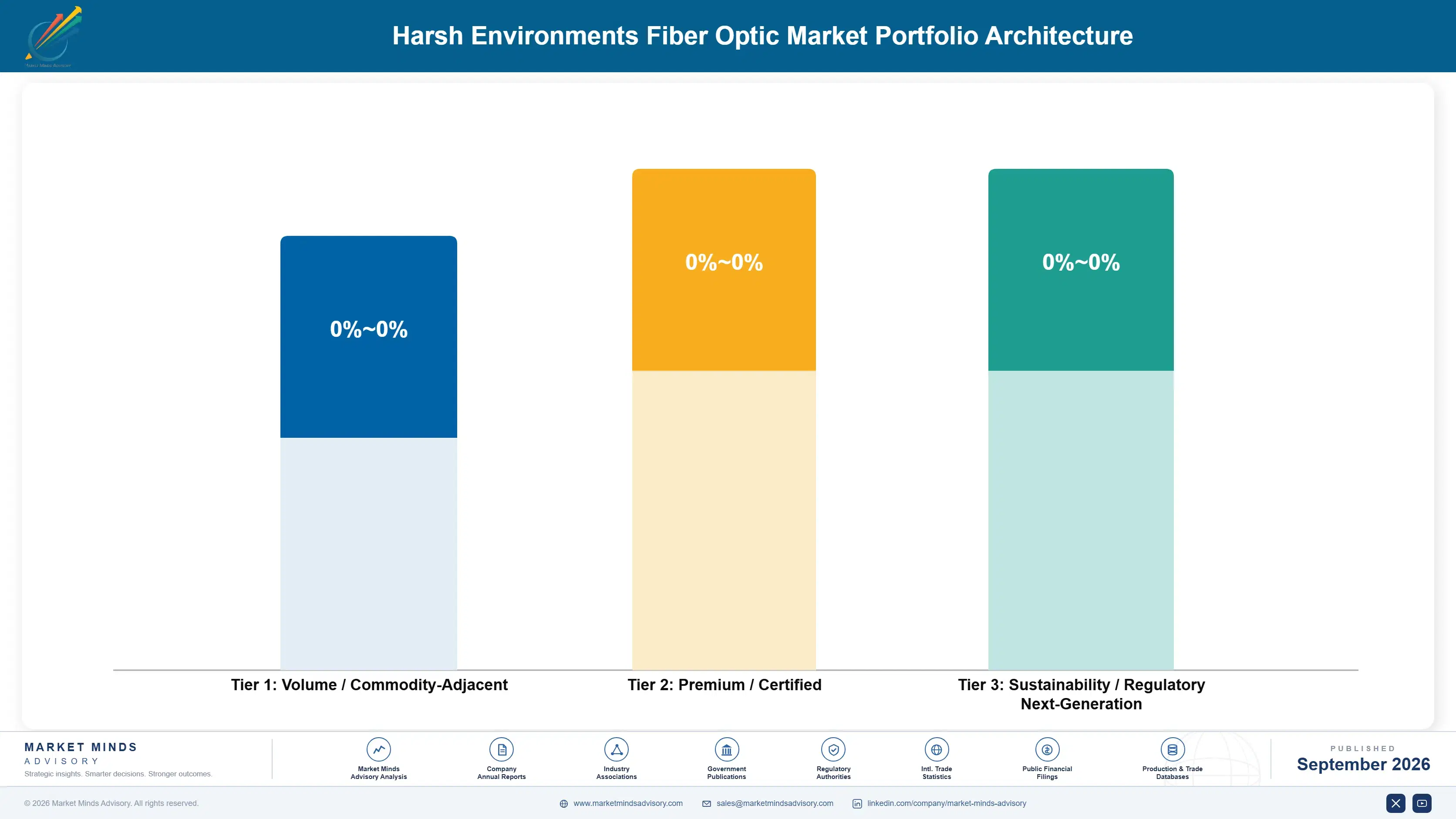
Margin architecture separates on qualification depth rather than on manufacturing difficulty. Sealed splice enclosures and armoured cable earn least, competed on price where the optical content is incidental. Ruggedised assemblies and harsh environment connectors sit in the middle, where certification supports pricing but several credible suppliers exist. Radiation-hardened and high-temperature coated fibre earn most, because a 24 month qualification and documented survival over a design life narrow the supplier list to very few names.
The volume versus premium tension is genuine here because the same drawing tower produces both. A supplier running commodity specialty fibre at volume fills capacity and earns little; one running radiation-hardened product earns several times as much on a fraction of the metres. Capacity allocation between them is an actual decision with real opportunity cost, unlike most component businesses where the premium product uses different equipment entirely.

High-value pools sit in radiation-hardened fibre for space and fusion and in gold-coated fibre for the hottest downhole and geothermal work. Both reward capability that cannot be bought quickly: dopant chemistry in one case, in-line coating process control in the other. Corning holds scale, OFS holds qualification breadth, and the specialists hold the highest margins on the smallest volumes.

Volume / Commodity-Adjacent

Sealed splice enclosures and armoured downhole and subsea cable, competed against industrial hardware suppliers on price. The eight point spread separates suppliers with scale in mechanical manufacturing from optical firms doing it incidentally.
Gross Margin: 26% to 34%

Premium / Certified

Ruggedised cable assemblies and harsh environment optical connectors sold on certification into aerospace, marine and industrial programmes. The ten point spread tracks how much of a supplier's book sits under long-running qualified positions.
Gross Margin: 42% to 52%

Sustainability / Regulatory / Next-Generation

Radiation-hardened and high-temperature coated fibre, where a twenty four month qualification and documented survival narrow the supplier list drastically. The twelve point spread reflects how differently each supplier amortised its qualification testing cost.
Gross Margin: 58% to 70%
harsh-environments-fiber-optic-market-portfolio-architecture-1788503722080

High-value Sub-segments and Strategic Watch-out

Radiation-Hardened Optical Fibre

Grows at 12.9% on satellite constellation volume and fusion instrumentation together, two demand sources that ignore the oil price entirely. The twelve point spread reflects how differently suppliers amortised radiation qualification testing. Dopant chemistry rather than manufacturing scale decides who gets approved. Positions won now last for decades.
Gross Margin: 58% to 70%

High-Temperature Coated Optical Fibre

Grows at 10.4% on Gulf downhole deployment, where gold coating reaches 700 degrees and very few drawing towers can apply it at production quality. The twelve point spread separates suppliers holding in-line coating capability from those buying coated fibre in. Hydrogen darkening rate decides selection.
Gross Margin: 58% to 70%

Ruggedised Cable Assemblies

Grows at 8.4% and carries most of the unit volume in this market, serving aerospace, marine and industrial programmes where certification matters but several suppliers qualify. The ten point spread tracks qualified position depth rather than manufacturing advantage. This is where most first entries into the category happen.
Gross Margin: 42% to 52%

Armoured Downhole And Subsea Cable

Grows at 6.6% and competes most directly against industrial cable suppliers, where the optical content is incidental to a mechanical product. The eight point spread reflects real differences in mechanical manufacturing scale. Suppliers hold this business because customers want a single source for the whole installation.
Gross Margin: 26% to 34%

How Qualified Positions Actually Work

The annuity is the qualified position rather than any contract. A fibre approved onto a nuclear, aerospace or downhole programme supplies that programme for its entire life, because requalifying costs more than the product ever will and the customer has no reason to try. That gives a position twenty years in nuclear, ten in aerospace, and the producing life of a well downhole. Revenue therefore reflects qualification spending committed years earlier.
Adoption depth varies sharply by vertical, in ways that matter commercially. Nuclear adopts deeply and permanently, with change control that fixes a position for the plant's life. Space adopts by programme, and a constellation is a single decision covering hundreds of units. Oil and gas adopts by well, which means constant repeat purchasing and constant re-exposure to competition. Geothermal and fusion adopt at small volume and the most demanding specifications anywhere.

The specifying buyer has shifted from a procurement engineer to a reliability engineer across most of this market. A procurement engineer compared attenuation specifications and price. A reliability engineer asks what the product looks like in year eight and wants measured data rather than a datasheet claim. That change is why documented survival outsells any performance figure.
harsh-environments-fiber-optic-market-end-use-penetration-index-1788503722575

Where The Returns Are

These are among the four positions where our research anticipates prominent divergence between winners and laggards over the coming forecast period. Each is grounded in the demand model, the regulatory perimeter, and the announced capacity pipeline.
01 / QUALIFICATION PORTFOLIO BUILDING

Fund Radiation Testing Before The Award

Radiation-hardened fibre compounds at 12.9% against 8.6% for the market and the qualification takes 24 months of dose testing, thermal cycling and documentation before any revenue exists. A supplier holding a completed qualification when a constellation or fusion programme places its first order gets evaluated, while one starting afterwards is compared against an approved competitor and rarely wins. Programmes run for a decade or more, so missing the entry point means missing the entire thing, which makes two years of unfunded testing the cheapest money in this business.
02 / CYCLE EXPOSURE MANAGEMENT

Move Weight Away From Oil And Gas

Downhole applications remain the largest single demand source here and they stopped almost entirely for two years after the 2020 price collapse, because instrumentation is discretionary in a way production is not. Space, nuclear and fusion demand follows launch cadence and construction schedules that ignore the oil price completely, which is a different business with the same manufacturing base behind it. Suppliers who funded radiation-hardened capability during the last downturn are the ones now taking 12.9% growth while oil-weighted competitors wait for the next cycle to turn.
03 / COATING PROCESS INVESTMENT

Own In-Line Coating, Not Just Drawing

Drawing towers are expensive and several suppliers operate them, but applying gold coating in line at production quality is a far shorter list. That single capability separates a supplier serving 300 degree applications from one serving 700 degree work at several times the price, and carbon hermetic layers for hydrogen blocking sit in the same category of process know-how. The investment is development on equipment that already exists rather than new capital, which makes it unusually good value and defends a position no expiring patent can erode.
04 / EVIDENCE PUBLICATION PRACTICE

Publish Long Duration Survival Data Honestly

An oilfield customer installing fibre to 8000 metres cannot retrieve it, so the purchase is a statement about behaviour in year eight rather than anything in the initial test report. Suppliers publishing measured darkening rates over long exposure, with test conditions stated plainly, win repeatedly against competitors quoting better opening attenuation figures they cannot sustain. Saudi Aramco and the other Gulf operators specify precisely this and barely negotiate on price, which makes the long-duration testing programme a sales investment rather than an engineering cost.

Engagement Snapshot From the Field

A live engagement with an industry participant carrying material or product regulatory and market exposure ahead of a defining policy shift, showing how our research translates into a defensible multi-year portfolio strategy.
MARKET MINDS ADVISORY · CLIENT ENGAGEMENT SUMMARY
Harsh Environments Fiber Optic Producer Strategic Portfolio Review and Transition Roadmap 2026·Investment Scenario on Harsh Environments Fiber Optic Exposure Evaluation 2025-26
CLIENT PROFILE
A national oilfield services organisation operating distributed temperature sensing across several hundred producing wells in a Gulf field, at depths beyond 6000 metres and reservoir temperatures near 300 degrees. Installed fibre was failing earlier than the design assumption on a meaningful proportion of wells, and retrieving it was not economically possible. Procurement and reservoir engineering disagreed about the cause.
STRATEGIC CHALLENGE
Procurement held that the supplier had underdelivered against specification and wanted a commercial claim. Reservoir engineering suspected hydrogen ingress at a rate nobody had specified because nobody had measured it in this field. Neither position could be settled from the purchase documentation, and the next tranche of well completions was already being specified on the same basis.
MMA APPROACH
MMA reconstructed the failure population against well conditions, separating thermal degradation from hydrogen darkening using the attenuation signature in the historical interrogator records. We benchmarked available coating constructions on published and supplier-provided long-duration data, and drew on 47 expert interviews conducted in Q4 2025 across fibre manufacturers, sensing system integrators and operators running comparable fields elsewhere in the region.
KEY FINDINGS
  1. Hydrogen darkening rather than thermal failure explained 8 of every 10 early failures, and no purchase specification had ever named a hydrogen exposure limit (client-reported, unverified by MMA).
  2. Only 3 suppliers could provide measured darkening data over exposure periods longer than two years, and their figures differed by more than an order of magnitude.
  3. Carbon hermetic coating construction rather than the outer thermal coating drove the difference, which meant the procurement specification had been comparing the wrong parameter entirely.
  4. Replacement cost across the affected wells exceeded the entire original fibre purchase by a wide margin, which nobody had modelled at specification (client-reported, unverified by MMA).
CLIENT PROFILE
A national oilfield services organisation operating distributed temperature sensing across several hundred producing wells in a Gulf field, at depths beyond 6000 metres and reservoir temperatures near 300 degrees. Installed fibre was failing earlier than the design assumption on a meaningful proportion of wells, and retrieving it was not economically possible. Procurement and reservoir engineering disagreed about the cause.
STRATEGIC CHALLENGE
Procurement held that the supplier had underdelivered against specification and wanted a commercial claim. Reservoir engineering suspected hydrogen ingress at a rate nobody had specified because nobody had measured it in this field. Neither position could be settled from the purchase documentation, and the next tranche of well completions was already being specified on the same basis.
MMA APPROACH
MMA reconstructed the failure population against well conditions, separating thermal degradation from hydrogen darkening using the attenuation signature in the historical interrogator records. We benchmarked available coating constructions on published and supplier-provided long-duration data, and drew on 47 expert interviews conducted in Q4 2025 across fibre manufacturers, sensing system integrators and operators running comparable fields elsewhere in the region.
KEY FINDINGS
  1. Hydrogen darkening rather than thermal failure explained 8 of every 10 early failures, and no purchase specification had ever named a hydrogen exposure limit (client-reported, unverified by MMA).
  2. Only 3 suppliers could provide measured darkening data over exposure periods longer than two years, and their figures differed by more than an order of magnitude.
  3. Carbon hermetic coating construction rather than the outer thermal coating drove the difference, which meant the procurement specification had been comparing the wrong parameter entirely.
  4. Replacement cost across the affected wells exceeded the entire original fibre purchase by a wide margin, which nobody had modelled at specification (client-reported, unverified by MMA).
RECOMMENDED STRATEGY
Phase 1: Phase one: rewrite the sensing fibre specification around measured hydrogen darkening rate over eight years, replacing the initial attenuation figure that decided previous awards. Phase 2: Phase two: qualify two suppliers able to evidence that parameter, rather than the single incumbent, since field volume justifies dual sourcing comfortably. Phase 3: Phase three: report expected replacement exposure alongside purchase cost in every completion review, so the comparison is never made on price alone.
OUTCOME
The specification was rewritten around measured darkening rate and two suppliers were qualified within three quarters (client-reported, unverified by MMA). Fibre purchase cost rose on the next completion tranche and expected replacement exposure fell by considerably more. Replacement exposure now appears alongside purchase cost in the standard completion review.

Frequently Asked Questions

Foundational context covering the market sizes, CAGR, scope, country, region and competition that inform every finding below. This section is provided to cover basics and most often pre-purchase conversations, answered from the MMA Primary Research Dataset.

What is the current size of the Harsh Environments Fiber Optic Market?

Global value reaches USD 2.82 billion in 2026, measured as supplier revenue across harsh environment fibre, cable and interconnect product lines. The 2025 base is USD 2.6 billion.

How large will the Harsh Environments Fiber Optic Market be by 2036?

Supplier revenue reaches USD 6.43 billion by 2036, an increase of USD 3.61 billion over the forecast period. That represents 2.28 times expansion from the 2026 base.

What is the CAGR for the Harsh Environments Fiber Optic Market 2026 to 2036?

The base case runs at 8.6% annually, with a bull case at 9.8% on faster fusion programme construction and a bear case at 7.4% if another oil price collapse halts downhole installations.

Which segment is growing fastest?

Radiation-hardened optical fibre grows at 12.9%, half again the market rate of 8.6%. Satellite constellation volume and fusion programme instrumentation drive it, and neither follows the oil price.

Who are the major companies in the Harsh Environments Fiber Optic Market?

Corning, OFS Fitel, Sumitomo Electric Industries, Exail and Fujikura lead on harsh environment product line revenue, together holding 64%. Fibercore, Coherent and Luna Innovations hold specialist positions.

Which country is growing fastest?

China leads at 11.8%, on reactor construction and space programme volume together rather than either alone. India and Saudi Arabia follow some way behind it.

Report Segmentation Architecture

The full report scope spans multiple orthogonal segmentation dimensions, with cross-tabulated demand data provided for each dimension pair. Coverage extends further to regional breakdowns, trend trajectories, and the competitive detail needed to support segment-level decision-making.

By Component Class

  • Radiation-Hardened Optical Fibre
  • High-Temperature Coated Optical Fibre
  • Ruggedised Cable Assemblies
  • Harsh Environment Optical Connectors
  • Armoured Downhole And Subsea Cable
  • Sealed Splice And Termination Enclosures

By End-Use Industry

  • Oil And Gas Production
  • Nuclear Power And Fusion
  • Space And Satellite Systems
  • Aerospace And Defence
  • Marine And Subsea Operations
  • Industrial Process And Mining

By Commercial Dimension

  • Direct Programme Supply
  • Systems Integrator Channel
  • Original Equipment Manufacturer Supply
  • Oilfield Service Contractor Procurement
  • Specialty Distribution
  • Government And Laboratory Framework Supply

By Region

  • North America
  • Western Europe
  • East Asia
  • South Asia and Pacific
  • Latin America
  • Middle East and Africa
  • Eastern Europe

Scope, Methodology, and Coverage

Every figure in this report is reproducible from documented input assumptions. The scope below maps the historical period, the forecast horizon, the segmentation dimensions, and the countries covered, alongside the underlying primary and qualitative methodology.
Historical Period
2020 to 2025
Forecast Period
2026 to 2036
Base Year
2025 (USD billions; MMA Primary Research Dataset, September 2026)
Market Definition
This report covers optical fibre, cable and interconnect hardware engineered to survive conditions that destroy standard telecommunications products: radiation-hardened fibre, high-temperature coated fibre, ruggedised cable assemblies, harsh environment optical connectors, armoured downhole and subsea cable, and sealed splice and termination enclosures. It excludes standard telecommunications fibre and cable, interrogator instruments and sensing electronics, submarine trunk cable systems, and the optical transceivers those systems connect to.
Quantitative Units
USD millions, supplier revenue basis; fibre kilometres shipped; peak continuous operating temperature in degrees; total ionising dose tolerance in grays; installed depth in metres.
Segmentation Dimensions
Component class; end-use industry; commercial channel; geography across seven regions.
Regions Covered
North America, Western Europe, East Asia, South Asia and Pacific, Latin America, Middle East and Africa, Eastern Europe
Countries Covered
United States, Canada, Mexico, Brazil, United Kingdom, France, Germany, Netherlands, Norway, Poland, Czechia, China, Japan, South Korea, India, Australia, Saudi Arabia, United Arab Emirates, Kuwait, South Africa.
Key Companies Profiled
Corning, OFS Fitel, Sumitomo Electric Industries, Exail, Fujikura, Coherent, Fibercore, j-fiber, YOFC, AFL, Amphenol, TE Connectivity, Luna Innovations, Prysmian, Nexans.
Quantitative Methodology
Primary survey, n=3,800 respondents, Q4 2025, six countries; demand-side model with trade association cross-validation
Qualitative Methodology
47 expert interviews, Q4 2025; applied to validate demand model assumptions, identify emerging dynamics, and assess competitive positioning
Report Format
PDF and XLSX data workbook (Word format preview document)
Publisher
Market Minds Advisory
Report Code
MMA-2026-TEC-321
Published
September 2026
Contact
sales@marketmindsadvisory.com | www.marketmindsadvisory.com

Purchase the full Harsh Environments Fiber Optic Market Report (2026 to 2036).

This report sizes the global harsh environments fibre optic market from 2026 to 2036 across six component classes, six end-use industries and seven regions. It sets out the three failure mechanisms that define the category, meaning heat, radiation and hydrogen, and what each one costs to engineer against. Cost composition is sourced to company annual reports, with silica preform at 34% of finished product cost. Regional analysis explains why Middle East and Africa sits above its normal share on Gulf downhole deployment. Competitive assessment covers 20 named suppliers on harsh environment product line revenue, with four revenue lever analyses.
Three failure mechanisms mapped against component classes
Six component classes sized through to 2036
Preform and coating cost composition from filings
Twenty named suppliers assessed on product line revenue
Four revenue levers with quantified commercial impact
Anonymised Gulf sensing specification engagement included in full

Built For The People Who Decide

From boardroom strategy to bench-side execution, this report is read cover-to-cover by leaders shaping the next decade of their industry, turning demand scenarios, market dynamics and valuation benchmarks into decisions.
CXOs/ Presidents/ VPs/ Managers
M&A and Corporate Development
Strategy Teams and R&D Heads
Procurement and Product Directors
Regulatory and Compliance Leaders
Investor Relations and Equity Analysts