Market Minds Advisory
Hardwood Pulp Market

Hardwood Pulp Market: A Cost Curve Anchored In One Country's Forestry

Brazilian eucalyptus reaches harvest in seven years. Nordic birch takes forty. That single agronomic fact fixes the bottom of the global cost curve in one geography and decides where every new tonne gets built.

Lead Analyst

Bilal Shaikh

Published

September 2026

Make Smarter Decisions with Customized Research Insights

Request a free sample report and evaluate market opportunities, growth trends, and competitive dynamics relevant to your business needs.

2025 MARKET VALUE$24.6BMarket Size 2025
2036 FORECAST VALUE$38.7BBase Case , 2026 to 2036
CAGR 2026 TO 20364.2 %Bull 5.4% / Bear 3.0%
INCREMENTAL OPPORTUNITY$13.1BNet 10- year value creation
EXPANSION MULTIPLE1.51x2036 value over 2026 base
Strategic Levers
M&A Pipeline
Regional Outlook
Country Rankings
Competitive Intelligence
Segmental Deep-dive
Call-Us : 91 93563 13602

Executive Snapshot and Market Trajectory

Competitive position in hardwood pulp gets decided in the forest rather than at the mill. Eucalyptus reaches harvest in about seven years on Brazilian plantations, against roughly forty for Nordic birch, and no amount of mill investment anywhere else closes an agronomic gap that wide.
The market reaches USD 24.6 billion in 2025 and compounds at 4.2% to USD 38.68 billion by 2036. Dissolving hardwood pulp grows fastest at 6.3%, exactly 1.50 times the market rate, competing directly against cotton in textile fibre supply. East Asia holds 38% of value, well above the band this framework applies, because Chinese paper and tissue mills import hardwood pulp at a volume no other region approaches.
Concentration is high at 44% across the top five, and it reflects plantation ownership rather than mill capacity or mill technology. Two separate things govern pricing in this market rather than one. New capacity arrives in indigestible lumps of 2.55 million tonnes at a time, which is roughly a twentieth of total world supply, and the demand mix keeps shifting away from declining printing paper toward tissue and toward textile fibre instead.
Market Definition
The hardwood pulp market covers chemically and mechanically produced pulp from hardwood species sold as market pulp or transferred to integrated paper production, spanning bleached eucalyptus kraft, other bleached hardwood kraft grades, unbleached hardwood kraft, bleached chemi-thermomechanical hardwood pulp, and dissolving hardwood pulp. Softwood pulp of all grades, recovered paper and deinked pulp, non-wood fibres including bamboo and bagasse, and downstream paper and board manufacture are excluded.
Base Year Value
$24.6B in 2025 (MMA Primary Research Dataset, August 2026)
Forecast Period
2026 to 2036, eleven discrete annual values
CAGR
4.2% base case. Bull 5.4%. Bear 3.0%.
Fastest Growth Segment
Dissolving Hardwood Pulp: 6.3% CAGR
Fastest Growth Country
India: 6.8% CAGR
Fastest Growth Region
South Asia and Pacific: 6.2% CAGR
Largest Region
East Asia: 38% of 2025 global value
Market Leaders
Suzano, Arauco, CMPC, Bracell, APRIL Group. Source: MMA Primary Research Dataset, July 2026.
Primary Survey
n=3,800 procurement and R&D decision-makers, Q4 2025, six countries
Methodology
Demand-side build-up, cross-validated against public data, 47 expert interviews

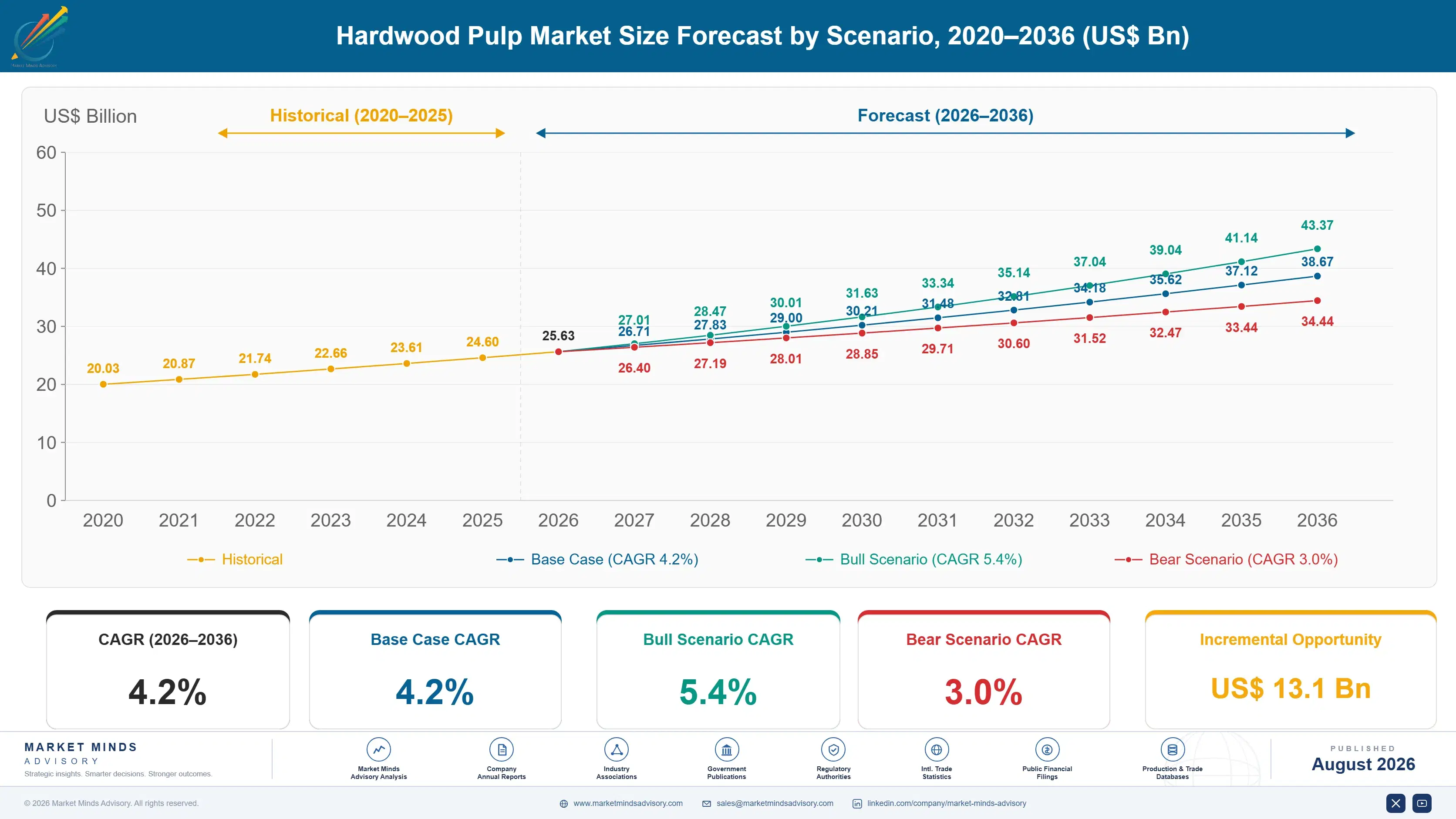
Hardwood Pulp Market Forecast Scenarios

hardwood-pulp-market-size-forecast-scenario-1787297934899
Prices between 2020 and 2025 behaved as they always do in this business, which is to say violently. A 2021 recovery ran into logistics disruption, then a 2022 spike collapsed as Chinese demand weakened and new Latin American capacity started. Printing paper demand fell throughout while tissue grew. A 3.4% historical CAGR describes an average that almost no individual year resembled.
Three mechanisms carry the 4.2% base case. Tissue and hygiene consumption growth is the largest, since hardwood fibre delivers the softness and bulk those grades require and consumption rises with income across Asia. Textile fibre substitution is the second, with dissolving pulp displacing cotton where land and water constraints bite. And packaging grade demand is the third, as fibre replaces plastic across food service formats under rules that are regulatory rather than voluntary.
The 5.4% bull case rests on viscose and lyocell capacity expanding faster than cotton supply can respond, which would pull dissolving pulp pricing well above paper grade economics and drag swing capacity with it. The 3.0% bear case is a Chinese demand plateau arriving alongside two or three greenfield Latin American lines, which would put roughly 7 million tonnes into a market unable to absorb it.

Seven Years Versus Forty

The cost curve in this business is written by agronomy. Eucalyptus on Brazilian plantations reaches harvest in seven years and yields well above anything achievable in the temperate north, where birch rotations run four decades. Wood accounts for roughly 48% of mill cash cost, so plantation productivity flows almost directly to the bottom line. That is why one end of the curve is fixed in South America.
TOP FIVE CONCENTRATION44%Concentrated by plantation ownership rather than by mill capacity
EUCALYPTUS ROTATION LENGTH7 yearsTime from planting to harvest in tropical plantation forestry
SINGLE LINE CAPACITY2.55 million tonnesAnnual output of a modern greenfield hardwood pulp line
CASH COST SPREADUSD 260/tonneGap between lowest and highest cost producers on delivered basis
WOOD COST SHARE48%Portion of mill cash cost accounted for by fibre
SEABORNE TRADE SHARE62%Share of output crossing an ocean before being consumed
Capacity arrives in a way that guarantees cycles. A modern greenfield line produces 2.55 million tonnes annually, close to a twentieth of world hardwood market supply, and it either runs or it does not. There is no gradual ramp that the market can absorb quietly. Price collapses here are almost always startup events rather than demand events, and the timing is visible years ahead.
Demand has split into three markets that share a fibre and nothing else. Printing and writing paper is in permanent decline and will not return. Tissue and hygiene grows steadily with income. Dissolving pulp competes against cotton on separate economics driven by land, water, and textile demand. Mills able to swing between paper grade and dissolving output hold optionality that shows clearly in weak years.
"Everyone models this market off demand. Demand moves two or three percent a year and is fairly predictable. What actually sets the price is whether a single line in Brazil or Indonesia starts up in March or in September."
Director, Forest Products And Fibre Practice · MMA Chemicals and Materials Pract

Market Trends

Swing Capacity Between Paper And Dissolving Grades Spreads

A growing number of hardwood lines can switch between bleached kraft for paper and dissolving grade for textile fibre, which lets an operator follow whichever market is paying better in a given quarter. Conversion between modes costs production days and requires specific cooking and bleaching capability, so it is not free, and the option is worth most precisely when paper grade pricing collapses on new capacity. Producers holding swing capability have shown materially lower earnings volatility across each of the last two price cycles, which is why more lines are being built with it.
Market Impact: Consumption below 5 kilograms yearly
Fibre Replaces Plastic Across Food Service And Packaging

Single-use plastic restrictions across Europe and a growing list of Asian jurisdictions have pushed food service packaging toward moulded fibre and paperboard formats that consume hardwood pulp for bulk and formability. Volumes remain modest when set against tissue and printing grades, but the direction of travel is settled and the substitution is regulatory rather than voluntary. Hardwood suits these applications considerably better than softwood, because short fibres form and mould cleanly into complex shapes. Demand of roughly 3 million tonnes annually now traces directly back to plastic substitution rules alone.
Market Impact: Cotton needs 8,000 litres water

Market Opportunities and Growth Drivers

Tissue And Hygiene Consumption Rises With Asian Incomes

Per capita tissue consumption across China, India, and Southeast Asia remains a fraction of North American levels and rises reliably with household income, which makes this by some distance the most predictable demand line in the whole industry. Hardwood fibre supplies the softness and bulk tissue grades require, so growth translates directly into hardwood tonnage rather than being split with softwood. Chinese tissue capacity additions alone have absorbed several million tonnes of incremental hardwood demand over the past decade, and nothing in the consumption data suggests that trajectory has begun to flatten.
Market Impact: Lines add 2.55 million tonnes

Dissolving Pulp Substitutes For Cotton In Textile Fibre

Viscose, modal, and lyocell all start from dissolving pulp, and they compete against cotton for the same textile demand under quite different resource constraints. Cotton requires arable land and substantial irrigation, both increasingly contested, while plantation eucalyptus grows perfectly well on land that is unsuitable for any food crop. Dissolving hardwood pulp therefore expands whenever global textile demand grows faster than cotton supply is able to respond. Capacity additions across Indonesia, Brazil, and China have run well ahead of paper grade additions for several years, and the announced pipeline extends that pattern.
Market Impact: Graphic demand falls 5% annually

Market Restraints and Challenges

Greenfield Capacity Arrives In Indigestible Discrete Lumps

A modern hardwood line produces 2.55 million tonnes annually and cannot be built smaller without losing the cost position that justified it. That single startup adds roughly a twentieth of world market supply in a matter of months. The root cause is scale economics in continuous digesters and recovery boilers. Commercially it means prices collapse on startup timing rather than on any demand change. Producers mitigate through staggered project timing, through swing capability into dissolving grades, and by building only where they sit at the bottom of the cost curve.
Market Impact: Conversion costs 12 production days

Printing And Writing Paper Demand Declines Permanently

Graphic paper consumption has fallen for two decades across every developed market and the decline continues at three to five percent annually with no plausible reversal. The root cause is substitution by screens, which is complete rather than cyclical. Commercially this removes a substantial share of traditional hardwood demand and strands the mills that were built specifically to serve it. Mitigation runs toward tissue and packaging grades where the fibre requirement suits hardwood equally well, toward dissolving conversion, and toward closing high-cost northern capacity outright rather than idling it in hope.
Market Impact: Substitution reaches 3 million tonnes
4 additional market trends, 3 additional growth drivers, and 2 additional restraints and challenges are covered in the full report. Contact sales@marketmindsadvisory.com to access the complete intelligence.

Segment CAGR and Growth Architecture

Segmentation follows the pulp grade, because grade determines the cooking and bleaching route, the mill assets required, the end use the fibre can serve, and the price behaviour a producer is exposed to. Wood species, mill geography, and sales route are handled in the framework and in commentary rather than being treated as separate segments here.
hardwood-pulp-market-market-share-analysis-1787297935428

Dissolving Hardwood Pulp

Dissolving pulp grows fastest at 6.3%, exactly 1.50 times the market rate, supplying viscose, modal, and lyocell production rather than any paper grade at all. Its economics are set by textile demand and cotton availability, which means it moves independently of paper pulp pricing and frequently in the opposite direction. Cotton needs arable land and heavy irrigation while plantation eucalyptus does not, and that comparison drives the substitution more than any cost argument. Producing dissolving grade requires prehydrolysis capability and tighter purity control than kraft pulping, which limits how much capacity can swing into it. Indonesian and Brazilian additions lead current expansion, and announced projects extend well beyond what paper grade capacity is adding.
CAGR 6.3%

Bleached Chemi-Thermomechanical Hardwood Pulp

Bleached chemi-thermomechanical pulp grows at 4.9%, produced through mechanical refining with chemical pretreatment rather than full chemical cooking, which retains far more of the wood and delivers yields near 90% against roughly half that for kraft. The resulting fibre is bulkier and less strong, which suits tissue, folding boxboard, and printing grades where thickness matters considerably more than tensile strength. Energy consumption is high and the economics therefore depend heavily on electricity pricing at the specific mill site. Chinese and Canadian capacity dominates global supply of this grade. Demand tracks tissue and paperboard converting rather than the market pulp cycle, so pricing behaves differently from bleached kraft through a downturn.
CAGR 4.9%
Full segment breakdown across 5 segments available in the complete report.

Regional Architecture and Country Demand Map

Three regions sit outside the bands this framework applies, because hardwood pulp is consumed where paper and tissue machines run rather than where the trees actually grow. Chinese converting capacity dominates demand while South American plantations dominate supply, and the two barely overlap at all.

East Asia

East Asia holds 38% of value against a 30% ceiling in this framework, and Chinese paper and tissue machine capacity explains almost all of the breach. China imports more market hardwood pulp than any other country by a very wide margin, because its converting capacity vastly exceeds its domestic fibre supply and recovered paper import restrictions closed the alternative. Tissue capacity additions alone have absorbed several million tonnes of incremental demand. Japanese and Korean mills consume steady volumes for household and printing grades. Domestic hardwood resources are limited and imports cover the gap almost entirely. Growth at 5.0% exceeds the global rate, driven by tissue and packaging rather than by any recovery in graphic paper.
Share: 38% | CAGR: 5.0% (2026 to 2036)

Latin America

Latin America accounts for 10% of consumption against a 9% ceiling here, and the figure understates the region's importance entirely, since Brazil supplies a very large share of the world's traded hardwood pulp from plantations no other geography can match. Eucalyptus reaching harvest in seven years fixes the bottom of the global cost curve in Brazil, Uruguay, and Chile. Domestic consumption is growing steadily through tissue and packaging demand across Brazil and Mexico in particular. Suzano, Arauco, and CMPC all originate here and between them dominate world supply. Chilean and Uruguayan mills export nearly all their output. Growth at 4.6% exceeds the global rate on domestic converting capacity additions rather than on export volume.
Share: 10% | CAGR: 4.6% (2026 to 2036)
Regional intelligence for 5 additional markets available in the complete report: Western Europe, North America, South Asia and Pacific, Middle East and Africa, Eastern Europe. Contact sales@marketmindsadvisory.com.
hardwood-pulp-market-country-cagr-analysis-1787297935937

Playing A Cost Curve You Cannot Move

Nobody prices hardwood pulp; the marginal tonne does. Every commercial lever therefore works by moving down the curve, by escaping the paper grade market entirely, or by capturing value the commodity price never reflects. Four approaches follow from that, and three of the four begin in the forest rather than anywhere near the mill.

Shorten Average Wood Haul Distance Through Plantation Placement

Wood accounts for roughly 48% of mill cash cost and a meaningful share of that is transport, so average haul distance is one of the few cost variables a producer genuinely controls. Every 20 kilometres added to the mean haul costs approximately USD 6 per tonne of pulp. Buying or leasing plantation land inside a tight radius before a mill is committed does more for lifetime cost position than any equipment specification decision. Producers who bought their plantation land late have never recovered the resulting cost gap, and most never will.
Market Impact: Each 20 kilometres costs USD 6 per tonne

Build Prehydrolysis Capability Into New Kraft Lines

Adding dissolving grade capability to a kraft line at the construction stage costs 8% to 12% of total project capital, against several times that as a later retrofit with the associated downtime. The option pays whenever paper grade pricing collapses on a competitor's startup, which happens roughly every three years in this industry. Producers holding swing capability showed materially lower earnings volatility right through the last two price cycles. The capability is worth buying even for a mill that fully expects to run paper grade almost all of the time.
Market Impact: Costs 8% to 12% of total project capital

Time Startups Against Competitor Project Schedules

A 2.55 million tonne greenfield line puts roughly a twentieth of world supply into the market at once, and two lines starting up within the same half year has repeatedly driven prices USD 150 per tonne below where a properly staggered schedule would have left them. Competitor construction schedules are visible years ahead to anybody tracking equipment orders, environmental permits, and financing announcements properly. Deliberately slipping a startup by two quarters costs some financing charges and it routinely protects several times that amount in realised price across the whole ramp period.
Market Impact: Avoids roughly USD 150 per tonne of damage

Sell Certified Fibre Into Grades That Actually Pay

Chain of custody certification carries real cost in audit fees, tracking systems, and mixed-supply segregation, and across most paper grades it earns nothing at all beyond basic market access. In tissue sold to European retail brands, and in textile fibre sold to apparel groups carrying public sourcing commitments, that same certification supports USD 20 to USD 40 per tonne. Directing certified volume toward exactly those buyers rather than spreading it thinly across the order book converts a compliance cost into a margin line without producing one extra tonne of pulp.
Market Impact: Earns USD 20 to 40 extra per tonne

Who Controls the Margin Pool

Concentration at 44% across the top five is high for a commodity, and it reflects plantation ownership rather than mill capacity. Owning the right land in the right latitude cannot be replicated by building a better mill somewhere else. All participants here are compared on measured global hardwood pulp production capacity in tonnes, the only basis that works across integrated producers and market pulp sellers alike.
Competition runs almost entirely on delivered cash cost, and the spread between best and worst producers reaches USD 260 per tonne. Suzano, Arauco, and CMPC operate at the bottom of the curve on South American eucalyptus. Bracell and APRIL run Indonesian acacia and eucalyptus with strong dissolving capability. Nordic and North American producers sit well above them and survive through integration and freight advantage.

Pressure is coming from grade mix rather than from any new entrant. Dissolving capacity additions have run ahead of paper grade for several years, and producers without prehydrolysis capability cannot follow that market at all. Rankings shift on startup timing more than on anything else, since a single greenfield line changes both a company's position and the price every competitor receives for the following two years.
hardwood-pulp-market-company-positioning-matrix-1787297936455

Competitive Moat and Risk Dimensions

SUZANO

Moat: Plantation Scale And Rotation Advantage

Suzano controls Brazilian eucalyptus plantations at a scale and productivity no competitor approaches, with seven year rotations and haul distances managed through decades of deliberate land acquisition around its mills. Wood is roughly half of cash cost, so that position translates directly into the lowest delivered cost in the industry. No mill investment elsewhere closes an agronomic gap.
SUZANO

Risk: Single Species Biological Exposure

Concentration in one species across contiguous plantation geography carries pest, disease, and drought exposure that a diversified fibre base does not. Eucalyptus rust and prolonged Brazilian drought have both affected yields within recent memory. A serious biological event would hit the cost advantage and the volume base simultaneously, and seven year rotations mean recovery is measured in years.
ARAUCO

Moat: Integrated Forestry Across Multiple Countries

Arauco holds plantation assets across Chile, Argentina, Brazil, and Uruguay, which spreads climate, biological, and political exposure that single-country producers carry in full. The group also runs softwood and panel operations that share forestry infrastructure and management. That diversification lowers the cost of capital and keeps supply commitments credible through regional disruption.
ARAUCO

Risk: Chilean Cost Base Erosion

Chilean plantation productivity trails Brazilian eucalyptus on rotation length and yield, and labour and energy costs have risen faster than in competing geographies. Wildfire losses have also been significant. The group's newer Brazilian and Uruguayan assets carry the cost position while older Chilean capacity increasingly depends on integration and freight rather than on standalone economics.

Players Tracked

Prominent Players

Suzano
Arauco
CMPC
Bracell
APRIL Group

Other Key Players

Klabin
Eldorado Brasil
Sappi
Stora Enso
UPM
Metsa Fibre
Domtar
Nippon Paper
Oji Holdings
Sun Paper
Lee and Man Paper
Chenming Paper
International Paper
Mondi
Altri

Recent Developments

FEBRUARY 2025

Suzano Advances Cerrado Project Ramp Toward Full Output

Suzano progressed the ramp of its Cerrado line toward nameplate output of roughly 2.55 million tonnes annually, one of the largest single hardwood pulp lines ever built. The project was organic rather than acquired, and market pulp prices weakened through the ramp period in the pattern greenfield startups reliably produce.
Signal: A single line at this scale reprices the market for every producer, not only its owner
MAY 2025

Bracell Expands Indonesian Dissolving Grade Swing Capacity

Bracell increased the share of its Indonesian capacity able to switch between dissolving and paper grade pulp, adding prehydrolysis capability on an existing line. The investment was internally funded, and the company cited earnings volatility reduction rather than any specific view on textile fibre demand growth.
Signal: Swing capability gets bought as insurance against startup-driven price collapse rather than for any particular upside
AUGUST 2025

Nordic Producer Closes Hardwood Line Serving Graphic Paper

A Nordic producer permanently closed a birch-based hardwood line that had supplied graphic paper customers, citing permanent demand decline in printing grades and an uncompetitive delivered cost position against South American supply. Employees were redeployed across remaining specialty and packaging operations at the same site.
Signal: High-cost northern capacity now exits the market rather than converting, which slowly tightens the marginal tonne

Wood, Chemicals And Energy

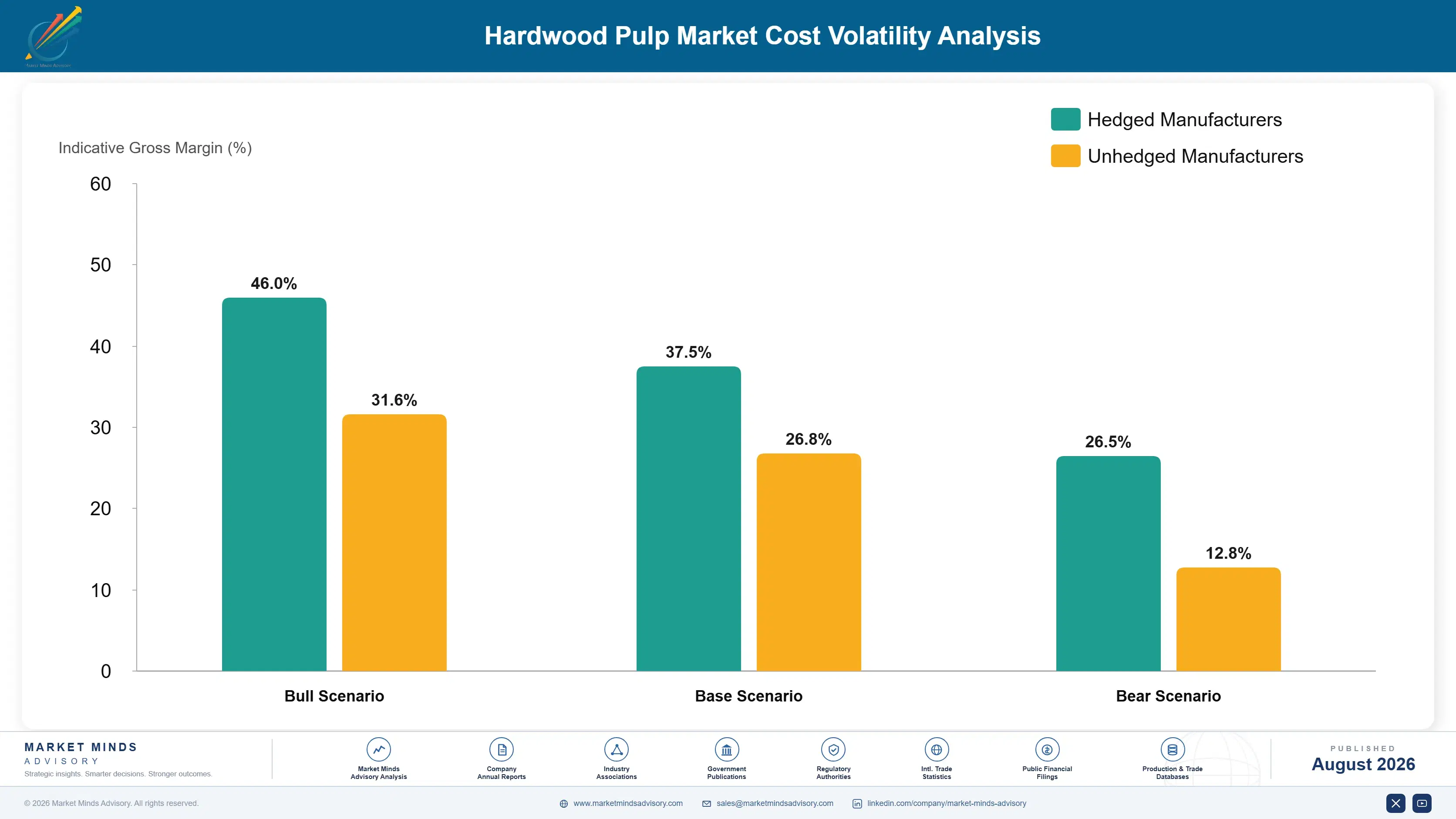
Wood accounts for roughly 44% to 52% of mill cash cost, sourced from owned plantations for the low-cost South American producers and from open market purchase for most northern mills. Chemicals, principally caustic soda, chlorine dioxide precursors, and oxygen, add 14% to 19%, tracking chlor-alkali and energy pricing. Energy is largely self-supplied from black liquor recovery, with purchased power and fuel covering 6% to 11% depending on the site.
Caustic soda pricing spiked through 2022 as European chlor-alkali producers cut operating rates against the gas price shock the IEA documented that year, and bleaching costs rose sharply for mills without long-term supply contracts. Suzano's 2022 annual report noted higher chemical input costs across the period. Northern mills buying wood on the open market faced simultaneous fibre cost increases, which compressed margins from two directions at once.

Exposure separates by fibre ownership more than by anything else. A producer harvesting owned plantations sees wood cost move with silviculture and haul distance, both managed over decades. A mill buying pulpwood on the open market competes for fibre against panel producers, energy users, and rival mills, with no defence when regional wood pricing tightens. That distinction explains most of the USD 260 spread.
hardwood-pulp-market-cost-volatility-analysis-1787297936651

Extend Owned Plantation Coverage Around Every Mill Site

Open market pulpwood purchase leaves a mill competing against panel producers and biomass energy users for the same fibre, with no defence when regional supply tightens. Extending owned or long-leased plantation coverage toward the mill's full annual requirement costs land capital but converts the largest cost line from a market exposure into a managed silvicultural variable.

Contract Caustic Soda Supply On Multi-Year Terms

Chlor-alkali pricing swings with European and Asian energy costs and with chlorine demand the pulp industry does not influence at all. Multi-year supply agreements with indexation to a published benchmark cost a modest premium against spot purchase in calm markets, and they proved worth several times that premium through the disruption of recent years.

Maximise Black Liquor Recovery And Surplus Power Sales

A well-run recovery boiler makes a hardwood mill a net electricity exporter, and surplus power sales offset purchased energy exposure entirely at the best sites. Investment in recovery capacity and turbine efficiency at construction is far cheaper than retrofitting later, and it converts an input cost into a revenue line that holds up when pulp pricing does not.

Portfolio Architecture for Margin Defence

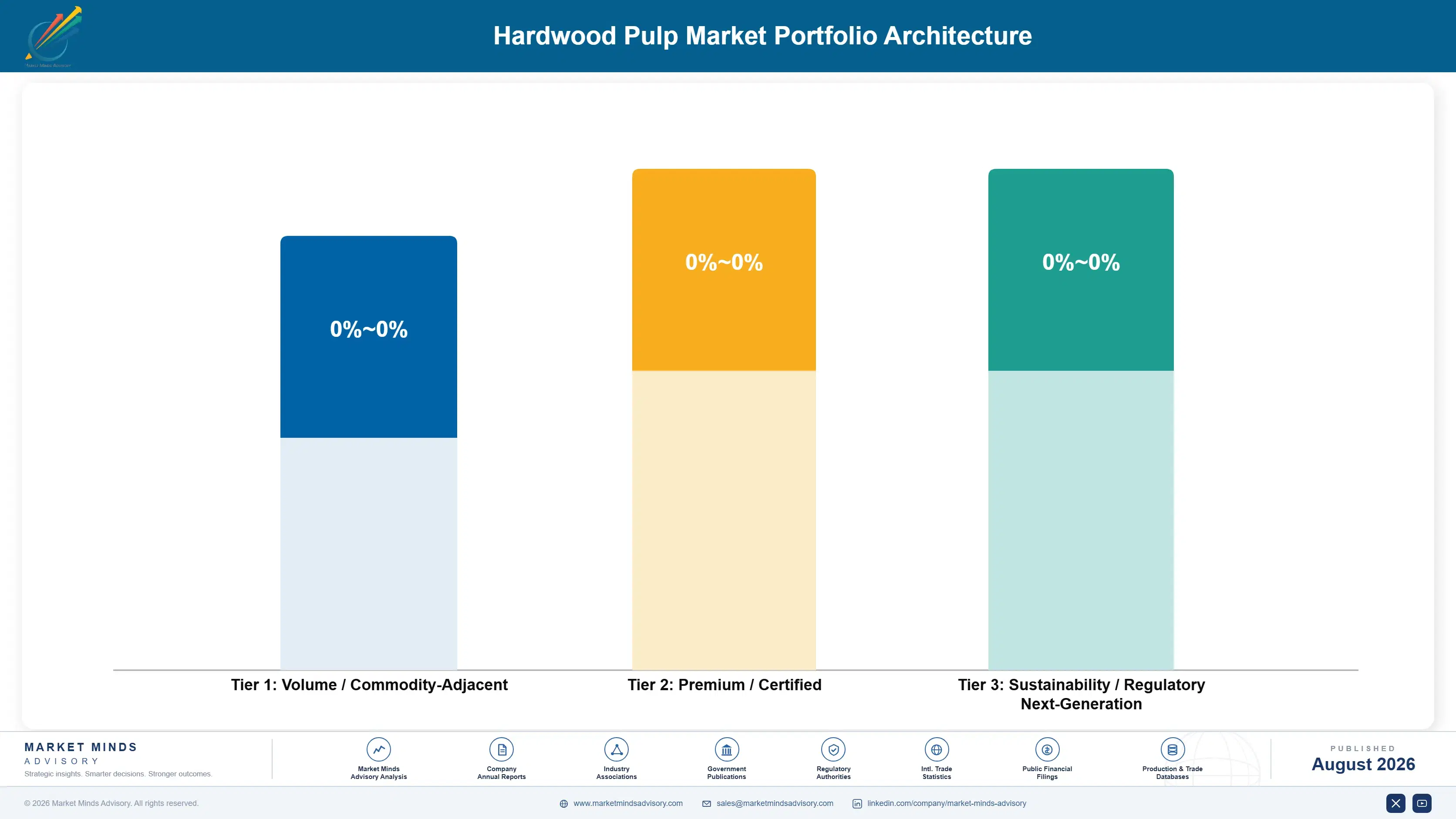
Margin architecture in hardwood pulp is set by position on the cost curve rather than by product tier, which makes it unusual among the markets MMA covers. Bottom-quartile South American eucalyptus lines earn 28% to 40% through the cycle. Northern mills serving graphic and standard paper grades earn 6% to 16% and lose money outright in troughs. Same product, same price, entirely different outcome.
The tension is that the only genuine escape from cost curve position is grade differentiation, and hardwood pulp differentiates poorly. Dissolving grade is the real exception, since it sells into textile economics rather than paper economics and requires capability most lines lack. Specialty and certified grades earn something, but the premium is measured in tens of dollars per tonne against a cost spread measured in hundreds.

High-value pools concentrate in dissolving grade capacity, swing capability, and surplus power generation. All three insulate a producer from paper grade pricing rather than improving its position within it. Dissolving carries the widest margin range in the market, because textile fibre pricing moves on cotton and apparel demand and bears no relationship to the pulp cycle at all.

Volume / Commodity-Adjacent

Standard bleached hardwood kraft from mills above the middle of the cost curve, serving graphic and commodity paper grades against declining demand. The ten-point range separates integrated mills capturing downstream margin from standalone market pulp sellers fully exposed to the index.
Gross Margin: 6% to 16%

Premium / Certified

Bottom-quartile plantation eucalyptus lines and certified fibre sold into tissue and textile customers who pay for chain of custody. The twelve-point range reflects the gap between good and exceptional plantation positions, which comes down to rotation length and average haul distance.
Gross Margin: 28% to 40%

Sustainability / Regulatory / Next-Generation

Dissolving grade pulp, swing capacity, surplus renewable power, and fibre for plastic substitution formats. The thirty-point range reflects genuine divergence: surplus power earns utility returns while dissolving grade in a tight textile market earns considerably more than any paper grade ever does.
Gross Margin: 22% to 52%
hardwood-pulp-market-portfolio-architecture-1787297937154

High-value Sub-segments and Strategic Watch-out

Dissolving Grade Capacity

Highest growth and the widest margin range in the market, priced against cotton and textile demand rather than against paper pulp. Prehydrolysis capability limits how much existing capacity can follow it. Indonesian and Brazilian additions have run well ahead of paper grade expansion for several years now.
Gross Margin: 26% to 46%

Bottom-Quartile Eucalyptus Lines

High value with steady growth, earning through every point of the cycle because the marginal tonne setting price always comes from higher up the curve. Position depends on plantation rotation and haul distance, both decided decades before a mill runs. Nothing built elsewhere can close it.
Gross Margin: 32% to 42%

Standard Bleached Hardwood Kraft

The volume core of this market, sold into tissue, packaging, and declining graphic paper at whatever the index says that week. Growth tracks tissue consumption rather than total paper demand. Producers sitting above the middle of the cost curve lose money outright through every single trough.
Gross Margin: 6% to 16%

Northern Graphic Paper Fibre

Strategic watch-out. Birch and northern hardwood capacity built for printing grades faces permanent demand decline and a delivered cost position South American eucalyptus makes untenable. Closure rather than conversion has been the established pattern here, and whatever capacity remains survives on integration and freight advantage alone.
Gross Margin: 4% to 14%

How Tonnage Actually Recurs

The annuity in this business is the paper machine, not the contract. A tissue or board machine runs a defined furnish and requalifying a different fibre source means trials, runnability risk, and quality variation the converter would rather avoid. So volume recurs monthly for years even where pricing is fully index-linked and renegotiated constantly. Producers frequently mistake price exposure for relationship weakness, and the two are not the same thing at all.
Stickiness varies considerably by end use. Dissolving pulp customers are the deepest, since viscose and lyocell lines are tuned to specific pulp purity characteristics and switching carries real process risk. Tissue is next, where softness and bulk depend on furnish and brands protect their hand feel. Packaging and board are shallower, buying largely on delivered cost. Graphic paper is shallowest of all, and it is disappearing regardless.

Buyer profiles have shifted. Purchasing moved from mill-level fibre buyers toward centralised procurement teams running index-linked contracts across multiple sites and multiple suppliers deliberately. Apparel and retail brands now reach past their converters to specify certified fibre directly. Both changes favour producers with certified plantation supply and the scale to serve a multi-site contract reliably over those selling mill by mill.
hardwood-pulp-market-end-use-penetration-index-1787297937642

Where We Come Out

These are among the four positions where our research anticipates prominent divergence between winners and laggards over the coming forecast period. Each is grounded in the demand model, the regulatory perimeter, and the announced capacity pipeline.
01 / COST CURVE POSITIONING

Build at the bottom of the curve or do not build

The marginal tonne sets the price for everybody, and that tonne comes from South American plantations with seven year rotations no temperate geography can approach. A mill built above the middle of the cost curve loses money through every trough and never earns enough in the upturns to make the arithmetic work over a full cycle. Capital committed to hardwood capacity outside the advantaged latitudes has destroyed shareholder value with remarkable consistency for the better part of two decades now.
02 / GRADE OPTIONALITY INVESTMENT

Buy prehydrolysis capability even if you never use it

Adding dissolving grade capability at construction costs eight to twelve percent of project capital, against several times that as a retrofit with the downtime a running line cannot easily absorb. The option pays whenever paper grade pricing collapses on somebody else's startup, which this industry has delivered roughly every three years without fail for decades. Producers holding swing capability showed materially lower earnings volatility through both of the last two price cycles, and that reduction alone is worth paying for at construction.
03 / STARTUP TIMING DISCIPLINE

Two lines in one half year damages everybody involved

A 2.55 million tonne greenfield line puts roughly a twentieth of world supply into the market within months, and there is no way to ramp it quietly or to hold volume back once the recovery boiler is running. When two projects land in the same half year, prices have repeatedly fallen a hundred and fifty dollars per tonne below where a staggered schedule would have left them. Competitor construction schedules are visible years ahead to anybody tracking equipment orders and environmental permits properly.
04 / FIBRE OWNERSHIP DEPTH

Owned plantation coverage is the only durable cost defence

Wood is roughly half of mill cash cost, and a producer buying pulpwood on the open market competes for it against panel makers, biomass energy users, and rival mills with no defence whatsoever when regional supply tightens. Owned or long-leased plantation coverage converts the largest single cost line from a market exposure into a silvicultural variable managed across decades. That single distinction explains most of the two hundred and sixty dollar per tonne spread running across the industry cost curve.

Engagement Snapshot From the Field

A live engagement with an industry participant carrying material or product regulatory and market exposure ahead of a defining policy shift, showing how our research translates into a defensible multi-year portfolio strategy.
MARKET MINDS ADVISORY · CLIENT ENGAGEMENT SUMMARY
Hardwood Pulp Producer Strategic Portfolio Review and Transition Roadmap 2026·Investment Scenario on Hardwood Pulp Exposure Evaluation 2025-26
CLIENT PROFILE
A northern European integrated producer operating three hardwood pulp lines with combined capacity near 1.4 million tonnes and roughly EUR 1.1 billion in annual pulp revenue (client-reported, unverified by MMA). Two lines were built to serve graphic paper customers and sourced birch pulpwood on the open market, while the third supplied tissue and specialty grades and held partial forest ownership.
STRATEGIC CHALLENGE
Delivered cost across the two graphic-oriented lines sat well above the global median and both had lost money in each of the previous three price troughs. The board was weighing conversion to dissolving grade, closure, or continued operation on the assumption that South American capacity additions would eventually slow. None of the three options had been costed properly.
MMA APPROACH
MMA built a delivered cost curve position for each line against global hardwood supply, modelled dissolving grade conversion capital and achievable purity against the client's existing digester configuration, and assessed regional pulpwood availability and competing demand over a fifteen year horizon. Announced South American and Indonesian project pipelines were mapped by expected startup quarter to test the board's slowdown assumption.
KEY FINDINGS
  1. Both graphic-oriented lines sat in the top cost quartile globally, with delivered cash cost running USD 190 per tonne above bottom-quartile South American eucalyptus supply.
  2. Dissolving grade conversion was technically feasible on only one of the three lines, and required capital equal to 34% of a comparable greenfield project cost.
  3. Regional pulpwood pricing was projected to rise with biomass energy demand competing for the same fibre, worsening rather than improving the client's open market exposure.
  4. Announced project pipelines showed roughly 6 million tonnes of new South American and Indonesian capacity through 2030, contradicting the board's assumption of a supply slowdown.
CLIENT PROFILE
A northern European integrated producer operating three hardwood pulp lines with combined capacity near 1.4 million tonnes and roughly EUR 1.1 billion in annual pulp revenue (client-reported, unverified by MMA). Two lines were built to serve graphic paper customers and sourced birch pulpwood on the open market, while the third supplied tissue and specialty grades and held partial forest ownership.
STRATEGIC CHALLENGE
Delivered cost across the two graphic-oriented lines sat well above the global median and both had lost money in each of the previous three price troughs. The board was weighing conversion to dissolving grade, closure, or continued operation on the assumption that South American capacity additions would eventually slow. None of the three options had been costed properly.
MMA APPROACH
MMA built a delivered cost curve position for each line against global hardwood supply, modelled dissolving grade conversion capital and achievable purity against the client's existing digester configuration, and assessed regional pulpwood availability and competing demand over a fifteen year horizon. Announced South American and Indonesian project pipelines were mapped by expected startup quarter to test the board's slowdown assumption.
KEY FINDINGS
  1. Both graphic-oriented lines sat in the top cost quartile globally, with delivered cash cost running USD 190 per tonne above bottom-quartile South American eucalyptus supply.
  2. Dissolving grade conversion was technically feasible on only one of the three lines, and required capital equal to 34% of a comparable greenfield project cost.
  3. Regional pulpwood pricing was projected to rise with biomass energy demand competing for the same fibre, worsening rather than improving the client's open market exposure.
  4. Announced project pipelines showed roughly 6 million tonnes of new South American and Indonesian capacity through 2030, contradicting the board's assumption of a supply slowdown.
RECOMMENDED STRATEGY
Phase 1: Phase one: close the weaker graphic-oriented line permanently rather than idling it, and redeploy its wood supply contracts to the specialty operation. Phase 2: Phase two: convert the technically feasible line to dissolving grade, targeting textile customers where pricing follows cotton rather than paper pulp. Phase 3: Phase three: extend forest ownership around the specialty mill toward its full annual fibre requirement, funded partly from the closure proceeds.
OUTCOME
The client closed one line and committed to dissolving conversion on a second within three quarters. Group pulp EBITDA margin improved by eleven points over the following year despite lower total tonnage, and the retained operations remained profitable through a price trough that would previously have produced losses (client-reported, unverified by MMA).

Frequently Asked Questions

Foundational context covering the market sizes, CAGR, scope, country, region and competition that inform every finding below. This section is provided to cover basics and most often pre-purchase conversations, answered from the MMA Primary Research Dataset.

What is the current size of the Hardwood Pulp Market?

The global hardwood pulp market reached USD 24.6 billion in 2025, covering bleached eucalyptus kraft, other bleached and unbleached hardwood kraft grades, bleached chemi-thermomechanical pulp, and dissolving hardwood pulp. Both market pulp and integrated transfers are included.

How large will the Hardwood Pulp Market be by 2036?

MMA forecasts USD 38.68 billion by 2036, up from USD 25.63 billion in 2026, an increase of USD 13.05 billion. That represents an expansion multiple of 1.51 times across the forecast period.

What is the CAGR for the Hardwood Pulp Market 2026 to 2036?

The base case CAGR is 4.2%, with a bull case of 5.4% and a bear case of 3.0%. Historical growth between 2020 and 2025 ran at 3.4%, an average that almost no individual year in that period actually resembled.

Which segment is growing fastest?

Dissolving hardwood pulp grows fastest at 6.3%, exactly 1.50 times the market rate, supplying viscose and lyocell production in competition with cotton. Bleached chemi-thermomechanical hardwood pulp follows at 4.9%.

Who are the major companies in the Hardwood Pulp Market?

Suzano, Arauco, CMPC, Bracell, and APRIL Group lead, together holding 44% of the market. Position depends on plantation ownership and rotation length rather than on mill technology.

Which country is growing fastest?

India grows fastest at 6.8%, driven by tissue and packaging demand rising from very low per capita consumption against domestic hardwood supply that cannot meet paper machine requirements. Imports cover most of the gap.

Report Segmentation Architecture

The full report scope spans multiple orthogonal segmentation dimensions, with cross-tabulated demand data provided for each dimension pair. Coverage extends further to regional breakdowns, trend trajectories, and the competitive detail needed to support segment-level decision-making.

By Pulp Grade

  • Bleached Eucalyptus Kraft
  • Other Bleached Hardwood Kraft
  • Unbleached Hardwood Kraft
  • Bleached Chemi-Thermomechanical Hardwood
  • Dissolving Hardwood Pulp

By End-Use Industry

  • Tissue And Hygiene
  • Packaging And Paperboard
  • Printing And Writing Paper
  • Textile Fibre Production
  • Specialty Paper And Filtration

By Commercial Dimension

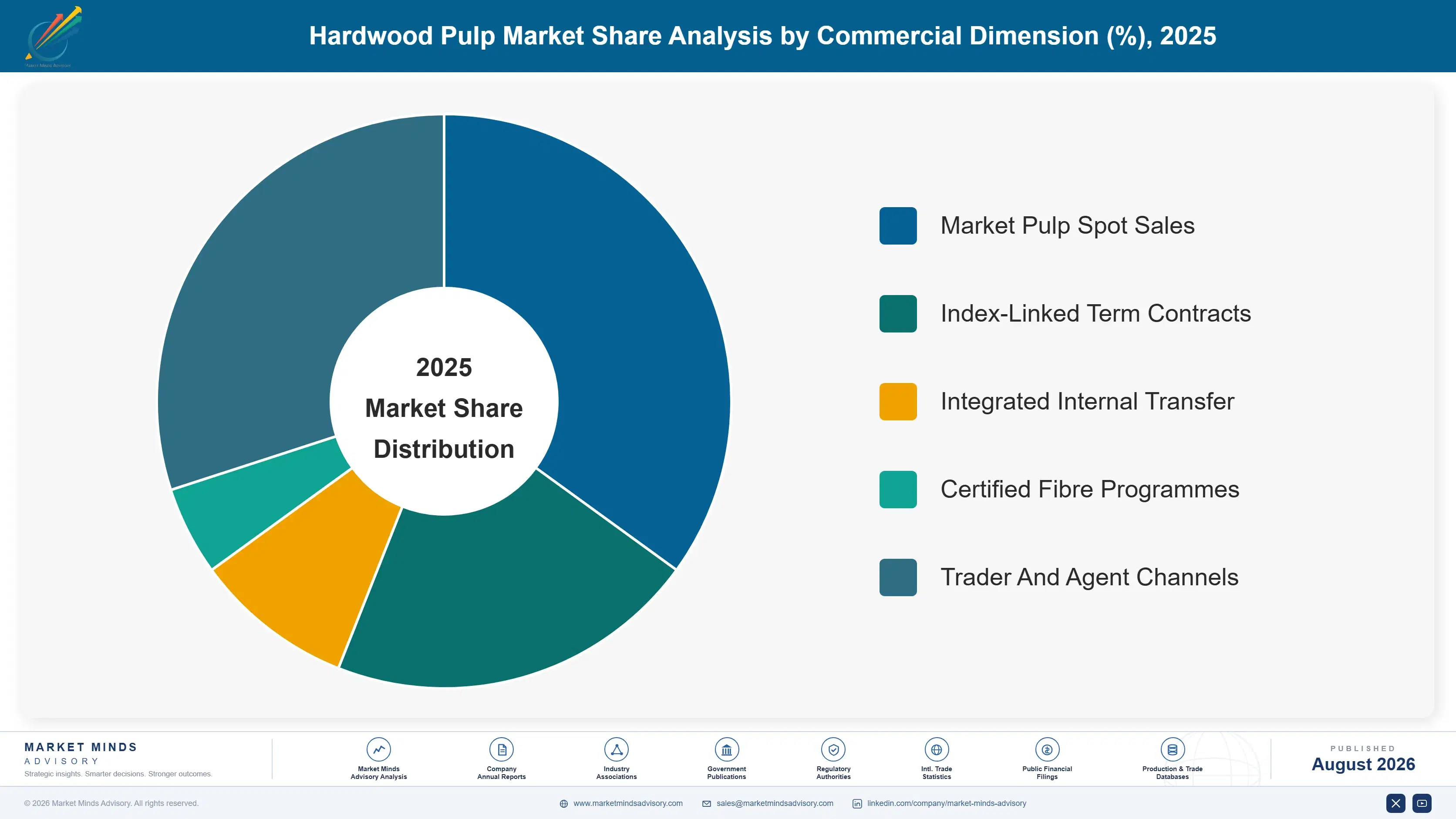
  • Market Pulp Spot Sales
  • Index-Linked Term Contracts
  • Integrated Internal Transfer
  • Certified Fibre Programmes
  • Trader And Agent Channels

By Region

  • East Asia
  • Latin America
  • Western Europe
  • North America
  • South Asia and Pacific
  • Middle East and Africa
  • Eastern Europe

Scope, Methodology, and Coverage

Every figure in this report is reproducible from documented input assumptions. The scope below maps the historical period, the forecast horizon, the segmentation dimensions, and the countries covered, alongside the underlying primary and qualitative methodology.
Historical Period
2020 to 2025
Forecast Period
2026 to 2036
Base Year
2025 (USD billions; MMA Primary Research Dataset, August 2026)
Market Definition
The hardwood pulp market covers chemically and mechanically produced pulp from hardwood species, whether sold as market pulp or transferred internally to integrated paper and board production. Scope spans bleached eucalyptus kraft, other bleached hardwood kraft grades including acacia, birch and mixed tropical species, unbleached hardwood kraft, bleached chemi-thermomechanical hardwood pulp, and dissolving hardwood pulp. Softwood pulp of all grades, recovered paper and deinked pulp, non-wood fibres including bamboo and bagasse, and downstream paper manufacture are excluded.
Quantitative Units
USD billions at producer revenue level; million tonnes of capacity and production; delivered cash cost per tonne.
Segmentation Dimensions
By pulp grade; by end-use industry; by commercial dimension; by region.
Regions Covered
East Asia, Latin America, Western Europe, North America, South Asia and Pacific, Middle East and Africa, Eastern Europe
Countries Covered
United States, Canada, Brazil, Chile, Uruguay, Mexico, Sweden, Finland, Portugal, Spain, Germany, Poland, China, Japan, South Korea, Indonesia, India, Australia, Egypt, South Africa.
Key Companies Profiled
Suzano, Arauco, CMPC, Bracell, APRIL Group, Klabin, Eldorado Brasil, Sappi, Stora Enso, UPM, Metsa Fibre, Domtar, Nippon Paper, Oji Holdings, Sun Paper, Lee and Man Paper, Chenming Paper, International Paper, Mondi, Altri.
Quantitative Methodology
Primary survey, n=3,800 respondents, Q4 2025, six countries; demand-side model with trade association cross-validation
Qualitative Methodology
47 expert interviews, Q4 2025; applied to validate demand model assumptions, identify emerging dynamics, and assess competitive positioning
Report Format
PDF and XLSX data workbook (Word format preview document)
Publisher
Market Minds Advisory
Report Code
MMA-2026-CHM-778
Published
August 2026
Contact
sales@marketmindsadvisory.com | www.marketmindsadvisory.com

Purchase the full Hardwood Pulp Market Report (2026 to 2036).

The full MMA report on hardwood pulp covers grade, regional, and competitive analysis in detail, with separate treatment of the delivered cost curve that determines which producers survive each trough. It includes mill-by-mill cash cost positioning, plantation rotation and yield benchmarking by geography, announced capacity pipeline mapping by expected startup quarter, and dissolving grade conversion feasibility screening. Regional chapters cover twenty countries with converting capacity and fibre balance assessed individually. Competitive profiling spans twenty producers compared on a single consistent capacity basis throughout the analysis.
Twenty country regional demand mechanism chapters
Mill-by-mill delivered cash cost positioning tables
Plantation rotation and yield benchmarking tables
Capacity pipeline mapped by startup quarter
Twenty producer competitive profiles compared consistently
Dissolving grade conversion feasibility screening models

Built For The People Who Decide

From boardroom strategy to bench-side execution, this report is read cover-to-cover by leaders shaping the next decade of their industry, turning demand scenarios, market dynamics and valuation benchmarks into decisions.
CXOs/ Presidents/ VPs/ Managers
M&A and Corporate Development
Strategy Teams and R&D Heads
Procurement and Product Directors
Regulatory and Compliance Leaders
Investor Relations and Equity Analysts