Market Minds Advisory
Hard Seltzer Market

Hard Seltzer Market: After The Correction, Spirit Bases And On-Premise Positions That Actually Held

The category grew faster than almost any drink in memory and then contracted just as fast, and what survived the correction looks nothing like what expanded into it in the first place.

Lead Analyst

Lisa Gevelber

Published

September 2026

Make Smarter Decisions with Customized Research Insights

Request a free sample report and evaluate market opportunities, growth trends, and competitive dynamics relevant to your business needs.

2025 MARKET VALUE$11.5BMarket Size 2025
2036 FORECAST VALUE$29.1BBase Case , 2026 to 2036
CAGR 2026 TO 20368.8 %Bull 10.0% / Bear 7.6%
INCREMENTAL OPPORTUNITY$16.6BNet 10- year value creation
EXPANSION MULTIPLE2.32x2036 value over 2026 base
Strategic Levers
M&A Pipeline
Regional Outlook
Country Rankings
Competitive Intelligence
Segmental Deep-dive
Call-Us : 91 93563 13602

Executive Snapshot and Market Trajectory

Hard seltzer expanded faster than almost any drink in living memory and then contracted almost as quickly, leaving shelf space, brands and considerable capital stranded. What survived that correction looks nothing like what expanded into it. Average retail range has fallen roughly 41% from peak.
Spirit-based seltzers carry the growth on cleaner taste, genuine flavour development and pricing that follows canned cocktail norms rather than beer. On-premise supply grows nearly as fast because a venue stocks one seltzer as a category answer rather than choosing between fifteen. North America holds the largest share because the category was created there and the correction happened there first and hardest. Retail listings lost during the contraction have simply not come back.
Concentration reads at 67% for the top five, high because the shakeout removed a great many entrants and left the survivors holding shelf space that had been contested by dozens of brands. Retail listings lost during the contraction have proved genuinely difficult to recover, which is the lasting commercial consequence of expanding too fast. Spirit bases and on-premise positions survived, and both favour drinks groups over specialists.
Market Definition
This market covers hard seltzer and flavoured alcoholic sparkling water, spanning spirit-based seltzers, on-premise supply, malt-based retail seltzers, wine and cider-based seltzers, and functional and low-alcohol seltzer variants. Ready-to-drink canned cocktails not positioned as seltzer, flavoured malt beverages of conventional style, alcohol-free sparkling water, beer including flavoured lagers, and hard kombucha are excluded from the sizing.
Base Year Value
$11.5B in 2025 (MMA Primary Research Dataset, August 2026)
Forecast Period
2026 to 2036, eleven discrete annual values
CAGR
8.8% base case. Bull 10.0%. Bear 7.6%.
Fastest Growth Segment
Spirit-Based Seltzers: 13.2% CAGR
Fastest Growth Country
India: 12.6% CAGR
Fastest Growth Region
South Asia and Pacific: 11.1% CAGR
Largest Region
North America: 47% of 2025 global value
Market Leaders
Mark Anthony Brands, Boston Beer Company, Anheuser-Busch InBev, Molson Coors and Constellation Brands lead on hard seltzer revenue. Source: MMA Primary Research Dataset, July 2026.
Primary Survey
n=3,800 procurement and R&D decision-makers, Q4 2025, six countries
Methodology
Demand-side build-up, cross-validated against public data, 47 expert interviews

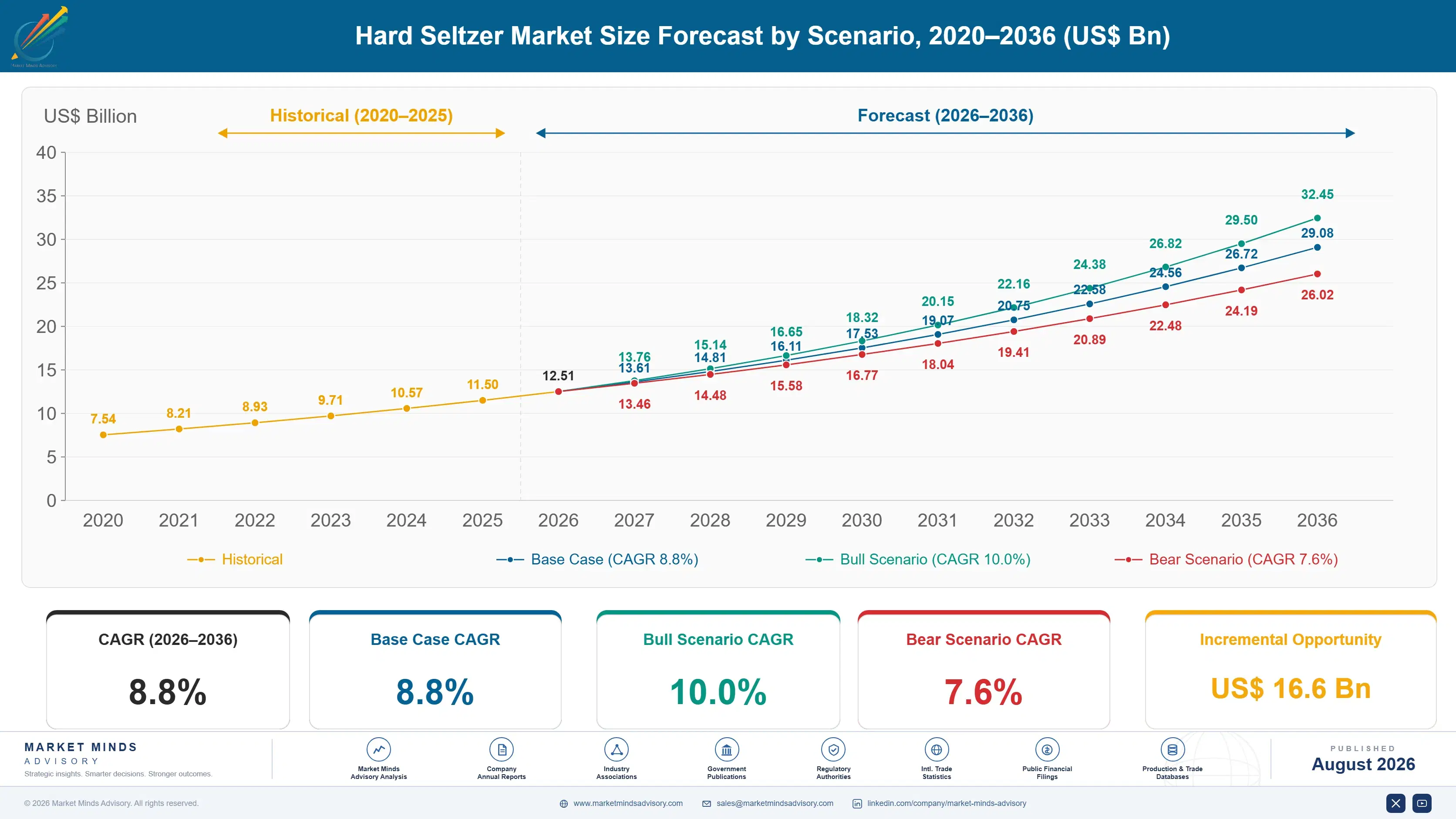
Hard Seltzer Market Forecast Scenarios

hard-seltzer-market-size-forecast-scenario-1787460096049
Growth ran at 7.7% annually between 2020 and 2025, and that average conceals an extraordinary shape. The category expanded dramatically through 2020 and 2021 as every brewer launched a seltzer, then contracted sharply as consumers moved on and retailers cut ranges that had been allowed to proliferate far beyond what shelf economics could justify. Shelf space, brands and considerable capital were all left stranded by that sequence.
The base case at 8.8% rests on three mechanisms. Spirit-based seltzers keep taking share from malt-based on taste and pricing that follows canned cocktail norms. On-premise listings keep growing because venues want a category answer rather than a range. And Indian and Southeast Asian demand grows as ready-to-drink categories develop in markets that never experienced the Western boom and correction at all. None of the three depends on Western trial recovering.
The bull case at 10.0% turns on spirit-based seltzer establishing itself as a durable ready-to-drink format rather than a category remnant, which would reset the growth trajectory entirely. The bear case at 7.6% reflects continued retail range rationalisation, since retailers who cut once have shown no reluctance to cut again when rate of sale disappoints.

What Survived Looks Nothing Like What Expanded

This category did something unusual and instructive. It expanded faster than almost any drink in living memory as every brewer launched a seltzer, then contracted almost as quickly when consumers moved on and retailers cut ranges that had proliferated well beyond what shelf economics could ever support. Average retail range has fallen roughly 41% from peak.
TOP FIVE CONCENTRATION67%High, since the shakeout removed a great many smaller entrants
SPIRIT-BASED VOLUME SHARE29%Portion of volume using spirit rather than fermented malt base
SPIRIT BASE PRICE PREMIUM48%Pricing advantage of spirit-based over comparable malt-based seltzers
ON-PREMISE VALUE SHARE23%Portion of value sold through bars, restaurants and venues
RETAIL LISTING DECLINE41%Reduction in average retail range since the category peak
PACKAGING COST SHARE34% of COGSCans and secondary packaging share of manufactured cost
The survivors are not the expanders. Spirit-based seltzers using vodka or tequila rather than fermented malt now hold roughly 29% of volume, deliver cleaner taste and command around 48% premium, and reach a buyer choosing against a canned cocktail rather than against a beer. That is a different product in a different competitive set. That is a genuinely different product competing in a different set.
On-premise held up considerably better than retail throughout, which is worth understanding. A venue stocks one seltzer as a category answer rather than choosing between fifteen, so the listing is a decision made once rather than contested every range review. Roughly 23% of value now comes through that channel and the positions have proved genuinely durable. Very little else in this category proved anything like as durable.
"Everyone launched a seltzer, retailers listed all of them, and then the shelf reasserted itself the way shelves always do. The interesting question now is not why it contracted but why on-premise barely noticed."
Director, Beverages and Ready-To-Drink Practice · MMA Beverages Practice · August 2026

Market Trends

Spirit Bases Replace Malt In The Surviving Premium Positions

Malt-based seltzer never fully escaped a faintly medicinal note that fermentation leaves behind, and spirit bases using vodka or tequila deliver cleaner taste with genuine flavour development instead. Spirit-based now holds roughly 29% of volume at around 48% premium, reaching a buyer choosing against a canned cocktail rather than a beer. Distribution moves into spirits licensing, which changes who can sell it and advantages businesses already holding those rights considerably. Pricing follows spirits ready-to-drink norms rather than beer comparison entirely. The competitive set changed alongside the base. Flavour development is genuinely possible now.
Market Impact: India grows at 12.6% annually
On-Premise Positions Proved Far More Durable Than Shelf

A bar or restaurant stocks one seltzer as a category answer rather than choosing between fifteen competing brands, which makes the listing a decision taken once rather than contested at every range review. That single dynamic is why on-premise barely noticed the correction that removed roughly 41% of average retail range. Around 23% of category value now comes through venues, and those positions have proved genuinely durable in a category where very little else did. Volumes per outlet are modest and the listings durable, which suits a producer that survived the shakeout. The decision is made once.
Market Impact: Delivers 60% fewer calories than beer

Market Opportunities and Growth Drivers

Asian Ready-To-Drink Development Skipped The Boom Entirely

Indian and Southeast Asian ready-to-drink categories are developing now without having experienced the Western expansion and correction at all, which means brands enter without competing against consumer memory of a category that disappointed. Indian demand grows near 12.6% annually as urban ready-to-drink consumption rises. Regional flavour preferences differ considerably from Western seltzer profiles, which favours local formulation over transferring products unchanged from elsewhere. Consumer memory of a disappointing category is the barrier Western brands still carry and these markets do not. Local formulation matters considerably here. Regulatory complexity is the offsetting difficulty.
Market Impact: Retail range fell 41% from peak

Low-Calorie Positioning Survived The Category Correction Intact

The nutritional proposition that built hard seltzer did not stop being true when the category contracted, and consumers still want a low-calorie alcoholic option that does not taste like a compromise. What failed was range proliferation rather than the underlying argument. Spirit bases deliver that proposition with better taste, which is why the surviving positions hold rather than continuing to decline. The occasion is genuine even where the original execution was not. Range proliferation rather than the underlying argument is what failed here. The occasion is genuine even where early execution was not.
Market Impact: Repeat purchase sits at 27%

Market Restraints and Challenges

Lost Retail Listings Have Proved Extremely Difficult To Recover

Average retail range fell roughly 41% from peak as retailers cut brands that had been listed during the expansion, and the shelf space released went to other categories rather than sitting empty. The root cause is that a retailer who cut once has learned the category can be smaller without losing sales. Commercially this caps recovery regardless of product improvement. Participants are responding with on-premise focus, spirit-based repositioning and rate of sale evidence rather than range arguments. Rate of sale evidence rather than range argument is what buyers now respond to.
Market Impact: Spirit base holds 29% of volume

Consumer Memory Of Disappointment Persists Across The Category

A great many consumers tried hard seltzer during the expansion, found it thin or faintly medicinal, and have not returned regardless of how much products have since improved. The root cause is that early execution was rushed as brands launched to hold shelf space rather than because they had a good product. Commercially this makes trial harder to win now than it was originally. Participants are responding with spirit bases, on-premise sampling and positioning against canned cocktails instead. Brands launched to hold shelf space rather than because they had good products.
Market Impact: Channel carries 23% of value
4 additional market trends, 2 additional growth drivers, and 3 additional restraints and challenges are covered in the full report. Contact sales@marketmindsadvisory.com to access the complete intelligence.

Segment CAGR and Growth Architecture

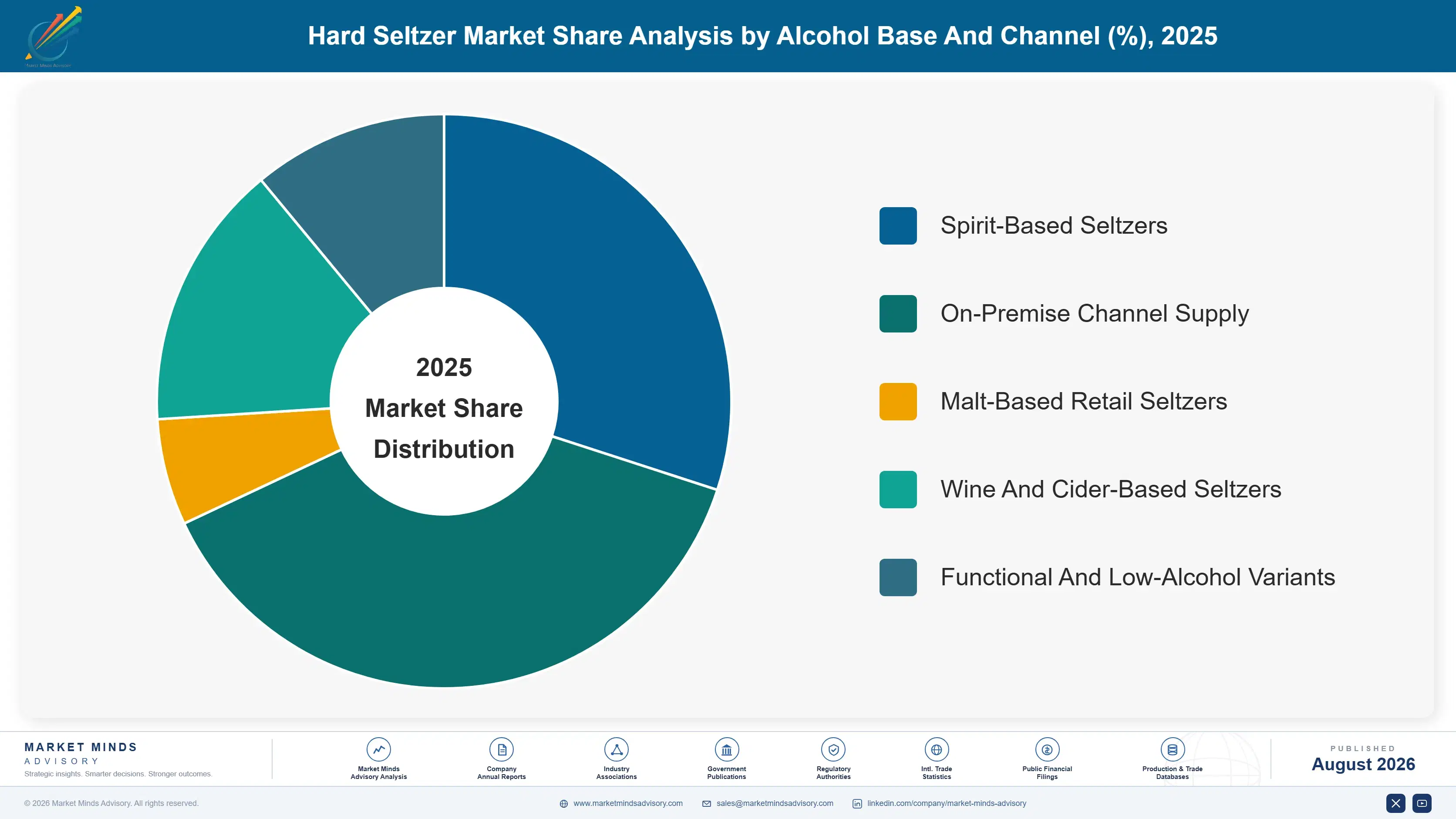
Five categories divide this market on alcohol base and channel rather than on flavour, which proliferated wildly during the expansion and told buyers nothing useful. Base determines taste, licensing route and price positioning together, while channel determines whether a listing is contested constantly or decided once and then left alone. Flavour told buyers nothing useful.
hard-seltzer-market-market-share-analysis-1787460096579

Spirit-Based Seltzers

Growing at 13.2% and the fastest part of this market, which is more a statement about where the category retreated to than about any new consumer enthusiasm. Spirit-based seltzers use vodka or tequila rather than fermented malt base, which delivers a cleaner taste, permits genuine flavour development and sidesteps the slightly medicinal note that malt-based products never fully escaped. Distribution runs through spirits licensing rather than beer, which changes who can sell it and where. Pricing follows spirits ready-to-drink norms at a considerable premium to malt-based seltzer, and the buyer is choosing against a canned cocktail rather than against a beer. The competitive set changed with the base. Licensing decides who can sell it.
CAGR 13.2%

On-Premise Channel Supply

Growing at 11.0% on hard seltzer supplied into on-premise venues rather than retail, where the buyer is a bar or restaurant operator selecting a low-calorie option for a drinks list rather than a shopper making a decision in a supermarket aisle. On-premise held up considerably better than retail through the category's correction, because a venue stocks one seltzer as a category answer rather than choosing between fifteen of them. That single dynamic makes the channel more defensible than shelf position ever was. Volumes per outlet are modest and the listings are durable, which suits a producer that has already survived the shakeout. Shelf position was never anything like as defensible. Producers who survived the shakeout benefit most.
CAGR 11.0%
Full segment breakdown across 5 segments available in the complete report.

Regional Architecture and Country Demand Map

North America holds 47% of global value because the category was created there and remains overwhelmingly concentrated there despite the correction. Western Europe follows at 21%, while South Asia and Pacific grows fastest on ready-to-drink development that never experienced the boom. On-premise held everywhere it existed.

North America

Note: North America holds 47% because hard seltzer was created here and the category remains overwhelmingly concentrated in this market despite the correction, which no realistic allocation can obscure. The expansion, the proliferation and the contraction all happened here first and hardest. Mark Anthony Brands built the leading position and held it through the shakeout. Retail range fell sharply and the space released went to other categories rather than waiting. Spirit-based seltzers have grown as the surviving premium position, with distribution running through spirits licensing that varies state by state and adds complexity brands manage rather than change. Spirits licensing varies state by state and adds complexity brands manage rather than change.
Share: 47% | CAGR: 9.2% (2026 to 2036)

Western Europe

Adoption followed North America with a lag and never reached comparable share of alcohol consumption, which meant the correction was correspondingly milder here than across the Atlantic. British and Nordic markets are the most developed, with German and Spanish adoption more limited. Existing categories occupy the low-calorie alcohol occasion more firmly here, with alcohol-free beer and wine spritzers both established. Spirit-based ready-to-drink formats have grown well and compete directly for the same occasion. On-premise listings have held better than retail here as elsewhere, for the same reason about category answers. Alcohol-free beer and wine spritzers both occupy the low-calorie occasion firmly. Adoption never reached North American share. The correction was correspondingly milder here.
Share: 21% | CAGR: 7.3% (2026 to 2036)
Regional intelligence for 5 additional markets available in the complete report: East Asia, South Asia and Pacific, Latin America, Middle East and Africa, Eastern Europe. Contact sales@marketmindsadvisory.com.
hard-seltzer-market-country-cagr-analysis-1787460097105

Where Seltzer Value Survived The Correction

Four positions separate businesses still growing from those defending shelf space that keeps shrinking: moving to spirit bases, building on-premise listings that hold, positioning against canned cocktails rather than beer, and entering markets that never experienced the boom and its disappointment. Only the second held through the correction without any intervention at all. The others were built back.

Move To Spirit Bases Rather Than Fermented Malt

Malt-based seltzer never fully escaped a faintly medicinal note that fermentation leaves behind, and vodka or tequila bases deliver cleaner taste with genuine flavour development instead. Spirit-based now holds roughly 29% of volume at around 48% premium pricing, reaching a buyer choosing against a canned cocktail rather than a beer. Distribution moves into spirits licensing, which advantages anybody already holding those rights and blocks anybody who does not. Taste was always the underlying problem rather than positioning. Cleaner taste and real flavour development follow from the base itself. The medicinal note simply disappears.
Market Impact: Commands a 48% premium over malt-based seltzer products

Build On-Premise Listings That Hold Through Reviews

A bar or restaurant stocks one seltzer as a category answer rather than choosing between fifteen competing brands, which makes the listing a decision taken once rather than contested at every range review. That is why on-premise barely noticed a correction removing 41% of average retail range. Roughly 23% of category value now comes through venues, and those positions proved genuinely durable where almost nothing else in this category did. Retail listings were contested constantly and lost regularly instead. Retail range fell by 41% while venue listings barely moved at all. Durability is the whole argument here.
Market Impact: Reaches the 23% on-premise share of category value

Position Against Canned Cocktails Not Against Beer

Hard seltzer positioned against beer competes on price against an established category with enormous scale advantages and a consumer who mostly likes beer. Positioned against canned cocktails it competes on convenience and calorie count against a format that is itself expanding, at pricing 40% to 50% higher than beer comparison permits. The product does not change at all. Only the competitive set does, and that reframing is available to anybody with a spirit base. Beer scale advantages are impossible to compete against on price. Canned cocktails are themselves an expanding format rather than a declining one.
Market Impact: Supports pricing up to 50% higher than beer

Enter Markets That Never Experienced The Correction

A great many Western consumers tried hard seltzer during the expansion, found it thin, and have not returned regardless of subsequent improvement, which leaves repeat purchase near 27% in the markets where the boom happened. Indian and Southeast Asian ready-to-drink categories are developing without that memory at all, with Indian demand growing near 12.6% annually. Entering there means competing on the product rather than against a disappointment. Repeat purchase sits near 27% where the boom happened. Fresh markets carry no such handicap at all. Local formulation matters considerably in these markets. Flavour preferences differ from Western profiles.
Market Impact: Indian demand keeps growing at 12.6% every year

Who Controls the Margin Pool

Concentration reads at 67% for the top five measured on hard seltzer revenue, the basis used throughout this section, and it is high because the shakeout removed a great many entrants. Mark Anthony Brands built and held the leading position throughout. Boston Beer, Anheuser-Busch InBev and Molson Coors all expanded heavily and then retrenched, while Constellation brings spirits distribution capability.
Competition runs on three fronts. Spirit base capability is the first and it determines both taste and which licensing route a product travels. On-premise position is the second, since those listings held when retail did not. Distribution rights are the third, because spirits licensing is a genuine barrier for anybody who built a business on beer distribution instead. None of the three is a flavour argument.

Pressure arrives from two directions. Canned cocktails and ready-to-drink spirits compete for the same occasion with formats consumers have not been disappointed by. Separately, retailers who cut range once have shown no reluctance to cut again. Rankings will shift toward businesses holding spirit bases and on-premise positions rather than those defending contested retail shelf space. Contested retail shelf space protects nobody now.
hard-seltzer-market-company-positioning-matrix-1787460097625

Competitive Moat and Risk Dimensions

MARK ANTHONY BRANDS

Moat: Category leadership through the correction

Building and holding the leading position through both the expansion and the contraction produced retail relationships and consumer recognition that competitors who retrenched cannot easily rebuild. Scale in a category that shrank also means the business absorbs fixed cost across volume that departing competitors left behind rather than carrying capacity nobody needs.
MARK ANTHONY BRANDS

Risk: Malt base and single category

Heavy weighting toward malt-based product exposes the business to exactly the taste criticism driving consumers toward spirit bases, and concentration in a single category leaves nowhere to move if the correction continues. Canned cocktails competing for the same occasion also carry no consumer memory of disappointment to overcome.
CONSTELLATION BRANDS

Moat: Spirits distribution and licensing

Spirits distribution rights and licensing across markets give the business a route for spirit-based seltzer that beer-built competitors cannot access without considerable regulatory work of their own. Portfolio breadth across beer, wine and spirits also means seltzer sits inside a wider commercial conversation with retailers and venues rather than standing alone.
CONSTELLATION BRANDS

Risk: Limited category-defining brand position

No hard seltzer brand in the portfolio approaches the category recognition that leaders built during the expansion, which matters in a segment where trial is now harder to win than it originally was. Ready-to-drink cocktails within the same portfolio also compete directly for the occasion seltzer is trying to hold.

Players Tracked

Prominent Players

Mark Anthony Brands
Boston Beer Company
Anheuser-Busch InBev
Molson Coors
Constellation Brands

Other Key Players

Diageo
Pernod Ricard
Heineken
Carlsberg
Suntory Holdings
Asahi Group Holdings
Kirin Holdings
Bacardi
Campari Group
E and J Gallo Winery
Coca-Cola Company
Duckhorn Portfolio
Talking Rain
Sazerac Company
Fifth Generation

Recent Developments

MARCH 2025

Spirit-based seltzer range launched through spirits distribution network

A drinks group launched a spirit-based seltzer range through its existing spirits distribution and licensing network, reaching venues and retail channels that beer-built seltzer brands cannot access without considerable regulatory work of their own. Beer-built competitors face considerable regulatory work to reach the same channels at all.
Signal: Spirits licensing is a genuine barrier that advantages the drinks groups already holding those distribution rights
JULY 2025

Retailer cuts seltzer range again following rate of sale review

A major grocery retailer reduced its hard seltzer range for the second time in three years following a rate of sale review, releasing shelf space to other categories and demonstrating that earlier cuts had not damaged category sales as feared. Shelf space released went to other categories.
Signal: Retailers who cut range once have learned that the category performs adequately with fewer brands listed
NOVEMBER 2025

On-premise listing programme extended across national venue group

A seltzer brand extended an on-premise listing across a national venue group as the single category answer on those drinks lists, securing a position decided once rather than contested at every subsequent range review the operator runs. The position was decided once rather than contested at every subsequent review.
Signal: Venues stock a single seltzer as their category answer, which makes those listings unusually durable indeed

What Drives Hard Seltzer Cost

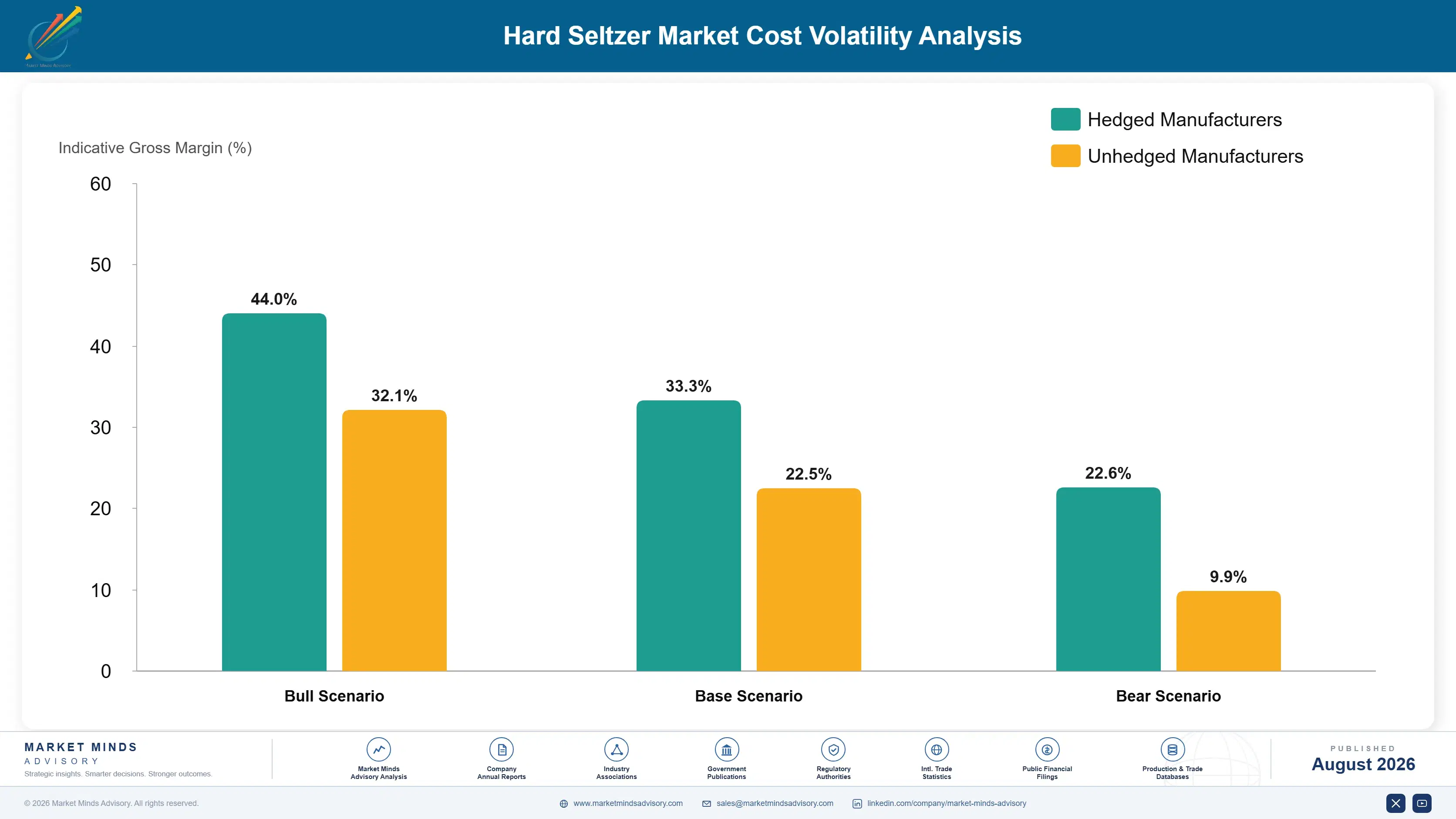
Packaging accounts for roughly 34% of manufactured cost, with aluminium cans the dominant line in a product where the liquid itself is inexpensive. Alcohol base contributes around 18% and varies considerably between fermented malt and purchased spirit. Flavours and sweeteners add about 9%, production and carbonation roughly 12%, and distribution close to 21% given how heavy and low-value canned beverages are per pallet.
Aluminium pricing moved sharply through 2022 and 2023 on energy and metals markets tracked in International Energy Agency data, which hit a category where packaging exceeds every other cost line. Neutral spirit and malt base costs followed grain markets reported in United States Department of Agriculture data across the same period, though from a smaller share of total cost. Producers absorbed most of both movements.

The disadvantage mechanism is packaging cost in a product whose liquid is cheap, and it falls on every producer regardless of base choice. Aluminium exceeds alcohol as a cost line, which makes metals markets more consequential than anything happening in agriculture. Exposure varies by scale rather than by formulation, since large producers hedge and buy at volumes that smaller competitors simply cannot match on terms.
hard-seltzer-market-cost-volatility-analysis-1787460097819

Hedge aluminium with the discipline applied to alcohol inputs

Packaging exceeds alcohol base as a cost line here and metals markets move independently of anything agricultural, which makes hedging discipline more consequential here than in most drinks categories. Extending formal hedging to aluminium absorbs much of any spike. The cost is locking in prices that may prove above market, which is the honest trade against removing that volatility.

Use contract packing rather than owned filling capacity

Category volume proved considerably less durable than the expansion assumed, and owned filling capacity became a fixed cost against volume that disappeared for a great many entrants. Contract packing converts that into variable cost and removes the utilisation risk entirely. The trade is margin given away per case and less control over scheduling, which matters more once volumes stabilise.

Consolidate distribution with wider beverage portfolios

Canned beverages are heavy and low in value per pallet, which makes distribution roughly 21% of cost and difficult to justify on seltzer volume alone after the correction. Moving product through a wider portfolio spreads that cost across more cases. The constraint is that the portfolio has to exist, which is why standalone seltzer businesses struggled most through the contraction.

Portfolio Architecture for Margin Defence

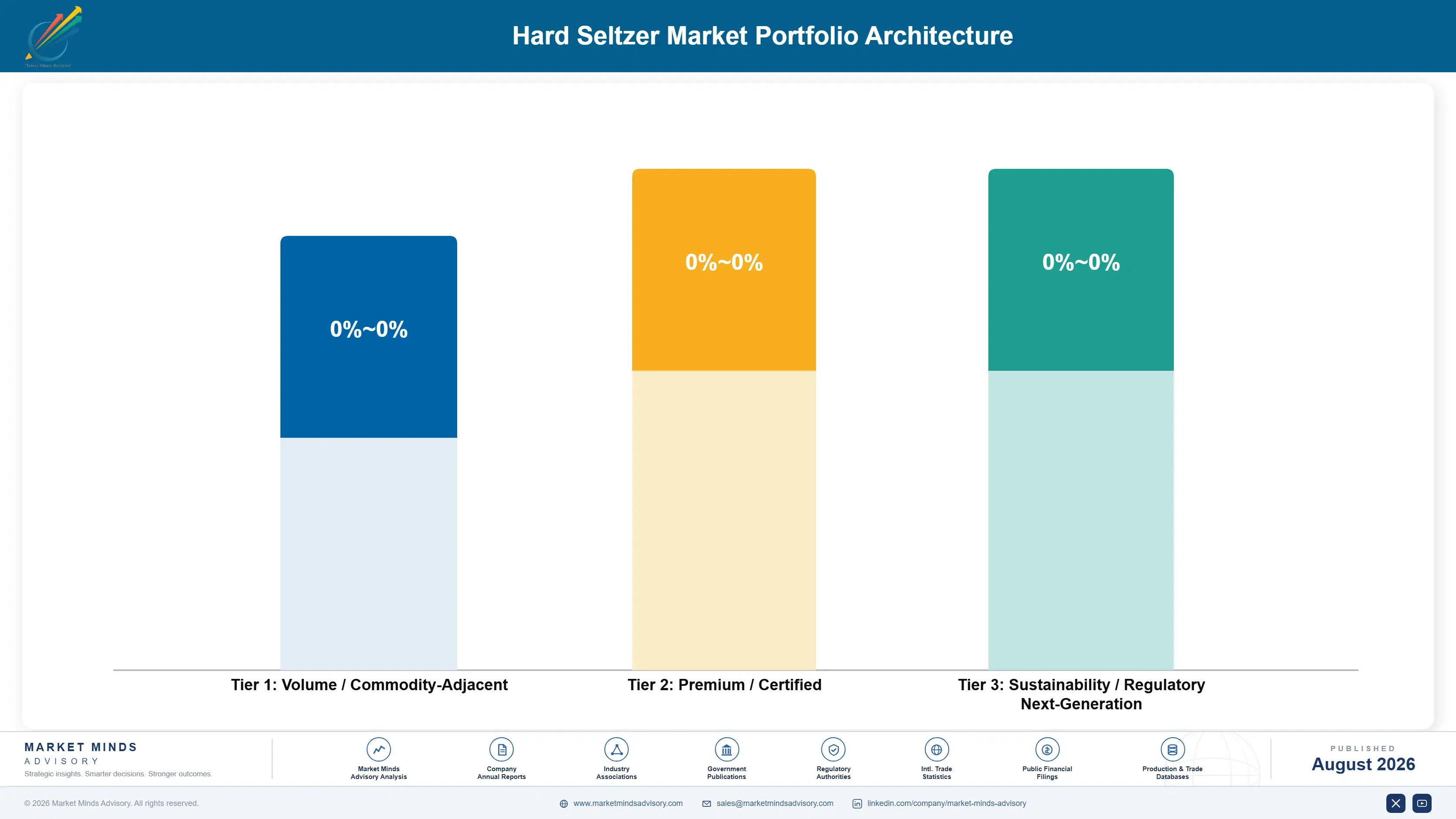
Portfolio economics here divide on alcohol base and channel rather than on flavour, which proliferated wildly during the expansion and told nobody anything useful. Malt-based retail seltzer competing for contested shelf space carries the taste criticism that drove consumers away and faces retailers who have cut range twice already. Recovering that space has proved genuinely difficult. Shelf space went to other categories.
The middle tier is on-premise supply. A venue stocks one seltzer as a category answer, so the listing is decided once rather than contested at every review, and roughly 23% of category value now comes through that channel. Margins reach the mid thirties and the positions proved durable where almost nothing else in this category did. Venue relationships outlasted every shelf position.

Above both sit spirit-based seltzers. Vodka and tequila bases deliver cleaner taste, permit real flavour development and support roughly 48% premium pricing against a buyer choosing between canned cocktails rather than beers. Margins reach the high forties. Spirits licensing is the barrier, which advantages drinks groups already holding those rights considerably. Beer-built businesses cannot access those channels easily. Spirits rights are the gating requirement here.

Volume / Commodity-Adjacent

Malt-based seltzer competing for contested retail shelf space. The range reflects packaging cost and promotional depth rather than product merit, and retailers have already cut range twice. Taste criticism persists here.
Gross Margin: 18 to 26%

Premium / Certified

On-premise supply as the single category answer on a drinks list. The range reflects venue group scale and whether the listing covers a national estate or individual outlets. Positions proved genuinely durable.
Gross Margin: 31 to 40%

Sustainability / Regulatory / Next-Generation

Spirit-based seltzers sold at canned cocktail pricing through spirits channels. The wide range reflects licensing access and whether distribution runs through owned spirits networks or third parties. Licensing decides who competes.
Gross Margin: 43 to 54%
hard-seltzer-market-portfolio-architecture-1787460098321

High-value Sub-segments and Strategic Watch-out

Spirit-Based Seltzer Ranges

High value and high growth together, reaching a buyer choosing against canned cocktails rather than beer. The wide range reflects licensing access and whether distribution runs through owned spirits networks or third-party arrangements instead. Canned cocktail comparison supports it. Taste finally works properly. Licensing gates it.
Gross Margin: 43 to 54%

On-Premise Venue Listings

High value on steady growth and the positions that genuinely held through the correction. The range reflects venue group scale and whether a listing covers a national estate or is negotiated outlet by outlet. Contested reviews do not apply. Decided once, not repeatedly. Reviews rarely touch it.
Gross Margin: 31 to 40%

Low-Alcohol And Functional Variants

A developing pool where the low-calorie proposition extends further and reaches occasions alcoholic versions cannot. The range reflects formulation cost and whether the variant carries genuine functional positioning or only reduced alcohol content. Occasions widen considerably here. The proposition itself survived. Formulation cost varies. Positioning depth differs.
Gross Margin: 28 to 37%

Malt-Based Retail Shelf Ranges

The strategic watch-out. Volumes remain from surviving listings but the taste criticism persists, retailers have cut twice, and recovering lost space has proved genuinely difficult. The range reflects promotional depth rather than product quality. Retailers have already cut twice. Recovery has proved difficult. Promotion is all that remains.
Gross Margin: 18 to 26%

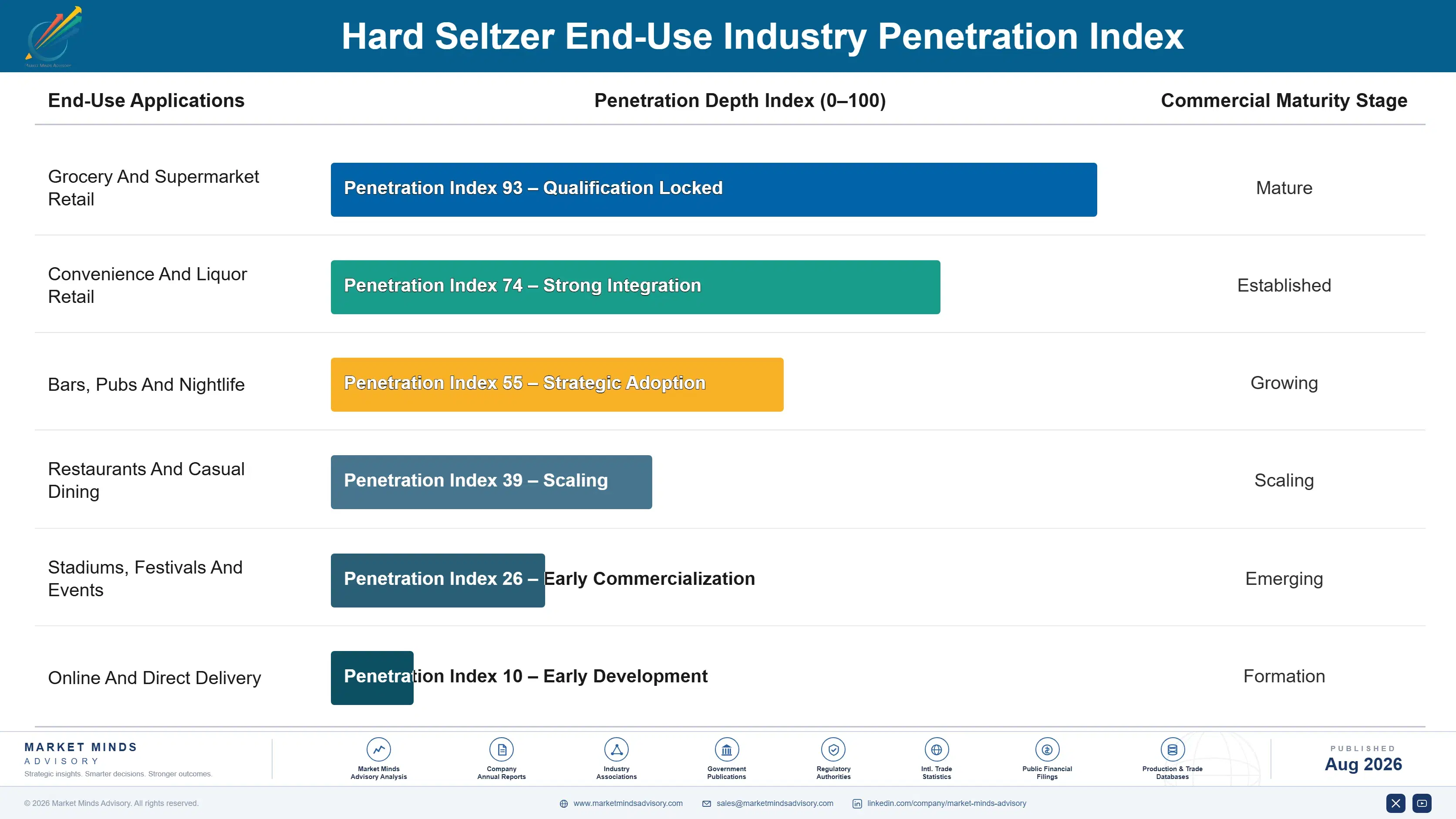
How Hard Seltzer Demand Now Repeats

Repeat purchase here sits near 27% and that single figure explains the correction more completely than any market commentary has. A great many consumers tried hard seltzer during the expansion, found it thin or faintly medicinal, and did not return. Products have improved considerably since, but a consumer who was disappointed once rarely gives a category a second hearing without a reason.
Stickiness varies sharply by channel and base. On-premise listings hold best by a wide margin, since a venue decides once and the drinker orders what is available rather than choosing between brands. Spirit-based products hold well among consumers who found them genuinely good. Malt-based retail holds worst, both because of the taste criticism and because the listings themselves keep getting cut.

The buyer profile has narrowed rather than broadened, which is unusual. The expansion reached a wide population trying something new, and the contraction left a smaller group who genuinely prefer the format. Today's reliable buyer is choosing a low-calorie option deliberately, frequently against a canned cocktail rather than a beer, and is considerably less price sensitive than the trial buyer ever was.
hard-seltzer-market-end-use-penetration-index-1787460098806

Where To Compete And Why

These are among the four positions where our research anticipates prominent divergence between winners and laggards over the coming forecast period. Each is grounded in the demand model, the regulatory perimeter, and the announced capacity pipeline.
01 / SPIRIT BASE CONVERSION

Fermentation left a medicinal note

Malt-based seltzer never fully escaped the faintly medicinal character that fermentation leaves behind, and vodka or tequila bases deliver cleaner taste with genuine flavour development in its place. Spirit-based product now holds roughly 29% of all volume at around 48% premium pricing and reaches a buyer who is choosing against a canned cocktail rather than against a beer. Distribution moves into spirits licensing, which advantages anybody already holding those rights and effectively blocks anybody who does not already hold them.
02 / ON-PREMISE POSITION BUILDING

Venues decide once, shelves constantly

A bar or restaurant stocks one seltzer as a category answer rather than choosing between fifteen competing brands, which makes that listing a decision taken once rather than one contested at every range review. It is why on-premise barely noticed a correction that removed 41% of average retail range. Roughly 23% of total category value now comes through venues, and those positions proved durable where almost nothing else in this category managed to hold on to at all through that period.
03 / COMPETITIVE SET REFRAMING

Beer is the wrong comparison

Positioned against beer, hard seltzer competes on price with an established category holding enormous scale advantages and a consumer who mostly likes beer already. Positioned against canned cocktails it competes on convenience and calories against a format that is itself expanding, at pricing 40% to 50% above what beer comparison permits. The product itself does not change at all; only the competitive set around it does, and any spirit base makes that reframing immediately available to anybody who wants it.
04 / FRESH MARKET ENTRY

Some markets never got disappointed

A great many Western consumers tried hard seltzer during the expansion, found it thin, and have not returned whatever the subsequent improvement, which is what leaves repeat purchase sitting near 27% in the markets where the boom actually happened. Indian and Southeast Asian ready-to-drink categories are now developing without that memory at all, with Indian demand growing near 12.6% annually. Entering there means competing on the product itself rather than against a disappointment that a great many Western consumers already remember rather clearly.

Engagement Snapshot From the Field

A live engagement with an industry participant carrying material or product regulatory and market exposure ahead of a defining policy shift, showing how our research translates into a defensible multi-year portfolio strategy.
MARKET MINDS ADVISORY · CLIENT ENGAGEMENT SUMMARY
Hard Seltzer Producer Strategic Portfolio Review and Transition Roadmap 2026·Investment Scenario on Hard Seltzer Exposure Evaluation 2025-26
CLIENT PROFILE
A North American beverage group with annual revenue near $780 million (client-reported, unverified by MMA), holding a hard seltzer portfolio built entirely on malt base during the category expansion. Retail listings had fallen substantially since peak, owned filling capacity built for the boom ran well below nameplate, and no spirit-based or on-premise position existed anywhere.
STRATEGIC CHALLENGE
Retail range cuts had removed roughly half the client's listings while filling capacity built during the expansion sat idle, and spirit-based competitors were taking the premium positions that remained. Management needed to decide between defending retail shelf space, converting to spirit bases, or building on-premise listings the business had never pursued.
MMA APPROACH
MMA modelled contribution by base, channel and pack across four years of the client's own data, benchmarked spirit-based pricing and licensing requirements against competitors, and assessed on-premise listing economics with venue groups. Twenty-one expert interviews with retail buyers, venue operators and distributors tested each of the routes genuinely available to the business.
KEY FINDINGS
  1. Retail buyers stated plainly that lost listings would not return regardless of product improvement, since released shelf space had gone to categories performing better on rate of sale.
  2. Spirit-based competitors realised roughly 44% higher pricing on comparable pack formats, and the client held no spirits distribution rights in any of its markets.
  3. On-premise listings at three venue groups had survived every review since the correction, and none of those operators had been approached by the client at any point.
  4. Owned filling capacity ran at 41% of nameplate and carried fixed cost that contract packing would have converted entirely into variable cost instead.
CLIENT PROFILE
A North American beverage group with annual revenue near $780 million (client-reported, unverified by MMA), holding a hard seltzer portfolio built entirely on malt base during the category expansion. Retail listings had fallen substantially since peak, owned filling capacity built for the boom ran well below nameplate, and no spirit-based or on-premise position existed anywhere.
STRATEGIC CHALLENGE
Retail range cuts had removed roughly half the client's listings while filling capacity built during the expansion sat idle, and spirit-based competitors were taking the premium positions that remained. Management needed to decide between defending retail shelf space, converting to spirit bases, or building on-premise listings the business had never pursued.
MMA APPROACH
MMA modelled contribution by base, channel and pack across four years of the client's own data, benchmarked spirit-based pricing and licensing requirements against competitors, and assessed on-premise listing economics with venue groups. Twenty-one expert interviews with retail buyers, venue operators and distributors tested each of the routes genuinely available to the business.
KEY FINDINGS
  1. Retail buyers stated plainly that lost listings would not return regardless of product improvement, since released shelf space had gone to categories performing better on rate of sale.
  2. Spirit-based competitors realised roughly 44% higher pricing on comparable pack formats, and the client held no spirits distribution rights in any of its markets.
  3. On-premise listings at three venue groups had survived every review since the correction, and none of those operators had been approached by the client at any point.
  4. Owned filling capacity ran at 41% of nameplate and carried fixed cost that contract packing would have converted entirely into variable cost instead.
RECOMMENDED STRATEGY
Phase 1: Phase one: pursue on-premise listings with venue groups directly, since those positions held through the correction and the client has never approached any of them. Phase 2: Phase two: secure spirit-based capability through licensing partnership rather than acquiring distribution rights, entering the premium position within a workable timeframe. Phase 3: Phase three: convert owned filling to contract packing where utilisation cannot recover, removing fixed cost that volume no longer supports.
OUTCOME
The client secured on-premise listings with two venue groups within ten months and signed a spirit-based licensing partnership (client-reported, unverified by MMA). On-premise reached 18% of volume from nothing, one filling line was converted to contract arrangements, and blended gross margin improved by roughly eight points despite continued retail decline.

Frequently Asked Questions

Foundational context covering the market sizes, CAGR, scope, country, region and competition that inform every finding below. This section is provided to cover basics and most often pre-purchase conversations, answered from the MMA Primary Research Dataset.

What is the current size of the Hard Seltzer Market?

The global hard seltzer market was valued at $11.50 billion in 2025, reaching an estimated $12.51 billion in 2026. That covers hard seltzer and flavoured alcoholic sparkling water across retail and on-premise channels.

How large will the Hard Seltzer Market be by 2036?

MMA forecasts the market reaching $29.08 billion by 2036, an increase of $16.57 billion over the 2026 base. That represents an expansion multiple of 2.32 times across the forecast period.

What is the CAGR for the Hard Seltzer Market 2026 to 2036?

The base case compound annual growth rate is 8.8%, with a bull case of 10.0% and a bear case of 7.6%. Historical growth between 2020 and 2025 ran at 7.7% annually.

Which segment is growing fastest?

Spirit-based seltzers grow at 13.2%, a full 1.50 times the market rate, on cleaner taste and canned cocktail pricing. On-premise channel supply follows at 11.0% annually.

Who are the major companies in the Hard Seltzer Market?

Mark Anthony Brands, Boston Beer Company, Anheuser-Busch InBev, Molson Coors and Constellation Brands lead on hard seltzer revenue. Together they account for roughly 67% after the shakeout.

Which country is growing fastest?

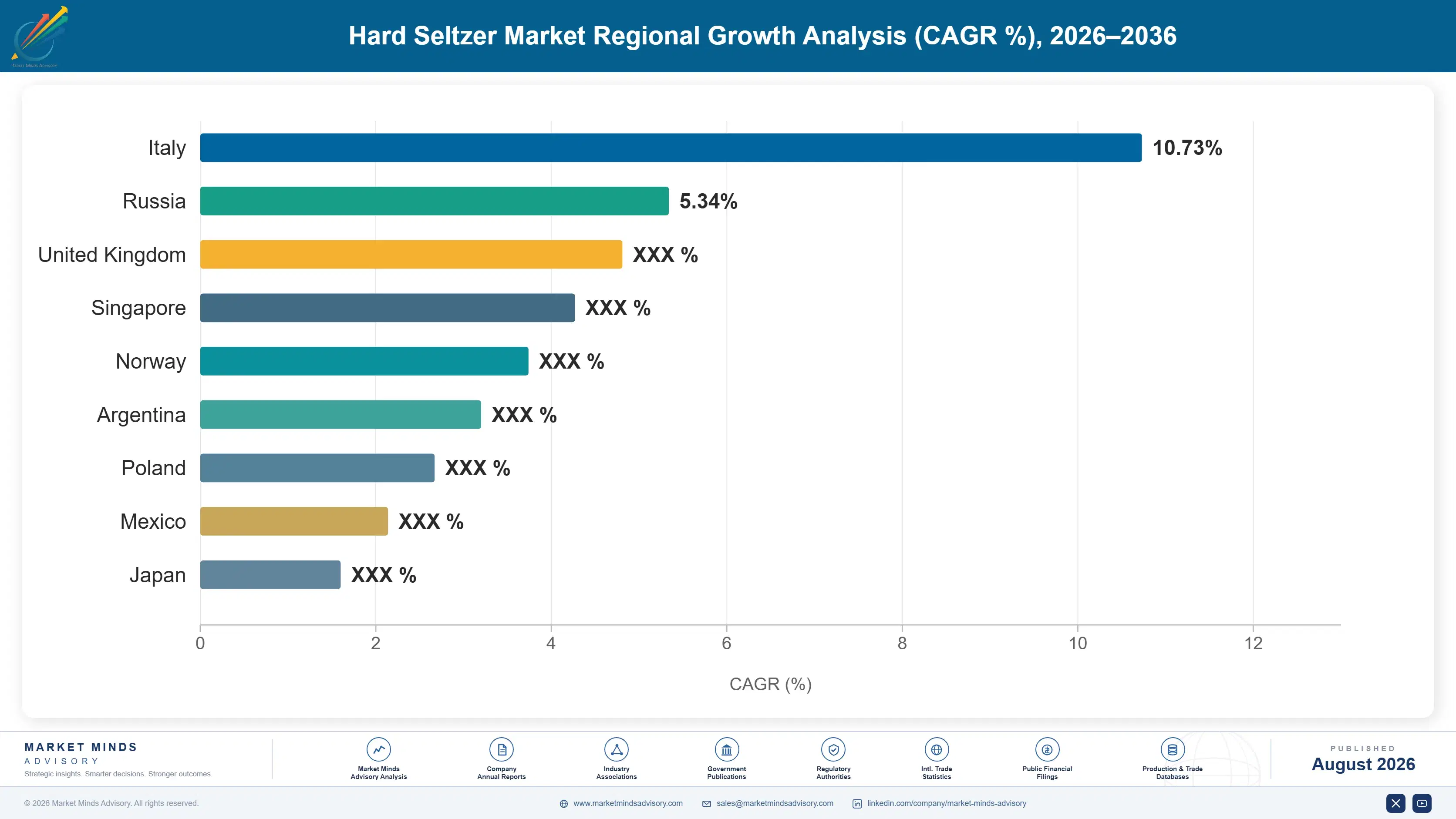
India grows fastest at 12.6% annually as ready-to-drink categories develop without any memory of the Western expansion and correction. Vietnam and Thailand follow closely behind.

Report Segmentation Architecture

The full report scope spans multiple orthogonal segmentation dimensions, with cross-tabulated demand data provided for each dimension pair. Coverage extends further to regional breakdowns, trend trajectories, and the competitive detail needed to support segment-level decision-making.

By Alcohol Base And Channel

  • Spirit-Based Seltzers
  • On-Premise Channel Supply
  • Malt-Based Retail Seltzers
  • Wine And Cider-Based Seltzers
  • Functional And Low-Alcohol Variants

By End-Use Industry

  • Grocery And Supermarket Retail
  • Convenience And Liquor Retail
  • Bars, Pubs And Nightlife
  • Restaurants And Casual Dining
  • Stadiums, Festivals And Events
  • Online And Direct Delivery

By Commercial Dimension

  • Owned Brand Production And Distribution
  • Spirits Licensed Distribution
  • Contract Packing And Co-Manufacturing
  • Retailer Private Label Supply
  • On-Premise Listing Agreements

By Region

  • North America
  • Western Europe
  • East Asia
  • South Asia and Pacific
  • Latin America
  • Middle East and Africa
  • Eastern Europe

Scope, Methodology, and Coverage

Every figure in this report is reproducible from documented input assumptions. The scope below maps the historical period, the forecast horizon, the segmentation dimensions, and the countries covered, alongside the underlying primary and qualitative methodology.
Historical Period
2020 to 2025
Forecast Period
2026 to 2036
Base Year
2025 (USD billions; MMA Primary Research Dataset, August 2026)
Market Definition
This report covers hard seltzer and flavoured alcoholic sparkling water, spanning spirit-based seltzers, on-premise channel supply, malt-based retail seltzers, wine and cider-based seltzers, and functional and low-alcohol variants, across grocery, convenience, on-premise, event and online channels. Ready-to-drink canned cocktails not positioned as seltzer, conventional flavoured malt beverages, alcohol-free sparkling water, beer including flavoured lagers and shandies, hard kombucha, and wine spritzers sold as wine are excluded from the sizing.
Quantitative Units
USD billions at producer realised value; volume in million cases; realised pricing in USD per case.
Segmentation Dimensions
By alcohol base and channel; by end-use industry; by commercial dimension; by region.
Regions Covered
North America, Western Europe, East Asia, South Asia and Pacific, Latin America, Middle East and Africa, Eastern Europe
Countries Covered
United States, Canada, Mexico, Brazil, Chile, United Kingdom, Germany, Sweden, Netherlands, Spain, Poland, Ireland, Australia, Japan, South Korea, China, India, Thailand, Vietnam, South Africa.
Key Companies Profiled
Mark Anthony Brands, Boston Beer Company, Anheuser-Busch InBev, Molson Coors, Constellation Brands, Diageo, Pernod Ricard, Heineken, Suntory Holdings, Asahi Group Holdings, Bacardi, Campari Group, Coca-Cola Company, Sazerac Company and others.
Quantitative Methodology
Primary survey, n=3,800 respondents, Q4 2025, six countries; demand-side model with trade association cross-validation
Qualitative Methodology
47 expert interviews, Q4 2025; applied to validate demand model assumptions, identify emerging dynamics, and assess competitive positioning
Report Format
PDF and XLSX data workbook (Word format preview document)
Publisher
Market Minds Advisory
Report Code
MMA-2026-AGR-285
Published
August 2026
Contact
sales@marketmindsadvisory.com | www.marketmindsadvisory.com

Purchase the full Hard Seltzer Market Report (2026 to 2036).

The full report sizes the hard seltzer market across five base and channel categories, six retail and on-premise channels and seven regions, with case volume and realised pricing detail behind every estimate. It profiles twenty companies on base capability, licensing access and on-premise position. Regional chapters cover adoption, correction depth and competing formats by market. Cost analysis quantifies packaging, alcohol base and distribution exposure by producer scale. Correction analysis measures the retail range reduction, listing recovery and where the category volume has actually settled afterwards.
Case volume and realised pricing by base and channel
Retail range reduction and listing recovery measured by market
Spirit-based against malt-based pricing and taste positioning compared
On-premise listing durability assessed across venue group types
Competitive position assessments across twenty companies
Repeat purchase and trial conversion measured post-correction by region

Built For The People Who Decide

From boardroom strategy to bench-side execution, this report is read cover-to-cover by leaders shaping the next decade of their industry, turning demand scenarios, market dynamics and valuation benchmarks into decisions.
CXOs/ Presidents/ VPs/ Managers
M&A and Corporate Development
Strategy Teams and R&D Heads
Procurement and Product Directors
Regulatory and Compliance Leaders
Investor Relations and Equity Analysts