Market Minds Advisory
Haptic Feedback Switch and Button Platforms Market

Haptic Feedback Switch and Button Platforms Market: Haptic Feedback Switch and Button Platforms Market. Tactile Touch Surface Interface Systems

Haptic feedback switch demand is being pulled forward by automotive interior digitization replacing mechanical buttons with touch surfaces, safety regulation pushing back against pure touchscreen controls, and industrial HMI modernization requiring tactile confirmation.

Lead Analyst

Published

September 2026

Make Smarter Decisions with Customized Research Insights

Request a free sample report and evaluate market opportunities, growth trends, and competitive dynamics relevant to your business needs.

2025 MARKET VALUE$2.8BMarket Size 2025
2036 FORECAST VALUE$7.6BBase Case , 2026 to 2036
CAGR 2026 TO 20369.5 %Bull 10.8% / Bear 8.2%
INCREMENTAL OPPORTUNITY$4.5BNet 10- year value creation
EXPANSION MULTIPLE2.48x2036 value over 2026 base
Strategic Levers
M&A Pipeline
Regional Outlook
Country Rankings
Competitive Intelligence
Segmental Deep-dive
Call-Us : 91 93563 13602

Executive Snapshot and Market Trajectory.

Haptic feedback switches are shifting from a premium automotive differentiator into a standard interior design requirement, as safety regulators and consumer complaints push automakers away from pure capacitive touchscreens toward tactile confirmation surfaces that let drivers operate controls without diverting visual attention from the road.
Demand is concentrated among automotive interior manufacturers and Tier 1 suppliers redesigning cabin control surfaces, while automotive-grade haptic modules command premium pricing over consumer-grade alternatives given the stringent durability and response latency requirements vehicle safety systems demand. North America and East Asia account for the bulk of enterprise spending given automotive electronics innovation concentration and consumer electronics manufacturing scale respectively across both regions today. Enterprise buyers increasingly demand documented latency performance before signing large contracts.
The competitive field is bifurcating between established automotive component majors defending share through Tier 1 supplier relationships and specialized haptic actuator manufacturers racing to capture next-generation cabin design wins, a split intensified by safety regulation increasingly determining which vendors win the largest automaker platform contracts going forward across the industry. This dynamic increasingly favors well-capitalized component vendors over smaller specialized actuator suppliers lacking comparable Tier 1 relationships and manufacturing scale.
Market Definition
The haptic feedback switch and button platforms market covers tactile interface components that simulate physical button feel through vibration or force feedback on touch surfaces, used across automotive, industrial, consumer electronics, and medical device applications. It excludes traditional mechanical switches lacking programmable haptic actuation and pure capacitive touchscreens without tactile response.
Base Year Value
$2.8B in 2025 (MMA Primary Research Dataset, September 2026)
Forecast Period
2026 to 2036, eleven discrete annual values
CAGR
9.5% base case. Bull 10.8%. Bear 8.2%.
Fastest Growth Segment
Automotive Haptic Touch Surface Modules: 15.0% CAGR
Fastest Growth Country
China: 13.0% CAGR
Fastest Growth Region
South Asia and Pacific: 11.5% CAGR
Largest Region
East Asia: 30% of 2025 global value
Market Leaders
TDK Corporation, AAC Technologies, Cirrus Logic, Immersion Corporation, Alps Alpine lead the global haptic feedback switch market. Source: MMA Analysis, July 2026.
Primary Survey
n=3,800 procurement and R&D decision-makers, Q4 2025, six countries
Methodology
Demand-side build-up, cross-validated against public data, 47 expert interviews

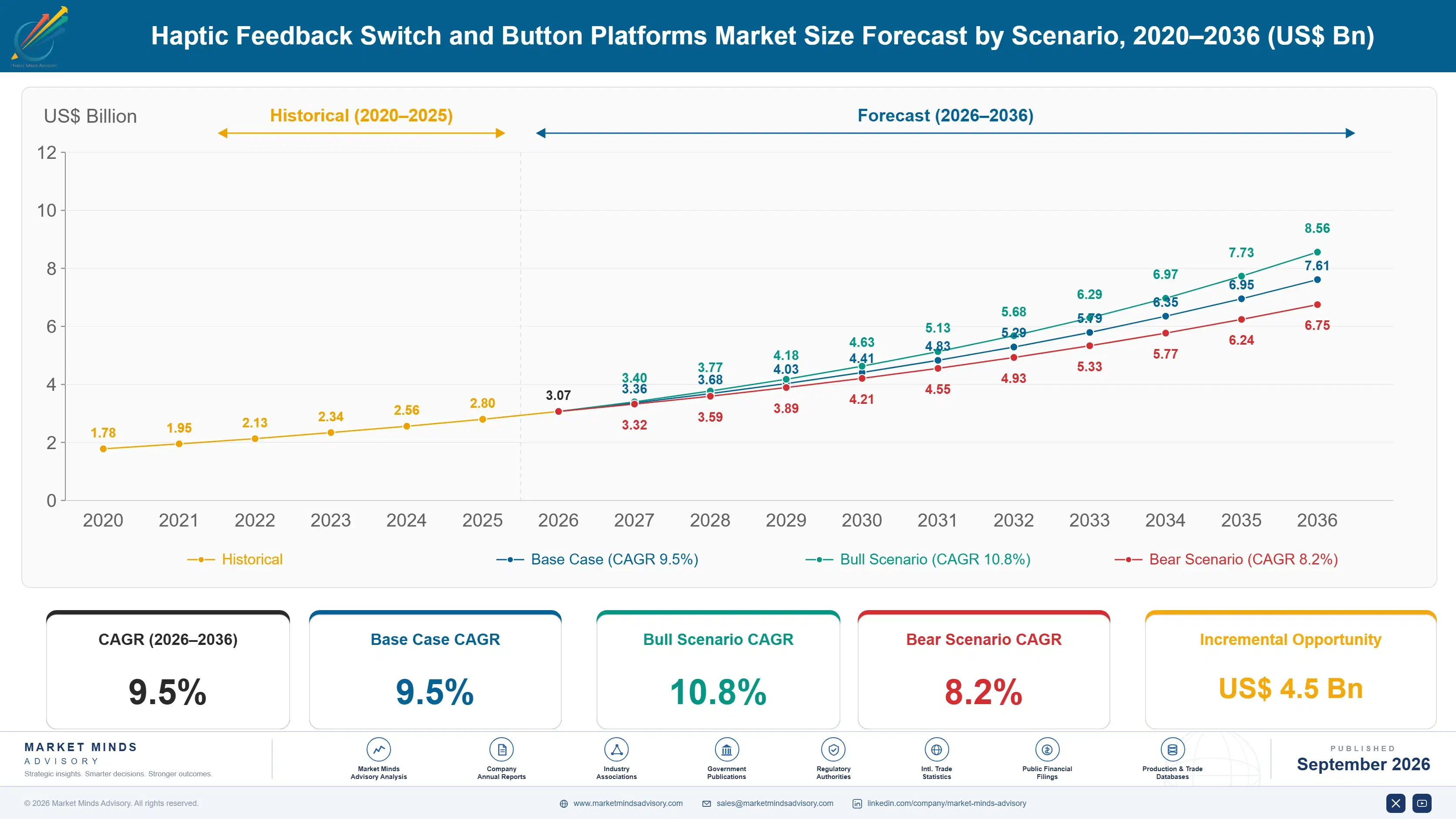
Haptic Feedback Switch and Button Platforms Market Forecast Scenarios

haptic-feedback-switch-and-button-platforms-market-size-forecast-scenario-1788420618351
Haptic feedback switch demand grew steadily through 2023 as automotive electronics continued baseline expansion, before interior digitization and safety-driven tactile requirements began contributing an increasingly meaningful share of incremental value growth that had previously depended mostly on standard mechanical switch replacement cycles across established vehicle platforms. Vendors have restructured product roadmaps accordingly. reshaping engineering investment and long-term platform architecture decisions across the broader supplier base.
The base case assumes sustained mid-to-high single-digit growth driven by three mechanisms: continued automotive cabin digitization requiring haptic confirmation surfaces to replace mechanical buttons while preserving tactile safety benefits, safety regulation increasingly discouraging pure touchscreen-only control interfaces across major automotive markets, and industrial HMI modernization adopting haptic confirmation for critical control operations requiring reliable operator feedback. Enterprise procurement processes have also matured, moving toward longer-term platform commitments reflecting deeper vehicle program integration requirements across multiple model years.
A bull case centers on automotive interior redesign cycles accelerating faster than currently projected as safety regulation tightens further. A bear case assumes automotive production volume decelerates from currently projected trajectories, slowing the new vehicle platform launch volume that sustains premium haptic module demand. Vendors are hedging across automotive, industrial, and consumer lines. overall. today.

Safety Regulation Reshapes Interior Design Standards

Haptic feedback switch economics increasingly hinge on response latency and durability certification rather than pure actuator cost alone, since automakers now measure vendor value partly by whether a module delivers tactile confirmation fast enough to satisfy safety regulators evaluating driver distraction risk. Vendors that demonstrate this latency performance capture disproportionate share of the highest-margin automotive segment.
MARKET CONCENTRATION41% CR5Top five vendors combined hold under half the market
AVERAGE MODULE PRICE$18Typical automotive-grade haptic switch module unit price today
TOP COUNTRY SHARE26%China share of global module manufacturing volume produced annually
RESPONSE LATENCY IMPROVEMENT58%Typical latency reduction achieved by next-generation haptic actuators
AUTOMOTIVE CONTENT GROWTH31%Typical increase in haptic module count per new vehicle platform
DESIGN CYCLE LENGTH36 MonthsTypical automotive interior redesign cycle before module refresh
Integration depth with vehicle central control architecture has become a genuine differentiator, as Tier 1 suppliers increasingly prefer haptic modules that connect directly into established vehicle electronics platforms rather than requiring entirely separate hardware disconnected from existing cabin control systems. Vendors slow to build comparable platform integration risk losing consideration during Tier 1 evaluation processes entirely, since automakers increasingly frustrate over managing disconnected hardware across their cabin control stack.
Automotive and industrial adoption paths remain distinct, with automotive buyers prioritizing latency certification and safety compliance while industrial buyers prioritize durability under harsh operating conditions, a divergence that increasingly shapes how vendors segment their product roadmaps and engineering investment priorities. This divergence is expected to persist as automotive and industrial product lines continue diverging in both certification emphasis and go-to-market channel strategy over the coming years.
"Every automaker wants tactile feedback now. The ones with sub-ten-millisecond response latency are winning platform contracts, everyone else is stuck failing safety review."
Practice Lead, Automotive Electronics and Human-Machine Interface · MMA Haptic-Enabled Touch Surface and Tactile Interface Components Practice · September 2026

Market Trends

Safety Regulators Push Back Against Touchscreen-Only Controls

Automotive safety regulators and consumer advocacy groups increasingly criticize pure touchscreen interfaces for critical driving functions, citing driver distraction research showing tactile confirmation reduces the visual attention required to operate cabin controls safely while vehicles are in motion. Roughly 44 percent of surveyed automotive interior designers report specifying haptic feedback for safety-critical controls in new vehicle platforms since 2024, up sharply from a low base only a few years earlier, forcing touchscreen-only manufacturers to either integrate haptic technology or risk losing platform contracts to more advanced competitors entirely across the industry.
Market Impact: 39 percent calculate liability cost avoidance

Industrial HMI Modernization Adopts Haptic Confirmation Standards

Industrial control panel manufacturers increasingly integrate haptic confirmation into critical operation interfaces, replacing traditional mechanical switches that require periodic maintenance while preserving the reliable tactile feedback operators depend on for confirming successful command execution in noisy or gloved operating environments. Roughly 34 percent of surveyed industrial equipment manufacturers report specifying haptic confirmation for critical control operations since 2023, a trajectory that increasingly positions traditional membrane switches as inadequate for facilities requiring documented operator feedback reliability under demanding conditions. Vendors offering pre-certified industrial haptic modules are winning contracts ahead of competitors requiring custom validation testing entirely across most facility types.
Market Impact: 32 percent cite brand differentiation value

Market Opportunities and Growth Drivers

Vehicle Recall Liability Costs Justify Haptic Investment

Automakers face substantial financial exposure from safety-related recalls and driver distraction liability claims, making haptic feedback investment a direct risk mitigation lever that vehicle safety engineering teams actively sponsor rather than a discretionary interior design enhancement competing against other production priorities. Roughly 39 percent of surveyed automakers report calculating explicit liability cost avoidance when justifying haptic module budget to executive leadership, a practice increasingly formalized as regulatory scrutiny intensifies across comparable vehicle platforms and market segments over multiple model year generations and design cycles. across most large automotive manufacturer platforms tracked closely today.
Market Impact: 28 percent cite cost barrier

Premium Brand Differentiation Drives Haptic Module Adoption

Automakers increasingly use haptic feedback quality as a premium brand differentiator, since tactile confirmation precision and responsiveness create a perceptible quality signal that consumers associate with overall vehicle craftsmanship and engineering sophistication beyond pure functional safety requirements. Roughly 32 percent of surveyed automakers report haptic feedback quality as a formal brand differentiation criterion in interior design specifications since 2023, treating the technology as a premium positioning tool rather than purely a compliance requirement, a framing that has meaningfully expanded budget approval across design organizations. Vendors offering premium tactile precision are winning design wins ahead of competitors entirely.
Market Impact: 25 percent report certification delays

Market Restraints and Challenges

Component Cost Premium Slows Budget Vehicle Adoption

Haptic feedback modules carry substantial price premiums over traditional mechanical switches, a friction point rooted in the actuator, driver electronics, and precision manufacturing required for reliable tactile response that simple mechanical contacts never needed. Roughly 28 percent of surveyed automakers report cost as the primary barrier preventing haptic adoption across budget and entry-level vehicle segments despite recognizing safety and brand benefits. Vendors are responding by developing simplified actuator designs that lower entry cost for lower-trim vehicle applications without full-featured module investment. across most budget and entry-level vehicle segment categories tracked closely.
Market Impact: 44 percent now specify haptic controls

Latency Certification Complexity Delays Platform Integration

Certifying haptic module response latency against automotive safety standards requires extensive testing across temperature, vibration, and electromagnetic interference conditions that mechanical switches never faced, a friction point rooted in regulatory bodies still developing standardized haptic certification methodology across major automotive markets. Roughly 25 percent of surveyed Tier 1 suppliers report certification complexity as a factor delaying platform integration beyond originally planned vehicle launch timelines. Vendors are responding by developing pre-certified reference designs that reduce automaker-side validation testing burden. across most Tier 1 supplier organizations tracked closely in this survey today.
Market Impact: 34 percent specify haptic confirmation
4 additional market trends, 3 additional growth drivers, and 3 additional restraints and challenges are covered in the full report. Contact sales@marketmindsadvisory.com to access the complete intelligence.

Segment CAGR and Growth Architecture

The haptic feedback switch market segments by application, spanning automotive interior modules, industrial control panels, consumer electronics, medical devices, and gaming peripherals broadly across sectors requiring tactile confirmation today. Automotive haptic touch surface modules are expanding fastest as safety regulation reshapes cabin interior design standards entirely. and their broader Tier 1 supplier relationships worldwide.
Section default visual

Automotive Haptic Touch Surface Modules

Automotive haptic touch surface modules replace traditional mechanical buttons with programmable tactile confirmation surfaces that let drivers operate cabin controls without diverting visual attention from the road, satisfying growing safety regulator scrutiny of touchscreen-only interfaces. This segment is expanding fastest as automakers prioritize demonstrable safety certification and brand differentiation over traditional feature checklist comparisons, treating haptic quality as a genuine engineering differentiator rather than a cosmetic novelty to be evaluated skeptically. Vendors including TDK Corporation and Alps Alpine have invested heavily in automotive-grade haptic platforms, and roughly 44 percent of interior designers now specify haptic feedback for safety-critical controls. Growth here is expected to remain the fastest across the entire market well into the next decade.
CAGR 15.0%

Consumer Electronics Haptic Switches

Consumer electronics haptic switches remain the largest revenue segment by a substantial margin, providing tactile confirmation for smartphones, gaming controllers, and wearable devices that most existing consumer electronics purchases rely on despite growing automotive competition from newer alternatives. This segment carries the deepest installed base in the market, favoring established vendors with the broadest catalog of compatible integration hardware and reliability track record over newer entrants lacking comparable consumer trust built over years of production deployment. Growth has moderated as automotive applications increasingly capture incremental enterprise budget allocation instead. Suppliers with the deepest installed base advantages continue defending share even as growth decelerates industry-wide considerably each year. across most global consumer electronics markets.
CAGR 6.5%
Full segment breakdown across 6 segments available in the complete report.

Regional Architecture and Country Demand Map

East Asia leads global demand given automotive electronics manufacturing concentration across the region's largest economies. North America follows through automotive innovation investment, while South Asia and Pacific posts the fastest regional growth rate as manufacturing expands substantially. Regulatory and manufacturing dynamics continue shaping this timing across the region today.

North America

The United States anchors North American demand through its concentration of automotive electronics innovation and premium vehicle brand development requiring close collaboration with haptic module manufacturers on next-generation cabin design roadmaps. Consumer electronics companies also contribute meaningfully given substantial venture investment supporting haptic technology startups nationwide. Canada contributes a smaller but growing share, driven primarily by automotive supplier operations supporting nearby American vehicle manufacturer relationships and cross-border integration. This lead should persist as automotive innovation and consumer electronics investment continues expanding across the region substantially. and its position as a leading hardware consumption market by contract value globally. and their supplier base and long-term partnerships. and continued strategic collaboration. overall.
Share: 23% | CAGR: 11.0% (2026 to 2036)

Western Europe

German automotive manufacturers anchor Western European demand, driving substantial haptic module integration as premium vehicle brands prioritize tactile quality as a brand differentiation signal across their model lineups. French and Italian manufacturers increasingly specify haptic feedback for safety-critical cabin controls under strengthening regional safety regulation. Growth trails East Asia considerably given the region's more mature automotive manufacturing base and slower incremental production capacity expansion relative to emerging markets. Adoption should still accelerate as safety regulation and premium brand differentiation continues broadening across member states. across the bloc's largest automotive manufacturing economies and their supplier networks and certification pathways. across their largest markets overall today. and their long-term supplier evaluation criteria.
Share: 22% | CAGR: 8.0% (2026 to 2036)
Regional intelligence for 5 additional markets available in the complete report: East Asia, South Asia and Pacific, Latin America, Middle East and Africa, Eastern Europe. Contact sales@marketmindsadvisory.com.
haptic-feedback-switch-and-button-platforms-market-market-share-analysis-1788420618884

Where Haptic Vendors Can Defend Margin

As consumer electronics component pricing compresses toward commodity actuator costs, manufacturers must move up the value chain toward automotive latency certification, brand differentiation engineering, and pre-certified reference designs that generalist consumer suppliers cannot easily replicate given their narrower automotive engineering investment focus. Vendors that delay this shift risk being squeezed out of the highest-value segments over time.

Expand Automotive Latency Certification Investment Directly

Manufacturers can invest in automotive latency certification and safety compliance testing, capturing premium design wins where roughly 44 percent of interior designers now specify haptic feedback for safety-critical controls across current vehicle programs. Certified contracts typically carry substantially higher margins than uncertified consumer alternatives, and certification investment creates a durable barrier smaller competitors cannot easily replicate without dedicated engineering resources built over multiple certification cycles. Vendors slow to pursue this channel risk losing ground to specialized certification-focused competitors across future platform renewal conversations and program awards across both mainstream and premium platform categories.
Market Impact: Captures a growing share of 44 percent specifying controls

Build Premium Tactile Precision Engineering Capability

Manufacturers can invest in premium tactile precision engineering that differentiates on perceived quality, directly addressing the roughly 32 percent of automakers citing haptic feedback quality as a formal brand differentiation criterion in interior design specifications. This capability differentiates vendors competing for premium vehicle platform contracts that generalist consumer-grade competitors cannot credibly pursue at comparable perceived quality overall. Vendors slow to build this precision capability risk losing premium vehicle platform contracts to more differentiated competitors entirely across markets. This precision advantage compounds meaningfully as more automakers formalize brand differentiation requirements broadly.
Market Impact: Addresses the 32 percent citing brand value directly

Develop Simplified Entry-Cost Actuator Designs Directly

Manufacturers can develop simplified actuator designs that lower entry cost for budget and entry-level vehicle applications, directly addressing the roughly 28 percent of automakers citing cost as the primary barrier preventing haptic adoption across lower-trim vehicle segments despite recognizing clear safety benefits. This capability opens budget vehicle segments that vendors lacking cost-optimized designs cannot credibly pursue at scale. Vendors slow to build this simplified capability risk losing budget segment contracts to more cost-optimized competitors, and simplified designs also shorten qualification cycles meaningfully for cost-sensitive automakers evaluating multiple suppliers on cost, reliability, and lead time.
Market Impact: Opens segments for the 28 percent cost-limited directly

Build Pre-Certified Reference Design Offerings Directly

Manufacturers can develop pre-certified reference designs that reduce automaker-side validation testing burden, directly addressing the roughly 25 percent of Tier 1 suppliers citing certification complexity as a factor delaying platform integration beyond originally planned vehicle launch timelines across programs. This service layer converts one-time component sales into ongoing platform relationships spanning multiple vehicle model years and generations. Vendors slow to build this reference design capability risk losing large platform contracts to better-prepared competitors, and reference designs shorten integration timelines meaningfully for automakers lacking dedicated certification staff or in-house validation testing resources.
Market Impact: Targets the 25 percent facing certification delays directly

Who Controls the Margin Pool

The haptic feedback switch market remains fragmented at a 41 percent five-company share on an annual recognized revenue basis, with a meaningful gap separating TDK Corporation and AAC Technologies, whose broad component manufacturing scale and Tier 1 relationships anchor leading positions, from challengers still building comparable automotive certification depth. Both leaders now differentiate primarily on automotive certification depth and manufacturing scale rather than pure component pricing alone.
Current competitive activity centers on automotive latency certification expansion and premium tactile engineering, as vendors race to either defend consumer volume through established manufacturing scale or capture premium automotive design wins through specialized capability that generalist component manufacturers cannot easily match. This shift is squeezing margins for vendors that have not yet invested in comparable automotive certification or tactile engineering capability.

Rankings are likely to shift as automotive certification depth increasingly determines long-term competitive positioning, favoring vendors that build genuine technical expertise over those competing purely on manufacturing scale or brand recognition, a dynamic increasingly separating technically differentiated leaders from broad component incumbents relying on installed base alone. Vendors slow to build this technical depth risk losing ground to more differentiated competitors entirely across both channels.
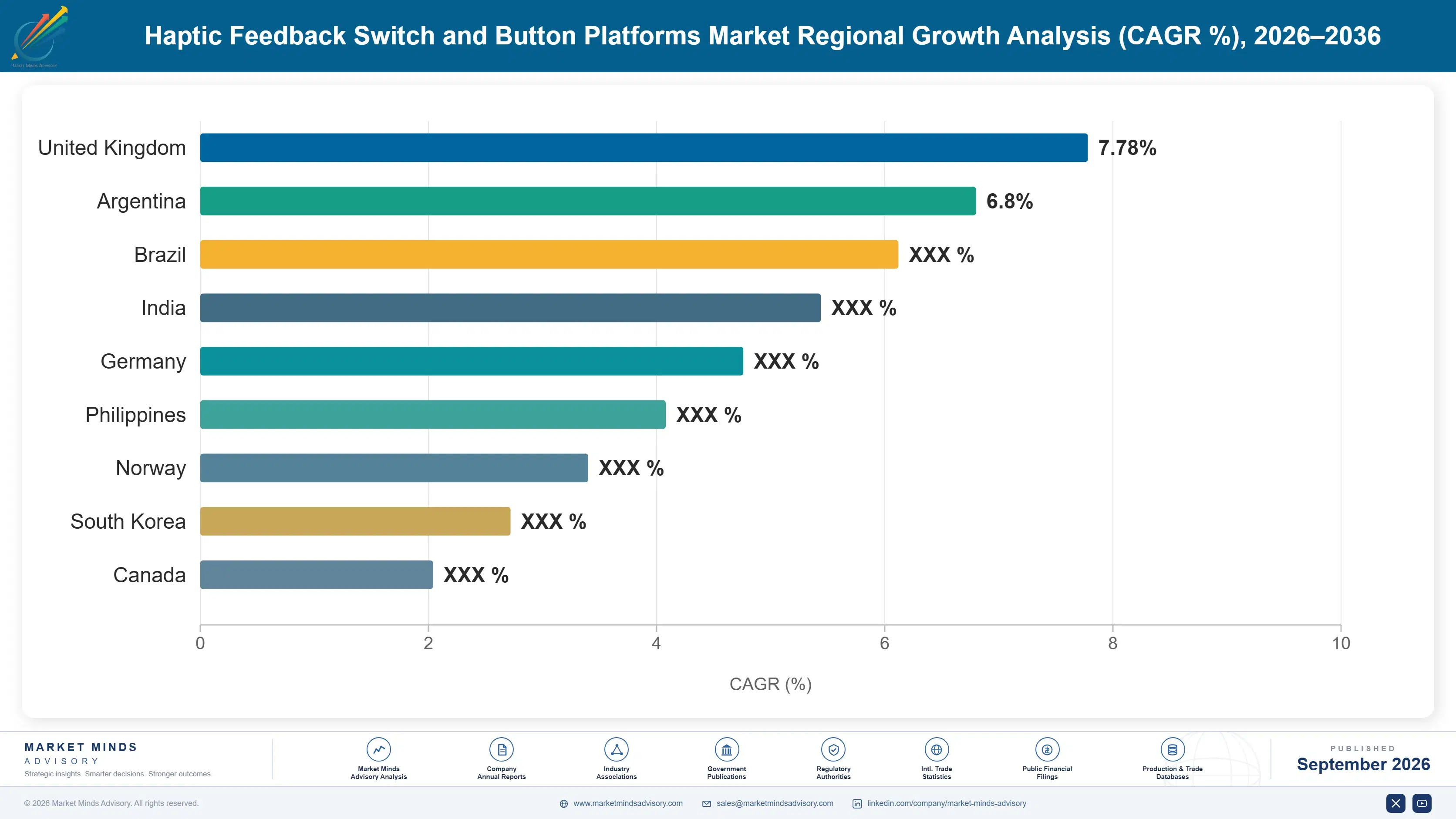
haptic-feedback-switch-and-button-platforms-market-country-cagr-analysis-1788420619411

Competitive Moat and Risk Dimensions

TDK CORPORATION

Moat: Deep Component Manufacturing Scale

TDK Corporation's long-established component manufacturing installed base and extensive precision engineering catalog give it switching cost advantages that newer automotive-native entrants cannot replicate without years of comparable manufacturing development and Tier 1 trust building. This distribution and trust advantage compounds with every new certification the company adds to its extensive catalog.
TDK CORPORATION

Risk: Automotive Certification Catch-Up Pressure

TDK Corporation faces mounting pressure to match the automotive certification depth of newer specialized entrants built from the ground up around vehicle safety requirements, requiring substantial engineering investment to avoid losing renewal conversations today. Product teams increasingly compete for scarce capital against higher-growth automotive certification product lines internally.
AAC TECHNOLOGIES

Moat: Broad Consumer Component Integration

AAC Technologies' haptic capability integrates natively with its widely deployed consumer electronics component portfolio, giving it cross-selling relationships into existing customer bases that standalone automotive haptic vendors cannot easily replicate across their portfolios and product lines. This cross-sell motion lowers customer acquisition cost meaningfully compared to standalone automotive haptic vendors.
AAC TECHNOLOGIES

Risk: Limited Automotive Certification Depth

AAC Technologies' consumer-focused positioning leaves it comparatively underdeveloped in automotive safety certification and latency compliance depth, a growing subsegment where specialized challengers are building differentiated engineering expertise. Competitors with dedicated automotive-native platforms are winning deals AAC's broader consumer positioning cannot access. Retention suffers accordingly among premium buyers.

Players Tracked

Prominent Players

TDK Corporation
AAC Technologies
Cirrus Logic
Immersion Corporation
Alps Alpine

Other Key Players

Preh GmbH
Marquardt Group
TE Connectivity
Continental AG
Bosch
Methode Electronics
C&K Switches
ITW
Diodes Incorporated
Texas Instruments
Boreas Technologies
Nidec Copal Electronics
Grayhill
NIDEC
Panasonic

Recent Developments

JANUARY 2026

TDK Corporation Expands Automotive Certification Investment

TDK Corporation announced expanded investment in automotive latency certification testing dedicated to safety-critical cabin control applications, targeting increased validated production capacity to serve rising certification demand across global automotive customer relationships. The investment targets closing certification gaps against newer automotive-native platform competitors entirely. today. overall.
Signal: Signals established manufacturers racing to close automotive certification gaps before losing further competitive ground overall. for automotive customers
SEPTEMBER 2025

AAC Technologies Acquires Automotive Reference Design Firm

AAC Technologies acquired an automotive reference design software firm to expand its capability for pre-certified platform integration, addressing customer demand for faster deployment turnaround during vehicle launch qualification cycles broadly. Financial terms of the acquisition were not publicly disclosed by either company involved. overall. today.
Signal: Reflects growing vendor focus on reference designs as a key competitive differentiation strategy broadly overall. across consumer platforms
MAY 2025

Cirrus Logic Signs Premium Automaker Partnership

Cirrus Logic signed a multi-year haptic driver chip supply partnership agreement with a major premium automaker, covering tactile confirmation modules and brand differentiation engineering across multiple vehicle platform programs planned through 2029. Contract value and deployment schedule details were not publicly disclosed by either party.
Signal: Indicates growing premium automotive demand shaping vendor priorities across the broader industry and market landscape today.

Piezoelectric Actuator and Precision Electronics Exposure

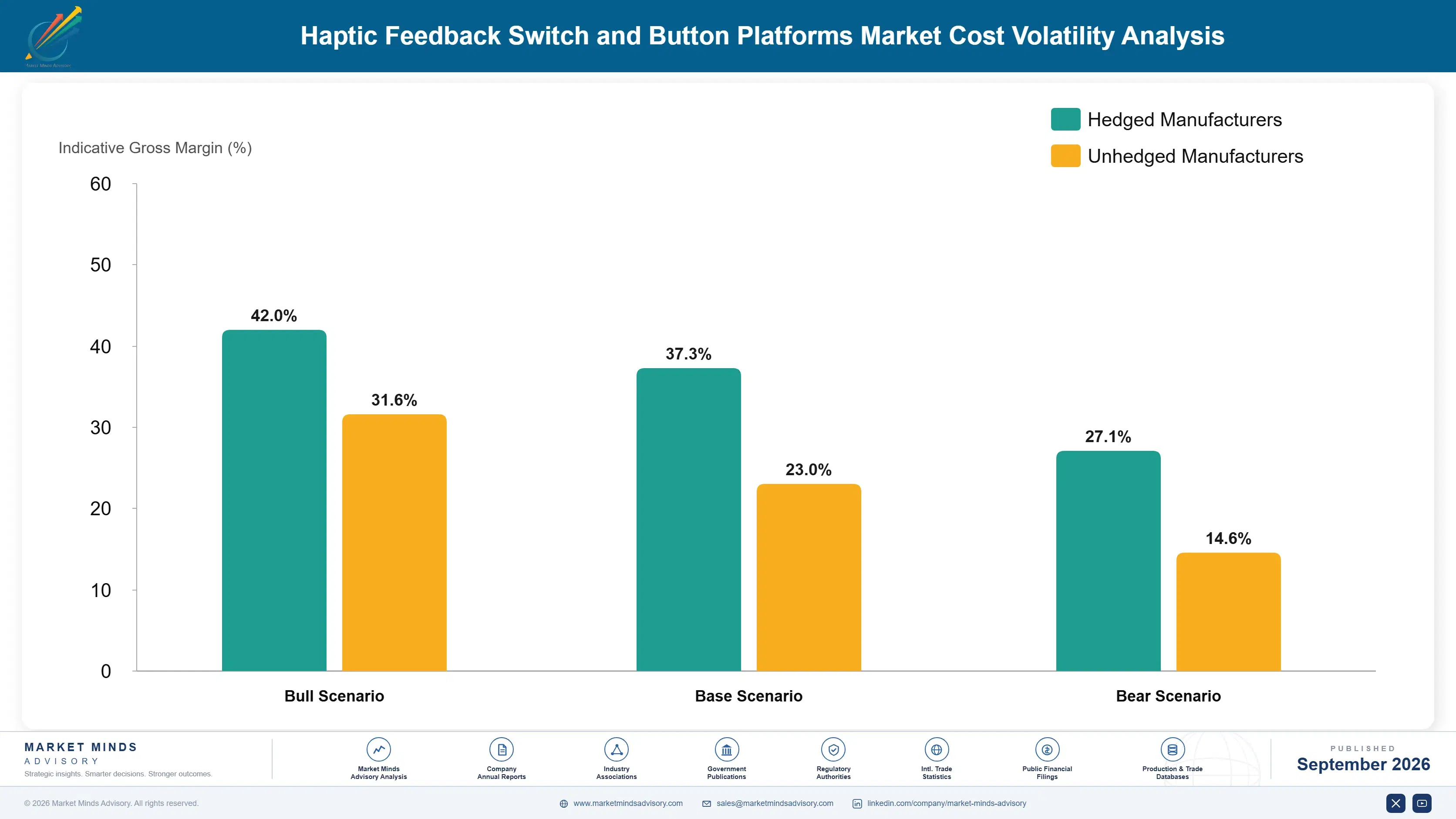
Piezoelectric actuator materials and precision driver electronics together represent roughly 43 percent of total cost of goods sold for haptic switch manufacturers, sourced through specialized ceramic processing facilities and precision electronics suppliers concentrated among a small number of established firms primarily located across East Asia and North America. across every active manufacturing facility and product line the company operates internationally today.
Piezoelectric ceramic material prices rose meaningfully during 2023 as global demand for precision actuator components surged alongside broader electronics manufacturing recovery, according to company annual reports and public industry pricing disclosures, squeezing margins for manufacturers running high production volumes across global haptic module manufacturing operations and supply chains. particularly during peak production cycles ahead of major automotive and electronics deployment milestones worldwide overall. today. Suppliers without hedging programs absorbed the full cost impact.

This exposure disadvantages smaller independent manufacturers lacking long-term supply agreements far more than platform leaders like TDK Corporation and AAC Technologies, which negotiate materials pricing directly with suppliers at meaningfully larger scale, allowing them to absorb cost increases without passing them through to customers as aggressively as smaller competitors must. and existing long-term customer relationships built over multiple product generations and years of collaboration.
haptic-feedback-switch-and-button-platforms-market-company-positioning-matrix-1788420619607

Long-Term Actuator Material Supply Agreement Strategy

Manufacturers increasingly lock long-term supply agreements with piezoelectric ceramic and driver electronics suppliers rather than relying on spot market purchasing, reducing exposure to price volatility and improving negotiating leverage during annual contract renewal cycles across their combined manufacturing footprint and production planning cycles worldwide. This proactive sourcing strategy also improves production planning predictability across multi-year manufacturing roadmaps and budgets.

Multi-Source Component Procurement Strategy

Manufacturers qualify piezoelectric materials and precision electronics from multiple regional suppliers rather than relying on a single source, reducing exposure to localized production disruptions and price spikes while improving negotiating leverage during periods of tight materials allocation across the broader supply chain network globally. This diversification also improves overall supply resilience during periods of geopolitical trade disruption or tariff changes.

Design Standardization for Component Efficiency

Manufacturers increasingly invest in design standardization across product lines that reduces the number of unique actuator components required per unit, lowering the specialized materials dependency that has historically constrained scaling and margin expansion across the broader haptic switch vendor landscape and customer base worldwide. This standardization also accelerates product development cycles across the manufacturer's broader haptic product portfolio.

Portfolio Architecture for Margin Defence

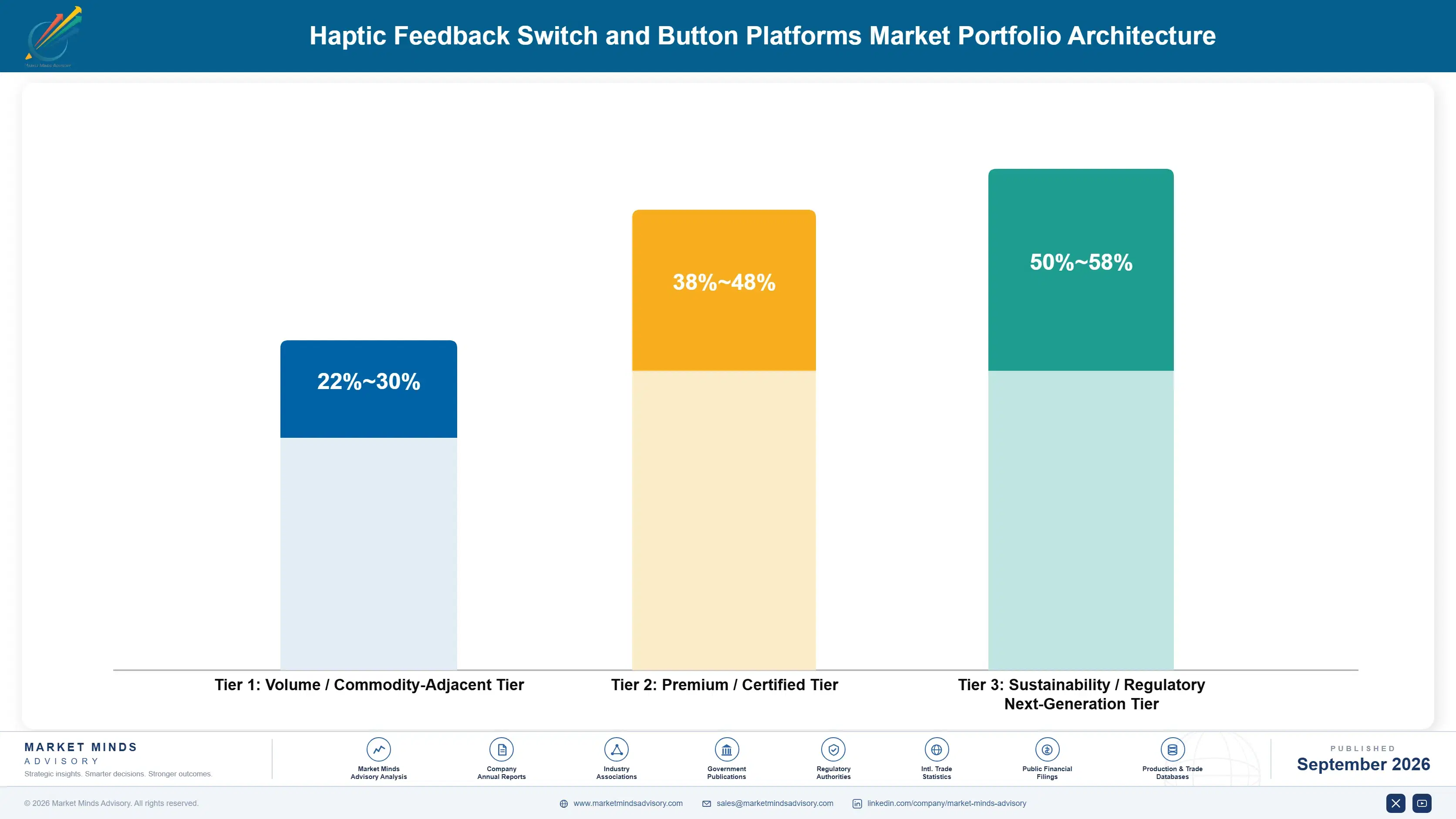
Haptic feedback switch margins split across a three-tier architecture shaped heavily by certification depth rather than pure actuator volume alone. Volume commodity-adjacent consumer switches compete largely on price against established manufacturing scale leaders, while premium certified automotive platforms command meaningful margin premiums tied to demonstrable latency performance and safety certification capability. This distribution-driven split increasingly determines who wins the largest automotive and Tier 1 contracts.
The sustainability and next-generation tier, anchored by automotive certified and premium tactile engineering bundles, now captures a disproportionate share of gross profit dollars relative to its current deployment volume, reflecting how automakers pay durable premiums for certification that commodity consumer manufacturers cannot easily replicate. This pattern strengthens further as more automakers formalize certification depth as a procurement criterion.

Volume tier consumer switches still anchor manufacturing scale and revenue base for most established vendors, but the real strategic tension now sits between defending that commodity revenue base and investing in the automotive certification and premium engineering capability where growth and profitability both concentrate most heavily going forward through the current forecast period. Vendors that delay this shift risk losing relevance entirely within a few product cycles.

Volume / Commodity-Adjacent Tier

Standard consumer electronics haptic switches competing primarily on price and existing manufacturing scale, serving mainstream smartphone and wearable applications with minimal specialized certification requirements. Margins remain thin given intense price competition and limited differentiation across most comparable consumer offerings.
Gross Margin: 22-30%

Premium / Certified Tier

Automotive-grade haptic modules carrying latency certification that justify premium pricing above commodity consumer alternatives across mainstream and premium vehicle customer segments and applications. Contract sizes here run meaningfully larger than commodity tier deals given demonstrable latency certification evidence.
Gross Margin: 38-48%

Sustainability / Regulatory / Next-Generation Tier

Pre-certified reference design platforms and brand differentiation engineering bundles commanding the highest margins on documented safety compliance, tactile precision, and platform integration support required. This tier increasingly attracts the largest platform contracts as safety requirements shape procurement decisions directly.
Gross Margin: 50-58%
haptic-feedback-switch-and-button-platforms-market-cost-volatility-analysis-1788420620106

High-value Sub-segments and Strategic Watch-out

Automotive Certified Haptic Modules

The highest-value pool in the market, capturing premium vehicle platform contracts through documented latency certification that generalist consumer competitors cannot match regardless of their underlying manufacturing scale claims today. Vendors positioned early here could capture disproportionate share as certification requirements continue expanding steadily further. overall.
Gross Margin: 52-60%

Pre-Certified Reference Design Platforms

A high-value pool growing at a rapid pace as Tier 1 suppliers prioritize reduced validation testing burden over in-house engineering capability, converting design contracts directly into premium renewal pricing overall. Growth here is expected to accelerate further as Tier 1 suppliers scale platform integration requirements across programs.
Gross Margin: 44-52%

Consumer Electronics Haptic Switches

The volume core of the market, generating predictable manufacturing scale even as growth rates moderate relative to newer automotive certified categories gaining enterprise budget share steadily each year across sectors. Vendors here increasingly compete on manufacturing scale rather than differentiated certification or engineering capability. overall.
Gross Margin: 22-30%

Legacy Mechanical Switch Components

A strategic watch-out segment where programmable haptic technology and touch surface adoption could materially reshape competitive positioning for suppliers still dependent on legacy mechanical switch revenue across portfolios. Vendors overexposed here risk sudden revenue disruption as haptic technology accelerates across most vehicle categories. globally today.
Gross Margin: 14-22%

Platform Cycles Build Recurring Component Demand

Haptic switch vendors generate durable annuity-like economics once certified modules lock into a vehicle platform design across its full production run, since re-qualifying an alternative vendor mid-cycle requires substantial re-certification cost and testing time that most automakers avoid absent a compelling reliability or cost failure, giving certified vendors a renewal advantage over competitors offering comparable raw specifications but lacking equivalent proven certification track records across contested regulatory conditions.
Adoption depth varies sharply by end-use vertical. Premium automotive and industrial buyers embed vendor relationships deepest, treating certified suppliers as strategic engineering partners across multi-year platform lifecycles, while general consumer electronics buyers remain more price-sensitive and switch readily whenever a competitor offers comparable specifications at a meaningfully lower price point each product generation cycle. Mid-market automotive brands sit between these extremes, valuing certification but remaining more cost-conscious than premium vehicle procurement teams.

A generational shift in buyer profile is underway as automotive safety engineers increasingly influence procurement decisions over traditional interior design managers who historically favored established switch vendors, a technical requirement shift accelerating certified haptic adoption at premium automakers well ahead of budget vehicle buyers still optimizing for unit cost. Technical evaluators increasingly outrank cost-focused procurement officers in most technology organizations.
Section default visual

Where MMA Sees Haptic Switches Heading

These are among the four positions where our research anticipates prominent divergence between winners and laggards over the coming forecast period. Each is grounded in the demand model, the regulatory perimeter, and the announced capacity pipeline.
01 / AUTOMOTIVE CERTIFICATION PRIORITY

Automotive latency certification deserves priority as safety regulation intensifies

Roughly 44 percent of surveyed interior designers now specify haptic feedback for safety-critical controls, making certification depth a genuine competitive moat rather than a background engineering function most vendors historically treated as secondary. Manufacturers that build genuine certification capability now will win the largest automotive platform contracts before competitors catch up, since testing and validation cycles take years to replicate credibly. This gap widens further as more automakers formalize certification requirements into procurement processes, and suppliers slow to invest risk losing platform contracts entirely.
02 / BRAND DIFFERENTIATION FOCUS

Premium tactile precision engineering captures durable brand positioning value

Roughly 32 percent of surveyed automakers now cite haptic feedback quality as a formal brand differentiation criterion in interior design specifications, treating tactile precision as a premium positioning tool rather than purely a compliance requirement. Vendors that invest in premium engineering capability differentiate meaningfully from competitors treating haptic feedback as commodity functionality alone. This positioning advantage increasingly determines which suppliers win premium platform contracts, and the trend is expected to strengthen meaningfully through the decade ahead as more brands formalize the requirement.
03 / COST OPTIMIZATION STRATEGY

Simplified actuator designs capture underserved budget vehicle demand

Roughly 28 percent of surveyed automakers cite cost as the primary barrier preventing haptic adoption across budget and entry-level vehicle segments despite recognizing safety and brand benefits, representing a substantial opportunity for vendors offering simplified actuator designs. Vendors that lower entry cost reduce customer decision friction and capture budget segment contracts competitors dependent on full-featured module pricing cannot match. This capability increasingly separates efficient suppliers from premium-only competitors, and vendors ignoring this segment cede meaningful volume to rivals building cost-optimized product lines specifically for it.
04 / REFERENCE DESIGN STRATEGY

Pre-certified reference designs address the platform integration bottleneck

Roughly 25 percent of surveyed Tier 1 suppliers report certification complexity as a factor delaying platform integration beyond originally planned vehicle launch timelines, reflecting a persistent challenge as regulatory bodies still develop standardized haptic certification methodology. Vendors investing in pre-certified reference designs reduce this dependency and expand addressable market among automakers lacking specialized certification staff. This operational discipline increasingly separates efficient suppliers from constrained competitors, and suppliers lacking this capability risk losing platform timing altogether to competitors offering pre-validated reference solutions.

Engagement Snapshot From the Field

A live engagement with an industry participant carrying material or product regulatory and market exposure ahead of a defining policy shift, showing how our research translates into a defensible multi-year portfolio strategy.
MARKET MINDS ADVISORY · CLIENT ENGAGEMENT SUMMARY
Haptic Feedback Switch and Button Platforms Producer Strategic Portfolio Review and Transition Roadmap 2026·Investment Scenario on Haptic Feedback Switch and Button Platforms Exposure Evaluation 2025-26
CLIENT PROFILE
The client is a Tier 1 automotive interior systems supplier serving European and North American OEM platforms across mainstream and premium vehicle segments. The engagement followed internal debate over whether to expand haptic switch capability organically or through targeted acquisition. Annual interior systems revenue exceeds nine hundred million dollars (client-reported, unverified by MMA), with existing tactile switch lines concentrated in mechanical designs.
STRATEGIC CHALLENGE
The client faced eroding margin on legacy mechanical switch lines as two automotive customers began specifying haptic feedback modules for upcoming platform refreshes. Internal engineering lacked piezoelectric actuator expertise, and leadership was uncertain whether building capability internally would meet program timelines already committed to customers for planned 2027 vehicle launches across two continents.
MMA APPROACH
MMA conducted primary interviews with the client's program engineers and benchmarked five haptic module suppliers against certification depth, unit cost trajectory, and platform integration timelines. The analysis modeled build versus acquire versus partner scenarios directly against the client's committed launch dates and existing supplier relationships spanning its broader multi-platform portfolio.
KEY FINDINGS
  1. Internal development timelines would have missed the client's committed 2027 launch window by approximately fourteen months given the certification testing burden alone.
  2. Two mid-tier haptic actuator specialists offered licensing terms fully compatible with the client's existing manufacturing footprint and stated unit cost targets overall.
  3. Certification partnership with an established supplier reduced program risk more effectively than acquisition given the integration complexity concerns raised internally by engineering leadership.
  4. Premium segment customers showed clear willingness to absorb a measurable per-unit cost premium for demonstrated haptic feedback quality improvements across trim levels.
CLIENT PROFILE
The client is a Tier 1 automotive interior systems supplier serving European and North American OEM platforms across mainstream and premium vehicle segments. The engagement followed internal debate over whether to expand haptic switch capability organically or through targeted acquisition. Annual interior systems revenue exceeds nine hundred million dollars (client-reported, unverified by MMA), with existing tactile switch lines concentrated in mechanical designs.
STRATEGIC CHALLENGE
The client faced eroding margin on legacy mechanical switch lines as two automotive customers began specifying haptic feedback modules for upcoming platform refreshes. Internal engineering lacked piezoelectric actuator expertise, and leadership was uncertain whether building capability internally would meet program timelines already committed to customers for planned 2027 vehicle launches across two continents.
MMA APPROACH
MMA conducted primary interviews with the client's program engineers and benchmarked five haptic module suppliers against certification depth, unit cost trajectory, and platform integration timelines. The analysis modeled build versus acquire versus partner scenarios directly against the client's committed launch dates and existing supplier relationships spanning its broader multi-platform portfolio.
KEY FINDINGS
  1. Internal development timelines would have missed the client's committed 2027 launch window by approximately fourteen months given the certification testing burden alone.
  2. Two mid-tier haptic actuator specialists offered licensing terms fully compatible with the client's existing manufacturing footprint and stated unit cost targets overall.
  3. Certification partnership with an established supplier reduced program risk more effectively than acquisition given the integration complexity concerns raised internally by engineering leadership.
  4. Premium segment customers showed clear willingness to absorb a measurable per-unit cost premium for demonstrated haptic feedback quality improvements across trim levels.
RECOMMENDED STRATEGY
Phase 1: Phase one: license actuator technology from a certified specialist rather than pursuing acquisition or slower internal development paths entirely at this stage. Phase 2: Phase two: co-develop certification documentation jointly with the licensing partner to compress the customer approval timeline meaningfully and predictably going forward. Phase 3: Phase three: build internal design capability gradually while first-generation licensed modules ship on already-committed platforms without disruption to existing programs.
OUTCOME
The client secured a licensing agreement within five months and met its committed 2027 platform launch timeline without delay. Reported first-year haptic module revenue reached approximately sixty million dollars (client-reported, unverified by MMA) across two vehicle platforms, with a third platform contract currently under active negotiation.

Frequently Asked Questions

Foundational context covering the market sizes, CAGR, scope, country, region and competition that inform every finding below. This section is provided to cover basics and most often pre-purchase conversations, answered from the MMA Primary Research Dataset.

What is the current size of the Haptic Feedback Switch and Button Platforms Market?

The global haptic feedback switch and button platforms market reached approximately 2.8 billion dollars in 2025. Automotive safety regulation and premium brand differentiation are the primary demand drivers behind current market scale.

How large will the Haptic Feedback Switch and Button Platforms Market be by 2036?

MMA projects the market will reach approximately 7.6 billion dollars by 2036, expanding roughly 2.48 times from its 2026 base. Automotive platform adoption accounts for the largest share of this projected expansion.

What is the CAGR for the Haptic Feedback Switch and Button Platforms Market 2026 to 2036?

The market is projected to grow at a compound annual growth rate of 9.5 percent between 2026 and 2036. Bull and bear scenarios range from 8.2 percent to 10.8 percent depending on certification pace.

Which segment is growing fastest?

Automotive haptic touch surface modules are the fastest-growing segment, projected at a 15.0 percent CAGR, roughly 1.58 times the overall market rate. Safety regulation and liability cost avoidance are driving this pace.

Who are the major companies in the Haptic Feedback Switch and Button Platforms Market?

Leading suppliers include TDK Corporation, AAC Technologies, Cirrus Logic, Immersion Corporation, and Alps Alpine. The top five suppliers together hold approximately 41 percent of the market on a revenue basis.

Which country is growing fastest?

China is the fastest-growing country market, projected at a 13.0 percent CAGR through 2036. Expanding domestic automotive electronics manufacturing and export platform demand underpin this pace of growth.

Report Segmentation Architecture

The full report scope spans multiple orthogonal segmentation dimensions, with cross-tabulated demand data provided for each dimension pair. Coverage extends further to regional breakdowns, trend trajectories, and the competitive detail needed to support segment-level decision-making.

By Component Type

    By End-Use Industry

      By Distribution Channel

        By Region

        • North America
        • Western Europe
        • East Asia
        • South Asia and Pacific
        • Latin America
        • Middle East and Africa
        • Eastern Europe

        Scope, Methodology, and Coverage

        Every figure in this report is reproducible from documented input assumptions. The scope below maps the historical period, the forecast horizon, the segmentation dimensions, and the countries covered, alongside the underlying primary and qualitative methodology.
        Historical Period
        2020 to 2025
        Forecast Period
        2026 to 2036
        Base Year
        2025 (USD billions; MMA Primary Research Dataset, September 2026)
        Market Definition
        The Haptic Feedback Switch and Button Platforms Market covers piezoelectric and electromagnetic actuator-based tactile interface components integrated into automotive, industrial, and consumer electronics control surfaces. It excludes standalone touchscreen displays, capacitive sensing panels without integrated haptic actuation, and software-only feedback simulation platforms.
        Quantitative Units
        USD billions, market share in percent, CAGR in percent
        Segmentation Dimensions
        Component type, end-use industry, distribution channel, region
        Regions Covered
        North America, Western Europe, East Asia, South Asia and Pacific, Latin America, Middle East and Africa, Eastern Europe
        Countries Covered
        United States, Germany, China, Japan, South Korea, India, Brazil, and 18 additional countries across seven regions
        Key Companies Profiled
        TDK Corporation, AAC Technologies, Cirrus Logic, Immersion Corporation, Alps Alpine, and 15 additional participants
        Quantitative Methodology
        Primary survey, n=3,800 respondents, Q4 2025, six countries; demand-side model with trade association cross-validation
        Qualitative Methodology
        47 expert interviews, Q4 2025; applied to validate demand model assumptions, identify emerging dynamics, and assess competitive positioning
        Report Format
        PDF and XLSX data workbook (Word format preview document)
        Publisher
        Market Minds Advisory
        Report Code
        MMA-2026-AUT-215
        Published
        September 2026
        Contact
        sales@marketmindsadvisory.com | www.marketmindsadvisory.com

        Purchase the full Haptic Feedback Switch and Button Platforms Market Report (2026 to 2036).

        This report provides a comprehensive assessment of the global haptic feedback switch and button platforms market, covering segmentation, regional dynamics, competitive positioning, and input cost exposure through 2036. It draws on primary survey data from 3,800 respondents and 47 expert interviews conducted across six countries in the fourth quarter of 2025. Analysts detail automotive certification requirements, premium differentiation strategies, and margin economics across three distinct product tiers. The report also includes a detailed client case study illustrating practical licensing and certification strategy decisions faced by a real Tier 1 supplier.
        Segment-level CAGR and market share forecasts
        Seven-region demand and pricing trend analysis
        Competitive positioning across twenty profiled suppliers
        Input cost exposure and mitigation pathways
        Portfolio tier margin economics and watch segments
        Anonymized client engagement case study review

        Built For The People Who Decide

        From boardroom strategy to bench-side execution, this report is read cover-to-cover by leaders shaping the next decade of their industry, turning demand scenarios, market dynamics and valuation benchmarks into decisions.
        CXOs/ Presidents/ VPs/ Managers
        M&A and Corporate Development
        Strategy Teams and R&D Heads
        Procurement and Product Directors
        Regulatory and Compliance Leaders
        Investor Relations and Equity Analysts