

Market Minds Advisory
Handle Gusseted Bags Market

Handle Gusseted Bags Market: The Handle Is The Entire Product

Without a handle this is a sack sold in a warehouse. With one it becomes a consumer package that walks off a retail shelf. The handle costs cents and changes the channel entirely.

Lead Analyst

Bilal Shaikh

Published

September 2026

Make Smarter Decisions with Customized Research Insights

Request a free sample report and evaluate market opportunities, growth trends, and competitive dynamics relevant to your business needs.

2025 MARKET VALUE$3.8BMarket Size 2025
2036 FORECAST VALUE$6.8BBase Case , 2026 to 2036
CAGR 2026 TO 20365.4 %Bull 6.6% / Bear 4.2%
INCREMENTAL OPPORTUNITY$2.8BNet 10- year value creation
EXPANSION MULTIPLE1.69x2036 value over 2026 base
Strategic Levers
M&A Pipeline
Regional Outlook
Country Rankings
Competitive Intelligence
Segmental Deep-dive
Call-Us : 91 93563 13602

Executive Snapshot and Market Trajectory

A gusseted bag without a handle is a sack that gets sold in a warehouse. Add a handle costing a few cents and it becomes a consumer package a shopper carries from shelf to car to cupboard, which moves the whole product into retail distribution at retail pricing.
The market reaches USD 3.8 billion in 2025 and compounds at 5.4% to USD 6.78 billion by 2036. Paper-based gusseted bags with handles grow fastest at 8.1%, exactly 1.50 times the market rate, on producer responsibility fees and retailer commitments together. East Asia holds 27% of value on Chinese pet food and staples volume, while South Asia and Pacific takes 16%, above this framework's band, on Indian rice and consumer staples packaging.
Concentration is remarkably low at 15% across the top five, because freight economics keep the converting business stubbornly regional and no supplier has any reason to consolidate across borders. Recyclability keeps failing at the handle rather than at the bag body itself. Die-cut handles weaken a wall already carrying fifteen kilograms, welded handles introduce a second polymer, and reinforced patches are almost always laminates by construction.
Market Definition
The handle gusseted bags market covers flexible bags manufactured with side or bottom gussets and an integrated or applied carrying handle, used for consumer and trade packaging of pet food, rice and staples, charcoal, garden and horticultural products, coffee, and comparable heavy retail goods. Scope spans paper-based, recyclable mono-material polyolefin, laminated multi-layer film, woven polypropylene, and coextruded polyethylene constructions. Flat pouches without gussets, sacks without handles, retail carrier bags below one kilogram capacity, rigid containers, and bulk industrial sacks are excluded.
Base Year Value
$3.8B in 2025 (MMA Primary Research Dataset, August 2026)
Forecast Period
2026 to 2036, eleven discrete annual values
CAGR
5.4% base case. Bull 6.6%. Bear 4.2%.
Fastest Growth Segment
Paper-Based Gusseted Bags With Handles: 8.1% CAGR
Fastest Growth Country
India: 8.8% CAGR
Fastest Growth Region
South Asia and Pacific: 7.6% CAGR
Largest Region
East Asia: 27% of 2025 global value
Market Leaders
Mondi, Amcor, ProAmpac, Berry Global, Smurfit Westrock. Source: MMA Primary Research Dataset, July 2026.
Primary Survey
n=3,800 procurement and R&D decision-makers, Q4 2025, six countries
Methodology
Demand-side build-up, cross-validated against public data, 47 expert interviews

Handle Gusseted Bags Market Forecast Scenarios

handle-gusseted-bags-market-size-forecast-scenario-1787298462972
Between 2020 and 2025 this market grew on channel rather than on any product change. Pet ownership rose sharply through the pandemic years and premium pet food moved almost entirely into handled formats, while resin and kraft paper pricing both swung violently and passed straight through to converted prices. A 4.3% historical CAGR reflects material cost movement layered onto steady format conversion.
Three mechanisms carry the 5.4% base case. Premium pet food growth is the largest, since the category has adopted handled gusseted formats almost universally and volumes rise with pet ownership across every region. Asian staples conversion is the second, as rice, flour, and animal feed shift from plain woven sacks into handled retail packs. And fibre substitution is the third, pushing coated paper constructions into applications that film laminates have always held.
The 6.6% bull case rests on producer responsibility fees pricing multi-layer laminates severely enough to force conversion across the whole category, which would move a very large installed volume onto fibre and mono-material at higher converted value. The 4.2% bear case is retailer format pressure toward smaller pack sizes, since a handle stops being necessary below roughly five kilograms and the format loses its purpose.

What A Few Cents Of Handle Buys

The handle is not a feature of this product; it is the product. A fifteen kilogram bag of rice or pet food without one is trade packaging that moves on a pallet into a warehouse. With a handle it becomes something a shopper lifts off a shelf and carries home, which puts the category into retail distribution at retail pricing. That transformation costs about 9% of converted bag cost.
TOP FIVE CONCENTRATION15%Regional converters dominate a format defined by freight economics
TYPICAL BAG PAYLOAD15 kgWeight a shopper carries by the handle from shelf
HANDLE COST SHARE9%Portion of converted bag cost added by the handle
HANDLE TEAR REQUIREMENT220 newtonsForce the handle attachment must survive without failing
MONO-MATERIAL HANDLE GAP35%Strength shortfall of recyclable handles against laminated equivalents
PET FOOD SHARE41%Portion of premium pet food sold in this format
Everything difficult about making these bags concentrates in the same place. A handle carrying fifteen kilograms has to survive being swung, dropped onto a boot floor, and dragged across a shelf, which means the attachment must hold around 220 newtons without tearing the wall. Barrier performance is straightforward next to that. Handle tear strength is the engineering constraint that actually decides whether a construction works.
Recyclability has stalled at the handle rather than the body. Die-cut handles remove material from a wall already carrying load, welded plastic handles introduce a polymer different from the bag itself, and reinforced patches are laminates by construction. Mono-material handles currently fall roughly 35% short of laminated equivalents on tear strength, which is why so many otherwise recyclable bags still carry a handle that disqualifies them.
"Brands spend two years converting a bag body to mono-material and then discover the handle patch is a laminate. The bag fails recyclability on a component that costs four cents and nobody thought about until the audit."
Director, Flexible Packaging And Converted Formats Practice · MMA Packaging Prac

Market Trends

Recyclability Conversion Keeps Failing At The Handle

Brands have now spent years converting bag bodies from multi-layer laminate to mono-material polyolefin or coated paper, and then discovered that the handle disqualifies the whole pack. Die-cut handles weaken a wall already carrying fifteen kilograms, welded handles introduce a second polymer, and reinforced patches are laminates by construction. Mono-material handles fall roughly 35% short of laminated equivalents on measured tear strength. The component costing four cents is now the one deciding whether an entire bag counts as recyclable under producer responsibility rules, and schemes have begun assessing it separately.
Market Impact: Conversion adds 9% handle value
Premium Pet Food Standardises On Handled Gusseted Formats

Premium and super-premium pet food has converged almost completely on handled gusseted bags, which now carry roughly 41% of the category, because the format displays well upright on shelf and a shopper can actually carry fifteen kilograms of it to a car. Brand owners treat the bag as their primary shelf differentiator in a category where formulation claims all look similar. That supports print quality, matte finishes, and engineered design well beyond anything a staples application would ever justify commercially. Converted value runs several times that of a plain staples equivalent.
Market Impact: Fee spread exceeds 4 times

Market Opportunities and Growth Drivers

Asian Staples Move From Plain Sacks Into Retail Packs

Rice, flour, pulses, and animal feed across India, China, and Southeast Asia are converting steadily from unbranded woven sacks sold loose into printed handled bags sold through organised retail. Each conversion adds print, handle, and gusset value to a pack that previously carried almost none, and it happens as modern retail displaces wet markets and traditional traders. Volume is enormous because staples move in quantities no other category approaches. This is comfortably the largest single source of unit growth anywhere in this market, and it has decades left to run.
Market Impact: Freight adds 11% beyond radius

Producer Responsibility Fees Reward Fibre Constructions

European schemes price packaging by weight and by recyclability grade, and multi-layer film laminates attract fees several times those of coated paper delivering entirely comparable protection. Brands calculate that fee exposure centrally across whole portfolios and then specify once for every market they supply. Paper-based handled bags with barrier coatings have improved enough to hold rice, pet food, and charcoal entirely reliably at this point. The fee differential rather than any performance advantage is what has actually moved the specification here, and that gap keeps widening with each scheme revision.
Market Impact: Handles unnecessary below 5 kilograms

Market Restraints and Challenges

Freight Economics Keep This Business Stubbornly Regional

Converted bags are bulky relative to their value, so shipping them more than a few hundred kilometres destroys the margin before delivery. The root cause is simple density: a truck of flat converted bags carries very little value. Commercially this fragments the supplier base into regional clusters and explains precisely why the top five hold only 15% of this market between them. Participants mitigate through regional plant networks placed close to filling operations, through licensed manufacture in distant markets, and through flat-pack designs that improve transport density modestly at best.
Market Impact: Handles fall 35% short on tear

Smaller Pack Sizes Remove The Reason For A Handle

Retailers across several markets have pushed pet food and staples toward smaller pack sizes to lower the shelf price point and improve rotation, and a handle stops being necessary below roughly five kilograms. The root cause is retailer shelf economics rather than any consumer preference about carrying weight. Commercially this converts a handled gusseted bag into an ordinary flat pouch worth considerably less per unit. Mitigation runs toward categories where large formats persist, toward handled formats at mid-weight, and toward premium positioning where the handle signals quality rather than mere utility.
Market Impact: Format carries 41% of category
2 additional market trends, 4 additional growth drivers, and 3 additional restraints and challenges are covered in the full report. Contact sales@marketmindsadvisory.com to access the complete intelligence.

Segment CAGR and Growth Architecture

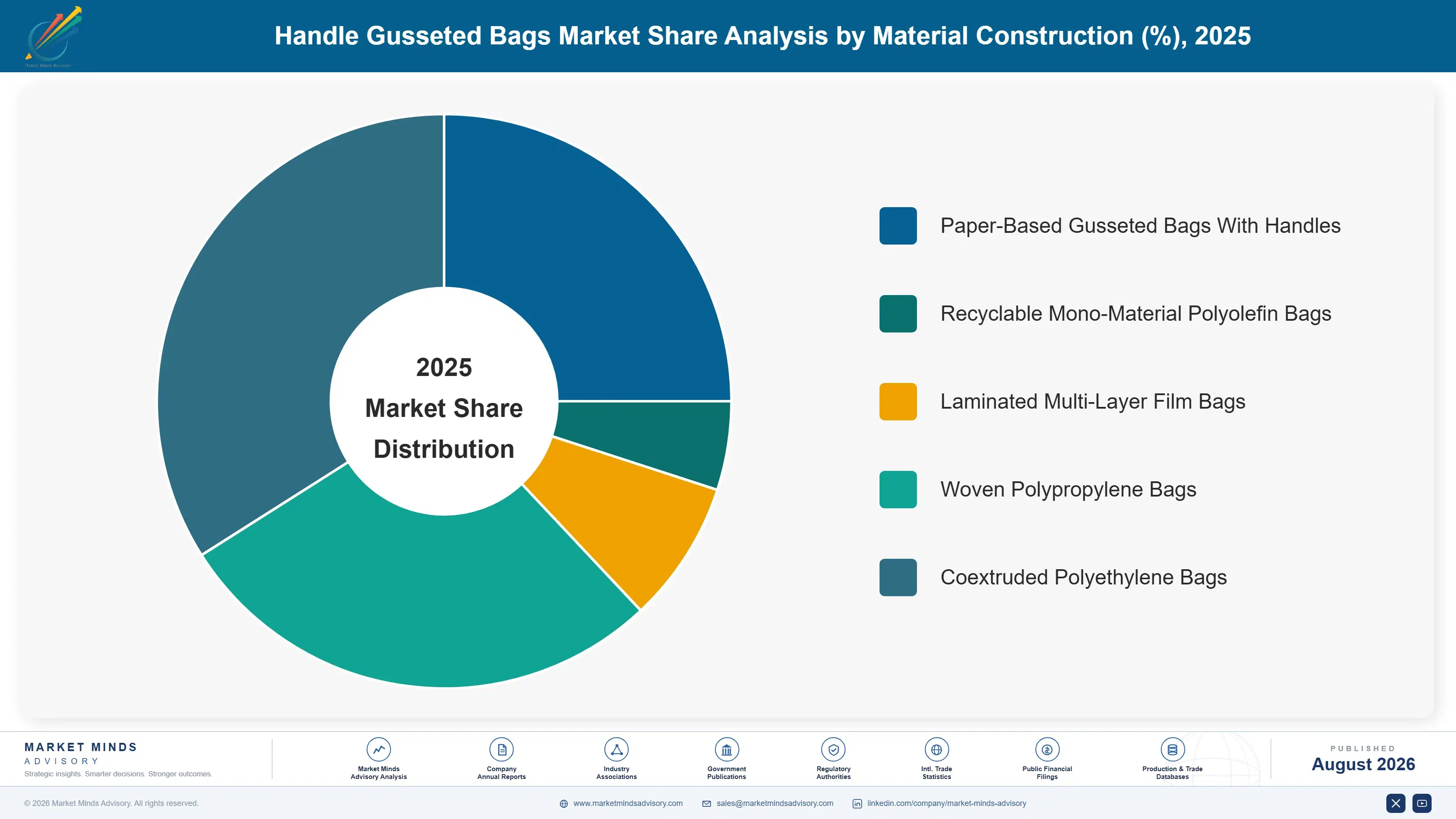
Segmentation follows the material construction, because the material determines whether a handle can actually carry fifteen kilograms without tearing, what producer responsibility fee the pack attracts, which converting assets are required, and how the finished bag prints. End-use category, pack weight, and sales channel are handled in the framework and in commentary instead of here.
handle-gusseted-bags-market-market-share-analysis-1787298463507

Paper-Based Gusseted Bags With Handles

Paper-based handled constructions grow fastest at 8.1%, exactly 1.50 times the market rate, taking share across pet food, charcoal, garden products, and increasingly staples as producer responsibility fees price laminates several times higher for comparable protection. Barrier coatings have improved enough to hold greasy pet food and moisture-sensitive rice reliably, though grease and moisture together remain genuinely awkward to handle. Charcoal and garden products converted earliest, and pet food is following now. The handle is the harder problem: a paper handle carrying fifteen kilograms needs reinforcement, and most available reinforcement is a laminate that quietly undoes the recyclability the conversion was meant to achieve. Nobody has solved this cleanly yet.
CAGR 8.1%

Recyclable Mono-Material Polyolefin Bags

Recyclable mono-material polyolefin bags grow at 7.4% annually, replacing multi-layer laminates with all-polyethylene or all-polypropylene structures that recycle cleanly within existing film collection streams and attract substantially lower producer responsibility fees. Barrier performance on oxygen-sensitive contents falls well short of laminated structures and brands convert anyway, because producer responsibility fees price recyclability while nothing at all prices the resulting shelf life loss. Handle tear strength on these constructions is roughly 35% below laminated equivalents, which is exactly why so many mono-material bag bodies still carry a handle that disqualifies the finished pack from recycling entirely. Brands convert the body first and then discover the problem at recyclability audit, months later.
CAGR 7.4%
Full segment breakdown across 5 segments available in the complete report.

Regional Architecture and Country Demand Map

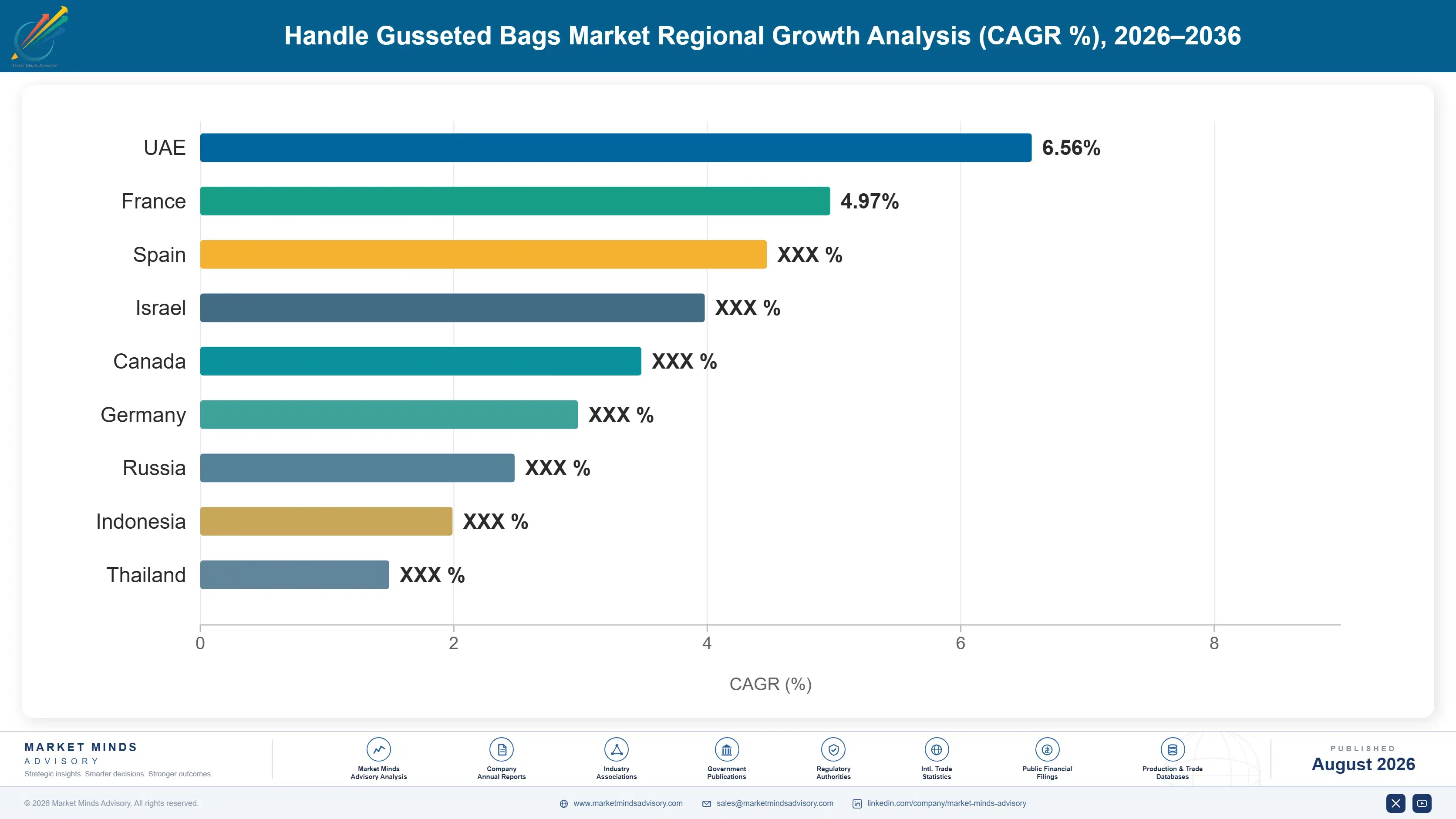
Regional shares track where heavy consumer goods actually get packed rather than where they are eventually bought, because converted bags are bulky and cannot travel far at all. One region sits outside the bands this framework applies, as a direct result of sheer staples packing volume.

East Asia

East Asia holds 27% of total value, the largest share of any region, on Chinese pet food growth and on staples packaging volume that nothing elsewhere matches. Chinese pet ownership has risen extremely fast from a low base and premium formats adopted handled gusseted bags almost immediately. Rice, flour, and animal feed conversion from plain woven sacks into printed retail packs is running steadily as organised retail displaces traditional traders. Domestic converters supply nearly everything used at prices imports could never approach. Producer responsibility pressure on handle construction is not yet a factor here. Growth at 6.0% exceeds the global rate on format conversion rather than on any population effect.
Share: 27% | CAGR: 6.0% (2026 to 2036)

South Asia and Pacific

South Asia and Pacific takes 16% of value against a 12% ceiling in this framework, and Indian staples packaging explains the breach entirely. Rice and flour volumes moving through organised retail are simply enormous, and every conversion from an unbranded woven sack into a printed handled bag adds print, gusset, and handle value where almost none existed before. Woven polypropylene remains the dominant construction here purely on cost grounds. Australian pet food packaging follows Western format conventions closely on both size and construction. Southeast Asian rice and feed packing follows the same trajectory a few years behind. Growth at 7.6% is the fastest of any region in this forecast by a clear margin.
Share: 16% | CAGR: 7.6% (2026 to 2036)
Regional intelligence for 5 additional markets available in the complete report: North America, Western Europe, Latin America, Middle East and Africa, Eastern Europe. Contact sales@marketmindsadvisory.com.
handle-gusseted-bags-market-country-cagr-analysis-1787298464022

Owning The Part That Fails

Everything commercially defensible in this market concentrates in a component worth a few cents. Handle engineering, fee modelling, premium print capability, and regional plant placement each build a position that price alone cannot dislodge. Four follow from that, and the first one addresses the exact problem every brand in this category is currently stuck on.

Solve The Recyclable Handle Before Anybody Else Does

Brands converting their bag bodies to mono-material or coated paper keep failing recyclability assessment on a handle costing four cents, because die-cut handles weaken an already loaded wall, welded handles introduce a second polymer, and reinforced patches are laminates by definition. Closing the 35% tear strength gap on a genuinely mono-material handle would sell into every single conversion programme running anywhere in this category worldwide. Development costs USD 2 million to USD 5 million and yields a licensable position that competitors cannot simply design around within a year or two.
Market Impact: Development costs USD 2 to 5 million total

Model Producer Responsibility Fees Across Whole Portfolios

Fee schedules price by weight and by recyclability grade, and the spread between a laminated handled bag and a coated paper equivalent delivering entirely comparable protection can exceed four times. Brands calculate those fees centrally while specifying bags through procurement teams who never see that line at all. A converter modelling total portfolio fee exposure and redesigning against it reaches the specification years before any tender is issued, and it charges design fees of USD 40,000 to USD 120,000 for each programme, on top of the eventual supply award itself.
Market Impact: Design fees run USD 40,000 to 120,000 each

Build Premium Print Capability For Pet Food Brands

Premium pet food treats the bag as its primary shelf differentiator in a category where every formulation claim reads much the same, and it accepts print quality, matte finishes, and engineered design costs no staples application would tolerate. Converted value on premium pet food bags runs 2.5 to 3 times that of a plain staples equivalent of the same size. Qualification with a brand owner takes nine to fifteen months and very rarely reverses afterwards, because reprinting an established pack is a marketing decision that nobody makes casually or quickly.
Market Impact: Converted value runs 3 times higher than staples

Place Converting Plants Inside The Freight Radius

Converted bags are bulky relative to their value, and shipping them beyond a few hundred kilometres removes the delivered margin entirely, which is exactly why the top five hold just 15% of this whole market between them. Placing a plant within trucking distance of a filling operation is worth considerably more than any price concession, because every distant competitor carries freight cost that the local converter simply does not. Plant investment runs USD 8 million to USD 20 million, and it effectively fences off an entire catchment against any outside competition.
Market Impact: Plants cost USD 8 to 20 million each

Who Controls the Margin Pool

Concentration is remarkably low at 15% across the top five, and freight economics rather than any absence of capable operators explain it. All participants here are compared on measured global revenue from handled gusseted bag formats specifically, which requires separating that line from flat pouches, sacks, and wider flexible packaging inside the diversified converting groups that report at a much higher level.
Competition runs within a freight radius rather than across a market, which is why a pet food brand routinely uses different converters in different regions for an identical pack. Mondi and Smurfit Westrock compete strongly in paper-based constructions. Amcor, ProAmpac, and Berry hold film and laminate positions across several regions. Regional specialists hold most volume everywhere, because a plant thirty kilometres from a filling line beats a better one six hundred kilometres away.

Pressure is building around the handle rather than anywhere else. Producer responsibility schemes are beginning to assess handle construction specifically rather than treating it as an incidental component, which puts otherwise converted packs back into the highest fee bands. Rankings shift where a converter reaches a brand's packaging specification before the tender, since fee modelling and engineered design both operate years upstream of any order.
handle-gusseted-bags-market-company-positioning-matrix-1787298464541

Competitive Moat and Risk Dimensions

MONDI

Moat: Integrated Paper And Converting Position

Mondi produces kraft paper and converts it into handled bag formats within one group, which gives it cost control and development capability across exactly the substrate taking share fastest in this category. Barrier coating development sits in the same organisation as the paper machine. Film-only converters have to buy substrate and cannot influence how it performs under a loaded handle.
MONDI

Risk: Paper Substrate Handle Limitations

A paper handle carrying fifteen kilograms needs reinforcement, and most reinforcement is a laminate that undoes the recyclability driving conversion in the first place. The group's advantage rests on a substrate with a genuine mechanical weakness at exactly the point that matters most. Whoever solves the mono-material handle first may solve it in film rather than in fibre.
AMCOR

Moat: Multi-Region Film Development Reach

Amcor operates flexible packaging development and converting across most major regions, which lets a multinational pet food or staples brand qualify one structure and deploy it in several markets rather than requalifying locally each time. Its mono-material development programme is among the largest anywhere. Regional converters cannot match that multi-market qualification capability at all.
AMCOR

Risk: Freight Radius Limits Scale Advantage

Whatever global development capability the company holds, a converted bag still cannot travel far, so every plant competes only inside its own trucking catchment against local specialists with lower overheads. Scale delivers development and purchasing advantage rather than any delivered cost advantage. In a market this fragmented, that has repeatedly proved a weaker position than it appears.

Players Tracked

Prominent Players

Mondi
Amcor
ProAmpac
Berry Global
Smurfit Westrock

Other Key Players

Sealed Air
Constantia Flexibles
Coveris
Huhtamaki
Sonoco
Winpak
TC Transcontinental
Uflex
Cosmo First
Printpack
American Packaging Corporation
Glenroy
Bryce Corporation
Novolex
Hood Packaging

Recent Developments

FEBRUARY 2025

European Scheme Assesses Handle Construction Within Recyclability Grading

A European producer responsibility organisation began assessing handle construction separately within its recyclability grading for flexible packaging, rather than treating handles as an incidental component of the bag. Packs with mono-material bodies and laminated handle reinforcement were moved into higher fee bands as a direct result.
Signal: A four cent component now decides which producer responsibility fee band an entire converted pack falls into
MAY 2025

Mondi Expands Barrier-Coated Paper Capacity For Handled Formats

Mondi added barrier-coated kraft paper capacity aimed at pet food and staples applications currently held by film laminates, including handled gusseted constructions. The investment was organic and internally funded, and the company openly acknowledged that handle reinforcement remains the principal technical constraint on achieving full recyclability.
Signal: Even the substrate producers themselves now concede the handle is where fibre conversion still keeps failing
SEPTEMBER 2025

Premium Pet Food Brand Converts European Range To Mono-Material

A premium pet food brand converted its European bag range to mono-material polyolefin construction across all pack sizes above five kilograms. Handle tear performance required a redesigned attachment geometry rather than an added laminate patch, which the brand said had taken considerably longer to validate than the bag body itself.
Signal: Handle validation now takes considerably longer than converting the entire bag body it is attached to

Paper, Resin And The Freight

Kraft paper and containerboard account for roughly 46% to 56% of converted cost on fibre-based constructions, sourced from integrated mills across Scandinavia, North America, and increasingly China. Polymer resin runs 44% to 54% on film and woven constructions, tracking naphtha and therefore crude. Print inks, adhesives, handle components, and coating chemistry carry the remainder, with freight adding 5% to 11% on delivered bags.
European kraft paper pricing moved violently through 2022 as mill energy costs rose with the gas price shock the IEA documented that year, and several producers took extended downtime rather than run at negative margin. Mondi's 2022 annual report described substantial energy and input cost inflation across its paper operations. Converters holding annual fixed-price brand contracts absorbed the entire increase until renewal allowed any repricing at all.

Exposure separates by substrate integration rather than by scale. An integrated group producing its own kraft paper sees fibre cost move through the business, with mill margin offsetting converting margin compression. An independent converter buying paper or film on the open market has neither offset nor pricing power against brand procurement. Woven polypropylene converters in Asia buying domestic resin sit on a different cost curve again.
handle-gusseted-bags-market-cost-volatility-analysis-1787298464736

Index Substrate Cost In Every Brand Supply Agreement

Annual fixed-price contracts transfer all paper and resin volatility onto the converter, and brand procurement accepts indexation considerably more readily than most suppliers assume. Tying the substrate component to a published benchmark converts an unmanageable exposure into a pass-through, and it removes the risk premium that a padded fixed quotation carries for both sides of the agreement.

Qualify Both Fibre And Film Constructions Per Programme

Paper and resin pricing rarely move together, and a converter qualified in only one substrate cannot follow a brand when fee structures or input costs shift the balance. Holding validated constructions in both for the same pack costs additional drop testing and brand approval, and it keeps the account when the specification eventually changes rather than losing it.

Locate Converting Capacity Within The Freight Radius

Freight is the one input cost a converter can remove outright rather than hedge, by placing a plant within trucking distance of the filling operation it supplies. Beyond a few hundred kilometres the delivered margin disappears completely, so plant placement here is fundamentally a cost decision rather than a market access one, and it fences a catchment.

Portfolio Architecture for Margin Defence

Margin architecture separates by whether the pack is a brand asset or a commodity container. Plain woven and unprinted handled bags for staples earn 8% to 16%, tendered against every converter within trucking distance. Premium printed pet food bags and fee-optimised recyclable constructions earn 21% to 32%, because print quality, engineered design, and producer responsibility performance all take months to replicate at another supplier.
The tension is that volume growth sits in the commodity tier and margin sits in the premium one, and the two need entirely different assets. Staples conversion across Asia is the largest source of new units in this market and it earns almost nothing per bag. Premium pet food earns properly and grows with pet ownership rather than with population, which is a much slower curve. Converters chasing both usually do neither well.

High-value pools concentrate in recyclable handle solutions, premium print capability, and fee modelling sold ahead of specification. All three attach a converter to a brand programme rather than to a purchase order. Recyclable handle technology carries the widest margin range in the market, because nobody has solved it and a licensable solution would price on scarcity rather than on cost.

Volume / Commodity-Adjacent

Plain woven polypropylene and unprinted polyethylene handled bags for staples, animal feed, and trade applications tendered on delivered cost. The eight-point range separates integrated producers making their own substrate from converters buying film and paper on the open market.
Gross Margin: 8% to 16%

Premium / Certified

Premium printed pet food bags, branded retail formats, and mechanically engineered constructions where print quality and shelf presence justify the specification. The eleven-point range separates straightforward printed work from full engineered design programmes with brand qualification behind them.
Gross Margin: 21% to 32%

Sustainability / Regulatory / Next-Generation

Mono-material and coated paper constructions, recyclable handle systems, and producer responsibility fee optimisation services. The twenty-six point range reflects genuine divergence: substituted substrates compete on cost while a solved recyclable handle would price on scarcity alone.
Gross Margin: 14% to 40%
handle-gusseted-bags-market-portfolio-architecture-1787298465231

High-value Sub-segments and Strategic Watch-out

Recyclable Handle Systems

The unsolved problem in this whole category, and therefore the single most valuable position available. Mono-material handles currently fall roughly thirty-five percent short on measured tear strength, and a component costing four cents currently disqualifies otherwise recyclable packs from the lower producer responsibility fee bands entirely.
Gross Margin: 28% to 40%

Premium Pet Food Formats

High value with steady growth, carrying two and a half to three times the converted value of plain staples equivalents. Brand qualification takes nine to fifteen months and rarely reverses, because reprinting an established pack is a marketing decision that nobody takes at all casually.
Gross Margin: 24% to 32%

Asian Staples Conversion Volume

The largest single source of new units anywhere in this market, adding print, gusset, and handle value where unbranded woven sacks carried almost none. Margin per bag is minimal and volume is enormous, which suits regional converters considerably better than it does any multinational group.
Gross Margin: 8% to 16%

Laminated Multi-Layer Constructions

Strategic watch-out here. Producer responsibility schemes price these several times above comparable fibre or mono-material packs, and handle assessment is now tightening the position further. Remaining volume sits only where barrier requirements genuinely leave no alternative construction available at all, and that ground keeps shrinking.
Gross Margin: 12% to 22%

How Bag Volume Actually Recurs

The annuity here is the packed product line rather than the customer relationship. A qualified bag construction supplies a stock keeping unit for as long as that product exists on shelf, because requalifying an alternative means drop testing, filling line trials, and reprinting artwork the brand team signed off years ago. Purchase orders recur weekly while the actual decision was taken once, which is why converters fight over specification and then find the tender almost a formality.
Depth varies sharply by category. Premium pet food is the stickiest, since print quality, engineered design, and brand artwork all lock together and reprinting is a marketing decision rather than a procurement one. Fee-optimised recyclable constructions are next, because the design work behind them took months. Plain staples bags are the shallowest, retendered annually on delivered cost with no loyalty whatsoever between purchases.

Buyer profiles have changed considerably. Bag sourcing moved from plant purchasing toward cross-functional teams combining brand marketing, packaging technology, and producer responsibility compliance, and they specify years before any tender exists. Retailers now impose recyclability requirements directly on their suppliers. Both changes reward converters arriving at the design stage rather than at the tender.
handle-gusseted-bags-market-end-use-penetration-index-1787298465719

Where We Come Out

These are among the four positions where our research anticipates prominent divergence between winners and laggards over the coming forecast period. Each is grounded in the demand model, the regulatory perimeter, and the announced capacity pipeline.
01 / HANDLE ENGINEERING INVESTMENT

Solve the four cent component nobody has solved yet

Every brand converting a bag body to mono-material or coated paper eventually discovers that the handle disqualifies the whole pack from the lower producer responsibility fee bands. Die-cut handles weaken a wall already carrying fifteen kilograms, welded handles introduce a second polymer, and reinforced patches are laminates by construction. Closing the thirty-five percent tear strength gap on a genuinely mono-material handle costs two to five million dollars in development and creates a licensable position across every conversion programme running worldwide.
02 / FREIGHT RADIUS REALISM

Scale buys development, not delivered cost, in this business

Converted bags are bulky relative to value and cannot travel more than a few hundred kilometres before the margin disappears entirely, which is exactly why the top five hold just fifteen percent of this market between them. Global scale delivers development capability and purchasing power, and none of that reaches a customer thirty kilometres from a regional competitor's plant. Plant placement inside the freight radius of a filling operation is worth more than any price concession a distant converter can offer.
03 / FEE MODELLING ENGAGEMENT

Reach the specification through the fee schedule instead

Producer responsibility fees vary by more than four times between a laminated handled bag and a coated paper equivalent delivering comparable protection, and brands calculate that exposure centrally while specifying through procurement teams who never see the fee line. A converter modelling total portfolio exposure and redesigning against it arrives years before any tender is issued. That turns into a consulting engagement ending in a sole-source award, which is a considerably better business than bidding against every plant within trucking distance.
04 / CATEGORY SELECTION DISCIPLINE

Staples volume and pet food margin need different businesses

Asian staples conversion is the largest source of new units anywhere in this market and it earns eight to sixteen percent on plain woven bags tendered relentlessly on delivered cost. Premium pet food earns two and a half to three times the converted value but grows with pet ownership rather than with population, which is a far slower curve. The assets, the sales approach, and the plant economics differ completely, and converters chasing both simultaneously have generally executed neither well.

Engagement Snapshot From the Field

A live engagement with an industry participant carrying material or product regulatory and market exposure ahead of a defining policy shift, showing how our research translates into a defensible multi-year portfolio strategy.
MARKET MINDS ADVISORY · CLIENT ENGAGEMENT SUMMARY
Handle Gusseted Bags Producer Strategic Portfolio Review and Transition Roadmap 2026·Investment Scenario on Handle Gusseted Bags Exposure Evaluation 2025-26
CLIENT PROFILE
A European flexible packaging converter operating four plants and supplying handled gusseted bags to pet food, garden product, and staples customers across seven countries, with roughly EUR 155 million in annual revenue (client-reported, unverified by MMA). Around 68% of revenue came from laminated multi-layer constructions, and the business held no coated paper capability and no in-house handle engineering.
STRATEGIC CHALLENGE
Two major pet food customers had committed to fully recyclable packaging within three years, and a European producer responsibility organisation had just begun assessing handle construction separately within its recyclability grading. The client's laminated portfolio faced higher fee bands while its attempts at mono-material conversion kept failing validation at the handle rather than at the bag body.
MMA APPROACH
MMA modelled producer responsibility fee exposure across the client's actual customer portfolios under current and proposed grading, benchmarked handle tear performance across mono-material, coated paper, and laminated constructions, and interviewed twenty-three brand packaging and sustainability leads on conversion timing and tolerance. Plant catchment economics were reassessed to establish which customers were genuinely defensible on freight.
KEY FINDINGS
  1. Fee exposure across the client's customer portfolios varied by 4.2 times between best and worst construction delivering identical protection, and no customer had modelled it at pack level.
  2. Mono-material handle attachments tested 34% below laminated equivalents on tear strength, and every workaround the client had trialled reintroduced a laminate component somewhere.
  3. Plain staples business ran at 11% gross margin and consumed 39% of plant capacity, with no account in that tier retained beyond three years at any of the four sites.
  4. Two of the four plants sat outside economic trucking distance of their largest declared customers, and those accounts had been retained on price concessions rather than on service.
CLIENT PROFILE
A European flexible packaging converter operating four plants and supplying handled gusseted bags to pet food, garden product, and staples customers across seven countries, with roughly EUR 155 million in annual revenue (client-reported, unverified by MMA). Around 68% of revenue came from laminated multi-layer constructions, and the business held no coated paper capability and no in-house handle engineering.
STRATEGIC CHALLENGE
Two major pet food customers had committed to fully recyclable packaging within three years, and a European producer responsibility organisation had just begun assessing handle construction separately within its recyclability grading. The client's laminated portfolio faced higher fee bands while its attempts at mono-material conversion kept failing validation at the handle rather than at the bag body.
MMA APPROACH
MMA modelled producer responsibility fee exposure across the client's actual customer portfolios under current and proposed grading, benchmarked handle tear performance across mono-material, coated paper, and laminated constructions, and interviewed twenty-three brand packaging and sustainability leads on conversion timing and tolerance. Plant catchment economics were reassessed to establish which customers were genuinely defensible on freight.
KEY FINDINGS
  1. Fee exposure across the client's customer portfolios varied by 4.2 times between best and worst construction delivering identical protection, and no customer had modelled it at pack level.
  2. Mono-material handle attachments tested 34% below laminated equivalents on tear strength, and every workaround the client had trialled reintroduced a laminate component somewhere.
  3. Plain staples business ran at 11% gross margin and consumed 39% of plant capacity, with no account in that tier retained beyond three years at any of the four sites.
  4. Two of the four plants sat outside economic trucking distance of their largest declared customers, and those accounts had been retained on price concessions rather than on service.
RECOMMENDED STRATEGY
Phase 1: Phase one: fund handle attachment engineering as a standalone development programme, and treat the resulting geometry as licensable rather than as a captive product feature. Phase 2: Phase two: offer producer responsibility fee modelling as a chargeable service to reach specification decisions well ahead of tender across the pet food customer base. Phase 3: Phase three: exit plain staples business below a defined margin floor and consolidate the two plants sitting outside their customers' freight radius.
OUTCOME
The client developed a reinforced mono-material handle geometry within four quarters and licensed it to two converters outside its own catchment. Revenue fell 6% as staples volume was exited, gross margin rose from 15% to 22%, and both at-risk pet food accounts renewed on multi-year terms (client-reported, unverified by MMA).

Frequently Asked Questions

Foundational context covering the market sizes, CAGR, scope, country, region and competition that inform every finding below. This section is provided to cover basics and most often pre-purchase conversations, answered from the MMA Primary Research Dataset.

What is the current size of the Handle Gusseted Bags Market?

The global handle gusseted bags market reached USD 3.8 billion in 2025, covering gusseted flexible bags with integrated or applied carrying handles for pet food, staples, charcoal, and comparable heavy retail goods. Sacks without handles are excluded.

How large will the Handle Gusseted Bags Market be by 2036?

MMA forecasts USD 6.78 billion by 2036, up from USD 4.01 billion in 2026, an increase of USD 2.77 billion. That represents an expansion multiple of 1.69 times across the forecast period.

What is the CAGR for the Handle Gusseted Bags Market 2026 to 2036?

The base case CAGR is 5.4%, with a bull case of 6.6% and a bear case of 4.2%. Historical growth between 2020 and 2025 ran at 4.3%, reflecting material cost movement layered onto steady format conversion.

Which segment is growing fastest?

Paper-based gusseted bags with handles grow fastest at 8.1%, exactly 1.50 times the market rate, on producer responsibility fees favouring fibre. Recyclable mono-material polyolefin bags follow at 7.4%.

Who are the major companies in the Handle Gusseted Bags Market?

Mondi, Amcor, ProAmpac, Berry Global, and Smurfit Westrock lead, together holding just 15% of the market. Freight economics keep converting regional and prevent any meaningful consolidation.

Which country is growing fastest?

India grows fastest at 8.8%, as rice, flour, and animal feed convert from unbranded woven sacks into printed handled retail packs. Organised retail expansion drives most of that conversion.

Report Segmentation Architecture

The full report scope spans multiple orthogonal segmentation dimensions, with cross-tabulated demand data provided for each dimension pair. Coverage extends further to regional breakdowns, trend trajectories, and the competitive detail needed to support segment-level decision-making.

By Material Construction

  • Paper-Based Gusseted Bags With Handles
  • Recyclable Mono-Material Polyolefin Bags
  • Laminated Multi-Layer Film Bags
  • Woven Polypropylene Bags
  • Coextruded Polyethylene Bags

By End-Use Industry

  • Pet Food And Animal Nutrition
  • Rice, Flour And Staple Foods
  • Charcoal And Solid Fuels
  • Garden And Horticultural Products
  • Coffee And Speciality Retail Goods

By Commercial Dimension

  • Brand Owner Direct Supply
  • Private Label And Retailer Contracts
  • Regional Converter Tender Supply
  • Design And Fee Optimisation Services
  • Licensed Construction And Handle Systems

By Region

  • East Asia
  • South Asia and Pacific
  • North America
  • Western Europe
  • Latin America
  • Middle East and Africa
  • Eastern Europe

Scope, Methodology, and Coverage

Every figure in this report is reproducible from documented input assumptions. The scope below maps the historical period, the forecast horizon, the segmentation dimensions, and the countries covered, alongside the underlying primary and qualitative methodology.
Historical Period
2020 to 2025
Forecast Period
2026 to 2036
Base Year
2025 (USD billions; MMA Primary Research Dataset, August 2026)
Market Definition
The handle gusseted bags market covers flexible packaging bags manufactured with side or bottom gussets and an integrated or applied carrying handle, used for consumer and trade packaging of heavy retail goods. Scope spans paper-based constructions, recyclable mono-material polyolefin structures, laminated multi-layer film, woven polypropylene, and coextruded polyethylene, together with the handle systems, reinforcement, and closures supplied with them. Flat pouches without gussets, sacks without handles, light retail carrier bags, rigid containers, and bulk industrial sacks above thirty kilograms are excluded.
Quantitative Units
USD billions at converter revenue level; bags produced annually; tonnes by material construction.
Segmentation Dimensions
By material construction; by end-use industry; by commercial dimension; by region.
Regions Covered
East Asia, South Asia and Pacific, North America, Western Europe, Latin America, Middle East and Africa, Eastern Europe
Countries Covered
United States, Canada, Mexico, Germany, France, United Kingdom, Italy, Netherlands, Poland, Czech Republic, China, Japan, South Korea, India, Vietnam, Australia, Brazil, Argentina, Saudi Arabia, South Africa.
Key Companies Profiled
Mondi, Amcor, ProAmpac, Berry Global, Smurfit Westrock, Sealed Air, Constantia Flexibles, Coveris, Huhtamaki, Sonoco, Winpak, TC Transcontinental, Uflex, Cosmo First, Printpack, American Packaging Corporation, Glenroy, Bryce Corporation, Novolex, Hood Packaging.
Quantitative Methodology
Primary survey, n=3,800 respondents, Q4 2025, six countries; demand-side model with trade association cross-validation
Qualitative Methodology
47 expert interviews, Q4 2025; applied to validate demand model assumptions, identify emerging dynamics, and assess competitive positioning
Report Format
PDF and XLSX data workbook (Word format preview document)
Publisher
Market Minds Advisory
Report Code
MMA-2026-PAC-876
Published
August 2026
Contact
sales@marketmindsadvisory.com | www.marketmindsadvisory.com

Purchase the full Handle Gusseted Bags Market Report (2026 to 2036).

The full MMA report on handle gusseted bags covers material, regional, and competitive analysis in detail, with separate treatment of the handle engineering problem that currently blocks recyclability conversion across the whole category. It includes producer responsibility fee modelling by construction and jurisdiction, handle tear performance benchmarking across substrates, freight radius and plant catchment economics, and staples conversion tracking across Asian organised retail. Regional chapters cover twenty countries with category mix and regulation assessed individually. Competitive profiling spans twenty converters on a consistent revenue basis throughout.
Twenty country category mix and regulation chapters
Producer responsibility fee modelling by bag construction
Handle tear performance benchmarking across every substrate
Freight radius and plant catchment economics analysis
Twenty converter competitive profiles compared consistently
Asian staples conversion tracking through organised retail

Built For The People Who Decide

From boardroom strategy to bench-side execution, this report is read cover-to-cover by leaders shaping the next decade of their industry, turning demand scenarios, market dynamics and valuation benchmarks into decisions.
CXOs/ Presidents/ VPs/ Managers
M&A and Corporate Development
Strategy Teams and R&D Heads
Procurement and Product Directors
Regulatory and Compliance Leaders
Investor Relations and Equity Analysts