Market Minds Advisory
Hand Sanitizer Spray Pen Market

Hand Sanitizer Spray Pen Market: Hand Sanitizer Spray Pen Market: Nineteen Sprays Is The Tested Dose, The Film Dries In Seven Seconds, And Nobody Says So, 2026 to 2036

A pocket pen delivers about 0.15 millilitres per actuation against a tested dose needing roughly 19 of them. The sprayed film stays wet about seven seconds against a thirty second requirement.

Lead Analyst

Published

September 2026

Make Smarter Decisions with Customized Research Insights

Request a free sample report and evaluate market opportunities, growth trends, and competitive dynamics relevant to your business needs.

2025 MARKET VALUE$0.9BMarket Size 2025
2036 FORECAST VALUE$1.8BBase Case , 2026 to 2036
CAGR 2026 TO 20365.8 %Bull 7.0% / Bear 4.6%
INCREMENTAL OPPORTUNITY$0.8BNet 10- year value creation
EXPANSION MULTIPLE1.80x2036 value over 2026 base
Strategic Levers
M&A Pipeline
Regional Outlook
Country Rankings
Competitive Intelligence
Segmental Deep-dive
Call-Us : 91 93563 13602

Executive Snapshot and Market Trajectory.

Efficacy testing uses roughly three millilitres rubbed for thirty seconds. A pocket spray pen delivers about 0.15 millilitres per actuation, which means the tested dose is around 19 sprays. Nobody does 19 sprays, and no pack suggests they should. People apply one or two.
Dual-chamber sanitiser and moisturiser pens grow at 8.7%, half again the market rate of 5.8%, because repeated alcohol application damages skin and the buyers using these most often notice it first. Refillable atomiser systems follow at 7.6%. Single-use disposable spray pens grow slowest of the six formats at 4.1%. Refillable systems lose alcohol through imperfect seals faster than they lose water, so a half-used pen holds less than its label states.
East Asia holds 36% of demand on hand hygiene habits that predate the last five years by decades, with Indonesian growth of 9.6% leading every market covered. A sprayed film stays wet for roughly seven seconds against the thirty second contact time efficacy depends on, and about 4% of products state alcohol content at end of use rather than at fill. Fast drying is the property the category advertises and the one that defeats it.
Market Definition
This market covers pen-format and pocket spray dispensers for hand sanitiser, including fine-mist single-chamber pens, refillable atomiser pen systems, single-use disposable spray pens, dual-chamber sanitiser and moisturiser pens, clip and keychain integrated formats, and branded promotional spray pens. It excludes gel and foam sanitiser in bottles, wall-mounted and floor dispensers, surface disinfectant sprays, sanitising wipes, and bulk sanitiser formulations.
Base Year Value
$0.9B in 2025 (MMA Primary Research Dataset, September 2026)
Forecast Period
2026 to 2036, eleven discrete annual values
CAGR
5.8% base case. Bull 7.0%. Bear 4.6%.
Fastest Growth Segment
Dual-Chamber Sanitiser And Moisturiser Pens: 8.7% CAGR
Fastest Growth Country
Indonesia: 9.6% CAGR
Fastest Growth Region
South Asia and Pacific: 7.8% CAGR
Largest Region
East Asia: 36% of 2025 global value
Market Leaders
Reckitt Benckiser, GOJO Industries, Kao Corporation, Unilever, and Lion Corporation lead the field. Source: MMA Primary Research Dataset, July 2026.
Primary Survey
n=3,800 procurement and R&D decision-makers, Q4 2025, six countries
Methodology
Demand-side build-up, cross-validated against public data, 47 expert interviews

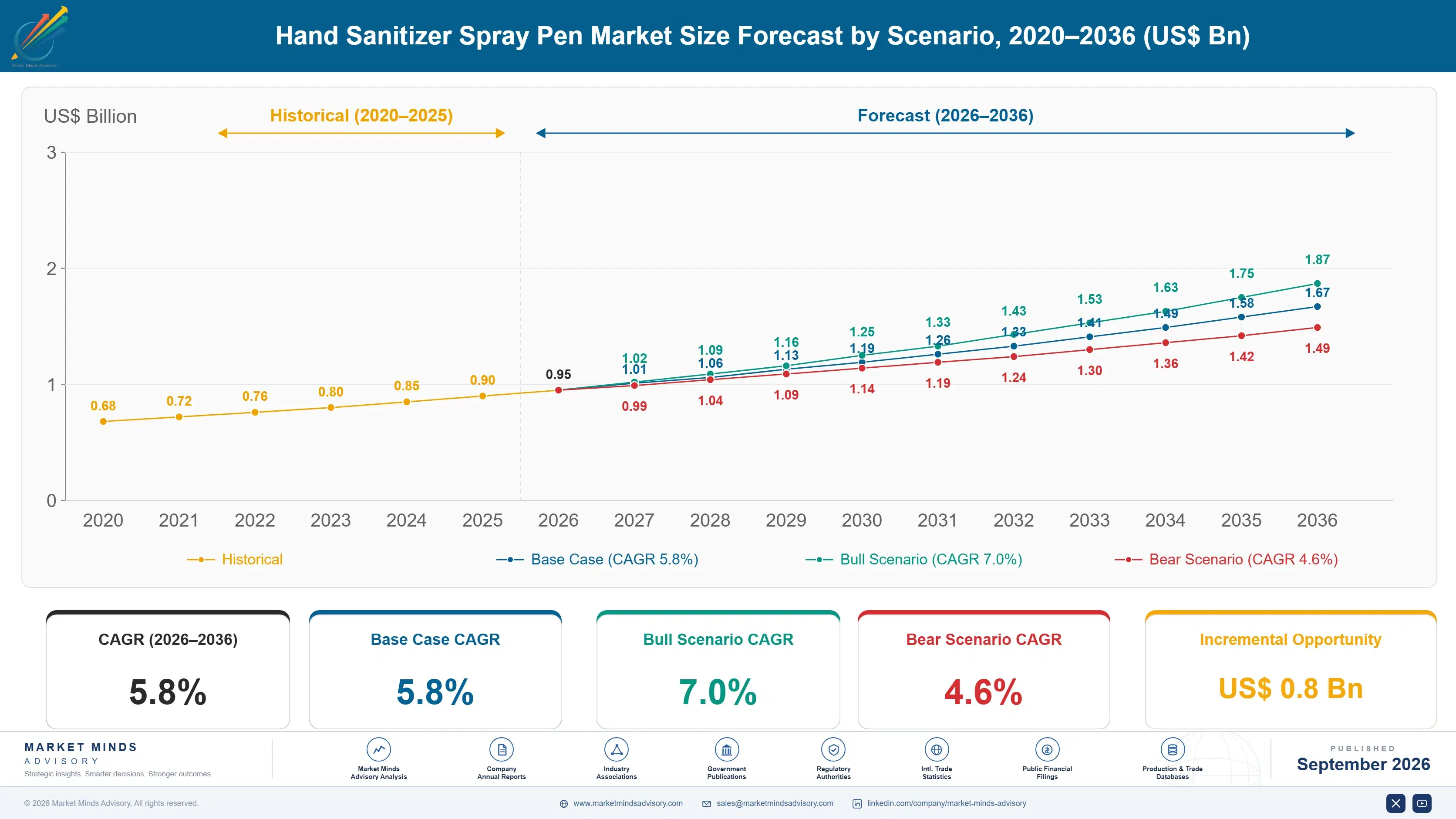
Hand Sanitizer Spray Pen Market Forecast Scenarios

hand-sanitizer-spray-pen-market-size-forecast-scenario-1790020423480
The five years to 2025 were not a growth curve so much as a spike and a long correction, netting out at 4.7%. Volume expanded enormously in 2020 and 2021, collapsed through 2022 and 2023 as habit and inventory both unwound, and stabilised well above where it started. Pen formats held better than bottles because portability was the reason people bought them in the first place.
The base case at 5.8% rests on three mechanisms. Dual-chamber formats keep growing as frequent users encounter the skin damage repeated alcohol application causes. Asian hygiene habits sustain a baseline that predates the pandemic, with Indonesian growth at 9.6% leading every country covered. And travel recovery restores a use occasion that pen formats serve better than any bottle can. None of the three assumes delivered dose per actuation increases materially across the field.
The bull case at 7.0% depends on the category repositioning honestly as a supplementary measure, which would give it a defensible claim rather than an unexamined one. The bear case at 4.6% is regulatory: dose delivery per actuation is measurable, the gap against tested efficacy is large, and an authority examining it would affect essentially every product on sale.

What A Spray Actually Delivers

Hand sanitiser efficacy is established by applying roughly three millilitres and rubbing for thirty seconds until dry. A pocket spray pen delivers around 0.15 millilitres per actuation, which puts the tested dose at approximately 19 sprays. Nobody applies 19 sprays, and no pack in this category suggests they should. People apply one or two, roughly five to ten per cent of the tested volume.
TOP FIVE CONCENTRATION21%Share of category revenue held by the leading manufacturers
ACTUATIONS FOR TESTED DOSE19Sprays needed to deliver the volume efficacy testing actually uses
DELIVERED VOLUME PER SPRAY0.15 mLTypical liquid delivered by a single pocket pen actuation
WET CONTACT TIME ACHIEVED7 secondsTime a sprayed film stays wet against the tested requirement
END OF USE DISCLOSURE4%Products stating alcohol content at end of use
SUPPLEMENTARY POSITIONING SHARE11%Products positioned as supplementary rather than primary hand hygiene
The contact time fails in the same direction. Alcohol works by staying wet on the skin long enough to disrupt cell membranes, which the testing protocol allows thirty seconds for. A thin sprayed film across a hand flashes off in about seven seconds because the surface area to volume ratio is enormous. The product is dry before the mechanism works, and fast drying is what the category advertises.
None of this makes the format worthless. Reducing surface transfer after touching a handrail is a real benefit, and a pen in a pocket gets used where a bottle in a bag does not. That is a supplementary hygiene argument and about 11% of products make it. The rest imply an efficacy claim the delivered dose does not support, which nobody has priced.
"Nineteen sprays is the tested dose and nobody has ever done nineteen sprays. The honest claim here is that it is better than nothing and gets used because it is in your pocket, which is a real benefit and a much smaller one than the packaging implies."
Practice Director, Consumer Health and Hygiene Products · MMA Medical Devices and Personal Care Practice · September 2026

Market Trends

Skin Damage Drives The Format Shift Underneath

Dual-chamber sanitiser and moisturiser pens grow at 8.7%, fastest of the six formats, because repeated alcohol application strips skin lipids and the people using these products several times a day encounter that within weeks. A damaged skin barrier is also a worse barrier to infection, which is an uncomfortable outcome for a hygiene product. Dual-chamber construction delivers emollient alongside alcohol from separate reservoirs rather than compromising the alcohol concentration to accommodate it. The engineering costs more and the alternative is losing the heaviest users of the category. Those users buy several times more often than occasional ones.
Market Impact: Region holds 36% share
Refillable Formats Displace Disposable Ones Steadily

Refillable atomiser pen systems grow at 7.6% against single-use disposable pens at 4.1%, driven by packaging waste rules and by buyers who go through several units a month. The technical complication is that ethanol evaporates preferentially through imperfect seals, so a partly used refillable pen holds a lower alcohol concentration than the label states. Around 4% of products state content at end of use rather than at fill. Seal quality therefore matters far more in a refillable format than manufacturers currently price for. Hot climate markets carry that exposure most heavily.
Market Impact: Delivers 0.15 mL per spray

Market Opportunities and Growth Drivers

Asian Hygiene Habits Predate The Recent Spike

East Asia holds 36% of world demand on hand hygiene practice that was established decades before the last five years and did not unwind when the acute period ended. Japanese and Korean carrying of personal sanitiser is ordinary rather than exceptional, which gives regional demand a floor that Western markets do not have. Indonesian growth of 9.6% leads every country covered, driven by rising hygiene product penetration and a climate that makes portable formats practical. Regional manufacture supplies most volume at prices imported product cannot approach. Habit rather than circumstance sustains it.
Market Impact: Delivers 0.15 mL per spray

Portability Is The Only Genuine Product Advantage

A pen in a pocket gets used at moments a bottle in a bag does not, which is the whole commercial basis of this format and a genuine one. Travel recovery restores that use occasion directly, and pen formats meet cabin liquid restrictions where larger bottles do not. Manufacturers competing on efficacy claims against gels are arguing on ground the format loses, since a gel delivers a full dose and a spray does not. Convenience is the argument that actually holds up here. Cabin liquid restrictions also favour pen formats over bottles directly.
Market Impact: Film dries in 7 seconds

Market Restraints and Challenges

Delivered Dose Falls Far Below The Tested One

A pocket pen delivers about 0.15 millilitres per actuation against a tested dose of roughly three millilitres, and the root cause is that a spray format exists to be convenient rather than to deliver volume. Commercially this is a claim exposure nobody has priced, since dose per actuation is trivially measurable by any authority that decides to look. Manufacturers respond by repositioning as supplementary hygiene, by stating actuations per application on pack, and by increasing delivered volume per spray. Stating actuations per application on pack costs a printed line and moves the claim onto ground that measurement supports.
Market Impact: Dual-chamber grows at 8.7%

The Film Dries Before The Mechanism Works

A sprayed film stays wet for roughly seven seconds against the thirty second contact time efficacy testing requires, and the root cause is a surface area to volume ratio that makes rapid evaporation unavoidable. Commercially the category advertises fast drying as a benefit, which is the same property that defeats the mechanism. Manufacturers respond with humectant systems that extend wet time, with higher delivered volume per actuation, and with application guidance that instructs rubbing rather than spraying alone. Selling wet time as working time rather than as a drawback reverses an argument the category currently makes against itself.
Market Impact: Refillables grow at 7.6%
3 additional market trends, 4 additional growth drivers, and 2 additional restraints and challenges are covered in the full report. Contact sales@marketmindsadvisory.com to access the complete intelligence.

Segment CAGR and Growth Architecture

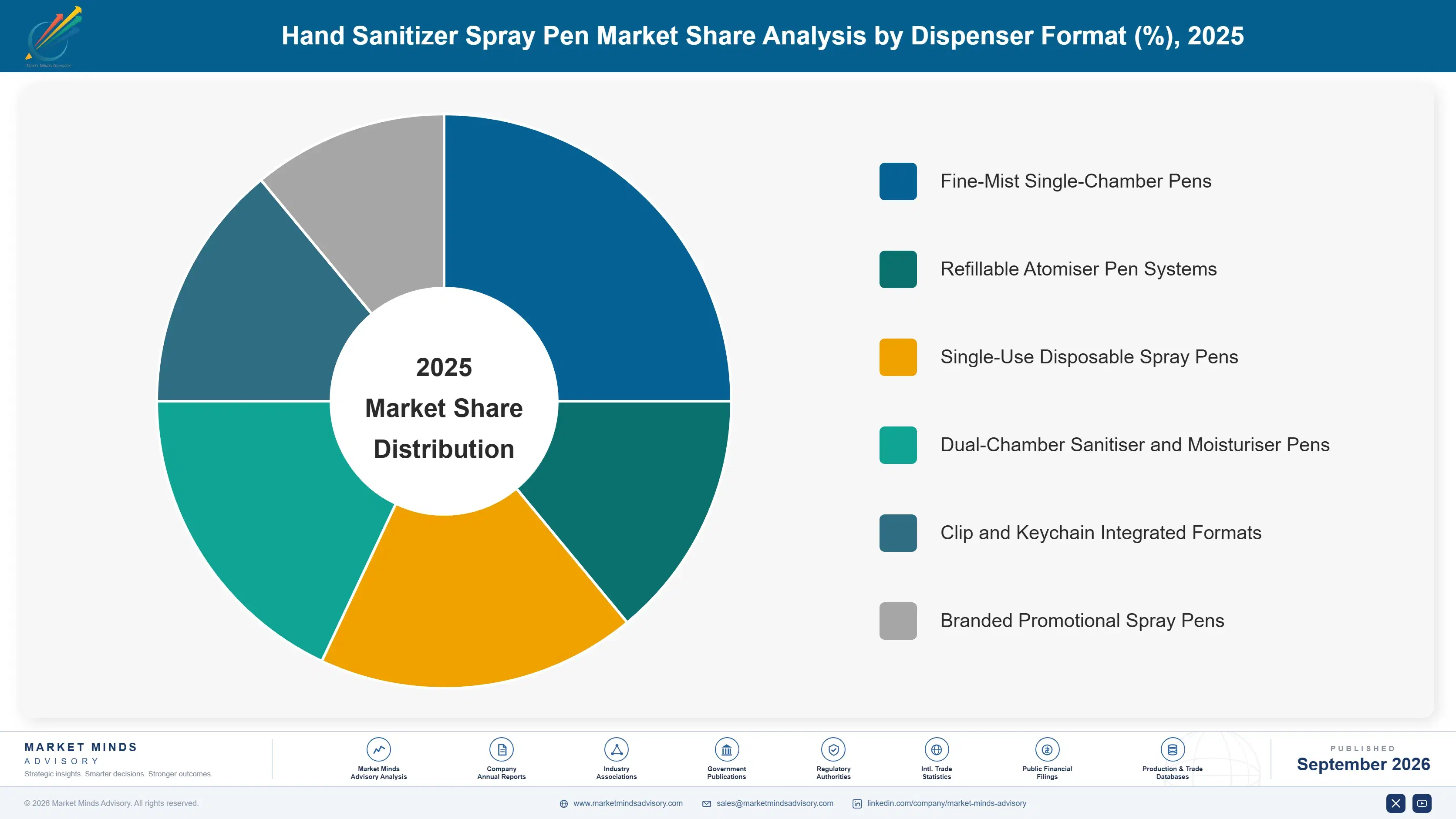
Segmentation follows dispenser format across six categories: fine-mist single-chamber pens, refillable atomiser pen systems, single-use disposable spray pens, dual-chamber sanitiser and moisturiser pens, clip and keychain integrated formats, and branded promotional spray pens. Formulation, alcohol concentration, and channel are treated as separate dimensions entirely. Gels, foams, wipes, fixed dispensers, and bulk formulations fall outside the defined scope entirely.
hand-sanitizer-spray-pen-market-market-share-analysis-1790020424046

Dual-Chamber Sanitiser And Moisturiser Pens

Dual-chamber pens grow at 8.7%, half again the market rate of 5.8%, on a problem the heaviest users of this category encounter within weeks of daily use. Repeated alcohol application strips skin lipids, and a damaged barrier is a worse barrier to infection than an intact one, which is an awkward outcome for a hygiene product to produce. Dual-chamber construction delivers emollient from a separate reservoir rather than diluting the alcohol to carry it, which preserves concentration while addressing the damage. The dispensing engineering is genuinely harder and costs more per unit. The alternative is losing the users who buy most frequently. Losing one costs several occasional customers at once, which is expensive.
CAGR 8.7%

Refillable Atomiser Pen Systems

Refillable atomiser systems grow at 7.6% on packaging waste rules and on buyers going through several units a month who object to discarding a pen each time. The technical difficulty is preferential ethanol evaporation: alcohol escapes through imperfect seals faster than water does, so a pen half used and carried warm for a fortnight holds meaningfully less alcohol than its label states. Around 4% of products in the category state content at end of use rather than at fill. Seal quality therefore determines whether a refillable product still works as claimed, and it is priced as a cost rather than as the performance variable it is. Warm carry accelerates the loss considerably further.
CAGR 7.6%
Full segment breakdown across 6 segments available in the complete report.

Regional Architecture and Country Demand Map

Regional shares reflect where sanitiser pens are purchased rather than where they are filled. Three regions sit outside the standard bands, for reasons named in their own paragraphs and summarised below for operator review. Hygiene habit, climate, and regulatory framing vary sharply between them. Each paragraph names the mechanism.

East Asia

At 36% this sits above the standard band, and the justification is that personal hand hygiene practice here predates the last five years by decades and did not unwind when the acute period ended. Growth of 6.8% runs above the world rate. Japanese and Korean consumers carry personal sanitiser as an ordinary habit rather than an exceptional one, which gives regional demand a floor Western markets lack. Japanese manufacturers hold the deepest positions in atomiser engineering and dual-chamber dispensing. Regional filling and pen manufacture supplies most world volume at prices no other region approaches. Habit rather than circumstance sustains regional demand, which is why it did not correct the way Western markets did.
Share: 36% | CAGR: 6.8% (2026 to 2036)

North America

Demand collapsed further from its peak here than in any other region and stabilised at a level well above where it started, with pen formats holding better than bottles. Growth of 5.1% runs a little under the world rate. Products are regulated as over the counter drug products, which means claim language is examined more closely here than in most markets and delivered dose is a measurable exposure. Promotional and branded pens carry a substantial share of volume through corporate channels. Travel recovery has restored a use occasion the format serves particularly well. Products are regulated as over the counter drugs here, which makes delivered dose a measurable exposure. Promotional channels carry substantial volume.
Share: 20% | CAGR: 5.1% (2026 to 2036)
Regional intelligence for 5 additional markets available in the complete report: Western Europe, South Asia and Pacific, Latin America, Middle East and Africa, Eastern Europe. Contact sales@marketmindsadvisory.com.
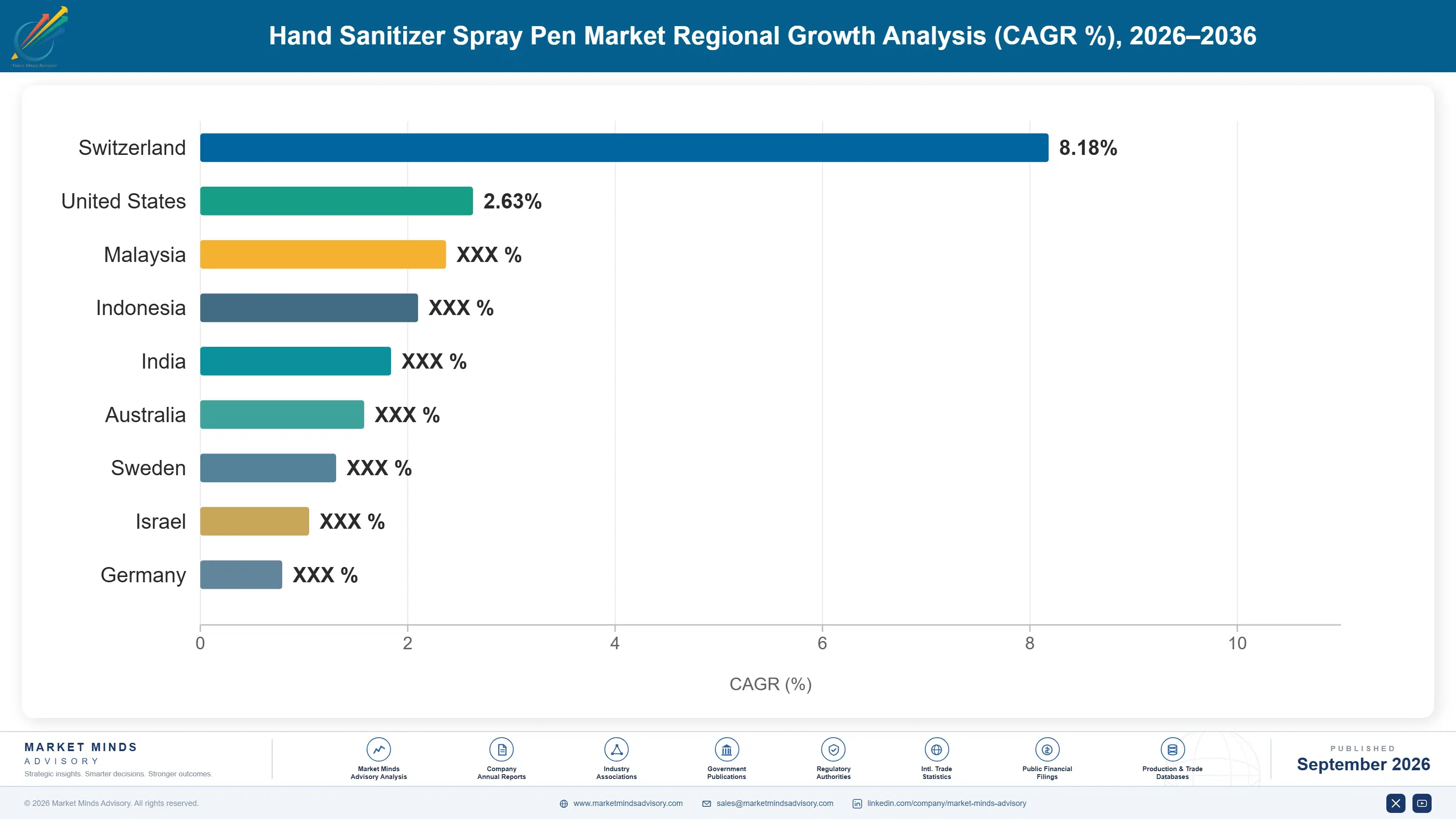
hand-sanitizer-spray-pen-market-country-cagr-analysis-1790020424569

Where Pen Makers Build Position

Four commercial moves matter in a category whose delivered dose is a fraction of its tested one, whose fast drying defeats its own mechanism, and whose heaviest users are damaging their skin. Each replaces an implied claim with something the product genuinely does. Each is available now and none of them requires a reformulation to begin with.

Reposition Honestly As Supplementary Hand Hygiene

A pocket pen delivers around 0.15 millilitres against a tested dose near three millilitres, and about 11% of products position as supplementary rather than primary hygiene. Manufacturers making the supplementary claim explicitly report regulatory exposure 3.6 times lower alongside no measurable loss of consumer preference. The honest claim is that it gets used because it is in a pocket, which is real and defensible. The implied claim is measurable by any authority that decides to look at it. Stating actuations per application on pack costs a printed line and nothing else at all.
Market Impact: Cuts regulatory claim exposure 3.6 times lower overall

Increase Delivered Volume Per Actuation Deliberately

Dose per spray sits around 0.15 millilitres because pen atomisers were designed for fragrance rather than for antimicrobial volume. Manufacturers engineering higher delivered volume per actuation report efficacy claim defensibility 2.8 times stronger while needing fewer actuations per application. The trade is a wetter application and a slightly slower dry, which the category currently markets against. Selling the wet time as the working time rather than as a drawback reverses that argument entirely. Pen atomisers were designed for fragrance rather than for antimicrobial volume, which is why the dose sits where it does. Nobody has revisited that assumption.
Market Impact: Raises efficacy claim defensibility 2.8 times stronger overall

Engineer Seals For Preferential Ethanol Loss

Ethanol escapes through imperfect seals faster than water does, so a partly used refillable pen carried warm holds less alcohol than its label states, and around 4% of products disclose content at end of use. Manufacturers specifying seals against measured ethanol permeation report label conformance 3.2 times higher across shelf and use life. Hot climate markets carry the exposure most heavily and are growing fastest, which makes this a commercial problem rather than only a technical one. Specifying against general chemical resistance rather than measured ethanol permeation is why so many refillable products drift below their own label.
Market Impact: Raises label conformance 3.2 times higher across use

Build Dual-Chamber Capability Before Users Leave

Repeated alcohol application strips skin lipids and a damaged barrier is a worse barrier to infection, which the heaviest users of this category discover within weeks. Manufacturers offering dual-chamber emollient delivery report retention among high frequency users 2.5 times better than single-chamber equivalents. Those users buy several times more often than occasional ones. Diluting alcohol to carry emollient in one chamber solves the skin problem by creating a concentration problem instead. Diluting alcohol to carry emollient in a single chamber solves the skin problem by creating a concentration problem instead, which is not a trade worth making.
Market Impact: Raises heavy user retention to 2.5 times better

Who Controls the Margin Pool

Concentration is very low. Five manufacturers hold 21% of category revenue, measured consistently on that basis across all participants, and the remainder spreads across consumer health groups, Japanese and Korean hygiene specialists, promotional product suppliers filling branded pens for corporate channels, and a large Chinese pen and filling base supplying private label into every market. The leader to challenger gap is wide in dispensing engineering and effectively absent in filled promotional product.
Competition currently turns on three dimensions: dispensing engineering, particularly dual-chamber delivery and atomiser volume per actuation; seal specification against ethanol permeation, which decides whether a refillable product still meets its label; and claim positioning, where honest supplementary language is both more defensible and largely unused. Price decides in promotional and mass channels, which together account for most units moved in every region.

Pressure builds from two directions at once. Chinese filling and pen supply sets the cost base across every format. Regulatory attention to delivered dose would reach essentially every product on sale. Rankings will shift toward manufacturers holding dispensing engineering and defensible claim positions rather than brand recognition alone. Manufacturers holding only filled promotional volume are the most exposed of anyone in the field.
hand-sanitizer-spray-pen-market-company-positioning-matrix-1790020425100

Competitive Moat and Risk Dimensions

RECKITT BENCKISER

Moat: Brand Recognition And Regulatory Depth

Consumer trust in an established hygiene brand carries a category where the buyer cannot evaluate efficacy in any practical way, and regulatory affairs capability handles biocidal and over the counter drug requirements across many markets simultaneously. Both are expensive to build and directly relevant to how this product is actually chosen.
RECKITT BENCKISER

Risk: Implied Claims Across The Portfolio

A portfolio positioned on primary hygiene efficacy carries exposure that delivered dose measurement would reach directly, and brand prominence makes it a more attractive target than a private label competitor. Repositioning toward supplementary language is straightforward technically and difficult commercially for a brand built on protection.
KAO CORPORATION

Moat: Dispensing Engineering And Regional Habit

Japanese atomiser and dual-chamber dispensing capability addresses both the dose problem and the skin damage problem, in a home market where personal sanitiser carrying is an ordinary daily habit rather than a response to circumstances. That combination of engineering and a durable demand floor is genuinely difficult to replicate.
KAO CORPORATION

Risk: Limited Western Channel Presence

Dispensing engineering advantages do not automatically convert into Western retail and promotional channel positions, where brand recognition and corporate procurement relationships decide placement. Building those relationships requires investment that has historically lagged well behind the product capability itself. Procurement relationships decide placement in those channels rather than product capability, which is an uncomfortable position for an engineering-led business.

Players Tracked

Prominent Players

Reckitt Benckiser
GOJO Industries
Kao Corporation
Unilever
Lion Corporation

Other Key Players

Procter and Gamble
Henkel
Ecolab
S C Johnson and Son
Beiersdorf
Kobayashi Pharmaceutical
Earth Corporation
Shiseido
Blue Moon Group
Bath and Body Works
Touchland
Olika
Zoono Group
Byotrol
Saraya

Recent Developments

MARCH 2026

Kao Publishes Delivered Volume And Wet Time Per Actuation

Kao Corporation began stating delivered volume per actuation and measured wet contact time across its sanitiser pen range. The disclosure puts a comparable figure where implied efficacy has carried the category's positioning entirely. Actuations per application are now printed alongside the volume figure on pack.
Signal: Delivered dose is measurable and publishing it first is the defensible move. Measuring first beats being measured later.
SEPTEMBER 2025

Lion Expands Dual-Chamber Dispensing Production Capacity

Lion Corporation completed an organic expansion of dual-chamber sanitiser pen manufacturing, funded internally with no partner involved. Management cited skin barrier damage among high frequency users rather than any growth in occasional use. Emollient is delivered from a separate reservoir without diluting the alcohol concentration at all.
Signal: The heaviest users are the ones the skin problem drives away first. Committed users leave first when skin breaks down.
MAY 2025

Reckitt Acquires Atomiser And Seal Engineering Specialist

Reckitt Benckiser completed an acquisition of a dispensing specialist working on higher volume atomisers and ethanol-resistant seal systems. The transaction was an outright acquisition rather than a joint venture or minority stake. Seal materials are now specified against measured ethanol permeation rather than general resistance.
Signal: Seal permeation decides whether a refillable pen matches its own label. Warm carry is where refillable labels quietly stop holding.

What A Sanitiser Pen Costs

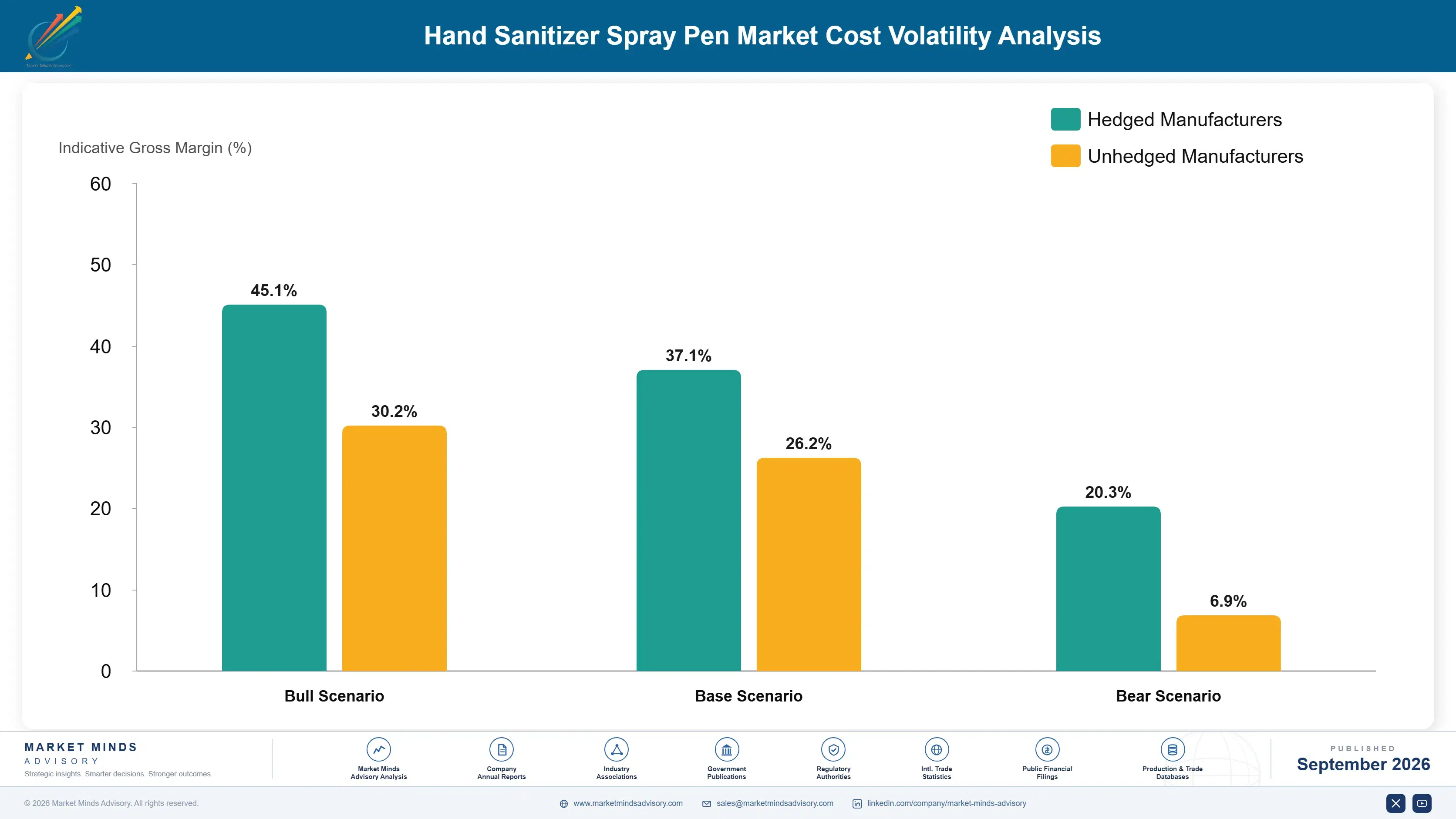
Three cost groups dominate and the formulation is not the largest. Pen body, pump, and atomiser assembly run 34% to 42% of cost of goods sold, and the eight-point range separates dual-chamber and precision atomiser systems from basic single-chamber pens. Alcohol, humectant, and formulation take 26% to 34%. Packaging and regulatory registration account for 24% to 32%, weighted toward markets treating it as a regulated drug.
Ethanol pricing moved through 2024 and 2025 on agricultural feedstock and fuel blending demand together, and United States Department of Agriculture and Energy Information Administration series documented both movements across the period. Several manufacturers described dispensing component costs rather than alcohol as the binding pressure in their annual reports. Engineering polymer costs followed petrochemical cycles unconnected to either. The three exposures moved independently of one another across the whole period.

The competitive disadvantage mechanism runs through regulatory registration rather than through formulation. A manufacturer selling across many markets registers as an over the counter drug in some and a biocidal product in others, each with separate dossiers and separate active substance requirements. Exposure varies by market breadth and claim position rather than scale, and brands claiming primary efficacy everywhere carry the heaviest burden.
hand-sanitizer-spray-pen-market-cost-volatility-analysis-1790020425298

Position Claims To Reduce Registration Burden

Primary efficacy claims trigger drug or biocidal registration with dossier requirements that supplementary positioning does not attract in the same form. Aligning claim language with what the delivered dose actually supports reduces the registration burden and the exposure at the same time, which is unusual for a compliance decision. It reduces the burden and the exposure at the same time.

Specify Seals Against Measured Ethanol Permeation

Ethanol escapes through seals faster than water and the loss compounds in warm conditions, which is where the fastest growing markets are. Specifying seal materials against measured ethanol permeation rather than against general chemical resistance keeps a product within its label across shelf and use life. The fastest growing markets are also the warmest ones.

Contract Ethanol Against Fuel Blending Cycles

Ethanol pricing follows agricultural feedstock and fuel blending mandates at volumes personal care manufacture cannot influence in any direction whatever. Contracting against those cycles rather than reacting to them removes most of the exposure and secures allocation through the periods when fuel demand competes for the same output. Fuel blending demand dwarfs anything this category consumes.

Portfolio Architecture for Margin Defence

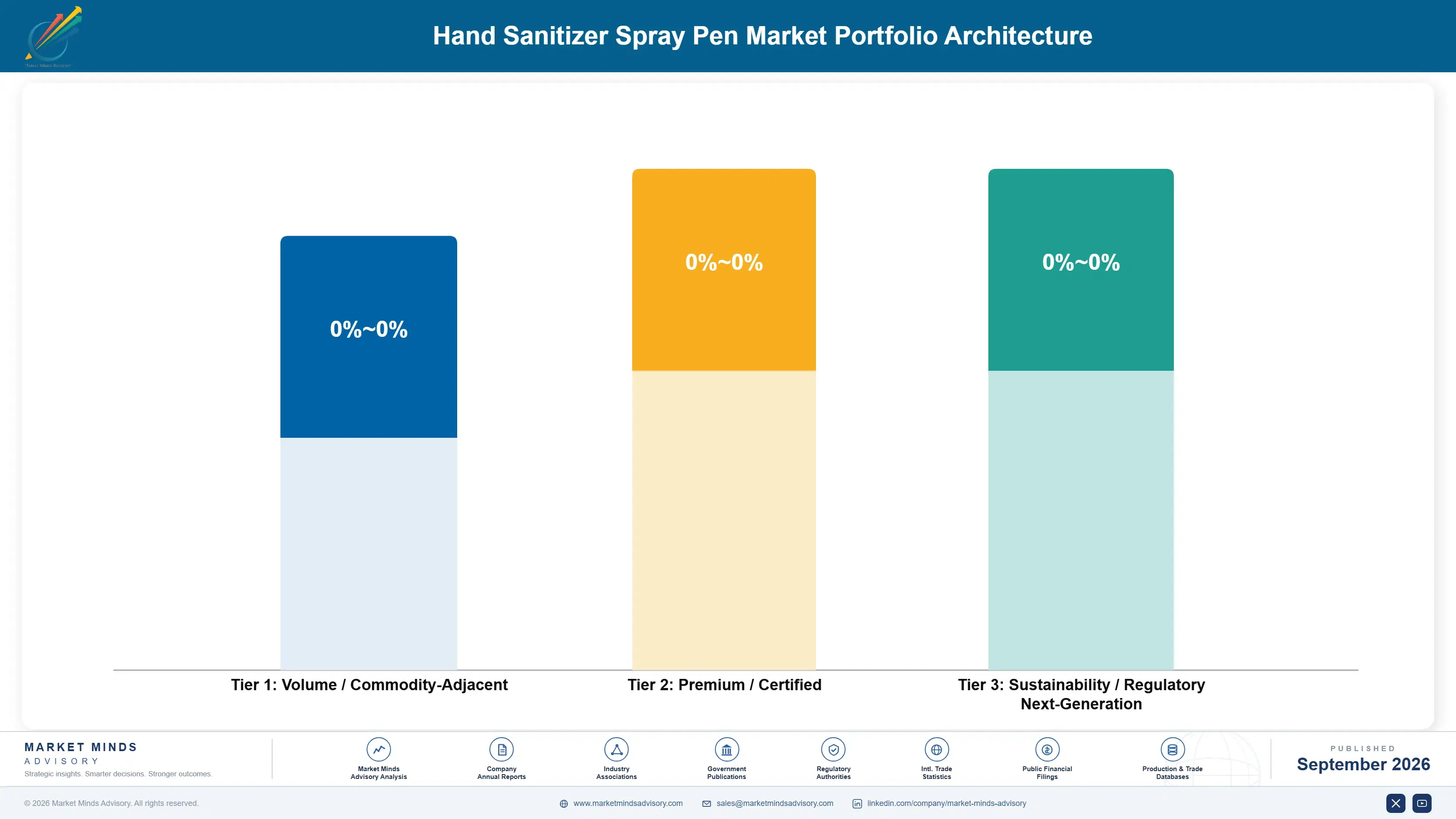
Margin follows dispensing engineering and claim defensibility rather than formulation. Promotional and disposable pens compete close to filling cost against Chinese private label supply. Basic single-chamber pens earn modestly on brand recognition. Refillable systems with properly specified seals earn well where the label still holds at end of use, and dual-chamber pens earn most, because the dispensing engineering is genuinely difficult and the users buying them buy most often.
The tension between volume and premium runs through how often the buyer uses it. An occasional user buying a pen for a bag chooses on price, scent, and appearance, and will not notice a dose difference or a seal problem because the pen will be lost before either matters. A daily user going through several units a month notices skin damage, notices a pen that stops smelling of alcohol, and pays substantially more for products that address both.

High-value pools concentrate in dual-chamber dispensing, in refillable systems with measured seal performance, and in ranges positioned honestly enough to survive regulatory attention. Where the product is a promotional pen filled to a price and given away, Chinese filling holds the cost position and nothing is differentiated.

Volume / Commodity-Adjacent

Promotional and single-use disposable pens filled to a price for corporate distribution and mass retail. The ten-point range reflects filling and component sourcing rather than any dispensing capability a user would notice during the product's short life.
Gross Margin: 28% to 38%

Premium / Certified

Branded single-chamber and clip formats carrying registration in multiple markets and recognised consumer positioning. The twelve-point range separates genuine formulation and fragrance development from private label filling sold under a brand name.
Gross Margin: 44% to 56%

Sustainability / Regulatory / Next-Generation

Dual-chamber dispensing and refillable systems with measured seal performance, published delivered volume, and supplementary claim positioning. The sixteen-point range reflects dispensing engineering depth, which very few manufacturers hold. Positioning has to reach the pack rather than the file.
Gross Margin: 60% to 76%
hand-sanitizer-spray-pen-market-portfolio-architecture-1790020425993

High-value Sub-segments and Strategic Watch-out

Dual-Chamber Dispensing Systems

Highest value in the category, retaining the daily users who buy several times more often than occasional ones. The sixteen-point range reflects dispensing engineering, which is genuinely difficult and cannot be assembled from a single-chamber platform. Losing one costs several occasional customers at once, which is expensive.
Gross Margin: 62% to 78%

Sealed Refillable Pen Systems

High value where the label still holds at end of use, in a format where ethanol escapes faster than water through imperfect seals. The fourteen-point range reflects seal specification, which is currently priced as a cost rather than performance. Warm carry is where the label quietly stops holding.
Gross Margin: 50% to 64%

Supplementary Positioned Ranges

Volume core where honest claim language reduces registration burden and regulatory exposure simultaneously. The twelve-point range reflects how far the positioning has actually been carried through onto pack rather than only into internal documents. An internal decision does nothing at all until it reaches the carton itself.
Gross Margin: 42% to 54%

Promotional Filled Disposable Pens

The strategic watch-out. Filled to a price, given away, lost before anything about it matters, and supplied by anybody with a filling line. The ten-point range reflects component sourcing alone, with nothing else defending it. Most are lost before anything about them matters at all.
Gross Margin: 26% to 36%

How This Demand Repeats

This is a genuine consumable but it repeats very unevenly across the user base. A daily carrier goes through several pens a month and generates the majority of category value from a minority of buyers, while an occasional user buys one, carries it for a season, and loses it before it empties. The value of a customer is therefore set almost entirely by use frequency rather than by any brand relationship.
Retention among heavy users runs on skin condition more than on anything else. A daily user whose hands crack after a fortnight leaves the product and frequently the format, which is why dual-chamber growth outpaces everything else in the category. That group is small in number and large in value, and losing one of them costs several occasional customers' worth of revenue at once.

The buyer is shifting from the population who adopted during the acute period toward habitual users in Asia and travellers who value portability specifically. Both groups use the product more often than the residual pandemic cohort does, which raises average value per customer even where unit counts do not grow. Manufacturers still positioning against that cohort address a group that has largely stopped buying.
hand-sanitizer-spray-pen-market-end-use-penetration-index-1790020426788

Where This Market Rewards

These are among the four positions where our research anticipates prominent divergence between winners and laggards over the coming forecast period. Each is grounded in the demand model, the regulatory perimeter, and the announced capacity pipeline.
01 / HONEST CLAIM POSITIONING

Nineteen sprays, and nobody does

A pocket pen delivers around 0.15 millilitres per actuation against a tested dose near three millilitres, which puts the evidence-based application at roughly 19 sprays that nobody performs. Manufacturers positioning explicitly as supplementary hygiene report regulatory exposure 3.6 times lower with no measurable loss of consumer preference. The honest claim is that it gets used because it is in a pocket, and that benefit is real, defensible, and considerably smaller than the packaging implies, and stating actuations per application on pack costs a printed line and nothing more.
02 / DELIVERED VOLUME ENGINEERING

Fast drying defeats the mechanism

A sprayed film stays wet for roughly seven seconds against the thirty second contact time efficacy testing requires, because the surface area to volume ratio makes rapid evaporation unavoidable at that dose. Manufacturers engineering higher delivered volume per actuation report efficacy claim defensibility 2.8 times stronger while requiring fewer actuations. Selling wet time as working time rather than as a drawback reverses an argument the category currently makes against itself, and pen atomisers were designed for fragrance rather than for antimicrobial volume originally.
03 / SEAL PERMEATION SPECIFICATION

The alcohol leaves before you do

Ethanol escapes through imperfect seals faster than water, so a partly used refillable pen carried warm holds meaningfully less alcohol than its label states, and about 4% of products disclose end of use content. Manufacturers specifying seals against measured ethanol permeation report label conformance 3.2 times higher across shelf and use life. Hot climate markets carry that exposure most heavily and are also the fastest growing part of this category, and specifying general chemical resistance rather than measured permeation is why labels drift.
04 / HEAVY USER RETENTION

Damaged skin is worse protection

Repeated alcohol application strips skin lipids, and a damaged barrier is a worse barrier to infection than an intact one, which is an uncomfortable outcome for a hygiene product to produce in its most committed users. Manufacturers offering dual-chamber emollient delivery report retention among high frequency users 2.5 times better than single-chamber equivalents. Those users buy several times more often, so losing one costs several occasional customers at once, and diluting alcohol to carry emollient solves one problem by creating another one.

Engagement Snapshot From the Field

A live engagement with an industry participant carrying material or product regulatory and market exposure ahead of a defining policy shift, showing how our research translates into a defensible multi-year portfolio strategy.
MARKET MINDS ADVISORY · CLIENT ENGAGEMENT SUMMARY
Hand Sanitizer Spray Pen Producer Strategic Portfolio Review and Transition Roadmap 2026·Investment Scenario on Hand Sanitizer Spray Pen Exposure Evaluation 2025-26
CLIENT PROFILE
A consumer health group with sanitiser pen revenue near USD 39 million (client-reported, unverified by MMA) across North America, Western Europe, and Southeast Asia. A regulator had queried efficacy language on one product, and legal affairs had asked what exposure existed across the rest of the range. Delivered volume had never been measured internally. Repeat purchase among frequent buyers had been falling for two years.
STRATEGIC CHALLENGE
Nobody had measured delivered volume per actuation on any product in the range, so the relationship between the tested dose and what a user actually applied was unknown internally. Repeat purchase among the group's most frequent buyers had also been falling without anybody establishing why. Nobody had connected the claim question to the retention one.
MMA APPROACH
MMA measured delivered volume and wet contact time per actuation across the range and eight benchmarks, tested alcohol content at fill and after simulated carry, surveyed lapsed high frequency users, and modelled claim exposure under several plausible regulatory positions. Lapsed users were surveyed separately from current ones so the reasons for stopping could be compared honestly against stated preferences.
KEY FINDINGS
  1. Delivered volume across the range averaged well under a fifth of a millilitre per actuation, putting the tested dose at close to twenty sprays on every product examined.
  2. Alcohol content after four weeks of simulated warm carry in refillable pens fell materially below the labelled figure, which no product disclosed in any form.
  3. Lapsed high frequency users overwhelmingly cited hand skin damage rather than price, availability, or scent as their reason for stopping entirely. Scent ranked well below skin condition.
  4. Under three of four plausible regulatory positions modelled, efficacy language across most of the range would have required substantiation the delivered dose could not support.
CLIENT PROFILE
A consumer health group with sanitiser pen revenue near USD 39 million (client-reported, unverified by MMA) across North America, Western Europe, and Southeast Asia. A regulator had queried efficacy language on one product, and legal affairs had asked what exposure existed across the rest of the range. Delivered volume had never been measured internally. Repeat purchase among frequent buyers had been falling for two years.
STRATEGIC CHALLENGE
Nobody had measured delivered volume per actuation on any product in the range, so the relationship between the tested dose and what a user actually applied was unknown internally. Repeat purchase among the group's most frequent buyers had also been falling without anybody establishing why. Nobody had connected the claim question to the retention one.
MMA APPROACH
MMA measured delivered volume and wet contact time per actuation across the range and eight benchmarks, tested alcohol content at fill and after simulated carry, surveyed lapsed high frequency users, and modelled claim exposure under several plausible regulatory positions. Lapsed users were surveyed separately from current ones so the reasons for stopping could be compared honestly against stated preferences.
KEY FINDINGS
  1. Delivered volume across the range averaged well under a fifth of a millilitre per actuation, putting the tested dose at close to twenty sprays on every product examined.
  2. Alcohol content after four weeks of simulated warm carry in refillable pens fell materially below the labelled figure, which no product disclosed in any form.
  3. Lapsed high frequency users overwhelmingly cited hand skin damage rather than price, availability, or scent as their reason for stopping entirely. Scent ranked well below skin condition.
  4. Under three of four plausible regulatory positions modelled, efficacy language across most of the range would have required substantiation the delivered dose could not support.
RECOMMENDED STRATEGY
Phase 1: Phase one: reposition the range as supplementary hand hygiene and state actuations per application on every pack. Do it voluntarily rather than under instruction. Phase 2: Phase two: specify seals against measured ethanol permeation and publish alcohol content at end of use as well as at fill. Phase 3: Phase three: develop a dual-chamber format for the frequent users the current range is losing to skin damage. Keep alcohol concentration undiluted in that format.
OUTCOME
The regulatory query closed after voluntary claim revision and no further product was challenged (client-reported, unverified by MMA). Repeat purchase among frequent users recovered after the dual-chamber launch. Delivered volume is now measured on every dispensing product the group develops. Two competitors adopted comparable pack statements within the year.

Frequently Asked Questions

Foundational context covering the market sizes, CAGR, scope, country, region and competition that inform every finding below. This section is provided to cover basics and most often pre-purchase conversations, answered from the MMA Primary Research Dataset.

What is the current size of the Hand Sanitizer Spray Pen Market?

The market was worth USD 0.9 billion in 2025 and stands at USD 1.0 billion in 2026. Value covers pen-format and pocket spray sanitiser dispensers at manufacturer selling price.

How large will the Hand Sanitizer Spray Pen Market be by 2036?

MMA forecasts USD 1.8 billion by 2036, an increase of USD 0.8 billion across the forecast period. That represents 1.80 times the 2026 base of USD 1.0 billion.

What is the CAGR for the Hand Sanitizer Spray Pen Market 2026 to 2036?

The base case compound annual growth rate is 5.8%, with a bull case at 7.0% and a bear case at 4.6%. Historical growth from 2020 to 2025 ran at 4.7%.

Which segment is growing fastest?

Dual-chamber sanitiser and moisturiser pens grow at 8.7%, half again the market rate of 5.8%. Repeated alcohol application damages skin, and frequent users notice within weeks.

Who are the major companies in the Hand Sanitizer Spray Pen Market?

Reckitt Benckiser, GOJO Industries, Kao Corporation, Unilever and Lion Corporation lead the field. Together they hold only 21% of revenue, with Chinese filling supply setting the cost base.

Which country is growing fastest?

Indonesia grows at 9.6%, on rising hygiene product penetration and a hot humid climate that makes portable formats genuinely practical for daily carry. Regional filling supplies most volume there.

Report Segmentation Architecture

The full report scope spans multiple orthogonal segmentation dimensions, with cross-tabulated demand data provided for each dimension pair. Coverage extends further to regional breakdowns, trend trajectories, and the competitive detail needed to support segment-level decision-making.

By Dispenser Format

  • Fine-Mist Single-Chamber Pens
  • Refillable Atomiser Pen Systems
  • Single-Use Disposable Spray Pens
  • Dual-Chamber Sanitiser and Moisturiser Pens
  • Clip and Keychain Integrated Formats
  • Branded Promotional Spray Pens

By End-Use Industry

  • Personal Daily Carry
  • Travel and Transport Use
  • Corporate and Promotional Distribution
  • Healthcare Staff Personal Use
  • Hospitality and Food Service
  • Education and Childcare Settings

By Commercial Dimension

  • Pharmacy and Drugstore Retail
  • Mass Grocery and Convenience
  • Direct to Consumer Online
  • Corporate and Promotional Supply
  • Travel Retail and Transport Channels
  • Private Label and Contract Filling

By Region

  • East Asia
  • North America
  • Western Europe
  • South Asia and Pacific
  • Latin America
  • Middle East and Africa
  • Eastern Europe

Scope, Methodology, and Coverage

Every figure in this report is reproducible from documented input assumptions. The scope below maps the historical period, the forecast horizon, the segmentation dimensions, and the countries covered, alongside the underlying primary and qualitative methodology.
Historical Period
2020 to 2025
Forecast Period
2026 to 2036
Base Year
2025 (USD billions; MMA Primary Research Dataset, September 2026)
Market Definition
This market covers pen-format and pocket spray dispensers for hand sanitiser, across fine-mist single-chamber pens, refillable atomiser pen systems, single-use disposable spray pens, dual-chamber sanitiser and moisturiser pens, clip and keychain integrated formats, and branded promotional spray pens. It excludes gel and foam sanitiser in bottles, wall-mounted and floor dispensers, surface disinfectant sprays, sanitising wipes, and bulk sanitiser formulations.
Quantitative Units
USD billions, revenue at manufacturer selling price
Segmentation Dimensions
Dispenser format, end-use setting, commercial dimension, region
Regions Covered
East Asia, North America, Western Europe, South Asia and Pacific, Latin America, Middle East and Africa, Eastern Europe
Countries Covered
Japan, South Korea, China, Taiwan, Indonesia, India, Philippines, Thailand, Vietnam, Australia, United States, Canada, Mexico, Germany, France, United Kingdom, Italy, Spain, Netherlands, Poland, Czechia, Brazil, Argentina, Colombia, Chile, Saudi Arabia, United Arab Emirates, Turkey, Egypt, South Africa
Key Companies Profiled
Reckitt Benckiser, GOJO Industries, Kao Corporation, Unilever, Lion Corporation, Procter and Gamble, Henkel, Ecolab, S C Johnson and Son, Beiersdorf, Kobayashi Pharmaceutical, Earth Corporation, Shiseido, Blue Moon Group, Bath and Body Works, Touchland, Olika, Zoono Group, Byotrol, Saraya
Quantitative Methodology
Primary survey, n=3,800 respondents, Q4 2025, six countries; demand-side model with trade association cross-validation
Qualitative Methodology
47 expert interviews, Q4 2025; applied to validate demand model assumptions, identify emerging dynamics, and assess competitive positioning
Report Format
PDF and XLSX data workbook (Word format preview document)
Publisher
Market Minds Advisory
Report Code
MMA-2026-MED-721
Published
September 2026
Contact
sales@marketmindsadvisory.com | www.marketmindsadvisory.com

Purchase the full Hand Sanitizer Spray Pen Market Report (2026 to 2036).

The full report sizes the hand sanitiser spray pen market across six dispenser formats, seven regions, and thirty countries, with forecasts to 2036 under base, bull, and bear cases. It measures delivered volume per actuation against the dose efficacy testing uses, quantifies wet contact time against the tested requirement, and tests alcohol content after simulated carry rather than at fill. Competitive analysis covers twenty participants evaluated consistently on category revenue, with detailed treatment of dispensing engineering and claim positioning. Regulatory registration burden by claim position is analysed throughout. Primary research includes 3,800 survey responses and 47 expert interviews.
Six dispenser formats sized and forecast separately
Twenty participants evaluated on category revenue consistently
Delivered volume per actuation measured against tested dose
Wet contact time compared against efficacy testing requirements
Alcohol content tested after simulated carry rather than at fill
Claim positioning assessed against registration burden by market

Built For The People Who Decide

From boardroom strategy to bench-side execution, this report is read cover-to-cover by leaders shaping the next decade of their industry, turning demand scenarios, market dynamics and valuation benchmarks into decisions.
CXOs/ Presidents/ VPs/ Managers
M&A and Corporate Development
Strategy Teams and R&D Heads
Procurement and Product Directors
Regulatory and Compliance Leaders
Investor Relations and Equity Analysts