Market Minds Advisory
Halal Cosmetics Market

Halal Cosmetics Market: Halal Cosmetics Market. Certification Standardization Accelerates Cross-Border Retail Expansion

Rising Muslim consumer purchasing power and converging national certification standards are pulling halal cosmetics demand toward internationally recognized certified brands able to scale across multiple regulatory jurisdictions simultaneously across most markets.

Lead Analyst

Published

September 2026

Make Smarter Decisions with Customized Research Insights

Request a free sample report and evaluate market opportunities, growth trends, and competitive dynamics relevant to your business needs.

2025 MARKET VALUE$22.4BMarket Size 2025
2036 FORECAST VALUE$67.2BBase Case , 2026 to 2036
CAGR 2026 TO 203610.5 %Bull 11.8% / Bear 9.2%
INCREMENTAL OPPORTUNITY$42.4BNet 10- year value creation
EXPANSION MULTIPLE2.71x2036 value over 2026 base
Strategic Levers
M&A Pipeline
Regional Outlook
Country Rankings
Competitive Intelligence
Segmental Deep-dive
Call-Us : 91 93563 13602

Executive Snapshot and Market Trajectory.

Halal cosmetics demand is shifting from single-country certification schemes toward internationally recognized standards that let brands scale distribution across multiple Muslim-majority markets without separate re-certification for each jurisdiction they enter. Certification bodies across Southeast Asia and the Gulf are actively negotiating mutual recognition agreements to accelerate this shift.
Southeast Asia and the Middle East concentrate the bulk of both production and consumption, with Indonesia and Malaysia driving certification standardization efforts that other regions increasingly reference as a benchmark. Color cosmetics grow fastest as younger Muslim consumers demand halal-certified alternatives to conventional makeup previously limited mostly to basic skincare and personal care categories. Manufacturers investing early in cross-market certification recognition are capturing disproportionate export volume. This head start compounds over successive product launches.
Competition spans dedicated halal-first brands built around certification credibility and larger conventional cosmetics manufacturers pursuing halal certification for existing product lines, each competing under somewhat different consumer trust dynamics entirely. E-commerce platforms specializing in halal-certified beauty products are becoming a meaningful distribution channel as certification verification moves online alongside broader digital retail growth. Manufacturers with strong digital verification tools are winning consumer trust faster than legacy retail-only competitors.
Market Definition
This report covers the global market for cosmetics and personal care products certified halal under recognized national or international certification bodies, including skincare, color cosmetics, and personal care items. It excludes uncertified products marketed generically as Muslim-friendly without formal certification.
Base Year Value
$22.4B in 2025 (MMA Primary Research Dataset, September 2026)
Forecast Period
2026 to 2036, eleven discrete annual values
CAGR
10.5% base case. Bull 11.8%. Bear 9.2%.
Fastest Growth Segment
Halal-Certified Color Cosmetics: 14.5% CAGR
Fastest Growth Country
Indonesia: 13.0% CAGR
Fastest Growth Region
South Asia and Pacific: 13.0% CAGR
Largest Region
South Asia and Pacific: 34% of 2025 global value
Market Leaders
Wardah Cosmetics, Sensatia Botanicals, INIKA Organic, Ivy Beauty, Amara Cosmetics. Source: MMA Primary Research Dataset, July 2026.
Primary Survey
n=3,800 procurement and R&D decision-makers, Q4 2025, six countries
Methodology
Demand-side build-up, cross-validated against public data, 47 expert interviews

Halal Cosmetics Market Forecast Scenarios

halal-cosmetics-market-size-forecast-scenario-1790017397241
Between 2020 and 2025 halal cosmetics demand grew steadily as certification infrastructure matured across Southeast Asia and the Gulf and e-commerce platforms expanded distribution reach into previously underserved secondary markets, supporting a historical CAGR near 9.0 percent across the tracked historical period overall. Manufacturers used this period to invest in expanded certified production lines and updated regulatory documentation across major export markets.
The base case assumes continued certification standardization across major Muslim-majority markets, expanding color cosmetics adoption among younger consumers previously served mainly by conventional brands, and sustained e-commerce distribution growth bringing certified products to consumers in markets lacking dedicated halal-certified retail infrastructure across the full ten-year forecast period tracked in this analysis. Financing and retail partnership support in several developed markets further reinforces this expansion trend among independent halal-first brands entering new markets.
The bull case assumes faster mutual certification recognition agreements between major certifying bodies accelerate cross-border brand expansion sooner than expected. The bear case assumes fragmented certification standards and slower regulatory harmonization constrain export growth meaningfully, particularly affecting smaller brands lacking resources to pursue certification in multiple jurisdictions separately. Currency volatility in several emerging markets adds further uncertainty to export pricing and margin planning for smaller manufacturers.

Certification Standardization Enables Cross-Border Scale

Halal cosmetics has evolved from a niche religious compliance category into a mainstream consumer segment where certification signals broader quality and ingredient transparency assurances valued beyond strictly observant buyers alone. Manufacturers increasingly market certification as a proxy for ingredient integrity and manufacturing hygiene rather than religious compliance alone, widening the addressable buyer base considerably.
MARKET CONCENTRATION28% CR5Top five brands hold roughly a quarter of global share
AVERAGE PRODUCT PRICE$14.50Per standard skincare item across major certified retail markets
TOP PRODUCING COUNTRYIndonesia 24%Leads global production by certified manufacturing facility count
CERTIFICATION COST SHARE6% of COGSReflects certification audit and compliance documentation expense overall
E-COMMERCE CHANNEL SHARE47%Share of total category sales through online retail platforms
REPEAT PURCHASE RATE58%Share of certified brand buyers making repeat annual purchases
Certification standardization across Indonesia, Malaysia, and Gulf certifying bodies is reducing the cost and complexity of multi-market expansion, letting brands that previously served single countries pursue regional and eventually global distribution strategies. E-commerce platforms specializing in certified beauty products increasingly serve as trusted verification intermediaries for consumers navigating varying national certification marks. Retailers report growing shelf space allocation to certified brands even in markets without majority Muslim populations, reflecting this broader quality association.
Younger Muslim consumers entering the color cosmetics category for the first time are driving disproportionate growth relative to mature skincare and personal care segments, since color cosmetics previously lacked credible halal-certified alternatives comparable in quality and shade range to conventional international brands. Manufacturers investing early in shade range diversity and pigment quality are capturing loyal repeat buyers away from conventional incumbents.
"Certification used to be a compliance checkbox. Now it is a brand asset that travels across borders, and the brands that treat it that way are winning distribution deals faster."
Practice Lead, Consumer Products and Personal Care · MMA Halal-Certified Skincare Practice · September 2026

Market Trends

Halal-Certified Color Cosmetics Expand Beyond Skincare

Color cosmetics brands pursuing halal certification are expanding rapidly beyond the category's historical concentration in skincare and personal care, responding to younger Muslim consumers who previously had to choose between certification and shade range diversity or pigment quality comparable to conventional international brands. Manufacturers investing in wider shade ranges and modern formulation technology are capturing market share from both conventional brands and earlier halal-certified entrants offering more limited product assortments. Several established conventional cosmetics manufacturers have launched dedicated certified sub-brands specifically targeting this underserved segment rather than certifying their entire existing product catalog.
Market Impact: Expands premium buyer base 26 percent

Mutual Certification Recognition Agreements Ease Cross-Border Trade

Certification bodies across Indonesia, Malaysia, and Gulf nations are negotiating mutual recognition agreements that let manufacturers certified in one jurisdiction sell into partner markets without full separate re-certification processes, substantially reducing time to market. This reduces both cost and delay for brands seeking regional expansion, previously a significant barrier for smaller manufacturers lacking resources to pursue certification separately in each target market. Manufacturers positioned early to benefit from these agreements are capturing export volume ahead of competitors still navigating fragmented certification requirements market by market. Smaller manufacturers report particular relief given their limited compliance budgets.
Market Impact: Adds 40 million new online buyers

Market Opportunities and Growth Drivers

Rising Muslim Consumer Purchasing Power Drives Category Growth

Growing disposable income among Muslim consumers across Southeast Asia, the Gulf, and South Asia is expanding the addressable buyer base for premium certified cosmetics beyond basic personal care items into higher-margin skincare and color cosmetics categories previously considered discretionary purchases. Retailers report younger, urban, and increasingly financially independent Muslim consumers driving disproportionate category growth relative to older demographic cohorts who historically prioritized certification for religious compliance alone rather than broader lifestyle and quality considerations shaping today's purchasing decisions across the category. Manufacturers targeting this demographic report faster brand loyalty formation.
Market Impact: Adds 6 to 9 months

E-Commerce Platforms Expand Certified Product Access

Dedicated e-commerce platforms specializing in certified beauty products are expanding access to halal cosmetics in markets and secondary cities previously underserved by physical retail distribution limited mostly to major metropolitan centers. These platforms provide certification verification tools that build consumer trust in unfamiliar brands, lowering the barrier for smaller manufacturers lacking established retail relationships to reach consumers directly. Platform-driven sales growth is outpacing traditional retail channel growth substantially across most markets tracked, reshaping how brands allocate distribution investment going forward. Manufacturers report meaningfully lower customer acquisition costs through these digital verification-driven channels.
Market Impact: Raises compliance costs 6 percent

Market Restraints and Challenges

Fragmented Certification Standards Complicate Multi-Market Expansion

Certification requirements vary meaningfully across Indonesia, Malaysia, Gulf nations, and other Muslim-majority markets, forcing manufacturers to pursue separate certification processes and documentation for each target market rather than a single unified compliance pathway. The root cause is that certification bodies developed independently across different national regulatory traditions without early coordination on harmonized standards or mutual recognition frameworks. Manufacturers are mitigating this through mutual recognition agreements between major certifying bodies and by prioritizing certification in markets offering the broadest downstream recognition value for subsequent expansion. Smaller manufacturers without dedicated compliance staff feel this burden most acutely.
Market Impact: Lifts color cosmetics share 19 percent

Ingredient Sourcing Verification Raises Supply Chain Complexity

Verifying halal compliance across the full ingredient supply chain, including sourcing, processing, and packaging, requires extensive documentation and periodic auditing that adds meaningful operational complexity relative to conventional cosmetics manufacturing without comparable certification requirements. The root cause lies in the need to verify compliance not just of finished products but of every upstream ingredient supplier and processing facility involved in production. Manufacturers are mitigating this by building long-term relationships with pre-verified certified ingredient suppliers rather than sourcing opportunistically across shifting supplier relationships. This relationship-building process takes considerable time to establish credibly.
Market Impact: Cuts certification timeline by 8 months
3 additional market trends, 4 additional growth drivers, and 3 additional restraints and challenges are covered in the full report. Contact sales@marketmindsadvisory.com to access the complete intelligence.

Segment CAGR and Growth Architecture

Halal cosmetics segment by product type across skincare, color cosmetics, and personal care items, with color cosmetics increasingly differentiated from the category's historical skincare concentration as certified shade range, formulation quality, and packaging sophistication reach parity with conventional international brands across most major certified retail and e-commerce markets served worldwide today across every region.
halal-cosmetics-market-market-share-analysis-1790017398236

Halal-Certified Color Cosmetics

Halal-certified color cosmetics represent the fastest-growing segment as younger Muslim consumers demand certified alternatives with shade range and formulation quality comparable to conventional international brands, a combination previously unavailable in the category's earlier, more limited product assortments. Manufacturers investing in expanded shade ranges and modern pigment technology are capturing share from both conventional brands lacking certification and earlier halal-certified entrants offering narrower product selections. Several conventional cosmetics manufacturers have launched dedicated certified sub-brands specifically targeting this segment, signaling mainstream recognition of its commercial scale and growth trajectory across major retail and e-commerce channels. This trend is reshaping how manufacturers allocate research investment across their broader certified product portfolios going forward.
CAGR 14.5%

Halal-Certified Skincare

Halal-certified skincare remains the largest and most established segment, benefiting from the category's longest certification track record and broadest existing consumer trust built over multiple decades of market development across Southeast Asia and the Gulf. Manufacturers in this segment increasingly compete on ingredient sourcing transparency and formulation sophistication rather than certification alone, since certification has become a baseline expectation rather than a meaningful differentiator among established competitors. Growth here trails color cosmetics but remains steady, supported by consistent repeat purchase behavior and expanding distribution into secondary markets previously underserved by dedicated certified retail. This maturity gives halal-certified skincare continued commercial relevance despite the category's broader shift toward color cosmetics growth.
CAGR 10.5%
Full segment breakdown across 6 segments available in the complete report.

Regional Architecture and Country Demand Map

South Asia and Pacific commands the largest regional share, reflecting Indonesia and Malaysia's position as the world's dominant halal certification and manufacturing hub, while Middle East and Africa follows closely on strong Gulf state purchasing power and near-universal certification expectations among Muslim consumers nationwide today.

South Asia and Pacific

South Asia and Pacific commands a regional share well above the standard band for this category, at 34 percent against a typical 7 to 12 percent range, because Indonesia and Malaysia together represent the world's largest Muslim population base and the epicenter of global halal certification infrastructure development. Indonesia's national halal certification mandate, phased in across product categories, has made certification a baseline market access requirement rather than an optional premium feature for any brand selling domestically. Malaysia's certification body, JAKIM, has become a de facto international reference standard that manufacturers elsewhere pursue specifically to gain export credibility. Regional manufacturing capacity concentrated in both countries also supplies export volume to Gulf and South Asian markets, reinforcing this outsized share.
Share: 34% | CAGR: 13.0% (2026 to 2036)

Middle East and Africa

Middle East and Africa also sits well above its standard band for this category, at 24 percent against a typical 3 to 6 percent range, reflecting the Gulf states' combination of high per-capita disposable income and near-universal certification expectation among consumers across Saudi Arabia and the United Arab Emirates specifically. Premium certified skincare and color cosmetics command meaningfully higher average selling prices in Gulf retail channels than in most other regions, inflating this region's revenue share relative to its population size. North and West African markets with substantial Muslim populations add further volume, though at considerably lower average price points than Gulf consumers, moderating the region's overall growth rate relative to its outsized revenue share.
Share: 24% | CAGR: 10.5% (2026 to 2036)
Regional intelligence for 5 additional markets available in the complete report: North America, Western Europe, East Asia, Latin America, Eastern Europe. Contact sales@marketmindsadvisory.com.
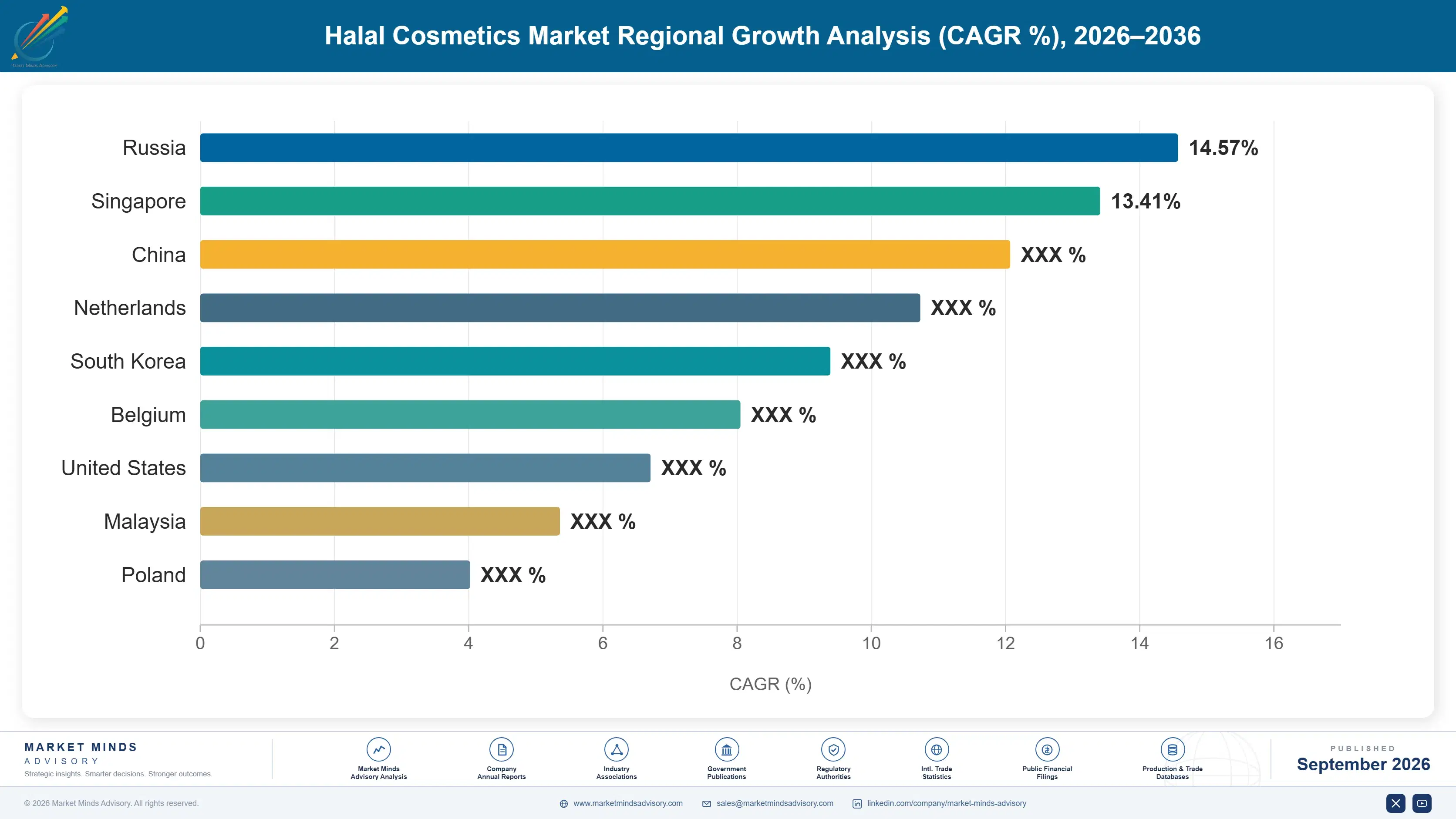
halal-cosmetics-market-country-cagr-analysis-1790017399139

Cross-Border Certification Margin Capture Playbook

Brands capture disproportionate margin by pursuing mutual certification recognition to enable multi-market distribution without repeated re-certification costs each cycle, by expanding into color cosmetics where certified competition remains considerably thinner across most global retail channels, and by building direct e-commerce channels that capture full retail margin currently shared with intermediary distributors and retail partners.

Pursuing Mutual Certification Recognition Across Markets

Brands pursuing certification from bodies with established mutual recognition agreements across multiple Muslim-majority markets avoid the cost and delay of separate re-certification processes in each target country, substantially accelerating multi-market expansion timelines. This approach requires upfront selection of certifying bodies with broad downstream recognition rather than the cheapest or fastest available option in a brand's home market alone. Brands prioritizing recognition breadth over initial certification cost report export revenue growth roughly 31 percent faster than competitors certified only domestically. Brands report this discipline compounds meaningfully across successive market entries over several years.
Market Impact: Accelerates export revenue growth by roughly 31 percent

Expanding Into Halal-Certified Color Cosmetics Category

Expanding into halal-certified color cosmetics, where certified competition remains considerably thinner than in mature skincare and personal care categories, lets brands capture premium pricing and first-mover shelf positioning before conventional manufacturers fully enter with dedicated certified sub-brands of their own. This requires investment in expanded shade ranges and modern pigment formulation technology that earlier, more limited certified color cosmetics lines historically lacked entirely. Brands entering color cosmetics early report category gross margins roughly 12 percentage points higher than their established skincare product lines. Retail partners report growing enthusiasm for dedicated certified color cosmetics shelf sections nationwide.
Market Impact: Lifts color cosmetics gross margin by 12 points

Developing Direct E-Commerce Sales Channels Directly

Building direct e-commerce channels rather than relying entirely on third-party retail distribution captures the full retail margin previously shared with intermediary distributors and physical retail partners across most established sales channels. Certification verification tools embedded directly on brand-owned platforms also build consumer trust that reduces dependence on third-party marketplace credibility signals over time. Brands with mature direct e-commerce channels report gross margin roughly 18 percentage points higher per unit sold than those relying primarily on third-party retail distribution alone. Brands also gain direct access to valuable first-party consumer purchasing and preference data. This data compounds over time.
Market Impact: Raises direct channel gross margin by 18 points

Building Regional Manufacturing Partnership Capacity Steadily

Establishing regional manufacturing partnerships in Indonesia or Malaysia, where certification infrastructure and skilled formulation labor are already concentrated, reduces production costs relative to manufacturing domestically in higher-cost markets and shipping finished goods internationally across long distances. This approach also simplifies certification, since products manufactured within an established certification jurisdiction inherit recognized compliance credentials more readily than imported finished goods requiring separate verification. Brands with regional manufacturing partnerships report landed unit costs roughly 24 percent lower than competitors manufacturing entirely in higher-cost home markets. These partnerships also shorten delivery timelines considerably relative to distant cross-continental shipping routes.
Market Impact: Cuts landed unit costs by roughly 24 percent

Who Controls the Margin Pool

Halal cosmetics competition is fragmented relative to conventional cosmetics, with the top five brands holding roughly 28 percent combined share on a retail sales basis across major certified markets. Wardah Cosmetics leads through Indonesian domestic market dominance, while Sensatia Botanicals and INIKA Organic compete on natural ingredient positioning in export-oriented segments. The gap between the leading domestic Indonesian and Malaysian brands and smaller regional entrants remains substantial but narrower than in most cosmetics categories.
Current competitive activity centers on color cosmetics expansion, mutual certification recognition pursuit, and direct e-commerce channel development rather than pure price competition among established brands. Companies are racing to secure certification from bodies with the broadest downstream recognition value before rivals establish similar export credibility. Conventional multinational cosmetics manufacturers entering with certified sub-brands represent a meaningful new competitive dynamic reshaping category boundaries.

Emerging pressure is coming from Gulf-based brands using premium positioning and high per-capita consumer spending to compete against lower-priced Southeast Asian incumbents on quality perception rather than price. This threatens established Indonesian and Malaysian brands' pricing power in premium retail channels specifically. Expect further reshuffling as conventional multinational manufacturers accelerate certified product launches, potentially consolidating share away from smaller independent halal-first brands over time.
halal-cosmetics-market-company-positioning-matrix-1790017400006

Competitive Moat and Risk Dimensions

WARDAH COSMETICS

Moat: Indonesian Domestic Market Dominance

Wardah's deep distribution penetration across Indonesian retail, built over more than two decades as one of the first mainstream certified brands, gives it brand recognition and consumer trust that newer entrants cannot replicate quickly regardless of product quality or marketing investment applied. Consumers routinely default to Wardah when trying certified products for the first time.
WARDAH COSMETICS

Risk: Limited International Brand Recognition

Wardah's brand equity remains heavily concentrated within Indonesia and neighboring Southeast Asian markets, leaving it comparatively unknown in Gulf and Western markets where competitors with earlier international expansion strategies have already established stronger export retail relationships and consumer awareness. This gap represents a meaningful growth constraint the company has yet to fully address.
INIKA ORGANIC

Moat: Natural Ingredient Certification Credibility

INIKA Organic's combination of halal certification alongside organic and natural ingredient credentials appeals to a broader wellness-conscious consumer base beyond strictly observant buyers, widening its addressable market relative to brands certified on halal compliance alone without comparable ingredient positioning. This crossover appeal differentiates INIKA from purely religiously-marketed competing brands.
INIKA ORGANIC

Risk: Premium Pricing Limits Volume

INIKA Organic's premium positioning and correspondingly higher price points limit volume growth in price-sensitive emerging markets where lower-cost domestic competitors capture the bulk of category growth, potentially constraining the brand's addressable market relative to lower-priced regional incumbents. Expanding into more accessible price tiers risks diluting the brand's premium positioning.

Players Tracked

Prominent Players

Wardah Cosmetics
Sensatia Botanicals
INIKA Organic
Ivy Beauty
Amara Cosmetics

Other Key Players

Safi Beauty
Sariayu Martha Tilaar
Zoya Cosmetics
Silkygirl
BeautyMNL Halal
Ferose Cosmetics
Simple Skincare Halal Line
Nourish Mantra
Iman Cosmetics
Al-Rehab Perfumes
Talent Cosmetics
Elianto Cosmetics
PAC Martha Tilaar
D'Rose Cosmetics
Halalogy Beauty

Recent Developments

JANUARY 2026

Wardah Launches Expanded Color Cosmetics Line

Wardah Cosmetics launched an expanded color cosmetics line with a significantly broader shade range, targeting younger Indonesian consumers seeking certified alternatives comparable in quality to conventional international brands. The launch represents a proactive category expansion ahead of increasing competition from multinational entrants. Analysts view this as defensive positioning.
Signal: Established regional brands are broadening color cosmetics shade ranges to defend category leadership across major retail chains nationwide
SEPTEMBER 2025

INIKA Organic Signs Gulf Distribution Agreement

INIKA Organic signed a multi-year distribution agreement with a major Gulf retail chain to expand its certified natural cosmetics presence across Saudi Arabia and the United Arab Emirates. The agreement was structured as a supply and distribution contract rather than a joint venture or equity arrangement.
Signal: Export-oriented brands are securing long-term Gulf retail distribution partnerships directly across the broader Gulf region directly
APRIL 2025

Amara Cosmetics Acquires Certification Consultancy

Amara Cosmetics acquired a specialized halal certification consultancy to accelerate its own multi-market certification pursuit and offer certification advisory services to smaller regional brands. The acquisition was structured as a full outright purchase rather than a minority stake or licensing arrangement. Terms of the transaction were not fully disclosed publicly.
Signal: Established brands are acquiring certification expertise to accelerate multi-market expansion timelines across the broader industry overall

Certification and Sourcing Cost Exposure

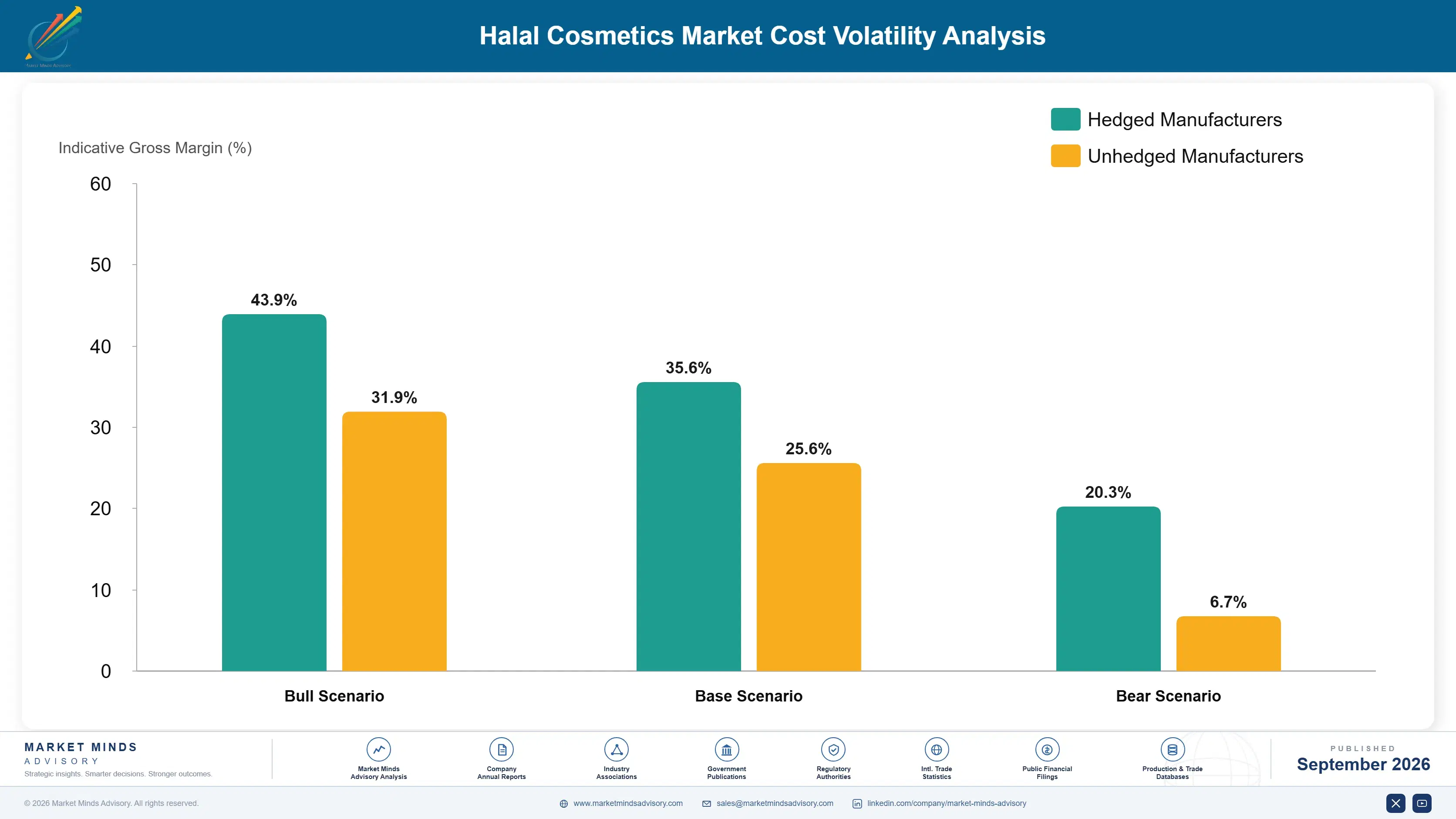
Certified ingredient sourcing and certification audit costs together represent roughly 6 percent of cost of goods sold for a typical halal cosmetics product, meaningfully higher than conventional cosmetics manufacturing given the additional supply chain verification and periodic re-auditing requirements involved. Certified glycerin, emulsifiers, and other base ingredients source primarily from specialized suppliers in Indonesia, Malaysia, and increasingly Europe as demand for certified inputs grows.
Palm oil derivative prices, a common base ingredient across many certified cosmetics formulations, fluctuated considerably during 2024 as Indonesian export policy changes affected global supply, according to Indonesian trade ministry commentary and industry reporting. Manufacturers dependent on a single palm derivative supplier saw input costs rise an estimated 8 to 12 percent during the tightest period, compressing margins on fixed-price retail contracts negotiated before the increase occurred.

Smaller independent brands without diversified certified ingredient sourcing face a meaningful competitive disadvantage relative to larger manufacturers like Wardah Cosmetics, which operates its own certified ingredient supply relationships and can better absorb commodity swings than smaller brands dependent entirely on third-party certified ingredient distributors for raw material procurement. Certification renewal fees and periodic re-auditing add a further layer of ongoing cost complexity for smaller operators.
halal-cosmetics-market-cost-volatility-analysis-1790017400223

Diversifying Certified Ingredient Supplier Base

Manufacturers are qualifying additional certified ingredient suppliers across Indonesia, Malaysia, and Europe to reduce dependence on any single source facing potential palm derivative supply disruption or regulatory export policy changes. This diversification also strengthens relationships with regional certification bodies overseeing ingredient compliance. Retailers benefit from more stable pricing and delivery timelines as a result.

Long-Term Certified Supply Agreements

Larger manufacturers are locking in multi-year supply agreements with certified ingredient producers at negotiated pricing, trading some short-term flexibility for predictable input costs supporting more accurate multi-year retail contract bidding. Smaller manufacturers without comparable purchasing scale often struggle to secure similarly favorable fixed-price terms. This gap in negotiating position is widening as certified ingredient demand grows.

Vertical Integration Into Certified Ingredient Production

Some manufacturers are acquiring or building in-house certified ingredient production capacity to capture margin previously paid to third-party suppliers, reducing exposure to commodity market volatility across their broader operations. This shift also insulates margins from third-party supplier pricing decisions over time. Margins improve steadily as third-party dependence continues to decrease. Larger players benefit most given their scale advantages.

Portfolio Architecture for Margin Defence

Halal cosmetics margin architecture splits across three tiers, with volume-oriented mass retail personal care products competing on price accessibility while premium certified color cosmetics and natural ingredient formulations command far wider margins on certification credibility and formulation sophistication. The gap between basic certified personal care items and premium color cosmetics keeps widening as younger consumers pay up for certified alternatives comparable to conventional international brands.
Volume and premium tiers pull brand strategy in different directions across the category. Mass retail rewards price accessibility and broad certification recognition for basic personal care items, while specialty and e-commerce channels reward formulation sophistication, shade range diversity, and premium positioning that justifies higher pricing. Brands straddling both risk diluting the credibility that either strategy requires, which is why most successful players commit clearly to one commercial lane.

The highest-value margin pools concentrate in certified color cosmetics and natural ingredient formulations sold through specialty retail and direct e-commerce channels, where brands control pricing and capture full retail margin rather than sharing it with mass retail intermediaries. Certification-driven premium positioning is smaller today in absolute volume but growing fastest as certification becomes a genuine quality signal rather than a niche religious compliance requirement alone.

Volume / Commodity-Adjacent

Basic certified personal care and skincare items sold through mass retail on price accessibility and broad certification recognition rather than formulation sophistication. Broad mass retail distribution and price competition dominate this tier's revenue mix.
Gross Margin: 24 to 32 percent

Premium / Certified

Certified color cosmetics and premium skincare with expanded shade ranges and formulation sophistication, sold through specialty retail at meaningfully higher price points. Dedicated brand marketing and retail partnerships support this pricing power further.
Gross Margin: 40 to 50 percent

Sustainability / Regulatory / Next-Generation

Natural and organic certified formulations combining halal compliance with broader clean beauty credentials, targeting wellness-conscious consumers beyond religious observance alone. Adoption remains uneven across markets with differing wellness consumer awareness levels.
Gross Margin: 36 to 46 percent
halal-cosmetics-market-portfolio-architecture-1790017400729

High-value Sub-segments and Strategic Watch-out

Halal-Certified Color Cosmetics

The fastest-growing and highest-value segment, combining certification with expanded shade ranges and formulation quality at premium price points across most specialty retail and e-commerce channels currently expanding. Manufacturers increasingly dedicate specialized formulation teams to this segment alone. Growth momentum here shows no sign of slowing soon.
Gross Margin: 42 to 52 percent

Natural and Organic Certified Formulations

A large and steadily growing segment appealing to wellness-conscious consumers beyond religious observance, capturing meaningful specialty retail shelf space at moderately premium price points across most markets. Crossover appeal to non-Muslim wellness consumers is expanding this segment's reach. Multi-year retail partnerships provide unusually strong revenue predictability here.
Gross Margin: 38 to 46 percent

Basic Certified Personal Care Items

The volume core of the category, sold at accessible price points through mass retail, sustaining category awareness even as growth concentrates elsewhere in premium color cosmetics and natural formulations. Retail promotional activity heavily influences purchasing timing across this core tier. Scale efficiency remains the primary competitive differentiator in this tier.
Gross Margin: 24 to 30 percent

Certified Fragrance and Perfume Products

A strategic watch-out segment growing on certification demand for alcohol-free formulations, currently small but positioned to gain share fastest as certification standards mature across major consumer markets globally. Early movers are building credibility with certification-conscious fragrance buyers directly. Regulatory tailwinds should accelerate adoption over the coming years steadily.
Gross Margin: 28 to 38 percent

Certification Trust and Loyalty Economics

Halal cosmetics behaves like an annuity relationship once a consumer establishes trust in a certified brand, since certification verification friction discourages casual brand switching that characterizes conventional cosmetics purchasing behavior more broadly. Brands capturing that initial trust relationship retain repeat purchase behavior for years, and this dynamic is what makes certification credibility and consistent formulation quality commercially durable across the category.
Adoption depth varies meaningfully by end-use vertical. Observant consumers purchasing personal care and skincare items show the deepest stickiness, since certification is a non-negotiable purchase criterion rather than a preference among alternatives. Color cosmetics buyers, particularly younger consumers, show somewhat shallower loyalty initially, often experimenting across multiple certified brands before settling into preferred formulations, though loyalty deepens considerably once a trusted shade match is found.

Generational shifts among Muslim consumers are reshaping demand architecture. Younger consumers increasingly research certification body credibility and ingredient sourcing transparency before purchasing, a behavior less common among older generations who historically relied more heavily on community word-of-mouth recommendation. Manufacturers serving both cohorts need distinctly different marketing approaches rather than a single unified campaign built around religious messaging alone. Regional dialect and cultural nuance in marketing content also matters considerably.
halal-cosmetics-market-end-use-penetration-index-1790017401226

Where to Compete Next

These are among the four positions where our research anticipates prominent divergence between winners and laggards over the coming forecast period. Each is grounded in the demand model, the regulatory perimeter, and the announced capacity pipeline.
01 / COLOR COSMETICS PRIORITY

Prioritize color cosmetics expansion over skincare line extensions

Halal-certified color cosmetics are growing at roughly 14.5 percent annually, well above the overall category rate, driven by younger consumers demanding shade range and formulation quality comparable to conventional international brands across most major certified markets today. Brands still concentrated purely in skincare are ceding the fastest-growing segment to competitors investing early in expanded pigment technology and shade diversity across multiple product lines. The window to establish credible color cosmetics positioning before conventional multinationals fully enter with certified sub-brands is closing steadily.
02 / CERTIFICATION RECOGNITION PURSUIT

Pursue certification bodies with the broadest recognition value

Mutual recognition agreements between certifying bodies are already reshaping which brands can expand across multiple Muslim-majority markets without costly separate re-certification processes in each target country entered. Brands certified through bodies with limited downstream recognition face meaningful competitive disadvantage relative to competitors certified through internationally recognized frameworks like Malaysia's JAKIM standard, which carries broad export credibility. Selecting certification partners strategically now, before expansion plans solidify, avoids costly re-certification later when entering new export markets across the broader Muslim-majority world where expansion ambitions realistically extend.
03 / GULF MARKET ENTRY STRATEGY

Enter Gulf markets early given elevated per-capita spending power

Middle East and Africa commands a share of this category well above what population size alone would predict, reflecting Gulf consumers' willingness to pay premium prices for certified products backed by credible formulation quality and consistent sourcing. Brands establishing Gulf retail distribution relationships now position themselves ahead of competitors waiting for the region's certification infrastructure to mature further before committing meaningful resources. Early entrants are already capturing premium retail shelf space that later entrants will find considerably harder to secure.
04 / DIRECT CHANNEL INVESTMENT

Build direct e-commerce channels before intermediary margins compound

Third-party retail and marketplace intermediaries currently capture a meaningful share of retail margin that brands could retain through direct e-commerce channel investment paired with credible certification verification tools built directly into the platform. Brands building direct channels now also gain first-party consumer data that sharpens product development and marketing decisions relative to competitors relying entirely on third-party retail relationships. Delaying this investment means competing against brands that already built direct consumer relationships, loyalty, and proprietary purchasing data used to sharpen future product decisions.

Engagement Snapshot From the Field

A live engagement with an industry participant carrying material or product regulatory and market exposure ahead of a defining policy shift, showing how our research translates into a defensible multi-year portfolio strategy.
MARKET MINDS ADVISORY · CLIENT ENGAGEMENT SUMMARY
Halal Cosmetics Producer Strategic Portfolio Review and Transition Roadmap 2026·Investment Scenario on Halal Cosmetics Exposure Evaluation 2025-26
CLIENT PROFILE
A mid-sized Indonesian halal cosmetics brand generating roughly $48 million in annual revenue (client-reported, unverified by MMA), with a product portfolio concentrated in skincare and basic personal care items sold primarily through domestic retail and limited color cosmetics presence relative to larger competitors in the category. The client had grown steadily domestically but had not previously pursued export markets beyond Southeast Asia.
STRATEGIC CHALLENGE
Management sought to expand into Gulf export markets but faced uncertainty over which certification bodies would provide the broadest downstream recognition and whether to prioritize skincare export or invest first in expanding its limited color cosmetics line to match competitor product breadth in target Gulf retail channels. The decision carried significant implications for capital allocation over the following several fiscal years.
MMA APPROACH
MMA conducted primary interviews with the client's export sales team and a competitive benchmarking exercise against five brands already established in Gulf retail channels to assess certification pathway and product mix priorities. The engagement combined market sizing across three Gulf countries with margin modeling comparing skincare-first versus color-cosmetics-first export strategies, drawing on MMA's primary research dataset.
KEY FINDINGS
  1. Competitive benchmarking showed that brands certified through internationally recognized frameworks secured Gulf retail placement roughly twice as fast as those certified only domestically (client-reported, unverified by MMA).
  2. Export sales team interviews revealed that Gulf retail buyers specifically requested expanded color cosmetics shade ranges before agreeing to stock the client's existing skincare line.
  3. Margin modeling showed that a combined skincare and limited color cosmetics launch outperformed either single-category approach on projected three-year Gulf revenue. This finding shifted leadership's initial single-category launch assumption considerably.
  4. Market sizing confirmed Saudi Arabia and the United Arab Emirates as the two highest-priority initial markets given retail infrastructure maturity and consumer spending power.
CLIENT PROFILE
A mid-sized Indonesian halal cosmetics brand generating roughly $48 million in annual revenue (client-reported, unverified by MMA), with a product portfolio concentrated in skincare and basic personal care items sold primarily through domestic retail and limited color cosmetics presence relative to larger competitors in the category. The client had grown steadily domestically but had not previously pursued export markets beyond Southeast Asia.
STRATEGIC CHALLENGE
Management sought to expand into Gulf export markets but faced uncertainty over which certification bodies would provide the broadest downstream recognition and whether to prioritize skincare export or invest first in expanding its limited color cosmetics line to match competitor product breadth in target Gulf retail channels. The decision carried significant implications for capital allocation over the following several fiscal years.
MMA APPROACH
MMA conducted primary interviews with the client's export sales team and a competitive benchmarking exercise against five brands already established in Gulf retail channels to assess certification pathway and product mix priorities. The engagement combined market sizing across three Gulf countries with margin modeling comparing skincare-first versus color-cosmetics-first export strategies, drawing on MMA's primary research dataset.
KEY FINDINGS
  1. Competitive benchmarking showed that brands certified through internationally recognized frameworks secured Gulf retail placement roughly twice as fast as those certified only domestically (client-reported, unverified by MMA).
  2. Export sales team interviews revealed that Gulf retail buyers specifically requested expanded color cosmetics shade ranges before agreeing to stock the client's existing skincare line.
  3. Margin modeling showed that a combined skincare and limited color cosmetics launch outperformed either single-category approach on projected three-year Gulf revenue. This finding shifted leadership's initial single-category launch assumption considerably.
  4. Market sizing confirmed Saudi Arabia and the United Arab Emirates as the two highest-priority initial markets given retail infrastructure maturity and consumer spending power.
RECOMMENDED STRATEGY
Phase 1: Phase one: pursue certification through an internationally recognized body while developing a limited initial color cosmetics shade range. This dual-track approach avoided sequential delays between certification and product development. Phase 2: Phase two: launch combined skincare and color cosmetics lines in Saudi Arabia and the United Arab Emirates through established retail partnerships. Phase 3: Phase three: expand color cosmetics shade range based on initial Gulf sales data before pursuing additional export markets. This approach avoided overinvesting in shade range before validating initial market demand.
OUTCOME
Within the first year of Gulf market entry, the client reported securing retail placement in two major Gulf retail chains and generating export revenue exceeding initial projections (client-reported, unverified by MMA). The combined product launch strategy outperformed the client's original skincare-only export plan. Leadership credited the combined launch strategy with securing broader retail buy-in than a skincare-only approach would have.

Frequently Asked Questions

Foundational context covering the market sizes, CAGR, scope, country, region and competition that inform every finding below. This section is provided to cover basics and most often pre-purchase conversations, answered from the MMA Primary Research Dataset.

What is the current size of the Halal Cosmetics Market?

The global halal cosmetics market was valued at $22.4 billion in 2025. Growth is driven by rising Muslim consumer purchasing power and converging certification standards.

How large will the Halal Cosmetics Market be by 2036?

The market is projected to reach approximately $67.17 billion by 2036. This represents a 2.71 times expansion driven primarily by color cosmetics adoption and certification standardization.

What is the CAGR for the Halal Cosmetics Market 2026 to 2036?

The market is forecast to grow at a 10.5 percent CAGR between 2026 and 2036. Bull and bear scenarios range from 9.2 to 11.8 percent depending on certification recognition progress.

Which segment is growing fastest?

Halal-Certified Color Cosmetics lead growth at a 14.5 percent CAGR, roughly 1.38 times the overall market rate. This reflects younger consumer demand for certified shade range parity.

Who are the major companies in the Halal Cosmetics Market?

Leading players include Wardah Cosmetics, Sensatia Botanicals, INIKA Organic, Ivy Beauty, and Amara Cosmetics. Together they hold roughly 28 percent combined market share on a retail sales basis.

Which country is growing fastest?

Indonesia leads country-level growth at a 13.0 percent CAGR. Its dominant certification infrastructure and large Muslim population are driving faster adoption than in most other markets.

Report Segmentation Architecture

The full report scope spans multiple orthogonal segmentation dimensions, with cross-tabulated demand data provided for each dimension pair. Coverage extends further to regional breakdowns, trend trajectories, and the competitive detail needed to support segment-level decision-making.

By Primary Market Dimension

  • Halal-Certified Color Cosmetics
  • Halal-Certified Skincare
  • Natural and Organic Certified Formulations
  • Basic Certified Personal Care Items
  • Certified Fragrance and Perfume Products
  • Certified Haircare Products

By End-Use Industry

  • Mass Retail Personal Care
  • Specialty Beauty Retail
  • Direct-to-Consumer E-Commerce
  • Professional Salon and Spa Services

By Commercial Dimension

  • Individual Retail Purchase
  • Certification Consultancy Services
  • Bundled Regimen Sets
  • Export and Cross-Border Distribution

By Region

  • North America
  • Western Europe
  • East Asia
  • South Asia and Pacific
  • Latin America
  • Middle East and Africa
  • Eastern Europe

Scope, Methodology, and Coverage

Every figure in this report is reproducible from documented input assumptions. The scope below maps the historical period, the forecast horizon, the segmentation dimensions, and the countries covered, alongside the underlying primary and qualitative methodology.
Historical Period
2020 to 2025
Forecast Period
2026 to 2036
Base Year
2025 (USD billions; MMA Primary Research Dataset, September 2026)
Market Definition
This report covers the global market for cosmetics and personal care products certified halal under recognized national or international certification bodies, including skincare, color cosmetics, and personal care items. It excludes uncertified products marketed generically as Muslim-friendly without formal certification.
Quantitative Units
USD billions, market share percentages, CAGR percentages
Segmentation Dimensions
Product type, end-use industry, commercial distribution channel, region
Regions Covered
North America, Western Europe, East Asia, South Asia and Pacific, Latin America, Middle East and Africa, Eastern Europe
Countries Covered
Indonesia, Malaysia, Saudi Arabia, United Arab Emirates, Pakistan, Bangladesh, India, Turkey, Egypt, United States, United Kingdom, France, Germany, Nigeria, Brazil
Key Companies Profiled
Wardah Cosmetics, Sensatia Botanicals, INIKA Organic, Ivy Beauty, Amara Cosmetics, Safi Beauty, Sariayu Martha Tilaar, Zoya Cosmetics, Silkygirl, BeautyMNL Halal, Ferose Cosmetics, Simple Skincare Halal Line, Nourish Mantra, Iman Cosmetics, Al-Rehab Perfumes, Talent Cosmetics, Elianto Cosmetics, PAC Martha Tilaar, D'Rose Cosmetics, Halalogy Beauty
Quantitative Methodology
Primary survey, n=3,800 respondents, Q4 2025, six countries; demand-side model with trade association cross-validation
Qualitative Methodology
47 expert interviews, Q4 2025; applied to validate demand model assumptions, identify emerging dynamics, and assess competitive positioning
Report Format
PDF and XLSX data workbook (Word format preview document)
Publisher
Market Minds Advisory
Report Code
MMA-2026-CON-527
Published
September 2026
Contact
sales@marketmindsadvisory.com | www.marketmindsadvisory.com

Purchase the full Halal Cosmetics Market Report (2026 to 2036).

This report delivers a comprehensive analysis of the global halal cosmetics market and its rapidly evolving certification landscape. It covers product segmentation, regional demand patterns, and competitive dynamics across the full forecast period from 2026 through 2036 in careful detail. The analysis combines primary survey data from 3,800 respondents across six countries with 47 expert interviews to quantify certification recognition trends and color cosmetics adoption patterns across the category. Analysts examine input cost exposure, margin architecture, and revenue lever strategy across domestic and export retail channels.
Seven-region demand share and CAGR breakdown
Five to six segment competitive positioning analysis
Twenty-company competitive landscape and moat assessment
Input cost exposure and mitigation strategy review
Revenue growth lever and margin expansion playbook
Anonymized client engagement case study analysis

Built For The People Who Decide

From boardroom strategy to bench-side execution, this report is read cover-to-cover by leaders shaping the next decade of their industry, turning demand scenarios, market dynamics and valuation benchmarks into decisions.
CXOs/ Presidents/ VPs/ Managers
M&A and Corporate Development
Strategy Teams and R&D Heads
Procurement and Product Directors
Regulatory and Compliance Leaders
Investor Relations and Equity Analysts