Market Minds Advisory
Hair Straightener Market

Hair Straightener Market: Hair Straightener Market: The Dial Is Not The Plate Temperature, The Plate Material Is Mostly A Word, And Fewer Passes Is Not Gentler, 2026 to 2036

Measured plate temperature runs about 24 degrees above the dial at the hottest point. Only 5% of products state coating thickness, and 31% of complaints cite heat damage. Brush results last 41% as long.

Lead Analyst

Published

September 2026

Make Smarter Decisions with Customized Research Insights

Request a free sample report and evaluate market opportunities, growth trends, and competitive dynamics relevant to your business needs.

2025 MARKET VALUE$4.2BMarket Size 2025
2036 FORECAST VALUE$8.4BBase Case , 2026 to 2036
CAGR 2026 TO 20366.4 %Bull 7.6% / Bear 5.2%
INCREMENTAL OPPORTUNITY$3.9BNet 10- year value creation
EXPANSION MULTIPLE1.87x2036 value over 2026 base
Strategic Levers
M&A Pipeline
Regional Outlook
Country Rankings
Competitive Intelligence
Segmental Deep-dive
Call-Us : 91 93563 13602

Executive Snapshot and Market Trajectory.

The dial is not the plate temperature. Measured readings run about 24 degrees above the setting at the hottest point on the plate, and vary across the surface as well. Over-temperature is the dominant cause of heat damage in this category. Nobody publishes the measurement.
Straightening brushes and combs grow at 9.6%, half again the market rate of 6.4%, and they are also the least effective format covered. Cordless and battery straighteners follow at 8.4% on a runtime claim measured without hair contact. Ceramic-plate flat irons grow slowest at 4.3%, and still hold the largest share of units sold. Result duration on a brush runs around 41% of a comparable plate iron, and buyers accept that trade knowingly.
East Asia holds 28% of demand and manufactures very nearly all of it, with Brazilian growth of 11.2% leading every market covered. About 5% of products state plate coating thickness rather than naming a material, and coating evenness matters considerably more than whether the box says tourmaline or titanium. Around 31% of complaints cite heat damage rather than any performance shortfall, which makes thermal control the largest retention determinant.
Market Definition
This market covers handheld thermal hair straightening appliances, including ceramic-plate flat irons, titanium-plate flat irons, infrared and far-infrared irons, steam-assisted straighteners, straightening brushes and combs, and cordless and battery straighteners. It excludes chemical relaxers and keratin treatments, hair dryers and curling irons, salon-only fixed equipment, hair extensions, and hot brushes intended primarily for volumising rather than straightening.
Base Year Value
$4.2B in 2025 (MMA Primary Research Dataset, September 2026)
Forecast Period
2026 to 2036, eleven discrete annual values
CAGR
6.4% base case. Bull 7.6%. Bear 5.2%.
Fastest Growth Segment
Straightening Brushes And Combs: 9.6% CAGR
Fastest Growth Country
Brazil: 11.2% CAGR
Fastest Growth Region
South Asia and Pacific: 8.4% CAGR
Largest Region
East Asia: 28% of 2025 global value
Market Leaders
Dyson, Coty, Helen of Troy, Conair, and Koninklijke Philips lead the field. Source: MMA Primary Research Dataset, July 2026.
Primary Survey
n=3,800 procurement and R&D decision-makers, Q4 2025, six countries
Methodology
Demand-side build-up, cross-validated against public data, 47 expert interviews

Hair Straightener Market Forecast Scenarios

hair-straightener-market-size-forecast-scenario-1790019260608
Growth from 2020 to 2025 ran at 5.3% and came from format shift rather than from any expansion in household penetration. Straightening brushes drew buyers who wanted an easier and less alarming device, while plate irons held their position among users prioritising result quality. Cordless formats arrived and grew quickly despite battery constraints that limit what they can actually sustain under load.
The base case at 6.4% rests on three mechanisms. Brush formats keep taking share on ease of use rather than on performance, with the trade accepted knowingly by most buyers. Latin American and South Asian penetration keeps rising, with Brazilian growth at 11.2% leading every country covered. And premium plate irons keep growing where temperature control is genuinely engineered rather than merely claimed on a dial. None of the three assumes the dial starts describing the plate accurately.
The bull case at 7.6% depends on measured plate temperature becoming a published specification, which would let genuinely well-controlled products demonstrate the difference and reprice the premium tier. The bear case at 5.2% is damage: about 31% of complaints already cite heat damage, and a consumer safety authority examining temperature accuracy would affect most of the field.

What The Dial Actually Means

Straightening works by heating hair enough to break hydrogen bonds and applying pressure while they reform in a new configuration. Temperature is therefore the whole variable, and the dial reporting it is unreliable. Measured plate readings run roughly 24 degrees above the setting at the hottest point and vary across the plate surface, which means a user selecting a moderate temperature is frequently applying an aggressive one without knowing it.
TOP FIVE CONCENTRATION39%Share of category revenue held by the leading manufacturers
PLATE TEMPERATURE DEVIATION24 degreesTypical gap between dial setting and measured hottest plate point
COATING DISCLOSURE RATE5%Products stating plate coating thickness rather than naming a material
BRUSH RESULT DURATION41%Straightening brush result duration against a comparable plate iron
CORDLESS RUNTIME METHOD12%Cordless products measuring runtime under actual hair contact load
DAMAGE COMPLAINT SHARE31%Complaints citing heat damage rather than any performance shortfall
Plate material is where the marketing energy goes and it matters least. Most plates are ceramic-coated aluminium regardless of whether the box says tourmaline, titanium, or ceramic, and what actually differs is coating thickness and evenness. About 5% of products state either. A thin or uneven coating produces hot spots and drags on the hair shaft, and no amount of naming a mineral on the packaging changes that.
The one-pass claim compounds the problem. Running hotter lets a user complete straightening in fewer passes, which the category sells as gentler, but total thermal dose is what damages hair rather than the number of passes taken. Hotter and fewer is not obviously better than cooler and more. Around 31% of complaints cite heat damage rather than any performance shortfall.
"The dial says one hundred and eighty and the plate is at two hundred and four, and the box wants to talk about tourmaline. Temperature accuracy is the entire product and it is the one number nobody publishes."
Practice Director, Personal Care Devices and Small Appliances · MMA Consumer Appliances and Personal Care Devices Practice · September 2026

Market Trends

Brushes Grow Fastest And Perform Worst

Straightening brushes and combs grow at 9.6%, fastest of the six formats, while delivering result duration around 41% of a comparable plate iron. The reason is mechanical: a brush cannot apply the plate pressure that holds hair in position while hydrogen bonds reform, so the result relaxes considerably sooner. Buyers accept that trade knowingly in most cases, because a brush is faster, easier on the arms, and feels less likely to burn anybody. Manufacturers positioning brushes on result quality rather than on ease are selling the wrong attribute entirely. Ease is the attribute buyers are paying for.
Market Impact: Country grows at 11.2%
Cordless Runtime Is Measured Without Hair

Cordless and battery straighteners grow at 8.4% on runtime figures that only about 12% of products measure under actual hair contact load. A plate loses heat rapidly into wet or thick hair, and maintaining temperature under that load draws far more power than idling at temperature does. Published runtimes measured at rest therefore overstate real use substantially. Battery energy density is the binding constraint rather than any engineering choice, and manufacturers stating loaded runtime separate themselves immediately from those quoting bench figures. Battery energy density is a physical constraint nobody engineers past.
Market Impact: Brushes grow at 9.6%

Market Opportunities and Growth Drivers

Brazilian Hair Culture Drives The Fastest Growth

Brazil grows at 11.2%, faster than any country covered, on a combination of hair texture prevalence, an unusually developed domestic beauty culture, and salon density that puts straightening equipment in front of consumers regularly. Latin America holds 9% of world demand, well above its share of comparable appliance categories. Household penetration is still rising, and the format mix skews toward plate irons rather than brushes because result durability matters more where hair texture makes the task harder. Local assembly supplies part of the mass tier while premium product is imported at considerable landed cost.
Market Impact: Deviation reaches 24 degrees

Ease Of Use Outsells Result Quality Consistently

Straightening brushes grow at 9.6% against ceramic plate irons at 4.3% despite delivering considerably shorter-lived results, which tells you what buyers actually optimise for. A brush is quicker, less tiring, harder to burn yourself with, and produces a result most users find adequate. That is a rational trade made with reasonable information, and manufacturers who treat it as a misunderstanding to be corrected keep launching products nobody asked for. Ease is the attribute, not durability of result. Positioning a brush on salon-equivalent results invites the disappointment that follows every launch of one.
Market Impact: Only 5% state coating

Market Restraints and Challenges

Temperature Accuracy Is Poor And Unpublished

Measured plate temperature runs about 24 degrees above the dial at the hottest point and varies across the surface, and the root cause is that thermistor placement and control tuning are cost-optimised while the dial is a marketing element. Commercially this leaves well-engineered products unable to demonstrate the difference. Manufacturers respond with multi-point sensing, with published thermal maps of the plate, and with dials calibrated against measured surface temperature rather than element temperature. Single-point sensing near the heating element cannot know surface temperature across the plate, which is where the deviation originates. Multi-point sensing costs very little now.
Market Impact: Duration runs 41% lower

Coating Quality Decides Performance And Nobody States It

Only around 5% of products state plate coating thickness or evenness, and the root cause is that naming a mineral is easier to market than publishing a micron figure nobody has been taught to interpret. Commercially this means a genuinely superior plate competes on a material name against an inferior one carrying the same word. Manufacturers respond by publishing coating specification, by offering wear data over stated cycles, and by warranting plate condition rather than only the appliance. Warranting plate condition rather than only the appliance makes the claim credible.
Market Impact: Only 12% measure loaded
3 additional market trends, 4 additional growth drivers, and 2 additional restraints and challenges are covered in the full report. Contact sales@marketmindsadvisory.com to access the complete intelligence.

Segment CAGR and Growth Architecture

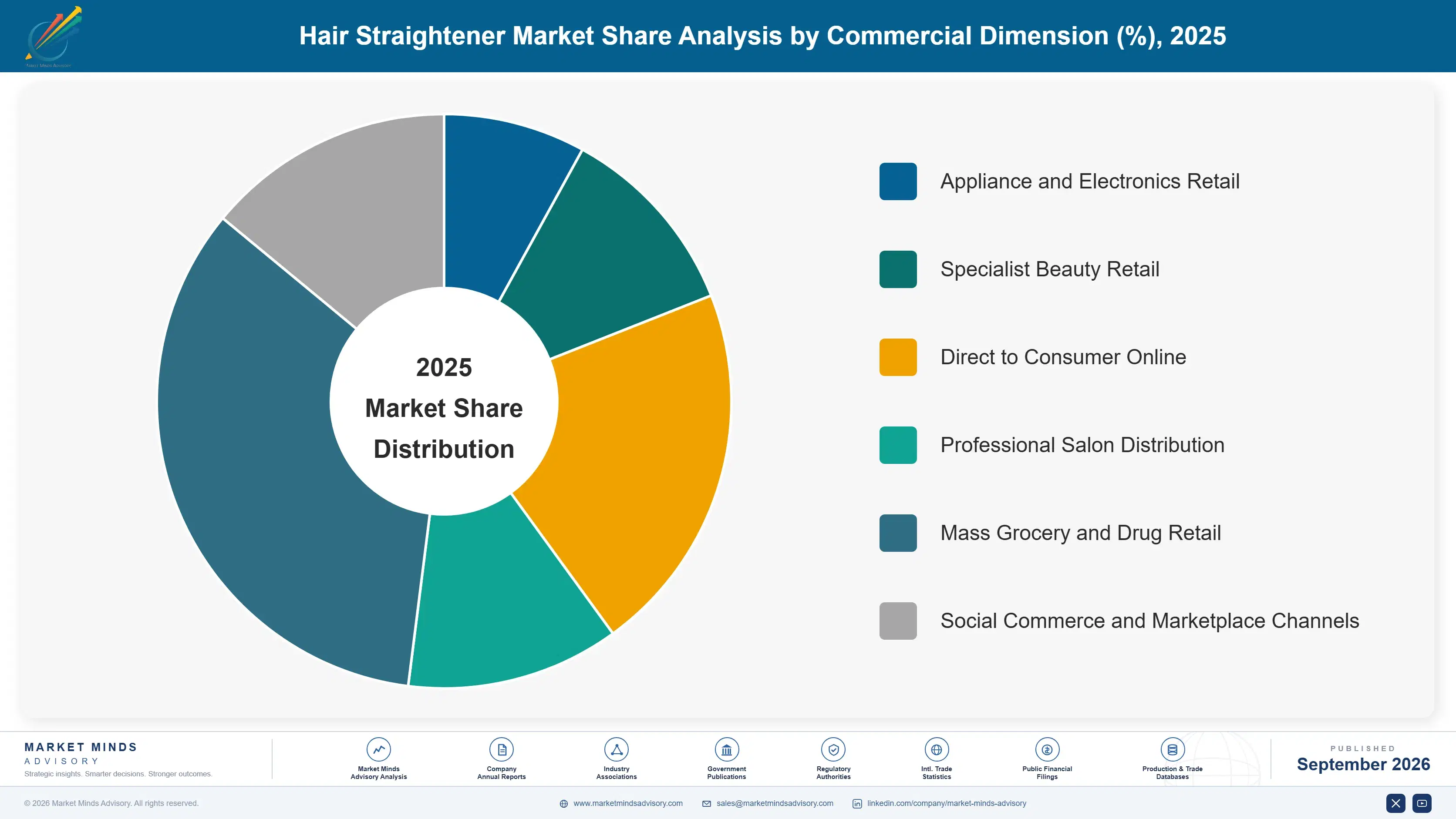
Segmentation follows device format across six categories: ceramic-plate flat irons, titanium-plate flat irons, infrared and far-infrared irons, steam-assisted straighteners, straightening brushes and combs, and cordless and battery straighteners. End-use setting, price tier, and plate specification are treated as separate dimensions entirely. Chemical relaxers, dryers, curling irons, and volumising hot brushes fall outside the defined scope entirely.
hair-straightener-market-market-share-analysis-1790019261163

Straightening Brushes And Combs

Straightening brushes and combs grow at 9.6%, half again the market rate of 6.4%, and deliver result duration around 41% of a comparable plate iron. The gap is mechanical rather than thermal: a brush cannot apply the compression that holds hair in position while hydrogen bonds reform, so the new configuration relaxes far sooner. Buyers accept that knowingly, because the format is faster, less tiring, and considerably harder to burn yourself with. Manufacturers marketing brushes on salon-equivalent results rather than on ease are selling an attribute the product does not have and inviting the disappointment that follows. The attribute that sells here is ease rather than any durability of result. Buyers know this.
CAGR 9.6%

Cordless And Battery Straighteners

Cordless and battery straighteners grow at 8.4% on convenience that is genuine and runtime figures that mostly are not. Only about 12% of cordless products measure runtime under actual hair contact load, and a plate loses heat rapidly into hair, drawing far more power than holding temperature at rest. Published bench runtimes therefore overstate real use by a wide margin, which produces exactly the disappointment that shows up in reviews. Battery energy density is the binding physical constraint rather than any engineering shortcut. Manufacturers publishing loaded runtime figures separate themselves immediately from a field quoting idle numbers. Convenience is genuine and worth paying for, which is why the format grows despite the constraint.
CAGR 8.4%
Full segment breakdown across 6 segments available in the complete report.

Regional Architecture and Country Demand Map

Regional shares reflect where hair straighteners are purchased rather than where they are manufactured. Two regions sit outside the standard bands, for reasons named in their own paragraphs and summarised below for operator review. Hair texture and penetration levels vary sharply between them, and each paragraph names the mechanism.

East Asia

Very nearly all of the world's hair straighteners are manufactured here, and Chinese, Japanese, and Korean domestic demand together form the largest single regional block. Growth of 7.4% runs above the world rate. Japanese manufacturers hold the deepest positions in plate coating technology and temperature control engineering, which is where the genuine differences in this category sit. Chinese producers supply most world volume and increasingly sell under their own labels rather than supplying Western brands. Straightening brushes have taken share here faster than in any Western market. Lower average hair thickness reduces the temperature requirement regionally. Coating technology and control engineering are where Japanese manufacturers hold their genuine advantage here.
Share: 28% | CAGR: 7.4% (2026 to 2036)

North America

Premium positioning is more developed here than anywhere, and consumers pay considerable premiums for brands associated with salon use regardless of measured temperature performance. Growth of 5.6% runs a little under the world rate. Textured hair care is a substantial and well served segment with its own product requirements and its own retail channels. Heat damage complaints are documented more thoroughly here than in other regions, which is why the share is measurable. Consumer safety authorities have begun examining temperature accuracy claims across heated styling appliances generally. Textured hair communities have driven most of the recent rise in heat damage awareness through social channels, and that group evaluates products on temperature accuracy rather than on brand heritage.
Share: 24% | CAGR: 5.6% (2026 to 2036)
Regional intelligence for 5 additional markets available in the complete report: Western Europe, South Asia and Pacific, Latin America, Middle East and Africa, Eastern Europe. Contact sales@marketmindsadvisory.com.
hair-straightener-market-country-cagr-analysis-1790019261693

Where Straightener Brands Actually Win

Four commercial moves matter in a category where the dial misreports, the plate material is a word, and the fastest growing format performs worst. Each publishes something measurable in a field that currently competes almost entirely on adjectives and brand association. Each publishes something measurable in a field competing almost entirely on adjectives and mineral names.

Publish Measured Plate Temperature And Uniformity

Measured plate temperature runs about 24 degrees above the dial at the hottest point and varies across the surface, which means a genuinely well-controlled product cannot demonstrate that it is one. Manufacturers publishing thermal maps and calibrating dials against measured surface temperature report price realisation 2.6 times higher in premium tiers. The measurement is straightforward bench work costing very little. Its absence is why temperature control engineering currently earns nothing at all. Single-point sensing near the element is where most of the deviation originates, and multi-point sensing has become inexpensive on volumes from unrelated categories.
Market Impact: Raises achieved price realisation to 2.6 times higher

State Coating Specification Rather Than Material Name

Only around 5% of products state plate coating thickness or evenness, while nearly all of them name a mineral that describes the coating rather than the plate. Manufacturers publishing coating specification with wear data over stated cycles report repurchase rates 2.2 times higher than material-name equivalents. A thin or uneven coating produces hot spots and drag that a user experiences directly, and warranting plate condition rather than only the appliance makes the claim credible. The plate is also what ends the product's useful life, so warranting it addresses the failure that actually drives replacement.
Market Impact: Raises repurchase rates to 2.2 times higher overall

Sell Brushes On Ease Not On Result Quality

Straightening brushes grow at 9.6% while delivering result duration around 41% of a comparable plate iron, and buyers accept that trade knowingly for speed and safety. Manufacturers positioning brushes on ease of use rather than on salon-equivalent results report review sentiment 2.4 times better and materially fewer returns. Selling an attribute the product does not have invites the disappointment that follows, and the attribute it does have is genuinely valuable to the people buying it. Speed, reduced arm fatigue, and lower burn risk are the attributes buyers are actually paying for, and none of them requires a claim about durability.
Market Impact: Improves review sentiment 2.4 times over the field

Publish Cordless Runtime Under Hair Contact Load

Only about 12% of cordless products measure runtime with the plate actually losing heat into hair, which is the only condition that matters to a user. Manufacturers publishing loaded runtime report return rates 3.1 times lower than those quoting bench figures measured at rest. Battery energy density is a physical constraint nobody can engineer past, so an honest number sets expectations correctly rather than promising something the format cannot deliver. A plate loses heat rapidly into wet or thick hair, which draws far more power than idling at temperature does, and the gap between the two figures is substantial.
Market Impact: Cuts product return rates 3.1 times lower overall

Who Controls the Margin Pool

Concentration is moderate. Five manufacturers hold 39% of category revenue, measured consistently on that basis across all participants, and the remainder divides between professional haircare brands, general appliance groups, textured hair specialists serving their own channels, and a very large Chinese production base increasingly selling under its own labels rather than supplying others. The leader to challenger gap is wide in thermal control engineering and narrow everywhere else.
Competition currently turns on three dimensions: thermal control engineering, which decides whether the dial means anything at all; plate coating quality and its disclosure; and format positioning, since the fastest growing format performs worst and marketing it on results invites returns rather than repeat purchase. Price and brand decide at mass tier, which still accounts for the large majority of units moved across every region covered here.

Pressure builds from two directions at once. Chinese manufacturers hold the component and assembly cost base and are moving into direct selling. Consumer safety authorities are beginning to examine temperature accuracy across heated styling appliances. Rankings will shift toward manufacturers publishing measured thermal performance rather than trading on salon association alone. Brands trading only on salon heritage face the most exposed position in the field.
hair-straightener-market-company-positioning-matrix-1790019262216

Competitive Moat and Risk Dimensions

DYSON

Moat: Thermal Control And Sensing Depth

Multi-point temperature sensing and control engineering address the one variable that actually determines both result and damage in this category. That capability is expensive to develop, difficult to replicate at commodity cost, and it is the only technical claim in the field that a measurement could substantiate.
DYSON

Risk: Premium Price Against Direct Sellers

Chinese manufacturers selling directly under their own brands price far below premium appliance structures while sourcing plates and elements from a comparable base. Defending a premium on thermal accuracy requires a buyer to understand a difference that no published standard currently helps them evaluate at the point of purchase.
COTY

Moat: Salon Association And Professional Channel

Brand association with professional salon use carries a premium that measured performance does not need to justify, and salon channel presence puts equipment in front of consumers who subsequently buy domestic versions. That association compounds slowly and cannot be bought quickly by a competitor entering the category.
COTY

Risk: Association Without Published Evidence

A premium resting on salon association rather than on measured thermal performance is exposed if temperature accuracy becomes a published or regulated specification. Brands already publishing thermal data would be positioned; those trading on professional heritage would need to build that evidence base from nothing.

Players Tracked

Prominent Players

Dyson
Coty
Helen of Troy
Conair
Koninklijke Philips

Other Key Players

Panasonic Holdings
Groupe SEB
Xiaomi
Wahl Clipper
Andis Company
Spectrum Brands
L'Oreal Groupe
Amika
Bio Ionic
CHI Haircare
Hot Tools Professional
T3 Micro
Drybar
Tescom
Ningbo Kemei

Recent Developments

MARCH 2026

Dyson Publishes Plate Thermal Maps Across Its Straightener Range

Dyson released measured plate temperature maps showing surface uniformity and deviation from dial setting across its straightener products. The disclosure puts a measurable specification where mineral names and dial markings have carried the category's claims. Deviation from dial setting is stated for each product rather than as a range.
Signal: Measured uniformity is the one specification a competitor cannot simply assert. Control engineering can finally be charged for now.
OCTOBER 2025

Conair Publishes Loaded Runtime Figures For Cordless Straighteners

Conair began stating cordless runtime measured with the plate losing heat into hair rather than idling at temperature. Published figures fell substantially against previous bench measurements taken without any contact load. Both figures are published side by side rather than only the loaded one. The method is documented alongside them.
Signal: An honest number sets expectations the format can actually meet. Bench runtime describes a condition nobody actually uses.
MAY 2025

Helen Of Troy Acquires Plate Coating Technology Business

Helen of Troy completed an acquisition of a business developing thin-film plate coatings with controlled thickness and uniformity. The transaction was an outright acquisition rather than a joint venture or minority stake, with coating consistency cited as the rationale. Deposition control engineers transferred with the business under agreed terms.
Signal: Coating evenness matters more than whichever mineral names the surface. Evenness is what a user actually feels.

What A Straightener Costs

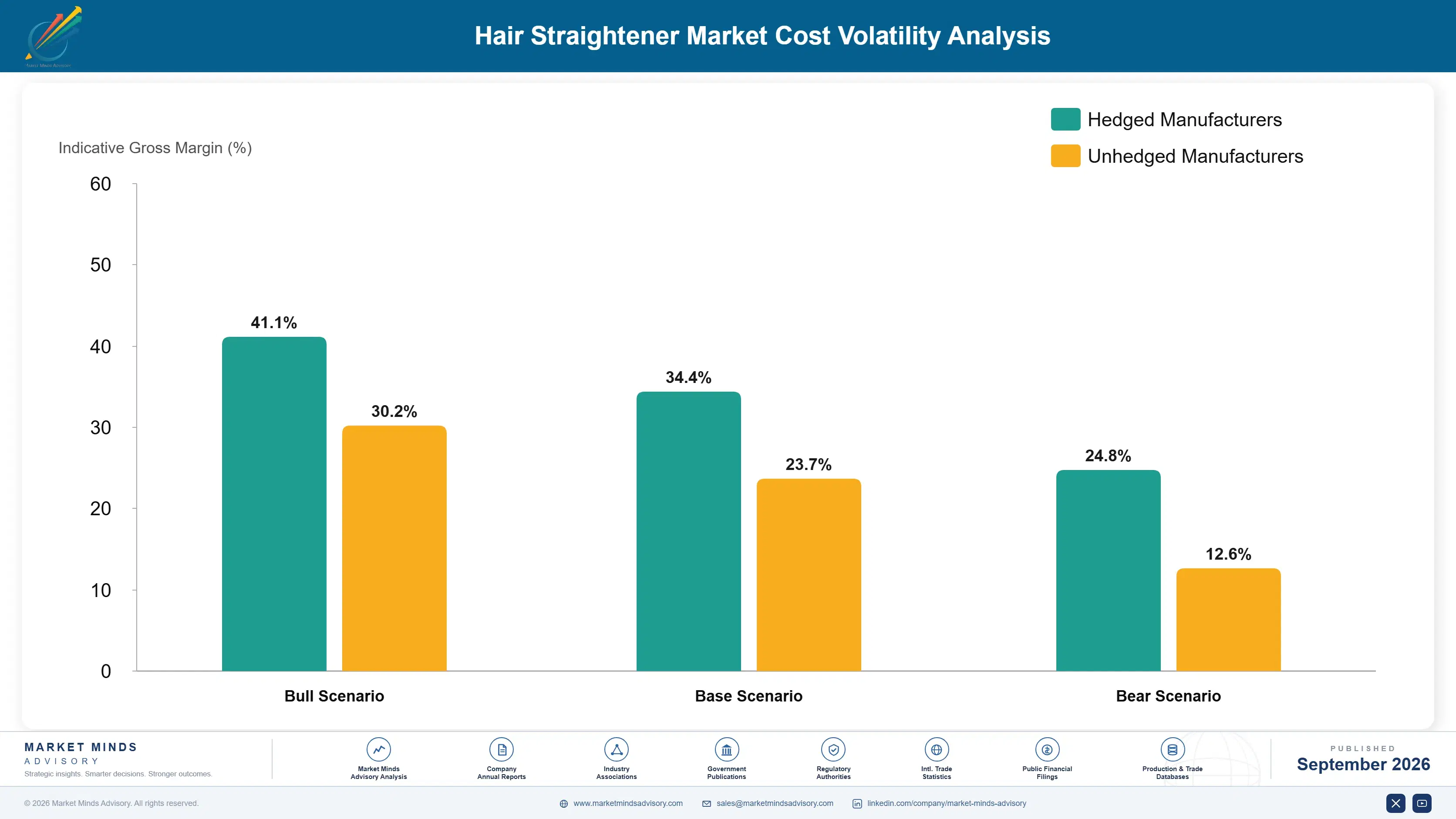
Three cost groups dominate. Heating element, plates, and coating run 28% to 36% of cost of goods sold, and the eight-point range separates controlled thin-film coatings from basic sprayed ceramic. Electronics, sensing, cable, and battery take 24% to 32%, rising sharply for cordless and multi-point sensing designs. Housing, tooling, and assembly account for 22% to 30% across the range of formats served.
Aluminium and titanium pricing moved through 2024 and 2025 on industrial demand and freight together, and United States Geological Survey mineral commodity summaries documented the underlying movements. Several appliance manufacturers described the resulting margin pressure in their annual reports. Electronic sensing component costs fell across the same window on volumes generated by unrelated consumer categories entirely, which improved the case for multi-point control. The two cost groups moved in opposite directions across the window.

The competitive disadvantage mechanism runs through sensing and control rather than through plate material. A manufacturer fitting a single thermistor near the element cannot know surface temperature across the plate, and no coating specification compensates for that. Exposure therefore varies by control architecture rather than by scale, and manufacturers competing on plate material naming carry a disadvantage they have not yet identified as one.
hair-straightener-market-cost-volatility-analysis-1790019262412

Specify Sensing Components At Consumer Volumes

Temperature sensing and control component costs are falling because unrelated consumer categories consume them at volumes personal care appliances never will approach. Specifying parts already at scale in those applications rather than commissioning bespoke sensing captures a cost curve this industry contributes nothing to and can otherwise only watch from the outside. Bespoke sensing forfeits that curve entirely.

Invest In Coating Control Before Plate Material

Coating thickness and evenness determine hot spots, drag, and wear life, while the named mineral describes a coating that is largely the same across price tiers. Investing in deposition control rather than in a different material moves measurable performance, and it is the change a user experiences directly during use. Deposition control is what a user experiences directly during use.

Contract Metals Against Industrial Rather Than Seasonal Cycles

Aluminium and titanium pricing follows industrial demand and freight at volumes small appliance manufacture cannot influence in any direction. Contracting against those cycles rather than against seasonal production peaks removes most of the exposure and secures allocation through the periods when larger consumers are competing for the same output. Allocation matters more than price at the tightest points.

Portfolio Architecture for Margin Defence

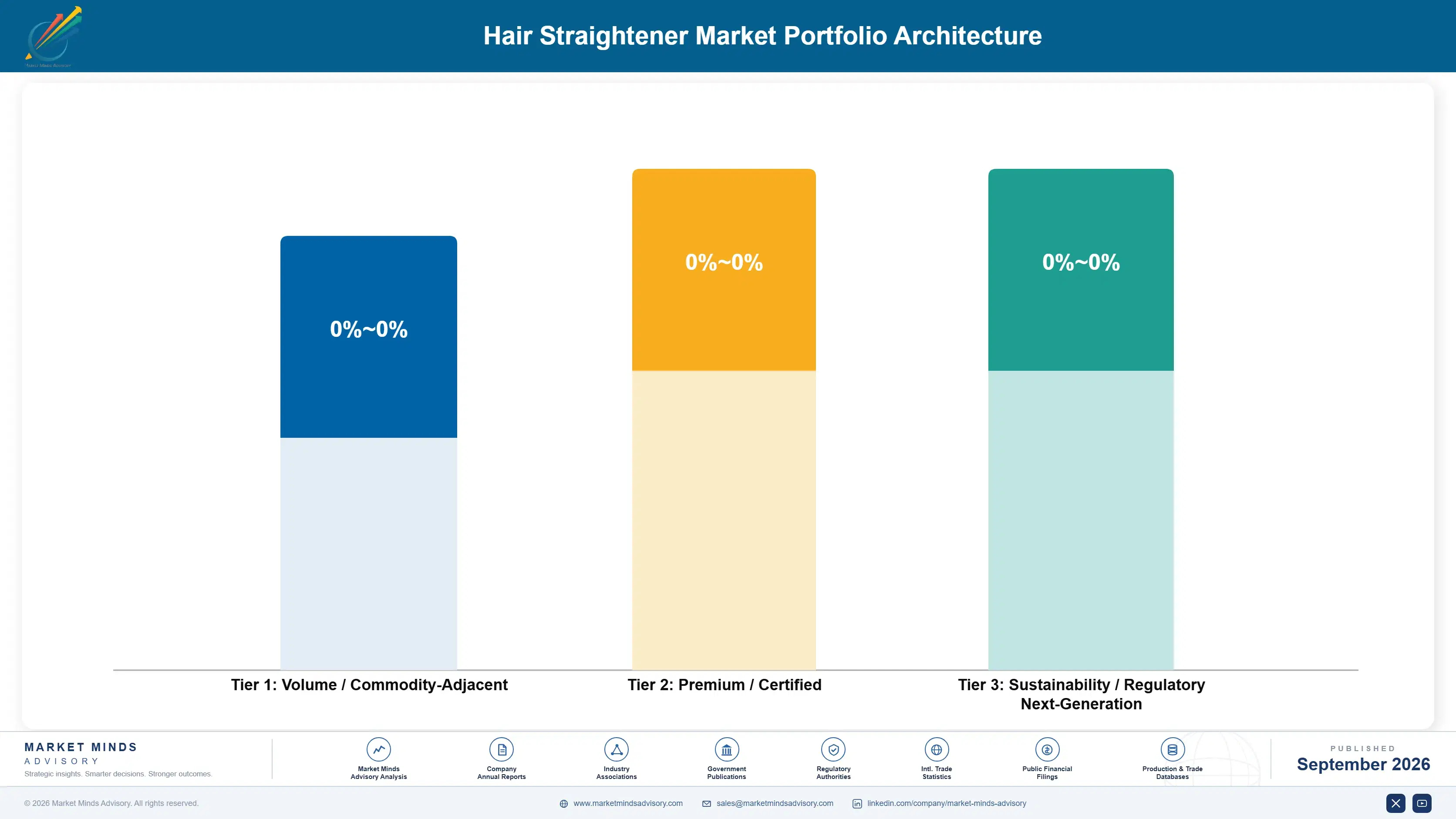
Margin follows measurable control rather than mineral naming. Basic ceramic plate irons compete close to commodity terms against Chinese direct sellers using comparable plates and elements. Brushes earn modestly on convenience positioning. Premium irons with genuine multi-point thermal control earn well where the performance is published, and professional-channel brands earn most, though largely on association rather than on anything measured.
The tension between volume and premium runs through what a buyer can verify. A shopper comparing two irons sees the same temperature range printed on both, similar plate material words, and a price difference, so price or brand decides. A buyer who has experienced heat damage and starts asking about temperature accuracy finds almost no product that answers, and pays substantially more for one that does.

High-value pools concentrate in irons with published thermal maps and multi-point control, in coatings with stated thickness and wear data, and in textured hair formats where higher working temperatures make accuracy genuinely consequential. Where the product is a basic ceramic iron sold on a temperature range and a mineral name, plates and elements are broadly identical and Chinese manufacturers hold the cost position.

Volume / Commodity-Adjacent

Basic ceramic plate irons and entry brushes sold on a temperature range, a mineral name, and price. The ten-point range reflects sourcing position and channel cost rather than any capability a buyer could verify before purchasing.
Gross Margin: 24% to 34%

Premium / Certified

Titanium and infrared formats and salon-associated brands carrying design, warranty, and professional channel credibility. The twelve-point range separates genuine build and coating quality from brand association applied over comparable internals and plates.
Gross Margin: 40% to 52%

Sustainability / Regulatory / Next-Generation

Multi-point thermal control systems with published plate maps, stated coating specification, and loaded runtime figures where cordless. The sixteen-point range reflects sensing architecture and disclosure practice together. Neither can be assembled quickly by a competitor.
Gross Margin: 56% to 72%
hair-straightener-market-portfolio-architecture-1790019262917

High-value Sub-segments and Strategic Watch-out

Published Thermal Control Systems

Highest value in the category and the only claim a measurement could substantiate rather than a competitor simply assert. The sixteen-point range reflects sensing architecture, since single-point sensing near the element cannot know surface temperature. Almost nobody in the whole category publishes anything measurable yet.
Gross Margin: 58% to 74%

Specified Coating Plate Systems

High value on thickness and evenness that a user experiences directly through drag and hot spots during ordinary use. The fourteen-point range reflects deposition control capability rather than whichever mineral is printed on the box. Coating is what wears out and ends the product's life.
Gross Margin: 46% to 60%

Ease-Positioned Straightening Brushes

Volume core growing fastest at 9.6% on convenience that is real and results that last considerably less. The twelve-point range reflects positioning discipline, since marketing them on salon-equivalent results invites returns rather than repeat purchase. Buyers accept the trade knowingly when it is described honestly.
Gross Margin: 38% to 50%

Basic Ceramic Plate Irons

The strategic watch-out. Plates and elements broadly identical across the field, a dial nobody has verified, and Chinese direct sellers holding cost. The ten-point range reflects sourcing and channel position alone. Chinese direct sellers now reach exactly the same buyers online, and nothing else defends it.
Gross Margin: 22% to 32%

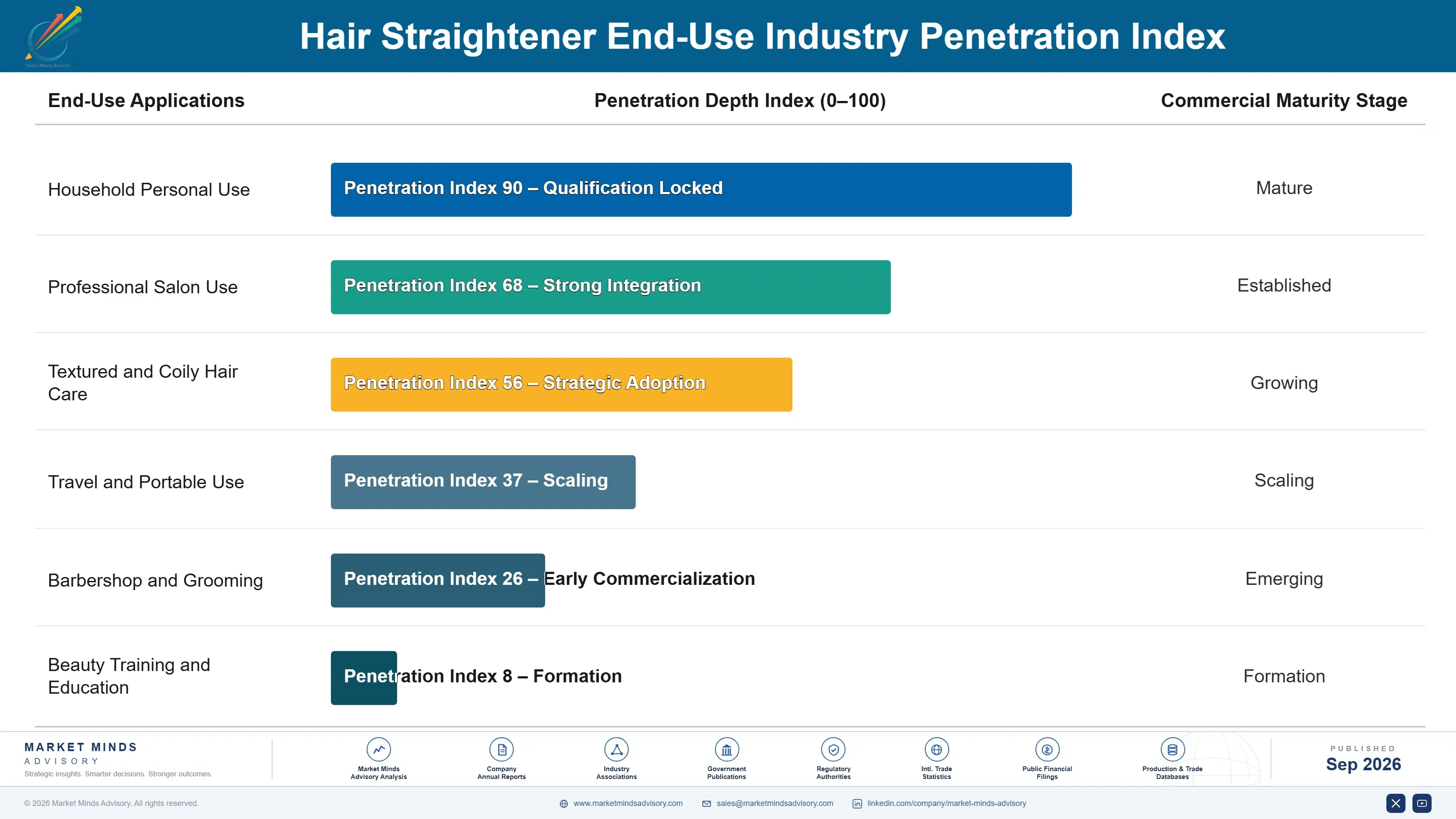
How This Demand Repeats

Replacement drives nearly all of this category and runs on plate condition rather than on electrical failure. A coating that wears or chips produces drag and snagging that a user feels immediately, and that experience prompts replacement long before anything stops working. Manufacturers warranting the appliance while excluding the plate are therefore warranting the part that rarely fails and excluding the part that actually ends the product's life.
Attachment follows experience rather than brand loyalty in most cases. A user who has had a good result and no damage repurchases the same brand almost automatically, while a user who has experienced heat damage leaves the brand and frequently the format. Around 31% of complaints cite heat damage, which makes thermal control the single largest determinant of whether a customer is retained at all.

The buyer profile is shifting as heat damage awareness spreads through social channels and textured hair communities in particular. That buyer asks about temperature accuracy, reads about coating, and treats a mineral name as marketing rather than specification. Manufacturers organised around brand association and salon heritage reach that buyer poorly, and the group is growing faster than the category is.
hair-straightener-market-end-use-penetration-index-1790019263406

Where This Market Rewards

These are among the four positions where our research anticipates prominent divergence between winners and laggards over the coming forecast period. Each is grounded in the demand model, the regulatory perimeter, and the announced capacity pipeline.
01 / THERMAL MAP PUBLISHING

The dial is not the plate

Measured plate temperature runs about 24 degrees above the dial setting at the hottest point and varies across the surface, which means a genuinely well-controlled product has no way to demonstrate that it is one. Manufacturers publishing thermal maps and calibrating dials against measured surface temperature report price realisation 2.6 times higher in premium tiers. The measurement is straightforward bench work, and its absence is why control engineering currently earns nothing, and single-point sensing near the element is where most of the deviation originates.
02 / COATING SPECIFICATION DISCLOSURE

Tourmaline names a coating, badly

Only around 5% of products state plate coating thickness or evenness, while nearly all of them name a mineral describing the coating rather than the plate underneath it. Manufacturers publishing coating specification with wear data over stated cycles report repurchase rates 2.2 times higher than material-name equivalents achieve. A thin or uneven coating produces hot spots and drag that a user experiences directly, which makes the disclosure genuinely useful, and the plate is also what ends the product's useful life rather than the electronics.
03 / BRUSH POSITIONING HONESTY

Ease is the attribute, not results

Straightening brushes grow at 9.6% while delivering result duration around 41% of a comparable plate iron, and buyers accept that trade knowingly for speed and reduced burn risk. Manufacturers positioning brushes on ease of use rather than on salon-equivalent results report review sentiment 2.4 times better and materially fewer returns. Selling an attribute the product does not have invites disappointment, and the one it does have is genuinely valuable, and speed, reduced fatigue, and lower burn risk are what buyers are paying for.
04 / LOADED RUNTIME MEASUREMENT

Hair takes the heat away

Only about 12% of cordless products measure runtime with the plate actually losing heat into hair, which is the only operating condition that matters to anybody using one. Manufacturers publishing loaded runtime report return rates 3.1 times lower than those quoting bench figures measured at rest. Battery energy density is a physical constraint nobody engineers past, so an honest figure sets an expectation the format can actually meet, and the gap between loaded and idle figures is substantial rather than marginal.

Engagement Snapshot From the Field

A live engagement with an industry participant carrying material or product regulatory and market exposure ahead of a defining policy shift, showing how our research translates into a defensible multi-year portfolio strategy.
MARKET MINDS ADVISORY · CLIENT ENGAGEMENT SUMMARY
Hair Straightener Producer Strategic Portfolio Review and Transition Roadmap 2026·Investment Scenario on Hair Straightener Exposure Evaluation 2025-26
CLIENT PROFILE
A personal care appliance brand with hair styling revenue near USD 210 million (client-reported, unverified by MMA) across North America, Western Europe, and Latin America. Heat damage complaints had risen for three consecutive years across the straightener range, and the engineering team had proposed lowering the maximum dial setting in response. No product in the range had been measured at the plate surface.
STRATEGIC CHALLENGE
Nobody had measured actual plate temperature against the dial across the range, so lowering the maximum setting would have moved a number that did not describe what the plate was doing. Complaints were also concentrated in specific products rather than spread evenly, which the proposal did not account for at all.
MMA APPROACH
MMA measured plate temperature at multiple points across every product in the range against dial setting, mapped complaint density by product and by market, tested coating thickness and uniformity on new and worn units, and modelled outcomes under dial reduction against sensing redesign. Measurements were taken at multiple points across each plate rather than at a single reference position.
KEY FINDINGS
  1. Deviation between dial and measured hottest point varied enormously across the range, from a few degrees on two products to well over thirty on the worst offenders.
  2. Complaint density tracked measured deviation almost exactly rather than tracking maximum dial setting, which the proposed change would not have addressed at all.
  3. The worst performing products used single-point sensing near the heating element rather than at the plate surface, which explained the deviation directly.
  4. Coating thickness on the two worst products was materially thinner and less uniform, producing hot spots that compounded the sensing problem further.
CLIENT PROFILE
A personal care appliance brand with hair styling revenue near USD 210 million (client-reported, unverified by MMA) across North America, Western Europe, and Latin America. Heat damage complaints had risen for three consecutive years across the straightener range, and the engineering team had proposed lowering the maximum dial setting in response. No product in the range had been measured at the plate surface.
STRATEGIC CHALLENGE
Nobody had measured actual plate temperature against the dial across the range, so lowering the maximum setting would have moved a number that did not describe what the plate was doing. Complaints were also concentrated in specific products rather than spread evenly, which the proposal did not account for at all.
MMA APPROACH
MMA measured plate temperature at multiple points across every product in the range against dial setting, mapped complaint density by product and by market, tested coating thickness and uniformity on new and worn units, and modelled outcomes under dial reduction against sensing redesign. Measurements were taken at multiple points across each plate rather than at a single reference position.
KEY FINDINGS
  1. Deviation between dial and measured hottest point varied enormously across the range, from a few degrees on two products to well over thirty on the worst offenders.
  2. Complaint density tracked measured deviation almost exactly rather than tracking maximum dial setting, which the proposed change would not have addressed at all.
  3. The worst performing products used single-point sensing near the heating element rather than at the plate surface, which explained the deviation directly.
  4. Coating thickness on the two worst products was materially thinner and less uniform, producing hot spots that compounded the sensing problem further.
RECOMMENDED STRATEGY
Phase 1: Phase one: abandon the dial reduction and move the worst three products to multi-point surface sensing with dials calibrated against measured plate temperature. Phase 2: Phase two: specify coating thickness and uniformity in manufacturing rather than accepting supplier tolerance, and test incoming plates against it. Phase 3: Phase three: publish measured plate thermal maps on the redesigned products rather than a temperature range on the box. State deviation from dial for each product.
OUTCOME
Heat damage complaints on the redesigned products fell by roughly two thirds within three quarters (client-reported, unverified by MMA). Maximum dial settings were unchanged. Measured plate temperature is now specified and tested on every heated styling product the brand develops. Two competitors began publishing comparable figures within the following year.

Frequently Asked Questions

Foundational context covering the market sizes, CAGR, scope, country, region and competition that inform every finding below. This section is provided to cover basics and most often pre-purchase conversations, answered from the MMA Primary Research Dataset.

What is the current size of the Hair Straightener Market?

The market was worth USD 4.2 billion in 2025 and stands at USD 4.5 billion in 2026. Value covers handheld thermal hair straightening appliances at manufacturer selling price.

How large will the Hair Straightener Market be by 2036?

MMA forecasts USD 8.4 billion by 2036, an increase of USD 3.9 billion across the forecast period. That represents 1.87 times the 2026 base of USD 4.5 billion.

What is the CAGR for the Hair Straightener Market 2026 to 2036?

The base case compound annual growth rate is 6.4%, with a bull case at 7.6% and a bear case at 5.2%. Historical growth from 2020 to 2025 ran at 5.3%.

Which segment is growing fastest?

Straightening brushes and combs grow at 9.6%, half again the market rate of 6.4%. They also deliver result duration around 41% of a comparable plate iron.

Who are the major companies in the Hair Straightener Market?

Dyson, Coty, Helen of Troy, Conair and Koninklijke Philips lead the field. Together they hold 39% of category revenue, with Chinese manufacturers increasingly selling under their own labels.

Which country is growing fastest?

Brazil grows at 11.2%, on hair texture prevalence, an unusually developed beauty culture, and salon density that puts straightening equipment in front of consumers regularly.

Report Segmentation Architecture

The full report scope spans multiple orthogonal segmentation dimensions, with cross-tabulated demand data provided for each dimension pair. Coverage extends further to regional breakdowns, trend trajectories, and the competitive detail needed to support segment-level decision-making.

By Device Format

  • Ceramic-Plate Flat Irons
  • Titanium-Plate Flat Irons
  • Infrared and Far-Infrared Irons
  • Steam-Assisted Straighteners
  • Straightening Brushes and Combs
  • Cordless and Battery Straighteners

By End-Use Industry

  • Household Personal Use
  • Professional Salon Use
  • Textured and Coily Hair Care
  • Travel and Portable Use
  • Barbershop and Grooming
  • Beauty Training and Education

By Commercial Dimension

  • Appliance and Electronics Retail
  • Specialist Beauty Retail
  • Direct to Consumer Online
  • Professional Salon Distribution
  • Mass Grocery and Drug Retail
  • Social Commerce and Marketplace Channels

By Region

  • East Asia
  • North America
  • Western Europe
  • South Asia and Pacific
  • Latin America
  • Middle East and Africa
  • Eastern Europe

Scope, Methodology, and Coverage

Every figure in this report is reproducible from documented input assumptions. The scope below maps the historical period, the forecast horizon, the segmentation dimensions, and the countries covered, alongside the underlying primary and qualitative methodology.
Historical Period
2020 to 2025
Forecast Period
2026 to 2036
Base Year
2025 (USD billions; MMA Primary Research Dataset, September 2026)
Market Definition
This market covers handheld thermal hair straightening appliances, across ceramic-plate flat irons, titanium-plate flat irons, infrared and far-infrared irons, steam-assisted straighteners, straightening brushes and combs, and cordless and battery straighteners. It excludes chemical relaxers and keratin treatments, hair dryers and curling irons, salon-only fixed equipment, hair extensions, and hot brushes intended primarily for volumising rather than straightening.
Quantitative Units
USD billions, revenue at manufacturer selling price
Segmentation Dimensions
Device format, end-use setting, commercial dimension, region
Regions Covered
East Asia, North America, Western Europe, South Asia and Pacific, Latin America, Middle East and Africa, Eastern Europe
Countries Covered
China, Japan, South Korea, Taiwan, United States, Canada, Mexico, United Kingdom, Germany, France, Italy, Spain, Netherlands, Poland, Czechia, India, Indonesia, Thailand, Vietnam, Philippines, Australia, Brazil, Argentina, Colombia, Chile, Saudi Arabia, United Arab Emirates, Turkey, Egypt, South Africa
Key Companies Profiled
Dyson, Coty, Helen of Troy, Conair, Koninklijke Philips, Panasonic Holdings, Groupe SEB, Xiaomi, Wahl Clipper, Andis Company, Spectrum Brands, L'Oreal Groupe, Amika, Bio Ionic, CHI Haircare, Hot Tools Professional, T3 Micro, Drybar, Tescom, Ningbo Kemei
Quantitative Methodology
Primary survey, n=3,800 respondents, Q4 2025, six countries; demand-side model with trade association cross-validation
Qualitative Methodology
47 expert interviews, Q4 2025; applied to validate demand model assumptions, identify emerging dynamics, and assess competitive positioning
Report Format
PDF and XLSX data workbook (Word format preview document)
Publisher
Market Minds Advisory
Report Code
MMA-2026-CON-651
Published
September 2026
Contact
sales@marketmindsadvisory.com | www.marketmindsadvisory.com

Purchase the full Hair Straightener Market Report (2026 to 2036).

The full report sizes the hair straightener market across six device formats, seven regions, and thirty countries, with forecasts to 2036 under base, bull, and bear cases. It measures plate temperature against dial setting across the field, quantifies coating disclosure practice, and compares straightening brush result duration against plate irons. Competitive analysis covers twenty participants evaluated consistently on category revenue, with detailed treatment of thermal control architecture and coating specification. Cordless runtime measurement method and heat damage complaint patterns are analysed throughout. Primary research includes 3,800 survey responses and 47 expert interviews.
Six device formats sized and forecast separately
Twenty participants evaluated on category revenue consistently
Plate temperature measured against dial setting across products
Coating thickness disclosure practice quantified across the field
Brush result duration compared against plate iron performance
Cordless runtime measurement methods assessed by manufacturer

Built For The People Who Decide

From boardroom strategy to bench-side execution, this report is read cover-to-cover by leaders shaping the next decade of their industry, turning demand scenarios, market dynamics and valuation benchmarks into decisions.
CXOs/ Presidents/ VPs/ Managers
M&A and Corporate Development
Strategy Teams and R&D Heads
Procurement and Product Directors
Regulatory and Compliance Leaders
Investor Relations and Equity Analysts