Market Minds Advisory
Grocery Bag Market

Grocery Bag Market: Plastic Bans and Paper Substitution Reshape Retail Checkout

Plastic bag bans spreading across states and countries are forcing retailers toward paper and reusable formats faster than converters can reliably scale production, creating real winners and losers among established bag suppliers.

Lead Analyst

Bilal Shaikh

Published

September 2026

Make Smarter Decisions with Customized Research Insights

Request a free sample report and evaluate market opportunities, growth trends, and competitive dynamics relevant to your business needs.

2025 MARKET VALUE$6.2BMarket Size 2025
2036 FORECAST VALUE$9.6BBase Case , 2026 to 2036
CAGR 2026 TO 20364.0 %Bull 5.2% / Bear 2.8%
INCREMENTAL OPPORTUNITY$3.1BNet 10- year value creation
EXPANSION MULTIPLE1.48x2036 value over 2026 base
Strategic Levers
M&A Pipeline
Regional Outlook
Country Rankings
Competitive Intelligence
Segmental Deep-dive
Call-Us : 91 93563 13602

Executive Snapshot and Market Trajectory

The grocery bag looks like a simple product until a plastic ban hits a jurisdiction and retailers realize how much operational complexity was hiding behind that one line item on the checkout counter, from sourcing to customer complaints and staff retraining across every affected store location.
Novolex and Duro Bag continue supplying established paper and traditional plastic formats across grocery chains that have not yet faced local plastic restrictions, since those products remain the lowest-cost option wherever regulation allows it across most unregulated markets. Reusable woven polypropylene bags are capturing disproportionate growth as jurisdictions ban single-use plastic outright and retailers need a durable format customers will actually bring back on repeat visits.
Novolex and International Paper are investing in expanded kraft paper bag capacity specifically to serve grocery chains transitioning away from plastic under new regulation, betting that paper demand will remain elevated well beyond the initial post-ban adjustment period across most regulated states and countries worldwide over the coming decade. Converters without flexible production capable of serving both paper and reusable formats increasingly find themselves exposed to regulatory risk in a single material category.
Market Definition
The grocery bag market covers traditional plastic film grocery bags, kraft paper grocery bags, reusable woven polypropylene bags, reusable cotton and canvas bags, compostable and biodegradable film bags, and bag-on-roll produce bags sold to grocery retailers and supermarket chains. It excludes industrial and shipping bags, garbage bags, and specialty retail bags sold for non-grocery applications.
Base Year Value
$6.2B in 2025 (MMA Primary Research Dataset, August 2026)
Forecast Period
2026 to 2036, eleven discrete annual values
CAGR
4.0% base case. Bull 5.2%. Bear 2.8%.
Fastest Growth Segment
Reusable Woven Polypropylene Bags: 7.5% CAGR
Fastest Growth Country
India: 6.5% CAGR
Fastest Growth Region
South Asia and Pacific: 6.0% CAGR
Largest Region
North America: 26% of 2025 global value
Market Leaders
Novolex, Duro Bag, International Paper, Inteplast Group, Advance Polybag. Source: MMA Analysis based on company annual reports.
Primary Survey
n=3,800 procurement and R&D decision-makers, Q4 2025, six countries
Methodology
Demand-side build-up, cross-validated against public data, 47 expert interviews

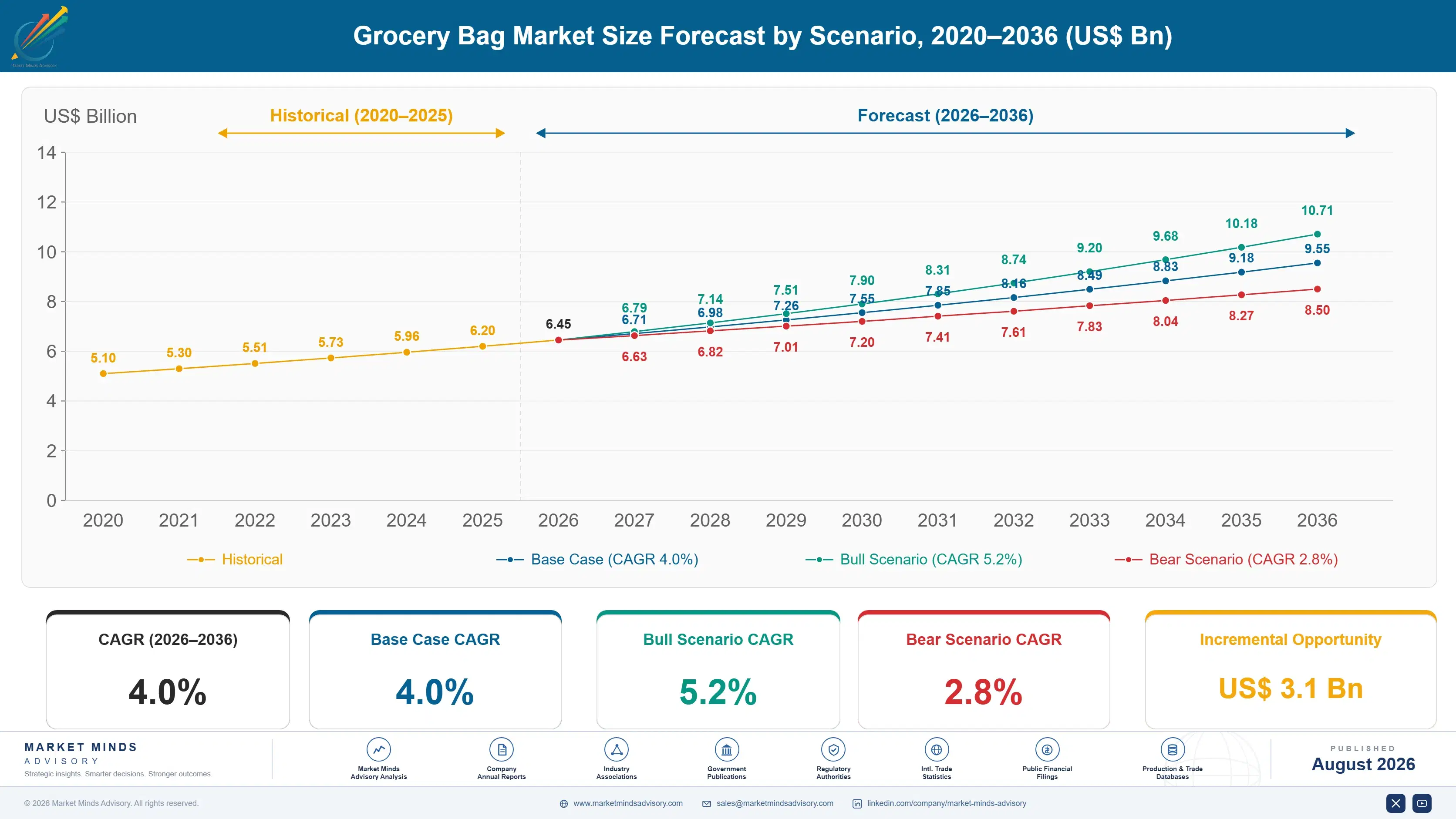
Grocery Bag Market Forecast Scenarios

grocery-bag-market-size-forecast-scenario-1787552403308
Between 2020 and 2025 the market grew at roughly 3.0 percent a year, as plastic bag bans expanded across additional states and countries and retailers gradually shifted purchasing toward paper and reusable formats to comply with new local regulations taking effect across their store networks during that entire stretch of recent years and well beyond it too.
The base case assumes 4.0 percent annual growth to 2036, built on three mechanisms: continued plastic bag ban expansion into additional jurisdictions that have not yet regulated single-use plastic, reusable woven polypropylene bags gaining share as retailers seek a durable format customers will reuse repeatedly rather than discard, and grocery retail square footage growth in emerging markets sustaining baseline bag demand even where no plastic restriction yet applies today or in the near term.
A bull case near 5.2 percent depends on plastic bag ban expansion accelerating faster than currently planned across additional major markets worldwide over the coming several years ahead and beyond that horizon. The bear case near 2.8 percent assumes regulatory expansion slows and retailers revert toward lower-cost traditional plastic formats wherever local rules still permit it.

Regulation Rewrites a Century-Old Retail Staple

Grocery bags sit at the intersection of retail operations and environmental regulation, since the format a retailer offers at checkout is increasingly dictated by local law rather than pure cost optimization across most jurisdictions today and increasingly worldwide each year. The category spans traditional plastic film, kraft paper, and reusable woven formats, each carrying meaningfully different cost structures and regulatory exposure.
MARKET CONCENTRATIONCR5 30%Highly fragmented base spans converters and regional printers
AVERAGE SELLING PRICE$0.08 per bagPrice varies sharply by material type and print complexity
TOP PRODUCING COUNTRY SHAREChina 22%Largest single manufacturing base for export converting capacity
CAPACITY UTILIZATION68%Reflects real overcapacity built in traditional plastic film lines
TRADE INTENSITY26% cross-borderMeaningful volume ships from Asia to Western retailers
FEEDSTOCK COST SHARE52%Resin or kraft paper pulp dominates total production cost
Demand tracks grocery retail square footage and transaction volume broadly, but material mix is shifting far faster than volume alone would suggest as plastic bans spread across additional jurisdictions worldwide each year. Reusable woven polypropylene bags are capturing disproportionate investment attention as retailers seek a format durable enough that customers actually bring it back on repeat shopping trips rather than discarding it after one use.
Production remains geographically dispersed given the relatively low capital intensity of bag converting, with China holding the largest single-country share given its established export converting capacity across multiple provinces and coastal ports nationwide. The United States follows given its large domestic grocery retail base and localized kraft paper production built up over many decades of industrial investment and expansion.
"A grocery bag costs pennies, but the regulatory calendar around it now drives real capital spending decisions at converters who bet wrong on which material would survive the next legislative session."
Practice Lead, Packaging and Retail Consumables · MMA Packaging Practice · August 2026

Market Trends

Reusable Bags Move From Optional to Standard Checkout

Reusable woven polypropylene bags have moved from an optional add-on customers occasionally purchased into the standard checkout offering at retailers operating in jurisdictions with outright plastic bans, since paper alone often cannot handle heavier grocery loads reliably. Retailers have increasingly branded these bags with store logos and loyalty program tie-ins, turning a regulatory compliance cost into a modest marketing opportunity. Novolex and several regional converters have expanded reusable bag production capacity specifically to serve this shift, competing on durability and print quality rather than pure unit cost, since customers now evaluate these bags on how many trips they survive.
Market Impact: Adds 7 percent annual demand shift
Kraft Paper Absorbs Volume Where Plastic Is Banned

Kraft paper bags have become the default fallback wherever plastic bans take effect but retailers are not ready to fully commit to reusable-only checkout, since paper requires no customer behavior change beyond accepting a different bag material. This has pulled meaningful volume away from traditional plastic film even in jurisdictions that only banned the thinnest single-use formats rather than plastic entirely. International Paper and Novolex have both expanded kraft grocery bag production capacity specifically to meet this demand, betting that paper's share gains will persist even as reusable formats continue growing at a faster underlying rate.
Market Impact: Adds 5 percent from new openings

Market Opportunities and Growth Drivers

Plastic Bag Legislation Keeps Expanding Geographically

Plastic bag bans and fees continue spreading to additional states, provinces, and countries that had not previously regulated single-use plastic, forcing retailers in each newly regulated jurisdiction to switch checkout bag formats within a defined compliance window. This creates a genuinely predictable demand driver, since legislative calendars are public well in advance and converters can plan capacity investment around known upcoming ban dates in specific markets. Retail chains operating across multiple jurisdictions increasingly standardize on paper or reusable formats everywhere rather than maintaining separate plastic and non-plastic checkout processes store by store, accelerating adoption beyond the newly regulated areas alone.
Market Impact: Adds 12 percent to sourcing cost

Grocery Retail Expansion in Emerging Markets Sustains Volume

Organized grocery retail continues expanding in emerging markets as modern supermarket formats replace informal and open-air markets that traditionally did not provide checkout bags at all. Each new supermarket opening represents incremental bag demand regardless of local plastic regulation status, since organized retail formats universally offer some form of checkout bag as standard customer service across most store types. This baseline volume growth has proven more durable than any single regulatory change in sustaining underlying category demand, since it reflects genuine retail format transition rather than a policy-dependent shift that could reverse.
Market Impact: Limits reusable adoption to 60 percent

Market Restraints and Challenges

Regulatory Fragmentation Complicates National Bag Sourcing Strategy

Grocery chains operating across multiple states or countries face genuinely fragmented bag regulations, since neighboring jurisdictions often impose different material bans, thickness requirements, or fee structures that prevent a single national sourcing strategy. The root cause is that plastic bag regulation has developed jurisdiction by jurisdiction rather than through coordinated national policy in most markets. This forces retailers and their converters to maintain multiple parallel bag specifications simultaneously, adding real supply chain complexity and inventory carrying cost. Converters are mitigating this friction by building flexible production lines capable of switching between specifications quickly.
Market Impact: Reusable bag share reaches 22 percent

Reusable Bag Hygiene Concerns Persist Among Shoppers

A meaningful share of grocery shoppers remain hesitant to fully adopt reusable bags given persistent concerns about bacterial contamination from raw meat or produce residue, particularly if bags are not washed regularly between uses. The root cause is documented research showing reusable bags can harbor bacteria when neglected, which surfaced in media coverage during health-conscious periods and left a lasting consumer impression. This limits full reusable bag adoption even in jurisdictions where plastic is banned outright, since some shoppers simply purchase paper alternatives instead. Retailers are mitigating this concern by promoting washable bag materials and offering periodic bag replacement programs.
Market Impact: Kraft paper volume grows 18 percent
3 additional market trends, 2 additional growth drivers, and 4 additional restraints and challenges are covered in the full report. Contact sales@marketmindsadvisory.com to access the complete intelligence.

Segment CAGR and Growth Architecture

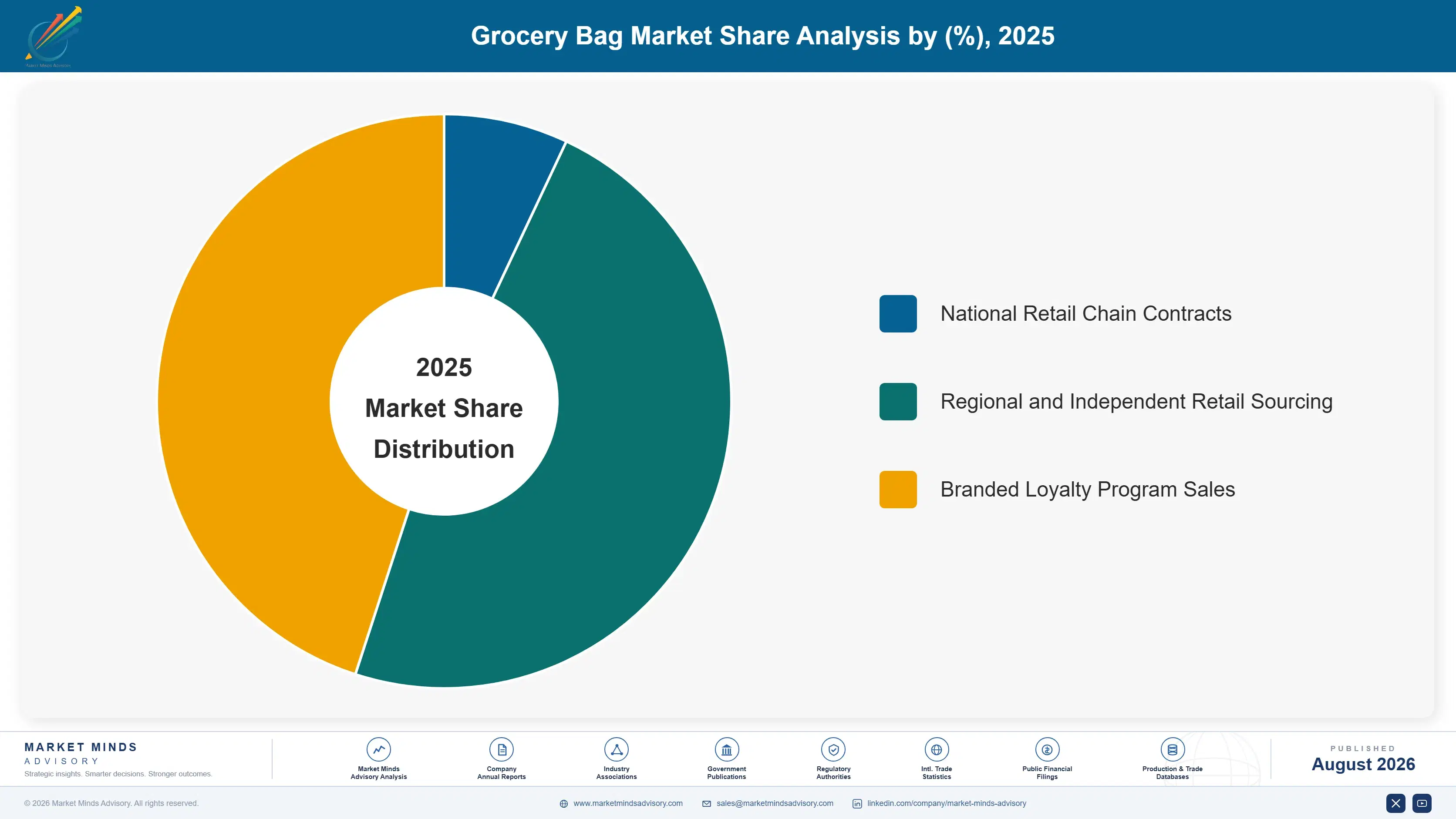
The market splits by material and format into six segments, since material choice drives most of the cost and regulatory exposure variation retailers actually navigate. Traditional plastic film bags hold the largest remaining installed base where regulation still permits them, while reusable woven and kraft paper formats grow fastest as plastic bans continue spreading across additional jurisdictions.
grocery-bag-market-market-share-analysis-1787552403881

Reusable Woven Polypropylene Bags

Reusable woven polypropylene bags are growing faster than any other format as jurisdictions move beyond taxing single-use plastic toward banning it outright, requiring retailers to offer a durable alternative customers will actually reuse across many shopping trips. Novolex has expanded reusable bag production capacity specifically to serve this shift, competing on durability and print quality rather than pure unit cost since customers evaluate longevity differently than a disposable format. Retailers have increasingly branded these bags with store logos, turning a regulatory compliance requirement into a modest ongoing marketing opportunity. Growth is expected to continue outpacing other formats as additional major markets move toward outright plastic prohibition rather than partial restrictions.
CAGR 7.5%

Kraft Paper Grocery Bags

Kraft paper grocery bags have become the default fallback wherever plastic bans take effect but retailers are not ready to commit fully to reusable-only checkout, since paper requires no customer behavior change beyond accepting a different bag material at checkout counters nationwide and abroad each year. International Paper and Novolex have both expanded kraft grocery bag production capacity specifically to meet this demand, recognizing that paper share gains have proven durable even in markets that only banned the thinnest single-use plastic formats rather than plastic entirely. The segment benefits from being widely recyclable through standard municipal paper recycling streams, a genuine sustainability advantage over most reusable alternatives requiring dedicated washing infrastructure.
CAGR 6.0%
Full segment breakdown across 7 segments available in the complete report.

Regional Architecture and Country Demand Map

Regional demand concentrates wherever grocery retail scale and plastic regulation intersect. North America and East Asia each hold roughly a quarter of global demand, reflecting patchwork state-level bans in one case and massive retail and converting scale in the other, while South Asia and Pacific posts the fastest regional growth.

North America

State-by-state plastic bag legislation has created a genuinely patchwork regulatory landscape here, with some states banning plastic outright while neighboring states impose only a small per-bag fee or no restriction at all today across the country. Novolex and Duro Bag both maintain significant converting capacity close to major grocery chain distribution centers, reflecting decades of built relationships with national and regional supermarket operators. Reusable bag adoption has moved fastest in states with the earliest and strictest plastic bans, giving converters serving those markets a multi-year head start on production scale and distribution reach. Canada has followed a broadly similar regulatory path at the provincial level, adding further demand for compliant bag formats nationwide.
Share: 26% | CAGR: 3.5% (2026 to 2036)

East Asia

China's enormous grocery retail base and established export converting capacity make it the largest single regional market, supplying both massive domestic demand and meaningful export volume to Western retailers seeking lower-cost converting capability at scale and reliably. Japanese and South Korean markets have both implemented mandatory bag charging policies, pushing customers toward bringing their own reusable bags rather than purchasing new ones at each visit. Domestic Chinese converters compete heavily on price in a market with relatively thin margins, given the fragmented and highly competitive nature of bag converting capacity across the country. Regional growth remains steady as grocery retail formats continue modernizing across smaller cities and towns nationwide each year.
Share: 26% | CAGR: 4.5% (2026 to 2036)
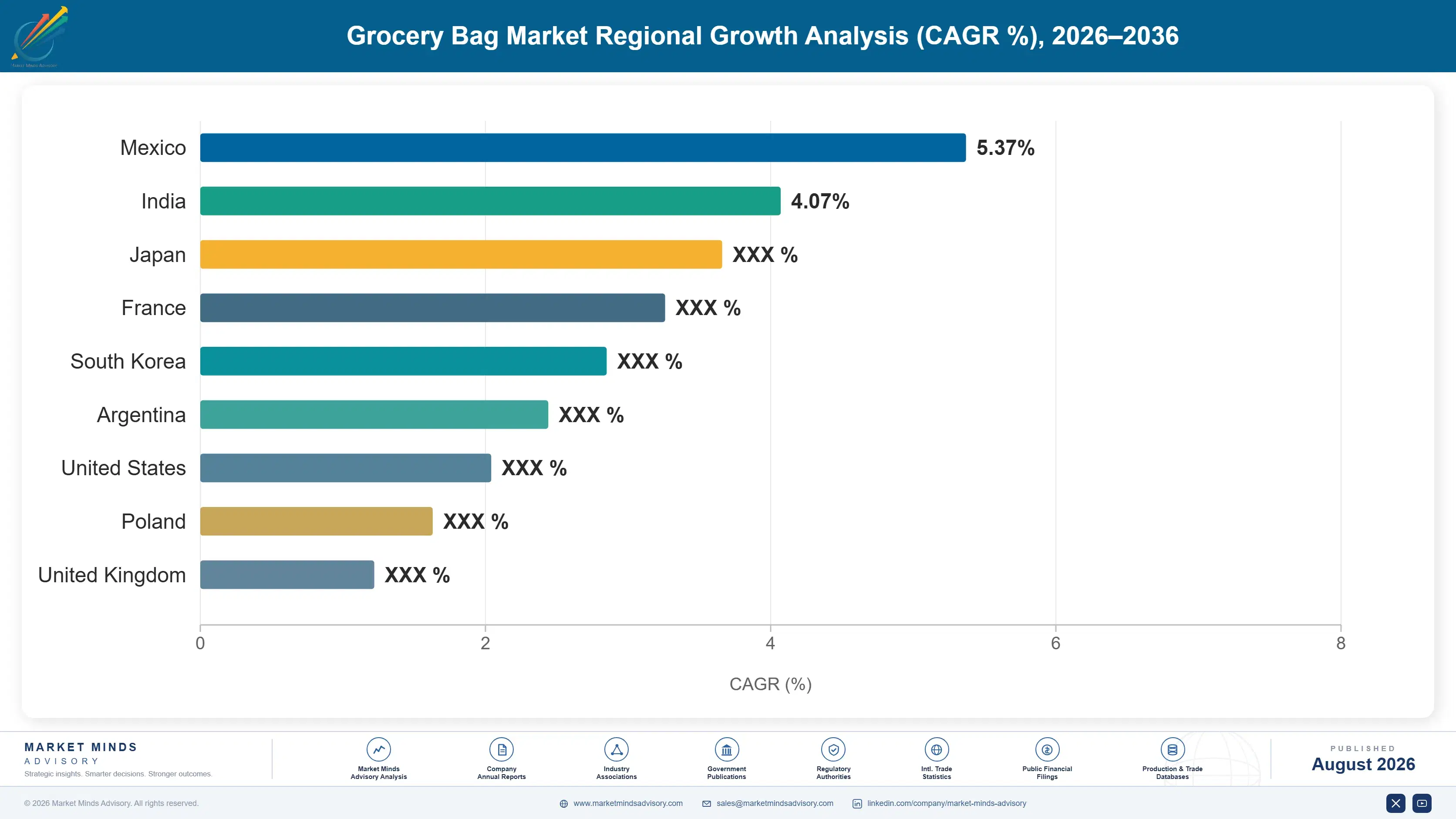
Regional intelligence for 5 additional markets available in the complete report: Western Europe, South Asia and Pacific, Latin America, Middle East and Africa, Eastern Europe. Contact sales@marketmindsadvisory.com.
grocery-bag-market-country-cagr-analysis-1787552404414

Where Bag Converters Actually Make Money

Standard plastic film bags compete almost entirely on price once a design is qualified, leaving thin margins for pure converters. The stronger revenue opportunities sit in branded reusable bag programs, multi-jurisdiction compliance capability, and kraft paper capacity expansion, categories where regulatory expertise and customization still command meaningfully better pricing than commodity plastic film typically achieves.

Selling Branded Reusable Bags as a Program

Converters who sell reusable bags as a branded loyalty program, including store logos and periodic design refreshes, capture pricing roughly 35 percent above unbranded reusable bags sold as pure commodity products across the market. This requires design and account management capability beyond pure converting, since retailers expect ongoing creative support and inventory planning for seasonal bag refreshes tied to marketing campaigns. Novolex has built a dedicated branded bag program practice around this capability, positioning it as a differentiator separate from converters who compete purely on unit price for undifferentiated reusable bags.
Market Impact: Captures a 35 percent branded pricing premium overall

Managing Bag Compliance Across Multiple Jurisdictions

Converters who build genuine multi-jurisdiction compliance capability capture national retail chain contracts that smaller regional converters cannot service, since large chains need one supplier managing bag specifications across dozens of different state and local regulations simultaneously and reliably across their entire national footprint, capturing pricing roughly 20 percent above single-region competitors. Winning these contracts requires maintaining detailed regulatory tracking and flexible production lines capable of switching specifications by destination market. Converters who invest early in this compliance infrastructure report winning national account contracts at meaningfully better margins than smaller competitors bidding on single-region business alone.
Market Impact: Wins national contracts at 20 percent higher margins

Expanding Kraft Paper Capacity Ahead of Demand

Converters who expand kraft paper bag production capacity ahead of local plastic ban implementation dates capture pricing roughly 25 percent above converters scrambling to add capacity after a ban already takes effect and demand spikes suddenly and unexpectedly across their order books and delivery schedules. This requires accurately forecasting legislative timelines and committing capital before demand is fully visible in order sheets. International Paper has built a dedicated legislative tracking function specifically to inform capacity investment timing, positioning it to capture premium pricing during the transition window before competitors catch up.
Market Impact: Captures a 25 percent early-mover pricing advantage overall

Who Controls the Margin Pool

Concentration sits low at a CR5 near 30 percent, calculated on shipment volume across all material formats, reflecting a category where regional converters and printers still hold meaningful share against national suppliers. Novolex holds the clearest leadership position given its scale across plastic, paper, and reusable formats and its established relationships with major grocery chains. The gap to challengers like Duro Bag is narrower in commodity plastic film than in branded reusable programs.
Current competitive activity centers on kraft paper capacity expansion and branded reusable bag program development, as converters race to capture premium pricing beyond commodity plastic film sales alone across most grocery accounts. International Paper and Novolex have both expanded kraft production, while Inteplast Group continues developing multi-jurisdiction compliance capability to differentiate from converters confined to single-region business.

Emerging pressure comes from Asian converters scaling export capability within their large domestic manufacturing base, a trajectory that could eventually support competition beyond commodity plastic film into paper and reusable formats currently dominated by established regional suppliers closer to end markets. Rankings could shift meaningfully over the next decade if these converters close the remaining compliance tracking and branded program capability gap that currently protects incumbents.
grocery-bag-market-company-positioning-matrix-1787552404943

Competitive Moat and Risk Dimensions

NOVOLEX

Moat: Broad Material Portfolio Scale

Novolex's presence across plastic, paper, and reusable formats lets it serve grocery chains operating under differing local regulations from a shared manufacturing base, reducing per-program development cost compared with narrower specialist competitors focused on a single material type across their entire product line and customer base.
NOVOLEX

Risk: Legacy Plastic Exposure Risk

Novolex's historical revenue base in traditional plastic film creates exposure as additional jurisdictions ban that format outright, requiring continued capital reallocation toward paper and reusable capacity to offset a shrinking addressable plastic market over the coming several years and decades still further ahead than expected.
DURO BAG

Moat: Deep Kraft Paper Heritage

Duro Bag has invested for decades in kraft paper bag manufacturing expertise, positioning it favorably as grocery chains increasingly specify paper formats under new plastic restrictions requiring reliable, high-volume paper converting capacity nationwide and across major export markets abroad as well today and well into tomorrow.
DURO BAG

Risk: Limited Reusable Format Presence

Duro Bag's relative focus on paper over reusable woven formats potentially limits its exposure to the faster-growing reusable segment that Novolex and other diversified competitors increasingly capture across newly regulated jurisdictions and expanding grocery retail chains nationwide and increasingly abroad as well today and tomorrow.

Players Tracked

Prominent Players

Novolex
Duro Bag
International Paper
Inteplast Group
Advance Polybag

Other Key Players

Superbag Corporation
Berry Global
Sonoco Products
WestRock
Smurfit Kappa
Mondi Group
Georgia-Pacific
Menasha Packaging
Shanghai Genius Industrial
Jiangsu Boyang
Hilex Poly
Roplast Industries
Command Packaging
Novolex Bagcraft
Polytex Fibers

Recent Developments

MAY 2025

Novolex announced an expansion of its reusable woven polypropylene bag production capacity at its domestic facility, adding capacity specifically to serve grocery chains converting away from plastic film specifications ahead of new state bans taking effect over the following several years across the entire country.
Signal: Signals supplier confidence that reusable bag demand will sustain long-term production capacity utilization broadly across markets
NOVEMBER 2025

International Paper entered a multi-year supply agreement with a major national grocery chain to provide kraft paper bags across several distribution regions, reinforcing its position in a category increasingly valued for reliable capacity during regulatory transition periods and unexpected supply disruptions nationwide and increasingly abroad.
Signal: Confirms major grocery chains increasingly commit to multi-year supply contracts over spot market purchasing today overall
FEBRUARY 2026

Inteplast Group launched an expanded regulatory tracking function aimed at accelerating compliance timelines for multi-jurisdiction retail chain customers entering newly regulated markets across several states scheduled for the following two years and well beyond that extended timeline overall and rather comprehensively too across the board.
Signal: Signals a competitive shift toward compliance tracking capability rather than production scale alone here today overall

What Sets Grocery Bag Costs

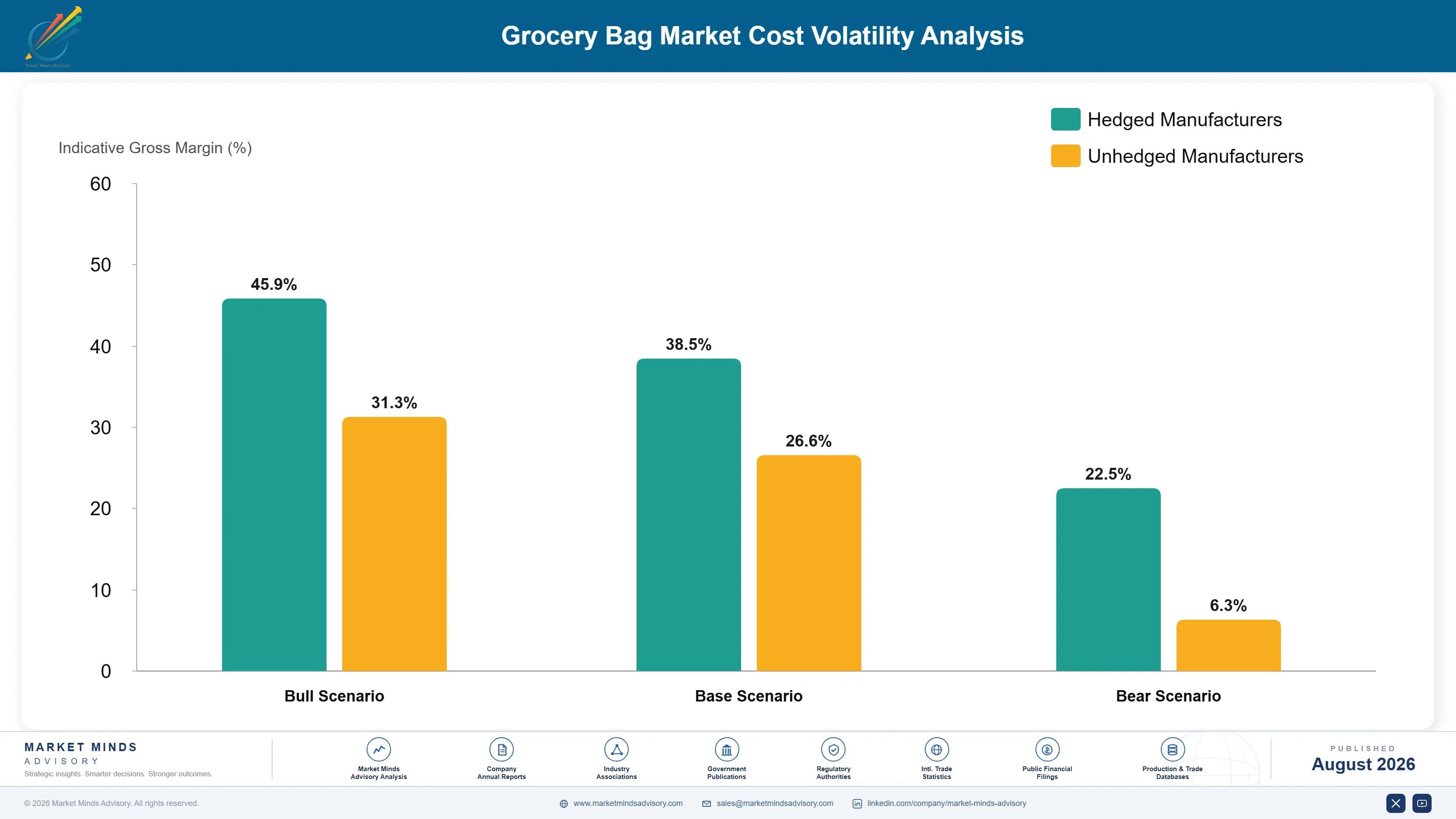
Polyethylene resin and kraft paper pulp together account for roughly 52 percent of total grocery bag production cost, varying sharply by which format a given order requires. Resin traces back to petrochemical crackers concentrated in the Gulf Coast, the Middle East, and East Asia, while kraft paper pulp sources mainly from North American and Scandinavian pulp mills with established recycled fiber supply chains.
Polyethylene prices spiked sharply during 2022 as Gulf Coast cracker outages coincided with broader petrochemical feedstock disruption, according to EIA data, pushing plastic bag producer input costs up meaningfully within a single quarter. Producers locked into annual retail supply contracts could not pass that increase through immediately, compressing margins for several quarters until contract renewal cycles allowed repricing closer to current resin cost levels across most accounts.

Smaller regional converters without diversified feedstock sourcing face proportionally larger margin swings than large multinational producers who can shift production between resin and paper lines depending on relative input cost. This creates a durable cost advantage for scale players, since geographic and material diversification functions as a hedge unavailable to single-material regional competitors operating on thinner margins.
grocery-bag-market-cost-volatility-analysis-1787552405146

Index-Linked Resin Pricing Clauses in Contracts

Larger producers are negotiating index-linked pricing clauses tied to published resin benchmarks directly into annual retail supply contracts, letting cost pass-through occur quarterly rather than waiting for full contract renewal. This reduces the multi-quarter margin compression smaller converters without comparable negotiating leverage continue to experience during resin price spikes across most regions and markets.

Shifting Production Mix Toward Kraft Paper Lines

Producers are actively shifting capital investment toward kraft paper conversion lines partly because paper pulp pricing has historically shown less volatility than petrochemical resin benchmarks over time and across cycles. This diversification reduces overall input cost exposure even before accounting for the separate regulatory demand driving that same conversion decision independently across most markets.

Portfolio Architecture for Margin Defence

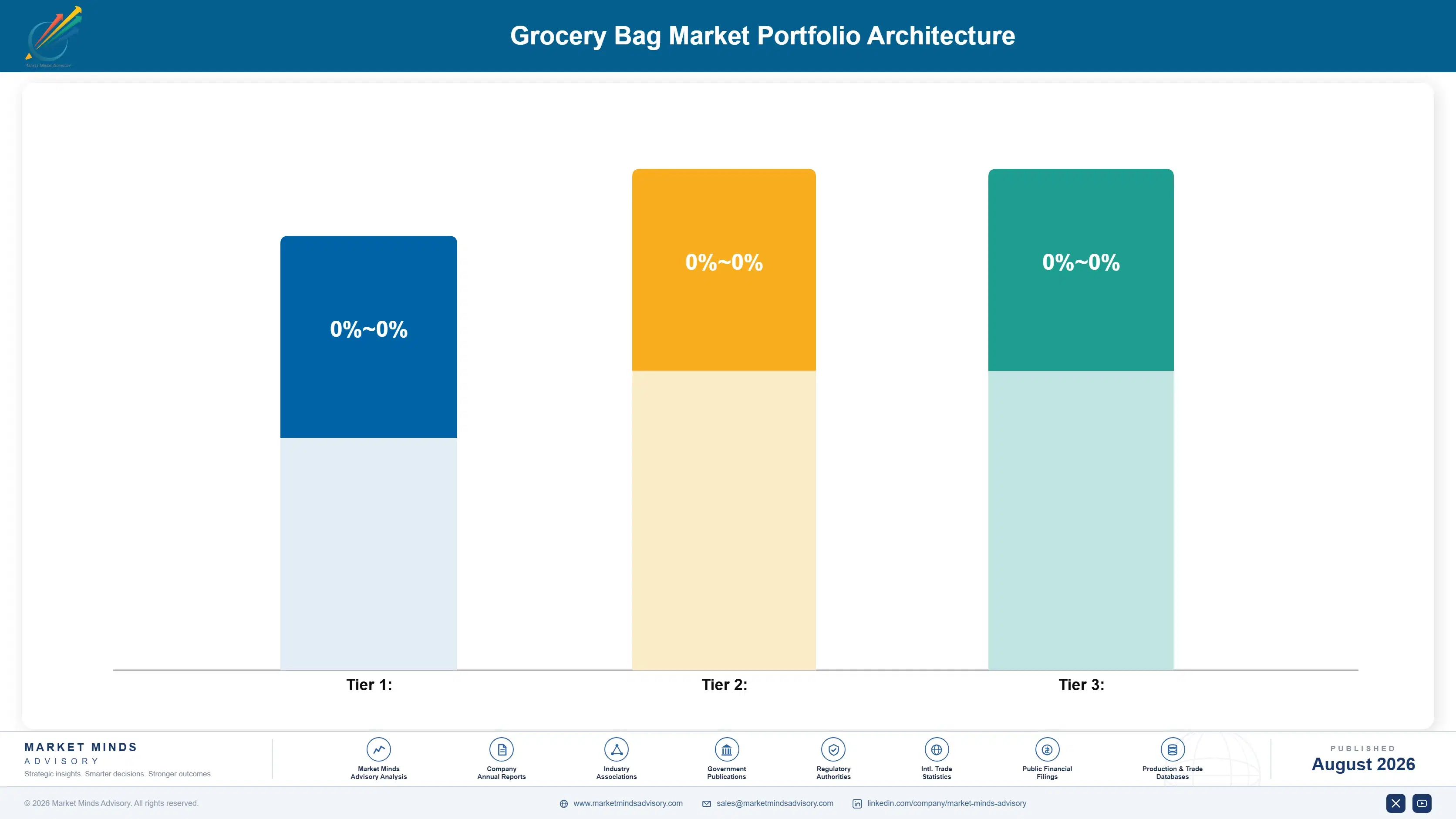
Three margin tiers define this category. Volume and commodity-adjacent products, mostly standard plastic film and unbranded paper bags, compete on price with gross margins around 12 to 18 percent. Premium and certified products including branded reusable programs command 25 to 33 percent margins across most transactions. Sustainability and next-generation compostable formats sit highest, reflecting both material scarcity and buyer willingness to pay for verified environmental credentials.
The volume versus premium tension shows up clearest in production line allocation decisions, since converting capacity to reusable or branded formats reduces available capacity for lower-margin commodity plastic that still represents meaningful revenue in unregulated markets. Producers balancing this tradeoff carefully tend to outperform those chasing premium categories too aggressively before local regulation actually forces the transition, particularly when capital commitments run ahead of confirmed legislative timelines.

High-value margin pools concentrate specifically around branded reusable bag programs and multi-jurisdiction compliance contracts, both categories where customization and regulatory expertise support pricing well above commodity plastic film levels sustainably, even as overall category volume growth moderates toward the middle of the forecast period and retailers consolidate purchasing toward fewer accountable converters.

Standard plastic film and unbranded paper bags sold primarily on price to grocery chains in jurisdictions without material restrictions, with limited differentiation between suppliers beyond delivery reliability and modest volume discount structures offered to the largest recurring accounts each contract cycle.
Gross Margin

Branded reusable bags and multi-jurisdiction compliant formats sold to national chains where customization and regulatory tracking justify meaningfully higher unit prices than standard alternatives, with account management creating a real barrier smaller converters rarely clear on their own.
Gross Margin

Compostable and biodegradable film bags sold to retailers seeking verified environmental credentials beyond simple paper substitution, commanding the category's highest margins given constrained material supply relative to demand and continued capability lag among smaller converters industry-wide.
Gross Margin
grocery-bag-market-portfolio-architecture-1787552405642

High-value Sub-segments and Strategic Watch-out

Reusable Woven Polypropylene Bags

Reusable woven polypropylene bags combine premium branded pricing with the fastest growth in the category, as outright plastic bans push retailers toward durable formats customers actually bring back on repeat shopping trips, a shift accelerating faster than overall category volume growth would suggest across most regulated markets.

Kraft Paper Grocery Bags

Kraft paper grocery bags carry solid margins and steady adoption momentum as the default regulatory fallback, though growth has moderated slightly as the segment matures beyond its initial post-ban adoption wave into steadier ongoing demand that requires somewhat different production planning and pulp sourcing strategies.

Traditional Plastic Film Grocery Bags

Traditional plastic film grocery bags remain the volume backbone of the category wherever regulation still permits them, generating meaningful absolute revenue even as their relative share declines against faster-growing paper and reusable alternatives across most regions worldwide each successive calendar year without fail or exception.

Bag-on-Roll Produce Bags

Bag-on-roll produce bags remain a smaller niche today but warrant close monitoring, since expanding plastic restrictions could eventually extend beyond checkout bags into produce bags currently exempted in many regulated jurisdictions, reshaping category economics for produce-focused converters gradually and rather unpredictably over the coming years.

Legislation Drives the Purchase Calendar

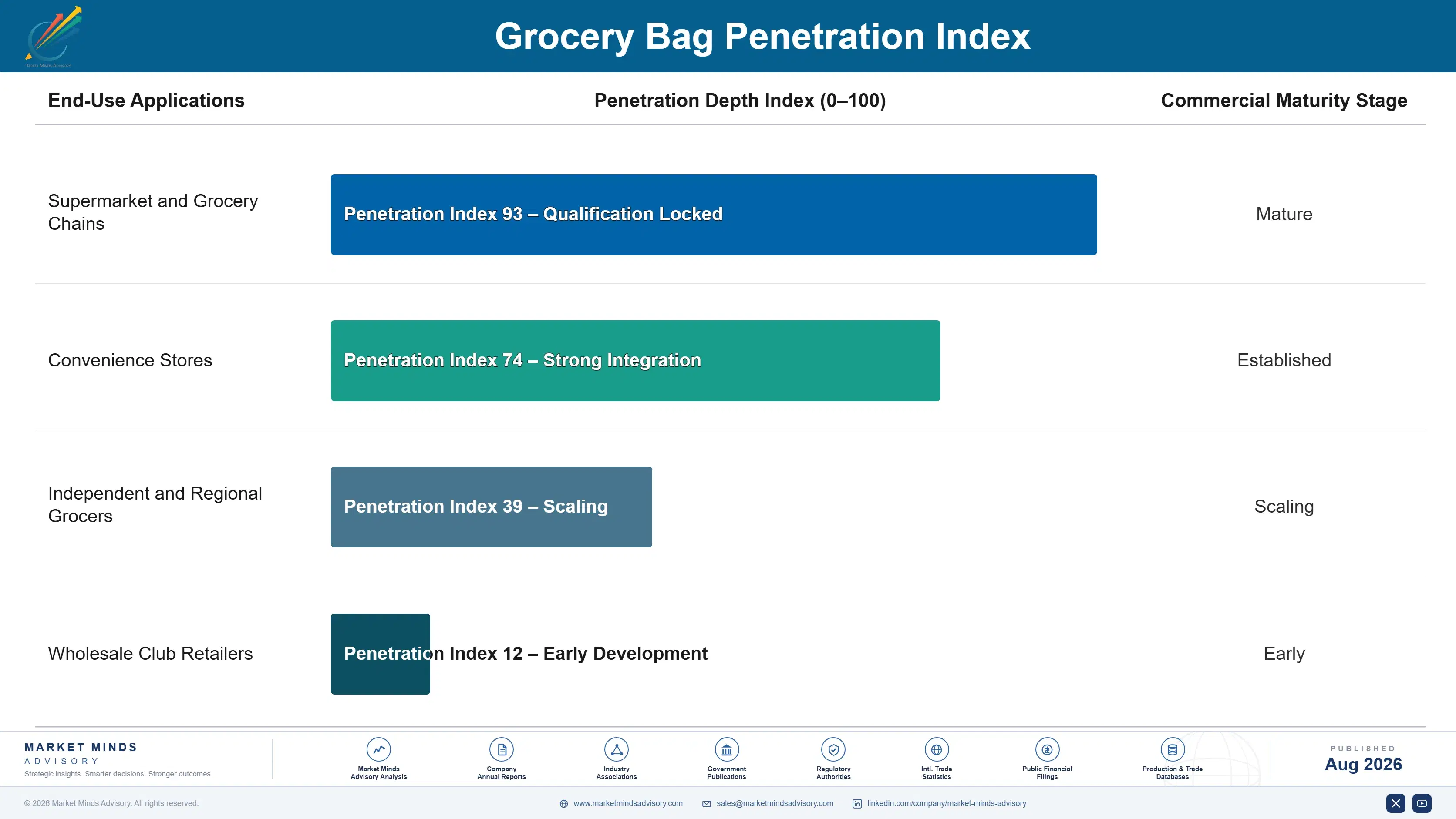
Grocery bag demand behaves less like a discretionary consumer purchase and more like a regulatory compliance calendar, since a single legislative vote can force an entire retail chain to switch formats within a defined window regardless of existing supplier relationships or contract terms. This makes legislative tracking capability a genuine competitive asset, since converters who can anticipate upcoming bans position inventory and capacity ahead of the actual demand spike rather than scrambling after the fact.
Adoption stickiness varies meaningfully by end-use vertical. National retail chains show the deepest lock-in once a converter proves multi-jurisdiction compliance capability, since switching suppliers mid-transition risks compliance gaps across dozens of stores simultaneously. Independent and regional grocers show shallower stickiness, since they operate under fewer overlapping regulations and can switch converters more easily when price competition intensifies.

Buyer profiles are shifting generationally as grocery chain sustainability officers increasingly influence checkout bag specification decisions that previously sat entirely within pure procurement departments focused on unit cost. This has elevated environmental credential verification and branded program value in supplier selection criteria at major chains, a shift that traditional commodity-focused converters are still adjusting their sales approach to address.
grocery-bag-market-end-use-penetration-index-1787552406123

What Separates Winners in Grocery Bags

These are among the four positions where our research anticipates prominent divergence between winners and laggards over the coming forecast period. Each is grounded in the demand model, the regulatory perimeter, and the announced capacity pipeline.
01 / LEGISLATIVE TIMING INVESTMENT

Track Ban Timelines Before Demand Spikes

Converters who invest in dedicated legislative tracking capability can position inventory and capacity ahead of confirmed ban dates, capturing premium pricing during the transition window before competitors scramble to catch up with orders already placed. Those who wait for demand to become visible in order sheets risk losing contracts entirely to converters who already committed capacity before the rush began in earnest. Capital committed early to tracking and forecasting capability tends to compound into a durable advantage that reactive competitors struggle to replicate quickly.
02 / BRANDED PROGRAM DEVELOPMENT

Build Design Capability Beyond Pure Converting

Converters who build genuine branded bag program capability, including design and account management services, capture premium pricing that pure commodity converters cannot access regardless of production scale or cost position in the market. This works best for converters who can demonstrate creative and inventory planning capability that retailers increasingly expect as part of an ongoing loyalty program relationship built over multiple seasons. Converters pursuing this strategy should prioritize the largest national chains first, since those relationships prove hardest for competitors to displace afterward.
03 / MULTI-JURISDICTION COMPLIANCE SCALE

Build National Compliance Capability Ahead of Chain Contracts

Converters who build genuine multi-jurisdiction compliance tracking capture national chain contracts that smaller regional converters simply cannot service on their own without significant additional investment in staff and systems. This works best for converters who maintain flexible production lines capable of switching specifications by destination market without requiring dedicated lines for every regional variant they serve nationwide. Converters pursuing this strategy should prioritize chains operating across the most fragmented regulatory landscape first, since those relationships prove hardest for smaller competitors to win away.
04 / GEOGRAPHIC GROWTH PRIORITIZATION

Weight Expansion Toward South Asia and Pacific

Producers concentrated in North America and Western Europe should weight incremental expansion investment toward South Asia and Pacific, where organized retail expansion and new plastic restrictions are creating the fastest addressable demand growth globally by a clear margin. Waiting for that formalization to complete before entering risks ceding early brand relationships to regional converters who move faster despite weaker compliance tracking and thinner distribution infrastructure overall. Early market entry there compounds into durable brand loyalty as organized retail keeps expanding across more cities.

Engagement Snapshot From the Field

A live engagement with an industry participant carrying material or product regulatory and market exposure ahead of a defining policy shift, showing how our research translates into a defensible multi-year portfolio strategy.
MARKET MINDS ADVISORY · CLIENT ENGAGEMENT SUMMARY
Grocery Bag Producer Strategic Portfolio Review and Transition Roadmap 2026·Investment Scenario on Grocery Bag Exposure Evaluation 2025-26
CLIENT PROFILE
The client operates a regional grocery chain with several hundred locations spanning multiple states, each subject to different plastic bag regulations ranging from outright bans to no restriction. Facing rising complaints about inconsistent checkout bag experiences across its footprint and increasing compliance risk in newly regulated states, the procurement team needed to determine whether to standardize on one national bag format or keep managing separate specifications by state indefinitely.
STRATEGIC CHALLENGE
The client needed to determine whether the cost savings from maintaining separate state-by-state bag specifications outweighed the operational complexity and compliance risk, or whether standardizing on reusable bags nationwide would prove more efficient overall despite higher unit costs in unregulated states currently facing no restrictions whatsoever at the present time.
MMA APPROACH
MMA conducted a structured cost and compliance risk comparison between the client's current state-by-state approach and full national standardization, supplemented by primary interviews with procurement teams at comparable regional chains that had already standardized. The analysis modeled total cost of ownership including compliance risk and operational complexity across both approaches.
KEY FINDINGS
  1. Maintaining separate state-by-state specifications generated meaningful compliance risk exposure whenever new legislation passed faster than the client's own tracking process could respond.
  2. National standardization on reusable bags increased average unit cost meaningfully but reduced total supply chain complexity and eliminated compliance tracking overhead entirely.
  3. Competitor chains that standardized nationwide reported meaningfully fewer customer complaints about checkout bag inconsistency across their entire combined store footprint overall today.
  4. Chains that delayed standardization decisions until forced by new legislation experienced measurable supply disruptions during the resulting compressed transition window each time.
CLIENT PROFILE
The client operates a regional grocery chain with several hundred locations spanning multiple states, each subject to different plastic bag regulations ranging from outright bans to no restriction. Facing rising complaints about inconsistent checkout bag experiences across its footprint and increasing compliance risk in newly regulated states, the procurement team needed to determine whether to standardize on one national bag format or keep managing separate specifications by state indefinitely.
STRATEGIC CHALLENGE
The client needed to determine whether the cost savings from maintaining separate state-by-state bag specifications outweighed the operational complexity and compliance risk, or whether standardizing on reusable bags nationwide would prove more efficient overall despite higher unit costs in unregulated states currently facing no restrictions whatsoever at the present time.
MMA APPROACH
MMA conducted a structured cost and compliance risk comparison between the client's current state-by-state approach and full national standardization, supplemented by primary interviews with procurement teams at comparable regional chains that had already standardized. The analysis modeled total cost of ownership including compliance risk and operational complexity across both approaches.
KEY FINDINGS
  1. Maintaining separate state-by-state specifications generated meaningful compliance risk exposure whenever new legislation passed faster than the client's own tracking process could respond.
  2. National standardization on reusable bags increased average unit cost meaningfully but reduced total supply chain complexity and eliminated compliance tracking overhead entirely.
  3. Competitor chains that standardized nationwide reported meaningfully fewer customer complaints about checkout bag inconsistency across their entire combined store footprint overall today.
  4. Chains that delayed standardization decisions until forced by new legislation experienced measurable supply disruptions during the resulting compressed transition window each time.
RECOMMENDED STRATEGY
Phase 1: Phase one: standardize on reusable woven bags at all locations in states with existing or imminent plastic restrictions already in place. Phase 2: Phase two: extend reusable standardization to remaining unregulated states once the initial rollout proves the overall cost model works well. Phase 3: Phase three: retire the legacy state-by-state tracking process entirely once national standardization reaches full chain-wide coverage everywhere across the chain.
OUTCOME
The client adopted the phased national standardization approach starting with regulated states, reducing compliance tracking overhead meaningfully (client-reported, unverified by MMA) while improving checkout consistency across its entire footprint, according to the client's own internal operations data shared throughout and after the engagement process concluded.

Frequently Asked Questions

Foundational context covering the market sizes, CAGR, scope, country, region and competition that inform every finding below. This section is provided to cover basics and most often pre-purchase conversations, answered from the MMA Primary Research Dataset.

What is the current size of the Grocery Bag Market?

The global grocery bag market reached approximately 6.2 billion dollars in 2025. Growth is driven by expanding plastic bag bans and rising grocery retail square footage in emerging markets.

How large will the Grocery Bag Market be by 2036?

MMA projects the market will reach approximately 9.55 billion dollars by 2036, roughly 1.48 times its 2026 value. Reusable woven and kraft paper formats will drive most of that growth.

What is the CAGR for the Grocery Bag Market 2026 to 2036?

The market is projected to grow at a 4.0 percent compound annual rate between 2026 and 2036. Bull and bear scenarios range from 2.8 to 5.2 percent depending on plastic ban expansion speed.

Which segment is growing fastest?

Reusable woven polypropylene bags are growing fastest at a 7.5 percent CAGR, roughly 1.88 times the overall market rate. Outright plastic bans in additional jurisdictions drive this outperformance.

Who are the major companies in the Grocery Bag Market?

Novolex, Duro Bag, International Paper, Inteplast Group, and Advance Polybag lead the market. Together they hold roughly 30 percent combined share on a shipment volume basis.

Which country is growing fastest?

India leads regional growth at a 6.5 percent CAGR, supported by its rapidly modernizing grocery retail sector and state-level plastic restrictions. Southeast Asian markets follow closely behind.

Report Segmentation Architecture

The full report scope spans multiple orthogonal segmentation dimensions, with cross-tabulated demand data provided for each dimension pair. Coverage extends further to regional breakdowns, trend trajectories, and the competitive detail needed to support segment-level decision-making.
  • Traditional Plastic Film Grocery Bags
  • Kraft Paper Grocery Bags
  • Reusable Woven Polypropylene Bags
  • Reusable Cotton and Canvas Bags
  • Compostable and Biodegradable Film Bags
  • Bag-on-Roll Produce Bags
  • Supermarket and Grocery Chains
  • Convenience Stores
  • Independent and Regional Grocers
  • Wholesale Club Retailers
  • National Retail Chain Contracts
  • Regional and Independent Retail Sourcing
  • Branded Loyalty Program Sales

By Region

  • North America
  • East Asia
  • Western Europe
  • South Asia and Pacific
  • Latin America
  • Middle East and Africa
  • Eastern Europe

Scope, Methodology, and Coverage

Every figure in this report is reproducible from documented input assumptions. The scope below maps the historical period, the forecast horizon, the segmentation dimensions, and the countries covered, alongside the underlying primary and qualitative methodology.
Historical Period
2020 to 2025
Forecast Period
2026 to 2036
Base Year
2025 (USD billions; MMA Primary Research Dataset, August 2026)
Market Definition
The grocery bag market covers traditional plastic film, kraft paper, reusable woven polypropylene, reusable cotton and canvas, compostable and biodegradable film, and bag-on-roll produce bags sold to grocery retailers and supermarket chains. It excludes industrial and shipping bags, garbage bags, and specialty retail bags sold for non-grocery applications.
Quantitative Units
USD billions
Segmentation Dimensions
Regions Covered
North America, East Asia, Western Europe, South Asia and Pacific, Latin America, Middle East and Africa, Eastern Europe
Countries Covered
Key Companies Profiled
Novolex, Duro Bag, International Paper, Inteplast Group, Advance Polybag, Superbag Corporation, Berry Global, Sonoco Products, WestRock, Smurfit Kappa, Mondi Group, Georgia-Pacific, Menasha Packaging, Shanghai Genius Industrial, Jiangsu Boyang, Hilex Poly, Roplast Industries, Command Packaging, Novolex Bagcraft, Polytex Fibers
Quantitative Methodology
Primary survey, n=3,800 respondents, Q4 2025, six countries; demand-side model with trade association cross-validation
Qualitative Methodology
47 expert interviews, Q4 2025; applied to validate demand model assumptions, identify emerging dynamics, and assess competitive positioning
Report Format
PDF and XLSX data workbook (Word format preview document)
Publisher
Market Minds Advisory
Report Code
MMA-2026-PAC-102
Published
August 2026
Contact
sales@marketmindsadvisory.com | www.marketmindsadvisory.com

Purchase the full Grocery Bag Market Report (2026 to 2036).

This report provides a comprehensive assessment of the global grocery bag market. It covers sizing, segmentation, competitive dynamics, and regional demand through 2036. The analysis examines the shift from traditional plastic film toward kraft paper and reusable woven formats driven by expanding plastic bag legislation across states and countries worldwide, along with the branded program economics reshaping converter margins. It includes detailed competitive profiling of leading converters, input cost exposure across the resin and paper pulp supply chain, and a phased case study on multi-jurisdiction bag sourcing strategy.
Ten-year market sizing and forecast scenarios
Six-segment MECE material classification breakdown overview
Seven-region demand and growth rate analysis
Competitive profiling of five leading converters
Input cost exposure across resin and pulp supply chains
Anonymized client case study on sourcing strategy

Built For The People Who Decide

From boardroom strategy to bench-side execution, this report is read cover-to-cover by leaders shaping the next decade of their industry, turning demand scenarios, market dynamics and valuation benchmarks into decisions.
CXOs/ Presidents/ VPs/ Managers
M&A and Corporate Development
Strategy Teams and R&D Heads
Procurement and Product Directors
Regulatory and Compliance Leaders
Investor Relations and Equity Analysts