Market Minds Advisory
Grid Casting Machine Market

Grid Casting Machine Market: Lead Acid Endurance, Continuous Alternatives, And A Capital Decision Nobody Wants

Everyone has predicted the end of lead acid for twenty years and nobody has stopped starting cars with it. The machines casting its grids are bought on that judgement, not on any forecast.

Lead Analyst

David Horsley

Published

September 2026

Make Smarter Decisions with Customized Research Insights

Request a free sample report and evaluate market opportunities, growth trends, and competitive dynamics relevant to your business needs.

2025 MARKET VALUE$0.4BMarket Size 2025
2036 FORECAST VALUE$0.6BBase Case , 2026 to 2036
CAGR 2026 TO 20363.4 %Bull 4.6% / Bear 2.2%
INCREMENTAL OPPORTUNITY$0.2BNet 10- year value creation
EXPANSION MULTIPLE1.39x2036 value over 2026 base
Strategic Levers
M&A Pipeline
Regional Outlook
Country Rankings
Competitive Intelligence
Segmental Deep-dive
Call-Us : 91 93563 13602

Executive Snapshot and Market Trajectory

A grid casting machine is bought on a judgement about how long lead acid batteries will keep being made, not on any published forecast. Twenty years of predicted decline have not happened. The market reaches USD 0.42 billion in 2025 and grows at 3.4%. That contradiction governs every purchase.
Continuous grid casting and punching lines grow fastest at 7.8%, about 2.29 times the market rate, because they produce thinner and more uniform grids at higher output than gravity casting manages and the labour content collapses. East Asia holds 34% of value on Chinese and Indian battery manufacturing, and no other region approaches it. North America takes 21% and Western Europe 18%, both on replacement. Machine demand follows plants rather than vehicle production anywhere.
Concentration runs at 64%, high because building a machine that handles molten lead safely at production rates is a narrow capability and few firms carry it. Competition turns on grid weight consistency, lead handling safety compliance, and whether a supplier can service the machine locally over a twenty year life. Buyers defer replacement as long as the equipment runs. Their maintenance department is the real competitor.
Market Definition
The grid casting machine market covers production equipment forming the lead alloy current-collecting grids used in lead acid battery plates, whether by gravity book mould casting, continuous strip casting and punching, expanded metal processes, or continuous grid rolling. It includes the melting pots, moulds, trimming, and stacking equipment supplied as part of a line. Battery assembly machinery, pasting and curing equipment, formation systems, lead alloy itself, and lithium cell manufacturing equipment are excluded.
Base Year Value
$0.4B in 2025 (MMA Primary Research Dataset, August 2026)
Forecast Period
2026 to 2036, eleven discrete annual values
CAGR
3.4% base case. Bull 4.6%. Bear 2.2%.
Fastest Growth Segment
Continuous Grid Casting and Punching Lines: 7.8% CAGR
Fastest Growth Country
India: 6.2% CAGR
Fastest Growth Region
South Asia and Pacific: 5.6% CAGR
Largest Region
East Asia: 34% of 2025 global value
Market Leaders
Wirtz Manufacturing, Sovema Group, MAC Engineering, TBS Engineering, Oak Press Solutions. Source: MMA Primary Research Dataset, July 2026.
Primary Survey
n=3,800 procurement and R&D decision-makers, Q4 2025, six countries
Methodology
Demand-side build-up, cross-validated against public data, 47 expert interviews

Grid Casting Machine Market Forecast Scenarios

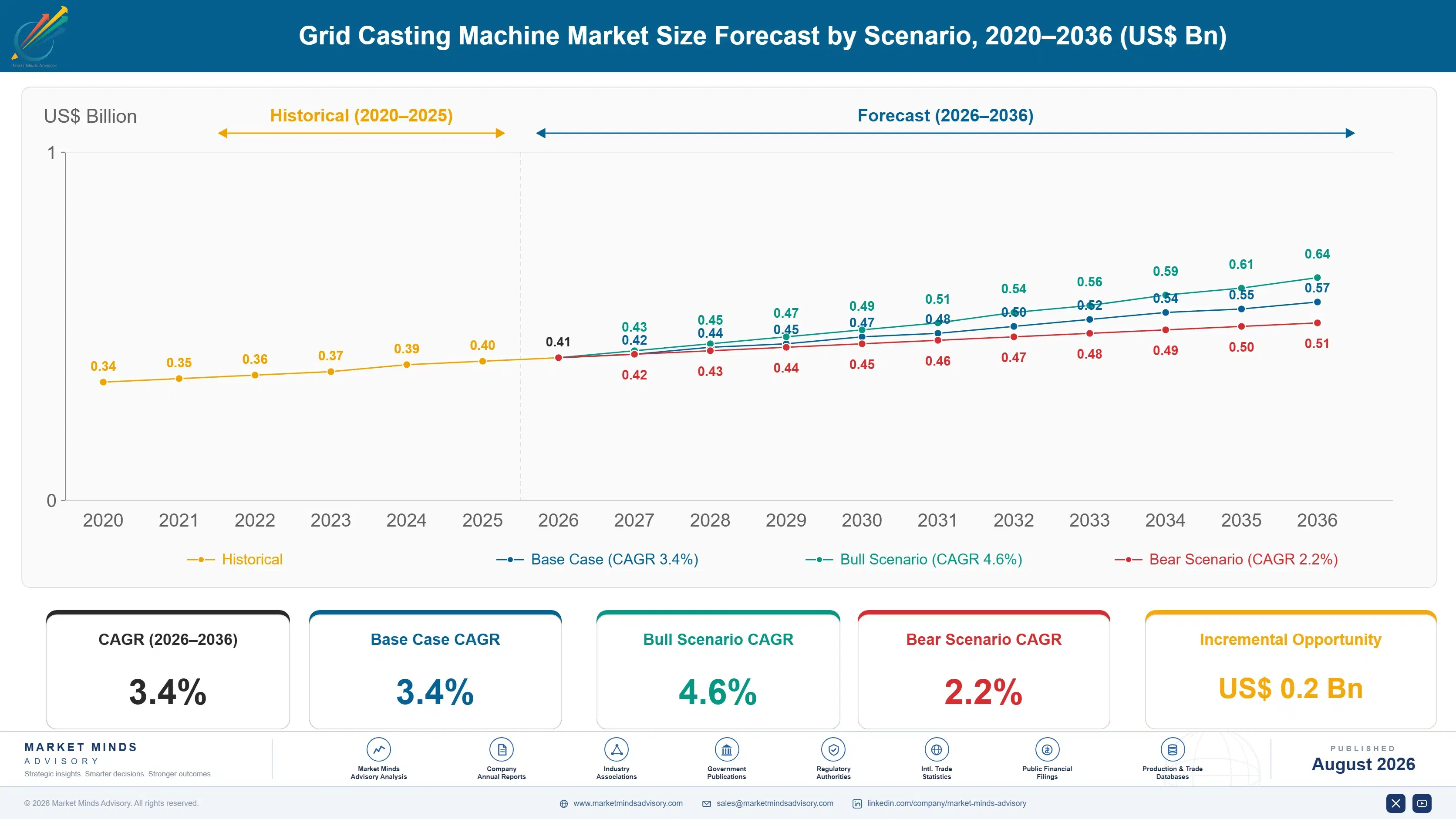
grid-casting-machine-market-size-forecast-scenario-1787333907074
Between 2020 and 2025 the market stayed almost flat and the mix changed underneath it. Western battery makers deferred capital while the electrification narrative made every lead acid investment look questionable to a board, and Asian producers added capacity throughout. Continuous casting took share from gravity casting wherever new lines were built. A 2.3% historical CAGR describes an industry replacing equipment rather than expanding it.
Three mechanisms carry the 3.4% base case. Starter battery demand persists because every vehicle including battery electric ones carries a low voltage battery, and lead acid still holds that position almost entirely. Data centre and telecom backup keeps growing and continues to specify lead acid for cost and recyclability reasons. And Asian battery manufacturing capacity keeps expanding, which is where nearly all new machine demand actually originates rather than in replacement markets.
The 4.6% bull case turns on lithium replacing the low voltage vehicle battery more slowly than currently assumed, which would extend the whole investment horizon. The 2.2% bear case is that transition arriving faster and freezing capital spending across the Western supply base. Both scenarios turn on a technology decision taken by vehicle manufacturers rather than by anybody in this industry.

Capital Equipment For An Industry Nobody Believes In

Nobody wants to sign a capital request for lead acid equipment. The narrative says the technology is ending, the board has read the same articles, and a twenty year machine looks like a bet against the future. Meanwhile every vehicle built including electric ones carries a low voltage lead acid battery, and the plants making them keep running. That contradiction governs every purchase in this category.
TOP FIVE CONCENTRATION64%Molten lead handling at production rates is a narrow capability
AVERAGE LINE VALUEUSD 1.9 millionComplete continuous casting line delivered and commissioned at a plant
MACHINE SERVICE LIFE20 to 30 yearsOperating years before a casting line is economically replaced
GRID WEIGHT VARIANCEUnder 2 percentConsistency required across grids from a modern production line
AFTERMARKET REVENUE SHARE41%Moulds, wear parts, and service across an installed machine life
LEADING PRODUCER SHARE37%Machine building concentrates where battery manufacturing capacity has grown
The consequence is deferral. A casting line lasts 20 to 30 years and gets run considerably longer than that whenever capital approval is difficult, which it usually is. Buyers repair, rebuild, and cannibalise rather than replace, and machine builders find their real competitor is the customer's own maintenance department rather than another supplier. Machine builders find their real competitor is a fitter with a welding set and a purchase order nobody had to approve.
Aftermarket carries 41% of category revenue as a result. Moulds wear, trimming knives dull, pot linings fail, and a plant running a thirty year old line consumes parts continuously. That revenue is more dependable than machine sales and considerably better in margin, which several builders have belatedly recognised and organised around.
"I have watched this industry get written off since about 2004. Every year somebody explains that lead acid is finished, and every year another few hundred million starter batteries get made. The machine builders who believed the story sold up. The ones who did not have a very comfortable business."
Principal Analyst, Battery Manufacturing Equipment Practice · MMA Construction a

Market Trends

Continuous Casting Displaces Gravity Book Moulds

Gravity casting pours molten alloy into a hinged book mould, one grid at a time, at a rate limited by how fast the metal solidifies and an operator can cycle. Continuous casting draws a strip from a rotating drum and punches grids from it at output rates several times higher, with grid weight variance under 2 percent and labour content that collapses to supervision. Thinner grids are possible, which matters because grid lead is dead weight in a battery. Almost every new line built now uses the continuous process, and the segment grows at 7.8% against a market at 3.4%.
Market Impact: Every vehicle carries 1 battery

Lead Handling Regulation Reshapes Machine Specification

Occupational lead exposure limits have tightened across Europe and North America and enforcement has become considerably more active, which makes fume extraction, enclosure, and automated handling requirements rather than options. A casting line built in 1998 cannot be brought to current exposure standards by adding a hood, because the machine architecture assumes operators reaching into it. That converts a deferred capital item into a compliance obligation with an inspection date attached, which is the only argument that reliably moves a battery plant. Suppliers with fully enclosed automated lines find themselves selling to buyers who had no intention of buying.
Market Impact: Lead recycles at above 95%

Market Opportunities and Growth Drivers

Every Vehicle Still Carries A Low Voltage Battery

A battery electric vehicle needs a twelve volt supply for lighting, control electronics, and the contactors that connect the traction pack, and almost all of them use a lead acid battery to provide it. That means electrification removes the starter function without removing the battery, which is the single most misunderstood fact in this industry. Global vehicle production continues at scale and each unit carries a grid set regardless of powertrain. Replacement demand from the existing vehicle parc dwarfs original equipment volume and continues entirely independently of what happens to new vehicle technology.
Market Impact: Approvals take over 18 months

Data Centre Backup Keeps Specifying Lead Acid

Uninterruptible power supply installations in data centres and telecom sites continue to specify valve-regulated lead acid on cost, recyclability, and fire behaviour grounds even where lithium is technically available. A battery that fails safely and recycles at above 95% rates carries arguments that matter to a facility manager thinking about a room full of racks. Data centre construction is expanding faster than almost any other industrial category, and each installation carries substantial battery content. That demand reaches grid casting through battery makers adding capacity rather than through any direct route.
Market Impact: Lines run 40 years in service

Market Restraints and Challenges

Boards Will Not Approve Capital For A Declining Technology

A twenty year machine for a technology every business publication describes as obsolete is a difficult paper to put in front of a board, regardless of what the plant actually needs. The root cause is a narrative gap rather than an economic one, since the underlying demand has not declined at all. Commercially it means capital approval takes longer, gets refused more often, and pushes plants toward repair and rebuild. Suppliers are mitigating with rebuild programmes, leasing structures, and modular upgrades that fit an operating budget rather than requiring a capital committee.
Market Impact: Grid weight variance under 2 percen

Customers Run Machines Decades Past Design Life

A casting line designed for 20 to 30 years frequently runs for forty, because a battery plant with a working machine and a difficult capital environment will repair almost anything rather than replace it. The root cause is that the equipment is genuinely durable and the failure modes are mechanical rather than catastrophic. Commercially this caps new machine demand well below what the installed population would suggest and turns the customer's maintenance department into the main competitor. Suppliers are mitigating by selling rebuild kits, control retrofits, and enclosure upgrades into machines they built decades ago.
Market Impact: Exposure limits cut to 30 microgram
2 additional market trends, 3 additional growth drivers, and 4 additional restraints and challenges are covered in the full report. Contact sales@marketmindsadvisory.com to access the complete intelligence.

Segment CAGR and Growth Architecture

Segmentation follows grid forming process, because the process determines achievable grid thickness, output rate, alloy compatibility, labour content, and the battery types a plant can serve. Battery application, plant scale, and automation level are handled in the framework and commentary, since each cuts across every forming process rather than defining one of them. Nothing else divides this market usefully.
grid-casting-machine-market-market-share-analysis-1787333907604

Continuous Grid Casting and Punching Lines

Continuous casting grows fastest at 7.8%, about 2.29 times the market rate, and it has effectively won the argument on any new line being built. A strip drawn from a rotating cooled drum and punched into grids runs several times faster than pouring book moulds one at a time, holds grid weight variance under 2 percent, and reduces labour to supervision rather than operation. Thinner grids become possible, which matters because grid lead contributes weight without contributing capacity. Capital cost is higher and the process suits fewer alloy chemistries, which keeps gravity casting alive in specialist applications. Nearly every greenfield battery plant now specifies continuous, and the retrofit conversation is starting in older ones.
CAGR 7.8%

Expanded Metal Grid Lines

Expanded metal processing grows at 5.1%, taking a cast or rolled strip and slitting and stretching it into a mesh rather than casting the grid geometry directly. The process suits thin automotive plates particularly well and produces very low grid weight, which improves the energy density of a starter battery measurably. Corrosion performance depends heavily on the alloy and the strip quality entering the line, and plants running the process need metallurgical control that gravity casting forgives. Equipment cost sits between gravity and continuous casting. Automotive battery makers building for weight-sensitive applications specify it most consistently, while industrial and traction battery producers largely do not. Alloy and strip quality decide whether it works at all.
CAGR 5.1%
Full segment breakdown across 7 segments available in the complete report.

Regional Architecture and Country Demand Map

Regional shares here track where lead acid batteries are actually manufactured rather than where they are used, and those two maps have diverged considerably over three decades. East Asia dominates production while Western regions replace equipment in plants built long ago. Equipment demand follows plants rather than vehicles.

East Asia

Manufacturing scale gives East Asia 34% of value, above the 30% ceiling this framework applies, and the reason is straightforward: the majority of the world's lead acid batteries are made here and machine demand follows plants rather than vehicles. Chinese producers operate at a scale no other region approaches and have consolidated substantially under environmental enforcement that closed smaller operators. Domestic machine builders now supply much of the volume at prices European builders cannot match, though the most demanding continuous lines still come from Italy and the United States. Japanese and Korean plants are technically advanced and replacement-driven. Growth at 4.3% exceeds the global rate on continued capacity investment rather than on any regulatory push.
Share: 34% | CAGR: 4.3% (2026 to 2036)

South Asia and Pacific

Fastest growth anywhere sits in South Asia and Pacific at 5.6%, on 15% of value, which is well above the band this framework normally applies for the region. Indian lead acid manufacturing serves an enormous two wheeler and commercial vehicle parc alongside a telecom and inverter backup market that has no equivalent elsewhere. Domestic battery makers have been investing in continuous casting steadily as they move upmarket from gravity lines. Australian and Southeast Asian demand is smaller and mostly replacement. Almost all of the growth here is new capacity rather than machine replacement, which makes the region the single most important source of genuinely new demand in this whole category.
Share: 15% | CAGR: 5.6% (2026 to 2036)
Regional intelligence for 5 additional markets available in the complete report: North America, Western Europe, Latin America, Middle East and Africa, Eastern Europe. Contact sales@marketmindsadvisory.com.
grid-casting-machine-market-country-cagr-analysis-1787333908117

Where Machine Builders Actually Earn

Four levers matter here, and selling new lines is the hardest of them. Aftermarket capture, compliance-triggered selling, rebuild programmes, and Asian market presence decide outcomes, because the installed base is durable and the capital environment is hostile. A builder organised entirely around new machine sales is competing against its own customers' maintenance departments and generally losing.

Capture The Mould And Wear Part Stream

Aftermarket already carries 41% of category revenue and behaves far more predictably than machine sales ever do, because moulds wear, knives dull, and pot linings fail on schedules a builder knows better than the plant does. A line running thirty years consumes several times its original value in parts. Third-party machine shops take that revenue wherever the original builder quotes long lead times or invites a price comparison. Holding it requires regional stock and same-week despatch rather than a catalogue, which is a distribution investment most builders in this category keep deferring.
Market Impact: Aftermarket already carries 41% of

Sell Against The Exposure Inspection, Not The Payback

A battery plant will defer a casting line replacement indefinitely on economics, because the existing machine still makes grids and the board does not want the paper. An occupational lead exposure limit that a 1998 machine architecture cannot meet is a different conversation entirely, with an inspection date attached and no negotiating position. Suppliers framing an enclosed automated line as a compliance solution reach a health and safety budget rather than a capital committee. That is the same equipment sold through a completely different and considerably faster approval route. Different budget, different timescale, same machine.
Market Impact: Exposure limits now sit at just 30

Build A Rebuild Business Before Somebody Else Does

Customers run lines forty years past their design life and repair almost anything rather than replace, which means the largest addressable opportunity in this category is not a new machine at all. A structured rebuild programme covering control retrofit, enclosure upgrade, and drive replacement costs the customer perhaps 30% of a new line and fits an operating budget. The builder who offers it keeps the customer, the parts stream, and the relationship until the eventual replacement. The builder who refuses to sell anything but new machines watches a local engineering firm take all three.
Market Impact: Rebuilds cost roughly 30% of a new

Follow The Plants East Rather Than Defending Home Markets

East Asia and South Asia together hold 49% of value and nearly all of the genuinely new machine demand, while Western regions replace a shrinking installed base. A builder without local engineering, service, and spares presence in India and China is selling into those markets at a permanent disadvantage against domestic competitors who are technically adequate for most requirements. Establishing that presence costs capital and management attention in markets that feel unfamiliar. The alternative is defending a home market that is contracting whatever anybody does about it. Presence there costs money and defending home costs more.
Market Impact: Asia already holds 49% of total cat

Who Controls the Margin Pool

Concentration sits at 64% for the top five, high because handling molten lead safely at production rates is a narrow engineering capability and very few firms have built it. The gap between leaders and challengers is service reach across a twenty year machine life rather than casting technology, which is broadly understood. All participants here are assessed on one basis, revenue from grid forming machinery and its dedicated tooling and parts.
Competition runs on four lines. Grid weight consistency decides technically evaluated purchases, since variance carries straight into battery performance. Lead handling compliance decides whether a machine can be installed in a regulated jurisdiction at all. Service and parts reach decides who a plant will commit to for two decades. Price decides Asian purchases, where domestic builders now set the level.

Two pressures will shift positions. Chinese and Indian machine builders are technically adequate for most requirements at prices European builders cannot approach, and they hold the markets where new demand actually is. Meanwhile the Western installed base keeps ageing without being replaced. Positions favour whoever combines compliance-grade machine architecture with genuine Asian service presence, and very few builders hold both today.
grid-casting-machine-market-company-positioning-matrix-1787333908636

Competitive Moat and Risk Dimensions

WIRTZ MANUFACTURING

Moat: Continuous casting and installed base

Wirtz developed much of the continuous grid casting process and holds an installed base across North American and international battery plants that generates parts and service revenue for decades. Process knowledge in strip casting and punching is genuinely difficult to replicate. Customers running Wirtz lines for thirty years call Wirtz when something breaks, a position no competitor buys.
WIRTZ MANUFACTURING

Risk: Exposure to Western capital reluctance

A customer base concentrated in North America and Europe faces the hardest capital approval environment for lead acid equipment anywhere, which caps new machine demand regardless of technical merit. Asian competitors are adequate for most requirements at a fraction of the price. Aftermarket revenue is dependable but grows only with the installed base, which is not growing.
SOVEMA GROUP

Moat: Full line supply and engineering

Sovema supplies complete battery manufacturing lines rather than casting machines alone, which means a plant buying grid casting frequently buys pasting, curing, and assembly from the same source and the specification conversation covers the whole facility. Italian engineering carries genuine credibility on lead handling and enclosure design. Breadth also spreads the cost of Asian service presence across several product lines.
SOVEMA GROUP

Risk: Cost base against Asian builders

An Italian manufacturing and engineering cost base cannot approach Chinese or Indian machine pricing, and most new capacity is being built in exactly those markets. Full line supply is an advantage on greenfield plants and irrelevant on a single machine replacement. Lithium equipment diversification competes for the same engineering resource with better growth prospects attached.

Players Tracked

Prominent Players

Wirtz Manufacturing
Sovema Group
MAC Engineering
TBS Engineering
Oak Press Solutions

Other Key Players

Bitrode
Hadi Maschinenbau
Farmer Mold and Machine Works
Accurate Products
Digatron Power Electronics
Zesar
OMI
Shanghai Sanyou
Zhejiang Naide Machinery
Chaowei Power Holdings
Hebei Jinli Machinery
Sun Automation
Bhandari Foils and Tubes
JOT Automation
Maschinenfabrik Gustav Eirich

Recent Developments

APRIL 2025

Occupational lead exposure enforcement tightens across European plants

Labour inspectorates across several European countries increased enforcement of occupational lead exposure limits in battery manufacturing, focusing on grid casting and plate handling areas. These were enforcement actions rather than commercial events, and older machine architectures cannot be brought into compliance by adding extraction alone.
Signal: An inspection date achieves what a payback
OCTOBER 2024

Indian battery makers commit to continuous casting conversions

Several Indian lead acid manufacturers committed capital to converting gravity book mould lines to continuous casting and punching, driven by grid weight consistency requirements from vehicle manufacturer customers. These were capital commitments rather than acquisitions, and they concentrate in the region generating most new machine demand.
Signal: Customer quality requirements move convers
JUNE 2024

Chinese machine builders widen presence in export markets

Chinese grid casting machine manufacturers extended sales into Southeast Asian, African, and Latin American battery plants, competing on delivered price and short lead times against European and American builders. These were competitive share movements rather than transactions, and they concentrate in new capacity rather than in replacement work.
Signal: Winning new capacity today builds the inst

Steel, Castings, Controls, And Engineering

Cost structure is dominated by fabrication and engineering rather than by exotic content. Steel, machined castings, and fabricated frames carry 30% to 42% of a line cost, sourced regionally because shipping fabrications is uneconomic. Drives, motors, and control systems add 20% to 28%. Refractory and pot components run 6% to 12%. Engineering, commissioning, and site labour make up the remainder and vary by destination.
European steel and energy prices rose sharply through 2021 and 2022, and the IEA documented the underlying industrial energy constraint across that period. Builders had quoted fixed prices on lines with eighteen month delivery, standard practice and an uncovered commodity position. Sovema and Hadi Maschinenbau both operate from European cost bases that absorbed most of it. Several builders introduced indexation clauses afterwards and several did not.

Each range above exceeds three points because a gravity casting machine and a full continuous line share little beyond the frame. Exposure separates by build location. A European builder carries steel, energy, and engineering wage risk on long-lead fixed price contracts. An Asian builder carries far less on all three. Engineering labour separates them most and no purchasing discipline addresses it.
grid-casting-machine-market-cost-volatility-analysis-1787333908831

Index long-lead machine contracts to steel and energy

Fabricated steel carries up to 42% of a line's cost and moved by large multiples between 2021 and 2023, while capital equipment is routinely quoted at fixed prices eighteen months ahead of delivery. That combination is a commodity bet dressed as a supply contract. Indexation costs a concession at award and removes an exposure that already destroyed sector margin once.

Standardise control platforms across the machine range

Drives, motors, and controls carry 20% to 28% of cost and are largely common across casting, punching, and handling equipment if a builder designs them that way. Most ranges grew by accretion instead, with each machine specified separately by whoever engineered it. Consolidating onto one control platform costs a redesign cycle and improves purchasing scale, spares, and service training together.

Engineer once and localise assembly near the customer

Engineering and commissioning labour is the largest variable cost and differs enormously between a European engineer travelling to India and a local team doing the same work. Designing for local assembly and commissioning, with European engineering retained centrally, cuts delivered cost substantially on Asian orders. It requires trusting a partner, which is why most builders decline.

Portfolio Architecture for Margin Defence

Three tiers sit inside this category and the capital environment shapes all of them. Gravity casting machines and standard equipment form the volume tier, where Asian builders set pricing and the technology is fully mature. Compliance-grade enclosed and automated lines earn more, because an inspection date rather than a payback drives the purchase. Aftermarket parts, rebuilds, and control retrofits price highest and carry the most dependable revenue in the whole business.
The tension is between new machine revenue that boards will not approve and aftermarket revenue that requires no approval at all. A new line needs a capital committee that has read that lead acid is finished. A rebuild kit or a mould set comes out of maintenance budget and gets signed the same week. Builders organised around selling machines find themselves arguing with the wrong department entirely.

High-value pools concentrate where the customer has no alternative: parts for machines only the original builder makes, compliance upgrades that a maintenance department cannot engineer, continuous casting technology on new Asian capacity, and rebuild programmes on ageing Western lines. The commodity end is standard gravity casting equipment into price-driven markets, where Chinese and Indian builders set the level.

Volume / Commodity-Adjacent Tier

Gravity book mould casting machines and standard handling equipment sold on delivered price. The range is wide because Asian fabrication and engineering cost positions differ enormously from European ones on functionally comparable machines.
Gross Margin: 14-26%

Premium / Certified Tier

Continuous casting and punching lines with enclosure, extraction, and automated handling meeting current exposure limits. The range is wide because compliance-driven purchases hold pricing while the same machine competes hard wherever regulation is not the trigger.
Gross Margin: 24-38%

Sustainability / Regulatory / Next-Generation Tier

Moulds, wear parts, control retrofits, enclosure upgrades, and structured rebuild programmes on the installed base. The range is wide because proprietary parts carry very different margin from general engineering work on the same machine.
Gross Margin: 36-58%
grid-casting-machine-market-portfolio-architecture-1787333909325

High-value Sub-segments and Strategic Watch-out

Continuous Grid Casting and Punching Lines

High value and high growth at 7.8%, the fastest process, because it holds grid weight variance under 2 percent at output rates gravity casting cannot approach. Nearly all greenfield capacity specifies it, and the conversion conversation is now starting in older Asian plants too. Capital approval is the only barrier.
Gross Margin: 24-38%

Expanded Metal Grid Lines

High value with steady growth at 5.1%, favoured for thin automotive plates where low grid weight improves starter battery energy density measurably. Metallurgical control requirements are demanding and the process forgives far less than gravity casting does. Weight-sensitive automotive plate is where it wins. Metallurgy is unforgiving.
Gross Margin: 24-38%

Gravity Book Mould Casting Machines

The volume core by installed units at 2.4%, still running in a great many plants and still bought where capital is tight and alloy chemistry demands it. Asian builders set the price and no Western manufacturer competes there on anything except service. Service is the only remaining argument.
Gross Margin: 14-26%

Continuous Grid Rolling Lines

The strategic watch-out at 3.1%, a technically capable route producing very uniform grids that never achieved the adoption its advocates expected. Installed population is small, the parts stream is thin, and few builders maintain serious capability in it now. Adoption never matched the technical promise here.
Gross Margin: 24-38%

How Machine Demand Actually Arrives

Demand commits at plant construction or line replacement and then repeats as parts and service for twenty to thirty years, frequently longer. A casting line sets the mould format, the spares, and the service relationship for its whole life, and the builder who supplied it gets the call at three in the morning. That is annuity economics in capital equipment clothing, and aftermarket carries 41% of revenue on that basis.
Stickiness varies with how proprietary the tooling is. Continuous casting lines stick hardest, since drum and punch tooling is machine-specific and no general engineering firm reproduces it credibly. Expanded metal lines stick nearly as hard through slitting tool geometry. Gravity casting sticks least, because book moulds are machinable by many shops and plants source them locally without much thought.

The buyer has moved from a plant engineer to a corporate capital committee that has opinions about lead acid formed largely outside the industry. Twenty years ago a works manager specified a replacement line. Now a board weighs a twenty year asset against a technology narrative, a different question entirely. Suppliers still presenting payback calculations are addressing an objection that is not financial.
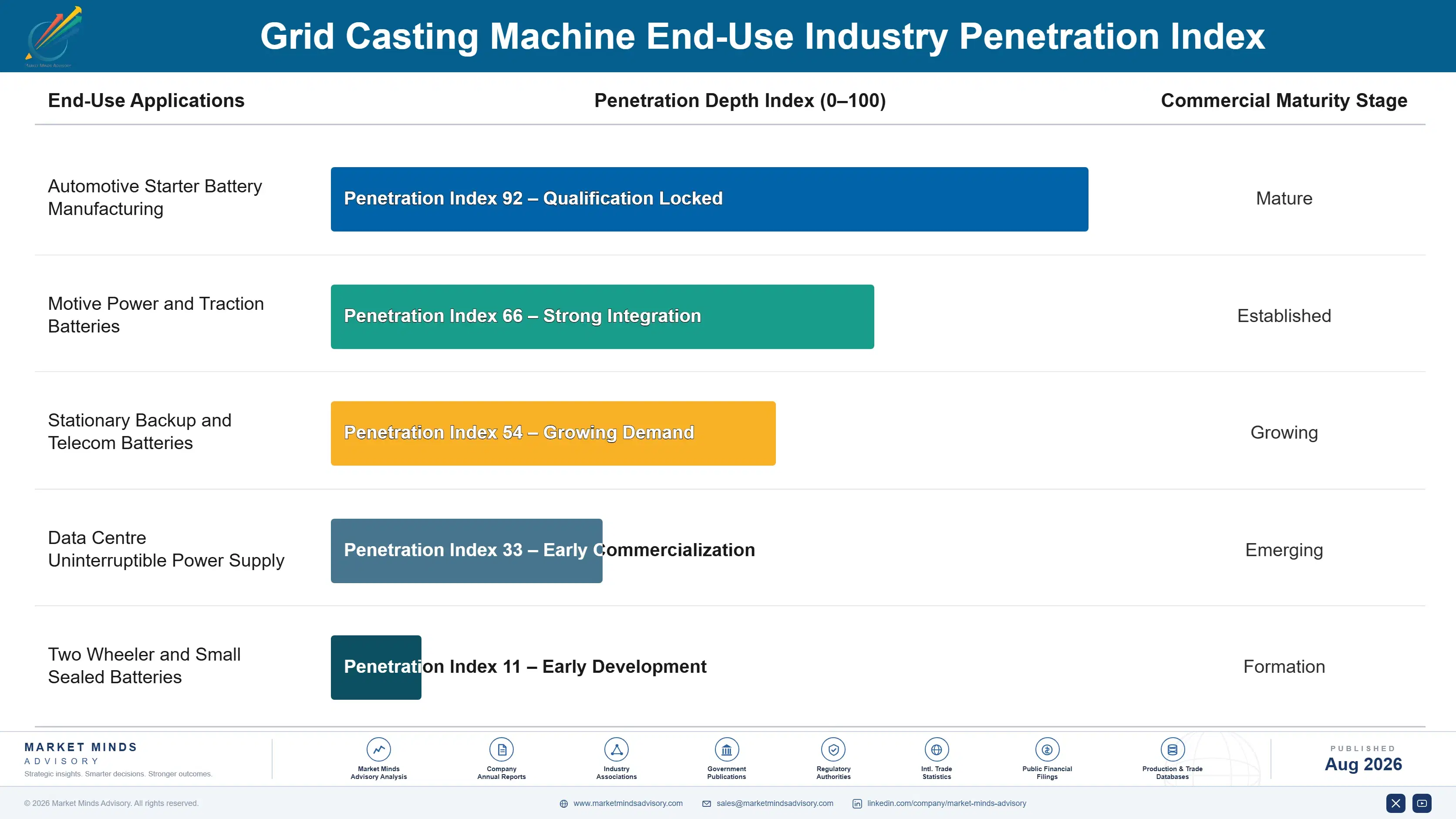
grid-casting-machine-market-end-use-penetration-index-1787333909812

Our Call On Grid Casting

These are among the four positions where our research anticipates prominent divergence between winners and laggards over the coming forecast period. Each is grounded in the demand model, the regulatory perimeter, and the announced capacity pipeline.
01 / AFTERMARKET REVENUE PRIORITY

The parts outlast the machine sale entirely

Aftermarket already carries 41% of category revenue and behaves far more predictably than machine sales, because moulds wear, punches dull, and pot linings fail on schedules the builder understands better than the plant does. A line running thirty or forty years consumes several times its original value in parts across that period, and the customer approves those purchases from maintenance budget without any capital paper. Builders who let third-party machine shops take that stream have handed away the more profitable and considerably more reliable half of their own business.
02 / COMPLIANCE TRIGGER SELLING

An inspection date beats a payback calculation

A battery plant will defer a casting line replacement indefinitely on economics, because the machine still makes grids and no board wants to sign capital for a technology it has read is finished. Occupational lead exposure limits that a 1998 machine architecture cannot meet by adding extraction are an entirely different conversation, with a date attached and no negotiating room. Framing enclosed automated lines as a compliance solution reaches a health and safety budget through a faster approval route than the capital committee ever offers.
03 / REBUILD PROGRAMME DISCIPLINE

Sell what the customer will actually buy

Customers run casting lines four decades past design life and repair almost anything rather than face a capital approval, which means the largest addressable opportunity here is a rebuild rather than a replacement. A structured programme covering control retrofit, enclosure upgrade, and drive replacement costs roughly 30% of a new line and fits an operating budget the plant already controls. Builders who refuse to sell anything but new machines watch a local engineering firm take the work, the parts stream, and eventually the relationship.
04 / ASIAN PRESENCE REQUIREMENT

Go where the plants are being built

East Asia and South Asia together hold 49% of category value and nearly all the genuinely new machine demand, while Western regions replace a shrinking installed population under a hostile capital environment. A builder without local engineering, commissioning, and spares presence in India and China competes at a permanent disadvantage against domestic manufacturers who are technically adequate for most requirements. Establishing that presence is uncomfortable and expensive, and the alternative is defending a home market that keeps contracting whatever anybody does.

Engagement Snapshot From the Field

A live engagement with an industry participant carrying material or product regulatory and market exposure ahead of a defining policy shift, showing how our research translates into a defensible multi-year portfolio strategy.
MARKET MINDS ADVISORY · CLIENT ENGAGEMENT SUMMARY
Grid Casting Machine Producer Strategic Portfolio Review and Transition Roadmap 2026·Investment Scenario on Grid Casting Machine Exposure Evaluation 2025-26
CLIENT PROFILE
A European grid casting machine builder with roughly USD 38 million in annual revenue engaged MMA after new machine orders fell for a fourth consecutive year while its installed base kept running (client-reported, unverified by MMA). The company had supplied more than 300 lines across four decades and estimated that fewer than a third of them were still buying parts from it.
STRATEGIC CHALLENGE
Sales wanted to cut machine prices to compete with Asian builders. Engineering wanted to develop a next generation line. Nobody had contacted the installed base to ask where it was buying moulds and wear parts, or why. The board needed a position before committing a development budget the company could only spend once in the current climate.
MMA APPROACH
MMA built a register of the client's installed machines by age, location, and configuration, which had never been assembled. We contacted 120 of those plants on where they source parts, who performs rebuilds, and what would bring the work back. We then modelled three routes: price competition, a next generation product programme, and an aftermarket and rebuild business.
KEY FINDINGS
  1. Around 68% of the installed base was buying moulds and wear parts from local machine shops rather than from the client, mainly on lead time rather than price (client-reported, unverified by MMA).
  2. Plants that had contacted the client for parts reported quotations taking three weeks or more, against local machine shops responding to the same enquiry within days.
  3. Price competition on new machines modelled worst of the three options, because Asian builders could match any reduction and the client could not sustain one.
  4. Roughly 40% of the register was running machines past forty years old with no compliant enclosure, which is a rebuild opportunity the client had never quantified.
CLIENT PROFILE
A European grid casting machine builder with roughly USD 38 million in annual revenue engaged MMA after new machine orders fell for a fourth consecutive year while its installed base kept running (client-reported, unverified by MMA). The company had supplied more than 300 lines across four decades and estimated that fewer than a third of them were still buying parts from it.
STRATEGIC CHALLENGE
Sales wanted to cut machine prices to compete with Asian builders. Engineering wanted to develop a next generation line. Nobody had contacted the installed base to ask where it was buying moulds and wear parts, or why. The board needed a position before committing a development budget the company could only spend once in the current climate.
MMA APPROACH
MMA built a register of the client's installed machines by age, location, and configuration, which had never been assembled. We contacted 120 of those plants on where they source parts, who performs rebuilds, and what would bring the work back. We then modelled three routes: price competition, a next generation product programme, and an aftermarket and rebuild business.
KEY FINDINGS
  1. Around 68% of the installed base was buying moulds and wear parts from local machine shops rather than from the client, mainly on lead time rather than price (client-reported, unverified by MMA).
  2. Plants that had contacted the client for parts reported quotations taking three weeks or more, against local machine shops responding to the same enquiry within days.
  3. Price competition on new machines modelled worst of the three options, because Asian builders could match any reduction and the client could not sustain one.
  4. Roughly 40% of the register was running machines past forty years old with no compliant enclosure, which is a rebuild opportunity the client had never quantified.
RECOMMENDED STRATEGY
Phase 1: Phase 1 (0 to 8 months): Publish the installed machine register internally and staff a parts desk quoting within two working days. Phase 2: Phase 2 (8 to 22 months): Launch a rebuild and enclosure upgrade programme priced against exposure compliance rather than against payback. Phase 3: Phase 3 (22 to 40 months): Establish Indian commissioning and spares presence rather than funding a next generation machine. Rather than a new machine.
OUTCOME
The board abandoned the price competition plan and funded the parts desk within two months, which the managing director described as embarrassingly overdue. Parts revenue rose materially within three quarters once quotation time fell below a week, and two rebuild contracts have since been signed on compliance grounds (client-reported, unverified by MMA). Indian presence remains under evaluation.

Frequently Asked Questions

Foundational context covering the market sizes, CAGR, scope, country, region and competition that inform every finding below. This section is provided to cover basics and most often pre-purchase conversations, answered from the MMA Primary Research Dataset.

What is the current size of the Grid Casting Machine Market?

The global market is valued at USD 0.42 billion in 2025, covering gravity book mould, continuous casting and punching, expanded metal, and grid rolling equipment. Battery assembly, pasting, and formation machinery are excluded.

How large will the Grid Casting Machine Market be by 2036?

The market is forecast to reach USD 0.61 billion by 2036 in the base case, about 1.39 times the 2026 level. That represents incremental value of roughly USD 0.17 billion.

What is the CAGR for the Grid Casting Machine Market 2026 to 2036?

The market grows at a 3.4% CAGR in the base case, with bull and bear scenarios at 4.6% and 2.2%. The spread turns on how quickly lithium replaces the low voltage vehicle battery.

Which segment is growing fastest?

Continuous grid casting and punching lines grow fastest at 7.8%, about 2.29 times the overall rate, because they hold grid weight variance under 2 percent at far higher output. Expanded metal lines follow at 5.1%.

Who are the major companies in the Grid Casting Machine Market?

Leading participants include Wirtz Manufacturing, Sovema Group, MAC Engineering, TBS Engineering, and Oak Press Solutions. Concentration sits at roughly 64%, because handling molten lead at production rates is a narrow capability.

Which country is growing fastest?

India grows fastest at a 6.2% CAGR, driven by battery manufacturers converting gravity lines to continuous casting as vehicle customers tighten quality requirements. China follows on continued capacity investment.

Report Segmentation Architecture

The full report scope spans multiple orthogonal segmentation dimensions, with cross-tabulated demand data provided for each dimension pair. Coverage extends further to regional breakdowns, trend trajectories, and the competitive detail needed to support segment-level decision-making.

By Grid Forming Process

  • Continuous Grid Casting and Punching Lines
  • Expanded Metal Grid Lines
  • Continuous Grid Rolling Lines
  • Gravity Book Mould Casting Machines
  • Tooling and Rebuild Systems

By End-Use Industry

  • Automotive Starter Battery Manufacturing
  • Motive Power and Traction Batteries
  • Stationary Backup and Telecom Batteries
  • Data Centre Uninterruptible Power Supply
  • Two Wheeler and Small Sealed Batteries

By Supply Scope

  • Complete New Line Supply
  • Individual Machine Replacement
  • Rebuild and Retrofit Programme
  • Tooling and Spare Parts Supply

By Region

  • East Asia
  • South Asia and Pacific
  • North America
  • Western Europe
  • Latin America
  • Middle East and Africa
  • Eastern Europe

Scope, Methodology, and Coverage

Every figure in this report is reproducible from documented input assumptions. The scope below maps the historical period, the forecast horizon, the segmentation dimensions, and the countries covered, alongside the underlying primary and qualitative methodology.
Historical Period
2020 to 2025
Forecast Period
2026 to 2036
Base Year
2025 (USD billions; MMA Primary Research Dataset, August 2026)
Market Definition
The grid casting machine market comprises the manufacture and sale of production equipment forming lead alloy current-collecting grids for lead acid battery plates, valued at manufacturer selling prices to battery producers, engineering contractors, and equipment integrators. It spans gravity book mould casting machines, continuous strip casting and punching lines, expanded metal slitting and stretching equipment, and continuous grid rolling lines, together with the melting pots and lead feed systems, moulds and drums, punch and slitting tooling, trimming, stacking and conveying equipment, enclosure and fume extraction hardware, and control systems supplied as part of a grid forming line, alongside the spare parts, tooling replacement, and rebuild programmes sold against the installed base. Battery plate pasting, curing, and drying equipment, plate stacking and assembly machinery, formation and charging systems, lead smelting and refining plant, lead alloy and any other raw material, and lithium ion cell manufacturing equipment are excluded. Battery plant operation and maintenance services sold independently sit outside scope.
Quantitative Units
USD billions (current prices); volume in units of machines and lines shipped
Segmentation Dimensions
By Grid Forming Process; By End-Use Industry; By Supply Scope; By Region
Regions Covered
East Asia, South Asia and Pacific, North America, Western Europe, Latin America, Middle East and Africa, Eastern Europe
Countries Covered
China, India, Japan, South Korea, Taiwan, Vietnam, Thailand, Indonesia, USA, Canada, Mexico, Germany, Italy, Spain, France, UK, Czechia, Poland, Romania, Bulgaria, Brazil, Argentina, Colombia, Chile, Turkey, Saudi Arabia, United Arab Emirates, Egypt, Morocco, South Africa, Nigeria, Australia, and additional markets relevant to this sector
Key Companies Profiled
Wirtz Manufacturing, Sovema Group, MAC Engineering, TBS Engineering, Oak Press Solutions, Bitrode, Hadi Maschinenbau, Farmer Mold and Machine Works, Accurate Products, Digatron Power Electronics, Zesar, OMI, Shanghai Sanyou, Zhejiang Naide Machinery, Chaowei Power Holdings, Hebei Jinli Machinery, Sun Automation, Bhandari Foils and Tubes, JOT Automation, Maschinenfabrik Gustav Eirich
Quantitative Methodology
Primary survey, n=3,800 respondents, Q4 2025, six countries; demand-side model with trade association cross-validation
Qualitative Methodology
47 expert interviews, Q4 2025; applied to validate demand model assumptions, identify emerging dynamics, and assess competitive positioning
Report Format
PDF and XLSX data workbook (Word format preview document)
Publisher
Market Minds Advisory
Report Code
MMA-2026-CON-498
Published
August 2026
Contact
sales@marketmindsadvisory.com | www.marketmindsadvisory.com

Purchase the full Grid Casting Machine Market Report (2026 to 2036).

The full MMA Grid Casting Machine report sizes the market across five forming processes, five end-use battery segments, four supply scopes, and seven regions through 2036. It profiles 20 participants on a consistent basis of grid forming machinery and tooling revenue, scoring each on continuous casting capability, compliance-grade machine architecture, aftermarket capture, and Asian service presence. Scenario models quantify how low voltage battery technology choices, occupational exposure enforcement, and Asian capacity investment move both volume and achievable margin. The report also includes an installed machine population estimate by age and process, aftermarket capture benchmarking by builder, exposure regulation tracking by jurisdiction, and rebuild opportunity sizing across the Western installed base.
Five-process and four-scope market sizing to 2036
Twenty-participant benchmark on machinery and tooling revenue
Installed machine population estimate by age and process
Aftermarket capture rate benchmarking across major builders
Occupational exposure regulation tracking by jurisdiction
Rebuild opportunity sizing across the Western installed base

Built For The People Who Decide

From boardroom strategy to bench-side execution, this report is read cover-to-cover by leaders shaping the next decade of their industry, turning demand scenarios, market dynamics and valuation benchmarks into decisions.
CXOs/ Presidents/ VPs/ Managers
M&A and Corporate Development
Strategy Teams and R&D Heads
Procurement and Product Directors
Regulatory and Compliance Leaders
Investor Relations and Equity Analysts