

Market Minds Advisory
Greaseproof Paper Sheets Market

Greaseproof Paper Sheets Market: The Mechanical Route Comes Back Into Fashion

Grease resistance can be made by refining the pulp or bought in a drum of chemistry. Regulators took away the drum, and the mills that never stopped refining suddenly hold the scarce asset.

Lead Analyst

Bilal Shaikh

Published

September 2026

Make Smarter Decisions with Customized Research Insights

Request a free sample report and evaluate market opportunities, growth trends, and competitive dynamics relevant to your business needs.

2025 MARKET VALUE$2.1BMarket Size 2025
2036 FORECAST VALUE$4.2BBase Case , 2026 to 2036
CAGR 2026 TO 20366.4 %Bull 7.5% / Bear 5.2%
INCREMENTAL OPPORTUNITY$1.9BNet 10- year value creation
EXPANSION MULTIPLE1.87x2036 value over 2026 base
Strategic Levers
M&A Pipeline
Regional Outlook
Country Rankings
Competitive Intelligence
Segmental Deep-dive
Call-Us : 91 93563 13602

Executive Snapshot and Market Trajectory

There are two ways to stop grease passing through paper. Refine the pulp until the sheet closes on itself, or apply chemistry to the surface. For fifty years the chemistry was cheaper and faster, and then the regulators withdrew it. That reversal is what this market now runs on.
Growth comes from method substitution rather than from more wrapped food. Mechanically refined greaseproof and glassine grow fastest at 9.6%, exactly 1.50 times the market rate, because they were never treated with anything and need no reformulation at all. Aqueous dispersion coated papers follow at 8.4%. East Asia holds the largest share on Chinese foodservice volume, though the highest-value grades still come out of Nordic mills.
Concentration sits at 38% across the top five measured on annual greaseproof tonnage, and the leaders are European specialty mills holding refining capability that took decades to build. Heavy refining costs roughly 47% of machine speed, which is why so few mills ever wanted it. Sheeting, interfolding, and printing add another layer of value most reel producers hand away. Reel producers hand that value straight to a converter who then owns the foodservice account.
Market Definition
This market covers grease-resistant papers supplied in sheet, interfolded, and pre-cut formats for direct food contact, including deli and bakery wrapping, basket liners, burger wraps, butter and fat wrapping, and baking parchment sheets. Scope spans mechanically refined, coated, siliconised, and treated grease-resistant grades measured at converter realised prices. Reel-form supply to third-party converters, corrugated and folding carton board, moulded fiber products, and plastic-laminated food wraps are excluded.
Base Year Value
$2.1B in 2025 (MMA Primary Research Dataset, August 2026)
Forecast Period
2026 to 2036, eleven discrete annual values
CAGR
6.4% base case. Bull 7.5%. Bear 5.2%.
Fastest Growth Segment
Mechanically Refined Greaseproof And Glassine: 9.6% CAGR
Fastest Growth Country
India: 10.4% CAGR
Fastest Growth Region
South Asia and Pacific: 8.6% CAGR
Largest Region
East Asia: 29% of 2025 global value
Market Leaders
Nordic Paper. Ahlstrom. Delfort Group. Twin Rivers Paper Company. Gascogne. Source: MMA Analysis based on company annual reports.
Primary Survey
n=3,800 procurement and R&D decision-makers, Q4 2025, six countries
Methodology
Demand-side build-up, cross-validated against public data, 47 expert interviews

Greaseproof Paper Sheets Market Forecast Scenarios

greaseproof-paper-sheets-market-size-forecast-scenario-1787298956847
The 2020 to 2025 period contained a demand shock and a chemistry shock, arriving in that order. Takeaway and delivery volumes rose sharply and stayed high, expanding the wrapping and liner categories permanently. Then fluorinated grease-proofing agents left food contact use across the United States and Europe, and converters built on that chemistry had to find another route. A 4.9% historical rate averages steady volume growth against a technical scramble.
Three mechanisms carry the 6.4% base case. Replacement of fluorochemical-treated grades is the largest, and it favours refined papers that never needed treating. Foodservice formalisation across South and Southeast Asia is the second, where wrapped and portioned food is displacing unwrapped street vending steadily. And conversion value is the third, as buyers move away from plain reels toward printed, interfolded, and pre-cut sheet formats that carry considerably more value per tonne.
The 7.5% bull case rests on quick-service chains standardising on refined greaseproof across all their wrap formats, which would pull volume toward a supply base that cannot expand quickly. The 5.2% bear case is aqueous dispersion coatings improving enough on heat and oil performance to close the gap, which would return the advantage to fast machines running ordinary furnish.

Refining. Not Chemistry. Makes Real Greaseproof

Genuine greaseproof paper contains no barrier chemistry whatsoever. Beat the pulp long enough and the fibres hydrate, swell, and close the sheet so tightly that oil cannot find a path through it. Scandinavian mills have made paper this way for over a century. The cost is speed: heavily refined furnish drains slowly on the wire and machine output falls by roughly 47%, which is exactly why most of the industry chose chemistry instead.
TOP FIVE CONCENTRATION38%Concentrated among European specialty mills holding refining capability
FLUORINE-FREE SHARE81%Sheet volume now produced without any fluorochemical grease treatment
REFINING SPEED PENALTY47%Machine speed lost when running heavily hydrated greaseproof furnish
TYPICAL BASIS WEIGHT41 gsmStandard for interfolded deli and bakery wrapping applications
PULP COST SHARE44%Bleached softwood kraft furnish as a share of production cost
CONVERSION VALUE ADDED17%Cutting, interfolding, and printing beyond the base reel
That decision looked sound for decades and then stopped being sound very quickly. With fluorochemical treatments withdrawn from food contact use, the mills that kept their refining capability hold something competitors cannot build in a hurry. Converting a machine to heavy refining means new refiner capacity, a furnish change toward long-fibre softwood, and accepting the speed penalty permanently.
Two forces shape the next decade. Aqueous dispersion coatings are the competing fluorine-free route, faster to run but weaker against hot oil over time. And sheet conversion, meaning interfolding, pre-cutting, and printing, adds 17% of value that reel producers routinely hand to somebody else. Neither force was visible in the industry five years ago, and both now decide who earns money.
"The Nordic mills spent thirty years being told their process was obsolete and slow. Nobody is telling them that now. It turns out the least fashionable asset in specialty paper was a refiner line and the willingness to run a machine at half speed."
Director. Specialty Papers and Food Contact Practice · MMA Packaging and Special

Market Trends

Fluorochemical Withdrawal Restores Value To Mechanical Greaseproofing

Fluorinated grease-proofing agents left food contact paper across the United States and the European Union within a compressed window, and roughly 81% of sheet volume now runs fluorine-free. That change transferred advantage to mills making greaseproof the mechanical way, since a refined sheet was never treated with anything and required no reformulation, no requalification, and no new supplier. Competitors running coated grades had to rebuild their product ranges. Refining capacity cannot be installed quickly, and the willingness to accept a 47% speed penalty is a commercial decision most producers still resist making.
Market Impact: Delivery uses 40% more wrap
Sheet Conversion Formats Displace Plain Reel Supply Steadily

Foodservice buyers increasingly want product delivered as interfolded pop-up sheets, pre-cut deli squares, and printed basket liners rather than as reels they must convert or hand to a third party. Conversion adds about 17% of value on top of the base paper, and it moves the commercial relationship from a paper mill to a packaging supplier. Quick-service chains in particular specify printed formats because the liner carries branding directly onto the tray. Mills that added sheeting and interfolding capability capture that value; those still shipping reels watch converters take it.
Market Impact: India grows at 10.4% annually

Market Opportunities and Growth Drivers

Delivery And Takeaway Volume Settled Permanently Higher

Food delivery expanded sharply and did not retreat, and delivered food needs more wrapping per meal than food eaten in a dining room does. Items must survive transit, stay separated, resist grease migration into a paper bag, and arrive presentable. That means liners, wraps, and interleaving sheets in quantities that dine-in service never required. The effect is permanent rather than cyclical, because the delivery channel itself has become a fixed part of foodservice rather than a substitute for anything. Wrapping consumption per delivered meal runs materially above the dine-in equivalent.
Market Impact: Machine speed falls by 47%

Asian Foodservice Formalisation Replaces Unwrapped Street Vending

Across India. Indonesia. Vietnam, and the Philippines, food increasingly moves through organised outlets, packaged bakery, and branded quick-service rather than through unwrapped street vending. Every step of that formalisation adds a wrapping requirement that previously did not exist, and food safety enforcement in metropolitan municipal areas has accelerated it. India contributes the fastest national growth rate in this forecast at 10.4%, with a domestic specialty paper base expanding to serve it. This is genuine new demand rather than substitution between materials, which makes it the highest-quality growth in the category.
Market Impact: Failures cluster beyond 30 minutes

Market Restraints and Challenges

Refining Costs Roughly Half The Machine Speed

Heavily refined furnish drains slowly on the wire, and a machine running greaseproof produces roughly 47% less tonnage per hour than the same machine on standard grades. The root cause is physical rather than fixable: closing the sheet requires fibre hydration, and hydrated fibre holds water. Commercial impact is that greaseproof tonnage must carry a substantial price premium simply to match the contribution of ordinary paper on the same asset. Producers are mitigating through refiner energy optimisation, furnish blending with selected long-fibre grades, and dedicating older slower machines to greaseproof rather than fast ones.
Market Impact: Fluorine-free reaches 81% of volume

Aqueous Coatings Underperform Against Hot Oil Over Time

The main fluorine-free alternative applies a dispersion coating to ordinary paper, which runs at full machine speed and costs less to make. It holds well against water and moderately against room-temperature grease, but hot fried food held for extended periods will still penetrate it. The root cause is that fluorochemicals delivered oleophobicity nothing currently replicates at comparable coat weight. Commercial impact falls on delivery operators where transit times are longest. Suppliers are working on higher coat weights, dual-layer systems, and hybrid constructions that combine partial refining with a lighter coating.
Market Impact: Conversion adds 17% of value
3 additional market trends, 4 additional growth drivers, and 2 additional restraints and challenges are covered in the full report. Contact sales@marketmindsadvisory.com to access the complete intelligence.

Segment CAGR and Growth Architecture

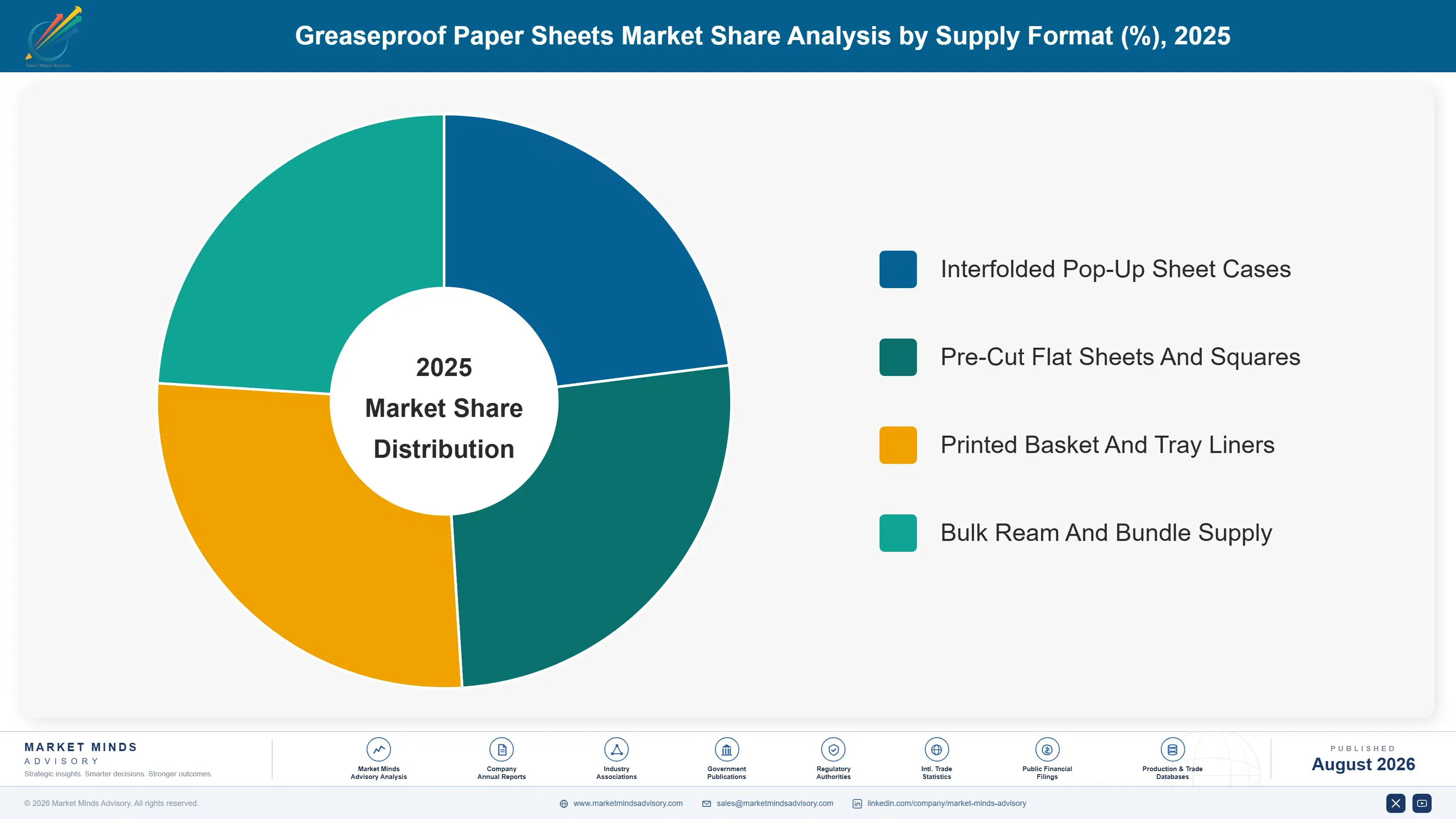
Segmentation here follows the method by which grease resistance is achieved, because that method determines machine speed, furnish requirement, regulatory standing, and the price premium a producer can defend against its competitors. End application and sheet format both cut across every method rather than separating them, so neither works as a primary dimension here.
greaseproof-paper-sheets-market-market-share-analysis-1787298957414

Mechanically Refined Greaseproof And Glassine

The fastest method at 9.6%, exactly 1.50 times the market rate, and the only one whose advantage came from regulation removing a competitor rather than from any innovation. Grease resistance here is a property of the sheet itself, created by refining pulp until the fibres hydrate and close the structure, so nothing is applied and nothing needs reformulating. Nordic and Central European mills have run this process for generations. The barrier to entry is genuine: refiner capacity, long-fibre softwood furnish, and the willingness to accept 47% less output from a machine. Glassine adds supercalendering for the transparency that bakery and confectionery applications want, at further cost in speed and energy.
CAGR 9.6%

Aqueous Dispersion Barrier Coated Papers

Second fastest at 8.4%, and the route most of the industry took when fluorochemicals were withdrawn because it required no change to the paper machine at all. A water-based polymer dispersion applied on-line or off-line gives useful grease resistance on ordinary furnish running at ordinary speed. That is a genuine cost advantage over refining. Performance is the limitation rather than economics: hot fried food held beyond about thirty minutes will still penetrate the coating, which matters most in delivery. Recyclability is better than fluorochemical grades but worse than uncoated refined paper, and repulpability testing has become a routine buyer requirement across European foodservice procurement. Coat weight is the lever most suppliers are currently pulling.
CAGR 8.4%
Full segment breakdown across 6 segments available in the complete report.

Regional Architecture and Country Demand Map

Consumption sits where foodservice volume is largest while the highest-value grades come from a narrow band of European mills. All seven regions fall inside their framework bands here, which is unusual for a category with supply this concentrated. Supply concentration and consumption geography diverge sharply here.

East Asia

Twenty-nine percent, the largest pool, and Chinese foodservice volume carries most of it across bakery, quick-service, and an enormous delivery sector that generates wrapping demand at a scale nowhere else matches. Domestic specialty paper capacity is substantial and has improved considerably on grease resistance, though the top refined grades are still imported. Japanese and Korean demand is smaller but exacting, with bakery and confectionery applications specifying glassine transparency and surface consistency tightly. Chinese food contact regulation has tightened on fluorochemicals in step with Western markets. Growth at 7.5% runs above the global rate on delivery volume and on bakery category expansion across second-tier cities. Delivery platform volume alone exceeds most national foodservice markets.
Share: 29% | CAGR: 7.5% (2026 to 2036)

South Asia and Pacific

Twelve percent, at the top of its framework band, and India contributes the fastest national growth rate anywhere in this forecast at 10.4%. Food is moving out of unwrapped street vending into packaged bakery, organised sweet retail, and branded quick-service, and each of those transitions creates wrapping demand that simply did not exist before. Municipal food safety enforcement across Indian metropolitan areas has accelerated the shift considerably. Domestic specialty paper mills have expanded to serve it, though refined greaseproof grades remain largely imported. Growth at 8.6% is the highest of any region, and it is genuine new demand rather than material substitution. Refined grades remain largely imported from European mills.
Share: 12% | CAGR: 8.6% (2026 to 2036)
Regional intelligence for 5 additional markets available in the complete report: North America, Western Europe, Latin America, Middle East and Africa, Eastern Europe. Contact sales@marketmindsadvisory.com.
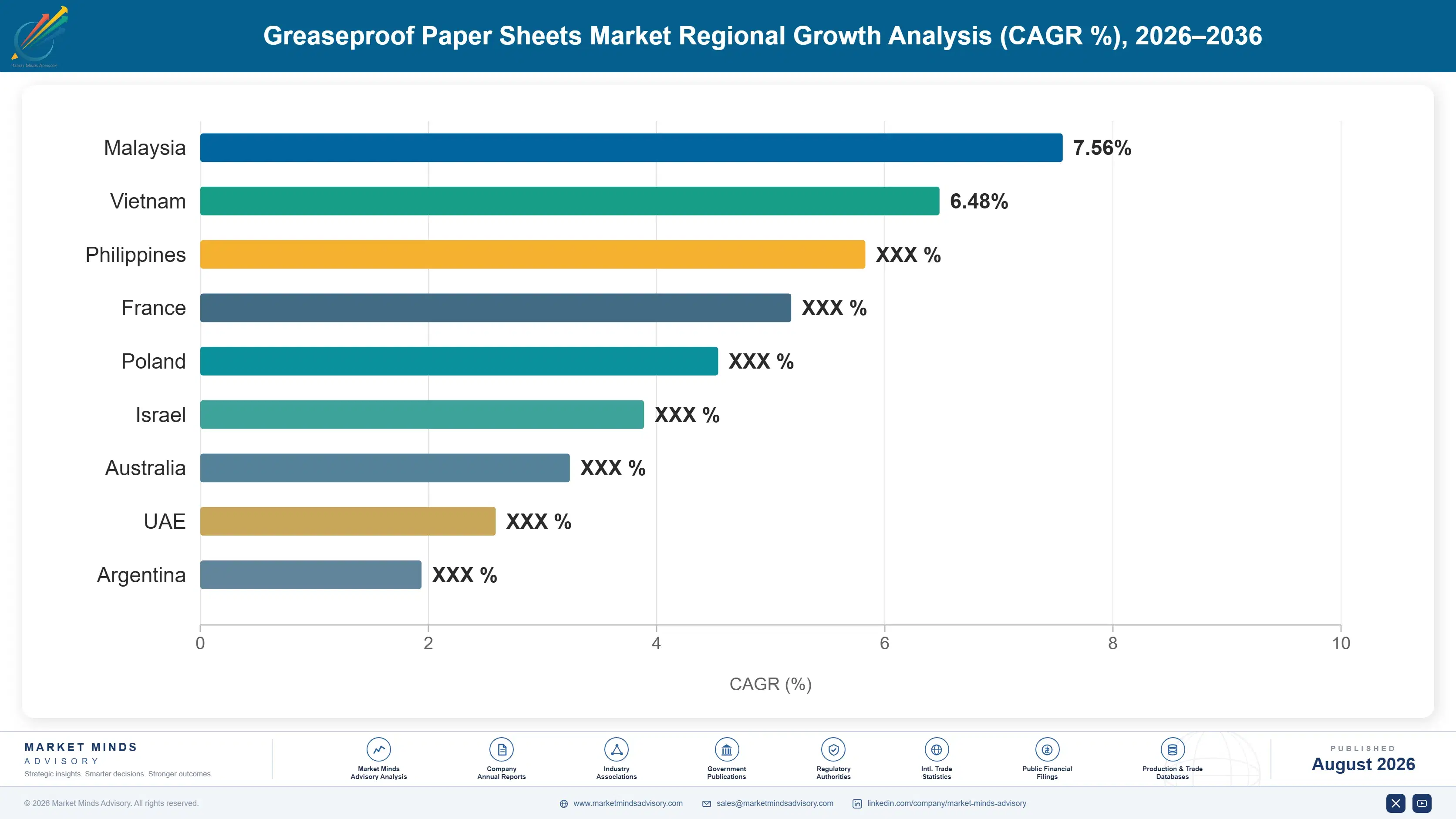
greaseproof-paper-sheets-market-country-cagr-analysis-1787298957925

Where Specialty Paper Margin Comes From

Pulp is 44% of cost and every mill buys it on the same published indices, so purchasing scale settles nothing. Margin comes from holding refining capability others cannot install quickly, from converting reels into sheets in-house, from printing at the sheeting stage, and from contracting long-fibre furnish properly. Four levers follow, and the first one is about asset allocation.

Dedicate Slower Machine Capacity To Refined Greaseproof Grades

Heavy refining costs roughly 47% of machine speed, which makes it ruinous on a fast modern machine and perfectly sensible on an older slower one whose opportunity cost is low. Producers who dedicated an older asset to greaseproof rather than trying to run it on their flagship line hold conversion economics competitors cannot match. Capital for additional refiner capacity runs around 4 million dollars on an existing machine. The grade premium available on refined greaseproof currently sits 25 to 35% above coated equivalents, and that gap is wider than it has been in decades.
Market Impact: Grade premium runs 25 to 35% above coated

Bring Sheeting And Interfolding Inside The Mill

Conversion adds about 17% of value on top of base paper, and mills shipping reels hand every point of it to a converter who then owns the foodservice relationship. Installing sheeting and interfolding capability costs roughly 6 million dollars for a plant-scale line and pays back inside three years at moderate volume. It also changes what the mill sells: a foodservice buyer wants pop-up sheets in a case, not a reel, and a supplier who can deliver that talks to the operator directly rather than through an intermediary who controls the specification.
Market Impact: Captures the full 17% of conversion value added

Print At The Sheeting Stage For Chain Branding Work

Quick-service chains want their branding on basket liners and burger wraps, and printed sheets carry a price premium that plain ones never will. Adding flexographic printing at the sheeting stage, using food-contact-compliant inks, costs perhaps 2.5 million dollars and lifts realised price per tonne by 20 to 28% on printed volume. It also creates a specification the chain has approved and does not want to requalify, which is worth more than the margin itself. Most specialty mills treat printing as somebody else's business and lose the account relationship as a direct result.
Market Impact: Lifts realised price per tonne 20 to 28%

Contract Long-Fibre Softwood Kraft On Annual Terms

Refined greaseproof needs northern bleached softwood kraft for fibre length, and that grade is neither interchangeable with hardwood nor cheap when bought on spot during a tight market. Pulp is 44% of production cost, so a swing of ten percent in furnish price moves the whole cost base by more than four points. Annual contracted volumes with quarterly price review remove most of that exposure. Mills buying spot during the recent pulp cycle absorbed cost they could not pass through inside fixed foodservice contracts, and some of them stopped making the grade entirely.
Market Impact: Softwood furnish is 44% of total production cost

Who Controls the Margin Pool

Concentration reaches 38% across the top five measured on annual greaseproof tonnage, and the composition is unusual for a paper category. The leaders are specialty mills rather than integrated pulp and paper groups, and several are small companies by industry standards holding disproportionate positions in a narrow grade. The gap to challengers is not scale but refining capability, which is why the ranking barely moved when the chemistry changed underneath everybody.
Competition runs on three fronts. Refining capability and the machine capacity dedicated to it is the first and the most defensible. Conversion and printing capability is the second, deciding whether a producer sells paper or sells foodservice packaging. Repulpability and food contact documentation is the third, increasingly a procurement requirement rather than a selling point. Documentation depth separates suppliers more than it used to.

Pressure comes from two directions. Chinese and Indian mills have improved grease resistance substantially on coated grades and compete hard below the refined tier. And aqueous coating chemistry keeps improving, which would erode the refining advantage if it ever closes the hot oil performance gap. Neither pressure has changed the ranking yet, and one of them will, probably within this forecast period.
greaseproof-paper-sheets-market-company-positioning-matrix-1787298958445

Competitive Moat and Risk Dimensions

NORDIC PAPER

Moat: Century of refining process knowledge

Making genuine greaseproof at commercial quality depends on refining control, furnish selection, and machine handling knowledge accumulated over generations rather than on any patent. The company runs machines dedicated to the grade with the speed penalty long absorbed into its economics. A competitor can buy refiners; matching a sheet made this way for a century takes far longer.
NORDIC PAPER

Risk: Narrow grade concentration risk

The position depends heavily on one grade family whose current advantage was handed over by regulation rather than earned in the market. If aqueous dispersion coatings eventually match refined paper on hot oil performance, the premium compresses and dedicated slow machines become an awkward asset to hold.
AHLSTROM

Moat: Breadth across food contact grades

A wide specialty portfolio spanning baking parchment, wrapping, filtration, and other food contact grades lets one supplier serve a foodservice customer across formats that would otherwise need three relationships. That breadth also spreads food contact compliance development cost across many grades. Buyers consolidating supplier bases value that reach.
AHLSTROM

Risk: Breadth dilutes grade specialisation

Serving many grades means no single one commands the dedicated machine capacity and refining focus a pure greaseproof specialist can commit. Capital competes internally across a wide portfolio, which slows decisions to expand refining. In a period when refined grades carry an unusual premium, that is a real cost.

Players Tracked

Prominent Players

Nordic Paper
Ahlstrom
Delfort Group
Twin Rivers Paper Company
Gascogne

Other Key Players

Seaman Paper
Pudumjee Paper Products
Mativ Holdings
Cheever Specialized Converting
Sappi
UPM Specialty Papers
Stora Enso
Oji Holdings
Nippon Paper Industries
Asia Pulp and Paper
Lecta Group
Koehler Paper
Guangdong Guanhao High-Tech
Shandong Sun Paper
Novolex

Recent Developments

JANUARY 2025

Nordic mill adds refiner capacity on dedicated greaseproof machine

A Scandinavian specialty paper producer installed additional refining capacity on a machine already dedicated to greaseproof grades, raising output of the highest hydration furnish. The investment was organic capital expenditure at an existing site rather than any acquisition, and it responds directly to demand created by fluorochemical withdrawal.
Signal: Refining capacity is the genuine bottleneck now, and the producers holding it are choosing to widen the gap
APRIL 2025

Quick-service chain standardises fluorine-free wrap across national network

An international restaurant group specified fluorine-free grease-resistant wrap across all formats in its principal markets, setting one performance standard for every regional supplier. The decision was internal procurement policy rather than any commercial arrangement with a paper producer, and franchise agreements made compliance mandatory downstream.
Signal: One chain specification propagates through thousands of outlets and reshapes what the whole distributor base stocks
AUGUST 2025

Indian specialty mill commissions grease-resistant paper capacity

An Indian specialty paper manufacturer commissioned additional grease-resistant paper capacity aimed at domestic bakery and quick-service demand, running coated rather than mechanically refined grades. The expansion was organic investment funded internally rather than any joint venture with an established European specialty producer. Tonnage figures were not disclosed publicly.
Signal: Domestic Asian capacity is arriving below the refined tier, which is where volume rather than value actually sits

Pulp. Refining Energy, and Speed

Two inputs dominate. Bleached softwood kraft pulp runs about 44% of production cost, sourced from Nordic. Canadian, and Southern United States producers, and refined greaseproof specifically needs long-fibre northern grades rather than cheaper hardwood. Energy is the second at roughly 23%, split between refining electricity and drying thermal load, and refining electricity here is far above what standard paper grades consume.
Pulp was the volatility that mattered. Northern bleached softwood kraft prices moved sharply through the recent period on supply disruption and shifting Chinese demand, and specialty mills locked into fixed foodservice contracts absorbed the difference directly. Company annual reports across the specialty paper sector describe the squeeze in consistent terms, and several producers reduced or suspended greaseproof output rather than run it at negative contribution during the worst of it.

The competitive disadvantage mechanism runs through machine allocation rather than purchasing. A producer running greaseproof on a fast modern machine loses 47% of that asset's output and must recover it in price, while a competitor using an older machine gives up far less. Integrated producers with their own pulp avoid the furnish exposure entirely, while independent mills buying market pulp on spot carry the worst position on both counts.
greaseproof-paper-sheets-market-cost-volatility-analysis-1787298958640

Allocate greaseproof to machines with the lowest opportunity cost

The 47% speed penalty is fixed by physics, but what it actually costs depends entirely on which machine absorbs it. Running the grade on an older asset whose alternative output is low-value commodity paper turns a severe penalty into an acceptable one. Producers who allocated greaseproof to their fastest line made an expensive mistake.

Contract northern softwood furnish annually with quarterly review

Long-fibre softwood is not substitutable in this grade, which removes the flexibility that lets other paper producers switch furnish whenever prices happen to move against them. Annual contracted volumes with quarterly price review convert an unmanageable exposure into a known one. Several spot buyers stopped making the grade entirely during the last pulp cycle.

Optimise refiner energy through plate design and staged refining

Refining electricity in this grade runs far above standard paper levels, and much of that energy is wasted through inefficient plate patterns and single-stage refiner configurations. Staged refining with grade-specific plate designs cuts refiner energy by a useful margin without losing any sheet closure at all. The engineering work is unglamorous and consistently deferred.

Portfolio Architecture for Margin Defence

Three tiers describe this market and the spread between them is wider than in commodity paper because method rather than material sets the price. Coated and treated grease-resistant grades running at full machine speed sit at the bottom on margin. Certified refined greaseproof and glassine, made slowly on dedicated machines, sits considerably higher. And converted formats, meaning printed interfolded sheets and chain-specified liners, occupy a third tier where the paper is only part of what is b
The tension is machine allocation rather than portfolio strategy. Every tonne of refined greaseproof costs 47% of a machine's output, so a producer cannot simply choose the highest-margin tier and run it everywhere. Contribution per machine hour rather than margin per tonne is the number that matters, and several producers have discovered they were optimising the wrong one entirely. Margin per tonne is the seductive and misleading measure.

High-value pools concentrate where a chain has approved a specification and will not requalify it casually. Printed liners and refined wraps both carry that stickiness once qualified. Requalification cost is what actually holds those accounts, not the relationship, and a chain that has qualified a print and a supplier stays put for years.

Volume / Commodity-Adjacent Tier

Coated, waxed, and machine-glazed grease-resistant papers running at full machine speed on ordinary furnish. Thin margin, high tonnage, and the volume that keeps specialty mills loaded between higher-value runs on the same assets.
Gross Margin: 13-21%

Premium / Certified Tier

Mechanically refined greaseproof and supercalendered glassine made on dedicated machines with food contact certification and full documentation. Margin reflects refining capability and the accepted speed penalty rather than any difference in raw material cost.
Gross Margin: 29-41%

Sustainability / Regulatory / Next-Generation Tier

Printed interfolded sheets, chain-specified liners, and repulpability-certified uncoated grades supplied ready for direct foodservice use. Price reflects conversion, approved specification, and food contact documentation rather than the paper underneath it, which is often the cheapest element.
Gross Margin: 34-48%
greaseproof-paper-sheets-market-portfolio-architecture-1787298959132

High-value Sub-segments and Strategic Watch-out

Printed Chain-Specified Liner Formats

Best margin in the whole category, lifting realised price per tonne by 20 to 28% over plain sheets while creating a specification the chain has already approved and will not casually requalify. Growth depends on winning chain accounts rather than on any underlying material demand.
Gross Margin: 34-48%

Mechanically Refined Greaseproof Grades

Strong margin and the fastest growth at 9.6%, carrying a premium 25 to 35% above coated equivalents because refining capability cannot be installed quickly. The advantage was handed over by regulation rather than earned, which is worth remembering when modelling its durability. Refining capacity cannot be installed at short notice.
Gross Margin: 29-41%

Coated Grease-Resistant Wrapping Papers

The volume core at thin margin, running at full machine speed on ordinary furnish and holding mill loading between higher-value runs. Contribution per machine hour here can exceed refined grades despite far worse margin per tonne, which producers regularly miss. Mill loading depends entirely on this tier staying full.
Gross Margin: 13-21%

Baking Parchment And Siliconised Sheets

The strategic watch-out, technically adjacent and commercially separate, competing against reusable silicone mats across retail channels and against permanent oven liners inside professional bakery kitchens. Silicone cost and release performance rather than grease resistance decide competitiveness here entirely, which makes it a genuinely different business.
Gross Margin: 22-33%

How Wrapping Demand Repeats

Every sheet is used once and thrown away, which makes this a pure consumable with no installed base to defend. What creates durability is specification approval: a quick-service chain that has qualified a grade, a print, and a supplier will keep buying for years because requalification costs more than any price difference on offer. Contracts run two to three years and renew routinely. Losing an account happens at renegotiation or at a specification change.
Depth varies sharply by customer type. National chains specify centrally, audit food contact documentation heavily, and hold suppliers for long periods. Independent restaurants buy whatever their distributor stocks, which makes the distributor the real customer. Industrial bakery and butter packers buy on technical specification and price with little brand sensitivity. Delivery-only kitchens are the newest and least settled group, buying on availability and switching easily, and they are growing fastest of all.

Buyer profiles are changing as food contact compliance moves from a technical question to a board-level one. The person signing the wrap contract now often reports into sustainability rather than into procurement. Food contact documentation is now requested at tender stage routinely, and few mills are ready for the depth of it.
greaseproof-paper-sheets-market-end-use-penetration-index-1787298959622

What We Would Tell a Board

These are among the four positions where our research anticipates prominent divergence between winners and laggards over the coming forecast period. Each is grounded in the demand model, the regulatory perimeter, and the announced capacity pipeline.
01 / MACHINE ALLOCATION ECONOMICS

Run greaseproof on the slow machine, not the good one

Heavy refining costs roughly 47% of machine speed and that penalty is fixed by physics, but what it costs the business depends entirely on which asset absorbs it. Running the grade on a fast modern line surrenders high-value output to recover a premium that will not cover it, while an older machine producing commodity paper gives up far less. Contribution per machine hour rather than margin per tonne is the number that should drive this allocation, and several producers are still optimising the wrong one.
02 / CONVERSION VALUE CAPTURE

Sell sheets in a case, not paper on a reel

Conversion adds about 17% of value on top of base paper, and mills shipping reels hand every point of that to a converter who then owns the foodservice relationship and controls the specification. Installing sheeting and interfolding costs roughly 6 million dollars at plant scale with payback inside three years at moderate volume. More importantly it changes who the mill talks to, because a foodservice operator buys pop-up sheets in a case and has no interest whatsoever in a reel.
03 / REFINING ADVANTAGE DURABILITY

The premium was handed over, not earned; treat it accordingly

Refined greaseproof currently carries 25 to 35% above coated equivalents because regulators removed the competing chemistry, not because the process improved in any way. Aqueous dispersion coatings continue improving on hot oil performance, and if they close that gap the premium compresses fast and dedicated slow machines become an awkward asset to hold. Boards should therefore invest in refining capacity on a payback horizon that assumes the advantage narrows over time, rather than on one that quietly assumes it persists indefinitely.
04 / SOFTWOOD FURNISH CONTRACTING

Long-fibre pulp is not substitutable, so contract it properly

Refined greaseproof requires northern bleached softwood kraft for fibre length, which removes the furnish flexibility other paper grades enjoy when pulp prices move against them. Pulp is 44% of production cost, so a ten percent swing shifts the whole cost base by more than four points inside fixed foodservice contracts. Annual contracted volumes with quarterly price review convert that into a known and manageable exposure, and several mills that bought spot through the recent pulp cycle stopped making the grade entirely.

Engagement Snapshot From the Field

A live engagement with an industry participant carrying material or product regulatory and market exposure ahead of a defining policy shift, showing how our research translates into a defensible multi-year portfolio strategy.
MARKET MINDS ADVISORY · CLIENT ENGAGEMENT SUMMARY
Greaseproof Paper Sheets Producer Strategic Portfolio Review and Transition Roadmap 2026·Investment Scenario on Greaseproof Paper Sheets Exposure Evaluation 2025-26
CLIENT PROFILE
A European specialty paper producer with approximately 190 million dollars in annual revenue (client-reported, unverified by MMA), operating three paper machines and supplying grease-resistant grades to foodservice converters across five countries. The company had shifted refined greaseproof production onto its newest and fastest machine to meet demand created by fluorochemical withdrawal, and shipped almost all output in reel form to third-party converters.
STRATEGIC CHALLENGE
Revenue had grown strongly on greaseproof demand while group operating profit fell, which management could not explain and attributed to pulp cost. A capital request for additional refining capacity on the same fast machine was pending. The board wanted an independent view before committing further capital into the grade. Nobody had tested the pulp explanation independently.
MMA APPROACH
We rebuilt contribution per machine hour by grade across all three assets, benchmarked realised price per tonne for reel versus converted formats across seven comparable producers, and modelled refining energy consumption against plate configuration. Foodservice buyer interviews across four countries tested willingness to purchase converted formats directly from a mill rather than through a converter.
KEY FINDINGS
  1. Greaseproof on the fast machine produced lower contribution per machine hour than the commodity grades it had displaced, despite a realised price premium of nearly a third per tonne.
  2. The oldest machine, running low-value packaging paper at full speed, showed the lowest opportunity cost in the fleet and was technically capable of the greaseproof grade after refiner investment.
  3. Reel supply was realising roughly 17% less per tonne than converted interfolded formats sold by the client's own converter customers into the same end accounts.
  4. Six of eleven foodservice buyers interviewed said they would buy converted sheets directly from a mill, and four were already dissatisfied with converter lead times.
CLIENT PROFILE
A European specialty paper producer with approximately 190 million dollars in annual revenue (client-reported, unverified by MMA), operating three paper machines and supplying grease-resistant grades to foodservice converters across five countries. The company had shifted refined greaseproof production onto its newest and fastest machine to meet demand created by fluorochemical withdrawal, and shipped almost all output in reel form to third-party converters.
STRATEGIC CHALLENGE
Revenue had grown strongly on greaseproof demand while group operating profit fell, which management could not explain and attributed to pulp cost. A capital request for additional refining capacity on the same fast machine was pending. The board wanted an independent view before committing further capital into the grade. Nobody had tested the pulp explanation independently.
MMA APPROACH
We rebuilt contribution per machine hour by grade across all three assets, benchmarked realised price per tonne for reel versus converted formats across seven comparable producers, and modelled refining energy consumption against plate configuration. Foodservice buyer interviews across four countries tested willingness to purchase converted formats directly from a mill rather than through a converter.
KEY FINDINGS
  1. Greaseproof on the fast machine produced lower contribution per machine hour than the commodity grades it had displaced, despite a realised price premium of nearly a third per tonne.
  2. The oldest machine, running low-value packaging paper at full speed, showed the lowest opportunity cost in the fleet and was technically capable of the greaseproof grade after refiner investment.
  3. Reel supply was realising roughly 17% less per tonne than converted interfolded formats sold by the client's own converter customers into the same end accounts.
  4. Six of eleven foodservice buyers interviewed said they would buy converted sheets directly from a mill, and four were already dissatisfied with converter lead times.
RECOMMENDED STRATEGY
Phase 1: Phase 1 (months one to nine): move greaseproof production onto the oldest machine and install the refiner capacity there rather than on the fast line. Phase 2: Phase 2 (months nine to twenty-four): commission sheeting and interfolding capability at the same site to capture conversion value internally. Phase 3: Phase 3 (months twenty-four to thirty-six): add flexographic printing capability and pursue chain-specified liner work directly with quick-service accounts rather than through converters.
OUTCOME
The client relocated greaseproof production and redirected the capital request to the older machine. Group contribution improved materially within three quarters despite unchanged tonnage and unchanged pulp costs (client-reported, unverified by MMA), and the sheeting line was approved ahead of the original schedule, with no change to the customer base.

Frequently Asked Questions

Foundational context covering the market sizes, CAGR, scope, country, region and competition that inform every finding below. This section is provided to cover basics and most often pre-purchase conversations, answered from the MMA Primary Research Dataset.

What is the current size of the Greaseproof Paper Sheets Market?

The market is valued at USD 2.1 billion in 2025, rising to USD 2.23 billion in 2026. Roughly 81% of sheet volume is now produced fluorine-free.

How large will the Greaseproof Paper Sheets Market be by 2036?

MMA forecasts USD 4.16 billion by 2036, an increase of USD 1.93 billion over the 2026 base. That represents an expansion multiple of 1.87 times.

What is the CAGR for the Greaseproof Paper Sheets Market 2026 to 2036?

The base case CAGR is 6.4%, with a bull case of 7.5% and a bear case of 5.2%. The historical rate from 2020 to 2025 was 4.9%.

Which segment is growing fastest?

Mechanically refined greaseproof and glassine at 9.6%, exactly 1.50 times the market rate. These grades were never chemically treated, so fluorochemical withdrawal required no reformulation at all.

Who are the major companies in the Greaseproof Paper Sheets Market?

Nordic Paper, Ahlstrom, Delfort Group, Twin Rivers Paper Company, and Gascogne lead on annual greaseproof tonnage. The top five together hold 38% of the market.

Which country is growing fastest?

India at 10.4%, driven by food moving out of unwrapped street vending into packaged bakery and branded quick-service. Municipal food safety enforcement has accelerated that shift considerably.

Report Segmentation Architecture

The full report scope spans multiple orthogonal segmentation dimensions, with cross-tabulated demand data provided for each dimension pair. Coverage extends further to regional breakdowns, trend trajectories, and the competitive detail needed to support segment-level decision-making.

By Greaseproofing Method

  • Mechanically Refined Greaseproof And Glassine
  • Aqueous Dispersion Barrier Coated Papers
  • Silicone-Coated Baking Parchment
  • Clay And Pigment Coated Grease-Resistant Papers
  • Wax And Paraffin Treated Papers
  • Uncoated Machine-Glazed Wrapping Papers

By End-Use Industry

  • Quick-Service Restaurants And Takeaway
  • Bakery And Confectionery Retail
  • Delicatessen And Butchery Counters
  • Industrial Butter And Fat Packing
  • Home Baking And Retail Consumer

By Supply Format

  • Interfolded Pop-Up Sheet Cases
  • Pre-Cut Flat Sheets And Squares
  • Printed Basket And Tray Liners
  • Bulk Ream And Bundle Supply

By Region

  • East Asia
  • South Asia and Pacific
  • North America
  • Western Europe
  • Latin America
  • Middle East and Africa
  • Eastern Europe

Scope, Methodology, and Coverage

Every figure in this report is reproducible from documented input assumptions. The scope below maps the historical period, the forecast horizon, the segmentation dimensions, and the countries covered, alongside the underlying primary and qualitative methodology.
Historical Period
2020 to 2025
Forecast Period
2026 to 2036
Base Year
2025 (USD billions; MMA Primary Research Dataset, August 2026)
Market Definition
This market comprises grease-resistant papers supplied in sheet, interfolded, pre-cut, and printed liner formats for direct food contact applications, measured at converter and mill realised prices inclusive of conversion and printing. Method coverage spans mechanically refined greaseproof and glassine, aqueous dispersion coated, silicone-coated parchment, clay and pigment coated, wax treated, and uncoated machine-glazed grades. Reel-form supply sold to third-party converters, corrugated and folding carton board, moulded fiber tableware, plastic-laminated wraps, and aluminium-based food foils fall outside scope.
Quantitative Units
USD billions (current prices); thousand tonnes shipped; realised price per tonne by format
Segmentation Dimensions
By Greaseproofing Method; By End-Use Industry; By Supply Format; By Region
Regions Covered
East Asia, South Asia and Pacific, North America, Western Europe, Latin America, Middle East and Africa, Eastern Europe
Countries Covered
China, Japan, South Korea, Taiwan, India, Indonesia, Vietnam, Thailand, Australia, USA, Canada, Mexico, Brazil, Argentina, Chile, Sweden, Norway, Finland, Germany, France, UK, Italy, Spain, Netherlands, Austria, Poland, Turkey, UAE, South Africa, and additional markets relevant to this sector
Key Companies Profiled
Nordic Paper, Ahlstrom, Delfort Group, Twin Rivers Paper Company, Gascogne, Seaman Paper, Pudumjee Paper Products, Mativ Holdings, Cheever Specialized Converting, Sappi, UPM Specialty Papers, Stora Enso, Oji Holdings, Nippon Paper Industries, Asia Pulp and Paper, Lecta Group, Koehler Paper, Guangdong Guanhao High-Tech, Shandong Sun Paper, Novolex
Quantitative Methodology
Primary survey, n=3,800 respondents, Q4 2025, six countries; demand-side model with trade association cross-validation
Qualitative Methodology
47 expert interviews, Q4 2025; applied to validate demand model assumptions, identify emerging dynamics, and assess competitive positioning
Report Format
PDF and XLSX data workbook (Word format preview document)
Publisher
Market Minds Advisory
Report Code
MMA-2026-PAC-231
Published
August 2026
Contact
sales@marketmindsadvisory.com | www.marketmindsadvisory.com

Purchase the full Greaseproof Paper Sheets Market Report (2026 to 2036).

The full report sizes greaseproof paper sheets across six greaseproofing methods, five end-use industries, four supply formats, and seven regions, with country detail for the fifteen largest national markets. Refined and coated grades are sized separately throughout, since their cost structures, machine economics, and regulatory positions differ completely. Contribution per machine hour is modelled by grade and machine class across the installed specialty paper base. Competitive profiling covers twenty companies on annual greaseproof tonnage. Fluorine-free conversion status is tracked by producer and by jurisdiction against dated regulatory requirements.
Refined and coated grades sized separately throughout
Contribution per machine hour modelled by grade class
Fluorine-free conversion status by producer and jurisdiction
Refining energy benchmarking across plate and staging configurations
Converted format price realisation against plain reel supply
Repulpability test performance compared across grease-resistant constructions

Built For The People Who Decide

From boardroom strategy to bench-side execution, this report is read cover-to-cover by leaders shaping the next decade of their industry, turning demand scenarios, market dynamics and valuation benchmarks into decisions.
CXOs/ Presidents/ VPs/ Managers
M&A and Corporate Development
Strategy Teams and R&D Heads
Procurement and Product Directors
Regulatory and Compliance Leaders
Investor Relations and Equity Analysts