Market Minds Advisory
Grease Gun Market

Grease Gun Market: Battery Platforms, Fleet Specifications, And A Commodity Tier Nobody Should Manufacture

The pump stopped deciding the purchase. A tradesman with eight batteries on one platform buys the grease gun that fits them, which moved this category from lubrication specialists to power tool brands.

Lead Analyst

David Horsley

Published

September 2026

Make Smarter Decisions with Customized Research Insights

Request a free sample report and evaluate market opportunities, growth trends, and competitive dynamics relevant to your business needs.

2025 MARKET VALUE$1.1BMarket Size 2025
2036 FORECAST VALUE$1.8BBase Case , 2026 to 2036
CAGR 2026 TO 20364.8 %Bull 6.0% / Bear 3.6%
INCREMENTAL OPPORTUNITY$0.7BNet 10- year value creation
EXPANSION MULTIPLE1.60x2036 value over 2026 base
Strategic Levers
M&A Pipeline
Regional Outlook
Country Rankings
Competitive Intelligence
Segmental Deep-dive
Call-Us : 91 93563 13602

Executive Snapshot and Market Trajectory

Battery platform ownership now decides which grease gun a buyer picks, not pump pressure or build quality, which has moved the category from lubrication specialists toward cordless tool brands. The market stands at USD 1.1 billion in 2025 and grows at 4.8% on mix rather than volume.
Battery-powered guns grow fastest at 9.4%, roughly twice the market rate, because a cordless unit sells at ten times a manual gun's price to a buyer who already owns the batteries. North America holds 28% of value on fleet, agricultural, and mining maintenance demand where cordless adoption runs highest. East Asia takes 26%, largely as the manufacturing base rather than as the consumer. Western Europe follows at 21% of value.
Fragmentation stays high at 41%, because a manual lever gun is a commodity any competent metal shop can build and hundreds do. Competition has split in two: commodity manual production on price, and cordless units sold on battery compatibility. Lubrication engineering heritage counts for less each year, and brands built on it are discovering that a battery platform beats a better pump on the shelf. That is a hard lesson for a heritage brand.
Market Definition
The grease gun market covers hand-held and powered devices that dispense lubricating grease under pressure into bearings, joints, and fittings, together with the couplers, hoses, and extensions supplied with them. It spans manual lever, manual pistol-grip, pneumatic, battery-powered, and hydraulic high-pressure formats. Grease itself, centralised and automatic lubrication systems, bulk transfer pumps, and oil dispensing equipment are excluded.
Base Year Value
$1.1B in 2025 (MMA Primary Research Dataset, August 2026)
Forecast Period
2026 to 2036, eleven discrete annual values
CAGR
4.8% base case. Bull 6.0%. Bear 3.6%.
Fastest Growth Segment
Battery-Powered Grease Guns: 9.4% CAGR
Fastest Growth Country
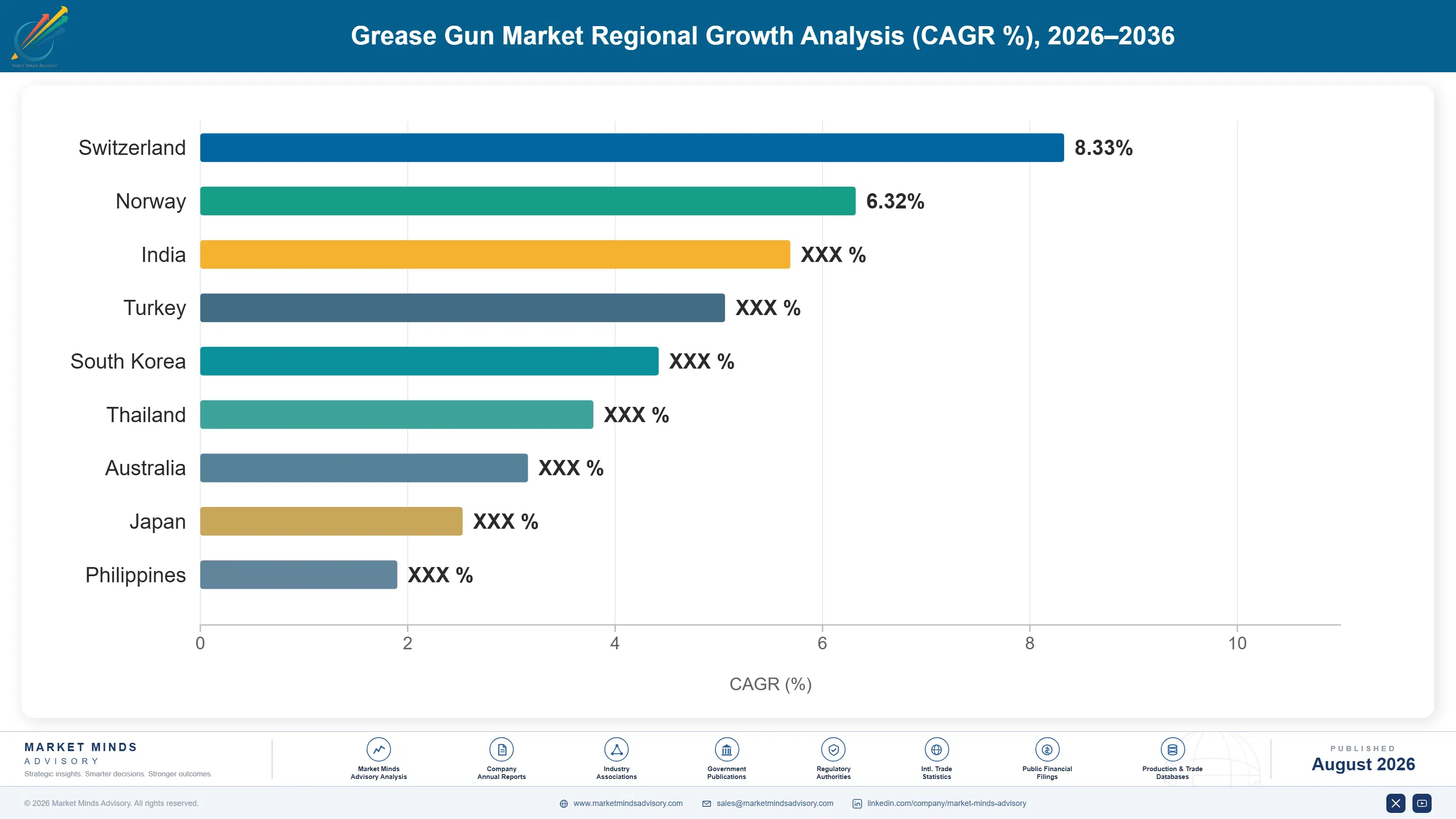
India: 7.8% CAGR
Fastest Growth Region
South Asia and Pacific: 7.0% CAGR
Largest Region
North America: 28% of 2025 global value
Market Leaders
SKF, Techtronic Industries, Stanley Black and Decker, Alemite, Graco. Source: MMA Primary Research Dataset, July 2026.
Primary Survey
n=3,800 procurement and R&D decision-makers, Q4 2025, six countries
Methodology
Demand-side build-up, cross-validated against public data, 47 expert interviews

Grease Gun Market Forecast Scenarios

grease-gun-market-size-forecast-scenario-1787332546414
Unit volumes barely moved between 2020 and 2025, and value grew anyway. Manual gun shipments were flat or slightly down across developed markets while battery-powered units took a growing share of a market where a cordless gun costs ten times a lever gun. A 3.9% historical CAGR is therefore almost entirely a mix effect, not a demand effect, which matters to anybody forecasting from unit data.
Three mechanisms carry the 4.8% base case. Cordless platform attachment is the largest: a buyer holding several batteries on one system pays a premium for a gun that fits, and 68% of cordless gun sales go to existing platform owners. Fleet maintenance standardisation is second, as commercial operators specify metered guns to control grease consumption and prevent seal damage from over-lubrication. Third, agricultural and construction fleets in South Asia keep expanding, and every machine adds fittings.
The 6.0% bull case turns on cordless conversion running faster than expected in commercial fleets, where the labour saving on a hundred fittings a day is quantifiable. The 3.6% bear case is automatic centralised lubrication spreading further down the equipment size range, which removes the manual greasing task rather than making it easier. Neither is a pricing question.

A Commodity Tool The Battery Reclassified

For a century this was a metal tube with a plunger, sold on price through industrial distribution, and the only thing separating them was whether the coupler leaked. Blended average selling price now sits at USD 46 across all formats, which conceals a range from about USD 15 for a lever gun to well over USD 300 for a cordless unit with two batteries. The average tells you almost nothing useful.
TOP FIVE CONCENTRATION41%Low-cost manufacturers keep participation broad across the manual segment
AVERAGE SELLING PRICEUSD 46Blended across manual, pneumatic, and battery-powered gun formats
BATTERY PLATFORM ATTACHMENT68%Share of cordless guns bought by existing battery owners
REPLACEMENT CYCLE LENGTH4 to 7 yearsInterval between purchase and replacement in commercial fleet use
LEADING PRODUCER SHARE51%Manufacturing concentrates where hand tool assembly cost is lowest
AFTERMARKET ACCESSORY SHARE23%Couplers, hoses, and fittings sold alongside the gun itself
Platform attachment at 68% is the number that matters. Two-thirds of cordless grease guns go to buyers who already own batteries on that system, which means the purchasing decision happened years earlier when they bought a drill. A lubrication specialist with a better pump cannot reach that buyer at all, because the comparison never gets made. Distribution reinforces it, since the same counter sells both.
Replacement runs on a four to seven year cycle in commercial use and considerably longer for occasional owners, since a manual gun with no electronics fails slowly if at all. Accessories carry 23% of category value: couplers wear, hoses split, and extensions get lost, all far faster than the gun itself. Suppliers who neglect the accessory line are leaving the more dependable revenue behind.
"Ask a maintenance technician why they bought that grease gun and they will not mention pressure ratings. They bought it because it takes the same battery as everything else on the truck. Sixty years of pump engineering lost to a battery slot."
Senior Analyst, Industrial Tools Practice · MMA Construction and Industrial Equi

Market Trends

Battery Platform Compatibility Decides The Purchase Entirely

A cordless grease gun costs ten times a manual one, and the buyer pays it without much thought if the battery already sits in their van. Platform attachment now runs at 68%, meaning two-thirds of cordless sales go to existing owners of that battery system. The pump inside matters, but nobody compares pumps at the point of sale, because the choice was made years earlier when they picked a drill brand. That reverses the traditional order in industrial tooling, where the tool led and the accessory followed. Lubrication specialists without a battery platform cannot enter the conversation.
Market Impact: Each tractor adds roughly 30 fittin
Metered Dispensing Moves From Feature To Fleet Requirement

Over-lubrication destroys seals and washes bearings, and it costs more in failed equipment than under-lubrication does in most fleets. Guns that meter output and count strokes let a maintenance supervisor set a specification and verify it was followed. Commercial fleet operators increasingly write metered dispensing into their maintenance procedures rather than leaving grease quantity to whoever holds the gun. That converts a premium feature into a purchase requirement, and it favours suppliers with electronic control over those selling pressure alone. Grease consumption data also feeds the maintenance record. Auditability is worth more than anybody expected.
Market Impact: Payback measured in 8 months

Market Opportunities and Growth Drivers

Agricultural And Construction Fleet Growth Adds Grease Fittings

Every tractor, excavator, and loader carries dozens of grease points requiring service on an hours-based schedule, and fleet expansion in South Asia and Latin America adds them at pace. Indian agricultural mechanisation continues to push tractor populations upward, and each unit adds roughly 30 fittings needing periodic attention. Unlike the developed markets, this is genuine unit volume growth rather than mix shift. It also skews toward manual and pneumatic formats, since a cordless gun costs more than a smallholder will spend on any tool. Volume and value grow at different rates here.
Market Impact: Caps cordless below 20 tonne machin

Maintenance Labour Cost Justifies Cordless Conversion In Fleets

A technician greasing 100 fittings by hand on a lever gun spends real time on it, and in a commercial fleet that time is priced. A cordless gun cuts the task substantially and removes the wrist fatigue that makes technicians skip fittings toward the end of a round. Skipped fittings cause bearing failures nobody traces back to the gun. Fleet operators running the arithmetic on labour hours find the payback measured in months rather than years, which is why cordless penetration is far higher in commercial fleets than among individual owners. Consistency matters as much as speed.
Market Impact: Manual guns retail near USD 15

Market Restraints and Challenges

Automatic Lubrication Systems Remove The Task Altogether

Centralised automatic lubrication fits a pump and distribution lines to a machine and greases every point on a timer, which eliminates the manual task rather than making it faster. The root cause of adoption is labour cost and consistency, exactly the argument cordless guns make, and automatic systems make it more completely. Commercially this caps the cordless opportunity at machines too small or too old to justify a system. Manufacturers are responding by supplying both, since the same distribution channel and the same maintenance buyer sits behind each, and a supplier holding only guns loses the account outright.
Market Impact: Platform attachment reaches 68 perc

Manual Segment Pricing Collapsed Under Low-Cost Manufacturing

A manual lever grease gun is a pressed steel tube, a plunger, and a coupler, and hundreds of manufacturers in China and India build competent ones. The root cause is that the design has no protectable content: patents expired generations ago and tolerances are undemanding. Commercially this has pushed branded manual guns toward the private label and hardware channel, where price is the only variable. Suppliers are mitigating by bundling accessories, extending warranties, and moving upmarket into pneumatic and cordless formats, though none of those defends the manual line itself.
Market Impact: Cuts grease waste by 30 percent
4 additional market trends, 3 additional growth drivers, and 2 additional restraints and challenges are covered in the full report. Contact sales@marketmindsadvisory.com to access the complete intelligence.

Segment CAGR and Growth Architecture

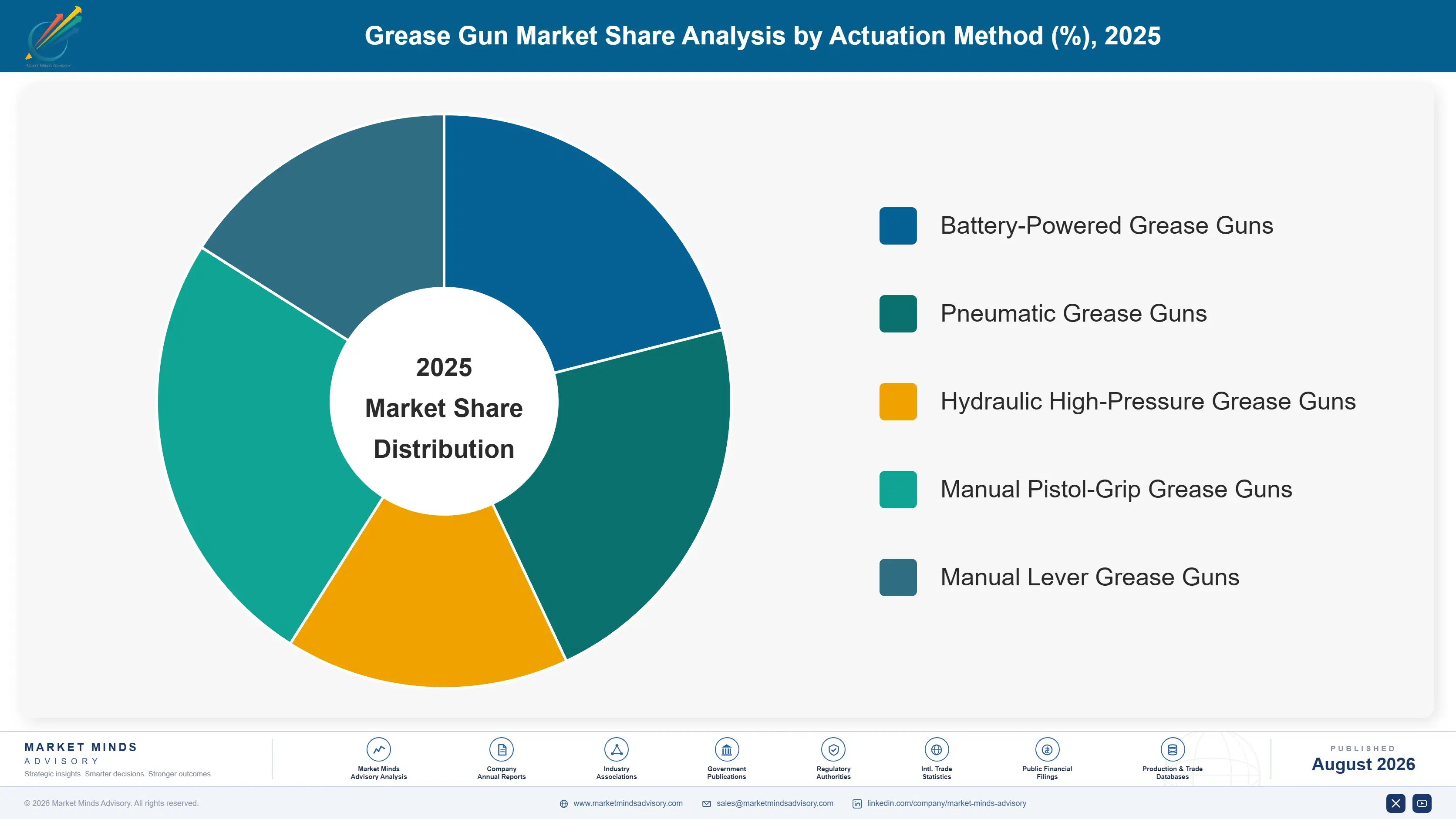
Segmentation follows actuation method, meaning how the gun generates dispensing pressure, because that single choice determines price point, buyer type, and channel more completely than any other attribute. Grease cartridge format, pressure rating, and end-use application are handled in the framework and commentary rather than as segments, since each cuts across all five actuation types.
grease-gun-market-market-share-analysis-1787332546944

Battery-Powered Grease Guns

Battery-powered guns grow fastest at 9.4%, roughly twice the market rate, and they now carry a disproportionate share of category value against a modest share of units. The economics are unusual: the gun sells for ten times a manual one, yet 68% of buyers already own the battery, so the incremental spend they perceive is far smaller than the shelf price. Commercial fleets convert first because the labour arithmetic is straightforward. Milwaukee, DeWalt, and Lincoln hold the strongest positions, and the deciding factor between them is which battery the buyer already carries rather than any pump specification. Platform, not product, is the competitive unit here. That is a genuinely new situation for this trade.
CAGR 9.4%

Pneumatic Grease Guns

Pneumatic guns grow at 5.1%, slightly above the market rate, and they occupy a position cordless has not taken: fixed workshop bays where compressed air is already plumbed and continuous duty matters more than portability. A vehicle service pit, a mining workshop, or a manufacturing maintenance bench runs air lines regardless, so the marginal cost of an air gun is low and there is no battery to charge or lose. Duty cycle is the genuine advantage, since an air motor runs all day where a battery does not. Growth tracks industrial and vehicle service facility construction rather than fleet size. Portability is simply not what a fixed workshop bay needs anyway.
CAGR 5.1%
Full segment breakdown across 7 segments available in the complete report.

Regional Architecture and Country Demand Map

Shares here follow industrial equipment fleets and vehicle populations rather than population or income. North America and East Asia together take more than half, though for entirely different reasons: one buys the premium cordless mix, the other manufactures most of what everybody else buys. Growth follows fleet expansion.

North America

North America holds 28% of value, the largest share anywhere, and cordless conversion explains most of it. Agricultural equipment fleets across the Midwest and Prairie provinces, mining operations in Nevada and Northern Ontario, and commercial vehicle fleets everywhere all run maintenance schedules where labour time is priced and cordless payback is straightforward. Milwaukee and DeWalt battery platforms are near-universal on service trucks, which decides the grease gun purchase before anybody compares specifications. Independent hardware and farm supply channels still move large manual volumes at low prices. Growth at 5.5% comes almost entirely from mix, since unit shipments here are flat. Mexican commercial fleet demand adds a further layer of manual volume too.
Share: 28% | CAGR: 5.5% (2026 to 2036)

Western Europe

Slow but stable describes Western Europe's 21% share. Industrial maintenance practice here is highly formalised, which favours metered dispensing and documented grease quantities more than any other region, and German and Nordic manufacturing plants specify accordingly. Automatic centralised lubrication also penetrates further down the equipment range here than elsewhere, which removes manual greasing tasks rather than upgrading them. Bosch and Makita battery platforms compete with the American brands on service vehicles. Growth at 3.4% is the slowest of any region, reflecting a mature equipment fleet, high automatic lubrication penetration, and manual volumes that have been declining for a decade. Formalised maintenance practice raises value per unit without raising units at all.
Share: 21% | CAGR: 3.4% (2026 to 2036)
Regional intelligence for 5 additional markets available in the complete report: East Asia, South Asia and Pacific, Latin America, Middle East and Africa, Eastern Europe. Contact sales@marketmindsadvisory.com.
grease-gun-market-country-cagr-analysis-1787332547454

Where The Money Actually Is

Four levers matter here, and the product itself is not one of them. Battery platform access, accessory attachment, fleet specification, and channel position decide outcomes, because the gun's engineering has been settled for decades. A supplier improving pump pressure against competitors whose pumps are already adequate is solving a problem no buyer has raised. That is the whole difficulty here.

License Onto A Battery Platform Or Lose Cordless

With 68% of cordless grease gun sales going to existing battery owners, a supplier without platform access is competing for the remaining third against brands the buyer already trusts. Building an independent battery system is not viable for a single tool category. Licensing onto an established platform costs margin per unit and surrenders some brand position, but it puts the product in front of a buyer who was never going to compare pumps anyway. Several lubrication specialists have chosen pride over access here and watched their cordless share go to zero. Access is worth more than the margin it costs.
Market Impact: Reaches the 68% of buyers who are p

Sell The Coupler, The Hose, And The Fitting

Accessories carry 23% of category value and replace far faster than guns do: couplers wear out, hoses split at the crimp, and extensions disappear from toolboxes constantly. A supplier selling only the gun is selling the part of the transaction that repeats least often. Building a full accessory line and getting it onto the same shelf converts a four to seven year replacement cycle into annual revenue from the same customer. It also defends against private label, since a distributor stocking one brand's accessories keeps ordering that brand's guns. Accessories hold the shelf better than guns do.
Market Impact: Accessories carry 23% of value at h

Get Written Into Fleet Maintenance Specifications

A commercial fleet that writes metered dispensing and a specific grease quantity into its maintenance procedure has effectively specified a class of gun, and the supplier who helped write that procedure is usually the one supplying it. Over-lubrication costs more in failed seals and bearings than the entire tooling budget, which is the argument that gets a maintenance engineer's attention. Winning a fleet of 400 vehicles takes one technical conversation and holds for years. Suppliers pursuing distributor promotions instead are competing for reorders on accounts somebody else specified. Specification work beats promotion every time here.
Market Impact: One technical conversation wins a 4

Concede The Manual Tier And Defend The Accessories

A pressed steel lever gun has no protectable content, and hundreds of Chinese and Indian manufacturers build competent ones that retail near USD 15. Fighting that on cost is a losing position for any Western manufacturer, and several have spent years and considerable capital confirming it. The productive response is to source manual guns rather than make them, keep the brand on the shelf, and put the engineering investment into accessories, cordless, and pneumatic formats where design content still matters. Conceding a tier is not the same as conceding the customer. Very few boards find that argument comfortable.
Market Impact: Manual guns retail near USD 15 in e

Who Controls the Margin Pool

Fragmentation is high: the top five hold 41% of grease gun revenue, and the manual tier alone supports hundreds of manufacturers because the design has no protectable content. The gap between leaders and challengers is battery platform access and fleet specification position, not manufacturing capability. All participants here are assessed on one basis, revenue from grease guns and dedicated dispensing accessories, excluding grease itself and centralised lubrication systems.
Three dimensions govern competition, and they barely overlap. In cordless, battery platform is the whole contest and the tool majors have already won it. In fleet and industrial supply, technical specification work and metered dispensing capability decide accounts that then hold for years. In manual, price is the only variable and Asian manufacturing sets it. A supplier strong in one dimension is often absent from the others entirely.

Pressure comes from two directions at once. Cordless tool platforms keep taking value from lubrication specialists who cannot match battery access, and automatic centralised lubrication keeps removing the manual task at the top of the equipment range. Rankings should favour suppliers holding a battery platform, a full accessory line, and a centralised lubrication offer, since those three cover where value is going.
grease-gun-market-company-positioning-matrix-1787332547975

Competitive Moat and Risk Dimensions

SKF

Moat: Lincoln brand and industrial distribution

SKF's Lincoln line holds the deepest position in industrial and fleet lubrication, where the buyer is a maintenance engineer rather than a tradesman and specification work decides the account. Bearing engineering credibility carries weight in exactly the conversation about over-lubrication that sells metered dispensing. The distribution reach into industrial supply houses is decades old and not easily replicated.
SKF

Risk: No mainstream battery platform

Lincoln's cordless guns run a proprietary battery that competes against systems the buyer already owns eight of, which is a losing position regardless of how good the pump is. Platform attachment at 68% means most cordless purchases are decided before Lincoln is considered. The industrial specification channel remains defensible, but it is the smaller and slower-growing half of the category.
TECHTRONIC INDUSTRIES

Moat: M18 platform and trade reach

Milwaukee's M18 platform sits on service trucks across North America and increasingly elsewhere, and a grease gun that takes those batteries wins the purchase before any comparison happens. The platform is the moat, not the tool: Techtronic did not need lubrication heritage to take the segment, only battery installed base and shelf position in the trade channel.
TECHTRONIC INDUSTRIES

Risk: No industrial specification position

Techtronic reaches the tradesman and the service truck, not the plant maintenance engineer who writes lubrication procedures for a refinery or a mining operation. Those accounts specify on metering accuracy, documentation, and bearing knowledge, none of which a power tool brand carries credibility on. The grease gun is also one product line among hundreds, so it receives engineering attention accordingly.

Players Tracked

Prominent Players

SKF
Techtronic Industries
Stanley Black and Decker
Alemite
Graco

Other Key Players

Ingersoll Rand
Legacy Manufacturing
Groz Engineering Tools
Macnaught
Samoa Industrial
Pressol
Yamada Corporation
Snap-on
Milton Industries
Makita
Bosch
Chicago Pneumatic
National Spencer
Balcrank
Plews and Edelmann

Recent Developments

MARCH 2025

Cordless grease gun ranges extended across major battery platforms

Several power tool manufacturers added or refreshed grease guns within their existing cordless battery ranges, positioning them alongside drills rather than within lubrication catalogues. These were product line extensions rather than acquisitions or partnerships, and they reflect how completely battery platform now determines where this product sits commercially.
Signal: Where a product sits in the catalogue now
OCTOBER 2024

Fleet maintenance standards adopt metered dispensing requirements

Large commercial vehicle and mining fleet operators updated maintenance procedures to specify metered grease quantities at each fitting rather than leaving volume to technician judgement. These were internal procedural changes rather than any commercial transaction, and they convert metered dispensing capability from a product feature into a supply requirement.
Signal: A procedure written once specifies tooling
JULY 2024

Indian manufacturers expand export capacity for manual guns

Indian hand tool manufacturers extended grease gun production aimed at export and private label supply, competing directly with established Chinese sources on cost and delivery. This was organic capacity expansion rather than acquisition or joint venture, and it puts further pressure on the pricing floor for manual formats worldwide.
Signal: A second low-cost source removes whatever

Steel, Motors, Cells, And Freight

Cost structure differs completely between formats. Pressed and machined steel carries 34% to 46% of manual gun cost, sourced wherever assembly happens. A cordless gun looks nothing like it: motor, gearbox, and electronics run 30% to 42%, with lithium cells adding 18% to 26% when a battery is included. Pneumatic guns sit between, with air motor and valve content around 28% to 38%.
Lithium carbonate prices rose sharply through 2022 before falling back across 2023 and 2024, and the IEA tracked both movements. For cordless grease gun makers the effect was indirect but real: cell cost sits inside a battery pack priced across an entire tool platform, so a gun bundled with two batteries absorbed platform-wide cost movement it could not influence. Stanley Black and Decker disclosed input cost pressure across that period.

Every range above spans more than three points because the three formats share almost no components. Exposure separates by format. A manual gun maker carries steel and freight risk on a product retailing near USD 15. A cordless supplier carries cell and electronics exposure but sells at a price with room in it. Asian manufacturers hold steel proximity, lower assembly labour, and shorter freight.
grease-gun-market-cost-volatility-analysis-1787332548171

Source manual guns rather than manufacturing them

Pressed steel carries 34% to 46% of manual gun cost and Asian manufacturers hold both material proximity and lower assembly labour, which no Western plant overcomes at a USD 15 retail price. Contract sourcing keeps the brand on the shelf and the distributor relationship intact while removing a manufacturing position that loses money every year it operates.

Buy battery packs, do not build cell supply

Lithium cells run 18% to 26% of a bundled cordless gun's cost and their price moved by a factor of several across three years. A single tool category has no scale to negotiate cells or hedge them. Licensing onto a platform passes that exposure to a partner who buys cells across hundreds of products and manages the volatility properly.

Load accessories onto the same freight and shelf

Freight and shelf space are the scarce inputs at this price point, not materials. Couplers, hoses, and extensions ship in the same carton space, carry higher margin per cubic metre, and replace several times per gun life. Loading them onto the existing logistics and distribution position costs almost nothing incremental and materially improves the economics of the whole line.

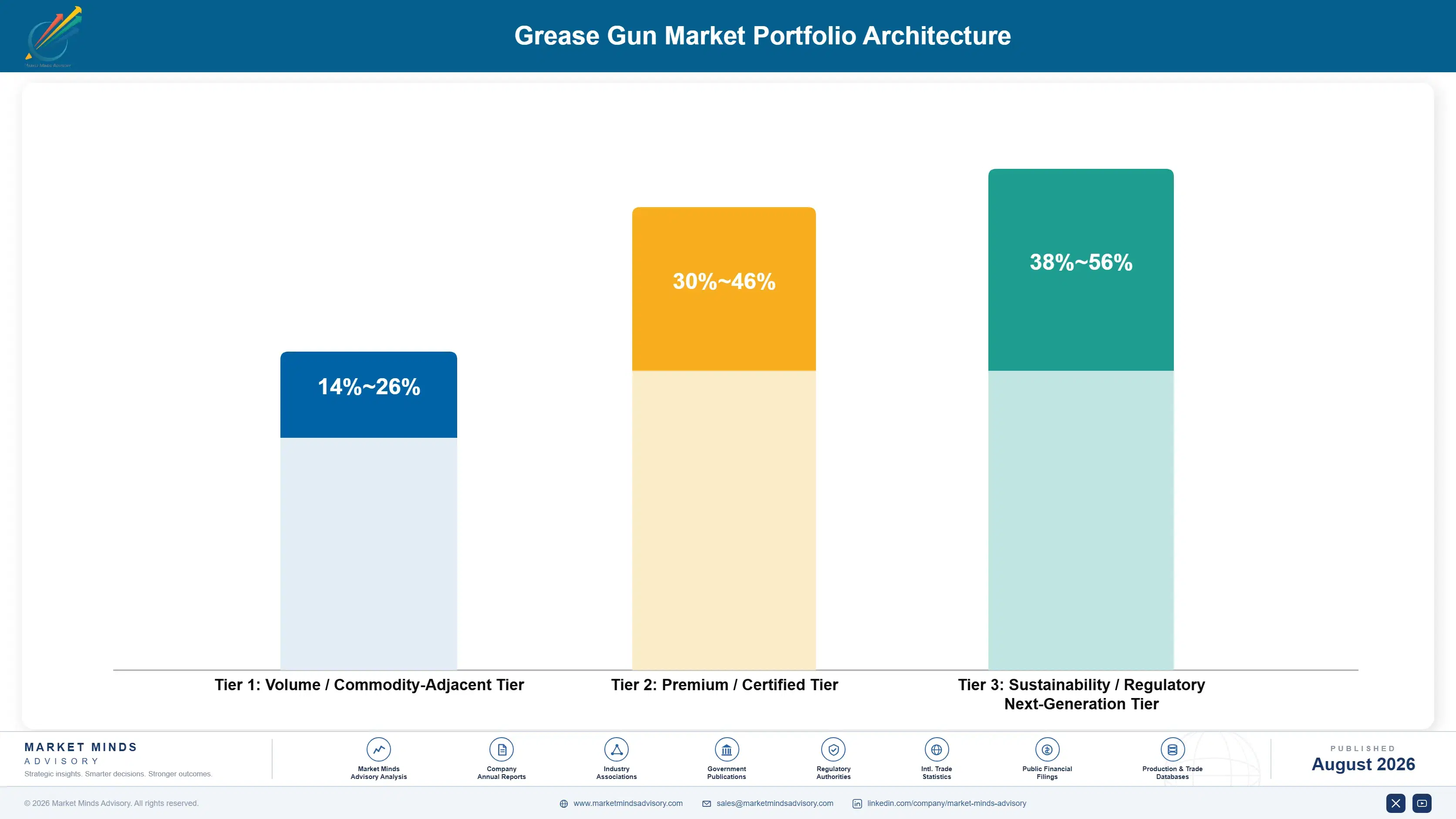
Portfolio Architecture for Margin Defence

Three tiers with very different margins sit inside this category. Manual lever and pistol-grip guns form the volume tier, built by hundreds of manufacturers and sold on price into hardware and farm supply channels. Pneumatic and industrial-specification guns earn considerably more, because the buyer is an engineer and the specification is written rather than browsed. Cordless and metered dispensing units price highest, and platform access explains why.
The tension is between volume that holds shelf position and premium work that makes money. A distributor stocking a brand's cordless and industrial lines usually wants the manual guns too, so abandoning the bottom tier risks the shelf entirely. Yet manufacturing manual guns in a high-cost country loses money reliably. The resolution most suppliers reach is to source the volume tier and manufacture where design content justifies it.

High-value pools concentrate where a buyer cannot simply compare on price: cordless guns sold into a battery platform the buyer already owns, metered units written into fleet maintenance procedures, and accessories that replace several times per gun life. The commodity end is the manual lever gun, where the specification is trivial and Asian manufacturing sets the price for everybody. Pneumatic sits between the two.

Volume / Commodity-Adjacent Tier

Manual lever and pistol-grip guns sold on price through hardware, farm supply, and private label channels. The range is wide because sourced product and own-manufactured product carry entirely different cost structures at the same retail price.
Gross Margin: 14-26%

Premium / Certified Tier

Pneumatic and industrial-specification guns with metered dispensing, sold to maintenance engineers through industrial supply. The range is wide because specification-won accounts hold pricing while distributor-stocked product competes with everything else on the same shelf.
Gross Margin: 30-46%

Sustainability / Regulatory / Next-Generation Tier

Cordless guns on established battery platforms, plus metered electronic dispensing and grease consumption recording. The range is wide because bundled battery content carries very different margin from bare tool sales at the same shelf position.
Gross Margin: 38-56%
grease-gun-market-portfolio-architecture-1787332548672

High-value Sub-segments and Strategic Watch-out

Battery-Powered Grease Guns

High value and high growth at 9.4%, roughly twice the market rate, because the buyer perceives only the incremental cost above batteries they already own. Platform access, not pump engineering, decides who participates, and a supplier without it competes for a third of the segment.
Gross Margin: 38-56%

Pneumatic Grease Guns

High value with steady growth at 5.1%, holding fixed workshop bays where air lines already exist and duty cycle beats portability. Cordless has not displaced it because an air motor runs all day, which no battery pack manages on a continuous greasing round. Workshop bays are safe ground.
Gross Margin: 30-46%

Manual Pistol-Grip Grease Guns

The volume core by units at 2.6%, sold on price into hardware, automotive, and farm supply channels where one-handed operation is the whole selling point. Design content is nil, hundreds of manufacturers compete, and brand carries only as far as the shelf position it buys.
Gross Margin: 16-28%

Manual Lever Grease Guns

The strategic watch-out at 1.4%, declining in developed markets as cordless takes the commercial fleet volume and holding on only through price-driven agricultural and emerging market demand. No Western manufacturer makes money building these, and several have proved it thoroughly. Sourcing is the only sane answer.
Gross Margin: 14-26%

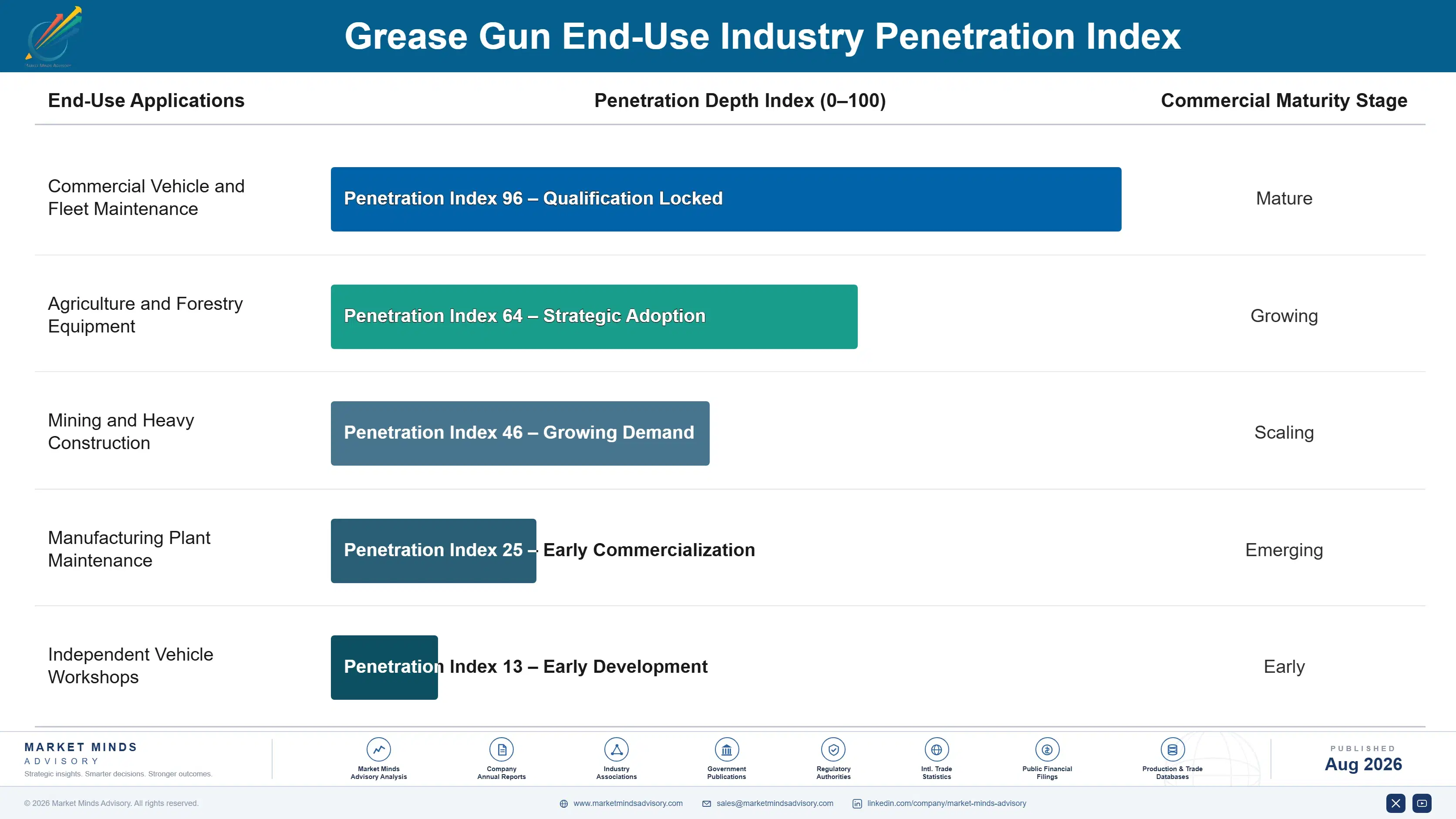
How This Purchase Gets Decided

Demand commits at battery platform choice and at maintenance procedure writing, both well before anybody thinks about a grease gun. A technician who bought into a battery system three years ago has already chosen their gun brand. A fleet engineer who wrote metered dispensing into a maintenance procedure has specified a class of product for as long as it stands. Neither looks like a grease gun purchase at the time.
Stickiness varies sharply by vertical. Commercial vehicle and mining fleets stick hardest, because procedures are documented and changing a specified tool requires a review nobody initiates. Manufacturing maintenance sticks nearly as hard through the same mechanism. Independent vehicle workshops stick through battery platform rather than through procedure. Agriculture sticks least: a farmer buys whatever the farm supply store has.

The buyer has changed generation as much as the product has. A maintenance supervisor who started in the 1990s bought on pump pressure and couplers. Their replacement buys on battery compatibility, on whether the gun logs what it dispensed, and on whether it sits in the same catalogue as everything on the truck. Suppliers still leading with pressure specifications are talking past the person holding the budget.
grease-gun-market-end-use-penetration-index-1787332549158

Our Call On Grease Guns

These are among the four positions where our research anticipates prominent divergence between winners and laggards over the coming forecast period. Each is grounded in the demand model, the regulatory perimeter, and the announced capacity pipeline.
01 / BATTERY PLATFORM ACCESS

No platform means no cordless business

Platform attachment runs at 68%, which means two-thirds of cordless grease gun buyers made their brand decision years earlier when they chose a drill, and no amount of pump engineering reaches them afterwards. A single tool category cannot justify building an independent battery system, so the realistic options are licensing onto an established platform or conceding the fastest-growing segment in the category entirely. Several lubrication specialists have chosen the second without quite admitting that is what they have actually decided to do.
02 / SPECIFICATION CHANNEL DEFENCE

Win the procedure, not the transaction

A fleet engineer who writes metered dispensing and a grease quantity into a maintenance procedure has specified a class of tool for as long as that document stands, which is usually years and sometimes several decades. Over-lubrication destroys seals and bearings at a cost that dwarfs any tooling budget, and that is the argument which gets a technical buyer to listen properly. Suppliers running distributor promotions instead are competing for reorders on accounts that somebody else has already specified for them.
03 / ACCESSORY REVENUE DISCIPLINE

The coupler outsells the gun over time

Accessories carry 23% of category value and replace several times over a gun's four to seven year life, since couplers wear, hoses split at the crimp, and extensions vanish from toolboxes without ceremony. A supplier selling only guns has taken the part of the relationship that repeats least often and left the recurring revenue to whoever stocks the rack beside it. Building a complete accessory line also defends shelf position against private label better than any pricing move ever does.
04 / MANUAL TIER REALISM

Source the commodity, keep the shelf

A pressed steel lever gun retails near USD 15, carries no protectable design content, and is built competently by hundreds of manufacturers in China and India with material proximity and labour costs no Western plant can approach. Several established brands have spent years and considerable capital proving that point to their own boards. Sourcing the volume tier rather than manufacturing it keeps the distributor relationship and the shelf position while removing a manufacturing position that loses money every year reliably.

Engagement Snapshot From the Field

A live engagement with an industry participant carrying material or product regulatory and market exposure ahead of a defining policy shift, showing how our research translates into a defensible multi-year portfolio strategy.
MARKET MINDS ADVISORY · CLIENT ENGAGEMENT SUMMARY
Grease Gun Producer Strategic Portfolio Review and Transition Roadmap 2026·Investment Scenario on Grease Gun Exposure Evaluation 2025-26
CLIENT PROFILE
A European lubrication equipment manufacturer with roughly USD 140 million in annual revenue engaged MMA after its cordless grease gun line failed to reach a tenth of forecast volume in its second full year (client-reported, unverified by MMA). The product tested well against competitors on pressure, cycle life, and build quality, and the company could not understand why distributors were not moving it.
STRATEGIC CHALLENGE
Engineering wanted more development budget to widen the performance gap. Sales wanted deeper distributor discounts. Neither had asked the buyer why they chose a competing product, and the internal assumption throughout was that the problem lay somewhere in execution. The board needed a decision on whether to fund another product generation before the next planning cycle closed.
MMA APPROACH
MMA surveyed 220 commercial fleet and workshop buyers on how they had chosen their most recent cordless grease gun, asking what they compared and in what order. We ran the same question with 40 distributors on why they allocated shelf space as they did. We then modelled the client's realistic cordless share under three options: continued independent battery, platform licensing, and withdrawal from cordless entirely.
KEY FINDINGS
  1. Battery compatibility was the first filter for 71% of buyers surveyed, and 44% said they never compared any other attribute at all (client-reported, unverified by MMA).
  2. Distributors allocated shelf space by platform rather than by product category, placing grease guns beside the drills sharing their battery instead of with lubrication equipment.
  3. Product performance advantages the client had funded were invisible to buyers, since no comparison stage existed where they could have been noticed.
  4. The client's pneumatic and industrial-specification lines held strong positions with maintenance engineers, a channel where specification work rather than shelf placement decides the account.
CLIENT PROFILE
A European lubrication equipment manufacturer with roughly USD 140 million in annual revenue engaged MMA after its cordless grease gun line failed to reach a tenth of forecast volume in its second full year (client-reported, unverified by MMA). The product tested well against competitors on pressure, cycle life, and build quality, and the company could not understand why distributors were not moving it.
STRATEGIC CHALLENGE
Engineering wanted more development budget to widen the performance gap. Sales wanted deeper distributor discounts. Neither had asked the buyer why they chose a competing product, and the internal assumption throughout was that the problem lay somewhere in execution. The board needed a decision on whether to fund another product generation before the next planning cycle closed.
MMA APPROACH
MMA surveyed 220 commercial fleet and workshop buyers on how they had chosen their most recent cordless grease gun, asking what they compared and in what order. We ran the same question with 40 distributors on why they allocated shelf space as they did. We then modelled the client's realistic cordless share under three options: continued independent battery, platform licensing, and withdrawal from cordless entirely.
KEY FINDINGS
  1. Battery compatibility was the first filter for 71% of buyers surveyed, and 44% said they never compared any other attribute at all (client-reported, unverified by MMA).
  2. Distributors allocated shelf space by platform rather than by product category, placing grease guns beside the drills sharing their battery instead of with lubrication equipment.
  3. Product performance advantages the client had funded were invisible to buyers, since no comparison stage existed where they could have been noticed.
  4. The client's pneumatic and industrial-specification lines held strong positions with maintenance engineers, a channel where specification work rather than shelf placement decides the account.
RECOMMENDED STRATEGY
Phase 1: Phase 1 (0 to 8 months): Stop funding independent cordless development and open licensing discussions with two established battery platform owners. Phase 2: Phase 2 (8 to 22 months): Redirect the freed engineering budget into metered dispensing and accessory lines serving the industrial specification channel. Phase 3: Phase 3 (22 to 40 months): Launch on a licensed platform if terms are acceptable, and otherwise concede cordless and defend industrial.
OUTCOME
The board halted independent cordless development and redirected the budget to metered dispensing and accessories. The client reported industrial channel revenue growing materially over the following year while cordless losses stopped, and licensing discussions with one platform owner continue (client-reported, unverified by MMA). Engineering leadership initially resisted and later described the decision as overdue.

Frequently Asked Questions

Foundational context covering the market sizes, CAGR, scope, country, region and competition that inform every finding below. This section is provided to cover basics and most often pre-purchase conversations, answered from the MMA Primary Research Dataset.

What is the current size of the Grease Gun Market?

The global market is valued at USD 1.1 billion in 2025, covering manual, pneumatic, battery-powered, and hydraulic grease guns with their dispensing accessories. Grease itself and centralised lubrication systems are excluded.

How large will the Grease Gun Market be by 2036?

The market is forecast to reach USD 1.84 billion by 2036 in the base case, about 1.60 times the 2026 level. That represents incremental value of roughly USD 0.69 billion.

What is the CAGR for the Grease Gun Market 2026 to 2036?

The market grows at a 4.8% CAGR in the base case, with bull and bear scenarios at 6.0% and 3.6%. Most of that growth is mix shift toward cordless rather than unit volume.

Which segment is growing fastest?

Battery-powered grease guns grow fastest at 9.4%, roughly twice the overall rate, because buyers already own the batteries and perceive only the incremental cost. Pneumatic guns follow at 5.1%.

Who are the major companies in the Grease Gun Market?

Leading participants include SKF, Techtronic Industries, Stanley Black and Decker, Alemite, and Graco. Fragmentation is high, with the top five holding roughly 41% because manual gun design carries no protectable content.

Which country is growing fastest?

India grows fastest at a 7.8% CAGR, driven by agricultural mechanisation where each tractor adds roughly 30 grease points on a service schedule. China follows on construction fleet demand.

Report Segmentation Architecture

The full report scope spans multiple orthogonal segmentation dimensions, with cross-tabulated demand data provided for each dimension pair. Coverage extends further to regional breakdowns, trend trajectories, and the competitive detail needed to support segment-level decision-making.

By Actuation Method

  • Battery-Powered Grease Guns
  • Pneumatic Grease Guns
  • Hydraulic High-Pressure Grease Guns
  • Manual Pistol-Grip Grease Guns
  • Manual Lever Grease Guns

By End-Use Industry

  • Commercial Vehicle and Fleet Maintenance
  • Agriculture and Forestry Equipment
  • Mining and Heavy Construction
  • Manufacturing Plant Maintenance
  • Independent Vehicle Workshops

By Distribution Channel

  • Industrial Supply Distribution
  • Trade and Power Tool Channel
  • Hardware and Farm Supply Retail
  • Private Label and Contract Supply

By Region

  • North America
  • Western Europe
  • East Asia
  • South Asia and Pacific
  • Latin America
  • Middle East and Africa
  • Eastern Europe

Scope, Methodology, and Coverage

Every figure in this report is reproducible from documented input assumptions. The scope below maps the historical period, the forecast horizon, the segmentation dimensions, and the countries covered, alongside the underlying primary and qualitative methodology.
Historical Period
2020 to 2025
Forecast Period
2026 to 2036
Base Year
2025 (USD billions; MMA Primary Research Dataset, August 2026)
Market Definition
The grease gun market comprises the manufacture and sale of hand-held and powered devices that dispense lubricating grease under pressure into bearings, pins, joints, and grease fittings, valued at manufacturer selling prices to industrial distributors, trade channels, retail chains, private label buyers, and fleet operators. It spans manual lever, manual pistol-grip, pneumatic air-operated, battery-powered cordless, and hydraulic high-pressure formats, together with the couplers, flexible hoses, rigid extensions, and cartridge loading accessories supplied with or alongside them. Lubricating grease and cartridges themselves, centralised and automatic lubrication systems including pumps, injectors and distribution lines, bulk grease transfer pumps and drum equipment, oil dispensing guns and meters, and general workshop compressors are excluded. Lubrication analysis services and maintenance contracts sit outside scope.
Quantitative Units
USD billions (current prices); volume in millions of units shipped
Segmentation Dimensions
By Actuation Method; By End-Use Industry; By Distribution Channel; By Region
Regions Covered
North America, Western Europe, East Asia, South Asia and Pacific, Latin America, Middle East and Africa, Eastern Europe
Countries Covered
USA, Canada, Mexico, Germany, France, Italy, Spain, UK, Netherlands, Sweden, China, Japan, South Korea, Taiwan, India, Australia, Indonesia, Vietnam, Thailand, Philippines, Brazil, Chile, Peru, Colombia, Argentina, Saudi Arabia, United Arab Emirates, South Africa, Zambia, Egypt, Turkey, Poland, Czechia, Romania, Hungary, and additional markets relevant to this sector
Key Companies Profiled
SKF, Techtronic Industries, Stanley Black and Decker, Alemite, Graco, Ingersoll Rand, Legacy Manufacturing, Groz Engineering Tools, Macnaught, Samoa Industrial, Pressol, Yamada Corporation, Snap-on, Milton Industries, Makita, Bosch, Chicago Pneumatic, National Spencer, Balcrank, Plews and Edelmann
Quantitative Methodology
Primary survey, n=3,800 respondents, Q4 2025, six countries; demand-side model with trade association cross-validation
Qualitative Methodology
47 expert interviews, Q4 2025; applied to validate demand model assumptions, identify emerging dynamics, and assess competitive positioning
Report Format
PDF and XLSX data workbook (Word format preview document)
Publisher
Market Minds Advisory
Report Code
MMA-2026-CON-428
Published
August 2026
Contact
sales@marketmindsadvisory.com | www.marketmindsadvisory.com

Purchase the full Grease Gun Market Report (2026 to 2036).

The full MMA Grease Gun report sizes the market across five actuation methods, five end-use industries, four distribution channels, and seven regions through 2036. It profiles 20 participants on a consistent basis of grease gun and dispensing accessory revenue, scoring each on battery platform access, fleet specification position, accessory line completeness, and channel reach. Scenario models quantify how cordless conversion pace, automatic lubrication penetration, and low-cost manufacturing capacity move both volume and achievable margin. The report also includes battery platform attachment analysis by region, accessory attachment rate benchmarking, fleet maintenance specification tracking, and a buyer decision survey covering commercial fleet and workshop purchasers.
Five-format and four-channel market sizing to 2036
Twenty-participant benchmark on grease gun and accessory revenue
Battery platform attachment analysis by region and vertical
Accessory attachment rate benchmarking across distribution channels
Fleet maintenance specification tracking for major operators
Buyer decision survey across commercial fleet and workshop purchasers

Built For The People Who Decide

From boardroom strategy to bench-side execution, this report is read cover-to-cover by leaders shaping the next decade of their industry, turning demand scenarios, market dynamics and valuation benchmarks into decisions.
CXOs/ Presidents/ VPs/ Managers
M&A and Corporate Development
Strategy Teams and R&D Heads
Procurement and Product Directors
Regulatory and Compliance Leaders
Investor Relations and Equity Analysts