Market Minds Advisory
GPU as a Service Market

GPU as a Service Market: GPU as a Service Market. On-Demand Compute Meets AI Scale

Enterprises are renting GPU compute capacity on demand as generative AI training and inference workloads outstrip what companies can justify purchasing outright, since cloud access avoids hardware that depreciates within a few product cycles.

Lead Analyst

Published

September 2026

Make Smarter Decisions with Customized Research Insights

Request a free sample report and evaluate market opportunities, growth trends, and competitive dynamics relevant to your business needs.

2025 MARKET VALUE$6.5BMarket Size 2025
2036 FORECAST VALUE$34.9BBase Case , 2026 to 2036
CAGR 2026 TO 203616.5 %Bull 17.8% / Bear 15.2%
INCREMENTAL OPPORTUNITY$27.3BNet 10- year value creation
EXPANSION MULTIPLE4.61x2036 value over 2026 base
Strategic Levers
M&A Pipeline
Regional Outlook
Country Rankings
Competitive Intelligence
Segmental Deep-dive
Call-Us : 91 93563 13602

Executive Snapshot and Market Trajectory.

GPU capacity has become the single binding constraint on generative AI development, forcing enterprises without hyperscale capital budgets to rent compute rather than compete for scarce chip allocations that even well-funded buyers struggle to secure quickly at any meaningful scale today, tomorrow, or ever again in the future.
Adoption is accelerating fastest among AI model training and inference workloads, since generative AI companies need burst compute capacity that fluctuates dramatically across training cycles rather than steady-state demand that favors owned infrastructure over rented capacity purchased upfront in bulk quantities. North America and East Asia lead deployment given their concentrated AI research and hyperscale data center investment, while specialized neocloud providers increasingly compete against traditional hyperscalers on price and chip availability.
A concentrated group of hyperscale cloud providers competes alongside emerging specialized GPU cloud vendors entering the market with dedicated AI infrastructure, while chip supply allocation from Nvidia increasingly determines which providers can offer the newest generation hardware first to waiting customers everywhere and quickly today. Long-term customer contracts securing guaranteed capacity continue to reshape which providers can compete for the largest enterprise AI training deals available.
Market Definition
The GPU as a service market covers cloud-based rental access to graphics processing unit compute capacity for AI model training, inference, and high-performance computing workloads, billed on a consumption or reserved capacity basis. It excludes on-premises GPU hardware sales and general-purpose CPU cloud computing services.
Base Year Value
$6.5B in 2025 (MMA Primary Research Dataset, September 2026)
Forecast Period
2026 to 2036, eleven discrete annual values
CAGR
16.5% base case. Bull 17.8%. Bear 15.2%.
Fastest Growth Segment
AI Inference-Optimized GPU Cloud Instances: 21.5% CAGR
Fastest Growth Country
India: 20.0% CAGR
Fastest Growth Region
South Asia and Pacific: 18.5% CAGR
Largest Region
North America: 32% of 2025 global value
Market Leaders
Amazon Web Services, Microsoft Azure, Google Cloud, CoreWeave, Oracle Cloud Infrastructure
Primary Survey
n=3,800 procurement and R&D decision-makers, Q4 2025, six countries
Methodology
Demand-side build-up, cross-validated against public data, 47 expert interviews

GPU as a Service Market Forecast Scenarios

gpu-as-a-service-market-size-forecast-scenario-1789984301367
GPU cloud demand grew explosively between 2020 and 2025 as generative AI model training scaled dramatically faster than hardware manufacturing capacity could expand, with chip shortages periodically constraining provider capacity even as customer demand continued climbing. Historical growth reflected a genuine multi-year platform shift rather than a temporary spike, distinguishing this market from prior cloud computing waves entirely.
Base-case growth through 2036 reflects three commercial mechanisms operating together: continued generative AI model training and inference demand requiring increasingly specialized GPU architecture across every industry vertical and use case, expanding neocloud provider capacity entering the market with dedicated AI-optimized infrastructure competing on price, and rising enterprise adoption of inference-optimized instances as AI applications move from experimentation into production deployment. Chip manufacturers are also expanding supply allocation to cloud providers.
The bull case centers on accelerated enterprise AI production deployment pulling inference compute demand well beyond current forecast assumptions already built into the base case scenario entirely and consistently. The bear case centers on prolonged chip supply constraints limiting provider capacity expansion, which would push customer wait times out and constrain revenue growth across affected segments and geographies.

Where Chip Scarcity Meets Consumption-Based Pricing

GPU as a service occupies an unusual position where demand consistently outstrips supply despite massive capital investment, a genuinely rare dynamic among cloud computing categories that typically compete primarily on price rather than raw availability across every customer segment and geography served. This scarcity dynamic gives providers with secured chip allocation meaningful pricing power that commodity cloud services never enjoy at comparable scale.
MARKET CONCENTRATIONCR5 62%Share held by top five GPU cloud providers globally
AVERAGE HOURLY INSTANCE PRICE$3.20 per hourTypical price for a leading-edge AI training instance
TOP ADOPTING COUNTRY SHAREUSA 36%Share of global GPU cloud compute deployment volume
CAPACITY UTILIZATION RATE82%Average utilization rate across deployed GPU cloud clusters
RESERVED CAPACITY CONTRACT SHARE58%Share of revenue from multi-year reserved capacity agreements
HARDWARE REFRESH CYCLE2 to 3 yearsTypical interval before providers upgrade GPU generation fleet
Providers compete primarily on chip generation access and capacity availability rather than pure price, since customers training large AI models care more about securing sufficient compute capacity than achieving marginal cost savings on their overall training budget alone. Long-term reserved capacity contracts remain decisive for reaching the largest AI training customers directly, since spot market pricing alone cannot guarantee the capacity they require.
Chip supply allocation from Nvidia increasingly determines competitive position, since providers securing priority access to the newest GPU generation can offer meaningfully better price-performance than competitors still running older hardware generations across their entire deployed fleet today. This dynamic favors hyperscale providers with existing Nvidia relationships over newer specialized entrants lacking that established purchasing history, scale, and negotiating leverage.
"Every cloud provider says they have capacity. What they actually have is a waitlist, and the honest ones will at least tell you how long it is before you sign the contract."
Senior Analyst, Cloud Infrastructure Practice · MMA GPU Cloud Computing Infrastructure as a Service Practice · September 2026

Market Trends

Inference-Optimized Instances Displacing Generic Training Configurations

Providers are increasingly launching GPU instance types specifically optimized for AI inference workloads rather than offering only training-optimized configurations, since inference now represents a growing share of total compute demand as enterprises move AI applications from experimentation into production deployment at meaningful scale worldwide today and tomorrow. AWS and Google Cloud have both expanded inference-specific instance offerings specifically to capture this demand segment separately from their traditional training-focused product lines and pricing tiers. Providers lacking dedicated inference instances increasingly lose competitive evaluations against rivals offering better price-performance for this workload.
Market Impact: Training runs require 5000 plus GPUs

Specialized Neocloud Providers Undercutting Hyperscaler Pricing

A wave of specialized neocloud providers focused exclusively on AI compute has emerged offering meaningfully lower pricing than traditional hyperscale cloud providers, since these companies carry lower overhead and target AI workloads specifically rather than supporting broad general-purpose cloud computing product portfolios across many diverse customer segments worldwide today and every tomorrow. CoreWeave and Lambda have both expanded capacity specifically to capture price-sensitive AI training customers who previously had no realistic alternative to hyperscaler pricing structures and terms. This competitive pressure is forcing traditional hyperscalers to reconsider their pricing structure.
Market Impact: Inference demand grows 45 percent yearly

Market Opportunities and Growth Drivers

Generative AI Model Training Requiring Massive Burst Compute

Training large generative AI models requires thousands of GPUs running continuously for weeks at a time, a compute requirement that far exceeds what most enterprises can justify purchasing outright given the rapid pace of hardware generation turnover and considerable hardware depreciation risk over time. This burst demand pattern represents the single largest driver of near-term GPU cloud adoption, since renting capacity for discrete training runs makes considerably more financial sense than owning hardware that sits idle between training cycles. Providers positioned to offer flexible short-term capacity hold a substantial competitive advantage.
Market Impact: Wait times extend 3 to 6

Enterprise AI Production Deployment Driving Inference Demand

Enterprises moving generative AI applications from pilot programs into full production deployment require sustained inference compute capacity that scales with user traffic rather than the discrete burst demand training workloads generate, creating a distinct and rapidly growing demand category providers increasingly specialize to serve almost exclusively today and well into the future. This production deployment wave represents durable recurring revenue rather than one-time training spend, since inference demand persists throughout an application's entire operational lifetime and beyond. Vendors offering cost-efficient inference-optimized instances hold a meaningful competitive advantage capturing this shift.
Market Impact: Compresses hardware ROI window 40 percent

Market Restraints and Challenges

GPU Supply Constraints Limiting Provider Capacity Expansion

Nvidia's manufacturing capacity cannot keep pace with cloud provider demand for the newest GPU generation, a friction point rooted in the extremely complex semiconductor fabrication process that cannot scale production quickly even with substantial capital investment directed at meaningful global expansion efforts undertaken. This supply constraint forces providers to allocate scarce capacity across competing customer demands, often resulting in wait times that push customer AI development timelines back by months regardless of budget availability. Several providers now offer priority allocation programs for customers willing to commit to longer contract terms.
Market Impact: Inference instances now exceed 35 percent

Rapid Hardware Obsolescence Compressing Provider Return Windows

New GPU generations arrive roughly every eighteen to twenty-four months carrying meaningfully better performance per dollar, a friction point rooted in the intense competitive pressure chip manufacturers face to continuously improve AI training and inference efficiency for their largest and most demanding enterprise customers worldwide today and tomorrow. This rapid obsolescence cycle compresses the window providers have to recover capital investment on existing hardware before customers demand access to newer generations offering superior economics. Several providers now negotiate shorter depreciation schedules into their financial planning to account for this compression.
Market Impact: Neocloud pricing undercuts hyperscalers 30 percent
3 additional market trends, 4 additional growth drivers, and 2 additional restraints and challenges are covered in the full report. Contact sales@marketmindsadvisory.com to access the complete intelligence.

Segment CAGR and Growth Architecture

GPU as a service segments by workload type and deployment model, spanning AI inference-optimized GPU cloud instances, AI training-optimized GPU cloud instances, high-performance computing GPU instances, reserved capacity contract offerings, spot and on-demand pricing offerings, and managed MLOps platform services, each addressing a genuinely distinct customer compute requirement, budget cycle, and specific workload profile.
gpu-as-a-service-market-market-share-analysis-1789984301908

AI Inference-Optimized GPU Cloud Instances

AI inference-optimized GPU cloud instances deliver cost-efficient compute specifically tuned for running trained AI models in production, prioritizing latency and throughput efficiency over the raw computational power that training workloads require, at meaningfully lower cost per query than general-purpose training instances repurposed for inference workloads at meaningful scale nationwide and internationally alike today and tomorrow. Growth reflects the rapid shift of enterprise AI investment from experimentation into production deployment, where inference compute represents sustained recurring demand rather than the discrete burst spend training workloads generate over time. AWS and Google Cloud have both expanded dedicated inference instance offerings specifically to capture this fast-growing segment worldwide and across every industry vertical served.
CAGR 21.5%

AI Training-Optimized GPU Cloud Instances

AI training-optimized GPU cloud instances provide the raw computational power required to train large generative AI models, bundling the newest GPU generations with high-bandwidth networking interconnects that allow thousands of chips to work together efficiently across a single distributed training run conducted at meaningful scale, speed, and considerable cost efficiency across the entire enterprise board today. Growth reflects continued generative AI model development across every major technology company and research institution, alongside rising model complexity that requires ever-larger training clusters to complete within reasonable timeframes and available budgets today. CoreWeave and Lambda have both expanded training-optimized capacity specifically to capture this premium demand segment nationwide and internationally today and tomorrow.
CAGR 18.0%
Full segment breakdown across 6 segments available in the complete report.

Regional Architecture and Country Demand Map

GPU cloud adoption tracks hyperscale data center concentration and generative AI research investment by region, with the largest AI model development hubs driving fastest and deepest deployment given their proximity to leading chip supply relationships and available capital worldwide today, tomorrow, and well beyond that.

North America

North America holds the largest regional share, anchored by AWS, Microsoft Azure, Google Cloud, CoreWeave, and Oracle Cloud Infrastructure all maintaining primary product development and hyperscale data center operations in the region, giving domestic AI companies earliest access to new GPU generations and the deepest capacity availability of any market worldwide. Nvidia's headquarters presence here also supports the closest chip supply relationships of any region globally and continuing to strengthen. Specialized neocloud providers have built substantial capacity specifically targeting AI-native startup customers each and every quarter without exception whatsoever across accounts and regions served as chip supply relationships continue strengthening steadily and reliably across every hyperscale operator and consistently today.
Share: 32% | CAGR: 17.0% (2026 to 2036)

Western Europe

Western Europe's substantial share reflects growing sovereign AI infrastructure investment across UK, German, and French government-backed data center programs, making domestic GPU cloud capacity a strategic priority rather than a purely commercial IT purchase for regional governments and enterprises. AWS and Microsoft Azure both maintain substantial European data center operations serving domestic AI research and enterprise customers subject to data sovereignty rules. Fragmented national energy and data sovereignty regulation across European Union member states somewhat slows multi-country capacity expansion compared with the more unified North American market each and every jurisdiction consistently and reliably today across the continent as sovereign investment continues expanding steadily across every member state and region.
Share: 20% | CAGR: 15.0% (2026 to 2036)
Regional intelligence for 5 additional markets available in the complete report: East Asia, South Asia and Pacific, Latin America, Middle East and Africa, Eastern Europe. Contact sales@marketmindsadvisory.com.
gpu-as-a-service-market-country-cagr-analysis-1789984302447

Turning Chip Scarcity Into Pricing Power

Providers are extending revenue beyond baseline hourly compute pricing into priority allocation tiers, managed MLOps services, and multi-year reserved capacity contracts, capturing more value per customer account as chip scarcity and enterprise AI production deployment continue reshaping the market across every customer segment, geography, workload type, pricing tier, and negotiated contract structure served worldwide.

Priority Allocation Tiers Above Standard Pricing

Providers including AWS and CoreWeave have introduced priority allocation tiers guaranteeing faster access to the newest GPU generations above standard on-demand pricing, capturing incremental revenue from customers who previously waited in queue for capacity at standard rates for extended periods of time each and every single month or fiscal quarter. These priority tiers now generate roughly 25 to 30 percent higher average revenue per instance than standard on-demand pricing among customers who upgrade to the newer tier. Adoption has grown steadily as customers recognize guaranteed capacity access justifies the premium.
Market Impact: Priority tiers add 25 to 30 percent revenue

Managed MLOps Platform Services Attached To Contracts

Providers increasingly bundle managed MLOps platform services, including model deployment automation and performance monitoring, directly into GPU capacity contracts rather than leaving customers to build this infrastructure internally with dedicated engineering staff of their own hiring, training, continued long-term management, support, oversight, everyday coordination, internal reporting, and full compliance. This managed services attach has generated meaningful incremental revenue per enterprise customer, with some providers reporting MLOps service revenue equal to roughly 20 to 25 percent of the underlying compute contract value. Customers value the reduced internal engineering burden this delivers.
Market Impact: MLOps services add 20 to 25 percent revenue

Multi-Year Reserved Capacity Contracts Locking In Revenue

Providers are increasingly offering multi-year reserved capacity contracts that guarantee customers access to specific GPU allocations in exchange for upfront commitment, locking in revenue predictability that spot market pricing alone cannot deliver for either contracting party involved in the negotiated multi-year arrangement itself entirely, reliably, consistently, predictably, transparently, and fairly. This approach trades some near-term pricing flexibility for meaningfully greater revenue certainty, since reserved capacity commitments equal to 30 to 40 percent of contract value substantially reduce the probability a customer moves workloads to a competing provider mid-contract. Larger AI training customers have proven most receptive to this arrangement.
Market Impact: Reserved contracts secure 30 to 40 percent revenue

Inference API Overlay Pricing Above Raw Compute

Providers increasingly layer managed inference API services on top of raw GPU compute rental, charging a premium for simplified model serving infrastructure that eliminates the need for customers to manage their own inference deployment stack and scaling logic entirely from scratch themselves each and every single time or workload they deploy. This overlay pricing has generated meaningful incremental revenue per customer account, with some providers reporting inference API revenue equal to roughly 15 to 20 percent above comparable raw compute pricing. Customers value the operational simplicity this managed layer delivers.
Market Impact: Inference API overlay adds 15 to 20 percent

Who Controls the Margin Pool

The GPU as a service market is highly concentrated on a revenue basis, with the top five providers holding an estimated 62 percent combined share while dozens of specialized neocloud providers compete for the remainder. AWS and Microsoft Azure lead on installed customer base and capacity scale, but the gap to third-place Google Cloud and fourth-place CoreWeave has narrowed as specialized neocloud pricing pressure increases.
Current competitive activity centers on chip generation access and inference optimization, with providers racing to secure priority Nvidia allocation that guarantees earliest access to newest hardware generations. CoreWeave has expanded its dedicated AI infrastructure capacity specifically to compete against traditional hyperscalers in the training workload segment, while Oracle Cloud Infrastructure continues investing in aggressive pricing to capture price-sensitive enterprise customers before larger rivals establish reference accounts.

Emerging pressure comes from specialized neocloud providers backed by substantial venture capital, several of which have already displaced traditional hyperscalers in discrete large-scale AI training deals despite lacking broad general-purpose cloud service portfolios. Rankings are most likely to shift in inference-optimized capacity, where cost-focused challengers can compete on comparable footing against established incumbents carrying broader but less specialized infrastructure.
gpu-as-a-service-market-company-positioning-matrix-1789984302981

Competitive Moat and Risk Dimensions

AMAZON WEB SERVICES

Moat: Broadest Global Data Center Footprint

AWS operates the industry's broadest global data center footprint, giving it geographic reach and existing enterprise customer relationships that specialized neocloud competitors entering the market cannot easily replicate, particularly for customers requiring GPU capacity across multiple regions for compliance or latency-sensitive reasons at meaningful scale.
AMAZON WEB SERVICES

Risk: Higher Pricing Than Neoclouds

AWS carries meaningfully higher overhead from its broad general-purpose cloud portfolio, leaving it exposed to specialized neocloud competitors like CoreWeave that offer comparable GPU capacity at lower prices since they operate dedicated AI infrastructure without subsidizing unrelated cloud service lines and business units elsewhere entirely.
COREWEAVE

Moat: Purpose-Built AI Infrastructure

CoreWeave built its entire infrastructure specifically for AI workloads rather than retrofitting general-purpose cloud infrastructure, giving it meaningfully better price-performance and faster access to newest GPU generations than hyperscalers balancing many competing infrastructure priorities across their broader product portfolios and diverse business lines entirely and continuously.
COREWEAVE

Risk: Concentrated Customer Base Risk

CoreWeave's revenue concentrates heavily among a small number of large AI training customers, creating meaningful revenue volatility risk if any single major customer reduces spending or shifts workloads to a competing provider, a concentration risk traditional diversified hyperscalers do not carry to the same degree.

Players Tracked

Prominent Players

Amazon Web Services
Microsoft Azure
Google Cloud
CoreWeave
Oracle Cloud Infrastructure

Other Key Players

Lambda
Crusoe Energy
Together AI
Vultr
Paperspace
Nebius
Lepton AI
RunPod
Voltage Park
Fluidstack
Cirrascale
Genesis Cloud
Hydra Host
Sesterce
TensorWave

Recent Developments

JANUARY 2026

AWS Launches Next-Generation Inference Instance Family

AWS launched a new inference-optimized instance family specifically tuned for large language model serving, offering meaningfully better price-performance than its previous generation training-optimized instances repurposed for inference workloads. The launch targets enterprise customers moving generative AI applications from pilot programs into full production deployment at scale.
Signal: Signals hyperscalers are increasingly differentiating instance types by specific AI workload requirements and overall market pricing.
SEPTEMBER 2025

CoreWeave Signs Multi-Billion Dollar Capacity Agreement

CoreWeave signed a multi-billion dollar multi-year capacity agreement with a major AI research laboratory, securing guaranteed GPU allocation in exchange for substantial upfront customer commitment spanning several years of compute capacity. The agreement represents one of the largest disclosed GPU cloud contracts signed to date in the industry.
Signal: Shows large AI customers are increasingly locking in capacity through long-term reserved multi-year capacity agreements signed.
APRIL 2025

Oracle Cloud Infrastructure Expands Nvidia Partnership

Oracle Cloud Infrastructure announced an expanded supply partnership with Nvidia, securing priority allocation of the newest GPU generation to support its growing enterprise AI customer base competing against larger hyperscale rivals. The expanded partnership includes joint engineering resources for optimizing large-scale AI training cluster performance.
Signal: Indicates smaller hyperscalers are securing dedicated chip supply commitments to remain competitive industry-wide today and tomorrow.

GPU Hardware and Power Cost Exposure

GPU hardware acquisition and data center power consumption together account for an estimated 60 to 70 percent of provider cost of goods sold, with GPUs sourced almost entirely from Nvidia given its dominant position in AI-optimized chip manufacturing worldwide across every major regional market served. Networking interconnect hardware and cooling infrastructure add further meaningful cost exposure.
GPU acquisition costs rose meaningfully during 2023 and 2024 as demand for the newest chip generation vastly outstripped Nvidia's manufacturing capacity, according to company annual reports and investor filings from major cloud providers covering this period and reported openly and quite transparently. Several providers disclosed hardware cost pressure of 15 to 20 percent within earnings disclosures, compressing gross margins on existing capacity commitments made previously.

Smaller GPU cloud providers lacking negotiated volume discounts with Nvidia face meaningfully higher hardware costs per instance than scale incumbents who commit to multi-year purchase agreements in advance, creating a persistent cost disadvantage that compounds as chip generation cycles accelerate further. Geographic exposure also varies, with providers dependent on regions facing higher electricity costs facing greater margin pressure than those in lower-cost power markets.
gpu-as-a-service-market-cost-volatility-analysis-1789984303178

Multi-Year Nvidia Supply Agreements Securing Priority Access

Larger providers have negotiated multi-year supply agreements directly with Nvidia and its key global manufacturing partners, securing priority allocation of the newest GPU generations while locking in favorable per-unit pricing that smaller competitors simply lack the purchasing scale to negotiate comparably or match at any meaningful scale today, tomorrow, or well beyond that point.

Renewable Power Purchase Agreements Reducing Energy Cost

Providers are increasingly signing long-term renewable power purchase agreements with major regional utility partners worldwide to lock in favorable electricity pricing for their data center operations, reducing exposure to volatile grid power pricing while supporting sustainability commitments that increasingly matter to enterprise customers evaluating competing vendors carefully today, tomorrow, and well into the future.

Extended Hardware Depreciation Schedules Improving Return Timelines

Providers are extending hardware depreciation schedules from three to five years across their entire deployed global fleet, spreading the substantial upfront GPU acquisition cost across a considerably longer useful life period and improving reported margins even as customers eventually migrate toward newer generation instances offered by competing rivals nearby, elsewhere, and everywhere else too.

Portfolio Architecture for Margin Defence

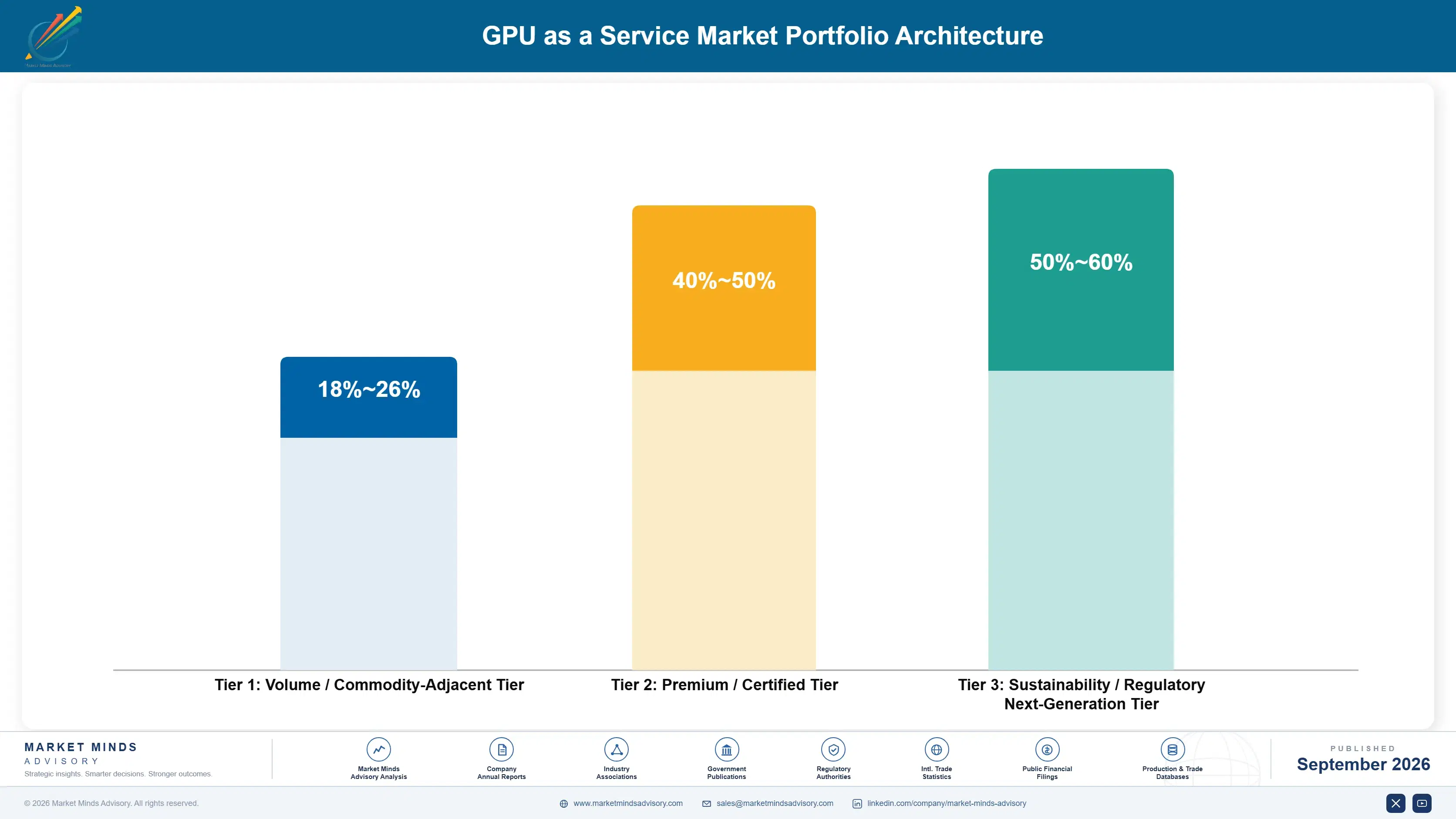
GPU as a service follows a three-tier portfolio architecture ranging from spot and on-demand pricing at the low end through reserved capacity contracts to next-generation priority allocation and managed MLOps integrated offerings, with gross margins expanding meaningfully at each successive tier as guaranteed access, service depth, and switching costs increase together over time, rising scale, and demand.
Volume tier products compete primarily on price against increasingly capable spot market alternatives, compressing margins for providers unable to differentiate on chip generation access or capacity guarantee reliability across a broad price-sensitive customer base spanning multiple workload types and geographies alike and quite consistently over time. Reserved capacity and managed service tiers carry materially higher margins, since large AI training customers value guaranteed access enough to pay a substantial premium over comparable spot alternatives on the open market today.

High-value margin pools concentrate overwhelmingly in priority allocation and managed MLOps integrated tiers, where guaranteed capacity access and service depth command premium pricing that basic spot instances simply cannot match given their comparatively unpredictable availability relative to what large enterprise AI customers increasingly require at scale, speed, and reliability.

Volume / Commodity-Adjacent Tier

Spot and on-demand GPU instances serving price-sensitive customers with flexible workload timing, priced primarily on cost with thin differentiation beyond baseline availability and reliability for smaller accounts and shorter-term needs.
Gross Margin: 18-26%

Premium / Certified Tier

Reserved capacity contracts guaranteeing dedicated GPU allocation for multi-year commitments, commanding premium pricing through proven capacity reliability and priority chip generation access built over successive agreements and long-standing customer relationships.
Gross Margin: 40-50%

Sustainability / Regulatory / Next-Generation Tier

Priority allocation and managed MLOps integrated offerings addressing next-generation enterprise AI production requirements, commanding the highest margins given scarce chip supply and genuine technical differentiation versus commodity alternatives still widely available.
Gross Margin: 50-60%
gpu-as-a-service-market-portfolio-architecture-1789984303746

High-value Sub-segments and Strategic Watch-out

AI Inference-Optimized GPU Cloud Instances

The fastest-growing and highest-margin segment, combining premium pricing with strong unit economics as enterprises move production AI applications from experimentation into fully sustained deployment nationwide, backed by sustained enterprise investment and executive-level prioritization across every single large account maintained today, tomorrow, and well into the future.
Gross Margin: 48-56%

AI Training-Optimized GPU Cloud Instances

Strong growth and healthy margins driven by continued generative AI model development, though competitive intensity from specialized neocloud providers keeps pricing power somewhat below the leading inference segment at comparable scale and geography across most accounts served and every industry served today, tomorrow, and beyond.
Gross Margin: 42-50%

Spot And On-Demand Pricing Offerings

The volume core of the market, generating steady but thinning margins as competitive pressure from neocloud providers commoditizes baseline spot pricing that most small customers no longer view as sufficiently differentiated today or in the reasonably near future ahead of them and their peers today.
Gross Margin: 20-28%

High-Performance Computing GPU Instances

A strategic watch-out segment facing gradual displacement as AI-optimized instances supersede general-purpose HPC configurations across enterprise customers, requiring providers to migrate customers before legacy revenue erodes faster than replacement revenue can realistically offset it across every single affected customer account maintained today, tomorrow, and beyond.
Gross Margin: 22-30%

Why GPU Cloud Contracts Rarely Churn

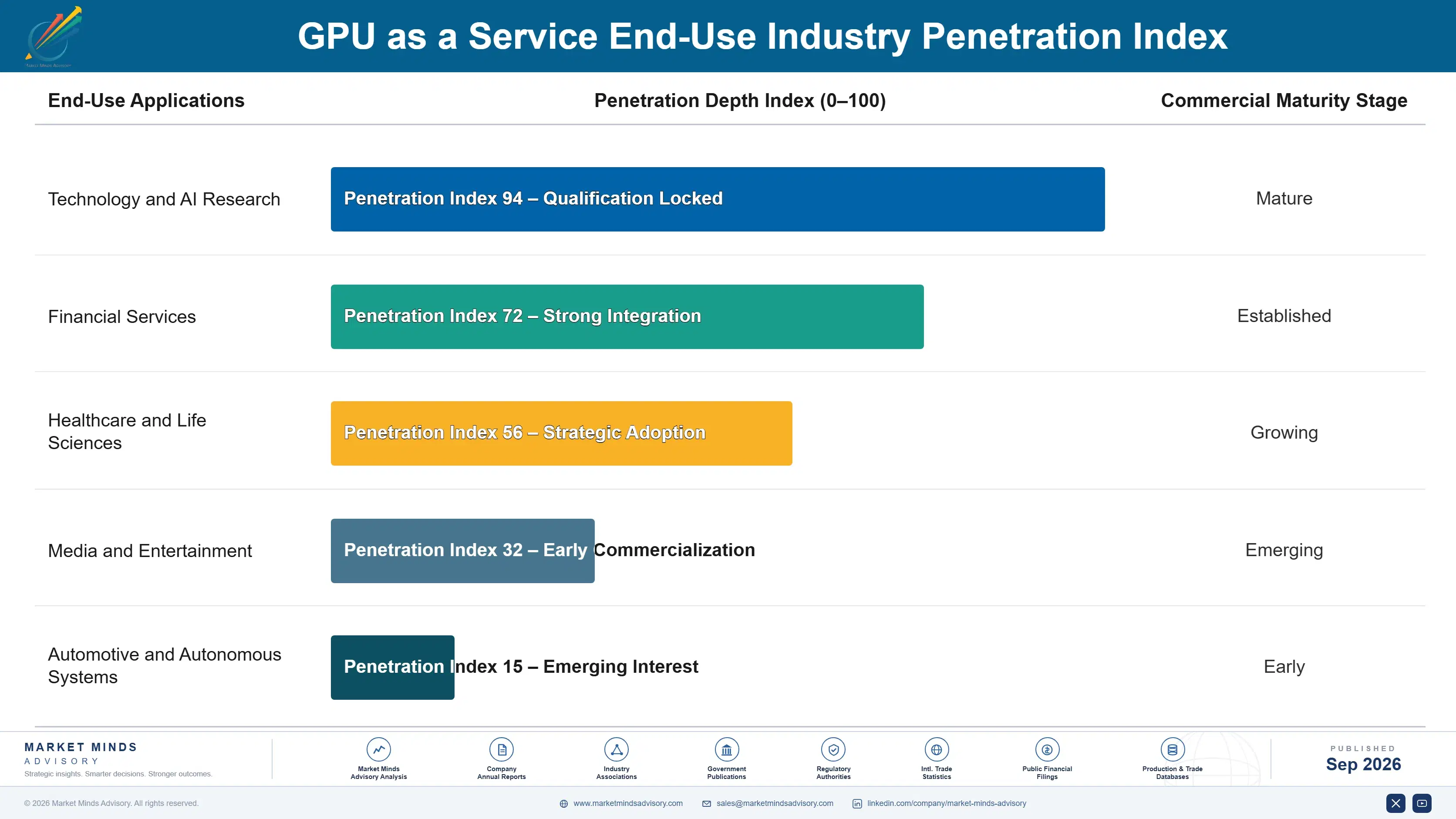
GPU cloud contracts function as multi-year annuities once large AI training workloads are deployed on a provider's infrastructure, since migrating a distributed training pipeline to a competing provider requires substantial re-engineering effort that most AI teams avoid absent a genuinely compelling technical or commercial reason to switch. Renewal rates on reserved capacity contracts consistently exceed 88 percent across successive contract terms and expansion phases.
Adoption stickiness varies by end-use vertical: large AI research laboratories exhibit the deepest lock-in given the scale and complexity of their distributed training infrastructure and the disruption risk any migration carries mid-training run across active clusters, while smaller AI startups switch providers more readily since their workloads involve fewer integrated dependencies and correspondingly lower switching cost. Enterprise inference customers sit somewhere between these two extremes on switching cost.

Buyer profiles are shifting generationally as procurement teams increasingly prioritize guaranteed capacity access over pure hourly pricing comparison, changing evaluation criteria away from the raw price benchmarks that dominated purchasing decisions during the early cloud computing era toward chip generation access and reserved capacity depth, a shift providers ignore at real competitive risk over the coming forecast period.
gpu-as-a-service-market-end-use-penetration-index-1789984304239

Where GPU Providers Should Focus Next

These are among the four positions where our research anticipates prominent divergence between winners and laggards over the coming forecast period. Each is grounded in the demand model, the regulatory perimeter, and the announced capacity pipeline.
01 / CHIP SUPPLY STRATEGY

Secure Direct Nvidia Relationships Before Rivals Consolidate

Providers without direct multi-year Nvidia supply agreements face a widening competitive gap against rivals securing priority allocation of the newest GPU generations at guaranteed volumes and favorable contract terms and pricing overall. Customers increasingly disqualify providers lacking demonstrated capacity availability early in the procurement process, since chip access now weighs as heavily as pricing in vendor scoring decisions overall. Securing direct supply relationships now positions providers to compete for the largest AI training contracts before competitors fully consolidate available allocation.
02 / INFERENCE OPTIMIZATION STRATEGY

Build Dedicated Inference Infrastructure Ahead Of Production Wave

Enterprise AI production deployment represents a rare multi-year growth opportunity distinct from training demand, since inference compute persists throughout an application's operational lifetime rather than ending after a discrete training run concludes entirely and permanently for good. Providers building genuinely optimized inference infrastructure now, ahead of the full enterprise production deployment wave, capture disproportionate recurring revenue share before competitors fully mobilize comparable capability of their own design. Waiting until inference demand peaks leaves considerably less differentiated share available to win.
03 / PRICING MODEL STRATEGY

Expand Reserved Capacity Contracts Before Neocloud Pressure Intensifies

Neocloud pricing pressure is compressing margins on standard on-demand instances industry-wide, and providers relying primarily on spot pricing face declining overall profitability as price-sensitive customers migrate toward cheaper specialized alternatives entering the broader market rapidly, consistently, aggressively, and continuously. Expanding reserved capacity contract offerings now locks in revenue predictability and customer commitment before competitors fully undercut standard pricing further across every customer segment. Providers delaying this shift risk losing negotiating leverage as customers grow accustomed to lower neocloud rates permanently.
04 / GEOGRAPHIC EXPANSION STRATEGY

Deepen India Presence Ahead Of AI Startup Growth

India's rapidly expanding AI startup sector represents a genuinely underserved growth opportunity, since most providers have concentrated capacity investment in North America and East Asia rather than this fast-growing emerging market and its rapidly expanding overall customer base today, tomorrow, and beyond. Providers without established regional data center presence risk losing this growing segment to domestic providers building comparable infrastructure at considerably lower cost. Early investment in local capacity now determines competitive position for years beyond the current growth cycle.

Engagement Snapshot From the Field

A live engagement with an industry participant carrying material or product regulatory and market exposure ahead of a defining policy shift, showing how our research translates into a defensible multi-year portfolio strategy.
MARKET MINDS ADVISORY · CLIENT ENGAGEMENT SUMMARY
GPU as a Service Producer Strategic Portfolio Review and Transition Roadmap 2026·Investment Scenario on GPU as a Service Exposure Evaluation 2025-26
CLIENT PROFILE
The client is a well-funded North American AI research startup developing large language models for enterprise customers, having raised over 500 million dollars in venture capital funding (client-reported, unverified by MMA). The startup needed to secure guaranteed GPU capacity for a major model training run within an aggressive timeline while managing substantial compute cost against its available capital.
STRATEGIC CHALLENGE
The startup faced severe GPU allocation constraints across major hyperscale providers, with wait times threatening to delay its planned model training timeline by several months and jeopardize competitive positioning against better-funded rivals already training comparable models. Leadership needed an independent assessment of which provider could realistically deliver guaranteed capacity within the required timeframe at sustainable cost.
MMA APPROACH
MMA conducted a structured provider evaluation spanning capacity availability verification, reference customer interviews with two comparable AI startups, and total cost of ownership modeling across a twelve-month horizon for the top four candidate providers. The assessment weighted guaranteed capacity timeline, chip generation access, and contract flexibility as the most decisive selection criteria given the startup's constraints.
KEY FINDINGS
  1. Two of the four candidate providers could not guarantee capacity within the startup's required timeline, while a specialized neocloud provider offered meaningfully faster access than traditional hyperscalers.
  2. Reference customers reported the recommended provider's capacity delivery reliability exceeded contractual commitments consistently, a meaningfully stronger track record than competitors demonstrated during reference conversations.
  3. Total cost of ownership modeling showed the recommended provider would cost approximately 22 percent less than the closest hyperscaler alternative over the twelve-month training and inference horizon.
  4. Contract flexibility analysis revealed the recommended provider offered meaningfully more favorable early termination terms, reducing the startup's financial risk if the training program required strategic adjustment.
CLIENT PROFILE
The client is a well-funded North American AI research startup developing large language models for enterprise customers, having raised over 500 million dollars in venture capital funding (client-reported, unverified by MMA). The startup needed to secure guaranteed GPU capacity for a major model training run within an aggressive timeline while managing substantial compute cost against its available capital.
STRATEGIC CHALLENGE
The startup faced severe GPU allocation constraints across major hyperscale providers, with wait times threatening to delay its planned model training timeline by several months and jeopardize competitive positioning against better-funded rivals already training comparable models. Leadership needed an independent assessment of which provider could realistically deliver guaranteed capacity within the required timeframe at sustainable cost.
MMA APPROACH
MMA conducted a structured provider evaluation spanning capacity availability verification, reference customer interviews with two comparable AI startups, and total cost of ownership modeling across a twelve-month horizon for the top four candidate providers. The assessment weighted guaranteed capacity timeline, chip generation access, and contract flexibility as the most decisive selection criteria given the startup's constraints.
KEY FINDINGS
  1. Two of the four candidate providers could not guarantee capacity within the startup's required timeline, while a specialized neocloud provider offered meaningfully faster access than traditional hyperscalers.
  2. Reference customers reported the recommended provider's capacity delivery reliability exceeded contractual commitments consistently, a meaningfully stronger track record than competitors demonstrated during reference conversations.
  3. Total cost of ownership modeling showed the recommended provider would cost approximately 22 percent less than the closest hyperscaler alternative over the twelve-month training and inference horizon.
  4. Contract flexibility analysis revealed the recommended provider offered meaningfully more favorable early termination terms, reducing the startup's financial risk if the training program required strategic adjustment.
RECOMMENDED STRATEGY
Phase 1: Phase 1 (Weeks 1 to 3): Complete a structured provider evaluation incorporating full capacity availability verification and reference customer calls. Phase 2: Phase 2 (Weeks 4 to 8): Execute the contract negotiation and begin phased capacity onboarding for the model training run. Phase 3: Phase 3 (Weeks 9 to 12): Complete the full-scale model training run and transition fully toward production inference deployment operations.
OUTCOME
The startup selected the recommended neocloud provider and began model training within eight weeks, meaningfully faster than the twelve-week timeline hyperscaler alternatives could have delivered. Reported compute cost savings reached approximately 19 percent against the closest hyperscaler alternative (client-reported, unverified by MMA), and leadership credited the structured evaluation process with avoiding a provider choice that would have delayed training.

Frequently Asked Questions

Foundational context covering the market sizes, CAGR, scope, country, region and competition that inform every finding below. This section is provided to cover basics and most often pre-purchase conversations, answered from the MMA Primary Research Dataset.

What is the current size of the GPU as a Service Market?

The global GPU as a service market reached 6.5 billion dollars in 2025. Growth is driven primarily by generative AI model training demand and expanding enterprise inference production deployment.

How large will the GPU as a Service Market be by 2036?

The market is projected to reach 34.86 billion dollars by 2036, roughly a 4.61-fold expansion from the 2026 base. This reflects sustained AI compute demand across every industry vertical.

What is the CAGR for the GPU as a Service Market 2026 to 2036?

The market is projected to grow at a 16.5 percent compound annual growth rate between 2026 and 2036. Bull and bear scenarios range from 15.2 to 17.8 percent depending on chip supply availability.

Which segment is growing fastest?

AI inference-optimized GPU cloud instances lead at a 21.5 percent CAGR, roughly 1.3 times the overall market rate. This reflects enterprises moving production AI applications from experimentation into sustained deployment.

Who are the major companies in the GPU as a Service Market?

Amazon Web Services, Microsoft Azure, Google Cloud, CoreWeave, and Oracle Cloud Infrastructure lead the market on a revenue basis, together holding an estimated 62 percent combined share. Dozens of neocloud providers compete for the rest.

Which country is growing fastest?

India leads country-level growth at a 20.0 percent CAGR, driven by its rapidly expanding AI startup sector and government-backed digital infrastructure investment programs. This sustains rapid GPU cloud demand growth.

Report Segmentation Architecture

The full report scope spans multiple orthogonal segmentation dimensions, with cross-tabulated demand data provided for each dimension pair. Coverage extends further to regional breakdowns, trend trajectories, and the competitive detail needed to support segment-level decision-making.

By Primary Market Dimension

  • AI Inference-Optimized GPU Cloud Instances
  • AI Training-Optimized GPU Cloud Instances
  • High-Performance Computing GPU Instances
  • Reserved Capacity Contract Offerings
  • Spot and On-Demand Pricing Offerings
  • Managed MLOps Platform Services

By End-Use Industry

  • Technology and AI Research
  • Financial Services
  • Healthcare and Life Sciences
  • Media and Entertainment
  • Automotive and Autonomous Systems

By Commercial Dimension

  • Direct Cloud Provider Contracts
  • Neocloud and Specialized Provider Channel
  • Managed Service Reseller Channel
  • Consumption-Based Pricing Model

By Region

  • North America
  • Western Europe
  • East Asia
  • South Asia and Pacific
  • Latin America
  • Middle East and Africa
  • Eastern Europe

Scope, Methodology, and Coverage

Every figure in this report is reproducible from documented input assumptions. The scope below maps the historical period, the forecast horizon, the segmentation dimensions, and the countries covered, alongside the underlying primary and qualitative methodology.
Historical Period
2020 to 2025
Forecast Period
2026 to 2036
Base Year
2025 (USD billions; MMA Primary Research Dataset, September 2026)
Market Definition
The GPU as a service market covers cloud-based rental access to graphics processing unit compute capacity for AI model training, inference, and high-performance computing workloads, billed on a consumption or reserved capacity basis. It excludes on-premises GPU hardware sales and general-purpose CPU cloud computing services.
Quantitative Units
USD billions (current prices); CAGR in percent
Segmentation Dimensions
By Primary Market Dimension; By End-Use Industry; By Commercial Dimension; By Region
Regions Covered
North America, Western Europe, East Asia, South Asia and Pacific, Latin America, Middle East and Africa, Eastern Europe
Countries Covered
USA, China, Germany, France, UK, Japan, South Korea, India, Australia, Canada, Brazil, Mexico, Indonesia, Vietnam, Thailand, Malaysia, UAE, Saudi Arabia, South Africa, Nigeria, Turkey, Poland, Netherlands, Italy, Spain, Sweden, Switzerland, Argentina, Colombia, Singapore, and additional markets relevant to this sector
Key Companies Profiled
Amazon Web Services, Microsoft Azure, Google Cloud, CoreWeave, Oracle Cloud Infrastructure, Lambda, Crusoe Energy, Together AI, Vultr, Paperspace, Nebius, Lepton AI, RunPod, Voltage Park, Fluidstack, Cirrascale, Genesis Cloud, Hydra Host, Sesterce, TensorWave
Quantitative Methodology
Primary survey, n=3,800 respondents, Q4 2025, six countries; demand-side model with trade association cross-validation
Qualitative Methodology
47 expert interviews, Q4 2025; applied to validate demand model assumptions, identify emerging dynamics, and assess competitive positioning
Report Format
PDF and XLSX data workbook (Word format preview document)
Publisher
Market Minds Advisory
Report Code
MMA-2026-TEC-182
Published
September 2026
Contact
sales@marketmindsadvisory.com | www.marketmindsadvisory.com

Purchase the full GPU as a Service Market Report (2026 to 2036).

This report delivers a comprehensive assessment of the global GPU as a service market across all seven world regions and the full ten-year forecast period running through the very end of the year 2036. It profiles twenty leading providers on a revenue basis, examines segment-level growth across six primary workload categories, and details the commercial mechanisms driving recurring capacity revenue expansion industry-wide. Regional analysis covers chip supply concentration effects on adoption pace. The report also includes an anonymized client case study illustrating real-world provider selection decision-making.
Seven-region market sizing and ten-year forecast
Twenty-company competitive benchmarking on a revenue basis
Segment-level CAGR and market share breakdown
Revenue lever and priority allocation pricing analysis
Input cost exposure and GPU hardware assessment
Anonymized client engagement case study with outcomes

Built For The People Who Decide

From boardroom strategy to bench-side execution, this report is read cover-to-cover by leaders shaping the next decade of their industry, turning demand scenarios, market dynamics and valuation benchmarks into decisions.
CXOs/ Presidents/ VPs/ Managers
M&A and Corporate Development
Strategy Teams and R&D Heads
Procurement and Product Directors
Regulatory and Compliance Leaders
Investor Relations and Equity Analysts