Market Minds Advisory
Gold Metallized Film Market

Gold Metallized Film Market: A Colour That Signals Price, and the Recycling Stream That Rejects It

There is no gold in gold metallized film, only aluminium under a tinted lacquer, and the entire category exists because that colour makes a product read as expensive on shelf.

Lead Analyst

Bilal Shaikh

Published

September 2026

Make Smarter Decisions with Customized Research Insights

Request a free sample report and evaluate market opportunities, growth trends, and competitive dynamics relevant to your business needs.

2025 MARKET VALUE$1.6BMarket Size 2025
2036 FORECAST VALUE$3.4BBase Case , 2026 to 2036
CAGR 2026 TO 20367.1 %Bull 8.3% / Bear 5.9%
INCREMENTAL OPPORTUNITY$1.7BNet 10- year value creation
EXPANSION MULTIPLE1.99x2036 value over 2026 base
Strategic Levers
M&A Pipeline
Regional Outlook
Country Rankings
Competitive Intelligence
Segmental Deep-dive
Call-Us : 91 93563 13602

Executive Snapshot and Market Trajectory

There is no gold in this product. It is vacuum-deposited aluminium under a tinted lacquer, and it exists because a gold finish makes confectionery, spirits and cosmetics read as premium at a distance of two metres in a shop. Two metres from a shelf, gold reads as expensive.
Recyclable mono-material gold films compound at 10.7%, a full 1.50x the market rate, because the tinted lacquer and metal layer that create the effect are precisely what recycling streams reject. East Asia holds the largest share at 34%, on Chinese and Indian metallizing capacity plus gift and festival packaging traditions that consume gold finishes at exceptional rates. Roughly 41% of annual volume ships inside two gifting windows.
Concentration is very low at 39%, since vacuum metallizing capacity is widely held and lacquer formulation is where the real differentiation sits. The category faces an uncomfortable position: its whole value is a visual effect, and the cheapest way to achieve that effect is the one regulators are pricing out of existence. Consumers assign around 22% higher value to identical product in gold packaging, which sustains pricing at roughly three times plain film.
Market Definition
This market covers polymer films carrying a gold or gold-toned metallic finish for packaging and decorative applications, spanning vacuum metallized gold-lacquered films, transfer metallized gold papers and boards, recyclable mono-material gold films, holographic and effect gold films, and gold-toned coated films without vacuum metallizing. Genuine gold leaf and gilding materials, aluminium foil laminates, silver and other metallic finishes, printing inks and hot stamping foils, and vacuum metallizing equipment are excluded.
Base Year Value
$1.6B in 2025 (MMA Primary Research Dataset, August 2026)
Forecast Period
2026 to 2036, eleven discrete annual values
CAGR
7.1% base case. Bull 8.3%. Bear 5.9%.
Fastest Growth Segment
Recyclable Mono-Material Gold Films: 10.7% CAGR
Fastest Growth Country
India: 11.2% CAGR
Fastest Growth Region
South Asia and Pacific: 9.3% CAGR
Largest Region
East Asia: 34% of 2025 global value
Market Leaders
Uflex, Cosmo Films, Jindal Poly Films, Toray Industries, and API Group. Source: MMA Primary Research Dataset, July 2026.
Primary Survey
n=3,800 procurement and R&D decision-makers, Q4 2025, six countries
Methodology
Demand-side build-up, cross-validated against public data, 47 expert interviews

Gold Metallized Film Market Forecast Scenarios

gold-metallized-film-market-size-forecast-scenario-1787307254994
Growth ran near 6.0% from 2020 to 2025 on premiumisation in confectionery, spirits and personal care across Asia and the Middle East. Gift and festival packaging volumes recovered strongly after two disrupted years and then exceeded prior levels, since occasions that had been cancelled were celebrated more elaborately afterward. Recyclability pressure was building throughout without yet changing much in practice.
Base case growth of 7.1% rests on three mechanisms. Premium positioning in confectionery, spirits and cosmetics keeps expanding across Asian and Middle Eastern markets where gold carries stronger cultural associations than it does in the West. Gift and festival packaging volumes continue rising with disposable income. And recyclable formulations are opening applications that brand sustainability commitments had closed to conventional metallized film. None of the three depends on Western premium categories reversing course.
The bull case at 8.3% assumes recyclable gold films reach performance parity on gloss and colour depth, which would reopen European and North American premium applications that sustainability commitments have been closing. The bear case at 5.9% reflects brand owners abandoning metallic finishes entirely in favour of uncoated paperboard aesthetics, which several premium categories have already begun doing.

Gold Film: Perception, Lacquer and Recyclability

The physics here are almost trivially simple and the commercial effect is not. A vacuum chamber deposits aluminium roughly 30 nanometres thick onto a polymer film, and a tinted lacquer over it produces a gold appearance. There is no precious metal involved at any point. What the finish buys is perception: consumers assign around 22% higher value to identical product presented in gold packaging.
TOP FIVE CONCENTRATION39%Fragmented across metallizers where lacquer formulation drives differentiation
ALUMINIUM DEPOSITION THICKNESS30 nanometresMetal layer thickness beneath the tinted lacquer creating the effect
PRICE AGAINST PLAIN FILM3.1xCost premium over uncoated film of comparable gauge and grade
PERCEIVED VALUE UPLIFT22%Price consumers assign to identical product in gold packaging
RECYCLING STREAM REJECTION89%Metallized structures rejected by optical sorting in recovery facilities
FESTIVAL SEASON CONCENTRATION41%Annual volume shipped within two gifting and festival periods
That perception justifies pricing at roughly 3.1 times plain film, which is why the category survives despite being technically unremarkable. Confectionery, premium spirits, cosmetics and gift packaging all use gold to communicate price positioning without saying anything, and the effect works across languages and cultures in a way that printed claims cannot. Two metres from a shelf, gold reads as expensive.
The problem arrived from recycling. Optical sorting in material recovery facilities rejects roughly 89% of metallized structures because the metal layer confuses near-infrared detection, so the pack ends up in residue regardless of its polymer. That is now a cost under producer responsibility schemes and a reputational issue under brand commitments, and it applies to precisely the finish that creates the value.
"You are selling thirty nanometres of aluminium and a coloured varnish for three times the price of plain film, and it works because gold means expensive to everybody on earth. The awkwardness is that the sorting machine also sees the metal, and it throws the whole pack away. The industry is trying to keep the effect and lose the metal."
Principal Analyst, Decorative Packaging and Metallized Materials Practice · MMA

Market Trends

Optical sorting rejection turns a finish into a liability

Material recovery facilities use near-infrared detection to sort polymers, and a metal layer defeats it, causing roughly 89% of metallized structures to be rejected into residue regardless of the base polymer beneath. That was an environmental footnote until producer responsibility schemes attached fees to unrecyclable packaging and brand owners published recyclability commitments. The finish that creates the entire commercial value of this category is now precisely the property that makes the pack fail, which is an uncomfortable position for any material. Neither fees nor brand commitments can be answered by improving the finish itself.
Market Impact: Perceived value rising around 22%
Recyclable formulations chase the effect without the metal

Developers are pursuing gold appearance through coated, pigmented and thin-deposition approaches that pass optical sorting, which is genuinely difficult because metallic lustre depends on specular reflection that pigments struggle to reproduce. The segment compounds at 10.7% against a market rate of 7.1% despite performance gaps in gloss and colour depth that premium brand owners notice immediately. Achieving visual parity would reopen European and North American applications that sustainability commitments have progressively closed to conventional metallized film. Regulation rather than any visual advantage drives the growth, which is unusual for a decorative material.
Market Impact: Two periods carrying 41% of volume

Market Opportunities and Growth Drivers

Gold signals price across every culture without translation

A gold finish communicates premium positioning at shelf distance without printed claims, language or explanation, which is unusually efficient in categories where purchase decisions take seconds. Consumers assign roughly 22% higher value to identical product in gold packaging, and brand owners price accordingly. That effect holds across markets where translated claims and regulatory restrictions complicate everything printed, which makes the finish disproportionately useful in export-oriented confectionery and spirits packaging. Brand and category managers control the positioning budgets that fund this choice, and they evaluate against price realisation rather than against cost per square metre of film.
Market Impact: Rejection affecting 89% of structur

Festival and gifting traditions concentrate demand and volume

Roughly 41% of annual volume ships within two gifting and festival periods, driven by traditions across South and East Asia and the Middle East where gold carries cultural associations far stronger than in Western markets. India compounds at 11.2%, faster than any country covered, on festival confectionery and gift packaging that consumes gold finishes at exceptional rates. That concentration creates severe capacity planning difficulty and also makes the demand unusually predictable in timing. Serving several regional festival calendars from one asset base smooths that concentration considerably, since Lunar New Year, Diwali, Ramadan and Christmas fall at different points.
Market Impact: Peak concentration reaching 41% ann

Market Restraints and Challenges

The value and the recyclability problem are the same layer

Everything commercially valuable about this product comes from a metal layer that optical sorting rejects, which means the category cannot solve its regulatory problem without removing the property it sells. The root cause is that metallic lustre depends on specular reflection from a continuous metal surface, and pigmented alternatives approximate it imperfectly. Commercial impact is progressive closure of premium applications in regulated markets. Participants respond by developing thin-deposition and coated alternatives that pass sorting while accepting some visual compromise. Visual compromise is unavoidable in every alternative. Removing the metal removes the property being sold.
Market Impact: Sorting rejecting 89% of structures

Seasonal concentration wastes capacity for most of the year

With roughly 41% of volume shipping in two festival windows, metallizing capacity sized for peak demand sits substantially idle across the remaining months. The root cause is cultural gifting patterns that no commercial activity shifts. Commercial impact is poor asset utilisation in a capital-intensive process where vacuum chamber time is the binding cost. Participants respond by running non-gold metallized and barrier work through the same chambers off-season, and by serving multiple regional festival calendars that fall at different times. Chamber time is the binding cost, which makes utilisation the dominant variable.
Market Impact: Segment compounding at 10.7% annual
3 additional market trends, 4 additional growth drivers, and 2 additional restraints and challenges are covered in the full report. Contact sales@marketmindsadvisory.com to access the complete intelligence.

Segment CAGR and Growth Architecture

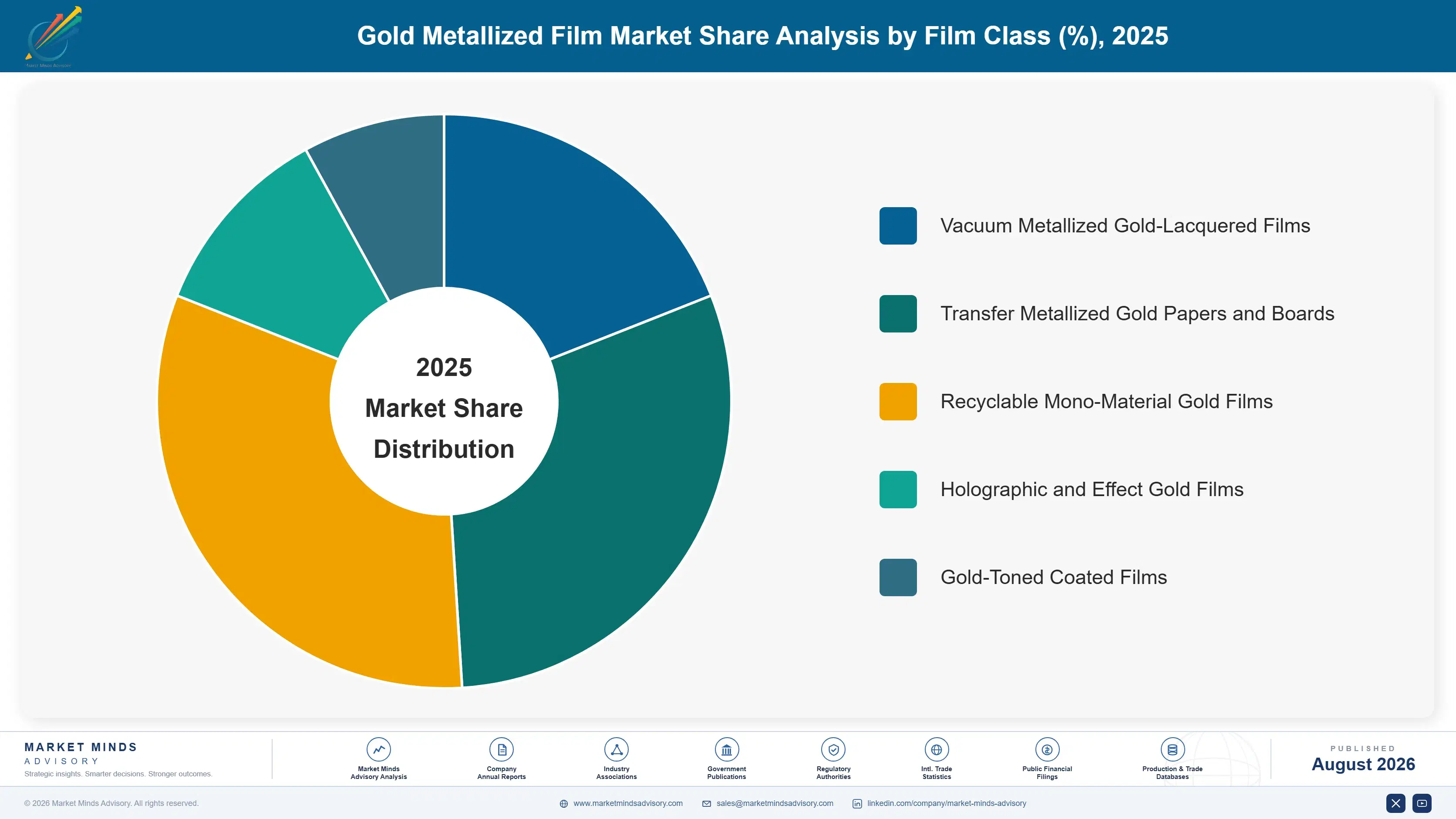
Five film classes divide this market by how the gold effect is created, which determines both visual quality and whether the resulting pack survives optical sorting. The division separates conventional vacuum metallizing from approaches designed to pass recovery facilities, and the visual gap between them is what the category is currently working to close.
gold-metallized-film-market-market-share-analysis-1787307255925

Recyclable Mono-Material Gold Films

Compounding at 10.7%, a full 1.50x the market rate, these films pursue gold appearance through coated, pigmented or ultra-thin deposition routes designed to pass near-infrared optical sorting rather than defeat it. The technical difficulty is genuine, since metallic lustre depends on specular reflection that pigments reproduce imperfectly, and premium brand owners notice gloss and colour depth differences immediately at shelf. Growth is driven entirely by brand recyclability commitments and producer responsibility fees rather than by any visual advantage. Reaching parity would reopen applications that regulation has been closing steadily. Whoever reaches visual parity first reopens applications that regulation has been closing steadily. Fee exposure is what made brand owners accept the current visual gap at all.
CAGR 10.7%

Vacuum Metallized Gold-Lacquered Films

Growing at 5.8%, conventional vacuum metallizing with tinted lacquer remains the reference standard for visual quality and the reason the category exists at all. Aluminium deposited around 30 nanometres thick under a coloured lacquer produces lustre that alternatives approach without matching, at roughly 3.1 times plain film pricing. Recovery facility rejection near 89% is progressively closing regulated market applications while Asian and Middle Eastern demand continues expanding. The class is simultaneously the technical benchmark and the regulatory problem this market is working around. Asian and Middle Eastern demand continues expanding without any comparable regulatory constraint, which is why the class still grows despite closure in regulated markets. It is the benchmark and the problem simultaneously.
CAGR 5.8%
Full segment breakdown across 5 segments available in the complete report.

Regional Architecture and Country Demand Map

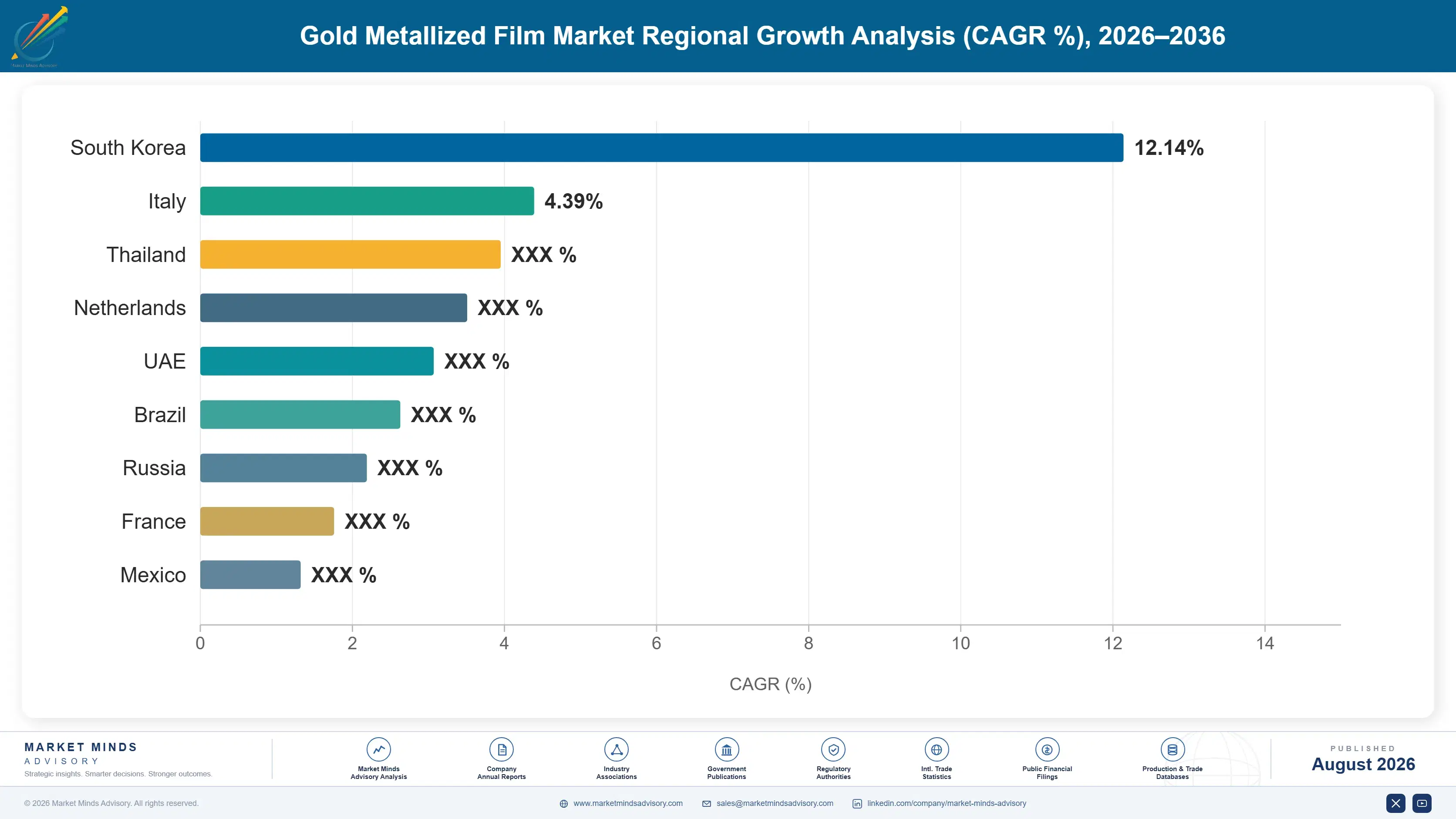
Regional distribution follows metallizing capacity and cultural association with gold, which happen to coincide across Asia. Where gold carries festival and gifting significance, consumption per capita runs far above what income levels alone would predict in any market. Cultural association drives consumption more than income does.

East Asia

Thirty-four per cent of global value, the largest regional position. Note: this exceeds the 22 to 30% band because Chinese metallizing capacity supplies gold films worldwide and regional gifting traditions consume gold finishes at rates no Western market approaches. Lunar New Year confectionery and gift packaging concentrates enormous volume into a short window, and premium spirits and cosmetics packaging across China, Japan and South Korea uses gold finishes extensively. Recyclability regulation is developing across the region without yet applying the fee differentials that have reshaped European specification. Visual quality rather than sortability still decides specification across most of the region. Lunar New Year concentrates enormous volume into a very short window each year.
Share: 34% | CAGR: 8.1% (2026 to 2036)

South Asia and Pacific

Seventeen per cent of global value and the fastest regional growth at 9.3%. Note: this exceeds the 7 to 12% band because Indian festival confectionery and gift packaging consumes gold metallized film at exceptional rates, and India compounds at 11.2%, faster than any country covered. Diwali and wedding season packaging concentrate volume severely, and gold carries cultural significance that makes the finish close to mandatory in premium gifting categories. Indian metallizers including Uflex, Cosmo and Jindal supply both domestic demand and substantial export volumes worldwide. Gold is close to mandatory in premium gifting categories there, which makes the finish a requirement rather than a choice for brand owners competing in those occasions.
Share: 17% | CAGR: 9.3% (2026 to 2036)
Regional intelligence for 5 additional markets available in the complete report: North America, Western Europe, Latin America, Middle East and Africa, Eastern Europe. Contact sales@marketmindsadvisory.com.
gold-metallized-film-market-country-cagr-analysis-1787307256905

Where Gold Film Value Actually Sits

This category sells a perception rather than a property, and the perception is worth roughly three times plain film. Value comes from protecting that visual effect while removing the metal that recovery facilities reject, from serving festival calendars that concentrate demand, and from filling vacuum chambers the rest of the year. Chamber utilisation decides the economics underneath all of it.

Close the visual gap before regulation closes the market

Recyclable formulations compound at 10.7% and still fall short on gloss and colour depth that premium brand owners notice at shelf distance immediately. Whoever reaches visual parity first reopens European and North American applications that recyclability commitments have been progressively closing to conventional metallized film. The technical problem is specular reflection, which pigmented systems approximate imperfectly, and solving it is a genuine materials achievement rather than a reformulation. The commercial prize is the applications regulation is currently removing. Regulation is removing those applications year by year. Materials development rather than converting scale decides it.
Market Impact: Recyclable segment compounding at 1

Serve several festival calendars from one asset base

Roughly 41% of annual volume ships within two gifting windows, which leaves capital-intensive vacuum metallizing capacity substantially idle for much of the year. Lunar New Year, Diwali, Ramadan and Western Christmas fall at different times, and serving several calendars from the same chambers smooths utilisation materially. Converters organised around a single regional calendar carry peak-sized capacity against demand that arrives twice, which is a considerably worse asset position than the same capacity spread across four windows. Export capability is the requirement rather than extra capacity. Single-calendar converters carry the worst asset position.
Market Impact: Two windows carrying 41% of the ann

Sell perceived value uplift, not film specification

Consumers assign roughly 22% higher value to identical product presented in gold packaging, which is a brand marketing argument rather than a packaging technical one and reaches an entirely different buyer. Brand and category managers control positioning budgets that packaging procurement does not, and they evaluate against price realisation rather than cost per square metre. Suppliers presenting shelf perception evidence to marketing functions reported conversion roughly 50% higher than those presenting film specifications to procurement. Specification-led selling reaches the wrong function. Positioning budgets sit outside packaging procurement entirely. The buyer who signs is not the one deciding.
Market Impact: Conversion roughly 50% higher using

Fill vacuum chambers with barrier work off-season

Vacuum metallizing capacity is capital-intensive and chamber time is the binding cost, which makes utilisation the dominant economic variable rather than material cost. Barrier metallizing for food packaging runs through identical chambers with different specification and no seasonal pattern, which fills capacity that gold demand leaves idle for months. Converters running gold alone carry the full asset cost against volume arriving twice yearly, and their cost per square metre reflects it directly. Barrier work runs at identical 30 nanometre deposition with no seasonal pattern, which fills chambers that gold demand leaves idle for months at a time.
Market Impact: Deposition running at 30 nanometres

Who Controls the Margin Pool

The top five hold 39% of the market measured on revenue from gold metallized film products, the basis used throughout this section. Fragmentation reflects widely held vacuum metallizing capability rather than any absence of scale, since the equipment is common across barrier and decorative applications. Indian converters including Uflex, Cosmo Films and Jindal Poly Films hold the largest positions, built on domestic festival demand and substantial export volumes.
Competitive activity runs along three lines. Converters are developing recyclable gold formulations that pass optical sorting, since brand commitments are closing conventional applications in regulated markets. Several are balancing gold demand against barrier metallizing to fill vacuum chambers outside festival windows. And specialists in lacquer formulation are competing on colour depth and lustre consistency, which is where visual differentiation genuinely sits.

Pressure comes from two directions and one is more serious than participants generally acknowledge. Recyclability regulation is closing applications progressively in Europe. More fundamentally, several premium categories are abandoning metallic finishes altogether for uncoated paperboard aesthetics, which removes the demand rather than redirecting it. Rankings shift on who solves recyclable lustre first, since that reopens closed applications for whoever achieves it.
gold-metallized-film-market-company-positioning-matrix-1787307257776

Competitive Moat and Risk Dimensions

UFLEX

Moat: Scale across metallizing applications

Extensive vacuum metallizing capacity serving barrier, decorative and gold applications from the same asset base smooths the severe seasonality that gold demand alone creates, which is a genuine cost advantage in a capital-intensive process. Domestic festival demand plus export volumes across several regional calendars fills chambers more evenly than any single-market converter can manage on its own.
UFLEX

Risk: Exposure to recyclability closure

A substantial share of volume is conventional metallized structure that recovery facilities reject at around 89%, and regulated market applications are closing progressively. Export exposure to European customers is where that pressure lands first, and recyclable alternatives require materials development that a converting scale advantage does not automatically confer on anybody.
API GROUP

Moat: Lacquer and effect formulation depth

Specialisation in decorative metallic effects has produced lacquer formulation and colour matching capability that determines visual quality far more than metallizing capacity does, and premium brand owners in cosmetics and spirits evaluate lustre and colour depth with genuine precision. That formulation expertise is the part of the value chain where differentiation actually exists in this category.
API GROUP

Risk: Narrow premium category exposure

Concentration in high-end decorative applications means exposure to precisely the categories most likely to abandon metallic finishes for uncoated paperboard aesthetics, which several premium brands have already begun doing. That shift removes demand rather than redirecting it to a recyclable alternative, and no formulation improvement addresses a brand deciding metallic is no longer the aesthetic it wants.

Players Tracked

Prominent Players

Uflex
Cosmo Films
Jindal Poly Films
Toray Industries
API Group

Other Key Players

Toppan Holdings
Dai Nippon Printing
Vacumet
Celplast Metallized Products
Rotoflex
Polyplex
SRF Limited
Taghleef Industries
Treofan
Bollore Films
Sunrise Metallizing
Guangdong Decro Film
Zhejiang Great Southeast
Kurz Group
Nakamoto Packs

Recent Developments

MARCH 2022

Recovery facilities confirm metallized rejection rates

Material recovery facility studies across several European countries documented that metallized flexible structures are rejected by near-infrared optical sorting at very high rates regardless of base polymer, sending them to residue. These were technical assessments rather than regulatory measures, and they informed the fee modulation schemes subsequently applied.
Signal: Sorting technology rather than any policy
SEPTEMBER 2023

Premium brands shift toward uncoated paperboard aesthetics

Several premium confectionery and spirits brands moved away from metallic packaging finishes toward uncoated and textured paperboard presentations signalling quality through material honesty rather than lustre. These were brand design decisions rather than regulatory or technical developments, and they remove demand rather than redirecting it.
Signal: A brand abandoning metallic finishes entir
MAY 2025

Recyclable metallic-effect films reach commercial qualification

Recyclable gold-effect film structures passing near-infrared optical sorting completed qualification into premium confectionery packaging with several European brand owners. These were commercial qualification milestones rather than regulatory events, and they demonstrated the approach at production line speeds despite continuing gloss differences. Fee exposure made the compromise acceptable.
Signal: Sortable gold reached commercial use carry

What Actually Costs Money Here

Base film and vacuum chamber time dominate, and aluminium barely registers despite being the functional layer. Polymer base film accounts for roughly 44% of cost of goods, purchased on petrochemical-linked markets. Vacuum metallizing chamber time including electricity, pumping and aluminium wire absorbs around 21%, and the aluminium itself is a trivial component at 30 nanometres deposition. Lacquer and coating chemistry adds a further 14% with disproportionate technical importance.
Polymer film pricing moved sharply through 2021 and 2022 on feedstock and energy costs, and converters on annual contracts absorbed the movement before repricing became possible. Flexible packaging sector reporting documented that compression. Electricity for vacuum pumping is also material, and European energy costs during the same period widened the gap against Indian and Chinese metallizing capacity considerably. Aluminium wire cost is trivial at these deposition thicknesses.

Exposure varies most by utilisation and by application mix. Vacuum metallizing is capital-intensive with chamber time as the binding cost, which makes utilisation the dominant variable rather than materials. Converters running gold alone against demand concentrated in two festival windows carry poor utilisation for much of the year, while those balancing barrier metallizing through the same chambers achieve considerably better asset economics on identical equipment.
gold-metallized-film-market-cost-volatility-analysis-1787307258112

Application mix balancing across vacuum chambers

Barrier metallizing for food packaging runs through identical chambers with different specification and no seasonal pattern, which fills capacity that gold demand leaves idle between festival windows. Switching between applications requires chamber cleaning and setup time, so the benefit depends on scheduling discipline rather than on any equipment change. Scheduling discipline rather than equipment decides the gain.

Multiple festival calendar coverage

Lunar New Year, Diwali, Ramadan and Western Christmas fall at different points in the year, and serving several of them from the same asset base smooths utilisation considerably. It requires export capability and regional customer relationships that single-market converters have to build deliberately rather than assume they already possess. Regional relationships take years to establish properly.

Index-linked base film clauses in contracts

Base film is roughly 44% of cost and moves on petrochemical markets that no converter influences, and annual fixed terms through a resin cycle cost a full year of compressed margin. Index adjustment transfers that exposure, and brand owners accept it where they already face comparable volatility across their own input purchasing. Recognition of the structure comes quickly.

Portfolio Architecture for Margin Defence

Margin architecture separates by whether the buyer is packaging procurement or brand marketing. Standard gold metallized film sold on specification against competing metallizers clears gross margins in the low twenties, since vacuum capability is widely held and the product is close to interchangeable. Films specified by brand teams on lustre, colour depth and shelf perception clear roughly double, from chambers running identical deposition.
The tension is between volume and specification. Standard gold film fills vacuum chambers, spreads capital cost across the asset base and supports the utilisation that makes the whole operation viable. It also earns little and competes against every metallizer with a chamber. Premium specified work carries the margin and arrives in smaller volumes concentrated into festival windows, which is exactly when capacity is tightest.

High-value pools concentrate where visual quality is evaluated precisely and where regulation has not yet closed the application. Luxury cosmetics and premium spirits in unregulated markets, festival gifting where the finish is culturally close to mandatory, and any recyclable formulation reaching visual parity all sit there. Everything sold on specification against competing metallizers competes on chamber time and base film cost alone.

Volume / Commodity-Adjacent Tier

Standard gold metallized film supplied on specification for general confectionery and consumer packaging, where vacuum capability is widely held and delivered price decides awards in nearly every account. Chamber time and base film decide the cost.
Gross Margin: 18-28%

Premium / Certified Tier

High-lustre films specified by brand teams for luxury cosmetics, premium spirits and festival gifting, protected by lacquer formulation and colour matching capability that brand owners evaluate with real precision. Physical standards govern the evaluation.
Gross Margin: 34-48%

Sustainability / Regulatory / Next-Generation Tier

Recyclable mono-material gold films passing near-infrared optical sorting, defended by materials development that pigmented systems make genuinely difficult and by regulatory exposure conventional structures cannot escape. Specular reflection is the technical obstacle.
Gross Margin: 40-56%
gold-metallized-film-market-portfolio-architecture-1787307258946

High-value Sub-segments and Strategic Watch-out

Recyclable Mono-Material Gold Films

The fastest growth at 10.7%, driven entirely by regulation and brand commitments rather than any visual advantage. Reaching lustre parity would reopen applications that recyclability requirements have been steadily closing off. Materials development rather than converting capability decides participation here. Regulation supplies the entire tailwind.
Gross Margin: 40-56%

Premium Lacquered Decorative Films

High value, specified by brand teams evaluating lustre and colour depth precisely rather than by procurement comparing specifications. Formulation capability rather than metallizing capacity decides who competes credibly here. Displacement on price alone is very difficult. Colour matching against physical standards is the test. Precision matters.
Gross Margin: 34-48%

Standard Vacuum Metallized Gold Films

The volume core at 5.8%, filling vacuum chambers and spreading capital cost across the asset base. Recovery facility rejection near 89% is progressively closing its regulated market applications each year. It remains the technical benchmark regardless. Asian demand keeps it growing regardless. Closure is progressive.
Gross Margin: 18-28%

Holographic and Effect Gold Films

The strategic watch-out at 8.4%. Effect films carry higher values and stronger anti-counterfeit utility, but they compound the sorting problem rather than easing it and face the same regulatory closure. Anti-counterfeit utility supports the higher values. Sorting problems compound rather than ease. Regulatory closure applies equally.
Gross Margin: 38-52%

Who Specifies and When It Ships

Revenue in this category is severely seasonal in a way few packaging materials match, with roughly 41% of annual volume shipping within two gifting and festival windows. That concentration makes capacity planning genuinely difficult and demand timing unusually predictable at the same time. Converters know almost to the week when orders will arrive, and they still carry idle chambers for months between those windows.
Specification stickiness varies by how precisely visual quality is judged. Luxury cosmetics and premium spirits evaluate lustre, colour depth and consistency against physical standards, which makes qualified suppliers difficult to displace on price alone. General confectionery and consumer packaging accept a broader tolerance and switch readily. Festival gifting sits between, with cultural expectations about how gold should look creating real constraints on acceptable variation.

The specifying voice differs sharply from most packaging categories. Gold finish is chosen by brand and category managers evaluating shelf perception and price positioning, not by packaging procurement comparing cost per square metre. Sustainability functions have now joined that conversation in regulated markets, applying recyclability criteria that neither marketing nor procurement previously considered. Suppliers addressing procurement alone reach the buyer who signs and miss the one who decides.
gold-metallized-film-market-end-use-penetration-index-1787307259737

Where Value Actually Sits

These are among the four positions where our research anticipates prominent divergence between winners and laggards over the coming forecast period. Each is grounded in the demand model, the regulatory perimeter, and the announced capacity pipeline.
01 / SORTABLE LUSTRE DEVELOPMENT

Whoever solves recyclable gold reopens closed markets

Recovery facilities now reject roughly 89% of metallized structures because near-infrared sorting simply cannot see past the metal layer, which is progressively closing premium applications right across every regulated market. Recyclable formulations compound at 10.7% while still falling short on the gloss and colour depth that premium brand owners notice immediately at shelf distance. Solving specular reflection without any continuous metal layer is a genuine materials achievement, and the commercial prize is every application that regulation has been steadily removing.
02 / FESTIVAL CALENDAR SPREADING

Four windows beat two for chamber utilisation

Roughly 41% of annual volume ships inside just two gifting windows, which leaves capital-intensive vacuum metallizing capacity substantially idle across the remaining months of every single year. Lunar New Year, Diwali, Ramadan and Western Christmas all fall at quite different points across the calendar year. Converters that are organised around a single regional festival carry peak-sized capacity against demand that arrives twice a year, which is a materially worse asset position than the identical capacity spread across four separate windows.
03 / MARKETING CHANNEL ACCESS

Procurement signs but marketing decides the finish

Consumers assign roughly 22% higher value to identical product presented in gold packaging, which is a brand positioning argument rather than a packaging technical one and reaches an entirely different function inside the customer. Brand and category managers control the positioning budgets that packaging procurement simply does not, and they evaluate against price realisation rather than cost per square metre. Suppliers that presented shelf perception evidence reported conversion running roughly 50% higher than specification-led selling to procurement had ever achieved.
04 / AESTHETIC ABANDONMENT RISK

Uncoated paperboard removes demand entirely

Several premium confectionery and spirits brands have already moved toward uncoated and textured paperboard presentations that signal quality through material honesty rather than through any metallic lustre at all. That single shift removes demand from this category altogether rather than redirecting it toward a recyclable alternative, which makes it a fundamentally more serious threat than regulation is. No amount of formulation improvement answers a brand simply deciding that metallic is no longer the aesthetic it wants to project at all.

Engagement Snapshot From the Field

A live engagement with an industry participant carrying material or product regulatory and market exposure ahead of a defining policy shift, showing how our research translates into a defensible multi-year portfolio strategy.
MARKET MINDS ADVISORY · CLIENT ENGAGEMENT SUMMARY
Gold Metallized Film Producer Strategic Portfolio Review and Transition Roadmap 2026·Investment Scenario on Gold Metallized Film Exposure Evaluation 2025-26
CLIENT PROFILE
A metallized film converter with annual revenue near $190 million (client-reported, unverified by MMA), operating vacuum metallizing capacity at two Asian plants serving decorative gold and barrier applications for confectionery, personal care and food customers. Utilisation had fallen for three consecutive years while gold volumes grew, and leadership could not reconcile those two facts. Chamber time was the binding cost.
STRATEGIC CHALLENGE
Gold demand had become more concentrated into festival windows as the customer base shifted toward gifting applications, which raised peak capacity requirements while leaving longer idle periods. Leadership needed to establish whether to add capacity for peak, redirect toward less seasonal applications, or pursue export markets whose festival calendars fell at different times.
MMA APPROACH
We reconstructed chamber utilisation week by week across three years, separating gold decorative from barrier work and mapping demand against festival calendars. Twenty-nine brand and packaging managers were interviewed on specification authority, seasonal ordering and recyclability requirements. We modelled capacity addition against export calendar diversification and barrier mix rebalancing. Export calendars were mapped alongside.
KEY FINDINGS
  1. Chamber utilisation peaked above 90% for eleven weeks and fell below 45% for twenty-three weeks, and the trend had worsened as the customer mix shifted toward festival gifting applications.
  2. Brand managers rather than procurement specified gold finish in 22 of 29 interviews, and the client's commercial organisation had contact with procurement functions almost exclusively.
  3. European customers were beginning to require sortable structures, and the client held no recyclable formulation capability and no development programme addressing it at all.
  4. Serving Middle Eastern and Western festival calendars alongside the domestic one modelled a utilisation improvement larger than any realistic capacity addition could deliver.
CLIENT PROFILE
A metallized film converter with annual revenue near $190 million (client-reported, unverified by MMA), operating vacuum metallizing capacity at two Asian plants serving decorative gold and barrier applications for confectionery, personal care and food customers. Utilisation had fallen for three consecutive years while gold volumes grew, and leadership could not reconcile those two facts. Chamber time was the binding cost.
STRATEGIC CHALLENGE
Gold demand had become more concentrated into festival windows as the customer base shifted toward gifting applications, which raised peak capacity requirements while leaving longer idle periods. Leadership needed to establish whether to add capacity for peak, redirect toward less seasonal applications, or pursue export markets whose festival calendars fell at different times.
MMA APPROACH
We reconstructed chamber utilisation week by week across three years, separating gold decorative from barrier work and mapping demand against festival calendars. Twenty-nine brand and packaging managers were interviewed on specification authority, seasonal ordering and recyclability requirements. We modelled capacity addition against export calendar diversification and barrier mix rebalancing. Export calendars were mapped alongside.
KEY FINDINGS
  1. Chamber utilisation peaked above 90% for eleven weeks and fell below 45% for twenty-three weeks, and the trend had worsened as the customer mix shifted toward festival gifting applications.
  2. Brand managers rather than procurement specified gold finish in 22 of 29 interviews, and the client's commercial organisation had contact with procurement functions almost exclusively.
  3. European customers were beginning to require sortable structures, and the client held no recyclable formulation capability and no development programme addressing it at all.
  4. Serving Middle Eastern and Western festival calendars alongside the domestic one modelled a utilisation improvement larger than any realistic capacity addition could deliver.
RECOMMENDED STRATEGY
Phase 1: Phase one: pursue export customers on Ramadan and Christmas calendars rather than adding peak capacity for a domestic festival window. Phase 2: Phase two: build commercial contact with brand and category managers, since they specify the finish that procurement subsequently buys. Procurement signs afterward. Phase 3: Phase three: begin recyclable formulation development or licensing, since European customers are already requiring what the company cannot supply. Requirements are already arriving.
OUTCOME
Export volumes on two additional festival calendars lifted annual chamber utilisation by eleven points within a year without any capacity addition (client-reported, unverified by MMA). Brand-facing commercial contact was established at four major accounts. A recyclable formulation licensing discussion opened and remains in progress. Capacity addition was deferred indefinitely.

Frequently Asked Questions

Foundational context covering the market sizes, CAGR, scope, country, region and competition that inform every finding below. This section is provided to cover basics and most often pre-purchase conversations, answered from the MMA Primary Research Dataset.

What is the current size of the Gold Metallized Film Market?

The global market is valued at $1.62 billion in 2025, rising to $1.73 billion in 2026. East Asia holds the largest share at 34%, reflecting metallizing capacity and gifting traditions that consume gold finishes heavily.

How large will the Gold Metallized Film Market be by 2036?

MMA forecasts $3.44 billion by 2036, an increase of $1.71 billion over the 2026 base and an expansion multiple of 1.99x. Recyclable formulations carry most of that growth.

What is the CAGR for the Gold Metallized Film Market 2026 to 2036?

The base case compound annual growth rate is 7.1%, with a bull case at 8.3% and a bear case at 5.9%. Historical growth from 2020 to 2025 ran near 6.0% on premiumisation across Asia.

Which segment is growing fastest?

Recyclable mono-material gold films compound at 10.7%, a full 1.50x the market rate. Growth is driven entirely by brand recyclability commitments rather than by any visual advantage over conventional metallizing.

Who are the major companies in the Gold Metallized Film Market?

Uflex, Cosmo Films, Jindal Poly Films, Toray Industries and API Group together hold 39% of gold metallized film revenue. Fragmentation reflects widely held vacuum metallizing capability across the industry.

Which country is growing fastest?

India compounds at 11.2%, faster than any other country covered, on festival confectionery and gift packaging that consumes gold finishes at exceptional rates. Diwali and wedding season concentrate volume severely.

Report Segmentation Architecture

The full report scope spans multiple orthogonal segmentation dimensions, with cross-tabulated demand data provided for each dimension pair. Coverage extends further to regional breakdowns, trend trajectories, and the competitive detail needed to support segment-level decision-making.

By Film Class

  • Vacuum Metallized Gold-Lacquered Films
  • Transfer Metallized Gold Papers and Boards
  • Recyclable Mono-Material Gold Films
  • Holographic and Effect Gold Films
  • Gold-Toned Coated Films

By End-Use Industry

  • Confectionery and Chocolate Packaging
  • Premium Spirits and Beverage Labels
  • Cosmetics and Personal Care
  • Festival and Gift Packaging
  • Tobacco and Speciality Packaging
  • Decorative Laminates and Print Applications

By Commercial Dimension

  • Brand Specified Supply
  • Converter and Printer Direct Sales
  • Distributor and Trader Channels
  • Contract Metallizing Services
  • Export and Regional Supply
  • Private Label Converting Programmes

By Region

  • East Asia
  • South Asia and Pacific
  • North America
  • Western Europe
  • Latin America
  • Middle East and Africa
  • Eastern Europe

Scope, Methodology, and Coverage

Every figure in this report is reproducible from documented input assumptions. The scope below maps the historical period, the forecast horizon, the segmentation dimensions, and the countries covered, alongside the underlying primary and qualitative methodology.
Historical Period
2020 to 2025
Forecast Period
2026 to 2036
Base Year
2025 (USD billions; MMA Primary Research Dataset, August 2026)
Market Definition
This market comprises polymer films carrying a gold or gold-toned metallic finish for packaging and decorative applications, measured at producer revenue across brand specified supply, converter and printer direct sales, distributor and trader channels, contract metallizing services, export and regional supply, and private label converting programmes. Coverage spans vacuum metallized films carrying aluminium deposition beneath a tinted lacquer, transfer metallized gold papers and boards where the metallic layer is transferred from a carrier, recyclable mono-material gold films engineered to pass near-infrared optical sorting, holographic and effect gold films carrying embossed or diffractive structures, and gold-toned coated films achieving the appearance without vacuum metallizing. Genuine gold leaf, gilding materials and precious metal decoration, aluminium foil and foil laminates, silver, copper and other metallic colour finishes, printing inks, hot stamping foils and cold foil transfer systems, vacuum metallizing and coating equipment, and base films supplied without any metallic finish fall outside scope.
Quantitative Units
USD millions (current prices); square metres shipped by film class; price against plain film equivalents; deposition thickness; recyclable share of volume; seasonal volume concentration; chamber utilisation
Segmentation Dimensions
By Film Class; By End-Use Industry; By Commercial Dimension; By Region
Regions Covered
East Asia, South Asia and Pacific, North America, Western Europe, Latin America, Middle East and Africa, Eastern Europe
Countries Covered
China, Japan, South Korea, Taiwan, India, Pakistan, Bangladesh, Indonesia, Thailand, Vietnam, Australia, United States, Canada, Mexico, Germany, France, Italy, United Kingdom, Spain, Netherlands, Switzerland, Brazil, Argentina, Colombia, Chile, Saudi Arabia, United Arab Emirates, Egypt, Nigeria, South Africa, Poland, Turkey, Czechia, Romania, and additional markets relevant to decorative packaging analysis
Key Companies Profiled
Uflex, Cosmo Films, Jindal Poly Films, Toray Industries, API Group, Toppan Holdings, Dai Nippon Printing, Vacumet, Celplast Metallized Products, Rotoflex, Polyplex, SRF Limited, Taghleef Industries, Treofan, Bollore Films, Sunrise Metallizing, Guangdong Decro Film, Zhejiang Great Southeast, Kurz Group, Nakamoto Packs
Quantitative Methodology
Primary survey, n=3,800 respondents, Q4 2025, six countries; demand-side model with trade association cross-validation
Qualitative Methodology
47 expert interviews, Q4 2025; applied to validate demand model assumptions, identify emerging dynamics, and assess competitive positioning
Report Format
PDF and XLSX data workbook (Word format preview document)
Publisher
Market Minds Advisory
Report Code
MMA-2026-PAC-591
Published
August 2026
Contact
sales@marketmindsadvisory.com | www.marketmindsadvisory.com

Purchase the full Gold Metallized Film Market Report (2026 to 2036).

The full MMA report treats gold finish as a perception product with a sorting problem attached, and follows both through specification, seasonality and regulatory exposure. It sizes five film classes and seven regions to 2036, modelling square metres shipped, pricing against plain film, deposition thickness, recyclable share, seasonal concentration and chamber utilisation separately. Competitive assessment covers twenty producers on one consistent revenue basis. Cost exposure is traced through base film, chamber time and lacquer chemistry. Four commercial levers and a strategic verdict close the report, grounded in 47 expert interviews and a 3,800-respondent survey.
Five film classes sized separately through 2036
Optical sorting rejection rates documented across recovery facility studies
Festival calendar demand concentration mapped by region and application
Twenty producers assessed on one consistent revenue basis
Specification authority traced between marketing, procurement and sustainability
Anonymised converter engagement with tested utilisation recommendations

Built For The People Who Decide

From boardroom strategy to bench-side execution, this report is read cover-to-cover by leaders shaping the next decade of their industry, turning demand scenarios, market dynamics and valuation benchmarks into decisions.
CXOs/ Presidents/ VPs/ Managers
M&A and Corporate Development
Strategy Teams and R&D Heads
Procurement and Product Directors
Regulatory and Compliance Leaders
Investor Relations and Equity Analysts