Market Minds Advisory
Gold Infused Skin Care Market

Gold Infused Skin Care Market: Gold Infused Skin Care Market: Signalling, Allergy and the Format Europe Banned

Metallic gold is inert and does nothing measurable to skin, which is why this category sells signalling rather than function, and why Europe has just prohibited the one form that actually had a literature.

Lead Analyst

Published

September 2026

Make Smarter Decisions with Customized Research Insights

Request a free sample report and evaluate market opportunities, growth trends, and competitive dynamics relevant to your business needs.

2025 MARKET VALUE$1.9BMarket Size 2025
2036 FORECAST VALUE$4.8BBase Case , 2026 to 2036
CAGR 2026 TO 20368.8 %Bull 10.0% / Bear 7.6%
INCREMENTAL OPPORTUNITY$2.7BNet 10- year value creation
EXPANSION MULTIPLE2.32x2036 value over 2026 base
Strategic Levers
M&A Pipeline
Regional Outlook
Country Rankings
Competitive Intelligence
Segmental Deep-dive
Call-Us : 91 93563 13602

Executive Snapshot and Market Trajectory.

Gold leaf on a face does nothing. The metal is inert, biologically unavailable through skin and a recognised contact allergen, and no dermatological literature supports the efficacy claim. That is not a problem for a category selling luxury signalling, and it becomes one the moment a claims regulator arrives.
Colloidal gold nanoparticle serums grow at 13.2%, half again the market rate of 8.8%, because nanoparticles are the one gold format with a genuine research base behind them. They are also now prohibited in European cosmetics, which removes the fastest segment from an entire region. East Asia holds 30% of demand and South Asia takes 14%, both above their usual bands, because gold in skincare is a tradition there rather than a marketing idea.
Concentration is very low at 18% because gold costs almost nothing at the quantities used, around 4% of goods sold, and anybody can add it to a cream. The barrier is price credibility rather than formulation. Gifting drives 37% of units, which is the honest explanation for a category priced at these levels and the reason it survives the efficacy question at all. Nobody in the industry says so.
Market Definition
The gold infused skin care market covers finished topical skincare products whose primary marketed active or positioning is metallic gold in any form, spanning gold leaf, colloidal gold nanoparticles, gold peptide complexes and gold salt preparations. Scope includes serums, masks, creams, eye treatments, cleansers and body preparations sold to consumers and through professional treatment channels. Excluded are gold-coloured packaging carrying no gold content, gold jewellery and cosmetic devices, colour cosmetics using metallic pigments, and gold compounds used in pharmaceutical rheumatology preparations.
Base Year Value
$1.9B in 2025 (MMA Primary Research Dataset, August 2026)
Forecast Period
2026 to 2036, eleven discrete annual values
CAGR
8.8% base case. Bull 10.0%. Bear 7.6%.
Fastest Growth Segment
Colloidal Gold Nanoparticle Serums: 13.2% CAGR
Fastest Growth Country
India: 11.0% CAGR
Fastest Growth Region
South Asia and Pacific: 11.0% CAGR
Largest Region
East Asia: 30% of 2025 global value
Market Leaders
Amorepacific, Shiseido, Peter Thomas Roth Labs, OROGOLD Cosmetics and Forest Essentials. Source: MMA Analysis, July 2026.
Primary Survey
n=3,800 procurement and R&D decision-makers, Q4 2025, six countries
Methodology
Demand-side build-up, cross-validated against public data, 47 expert interviews

Gold Infused Skin Care Market Forecast Scenarios

gold-infused-beauty-products-market-size-forecast-scenario-1788171198640
Between 2020 and 2025 the category compounded at 7.8% and almost all of that came from Asian and Gulf demand rather than from Western adoption. Gold facials have been an ordinary salon service across India and Korea for longer than any Western brand has sold a gold serum. What Western marketing added was price, not volume, and the two grew at different rates.
The 8.8% base case rests on three mechanisms. Gifting sustains a price point that function could never justify, and gifting demand is remarkably insensitive to efficacy debates. Traditional use across South Asia and East Asia continues on a base that predates the modern category entirely. And Gulf demand keeps growing at price points above anywhere else on a strong cultural association between gold and status. None of the three depends on the ingredient working in the first place.
The bull case at 10.0% turns on colloidal gold nanoparticles finding a defensible delivery application, which would move part of this category from decoration to dermatology. The bear case at 7.6% is regulatory contagion: the European prohibition on colloidal gold in cosmetics spreading to other jurisdictions would remove the only technically interesting segment in this whole category worldwide.

What The Gold Actually Does

Metallic gold is inert, which is why it has been used in dentistry and jewellery for millennia and why it does nothing on skin. It does not penetrate, it does not react and it is not bioavailable. Gold is also a recognised contact allergen, with gold salts producing positive patch test reactions in roughly one in ten patients tested. None of that has slowed the category.
TOP FIVE CONCENTRATION18%Share held by the five largest gold skincare sellers
AVERAGE SELLING PRICEUSD 68.40Mean retail price across serum and mask product formats
GOLD CONTENT BY MASS0.003%Typical metallic gold proportion in a finished formulation
GOLD INPUT COST SHARE4% of COGSMetal cost as proportion of finished product production cost
CONTACT ALLERGY PREVALENCE9.5%Portion of patch tested patients reacting to gold salts
GIFTING PURCHASE SHARE37%Portion of units bought as gifts rather than personal use
The economics explain the persistence better than the science does. Gold content in a finished formulation runs around three thousandths of one percent by mass, which costs roughly 4% of goods sold at record metal prices. A brand can therefore sell an ingredient story worth a premium for almost nothing, which is the most attractive arrangement in cosmetic formulation and the reason the tail is endless.
Colloidal gold nanoparticles are the genuine exception and Europe has just closed them. Nanoscale gold has an actual research literature in delivery and photothermal applications, unlike leaf, and it is the only part of this category a dermatologist will discuss seriously. European cosmetic regulation now prohibits colloidal gold, which removes the fastest-growing segment from the region entirely and leaves it concentrated in Asia and the Gulf.
"This category has spent twenty years defending an efficacy claim it never needed. Nobody buying a gold mask as a gift is asking whether it works, and the brands that understood that early are the ones charging the most for the least."
Principal, Prestige Beauty and Ingredients Practice · MMA Chemicals and Materials Practice · August 2026

Market Trends

European regulation removed colloidal gold entirely

European cosmetic regulation now prohibits colloidal gold in finished cosmetic products, which takes the one gold format with a genuine research literature out of an entire region. Brands selling colloidal gold serums into Europe reformulated to gold leaf or gold peptide complexes, which are permitted and do considerably less. The commercial effect is a category whose fastest-growing segment at 13.2% is unavailable in a fifth of world demand, and whose remaining European offer rests entirely on decoration. Nobody expected the regulator to remove the defensible part of it all first.
Market Impact: Anchors 14% South Asian share
Gifting sustains prices that function never could

Around 37% of units in this category are bought as gifts, and a gift buyer behaves nothing like somebody buying for themselves. They choose on presentation, they buy at higher price points, and they never ask whether the product works because they will not be using it. That channel is the honest explanation for a category priced well above its ingredient cost, and it is remarkably insulated from any efficacy debate. Brands merchandising for the gift occasion outperform brands merchandising for a skin concern by quite a wide margin indeed.
Market Impact: Holds 7% on 4% band

Market Opportunities and Growth Drivers

Traditional use anchors demand across South Asia

Gold in skin preparation has an Ayurvedic history running back centuries, and the gold facial remains an ordinary and widely available salon service across India rather than a luxury novelty. That gives the category a demand base in the region that owes nothing to modern marketing and does not depend on any efficacy claim being defensible. South Asia takes 14% of world demand, above its usual band, and Indian growth at 11.0% is the fastest of any country covered. Western brands entering there are joining a conversation that started long before them.
Market Impact: Affects 9.5% of tested patients

Gulf demand pays the highest prices anywhere

The cultural association between gold and status runs deeper across the Gulf than anywhere else, and it translates directly into willingness to pay for gold-positioned skincare at price points above Western Europe. Saudi and Emirati households buy through pharmacy, department store and premium online channels, and gifting around religious and family occasions concentrates demand into predictable periods. The region takes 7% of world demand, above its usual band, on a population that would not otherwise support it. Very few Western brands merchandise properly for any of those particular occasions at all.
Market Impact: Rests on 0 published efficacy studies

Market Restraints and Challenges

Gold is a recognised contact allergen

Gold sodium thiosulfate sits in standard dermatological patch test series and produces positive reactions in roughly one in ten patients tested, which makes gold one of the more common contact allergens in routine screening. The root cause is immunological sensitisation rather than any formulation error, so no manufacturer can formulate around it. Commercial impact is a steady flow of reaction complaints that a brand cannot attribute to anything else in the product. Participants are responding with lower gold loadings, patch test guidance on pack, gold peptide complexes rather than salts, and warnings that most competitors still omit entirely.
Market Impact: Removes 17% of world demand

No efficacy literature supports the core claim

Metallic gold is inert and biologically unavailable through intact skin, and the dermatological literature contains nothing that supports an anti-ageing or repair claim for gold leaf in a topical formulation. The root cause is chemistry rather than insufficient research, which means no amount of investment resolves it. Commercial impact arrives when claims regulation does, since a substantiation request on a gold efficacy claim has no available answer. Participants are responding by rewording toward luminosity and appearance rather than function, emphasising the formulation around the gold, and moving quietly toward peptide and nanoparticle systems that at least have papers.
Market Impact: Drives 37% of unit demand
3 additional market trends, 4 additional growth drivers, and 2 additional restraints and challenges are covered in the full report. Contact sales@marketmindsadvisory.com to access the complete intelligence.

Segment CAGR and Growth Architecture

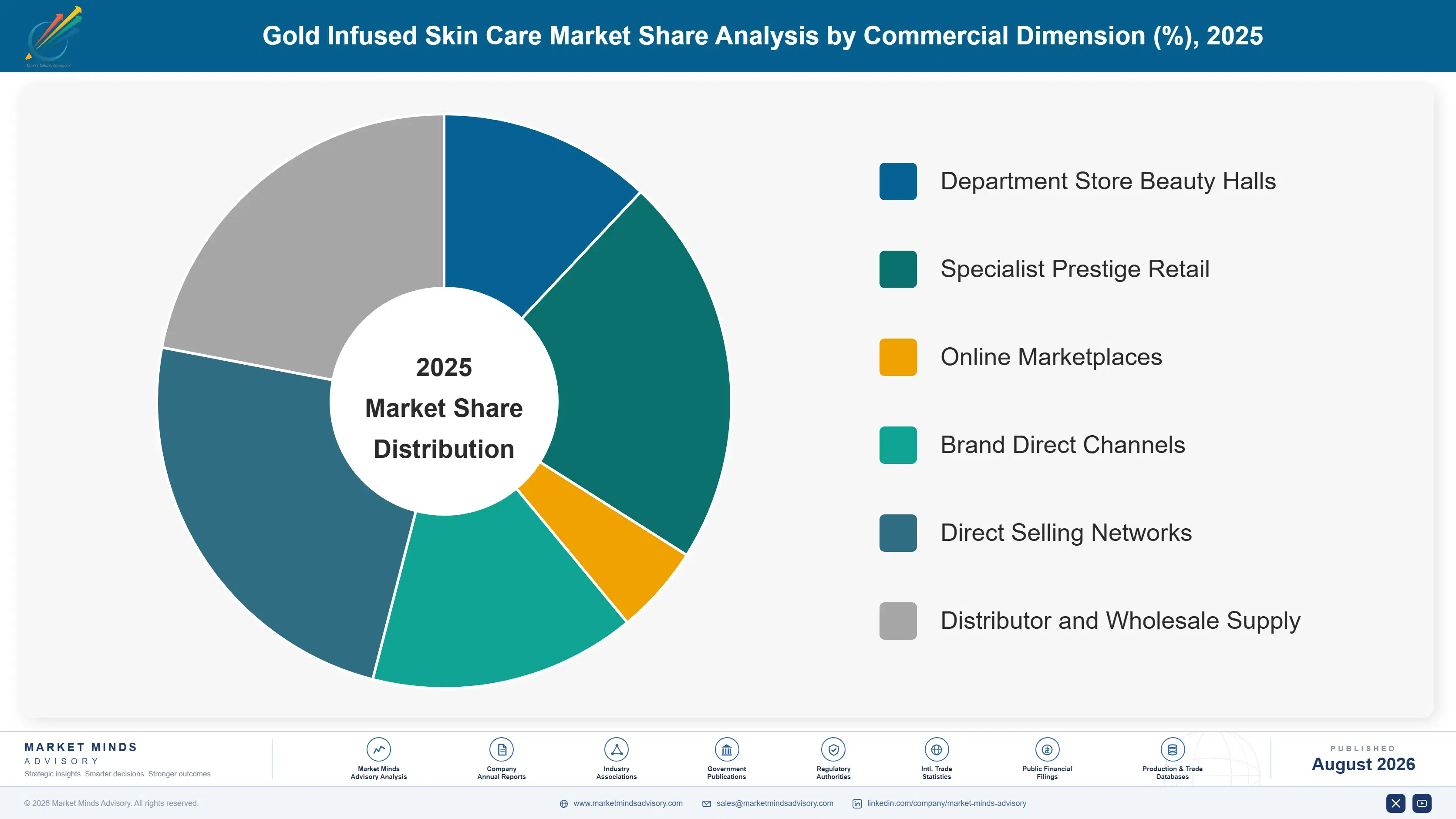
Segmentation follows product format, the dimension on which gold form, price point and regulatory status all operate together. Creams, cleansers and body preparations carry the volume at accessible price points. Nanoparticle serums and gold leaf masks carry the growth for opposite reasons: one has a research base and one has a photograph, and both of them sell perfectly well.
gold-infused-beauty-products-market-market-share-analysis-1788171199210

Colloidal Gold Nanoparticle Serums

Colloidal gold nanoparticle serums grow at 13.2%, half again the market rate of 8.8%, and they are the only part of this category with anything resembling a scientific literature behind them. Nanoscale gold behaves nothing like leaf: it has documented photothermal properties and a research history as a delivery carrier, which gives a formulator something real to work with. The commercial problem is regulatory rather than technical. European cosmetic regulation now prohibits colloidal gold outright, which removes the segment from a substantial share of world demand and concentrates the remainder in Asian, Gulf and American markets that have taken no equivalent position yet. Whether they will is the open question in this category.
CAGR 13.2%

Gold Leaf Facial Masks and Sheets

Gold leaf facial masks and sheets grow at 11.0% and they are the purest expression of what this category actually sells. A visible sheet of gold on a face photographs extraordinarily well, which is the entire mechanism, and no participant seriously argues that the leaf itself does anything to skin. Unit prices run several times a conventional sheet mask on a material cost difference of almost nothing. The format dominates the gifting channel that drives 37% of category units, and it travels through social content in a way no serum ever manages. It is honest commerce sold on a dishonest premise. Very few people in this industry will say that out loud.
CAGR 11.0%
Full segment breakdown across 6 segments available in the complete report.

Regional Architecture and Country Demand Map

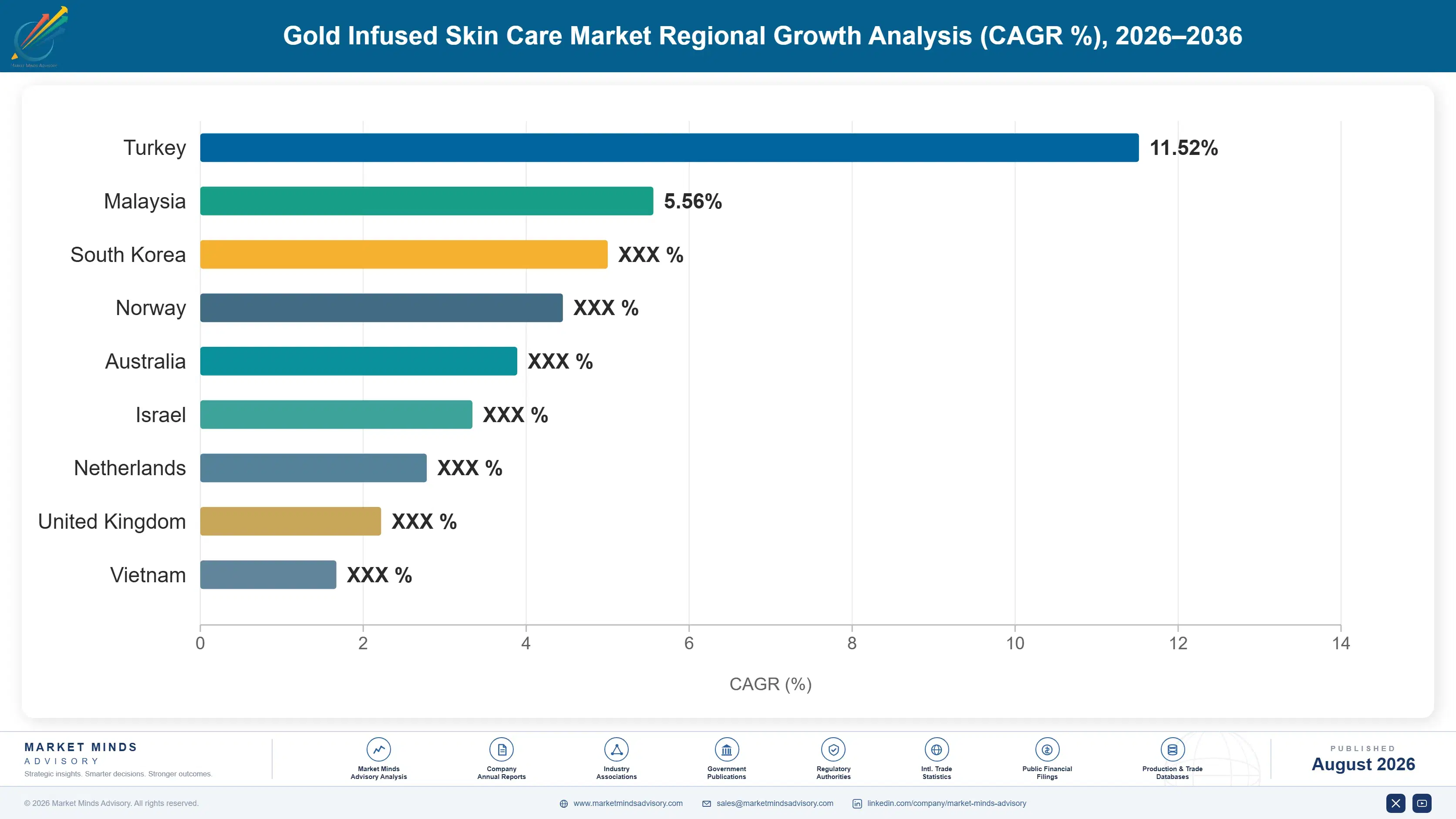
East Asia takes 30% and South Asia 14%, both above their usual bands, because gold in skin preparation is a tradition in those regions rather than a marketing construction. Western Europe sits below its band because the regulator there prohibited colloidal gold outright and recently.

East Asia

Tradition and manufacturing sit in the same place here, which no other region can claim. Korean gold sheet masks, Japanese gold leaf from Kanazawa and Chinese gold preparations all predate the modern category by a considerable distance, and the formulation and contract manufacturing base that supplies Western brands is concentrated in the same countries. Korean brands set the product release calendar that Western competitors follow six to nine months later. Colloidal gold remains permitted here, which means the fastest-growing format is available in a way it no longer is across Europe. That regulatory divergence is now a genuine competitive asset. Very few Western brands have worked out how to use it.
Share: 30% | CAGR: 9.9% (2026 to 2036)

North America

Prestige retail built this category here and social content sustains it. American gold skincare sells through department store beauty halls, specialist prestige retail and direct online, at price points that rest on presentation rather than on any published evidence. Federal claims guidance is the live exposure, since an anti-ageing claim attached to an inert metal has no substantiation available if anybody asks for it. Colloidal gold remains permitted, which leaves the American market as the largest Western outlet for the nanoparticle segment. Brands that reworded toward appearance rather than function some years ago are considerably better placed than those that did not. The rewording was cheap and the delay is proving expensive.
Share: 22% | CAGR: 9.2% (2026 to 2036)
Regional intelligence for 5 additional markets available in the complete report: Western Europe, South Asia and Pacific, Latin America, Middle East and Africa, Eastern Europe. Contact sales@marketmindsadvisory.com.
gold-infused-beauty-products-market-country-cagr-analysis-1788171199734

Four Moves Beyond The Metal

None of these four requires the gold to work, which is convenient, because it does not and everybody in the category knows it. Each takes something the business genuinely owns, the gifting occasion, the traditional association, the formulation around the metal or the regulatory position, and turns it into revenue that survives any substantiation request intact.

Merchandise for the gift, not the skin

Around 37% of units in this category are bought as gifts and the gift buyer never uses the product, which means efficacy is irrelevant to more than a third of demand. That buyer chooses on presentation, packaging and price signal. Building the range and the calendar around gifting occasions costs nothing beyond merchandising attention and reaches a customer who will not ask the question the category cannot answer. Most brands still merchandise against skin concerns, which addresses the smaller and considerably more sceptical half of the total demand base instead.
Market Impact: Targets 37% of all unit demand more directly

Sell the formulation, not the gold

Gold contributes around 4% of goods sold and nothing measurable to skin, while the peptides, humectants and actives surrounding it in a well-built formulation do the actual work and carry actual literature. Repositioning the claim onto those ingredients keeps the gold as visual and price signalling while giving the brand something a substantiation request can be answered with. It costs no reformulation at all, only a rewrite. Brands that made this move years ago are now watching competitors do it under real regulatory pressure instead of by their own choice.
Market Impact: Defends the claim on 96% of the formulation

Build the Gulf occasion calendar properly

Gulf buyers pay more for gold-positioned skincare than anybody else and the demand concentrates around religious and family occasions with dates known years in advance. Very few Western brands build ranges, pack sizes or shipment timing around that calendar, which leaves the highest-price market in the world served by whatever the standard global range happens to be. The region takes 7% of demand on a fraction of the population. Merchandising properly for two or three occasions a year would move that share considerably further than where it currently sits now.
Market Impact: Serves the 7% share at the highest prices

Hold the nanoparticle position outside Europe

European regulation now prohibits colloidal gold in cosmetics, and the segment grows at 13.2% everywhere else. A brand with a nanoparticle formulation, the safety file behind it and distribution across Asia, the Gulf and North America holds a position European competitors cannot occupy at all. That is an unusual situation: a regulatory divergence creating an exportable advantage rather than a compliance cost. The risk is contagion, so the file matters more than the formula and the brands documenting properly now are the ones who survive if it spreads any further.
Market Impact: Holds a 13.2% growth segment right outside Europe

Who Controls the Margin Pool

CR5 stands at 18%, measured on retail revenue in gold-positioned skincare, since no participant discloses the category separately. That is extremely low and the reason is that adding gold to a cream requires no capability whatsoever: the metal costs almost nothing at these loadings and every contract formulator will supply it. The gap between the prestige houses and the long tail is entirely one of price credibility.
Competition runs on price credibility, presentation and regulatory position. Price credibility decides whether a buyer accepts a premium for an ingredient that costs nothing, which is a brand question rather than a formulation one. Presentation decides the gifting channel, which is more than a third of units. Regulatory position decides which formats can be sold where, and Europe has made that decisive. Efficacy claims decide nothing.

Rankings will move on regulatory divergence rather than on product. A brand holding a documented nanoparticle safety file and distribution outside Europe occupies a segment growing at 13.2% that European competitors cannot enter at all. Several Korean and American brands already sit there. The pressure comes from regulators rather than from competitors, and it has produced the unusual situation where compliance capability is an offensive asset.
gold-infused-beauty-products-market-company-positioning-matrix-1788171200254

Competitive Moat and Risk Dimensions

AMOREPACIFIC

Moat: Release pace sets the calendar

Korean development cycles run considerably shorter than Western equivalents, which lets the group ship a gold format while competitors are still briefing one, and Western brands routinely follow Korean releases six to nine months behind. Formulation, packaging and contract capacity all sit within a few hours of each other. That geographic compression is not something a competitor buys.
AMOREPACIFIC

Risk: Domestic Chinese competition intensifying

Chinese domestic brands invoking the same traditional gold association and increasingly capable local formulation have taken share in the group's largest export market, at prices below imported Korean product. Rebuilding that position means competing on brand rather than on release speed, which is a slower and considerably more expensive contest to run. The traditional association belongs to nobody in particular.
SHISEIDO

Moat: Prestige credibility across regions

A prestige position built over more than a century carries price credibility that this category depends on entirely, because the buyer is paying for signalling rather than for ingredient cost. The group can charge for gold in a way a new entrant cannot, on exactly the same formulation. Establishing that credibility is a matter of decades rather than campaigns.
SHISEIDO

Risk: Claims exposure across markets

A prestige house carries reputational exposure that a small brand does not, because a substantiation challenge on a gold efficacy claim reaches the whole portfolio rather than one product. Regulatory attention concentrates on the largest names first. The group therefore has to reword and document ahead of a market where smaller competitors continue claiming freely until somebody stops them.

Players Tracked

Prominent Players

Amorepacific
Shiseido
Peter Thomas Roth Labs
OROGOLD Cosmetics
Forest Essentials

Other Key Players

Chantecaille
The Estee Lauder Companies
L'Oreal
Kose Corporation
LG Household and Health Care
Kama Ayurveda
Vaadi Herbals
Biotique
Able C and C
Mediheal
Kanebo Cosmetics
Rodial
111Skin
Tatcha
Oriflame Cosmetics

Recent Developments

JANUARY 2025

European cosmetic regulation prohibited colloidal gold in products

European cosmetic regulation added colloidal gold to the list of substances prohibited in finished cosmetic products, removing the format from the region on a fixed compliance date. Brands selling colloidal gold serums into Europe reformulated to gold leaf or peptide complexes, and several withdrew the products from European ranges.
Signal: The regulator removed the one format with a literature and left all the decorative ones alone.
MAY 2025

Amorepacific expanded gold formulation and mask production capacity

Amorepacific brought additional production capacity for gold sheet masks and gold-containing serums into operation in South Korea, an organic capacity expansion rather than any acquisition or joint venture. The investment weights output toward formats permitted in every major market rather than toward those now restricted in Europe.
Signal: Capacity is being placed where the regulation permits rather than where any of the science points.
SEPTEMBER 2025

Gulf retailers expanded gold skincare gifting ranges

Major Gulf department store and pharmacy retailers expanded dedicated gold skincare gifting ranges timed around religious and family occasions, with pack sizes and presentation formats specified for the purpose. Brands supplying against that calendar reported considerably better sell-through than brands shipping standard global assortments into the same windows.
Signal: The highest-price market in this category is served by whatever the global range happens to be.

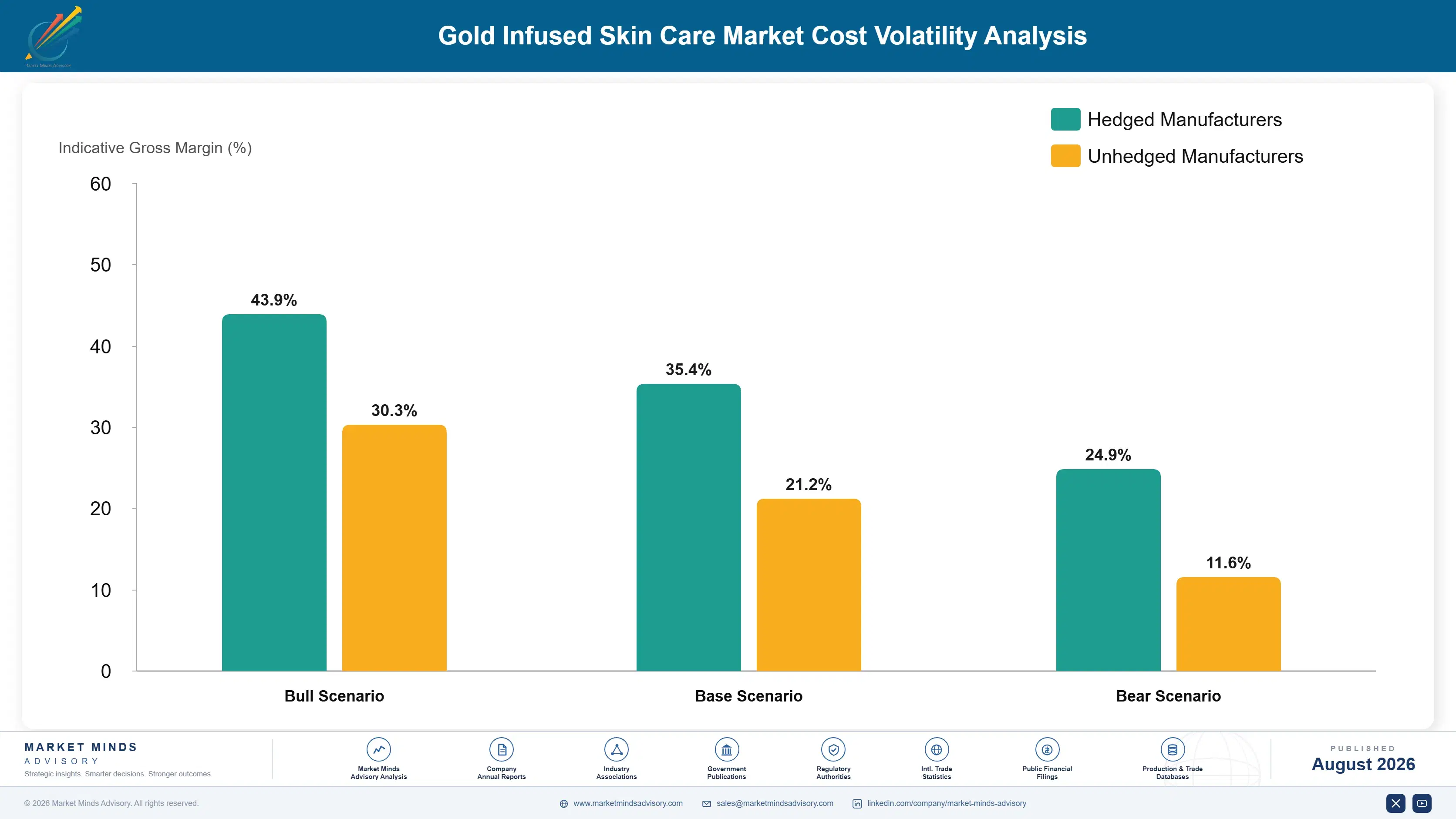
The Metal Costs Almost Nothing

Gold accounts for roughly 4% of cost of goods despite record metal prices, because the quantity in a finished formulation runs around three thousandths of one percent by mass. Packaging carries far more at around 31%, and the surrounding actives another 22%. Gold leaf comes largely from Japanese and Italian beaters; colloidal preparations from a small number of specialist suppliers.
Packaging rather than gold gave this category its cost lesson. European container glass producers absorbed energy cost increases through 2022 and 2023, and the International Energy Agency documented the scale of industrial gas price movement. A category selling presentation cannot economise on the jar, which is where the cost landed. Brands holding glass contracts held their price lists; spot buyers repriced and discovered that a premium buyer notices a price change more than formulation.

The disadvantage falls on scale rather than on geography. A prestige house buys glass, cartons and closures across a whole portfolio and barely notices a movement. A single-brand entrant buys small volumes of decorated glass at whatever the moulder quotes, and the packaging is the majority of what the customer is actually paying for. Gold itself is almost irrelevant to either.
gold-infused-beauty-products-market-cost-volatility-analysis-1788171200450

Contract decorated glass on annual volume terms

Packaging is around 31% of cost of goods in a category that cannot economise on presentation, which makes it the largest controllable line by a distance. Annual contracts with a moulder and a decorator cost a premium over spot in a soft market and remove a price exposure that a premium buyer notices faster than any formulation change.

Qualify a second gold leaf supplier

Cosmetic-grade gold leaf comes from a small number of Japanese and Italian beaters, and a single-source position on a decorative input is an unnecessary exposure for a business whose whole proposition rests on it being visible. Qualifying a second supplier costs a specification approval and modest testing. The metal is cheap; the interruption is not.

Build the nanoparticle safety file properly

European regulation has prohibited colloidal gold and other jurisdictions are watching. A documented safety dossier covering particle size distribution, dermal exposure and stability is what determines whether a nanoparticle range survives a review elsewhere or follows Europe out of the market. The file costs a testing programme and considerably less than reformulating a range under pressure later.

Portfolio Architecture for Margin Defence

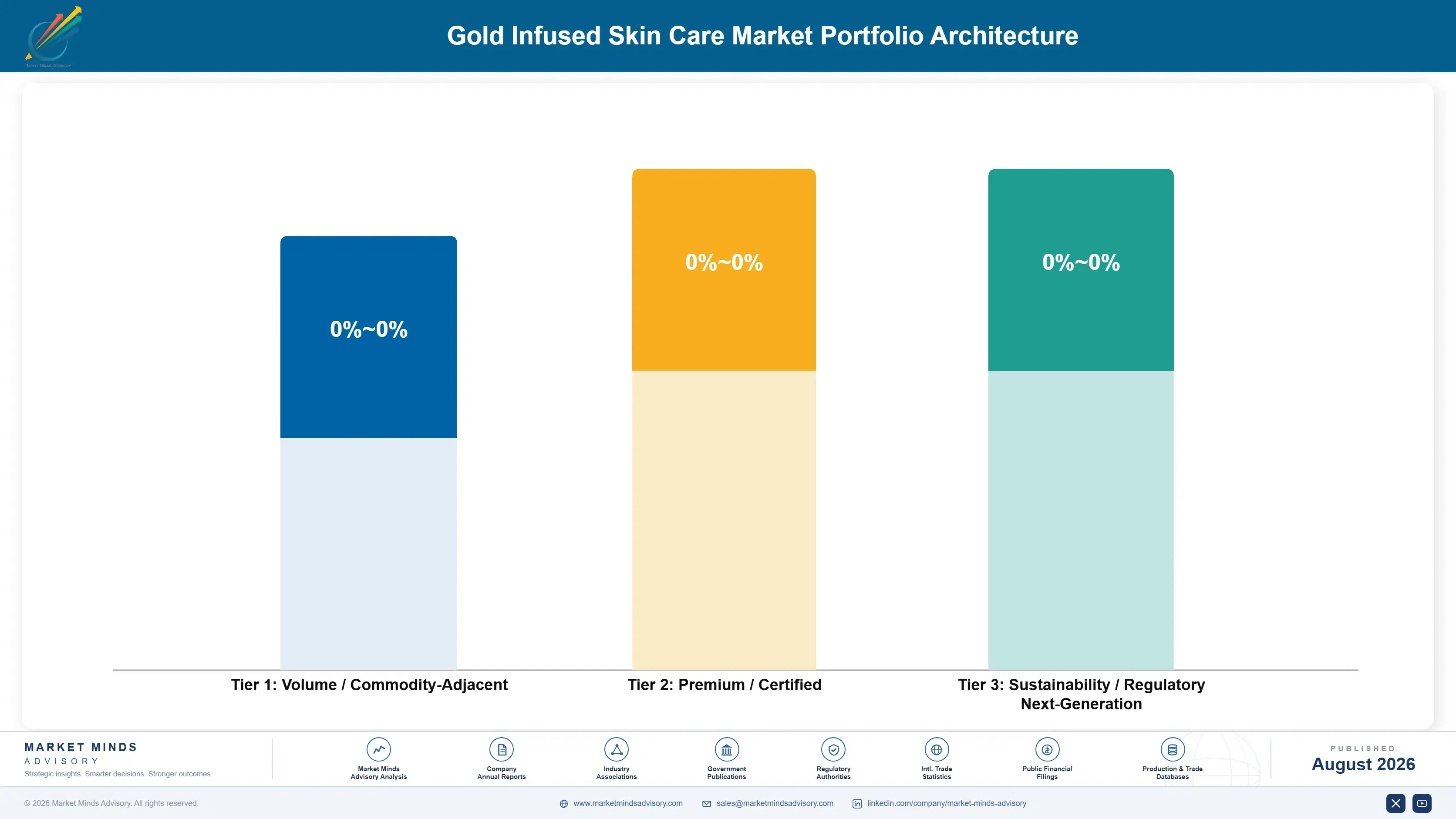
Margin here follows presentation rather than formulation, which is unusual even in prestige beauty. Two products with identical gold loadings can differ by a factor of five in retail price on packaging and brand alone, and the cost difference between them is almost entirely the jar. Brands costing on delivered margin after packaging run a completely different portfolio from those costing on formulation.
Volume and premium pull against each other through credibility rather than cost. The accessible tier builds familiarity with the ingredient and funds the packaging volumes that make the premium tier's costs work, but it undermines the scarcity signalling that justifies the premium price. A brand selling gold cream in grocery has a harder conversation at the beauty counter. Most participants pick one end and stay there.

High-value pools sit in Gulf gifting, in the nanoparticle segment outside Europe and in contract formulation. The third is the least visible: the Korean and Japanese houses that formulate gold products for Western brands earn a reliable margin regardless of whose name goes on the jar, and they have visibility into every competitor's range at the same time. Nobody in the West has built the equivalent position.

Volume / Commodity-Adjacent

Gold-infused creams, cleansers and body preparations sold through grocery, pharmacy and marketplace channels at accessible price points. Competes on price against conventional skincare offering more demonstrable benefit. The 9 point spread reflects packaging specification, which varies enormously across the tier.
Gross Margin: 52 to 61%

Premium / Certified

Gold leaf masks and prestige serums sold through department store beauty halls and specialist prestige retail. Presentation and brand credibility support the price rather than any demonstrated function. The 9 point spread reflects channel mix between own retail and wholesale distribution.
Gross Margin: 68 to 77%

Sustainability / Regulatory / Next-Generation

Colloidal gold nanoparticle serums sold outside Europe, documented safety files licensed to other brands and contract formulation supplied to Western houses. Margins are high because capability is scarce rather than because volume is large. The 12 point spread separates finished product from formulation services.
Gross Margin: 72 to 84%
gold-infused-beauty-products-market-portfolio-architecture-1788171200942

High-value Sub-segments and Strategic Watch-out

Colloidal Gold Nanoparticle Serums

High value and high growth at 13.2%. The only gold format with a genuine research literature behind it, and now prohibited in European cosmetics, which concentrates the segment outside that region entirely. The 8 point spread reflects whether the safety file is held directly or licensed.
Gross Margin: 74 to 82%

Gold Leaf Facial Masks

High value with strong growth at 11.0%. A visible sheet of gold photographs extraordinarily well, which is the entire mechanism, and it dominates the gifting channel driving over a third of units. The 8 point spread reflects whether the leaf is sourced directly or through a converter.
Gross Margin: 66 to 74%

Gold-Infused Creams and Moisturisers

The volume core. It earns solid margins but builds the familiarity that erodes the scarcity signal the premium tier depends on, which is a genuine internal tension. The 9 point spread reflects packaging specification, which varies enormously between different channels and between the individual brands.
Gross Margin: 50 to 59%

Unsubstantiated Efficacy Positioning

The strategic watch-out. An anti-ageing claim attached to an inert metal has no substantiation available anywhere, and claims regulation is tightening across every major market at once. The 30 point spread reflects how much of the volume still sells on an explicit function claim today.
Gross Margin: 48 to 78%

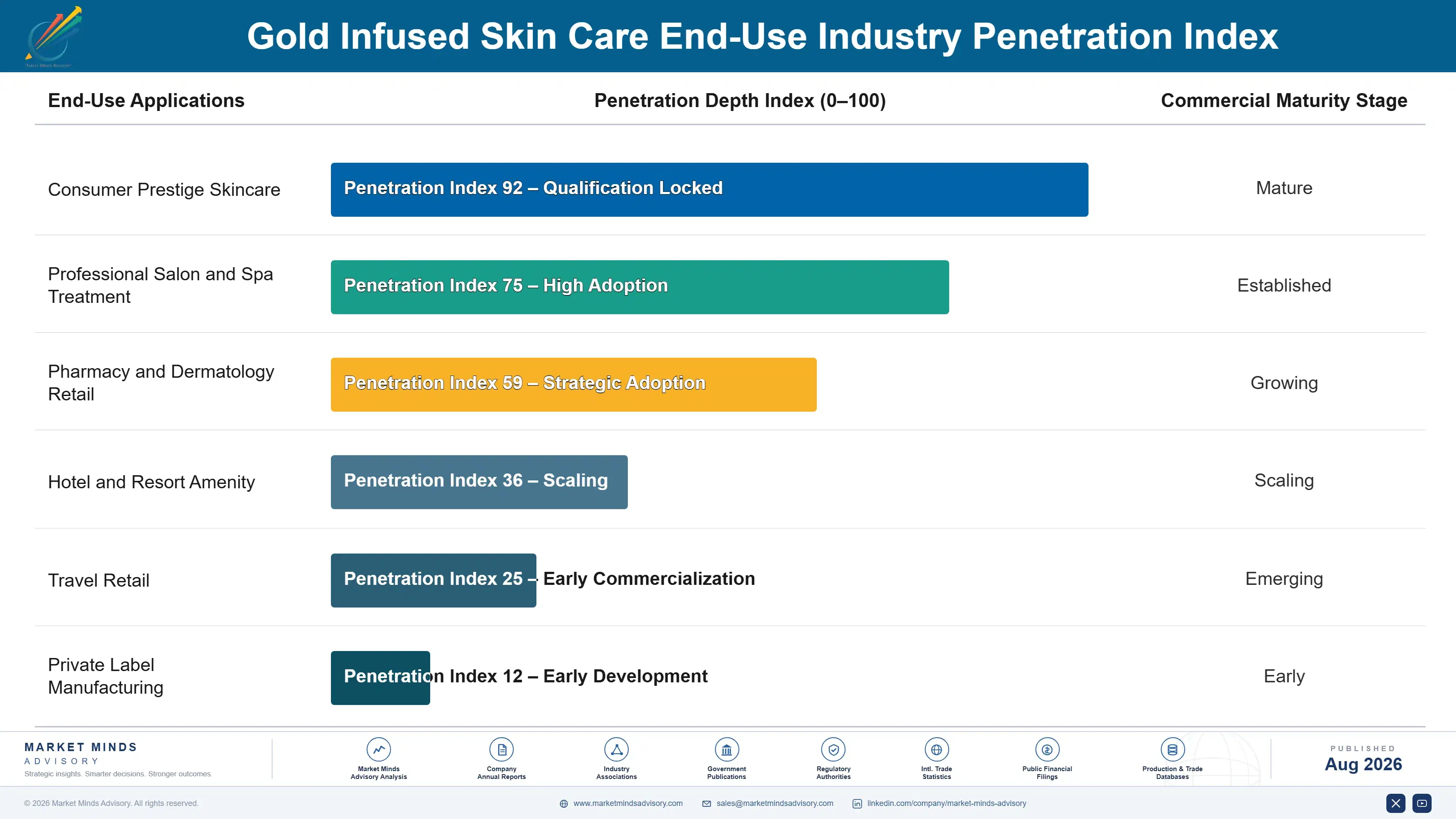
Who Actually Buys The Gold

The annuity in this category is weaker than the price points suggest. A gold mask is bought for an occasion rather than as part of a routine, and 37% of units go to somebody who will never repurchase because they were buying a gift. Regular users exist and repurchase reliably, but they are a minority of everybody the category sells to in any given year.
Stickiness varies by why somebody arrived. Buyers in South Asia and the Gulf came through tradition, and they repurchase across years without the category having to persuade them of anything. Western buyers arrived through social content and behave accordingly, moving on when the next ingredient becomes visible. Gift buyers show no loyalty and choose on presentation, which is why the packaging investment outperforms the formulation one.

Buyer profiles have shifted toward scepticism in the West and not at all elsewhere. Western buyers increasingly read ingredient lists and ask what the gold does, which is a question the category cannot answer honestly. Asian and Gulf buyers ask nothing of the sort, because the association is cultural rather than clinical. Brands running one global claims strategy are answering the wrong question in most markets.
gold-infused-beauty-products-market-end-use-penetration-index-1788171201439

Selling What It Actually Is

These are among the four positions where our research anticipates prominent divergence between winners and laggards over the coming forecast period. Each is grounded in the demand model, the regulatory perimeter, and the announced capacity pipeline.
01 / GIFT OCCASION MERCHANDISING

Build the range for the gift buyer

Around 37% of units in this category are bought as gifts by somebody who will never use the product, which makes efficacy entirely irrelevant to more than a third of all demand. That buyer chooses on presentation, packaging and price signal, and never asks the question this category cannot answer. Building ranges and calendars around gifting occasions costs nothing beyond merchandising attention, and most brands still spend their effort addressing the smaller and more sceptical half of the whole market.
02 / CLAIM REPOSITIONING DISCIPLINE

Claim the formulation, not the metal

Gold contributes around 4% of cost of goods and nothing measurable to skin, while the peptides, humectants and actives around it do the actual work and carry actual published literature behind them. Moving the claim onto those ingredients keeps the gold as price and visual signalling while giving the brand something a substantiation request can actually be answered with. The change costs no reformulation whatever, only a rewrite, and it becomes considerably harder to do under any real regulatory pressure.
03 / GULF OCCASION SUPPLY

Serve the calendar that pays the most

Gulf buyers pay more for gold-positioned skincare than anybody else in the world, and the demand concentrates around religious and family occasions whose dates are known years in advance. The region takes 7% of world demand on a fraction of the population, which is why the share sits above its usual band. Very few Western brands build ranges, pack sizes or shipment timing around that calendar, and the highest-price market is served by whatever the standard assortment happens to be.
04 / REGULATORY DIVERGENCE POSITION

Hold the nanoparticle segment where it is permitted

European regulation now prohibits colloidal gold in cosmetics while the same segment grows at 13.2% across every other region, which is an unusual situation where regulatory divergence creates an exportable advantage rather than a cost. A brand with a documented nanoparticle safety file and distribution across Asia, the Gulf and North America holds a position European competitors cannot occupy at all. The risk is contagion, so the safety file matters considerably more than the actual formula itself could ever do.

Engagement Snapshot From the Field

A live engagement with an industry participant carrying material or product regulatory and market exposure ahead of a defining policy shift, showing how our research translates into a defensible multi-year portfolio strategy.
MARKET MINDS ADVISORY · CLIENT ENGAGEMENT SUMMARY
Gold Infused Skin Care Producer Strategic Portfolio Review and Transition Roadmap 2026·Investment Scenario on Gold Infused Skin Care Exposure Evaluation 2025-26
CLIENT PROFILE
A European prestige skincare house with a gold-positioned range sold through department store beauty halls and travel retail across fourteen countries, with annual revenue in the low hundreds of millions of euros (client-reported, unverified by MMA). The range included a colloidal gold serum that carried the highest price point and the strongest efficacy language in the entire portfolio.
STRATEGIC CHALLENGE
The European prohibition on colloidal gold removed the range's flagship product from its home market with a fixed compliance date, and a retailer had separately queried the efficacy language on two other products. Management wanted to know what could be sold where, what the claims exposure actually was, and whether the gold positioning was still worth defending.
MMA APPROACH
MMA mapped every claim in the range against the substantiation standards applying in each of the fourteen markets, and separated the products by permitted gold form. Forty-seven expert interviews with regulatory specialists, dermatologists, retail buyers and Gulf distributors established what language would survive review, what the nanoparticle file would require elsewhere, and where the demand actually sat.
KEY FINDINGS
  1. Gulf and Asian markets accounted for 58% of the range's revenue despite receiving a fraction of its marketing budget and none of its merchandising attention.
  2. The colloidal serum remained permitted in eleven of the fourteen markets, and the compliance work needed to defend it there was modest.
  3. Every efficacy claim attributable to gold itself failed the substantiation test, while claims attributable to the surrounding peptide complex passed the test comfortably.
  4. Gulf retail buyers said gifting-specific pack formats timed to two annual occasions would materially increase orders, and no competitor was supplying them.
CLIENT PROFILE
A European prestige skincare house with a gold-positioned range sold through department store beauty halls and travel retail across fourteen countries, with annual revenue in the low hundreds of millions of euros (client-reported, unverified by MMA). The range included a colloidal gold serum that carried the highest price point and the strongest efficacy language in the entire portfolio.
STRATEGIC CHALLENGE
The European prohibition on colloidal gold removed the range's flagship product from its home market with a fixed compliance date, and a retailer had separately queried the efficacy language on two other products. Management wanted to know what could be sold where, what the claims exposure actually was, and whether the gold positioning was still worth defending.
MMA APPROACH
MMA mapped every claim in the range against the substantiation standards applying in each of the fourteen markets, and separated the products by permitted gold form. Forty-seven expert interviews with regulatory specialists, dermatologists, retail buyers and Gulf distributors established what language would survive review, what the nanoparticle file would require elsewhere, and where the demand actually sat.
KEY FINDINGS
  1. Gulf and Asian markets accounted for 58% of the range's revenue despite receiving a fraction of its marketing budget and none of its merchandising attention.
  2. The colloidal serum remained permitted in eleven of the fourteen markets, and the compliance work needed to defend it there was modest.
  3. Every efficacy claim attributable to gold itself failed the substantiation test, while claims attributable to the surrounding peptide complex passed the test comfortably.
  4. Gulf retail buyers said gifting-specific pack formats timed to two annual occasions would materially increase orders, and no competitor was supplying them.
RECOMMENDED STRATEGY
Phase 1: Phase one: reattribute every efficacy claim in the range to the peptide complex rather than to the gold, across all fourteen markets. Phase 2: Phase two: retain and defend the colloidal serum in the eleven markets where it remains permitted, and build the safety file properly. Phase 3: Phase three: redirect marketing budget toward Gulf and Asian markets, with gifting pack formats timed to the two occasions retail buyers identified.
OUTCOME
Within four quarters the reworded range passed two retailer claims reviews without a single product being delisted, and the colloidal serum continued selling in eleven markets (client-reported, unverified by MMA). Gulf revenue grew materially on the gifting formats, and the marketing reallocation cost nothing beyond moving spend that had been reaching the wrong customers.

Frequently Asked Questions

Foundational context covering the market sizes, CAGR, scope, country, region and competition that inform every finding below. This section is provided to cover basics and most often pre-purchase conversations, answered from the MMA Primary Research Dataset.

What is the current size of the Gold Infused Skin Care Market?

The global gold infused skin care market was valued at USD 1.9 billion in 2025, covering topical products positioned on metallic gold content. The 2026 figure reaches USD 2.07 billion.

How large will the Gold Infused Skin Care Market be by 2036?

MMA forecasts USD 4.81 billion by 2036, an increase of USD 2.74 billion over the 2026 base. That represents an expansion multiple of 2.32 times across the forecast period.

What is the CAGR for the Gold Infused Skin Care Market 2026 to 2036?

The base case compound annual growth rate is 8.8%, with a bull case at 10.0% and a bear case at 7.6%. Historical growth between 2020 and 2025 ran at 7.8%.

Which segment is growing fastest?

Colloidal gold nanoparticle serums grow at 13.2%, half again the market rate of 8.8%, because nanoscale gold has an actual research literature. Gold leaf masks follow at 11.0%.

Who are the major companies in the Gold Infused Skin Care Market?

Amorepacific, Shiseido, Peter Thomas Roth Labs, OROGOLD Cosmetics and Forest Essentials lead on gold-positioned skincare revenue, with combined CR5 of 18%. The tail is exceptionally long.

Which country is growing fastest?

India grows fastest at 11.0%, on an Ayurvedic tradition of gold preparation that predates the modern category entirely. South Asia and Pacific leads regionally at 11.0%.

Report Segmentation Architecture

The full report scope spans multiple orthogonal segmentation dimensions, with cross-tabulated demand data provided for each dimension pair. Coverage extends further to regional breakdowns, trend trajectories, and the competitive detail needed to support segment-level decision-making.

By Product Format

  • Colloidal Gold Nanoparticle Serums
  • Gold Leaf Facial Masks and Sheets
  • Gold-Infused Creams and Moisturisers
  • Gold Eye Treatments and Patches
  • Gold Cleansers and Toners
  • Gold Body and Bath Preparations

By End-Use Industry

  • Consumer Prestige Skincare
  • Professional Salon and Spa Treatment
  • Pharmacy and Dermatology Retail
  • Hotel and Resort Amenity
  • Travel Retail
  • Private Label Manufacturing

By Commercial Dimension

  • Department Store Beauty Halls
  • Specialist Prestige Retail
  • Online Marketplaces
  • Brand Direct Channels
  • Direct Selling Networks
  • Distributor and Wholesale Supply

By Region

  • North America
  • Western Europe
  • East Asia
  • South Asia and Pacific
  • Latin America
  • Middle East and Africa
  • Eastern Europe

Scope, Methodology, and Coverage

Every figure in this report is reproducible from documented input assumptions. The scope below maps the historical period, the forecast horizon, the segmentation dimensions, and the countries covered, alongside the underlying primary and qualitative methodology.
Historical Period
2020 to 2025
Forecast Period
2026 to 2036
Base Year
2025 (USD billions; MMA Primary Research Dataset, August 2026)
Market Definition
The gold infused skin care market covers finished topical skincare products whose primary marketed active or positioning is metallic gold in any form, spanning gold leaf, colloidal gold nanoparticles, gold peptide complexes and gold salt preparations. Scope includes serums, masks, creams, eye treatments, cleansers and body preparations sold to consumers and through professional treatment channels. Excluded are gold-coloured packaging carrying no gold content, gold jewellery and cosmetic devices, colour cosmetics using metallic pigments, and gold compounds used in pharmaceutical rheumatology preparations.
Quantitative Units
USD billion, 2025 base year, 2026 to 2036 forecast period
Segmentation Dimensions
Product format, end-use channel, commercial model, region
Regions Covered
North America, Western Europe, East Asia, South Asia and Pacific, Latin America, Middle East and Africa, Eastern Europe
Countries Covered
United States, Canada, Germany, France, United Kingdom, Italy, Spain, Poland, China, Japan, South Korea, India, Australia, Brazil, Mexico, Saudi Arabia, United Arab Emirates, South Africa
Key Companies Profiled
20 companies across prestige houses, specialist gold brands and contract formulators
Quantitative Methodology
Primary survey, n=3,800 respondents, Q4 2025, six countries; demand-side model with trade association cross-validation
Qualitative Methodology
47 expert interviews, Q4 2025; applied to validate demand model assumptions, identify emerging dynamics, and assess competitive positioning
Report Format
PDF and XLSX data workbook (Word format preview document)
Publisher
Market Minds Advisory
Report Code
MMA-2026-CHM-221
Published
August 2026
Contact
sales@marketmindsadvisory.com | www.marketmindsadvisory.com

Purchase the full Gold Infused Skin Care Market Report (2026 to 2036).

The full MMA report on the gold infused skin care market runs to detailed format and regional models across the 2026 to 2036 forecast period, with cost benchmarks separated by gold form and packaging specification. It profiles 20 companies on a consistent retail revenue basis, covering prestige houses, specialist gold brands and the contract formulators supplying both. Regulatory status for each gold form is mapped market by market alongside the claims language surviving review. Regional chapters cover the seven MMA regions with country-level detail on the eighteen markets surveyed. Primary research draws on a quantitative survey of 3,800 respondents across six countries and 47 expert interviews conducted in Q4 2025.
Cost benchmarks separated by gold form and packaging
Regulatory status for each gold form by market
Claims language analysis across regulated jurisdictions
Twenty company profiles on consistent revenue basis
Gifting occasion calendar mapped across Gulf markets
Seven regional chapters with eighteen country detail tables

Built For The People Who Decide

From boardroom strategy to bench-side execution, this report is read cover-to-cover by leaders shaping the next decade of their industry, turning demand scenarios, market dynamics and valuation benchmarks into decisions.
CXOs/ Presidents/ VPs/ Managers
M&A and Corporate Development
Strategy Teams and R&D Heads
Procurement and Product Directors
Regulatory and Compliance Leaders
Investor Relations and Equity Analysts