

Market Minds Advisory
Global Water-Borne Inks and Paints Market

Global Water-Borne Inks and Paints Market: Drying Energy, the Substrates That Never Converted, and Freeze Risk Nobody Costs

Removing solvent moved the problem rather than solving it. Water takes far more energy to evaporate, and the oven that dries it now costs more to run than the solvent recovery it replaced.

Lead Analyst

Bilal Shaikh

Published

September 2026

Make Smarter Decisions with Customized Research Insights

Request a free sample report and evaluate market opportunities, growth trends, and competitive dynamics relevant to your business needs.

2025 MARKET VALUE$68.4BMarket Size 2025
2036 FORECAST VALUE$129.8BBase Case , 2026 to 2036
CAGR 2026 TO 20366.0 %Bull 7.2% / Bear 4.8%
INCREMENTAL OPPORTUNITY$57.4BNet 10- year value creation
EXPANSION MULTIPLE1.79x2036 value over 2026 base
Strategic Levers
M&A Pipeline
Regional Outlook
Country Rankings
Competitive Intelligence
Segmental Deep-dive
Call-Us : 91 93563 13602

Executive Snapshot and Market Trajectory

Water needs roughly 4.4 times the energy of a typical solvent to evaporate from a wet film, which nobody mentioned when the industry converted. The emissions went down and the drying oven bill went up, and on some lines it went up more. Almost nobody costed that beforehand.
Commercial advantage belongs to formulators who solve the substrates that never converted rather than those defending architectural volume already water-borne, because industrial metal, wood, and plastic coatings still resist for genuine technical reasons. Water-borne industrial and metal coatings grow fastest at 9.6%, roughly 1.60 times the market. East Asia holds 33% of value, above the standard band. Nothing about that reflects a specification premium.
Concentration is moderate at roughly 34% for the top five, held by resin capability and application support rather than by any barrier to dispersing pigment in water. Architectural conversion is essentially complete at 84%. Freeze damage in transit and storage costs the industry real money nobody puts in a budget line. Freeze-thaw stability packages cost money and less than the losses do, which is a comparison very few formulators have ever actually run.
Market Definition
The market comprises water-borne coatings and printing inks supplied to industrial, architectural, and packaging users, covering architectural and decorative paints, water-borne packaging and publication inks, wood and furniture coatings, industrial and metal coatings, water-borne automotive coatings, and textile and specialty inks. Value is measured at formulator level. Solvent-borne, powder, and radiation-cured systems, resins and pigments sold as raw materials, application equipment and drying ovens, and coating or printing services fall outside scope.
Base Year Value
$68.4B in 2025 (MMA Primary Research Dataset, August 2026)
Forecast Period
2026 to 2036, eleven discrete annual values
CAGR
6.0% base case. Bull 7.2%. Bear 4.8%.
Fastest Growth Segment
Water-Borne Industrial and Metal Coatings: 9.6% CAGR
Fastest Growth Country
India: 9.8% CAGR
Fastest Growth Region
South Asia and Pacific: 8.2% CAGR
Largest Region
East Asia: 33% of 2025 global value
Market Leaders
PPG Industries, Sherwin-Williams, AkzoNobel, Sun Chemical, and Nippon Paint lead on water-borne coatings and ink revenue. Source: company annual reports and MMA Analysis, July 2026.
Primary Survey
n=3,800 procurement and R&D decision-makers, Q4 2025, six countries
Methodology
Demand-side build-up, cross-validated against public data, 47 expert interviews

Global Water-Borne Inks and Paints Market Forecast Scenarios

global-water-borne-inks-and-paints-market-size-forecast-scenario-1787553609437
Between 2020 and 2025 the easy conversions finished and the difficult ones stalled. Architectural paint reached near-complete water-borne penetration in developed markets, and packaging inks converted steadily under food contact and emissions pressure. Industrial metal, wood, and plastic coatings stayed largely solvent-borne because the performance gap is real rather than rhetorical. The 5.0% historical rate combines a completed conversion with an unfinished one nobody has yet solved.
The 6.0% base case rests on three mechanisms. Emissions regulation keeps tightening on industrial coating operations that architectural rules addressed decades ago, which forces the harder conversions regardless of readiness. Resin technology continues improving corrosion resistance and hardness on metal substrates. And packaging ink conversion continues as food contact scrutiny extends into more categories and jurisdictions. None of the three depends on architectural paint volumes growing anywhere at all. Regulation carries all three.
The 7.2% bull case assumes industrial resin performance closes enough for broad metal coating conversion while energy costs moderate. The 4.8% bear case reflects industrial coating operations relocating rather than converting, drying energy costs deterring conversion where emissions rules permit a choice, and freeze losses plus shorter shelf life eroding the economics in cold and remote markets.

The Energy Nobody Costed

The conversion story is usually told as a straight environmental win and the physics complicate it. Evaporating water from a wet film takes roughly 4.4 times the energy a typical solvent needs, which means the drying oven runs hotter, longer, or both. On lines that previously recovered and reused solvent, the operating cost went up rather than down, and several converted plants discovered that only after commissioning.
TOP-FIVE CONCENTRATION34%Combined share of water-borne supply held by leading formulators
EVAPORATION ENERGY RATIO4.4 timesEnergy needed to evaporate water against a typical solvent
ARCHITECTURAL CONVERSION RATE84%Share of decorative paint volume already using water-borne systems
INDUSTRIAL CONVERSION RATE37%Share of industrial and metal coating volume converted so far
FREEZE LOSS RATE2.8%Portion of volume damaged by freezing during transit or storage
RESIN COST SHARE43%Portion of formulated cost accounted for by binder resin
Architectural paint reached 84% water-borne penetration and that conversion is effectively finished in developed markets. Industrial and metal coatings sit at 37% and have stalled, because corrosion resistance, hardness, adhesion to bare metal, and humidity tolerance during cure are all genuinely harder to achieve without solvent. That gap is technical rather than commercial, which is why exhortation has not moved it.
The unglamorous problem is freezing. A water-borne coating that freezes in a container coagulates irreversibly, and roughly 2.8% of volume is lost in transit or storage to exactly that. Cold-climate distribution, unheated warehouses, and long supply chains all raise the exposure. Formulators add freeze-thaw stability packages that cost money, and nobody puts the loss in a budget line anywhere.
"The industry converted everything that was easy and then wrote reports saying conversion was progressing. What is left is metal in humid factories and wood that swells when you put water on it, and no amount of regulatory pressure changes either of those facts."
Practice Director, Coatings, Inks and Surface Chemistry · MMA Coatings and Printing Inks Practice · August 2026

Market Trends

Industrial Emissions Rules Force the Harder Conversions

Architectural coating emissions were addressed decades ago and industrial coating operations are only now facing comparable limits across more jurisdictions, which forces conversion on substrates where water-borne performance genuinely lags. Industrial and metal coatings sit at 37% converted and the remaining volume is the difficult part rather than the neglected part. Some operations will relocate instead of converting. Formulators who solve corrosion resistance and cure humidity tolerance reach demand that regulation is creating whether the chemistry is ready or not. Exhortation has not moved this and nor has another decade of development spending.
Market Impact: Packaging inks reach 61% converted

Drying Energy Costs Reshape the Conversion Arithmetic

Water takes roughly 4.4 times the energy of a typical solvent to evaporate, and lines that previously recovered solvent for reuse frequently found operating costs rose after conversion rather than falling. European energy prices sharpened that considerably. Where emissions rules leave a genuine choice, some operators are choosing powder or radiation-cured systems instead of water-borne on exactly this arithmetic. Formulators who reduce required film build or cure temperature address the objection directly rather than arguing about it. Arguing the environmental case without engaging that number loses conversions to competing technologies entirely.
Market Impact: East Asia holds 33% of value

Market Opportunities and Growth Drivers

Food Contact Scrutiny Extends Packaging Ink Conversion

Migration of ink components through packaging into food has driven regulatory and retailer scrutiny that keeps widening across categories and jurisdictions, and water-borne systems remove a class of concern that solvent residues create. Flexible packaging, corrugated, and label printing have all converted substantially. Set-off and migration from the reverse of a printed web remains a live technical issue independent of the carrier. Brand owner specifications now frequently move ahead of regulation entirely. Set-off from the reverse of a printed web remains a live technical issue independent of the carrier, and it complicates conversion in ways nobody advertises.
Market Impact: Freezing destroys 2.8% of volume

Asian Coating Demand Anchors Volume Growth

Chinese and Indian construction, furniture, appliance, and packaging manufacture continue expanding, and emissions regulation across both is tightening on schedules that pull water-borne conversion forward. India grows fastest of any country at 9.8% as construction and manufacturing expand simultaneously. East Asia holds 33% of value, above the standard band, on manufacturing and construction concentration rather than any specification premium. Domestic formulators supply most volume at costs international competitors cannot approach. High humidity across much of the region genuinely complicates water-borne cure in industrial applications, which is a technical constraint temperate specification never anticipates at all.
Market Impact: Metal conversion stuck at 37%

Market Restraints and Challenges

Freeze Damage Costs More Than Anybody Budgets

A water-borne coating that freezes coagulates irreversibly, and roughly 2.8% of volume is destroyed in transit or unheated storage every year without appearing as a line in anybody's cost model. The root cause is that water freezes and solvent largely does not. Formulators mitigate through freeze-thaw stability packages that add cost, through winter distribution protocols and heated storage, and by being explicit with distributors in cold climates about handling rather than assuming it is understood. Very few formulators quantify this exposure or discuss it with the distributors absorbing the loss themselves.
Market Impact: Industrial conversion stalled at 37%

Substrate Performance Gaps Are Physical Rather Than Commercial

Water swells wood fibre, struggles to wet bare metal, and cures unpredictably in humid factory air, which are properties of the carrier rather than failures of formulation effort. Industrial conversion has therefore stalled at 37% despite decades of development. Formulators mitigate through resin design improving corrosion resistance and hardness, through surface preparation and primer systems that address wetting, and by accepting that some substrates will convert to powder or radiation-cured systems instead of water. Decades of development effort have narrowed the gap without closing it, which is what physics rather than diligence produces.
Market Impact: Water needs 4.4 times the energy
4 additional market trends, 3 additional growth drivers, and 2 additional restraints and challenges are covered in the full report. Contact sales@marketmindsadvisory.com to access the complete intelligence.

Segment CAGR and Growth Architecture

Segmentation follows application area, because substrate, cure conditions, and performance requirement determine how far water-borne technology has actually converted each one. Six areas cover commercial supply, and the divide between applications where conversion is finished and those where physics still resists matters far more commercially than any distinction between resin chemistries. Resin chemistry follows from the substrate.
global-water-borne-inks-and-paints-market-market-share-analysis-1787553610019

Water-Borne Industrial and Metal Coatings

The fastest area at 9.6%, roughly 1.60 times the market, and the one where conversion has genuinely stalled at 37% for technical reasons rather than commercial reluctance. Corrosion resistance, hardness, adhesion to bare metal, and cure behaviour in humid factory air are all harder to achieve without solvent. Emissions regulation is forcing the conversion regardless, which creates demand that resin performance has not fully earned. Formulators solving flash rust, cure window, and salt spray performance reach applications competitors simply cannot quote against at all. Some operations will relocate rather than convert, which is a real outcome that regulatory impact assessments rarely acknowledge and that formulators should factor into any demand forecast.
CAGR 9.6%

Wood and Furniture Coatings

Second fastest at 7.4%, held back by the simple fact that water raises wood grain and swells fibre, which requires additional sanding steps that add labour cost a furniture manufacturer notices immediately. Clarity, build, and hardness on high-gloss finishes remain harder to match than on architectural surfaces. Emissions rules in furniture manufacturing regions are forcing conversion regardless of those obstacles. Formulators who reduce grain raise and cut the intermediate sanding requirement address the real objection rather than the one stated in a specification. Furniture manufacturing has also relocated toward regions with lighter enforcement, which means some of this conversion is not happening so much as moving somewhere it is not required yet.
CAGR 7.4%
Full segment breakdown across 6 segments available in the complete report.

Regional Architecture and Country Demand Map

Regional shares follow construction, manufacturing, and packaging activity weighted by how far emissions regulation has forced conversion. East Asia sits above the standard band for the reason stated below, and every other region falls inside its range. Regulation rather than demand decides most of this map.

North America

Architectural conversion finished decades ago under state and federal emission rules, and industrial coating operations are now facing comparable limits that vary considerably between jurisdictions. Cold-climate distribution makes freeze protection a genuine formulation and logistics requirement across large parts of the continent every winter. PPG, Sherwin-Williams, and Sun Chemical hold strong positions with deep industrial application support. Wood and furniture coating conversion lags because much manufacturing relocated rather than converted. Growth of 5.8% depends on industrial conversion advancing rather than any architectural volume increase. Industrial conversion decisions here frequently come down to whether a plant can absorb the drying oven capital alongside the coating change, which is a considerably larger investment than the formulation itself.
Share: 23% | CAGR: 5.8% (2026 to 2036)

Western Europe

Emissions regulation on industrial coating is the most advanced anywhere, which forces conversion on substrates where performance genuinely lags and leaves operators choosing between water-borne, powder, and radiation-cured alternatives. Energy costs make the drying penalty considerably more visible here than in cheaper power markets, and that arithmetic is steering some conversions toward powder instead. AkzoNobel and regional formulators hold deep technical positions. Growth of 4.6% is the slowest anywhere, reflecting completed architectural conversion and weak industrial production volumes. Formulators here have the deepest industrial resin capability anywhere and the weakest industrial production volumes to apply it to, which is an uncomfortable position that regional competitors in growing markets do not share. Development spending is hard to justify against it.
Share: 20% | CAGR: 4.6% (2026 to 2036)
Regional intelligence for 5 additional markets available in the complete report: East Asia, South Asia and Pacific, Latin America, Middle East and Africa, Eastern Europe. Contact sales@marketmindsadvisory.com.
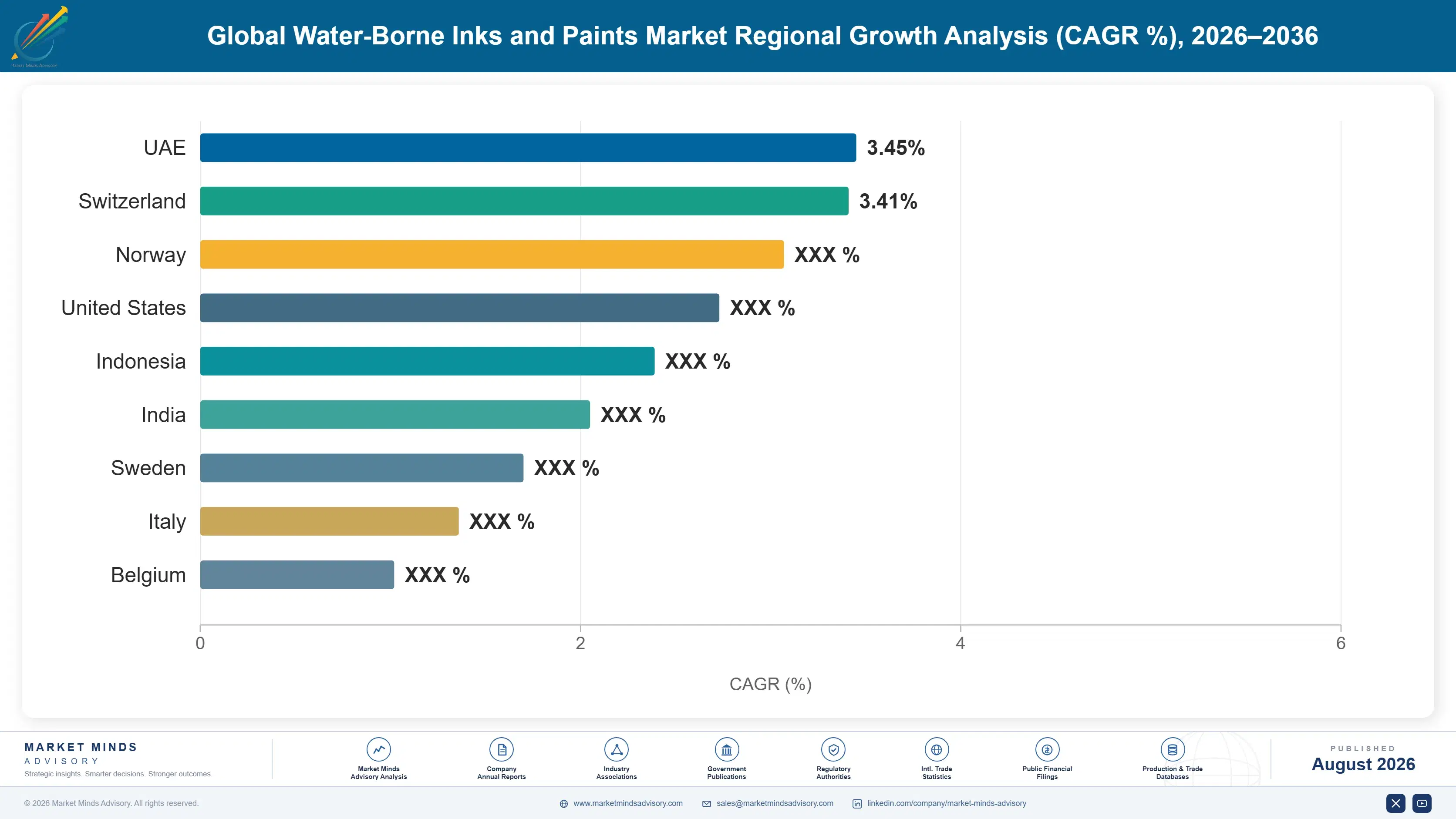
global-water-borne-inks-and-paints-market-country-cagr-analysis-1787553610544

Four Moves Worth Real Capital

Advantage here comes from solving substrates that resisted conversion, answering the energy objection rather than dismissing it, and protecting product that freezes on the way to a customer. Four moves justify capital across the forecast period, and the first addresses where the remaining growth genuinely sits. Architectural volume does not appear among the four.

Solve the metal substrate, not the architectural one

Architectural conversion is finished at 84% and industrial coating has stalled at 37% because flash rust, cure window, hardness, and salt spray performance are genuinely harder without solvent. Emissions regulation is forcing that conversion anyway, which creates demand resin performance has not fully earned yet. Formulators who solve those properties reach applications competitors cannot quote against at all, and the segment grows at 9.6% against a market rate of 6.0%. Some operations will relocate rather than convert, which formulators should factor into demand forecasts that regulatory impact assessments consistently fail to acknowledge at all.
Market Impact: Addresses the 63% of industrial volume still unconverted

Answer the drying energy objection with formulation

Water takes roughly 4.4 times the energy of a solvent to evaporate, and operators who previously recovered solvent found costs rose after converting. Where regulation permits a choice, some are selecting powder or radiation-cured systems on exactly that arithmetic. Reducing required film build, lowering cure temperature, or improving open time addresses the objection directly. Formulators who argue the environmental case without engaging the energy number lose those conversions to competing technologies entirely. Drying oven capital is frequently a larger investment than the coating change itself, which means the conversation belongs with a plant engineer rather than a purchasing officer.
Market Impact: Answers an evaporation energy penalty of 4.4 times

Engineer freeze stability into the distribution chain

Roughly 2.8% of volume is destroyed by freezing in transit or unheated storage each year without appearing anywhere in a cost model, and cold-climate and long-supply-chain markets carry considerably more. Freeze-thaw stability packages cost money and less than the losses do. Being explicit with distributors about handling rather than assuming it is understood costs nothing at all. Very few formulators quantify this exposure or discuss it with the customers absorbing it. Distributors absorb the loss silently and rarely report it, which means the formulator sees no signal until somebody actually goes looking through warehouse records.
Market Impact: Recovers an annual freeze loss reaching 2.8% of volume

Cut the sanding step out of wood conversion

Water raises wood grain and swells fibre, which forces an intermediate sanding operation that adds labour a furniture manufacturer feels immediately and mentions in every conversation. That is the actual objection rather than the clarity or hardness questions usually cited in a specification. Formulators who reduce grain raise remove a cost the customer can measure. Wood coatings grow at 7.4% and emissions rules are forcing conversion regardless of whether the objection is answered. Coating performance and appearance frequently pass the trial while the sanding operation kills the conversion, which is a distinction development programmes routinely fail to make at all.
Market Impact: Removes a labour step from a 7.4% segment

Who Controls the Margin Pool

Concentration sits at roughly 34% for the top five on water-borne revenue, held by resin capability and application support rather than by any barrier to dispersing pigment in water. PPG and Sherwin-Williams hold the broadest industrial and architectural positions. AkzoNobel brings deep European technical and regulatory depth, Sun Chemical leads packaging ink formulation, and Nippon Paint anchors an enormous Asian position across architectural and industrial ranges.
Competition runs on three dimensions. Resin performance on difficult substrates is the first, since that is where the remaining conversion sits. Application support is the second, because a converted line frequently needs process changes rather than just a different product. Distribution and handling capability is the third, particularly in cold climates where freeze losses are real. None of the three is about dispersing pigment at all.

Pressure is building from two directions. Domestic Asian formulators supply architectural and general industrial volume at prices international competitors cannot approach. Powder and radiation-cured systems compete for exactly the conversions water-borne technology has not earned technically. Rankings will shift toward formulators solving difficult substrates rather than toward whoever supplies architectural volume most cheaply. Regulatory pressure creates the demand and technology choice decides who serves it.
global-water-borne-inks-and-paints-market-company-positioning-matrix-1787553611068

Competitive Moat and Risk Dimensions

PPG INDUSTRIES

Moat: Industrial resin and application depth

PPG develops resin systems for demanding industrial substrates and supports the process changes a converted coating line actually requires, which reaches the segment where conversion has stalled rather than the architectural volume already settled. Application engineering inside a customer plant is what makes a difficult conversion work at all. That capability took decades to build and cannot be assembled quickly.
PPG INDUSTRIES

Risk: Competing technology substitution

Powder and radiation-cured systems compete for exactly the industrial conversions water-borne technology has not yet earned on performance, and the drying energy arithmetic favours them in expensive power markets. Winning the regulatory argument does not guarantee winning the technology choice that follows it. Defending water-borne on difficult substrates requires resin performance that still lags on several properties.
SUN CHEMICAL

Moat: Packaging ink migration expertise

Sun Chemical holds deep formulation capability across packaging ink chemistry alongside migration and food contact expertise that brand owners increasingly require before a specification is set. That knowledge reaches decisions taken well upstream of any purchase order. Global supply capability also serves brand owners standardising ink specification across converters in several countries at once.
SUN CHEMICAL

Risk: Regional converter price competition

Packaging ink is bought by converters who tender annually on price, and regional formulators supply adequate general-purpose products at costs Sun Chemical cannot match on a comparable basis. Migration expertise defends brand-specified work and not the general converter volume underneath it. That volume still carries substantial fixed cost across formulation and manufacturing assets.

Players Tracked

Prominent Players

PPG Industries
Sherwin-Williams
AkzoNobel
Sun Chemical
Nippon Paint

Other Key Players

BASF
Axalta Coating Systems
RPM International
Asian Paints
Kansai Paint
Flint Group
Siegwerk
hubergroup
Jotun
Hempel
Beckers Group
Toyo Ink
DIC Corporation
Berger Paints
Tikkurila

Recent Developments

FEBRUARY 2025

Coating line selects powder over water-borne on energy

An industrial manufacturer facing emission limits chose a powder coating system rather than converting to water-borne, citing drying oven energy costs that would have exceeded the solvent recovery operation being replaced. Regulatory compliance was achieved either way under the operator's own assessment. Compliance was never the question.
Signal: Where regulation permits a genuine technology choice, drying energy arithmetic is now steering conversions away from water
JUNE 2025

Distributor reports winter freeze losses on shipped stock

A coatings distributor in a cold-climate market reported material losses from freezing in unheated warehouse and transit conditions, prompting the formulator to review freeze-thaw stability specification across the affected product range. The loss had not previously been tracked or reported at all. Nobody had asked for it.
Signal: Freeze losses are absorbed silently in distribution rather than measured, which hides a real annual cost
OCTOBER 2025

Furniture manufacturer rejects conversion on sanding labour

A furniture producer declined a water-borne conversion after trials showed grain raise required an additional sanding operation that added measurable labour cost per unit. Coating performance and appearance had both been judged entirely acceptable during the same trial programme. Only the additional labour operation blocked it.
Signal: Labour added by grain raise rather than coating performance is what actually blocks wood conversion work

What Formulating in Water Costs

Binder resin dominates at roughly 43% of formulated cost, covering acrylic, polyurethane, alkyd emulsion, and hybrid dispersions from a concentrated supplier base. Pigments and extenders take a further 22%, with titanium dioxide the single largest line in white and pastel systems. Additives including defoamers, coalescents, biocides, and freeze-thaw packages absorb 14%. Manufacturing, filling, and quality control carry the remainder across the portfolio.
Acrylic monomer and titanium dioxide pricing both moved sharply through 2021 and 2022 on feedstock, energy, and supply disruption, and formulators on annual customer agreements absorbed most of it directly. PPG and AkzoNobel both discussed raw material cost pressure and pricing actions in their reporting for those years. Biocide availability tightened separately under registration attrition, which affected water-borne systems specifically since solvent-borne formulations rarely need them.

Exposure divides on portfolio position and contract terms rather than on scale. Architectural formulators carry heavy titanium dioxide exposure against retail price points that reprice slowly and visibly. Industrial and packaging ink formulators carry resin exposure against annual customer agreements. Freeze-thaw and biocide packages add cost only to water-borne systems, which is a permanent penalty against competing technologies nobody discusses openly.
global-water-borne-inks-and-paints-market-cost-volatility-analysis-1787553611263

Index industrial agreements to resin references

Binder resin at 43% of formulated cost moves on acrylic monomer and feedstock prices that no formulator influences, yet annual industrial and converter agreements routinely fix pricing across that whole exposure. Indexation to published references removes the mismatch. Customers carry identical exposure through every alternative supplier and accept indexation considerably more readily than commercial teams generally anticipate.

Qualify alternative biocide chemistries early

Registration attrition keeps removing preservative actives from approval, and water-borne systems need them where solvent-borne formulations do not. Each withdrawal forces reformulation across affected products under time pressure. Qualifying alternates before a review concludes costs stability testing time rather than capital, and formulators who do it avoid an emergency their competitors will be managing.

Cost freeze-thaw protection against actual losses

Freeze damage destroys roughly 2.8% of volume in transit and storage without appearing in any cost model, while the stability packages that prevent it appear in formulated cost immediately and visibly. Comparing the two properly usually justifies the additive. Very few formulators have ever measured the loss well enough to make that comparison at all.

Portfolio Architecture for Margin Defence

Margin architecture follows technical difficulty rather than volume, which is why the largest application is not the profitable one. Architectural paint sold through retail and trade competes on brand, distribution, and price against regional formulators everywhere. Packaging inks earn more on migration and food contact expertise. Industrial metal, wood, and specialty applications earn most, because the conversion is technically hard and few formulators can actually deliver it.
The volume and premium tension shows in where formulators put development effort. Architectural systems are mature, well understood, and generate the tonnage that loads a plant. The remaining conversion sits in industrial applications requiring resin work that takes years and serves smaller volumes at better margins. Businesses organised around architectural volume find their development priorities pointing the wrong way entirely. Very few businesses have reallocated development against that reality.

High-value pools concentrate in industrial metal coatings solving flash rust and cure window, wood systems that remove the sanding step, and packaging inks supported by migration expertise. Each is defended by resin capability or regulatory knowledge rather than by manufacturing cost, which regional formulators already match on anything straightforward. Manufacturing scale defends almost nothing in this business now.

Volume / Commodity-Adjacent Tier

Architectural and decorative paint sold through retail and trade channels where conversion finished long ago and brand, distribution, and price decide. Regional formulators compete effectively everywhere. Technical differentiation is minimal at this end.
Gross Margin: 22%-32%

Premium / Certified Tier

Packaging and publication inks supported by migration testing and food contact expertise, plus general industrial coatings requiring application support. Regulatory knowledge defends this. The range reflects wide variation between converter-tendered and brand-specified work.
Gross Margin: 30%-42%

Sustainability / Regulatory / Next-Generation Tier

Industrial metal coatings solving corrosion and cure window problems, wood systems reducing grain raise, and specialty applications where water-borne performance is genuinely hard. Resin capability defends pricing firmly. The range is wide because substrate difficulty varies enormously.
Gross Margin: 36%-50%
global-water-borne-inks-and-paints-market-portfolio-architecture-1787553611764

High-value Sub-segments and Strategic Watch-out

Industrial Metal Coating Systems

Conversion has stalled at 37% because flash rust, cure window, hardness, and salt spray performance are genuinely harder without solvent, while emissions regulation forces the conversion regardless of readiness. Some operations will simply relocate rather than convert at all, which no regulatory impact assessment acknowledges.
Gross Margin: 38%-50%

Low Grain Raise Wood Systems

Grain raise forces an intermediate sanding operation that adds labour a furniture manufacturer measures immediately, which is the actual objection rather than the clarity or hardness usually cited in a specification. Coating performance frequently passes the trial while the added sanding operation kills it. That is a real distinction.
Gross Margin: 34%-46%

Migration-Supported Packaging Inks

Brand owner specifications now move ahead of regulation on food contact, and formulators supplying migration testing evidence reach decisions taken well upstream of any converter purchase order at all. Brand specification now moves ahead of regulation entirely, which changes who a formulator must persuade first.
Gross Margin: 32%-44%

Architectural Retail and Trade Paint

The strategic watch-out. Conversion finished at 84%, regional formulators compete everywhere on brand and price, and titanium dioxide exposure lands on retail price points that reprice slowly and visibly. Regional formulators compete on brand and distribution reach in every single market they operate within. Distribution reach decides it.
Gross Margin: 22%-32%

How Conversion Decisions Get Taken

Demand reaches formulators through three routes with entirely different dynamics. Architectural volume moves through retail, trade merchant, and contractor channels where brand and availability decide and price is visible to everybody. Industrial conversions are engineering projects involving line trials, process changes, and frequently new drying equipment, taken by production and environmental functions together. Packaging ink specification increasingly originates with brand owners rather than the converters who actually buy it.
Stickiness follows how much changed to adopt the product. An industrial conversion involving process and equipment changes holds because reversing it costs more than the coating ever will. Migration-specified inks hold through brand owner requirements. Architectural volume holds until a merchant changes its shelf, which happens on commercial terms alone. Nothing about the coating itself holds architectural shelf space.

The deciding buyer on the growth half of this market is a production engineer weighing line speed, cure window, and reject rate rather than a purchasing officer comparing price per litre. Formulators organised around architectural distribution find they have no relationship at all with the people making the conversions that carry future growth. Building that relationship requires technical people in a customer plant.
global-water-borne-inks-and-paints-market-end-use-penetration-index-1787553612254

Where the Conversion Still Sits

These are among the four positions where our research anticipates prominent divergence between winners and laggards over the coming forecast period. Each is grounded in the demand model, the regulatory perimeter, and the announced capacity pipeline.
01 / DIFFICULT SUBSTRATE DEVELOPMENT

Solve metal, because architectural is finished

Architectural conversion reached 84% and is effectively complete in developed markets, while industrial and metal coatings have stalled at 37% because flash rust, cure window, hardness, and salt spray performance are all genuinely harder to achieve without any solvent present at all. Emissions regulation is forcing that conversion regardless of whether resin performance has earned it yet, which creates demand nobody can currently serve properly. Formulators who solve those specific properties reach applications competitors cannot quote against at all today.
02 / ENERGY OBJECTION ENGINEERING

Answer the drying bill instead of avoiding it

Evaporating water takes roughly 4.4 times the energy a typical solvent needs, and operators who previously recovered and reused solvent frequently discovered operating costs rose after converting rather than falling as everybody had expected. Where emissions regulation permits a genuine technology choice, some are now selecting powder or radiation-cured systems on precisely that arithmetic instead. Reducing required film build, lowering cure temperature, or improving open time addresses the objection directly rather than restating the environmental argument yet again to somebody who has heard it.
03 / FREEZE LOSS MANAGEMENT

Measure what freezes before adding the additive

Water-borne coating that freezes coagulates irreversibly, and roughly 2.8% of annual volume is destroyed in transit or unheated storage without ever appearing as a line in anybody's cost model or budget anywhere. Freeze-thaw stability packages appear in formulated cost immediately and visibly while the losses they prevent do not, which is why the comparison rarely ever gets made properly at all. Very few formulators have measured the exposure well enough to have that conversation with a distributor properly at all.
04 / WOOD SANDING STEP REMOVAL

Cut the labour, not the coating specification

Water raises wood grain and swells fibre, which forces an intermediate sanding operation adding labour cost that a furniture manufacturer feels immediately and raises in every single conversation about a possible conversion. That is the genuine objection rather than the clarity, build, or hardness questions usually written into a specification document instead of raised. Formulators who reduce grain raise remove a cost the customer can measure directly, and emissions rules are forcing conversion regardless of whether anybody ever answers it properly.

Engagement Snapshot From the Field

A live engagement with an industry participant carrying material or product regulatory and market exposure ahead of a defining policy shift, showing how our research translates into a defensible multi-year portfolio strategy.
MARKET MINDS ADVISORY · CLIENT ENGAGEMENT SUMMARY
Global Water-Borne Inks and Paints Producer Strategic Portfolio Review and Transition Roadmap 2026·Investment Scenario on Global Water-Borne Inks and Paints Exposure Evaluation 2025-26
CLIENT PROFILE
A European coatings formulator with water-borne revenue near EUR 240 million (client-reported, unverified by MMA), supplying architectural, wood, and general industrial systems across several countries. Industrial metal capability was limited, freeze losses had never been measured, and margins had compressed for four consecutive years running. Industrial development resource had already been cut twice in three years.
STRATEGIC CHALLENGE
Architectural conversion was complete and competing entirely on price against regional formulators. Two industrial customers facing emission limits had chosen powder systems rather than the client's water-borne offer. A furniture customer had rejected conversion on sanding labour the development team had never considered as a variable. Nobody had compared the two technologies on energy.
MMA APPROACH
MMA analysed win and loss outcomes by substrate and objection type, assessed resin development requirements for industrial metal performance, and quantified freeze losses across the distribution chain from distributor records. Forty-seven expert interviews with production engineers, environmental managers, furniture manufacturers, and distributors established what actually decides a conversion. Distributor warehouse records were reviewed across three winters.
KEY FINDINGS
  1. Both industrial conversions lost to powder had been decided on drying oven energy cost, and the client's technical response had addressed emissions compliance instead.
  2. Freeze losses across cold-climate distribution exceeded the annual cost of adding freeze-thaw stability packages to the affected range by a considerable margin.
  3. The furniture rejection turned entirely on additional sanding labour, and the client's development programme had been optimising clarity and hardness that trials already judged acceptable.
  4. Architectural volume was loading the plant and generating the lowest margin in the portfolio, while industrial development resource had been cut twice in three years.
CLIENT PROFILE
A European coatings formulator with water-borne revenue near EUR 240 million (client-reported, unverified by MMA), supplying architectural, wood, and general industrial systems across several countries. Industrial metal capability was limited, freeze losses had never been measured, and margins had compressed for four consecutive years running. Industrial development resource had already been cut twice in three years.
STRATEGIC CHALLENGE
Architectural conversion was complete and competing entirely on price against regional formulators. Two industrial customers facing emission limits had chosen powder systems rather than the client's water-borne offer. A furniture customer had rejected conversion on sanding labour the development team had never considered as a variable. Nobody had compared the two technologies on energy.
MMA APPROACH
MMA analysed win and loss outcomes by substrate and objection type, assessed resin development requirements for industrial metal performance, and quantified freeze losses across the distribution chain from distributor records. Forty-seven expert interviews with production engineers, environmental managers, furniture manufacturers, and distributors established what actually decides a conversion. Distributor warehouse records were reviewed across three winters.
KEY FINDINGS
  1. Both industrial conversions lost to powder had been decided on drying oven energy cost, and the client's technical response had addressed emissions compliance instead.
  2. Freeze losses across cold-climate distribution exceeded the annual cost of adding freeze-thaw stability packages to the affected range by a considerable margin.
  3. The furniture rejection turned entirely on additional sanding labour, and the client's development programme had been optimising clarity and hardness that trials already judged acceptable.
  4. Architectural volume was loading the plant and generating the lowest margin in the portfolio, while industrial development resource had been cut twice in three years.
RECOMMENDED STRATEGY
Phase 1: Phase one: redirect development resource away from architectural systems toward industrial metal performance, targeting flash rust and cure window behaviour on bare metal specifically. Phase 2: Phase two: build a drying energy comparison into every industrial conversion proposal, addressing the objection that lost both recent opportunities. Phase 3: Phase three: measure freeze losses properly, add stability packages where the comparison justifies them, and brief cold-climate distributors on handling.
OUTCOME
The client won one industrial conversion within a year after leading with energy comparison rather than compliance. A low grain raise wood system entered trials, freeze losses fell measurably, and blended gross margin improved 6.4 percentage points (client-reported, unverified by MMA). A second industrial trial is now under way.

Frequently Asked Questions

Foundational context covering the market sizes, CAGR, scope, country, region and competition that inform every finding below. This section is provided to cover basics and most often pre-purchase conversations, answered from the MMA Primary Research Dataset.

What is the current size of the Global Water-Borne Inks and Paints Market?

The market was valued at USD 68.4 billion in 2025, rising to an estimated USD 72.5 billion in 2026. East Asia holds the largest regional share at 33% of value.

How large will the Global Water-Borne Inks and Paints Market be by 2036?

MMA forecasts USD 129.85 billion by 2036 under the base case, an expansion multiple of 1.79 times the 2026 value. That represents USD 57.35 billion of incremental value.

What is the CAGR for the Global Water-Borne Inks and Paints Market 2026 to 2036?

The base case CAGR is 6.0%, with a bull case of 7.2% and a bear case of 4.8%. The spread reflects uncertainty over industrial conversion and drying energy costs.

Which segment is growing fastest?

Water-borne industrial and metal coatings grow fastest at 9.6%, roughly 1.60 times the market rate. Wood and furniture coatings follow at 7.4% under emissions pressure.

Who are the major companies in the Global Water-Borne Inks and Paints Market?

PPG Industries, Sherwin-Williams, AkzoNobel, Sun Chemical, and Nippon Paint lead, holding roughly 34% between them. Resin capability rather than manufacturing scale sustains that position rather than manufacturing capacity.

Which country is growing fastest?

India grows fastest at 9.8%, as construction, furniture manufacture, and packaging printing all expand simultaneously alongside emissions regulation tightening across industrial coating. Enforcement varies considerably between cities there.

Report Segmentation Architecture

The full report scope spans multiple orthogonal segmentation dimensions, with cross-tabulated demand data provided for each dimension pair. Coverage extends further to regional breakdowns, trend trajectories, and the competitive detail needed to support segment-level decision-making.

By Application Area

  • Architectural and Decorative Paints
  • Packaging and Publication Inks
  • Wood and Furniture Coatings
  • Industrial and Metal Coatings
  • Automotive Coatings
  • Textile and Specialty Inks

By End-Use Industry

  • Building and Construction
  • Furniture and Wood Products
  • Packaging and Printing
  • General Manufacturing and Metal Fabrication
  • Automotive and Transportation
  • Textiles and Consumer Goods

By Sales Model

  • Retail and Trade Merchant Distribution
  • Direct Industrial Supply Contracts
  • Converter and Printer Supply
  • Brand-Specified Ink Programmes
  • Distributor and Dealer Networks

By Region

  • North America
  • Western Europe
  • East Asia
  • South Asia and Pacific
  • Latin America
  • Middle East and Africa
  • Eastern Europe

Scope, Methodology, and Coverage

Every figure in this report is reproducible from documented input assumptions. The scope below maps the historical period, the forecast horizon, the segmentation dimensions, and the countries covered, alongside the underlying primary and qualitative methodology.
Historical Period
2020 to 2025
Forecast Period
2026 to 2036
Base Year
2025 (USD billions; MMA Primary Research Dataset, August 2026)
Market Definition
The market comprises water-borne coatings and printing inks supplied to industrial, architectural, and packaging users, covering architectural and decorative paints, packaging and publication inks, wood and furniture coatings, industrial and metal coatings, automotive coatings, and textile or specialty inks. Value is measured at formulator level across retail, industrial, and converter channels. Solvent-borne, powder, and radiation-cured systems, resins and pigments sold as raw materials, application equipment and drying ovens, and coating or printing services fall outside scope.
Quantitative Units
USD billions (current prices); million tonnes of formulated product annually; USD per litre by application area and system
Segmentation Dimensions
By Application Area; By End-Use Industry; By Sales Model; By Region
Regions Covered
North America, Western Europe, East Asia, South Asia and Pacific, Latin America, Middle East and Africa, Eastern Europe
Countries Covered
China, Japan, South Korea, Taiwan, India, Indonesia, Vietnam, Thailand, Australia, United States, Canada, Mexico, Germany, France, United Kingdom, Italy, Spain, Netherlands, Sweden, Finland, Poland, Czechia, Romania, Turkey, Brazil, Argentina, Chile, Saudi Arabia, United Arab Emirates, South Africa
Key Companies Profiled
PPG Industries, Sherwin-Williams, AkzoNobel, Sun Chemical, Nippon Paint, BASF, Axalta Coating Systems, RPM International, Asian Paints, Kansai Paint, Flint Group, Siegwerk, hubergroup, Jotun, Hempel, Beckers Group, Toyo Ink, DIC Corporation, Berger Paints, Tikkurila
Quantitative Methodology
Primary survey, n=3,800 respondents, Q4 2025, six countries; demand-side model with trade association cross-validation
Qualitative Methodology
47 expert interviews, Q4 2025; applied to validate demand model assumptions, identify emerging dynamics, and assess competitive positioning
Report Format
PDF and XLSX data workbook (Word format preview document)
Publisher
Market Minds Advisory
Report Code
MMA-2026-CHM-491
Published
August 2026
Contact
sales@marketmindsadvisory.com | www.marketmindsadvisory.com

Purchase the full Global Water-Borne Inks and Paints Market Report (2026 to 2036).

The full report sizes water-borne coating and ink demand across six application areas, six end-use industries, and seven regions with 2026 to 2036 forecasts under base, bull, and bear cases. It separates the conversion that is finished from the conversion that has stalled, since architectural and industrial applications behave completely differently and only one still carries growth. Competitive profiles cover twenty formulators assessed consistently on water-borne revenue, resin capability, and application support depth. Cost analysis traces resin, pigment, and additive exposure by application. Commercial guidance addresses difficult substrate development, energy objections, freeze management, and wood sanding removal.
Six application areas sized separately by region
Conversion rates measured separately by substrate and application
Drying energy penalty quantified against solvent recovery economics
Freeze loss exposure estimated across distribution chains by climate
Competing powder and radiation-cured technologies assessed as substitutes
Biocide registration attrition tracked against reformulation requirements

Built For The People Who Decide

From boardroom strategy to bench-side execution, this report is read cover-to-cover by leaders shaping the next decade of their industry, turning demand scenarios, market dynamics and valuation benchmarks into decisions.
CXOs/ Presidents/ VPs/ Managers
M&A and Corporate Development
Strategy Teams and R&D Heads
Procurement and Product Directors
Regulatory and Compliance Leaders
Investor Relations and Equity Analysts