Market Minds Advisory
Shape Memory Polymer Market

Shape Memory Polymer Market: Medical Volume, Aerospace Qualification

Boston Scientific and MedShape already ship shape memory polymer stents and orthopedic implants at scale, while aerospace deployables and 4D-printed textiles remain locked in qualification cycles that reward whoever proves reliable actuation first.

Lead Analyst

Bilal Shaikh

Published

September 2026

Make Smarter Decisions with Customized Research Insights

Request a free sample report and evaluate market opportunities, growth trends, and competitive dynamics relevant to your business needs.

2025 MARKET VALUE$0.6BMarket Size 2025
2036 FORECAST VALUE$1.7BBase Case , 2026 to 2036
CAGR 2026 TO 20369.6 %Bull 11.0% / Bear 8.3%
INCREMENTAL OPPORTUNITY$1.0BNet 10- year value creation
EXPANSION MULTIPLE2.50x2036 value over 2026 base
Strategic Levers
M&A Pipeline
Regional Outlook
Country Rankings
Competitive Intelligence
Segmental Deep-dive
Call-Us : 91 93563 13602

Executive Snapshot and Market Trajectory

Medical device buyers are the ones actually paying today; aerospace and automotive programs are still qualifying. Boston Scientific and MedShape ship SMP-based stents and orthopedic fixation devices in commercial volume, while NASA and Lockheed Martin fund deployable structure trials that have not yet reached production contracts.
4D printing and additive manufacturing is the fastest-growing application at 13.2% CAGR, more than 1.3 times the market average, as aerospace and medical device makers print SMP components with actuation geometry baked directly into the part rather than assembled afterward. Geographic concentration favors North America on defense-funded aerospace research and Boston-area medical device clusters, while East Asia builds manufacturing scale for textile and consumer-facing SMP applications that American and European developers still treat as secondary.
Competition is fragmented between materials chemistry specialists and device integrators who license that chemistry rather than compete on it directly. Regulatory approval, not manufacturing cost, sets the pace in medical applications, since every new SMP implant geometry requires its own clinical validation pathway. Meanwhile, polyurethane-based SMP grades keep getting cheaper as production scales, pulling lower-value textile and packaging applications toward commodity-like pricing even as medical-grade material commands a wide premium.
Market Definition
The shape memory polymer market covers polymers engineered to return from a deformed temporary shape to a pre-set permanent shape when triggered by heat, light, moisture, or another stimulus, sold as raw resin, film, fiber, or fabricated component for medical, aerospace, automotive, textile, and packaging use. It excludes shape memory alloys such as nitinol and finished consumer products that merely incorporate an SMP component as a minor input.
Base Year Value
$0.6B in 2025 (MMA Primary Research Dataset, August 2026)
Forecast Period
2026 to 2036, eleven discrete annual values
CAGR
9.6% base case. Bull 11.0%. Bear 8.3%.
Fastest Growth Segment
4D Printing and Additive Manufacturing: 13.2% CAGR
Fastest Growth Country
India: 13.5% CAGR
Fastest Growth Region
South Asia and Pacific: 11.6% CAGR
Largest Region
North America: 29% of 2025 global value
Market Leaders
SMP Technologies Inc., Cornerstone Research Group Inc., Mnemoscience GmbH, Boston Scientific Corporation, Composite Technology Development Inc. Source: MMA Analysis based on company annual reports.
Primary Survey
n=3,800 procurement and R&D decision-makers, Q4 2025, six countries
Methodology
Demand-side build-up, cross-validated against public data, 47 expert interviews

Shape Memory Polymer Market Forecast Scenarios

global-shape-memory-polymer-market-trends-size-forecast-scenario-1787552963273
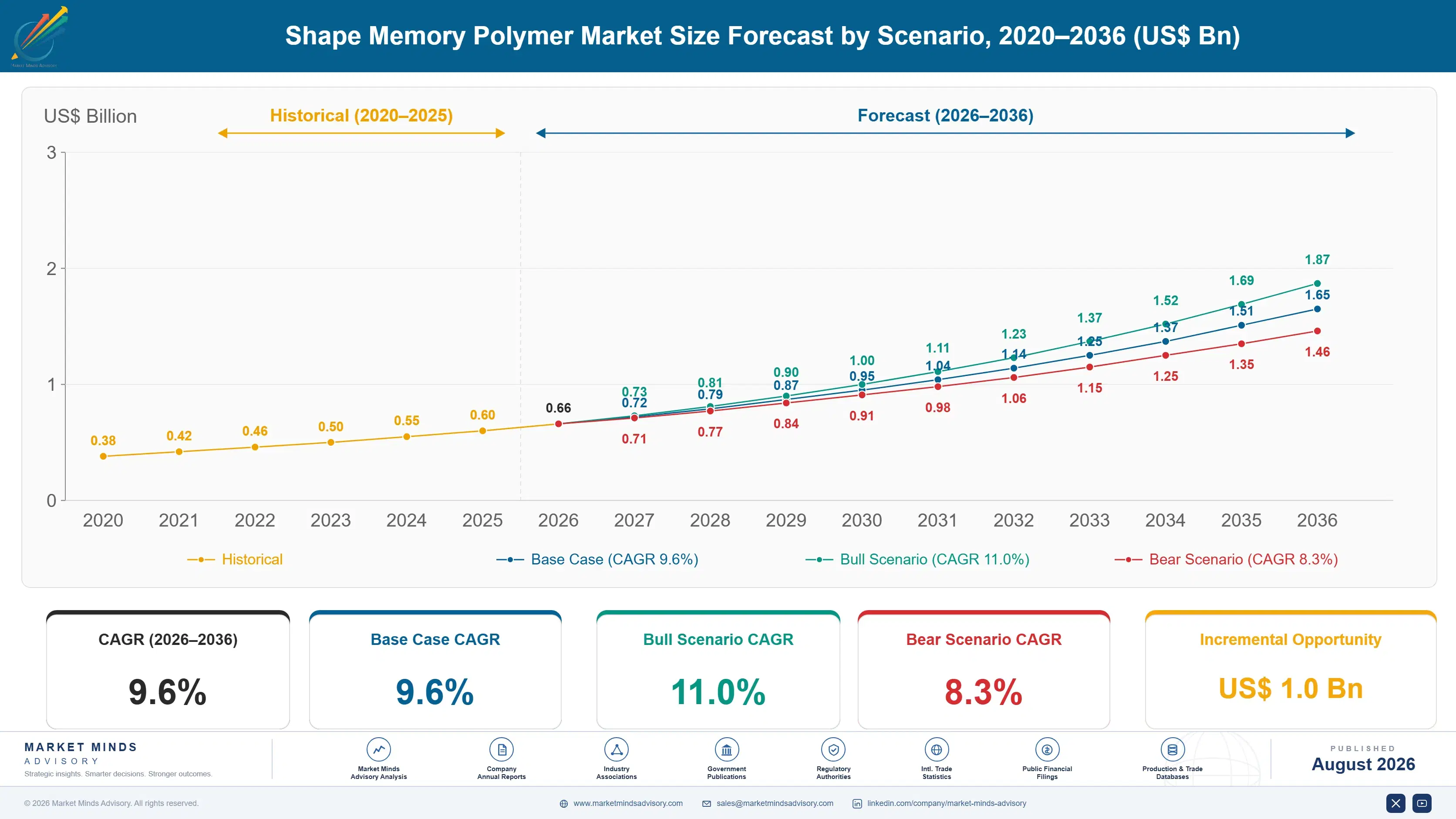
Shape memory polymer demand grew unevenly across 2020 to 2025, expanding at an 8.3% historical CAGR as medical device adoption accelerated steadily while aerospace and automotive programs moved slowly from lab demonstration toward funded development. Pandemic-era hospital procurement disruption briefly slowed elective device volumes in 2020 and 2021, and aerospace deployable structure programs gained real momentum only after 2022 as satellite constellation launches multiplied.
The base case carries the market to a 9.6% CAGR through three mechanisms. First, medical device makers keep expanding SMP stent, catheter, and orthopedic fixation approvals as clinical data accumulates and regulatory familiarity grows. Second, satellite operators building mega-constellations increasingly specify SMP deployable structures, antennas, and solar array hinges over heavier mechanical alternatives to save launch mass. Third, 4D printing matures from prototyping novelty into a qualified production process for aerospace and medical components.
The bull case reaches 11.0% if two or more additional mega-constellation operators adopt SMP deployable hardware the way early movers already have, pulling aerospace demand forward. The bear case falls to 8.3% if medical device reimbursement tightens or a high-profile SMP implant failure slows regulatory approval momentum, pushing hospitals back toward established metal and ceramic alternatives.

From Lab Curiosity To Qualified Production Material

Shape memory polymers sit between two very different economics. Medical-grade material commands prices closer to specialty pharmaceuticals than to commodity plastics, reflecting clinical validation cost, while textile and packaging-grade polyurethane SMP increasingly competes on cost against conventional heat-shrink material. Both draw on the same underlying chemistry platforms, which is why materials specialists license broadly rather than compete narrowly in a single end market.
MARKET CONCENTRATIONCR5: 52%Top five suppliers hold roughly half global capacity
AVERAGE SELLING PRICE$85/kgMedical-grade resin commands a consistently steep price premium
TOP PRODUCER SHAREUSA: 34%The United States leads global production by volume
CAPACITY UTILISATION68%Plants run below capacity amid slow aerospace qualification
EXPORT TRADE INTENSITY39%Roughly two in five tonnes cross a border
R&D COST SHARE22% of COGSResearch spending remains unusually high for a polymer
Commercially, adoption depends entirely on trust in actuation reliability rather than price. Medical device makers will not switch a validated SMP grade once a device receives regulatory clearance, since any material change triggers a fresh approval pathway. Aerospace programs show the same rigidity for different reasons: a deployable structure that fails to actuate in orbit cannot be repaired, so qualification testing runs for years before any flight contract follows.
Over the next decade, the biggest swing factor is whether 4D printing moves from prototyping into qualified production at scale, since that would let manufacturers print actuation directly into a part rather than assembling triggered mechanisms separately. Materials specialists who control both chemistry and printable formulations stand to capture disproportionate value as that transition plays out across aerospace and medical applications.
"Everyone asks when shape memory polymers go mainstream. Wrong question. Medical device makers already went mainstream years ago; the aerospace and automotive people are still deciding whether they trust a plastic that remembers."
Director, Advanced and Smart Materials Practice · MMA Chemicals and Materials / Advanced Materials Practice · August 2026

Market Trends

4D Printing Converts SMP From Prototype To Product

Additive manufacturers including Stratasys and specialized aerospace printers have begun qualifying SMP feedstock for production parts rather than prototypes only, printing actuation geometry directly into components that previously required separate hinges or triggered mechanisms assembled afterward. NASA's use of 4D-printed SMP structures in small satellite deployment trials since 2022 has demonstrated repeatable actuation reliability under vacuum and thermal cycling conditions that earlier bulk-molded SMP components struggled to match consistently. As qualification data accumulates, aerospace primes are moving cautiously from technology demonstration toward inclusion in funded flight programs, which would meaningfully expand addressable volume beyond today's largely experimental deployment base.
Market Impact: Adds 9 new FDA device clearances

Mega-Constellation Launches Pull Deployable SMP Demand

SpaceX, OneWeb, and Amazon's Kuiper program have collectively launched thousands of satellites carrying deployable solar arrays and antennas, and a growing share specify shape memory polymer hinges over traditional spring-loaded metal mechanisms because SMP components weigh less and stow more compactly during launch. Composite Technology Development and similar specialists have supplied SMP deployable hardware for multiple constellation programs since 2021, and each successful on-orbit deployment strengthens the case for the next contract award. Launch mass savings translate directly into additional payload capacity or reduced launch cost, an argument that resonates with operators running tight margins.
Market Impact: Aerospace segment grows 1.1 times faster

Market Opportunities and Growth Drivers

Minimally Invasive Medical Device Adoption Accelerates

Cardiovascular and orthopedic device makers increasingly favor shape memory polymer over metal for stents, catheters, and bone fixation hardware because SMP components can be compressed for minimally invasive delivery and then self-expand to a pre-set shape once deployed inside the body, avoiding a second surgical intervention. Boston Scientific and MedShape have both expanded regulatory clearances for SMP-based devices since 2022, and clinical data accumulating from those approvals is lowering the evidentiary bar for follow-on device categories. Hospital procurement increasingly favors devices that shorten recovery time and reduce repeat-procedure risk, both of which SMP-based designs demonstrate consistently across published outcome studies.
Market Impact: Adds 18 to 24 months delay

Satellite Constellation Buildout Demands Lightweight Deployables

Global satellite launch cadence has multiplied over the past five years as mega-constellation operators race to complete coverage, and every kilogram of deployable hardware mass removed from a satellite bus translates into launch cost savings or additional payload capacity. Shape memory polymer hinges, antennas, and solar array mechanisms weigh meaningfully less than spring-loaded metal equivalents and stow into a smaller launch volume, letting operators fit more satellites per launch vehicle. Composite Technology Development and Cornerstone Research Group have both scaled production to serve this demand, and operators now specify SMP deployables as a standard option.
Market Impact: Adds 3 to 5 years testing

Market Restraints and Challenges

Clinical Validation Cycles Slow Medical Device Approval

Every new shape memory polymer implant geometry requires its own clinical validation pathway, since regulators treat material behavior and device geometry as inseparable variables that cannot be approved independently. The root cause is that SMP actuation depends on precise transition temperature calibration that shifts with even minor formulation changes, so regulators cannot extend approval from one device to a similar one without new data. The commercial impact is a multi-year lag between innovation and revenue, during which competitors can catch up on chemistry alone. Some developers respond by building modular validation platforms that reuse clinical data across related geometries.
Market Impact: Adds 4D-printed parts to 12 satellites

Actuation Reliability Concerns Limit Aerospace Qualification

Aerospace programs remain cautious about shape memory polymer because a deployable structure that fails to actuate in orbit cannot be repaired, and the root cause is limited long-duration flight heritage relative to established spring-loaded metal mechanisms that have decades of proven reliability behind them. The commercial impact shows up as extended qualification testing, often three to five years of thermal cycling and vacuum exposure before a component earns flight approval for a funded mission. Developers are mitigating this by building redundant actuation pathways into critical deployables and by flying low-cost technology demonstration missions specifically to accumulate on-orbit heritage data.
Market Impact: Cuts deployable hardware mass 30%
3 additional market trends, 3 additional growth drivers, and 3 additional restraints and challenges are covered in the full report. Contact sales@marketmindsadvisory.com to access the complete intelligence.

Segment CAGR and Growth Architecture

Segmentation follows end-use application, a single commercial logic tracking who specifies transition temperature, actuation trigger, and regulatory pathway. Medical devices, aerospace and defense, 4D printing, automotive, textiles, and packaging each demand distinct formulations and qualification processes, so commercial position tracks application-specific validation rather than base chemistry or manufacturing process alone across the whole industry.
global-shape-memory-polymer-market-trends-market-share-analysis-1787552964839

4D Printing and Additive Manufacturing

4D printing and additive manufacturing is the fastest-growing shape memory polymer application at 13.2% CAGR, roughly 1.4 times the overall market rate, as aerospace and medical device makers move from printing static parts toward printing components with actuation geometry embedded directly into the structure. This eliminates the need for separately assembled hinges, springs, or triggered mechanisms, reducing part count and potential failure points. NASA and several aerospace primes have run small satellite deployment trials using 4D-printed SMP structures since 2022, generating qualification data that is slowly building confidence for funded flight programs. Medical device makers are exploring the same approach for patient-specific implant geometries, though regulatory pathways for printed medical devices remain less mature than for aerospace hardware today.
CAGR 13.2%

Medical Devices

Medical devices remain the second-fastest segment at 12.5% CAGR and the largest by current revenue, anchored by cardiovascular stents, catheters, and orthopedic fixation hardware that use SMP's ability to compress for minimally invasive delivery and self-expand to a pre-set shape once positioned inside the body. Boston Scientific and MedShape both hold multiple FDA-cleared SMP device families, and clinical outcome data accumulating from those approvals is lowering the evidentiary bar for follow-on device categories including embolization devices and orthopedic fixation hardware. Growth here is more predictable than in aerospace, since medical device reimbursement pathways are well established, but each new geometry still requires its own clinical validation, keeping the segment growing steadily rather than explosively despite its underlying revenue scale advantage.
CAGR 12.5%
Full segment breakdown across 6 segments available in the complete report.

Regional Architecture and Country Demand Map

North America leads at 29% of 2025 value on Boston-area medical device clusters and defense-funded aerospace research, narrowly ahead of East Asia's manufacturing scale. South Asia and Pacific posts the fastest regional growth as India and Southeast Asian device and electronics manufacturers scale SMP-enabled production beyond pilot volume.

North America

North America holds the largest share at 29%, anchored by Boston-area medical device clusters where Boston Scientific and MedShape both maintain SMP device development and manufacturing operations, and by defense-funded aerospace research at NASA, Lockheed Martin, and Composite Technology Development. CHIPS Act and broader reshoring incentives have also pulled some SMP materials production back onshore that had drifted toward Asian contract manufacturers over the previous decade. Growth of 9.9% sits close to the global base rate, reflecting a mature medical device channel growing steadily alongside a smaller but faster-scaling aerospace deployable hardware segment tied to mega-constellation launch cadence. The region's advantage lies in device integration and systems qualification capability, not raw material production.
Share: 29% | CAGR: 9.9% (2026 to 2036)

Western Europe

Western Europe underperforms the base rate by roughly a point and a half at 8.1%, reflecting a materials chemistry legacy, Mnemoscience pioneered much of the medical-grade SMP science now licensed globally, that has not translated into equivalent device manufacturing scale. German and French medical device makers remain active in orthopedic and cardiovascular SMP applications, while European Space Agency programs fund aerospace deployable research at a smaller scale than NASA-linked American programs. Regulatory harmonization under the EU Medical Device Regulation has added qualification cost and delay for smaller SMP device developers specifically, slowing the pace at which European chemistry innovation converts into commercial device revenue relative to American and Asian competitors moving faster through comparable approval pathways today.
Share: 21% | CAGR: 8.1% (2026 to 2036)
Regional intelligence for 5 additional markets available in the complete report: East Asia, South Asia and Pacific, Latin America, Middle East and Africa, Eastern Europe. Contact sales@marketmindsadvisory.com.
global-shape-memory-polymer-market-trends-country-cagr-analysis-1787552966266

Where SMP Developers Actually Capture Value

Margin in this market concentrates in validated chemistry and regulatory clearance, not raw polymer production. The framing below identifies four commercial moves that shift revenue toward proprietary formulations, faster qualification pathways, and licensing structures that basic resin sale cannot capture, each grounded in where buyers already pay a premium: clinical validation, actuation reliability, and manufacturing integration.

License Proprietary Chemistry Rather Than Sell Resin

Materials specialists who license their SMP chemistry platform to device integrators, rather than simply selling raw resin at commodity pricing, capture ongoing royalty revenue tied to the integrator's device sales rather than a one-time material transaction. Mnemoscience pioneered this model in medical devices, licensing core chemistry to multiple downstream device makers rather than manufacturing finished devices itself. This structure also transfers regulatory and clinical validation cost to the integrator best positioned to run it. Licensing royalties in comparable specialty polymer categories have historically run 4% to 6% of downstream device revenue.
Market Impact: Royalty revenue reaches 4% to 6% of sales

Build Reusable Modular Clinical Validation Platforms

Every new SMP device geometry currently requires its own clinical validation pathway, but developers who build modular validation platforms, reusing core biocompatibility and material behavior data across related device geometries, can shorten follow-on approval timelines meaningfully. Boston Scientific and MedShape have both pursued variations of this approach across their device families, cutting the incremental approval timeline for follow-on products by roughly 12 months compared with first-in-class submissions. This matters most in a market where multi-year approval lag is the single biggest gap between chemistry innovation and revenue, and closing it fastest wins share.
Market Impact: Cuts follow-on device approval timelines by roughly 12 months

Supply Deployable Hardware Directly To Constellation Operators

Aerospace materials specialists who move beyond selling raw SMP composite material toward supplying fully integrated, flight-qualified deployable hardware, hinges, antennas, solar array mechanisms, capture significantly more value per satellite than a materials-only relationship allows. Composite Technology Development has pursued exactly this integration, moving from a components supplier role toward a systems-level deployable hardware provider serving multiple mega-constellation programs directly. Constellation operators value single-source accountability for a mission-critical deployment event, and specialists who guarantee integrated performance command roughly 25% higher pricing per unit than commodity composite suppliers achieve today. Volume keeps rising as launch cadence accelerates.
Market Impact: Integrated hardware sales command roughly 25% higher margin

Scale Textile And Packaging Grades Toward Commodity Volume

While medical and aerospace grades command premium pricing, textile and heat-shrink packaging applications offer a genuine volume opportunity for producers willing to compete on cost rather than premium chemistry. Japanese and Chinese polyurethane SMP film producers have already scaled this segment meaningfully, and Western chemistry specialists who license lower-margin textile and packaging formulations to high-volume Asian manufacturers can capture 8% to 10% incremental revenue from production volumes their own medical-grade-focused facilities were never designed to handle economically. This dual-track approach lets a single platform serve both margin-focused and volume-focused segments.
Market Impact: Volume licensing adds roughly 10% incremental revenue overall

Who Controls the Margin Pool

Concentration is moderately high: the top five participants hold an estimated 52% of value, measured on a consistent basis of SMP-specific revenue across materials, licensing, and device sales, leaving a long tail of smaller specialists to compete for the remainder. The gap between leader and challenger is substantial, since chemistry patents and validation history create real barriers.
Competitive activity currently runs along three lines. First, clinical validation speed: device makers race to expand FDA and CE clearances across new geometries, since approval timeline determines who captures a given clinical application first. Second, aerospace flight heritage: specialists accumulate on-orbit deployment track record that strengthens future contract bids. Third, vertical integration: several materials specialists are moving from resin supply toward integrated device or hardware manufacturing directly.

Pressure is building from adjacent materials categories and from new entrants backed by additive manufacturing capability rather than traditional polymer chemistry expertise. 4D printing specialists without decades of SMP chemistry history are qualifying printable formulations fast enough to compete for aerospace contracts. Meanwhile, shape memory alloys remain a persistent substitute in some applications. Rankings will likely shift toward whichever participants best combine chemistry depth with integration capability across both channels.
global-shape-memory-polymer-market-trends-company-positioning-matrix-1787552967157

Competitive Moat and Risk Dimensions

SMP TECHNOLOGIES INC.

Moat: Pioneering Polyurethane SMP Film Patents

SMP Technologies holds foundational polyurethane shape memory polymer film patents dating back decades, originally developed through DiAPLEX research, giving it licensing leverage across textile, packaging, and consumer applications globally. Its patent position and manufacturing know-how in Japan remain difficult for newer entrants to replicate quickly, particularly in film-based applications where processing consistency matters as much as base chemistry.
SMP TECHNOLOGIES INC.

Risk: Narrow Application Base Beyond Films

The company's core strength concentrates heavily in film-based textile and packaging applications, leaving it less positioned in the faster-growing medical device and aerospace segments where device integrators and materials specialists with different capabilities are capturing disproportionate growth. Diversifying beyond its film heritage requires capabilities and regulatory relationships the company has not yet fully built.
BOSTON SCIENTIFIC CORPORATION

Moat: Regulatory Scale And Data Depth

As a major diversified medical device company, Boston Scientific brings regulatory affairs scale and accumulated clinical outcome data across multiple SMP device families that smaller specialists cannot match, shortening its effective approval timelines for follow-on device geometries. Its existing hospital distribution relationships also let new SMP devices reach clinicians faster than an unknown smaller competitor could achieve alone.
BOSTON SCIENTIFIC CORPORATION

Risk: Device Focus Limits Chemistry Control

Boston Scientific licenses much of its core SMP chemistry rather than controlling it proprietarily, leaving it exposed to licensing cost and supply terms set by materials specialists upstream. A chemistry specialist raising licensing rates or restricting exclusivity could compress device-level margins in ways the company does not fully control internally.

Players Tracked

Prominent Players

SMP Technologies Inc.
Cornerstone Research Group Inc.
Mnemoscience GmbH
Boston Scientific Corporation
Composite Technology Development Inc.

Other Key Players

Evonik Industries AG
Covestro AG
Lubrizol Corporation
MedShape Inc.
Syzygy Memory Plastics
Endoshape Inc.
Shape Memory Medical Inc.
Confluent Medical Technologies
Arkema S.A.
Huntsman Corporation
BASF SE
Mitsubishi Heavy Industries Ltd.
Deployable Space Systems Inc.
Tecnimed S.r.l.
Asahi Kasei Corporation

Recent Developments

JUNE 2024

Boston Scientific Expands SMP Device Regulatory Clearances

Boston Scientific received expanded FDA clearance in June 2024 for additional SMP-based orthopedic fixation device geometries, building on its existing cardiovascular device clearance base. The expansion was a regulatory approval milestone, not a corporate transaction, extending the company's addressable device portfolio into new anatomical applications.
Signal: A regulatory clearance, not an acquisition, shows how incumbents extend SMP device families beyond their original approval.
NOVEMBER 2024

Composite Technology Development Signs Multi-Satellite Deployable Contract

Composite Technology Development signed a multi-year supply agreement in November 2024 to provide SMP deployable hinge and antenna hardware across a mega-constellation operator's next-generation satellite platform. This was a commercial supply contract, not a joint venture or acquisition, extending the company's flight heritage across a larger fleet.
Signal: A large multi-satellite contract signals aerospace SMP hardware has moved from pilot deployment toward standard specification.
FEBRUARY 2025

Evonik Acquires Minority Stake In SMP Chemistry Startup

Evonik Industries acquired a minority equity stake in a European SMP chemistry startup in February 2025, gaining early access to next-generation formulation research without full acquisition or operational control. The transaction was an equity investment, not a merger, joint venture, or full acquisition of the startup.
Signal: A minority stake, not a full acquisition, shows incumbents hedging exposure to next-generation SMP chemistry research.

Chemistry Research, Not Raw Material

Specialty monomers and catalysts used in SMP chemistry represent 35% to 45% of processing cost of goods sold, reflecting the purity and consistency requirements medical and aerospace applications demand. Research and clinical validation labor accounts for another 20% to 30%, while manufacturing and quality testing adds 15% to 20% more, and base polyurethane feedstock itself remains a comparatively small share of total delivered cost.
There is no single dramatic price shock comparable to an energy crisis in this market, but specialty monomer supply has tightened meaningfully at times. ACC data and company disclosures noted feedstock supply chain disruption during 2021 and 2022 affecting specialty polymer intermediates broadly, and Covestro's 2022 annual report disclosed higher raw material costs across its specialty polyurethane portfolio during that period. SMP-specific monomers, produced by a small number of suppliers, saw lead times extend noticeably.

Exposure varies by business model rather than by geography. Vertically integrated specialists who produce their own specialty monomers absorb less volatility than smaller device makers who purchase finished SMP resin from a handful of chemistry suppliers with real pricing power. Device makers without backward integration face the steepest competitive disadvantage, since alternative qualified suppliers for a validated formulation are often limited.
global-shape-memory-polymer-market-trends-cost-volatility-analysis-1787552967530

Secure Long-Term Monomer Supply Agreements With Chemistry Producers

Device makers and smaller materials specialists who lack backward integration into specialty monomer production can secure multi-year supply agreements directly with chemistry producers, locking in both price and priority allocation during periods of tight supply. This reduces exposure to spot market shortages that have periodically affected specialty polymer intermediates across the broader chemicals industry.

Qualify Second-Source Chemistry Suppliers Where Possible

Where regulatory pathways allow, device makers can qualify a second chemistry supplier for critical monomers, reducing single-source dependency even though requalifying a device against an alternate material source requires its own validation process. This mitigation works best when pursued proactively rather than reactively after a supply disruption has already occurred across the wider supply base.

Pursue Backward Integration Into Core Chemistry

Larger materials specialists and device makers with sufficient scale can pursue backward integration into monomer and catalyst production directly, capturing margin currently paid to upstream chemistry suppliers while gaining full control over formulation consistency. This is capital-intensive and works best for companies with sufficient production volume to justify dedicated chemistry manufacturing investment over time.

Portfolio Architecture for Margin Defence

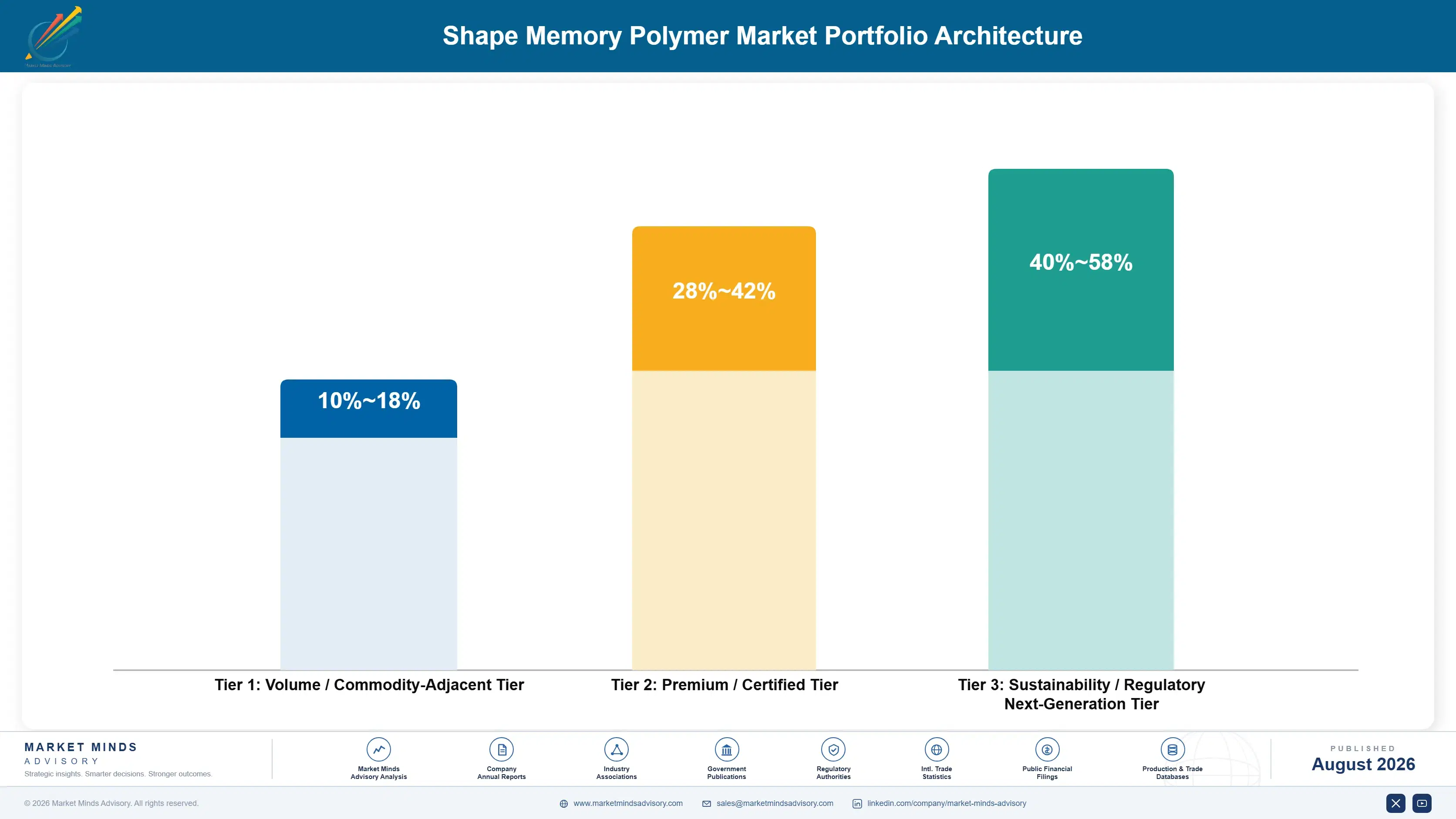
The SMP portfolio splits into three tiers with wide margin separation. Textile and packaging-grade polyurethane film competes largely on cost against conventional heat-shrink and elastic materials, forming the volume base. Certified medical-grade material commands a substantial premium tied to clinical validation and regulatory clearance. Flight-qualified aerospace deployable hardware earns the highest margins, reflecting qualification barriers and limited flight heritage among competing suppliers.
The tension running through this portfolio is between volume scale and validation-driven scarcity value. Textile-grade material funds base manufacturing capacity and keeps production lines running, yet it faces continuous cost pressure from conventional substitute materials that offer comparable performance at lower price. Medical and aerospace grades face far less substitution pressure, but the volumes involved remain a small fraction of total market tonnage relative to textile and packaging applications.

High-value pools concentrate specifically where regulatory and qualification barriers are highest, medical device clearance and aerospace flight heritage, rather than where raw material scale is largest. A specialist with modest production volume but deep clinical or flight qualification history captures more value than a much larger textile-grade producer, an inversion reshaping where investment capital in this space actually flows.

Volume / Commodity-Adjacent Tier

Textile, apparel, and heat-shrink packaging-grade polyurethane SMP film sold primarily on delivered cost against conventional elastic and heat-shrink substitute materials, competing on price and processing consistency rather than proprietary chemistry across most buyer segments.
Gross Margin: 10-18%

Premium / Certified Tier

Certified medical-grade SMP material and components serving cardiovascular, orthopedic, and minimally invasive device applications, where clinical validation and regulatory clearance history create a durable premium over unvalidated material of comparable chemistry.
Gross Margin: 28-42%

Sustainability / Regulatory / Next-Generation Tier

Flight-qualified aerospace deployable hardware and next-generation 4D-printed components serving satellite, defense, and advanced manufacturing applications, where limited flight heritage and steep qualification barriers concentrate pricing power among a small number of specialists.
Gross Margin: 40-58%
global-shape-memory-polymer-market-trends-portfolio-architecture-1787552968901

High-value Sub-segments and Strategic Watch-out

4D Printing and Additive Manufacturing

The fastest-growing and increasingly high-margin segment, at 13.2% CAGR, as aerospace and medical device makers move from printing static parts toward printing components with actuation embedded directly into the structure, a capability only a handful of specialists worldwide currently offer at qualified production scale. Buyers pre-book capacity years ahead.
Gross Margin: 38-55%

Medical Devices

The largest segment by current revenue and second-fastest by growth at 12.5% CAGR, anchored by cardiovascular and orthopedic devices where Boston Scientific and MedShape hold accumulating clinical validation advantages newer entrants find difficult to replicate quickly across comparable geometries and regulatory markets worldwide. Reimbursement pathways remain well established.
Gross Margin: 28-42%

Textiles and Apparel

A steady volume segment growing near 8.4%, using polyurethane SMP film in self-adjusting fabrics and heat-responsive apparel, priced competitively against conventional elastic materials and facing continuous cost pressure from lower-cost Asian film producers scaling output aggressively across export markets each year. Growth stays steady but unspectacular overall.
Gross Margin: 10-18%

Automotive Applications

A segment facing genuine uncertainty, since automotive self-healing coatings and SMP-based actuators compete against both traditional mechanical systems and alternative smart material categories, leaving adoption dependent on original equipment manufacturer design cycles that move slowly and unpredictably across regions. Adoption could still accelerate later on.
Gross Margin: 15-25%

Validation Cycles, Not Contracts, Govern Demand

Demand here runs on regulatory and qualification cycles rather than simple purchase contracts. Medical device makers commit to a validated SMP grade for the life of a device family, often a decade or more, since any material change triggers a fresh regulatory approval pathway. Aerospace programs commit even longer, since a deployable structure qualified for one satellite platform typically carries forward across an entire constellation program spanning years of production.
Adoption depth varies sharply by end-use vertical. Medical device makers show the deepest stickiness, given the multi-year, multi-million-dollar cost of requalifying an approved device against an alternate material source. Aerospace programs show comparable stickiness once flight heritage is established, since switching suppliers mid-program risks losing accumulated qualification data. Textile and packaging buyers sit at the opposite end, treating SMP film more as a substitutable commodity input that competes on price.

Buyer profiles are shifting as procurement moves from viewing SMP as a novelty material toward treating it as a standard qualified option alongside metal and ceramic alternatives. Younger device engineers and aerospace systems designers increasingly specify SMP by default for weight-sensitive or minimally invasive applications, a shift in default assumption more than in underlying material capability itself.
global-shape-memory-polymer-market-trends-end-use-penetration-index-1787552970520

Where MMA Sees SMP Diverging

These are among the four positions where our research anticipates prominent divergence between winners and laggards over the coming forecast period. Each is grounded in the demand model, the regulatory perimeter, and the announced capacity pipeline.
01 / CHEMISTRY LICENSING STRATEGY

Licensing models will outperform pure resin manufacturing sales

Materials specialists who license proprietary SMP chemistry to device integrators capture ongoing royalty revenue tied to downstream device sales rather than a single resin transaction, a durably superior economic model to commodity resin sale. Mnemoscience demonstrated this model's durability in medical devices years before most competitors recognized its value, and comparable specialty polymer licensing arrangements have historically delivered royalty rates in the mid-single-digit percentage range of downstream revenue. We expect chemistry specialists who resist competing with their own device-integrator customers to command better long-term economics.
02 / AEROSPACE QUALIFICATION TIMING

Flight heritage accumulated now compounds into future contract share

Aerospace deployable hardware qualification takes years, and each successful on-orbit deployment strengthens a supplier's case for the next contract award in a market where flight heritage functions as the primary competitive currency. Composite Technology Development's early mover position across multiple constellation programs since 2021 has compounded into a qualification advantage that newer entrants cannot shortcut regardless of how much capital they deploy. We expect this compounding advantage to widen further as launch cadence accelerates, rewarding specialists who invested in flight heritage years before mega-constellation demand became commercially obvious.
03 / MEDICAL DEVICE VALIDATION MOAT

Clinical data depth will keep incumbents ahead of new entrants

Boston Scientific and MedShape both benefit from accumulated clinical outcome data across multiple SMP device families that shortens their effective approval timeline for follow-on device geometries relative to a newcomer starting from zero clinical history. That data advantage compounds with each new device approval, since regulators increasingly accept modular validation arguments built on an established safety record. We expect the gap between incumbents and new entrants in medical SMP devices to widen rather than narrow over the coming decade, absent a major clinical safety event that resets the field.
04 / 4D PRINTING TRANSITION RISK

Printable formulation control will decide the next competitive cycle

As 4D printing matures from prototyping into qualified production, competitive advantage increasingly depends on who controls printable SMP formulations rather than who holds legacy bulk-molding chemistry patents built for an earlier manufacturing era entirely. Materials specialists slow to develop printable formulations risk ceding the fastest-growing segment to newer entrants built specifically around additive manufacturing capability from the outset. We expect the next competitive cycle in this market to be decided substantially by formulation printability rather than by traditional bulk material performance metrics that dominated the prior decade of competition.

Engagement Snapshot From the Field

A live engagement with an industry participant carrying material or product regulatory and market exposure ahead of a defining policy shift, showing how our research translates into a defensible multi-year portfolio strategy.
MARKET MINDS ADVISORY · CLIENT ENGAGEMENT SUMMARY
Shape Memory Polymer Producer Strategic Portfolio Review and Transition Roadmap 2026·Investment Scenario on Shape Memory Polymer Exposure Evaluation 2025-26
CLIENT PROFILE
A mid-sized cardiovascular device manufacturer developing a next-generation SMP-based stent platform approached MMA while evaluating whether to develop proprietary chemistry or license an established platform ahead of its first regulatory submission. The client reported development spend exceeding USD 22 million to date, with an internal target of first commercial revenue within three years of the engagement beginning (client-reported, unverified by MMA).
STRATEGIC CHALLENGE
Management was divided between building proprietary SMP chemistry in-house, which promised long-term margin advantage but added years to the regulatory timeline, and licensing established chemistry from a specialist, which would accelerate submission but cede long-term royalty economics to a third party. No internal team had modeled the full timeline and revenue tradeoff between the two paths.
MMA APPROACH
MMA modeled realistic regulatory timelines under both paths using comparable device approval precedent, benchmarked licensing royalty terms across analogous specialty polymer categories, and assessed the client's internal chemistry development capability against specialists already active in the space. We also evaluated competitive timing risk, specifically how quickly a rival device maker might reach market first under each scenario.
KEY FINDINGS
  1. Proprietary chemistry development would have added an estimated 30 months to the client's regulatory timeline, a delay management had significantly underestimated before the engagement began (client-reported, unverified by MMA).
  2. Licensing established chemistry carried a royalty cost equivalent to roughly 5% of projected device revenue, well below the client's internal cost-of-capital estimate for self-funded chemistry development.
  3. At least one competitor was independently pursuing a similar device concept, making the licensing path's faster timeline materially more valuable than its long-term royalty cost implied on paper.
  4. The client's internal chemistry team lacked specific experience with the regulatory validation requirements unique to implantable SMP devices, a capability gap licensing would immediately close.
CLIENT PROFILE
A mid-sized cardiovascular device manufacturer developing a next-generation SMP-based stent platform approached MMA while evaluating whether to develop proprietary chemistry or license an established platform ahead of its first regulatory submission. The client reported development spend exceeding USD 22 million to date, with an internal target of first commercial revenue within three years of the engagement beginning (client-reported, unverified by MMA).
STRATEGIC CHALLENGE
Management was divided between building proprietary SMP chemistry in-house, which promised long-term margin advantage but added years to the regulatory timeline, and licensing established chemistry from a specialist, which would accelerate submission but cede long-term royalty economics to a third party. No internal team had modeled the full timeline and revenue tradeoff between the two paths.
MMA APPROACH
MMA modeled realistic regulatory timelines under both paths using comparable device approval precedent, benchmarked licensing royalty terms across analogous specialty polymer categories, and assessed the client's internal chemistry development capability against specialists already active in the space. We also evaluated competitive timing risk, specifically how quickly a rival device maker might reach market first under each scenario.
KEY FINDINGS
  1. Proprietary chemistry development would have added an estimated 30 months to the client's regulatory timeline, a delay management had significantly underestimated before the engagement began (client-reported, unverified by MMA).
  2. Licensing established chemistry carried a royalty cost equivalent to roughly 5% of projected device revenue, well below the client's internal cost-of-capital estimate for self-funded chemistry development.
  3. At least one competitor was independently pursuing a similar device concept, making the licensing path's faster timeline materially more valuable than its long-term royalty cost implied on paper.
  4. The client's internal chemistry team lacked specific experience with the regulatory validation requirements unique to implantable SMP devices, a capability gap licensing would immediately close.
RECOMMENDED STRATEGY
Phase 1: Phase 1 (0 to 6 months): License established SMP chemistry from a qualified specialist and begin regulatory submission preparation immediately rather than delaying for in-house development. Phase 2: Phase 2 (6 to 24 months): Pursue regulatory clearance using licensed chemistry while building internal formulation expertise in parallel for potential future proprietary development. Phase 3: Phase 3 (24 to 48 months): Evaluate transitioning toward proprietary chemistry for next-generation device iterations once initial device revenue funds internal development capability.
OUTCOME
The client licensed established chemistry and reached regulatory submission fourteen months faster than the proprietary development path would have allowed. Reported first-year device revenue exceeded internal projections by approximately 15%, and the royalty cost proved manageable against realized margins (client-reported, unverified by MMA). The client has since begun internal chemistry development for its second-generation device platform.

Frequently Asked Questions

Foundational context covering the market sizes, CAGR, scope, country, region and competition that inform every finding below. This section is provided to cover basics and most often pre-purchase conversations, answered from the MMA Primary Research Dataset.

What is the current size of the Shape Memory Polymer Market?

The global shape memory polymer market stands at USD 0.62 billion in 2025, according to MMA Primary Research. Medical devices account for the largest share of current revenue.

How large will the Shape Memory Polymer Market be by 2036?

MMA projects the market will reach USD 1.70 billion by 2036, up from USD 0.68 billion in 2026, an expansion multiple of roughly 2.50 times over the forecast period.

What is the CAGR for the Shape Memory Polymer Market 2026 to 2036?

The base case CAGR is 9.6% across 2026 to 2036. MMA's bull scenario reaches 11.0% and the bear scenario falls to 8.3%, depending on constellation launch cadence and device reimbursement trends.

Which segment is growing fastest?

4D printing and additive manufacturing grows fastest at 13.2% CAGR, roughly 1.4 times the overall market rate, as aerospace and medical device makers print actuation directly into components.

Who are the major companies in the Shape Memory Polymer Market?

Leading participants include SMP Technologies, Cornerstone Research Group, Mnemoscience, Boston Scientific, and Composite Technology Development. Together these five account for an estimated 52% of market value.

Which country is growing fastest?

India posts the fastest national growth at approximately 13.5% CAGR, supported by expanding medical device manufacturing capacity, production-linked incentive programs, and rising domestic orthopedic device demand.

Report Segmentation Architecture

The full report scope spans multiple orthogonal segmentation dimensions, with cross-tabulated demand data provided for each dimension pair. Coverage extends further to regional breakdowns, trend trajectories, and the competitive detail needed to support segment-level decision-making.

By Application

  • Medical Devices
  • Aerospace and Defense
  • 4D Printing and Additive Manufacturing
  • Automotive
  • Textiles and Apparel
  • Packaging and Heat-Shrink

By End-Use Industry

  • Healthcare and Medical
  • Aerospace and Satellite
  • Automotive
  • Textiles and Consumer Goods
  • Industrial Manufacturing

By Commercial Dimension

  • Direct Chemistry Licensing
  • Integrated Device Manufacturing
  • Contract Component Supply
  • Raw Resin Sale

By Region

  • North America
  • Western Europe
  • East Asia
  • South Asia and Pacific
  • Latin America
  • Middle East and Africa
  • Eastern Europe

Scope, Methodology, and Coverage

Every figure in this report is reproducible from documented input assumptions. The scope below maps the historical period, the forecast horizon, the segmentation dimensions, and the countries covered, alongside the underlying primary and qualitative methodology.
Historical Period
2020 to 2025
Forecast Period
2026 to 2036
Base Year
2025 (USD billions; MMA Primary Research Dataset, August 2026)
Market Definition
The shape memory polymer market covers polymers engineered to return from a deformed temporary shape to a pre-set permanent shape when triggered by heat, light, moisture, or another stimulus, sold as raw resin, film, fiber, or fabricated component for medical, aerospace, automotive, textile, and packaging use. It excludes shape memory alloys such as nitinol and finished consumer products that merely incorporate an SMP component as a minor input.
Quantitative Units
USD billions (current prices); metric tonnes of SMP resin and film where applicable
Segmentation Dimensions
By Application; By End-Use Industry; By Commercial Dimension; By Region
Regions Covered
North America, Western Europe, East Asia, South Asia and Pacific, Latin America, Middle East and Africa, Eastern Europe
Countries Covered
USA, China, Germany, France, UK, Japan, South Korea, India, Australia, Canada, Brazil, Mexico, Indonesia, Vietnam, Thailand, Malaysia, UAE, Saudi Arabia, South Africa, Nigeria, Turkey, Poland, Netherlands, Italy, Spain, Sweden, Switzerland, Argentina, Colombia, Singapore, and additional markets relevant to this sector
Key Companies Profiled
SMP Technologies Inc., Cornerstone Research Group Inc., Mnemoscience GmbH, Boston Scientific Corporation, Composite Technology Development Inc., Evonik Industries AG, Covestro AG, Lubrizol Corporation, MedShape Inc., Syzygy Memory Plastics, Endoshape Inc., Shape Memory Medical Inc., Confluent Medical Technologies, Arkema S.A., Huntsman Corporation, BASF SE, Mitsubishi Heavy Industries Ltd., Deployable Space Systems Inc., Tecnimed S.r.l., Asahi Kasei Corporation
Quantitative Methodology
Primary survey, n=3,800 respondents, Q4 2025, six countries; demand-side model with trade association cross-validation
Qualitative Methodology
47 expert interviews, Q4 2025; applied to validate demand model assumptions, identify emerging dynamics, and assess competitive positioning
Report Format
PDF and XLSX data workbook (Word format preview document)
Publisher
Market Minds Advisory
Report Code
MMA-2026-CHM-102
Published
August 2026
Contact
sales@marketmindsadvisory.com | www.marketmindsadvisory.com

Purchase the full Shape Memory Polymer Market Report (2026 to 2036).

The full MMA Shape Memory Polymer Market report sizes global demand across six application segments, five end-use industries, four commercial models, and seven regions through 2036. It profiles twenty participants on a consistent SMP-specific revenue basis, scoring each on chemistry control, clinical or flight qualification depth, and manufacturing integration. Scenario models quantify how mega-constellation launch cadence, medical device reimbursement trends, and 4D printing qualification progress move both volume and realizable price across the forecast period. The report also includes delivered-cost modelling by application, a regulatory pathway timeline benchmark, licensing royalty rate analysis, and a competitive flight-heritage and clinical-validation scorecard built for strategy, investment, and procurement teams.
Application-Level Demand Sizing Across Six Segments
Twenty-Company Competitive Benchmarking On Qualification Depth
Regulatory And Flight Heritage Timeline Scenario Modelling
Chemistry Licensing Royalty Rate Benchmark Analysis
Regional Trade Flow And Country Growth Mapping
4D Printing Qualification Pipeline And Adoption Tracking

Built For The People Who Decide

From boardroom strategy to bench-side execution, this report is read cover-to-cover by leaders shaping the next decade of their industry, turning demand scenarios, market dynamics and valuation benchmarks into decisions.
CXOs/ Presidents/ VPs/ Managers
M&A and Corporate Development
Strategy Teams and R&D Heads
Procurement and Product Directors
Regulatory and Compliance Leaders
Investor Relations and Equity Analysts