Market Minds Advisory
Global Pouch Market

Global Pouch Market: The Format That Wins on Carbon and Loses on Recyclability, and What Fee Modulation Did About It

A pouch uses 72% less material than the rigid container it replaces and almost none of it gets recycled. That contradiction has defined this format for twenty years and fee modulation is finally pricing it.

Lead Analyst

Bilal Shaikh

Published

September 2026

Make Smarter Decisions with Customized Research Insights

Request a free sample report and evaluate market opportunities, growth trends, and competitive dynamics relevant to your business needs.

2025 MARKET VALUE$49.4BMarket Size 2025
2036 FORECAST VALUE$95.7BBase Case , 2026 to 2036
CAGR 2026 TO 20366.2 %Bull 7.4% / Bear 5.0%
INCREMENTAL OPPORTUNITY$43.3BNet 10- year value creation
EXPANSION MULTIPLE1.82x2036 value over 2026 base
Strategic Levers
M&A Pipeline
Regional Outlook
Country Rankings
Competitive Intelligence
Segmental Deep-dive
Call-Us : 91 93563 13602

Executive Snapshot and Market Trajectory

A pouch beats the rigid container it replaces by roughly 72% on packaging weight, which is an enormous carbon and freight advantage. It is also a laminate of incompatible polymers that essentially nothing recycles, and only 9% of household flexibles get collected at all. Both of those facts are true.
Commercial advantage belongs to converters who can deliver a mono-material structure that actually holds shelf life, because extended producer responsibility fees now run 2.4 times higher on non-recyclable formats and that is a real number on a brand owner's invoice. Recycle-ready mono-material pouches grow fastest at 14.8%, roughly 2.39 times the market. East Asia holds 32% of value, above the standard band.
Concentration is extraordinarily low at roughly 18% for the top five despite continuous consolidation, because thousands of converters serve regional brands within delivery radii. Mono-material structures still fall 38% short on achieved shelf life against multilayer laminates. Closing that gap is the technical question the whole category depends on. Categories with short shelf life convert readily and demanding ones have not converted at all, which is where the whole argument actually now sits.
Market Definition
The market comprises flexible pouches supplied for product containment, covering stand-up pouches, flat and pillow pouches, spouted pouches, retort pouches, vacuum and skin pouches, and recycle-ready mono-material pouches. Value is measured at converter level on printed and formed product. Unconverted film and laminate sold as roll stock, filling and sealing machinery, rigid containers and closures, sacks and bags above pouch format sizes, and labels applied to pouches fall outside scope.
Base Year Value
$49.4B in 2025 (MMA Primary Research Dataset, August 2026)
Forecast Period
2026 to 2036, eleven discrete annual values
CAGR
6.2% base case. Bull 7.4%. Bear 5.0%.
Fastest Growth Segment
Recycle-Ready Mono-Material Pouches: 14.8% CAGR
Fastest Growth Country
India: 9.6% CAGR
Fastest Growth Region
South Asia and Pacific: 8.4% CAGR
Largest Region
East Asia: 32% of 2025 global value
Market Leaders
Amcor, Sealed Air, Mondi, Berry Global, and Huhtamaki lead on converted pouch supply revenue. Source: company annual reports and MMA Analysis, July 2026.
Primary Survey
n=3,800 procurement and R&D decision-makers, Q4 2025, six countries
Methodology
Demand-side build-up, cross-validated against public data, 47 expert interviews

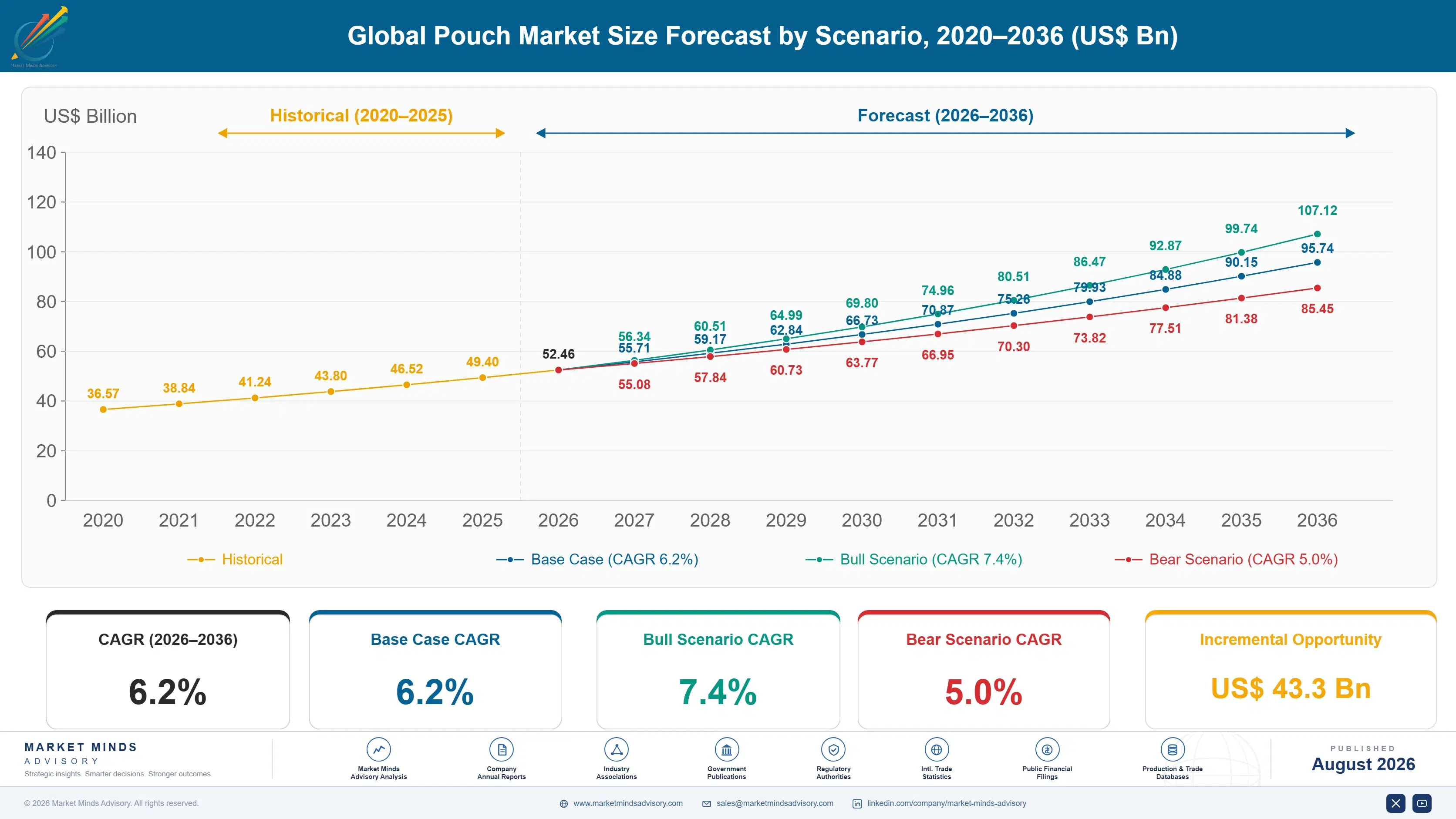
Global Pouch Market Forecast Scenarios

global-pouch-market-2025-2035-size-forecast-scenario-1787553570520
Between 2020 and 2025 recyclability moved from a talking point to a line on an invoice. Extended producer responsibility schemes across Europe and elsewhere began modulating fees by recyclability, which put a direct price on the multilayer laminate that makes a pouch work. Brand owners started reformulating structures rather than defending them. The 5.2% historical rate combines steady conversion from rigid packaging with a genuine material change underneath.
The 6.2% base case rests on three mechanisms. Format conversion from rigid containers continues across food, beverage, personal care, and household categories on weight, cost, and shelf presence. Fee modulation keeps widening the penalty on non-recyclable structures across more jurisdictions. And spouted refill formats keep growing as brand owners replace rigid bottles with pouches that carry a fraction of the material. None of the three depends on collection infrastructure improving anywhere.
The 7.4% bull case assumes mono-material barrier performance closes enough for mainstream food adoption while collection infrastructure improves. The 5.0% bear case reflects consumer goods volume weakness, mono-material shelf life shortfalls stalling conversion in demanding categories, and collection rates staying low enough that recyclable-in-principle structures earn no practical benefit at all. Barrier performance sits under both cases as the deciding variable.

Best on Carbon, Worst on Recycling

The pouch is the packaging industry's most awkward success. Replacing a rigid container cuts packaging weight by around 72%, which reduces material, freight, and emissions by margins no other format approaches. Achieving that requires laminating polyester, aluminium, and polyethylene into a structure that separates in no recycling system anywhere, and household flexible collection currently runs at about 9%.
TOP-FIVE CONCENTRATION18%Combined share of pouch supply held by leading converters
MATERIAL WEIGHT ADVANTAGE72%Reduction in packaging weight against a comparable rigid container
MONO-MATERIAL BARRIER GAP38%Shortfall in achieved shelf life against multilayer laminate structures
FLEXIBLE COLLECTION RATE9%Portion of household flexible packaging actually collected for recycling
EPR FEE DIFFERENTIAL2.4 timesModulated fee gap between recyclable and non-recyclable pouch formats
RECYCLE-READY ADOPTION RATE16%Share of pouch volume converted to mono-material structures
Fee modulation is what finally moved the argument. Extended producer responsibility schemes now charge roughly 2.4 times more for non-recyclable formats, which converts a sustainability discussion into a cost line a brand owner cannot argue with. Mono-material structures answer it in principle and reach only 16% of volume, because the barrier performance falls short by around 38% on achieved shelf life. Nobody designed the system for this format at all.
That shortfall is the whole technical problem. Replacing aluminium foil and mixed polymer layers with an all-polyethylene or all-polypropylene structure means recovering oxygen and moisture barrier through coatings rather than through incompatible layers. Metallised and oxide coatings help and rarely close the gap completely. Categories with short shelf life convert easily and demanding ones do not convert at all. That is the whole commercial question in this category now.
"The format that saves the most material is the one scoring worst on recyclability, and the industry has been arguing about which metric matters for two decades. Fee modulation ended that argument by putting a number on one side of it and nothing on the other."
Practice Director, Flexible Packaging and Materials Systems · MMA Flexible Packaging Practice · August 2026

Market Trends

Fee Modulation Prices the Multilayer Laminate Directly

Extended producer responsibility schemes increasingly charge by recyclability rather than by weight alone, and the differential now runs around 2.4 times between recyclable and non-recyclable pouch formats. That converts a sustainability preference into a cost line a brand owner sees every quarter and cannot argue away. Conversion follows the fee rather than any consumer research. Jurisdictions without modulated fees show markedly slower mono-material adoption, which tells you what is genuinely driving this. Brand owners bring conversion programmes forward when a scheme widens its differential at annual review, which makes the review calendar the demand signal worth watching.
Market Impact: Cuts packaging weight by 72%
Mono-Material Barrier Performance Still Falls Short

An all-polyethylene or all-polypropylene structure recycles in principle and loses the oxygen and moisture barrier that aluminium foil and mixed polymer layers provided. Metallised and oxide coatings recover part of it and the achieved shelf life still runs roughly 38% short of a comparable multilayer laminate. Short shelf life categories convert readily and demanding ones cannot. That gap rather than any commercial reluctance is what holds adoption at 16% of volume. Metallised and oxide coatings recover part of the barrier and rarely all of it, and the categories that need the most performance are precisely the ones that cannot convert.
Market Impact: East Asia holds 32% of value

Market Opportunities and Growth Drivers

Rigid to Flexible Conversion Continues Across Categories

Replacing a bottle, jar, or can with a pouch cuts packaging weight by roughly 72%, which reduces material cost, freight, warehouse space, and emissions simultaneously. Shelf presence improves in several categories and consumer convenience arguments favour resealable formats. That conversion has run for two decades and continues, since the arithmetic works before any environmental argument is made. Spouted refill formats extend it into liquid categories rigid packaging had held completely until recently. Warehouse space and backhaul savings frequently exceed the material saving itself, which is an argument logistics functions make far more readily than packaging teams do.
Market Impact: Only 9% of flexibles collected

Asian Packaged Goods Manufacture Anchors Volume Growth

Chinese and Indian packaged food, beverage, and personal care manufacture continues expanding, and pouch formats suit categories where rigid packaging was never economic in the first place across those markets. India grows fastest of any country at 9.6% as sachet and pouch consumption deepens alongside organised retail. East Asia holds 32% of value, above the standard band, on packaging production concentration. Local converters serve those filling plants within tight delivery radii nobody crosses. Single-serve sachets reach consumers that larger pack sizes never could on affordability grounds, which is a volume driver with no equivalent in developed markets at all.
Market Impact: Top five hold only 18% share

Market Restraints and Challenges

Collection Infrastructure Does Not Exist for Flexibles

Only about 9% of household flexible packaging is collected for recycling, which means a mono-material pouch is recyclable in principle and lands in residual waste in practice almost everywhere. The root cause is that kerbside systems were designed around rigid containers and paper. Converters mitigate by supporting store drop-off schemes, by designing for the sorting equipment that actually exists rather than for theoretical capability, and by being honest with brand owners about what recycle-ready currently delivers. Recyclable in principle and residual waste in practice is an uncomfortable position for anybody making a public claim about it.
Market Impact: Fees run 2.4 times higher

Converter Fragmentation Keeps Pricing Under Permanent Pressure

Thousands of converters serve regional brands within delivery radii that make national competition impractical, which holds concentration at 18% despite the largest players acquiring continuously for decades. The root cause is that laminating and pouch-forming equipment is affordable and customers value proximity. Larger converters mitigate through multi-plant supply national brands require, through structure development capability smaller shops lack, and by competing on recyclability support rather than on price per thousand. Falling equipment costs keep letting new regional converters enter markets that scale was supposed to have closed, which means the fragmentation is stable rather than temporary.
Market Impact: Shelf life falls 38% short
4 additional market trends, 3 additional growth drivers, and 2 additional restraints and challenges are covered in the full report. Contact sales@marketmindsadvisory.com to access the complete intelligence.

Segment CAGR and Growth Architecture

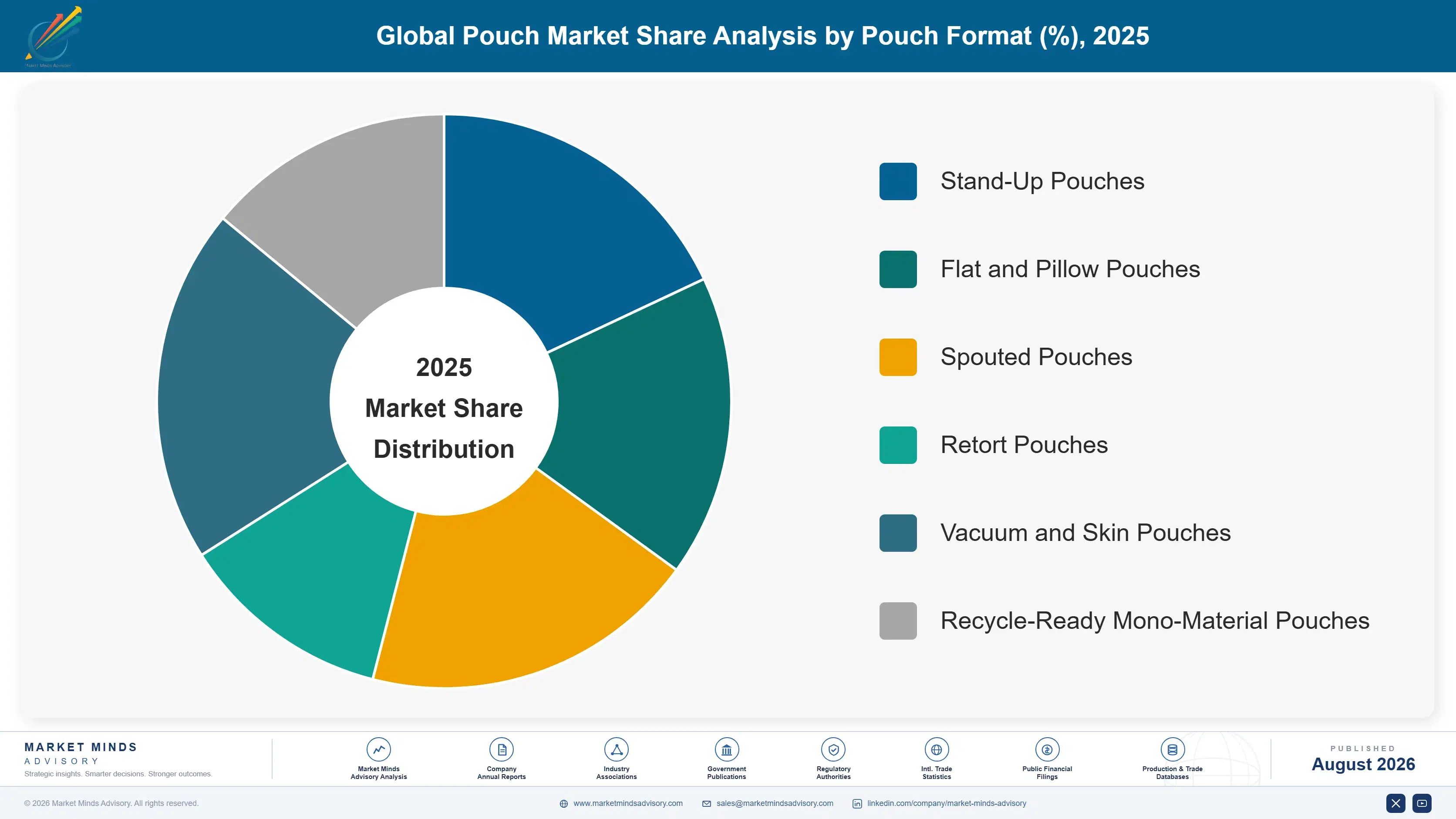
Segmentation follows pouch format, because shape, closure, and processing requirement determine which products a structure can hold and what a filling line can run. Six formats cover commercial supply, and the divide between conventional multilayer laminates and mono-material structures cuts across all of them, which is why recycle-ready is treated as a format rather than a material choice.
global-pouch-market-2025-2035-market-share-analysis-1787553571055

Recycle-Ready Mono-Material Pouches

The fastest format at 14.8%, roughly 2.39 times the market, built from a single polymer family so the structure can in principle enter a recycling stream rather than separating in none of them. Barrier is recovered through metallised or oxide coatings rather than through aluminium foil and mixed layers, and achieved shelf life still falls around 38% short of a conventional laminate. Fee modulation rather than consumer preference is driving adoption, which currently reaches 16% of volume. Collection infrastructure remains the unresolved half of the proposition entirely. Designing for the optical sorting equipment that materials recovery facilities actually operate matters as much as polymer consistency, and trials have rejected structures on format alone.
CAGR 14.8%

Spouted Pouches

Second fastest at 8.6%, carrying a fitment that allows controlled dispensing and resealing, which opened liquid and semi-liquid categories that rigid bottles had held completely. Baby food, beverages, sauces, and liquid detergent refills drive most demand. The refill argument is unusually strong, since a pouch replacing a rigid bottle carries a fraction of the material while the consumer keeps the original container. The spout itself is frequently a different polymer from the body, which complicates recyclability considerably more than the film structure alone does. Fitment application requires equipment and process control that a standard pouch-forming operation does not carry, which narrows the competitor set considerably compared with flat and stand-up formats.
CAGR 8.6%
Full segment breakdown across 6 segments available in the complete report.

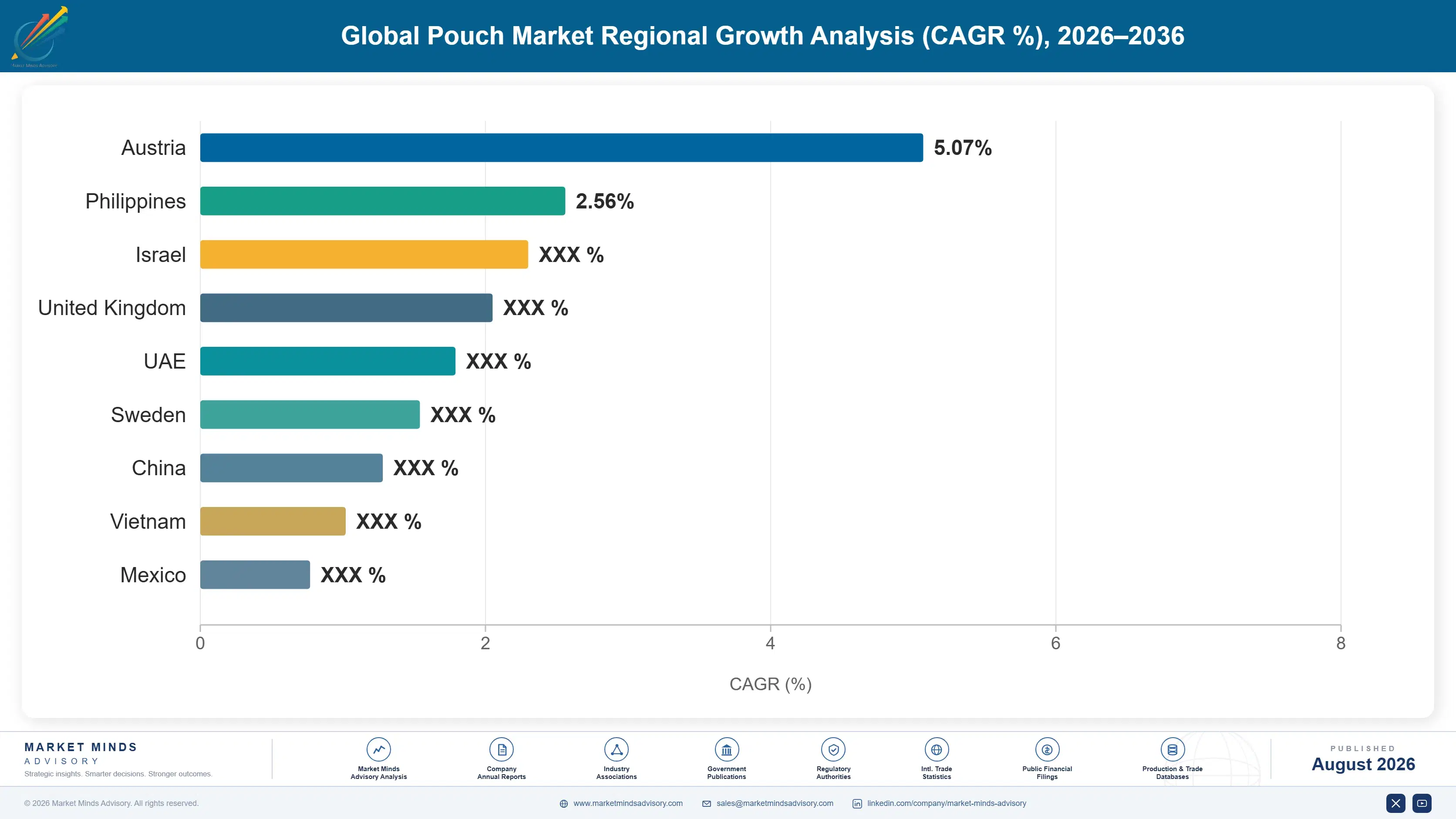
Regional Architecture and Country Demand Map

Regional shares follow packaged goods manufacture rather than consumption, since pouches are converted close to the filling line. East Asia sits above the standard band for the reason stated below, and every other region falls inside its range. Consumption and conversion sit in different places entirely.

North America

Rigid to flexible conversion is well advanced across food, pet food, and household categories, with stand-up and spouted formats widely established. Extended producer responsibility schemes are arriving state by state rather than nationally, which fragments the fee modulation pressure that drives mono-material conversion elsewhere. Amcor, Sealed Air, ProAmpac, and Printpack hold strong positions alongside a long tail of regional converters. Store drop-off collection is more developed than kerbside for flexibles. Growth of 6.0% reflects continued format conversion rather than recyclability-driven restructuring. Pet food is an unusually large pouch category here compared with other regions, and its barrier requirements sit awkwardly between the easy conversions and the demanding ones nobody has solved yet.
Share: 23% | CAGR: 6.0% (2026 to 2036)

Western Europe

Fee modulation under packaging regulation is the most developed anywhere, which makes the recyclability penalty a direct and quarterly cost that brand owners cannot defer or argue about. Mono-material adoption is correspondingly furthest advanced, though barrier shortfalls still exclude demanding food categories entirely. Amcor, Mondi, Constantia, and Wipak hold established structure development capability. Collection infrastructure for flexibles remains poor despite the regulatory pressure. Growth of 4.8% is the slowest anywhere, reflecting mature format conversion and flat packaged goods volumes. Brand owners here now bring structure conversion programmes forward whenever a scheme widens its fee differential at annual review, which makes the regulatory calendar a more reliable demand forecast than any market research.
Share: 19% | CAGR: 4.8% (2026 to 2036)
Regional intelligence for 5 additional markets available in the complete report: East Asia, South Asia and Pacific, Latin America, Middle East and Africa, Eastern Europe. Contact sales@marketmindsadvisory.com.
global-pouch-market-2025-2035-country-cagr-analysis-1787553571580

Four Moves Worth Real Capital

Advantage here comes from closing a barrier gap nobody has closed, from following fee modulation rather than consumer sentiment, and from capabilities a single-machine converter cannot offer. Four moves justify capital across the forecast period, and the first is the technical problem the entire category now depends on. Conversion capacity is not among the four.

Close the mono-material barrier gap deliberately

Recycle-ready structures reach only 16% of volume because achieved shelf life falls roughly 38% short of a conventional laminate, and no amount of commercial enthusiasm changes that arithmetic for a demanding food category. Metallised and oxide coating development, layer design, and sealant selection all contribute. Converters who close the gap for a category competitors cannot serve win conversions that fee modulation has already made urgent for the brand owner concerned. Shelf life modelling frequently shows that a category could already convert with technology available today, which is a conversation nobody has because nobody has run the modelling at all.
Market Impact: Closes a shelf life shortfall now reaching 38%

Track fee modulation schedules by jurisdiction

Conversion follows the modulated fee rather than consumer research, and the differential now runs around 2.4 times between recyclable and non-recyclable formats where schemes operate. Jurisdictions without modulation show markedly slower adoption, which makes the regulatory calendar the demand forecast. Converters who track scheme design and fee schedules position with brand owners before the cost lands rather than after. Very few commercial organisations in this industry follow that detail at all. Scheme fee schedules are published years ahead and reviewed annually, which makes this one of the few genuinely forecastable demand signals available in packaging anywhere.
Market Impact: Anticipates a modulated fee gap of 2.4 times

Be honest about what recycle-ready delivers

Only about 9% of household flexible packaging is actually collected, which means a mono-material pouch is recyclable in principle and residual waste in practice across most markets. Brand owners discovering that after a launch remember who told them and who did not. Converters who explain the collection reality, support store drop-off schemes, and design for sorting equipment that exists build credibility that a recyclability claim alone never survives. A sorting trial rejecting mono-material pouches on format rather than polymer showed how far the gap runs between recyclable material and recyclable packaging in practice.
Market Impact: Addresses a household collection rate of only 9%

Compete on structure development, not conversion price

Thousands of converters run pouch-forming equipment within any delivery radius, which holds concentration at 18% and makes price competition permanent for anybody offering only conversion. Structure development, barrier testing, multi-plant supply, and regulatory support all sit beyond a single-machine operation. Larger converters competing there rather than on price per thousand choose ground where fragmentation stops mattering, and the fee modulation pressure makes that capability genuinely valuable now. Falling equipment costs keep letting new regional converters in, which means the price pressure at the commodity end is permanent rather than a phase anybody can wait out.
Market Impact: Escapes the price war behind an 18% concentration

Who Controls the Margin Pool

Concentration is extraordinarily low at roughly 18% for the top five on converted pouch revenue, and it has stayed there despite the largest players acquiring continuously for decades. Amcor holds the broadest international network with genuine structure development depth. Sealed Air is strong in protein and vacuum applications, Mondi combines paper and flexible capability, Berry Global brings scale across formats, and Huhtamaki is established across food service and consumer flexibles.
Competition runs on three dimensions. Proximity and responsiveness is the first, which is why thousands of regional converters survive against international players. Structure development and barrier capability is the second, and it decides who can serve a mono-material conversion at all. Multi-plant supply is the third, since national brands require consistency across filling sites. None of the three is solved by more machine capacity.

Pressure is building from two directions. Fee modulation is pushing brand owners toward converters who can actually deliver recyclable structures, which favours technical capability over price. Regional converters keep entering as equipment costs fall. Rankings will shift toward those holding barrier development capability rather than toward whoever laminates most cheaply anywhere. Laminating capacity has stopped being a defensible position anywhere.
global-pouch-market-2025-2035-company-positioning-matrix-1787553572101

Competitive Moat and Risk Dimensions

AMCOR

Moat: Structure development and global reach

Amcor combines laminate structure development with converting plants across many countries, which serves multinational brand owners consolidating flexible packaging supply and needing consistent specification across filling sites. Barrier development capability reaches the mono-material conversions that fee modulation is making urgent. That combination of technical depth and geographic coverage is genuinely difficult for a regional converter to approach.
AMCOR

Risk: Regional converter proximity advantage

Local converters retain real advantages in responsiveness and delivery for the enormous volume placed by regional brands rather than multinationals, which is why concentration remains at 18% after decades of acquisition. Buying that fragmentation is expensive and slow to integrate. Falling equipment costs also keep letting new regional converters enter markets that scale was supposed to have closed.
MONDI

Moat: Paper and flexible material breadth

Mondi produces paper and flexible substrates alongside converting, which lets it propose paper-based and mono-material alternatives from an upstream position rather than buying film from a competitor. That breadth matters where fee modulation pushes brand owners to reconsider the substrate rather than only the structure. Material knowledge reaches specification decisions taken well before any conversion quote.
MONDI

Risk: Barrier performance on paper structures

Paper-based flexible structures score well on recyclability metrics and struggle badly on oxygen and moisture barrier, which limits them to categories with undemanding shelf life requirements. That constrains where the substrate advantage can actually be applied commercially. Competitors closing the polymer mono-material barrier gap may reach demanding categories that paper structures will never serve at all.

Players Tracked

Prominent Players

Amcor
Sealed Air
Mondi
Berry Global
Huhtamaki

Other Key Players

Constantia Flexibles
ProAmpac
Sonoco
Coveris
Winpak
Glenroy
TC Transcontinental
Uflex
Toppan
Dai Nippon Printing
Printpack
American Packaging
Wipak
Schur Flexibles
Clondalkin

Recent Developments

FEBRUARY 2025

Brand owner reverts mono-material launch on shelf life

A food manufacturer withdrew a mono-material pouch conversion after accelerated shelf life testing showed the structure could not hold the stated date, returning to a conventional laminate and accepting the higher modulated fee instead. Barrier coating development continued with the converter afterwards. The fee was simply absorbed.
Signal: Fee pressure loses to shelf life whenever the two genuinely conflict inside a demanding food category
JUNE 2025

Fee modulation differential widens in a major scheme

An extended producer responsibility scheme widened the fee gap between recyclable and non-recyclable packaging formats at its annual review, increasing the penalty on multilayer laminate pouches specifically. Brand owners brought forward structure conversion programmes that had previously been scheduled for later years. Nobody had planned that timing.
Signal: Scheme fee reviews rather than any consumer research now set the pace of structure conversion programmes entirely
OCTOBER 2025

Sorting trial rejects mono-material pouches on format

A materials recovery facility trial found mono-material pouches were rejected by optical sorting equipment configured for rigid containers, regardless of the polymer consistency of the structure itself. Designing for existing sorting equipment rather than for theoretical recyclability was identified as the gap. Polymer consistency changed nothing.
Signal: Recyclable material does not survive sorting equipment that was never once configured for flexible packaging formats

What Goes Into a Laminate

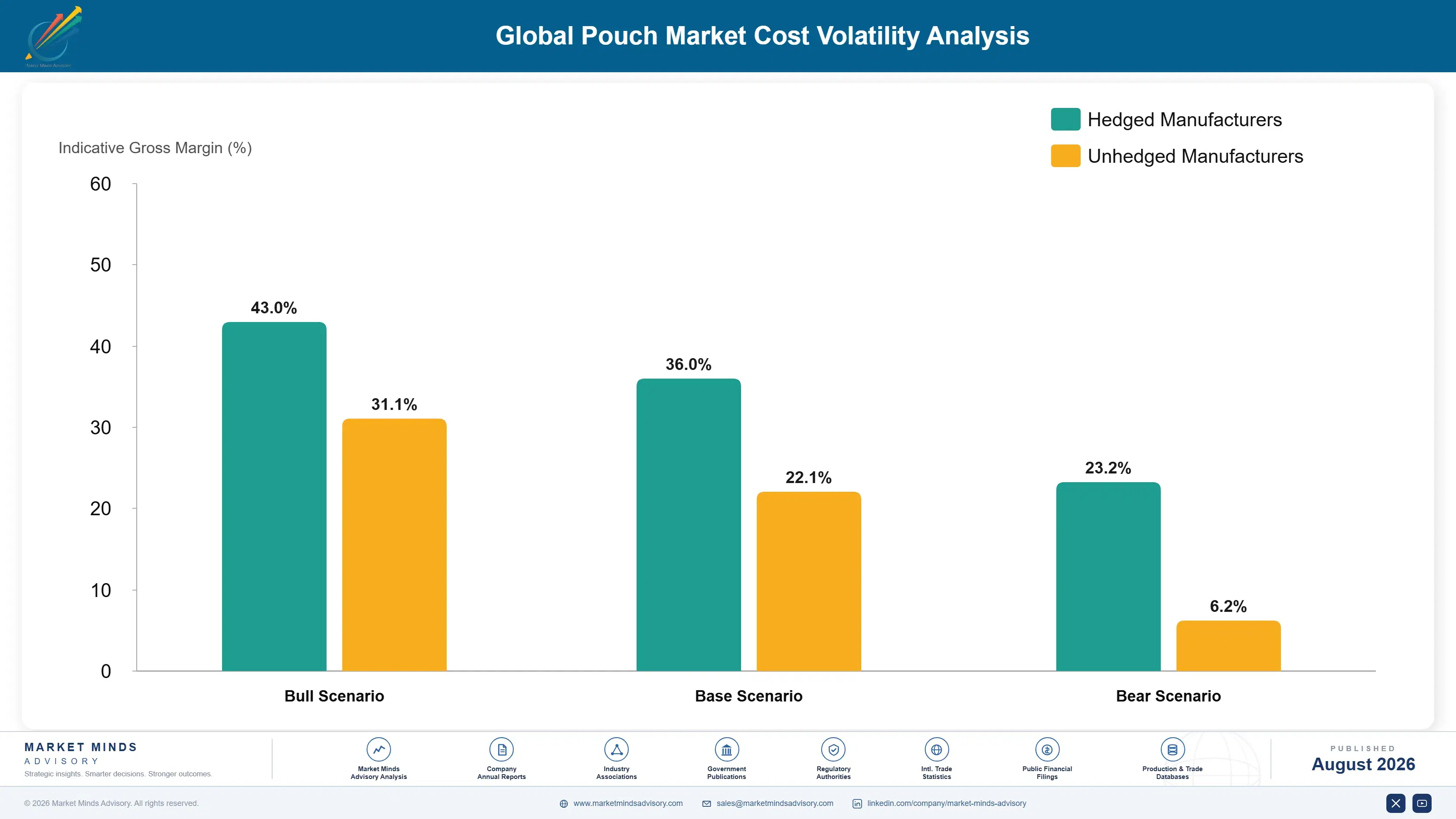
Film substrates dominate at roughly 54% of converted cost, spanning polyester, polyethylene, polypropylene, and aluminium foil purchased from resin converters and foil rollers. Adhesives, inks, and coatings take a further 15%, with barrier coatings costing considerably more on mono-material structures. Lamination and pouch-forming machine time absorbs 17%. Waste and setup scrap carries the remainder, and it rises sharply on shorter runs.
Polymer resin pricing moved sharply through 2021 and 2022 on feedstock and energy costs, and converters holding annual brand owner price agreements absorbed most of it directly. Amcor and Mondi both discussed raw material cost pressure and pricing recovery in their reporting for those years. Aluminium foil moved separately on metal and energy costs, which affected high-barrier structures more than any mono-material alternative. Mono-material converters were less exposed to foil throughout.

Exposure divides on structure mix and contract terms rather than on scale. Converters running high-barrier foil laminates carry aluminium exposure alongside polymer. Mono-material structures avoid foil and add barrier coating cost that is smaller in absolute terms and more concentrated in fewer suppliers. Annual brand owner agreements transfer a full year of material movement to the converter regardless of what any of those inputs actually did.
global-pouch-market-2025-2035-cost-volatility-analysis-1787553572296

Index brand agreements to resin references

Film at 54% of converted cost moves on polymer and energy prices that no converter influences, yet annual brand owner agreements routinely fix pricing across that whole exposure. Indexation to published resin references removes the mismatch entirely. Brand owners carry identical exposure through every alternative converter and accept indexation more readily than commercial teams generally expect.

Qualify second sources for barrier coatings

Metallised and oxide barrier coatings come from a narrower supplier base than conventional film substrates, and mono-material conversion concentrates dependence on exactly those materials. Qualifying alternates costs shelf life testing time rather than capital. Converters building mono-material capability without a second source are creating a single point of failure in their fastest-growing product line.

Price setup separately on short structure runs

Waste and setup scrap rises sharply as run length falls, and pricing per thousand pouches hides that entirely on short work. Separating a setup charge from the running rate makes the economics visible to brand owners ordering many regional variants. It also stops short runs quietly subsidising themselves from long ones that no longer exist in the same numbers.

Portfolio Architecture for Margin Defence

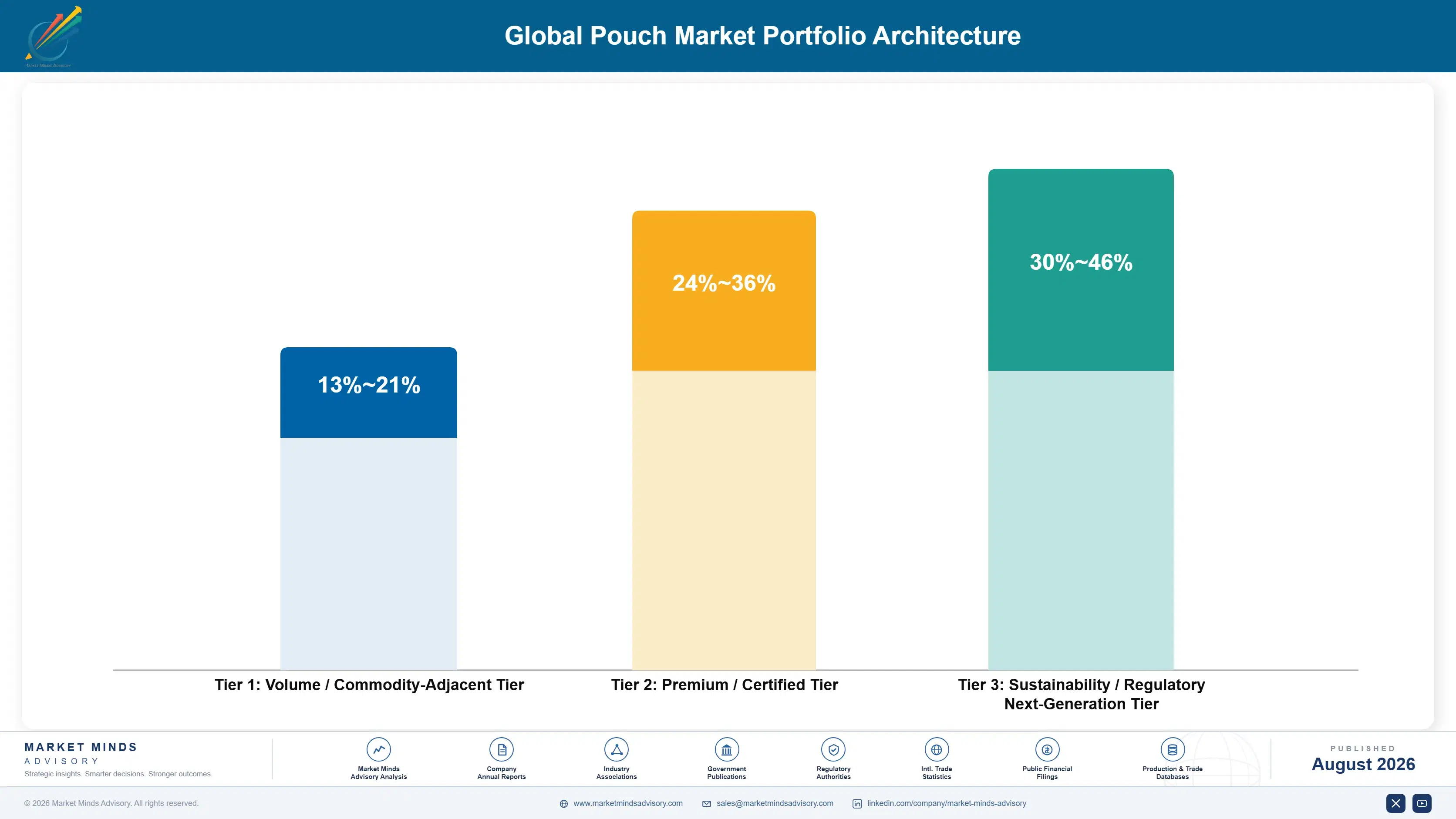
Margin architecture follows technical capability rather than converting capacity, because laminating and pouch forming are available from thousands of shops within any delivery radius. Standard laminate structures for regional brands compete on price and proximity and earn accordingly. High-barrier retort and vacuum structures earn more on processing difficulty. Mono-material conversions supported by barrier development and shelf life testing earn most, because so few converters can deliver them at all.
The volume and premium tension appears in who the converter talks to. Procurement compares cost per thousand across qualified suppliers. Packaging development and sustainability functions decide structure, substrate, and recyclability, and they are the people fee modulation is now landing on directly. Converters reaching only the first are competing where fragmentation sets the price and none of the technical work is visible. Very few converters reach the second conversation at all.

High-value pools concentrate in mono-material structures that hold shelf life, spouted and retort formats requiring processing capability, and multi-plant supply for national brands needing consistency. Each is defended by development capability, equipment, or scale rather than by conversion cost, which every competent regional converter can already match closely. Conversion cost defends nothing at all in this business.

Volume / Commodity-Adjacent Tier

Standard laminate stand-up and pillow pouches for regional brands where structure is settled and proximity decides. Thousands of converters compete within any delivery radius. Nothing about the conversion defends a position at all.
Gross Margin: 13%-21%

Premium / Certified Tier

Retort, vacuum, and spouted formats requiring processing capability, fitment application, and validated seal integrity beyond standard pouch forming. Equipment and process control defend this. The range reflects wide differences between format economics and volumes.
Gross Margin: 24%-36%

Sustainability / Regulatory / Next-Generation Tier

Mono-material structures that hold shelf life, barrier coating development, and fee modulation support across jurisdictions. Technical capability and regulatory knowledge both defend pricing here. The range is wide because barrier difficulty varies enormously by product category.
Gross Margin: 30%-46%
global-pouch-market-2025-2035-portfolio-architecture-1787553572796

High-value Sub-segments and Strategic Watch-out

Barrier-Solved Mono-Material Structures

Shelf life falls roughly 38% short of conventional laminates, and converters closing that gap for a demanding category serve conversions fee modulation has already made urgent for the brand owner concerned. Shelf life modelling frequently shows a category could already convert with existing technology today.
Gross Margin: 34%-46%

Spouted and Retort Formats

Fitment application and retort validation both require equipment and process control that a standard pouch-forming operation cannot offer, which removes the proximity advantage protecting most of this industry. Retort validation and seal integrity testing both narrow the available competitor set considerably further still in this format.
Gross Margin: 26%-36%

Fee Modulation Advisory Support

Scheme design and fee schedules by jurisdiction now set the pace of conversion programmes, and converters who track that detail position with brand owners before the cost actually lands on them. Very few commercial teams anywhere in this industry actually follow that detail at all.
Gross Margin: 30%-42%

Standard Regional Laminate Supply

The strategic watch-out. Thousands of converters compete within every delivery radius, structure is settled and undifferentiated, and falling equipment costs keep letting new entrants into the same work. Falling equipment costs also keep letting new regional converters into exactly the same commodity work each year.
Gross Margin: 13%-21%

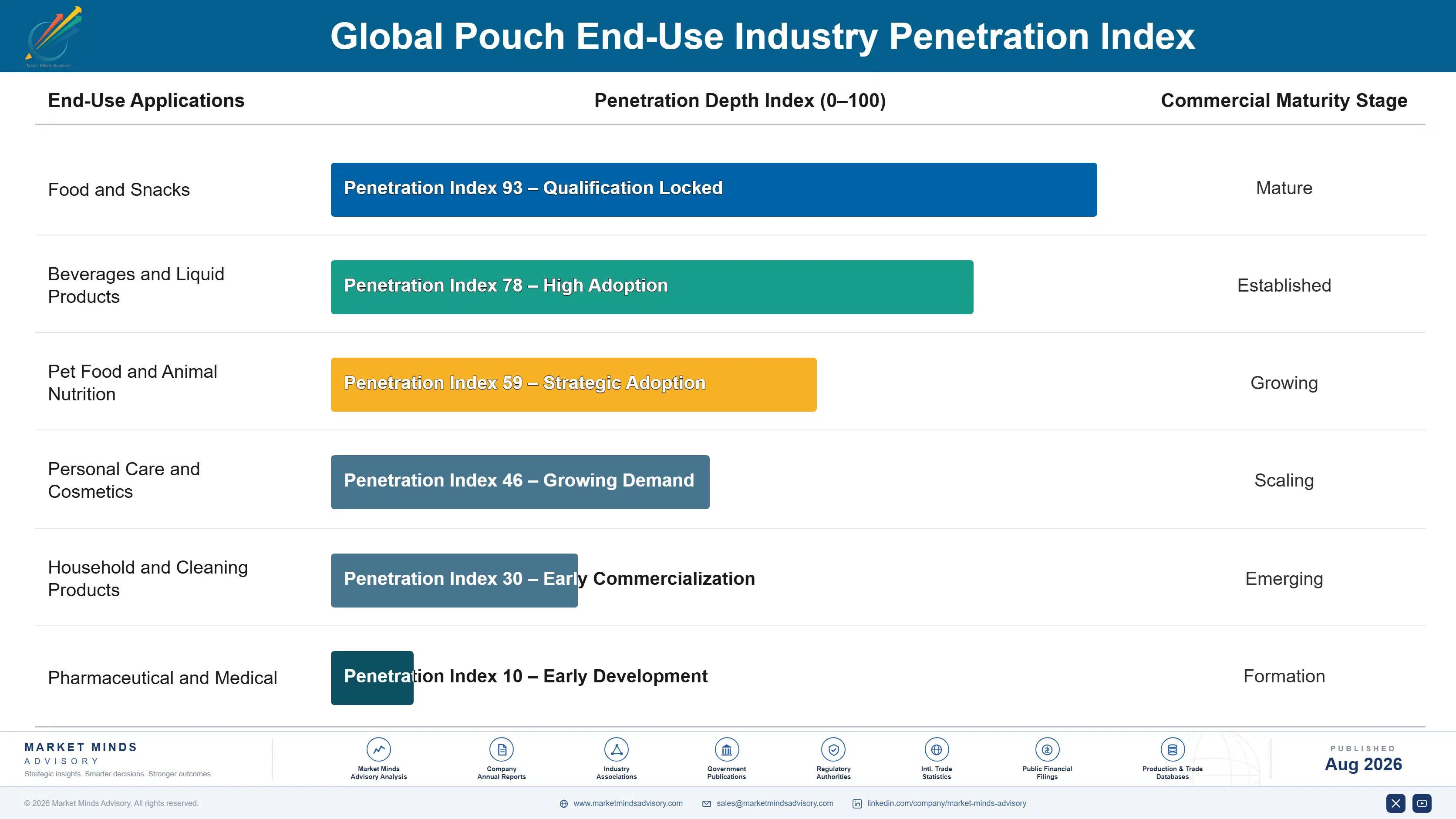
Who Decides the Structure

Demand reaches converters through three routes that rarely meet inside a brand owner. Procurement tenders annually on cost per thousand against a settled structure specification. Packaging development designs the structure, substrate, and format during product development, frequently years before any order. Sustainability functions now set recyclability constraints on both, and fee modulation has given them a cost argument that neither of the other two can dismiss as a preference. Those three functions rarely compare notes inside the same business.
Stickiness follows which function chose the converter. Structure developed jointly during product development holds through the product life. Retort and spouted work holds on validated process capability. Standard laminate volume holds until the next annual tender, which arrives quickly and repeatedly. Nothing about the conversion itself holds any of it.

The deciding buyer has shifted toward packaging development and sustainability as fee modulation landed, which is a genuine change in a category bought on price for decades. Converters organised entirely around tender response compete for the volume that moves annually while somebody with barrier capability holds the work that does not move at all. Reaching those two functions requires people who do not lead with price.
global-pouch-market-2025-2035-end-use-penetration-index-1787553573283

What Decides the Conversion

These are among the four positions where our research anticipates prominent divergence between winners and laggards over the coming forecast period. Each is grounded in the demand model, the regulatory perimeter, and the announced capacity pipeline.
01 / BARRIER GAP ENGINEERING

Solve shelf life or watch the conversion fail

Recycle-ready mono-material structures reach only 16% of pouch volume because achieved shelf life falls roughly 38% short of a conventional multilayer laminate, and no amount of commercial enthusiasm or fee pressure changes that arithmetic inside a genuinely demanding food category. Metallised and oxide coating development, layer design, and sealant selection all contribute to closing it in practice. Converters who solve it for a category competitors cannot serve win conversions that fee modulation has already made urgent for the brand owner concerned.
02 / FEE SCHEDULE TRACKING

Read the scheme reviews, not the consumer research

Extended producer responsibility fee modulation now runs at roughly 2.4 times between recyclable and non-recyclable pouch formats, and structure conversion follows that differential rather than any measured consumer preference for recyclable packaging anywhere yet measured. Jurisdictions operating without modulated fees show markedly slower mono-material adoption rates, which tells you plainly what is actually driving the change here. Converters tracking scheme design and annual fee reviews position with brand owners before the cost lands rather than after it has already landed.
03 / COLLECTION REALITY HONESTY

Say what recycle-ready actually delivers today

Only about 9% of household flexible packaging is genuinely collected for recycling, which means a mono-material pouch is recyclable in principle and ends up in residual waste in practice across most markets in the world today. Brand owners who discover that after a launch and a marketing claim remember exactly who told them and who preferred not to. Converters explaining the collection position, supporting store drop-off, and designing for sorting equipment that actually exists build credibility no marketing claim survives without.
04 / CAPABILITY OVER CONVERSION PRICE

Sell development where a single machine cannot

Thousands of converters run pouch-forming equipment inside any delivery radius, which has held concentration down at 18% despite the largest players acquiring continuously for several decades of trying now. Structure development, barrier testing, retort validation, multi-plant consistency, and fee modulation support all sit a long way beyond what a single-machine operation can credibly offer any brand owner at all. Larger converters competing on all those rather than on cost per thousand choose ground where the fragmentation simply stops mattering to anybody.

Engagement Snapshot From the Field

A live engagement with an industry participant carrying material or product regulatory and market exposure ahead of a defining policy shift, showing how our research translates into a defensible multi-year portfolio strategy.
MARKET MINDS ADVISORY · CLIENT ENGAGEMENT SUMMARY
Global Pouch Producer Strategic Portfolio Review and Transition Roadmap 2026·Investment Scenario on Global Pouch Exposure Evaluation 2025-26
CLIENT PROFILE
A European pouch converter with revenue near EUR 165 million (client-reported, unverified by MMA), supplying stand-up and pillow formats to food and household brands across several countries. Barrier development capability was limited, no mono-material structures had been commercialised, and margins had compressed for four consecutive years running. Brand sustainability functions had never once been contacted.
STRATEGIC CHALLENGE
Fee modulation had made non-recyclable structures visibly expensive to brand owners, and three customers had asked for mono-material conversions the business could not deliver on shelf life. Regional converters were undercutting standard laminate pricing everywhere. Every relationship ran through procurement on cost per thousand. Nobody had ever modelled the barrier requirement properly.
MMA APPROACH
MMA analysed conversion enquiries against barrier requirement by product category, assessed coating development options against the shelf life gap, and mapped fee modulation schedules across the client's markets. Forty-seven expert interviews with brand packaging developers, sustainability leads, procurement teams, and materials recovery operators established how structure decisions genuinely get made.
KEY FINDINGS
  1. All three mono-material enquiries had come from sustainability functions the client had never met, and each had gone to a competitor with barrier testing capability instead.
  2. Two of the three product categories involved could have converted with existing coating technology, and nobody in the business had run the shelf life modelling to establish that.
  3. Fee modulation schedules in four of the client's markets were published and none of the commercial team had ever looked at them or planned around the dates.
  4. Standard laminate work priced per thousand was subsidising short regional variant runs whose setup and scrap cost had never been allocated to them properly.
CLIENT PROFILE
A European pouch converter with revenue near EUR 165 million (client-reported, unverified by MMA), supplying stand-up and pillow formats to food and household brands across several countries. Barrier development capability was limited, no mono-material structures had been commercialised, and margins had compressed for four consecutive years running. Brand sustainability functions had never once been contacted.
STRATEGIC CHALLENGE
Fee modulation had made non-recyclable structures visibly expensive to brand owners, and three customers had asked for mono-material conversions the business could not deliver on shelf life. Regional converters were undercutting standard laminate pricing everywhere. Every relationship ran through procurement on cost per thousand. Nobody had ever modelled the barrier requirement properly.
MMA APPROACH
MMA analysed conversion enquiries against barrier requirement by product category, assessed coating development options against the shelf life gap, and mapped fee modulation schedules across the client's markets. Forty-seven expert interviews with brand packaging developers, sustainability leads, procurement teams, and materials recovery operators established how structure decisions genuinely get made.
KEY FINDINGS
  1. All three mono-material enquiries had come from sustainability functions the client had never met, and each had gone to a competitor with barrier testing capability instead.
  2. Two of the three product categories involved could have converted with existing coating technology, and nobody in the business had run the shelf life modelling to establish that.
  3. Fee modulation schedules in four of the client's markets were published and none of the commercial team had ever looked at them or planned around the dates.
  4. Standard laminate work priced per thousand was subsidising short regional variant runs whose setup and scrap cost had never been allocated to them properly.
RECOMMENDED STRATEGY
Phase 1: Phase one: build shelf life modelling and barrier testing capability, establishing which customer categories can convert with technology already available today. Phase 2: Phase two: open direct relationships with brand sustainability functions, reaching the people fee modulation is landing on rather than procurement. Phase 3: Phase three: track fee modulation schedules across all markets served, and separate setup charges from the running rate on short variant work.
OUTCOME
The client converted two customer categories to mono-material within a year using existing coating technology. Sustainability relationships opened at four brand owners, setup repricing turned short runs profitable, and blended gross margin improved 7.1 percentage points (client-reported, unverified by MMA). Fee schedule tracking now informs commercial planning.

Frequently Asked Questions

Foundational context covering the market sizes, CAGR, scope, country, region and competition that inform every finding below. This section is provided to cover basics and most often pre-purchase conversations, answered from the MMA Primary Research Dataset.

What is the current size of the Global Pouch Market?

The market was valued at USD 49.4 billion in 2025, rising to an estimated USD 52.46 billion in 2026. East Asia holds the largest regional share at 32% of value.

How large will the Global Pouch Market be by 2036?

MMA forecasts USD 95.74 billion by 2036 under the base case, an expansion multiple of 1.82 times the 2026 value. That represents USD 43.28 billion of incremental value.

What is the CAGR for the Global Pouch Market 2026 to 2036?

The base case CAGR is 6.2%, with a bull case of 7.4% and a bear case of 5.0%. The spread reflects uncertainty over barrier performance and fee modulation spread.

Which segment is growing fastest?

Recycle-ready mono-material pouches grow fastest at 14.8%, roughly 2.39 times the market rate. Spouted pouches follow at 8.6% on refill and dispensing demand across liquid categories.

Who are the major companies in the Global Pouch Market?

Amcor, Sealed Air, Mondi, Berry Global, and Huhtamaki lead, holding roughly 18% between them. Delivery radius economics keep concentration low despite decades of continuous consolidation.

Which country is growing fastest?

India grows fastest at 9.6%, as sachet and pouch consumption deepens across food, personal care, and household categories alongside expanding organised retail everywhere. Affordability makes single-serve formats the default there.

Report Segmentation Architecture

The full report scope spans multiple orthogonal segmentation dimensions, with cross-tabulated demand data provided for each dimension pair. Coverage extends further to regional breakdowns, trend trajectories, and the competitive detail needed to support segment-level decision-making.

By Pouch Format

  • Stand-Up Pouches
  • Flat and Pillow Pouches
  • Spouted Pouches
  • Retort Pouches
  • Vacuum and Skin Pouches
  • Recycle-Ready Mono-Material Pouches

By End-Use Industry

  • Food and Snacks
  • Beverages and Liquid Products
  • Pet Food and Animal Nutrition
  • Personal Care and Cosmetics
  • Household and Cleaning Products
  • Pharmaceutical and Medical

By Sales Model

  • Annual Procurement Tenders
  • Packaging Development Specification
  • Multi-Plant Brand Supply Agreements
  • Contract Filler and Co-Packer Supply
  • Distributor and Trade Channels

By Region

  • North America
  • Western Europe
  • East Asia
  • South Asia and Pacific
  • Latin America
  • Middle East and Africa
  • Eastern Europe

Scope, Methodology, and Coverage

Every figure in this report is reproducible from documented input assumptions. The scope below maps the historical period, the forecast horizon, the segmentation dimensions, and the countries covered, alongside the underlying primary and qualitative methodology.
Historical Period
2020 to 2025
Forecast Period
2026 to 2036
Base Year
2025 (USD billions; MMA Primary Research Dataset, August 2026)
Market Definition
The market comprises flexible pouches supplied for product containment, covering stand-up pouches, flat and pillow pouches, spouted pouches, retort pouches, vacuum and skin pouches, and recycle-ready mono-material pouches. Value is measured at converter level on printed and formed product across food, beverage, personal care, household, and pharmaceutical applications. Unconverted film and laminate sold as roll stock, filling and sealing machinery, rigid containers and closures, sacks and bags above pouch format sizes, and labels applied to pouches fall outside scope.
Quantitative Units
USD billions (current prices); billion pouch units converted annually; USD per thousand pouches by format and structure
Segmentation Dimensions
By Pouch Format; By End-Use Industry; By Sales Model; By Region
Regions Covered
North America, Western Europe, East Asia, South Asia and Pacific, Latin America, Middle East and Africa, Eastern Europe
Countries Covered
China, Japan, South Korea, Taiwan, India, Indonesia, Vietnam, Thailand, Australia, United States, Canada, Mexico, Germany, France, United Kingdom, Italy, Spain, Netherlands, Belgium, Poland, Czechia, Romania, Hungary, Turkey, Brazil, Argentina, Chile, Saudi Arabia, Egypt, South Africa
Key Companies Profiled
Amcor, Sealed Air, Mondi, Berry Global, Huhtamaki, Constantia Flexibles, ProAmpac, Sonoco, Coveris, Winpak, Glenroy, TC Transcontinental, Uflex, Toppan, Dai Nippon Printing, Printpack, American Packaging, Wipak, Schur Flexibles, Clondalkin
Quantitative Methodology
Primary survey, n=3,800 respondents, Q4 2025, six countries; demand-side model with trade association cross-validation
Qualitative Methodology
47 expert interviews, Q4 2025; applied to validate demand model assumptions, identify emerging dynamics, and assess competitive positioning
Report Format
PDF and XLSX data workbook (Word format preview document)
Publisher
Market Minds Advisory
Report Code
MMA-2026-PAC-159
Published
August 2026
Contact
sales@marketmindsadvisory.com | www.marketmindsadvisory.com

Purchase the full Global Pouch Market Report (2026 to 2036).

The full report sizes pouch demand across six formats, six end-use industries, and seven regions with 2026 to 2036 forecasts under base, bull, and bear cases. It treats the barrier performance gap and extended producer responsibility fee modulation as the two variables that actually govern structure conversion, rather than consumer preference. Competitive profiles cover twenty converters assessed consistently on converted pouch revenue, barrier development capability, and multi-plant reach. Cost analysis traces film, coating, and setup exposure against contract structures. Commercial guidance addresses barrier engineering, fee schedule tracking, collection honesty, and competing on capability.
Six pouch formats sized separately by region
Mono-material shelf life gap quantified by product category
Fee modulation differentials tracked across major schemes
Flexible collection and sorting rates measured against claims
Weight advantage against rigid formats modelled per category
Specification authority traced across procurement, development, and sustainability

Built For The People Who Decide

From boardroom strategy to bench-side execution, this report is read cover-to-cover by leaders shaping the next decade of their industry, turning demand scenarios, market dynamics and valuation benchmarks into decisions.
CXOs/ Presidents/ VPs/ Managers
M&A and Corporate Development
Strategy Teams and R&D Heads
Procurement and Product Directors
Regulatory and Compliance Leaders
Investor Relations and Equity Analysts