Market Minds Advisory
Global Plastic Retort Cans Market

Global Plastic Retort Cans Market: Metal Conversion and Pet Food Growth Dynamics

Brands are converting shelf-stable metal cans to lighter, microwavable plastic retort formats faster than converters can build qualified barrier film production lines, concentrating value among the handful of manufacturers with proven high-temperature sterilization engineering.

Lead Analyst

Bilal Shaikh

Published

September 2026

Make Smarter Decisions with Customized Research Insights

Request a free sample report and evaluate market opportunities, growth trends, and competitive dynamics relevant to your business needs.

2025 MARKET VALUE$0.9BMarket Size 2025
2036 FORECAST VALUE$2.1BBase Case , 2026 to 2036
CAGR 2026 TO 20367.8 %Bull 9.0% / Bear 6.5%
INCREMENTAL OPPORTUNITY$1.1BNet 10- year value creation
EXPANSION MULTIPLE2.12x2036 value over 2026 base
Strategic Levers
M&A Pipeline
Regional Outlook
Country Rankings
Competitive Intelligence
Segmental Deep-dive
Call-Us : 91 93563 13602

Executive Snapshot and Market Trajectory

Plastic retort cans are converting a meaningful share of shelf-stable food packaging away from traditional metal cans as brands seek lighter weight, microwavable convenience, and easier-open formats that metal cans cannot match worldwide each year. Buyers face genuinely new competitive dynamics worth understanding.
Ready meal and soup retort cans form the fastest-growing segment as convenience food brands increasingly adopt microwavable plastic formats that let consumers heat and eat directly from the container without transferring to separate cookware. North America anchors the deepest commercial concentration, reflecting the region's exceptionally large pet food packaging industry and established retort converter infrastructure that developing packaging markets still cannot fully replicate at comparable scale. Regional converter relationships continue deepening across leading brand networks.
Sonoco Products and Silgan Holdings set the technology benchmark through deep retort barrier film engineering and broad metal-to-plastic conversion relationships respectively, while a fragmented tail of smaller regional converters competes on price and local brand relationships. Expanding pet food category growth and ready meal microwavability demand are both reshaping which converters capture retort can volume as metal-to-plastic conversion accelerates faster than smaller competitors can follow. Smaller converters form partnerships to compete.
Market Definition
The global plastic retort cans market covers rigid multilayer plastic containers engineered to withstand high-temperature, high-pressure retort sterilization processing used to achieve shelf-stable food packaging. It spans pet food, ready meal, soup, seafood, and meat applications packaged in retort-capable plastic cans across both single-serve and multi-serve formats. Traditional metal cans, flexible retort pouches, and unrelated non-retort rigid packaging formats are excluded from this scope.
Base Year Value
$0.9B in 2025 (MMA Primary Research Dataset, August 2026)
Forecast Period
2026 to 2036, eleven discrete annual values
CAGR
7.8% base case. Bull 9.0%. Bear 6.5%.
Fastest Growth Segment
Ready Meal and Soup Retort Cans: 12.4% CAGR
Fastest Growth Country
China: 10.6% CAGR
Fastest Growth Region
South Asia and Pacific: 9.8% CAGR
Largest Region
North America: 30% of 2025 global value
Market Leaders
Sonoco Products, Silgan Holdings, Amcor, Crown Holdings, CurTec International. Source: MMA Analysis based on company annual reports.
Primary Survey
n=3,800 procurement and R&D decision-makers, Q4 2025, six countries
Methodology
Demand-side build-up, cross-validated against public data, 47 expert interviews

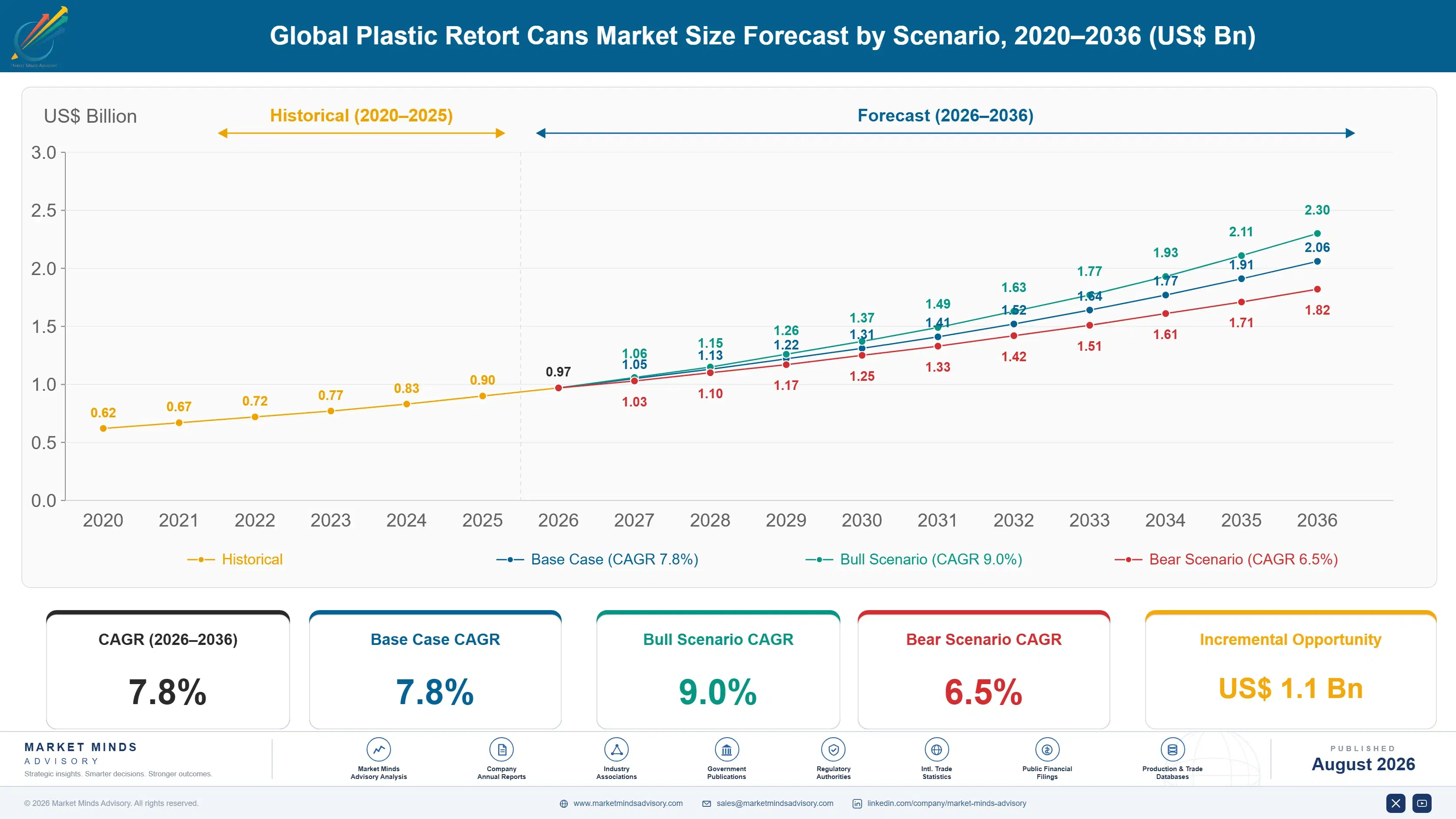
Global Plastic Retort Cans Market Forecast Scenarios

global-plastic-retort-cans-market-size-forecast-scenario-1787305100660
Plastic retort can demand grew steadily across 2020 to 2025 as pet food category volume expanded and brands increasingly sought metal-to-plastic conversion for lighter weight and improved consumer convenience, even as resin price volatility periodically slowed converter capital investment. The market grew at an estimated 7.0% historical CAGR across the period, reflecting steady conversion momentum offsetting periodic feedstock cost pressure across major producing regions.
The base case assumes metal-to-plastic conversion continues accelerating across major food categories through 2030, ready meal and soup brands increasingly adopt microwavable retort can formats as consumer convenience expectations rise, and converter production capacity expands to meet growing brand demand. Together these three commercial mechanisms support a 7.8% forecast CAGR, with pet food packaging remaining the volume anchor even as ready meal and soup applications capture a growing share of total value each year across every major packaging market worldwide.
The bull case centers on faster-than-expected metal-to-plastic conversion that pushes brand adoption well ahead of current converter capacity expansion timelines. The bear case centers on renewed resin price volatility, which would slow converter tooling investment and push brands back toward established metal can formats across cost-constrained categories for several years across the industry nationwide. each year.

Metal Conversion and Barrier Engineering Dynamics

Plastic retort cans sit at the intersection of polymer materials science and high-temperature sterilization engineering, since barrier film formulation must withstand retort processing conditions without compromising the shelf-stability seal integrity that makes retort packaging commercially viable. That split has kept the vendor base divided between large diversified converters competing on production scale and specialized manufacturers competing on application-specific barrier design.
TOP 5 CONCENTRATION44%share held by leading five plastic retort can converters
AVERAGE CAN PRICE$0.22 per unittypical unit price across pet food and meal formats
LEADING COUNTRY SHAREUnited States, 21%share of global plastic retort can production volume overall
METAL CONVERSION RATE18% of eligible categoriesshare of eligible metal can categories converted to plastic retort
PET FOOD CATEGORY SHARE52% of retort can volumeshare of total retort can volume serving pet food applications
MICROWAVABILITY ADOPTION34% of new toolingshare of new tooling investment supporting microwavable design
Commercially, the market splits between a mature pet food base sold through established brand and co-packer relationships built over years of category development, and a smaller but faster-growing ready meal and soup tier sold on microwavable convenience rather than price alone. Seafood and meat applications round out demand with category-specific purchasing tied to shelf-life and barrier performance needs.
Over the next decade, barrier engineering capability and conversion partnership depth will matter more than raw production volume alone, since brands increasingly select converters based on proven retort sterilization reliability rather than which supplier offers the lowest per-unit price. Converters that can expand barrier engineering capacity into mid-tier brand relationships fastest stand to capture a widening share of a market that metal-to-plastic conversion is reshaping as much as category volume growth is.
"Brands love the pitch of a lighter, microwavable can. What they don't love is finding out the barrier film failed a retort cycle after the product's already on a truck."
Director, Rigid Packaging and Materials Practice · MMA Packaging / Rigid Food Co

Market Trends

Pet Food Brands Lead Metal-to-Plastic Conversion

Pet food brands are converting traditional metal cans to plastic retort formats faster than any other category, driven by consumer preference for lighter, easier-to-open packaging and brand interest in differentiated shelf presence relative to conventional metal can competitors. Sonoco Products and Silgan Holdings have both expanded pet food retort can capacity since 2023, targeting companies that want reliable barrier performance matching metal can shelf-life expectations. Smaller regional converters are following more slowly, constrained by the barrier engineering investment required for retort-grade plastic qualification, but conversion is broadening steadily each year across major markets.
Market Impact: Adds 6% annual category volume grow

Microwavable Design Expands Ready Meal Category Adoption

Microwavable plastic retort can designs are expanding adoption among ready meal and soup brands as consumers increasingly favor heat-and-eat convenience that eliminates the need to transfer food to separate microwave-safe cookware before consumption. Amcor and Crown Holdings have both expanded microwavable retort can offerings since 2023, targeting convenience food brands that want differentiated on-shelf positioning built around genuine consumer convenience benefits. This design trend is broadening ready meal category adoption steadily each year across major convenience food markets. Retailers increasingly favor brands offering genuine consumer convenience benefits over marketing claims alone.
Market Impact: Cuts packaging weight by 40%

Market Opportunities and Growth Drivers

Growing Pet Ownership Expands Category Volume

Global pet ownership continues expanding each year, with rising disposable income and changing household composition sustaining long-term growth in wet pet food category volume that increasingly relies on retort can packaging formats regardless of near-term resin cost cycles in any single market. This category growth provides a durable baseline volume floor beneath the faster-growing metal-to-plastic conversion trend layered on top of it, since underlying pet food consumption continues expanding independent of packaging format decisions. Pet food brands increasingly view packaging format as a genuine differentiation opportunity within a crowded category.
Market Impact: Delays qualification by 12 months

Brand Sustainability Positioning Favors Lighter Packaging

Consumer packaged goods brands increasingly favor plastic retort cans over metal alternatives as part of broader sustainability positioning built around reduced packaging weight and associated transportation emissions relative to heavier metal can formats. This positioning has expanded meaningfully since 2023 as brands formalize packaging weight reduction targets within broader corporate sustainability commitments extending beyond voluntary marketing claims. Brands with strong sustainability positioning increasingly favor plastic retort conversion as a visible, quantifiable improvement they can report to stakeholders. Manufacturers with strong sustainability credentials increasingly capture this expanding demand first. This trend is expected to accelerate further.
Market Impact: Excludes 47% of regional population

Market Restraints and Challenges

Barrier Film Qualification Requires Extensive Validation

Qualifying a new barrier film formulation for retort sterilization service requires extensive validation testing to confirm the film maintains seal integrity and shelf-stability performance across repeated high-temperature, high-pressure processing cycles, creating a lengthy qualification timeline that slows how quickly converters can introduce new formulations even when they offer meaningful performance improvements. This constraint is particularly burdensome for smaller regional converters lacking the analytical infrastructure and retort processing relationships that larger converters maintain internally for faster qualification turnaround. Converters are responding by investing in expanded testing capability and pursuing platform-based validation data that can support multiple film applications simultaneously.
Market Impact: Adds $0.22 per converted unit

Recycling Infrastructure Gaps Undermine Sustainability Claims

Municipal recycling infrastructure capable of properly processing multilayer plastic retort cans remains unevenly available across markets, meaning packaging marketed on sustainability grounds often ends up in conventional waste streams where its recyclability advantage over metal cans is substantially diminished or eliminated entirely. This infrastructure gap is most pronounced in markets where municipal recycling systems were not originally designed to separate and process multilayer plastic packaging at meaningful scale. Converters and brands are investing in expanded recycling infrastructure partnerships to close this gap, though meaningful improvement will take considerable time across most affected regions.
Market Impact: Cuts preparation time by 3 minutes
3 additional market trends, 2 additional growth drivers, and 3 additional restraints and challenges are covered in the full report. Contact sales@marketmindsadvisory.com to access the complete intelligence.

Segment CAGR and Growth Architecture

Plastic retort cans segment by application and format type, the classification brands and converters use to set barrier requirements, tooling investment, and pricing tier, since pet food, ready meal, and seafood buyers each negotiate under distinct commercial terms. Vendors price each category differently depending on barrier complexity and shelf-life requirements involved. Brands weigh both factors closely when selecting a converter.
global-plastic-retort-cans-market-market-share-analysis-1787305101191

Ready Meal and Soup Retort Cans

Ready meal and soup retort cans form the fastest-growing segment as convenience food brands increasingly adopt microwavable plastic formats that eliminate the need to transfer food to separate cookware before heating and consumption. Amcor and Crown Holdings have both expanded microwavable retort can production capacity since 2023, targeting brands that want differentiated convenience positioning built around genuine consumer benefit rather than marketing claims alone. Converters that secure early brand relationships are capturing volume from smaller competitors that lack barrier engineering scale to meet large brand requirements, an advantage that compounds as more brands standardize around microwavable formats. If conversion continues at the current pace, this segment could approach a meaningful share of total category value.
CAGR 12.4%

Multi-Serve Family-Size Retort Cans

Multi-serve family-size retort cans form the second-fastest segment as brands increasingly offer larger-format plastic containers for household consumption occasions that traditional single-serve metal cans cannot address economically. Sonoco Products and Silgan Holdings have both expanded family-size tooling capability since 2023, targeting brands that want to capture larger household consumption occasions without requiring separate multi-can purchases. Converters that build strong family-size relationships early are capturing volume from competitors lacking comparable large-format tooling scale, an advantage that compounds as more brands standardize around family-size retort packaging. This segment increasingly serves households seeking value-oriented bulk purchasing options. Payers increasingly view family-size formats as a durable long-term differentiator worth monitoring closely. Retailers increasingly favor these formats.
CAGR 10.2%
Full segment breakdown across 6 segments available in the complete report.

Regional Architecture and Country Demand Map

Plastic retort can commercial activity concentrates where pet food category volume and converter manufacturing infrastructure are most developed, even though underlying category volume growth runs highest in regions still building the production infrastructure needed to capture that value commercially each year. particularly across major pet food markets.

North America

The United States accounts for the overwhelming majority of North America's plastic retort can commercial value, reflecting the region's exceptionally large pet food category volume, dense converter manufacturing presence, and comprehensive brand relationships driving early access to newest barrier film technology. Canada contributes a smaller but meaningful share through its established pet food and convenience food processing infrastructure. Metal-to-plastic conversion activity runs meaningfully ahead of the global average across most large pet food and convenience food brands in the region. Microwavable ready meal adoption continues expanding steadily each year across major metropolitan retail markets. particularly across major United States pet food manufacturing hubs nationwide, reinforcing steady demand growth each successive year.
Share: 30% | CAGR: 8.6% (2026 to 2036)

Western Europe

Germany, France, and the United Kingdom together anchor Western Europe's plastic retort can demand, reflecting well-established convenience food and pet food processing infrastructure and comparatively strong brand sustainability positioning favoring plastic conversion. Regulatory attention to packaging recyclability across the region has driven particularly careful evaluation of retort can end-of-life claims relative to metal can alternatives. Smaller Western European markets rely more heavily on regional converters rather than domestic large-scale production, concentrating manufacturing volume at fewer high-throughput facilities. Regional pet food category growth continues supporting steady conversion demand. Regional composting and recycling facility density continues to support broader packaging end-of-life processing capability effectively. Local manufacturers increasingly seek recycling infrastructure partnerships to strengthen sustainability claims.
Share: 23% | CAGR: 6.5% (2026 to 2036)
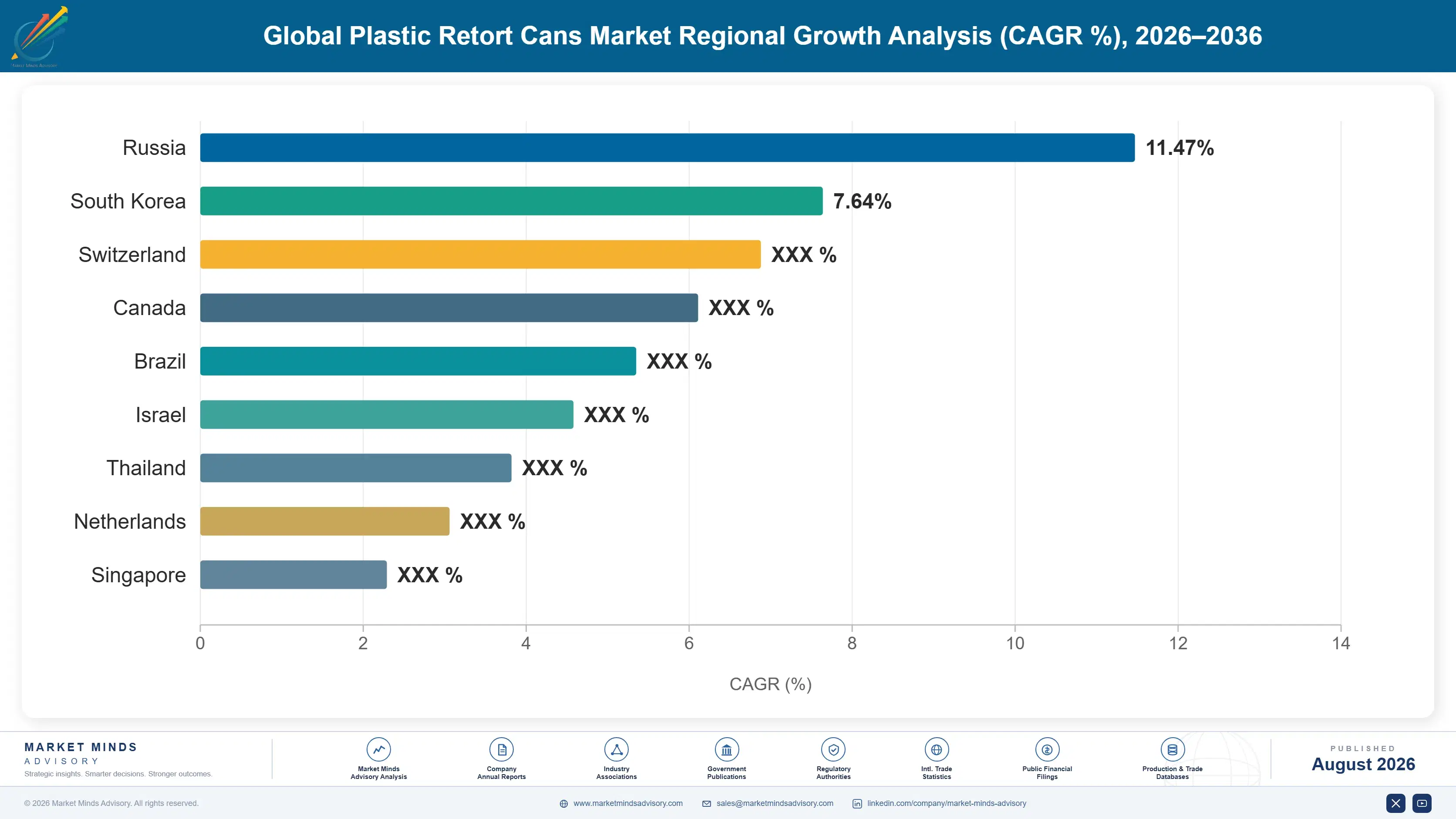
Regional intelligence for 5 additional markets available in the complete report: East Asia, South Asia and Pacific, Latin America, Middle East and Africa, Eastern Europe. Contact sales@marketmindsadvisory.com.
global-plastic-retort-cans-market-country-cagr-analysis-1787305101704

Where Conversion Value Concentrates Next

Revenue growth in plastic retort cans increasingly depends on capturing metal-to-plastic conversion demand, ready meal microwavability adoption, and pet food category expansion rather than raw legacy volume alone, since brand conversion decisions, not raw category growth, are reshaping where packaging value concentrates. The levers below outline where that value is concentrating fastest across the conversion pathway today.

Expanding Barrier Film Engineering Capacity Further

Converters expanding barrier film engineering capacity are capturing brand conversion volume that engineering-constrained competitors cannot fulfill, particularly as more brands face growing consumer demand for lighter, microwavable packaging formats. Building competitive barrier engineering capacity typically costs $22 million to $50 million in mold engineering, production line, and validation testing investment. Converters without adequate engineering capacity increasingly lose brand relationships to better-capitalized competitors offering proven conversion supply sooner. Converters without such investment risk losing brand relationships to better-capitalized competitors permanently over time. That advantage compounds further as more brands standardize around proven barrier engineering supply.
Market Impact: Costs $22 to $50 million to fully b

Building Advanced Retort Sterilization Testing Capability

Converters building advanced retort sterilization testing capability are capturing brand relationships that basic barrier film offerings cannot match for applications with demanding shelf-life requirements. Developing competitive testing capability typically costs $6 million to $16 million in material science research, pilot testing, and regulatory validation investment. Converters with superior testing capability increasingly win brand preference from competitors offering only basic barrier performance validation. Converters without such capability risk losing demanding-application brand relationships to better-positioned competitors indefinitely. That advantage compounds further as more brands seek demanding barrier performance validation. Manufacturers with adequate testing increasingly win preference over less-validated offerings.
Market Impact: Costs $6 to $16 million to fully bu

Securing Pet Food Category Expansion Partnerships

Converters securing dedicated partnerships with pet food brands expanding their plastic retort can portfolio are capturing volume growth that transactional spot-market relationships cannot match on reliability and long-term category planning visibility. These partnerships typically carry a 10 to 18% margin premium given the application-specific design and volume commitment brands value. Converters able to demonstrate reliable pet-food-specific design capability increasingly win these partnerships over less-prepared competitors. Converters without such partnerships compete purely on commodity volume when category expansion channels remain closed. That advantage compounds further as more brands consolidate spend with fewer, deeper category partners.
Market Impact: Commands a 10 to 18% margin premium

Investing In Recyclable Mono-Material Formulations Now

Converters investing in recyclable mono-material retort can formulations are positioned to capture premium sustainability-positioned brand volume that standard multilayer plastic offerings cannot fully address for brands seeking maximum differentiation. Developing competitive mono-material capability typically costs $16 million to $38 million in barrier coating technology, testing, and facility investment. Converters with strong mono-material capability increasingly win premium brand relationships from competitors offering only standard multilayer alternatives. Converters without such investment risk losing this premium differentiation segment to better-positioned competitors permanently. That advantage compounds further as more premium brands seek maximum sustainability differentiation.
Market Impact: Costs $16 to $38 million to fully b

Who Controls the Margin Pool

The top five vendors hold an estimated 44% of global plastic retort can revenue, a fragmented plurality reflecting the wide range of regional converters and the capital-intensive but not fully consolidated nature of barrier engineering and production infrastructure. Sonoco Products and Silgan Holdings lead on barrier engineering depth and metal-to-plastic conversion relationships respectively, while a fragmented tail of smaller regional converters competes on price and local brand relationships.
Current competitive activity centers on three fronts. Barrier engineering capacity expansion is opening a new front for converters willing to invest ahead of confirmed brand conversion demand. Retort sterilization testing capability is becoming increasingly important as converters compete on performance for demanding shelf-life applications. And several mid-sized converters are pursuing pet food category partnerships to differentiate beyond commoditized standard can sales.

Emerging pressure comes from mid-sized regional converters moving into plastic retort conversion as they partner with resin suppliers and mold engineering firms, though matching Sonoco Products or Silgan Holdings's barrier engineering depth and brand relationships remains years away for most. If these challengers close that gap, expect share to shift within regional relationships first, before pressure reaches the largest incumbents.
global-plastic-retort-cans-market-company-positioning-matrix-1787305102223

Competitive Moat and Risk Dimensions

SONOCO PRODUCTS COMPANY

Moat: Deep Retort Barrier Film Engineering

Sonoco Products maintains one of the industry's deepest retort barrier film engineering capabilities, built through decades of continuous investment in high-temperature sterilization material science across multiple food categories. That engineering depth gives Sonoco Products a durable technical credibility advantage that smaller competitors with thinner engineering investment cannot quickly replicate, even as new entrants continue entering the category.
SONOCO PRODUCTS COMPANY

Risk: High Capital Intensity Risk

Sonoco Products' retort can production requires substantial ongoing capital investment in specialized barrier film and sterilization equipment that constrains flexibility relative to competitors with lower fixed-asset intensity in adjacent packaging categories. If category growth accelerates faster than Sonoco Products' capacity expansion allows, it risks ceding emerging brand relationships to more agile smaller competitors.
SILGAN HOLDINGS INC.

Moat: Broad Metal-To-Plastic Conversion Relationships

Silgan Holdings maintains broad metal-to-plastic conversion relationships built through its established metal can manufacturing heritage, giving it unique insight into which brands are evaluating conversion and direct access to existing metal can customer relationships. That relationship depth gives Silgan Holdings a durable advantage in capturing brands transitioning away from metal formats.
SILGAN HOLDINGS INC.

Risk: Slower Adoption Versus Metal Incumbency

Silgan Holdings' substantial metal can manufacturing revenue creates some internal tension around aggressively promoting plastic conversion that could cannibalize its existing metal can business relationships. If Silgan Holdings moves too cautiously on plastic conversion promotion, it risks losing brand relationships to converters without competing metal can revenue to protect.

Players Tracked

Prominent Players

Sonoco Products Company
Silgan Holdings Inc.
Amcor plc
Crown Holdings Inc.
CurTec International B.V.

Other Key Players

Berry Global Inc.
Winpak Ltd.
Coveris Holdings S.A.
Genpak LLC
ProAmpac LLC
Placon Corporation
Greiner Packaging International GmbH
Huhtamaki Oyj
Constantia Flexibles Group GmbH
Faerch Group A/S
Sealed Air Corporation
ALPLA Group
Guala Pack S.p.A.
Mauser Packaging Solutions
Toyo Seikan Group Holdings Ltd.

Recent Developments

APRIL 2025

Sonoco Products Expands Barrier Film Manufacturing Capacity

Sonoco Products commissioned additional barrier film manufacturing capacity to meet rising demand from pet food brands transitioning ahead of category growth targets, following distributor commitments signed as more brands sought reliable retort-grade supply. The expansion followed sustained customer pressure for dedicated barrier film infrastructure across major categories.
Signal: Confirms barrier film capacity remains the
OCTOBER 2024

Silgan Holdings Signs Multi-Year Brand Conversion Partnership

Silgan Holdings secured a multi-year conversion partnership agreement with a major pet food brand, guaranteeing plastic retort can tooling development and supply volume through 2029 across several affiliated product lines. The agreement reflects brands' push to lock in reliable conversion capability ahead of expanding category commitments.
Signal: Shows brands prioritizing long-term conver
JANUARY 2025

Amcor Announces Microwavable Retort Can Production Expansion

Amcor announced expanded microwavable retort can production capacity to serve growing demand from ready meal brands seeking differentiated convenience positioning beyond standard heating instructions. Similar expansions are expected across other qualified competitors soon. Additional expansions are expected across other manufacturers over the coming year as demand grows.
Signal: Signals microwavable design is becoming a

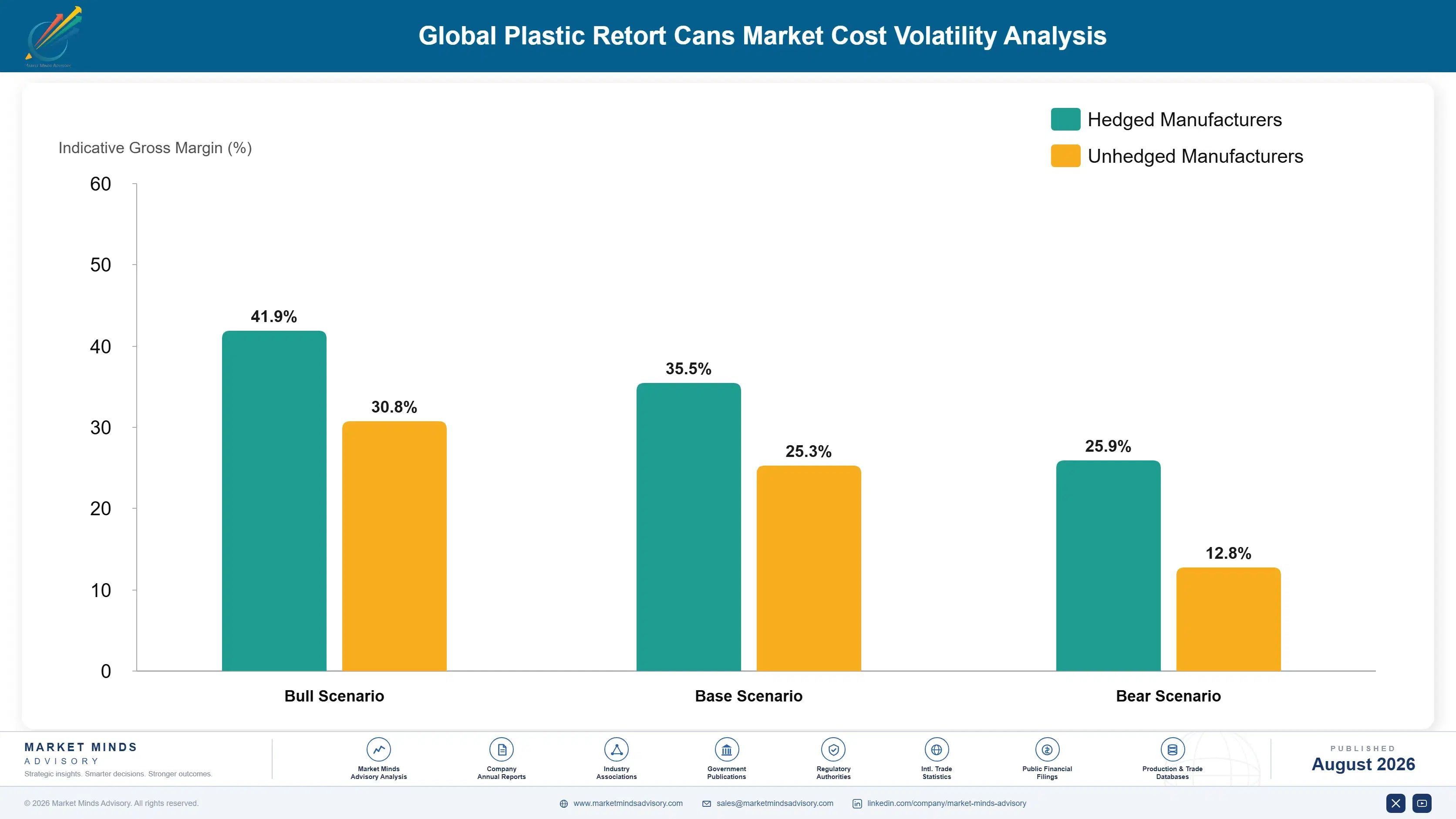
Resin and Barrier Coating Cost Pressure

Polypropylene resin and specialized barrier coating materials together account for roughly 40% of effective cost of goods for plastic retort can converters, given the direct petrochemical feedstock exposure and specialized coating requirements inherent in retort-grade barrier film manufacturing. Mold tooling amortization and production line equipment costs add a further meaningful share, particularly for converters actively investing in new format development.
Resin and barrier coating costs rose meaningfully following 2022 global petrochemical supply disruption, with several manufacturers reporting input cost increases exceeding 20% in their annual reports before pricing stabilized through 2023 and into 2024. Industry supply chain reviews have flagged resin pricing as this market's single most concentrated input, more than tooling amortization or labor costs combined. Several converters have flagged feedstock price volatility as an ongoing operational risk.

Smaller regional converters without long-term resin supply agreements absorbed the 2022 cost increases hardest, losing brand contract bids to larger competitors including Sonoco Products and Silgan Holdings that had negotiated priority supplier allocation years in advance. Converters with secured resin supply weathered the cost increases far better than those dependent on spot market purchasing, a cost advantage that persists most sharply across smaller regional converters today.
global-plastic-retort-cans-market-cost-volatility-analysis-1787305102419

Long-Term Resin Supplier Agreements Secure Pricing

Converters increasingly negotiate multi-year resin and barrier coating supply agreements with priority allocation clauses, reducing exposure to spot market price volatility during periods of petrochemical supply disruption. This approach has helped several converters maintain more stable packaging pricing even during periods of broader input cost inflation across the industry. This approach is becoming standard practice industry-wide.

Resin Cost Pass-Through Clauses Protect Margins

Converters increasingly negotiate resin cost pass-through clauses within brand supply contracts, reducing the margin compression risk that sudden feedstock price spikes previously created under fixed-price contract terms. This approach has helped several converters maintain more stable margins even during periods of significant resin price volatility. This model has become increasingly common as smaller converters scale operations without heavy capital investment.

Vertical Integration Into Resin Sourcing Reduces Exposure

Several larger converters are investing in direct resin sourcing relationships with petrochemical producers to reduce dependence on distributor intermediaries, gaining pricing control and supply security that non-integrated competitors cannot match during periods of tightening supply. This integration also reduces exposure to spot market volatility across the supply chain. This has helped several companies weather recent cost volatility better.

Portfolio Architecture for Margin Defence

Plastic retort can portfolios span three margin tiers, from commodity-adjacent standard pet food cans sold largely on price, through certified ready meal and soup cans carrying microwavability-driven premiums, toward an emerging next-generation tier built around mono-material recyclable designs still gaining share. Gross margin widens meaningfully at each tier as barrier engineering complexity and consumer convenience features increase across the industry today, reflecting growing willingness to
The volume versus premium tension centers on tooling and research investment allocation. Converters must choose between dedicating capital to high-margin microwavable and mono-material programs with growing but still-smaller volume, or serving reliable pet food demand that fills out most production volume across a typical year. Converters without spare capital increasingly favor higher-margin next-generation programs where competition remains comparatively thin still.

High-value margin pools concentrate in microwavable and mono-material retort can designs, where tooling investment and material research keep competition thin and brands pay a premium for consumer convenience and sustainability differentiation. Standard pet food cans remain the volume anchor but carry thinner margins across the portfolio, leaving smaller converters with fewer diversification options than larger integrated competitors today.

Volume / Commodity-Adjacent Tier

Standard pet food retort cans sold largely on price and distributor availability without convenience-driven premiums, across most standard brand buyer segments worldwide each year. Pricing pressure from distributors and metal can competition keeps margins comparatively thin across this tier.
Gross Margin: 14-24%

Premium / Certified Tier

Microwavable ready meal and soup cans sold under brand supply contracts carrying convenience-driven pricing power built through years of proven consumer performance across major markets worldwide. Buyers increasingly compare barrier performance data before committing to a long-term relationship.
Gross Margin: 26-38%

Sustainability / Regulatory / Next-Generation Tier

Mono-material recyclable retort cans in active premium brand adoption, commanding premium pricing against limited proven alternatives as sustainability differentiation and production capability expand across major markets. Manufacturers with the deepest certification and brand relationship network capture most of this premium value.
Gross Margin: 34-46%
global-plastic-retort-cans-market-portfolio-architecture-1787305102915

Multi-Year Brand Tooling Relationship

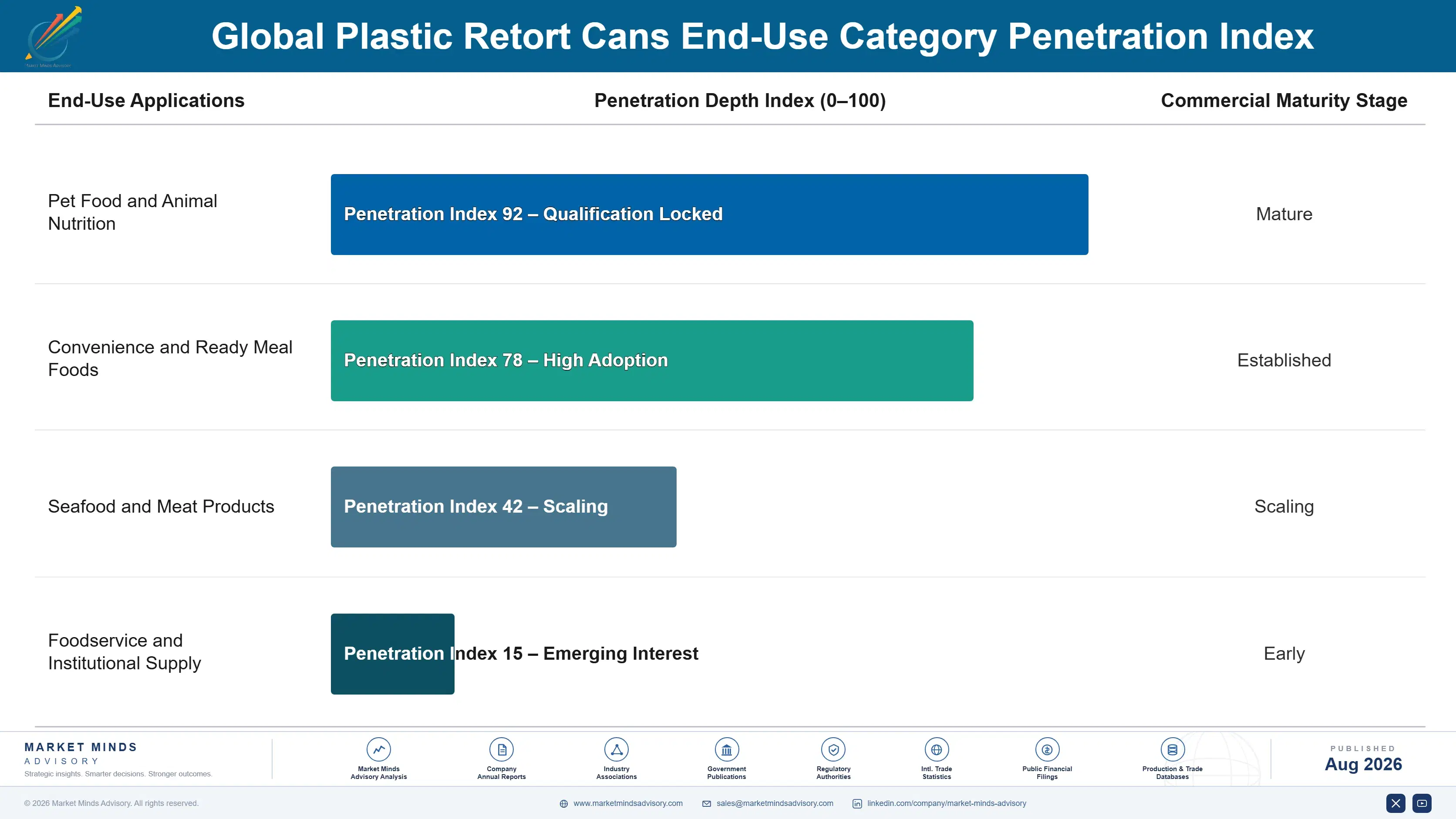
Plastic retort can purchasing functions closer to a multi-year annuity than a single transaction for brand relationships, since custom mold tooling investment and validated retort qualification typically lock in purchasing commitments for years once a converter secures the initial brand conversion contract. Commodity can purchasing behaves somewhat differently, tracking broader category volume rather than any dedicated tooling relationship specifically.
Adoption depth varies sharply by end-use vertical. Large pet food and consumer packaged goods brands show the deepest engagement with microwavable and mono-material conversion, given dedicated packaging development staff and formal category growth targets, while smaller regional brands adopt more slowly since conversion investment rarely gets justified by comparatively low individual purchasing volume. That divide shapes where converters concentrate commercial and tooling investment.

A generational shift is underway as younger brand packaging managers, trained during the era of routine metal-to-plastic conversion consideration, evaluate converters on barrier engineering capability and conversion partnership depth rather than decades-long familiarity with conventional metal can suppliers. That openness gives conversion-forward converters a rare opening to win brand share in a category where legacy metal can relationships have otherwise been difficult to dislodge, across several major markets today.
global-plastic-retort-cans-market-end-use-penetration-index-1787305103408

Where MMA Sees The Opportunity

These are among the four positions where our research anticipates prominent divergence between winners and laggards over the coming forecast period. Each is grounded in the demand model, the regulatory perimeter, and the announced capacity pipeline.
01 / BARRIER ENGINEERING INVESTMENT

Expand Barrier Capacity Before Conversion Deadlines Fully Bite

Brands are increasingly requiring proven barrier performance before adopting a converter as their primary conversion partner, and converters without adequate engineering investment are losing brand relationships to better-equipped competitors as this shift accelerates. Engineering investment requires meaningful upfront capital but opens durable brand relationships that engineering-constrained competitors cannot match once conversion demand fully materializes. Converters waiting until demand fully peaks will find themselves racing to catch up against incumbents who invested years earlier, a gap that widens each quarter engineering investment lags behind competitor programs already underway.
02 / TESTING CAPABILITY INVESTMENT

Build Sterilization Testing Before Standards Tighten Further

Brands have not universally committed to a single retort sterilization testing standard, leaving a genuine opportunity for converters willing to fund testing capability ahead of confirmed industry standardization trends. Waiting for testing standards to formally standardize risks missing the technical differentiation window entirely once a preferred testing approach forms across brand networks. The investment required is meaningful but positions early movers to capture a technology category growing faster than basic barrier offerings today, a window that will not stay open indefinitely.
03 / PET FOOD PARTNERSHIP DEVELOPMENT

Pursue Pet Food Partnerships Before Category Growth Peaks

Pet food category expansion has repeatedly rewarded early-mover converters first, and converters without dedicated partnership strategies risk ceding this growing category volume to competitors who invest in application-specific design capability earlier. Pet food partnerships represent a meaningful growth opportunity even though standard commodity sales currently drive most category revenue. Converters pursuing partnership development now, while competitive density remains manageable, protect volume against the next wave of competitors entering this category as pet food category growth continues across both retail and specialty channels.
04 / REGIONAL ACCESS INVESTMENT

Prioritize South Asia and East Asia Access Investment Now

South Asia and Pacific and East Asia carry rapidly growing consumption-driven demand relative to their current commercial plastic retort can value, as organized retail and converter manufacturing investment accelerate across India, China, and neighboring markets. Converters concentrating capacity expansion solely around legacy Western relationships risk ceding share in the regions where demand growth will be steepest through 2036. Early investment in regional production and distribution partnerships offers a meaningful head start over competitors still anchored entirely to legacy Western customer bases.

Engagement Snapshot From the Field

A live engagement with an industry participant carrying material or product regulatory and market exposure ahead of a defining policy shift, showing how our research translates into a defensible multi-year portfolio strategy.
MARKET MINDS ADVISORY · CLIENT ENGAGEMENT SUMMARY
Global Plastic Retort Cans Producer Strategic Portfolio Review and Transition Roadmap 2026·Investment Scenario on Global Plastic Retort Cans Exposure Evaluation 2025-26
CLIENT PROFILE
The client is a mid-sized regional pet food brand operating across several major United States metropolitan markets, selling wet pet food products through both retail and specialty pet store channels. The brand reported annual revenue of approximately $210 million (client-reported, unverified by MMA) and was evaluating whether to transition its full wet food product line to plastic retort cans ahead of anticipated category shifts or delay the transition instead.
STRATEGIC CHALLENGE
Leadership needed to decide whether early voluntary transition to plastic retort cans, which carried meaningful tooling investment cost, would generate sufficient retailer and consumer relationship benefits to justify the cost relative to continuing with established metal can formats. Competing regional pet food brands were beginning to transition voluntarily, raising competitive pressure.
MMA APPROACH
MMA benchmarked the client's transition options against comparable pet food brands that had already completed voluntary packaging transitions, modeling retailer relationship impact and cost against transition timing and tooling investment requirements. The analysis incorporated primary survey data from packaging and brand executives at ten comparable regional pet food companies. Findings were cross-checked against retailer relationship benchmarks published in recent industry surveys.
KEY FINDINGS
  1. Retailer shelf placement improvement from early transition exceeded management's initial projections once major retailer packaging sustainability scorecard requirements were incorporated into the brand positioning model used.
  2. Peer pet food brands that transitioned early reported measurably stronger retailer relationship metrics than brands that waited for broader category conversion to force the transition.
  3. Tooling investment payback occurred faster than initially budgeted once retailer volume commitment increases were properly incorporated into the financial model used for this specific transition.
  4. Delaying the transition carried a quantifiable competitive risk as retailers increasingly favored suppliers with lighter, more differentiated packaging in shelf placement and promotional allocation decisions.
CLIENT PROFILE
The client is a mid-sized regional pet food brand operating across several major United States metropolitan markets, selling wet pet food products through both retail and specialty pet store channels. The brand reported annual revenue of approximately $210 million (client-reported, unverified by MMA) and was evaluating whether to transition its full wet food product line to plastic retort cans ahead of anticipated category shifts or delay the transition instead.
STRATEGIC CHALLENGE
Leadership needed to decide whether early voluntary transition to plastic retort cans, which carried meaningful tooling investment cost, would generate sufficient retailer and consumer relationship benefits to justify the cost relative to continuing with established metal can formats. Competing regional pet food brands were beginning to transition voluntarily, raising competitive pressure.
MMA APPROACH
MMA benchmarked the client's transition options against comparable pet food brands that had already completed voluntary packaging transitions, modeling retailer relationship impact and cost against transition timing and tooling investment requirements. The analysis incorporated primary survey data from packaging and brand executives at ten comparable regional pet food companies. Findings were cross-checked against retailer relationship benchmarks published in recent industry surveys.
KEY FINDINGS
  1. Retailer shelf placement improvement from early transition exceeded management's initial projections once major retailer packaging sustainability scorecard requirements were incorporated into the brand positioning model used.
  2. Peer pet food brands that transitioned early reported measurably stronger retailer relationship metrics than brands that waited for broader category conversion to force the transition.
  3. Tooling investment payback occurred faster than initially budgeted once retailer volume commitment increases were properly incorporated into the financial model used for this specific transition.
  4. Delaying the transition carried a quantifiable competitive risk as retailers increasingly favored suppliers with lighter, more differentiated packaging in shelf placement and promotional allocation decisions.
RECOMMENDED STRATEGY
Phase 1: Phase 1 (Months 1 to 6): Secure plastic retort can tooling investment and begin pilot production testing across select product lines ahead of full transition. Phase 2: Phase 2 (Months 7 to 14): Complete full packaging transition across the product portfolio while tracking retailer relationship and cost performance against the modeled benchmark closely. Phase 3: Phase 3 (Months 15 to 22): Expand sustainability marketing to capture broader retailer and consumer loyalty benefits once the transition demonstrates measurable results.
OUTCOME
Within eighteen months of transition, the client reported retailer shelf placement improvement of approximately 13% (client-reported, unverified by MMA), exceeding initial projections meaningfully. Overall packaging cost increase remained below initial budget projections (client-reported, unverified by MMA), and the brand now serves as a regional reference model for peer pet food companies.

Frequently Asked Questions

Foundational context covering the market sizes, CAGR, scope, country, region and competition that inform every finding below. This section is provided to cover basics and most often pre-purchase conversations, answered from the MMA Primary Research Dataset.

What is the current size of the Global Plastic Retort Cans Market?

The global plastic retort cans market was valued at approximately $0.92 billion in 2025. Growth is driven primarily by metal-to-plastic conversion and rising pet food category consumption.

How large will the Global Plastic Retort Cans Market be by 2036?

The market is forecast to reach approximately $2.10 billion by 2036, roughly 2.12 times its 2026 value as ready meal and family-size formats broaden globally.

What is the CAGR for the Global Plastic Retort Cans Market 2026 to 2036?

The market is forecast to grow at a 7.8% CAGR between 2026 and 2036. Bull and bear scenarios range from roughly 6.5% to 9.0% depending on conversion pace and resin cost trends.

Which segment is growing fastest?

Ready meal and soup retort cans are the fastest-growing segment at approximately 12.4% CAGR, roughly 1.59 times the overall market growth rate. Multi-serve family-size cans follow as the second-fastest segment.

Who are the major companies in the Global Plastic Retort Cans Market?

Leading companies include Sonoco Products, Silgan Holdings, Amcor, Crown Holdings, and CurTec International, together holding an estimated 44% of global commercial revenue. Smaller regional converters make up the remaining fragmented share.

Which country is growing fastest?

China is the fastest-growing country at approximately 10.6% CAGR, driven by rapidly expanding packaged food consumption and converter manufacturing capacity. The United States still commands the largest overall share of commercial value.

Report Segmentation Architecture

The full report scope spans multiple orthogonal segmentation dimensions, with cross-tabulated demand data provided for each dimension pair. Coverage extends further to regional breakdowns, trend trajectories, and the competitive detail needed to support segment-level decision-making.

By Application and Format Type

  • Pet Food Retort Cans
  • Ready Meal and Soup Retort Cans
  • Seafood and Meat Retort Cans
  • Multi-Serve Family-Size Retort Cans
  • Single-Serve Portion Retort Cans
  • Industrial and Foodservice Bulk Retort Cans

By End-Use Category

  • Pet Food and Animal Nutrition
  • Convenience and Ready Meal Foods
  • Seafood and Meat Products
  • Foodservice and Institutional Supply

By Commercial Dimension

  • Direct Brand Contract Manufacturing
  • Retailer Private-Label Contracts
  • Distributor and Wholesale Channels
  • Foodservice Supply Channels

By Region

  • North America
  • Western Europe
  • East Asia
  • South Asia and Pacific
  • Latin America
  • Middle East and Africa
  • Eastern Europe

Scope, Methodology, and Coverage

Every figure in this report is reproducible from documented input assumptions. The scope below maps the historical period, the forecast horizon, the segmentation dimensions, and the countries covered, alongside the underlying primary and qualitative methodology.
Historical Period
2020 to 2025
Forecast Period
2026 to 2036
Base Year
2025 (USD billions; MMA Primary Research Dataset, August 2026)
Market Definition
The global plastic retort cans market covers rigid multilayer plastic containers engineered to withstand high-temperature, high-pressure retort sterilization processing used to achieve shelf-stable food packaging. It spans pet food, ready meal, soup, seafood, and meat applications packaged in retort-capable plastic cans across both single-serve and multi-serve formats. Traditional metal cans, flexible retort pouches, and unrelated non-retort rigid packaging formats are excluded from this scope.
Quantitative Units
USD billions (current prices); production volume in billions of units where applicable
Segmentation Dimensions
By Application and Format Type; By End-Use Category; By Commercial Dimension; By Region
Regions Covered
North America, Western Europe, East Asia, South Asia and Pacific, Latin America, Middle East and Africa, Eastern Europe
Countries Covered
USA, China, Germany, France, UK, Japan, South Korea, India, Australia, Canada, Brazil, Mexico, Indonesia, Vietnam, Thailand, Malaysia, UAE, Saudi Arabia, South Africa, Nigeria, Turkey, Poland, Netherlands, Italy, Spain, Sweden, Switzerland, Argentina, Colombia, Singapore, and additional markets relevant to this sector
Key Companies Profiled
Sonoco Products Company, Silgan Holdings Inc., Amcor plc, Crown Holdings Inc., CurTec International B.V., Berry Global Inc., Winpak Ltd., Coveris Holdings S.A., Genpak LLC, ProAmpac LLC, Placon Corporation, Greiner Packaging International GmbH, Huhtamaki Oyj, Constantia Flexibles Group GmbH, Faerch Group A/S, Sealed Air Corporation, ALPLA Group, Guala Pack S.p.A., Mauser Packaging Solutions, Toyo Seikan Group Holdings Ltd.
Quantitative Methodology
Primary survey, n=3,800 respondents, Q4 2025, six countries; demand-side model with trade association cross-validation
Qualitative Methodology
47 expert interviews, Q4 2025; applied to validate demand model assumptions, identify emerging dynamics, and assess competitive positioning
Report Format
PDF and XLSX data workbook (Word format preview document)
Publisher
Market Minds Advisory
Report Code
MMA-2026-PAC-134
Published
August 2026
Contact
sales@marketmindsadvisory.com | www.marketmindsadvisory.com

Purchase the full Global Plastic Retort Cans Market Report (2026 to 2036).

This report provides a comprehensive analysis of the global plastic retort cans market, covering pet food, ready meal, and multi-serve segments across all seven MMA-tracked global regions. It includes detailed market sizing and forecasts through 2036, competitive benchmarking of the top twenty vendors across large diversified and specialty converters, and segment-level analysis of application adoption. The report draws on MMA's primary survey of 3,800 respondents and 47 expert interviews conducted in the fourth quarter of 2025, supplemented by company disclosures and government trade agency data. Buyers receive full access to regional data tables, competitive profiles, and strategic recommendations tailored to converters, brand owners, and materials investors worldwide.
Full seven-region market sizing and forecast data
Competitive benchmarking of twenty profiled industry vendors
Segment-level analysis of application adoption trends
Primary survey data from 3,800 global respondents
Expert interview insights from 47 packaging materials specialists
Strategic recommendations for converters and brand owners

Built For The People Who Decide

From boardroom strategy to bench-side execution, this report is read cover-to-cover by leaders shaping the next decade of their industry, turning demand scenarios, market dynamics and valuation benchmarks into decisions.
CXOs/ Presidents/ VPs/ Managers
M&A and Corporate Development
Strategy Teams and R&D Heads
Procurement and Product Directors
Regulatory and Compliance Leaders
Investor Relations and Equity Analysts