Market Minds Advisory
Modular Energy Control System Market

Modular Energy Control System Market: Distributed Grid Flexibility and Software Integration Through 2036

Distributed solar, storage, and electric vehicle charging are overwhelming legacy grid controllers, pushing utilities and commercial site operators toward modular systems that scale incrementally rather than requiring a full control platform replacement.

Lead Analyst

David Horsley

Published

September 2026

Make Smarter Decisions with Customized Research Insights

Request a free sample report and evaluate market opportunities, growth trends, and competitive dynamics relevant to your business needs.

2025 MARKET VALUE$3.4BMarket Size 2025
2036 FORECAST VALUE$10.7BBase Case , 2026 to 2036
CAGR 2026 TO 203611.0 %Bull 12.3% / Bear 9.7%
INCREMENTAL OPPORTUNITY$6.9BNet 10- year value creation
EXPANSION MULTIPLE2.84x2036 value over 2026 base
Strategic Levers
M&A Pipeline
Regional Outlook
Country Rankings
Competitive Intelligence
Segmental Deep-dive
Call-Us : 91 93563 13602

Executive Snapshot and Market Trajectory

Modular energy control systems let a site add solar, storage, or charging capacity without replacing the entire control platform each time, a design philosophy that is winning out over monolithic systems as distributed energy resources multiply faster than any single vendor roadmap can anticipate today and well into tomorrow.
Schneider Electric and Siemens continue supplying established hardware-centric control modules across commercial and industrial sites, since that architecture remains proven and bankable for large capital projects across most markets today and for years to come, particularly at scale. Software-defined control modules are capturing disproportionate growth as site operators demand faster reconfiguration and remote update capability that fixed hardware logic cannot match at comparable cost.
AutoGrid and Enel X are investing in cloud-native control platforms that manage distributed assets across many sites from a single interface, betting that centralized software management will win out over site-by-site hardware configuration over the coming decade of continued expansion and platform investment across the industry. Vendors without genuine software integration capability increasingly find themselves confined to commodity hardware contracts as the category shifts toward platform-based competition and recurring subscription revenue models.
Market Definition
The modular energy control system market covers hardware-centric control modules, software-defined control modules, hybrid hardware-software control platforms, energy management gateways, distributed control interoperability layers, and retrofit control upgrade kits sold for commercial, industrial, and utility-scale distributed energy applications. It excludes the underlying solar, storage, or generation assets themselves and standalone building automation systems sold without distributed energy control functionality.
Base Year Value
$3.4B in 2025 (MMA Primary Research Dataset, August 2026)
Forecast Period
2026 to 2036, eleven discrete annual values
CAGR
11.0% base case. Bull 12.3%. Bear 9.7%.
Fastest Growth Segment
Software-Defined Control Modules: 14.5% CAGR
Fastest Growth Country
China: 13.0% CAGR
Fastest Growth Region
South Asia and Pacific: 13.0% CAGR
Largest Region
North America: 30% of 2025 global value
Market Leaders
Schneider Electric, Siemens, AutoGrid, Enel X, Honeywell. Source: MMA Analysis based on company annual reports.
Primary Survey
n=3,800 procurement and R&D decision-makers, Q4 2025, six countries
Methodology
Demand-side build-up, cross-validated against public data, 47 expert interviews

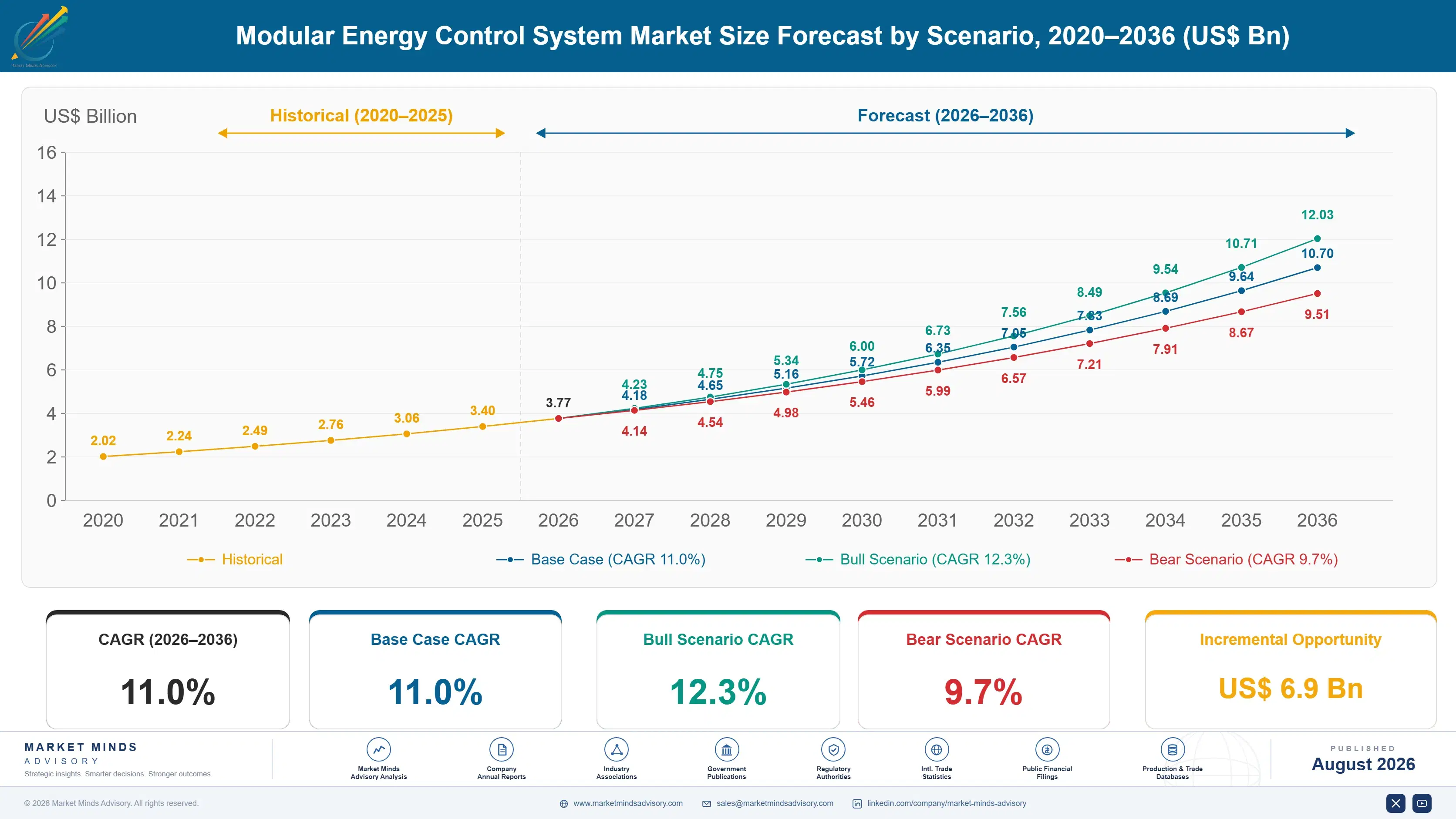
Modular Energy Control System Market Forecast Scenarios

global-modular-energy-control-system-market-size-forecast-scenario-1787552546001
Between 2020 and 2025 the market grew at roughly 9.5 percent a year, as distributed solar and storage installations accelerated across commercial and industrial sites and operators increasingly needed coordinated control across multiple asset types rather than isolated point solutions purchased separately from different vendors over that entire stretch of recent years and well beyond.
The base case assumes 11.0 percent annual growth to 2036, built on three mechanisms: electric vehicle charging infrastructure requiring coordinated load management alongside existing solar and storage assets, utilities pushing distributed energy resource aggregation programs that demand interoperable control layers across many small sites, and software-defined control modules capturing share as operators prioritize update flexibility over one-time hardware capability across their installed asset base and future expansion plans well into the next decade.
A bull case near 12.3 percent depends on utility aggregation programs scaling faster than currently planned across additional grid regions and jurisdictions worldwide over time and with wider adoption. The bear case near 9.7 percent assumes distributed energy installation growth slows enough that control system demand growth tracks closer to simple hardware replacement cycles without genuine platform expansion.

Control Architecture Becomes the Real Product

Modular energy control systems coordinate solar, storage, charging, and generation assets at a single site or across a distributed fleet, replacing the single-purpose controllers that once managed each asset type independently and required separate integration work each and every time. The category sits at the intersection of power electronics and enterprise software, requiring vendors to compete on both hardware reliability and software update cadence simultaneously.
MARKET CONCENTRATIONCR5 40%Fragmented base spans hardware and software specialists alike
AVERAGE SELLING PRICE$18,500 per systemPrice varies sharply by site capacity and asset count
TOP PRODUCING COUNTRY SHAREUnited States 26%Largest base tied to commercial solar and storage deployment
CAPACITY UTILIZATION70%Room remains as software vendors scale delivery capacity
TRADE INTENSITY24% cross-borderMost systems configured and deployed within the same region
SOFTWARE COST SHARE34%Development and licensing costs rival hardware component costs
Demand tracks distributed energy installation volume closely, but the competitive center of gravity is shifting from hardware toward software faster than installation volume alone would suggest across most commercial markets worldwide. Vendors offering cloud-native platforms capture recurring subscription revenue that pure hardware sales cannot match, a shift concentrated most heavily among commercial site operators managing multiple locations and asset types simultaneously.
Deployment remains concentrated in markets with mature distributed energy incentive programs, with the United States holding the largest single-country share given its dense commercial solar and storage installation base across most states nationwide today and expanding fast. Germany follows given its established distributed generation policy framework and grid flexibility requirements built over the past decade of continued investment and expansion.
"Everyone talks about solar panels and batteries, but the boring box that coordinates them is where the real margin now sits. That box just happens to run software instead of just wires."
Practice Lead, Distributed Energy and Grid Software · MMA Energy Practice · August 2026

Market Trends

Cloud Platforms Displace Site-by-Site Hardware Logic

Vendors are moving control logic away from fixed on-site hardware toward cloud-hosted platforms that can push configuration updates across an entire fleet of sites simultaneously, without requiring a technician visit to each individual location. AutoGrid and Enel X have both built cloud-native platforms specifically to serve commercial operators managing dozens or hundreds of distributed sites under one management contract. This shift favors vendors with genuine software development capability over pure hardware manufacturers, since customers increasingly evaluate platforms on update frequency and remote diagnostic capability rather than hardware specifications alone, reshaping the competitive basis of the entire category.
Market Impact: Adds 9 percent annual installed capacity
Electric Vehicle Charging Forces Multi-Asset Coordination

Commercial sites adding electric vehicle charging infrastructure alongside existing solar and storage assets increasingly require control systems that manage all three asset types together, since uncoordinated charging can spike demand charges and undermine the economics of on-site solar and storage investment entirely across an operator's portfolio. This differs from earlier single-asset control approaches that treated charging as a separate system requiring its own dedicated management interface and billing relationship. Vendors offering genuine multi-asset coordination report winning a disproportionate share of new site contracts compared with those still selling single-purpose charging management systems alone.
Market Impact: Adds 6 percent from aggregation programs

Market Opportunities and Growth Drivers

Distributed Solar and Storage Growth Sustains Demand

Commercial and industrial solar and storage installations continue expanding across major markets, and each new site requires control capability to manage generation, consumption, and export decisions in real time. Falling battery and panel costs have pulled distributed energy investment down into smaller commercial and even large residential projects that previously could not justify dedicated control system spending. This broadening addressable base has proven more durable than any single incentive program in sustaining baseline demand, since it reflects genuine economic improvement in the underlying assets rather than a policy-dependent trend that could reverse with a change in government.
Market Impact: Adds 25 percent to integration cost

Utility Aggregation Programs Demand Interoperable Control

Utilities increasingly run distributed energy resource aggregation programs that pay site owners for grid flexibility services, but participating requires control systems capable of responding to utility signals within tight timeframes and interoperability standards set by each grid operator. This creates a genuine technical requirement rather than a marketing preference, since utilities test compliance before approving program participation and will not compensate sites that cannot meet response time requirements. Vendors with proven utility program certification report winning contracts specifically because operators want confidence their sites will qualify for aggregation revenue once installed.
Market Impact: Certification delays add 8 months

Market Restraints and Challenges

Interoperability Gaps Slow Multi-Vendor Site Deployment

Many commercial sites accumulate solar, storage, and charging equipment from different vendors over several years, and getting all of it under one coordinated control system often requires costly custom integration work rather than a simple plug-and-play connection. The root cause is a lack of universal communication standards across the distributed energy hardware industry, since manufacturers have historically prioritized their own proprietary protocols over open interoperability. This has slowed control system adoption at sites with mixed vendor equipment specifically. Vendors are mitigating this friction by building broader protocol translation libraries and partnering with major hardware manufacturers to pre-certify compatibility.
Market Impact: Cuts site visits by 45 percent

Cybersecurity Concerns Slow Utility Program Approval

Control systems that connect distributed energy assets to utility grid signals represent a genuine cybersecurity attack surface, and utilities have grown more cautious about approving new vendors for aggregation programs following several high-profile grid security incidents in adjacent industries. The root cause is the inherent tension between wanting rapid response capability for grid signals and minimizing the attack surface that remote connectivity necessarily creates. This has extended utility certification timelines meaningfully beyond what vendors originally planned for market entry. Vendors are mitigating this restraint by investing in dedicated security certification and third-party penetration testing ahead of utility program applications.
Market Impact: Cuts demand charges by 20 percent
3 additional market trends, 2 additional growth drivers, and 4 additional restraints and challenges are covered in the full report. Contact sales@marketmindsadvisory.com to access the complete intelligence.

Segment CAGR and Growth Architecture

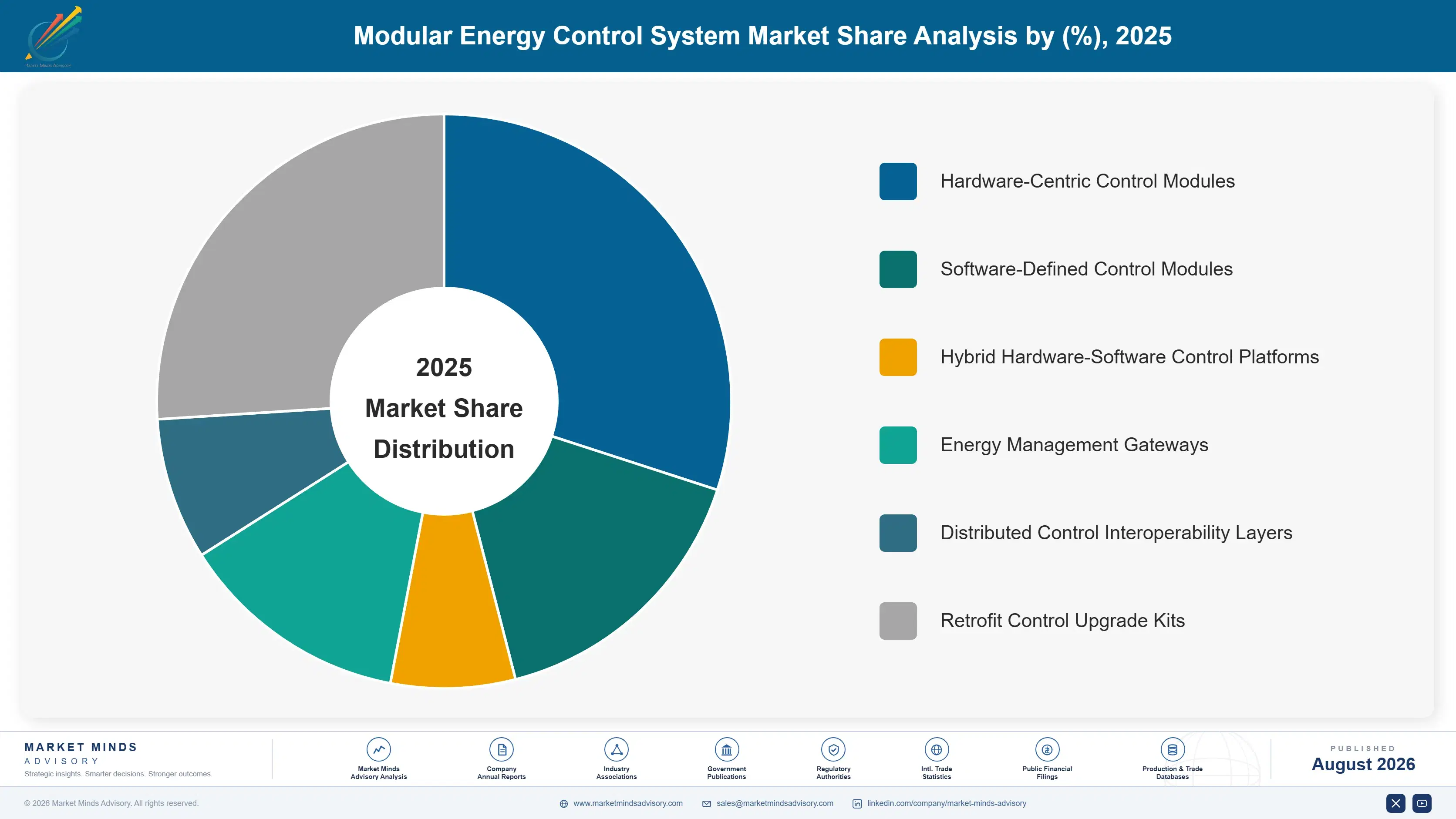
The market splits by control architecture into six segments, since the balance between hardware and software content drives most of the cost and flexibility variation buyers actually evaluate. Hardware-centric control modules hold the largest installed base across established sites, while software-defined and hybrid platforms grow fastest as operators demand faster reconfiguration and remote update capability.
global-modular-energy-control-system-market-market-share-analysis-1787552546558

Software-Defined Control Modules

Software-defined control modules are growing faster than any other architecture as site operators demand the ability to reconfigure logic and add new asset types without swapping physical hardware every time requirements change. AutoGrid and Enel X have both built cloud-native platforms specifically to serve this demand, capturing recurring subscription revenue that pure hardware sales cannot replicate. The segment benefits from faster deployment timelines than hardware-centric alternatives, since software updates can push to existing installed sites without a technician visit. Vendors without genuine software development capability increasingly struggle to compete here, ceding ground to specialists who invested early in platform architecture rather than treating software as an afterthought to hardware sales.
CAGR 14.5%

Hybrid Hardware-Software Control Platforms

Hybrid platforms combine dedicated on-site hardware for time-critical control functions with cloud-based software for configuration, monitoring, and fleet-wide management, capturing benefits from both architectures rather than committing fully to either single approach on its own merits alone entirely. Schneider Electric and Siemens have both expanded hybrid platform offerings specifically to serve customers wary of fully cloud-dependent control for safety-critical functions but still wanting remote management convenience across their entire site portfolios. This positions the segment as a bridge category for buyers who need proven hardware reliability but still want modern software flexibility, appealing particularly to utility and large industrial customers with strict reliability requirements and unusually long procurement cycles overall.
CAGR 13.0%
Full segment breakdown across 7 segments available in the complete report.

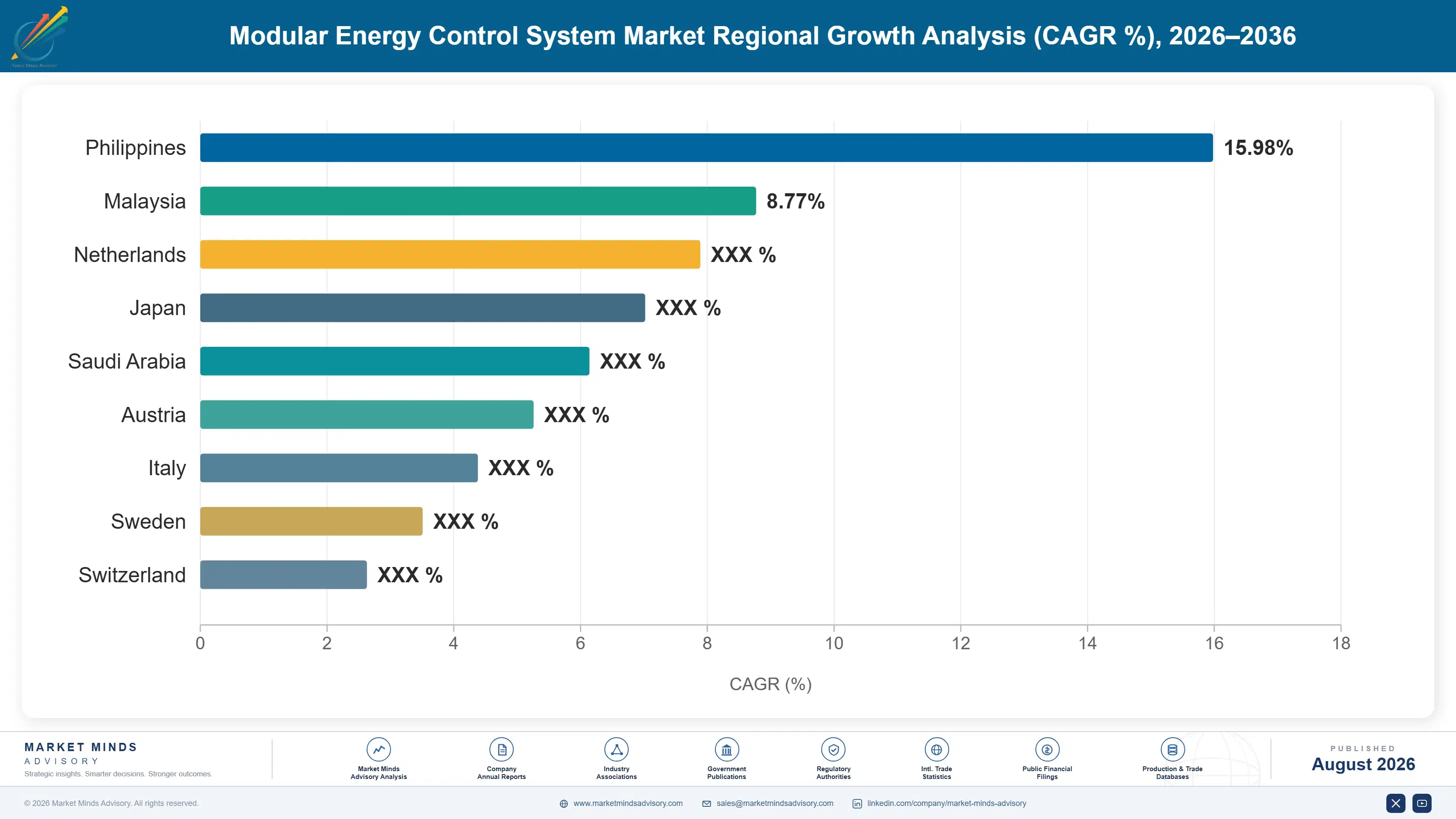
Regional Architecture and Country Demand Map

Regional demand concentrates wherever distributed energy installation intersects with grid flexibility requirements. North America holds the largest share given its dense commercial solar and storage base and mature utility aggregation programs, while South Asia and Pacific posts the fastest regional growth as India's grid strain drives new demand.

North America

The United States anchors regional demand through its dense commercial solar and storage installation base, supported by federal and state incentive programs that have made distributed energy investment attractive across a wide range of building types and industries nationwide. Schneider Electric and Honeywell both maintain significant engineering and manufacturing presence here, reflecting decades of built relationships with commercial and industrial energy customers. Utility aggregation programs have scaled faster here than in most regions, creating genuine demand for interoperable control systems that can meet grid operator response requirements. Electric vehicle charging infrastructure buildout adds a further demand layer as commercial sites integrate charging with existing solar and storage assets across the country.
Share: 30% | CAGR: 11.5% (2026 to 2036)

East Asia

China's massive renewable energy buildout has created enormous demand for distributed control capability, though much of that demand flows through large-scale utility projects rather than the commercial and industrial site model common in North America and Europe today. Japanese and South Korean markets show more mature, steadily growing demand tied to established distributed generation policy frameworks and grid modernization programs across their utility networks. Domestic Chinese control system vendors have scaled rapidly to serve this demand, competing increasingly on price against international suppliers in a market still forming clear technology standards. Regional growth continues outpacing the global average as renewable capacity additions keep climbing across multiple provinces and manufacturing hubs.
Share: 24% | CAGR: 12.0% (2026 to 2036)
Regional intelligence for 5 additional markets available in the complete report: Western Europe, South Asia and Pacific, Latin America, Middle East and Africa, Eastern Europe. Contact sales@marketmindsadvisory.com.
global-modular-energy-control-system-market-country-cagr-analysis-1787552547072

Software Subscriptions Beat One-Time Hardware Sales

Standalone hardware modules compete largely on upfront price once a design is qualified, leaving modest margins for pure equipment vendors. The stronger revenue opportunities sit in cloud platform subscriptions, utility program certification, and multi-site fleet management contracts, categories where recurring software revenue and validated compliance still command meaningfully better economics than one-time hardware sales.

Converting Hardware Sales Into Subscription Revenue

Vendors who bundle cloud platform access as an ongoing subscription rather than a one-time software license capture recurring revenue running roughly 30 percent of initial hardware sale value annually across the life of a site relationship and beyond. This requires building genuine cloud infrastructure and committing to continuous feature development that customers expect from a subscription relationship rather than a static product purchase. AutoGrid and Enel X both pursued subscription models years before competitors, positioning them to capture recurring revenue that hardware-only vendors cannot replicate without a fundamental business model shift.
Market Impact: Adds 30 percent recurring annual revenue growth overall

Winning Utility Aggregation Program Certification Early

Vendors who invest in utility aggregation program certification capture site contracts that command per-unit pricing running roughly 20 percent above uncertified alternatives, since operators need certified control systems to actually collect aggregation revenue from participating sites they operate across their entire portfolio. Winning certification requires demonstrating response time compliance and cybersecurity standards that uncertified vendors often cannot meet without meaningful engineering investment and dedicated testing programs. Vendors who invest early in this certification report securing contracts at meaningfully better win rates than uncertified competitors bidding on the same aggregation-eligible sites.
Market Impact: Commands a 20 percent certified pricing premium overall

Managing Multi-Site Fleets Under One Contract

Vendors who win multi-site fleet management contracts capture revenue running roughly 25 percent above the sum of individually negotiated single-site contracts, since fleet operators pay a premium for centralized reporting and consistent service levels across every location they manage nationwide and abroad. This requires building genuine multi-tenant platform architecture capable of managing dozens or hundreds of sites without proportional increases in support staffing or overhead costs. Schneider Electric has built a dedicated fleet management practice around this capability, positioning it as a differentiator separate from pure per-site hardware supply relationships.
Market Impact: Commands a 25 percent fleet contract premium overall

Who Controls the Margin Pool

Concentration sits moderate at a CR5 near 40 percent, calculated on installed site count across all architecture types. Schneider Electric holds the clearest leadership position given its scale across hardware-centric and hybrid platforms and its established relationships with large commercial and industrial customers. The gap to challengers like Siemens is narrower in traditional hardware segments than in cloud-native software platforms, where AutoGrid and Enel X have built genuine leadership positions.
Current competitive activity centers on cloud platform development and utility aggregation certification, as vendors race to capture recurring subscription revenue beyond one-time hardware sales across most commercial and industrial markets. AutoGrid and Enel X have both expanded cloud platform capability, while Honeywell continues developing hybrid architecture to differentiate from vendors confined to pure hardware or pure software offerings.

Emerging pressure comes from Chinese domestic vendors scaling control system technical capability within their large home market, a trajectory that could eventually support competition beyond domestic Chinese utility projects into export markets and commercial segments currently dominated by established multinational suppliers. Rankings could shift meaningfully over the next decade if these vendors close the remaining software platform and certification capability gap that currently protects incumbents.
global-modular-energy-control-system-market-company-positioning-matrix-1787552547595

Competitive Moat and Risk Dimensions

SCHNEIDER ELECTRIC

Moat: Broad Hardware and Software Scale

Schneider Electric's presence across hardware-centric, hybrid, and increasingly software-defined formats lets it serve customers across the full spectrum of control sophistication from a shared engineering base, reducing per-program development cost compared with narrower specialist competitors focused on one architecture type across their entire product line.
SCHNEIDER ELECTRIC

Risk: Slower Cloud-Native Pivot

Schneider Electric's historical strength in hardware creates some organizational inertia around fully committing capital to cloud-native software platforms, potentially ceding early mover advantage in that faster-growing segment to competitors already focused there exclusively and moving with far greater urgency to secure new customers and contracts.
AUTOGRID

Moat: Deep Cloud Platform Expertise

AutoGrid has invested for years in cloud-native platform architecture built specifically for distributed energy management, positioning it favorably as operators demand fleet-wide visibility and remote update capability that hardware-centric competitors struggle to match without a fundamental platform rebuild across their entire installed customer base nationwide.
AUTOGRID

Risk: Limited Hardware Manufacturing Scale

AutoGrid's relative focus on software over hardware manufacturing potentially limits its ability to offer bundled hardware and software packages that customers increasingly prefer over separately sourced components from multiple vendors across their sites and broader portfolios overall today and going forward into the coming years.

Players Tracked

Prominent Players

Schneider Electric
Siemens
AutoGrid
Enel X
Honeywell

Other Key Players

ABB
Eaton
General Electric
Emerson Electric
Johnson Controls
Itron
Landis+Gyr
Generac Grid Services
Stem Inc
Fluence Energy
Sunverge Energy
SolarEdge Technologies
Enphase Energy
Tigo Energy
Kore Power

Recent Developments

MAY 2025

Schneider Electric announced an expansion of its hybrid control platform production capacity at its European facility, adding capacity specifically to serve commercial customers scaling multi-site solar and storage deployments ahead of continued adoption growth over the following several years across the wider region and beyond.
Signal: Signals supplier confidence that hybrid platform demand will sustain long-term production capacity utilization broadly across markets
NOVEMBER 2025

AutoGrid entered a multi-year supply agreement with a major North American utility to provide aggregation-certified control platforms across several thousand commercial sites, reinforcing its position in a category increasingly valued for utility program compliance and rapid grid signal response times nationwide and beyond that scope.
Signal: Confirms major utilities increasingly commit to multi-year platform contracts over spot market purchasing decisions today overall
FEBRUARY 2026

Enel X launched an expanded cybersecurity testing laboratory aimed at accelerating utility certification timelines for next-generation aggregation platforms entering development ahead of upcoming grid flexibility program launches scheduled for the following two years across several major global export markets and regions worldwide and well beyond that.
Signal: Signals a competitive shift toward faster certification capability rather than platform scale alone here today overall

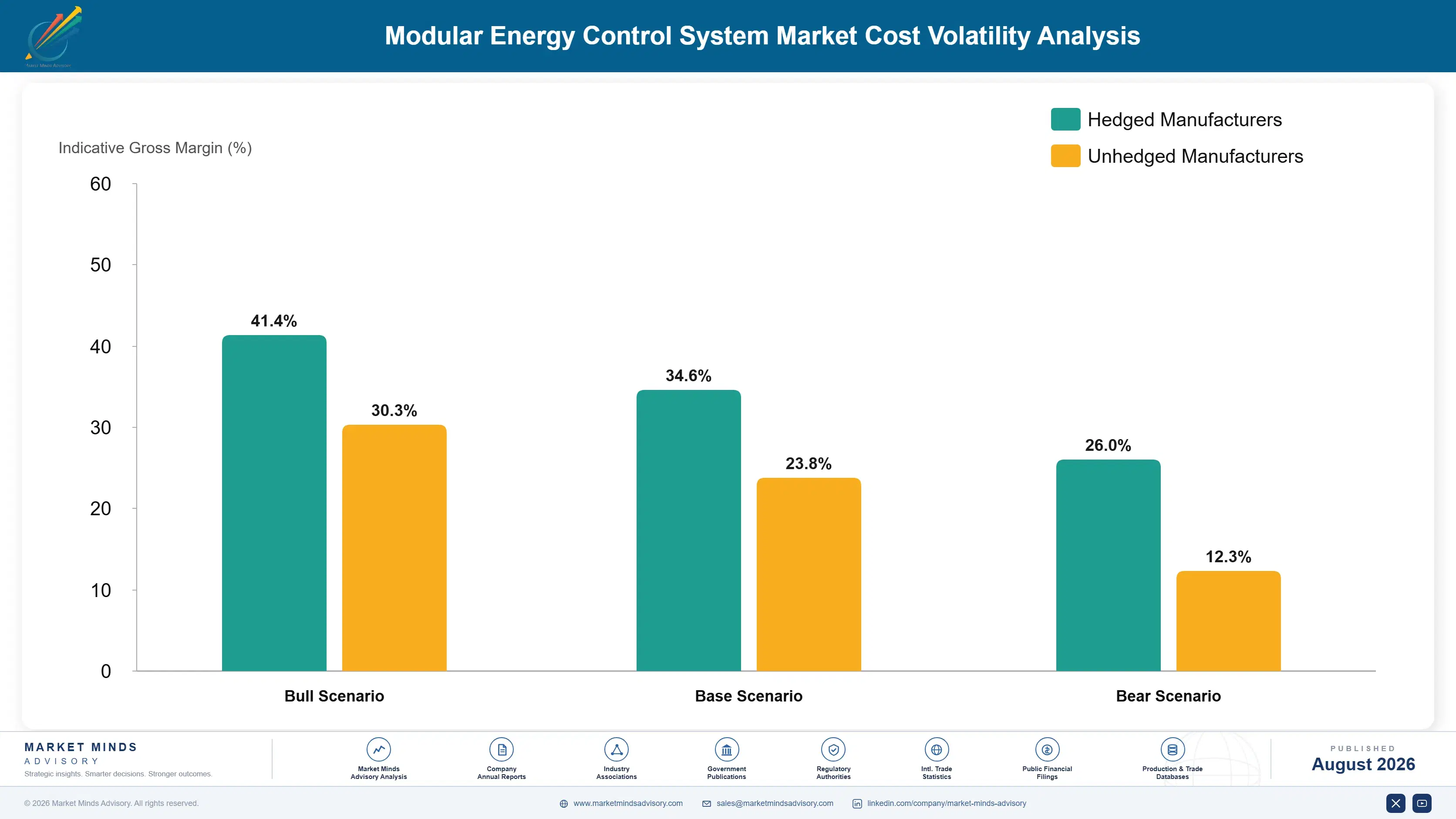
Semiconductors and Software Talent Drive Cost

Power electronics semiconductors and software development labor together account for roughly 34 percent of total control system cost, an unusually high share for a hardware category given the software component involved. Semiconductors trace back to fabrication plants concentrated in Taiwan, South Korea, and increasingly the United States, while software development talent concentrates in established technology hubs facing persistent hiring competition.
Semiconductor prices and lead times spiked sharply during the 2021 to 2022 global chip shortage, according to industry and company annual report disclosures, pushing control system manufacturer costs and delivery timelines up meaningfully within a short period. Manufacturers locked into fixed-price customer contracts could not pass that increase through immediately, compressing margins for several quarters until component supply normalized and contract renewal cycles allowed repricing closer to current cost levels.

Smaller vendors without diversified semiconductor sourcing or in-house software teams face proportionally larger cost and delivery risk than large multinational producers who can shift component sourcing and development resources depending on relative availability. This creates a durable cost advantage for scale players, since supplier and talent diversification functions as a hedge unavailable to smaller regional competitors.
global-modular-energy-control-system-market-cost-volatility-analysis-1787552547791

Diversifying Semiconductor Suppliers Across Regions

Larger producers are actively qualifying multiple semiconductor suppliers across different regions specifically to reduce dependence on any single fabrication source during periods of shortage or geopolitical supply disruption. This diversification strategy requires meaningful upfront qualification investment but pays off during exactly the shortage periods when single-source competitors face the largest delivery and cost pressure.

Building In-House Software Development Capability

Vendors are investing in in-house software development teams rather than relying entirely on outside contractors, reducing exposure to talent market wage inflation and project delivery delays common among external development partners. This internal capability also lets vendors iterate faster on platform features, a competitive advantage that compounds beyond the immediate cost savings from reduced contractor dependence.

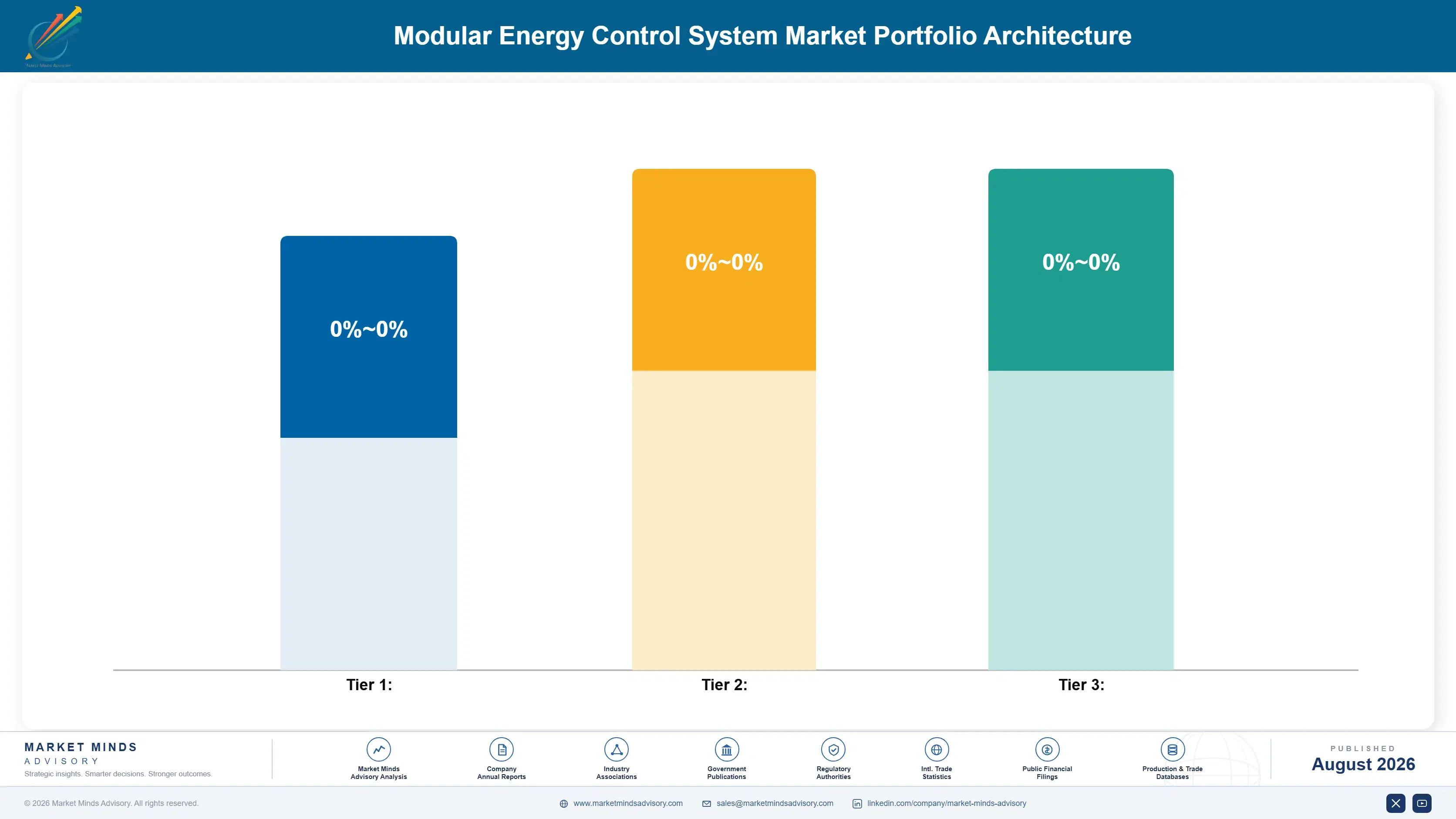
Portfolio Architecture for Margin Defence

Three margin tiers define this category. Volume and commodity-adjacent products, mostly standard hardware-centric control modules, compete on price with gross margins around 18 to 25 percent. Premium and certified products including hybrid platforms and aggregation-certified systems command 28 to 36 percent margins across most transactions. Sustainability and next-generation software-defined platforms sit highest, reflecting both engineering scarcity and buyer willingness to pay for recurring subscription value over time.
The volume versus premium tension shows up clearest in engineering resource allocation decisions, since building cloud-native software capability draws talent and capital away from optimizing standard hardware modules that still represent the largest single revenue pool today. Producers balancing this tradeoff carefully tend to outperform those chasing software transformation too aggressively before customer demand fully materializes across their target markets, particularly when certification cycles run longer than the sales pipeline supporting new capacity.

High-value margin pools concentrate specifically around utility aggregation-certified platforms and multi-site fleet management contracts, both categories where compliance depth and platform capability support pricing well above commodity hardware levels sustainably, even as overall category volume growth moderates toward the middle of the forecast period and operators consolidate sourcing toward fewer accountable vendors.

Standard hardware-centric control modules sold primarily on price to single-site commercial customers, with limited differentiation between suppliers beyond delivery reliability, basic cost competitiveness, and modest volume discount structures offered to the largest recurring accounts each contract cycle.
Gross Margin

Hybrid platforms and aggregation-certified systems sold to customers where compliance depth and reliability requirements justify meaningfully higher unit prices than standard hardware alternatives, with certification testing creating a real barrier smaller vendors rarely clear on their own.
Gross Margin

Software-defined platforms sold to multi-site operators seeking centralized fleet management and recurring subscription value, commanding the category's highest margins given constrained engineering capacity relative to demand and continued capability lag among smaller vendors industry-wide.
Gross Margin
global-modular-energy-control-system-market-portfolio-architecture-1787552548283

High-value Sub-segments and Strategic Watch-out

Software-Defined Control Modules

Software-defined control modules combine premium pricing with the fastest content growth in the category, as operators increasingly prefer cloud-native platforms over fixed hardware logic requiring physical replacement to reconfigure, a shift accelerating faster than overall category volume growth would suggest across most tracked customer segments.

Hybrid Hardware-Software Control Platforms

Hybrid platforms carry strong margins and steady adoption momentum among utility and industrial customers, though growth has moderated slightly as the segment matures beyond its initial adoption wave into broader commercial deployment that requires somewhat different specifications and pricing structures overall today and going forward.

Hardware-Centric Control Modules

Hardware-centric control modules remain the volume backbone of the category, generating the largest absolute revenue even as their relative share slowly declines against faster-growing software-defined and hybrid alternatives across most regions and customer segments worldwide each successive production year without any real exception at all.

Retrofit Control Upgrade Kits

Retrofit control upgrade kits remain niche today but warrant monitoring, since a growing installed base of aging control systems entering their replacement window could shift meaningful demand toward upgrade rather than new installation, reshaping category economics for hardware-focused vendors gradually and rather unpredictably over time.

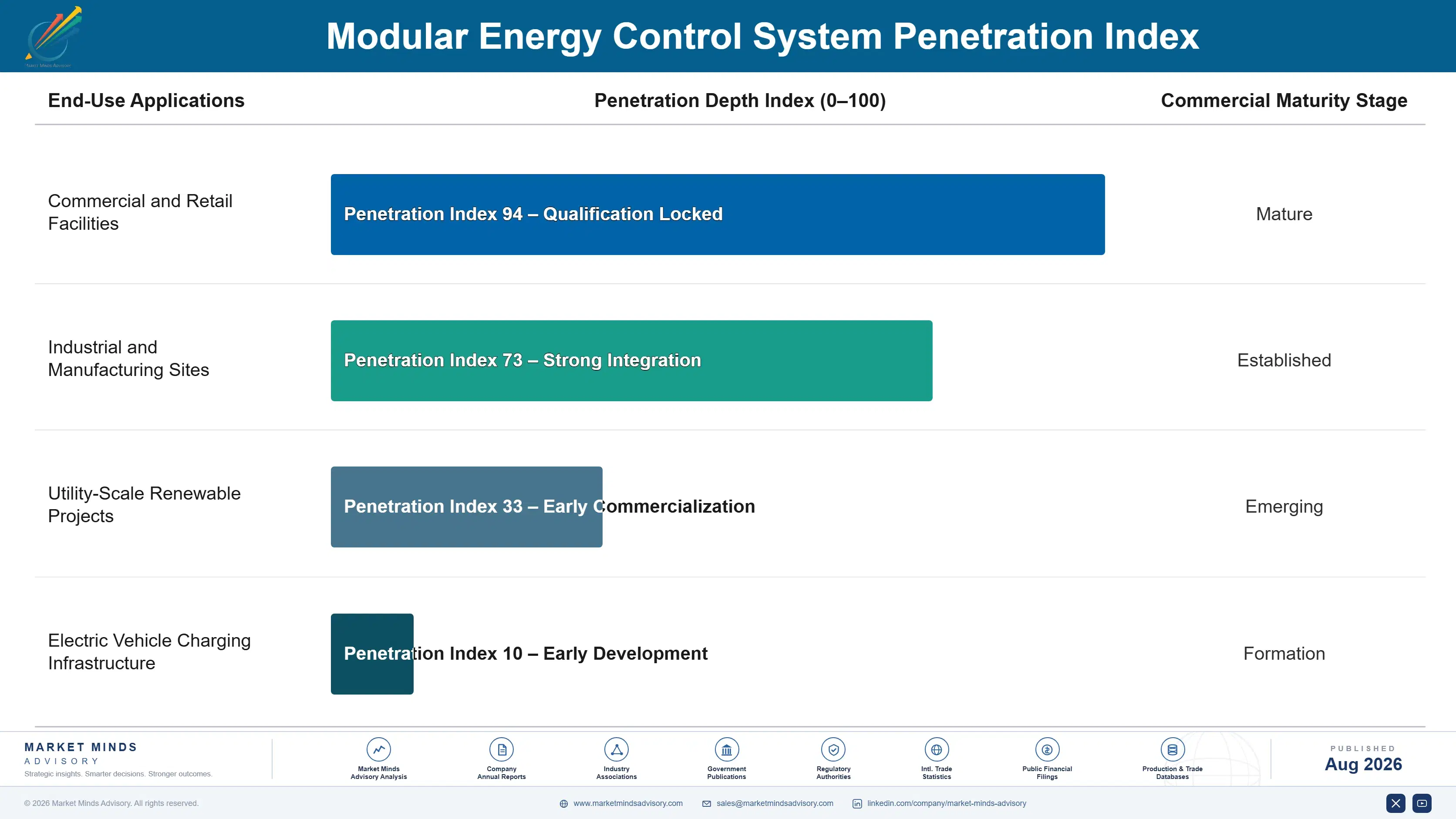
Subscriptions Replace One-Time Installation Sales

Unlike pure hardware categories, modular energy control systems increasingly generate recurring subscription revenue tied to cloud platform access, monitoring, and feature updates, making the initial installation only the beginning of a customer relationship rather than its conclusion. This shift toward annuity-style economics rewards vendors who invest in ongoing platform development rather than treating the sale as a completed transaction once hardware ships.
Adoption stickiness varies meaningfully by end-use vertical. Utility aggregation program participants show the deepest lock-in, given certification requirements that make switching control system vendors mid-program costly and slow. Single-site commercial customers show shallower stickiness, since standard hardware installations carry fewer differentiating specifications and operators can shift vendors between site expansions more easily when cost pressure demands it.

Buyer profiles are shifting generationally as facility and energy management teams increasingly recruit from software and data analytics backgrounds rather than pure electrical engineering expertise, changing how supplier evaluation criteria get weighted. Younger buyers entering these roles show more comfort evaluating platforms on update cadence and API integration capability rather than treating the control system as purely electrical infrastructure, accelerating software-defined platform adoption faster than pure cost economics alone would predict.
global-modular-energy-control-system-market-end-use-penetration-index-1787552548763

What Wins in Distributed Energy Control

These are among the four positions where our research anticipates prominent divergence between winners and laggards over the coming forecast period. Each is grounded in the demand model, the regulatory perimeter, and the announced capacity pipeline.
01 / CLOUD PLATFORM INVESTMENT

Build Software Capability Before Hardware Margins Erode

Vendors who invest in cloud-native platform architecture before customer demand for recurring software relationships fully materializes capture subscription revenue more easily than those entering after hardware-only competitors have already commoditized the segment across most markets. Building that capability after demand is visible means competing against vendors who established documented platform reliability years earlier through sustained development investment and patient testing work. The engineering cycle itself takes long enough that late movers effectively concede the category's highest-margin segment to whoever invested first.
02 / UTILITY CERTIFICATION PRIORITY

Pursue Aggregation Certification Ahead of Program Scale-Up

Vendors who secure utility aggregation program certification before programs scale broadly capture premium site contracts more easily than those entering after utilities have already standardized on certified competitors across their service territories and existing relationships. This works best for vendors who can demonstrate response time compliance and cybersecurity standards that utilities test rigorously before approving new program participants. Vendors pursuing this strategy should prioritize utilities running the largest aggregation programs first, since those relationships prove hardest for competitors to displace afterward.
03 / MULTI-ASSET COORDINATION FOCUS

Build Genuine Cross-Asset Management Rather Than Point Solutions

Vendors who build genuine multi-asset coordination capability across solar, storage, and charging capture site contracts that single-purpose point solution vendors increasingly lose as operators consolidate toward unified control platforms across their site portfolios. This works best for vendors who can demonstrate measurable demand charge reduction and coordinated asset scheduling rather than simply managing each asset type in isolation. Vendors pursuing this strategy should prioritize sites with the most diverse asset mix first, since those relationships prove hardest for single-purpose competitors to win back.
04 / GEOGRAPHIC GROWTH PRIORITIZATION

Weight Expansion Toward South Asia and Pacific

Producers concentrated in North America and Western Europe should weight incremental expansion investment toward South Asia and Pacific, where grid strain and renewable capacity growth are creating the fastest addressable demand growth globally by a clear margin. Waiting for that demand to fully materialize before entering risks ceding early customer relationships to regional vendors who move faster despite weaker software platform capability and thinner certification infrastructure. Early market entry there compounds into durable customer relationships as the region's renewable capacity keeps climbing steadily.

Engagement Snapshot From the Field

A live engagement with an industry participant carrying material or product regulatory and market exposure ahead of a defining policy shift, showing how our research translates into a defensible multi-year portfolio strategy.
MARKET MINDS ADVISORY · CLIENT ENGAGEMENT SUMMARY
Modular Energy Control System Producer Strategic Portfolio Review and Transition Roadmap 2026·Investment Scenario on Modular Energy Control System Exposure Evaluation 2025-26
CLIENT PROFILE
The client operates a large North American retail chain with solar and storage installations across several hundred store locations, each purchased and configured somewhat independently over the past several years by different regional facilities teams. Facing rising demand charges and inconsistent reporting across locations, the corporate energy management team needed to determine whether consolidating all sites under one unified control platform would justify the transition cost and disruption.
STRATEGIC CHALLENGE
The client needed to determine whether a single unified control platform could genuinely manage its mixed-vendor hardware installed across hundreds of sites without requiring a costly hardware replacement at every location, and which vendor possessed the interoperability track record the transition demanded across such a diverse and aging installed base.
MMA APPROACH
MMA conducted a structured review of platform interoperability capability against the client's specific installed hardware mix, supplemented by primary interviews with vendors and comparable retail chains already running unified multi-site platforms across mixed vendor equipment nationwide. The analysis modeled integration cost and demand charge reduction potential across leading platform options.
KEY FINDINGS
  1. Platforms with broad protocol translation libraries could integrate roughly 80 percent of the client's existing hardware without requiring physical replacement at the site level.
  2. Centralized platform adoption reduced measured demand charges quite meaningfully at pilot sites compared with the client's previous uncoordinated site-by-site control approach entirely.
  3. Sites with the oldest and most fragmented hardware mix required meaningfully more integration work than newer, more standardized locations across the chain.
  4. Competitors who attempted full-chain platform rollout without a phased pilot approach experienced measurable integration delays and cost overruns during their entire transition.
CLIENT PROFILE
The client operates a large North American retail chain with solar and storage installations across several hundred store locations, each purchased and configured somewhat independently over the past several years by different regional facilities teams. Facing rising demand charges and inconsistent reporting across locations, the corporate energy management team needed to determine whether consolidating all sites under one unified control platform would justify the transition cost and disruption.
STRATEGIC CHALLENGE
The client needed to determine whether a single unified control platform could genuinely manage its mixed-vendor hardware installed across hundreds of sites without requiring a costly hardware replacement at every location, and which vendor possessed the interoperability track record the transition demanded across such a diverse and aging installed base.
MMA APPROACH
MMA conducted a structured review of platform interoperability capability against the client's specific installed hardware mix, supplemented by primary interviews with vendors and comparable retail chains already running unified multi-site platforms across mixed vendor equipment nationwide. The analysis modeled integration cost and demand charge reduction potential across leading platform options.
KEY FINDINGS
  1. Platforms with broad protocol translation libraries could integrate roughly 80 percent of the client's existing hardware without requiring physical replacement at the site level.
  2. Centralized platform adoption reduced measured demand charges quite meaningfully at pilot sites compared with the client's previous uncoordinated site-by-site control approach entirely.
  3. Sites with the oldest and most fragmented hardware mix required meaningfully more integration work than newer, more standardized locations across the chain.
  4. Competitors who attempted full-chain platform rollout without a phased pilot approach experienced measurable integration delays and cost overruns during their entire transition.
RECOMMENDED STRATEGY
Phase 1: Phase one: pilot the unified platform at a representative sample of sites spanning the full range of installed hardware age. Phase 2: Phase two: prioritize full rollout at newer, more standardized locations before tackling the oldest and most fragmented sites chain-wide overall. Phase 3: Phase three: complete integration at legacy sites once protocol translation libraries mature further still based on the pilot's own learnings.
OUTCOME
The client adopted the phased rollout approach starting with representative pilot sites, reducing measured demand charges meaningfully at those locations (client-reported, unverified by MMA) while validating integration cost estimates before committing to full-chain rollout, according to the client's own internal energy management data shared during the engagement.

Frequently Asked Questions

Foundational context covering the market sizes, CAGR, scope, country, region and competition that inform every finding below. This section is provided to cover basics and most often pre-purchase conversations, answered from the MMA Primary Research Dataset.

What is the current size of the Modular Energy Control System Market?

The global modular energy control system market reached approximately 3.4 billion dollars in 2025. Growth is driven by rising distributed solar and storage installations and expanding electric vehicle charging infrastructure.

How large will the Modular Energy Control System Market be by 2036?

MMA projects the market will reach approximately 10.7 billion dollars by 2036, roughly 2.84 times its 2026 value. Software-defined platforms will drive much of that expansion.

What is the CAGR for the Modular Energy Control System Market 2026 to 2036?

The market is projected to grow at an 11.0 percent compound annual rate between 2026 and 2036. Bull and bear scenarios range from 9.7 to 12.3 percent depending on utility aggregation program adoption speed.

Which segment is growing fastest?

Software-defined control modules are growing fastest at a 14.5 percent CAGR, roughly 1.32 times the overall market rate. Demand for remote update flexibility drives this outperformance.

Who are the major companies in the Modular Energy Control System Market?

Schneider Electric, Siemens, AutoGrid, Enel X, and Honeywell lead the market. Together they hold roughly 40 percent combined share on an installed site count basis.

Which country is growing fastest?

China leads regional growth at a 13.0 percent CAGR, supported by its massive renewable energy capacity buildout across utility-scale projects. India follows closely within South Asia and Pacific.

Report Segmentation Architecture

The full report scope spans multiple orthogonal segmentation dimensions, with cross-tabulated demand data provided for each dimension pair. Coverage extends further to regional breakdowns, trend trajectories, and the competitive detail needed to support segment-level decision-making.
  • Hardware-Centric Control Modules
  • Software-Defined Control Modules
  • Hybrid Hardware-Software Control Platforms
  • Energy Management Gateways
  • Distributed Control Interoperability Layers
  • Retrofit Control Upgrade Kits
  • Commercial and Retail Facilities
  • Industrial and Manufacturing Sites
  • Utility-Scale Renewable Projects
  • Electric Vehicle Charging Infrastructure
  • Original Equipment Sourcing
  • Cloud Platform Subscription
  • Multi-Site Fleet Management Contracts

By Region

  • North America
  • East Asia
  • Western Europe
  • South Asia and Pacific
  • Latin America
  • Middle East and Africa
  • Eastern Europe

Scope, Methodology, and Coverage

Every figure in this report is reproducible from documented input assumptions. The scope below maps the historical period, the forecast horizon, the segmentation dimensions, and the countries covered, alongside the underlying primary and qualitative methodology.
Historical Period
2020 to 2025
Forecast Period
2026 to 2036
Base Year
2025 (USD billions; MMA Primary Research Dataset, August 2026)
Market Definition
The modular energy control system market covers hardware-centric, software-defined, hybrid, gateway, interoperability layer, and retrofit control products sold for commercial, industrial, and utility-scale distributed energy applications. It excludes the underlying solar, storage, or generation assets themselves and standalone building automation systems sold without distributed energy control functionality.
Quantitative Units
USD billions
Segmentation Dimensions
Regions Covered
North America, East Asia, Western Europe, South Asia and Pacific, Latin America, Middle East and Africa, Eastern Europe
Countries Covered
Key Companies Profiled
Schneider Electric, Siemens, AutoGrid, Enel X, Honeywell, ABB, Eaton, General Electric, Emerson Electric, Johnson Controls, Itron, Landis+Gyr, Generac Grid Services, Stem Inc, Fluence Energy, Sunverge Energy, SolarEdge Technologies, Enphase Energy, Tigo Energy, Kore Power
Quantitative Methodology
Primary survey, n=3,800 respondents, Q4 2025, six countries; demand-side model with trade association cross-validation
Qualitative Methodology
47 expert interviews, Q4 2025; applied to validate demand model assumptions, identify emerging dynamics, and assess competitive positioning
Report Format
PDF and XLSX data workbook (Word format preview document)
Publisher
Market Minds Advisory
Report Code
MMA-2026-ENE-115
Published
August 2026
Contact
sales@marketmindsadvisory.com | www.marketmindsadvisory.com

Purchase the full Modular Energy Control System Market Report (2026 to 2036).

This report provides a comprehensive assessment of the global modular energy control system market. It covers sizing, segmentation, competitive dynamics, and regional demand through 2036. The analysis examines the shift from hardware-centric designs toward software-defined and hybrid platforms driven by operator demand for remote update capability and utility aggregation program compliance across commercial and industrial sites. It includes detailed competitive profiling of leading vendors, input cost exposure across the semiconductor and software talent supply chain, and a phased case study on multi-site platform consolidation strategy.
Ten-year market sizing and forecast scenarios
Six-segment MECE architecture classification breakdown overview
Seven-region demand and growth rate analysis
Competitive profiling of five leading vendors
Input cost exposure across semiconductor supply chains
Anonymized client case study on platform consolidation

Built For The People Who Decide

From boardroom strategy to bench-side execution, this report is read cover-to-cover by leaders shaping the next decade of their industry, turning demand scenarios, market dynamics and valuation benchmarks into decisions.
CXOs/ Presidents/ VPs/ Managers
M&A and Corporate Development
Strategy Teams and R&D Heads
Procurement and Product Directors
Regulatory and Compliance Leaders
Investor Relations and Equity Analysts