Market Minds Advisory
Lactates Market

Lactates Market: Clean Label Declaration, Sodium Reduction Working Against Itself, and Polymer Capacity Taking the Acid

Public health targets push processors from sodium lactate toward potassium, which tastes worse and costs more. The same regulation creating the demand keeps making the product harder to formulate around.

Lead Analyst

Bilal Shaikh

Published

September 2026

Make Smarter Decisions with Customized Research Insights

Request a free sample report and evaluate market opportunities, growth trends, and competitive dynamics relevant to your business needs.

2025 MARKET VALUE$0.9BMarket Size 2025
2036 FORECAST VALUE$1.7BBase Case , 2026 to 2036
CAGR 2026 TO 20366.0 %Bull 7.2% / Bear 4.8%
INCREMENTAL OPPORTUNITY$0.8BNet 10- year value creation
EXPANSION MULTIPLE1.79x2036 value over 2026 base
Strategic Levers
M&A Pipeline
Regional Outlook
Country Rankings
Competitive Intelligence
Segmental Deep-dive
Call-Us : 91 93563 13602

Executive Snapshot and Market Trajectory

Lactates sell on what a food processor can print on a pack. A fermentation-derived preservative that replaces a synthetic one carries a 28% premium for exactly that reason, and the chemistry inside the bag has barely changed in decades. Nothing about the molecule explains the price at all.
Commercial advantage belongs to producers who secure lactic acid supply rather than those who simply salt it, because polymer capacity now diverts 37% of the acid away from lactate salts entirely. Lactate esters grow fastest at 9.8%, roughly 1.63 times the market. East Asia holds the largest position at 28% of value, on fermentation capacity and food processing expansion advancing together across the region.
Concentration is high at roughly 62% for the top five, because lactic acid fermentation at commercial scale sits with very few operators. Ready-to-eat meat preservation takes 34% of volume and is effectively locked in by food safety practice. Sodium reduction targets are pushing that application toward a salt that tastes worse. Processors will not lightly reformulate a system that has kept them out of a recall for twenty years, so the conversion is slow.
Market Definition
The market comprises lactate salts and esters supplied to food, pharmaceutical, personal care, and industrial users, covering sodium lactate, calcium lactate, potassium lactate, magnesium and zinc lactate, lactate esters, and pharmaceutical grade lactates. Value is measured at producer level. Lactic acid sold as an acid rather than converted to a salt or ester, polylactic acid and lactide polymers, fermentation feedstocks, other organic acid salts, and finished food or pharmaceutical products fall outside scope.
Base Year Value
$0.9B in 2025 (MMA Primary Research Dataset, August 2026)
Forecast Period
2026 to 2036, eleven discrete annual values
CAGR
6.0% base case. Bull 7.2%. Bear 4.8%.
Fastest Growth Segment
Lactate Esters: 9.8% CAGR
Fastest Growth Country
India: 9.4% CAGR
Fastest Growth Region
South Asia and Pacific: 8.2% CAGR
Largest Region
East Asia: 28% of 2025 global value
Market Leaders
Corbion, Galactic, Jungbunzlauer, Musashino Chemical, and Henan Jindan Lactic Acid lead on lactate supply revenue. Source: company annual reports and MMA Analysis, July 2026.
Primary Survey
n=3,800 procurement and R&D decision-makers, Q4 2025, six countries
Methodology
Demand-side build-up, cross-validated against public data, 47 expert interviews

Lactates Market Forecast Scenarios

global-lactates-market-trends-size-forecast-scenario-1787553533845
Between 2020 and 2025 two forces pulled in opposite directions. Clean label reformulation kept moving processed food away from synthetic preservatives toward fermentation-derived alternatives, which favoured lactates directly. Polylactic acid capacity expansion meanwhile competed for the same lactic acid from the same fermentation plants. The 5.0% historical rate reflects genuine application growth constrained periodically by acid availability that had been committed somewhere else.
The 6.0% base case rests on three mechanisms. Clean label reformulation continues across processed food categories as retailers and brand owners tighten ingredient declarations further. Solvent restriction keeps pushing coatings and electronics cleaning toward lactate esters as replacements for restricted alternatives. And pharmaceutical demand for dialysis and infusion solutions grows steadily with treatment volumes independent of any food or industrial cycle. None of the three depends on food processing volumes growing at all.
The 7.2% bull case assumes solvent substitution accelerates while fermentation capacity expands ahead of polymer demand. The 4.8% bear case reflects polylactic acid capacity taking a larger share of available acid, sodium reduction targets complicating the meat preservation application faster than potassium formulations improve, and food processors reverting to cheaper synthetic systems under margin pressure.

What the Label Can Say

The commercial argument for lactates is a labelling one and it is worth 28% over comparable synthetic systems. A processor replacing benzoate or sorbate with a fermentation-derived preservative changes what appears on the ingredient panel, which retailers and consumers respond to whatever the underlying microbiology says. Producers who supply the declaration evidence alongside the material are selling something a chemical specification never captures.
TOP-FIVE CONCENTRATION62%Combined share of lactate supply held by leading producers
MEAT APPLICATION SHARE34%Portion of volume entering ready-to-eat meat preservation systems
FERMENTATION FEEDSTOCK COST SHARE41%Portion of production cost traced to sugar feedstock
CLEAN LABEL DECLARATION PREMIUM28%Uplift for grades declarable as fermentation-derived on packaging
PLA CAPACITY COMPETITION37%Share of lactic acid output diverted to polymer production
PHARMACEUTICAL QUALIFICATION PERIOD22 monthsTypical approval time before a lactate grade reaches production
Ready-to-eat meat is the anchor application at 34% of volume and it is unusually locked in. Potassium and sodium lactate combined with diacetate is the standard antimicrobial system controlling Listeria across cooked meats, established by food safety practice rather than by any regulation naming it. Processors do not casually reformulate a system that has kept them out of a recall for two decades.
The awkwardness sits underneath that. Public health sodium targets push processors from sodium lactate toward potassium, which is more bitter and costs more, and the reformulation work required is genuinely difficult. Meanwhile polylactic acid capacity now takes 37% of available lactic acid, which means the same fermentation plants supplying salts are increasingly committed to a polymer instead. Neither pressure is anything a lactate producer can influence.
"Everybody in this market talks about efficacy and the buying decision is about whether the ingredient panel reads better afterwards. That has been true for fifteen years and suppliers still lead with antimicrobial data to procurement people who already knew it worked."
Practice Director, Food Ingredients and Fermentation Chemistry · MMA Specialty Food and Fermentation Chemicals Practice · August 2026

Market Trends

Polymer Capacity Competes for the Same Fermentation Output

Polylactic acid manufacture consumes lactic acid from the same fermentation plants that supply lactate salts, and polymer capacity expansion has pulled roughly 37% of available output toward it. That competition is invisible to a food processor buying salt and entirely visible to the producer allocating acid between two very different customers. Salt buyers who assumed availability was settled have discovered otherwise during tight periods. Contracting acid supply matters more now than it did a decade ago. Contracting acid supply now matters more than any commercial relationship a salt buyer has with a producer.
Market Impact: Declaration earns a 28% premium

Sodium Targets Push Meat Systems Toward Potassium

Public health sodium reduction targets apply directly to processed meat, and sodium lactate contributes measurably to the total, which pushes processors toward potassium lactate instead. Potassium is more bitter, costs more, and requires masking work that reformulation teams find genuinely awkward. The antimicrobial performance is comparable and the sensory outcome is not. Suppliers who help solve the bitterness rather than simply offering the alternative salt are answering the question that actually holds the reformulation up. Antimicrobial performance is comparable between the two salts and the sensory outcome plainly is not, which is where the work sits.
Market Impact: Ester demand grows at 9.8%

Market Opportunities and Growth Drivers

Clean Label Reformulation Continues Across Processed Food

Retailers and brand owners keep tightening ingredient declaration standards, and a fermentation-derived preservative replacing a synthetic one changes what a consumer reads on the pack without changing the shelf life achieved. That declaration is worth roughly 28% over comparable synthetic systems, which is a marketing premium rather than a performance one and none the less real for it. Categories that reformulated early have not gone back. The remaining opportunity sits in mid-tier and private label ranges. Private label ranges are where the remaining conversion sits, and they buy on price more aggressively than premium brands ever did.
Market Impact: Feedstock is 41% of production cost

Solvent Restriction Pulls Lactate Esters Into Coatings

Restrictions on reprotoxic and hazardous solvents across European and other jurisdictions have removed established options from coatings, electronics cleaning, and pharmaceutical processing, and lactate esters answer several of those applications with genuinely comparable solvency. The segment grows at 9.8%, fastest here, from a small base. Cost sits above the restricted solvents they replace, which confines adoption to applications where the restriction leaves no alternative. Regulatory timetables rather than any performance argument govern how quickly it grows. Qualification with a coatings or pharmaceutical formulator takes time, so positioning ahead of a deadline matters more than pricing does.
Market Impact: Qualification runs 22 months long

Market Restraints and Challenges

Feedstock Cost Ties Producers to Agricultural Markets

Fermentation sugar from corn, cane, beet, or cassava represents 41% of production cost, and its pricing follows agricultural markets and biofuel policy that no lactate producer influences at all. The root cause is that this is a fermentation product wearing a chemical's commercial clothing. Producers mitigate through feedstock flexibility across multiple sugar sources, through plant siting near cheap agricultural supply, and by indexing customer agreements to published sugar references rather than absorbing the movement themselves. Flexibility across sugar sources requires fermentation and purification adjustment rather than new capacity, which is modest engineering against real volatility.
Market Impact: Polymer takes 37% of acid output

Pharmaceutical Qualification Excludes Most Producers Entirely

Dialysis concentrate, infusion solutions, and injectable applications require endotoxin control, documentation, and manufacturing systems that a food grade fermentation plant does not maintain, and qualification runs around 22 months before any material ships. The root cause is regulatory rather than chemical. Producers mitigate by dedicating a line rather than converting a whole plant, by partnering with pharmaceutical formulators who carry the regulatory relationship, and by accepting that most food grade capacity will never reach that market. Dedicating a single line rather than converting a whole plant is how most producers who reached this market actually did it.
Market Impact: Meat preservation takes 34% of volume
4 additional market trends, 3 additional growth drivers, and 2 additional restraints and challenges are covered in the full report. Contact sales@marketmindsadvisory.com to access the complete intelligence.

Segment CAGR and Growth Architecture

Segmentation follows salt or ester type, because cation choice and esterification determine solubility, taste contribution, regulatory status, and which applications a grade can serve. Six categories cover commercial supply, and the divide between food salts sold on a label declaration and industrial esters sold on solvent performance matters more commercially than any chemical similarity between them.
global-lactates-market-trends-market-share-analysis-1787553534372

Lactate Esters

The fastest category at 9.8%, roughly 1.63 times the market, covering ethyl, butyl, and related esters positioned as replacements for restricted solvents in coatings, electronics cleaning, and pharmaceutical processing. Solvency is genuinely comparable across several applications and biodegradability is favourable, which suits formulators facing restriction rather than choosing freely. Cost sits above the solvents being displaced, so adoption follows regulatory timetables rather than any performance argument. Esterification adds a processing step and a purification requirement that salt production does not carry at all. Formulators facing an authorisation deadline qualify under time pressure and rarely revisit the choice afterwards, which makes early positioning worth considerably more than any price advantage a competitor might offer later.
CAGR 9.8%

Magnesium and Zinc Lactate

Second fastest at 8.6%, serving mineral fortification in food, supplements, and clinical nutrition where lactate salts offer better solubility and tolerance than oxide or carbonate forms of the same minerals. Supplement demand follows dietary and ageing trends rather than any industrial cycle, which makes it usefully uncorrelated with the rest of this portfolio. Purity requirements sit above food preservation grades and below pharmaceutical ones. Bioavailability claims require substantiation that varies enormously by jurisdiction, which shapes how the material can actually be marketed. Supplement brand owners rather than food processors make the purchase here, which is a different customer with different technical expectations and a considerably shorter product development cycle behind it.
CAGR 8.6%
Full segment breakdown across 6 segments available in the complete report.

Regional Architecture and Country Demand Map

Regional shares follow fermentation capacity and processed food manufacture together, since lactates are produced close to sugar and consumed close to food processing. All seven regions sit inside the standard bands across the forecast period here. Fermentation capacity and food processing rarely sit in the same place.

North America

Ready-to-eat meat processing is the largest single application anywhere, and the lactate plus diacetate antimicrobial system is close to universal across cooked meats following decades of Listeria control practice. Corn-derived fermentation feedstock is cheap and locally abundant, which supports domestic production economics. Clean label reformulation is well advanced in premium ranges and still developing in private label. Corbion holds a strong regional manufacturing position. Growth of 5.8% depends on sodium reduction reformulation and clean label extension rather than any new application arriving. Sodium reduction targets bite hardest here given the volume of processed meat consumed, which makes potassium conversion a larger commercial question in this region than anywhere else in the world.
Share: 25% | CAGR: 5.8% (2026 to 2036)

Western Europe

Ingredient declaration standards are the most demanding anywhere and retailer own-label specifications frequently exceed regulation, which makes the clean label premium more reliably realised here than in any other region. Solvent restriction is also furthest advanced, which pulls lactate ester demand into coatings and pharmaceutical processing ahead of elsewhere. Corbion, Galactic, and Jungbunzlauer hold established positions with strong technical and regulatory depth. Growth of 4.6% is the slowest anywhere, reflecting mature food processing volumes and clean label reformulation already largely complete. Polymer capacity expansion has been concentrated here as well, which means the acid competition affecting salt availability is a regional phenomenon before it becomes a global one for anybody buying in.
Share: 22% | CAGR: 4.6% (2026 to 2036)
Regional intelligence for 5 additional markets available in the complete report: East Asia, South Asia and Pacific, Latin America, Middle East and Africa, Eastern Europe. Contact sales@marketmindsadvisory.com.
global-lactates-market-trends-country-cagr-analysis-1787553534932

Four Moves Worth Real Capital

Advantage here comes from securing acid supply against polymer competition, solving the reformulation problems that hold customers up, and reaching applications where regulation removes the alternatives. Four moves justify capital across the forecast period, and the first addresses a constraint most salt buyers have never even considered. Salting the acid is not among them.

Contract lactic acid supply against polymer demand

Polylactic acid capacity now takes roughly 37% of available lactic acid from the same fermentation plants supplying salts, and that allocation decision sits with the producer rather than with any customer. Salt buyers who assumed availability was settled have discovered otherwise during tight periods. Multi-year acid contracting or backward integration into fermentation removes an exposure that no commercial relationship addresses, and the competing polymer demand is growing rather than stabilising. Backward integration into fermentation is expensive and slow, while multi-year acid contracting achieves most of the same protection at a fraction of the capital commitment involved.
Market Impact: Secures supply against a 37% polymer acid diversion

Solve potassium bitterness, not just offer the salt

Sodium reduction targets push processed meat toward potassium lactate, which is more bitter and costs more, and the masking work required is what actually holds those reformulations up rather than any supply question. Meat preservation carries 34% of volume and processors will not risk a system that has kept them recall-free for two decades. Suppliers who bring masking approaches and sensory support are answering the real obstacle. Those offering only the alternative salt are handing the customer a problem. Sensory panels rather than microbiologists reject these reformulations, and almost no supplier organises around that reality.
Market Impact: Unblocks the 34% of volume sitting in meat

Sell the declaration, not the antimicrobial data

The commercial premium here is 28% and it comes from what appears on an ingredient panel rather than from any microbiological performance the buyer did not already accept. Producers who supply declaration evidence, regulatory position by jurisdiction, and retailer specification support are selling something a chemical datasheet never captures. Leading with efficacy data to procurement people who already know it works wastes the conversation entirely, and it has been happening in this market for fifteen years. Retailer specification support and jurisdiction-by-jurisdiction regulatory position are what a reformulation team actually needs from a supplier.
Market Impact: Captures the entire 28% premium on label declaration

Follow solvent restriction timetables into esters

Lactate esters grow at 9.8% because restrictions removed established solvents from coatings, electronics cleaning, and pharmaceutical processing rather than because formulators preferred them on merit. Cost sits above what they replace, so adoption follows published restriction timetables precisely. Producers tracking those timetables position with formulators before the substitution becomes urgent, which is when the qualification work can still be done properly rather than under a compliance deadline. Cost sits above the solvents being replaced, so nobody converts voluntarily and everybody converts eventually, which makes the timetable rather than the pitch the thing worth tracking closely.
Market Impact: Enters a segment currently growing 9.8% each year

Who Controls the Margin Pool

Concentration is high at roughly 62% for the top five on lactate supply revenue, because commercial-scale lactic acid fermentation sits with a small number of operators and salting the acid is the easy part. Corbion holds the broadest international position across food, pharmaceutical, and industrial grades. Galactic and Jungbunzlauer bring strong European positions, Musashino anchors Japanese high-purity supply, and Henan Jindan leads Chinese production volume.
Competition runs on three dimensions. Acid supply security is the first, since polymer demand competes for the same fermentation output continuously. Regulatory and declaration support is the second, because the premium comes from what a customer can print rather than from performance. Application formulation help is the third, particularly on potassium bitterness and clean label conversion. None of the three is a chemistry capability at all.

Pressure is building from two directions. Chinese producers supply food grade salts at prices international producers cannot match on any comparable cost base. Polymer producers bid for the same acid with different economics behind them. Rankings will shift toward producers holding fermentation capacity and genuine formulation support rather than toward whoever converts acid most cheaply. Salting the acid was never the hard part of this.
global-lactates-market-trends-company-positioning-matrix-1787553535452

Competitive Moat and Risk Dimensions

CORBION

Moat: Fermentation capacity and grade breadth

Corbion operates lactic acid fermentation across several continents and converts it into food, pharmaceutical, and industrial grades from the same upstream position, which removes the acid supply exposure that troubles anybody buying it in. Grade breadth serves customers needing several qualities from one qualified source. Pharmaceutical qualification across multiple sites is a capability accumulated over decades rather than purchased.
CORBION

Risk: Polymer allocation internal tension

Owning fermentation capacity means choosing continuously between lactate salt customers and polymer demand competing for the same acid, and polymer volumes are growing faster. That allocation decision is internal and therefore invisible to salt customers who experience it only as availability. Managing both businesses from one asset base creates a tension that pure salt producers simply do not face.
JUNGBUNZLAUER

Moat: Food ingredient regulatory depth

Jungbunzlauer supports customers on ingredient declaration, regulatory position by jurisdiction, and retailer specification requirements rather than supplying against a chemical specification, which reaches the clean label premium that carries this market. That capability sits alongside a broader fermentation ingredient portfolio customers already buy from. Food processors reformulating value the regulatory certainty more than the material.
JUNGBUNZLAUER

Risk: Limited pharmaceutical grade position

Dialysis, infusion, and injectable applications require endotoxin control and documentation systems well beyond food grade practice, with qualification running around 22 months before shipment. Those grades carry considerably better pricing and grow independently of food cycles. Building the capability means dedicating capacity and regulatory infrastructure that a food ingredient operating model does not naturally support.

Players Tracked

Prominent Players

Corbion
Galactic
Jungbunzlauer
Musashino Chemical
Henan Jindan Lactic Acid

Other Key Players

Cargill
ADM
BASF
Merck KGaA
Vigon International
Prinova
Global Calcium
Dr. Paul Lohmann
Tate and Lyle
Vertec BioSolvents
Wuhan Sanjiang
Anhui BBCA
Sucroal
Vaishnavi Bio Tech
Zhengzhou Tianrun

Recent Developments

MARCH 2025

Meat processor delays sodium reduction on bitterness grounds

A ready-to-eat meat manufacturer postponed a potassium lactate conversion after sensory panels rejected the reformulated products, despite antimicrobial performance testing showing equivalent Listeria control throughout the shelf life. Masking approaches were being evaluated with the ingredient supplier afterwards. Supply availability had never been the obstacle here.
Signal: Sensory outcome rather than any antimicrobial performance question is what actually stalls sodium reduction reformulation work
JULY 2025

Salt customer secures multi-year lactic acid commitment

A lactate salt producer without upstream fermentation signed a multi-year lactic acid supply agreement after availability tightened during a period of polymer capacity expansion. Spot purchasing had previously been treated as adequate given historically comfortable acid supply conditions. Contracting terms were considerably less favourable by then.
Signal: Polymer demand has now made acid availability a contracting question rather than any routine purchasing assumption
NOVEMBER 2025

Coatings formulator converts to lactate ester on restriction

A European coatings manufacturer replaced a restricted solvent with a lactate ester after the substance faced authorisation requirements that made continued use commercially impractical. Cost per litre rose measurably and no alternative offering comparable solvency was available under the timetable. Formulation performance was never the driver here.
Signal: Ester adoption follows published restriction deadlines precisely rather than any comparison of formulation performance or cost

What Fermentation Actually Costs

Fermentation sugar dominates at roughly 41% of production cost, drawn from corn, cane, beet, or cassava depending on plant location and regional agricultural economics. Neutralising bases and downstream purification chemicals take a further 17%. Energy for fermentation, separation, and evaporation absorbs 19%, since concentrating a dilute aqueous product is genuinely demanding. Waste treatment and gypsum handling carry most of the remaining cost across conventional routes.
Sugar and corn pricing moved sharply through recent years on weather, biofuel policy, and export restriction, none of which responds to lactate demand in any way. Corbion and Jungbunzlauer both discussed raw material cost pressure in their reporting for those years. European energy costs compounded the burden regionally, since evaporation and purification consume power almost without limit as concentration requirements rise across pharmaceutical grades. Producers with flexible feedstock absorbed considerably less of it.

Exposure divides on feedstock flexibility and grade mix rather than on scale. Producers able to switch between sugar sources carry less exposure than those tied to one crop. Grade mix matters equally: pharmaceutical and ester products carry margins absorbing feedstock movement comfortably, while food grade salts competing against Chinese supply have very little cushion at all when sugar prices move.
global-lactates-market-trends-cost-volatility-analysis-1787553535649

Build feedstock flexibility across sugar sources

Sugar at 41% of production cost follows agricultural markets and biofuel policy that no producer influences, and a plant tied to one crop carries that exposure without any alternative. Flexibility across corn, cane, beet, and cassava requires fermentation and purification adjustments rather than new capacity. The engineering work is modest against the volatility it removes permanently.

Index customer agreements to published sugar references

Annual food processor agreements priced firm against fermentation feedstock at 41% of cost transfer the whole agricultural exposure to the producer for nothing in return. Indexation to published sugar or corn references removes it. Food processors carry identical exposure through every alternative supplier and accept indexation more readily than commercial teams usually anticipate they will.

Weight production toward higher margin grades

Pharmaceutical and ester products carry margins that absorb feedstock and energy movement without difficulty, while food grade salts competing against Chinese supply have almost no cushion available. Mix shift is the most effective cost defence here and it points toward the parts of the market growing fastest anyway, which makes the capital argument considerably easier to make.

Portfolio Architecture for Margin Defence

Margin architecture follows regulatory position and support rather than chemistry, since salting lactic acid is not a difficult operation for anybody. Food grade salts sold on price against Chinese supply earn very little regardless of volume. Clean label grades with declaration and regulatory support earn the 28% premium that carries this market. Pharmaceutical and ester grades earn most, behind qualification and restriction barriers competitors take years to cross.
The volume and premium tension is really about who the producer talks to. Procurement compares price per kilogram on a specification. Reformulation and regulatory teams care about what the ingredient panel says and whether the sensory outcome works. Producers reaching only the first are competing where Chinese supply sets the price and the label premium never appears in the conversation at all. Very few producers reach both conversations at all.

High-value pools concentrate in pharmaceutical grades behind qualification, lactate esters riding solvent restriction timetables, and clean label conversion supported by declaration evidence and formulation help. Each is defended by regulatory capability or application knowledge rather than by fermentation cost, which producers in cheaper sugar regions will always win eventually. Fermentation cost is a race cheap-sugar regions always win.

Volume / Commodity-Adjacent Tier

Standard food grade sodium and calcium lactate sold on specification against Chinese and regional supply. Feedstock cost and freight decide outcomes entirely. Nothing about the chemistry defends any position at all here.
Gross Margin: 18%-27%

Premium / Certified Tier

Clean label grades supported by declaration evidence and regulatory position by jurisdiction, plus formulation support on potassium conversion and sensory masking. Support rather than material earns the premium. The range reflects wide variation in how much support is provided.
Gross Margin: 30%-44%

Sustainability / Regulatory / Next-Generation Tier

Pharmaceutical grades behind endotoxin and documentation qualification, and lactate esters replacing restricted solvents under published timetables. Regulatory barriers defend both positions firmly. The range is wide because pharmaceutical and ester economics differ substantially from each other.
Gross Margin: 38%-54%
global-lactates-market-trends-portfolio-architecture-1787553536146

High-value Sub-segments and Strategic Watch-out

Pharmaceutical Grade Lactates

Qualification runs around 22 months behind endotoxin control and documentation that food grade plants never maintain, and demand follows dialysis and infusion treatment volumes rather than any food or industrial cycle at all. Dedicating a single line rather than converting a plant is the practical route.
Gross Margin: 42%-54%

Restriction-Driven Lactate Esters

Growing at 9.8% on published solvent restriction timetables rather than any formulation preference, which makes the demand unusually forecastable for anybody tracking authorisation and substitution deadlines properly. Formulators qualifying under deadline pressure rarely revisit the choice afterwards at all, which rewards early positioning very heavily.
Gross Margin: 38%-50%

Clean Label Declaration Support

The 28% premium comes from what appears on an ingredient panel, and producers supplying declaration evidence and jurisdiction-by-jurisdiction regulatory position sell something no chemical datasheet ever captures. Retailer specification support matters far more to a reformulation team than any technical datasheet has ever managed to.
Gross Margin: 32%-44%

Commodity Food Grade Salts

The strategic watch-out. Chinese and regional producers set pricing on a straightforward salting operation, feedstock at 41% of cost swings on agricultural markets, and no support attaches to the sale at all. Feedstock swings land directly on margin with nothing at all to absorb them.
Gross Margin: 18%-27%

Who Decides What Goes In

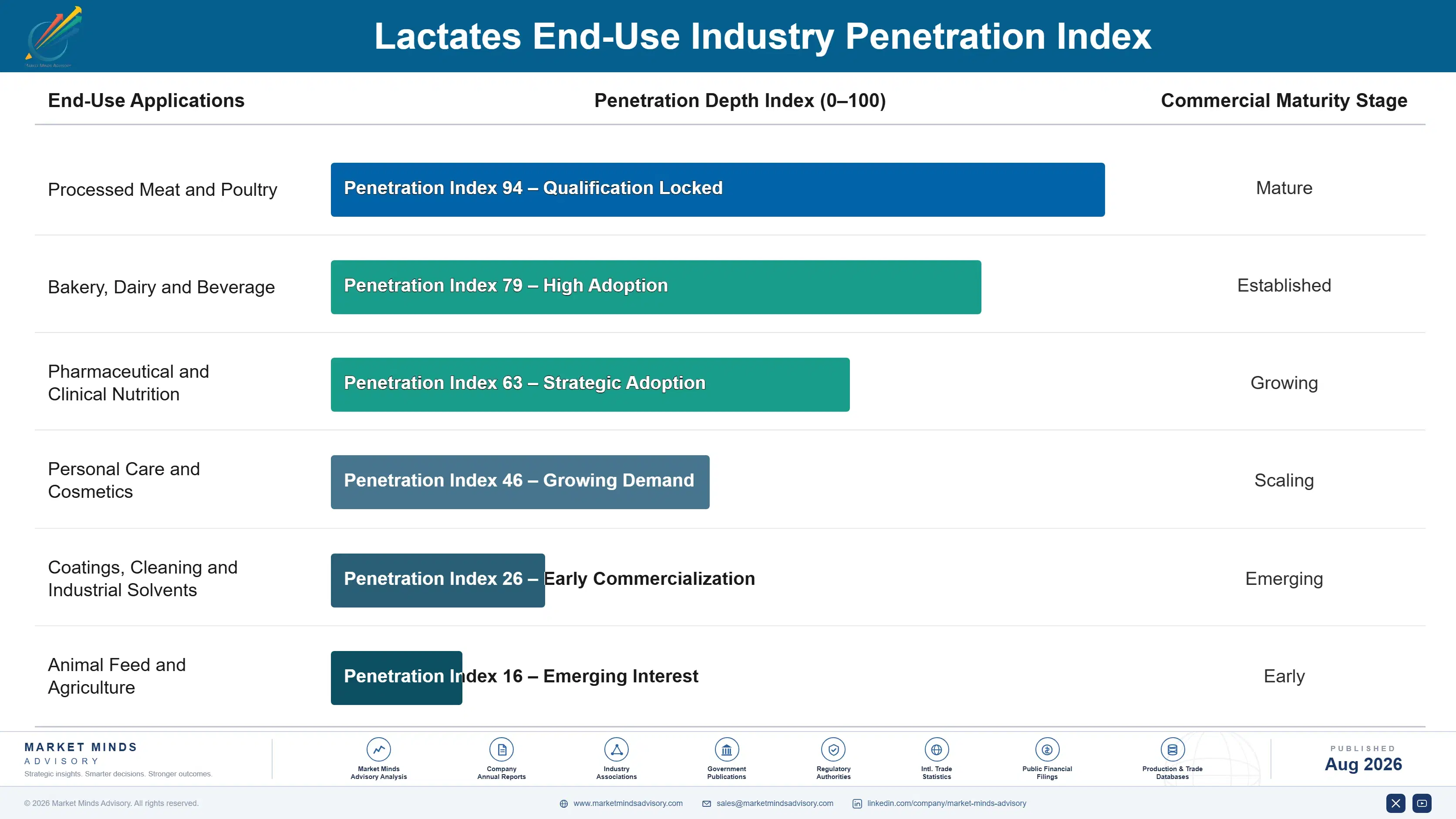
Demand reaches producers through three routes that share a customer and very little else. Food processor procurement tenders annually on price against a specification that treats the lactate as interchangeable. Reformulation and regulatory teams decide what the ingredient panel will say and whether a sensory outcome is acceptable, which happens during product development rather than at purchase. Pharmaceutical demand runs through a qualification programme measured in years and then reorders without revisiting the choice.
Stickiness follows how expensive changing would be. Pharmaceutical qualification holds until the customer changes its own process. Clean label conversions hold because reverting means changing the pack. Meat preservation systems hold because nobody reformulates a recall-free antimicrobial casually. Commodity food salts hold until the next annual tender closes. Nothing about the salt itself holds any of it.

The deciding buyer has shifted noticeably toward regulatory and marketing functions as clean label reformulation spread, which is unusual for an ingredient sold by the tonne. Those people evaluate declaration wording and retailer specification compliance rather than assay. Producers presenting antimicrobial performance data to procurement are answering a settled question for an audience that never asked it. That shift happened quietly and most suppliers missed it.
global-lactates-market-trends-end-use-penetration-index-1787553536634

Where the Premium Actually Comes From

These are among the four positions where our research anticipates prominent divergence between winners and laggards over the coming forecast period. Each is grounded in the demand model, the regulatory perimeter, and the announced capacity pipeline.
01 / ACID SUPPLY SECURITY

Contract the fermentation before the polymer does

Polylactic acid manufacture now consumes roughly 37% of available lactic acid from the same fermentation plants that supply lactate salts, and the allocation decision between them sits entirely with the producer rather than with any salt customer. Buyers who treated availability as a settled question have discovered otherwise during genuinely tight periods over the past few years. Multi-year acid contracting or backward integration removes an exposure that no ordinary commercial relationship addresses, and polymer demand is growing rather than stabilising.
02 / REFORMULATION PROBLEM SOLVING

Fix the bitterness, do not just supply potassium

Public health sodium reduction targets push processed meat toward potassium lactate, which is measurably more bitter and costs more, and the masking work required is what actually holds those conversions up rather than any question of supply or antimicrobial performance. Meat preservation carries 34% of volume and processors will not lightly risk a system that has kept them free of a recall for two decades. Suppliers bringing masking approaches and sensory support answer the real obstacle rather than restating it.
03 / DECLARATION SELLING FOCUS

Sell the ingredient panel, not the efficacy data

The 28% premium in this market comes from what appears on a pack rather than from any microbiological performance a buyer had not already accepted as adequate years earlier. Producers who supply declaration evidence, regulatory position jurisdiction by jurisdiction, and retailer specification support are selling something no chemical datasheet has ever managed to capture properly. Leading with antimicrobial data to procurement teams who already know it works wastes the conversation, and this industry has been doing it for fifteen years.
04 / RESTRICTION TIMETABLE TRACKING

Reach formulators before the deadline forces them

Lactate esters grow at 9.8% because solvent restrictions removed established options from coatings, electronics cleaning, and pharmaceutical processing work, not because any formulator preferred them on cost or performance merit of any kind. Cost sits above what they replace, so adoption follows published authorisation and substitution timetables with unusual and helpful precision. Producers tracking those dates position with formulators while qualification work can still be done properly, rather than arriving when a compliance deadline has already removed the alternatives entirely.

Engagement Snapshot From the Field

A live engagement with an industry participant carrying material or product regulatory and market exposure ahead of a defining policy shift, showing how our research translates into a defensible multi-year portfolio strategy.
MARKET MINDS ADVISORY · CLIENT ENGAGEMENT SUMMARY
Lactates Producer Strategic Portfolio Review and Transition Roadmap 2026·Investment Scenario on Lactates Exposure Evaluation 2025-26
CLIENT PROFILE
A European lactate producer with revenue near EUR 88 million (client-reported, unverified by MMA), supplying food grade sodium and calcium lactate to meat and dairy processors across several countries. Lactic acid was purchased rather than fermented, no pharmaceutical grade existed, and margins had compressed for four consecutive years running. Fermentation had never been considered internally.
STRATEGIC CHALLENGE
Purchased acid availability had tightened twice during polymer capacity expansion, leaving the business short against contracted customer commitments it could not fulfil. Chinese producers were undercutting food grade pricing everywhere. Two customers had stalled potassium conversions the business could not help them solve technically. Nobody had ever quantified what the shortfalls cost.
MMA APPROACH
MMA analysed margin by grade and customer function, assessed acid contracting and backward integration options against polymer demand growth, and evaluated pharmaceutical qualification requirements against existing plant capability. Forty-seven expert interviews with meat processors, reformulation teams, regulatory affairs functions, and pharmaceutical formulators established where decisions genuinely originate. Three years of acid purchasing records were rebuilt.
KEY FINDINGS
  1. Every account retained at full margin involved the client's regulatory people supporting a declaration decision, and every account lost on price had been managed exclusively through procurement.
  2. Acid purchasing on annual terms had left the business exposed twice during polymer expansion, and the cost of those shortfalls exceeded three years of contracting premium.
  3. Both stalled potassium conversions were blocked on sensory outcome rather than supply, and neither customer had been offered any masking or formulation support at all.
  4. One existing production line could reach pharmaceutical qualification with modest investment, and nobody in the business had assessed it against the endotoxin requirement.
CLIENT PROFILE
A European lactate producer with revenue near EUR 88 million (client-reported, unverified by MMA), supplying food grade sodium and calcium lactate to meat and dairy processors across several countries. Lactic acid was purchased rather than fermented, no pharmaceutical grade existed, and margins had compressed for four consecutive years running. Fermentation had never been considered internally.
STRATEGIC CHALLENGE
Purchased acid availability had tightened twice during polymer capacity expansion, leaving the business short against contracted customer commitments it could not fulfil. Chinese producers were undercutting food grade pricing everywhere. Two customers had stalled potassium conversions the business could not help them solve technically. Nobody had ever quantified what the shortfalls cost.
MMA APPROACH
MMA analysed margin by grade and customer function, assessed acid contracting and backward integration options against polymer demand growth, and evaluated pharmaceutical qualification requirements against existing plant capability. Forty-seven expert interviews with meat processors, reformulation teams, regulatory affairs functions, and pharmaceutical formulators established where decisions genuinely originate. Three years of acid purchasing records were rebuilt.
KEY FINDINGS
  1. Every account retained at full margin involved the client's regulatory people supporting a declaration decision, and every account lost on price had been managed exclusively through procurement.
  2. Acid purchasing on annual terms had left the business exposed twice during polymer expansion, and the cost of those shortfalls exceeded three years of contracting premium.
  3. Both stalled potassium conversions were blocked on sensory outcome rather than supply, and neither customer had been offered any masking or formulation support at all.
  4. One existing production line could reach pharmaceutical qualification with modest investment, and nobody in the business had assessed it against the endotoxin requirement.
RECOMMENDED STRATEGY
Phase 1: Phase one: contract lactic acid supply on multi-year terms and index customer agreements to published sugar references at the same time. Phase 2: Phase two: build sensory and masking support for potassium conversion, addressing the obstacle that has stalled reformulation at two major customers. Phase 3: Phase three: qualify one dedicated line for pharmaceutical grade production, accepting the twenty-two month timeline rather than deferring it further.
OUTCOME
The client secured multi-year acid supply within a quarter and ended the availability exposure. Masking support unblocked one stalled conversion, pharmaceutical qualification began on a dedicated line, and blended gross margin improved 7.2 percentage points (client-reported, unverified by MMA). Sugar indexation entered every renewed customer agreement.

Frequently Asked Questions

Foundational context covering the market sizes, CAGR, scope, country, region and competition that inform every finding below. This section is provided to cover basics and most often pre-purchase conversations, answered from the MMA Primary Research Dataset.

What is the current size of the Lactates Market?

The market was valued at USD 0.9 billion in 2025, rising to an estimated USD 0.95 billion in 2026. East Asia holds the largest regional share at 28% of value.

How large will the Lactates Market be by 2036?

MMA forecasts USD 1.71 billion by 2036 under the base case, an expansion multiple of 1.79 times the 2026 value. That represents USD 0.76 billion of incremental value.

What is the CAGR for the Lactates Market 2026 to 2036?

The base case CAGR is 6.0%, with a bull case of 7.2% and a bear case of 4.8%. The spread reflects uncertainty over polymer acid competition and clean label extension.

Which segment is growing fastest?

Lactate esters grow fastest at 9.8%, roughly 1.63 times the market rate, on solvent restriction. Magnesium and zinc lactate follow at 8.6% on mineral fortification.

Who are the major companies in the Lactates Market?

Corbion, Galactic, Jungbunzlauer, Musashino Chemical, and Henan Jindan lead, holding roughly 62% between them. Fermentation capacity rather than salting capability sustains that concentration rather than any conversion capability.

Which country is growing fastest?

India grows fastest at 9.4%, as packaged food consumption expands, organised retail deepens, and pharmaceutical manufacture creates demand for qualified lactate grades simultaneously. Cane and cassava feedstock is competitive there.

Report Segmentation Architecture

The full report scope spans multiple orthogonal segmentation dimensions, with cross-tabulated demand data provided for each dimension pair. Coverage extends further to regional breakdowns, trend trajectories, and the competitive detail needed to support segment-level decision-making.

By Salt and Ester Type

  • Sodium Lactate
  • Calcium Lactate
  • Potassium Lactate
  • Magnesium and Zinc Lactate
  • Lactate Esters
  • Pharmaceutical Grade Lactates

By End-Use Industry

  • Processed Meat and Poultry
  • Bakery, Dairy and Beverage
  • Pharmaceutical and Clinical Nutrition
  • Personal Care and Cosmetics
  • Coatings, Cleaning and Industrial Solvents
  • Animal Feed and Agriculture

By Customer Type

  • Large Food Processing Groups
  • Private Label and Regional Manufacturers
  • Pharmaceutical Formulators
  • Coatings and Cleaning Formulators
  • Ingredient Distributors and Blenders

By Region

  • North America
  • Western Europe
  • East Asia
  • South Asia and Pacific
  • Latin America
  • Middle East and Africa
  • Eastern Europe

Scope, Methodology, and Coverage

Every figure in this report is reproducible from documented input assumptions. The scope below maps the historical period, the forecast horizon, the segmentation dimensions, and the countries covered, alongside the underlying primary and qualitative methodology.
Historical Period
2020 to 2025
Forecast Period
2026 to 2036
Base Year
2025 (USD billions; MMA Primary Research Dataset, August 2026)
Market Definition
The market comprises lactate salts and esters supplied to food, pharmaceutical, personal care, and industrial users, covering sodium lactate, calcium lactate, potassium lactate, magnesium and zinc lactate, lactate esters, and pharmaceutical grade lactates. Value is measured at producer level across food preservation, fortification, pharmaceutical, and solvent applications. Lactic acid sold as an acid rather than converted, polylactic acid and lactide polymers, fermentation feedstocks, other organic acid salts, and finished food or pharmaceutical products fall outside scope.
Quantitative Units
USD billions (current prices); thousand tonnes supplied annually; USD per tonne by salt type and grade
Segmentation Dimensions
By Salt and Ester Type; By End-Use Industry; By Customer Type; By Region
Regions Covered
North America, Western Europe, East Asia, South Asia and Pacific, Latin America, Middle East and Africa, Eastern Europe
Countries Covered
China, Japan, South Korea, Thailand, India, Indonesia, Vietnam, Australia, Malaysia, United States, Canada, Mexico, Netherlands, Belgium, Germany, France, Austria, Spain, Italy, United Kingdom, Poland, Czechia, Hungary, Romania, Brazil, Argentina, Colombia, Saudi Arabia, Egypt, South Africa
Key Companies Profiled
Corbion, Galactic, Jungbunzlauer, Musashino Chemical, Henan Jindan Lactic Acid, Cargill, ADM, BASF, Merck KGaA, Vigon International, Prinova, Global Calcium, Dr. Paul Lohmann, Tate and Lyle, Vertec BioSolvents, Wuhan Sanjiang, Anhui BBCA, Sucroal, Vaishnavi Bio Tech, Zhengzhou Tianrun
Quantitative Methodology
Primary survey, n=3,800 respondents, Q4 2025, six countries; demand-side model with trade association cross-validation
Qualitative Methodology
47 expert interviews, Q4 2025; applied to validate demand model assumptions, identify emerging dynamics, and assess competitive positioning
Report Format
PDF and XLSX data workbook (Word format preview document)
Publisher
Market Minds Advisory
Report Code
MMA-2026-CHM-468
Published
August 2026
Contact
sales@marketmindsadvisory.com | www.marketmindsadvisory.com

Purchase the full Lactates Market Report (2026 to 2036).

The full report sizes lactate demand across six salt and ester types, six end-use industries, and seven regions with 2026 to 2036 forecasts under base, bull, and bear cases. It treats the clean label declaration premium as the central commercial variable rather than antimicrobial performance, since that is what customers actually pay for. Competitive profiles cover twenty producers assessed consistently on lactate supply revenue, fermentation position, and regulatory support capability. Cost analysis traces sugar feedstock, energy, and purification exposure by grade. Commercial guidance addresses acid supply security, reformulation support, declaration selling, and restriction timetable tracking.
Six salt and ester types sized separately by region
Polymer competition for lactic acid quantified against salt supply
Clean label declaration premium measured against synthetic alternatives
Sodium reduction reformulation obstacles assessed by product category
Solvent restriction timetables tracked across major jurisdictions
Pharmaceutical qualification requirements mapped against plant capability

Built For The People Who Decide

From boardroom strategy to bench-side execution, this report is read cover-to-cover by leaders shaping the next decade of their industry, turning demand scenarios, market dynamics and valuation benchmarks into decisions.
CXOs/ Presidents/ VPs/ Managers
M&A and Corporate Development
Strategy Teams and R&D Heads
Procurement and Product Directors
Regulatory and Compliance Leaders
Investor Relations and Equity Analysts