Market Minds Advisory
Hydrosulfite Market

Hydrosulfite Market: Water Treatment Grade Growth and Textile Dyeing Economics

Food-grade and water treatment hydrosulfite demand is converting reducing agent specification as processors chase documented purity credentials ahead of tightening global industrial and food chemical safety regulation nationwide and internationally.

Lead Analyst

Bilal Shaikh

Published

September 2026

Make Smarter Decisions with Customized Research Insights

Request a free sample report and evaluate market opportunities, growth trends, and competitive dynamics relevant to your business needs.

2025 MARKET VALUE$1.8BMarket Size 2025
2036 FORECAST VALUE$3.3BBase Case , 2026 to 2036
CAGR 2026 TO 20365.6 %Bull 6.8% / Bear 4.4%
INCREMENTAL OPPORTUNITY$1.4BNet 10- year value creation
EXPANSION MULTIPLE1.73x2036 value over 2026 base
Strategic Levers
M&A Pipeline
Regional Outlook
Country Rankings
Competitive Intelligence
Segmental Deep-dive
Call-Us : 91 93563 13602

Executive Snapshot and Market Trajectory

Hydrosulfite remains anchored in standard textile dyeing and pulp bleaching grades by unit volume, but food-processing and water-treatment chemistries are steadily converting reducing agent specification across China, India, Bangladesh, Pakistan, Vietnam, Indonesia, and increasingly across most other parts of the United States today.
Food and beverage processing grade is growing roughly fifty percent faster than the category overall, as processors convert reducing agent specification toward chemistries offering documented purity credentials beyond conventional textile-grade dithionite across most major compliance-focused processing markets. East Asia holds the largest regional share on its concentrated textile dyeing and pulp manufacturing infrastructure, while China's expanding textile and paper production pipeline is now the fastest-growing national market this report tracks closely and consistently.
Forty-six percent concentration among the top five manufacturers, evaluated here on estimated global revenue, reflects a category still shaped by a handful of established sodium dithionite producers with deep synthesis infrastructure rather than a fragmented field of interchangeable suppliers. Purity certification depth and engineering reach increasingly separate leading manufacturers from smaller suppliers competing purely on unit price. Food-safety regulation is reshaping which manufacturers sustain long-term processor supply contracts nationwide.
Market Definition
The hydrosulfite market comprises sodium dithionite and related reducing agent chemicals used in textile dye reduction, pulp and paper bleaching, water treatment, food and beverage processing, and leather processing applications. It excludes finished dye formulations, bleached pulp and paper products, and downstream water treatment systems sold as complete equipment.
Base Year Value
$1.8B in 2025 (MMA Primary Research Dataset, August 2026)
Forecast Period
2026 to 2036, eleven discrete annual values
CAGR
5.6% base case. Bull 6.8%. Bear 4.4%.
Fastest Growth Segment
Food and Beverage Processing Grade: 8.4% CAGR
Fastest Growth Country
China: 6.8% CAGR
Fastest Growth Region
South Asia and Pacific: 7.6% CAGR
Largest Region
East Asia: 34% of 2025 global value
Market Leaders
BASF SE, Jiangsu Sopo Chemical Co., Ltd., Transpek Silox Industry Limited, Guangxi Nanning Chemical Industry Group Co., Ltd., and Chemtrade Logistics Income Fund lead the category. Source: MMA Analysis based on company annual reports and investor filings.
Primary Survey
n=3,800 procurement and R&D decision-makers, Q4 2025, six countries
Methodology
Demand-side build-up, cross-validated against public data, 47 expert interviews

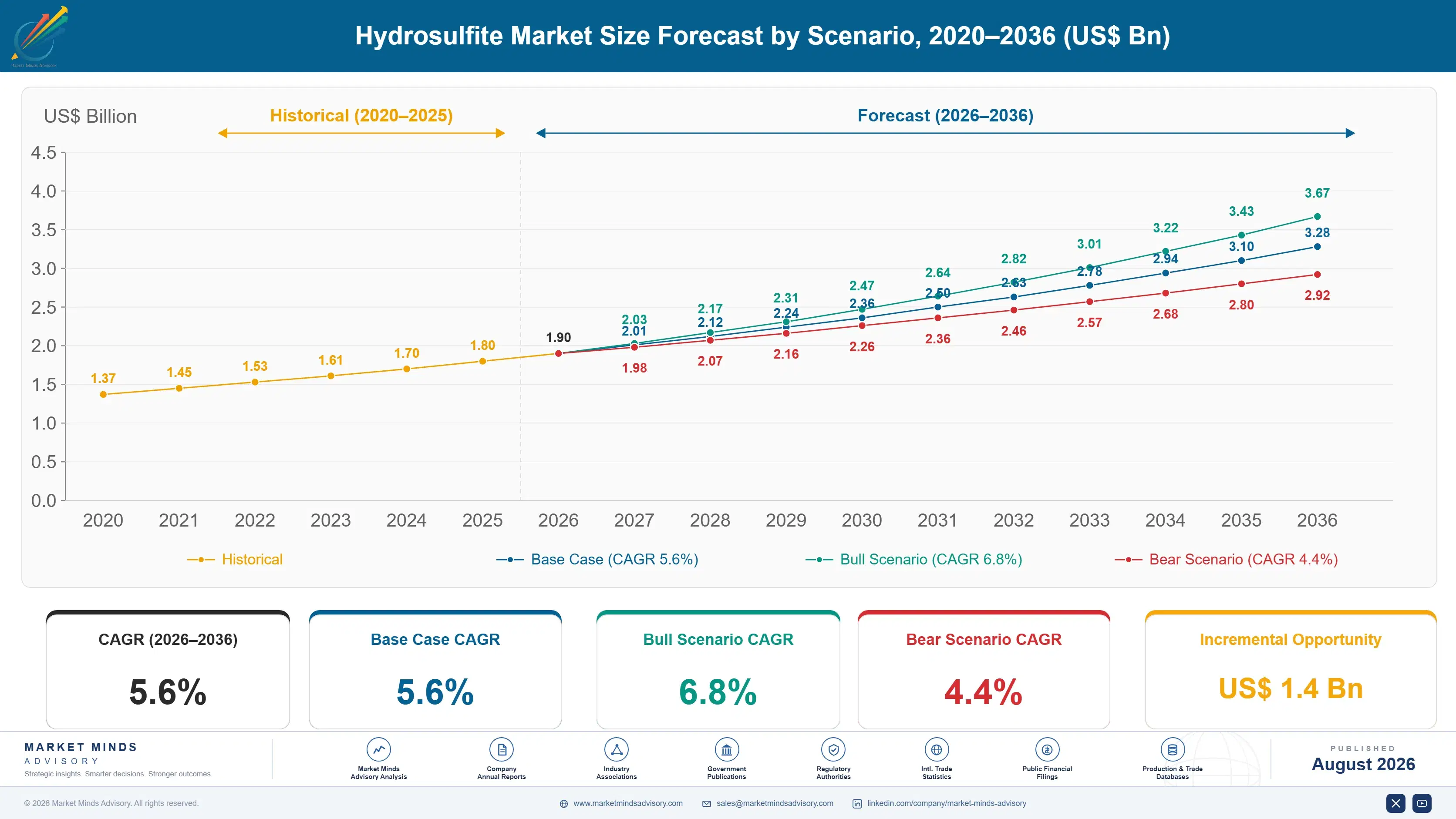
Hydrosulfite Market Forecast Scenarios

global-hydrosulfite-market-trends-size-forecast-scenario-1787310609488
Between 2020 and 2025 the category grew at roughly 4.6 percent annually as global textile dyeing and pulp bleaching production expanded steadily following recovering industrial demand across most developed and emerging chemical markets globally, nationwide, and across most major economies worldwide. Food-processing formulations remained a smaller premium share of total volume through most of that stretch.
The base case assumes 5.6 percent annual growth through 2036, anchored in three mechanisms: continued expansion of global textile dyeing and pulp bleaching capacity sustaining baseline hydrosulfite demand across dyeing and processing applications combined, accelerating conversion from standard textile grades toward food-processing and water-treatment chemistries among processors seeking documented purity credentials, and expanding textile and paper production capacity across China driving new hydrosulfite volume well ahead of the category average. Purity certification investment increasingly determines which manufacturers defend processor contract volume.
A bull case builds around processors accelerating food-grade conversion faster than expected as food-safety regulation expands across major processing markets, pushing growth toward 6.8 percent. The bear case centers on global textile production softening and elevated feedstock costs delaying formulation investment broadly, pulling growth down toward 4.4 percent if processors defer specification changes across most territories.

Where Purity Credentials Meet Textile Manufacturing Economics

Hydrosulfite occupies a defensible position within industrial reducing agent chemicals, where standard textile-grade dithionite remains the processor's entry point even as food-processing and water-treatment chemistries expand the category's addressable premium purity base substantially. That expansion means growth increasingly concentrates in whichever producers can combine synthesis depth with purity certification investment across most compliance-focused processing accounts. Established distr
MARKET CONCENTRATION (CR5)46%Revenue spread across established sodium dithionite producer base
AVERAGE SELLING PRICE$1.15 per kilogramBlended price across textile-grade and premium food-processing grades
TOP PRODUCING COUNTRY SHAREChina, 28% of revenueReflects concentrated textile dyeing manufacturing infrastructure and investment strength
CAPACITY UTILISATION72%Sodium dithionite synthesis units run below full production capacity
FEEDSTOCK COST SHARE43% of production costSulfur dioxide and zinc dust inputs dominate unit cost structure
FOOD-GRADE PENETRATION19% of total reducing agent volumeShare of total volume now allocated to food-processing applications
Competitive character centers on documented purity performance and certification depth rather than pure unit price alone, since food and beverage processors increasingly specify supply contracts based on heavy-metal contamination data and food-safety credentials rather than cost in isolation. Purity certification investment depth determines which manufacturers can bid on large multi-region processor contracts. Suppliers lacking documented purity data increasingly struggle to justify premium pricing against budget-conscious processors.
Over the next decade, food-processing formulation maturation and textile demand growth will likely determine how much of the category's remaining growth potential converts into actual unit volume rather than continuing to rely on standard textile-grade dithionite indefinitely. Smaller regional producers, where standard textile grades still satisfy conventional dyeing needs, represent legacy chemistry's most defensible remaining stronghold nationwide.
"A dye house used to treat sodium dithionite as an interchangeable commodity reducing agent. Now heavy-metal purity data is dictating which grade wins the specification before price even enters the conversation, and that shift is what is reshaping producer order books right now."
Director, Industrial Reducing Agent Chemicals Practice · MMA Industrial Reducing

Market Trends

Food-Grade Chemistry Displaces Standard Textile Specifications

Food and beverage processors increasingly specify food-grade hydrosulfite for sugar refining and beverage clarification applications, converting reducing agent standards well ahead of any regulatory mandate requiring the switch specifically across most major food processing markets nationwide and internationally. Quality assurance teams increasingly cite documented heavy-metal purity data as justification for expanding food-grade specification, giving procurement teams formal internal justification for paying a meaningful per-kilogram price premium that previous textile-only purchasing criteria would have rejected outright. Manufacturers with food-grade formulation capability report order volume from compliance-focused processing accounts growing meaningfully faster than textile-only sales nationwide today.
Market Impact: Adds 3% annual baseline reduction d
Purity Certification Requirements Reshape Processor Procurement

Food and beverage processors increasingly require formal heavy-metal contamination testing before a hydrosulfite product can even enter their preferred supplier shortlist, pushing manufacturers to secure dedicated testing infrastructure well ahead of broader industry adoption of similar certification standards across the category overall and internationally today. Food safety trade associations and manufacturers increasingly coordinate certification protocols directly, since a producer unable to demonstrate documented purity consistency risks losing preferred-supplier status with major processing accounts entirely and permanently. This dynamic is consolidating demand around manufacturers with dedicated testing infrastructure across most major markets nationwide.
Market Impact: Adds 5% annual capacity-driven dema

Market Opportunities and Growth Drivers

Global Textile Dyeing Capacity Sustains Baseline Demand

Global textile dyeing and pulp bleaching capacity continues expanding steadily across both developed and emerging markets, and a meaningful share of that capacity still requires formal hydrosulfite reduction regardless of which specific grade a given processor ultimately selects for the production line underway. Dye houses report that hydrosulfite reduction remains the required approach specifically for vat-dye applications that alternative reducing agents handle less cost-effectively at comparable production scale. This baseline demand floor supports steady volume even as grade format continues shifting within the category across most major manufacturing markets nationwide.
Market Impact: Delays roughly 14% of grade upgrade

Textile and Paper Production Expands Across China

Textile and paper production capacity continues expanding meaningfully across China, driven by both rising domestic apparel demand and multinational textile companies building regional production lines to serve rapidly growing export demand more efficiently across major manufacturing hubs nationwide. Processors report that new production line specifications increasingly default toward food-grade-inclusive reducing agent inventories from the outset rather than textile-only stock, an advantage that favors producers with established regional distribution relationships over new entrants lacking comparable local support. This capacity-driven volume growth substantially exceeds the modest growth rates typical of mature developed textile manufacturing markets elsewhere.
Market Impact: Adds roughly 12% cyclical demand vo

Market Restraints and Challenges

Food-Grade Purification Cost Limits Broader Adoption

Food-grade hydrosulfite production depends heavily on multi-stage purification and heavy-metal removal infrastructure, and processors facing this cost constraint frequently default to standard textile-grade output or delay expansion until adequate purification investment becomes available from specialty equipment suppliers worldwide. The root cause is that achieving consistent food-grade purity requires specialty purification equipment produced by a limited number of global suppliers, limiting broader category adoption relative to widely available textile-grade production across most manufacturing regions. Manufacturers are responding by securing long-term equipment financing agreements that reduce the capital barrier for smaller producers.
Market Impact: Adds 8.4% annual food-grade segment

Textile Production Cyclicality Slows Consistent Growth

Hydrosulfite demand correlates closely with broader textile dyeing and pulp bleaching capacity utilization and global apparel demand conditions, and processors facing tightened capital budgets frequently delay grade specification changes until financial and demand conditions improve more confidently across most textile manufacturing markets. The root cause is that hydrosulfite demand tracks discretionary textile capacity investment rather than fixed replacement demand, making the category more sensitive to apparel cycles than baseline chemical replacement demand. Manufacturers are responding by developing more affordable entry-level textile formulations that broaden the category's addressable price-sensitive customer base considerably over time.
Market Impact: Affects supplier qualification stan
3 additional market trends, 4 additional growth drivers, and 2 additional restraints and challenges are covered in the full report. Contact sales@marketmindsadvisory.com to access the complete intelligence.

Segment CAGR and Growth Architecture

MMA segments the hydrosulfite market by application grade, distinguishing textile dyeing, pulp and paper bleaching, water treatment, food and beverage processing, leather processing, and general industrial reducing agent grades, since each carries genuinely distinct purity requirements across most specialty chemical markets today, internationally and nationwide alike, regardless of specific end-use application or industry vertical.
global-hydrosulfite-market-trends-market-share-analysis-1787310610039

Food and Beverage Processing Grade

Food and beverage processing grade is growing fastest as sugar refiners and beverage processors with formal purity goals adopt formulations offering documented heavy-metal contamination control alongside conventional textile effects simultaneously across most major compliance-focused food processing markets nationwide. Manufacturers with established purification and certification capability capture disproportionate share, since food-grade production requires considerable process chemistry and specialty purification investment that smaller regional producers generally cannot justify without confidence in sustained demand growth from major processing accounts over the medium to long term. Quality assurance teams increasingly cite documented purity data as justification for expanding food-grade specification, giving procurement teams formal internal justification for the added cost across most compliance-focused food processing markets nationwide and internationally today.
CAGR 8.4%

Water Treatment Grade

Water treatment grade forms the second-fastest-growing segment, expanding as municipal and industrial water treatment applications increasingly favor sodium dithionite reduction over standard textile alternatives for demanding dechlorination and metal-reduction applications across most premium water treatment settings nationwide. Manufacturers increasingly develop refined water-treatment production capability optimized for reduced impurity content and improved reactor compatibility, deepening technical relationships with utilities that favor established suppliers over new entrants lacking comparable supply consistency and technical documentation. This segment benefits from genuine differentiation within the broader hydrosulfite category itself, since water-treatment grade targets dechlorination performance directly rather than the broader dyeing positioning that textile grades primarily occupy across most industrial markets nationwide and internationally today.
CAGR 7.6%
Full segment breakdown across 6 segments available in the complete report.

Regional Architecture and Country Demand Map

East Asia holds the largest regional share on its concentrated textile dyeing and pulp manufacturing infrastructure, while South Asia and Pacific follows closely on expanding textile capacity across most facilities nationwide. China is growing fastest as production accelerates rapidly across major manufacturing hubs nationwide and internationally.

North America

United States and Canadian processors anchor North American demand, with domestic textile dyeing capacity remaining limited given decades of offshore manufacturing migration toward Asian production hubs, keeping the region's share below the standard band despite growing food-processing and water-treatment consumption. The region imports the substantial majority of its textile-grade hydrosulfite while sustaining meaningful domestic demand for premium food-processing and water-treatment grades produced by BASF and Chemtrade facilities. Performance-driven food-grade adoption has accelerated meaningfully among large processors with formal purity requirements, though the region's overall reducing agent consumption remains modest relative to Asian textile manufacturing hubs. Growth here trails East Asia and South Asia because the region's demand base is concentrated in specialty applications rather than bulk textile dyeing nationwide.
Share: 16% | CAGR: 6.4% (2026 to 2036)

Western Europe

Germany, France, and Italy lead Western European demand through a handful of specialty chemical producers, though the region's share sits below the standard band because domestic textile dyeing capacity has substantially declined relative to Asian production centers over the past two decades. European food-safety and water-treatment quality standards increasingly favor certified food-grade hydrosulfite over standard textile alternatives for premium processing applications, adding regulatory tailwind that supports category conversion across the smaller domestic manufacturing base that does exist. The region has also seen steady growth in premium grade demand, reflecting its advanced food-processing spending environment and sophisticated quality assurance infrastructure. Growth trails the global average because the region combines limited domestic textile capacity with reliance on imported reducing agent supply.
Share: 14% | CAGR: 4.3% (2026 to 2036)
Regional intelligence for 5 additional markets available in the complete report: East Asia, South Asia and Pacific, Latin America, Middle East and Africa, Eastern Europe. Contact sales@marketmindsadvisory.com.
global-hydrosulfite-market-trends-country-cagr-analysis-1787310610551

Where Manufacturers Can Defend Margin and Grow

Margin defense in hydrosulfite depends heavily on expanding food-grade purification capacity, securing purity certification infrastructure, and locking long-term processor contracts around purity reliability that thin commodity textile-grade margins cannot easily replicate without meaningful sustained capital investment maintained consistently over time across most major premium chemical and food processing markets served nationwide and internationally today.

Food-Grade Purification Capacity Expansion Investment Program

Purity-driven demand for food-grade hydrosulfite continues outpacing industry-wide purification capacity additions, creating a genuine premium pricing opportunity for manufacturers investing directly in expanded purification capability ahead of broader industry adoption across the category and its major processor customer base nationwide and internationally today. Manufacturers building dedicated purification capacity now capture premium pricing from purity-conscious processing customers before capacity constraints ease and competitive pressure intensifies meaningfully across the segment considerably over time and across regions. Early purification investors report capturing roughly 18 percent more food-grade segment volume share than competitors do currently.
Market Impact: Captures roughly 18% more food-grad

Processor Purity Certification Partnership Development Program

Food and beverage processors increasingly require formal heavy-metal contamination testing before a hydrosulfite product can even enter their preferred supplier shortlist, and manufacturers investing directly in dedicated testing infrastructure capture preferred-supplier status that translates into meaningful order volume from the largest, most certification-focused processing accounts available today. Manufacturers with secured testing infrastructure report winning roughly 15 percent more large processor contracts than competitors lacking comparable certification investment overall. Building this certification portfolio requires sustained partnership investment, but it captures customers with meaningfully higher switching costs once workflows are properly calibrated.
Market Impact: Wins roughly 15% more processor con

Multi-Year Sulfur Feedstock Supply Contract Strategy

Sulfur dioxide and zinc dust feedstock costs fluctuate meaningfully with broader specialty chemicals commodity market cycles, and manufacturers without long-term supply agreements absorb that volatility directly into thin margins during tight-supply periods that recur unpredictably across both feedstock categories entirely and without warning at any point in the pricing cycle across most major producing regions nationwide. Manufacturers negotiating multi-year fixed-price contracts protect margin predictability even during industry-wide price spikes exceeding 14 percent, a stability smaller regional competitors without comparable purchasing scale genuinely cannot replicate independently across their own supply relationships today.
Market Impact: Protects margin during roughly 9 to

Independent Processor Bundled Access Expansion Program

Smaller regional processors increasingly want food-grade capability but lack the purchasing scale to negotiate favorable pricing on their own, and manufacturers developing bundled product and training access programs that spread costs across multiple smaller processors can capture roughly 13 percent more addressable business previously lost to larger processor-network-focused competitors specifically and permanently across most regional markets served today and going forward, quite consistently over time and quite reliably. This approach also builds durable brand loyalty among processors who might otherwise default to whichever supplier offers the lowest unit price available.
Market Impact: Expands addressable smaller process

Who Controls the Margin Pool

Five manufacturers, evaluated here on estimated global revenue, hold roughly forty-six percent of the hydrosulfite category between them, a moderately concentrated structure reflecting how strongly synthesis infrastructure and purification investment continue favoring established producers over regional standalone converters. The gap between the largest producers and the long tail of regional suppliers remains meaningful, with purification depth increasingly determining processor contract access
Current competitive activity centers on three fronts: food-grade purification capacity expansion to capture purity-conscious processor demand, processor certification partnership investment to defend supply contracts, and independent processor bundled access development to capture budget-constrained smaller accounts. Larger manufacturers are also acquiring smaller regional competitors to expand production and geographic coverage without building new capacity from scratch entirely. Consolidation among smaller regional competitors is also accelerating as certification costs rise.

Pressure is building from food-grade-focused specialty suppliers steadily expanding share across compliance-focused processing accounts, a threat concentrated specifically in the highest-value food-grade and water-treatment tiers where purification investment matters more than pure unit price. Ranking shifts are most likely among smaller regional producers unable to fund purification research investment, several of which MMA expects will exit.
global-hydrosulfite-market-trends-company-positioning-matrix-1787310611090

Competitive Moat and Risk Dimensions

BASF SE

Moat: Deep Purification Infrastructure Base

BASF maintains genuine depth in multi-stage sodium dithionite purification infrastructure developed specifically for food-grade applications, giving it meaningfully better ability to serve processors seeking documented heavy-metal purity than competitors relying on less established purification science overall. That depth shortens qualification cycles competitors cannot easily match.
BASF SE

Risk: Exposure to Textile Grade Volume

BASF maintains meaningful revenue exposure to standard textile-grade volume facing persistent pricing pressure from lower-cost Asian competitors, leaving a portion of its revenue base more exposed to margin compression than competitors already concentrated in premium food-processing formats nationwide and internationally today across most segments served.
JIANGSU SOPO CHEMICAL CO., LTD.

Moat: Deep Manufacturing Scale Base

Jiangsu Sopo maintains genuine depth in large-scale sodium dithionite production capacity developed through sustained facility investment across multiple production lines, giving it meaningfully broader supply reliability than competitors who entered the category more recently. Processors value that scale when evaluating long-term contract dependability and support.
JIANGSU SOPO CHEMICAL CO., LTD.

Risk: Narrower Food-Grade Certification Depth

Jiangsu Sopo's food-grade certification capability remains comparatively less developed than competitors who built broader purity documentation infrastructure earlier, leaving it somewhat exposed among processors seeking a single supplier spanning both textile and food-grade formats nationwide and internationally today, particularly the largest global food processing accounts.

Players Tracked

Prominent Players

BASF SE
Jiangsu Sopo Chemical Co., Ltd.
Transpek Silox Industry Limited
Guangxi Nanning Chemical Industry Group Co., Ltd.
Chemtrade Logistics Income Fund

Other Key Players

Songyuan Xinlong Chemical Co., Ltd.
Jiangxi Fenghui New Materials Co., Ltd.
Hangzhou Hongyan Chemical Co., Ltd.
Tokai Denka Kogyo Co., Ltd.
Nippon Chemical Industrial Co., Ltd.
Nanjing Chemical Industry Group
Zhejiang Fangyuan Chemical Co., Ltd.
Aditya Birla Chemicals (Thailand) Ltd.
Excel Industries Limited
Anhui Fengyuan Bio-Chemical Co., Ltd.
Shandong Kailong Chemical Co., Ltd.
Sarex Overseas Pvt. Ltd.
Zhenjiang Dongtai Sodium Sulfite Co., Ltd.
Kemira Oyj
Solvay SA

Recent Developments

JANUARY 2025

BASF Expands Food-Grade Purification Capacity in Germany

BASF completed an organic capacity expansion at its existing German facility, adding dedicated food-grade purification and testing capability to meet growing demand from processors converting toward purity-focused specifications across most major markets nationwide. Full timeline details for the broader expansion program remain forthcoming for now.
Signal: Reflects manufacturers investing directly
MAY 2025

Jiangsu Sopo Signs Multi-Year Processor Certification Partnership

Jiangsu Sopo signed a multi-year heavy-metal certification partnership agreement with a major global food processor to accelerate documented purity testing across its hydrosulfite product line, becoming a preferred supplier recommended directly to processors with certification requirements nationwide. The agreement includes joint development of future testing protocols as well.
Signal: Shows manufacturers pursuing direct certif
SEPTEMBER 2025

Transpek Silox Acquires Regional Distributor in Southeast Asia

Transpek Silox acquired a majority equity stake in a regional Southeast Asian hydrosulfite distributor, expanding its service footprint to serve the region's growing textile manufacturing sector, which has become one of the fastest-growing demand pools within the broader category. Terms of the transaction were not disclosed publicly.
Signal: Signals established producers acquiring re

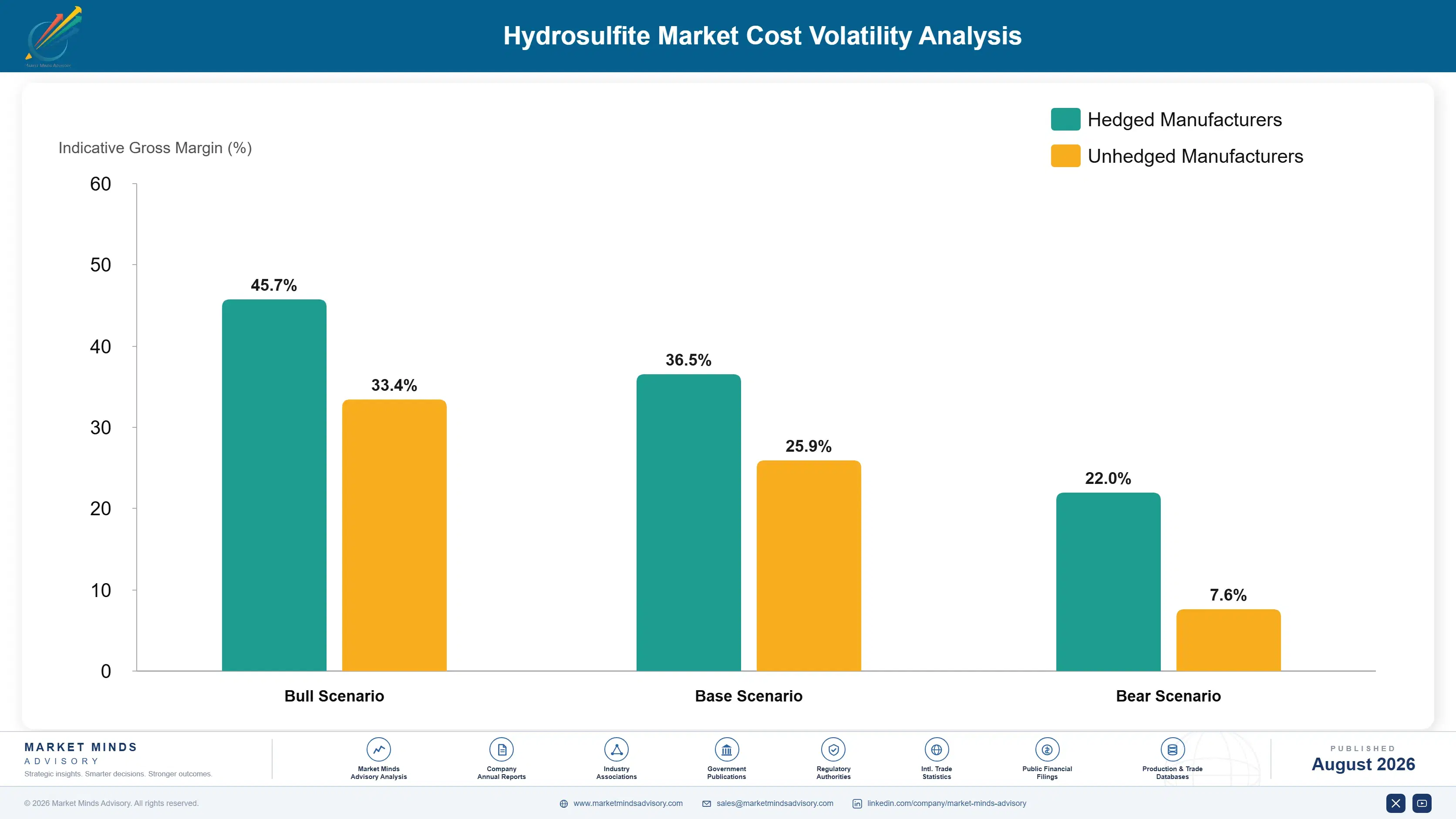
Sulfur Dioxide and Zinc Dust Feedstock Exposure

Sulfur dioxide and zinc dust feedstock materials together represent an estimated 39 to 47 percent of cost of goods sold for a typical hydrosulfite production line, sourced from global specialty chemical production concentrated among a relatively small number of major suppliers worldwide. This dual dependency leaves producers with genuinely limited substitution options available during any significant supply disruption event.
Zinc dust feedstock prices rose meaningfully during 2024 after global specialty metals supply tightened following capacity constraints across several major producing regions, according to figures the EIA and IEA track for comparable specialty chemical and petrochemical manufacturing input costs alongside broader industrial commodity conditions across domestic and internationally traded volumes. Smaller producers without long-term component contracts reported input cost increases exceeding 14 percent within two quarters, a shock larger producers with hedged supply absorbed more comfortably.

Smaller regional producers without the purchasing scale to negotiate multi-year fixed-price feedstock contracts absorb raw material volatility directly into thin margins, while the largest manufacturers use long-term supply agreements spanning both sulfur dioxide and zinc dust component procurement simultaneously. This gap compounds over time: undercapitalized producers either raise unit prices, risking volume loss, or hold pricing, unlike larger manufacturers.
global-hydrosulfite-market-trends-cost-volatility-analysis-1787310611288

Multi-Year Fixed-Price Feedstock Supply Contracts

Locking sulfur dioxide and zinc dust feedstock procurement into two to four year fixed-price agreements with primary suppliers protects margin predictability during spot market volatility, though it requires accepting somewhat higher baseline pricing during calm periods, a trade-off larger manufacturers with stronger balance sheets absorb more comfortably than smaller regional producers operating on thinner working capital margins nationwide.

Vertical Integration into Feedstock Production

The largest manufacturers are selectively integrating backward into zinc dust production capacity, reducing dependence on open-market purchasing even though the sizable capital investment required puts this option genuinely out of reach for smaller regional producers competing primarily on price and delivery proximity to processor customers across most regional markets served nationwide and internationally today.

Regional Feedstock Sourcing Diversification Strategy

Shifting a portion of feedstock procurement toward diversified specialty chemical producing regions reduces exposure to any single producing region's supply disruption or currency risk simultaneously, though this diversification requires meaningful supplier qualification investment that smaller manufacturers often cannot justify given constrained capital budgets. Early movers report meaningfully steadier input pricing overall across their supply chains nationwide today.

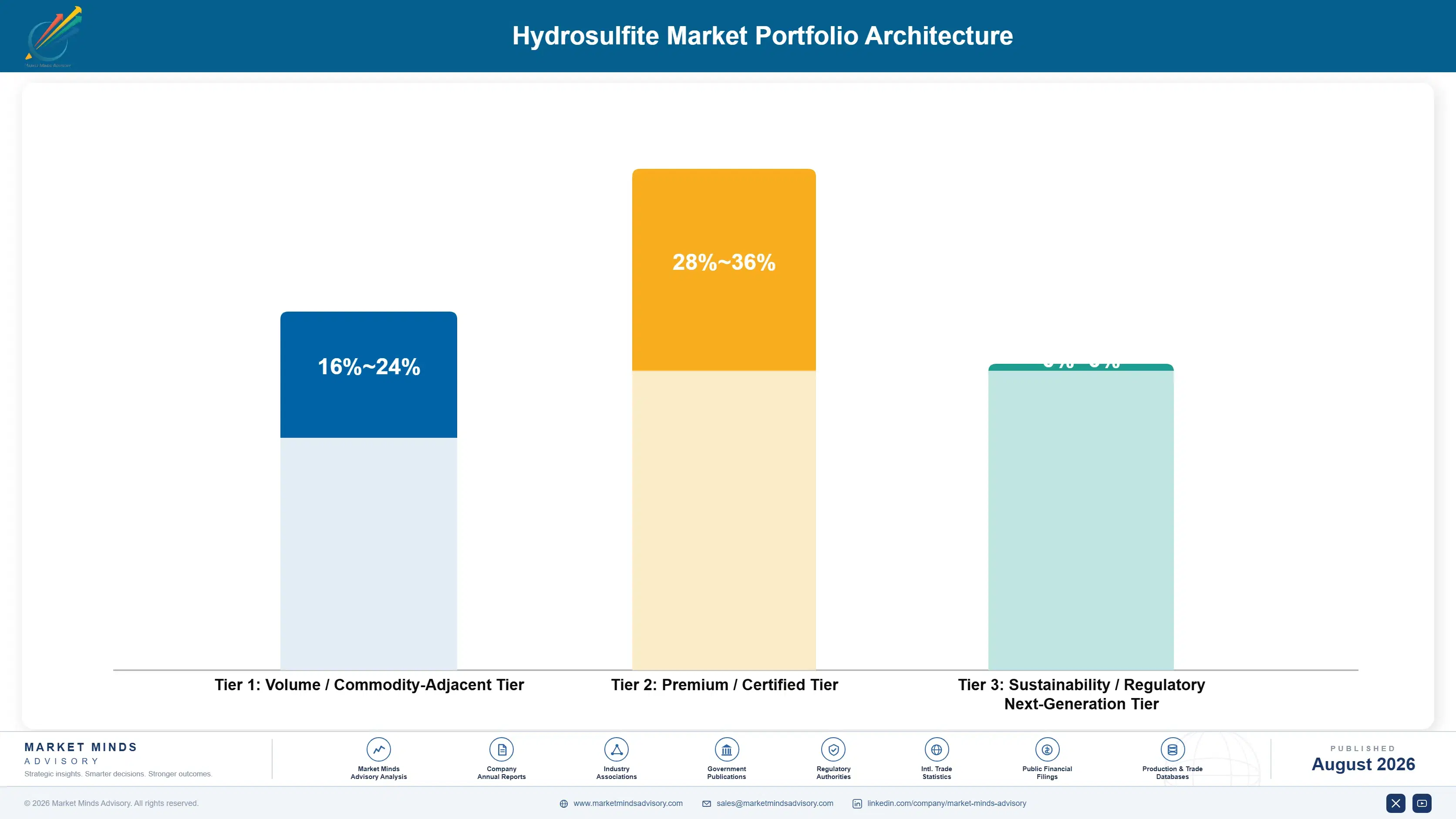
Portfolio Architecture for Margin Defence

Hydrosulfite portfolios split cleanly into three margin tiers. Volume commodity-adjacent standard textile-grade sold through competitive distributor contracts carries the thinnest margins but the highest unit volume, competing primarily on price and supply reliability rather than documented purity differentiation. Premium food-grade and water-treatment formats command meaningfully higher margins tied to purification depth and certification investment rather than material cost alone.
The tension between commodity textile volume and premium food-grade positioning shapes nearly every strategic decision manufacturers make, from where to invest purification capital, to which processor relationships to prioritize for joint certification program development. Chasing volume through commodity textile-grade generates steady cash flow but exposes manufacturers directly to margin compression from feedstock price cycles, while over-indexing on premium positioning limits addressable market size given how much smaller the truly purity-driven processor base remains today. Manufacturers unable to fund purification investment risk sliding entirely into the lowest-margin commodity tier permanently.

High-value margin pools concentrate specifically in food-grade and water-treatment formats, both growing faster than the broader category and commanding pricing that neither commodity textile-grade nor standard leather-processing products currently achieve at comparable scale within the category or across most regional markets.

Volume / Commodity-Adjacent Tier

Standard textile-grade and leather-processing hydrosulfite sold through competitive distributor contracts, competing primarily on price and supply reliability rather than documented purity differentiation, supported by lower barriers to entry across most regional markets nationwide.
Gross Margin: 16-24%

Premium / Certified Tier

Food-grade and water-treatment formats backed by formal purification and processor qualification investment, sold primarily to purity-focused processing accounts requiring documented heavy-metal control. This tier increasingly determines which manufacturers win large multi-year processor contracts.
Gross Margin: 28-36%

Sustainability / Regulatory / Next-Generation Tier

Next-generation ultra-low-particle food-grade formulations and biosourced feedstock hydrosulfite targeting purity-focused processor accounts ahead of anticipated food-safety standard tightening across major markets. Margins here remain the highest in the category but require sustained purification and regulatory investment to defend.
Gross Margin
global-hydrosulfite-market-trends-portfolio-architecture-1787310611790

High-value Sub-segments and Strategic Watch-out

Food-Grade and Water-Treatment Formats

Food-grade and water-treatment formats represent the fastest-growing, highest-margin pocket of the category, moving from niche specialty product into standard purity-driven procurement requirement as processor compliance commitments continue expanding across major accounts nationwide today. Manufacturers without dedicated food-grade capability risk losing these accounts entirely and permanently.

Processor Purity Certification Partnership Programs

Purity certification programs formally validated through documented compliance success are growing steadily as processors increasingly specify documented purity consistency, commanding a meaningful price premium that reflects the certification investment required to earn preferred-supplier status among leading processor networks operating across most major markets nationwide today.

Standard Textile and Leather-Processing Formats

The largest volume segment by unit count, standard textile-grade and leather-processing hydrosulfite sold through established distributor relationships anchor category revenue even as growth moderates, remaining the primary entry point through which most smaller formulators first specify hydrosulfite products. Pricing pressure remains intense among competing regional producers.

Food-Grade Substitution Threat

Food-grade-focused specialty producers capturing share among compliance-focused processing accounts represent a genuine strategic threat to legacy textile-grade suppliers lacking comparable purification and certification capability, eroding volume among the largest, most purity-driven accounts. Manufacturers that close this gap fastest stand to defend the most volume nationwide.

Where Certification Investment Decides Recurring Volume

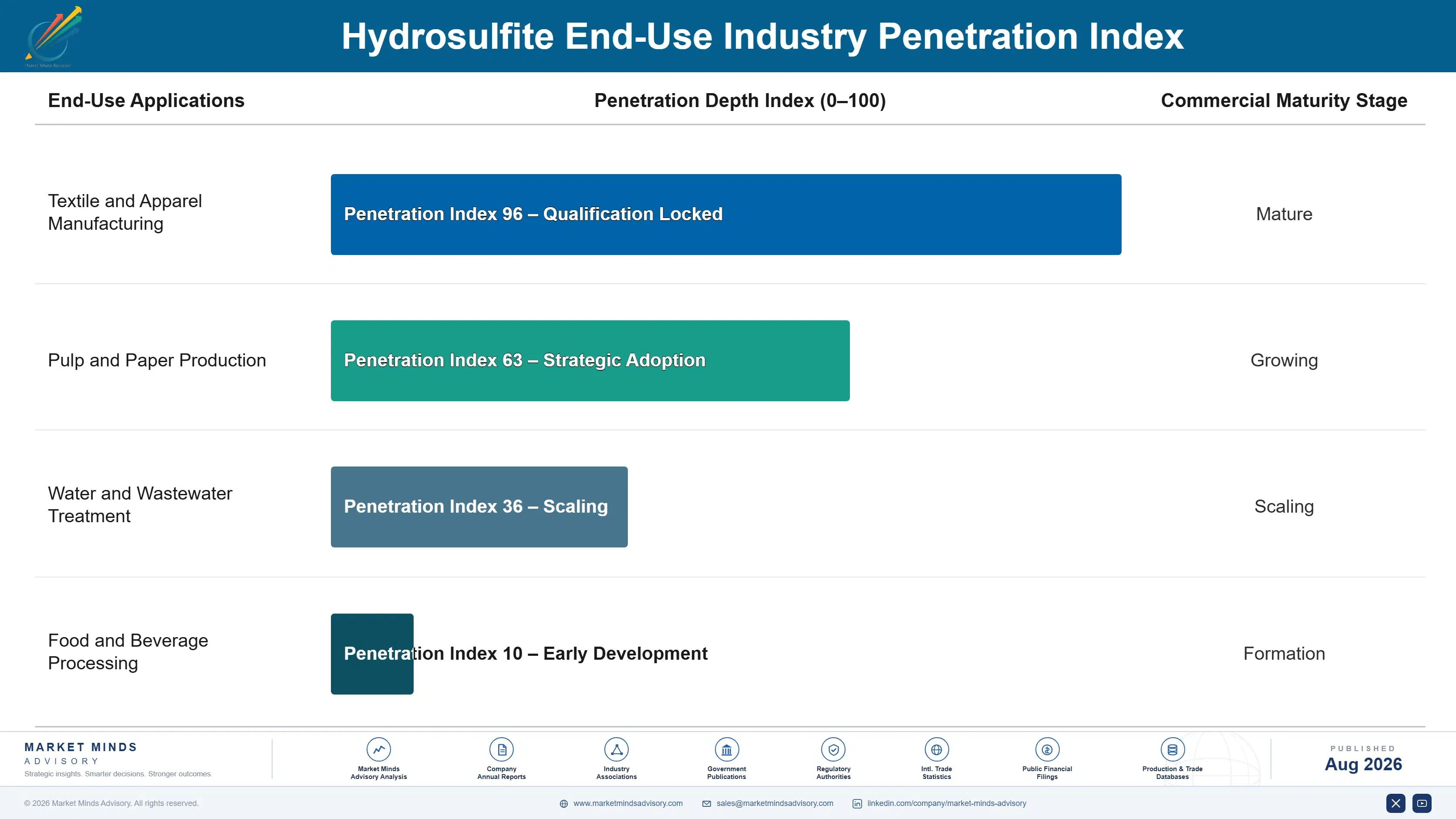
Hydrosulfite demand tracks global textile dyeing and pulp bleaching capacity utilization directly rather than generating true durable-goods-style replacement demand on a fixed cycle, since products are consumed per production batch and replaced through ongoing distributor procurement rather than any fixed lifespan consideration. Repeat purchase comes from ongoing producer and processor relationships rather than any individual production run's usage pattern, meaning producer revenue depends heavi
Adoption depth varies considerably by end-use vertical. Food and beverage processors show the most volatile format loyalty, since purity requirements and internal compliance reviews can shift an entire procurement protocol relatively quickly once food-grade alternatives prove commercially popular. Textile dye houses show meaningfully deeper standard-grade loyalty, since basic reduction needs and lower certification investment favor durable simple formats over more expensive food-grade alternatives. Mid-tier regional formulators sit in a defensible middle position.

A generational shift among procurement buyers, increasingly trained to weigh total purity and certification-support value rather than upfront unit price alone, is reshaping specification decisions gradually, favoring food-grade and evidence-backed formats over undifferentiated commodity textile-grade hydrosulfite even where switching costs remain meaningfully higher today across most application protocols.
global-hydrosulfite-market-trends-end-use-penetration-index-1787310612283

Where Manufacturers Should Invest Next

These are among the four positions where our research anticipates prominent divergence between winners and laggards over the coming forecast period. Each is grounded in the demand model, the regulatory perimeter, and the announced capacity pipeline.
01 / PURIFICATION CAPACITY INVESTMENT

Expand food-grade capacity to capture purity demand

Purity-driven demand for food-grade hydrosulfite continues outpacing industry-wide purification capacity additions, creating a genuine premium pricing opportunity for manufacturers investing directly in expanded purification capability ahead of broader industry adoption across the category and its major processor customer base nationwide today. Manufacturers building dedicated purification capacity now capture premium pricing from purity-conscious customers before capacity constraints ease and competitive pressure intensifies across the segment considerably. Companies that delay this investment risk losing evidence-driven accounts permanently to competitors offering more reliable purification innovation.
02 / PROCESSOR CERTIFICATION PARTNERSHIPS

Secure purity programs to defend supply contracts

Food and beverage processors increasingly require formal heavy-metal contamination testing before a hydrosulfite product can even enter their preferred supplier shortlist, and manufacturers investing directly in dedicated testing infrastructure capture preferred-supplier status that translates into meaningful order volume from the largest, most certification-focused processing accounts available today. Building this certification portfolio requires sustained partnership investment, but it captures customers with meaningfully higher switching costs once processes are calibrated and documented. Waiting risks permanently ceding these accounts to competitors with faster certification expansion timelines instead.
03 / COMPONENT SUPPLY HEDGING

Lock multi-year contracts to protect margin against volatility

Sulfur dioxide and zinc dust feedstock costs fluctuate meaningfully with broader specialty chemicals commodity cycles, and manufacturers without long-term supply agreements absorb spot-market volatility directly into thin margins during tight-supply periods that recur unpredictably across both component categories without warning at any point. Manufacturers negotiating multi-year fixed-price contracts protect margin predictability even during industry-wide price spikes, a stability smaller regional competitors without comparable purchasing scale cannot replicate on their own without meaningful investment. Manufacturers that skip this hedging discipline remain exposed whenever either feedstock market tightens unexpectedly.
04 / SMALLER PROCESSOR ACCESS

Build bundled programs for budget-constrained smaller processors

Smaller regional processors increasingly want food-grade capability but lack the purchasing scale to negotiate favorable pricing on their own, leaving them dependent on whatever terms larger distributors happen to offer. Manufacturers developing bundled product and training access programs that spread costs across multiple smaller processors can capture business previously lost to larger processor-network-focused competitors specifically and permanently across most regional markets served nationwide. Companies successfully demonstrating bundled access models capture referral volume from processors that competing formats have not yet fully addressed across most territories.

Engagement Snapshot From the Field

A live engagement with an industry participant carrying material or product regulatory and market exposure ahead of a defining policy shift, showing how our research translates into a defensible multi-year portfolio strategy.
MARKET MINDS ADVISORY · CLIENT ENGAGEMENT SUMMARY
Hydrosulfite Producer Strategic Portfolio Review and Transition Roadmap 2026·Investment Scenario on Hydrosulfite Exposure Evaluation 2025-26
CLIENT PROFILE
The client is a regional sugar refining processor generating approximately 145 million dollars in annual revenue (client-reported, unverified by MMA), operating three refining lines serving industrial and retail sugar customers across Southeast Asia. The company had relied primarily on standard textile-grade hydrosulfite across its reducing agent supply portfolio and faced declining bid-win rates as competing refiners offered documented food-grade purity credentials.
STRATEGIC CHALLENGE
Management needed to determine whether converting its entire reducing agent supply chain to food-grade hydrosulfite justified the certification cost and purification sourcing investment required, while also evaluating whether a phased rollout targeting only its highest-margin refining line could deliver most of the competitive benefit at a fraction of the investment. That decision carried real budget implications heading into the next fiscal planning cycle.
MMA APPROACH
MMA conducted primary interviews with the client's procurement, quality assurance, and process engineering teams, benchmarked food-grade conversion outcomes at comparable regional sugar refining processors, and modeled cost and yield impact under three conversion scenarios before presenting a phased recommendation to leadership. MMA also reviewed the client's current feedstock supplier relationships to assess conversion feasibility.
KEY FINDINGS
  1. The client's primary refining line accounted for the large majority of its declining yield performance over the preceding two years, per internal process records reviewed.
  2. Comparable regional sugar refiners that converted their primary line to food-grade hydrosulfite first reported measurably improved yield rates within two quarters, according to comparable case data MMA reviewed.
  3. A phased rollout targeting only the primary refining line would cost meaningfully less upfront than full three-line conversion based on comparable qualification estimates reviewed.
  4. Food-grade material costs ran an estimated 33 percent above standard textile-grade inventory across the specific formats evaluated for the client's production volume.
CLIENT PROFILE
The client is a regional sugar refining processor generating approximately 145 million dollars in annual revenue (client-reported, unverified by MMA), operating three refining lines serving industrial and retail sugar customers across Southeast Asia. The company had relied primarily on standard textile-grade hydrosulfite across its reducing agent supply portfolio and faced declining bid-win rates as competing refiners offered documented food-grade purity credentials.
STRATEGIC CHALLENGE
Management needed to determine whether converting its entire reducing agent supply chain to food-grade hydrosulfite justified the certification cost and purification sourcing investment required, while also evaluating whether a phased rollout targeting only its highest-margin refining line could deliver most of the competitive benefit at a fraction of the investment. That decision carried real budget implications heading into the next fiscal planning cycle.
MMA APPROACH
MMA conducted primary interviews with the client's procurement, quality assurance, and process engineering teams, benchmarked food-grade conversion outcomes at comparable regional sugar refining processors, and modeled cost and yield impact under three conversion scenarios before presenting a phased recommendation to leadership. MMA also reviewed the client's current feedstock supplier relationships to assess conversion feasibility.
KEY FINDINGS
  1. The client's primary refining line accounted for the large majority of its declining yield performance over the preceding two years, per internal process records reviewed.
  2. Comparable regional sugar refiners that converted their primary line to food-grade hydrosulfite first reported measurably improved yield rates within two quarters, according to comparable case data MMA reviewed.
  3. A phased rollout targeting only the primary refining line would cost meaningfully less upfront than full three-line conversion based on comparable qualification estimates reviewed.
  4. Food-grade material costs ran an estimated 33 percent above standard textile-grade inventory across the specific formats evaluated for the client's production volume.
RECOMMENDED STRATEGY
Phase 1: Phase 1 (Months 1 to 4): Convert the primary refining line to food-grade hydrosulfite immediately, prioritizing procurement and thorough testing. Phase 2: Phase 2 (Months 5 to 10): Formalize supplier qualification partnership agreements confirming consistent food-grade pricing, availability, and dedicated technical support. Phase 3: Phase 3 (Months 10 to 16): Evaluate yield outcomes and expand food-grade conversion to additional lines based on demonstrated results.
OUTCOME
Within sixteen months, the client reported a meaningful improvement in yield rates among its converted primary line (client-reported, unverified by MMA), while phased deployment kept qualification investment aligned with available budget throughout the rollout. Management credited the phased, evidence-driven approach with protecting competitive position without overcommitting scarce capital upfront.

Frequently Asked Questions

Foundational context covering the market sizes, CAGR, scope, country, region and competition that inform every finding below. This section is provided to cover basics and most often pre-purchase conversations, answered from the MMA Primary Research Dataset.

What is the current size of the Hydrosulfite Market?

The hydrosulfite market reached an estimated 1.8 billion dollars in 2025. Growth is being driven by food-grade adoption and expanding global textile dyeing and processing capacity.

How large will the Hydrosulfite Market be by 2036?

MMA projects the market will reach approximately 3.28 billion dollars by 2036 under the base case scenario, roughly 1.73 times the 2026 starting value over the ten-year forecast window.

What is the CAGR for the Hydrosulfite Market 2026 to 2036?

The base case CAGR is 5.6 percent annually through 2036, with a bull case of 6.8 percent and a bear case of 4.4 percent depending on food-grade adoption pace.

Which segment is growing fastest?

Food and beverage processing grade is growing fastest, at roughly 8.4 percent annually, nearly 1.50 times the category average as processors adopt purity-driven formats across most major food markets nationwide.

Who are the major companies in the Hydrosulfite Market?

BASF, Jiangsu Sopo Chemical, Transpek Silox, Guangxi Nanning Chemical, and Chemtrade all currently lead the category based on estimated global revenue, with concentration reflecting deep synthesis infrastructure advantages.

Which country is growing fastest?

China is the fastest-growing major market, expanding at an estimated 6.8 percent annually as textile and paper production capacity continues rising steadily nationwide. Manufacturing capacity is spreading beyond its largest established hubs.

Report Segmentation Architecture

The full report scope spans multiple orthogonal segmentation dimensions, with cross-tabulated demand data provided for each dimension pair. Coverage extends further to regional breakdowns, trend trajectories, and the competitive detail needed to support segment-level decision-making.

By Application Grade

  • Textile Dyeing Grade
  • Pulp and Paper Bleaching Grade
  • Water Treatment Grade
  • Food and Beverage Processing Grade
  • Leather Processing Grade
  • General Industrial Reducing Agent Grade

By End-Use Industry

  • Textile and Apparel Manufacturing
  • Pulp and Paper Production
  • Water and Wastewater Treatment
  • Food and Beverage Processing

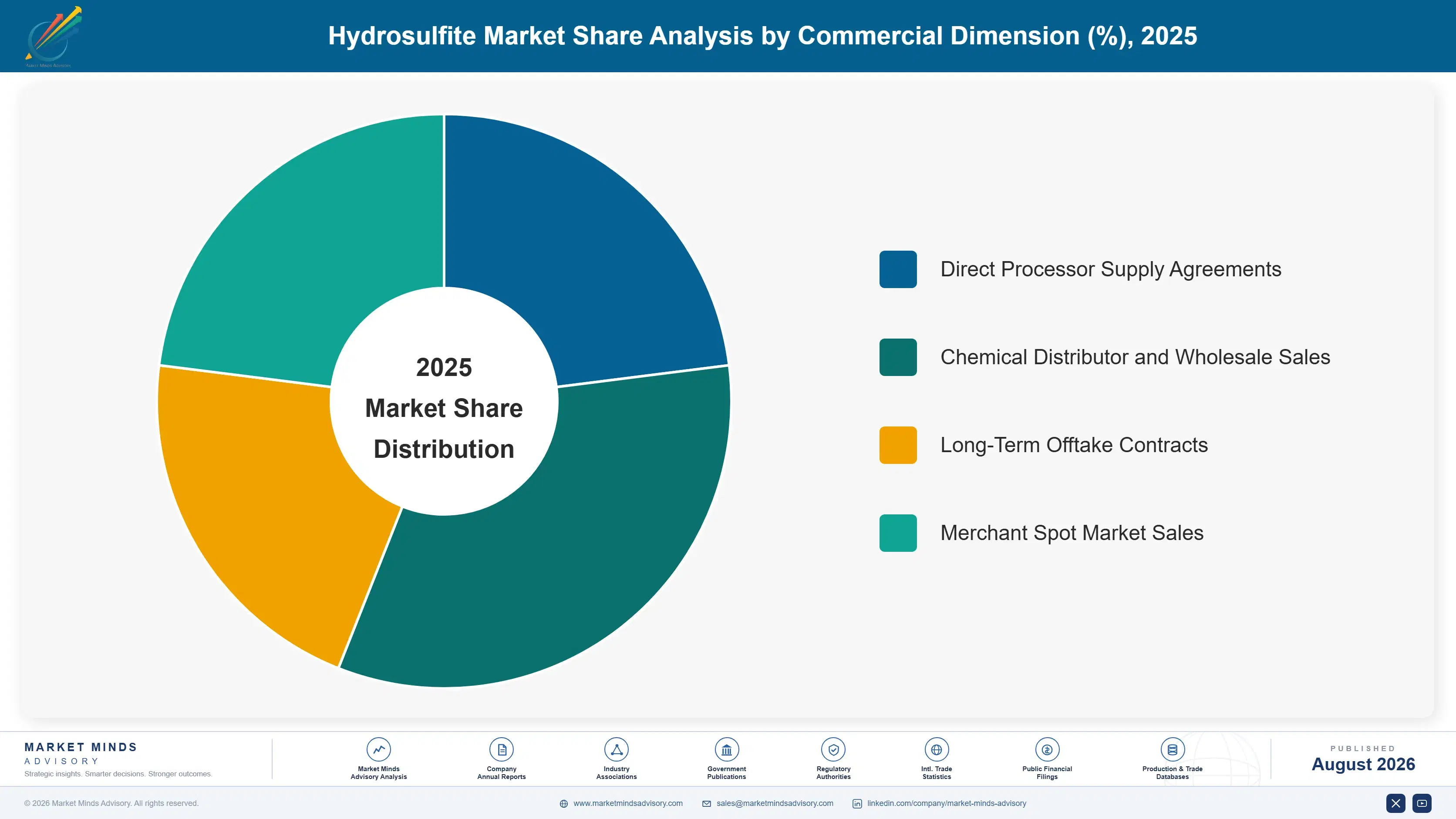
By Commercial Dimension

  • Direct Processor Supply Agreements
  • Chemical Distributor and Wholesale Sales
  • Long-Term Offtake Contracts
  • Merchant Spot Market Sales

By Region

  • North America
  • Western Europe
  • East Asia
  • South Asia and Pacific
  • Latin America
  • Middle East and Africa
  • Eastern Europe

Scope, Methodology, and Coverage

Every figure in this report is reproducible from documented input assumptions. The scope below maps the historical period, the forecast horizon, the segmentation dimensions, and the countries covered, alongside the underlying primary and qualitative methodology.
Historical Period
2020 to 2025
Forecast Period
2026 to 2036
Base Year
2025 (USD billions; MMA Primary Research Dataset, August 2026)
Market Definition
The hydrosulfite market comprises sodium dithionite and related reducing agent chemicals used in textile dye reduction, pulp and paper bleaching, water treatment, food and beverage processing, and leather processing applications. It excludes finished dye formulations, bleached pulp and paper products, and downstream water treatment systems sold as complete equipment.
Quantitative Units
USD billions (current prices); volume in thousand metric tons where applicable
Segmentation Dimensions
Application Grade; End-Use Industry; Commercial Dimension; By Region
Regions Covered
North America, Western Europe, East Asia, South Asia and Pacific, Latin America, Middle East and Africa, Eastern Europe
Countries Covered
China, India, Bangladesh, Pakistan, USA, Germany, France, Italy, Japan, South Korea, Vietnam, Indonesia, Australia, Canada, Brazil, Mexico, UAE, Saudi Arabia, South Africa, Poland, Czech Republic, Turkey, Thailand, Singapore, and additional markets relevant to this sector
Key Companies Profiled
BASF SE, Jiangsu Sopo Chemical Co., Ltd., Transpek Silox Industry Limited, Guangxi Nanning Chemical Industry Group Co., Ltd., Chemtrade Logistics Income Fund, Tokai Denka Kogyo Co., Ltd., Nippon Chemical Industrial Co., Ltd., Aditya Birla Chemicals (Thailand) Ltd., Excel Industries Limited, Sarex Overseas Pvt. Ltd., Kemira Oyj, Solvay SA
Quantitative Methodology
Primary survey, n=3,800 respondents, Q4 2025, six countries; demand-side model with trade association cross-validation
Qualitative Methodology
47 expert interviews, Q4 2025; applied to validate demand model assumptions, identify emerging dynamics, and assess competitive positioning
Report Format
PDF and XLSX data workbook (Word format preview document)
Publisher
Market Minds Advisory
Report Code
MMA-2026-CHM-416
Published
August 2026
Contact
sales@marketmindsadvisory.com | www.marketmindsadvisory.com

Purchase the full Hydrosulfite Market Report (2026 to 2036).

This report provides a comprehensive analysis of the global hydrosulfite market, covering market sizing, segmentation, and regional dynamics across the 2026 to 2036 forecast period. It profiles twenty leading manufacturers spanning commodity textile-grade and premium food-processing formats, with detailed competitive positioning, moat and risk analysis for the two category leaders, and recent corporate developments across capacity, partnerships, and acquisitions. The report examines revenue-generation levers, feedstock input cost exposure, and portfolio margin economics across three product tiers. It draws on primary survey data from 3,800 respondents and 47 expert interviews conducted across six countries in the fourth quarter of 2025.
Ten-year market sizing and growth forecast
Six-segment application grade breakdown with CAGR
Seven-region demand and pricing trend analysis
Twenty-company competitive profiling and moat assessment
Feedstock input cost and supply exposure review
Revenue lever and portfolio margin economics

Built For The People Who Decide

From boardroom strategy to bench-side execution, this report is read cover-to-cover by leaders shaping the next decade of their industry, turning demand scenarios, market dynamics and valuation benchmarks into decisions.
CXOs/ Presidents/ VPs/ Managers
M&A and Corporate Development
Strategy Teams and R&D Heads
Procurement and Product Directors
Regulatory and Compliance Leaders
Investor Relations and Equity Analysts