Market Minds Advisory
High Silica Fiber Market

High Silica Fiber Market: Trends and Forecast 2026 to 2036

Aerospace thermal protection programmes and defense procurement cycles are pulling high silica fiber demand toward specialty composite panels, even as Asian industrial furnace and refractory demand keeps bulk fiber volumes expanding steadily.

Lead Analyst

Bilal Shaikh

Published

September 2026

Make Smarter Decisions with Customized Research Insights

Request a free sample report and evaluate market opportunities, growth trends, and competitive dynamics relevant to your business needs.

2025 MARKET VALUE$1.8BMarket Size 2025
2036 FORECAST VALUE$3.9BBase Case , 2026 to 2036
CAGR 2026 TO 20367.4 %Bull 8.7% / Bear 6.1%
INCREMENTAL OPPORTUNITY$2.0BNet 10- year value creation
EXPANSION MULTIPLE2.04x2036 value over 2026 base
Strategic Levers
M&A Pipeline
Regional Outlook
Country Rankings
Competitive Intelligence
Segmental Deep-dive
Call-Us : 91 93563 13602

Executive Snapshot and Market Trajectory

High silica fiber demand is shifting decisively toward aerospace-grade composite panels and tape formats as thermal protection specifications tighten across defense and space launch programmes, even as industrial furnace and refractory demand holds broadly steady across most major manufacturing regions worldwide.
Commercial forces now split the market between specialty aerospace buyers paying premium pricing for certified thermal performance and industrial buyers purchasing bulk fiber for furnace lining at commodity pricing. Silica fiber composite panels are the fastest-growing format, expanding as reusable launch vehicle programmes and hypersonic defense platforms specify higher-performance ablative materials. North America and East Asia together account for most global demand, split between defense procurement and industrial manufacturing scale.
Competitive intensity concentrates among a handful of specialty fiber producers holding the acid-leaching process expertise required for aerospace-grade output, leaving bulk industrial fiber production far more fragmented across dozens of regional manufacturers. Export control regulations on defense-related materials add a further layer of complexity, restricting which suppliers can serve government aerospace programmes directly without additional licensing. Environmental permitting for acid-leaching facilities is also tightening in several jurisdictions, pushing some capacity toward newer, cleaner facilities.
Market Definition
The High Silica Fiber Market covers acid-leached and amorphous silica fiber products, including cloth, rope, tape, blanket, and composite panel formats, used for high-temperature insulation, ablative thermal protection, and filtration. It excludes standard fiberglass insulation and ceramic fiber products made through different manufacturing processes.
Base Year Value
$1.8B in 2025 (MMA Primary Research Dataset, August 2026)
Forecast Period
2026 to 2036, eleven discrete annual values
CAGR
7.4% base case. Bull 8.7%. Bear 6.1%.
Fastest Growth Segment
Silica Fiber Composite Panels: 9.4% CAGR
Fastest Growth Country
India: 9.8% CAGR
Fastest Growth Region
South Asia and Pacific: 9.5% CAGR
Largest Region
North America: 30% of 2025 global value
Market Leaders
Unifrax, 3M, Zircar Ceramics, Auburn Manufacturing, Nitivy Co. Ltd (MMA Analysis, 2025).
Primary Survey
n=3,800 procurement and R&D decision-makers, Q4 2025, six countries
Methodology
Demand-side build-up, cross-validated against public data, 47 expert interviews

High Silica Fiber Market Forecast Scenarios

global-high-silica-fiber-market-trends-size-forecast-scenario-1787550936603
The high silica fiber market grew at an estimated 6.4% annually between 2020 and 2025, supported by steady industrial furnace and refractory demand alongside gradually expanding aerospace thermal protection procurement across multiple national space and defense programmes. Growth accelerated modestly toward the end of the period as reusable launch vehicle programmes began scaling production and specifying higher-performance ablative composite materials.
The base case assumes 7.4% annual growth through 2036, driven by three commercial mechanisms: expanding reusable launch vehicle production schedules requiring recurring ablative panel replacement, tightening thermal protection specifications across hypersonic defense platforms, and continued industrial furnace capacity additions across East Asian steel and glass manufacturing. Certification requirements for aerospace-grade fiber are also rising, favoring producers who already hold qualified supplier status with defense primes over new entrants still pursuing certification.
The bull case, at 8.7%, assumes accelerated defense procurement tied to expanded hypersonic weapons programmes across multiple governments pursuing parallel development tracks simultaneously through the forecast period. The bear case, at 6.1%, assumes ceramic matrix composite substitution displaces silica fiber in a meaningful share of new aerospace thermal protection designs before 2036, eroding the premium segment's growth trajectory.

Aerospace-Grade Fiber Meets Industrial Bulk Demand

The High Silica Fiber Market occupies a narrow but strategically important niche between industrial insulation and aerospace-grade thermal protection materials. Acid-leached silica fiber's ability to withstand sustained exposure above 1000 degrees Celsius while retaining structural integrity makes it difficult to substitute in ablative and refractory applications, even as buyers periodically test ceramic matrix composite alternatives.
MARKET CONCENTRATION52%Top five producers hold combined global market share
AVERAGE SELLING PRICE$18 per kgReflects premium pricing tiers for aerospace grade fiber
TOP PRODUCER SHARE38%China leads global manufacturing capacity for silica fiber
CAPACITY UTILIZATION76%Producers run plants near typical industry utilization ceiling
FEEDSTOCK SHARE OF COGS42%Quartz sand and acid inputs dominate production costs
REPLACEMENT CYCLE5 to 7 yearsAblative panels require periodic replacement after mission cycles
Production is technically demanding. The acid-leaching process that converts glass fiber into high-purity silica fiber requires specialized chemical processing infrastructure that few manufacturers operate at commercial scale, concentrating aerospace-grade output among a handful of qualified suppliers holding defense certification. Industrial-grade bulk fiber production is comparatively less concentrated, with regional manufacturers across East Asia serving furnace lining and refractory demand at lower price points and looser certification requirements.
Capacity utilization runs high across qualified aerospace suppliers given the multi-year qualification timeline new entrants face, while industrial-grade capacity has more room to expand as demand grows. Feedstock costs, dominated by quartz sand and processing acids, remain a moderate share of total cost of goods sold, leaving processing expertise and certification status as the primary differentiators between competitors rather than raw material access alone.
"Everyone keeps waiting for ceramic matrix composites to replace silica fiber in thermal protection, and it just hasn't happened at the pace people expected five years ago. The qualification cost of switching an already-certified ablative material is what actually protects this market, not the fiber's performance ceiling."
Senior Analyst, Advanced Materials and Aerospace Practice · MMA Chemicals and Materials Practice · August 2026

Market Trends

Reusable Launch Vehicle Programmes Drive Ablative Panel Demand

Reusable launch vehicle programmes are reshaping demand for ablative thermal protection materials because each vehicle requires periodic panel replacement after repeated atmospheric re-entry cycles, unlike expendable rockets that used a single set once. Commercial launch providers now fly individual boosters dozens of times per year, creating a recurring replacement demand stream that did not exist under the expendable launch model. Several national space agencies have expanded reusable vehicle fleets since 2023, and silica fiber composite panel suppliers holding qualified aerospace certification are positioned to capture this recurring revenue directly rather than competing purely on one-time production volume.
Market Impact: Over 200 annual orbital launches
Hypersonic Defense Platforms Tighten Thermal Protection Certification Standards

Hypersonic weapons and defense platforms operate at sustained speeds generating thermal loads well beyond what conventional aircraft materials tolerate, pushing defense procurement toward higher-performance ablative and insulating fiber formats with tighter certification requirements. Multiple governments have expanded hypersonic development budgets since 2024, and each new platform programme requires its own qualification cycle for thermal protection suppliers before production contracts are awarded. This certification requirement favors incumbent suppliers who already hold defense-qualified status over new entrants, since qualification cycles for aerospace-grade silica fiber routinely run two to three years before a supplier can bid on production contracts.
Market Impact: Budgets expanded over 30% since 2024

Market Opportunities and Growth Drivers

Government Space Launch Cadence Accelerates Sharply Worldwide

Government and commercial space launch cadence has accelerated sharply since 2023, with multiple national space agencies and private launch providers together conducting well over 200 orbital launches annually by 2025, up from under 100 just five years earlier. Every launch vehicle using reusable stages requires ablative or insulating thermal protection materials rated for repeated atmospheric re-entry cycles, and silica fiber composite panels remain the qualified material of choice for several major launch vehicle families currently in active production. This launch cadence growth translates directly into recurring aerospace-grade fiber demand that industrial-only fiber producers cannot easily capture without pursuing defense certification.
Market Impact: Wastewater upgrades cost over 2 million

Defense Hypersonic Weapons Programmes Expand Procurement Budgets

Multiple governments have expanded hypersonic weapons development budgets substantially since 2024, funding new thermal protection material qualification programmes as platform speeds and flight durations increase beyond what earlier defense systems required. Each hypersonic platform generation demands incrementally higher thermal performance from ablative and insulating fiber materials, and defense procurement officials increasingly specify silica fiber composite formats by name in technical requirements documents rather than leaving material selection open to contractor discretion. This budget expansion is expected to continue through the forecast period, sustaining demand growth well above the broader industrial fiber segment's pace.
Market Impact: Ceramic composites cost 3x more

Market Restraints and Challenges

Environmental Permitting For Acid-Leaching Facilities Tightens Steadily

Acid-leaching production, the chemical process that converts standard glass fiber into high-purity silica fiber, generates acidic wastewater streams facing increasingly strict environmental permitting requirements in several manufacturing jurisdictions. The root cause is regulatory tightening around industrial wastewater discharge standards rather than any change in the silica fiber process itself, but the commercial impact falls disproportionately on older production facilities built before current treatment standards existed. Several manufacturers are now investing in upgraded wastewater treatment infrastructure or relocating capacity to newer facilities designed around current permitting requirements, though this transition adds meaningful capital cost and multi-year lead time.
Market Impact: Recurring demand from 40+ annual reflights

Ceramic Matrix Composites Threaten Aerospace Fiber Substitution

Ceramic matrix composites offer comparable or superior thermal performance to silica fiber in some aerospace applications, and several aerospace primes have run substitution trials over the past two years as part of next-generation platform design. The root cause is ceramic matrix composites' better performance at the very highest sustained temperature ranges hypersonic platforms increasingly require, which silica fiber cannot always match. The commercial impact remains limited so far because ceramic matrix composites cost substantially more to produce, and silica fiber suppliers are responding by developing hybrid formulations that capture the performance benefit at lower blended cost.
Market Impact: Qualification takes 2 to 3 years
2 additional market trends, 2 additional growth drivers, and 2 additional restraints and challenges are covered in the full report. Contact sales@marketmindsadvisory.com to access the complete intelligence.

Segment CAGR and Growth Architecture

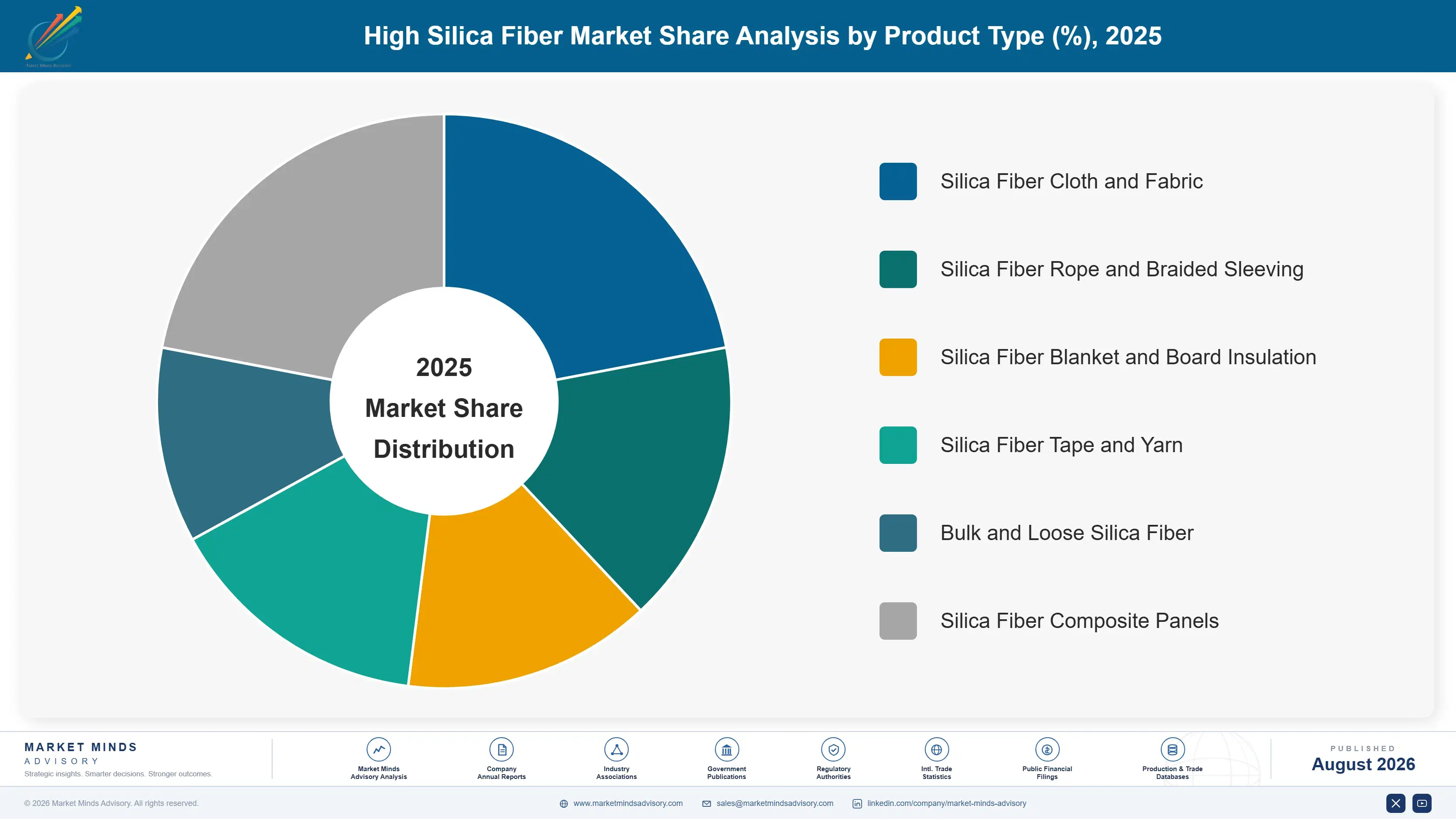
Segmentation follows product and form type, the classification aerospace and industrial buyers use when specifying material requirements, since each format addresses a distinct application need through different manufacturing and finishing steps rather than a shared end-use pathway, and each typically involves its own separate qualification testing, certification protocol, and technical service relationship across all six categories.
global-high-silica-fiber-market-trends-market-share-analysis-1787550937155

Silica Fiber Composite Panels

Silica fiber composite panels are the fastest-growing segment, expanding at 9.4% annually as reusable launch vehicle programmes and hypersonic defense platforms specify pre-formed ablative panels over loose fiber or cloth formats for consistent thermal performance across repeated mission cycles, tighter dimensional tolerances, and demanding structural integration requirements found across nearly every major aerospace platform currently in active development around the world today. These panels combine silica fiber with resin binders engineered for dimensional stability under extreme thermal cycling, letting manufacturers deliver pre-qualified components that integrate directly into vehicle structures without additional on-site fabrication. Demand concentrates heavily in defense and space launch applications, where certified performance justifies pricing well above bulk industrial fiber formats.
CAGR 9.4%

Silica Fiber Tape and Yarn

Silica fiber tape and yarn, the second-fastest segment at 8.9% annually, serve applications requiring flexible, wrappable thermal protection around irregular shapes, including cable insulation, pipe wrapping, and fire protection barriers in industrial and marine settings where rigid panel formats simply cannot conform to the equipment geometry involved. Growing electric vehicle battery fire protection requirements have opened a genuinely meaningful new demand channel for this format specifically, as battery pack manufacturers increasingly specify silica fiber tape barriers between cells to slow thermal runaway propagation during failure events. This segment commands premium pricing over bulk fiber given the additional weaving and finishing steps required to produce a flexible, dimensionally consistent tape product.
CAGR 8.9%
Full segment breakdown across 6 segments available in the complete report.

Regional Architecture and Country Demand Map

Regional demand splits between North American aerospace and defense procurement and East Asian industrial furnace manufacturing scale, together accounting for well over half of global consumption. South Asia and Pacific grows fastest as India expands both defense manufacturing and industrial capacity, while Western Europe holds steady mid-tier demand.

North America

North America leads global demand because it hosts the largest concentration of qualified aerospace-grade silica fiber suppliers, serving both government defense procurement and a growing commercial space launch sector operating out of Florida, Texas, and California. NASA and Department of Defense contracts specify domestically certified thermal protection materials for the majority of national security launches, keeping demand concentrated among a small number of established suppliers holding long-standing qualification status built up over decades of programme history. Commercial reusable launch vehicle providers based in the region have scaled reflight cadence significantly since 2023, adding recurring ablative panel replacement demand on top of steady industrial furnace and refractory consumption across the broader manufacturing base nationwide.
Share: 30% | CAGR: 7.0% (2026 to 2036)

Western Europe

Western Europe's demand centers on aerospace component manufacturing tied to Airbus and the European Space Agency's launch programmes, alongside industrial refractory demand from Germany's steel and glass manufacturing base. European aerospace primes maintain their own qualified supplier networks for ablative and insulating fiber materials, though the region's launch cadence trails the pace scaling in North America and China considerably across nearly every comparable programme category and platform generation currently under active development. Industrial demand grows more slowly than the global average as European steel production capacity has plateaued in recent years, with modernization spending directed toward efficiency upgrades rather than new furnace capacity requiring fresh refractory fiber volumes across most facilities region-wide.
Share: 20% | CAGR: 5.9% (2026 to 2036)
Regional intelligence for 5 additional markets available in the complete report: East Asia, South Asia and Pacific, Latin America, Middle East and Africa, Eastern Europe. Contact sales@marketmindsadvisory.com.
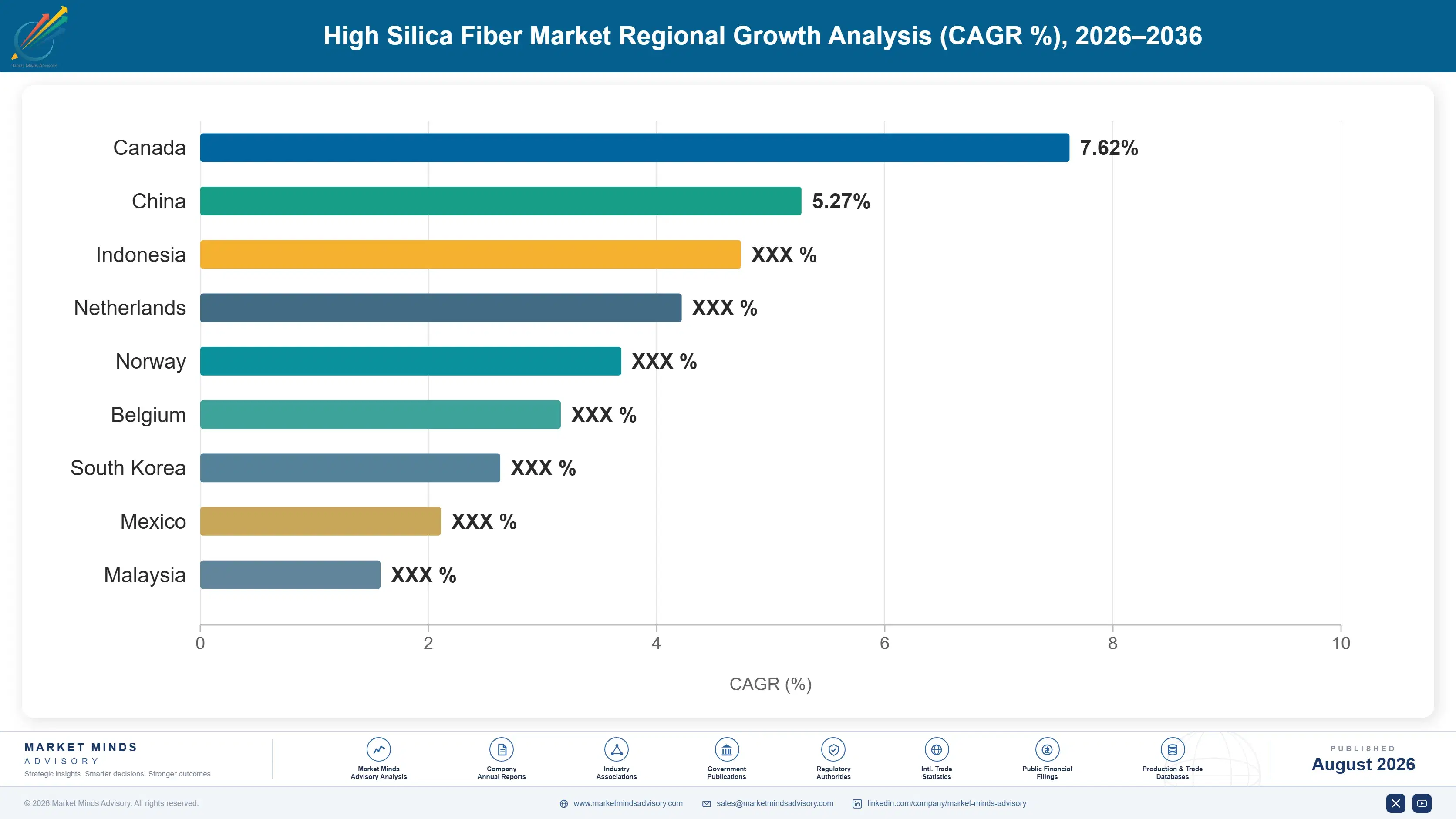
global-high-silica-fiber-market-trends-country-cagr-analysis-1787550937671

Where Silica Fiber Producers Can Capture Margin

Margin expansion in this market concentrates around aerospace certification, composite panel manufacturing capacity, defense supply relationships, and hybrid material development, four distinct commercial moves that convert existing technical capability into premium pricing rather than requiring entirely new manufacturing infrastructure or unproven chemistry, each accessible to established producers already operating profitably in adjacent segments today.

Pursue Aerospace-Grade Certification For Bulk Fiber Producers

Industrial-grade bulk fiber producers currently outside aerospace certification are leaving the highest-margin segment of the market entirely to a small number of qualified incumbents, even though the underlying acid-leaching process is fundamentally similar across grades. Pursuing certification from defense and space agency qualification bodies typically takes two to three years and requires meaningful capital investment in process controls and testing infrastructure, but successfully certified producers gain access to pricing 3 to 4 times higher than bulk industrial rates on comparable fiber volumes. Producers with existing acid-leaching capacity are best positioned to make this transition profitably.
Market Impact: Captures pricing 3 to 4 times higher than bulk rates

Expand Composite Panel Manufacturing Capacity For Launch Vehicles

Reusable launch vehicle programmes require recurring ablative panel replacement after each re-entry cycle, creating a demand stream fundamentally different from the one-time material sales that characterized the expendable rocket era. Producers who expand composite panel manufacturing capacity now, ahead of continued launch cadence growth, position themselves to capture recurring revenue from vehicles already in active commercial service rather than competing for one-time contracts on new vehicle development programmes. Panel-format sales already command roughly 35% higher margins than raw fiber or cloth formats sold into the same aerospace applications, reflecting the added value of pre-qualified, ready-to-integrate components.
Market Impact: Panel format margins run roughly 35% above raw fiber sales

Build Direct Supply Relationships With Defense Prime Contractors

Defense procurement increasingly specifies silica fiber composite formats by name in technical requirements documents, but many qualified suppliers still sell through intermediate distributors rather than direct relationships with prime contractors, leaving margin on the table at each distribution layer. Producers who invest in the business development and compliance infrastructure required to sell directly to defense primes typically capture 15 to 20 percentage points of additional margin previously absorbed by distributors, while also gaining earlier visibility into upcoming platform qualification cycles that inform capacity planning decisions well ahead of competitors still working through distributor channels.
Market Impact: Direct sales add 15 to 20 points margin

Develop Hybrid Silica Ceramic Fiber Formulations Proactively

Ceramic matrix composites threaten to displace silica fiber in the very highest temperature aerospace applications, but developing hybrid formulations that combine both materials lets producers capture the performance benefit at a blended cost roughly 40% below pure ceramic matrix composite pricing. Producers who move first on hybrid formulation development position themselves ahead of the substitution curve rather than reacting once ceramic matrix composites have already displaced silica fiber in a meaningful share of new platform designs. This defensive move also opens a genuinely new premium product category rather than simply protecting existing volume against encroachment.
Market Impact: Hybrid formulations cost roughly 40% less than pure ceramic composites

Who Controls the Margin Pool

The High Silica Fiber Market shows moderate concentration with a CR5 of 52%, evaluated on a revenue basis across both aerospace-grade and industrial-grade fiber production. Unifrax and 3M lead the aerospace-certified segment specifically, while the gap between these two leaders and the third-ranked challenger widens further once industrial bulk fiber revenue is excluded from the comparison entirely.
Current competitive activity centers on certification expansion, with several mid-tier producers pursuing defense and space agency qualification to access premium pricing previously reserved for established suppliers. Capacity investment is also concentrated in composite panel manufacturing rather than raw fiber production, reflecting where margin and demand growth both point. Chinese domestic producers are simultaneously investing heavily in acid-leaching capacity to reduce reliance on imported aerospace-grade fiber.

Emerging pressure comes from ceramic matrix composite substitution at the highest temperature end of the market, which could erode the premium segment's growth trajectory if hybrid formulation development does not keep pace. Rankings could shift meaningfully if a mid-tier producer completes defense certification faster than incumbents expect, since qualification status rather than raw production scale determines access to the highest-margin aerospace contracts industry-wide.
global-high-silica-fiber-market-trends-company-positioning-matrix-1787550938192

Competitive Moat and Risk Dimensions

UNIFRAX

Moat: Broadest Aerospace Certification Portfolio

Unifrax holds qualification status across the widest range of defense and space agency programmes among all silica fiber producers, built up over decades of programme-specific testing and certification renewal. This breadth lets the company bid on nearly every aerospace-grade opportunity in the market, while narrower competitors remain locked out of programmes requiring qualification history they simply do not yet hold.
UNIFRAX

Risk: Concentrated Programme Revenue Exposure

Unifrax's aerospace-grade revenue concentrates heavily in a relatively small number of defense and space launch programmes, leaving the company exposed if any single major programme faces budget cuts or cancellation. A pullback in government space or defense spending would affect Unifrax more severely than diversified competitors with larger industrial-grade revenue bases to fall back on.
3M

Moat: Cross-Business Materials Science Depth

3M's diversified research and development infrastructure, built across dozens of adjacent materials science businesses, lets the company develop hybrid silica ceramic formulations faster than smaller specialist competitors focused solely on silica fiber. This cross-pollination advantage positions 3M well ahead of the ceramic matrix composite substitution threat facing narrower competitors in the space.
3M

Risk: Low Internal Priority Allocation

Silica fiber represents a small fraction of 3M's overall revenue base, creating internal capital allocation competition against larger, faster-growing business units within the broader corporate portfolio. This relative priority mismatch could slow 3M's investment pace in silica fiber capacity expansion compared to smaller, more focused specialist competitors who depend entirely on this single product category for survival.

Players Tracked

Prominent Players

Unifrax
3M
Zircar Ceramics
Fiber Materials Inc
Luyang Energy-Saving Materials

Other Key Players

Auburn Manufacturing
Nitivy Co Ltd
Newtex Industries
JPS Composite Materials
Cotronics Corp
McAllister Mills
Refractory Specialties Inc
Morgan Advanced Materials
IBIDEN
Isolite Insulating Products
BJS Ceramics
Shandong Baishun New Materials
Sichuan Weibo Special Fiber
Zhejiang Huatao Composite Material
Techstyle Materials

Recent Developments

MARCH 2025

Unifrax completed qualification testing for a new composite panel formulation targeting reusable launch vehicle applications, expanding its certified product line beyond traditional cloth and blanket formats. The qualification, backed by an independent third-party testing programme, positions Unifrax to bid on upcoming reusable launch vehicle contracts requiring panel-format thermal protection.
Signal: Signals aerospace primes are shifting specification language toward panel formats specifically, ahead of new vehicle qualification cycles
JULY 2025

3M announced an expansion of its silica fiber production capacity at an existing North American facility, adding dedicated line capacity for aerospace-grade cloth and tape formats. The expansion responds directly to rising defense procurement demand tied to expanded hypersonic weapons development programmes across multiple government agencies.
Signal: Confirms incumbents are investing ahead of confirmed hypersonic programme demand growth across multiple allied government defense agencies
NOVEMBER 2025

A Chinese domestic producer commissioned a new acid-leaching production facility designed to reduce national reliance on imported aerospace-grade silica fiber, part of a broader government-backed materials self-sufficiency initiative. The facility adds meaningful qualified capacity to the East Asian regional supply base for the first time.
Signal: Indicates China is pursuing domestic aerospace fiber self-sufficiency deliberately and quickly, reducing reliance on foreign qualified suppliers

Acid and Energy Cost Exposure

Glass fiber feedstock, leaching acids, and process energy together represent 45% to 55% of cost of goods sold for silica fiber producers, with sulfuric and hydrochloric acid sourced primarily from regional chemical manufacturers rather than specialized silica-specific suppliers. Energy costs run especially high given the sustained high-temperature processing silica fiber production requires at every stage.
Natural gas prices spiked sharply across Europe following the 2022 supply disruption, and several European silica fiber producers reported meaningful margin compression through 2023 and into 2024 as energy costs remained elevated well above pre-disruption levels, according to EIA European gas market reporting. Producers without long-term energy supply contracts absorbed most of this cost increase directly, while those with hedged positions weathered the spike considerably better across comparable production volumes.

This energy cost exposure creates a genuine competitive disadvantage for European producers relative to North American and Asian competitors with access to cheaper domestic natural gas and electricity, particularly Gulf Coast and Chinese facilities benefiting from lower regional energy pricing structures. Smaller producers without hedging infrastructure face the sharpest exposure, since large diversified competitors can absorb short-term volatility more easily across broader production bases and geographies.
global-high-silica-fiber-market-trends-cost-volatility-analysis-1787550938386

Secure Long-Term Energy Supply Contracts

Negotiating multi-year fixed-price or hedged natural gas and electricity contracts protects margin against the kind of energy price spikes that hit European producers hard through 2023 and 2024. This gives producers predictable processing costs to plan production scheduling and customer pricing around well in advance, rather than absorbing spot-market energy volatility directly into gross margin unpredictably.

Relocate Production Toward Lower-Cost Energy Regions

Producers with flexibility to site new acid-leaching capacity in regions with consistently lower energy costs, such as the Gulf Coast or parts of East Asia, can avoid much of the volatility exposure that European facilities face. This relocation strategy requires meaningful upfront capital investment but delivers a durable cost advantage over facilities tied to higher-cost energy markets long-term.

Diversify Acid Feedstock Sourcing Across Multiple Suppliers

Sourcing leaching acids from multiple regional chemical suppliers, rather than depending on a single supplier relationship, reduces exposure to any one producer's capacity disruptions or price increases affecting delivery schedules. Producers already diversifying acid sourcing reported smoother cost management during the 2023 energy volatility spike than peers dependent on a single feedstock supplier relationship.

Portfolio Architecture for Margin Defence

High silica fiber margins split sharply between industrial bulk fiber and aerospace-certified formats. Bulk fiber sold for furnace lining and refractory applications competes largely on price, with gross margins near 20% to 28%, while aerospace-qualified cloth, tape, and composite panel formats command materially higher pricing given the certification barriers protecting that segment from new entrants.
Volume bulk fiber still anchors most producers' revenue given steady industrial furnace and refractory demand across East Asian steel and glass manufacturing, but the margin tension is real. Producers selling bulk fiber alone see margins compressed by energy cost volatility discussed earlier, while producers who pursue aerospace certification and shift mix toward composite panels convert flat volume growth into meaningfully expanding profit pools instead.

High-value margin pools concentrate specifically around defense and space launch programmes requiring certified ablative and thermal protection formats, where qualification status locks in premium pricing for the life of a multi-year platform programme. Next-generation hybrid silica ceramic formulations represent the smallest current pool but the fastest-growing one, as ceramic matrix composite substitution pressure pushes producers toward blended chemistries that capture premium pricing without the full cost of pure ceramic matrix materials.

Bulk industrial silica fiber sold for furnace lining and refractory applications to steel and glass manufacturers, competing on price with gross margins near 20% to 28% and limited product differentiation between regional suppliers.
Gross Margin

Certified aerospace-grade cloth, rope, and tape formats sold to defense and space launch programmes with technical qualification support, commanding gross margins between 38% and 48% through certification barriers and specification lock-in.
Gross Margin

Hybrid silica ceramic composite panels and next-generation ablative formulations tied to hypersonic and reusable launch vehicle programmes, commanding the highest margins near 50% to 58% given limited qualified supplier competition worldwide.
Gross Margin
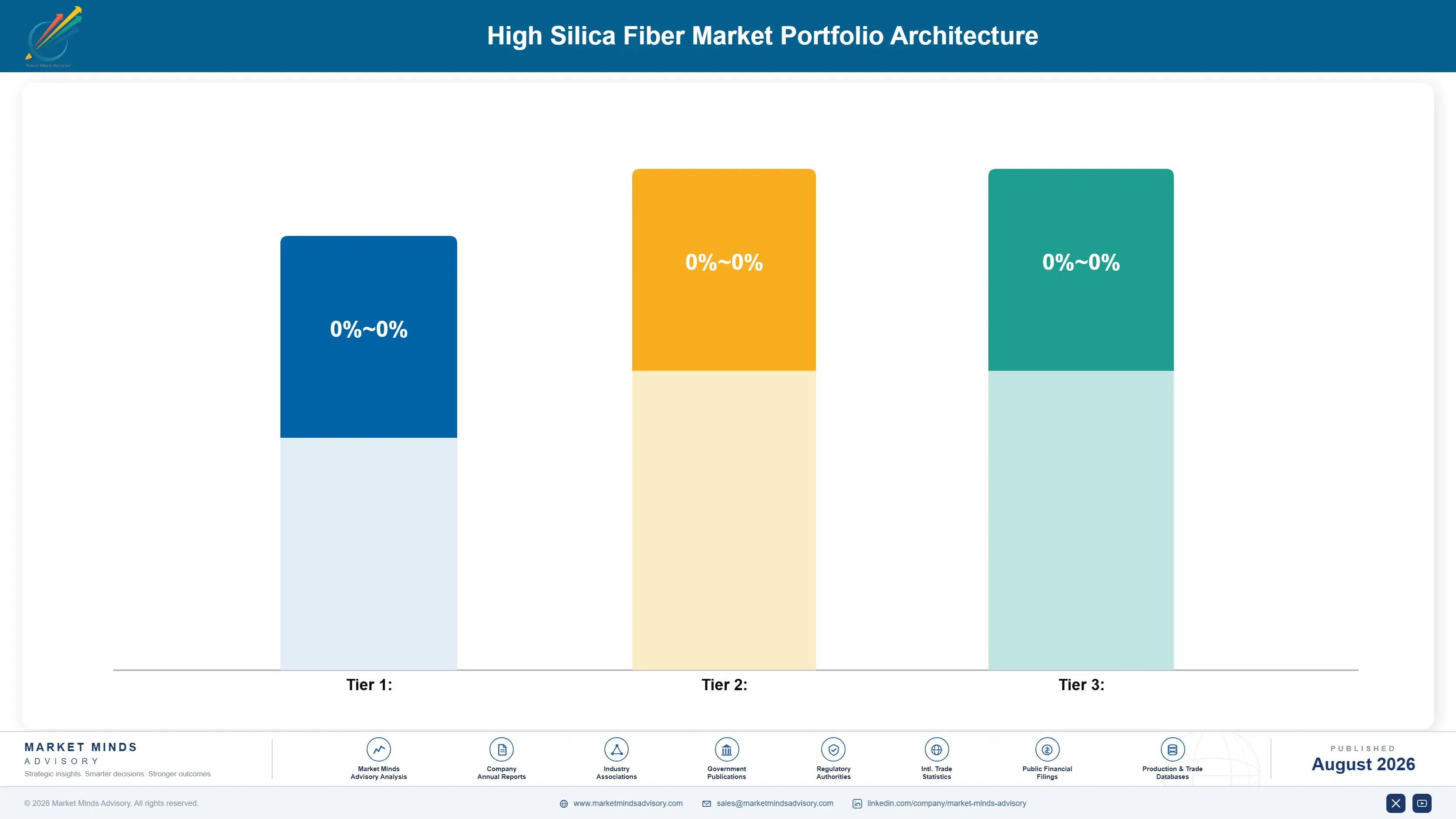
global-high-silica-fiber-market-trends-portfolio-architecture-1787550938887

High-value Sub-segments and Strategic Watch-out

Silica Fiber Composite Panels

Composite panels combine the fastest visible-segment growth with the highest margin economics, driven by reusable launch vehicle programmes requiring recurring ablative replacement. Producers with established aerospace certification and panel manufacturing capacity are positioned to convert this combination of growth and margin into disproportionate profit expansion through the full forecast period.

Silica Fiber Tape and Yarn

Silica fiber tape and yarn already anchor a growing revenue pool tied to both aerospace wrapping applications and electric vehicle battery fire protection barriers. The segment offers dependable margin expansion without the qualification volatility that pure aerospace formats carry, making it an attractive diversification path for producers.

Bulk Industrial Fiber

Bulk industrial fiber for furnace lining and refractory applications remains the volume core of the market, supplying steel and glass producers who prioritize cost and delivery reliability over performance differentiation. Growth here tracks industrial manufacturing activity closely, and margins stay compressed by energy cost exposure and price competition.

Ceramic Matrix Composite Substitution Risk

Ceramic matrix composite substitution is a genuine strategic watch-out because it threatens to displace silica fiber in the very highest temperature aerospace applications faster than hybrid formulation development can currently respond. Producers slow to develop hybrid chemistries risk losing specification position to composite suppliers who move first on blended formulations.

Certification-Locked Recurring Demand

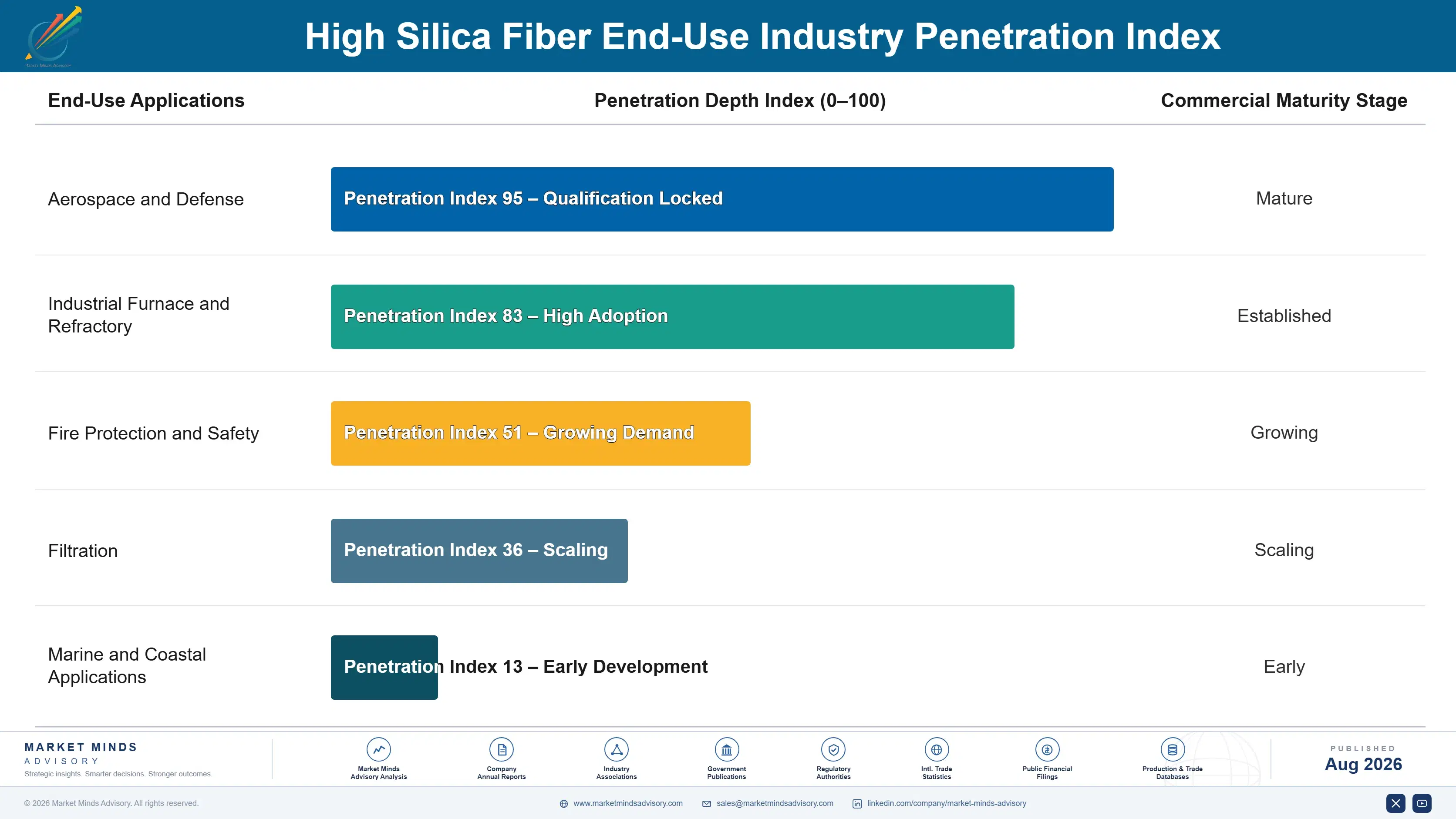
High silica fiber demand behaves like an annuity business once a producer earns qualification on a defense or space launch programme, because platform-specific certification rarely gets re-opened mid-programme given the cost and schedule risk of requalifying a new supplier. This locks in recurring purchasing across the full multi-year duration of platform production and reflight cycles.
Adoption stickiness varies meaningfully by end-use vertical. Defense and space programmes show the deepest stickiness because qualification cycles run two to three years and rarely get repeated once a supplier is certified, while industrial furnace and refractory buyers switch suppliers more readily based on short-term pricing. Fire protection and filtration applications sit between the two, with moderate switching costs tied to product-level testing rather than platform-level certification requirements.

Buyer profiles are shifting generationally as defense and space procurement moves from individual programme engineers making informal material choices toward centralized qualification boards applying formal, standardized testing protocols across multiple platforms simultaneously. Younger materials engineers entering aerospace programmes also carry stronger familiarity with hybrid and composite chemistries, pushing next-generation formulations into qualification conversations earlier than the previous generation of engineers typically allowed.
global-high-silica-fiber-market-trends-end-use-penetration-index-1787550939365

Where Silica Fiber Strategy Wins

These are among the four positions where our research anticipates prominent divergence between winners and laggards over the coming forecast period. Each is grounded in the demand model, the regulatory perimeter, and the announced capacity pipeline.
01 / AEROSPACE CERTIFICATION STRATEGY

Pursue Aerospace Certification Before Requirements Tighten Further

Aerospace-grade certification already commands pricing 3 to 4 times higher than bulk industrial rates, and producers without qualification status are locked out of the highest-margin segment of this entire market entirely and indefinitely, regardless of production scale. Pursuing certification now, before qualification boards tighten requirements further, gives producers a multi-year head start that competitors starting later simply cannot recover through faster execution alone. Producers with existing acid-leaching capacity should treat certification as the single highest-leverage investment available to them this coming decade.
02 / CAPACITY INVESTMENT PRIORITY

Expand Composite Panel Capacity Ahead Of Launch Cadence Growth

Composite panel manufacturing capacity is where recurring reusable launch vehicle demand concentrates, and panel-format sales already command roughly 35% higher margins than raw fiber sold into the same aerospace applications across nearly every comparable programme. Producers who expand panel capacity now, ahead of continued launch cadence growth, position themselves to capture recurring replacement revenue from vehicles already flying rather than competing for one-time contracts later on. Waiting until launch cadence growth becomes obvious to everyone erases the first-mover capacity advantage entirely.
03 / GEOGRAPHIC MANUFACTURING FOOTPRINT

Build Manufacturing Presence In North America Or East Asia

North America and East Asia together represent the largest combined demand base, driven by defense procurement in one region and industrial manufacturing scale in the other, and China is actively closing the aerospace certification gap through state-backed investment. Producers without meaningful manufacturing presence in at least one of these two regions are ceding share to domestic competitors who serve government and industrial buyers with shorter lead times. Building local capacity in one of these regions is now close to a competitive necessity.
04 / HYBRID FORMULATION R&D

Develop Hybrid Ceramic Formulations Ahead Of The Substitution Curve

Ceramic matrix composites threaten to displace silica fiber in the highest temperature aerospace applications faster than most producers' formulation development cycles can currently absorb across their existing chemistries and production lines. Producers who develop hybrid silica ceramic formulations proactively protect their specification position at a blended cost roughly 40% below pure ceramic matrix pricing, while those who wait risk losing certified status on active platform programmes. Formulation investment should shift toward hybrid chemistries now, well ahead of the substitution curve.

Engagement Snapshot From the Field

A live engagement with an industry participant carrying material or product regulatory and market exposure ahead of a defining policy shift, showing how our research translates into a defensible multi-year portfolio strategy.
MARKET MINDS ADVISORY · CLIENT ENGAGEMENT SUMMARY
High Silica Fiber Producer Strategic Portfolio Review and Transition Roadmap 2026·Investment Scenario on High Silica Fiber Exposure Evaluation 2025-26
CLIENT PROFILE
The client is a mid-sized industrial silica fiber manufacturer serving furnace lining and refractory customers across two continents, with annual revenue in the tens of millions of dollars. The company had built its position entirely on bulk industrial fiber but had never pursued aerospace-grade certification despite holding acid-leaching production capacity technically comparable to certified competitors already serving defense programmes.
STRATEGIC CHALLENGE
Bulk fiber margins had compressed as energy costs rose and regional competitors added capacity, while the client lacked visibility into what certification would actually require, how long it would take, and whether the investment would pay back within a reasonable timeframe. Leadership needed a credible, data-backed case before committing capital to a multi-year qualification process with an uncertain outcome.
MMA APPROACH
MMA conducted primary interviews with the client's production engineers, two defense procurement officials, and three certified competitors' former employees to map the specific qualification requirements and realistic timeline for aerospace certification. The engagement combined this qualitative work with a financial model comparing certified versus bulk fiber margins, quantifying the payback period under conservative and optimistic certification timeline scenarios.
KEY FINDINGS
  1. Certification lead time for aerospace-grade silica fiber averaged twenty-eight months across the interviewed procurement officials, longer than the client's initial internal estimate of eighteen months by a meaningful margin.
  2. Certified competitors priced aerospace-grade cloth and tape at gross margins 20 to 25 percentage points above the client's bulk fiber line, confirming a payback period under four years even in conservative scenarios.
  3. Two of three former competitor employees interviewed identified testing infrastructure investment, not raw production capacity, as the single largest barrier smaller producers faced when pursuing certification independently.
  4. The client's existing acid-leaching equipment met roughly 80% of certification testing requirements already, needing only incremental investment in dimensional tolerance and thermal cycling test infrastructure to close the remaining gap.
CLIENT PROFILE
The client is a mid-sized industrial silica fiber manufacturer serving furnace lining and refractory customers across two continents, with annual revenue in the tens of millions of dollars. The company had built its position entirely on bulk industrial fiber but had never pursued aerospace-grade certification despite holding acid-leaching production capacity technically comparable to certified competitors already serving defense programmes.
STRATEGIC CHALLENGE
Bulk fiber margins had compressed as energy costs rose and regional competitors added capacity, while the client lacked visibility into what certification would actually require, how long it would take, and whether the investment would pay back within a reasonable timeframe. Leadership needed a credible, data-backed case before committing capital to a multi-year qualification process with an uncertain outcome.
MMA APPROACH
MMA conducted primary interviews with the client's production engineers, two defense procurement officials, and three certified competitors' former employees to map the specific qualification requirements and realistic timeline for aerospace certification. The engagement combined this qualitative work with a financial model comparing certified versus bulk fiber margins, quantifying the payback period under conservative and optimistic certification timeline scenarios.
KEY FINDINGS
  1. Certification lead time for aerospace-grade silica fiber averaged twenty-eight months across the interviewed procurement officials, longer than the client's initial internal estimate of eighteen months by a meaningful margin.
  2. Certified competitors priced aerospace-grade cloth and tape at gross margins 20 to 25 percentage points above the client's bulk fiber line, confirming a payback period under four years even in conservative scenarios.
  3. Two of three former competitor employees interviewed identified testing infrastructure investment, not raw production capacity, as the single largest barrier smaller producers faced when pursuing certification independently.
  4. The client's existing acid-leaching equipment met roughly 80% of certification testing requirements already, needing only incremental investment in dimensional tolerance and thermal cycling test infrastructure to close the remaining gap.
RECOMMENDED STRATEGY
Phase 1: Invest in dimensional tolerance and thermal cycling test infrastructure immediately, closing the identified 20% testing gap before beginning formal qualification submission with defense procurement bodies. Phase 2: Begin qualification proceedings with the procurement office showing the shortest historical certification timeline, while continuing bulk fiber production to fund the certification investment during the process. Phase 3: Launch certified aerospace-grade cloth and tape products upon qualification completion, targeting the interviewed procurement contacts as anchor customers for the first certified programme wins.
OUTCOME
Within twenty-six months of the engagement, the client completed aerospace certification and won its first qualified supply contract with a national space launch programme. Certified product revenue reached 9% of total sales within the first year of launch, with gross margin on that line reported at 41%, figures client-reported and unverified by MMA.

Frequently Asked Questions

Foundational context covering the market sizes, CAGR, scope, country, region and competition that inform every finding below. This section is provided to cover basics and most often pre-purchase conversations, answered from the MMA Primary Research Dataset.

What is the current size of the High Silica Fiber Market?

The High Silica Fiber Market reached an estimated $1.8 billion in global value during 2025, the base year for this report. Growth is driven by aerospace thermal protection procurement alongside steady industrial furnace and refractory demand across East Asia.

How large will the High Silica Fiber Market be by 2036?

MMA projects the market will reach approximately $3.9 billion by 2036, more than doubling from its 2025 base value. This expansion reflects a compound annual growth rate of 7.4% sustained across the full forecast period.

What is the CAGR for the High Silica Fiber Market 2026 to 2036?

The base case compound annual growth rate is 7.4% across the 2026 to 2036 forecast window. Bull and bear scenarios range from 8.7% to 6.1%, depending on defense procurement and substitution trends.

Which segment is growing fastest?

Silica fiber composite panels are the fastest-growing segment, expanding at 9.4% annually, roughly 1.3 times the overall market rate. Silica fiber tape and yarn follow closely as the second-fastest segment given electric vehicle fire protection demand.

Who are the major companies in the High Silica Fiber Market?

Leading suppliers include Unifrax, 3M, Zircar Ceramics, Fiber Materials Inc, and Luyang Energy-Saving Materials, together holding an estimated 52% combined share. Competition is evaluated on a revenue basis across aerospace and industrial segments.

Which country is growing fastest?

India is the fastest-growing major market, expanding at approximately 9.8% annually as its space launch and defense manufacturing self-reliance programmes accelerate. This outpaces the global average meaningfully across both aerospace and industrial demand.

Report Segmentation Architecture

The full report scope spans multiple orthogonal segmentation dimensions, with cross-tabulated demand data provided for each dimension pair. Coverage extends further to regional breakdowns, trend trajectories, and the competitive detail needed to support segment-level decision-making.

By Product Type

  • Silica Fiber Cloth and Fabric
  • Silica Fiber Rope and Braided Sleeving
  • Silica Fiber Blanket and Board Insulation
  • Silica Fiber Tape and Yarn
  • Bulk and Loose Silica Fiber
  • Silica Fiber Composite Panels

By End-Use Industry

  • Aerospace and Defense
  • Industrial Furnace and Refractory
  • Fire Protection and Safety
  • Filtration
  • Marine and Coastal Applications

By Commercial Dimension

  • Direct Defense and Government Contracts
  • Industrial Distributor Sales
  • OEM Component Integration
  • Aftermarket Replacement Sales

By Region

  • North America
  • Western Europe
  • East Asia
  • South Asia and Pacific
  • Latin America
  • Middle East and Africa
  • Eastern Europe

Scope, Methodology, and Coverage

Every figure in this report is reproducible from documented input assumptions. The scope below maps the historical period, the forecast horizon, the segmentation dimensions, and the countries covered, alongside the underlying primary and qualitative methodology.
Historical Period
2020 to 2025
Forecast Period
2026 to 2036
Base Year
2025 (USD billions; MMA Primary Research Dataset, August 2026)
Market Definition
The High Silica Fiber Market comprises acid-leached and amorphous silica fiber products in cloth, rope, tape, blanket, and composite panel formats, used for high-temperature insulation, ablative thermal protection, and filtration. It excludes standard fiberglass insulation and ceramic fiber products manufactured through different chemical processes.
Quantitative Units
USD billions (current prices); metric tons for volume-referenced segment discussion where applicable
Segmentation Dimensions
By Product Type; By End-Use Industry; By Commercial Dimension; By Region
Regions Covered
North America, Western Europe, East Asia, South Asia and Pacific, Latin America, Middle East and Africa, Eastern Europe
Countries Covered
USA, China, Germany, France, UK, Japan, South Korea, India, Australia, Canada, Brazil, Mexico, Indonesia, Vietnam, Thailand, Malaysia, UAE, Saudi Arabia, South Africa, Nigeria, Turkey, Poland, Netherlands, Italy, Spain, Sweden, Switzerland, Argentina, Colombia, Singapore, and additional markets relevant to this sector
Key Companies Profiled
Unifrax, 3M, Zircar Ceramics, Fiber Materials Inc, Luyang Energy-Saving Materials, Auburn Manufacturing, Nitivy Co Ltd, Newtex Industries, JPS Composite Materials, Cotronics Corp, McAllister Mills, Refractory Specialties Inc, Morgan Advanced Materials, IBIDEN, Isolite Insulating Products, BJS Ceramics, Shandong Baishun New Materials, Sichuan Weibo Special Fiber, Zhejiang Huatao Composite Material, Techstyle Materials
Quantitative Methodology
Primary survey, n=3,800 respondents, Q4 2025, six countries; demand-side model with trade association cross-validation
Qualitative Methodology
47 expert interviews, Q4 2025; applied to validate demand model assumptions, identify emerging dynamics, and assess competitive positioning
Report Format
PDF and XLSX data workbook (Word format preview document)
Publisher
Market Minds Advisory
Report Code
MMA-2026-CHM-216
Published
August 2026
Contact
sales@marketmindsadvisory.com | www.marketmindsadvisory.com

Purchase the full High Silica Fiber Market Report (2026 to 2036).

This report provides a comprehensive, ten-year forecast of the global High Silica Fiber Market. Coverage spans aerospace-grade composite panels, tape and yarn, cloth, and bulk industrial fiber formats across all seven world regions. Deliverables include segment-level and regional sizing to 2036, competitive benchmarking of twenty profiled companies on a consistent revenue basis, and energy cost exposure analysis. A strategic verdict identifies where producers should concentrate capital and certification investment over the coming decade. The report is built from primary survey data, expert interviews, and company disclosures rather than secondary aggregation.
Ten-year sizing and CAGR forecasts across seven global regions
Segment-level analysis of composite panels, tape, cloth, and bulk fiber
Competitive benchmarking of twenty profiled silica fiber manufacturers
Energy and feedstock cost exposure and mitigation strategy analysis
Aerospace certification and qualification timeline tracking by region
Strategic verdict on capital allocation and certification investment priorities

Built For The People Who Decide

From boardroom strategy to bench-side execution, this report is read cover-to-cover by leaders shaping the next decade of their industry, turning demand scenarios, market dynamics and valuation benchmarks into decisions.
CXOs/ Presidents/ VPs/ Managers
M&A and Corporate Development
Strategy Teams and R&D Heads
Procurement and Product Directors
Regulatory and Compliance Leaders
Investor Relations and Equity Analysts