Market Minds Advisory
Global Gold Plating Chemicals Market

Global Gold Plating Chemicals Market: Electrolytes and Immersion Chemistries Across Electronics and Decorative Finishing, 2026 to 2036

Gold is 78% of what a plating chemical costs, which means the formulator adds a fraction of the value and carries all of the price risk unless the contract is written properly.

Lead Analyst

Bilal Shaikh

Published

September 2026

Make Smarter Decisions with Customized Research Insights

Request a free sample report and evaluate market opportunities, growth trends, and competitive dynamics relevant to your business needs.

2025 MARKET VALUE$1.5BMarket Size 2025
2036 FORECAST VALUE$3.0BBase Case , 2026 to 2036
CAGR 2026 TO 20366.6 %Bull 7.9% / Bear 5.4%
INCREMENTAL OPPORTUNITY$1.4BNet 10- year value creation
EXPANSION MULTIPLE1.89x2036 value over 2026 base
Strategic Levers
M&A Pipeline
Regional Outlook
Country Rankings
Competitive Intelligence
Segmental Deep-dive
Call-Us : 91 93563 13602

Executive Snapshot and Market Trajectory

This is a market where the chemistry is the small part of it. Contained gold accounts for 78% of what a formulated plating chemical costs, so a formulator supplies perhaps a fifth of the value while carrying the full exposure to a metal price it cannot influence.
Growth concentrates in the sulphite and non-cyanide gold electrolytes, expanding at 9.9%, where semiconductor packaging and medical device platers need chemistry compatible with photoresists and with substrate materials that cyanide baths attack directly. East Asia holds 39% of value, above the band this report applies elsewhere, because connector, printed circuit board and semiconductor packaging plating are all concentrated there, far beyond what electronics assembly share alone would suggest to anybody looking at device production data.
The supplier base is moderately concentrated, the top five holding 47% of chemical revenue, and it splits between precious metal refiners who control the gold and specialty formulators who control the chemistry. Competition runs on bath performance and gold efficiency rather than on formulation price, which nobody discounts meaningfully. Metal price volatility, rather than competitive pricing, is what actually determines whether a formulator makes money in any given year.
Market Definition
The market comprises gold plating chemicals and electrolytes supplied for electrodeposition and immersion finishing, spanning sulphite and non-cyanide gold electrolytes, electroless and immersion gold chemistries, hard gold cyanide electrolytes, soft gold cyanide electrolytes, and decorative and jewellery plating chemistries. Sizing captures formulated chemical revenue at realised delivered price including contained gold value, across electronics, semiconductor packaging, connectors, medical devices, aerospace and decorative finishing. Gold bullion and salts sold as raw material, plating equipment, refining and recovery services, other precious metal plating chemistries and finished plated components fall outside scope.
Base Year Value
$1.5B in 2025 (MMA Primary Research Dataset, August 2026)
Forecast Period
2026 to 2036, eleven discrete annual values
CAGR
6.6% base case. Bull 7.9%. Bear 5.4%.
Fastest Growth Segment
Sulphite and Non-Cyanide Gold Electrolytes: 9.9% CAGR
Fastest Growth Country
Vietnam: 9.4% CAGR
Fastest Growth Region
South Asia and Pacific: 8.7% CAGR
Largest Region
East Asia: 39% of 2025 global value
Market Leaders
Technic, Umicore, Atotech, Metalor Technologies, Heraeus. Source: MMA Analysis based on company annual reports.
Primary Survey
n=3,800 procurement and R&D decision-makers, Q4 2025, six countries
Methodology
Demand-side build-up, cross-validated against public data, 47 expert interviews

Global Gold Plating Chemicals Market Forecast Scenarios

global-gold-plating-chemicals-market-size-forecast-scenario-1787310495129
Growth of 5.3% across 2020 to 2025 says more about metal pricing than about volume. Gold rose substantially across the window, which lifted the value of every litre of electrolyte sold without one additional connector being plated, while platers thinned deposits and pushed recovery rates higher. Underlying chemical volume grew far more slowly than the revenue figures suggest, and several formulators mistook one for the other.
The base case at 6.6% rests on three mechanisms. Connector count per device keeps rising across automotive electrification, data centre interconnect and high-frequency applications, each contact requiring gold for contact resistance and corrosion performance nothing cheaper matches yet. Semiconductor packaging complexity drives immersion and electroless gold demand across substrate and bump finishing. And medical device plating keeps growing alongside implantable and diagnostic electronics that require biocompatible non-cyanide deposition rather than conventional cyanide chemistry.
The bull case at 7.9% turns on gold pricing holding at elevated levels, which raises market value directly whatever happens to volume. The bear case at 5.4% turns on thrifting. Platers respond to expensive gold by reducing deposit thickness, improving recovery and substituting palladium or silver where contact requirements permit, and sustained high metal prices accelerate every one of those responses.

What Actually Determines Plating Chemical Value

The commercial structure here is unlike most specialty chemical markets and it confuses newcomers reliably. Gold is 78% of formulated cost, which means a formulator's actual contribution sits in the remaining fifth: the complexing agents, brighteners, hardeners and buffers that determine how the deposit behaves. Revenue looks large and value added is modest, and any formulator who prices as though the gold were theirs to mark up discovers the customer already knows the metal price to four decima
GOLD CONTENT COST SHARE78%Contained precious metal share of formulated plating chemical cost
TOP FIVE SHARE47%Concentration of plating chemical revenue across the largest suppliers
CONNECTOR DEPOSIT THICKNESS0.5 micronsTypical gold layer applied to electronic connector contact surfaces
PLATING BATH LIFE42 turnoversMetal turnovers achieved before an electrolyte requires full replacement
GOLD RECOVERY RATE94%Share of drag-out and spent bath gold recovered by platers
ELECTRONICS DEMAND SHARE68%Electronics and connector share of total plating chemical consumption
Bath performance is where the differentiation genuinely lives. An electrolyte reaching 42 metal turnovers before replacement wastes far less gold than one failing at half that, and drag-out losses compound daily across a production line. Platers who measure this buy on gold efficiency; those who do not buy on drum price and lose money quietly.
Deposit thickness has been falling for two decades and continues to. Connector finishes near 0.5 microns are common where two microns was once standard, achieved through better underlayers, selective plating and tighter process control. Every reduction cuts gold consumption directly, which is why chemical volume growth persistently lags device volume growth in this market.
"Platers negotiate hard on the price of a formulation that is four fifths gold and then throw away several percent of that gold in drag-out because nobody costed the rinse tanks. The money in this business has always been in bath life and recovery, and it is still the thing least often measured on a production floor."
Director, Surface Finishing and Precious Metal Chemicals Practice · MMA Chemical

Market Trends

Non-Cyanide Chemistries Displace Cyanide In Sensitive Applications

Sulphite and other non-cyanide gold electrolytes have moved from niche to necessity in semiconductor packaging and medical device plating, because cyanide baths attack photoresists and several substrate materials that modern processes now depend on entirely. Roughly 27% of electronic gold plating volume now uses non-cyanide chemistry. Handling and disposal advantages matter as well, since cyanide regulation has tightened considerably across most producing regions. The chemistry is harder to stabilise and less forgiving of contamination, which gives formulators with genuine process capability a defensible position here rather than a commodity one.
Market Impact: Reaches 3,800 contacts per vehicle

Deposit Thinning Decouples Chemical Volume From Device Growth

Platers have reduced connector gold thickness steadily for two decades, from roughly two microns toward 0.5 microns today, using improved nickel underlayers, selective plating and closer process control to maintain contact performance on less metal. Each reduction removes gold consumption permanently rather than temporarily. The commercial consequence is uncomfortable for suppliers selling contained metal: device volumes can grow strongly while chemical tonnage stagnates, and formulators who forecast from electronics production data consistently overestimate their own demand by a wide margin. Automotive and data centre applications resist the pressure better than consumer electronics ever has.
Market Impact: Covers 41% of interconnect area

Market Opportunities and Growth Drivers

Connector Count Rises Across Automotive And Data Centre

Vehicle electrification multiplies electrical connections per vehicle, and data centre interconnect for accelerated computing requires high-frequency contacts where gold remains the only finish delivering the contact resistance and corrosion performance required. Roughly 3,800 electrical contacts sit in a typical electric vehicle against a fraction of that in a conventional one. Each contact carries a gold deposit, and reliability requirements in automotive and data centre applications resist the thrifting pressure that consumer electronics has applied continuously for two decades, because failure in either application costs far more than the metal saved.
Market Impact: Gold is 78% of cost

Semiconductor Packaging Drives Immersion Gold Consumption

Substrate finishing, bump metallisation and wire bond pads all require gold, and advanced packaging has multiplied the number of interconnect surfaces requiring it within each device. Electroless nickel immersion gold and its palladium-containing variant now cover roughly 41% of high-density interconnect substrate area. Packaging complexity rises faster than device counts do, which makes this the demand that keeps growing even in years when unit shipments fall. The chemistry requirements are genuinely demanding, and qualification at substrate manufacturers is genuinely difficult to displace once a chemistry is established on a line.
Market Impact: Recovery already reaches 94%

Market Restraints and Challenges

Gold Price Volatility Passes Directly Into Customer Pricing

Contained metal is 78% of formulated cost, so a formulator selling on fixed prices carries an exposure that dwarfs its own margin on the chemistry. The root cause is that gold trades continuously while plating chemical supply agreements are frequently annual, leaving the formulator short of metal it has already committed to deliver. Commercially a sharp move can eliminate a full year of chemistry profit outright. Mitigation runs through metal pass-through clauses priced daily, customer-supplied gold arrangements, and metal leasing arrangements that separate the chemistry margin from the commodity position entirely.
Market Impact: Reaches 27% of electronic volume

Thrifting And Substitution Erode Volume Continuously

Expensive gold makes every plater a cost engineer, and the responses are well understood: thinner deposits, better recovery, selective plating that covers only the contact area, and substitution to palladium or silver wherever contact requirements allow it. The root cause is simply that gold is expensive and the plated function rarely requires as much as convention specified. Commercially it caps volume growth well below device growth. Participants are responding with chemistries enabling thinner uniform deposits, selective plating systems, and recovery services that turn the customer's gold saving into supplier revenue as well.
Market Impact: Thickness falls toward 0.5 microns
3 additional market trends, 2 additional growth drivers, and 4 additional restraints and challenges are covered in the full report. Contact sales@marketmindsadvisory.com to access the complete intelligence.

Segment CAGR and Growth Architecture

Segmentation follows electrolyte chemistry and deposition mechanism, which is the dimension determining substrate compatibility, deposit properties, regulatory handling burden and realised formulation margin together. End-use application maps loosely across several chemistries without separating them commercially, since hard gold serves connectors and aerospace alike, so end-use application sits in demand analysis rather than in this primary hierarchy.
global-gold-plating-chemicals-market-market-share-analysis-1787310495668

Sulphite and Non-Cyanide Gold Electrolytes

Growing at 9.9%, exactly 1.50 times the market rate, and the segment where formulation capability rather than metal supply determines who competes. Sulphite complexes deposit gold without the free cyanide that attacks photoresists, aluminium bond pads and several polymer substrates, which makes them mandatory in semiconductor packaging and increasingly in medical device plating. The chemistry is considerably less stable than cyanide systems and unforgiving of organic contamination, so bath control and additive packages matter enormously. Formulators with genuine process capability hold defensible positions here, and regulatory pressure on cyanide handling keeps pushing further volume toward them across every producing region. Bath control and additive packages decide who retains a line.
CAGR 9.9%

Electroless and Immersion Gold Chemistries

Expanding at 8.2% on printed circuit board and substrate finishing demand, where electroless nickel immersion gold and its palladium-containing variant now cover roughly 41% of high-density interconnect area. These are autocatalytic and displacement processes rather than electrolytic ones, so they plate without any electrical contact and reach geometries that racked electrolytic plating cannot serve at all. Bath stability and the notorious black pad failure mechanism make process control genuinely critical, and substrate manufacturers qualify these chemistries very carefully indeed before committing any production to them. Advanced packaging growth pulls this segment considerably faster than board volumes alone would ever imply, since interconnect surface area rises even when unit shipments do not.
CAGR 8.2%
Full segment breakdown across 5 segments available in the complete report.

Regional Architecture and Country Demand Map

Regional value follows plating capacity rather than electronics consumption, and the two diverge sharply. Connector, board and substrate plating concentrates near component manufacture, while the devices those components eventually enter are assembled, sold and used somewhere else entirely. Decorative demand follows a quite separate geography again.

East Asia

Thirty-nine percent of value sits here, above the band this report applies to global markets. Note: the deviation is genuine, since connector, printed circuit board and semiconductor substrate plating capacity is concentrated in this region far beyond what electronics assembly share alone would indicate. Chinese and Taiwanese board and substrate manufacture consumes immersion gold at enormous scale, Japanese connector and semiconductor packaging plating operates at the most demanding specifications anywhere, and Korean substrate producers serve memory packaging requiring precise deposit control. Japanese formulators hold particularly strong positions in non-cyanide chemistry across the region. Growth of 7.6% runs above the global rate, driven by packaging complexity rather than by board volume growth.
Share: 39% | CAGR: 7.6% (2026 to 2036)

North America

Twenty-two percent of value from aerospace, defence, medical device and high-reliability connector plating rather than from volume electronics, most of which left the region decades ago and has not returned. What remains is the demanding end: military connectors with qualification requirements measured in decades, implantable medical devices needing biocompatible non-cyanide deposition, and semiconductor packaging serving domestic fab output. Deposit specifications here resist thrifting far more than consumer electronics does, because reliability requirements are contractual. Growth of 6.0% reflects steady high-specification demand alongside modest new domestic packaging capacity, and defence programme funding provides a demand floor that commercial electronics has never offered anybody. Non-cyanide medical chemistry is a genuine regional strength.
Share: 22% | CAGR: 6.0% (2026 to 2036)
Regional intelligence for 5 additional markets available in the complete report: Western Europe, South Asia and Pacific, Latin America, Middle East and Africa, Eastern Europe. Contact sales@marketmindsadvisory.com.
global-gold-plating-chemicals-market-country-cagr-analysis-1787310496236

Where Plating Chemical Suppliers Earn More

Marking up gold is not a business, and customers who track the metal price hourly will not permit it in any case. The margin available sits in bath life, in drag-out recovery, in the non-cyanide chemistries that genuinely require formulation capability, and in the contract terms that remove metal price exposure from the formulator entirely.

Sell Gold Efficiency Rather Than Formulation Price

An electrolyte reaching 42 metal turnovers wastes far less gold than one failing at half that, and drag-out compounds daily across a production line. Given that contained metal is 78% of cost, a formulation delivering better bath life and lower drag-out saves a plater more in a quarter than the entire annual chemical premium costs. Suppliers who measure and contract against gold efficiency realise roughly 32% above formulation-price competitors. The measurement work requires a technician on site rather than any new chemistry at all, which makes it among the cheapest commercial advantages available here.
Market Impact: Realises roughly 32% above formulat

Remove Metal Exposure Through Pass-Through Or Leasing

Gold at 78% of cost means a formulator on fixed annual pricing carries commodity exposure many times its own chemistry margin, which is a position no chemical company should hold deliberately. Daily-priced pass-through clauses, customer-supplied metal arrangements or metal leasing separate the chemistry business from the commodity position and protect roughly 85% of gross margin through a sharp price move. Customers accept these structures readily because they already price gold themselves. Formulators resist because the reported revenue line shrinks, which is presentation rather than economics and a poor reason to carry the risk.
Market Impact: Protects roughly 85% of chemistry g

Build Non-Cyanide Formulation Capability Quite Deliberately

Sulphite and other non-cyanide systems grow at 9.9% and are considerably harder to stabilise than cyanide baths, which is precisely why they carry formulation margins roughly 45% above conventional hard gold electrolytes. Semiconductor packaging and medical device platers have no workable alternative at all, and regulatory pressure on cyanide handling keeps widening the addressable base each year. The development work involved is genuinely demanding and takes several years to complete, and it is the only part of this market where chemistry rather than metal supply determines who wins and holds the position.
Market Impact: Carries roughly 45% higher formulat

Attach Recovery And Refining Services To Chemical Supply

Platers already recover 94% of drag-out and spent bath gold, and the remaining loss is well worth chasing at current metal values. Suppliers offering integrated recovery, refining and metal return alongside chemical supply convert a transactional sale into a closed loop worth roughly 1.6 times the chemical revenue alone. It also gives the supplier visibility of the customer's actual gold consumption, which is the information needed to sell efficiency credibly rather than merely assert it. Very few specialty chemical formulators currently offer any of it, which leaves the field unusually open.
Market Impact: Worth roughly 1.6 times the chemica

Who Controls the Margin Pool

Concentration is moderate and the participant base divides along an awkward line. The top five hold 47% of plating chemical revenue, the basis used throughout this section including contained metal value, and the gap between them reflects two different businesses. Umicore, Metalor and Heraeus approach this market from precious metal refining and control the gold; Technic, Atotech and the specialty formulators approach it from surface chemistry and control the additive systems that determine depo
Competition currently runs on three dimensions and formulation price is the least significant, since it represents a fifth of what the customer pays. Bath performance decides who retains a plating line once qualified. Metal handling capability decides who can offer leasing and recovery. Regulatory positioning in non-cyanide chemistry decides access to the fastest growing applications entirely.

Pressure is building from two directions. Regional formulators in Asia are competing effectively on service proximity where chemistry requirements are conventional. Metal price volatility keeps rewarding suppliers with refining capability over those without it. Rankings shift first in non-cyanide chemistry, where formulation skill outweighs metal position and the competitive set is narrower than elsewhere.
global-gold-plating-chemicals-market-company-positioning-matrix-1787310496755

Competitive Moat and Risk Dimensions

TECHNIC

Moat: Specialty formulation and service

Deep additive and process chemistry capability across electronic finishing, supported by technical service organisations working on customer production floors, defends positions that metal supply alone never could. Long qualification histories at connector and substrate manufacturers create relationships where the supplier understands a specific plating line better than the plater's own engineering staff does.
TECHNIC

Risk: Limited metal position exposure

Without refining and metal financing capability, the company competes for the fifth of value that chemistry represents while refiner-formulators can offer leasing, recovery and metal terms that customers increasingly want bundled. As gold prices rise, that gap matters more, and building refining capability from nothing is neither quick nor cheap.
UMICORE

Moat: Refining and metal integration

Precious metal refining, recycling and financing capability alongside plating chemistry lets the company close the loop for customers, supplying electrolyte, leasing the metal and recovering it from spent baths and drag-out. That combination is genuinely difficult for a pure formulator to replicate, and it gives visibility of customer gold consumption that informs technical selling.
UMICORE

Risk: Formulation depth against specialists

In non-cyanide and advanced packaging chemistries, where bath stability and additive systems determine success, specialist formulators hold capability built over decades of dedicated development. Competing there on metal integration alone is insufficient, and the fastest growing part of this market is precisely where chemistry rather than metal supply decides who wins the position.

Players Tracked

Prominent Players

Technic
Umicore
Atotech
Metalor Technologies
Heraeus

Other Key Players

Element Solutions
Japan Pure Chemical
Tanaka Kikinzoku Kogyo
Johnson Matthey
Uyemura
Okuno Chemical Industries
DuPont
Legor Group
Asahi Pretec
Materion
Aurubis
Shanghai Sinyang Semiconductor Materials
Guangdong Guanghua Sci-Tech
Schloetter
Kanto Chemical

Recent Developments

MAY 2025

Non-cyanide gold electrolyte qualified at packaging substrate maker

A semiconductor packaging substrate manufacturer qualified a sulphite-based gold electrolyte across its bump and pad finishing lines, replacing the cyanide chemistry that had previously constrained its photoresist selection, following an extended evaluation covering bath stability and deposit uniformity across full production volumes at the site.
Signal: Photoresist compatibility rather than envi
SEPTEMBER 2025

Metal leasing programme launched for plating customers

A precious metal refiner extended metal leasing and closed-loop recovery arrangements to plating chemical customers, allowing platers to hold their working gold inventory without owning it outright and returning drag-out and spent bath metal directly into the same leasing arrangement rather than selling it separately.
Signal: Separating metal financing from chemical s
FEBRUARY 2025

Selective plating adoption cuts connector gold consumption

Automotive connector manufacturers expanded their selective plating deployment considerably further, depositing gold only onto contact interface areas rather than across entire terminal surfaces, reducing gold consumption per contact quite substantially while still maintaining the contact resistance specifications that reliability testing continues to demand from them.
Signal: Thrifting continues wherever engineering p

What Sits Inside Formulated Chemical Cost

Contained gold accounts for roughly 78% of formulated plating chemical cost, purchased as bullion or refined salt and converted into cyanide or sulphite complexes. Complexing agents and their precursors add around 7%, brighteners, wetting agents and grain refiners about 5%, and cobalt or nickel hardeners a further 3%. Conversion energy, analytical control and packaging make up the remaining 7%.
Precious metal pricing moved substantially across 2022 to 2025, rising to levels that changed plater behaviour rather than merely raising cost. Formulators on fixed annual contracts absorbed the difference on metal already committed to customers, and several took losses exceeding a full year of chemistry margin. Umicore Annual Report 2022 and Johnson Matthey Annual Report 2023 both recorded precious metal price movements and their effect on working capital across refining and chemical operations.

The competitive disadvantage mechanism runs through metal financing rather than chemical formulation skill. A formulator without refining capability or leasing arrangements must buy gold outright, finance the inventory and carry price exposure between purchase and delivery, against a chemistry margin representing a fifth of the invoice. Refiner-formulators avoid that entirely. Small regional formulators carry that exposure in full and fail first when metal prices move against them.
global-gold-plating-chemicals-market-cost-volatility-analysis-1787310496950

Price contained metal daily through pass-through clauses

Daily metal pricing linked to a published fix removes the exposure that annual fixed pricing creates, and customers accept it readily because they already track gold themselves continuously. Formulators resist because invoice values become volatile, which is presentation rather than economics and a poor reason for a chemical company to carry commodity risk at all.

Use metal leasing to avoid owning working inventory

Leasing arrangements let a formulator supply the chemistry without financing the gold sitting inside it, converting what is a large working capital position into a simple financing fee. The leasing market for precious metals is well established, and surprisingly few specialty formulators use it, despite carrying metal inventory that dwarfs their entire chemistry margin.

Close the loop through integrated recovery and refining

Recovering drag-out and spent bath gold and returning it against the customer's next order reduces the metal a formulator must purchase outright, and it deepens the customer relationship considerably at the same time. Platers already recover 94% of it, so the recovery infrastructure already exists and only the commercial arrangement around it is generally missing.

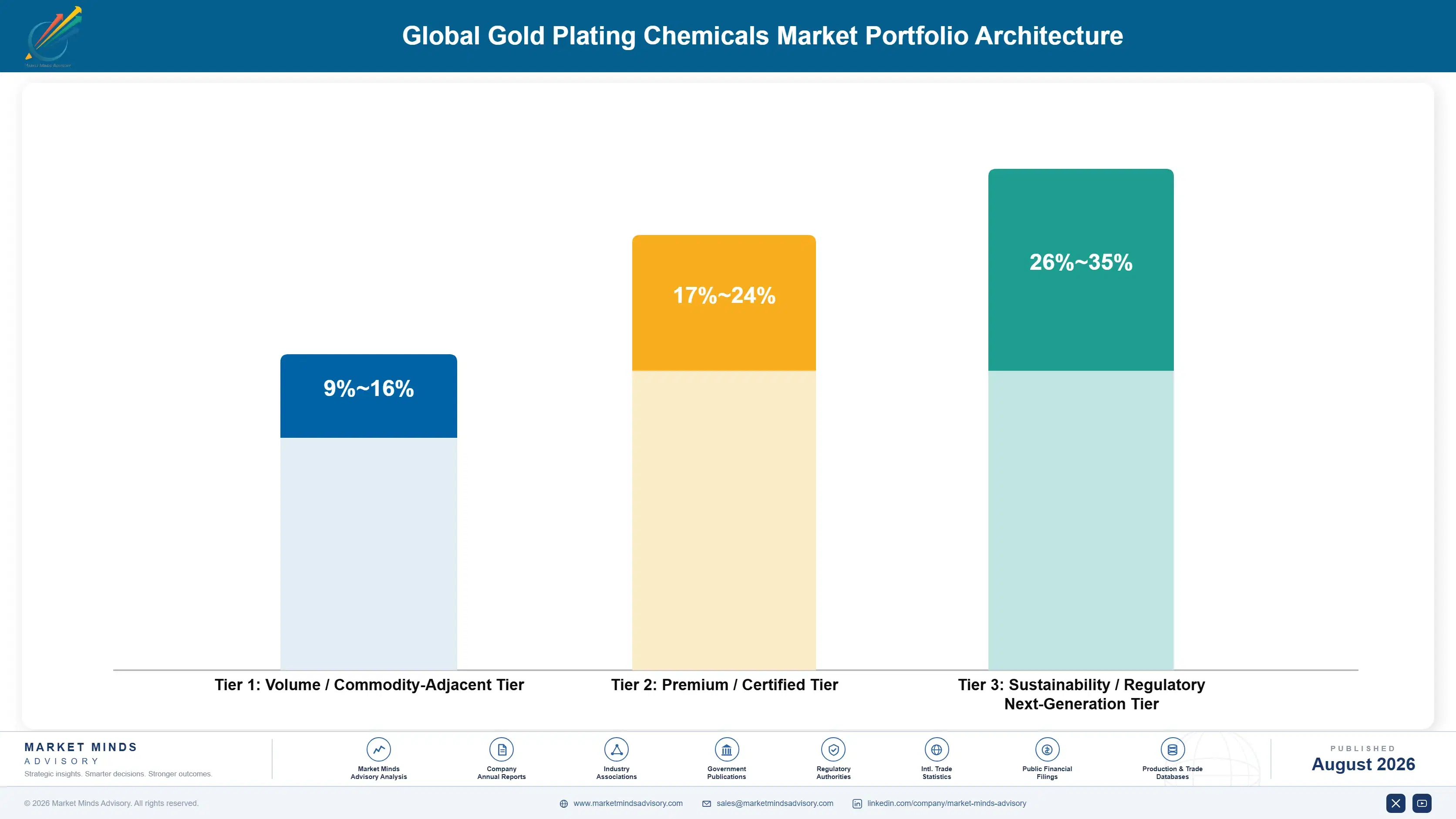
Portfolio Architecture for Margin Defence

Margin architecture here has to be read on the chemistry rather than on the invoice, because contained gold at 78% of cost flattens every gross margin percentage toward the metal. Measured on formulation value added, conventional hard and soft gold cyanide systems earn modestly, since the chemistry is well understood and several suppliers can match it. Value rises steeply with formulation difficulty, which means non-cyanide systems and advanced packaging chemistries.
The volume versus premium tension runs between connector plating and everything demanding. Hard gold connector electrolytes carry the volume that keeps a formulator relevant to large platers and justifies technical service coverage, at chemistry margins that competitive tendering compresses continuously. Non-cyanide and packaging chemistries earn far better on smaller volumes. A formulator serving only connector volume funds a technical organisation from margins that connector procurement will not support.

High-value pools concentrate in three places. Non-cyanide electrolytes command chemistry premiums because stabilising them is genuinely difficult. Metal leasing and recovery services earn on financing and logistics rather than on chemistry at all. And medical and aerospace qualified systems earn on specifications that resist both thrifting and retendering.

Volume / Commodity-Adjacent Tier

Conventional hard and soft gold cyanide electrolytes and decorative plating chemistries supplied into connector, jewellery and general finishing, where chemistry is well understood and several qualified suppliers compete directly on formulation price.
Gross Margin: 9-16%

Premium / Certified Tier

Electroless and immersion gold chemistries qualified at substrate and board manufacturers, where bath stability and deposit uniformity determine yield. Process capability and qualification history defend pricing. The seven-point range reflects standard against high-density interconnect work.
Gross Margin: 17-24%

Sustainability / Regulatory / Next-Generation Tier

Non-cyanide sulphite electrolytes for semiconductor packaging and medical devices, alongside integrated metal leasing and recovery services. Formulation difficulty and regulatory pressure defend margin strongly. The nine-point range reflects chemistry against service-led revenue economics.
Gross Margin: 26-35%
global-gold-plating-chemicals-market-portfolio-architecture-1787310497452

High-value Sub-segments and Strategic Watch-out

Non-cyanide electrolytes for packaging and medical

High value and high growth together, because sulphite systems are considerably harder to stabilise than cyanide baths and semiconductor packaging and medical device platers have no workable alternative available to them. Regulatory pressure on cyanide handling keeps widening the addressable base steadily across every producing region.
Gross Margin: 26-35%

Metal leasing and closed-loop recovery services

Strong realised value on steady growth, because these services earn on financing and logistics rather than on chemistry margin at all, and they give the supplier visibility of a customer's actual gold consumption. Very few specialty chemical formulators currently offer any of it at all.
Gross Margin: 22-32%

Hard gold connector electrolyte volume

The volume core here, keeping formulators relevant to the largest platers and justifying broad technical service coverage while earning chemistry margins that competitive tendering keeps compressing year after year. Necessary for commercial scale, but this tier will never fund non-cyanide development work on its own.
Gross Margin: 9-16%

Decorative and jewellery plating chemistries

The strategic watch-out, because demand tracks luxury goods consumption rather than industrial cycles and has been declining slowly across Western Europe for years while continuing to grow across Gulf and Turkish markets. Regional exposure alone decides whether this segment helps a supplier or actively hurts it.
Gross Margin: 11-19%

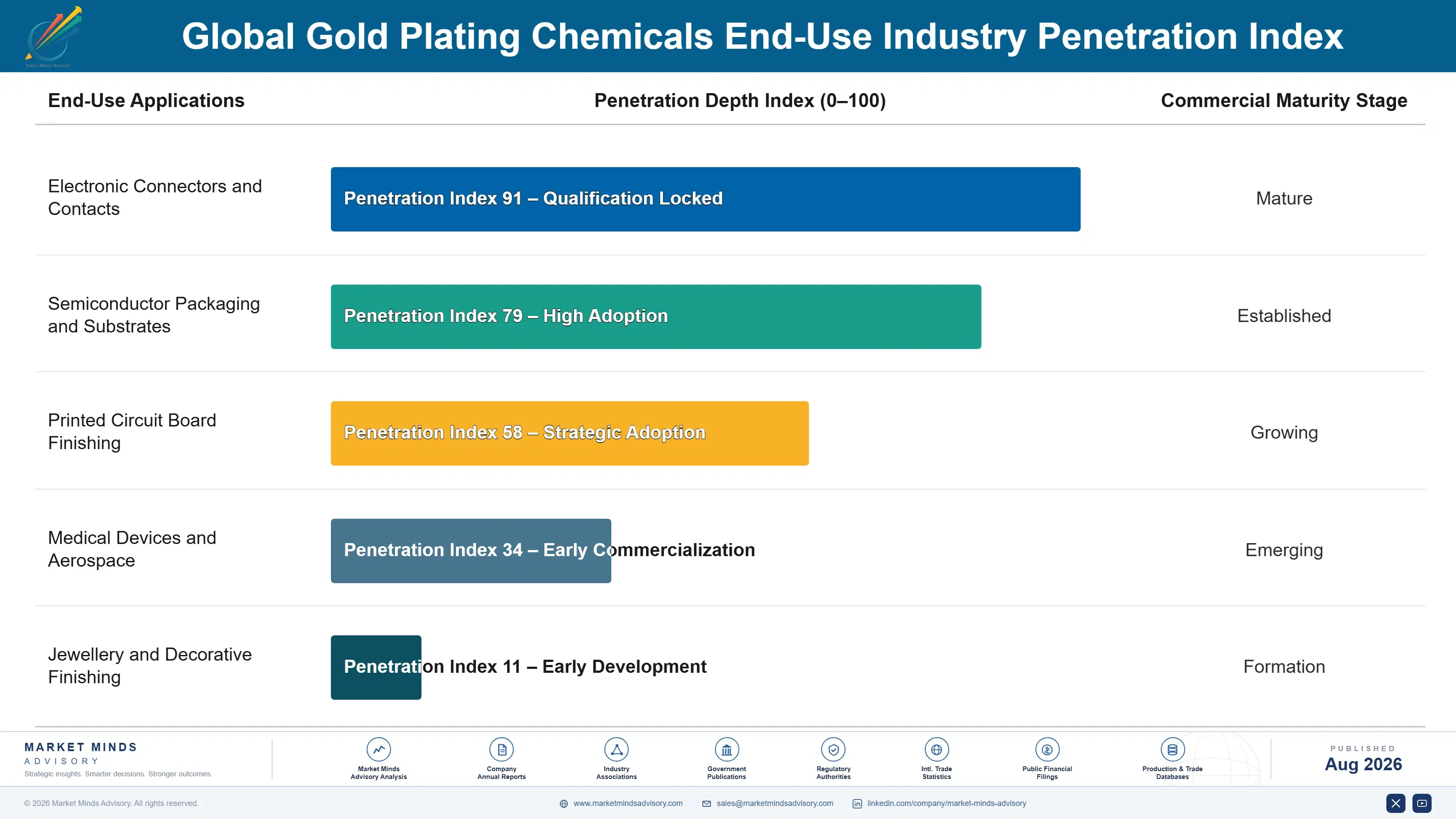
How Plating Chemical Demand Behaves

Demand is line-locked rather than transactional. A plating line qualified on a particular electrolyte runs it continuously, replenishes on a standing schedule set by throughput and drag-out, and changes chemistry only when a process problem forces the question. Winning a line is slow and technical; holding it costs a periodic service visit. Revenue therefore tracks installed plating capacity and its utilisation rather than any purchasing cycle, which makes forecasting straightforward and losing
Stickiness varies sharply with process difficulty. Decorative and conventional soft gold plating is loosest, retendered against price where any competent formulator can supply. Hard gold connector plating sits tighter, since deposit hardness and wear specifications are qualified against customer testing. Non-cyanide and packaging chemistries are stickiest of all, where bath behaviour is understood through experience with that specific line and requalification risks yield.

The buyer profile has shifted toward finance in a way that surprises chemical suppliers. A decade ago plating chemistry was bought by process engineers evaluating deposit quality. Rising gold prices have pulled purchasing and treasury into the decision at most substantial platers, and those functions evaluate metal terms and leasing at least as closely as deposit quality.
global-gold-plating-chemicals-market-end-use-penetration-index-1787310497938

Where We Land On This

These are among the four positions where our research anticipates prominent divergence between winners and laggards over the coming forecast period. Each is grounded in the demand model, the regulatory perimeter, and the announced capacity pipeline.
01 / GOLD EFFICIENCY SELLING

Sell bath life and drag-out savings, not formulation price

Contained metal represents 78% of formulated cost, which means an electrolyte reaching 42 turnovers rather than half that saves a plater more in one quarter than the entire annual chemical premium costs them. Suppliers who measure gold efficiency on the production floor and contract against it realise roughly 32% above competitors selling on formulation price alone. The measurement work needs a technician on site rather than any new chemistry, which makes the widespread neglect of it considerably harder to justify commercially.
02 / METAL EXPOSURE REMOVAL

Stop carrying commodity risk larger than your margin

A formulator on fixed annual pricing carries gold exposure many times its own chemistry margin, and a sharp move eliminates a full year of chemistry profit on metal already committed to customers. Daily pass-through pricing, customer-supplied metal or leasing arrangements protect roughly 85% of gross margin through such a move, and customers accept them readily because they track gold themselves anyway. Formulators resist mainly because reported revenue shrinks when metal moves off the invoice, which is presentation rather than economics.
03 / NON-CYANIDE CHEMISTRY CAPABILITY

Develop sulphite chemistry where formulation actually decides

Non-cyanide electrolytes grow at 9.9% and carry formulation margins roughly 45% above conventional hard gold, precisely because stabilising them against organic contamination is genuinely difficult and takes years to master properly. Semiconductor packaging and medical device platers have no workable alternative, and cyanide regulation keeps widening the addressable base. This is the only part of the market where chemistry rather than metal position determines who holds the account, and it is where a specialty formulator should be concentrating everything it has.
04 / CLOSED-LOOP SERVICE ATTACHMENT

Attach recovery and refining to every chemical relationship

Platers already recover 94% of drag-out and spent bath gold, so the infrastructure exists and only the commercial arrangement is generally missing from the supply relationship. Suppliers offering integrated recovery, refining and metal return convert what is a transactional chemical sale into a closed loop worth roughly 1.6 times the chemical revenue alone. It also reveals a customer's actual gold consumption, which is exactly the information required to sell gold efficiency credibly rather than simply assert it in a presentation.

Engagement Snapshot From the Field

A live engagement with an industry participant carrying material or product regulatory and market exposure ahead of a defining policy shift, showing how our research translates into a defensible multi-year portfolio strategy.
MARKET MINDS ADVISORY · CLIENT ENGAGEMENT SUMMARY
Global Gold Plating Chemicals Producer Strategic Portfolio Review and Transition Roadmap 2026·Investment Scenario on Global Gold Plating Chemicals Exposure Evaluation 2025-26
CLIENT PROFILE
A specialty plating chemical formulator operating across Europe and Southeast Asia, supplying hard gold connector electrolytes and decorative chemistries to automotive, electronics and jewellery platers through direct sales and regional distribution. Gold plating chemical revenue approached EUR 68 million annually (client-reported, unverified by MMA), roughly four fifths of it in conventional cyanide systems sold under annual fixed-price agreements.
STRATEGIC CHALLENGE
Profitability had swung violently for three years and management attributed it to competitive pricing pressure, responding with cost reduction across formulation and logistics. Semiconductor packaging opportunities were being lost without explanation despite the client holding relevant chemistry. A proposed investment in additional blending capacity assumed connector volume growth would continue at historical rates.
MMA APPROACH
MMA interviewed forty-seven platers, process engineers, procurement leads and metal traders across six markets, reconstructing how chemical and metal decisions are actually taken. We separated metal exposure from chemistry margin across three years of the client's own results, benchmarked bath performance against competitors at customer sites, and reviewed every lost packaging opportunity in detail.
KEY FINDINGS
  1. Separating metal from chemistry showed the profit swings came almost entirely from gold price exposure on fixed contracts rather than from any competitive pricing pressure at all.
  2. The client's hard gold electrolyte achieved materially fewer metal turnovers than the leading competitor at comparable sites, a gap nobody had measured because customers bought on drum price.
  3. All five lost packaging opportunities had required non-cyanide sulphite chemistry, which the client did not offer anywhere in its range and had never attempted to develop.
  4. Connector volume had grown far more slowly than device production because of selective plating and deposit thinning (client-reported, unverified by MMA), which the capacity plan had entirely ignored.
CLIENT PROFILE
A specialty plating chemical formulator operating across Europe and Southeast Asia, supplying hard gold connector electrolytes and decorative chemistries to automotive, electronics and jewellery platers through direct sales and regional distribution. Gold plating chemical revenue approached EUR 68 million annually (client-reported, unverified by MMA), roughly four fifths of it in conventional cyanide systems sold under annual fixed-price agreements.
STRATEGIC CHALLENGE
Profitability had swung violently for three years and management attributed it to competitive pricing pressure, responding with cost reduction across formulation and logistics. Semiconductor packaging opportunities were being lost without explanation despite the client holding relevant chemistry. A proposed investment in additional blending capacity assumed connector volume growth would continue at historical rates.
MMA APPROACH
MMA interviewed forty-seven platers, process engineers, procurement leads and metal traders across six markets, reconstructing how chemical and metal decisions are actually taken. We separated metal exposure from chemistry margin across three years of the client's own results, benchmarked bath performance against competitors at customer sites, and reviewed every lost packaging opportunity in detail.
KEY FINDINGS
  1. Separating metal from chemistry showed the profit swings came almost entirely from gold price exposure on fixed contracts rather than from any competitive pricing pressure at all.
  2. The client's hard gold electrolyte achieved materially fewer metal turnovers than the leading competitor at comparable sites, a gap nobody had measured because customers bought on drum price.
  3. All five lost packaging opportunities had required non-cyanide sulphite chemistry, which the client did not offer anywhere in its range and had never attempted to develop.
  4. Connector volume had grown far more slowly than device production because of selective plating and deposit thinning (client-reported, unverified by MMA), which the capacity plan had entirely ignored.
RECOMMENDED STRATEGY
Phase 1: Phase 1 (0 to 6 months): Halt the blending investment and convert every contract renewal to daily metal pass-through pricing at the next opportunity. Phase 2: Phase 2 (6 to 18 months): Fund bath life improvement in the hard gold range and begin measuring gold efficiency at major customer sites directly. Phase 3: Phase 3 (18 to 36 months): Develop sulphite non-cyanide capability targeting packaging and medical device platers rather than chasing connector volume.
OUTCOME
The client cancelled roughly EUR 12 million of blending capacity (client-reported, unverified by MMA) and moved seven of nine major contracts to daily metal pricing within a year. Reported profitability stabilised immediately, bath life improved measurably at three benchmark customers, and a sulphite development programme entered customer trials twenty months into the engagement.

Frequently Asked Questions

Foundational context covering the market sizes, CAGR, scope, country, region and competition that inform every finding below. This section is provided to cover basics and most often pre-purchase conversations, answered from the MMA Primary Research Dataset.

What is the current size of the Global Gold Plating Chemicals Market?

The market reached USD 1.5 billion in 2025, measured as formulated chemical revenue including contained gold value. Electronics and connector applications absorb 68% of total consumption.

How large will the Global Gold Plating Chemicals Market be by 2036?

MMA forecasts USD 3.03 billion by 2036, an expansion of 1.89 times the 2026 level. Incremental value across the forecast period reaches USD 1.43 billion.

What is the CAGR for the Global Gold Plating Chemicals Market 2026 to 2036?

The base case compound annual growth rate is 6.6%, with a bull case of 7.9% and a bear case of 5.4%. Gold pricing and deposit thrifting separate those two scenarios.

Which segment is growing fastest?

Sulphite and non-cyanide gold electrolytes grow fastest at 9.9%, exactly 1.50 times the overall market rate. Photoresist and substrate compatibility rather than environmental preference drives that adoption.

Who are the major companies in the Global Gold Plating Chemicals Market?

Technic, Umicore, Atotech, Metalor Technologies and Heraeus lead, holding 47% of chemical revenue between them. Precious metal refiners and specialty formulators approach this market from opposite directions.

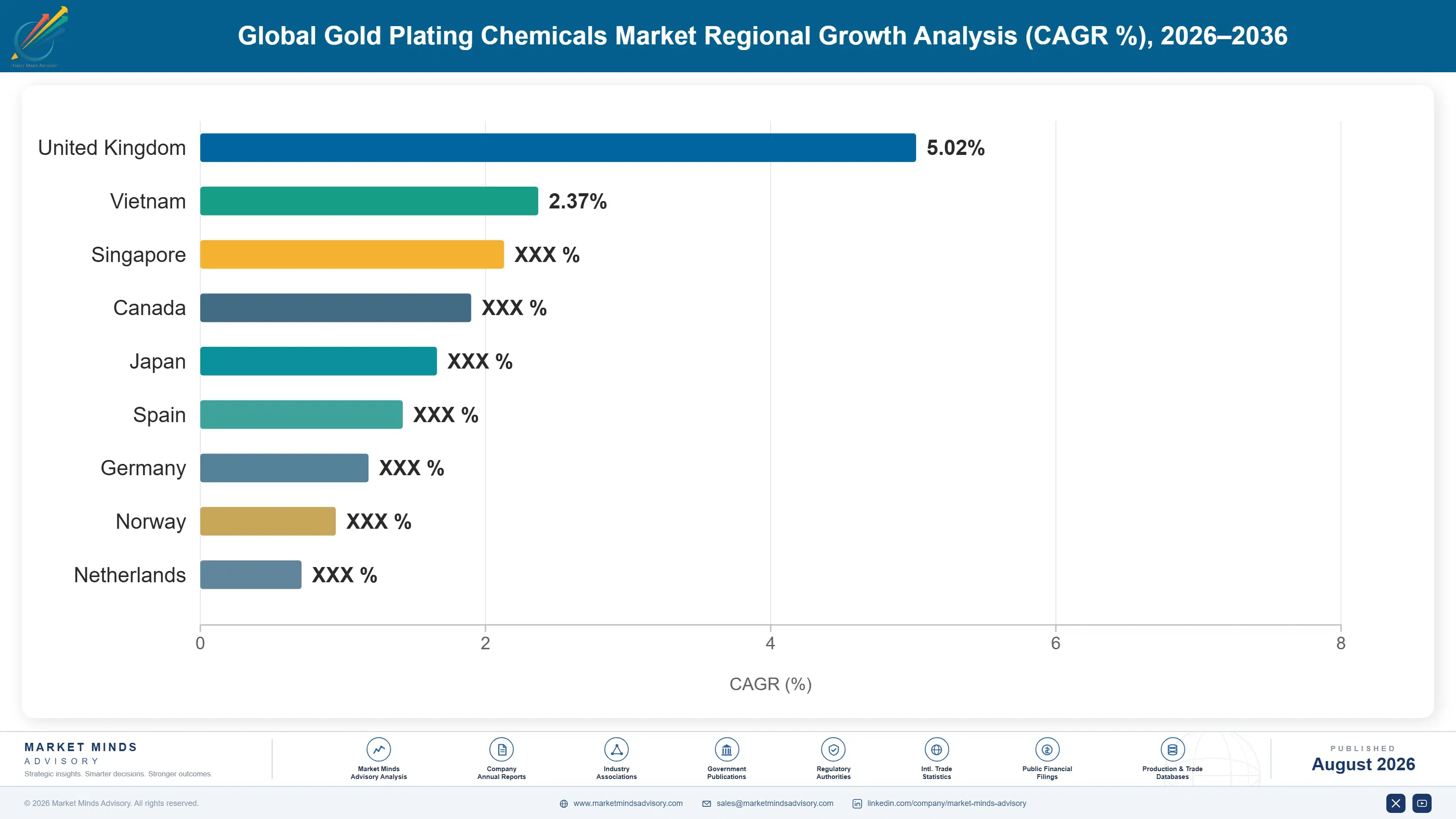
Which country is growing fastest?

Vietnam grows fastest at 9.4%, as electronics assembly and component manufacture relocate there and connector and board plating capacity follows. Regional formulators are emerging alongside international suppliers.

Report Segmentation Architecture

The full report scope spans multiple orthogonal segmentation dimensions, with cross-tabulated demand data provided for each dimension pair. Coverage extends further to regional breakdowns, trend trajectories, and the competitive detail needed to support segment-level decision-making.

By Electrolyte Chemistry and Deposition Mechanism

  • Sulphite and Non-Cyanide Gold Electrolytes
  • Electroless and Immersion Gold Chemistries
  • Hard Gold Cyanide Electrolytes
  • Soft Gold Cyanide Electrolytes
  • Decorative and Jewellery Plating Chemistries

By End-Use Industry

  • Electronic Connectors and Contacts
  • Semiconductor Packaging and Substrates
  • Printed Circuit Board Finishing
  • Medical Devices and Aerospace
  • Jewellery and Decorative Finishing

By Customer Type and Channel

  • Captive Component Manufacturer Plating
  • Job Shop and Contract Platers
  • Substrate and Board Fabricators
  • Jewellery and Decorative Finishers
  • Chemical Distributors and Metal Traders

By Region

  • North America
  • Western Europe
  • East Asia
  • South Asia and Pacific
  • Latin America
  • Middle East and Africa
  • Eastern Europe

Scope, Methodology, and Coverage

Every figure in this report is reproducible from documented input assumptions. The scope below maps the historical period, the forecast horizon, the segmentation dimensions, and the countries covered, alongside the underlying primary and qualitative methodology.
Historical Period
2020 to 2025
Forecast Period
2026 to 2036
Base Year
2025 (USD billions; MMA Primary Research Dataset, August 2026)
Market Definition
The market comprises gold plating chemicals and electrolytes supplied for electrodeposition and immersion finishing, spanning sulphite and non-cyanide gold electrolytes, electroless and immersion gold chemistries, hard gold cyanide electrolytes, soft gold cyanide electrolytes, and decorative and jewellery plating chemistries, together with the brighteners, hardeners and additive packages formulated into them. Sizing captures formulated chemical revenue at realised delivered price including contained gold value, across electronic connectors, semiconductor packaging, printed circuit board finishing, medical devices, aerospace and decorative applications. Gold bullion and refined salts sold as raw material, plating equipment, standalone refining and recovery services, other precious metal chemistries and finished plated components fall outside scope.
Quantitative Units
USD billions (current prices); formulated electrolyte volume supplied annually; USD per litre and per gram of contained gold deposited
Segmentation Dimensions
By Electrolyte Chemistry and Deposition Mechanism; By End-Use Industry; By Customer Type and Channel; By Region
Regions Covered
North America, Western Europe, East Asia, South Asia and Pacific, Latin America, Middle East and Africa, Eastern Europe
Countries Covered
USA, Canada, Mexico, Germany, Switzerland, France, Italy, UK, Netherlands, Austria, Poland, Czech Republic, Hungary, Turkey, China, Japan, South Korea, Taiwan, Vietnam, Thailand, Malaysia, Singapore, India, Philippines, Brazil, Argentina, Saudi Arabia, UAE, South Africa, and additional markets relevant to this sector
Key Companies Profiled
Technic, Umicore, Atotech, Metalor Technologies, Heraeus, Element Solutions, Japan Pure Chemical, Tanaka Kikinzoku Kogyo, Johnson Matthey, Uyemura, Okuno Chemical Industries, DuPont, Legor Group, Asahi Pretec, Materion, Aurubis, Shanghai Sinyang Semiconductor Materials, Guangdong Guanghua Sci-Tech, Schloetter, Kanto Chemical.
Quantitative Methodology
Primary survey, n=3,800 respondents, Q4 2025, six countries; demand-side model with trade association cross-validation
Qualitative Methodology
47 expert interviews, Q4 2025; applied to validate demand model assumptions, identify emerging dynamics, and assess competitive positioning
Report Format
PDF and XLSX data workbook (Word format preview document)
Publisher
Market Minds Advisory
Report Code
MMA-2026-CHM-459
Published
August 2026
Contact
sales@marketmindsadvisory.com | www.marketmindsadvisory.com

Purchase the full Global Gold Plating Chemicals Market Report (2026 to 2036).

The full report sizes the global gold plating chemicals market across five electrolyte chemistries, five end-use industries, five customer channels and seven regions, with annual forecasts to 2036 in revenue and formulated volume supplied. It separates contained metal value from formulation value added throughout, which is the analysis establishing where suppliers actually earn and where they merely invoice. Twenty participants are assessed on a consistent chemical revenue basis, with metal financing and refining capability mapped separately from formulation depth. Deposit thickness trends and thrifting behaviour are quantified application by application.
Five electrolyte chemistries sized and forecast annually
Contained metal value separated from formulation value added
Twenty participants on consistent chemical revenue basis
Metal financing capability mapped separately from formulation depth
Deposit thickness and thrifting quantified by application
Bath life and gold efficiency benchmarked across supplier ranges

Built For The People Who Decide

From boardroom strategy to bench-side execution, this report is read cover-to-cover by leaders shaping the next decade of their industry, turning demand scenarios, market dynamics and valuation benchmarks into decisions.
CXOs/ Presidents/ VPs/ Managers
M&A and Corporate Development
Strategy Teams and R&D Heads
Procurement and Product Directors
Regulatory and Compliance Leaders
Investor Relations and Equity Analysts