Market Minds Advisory
Global Cosmetic Tubes Market

Global Cosmetic Tubes Market: Mono-Material Conversion, Recycled Content Scarcity and Short Run Economics

European recyclability rules are forcing the aluminium barrier layer out of tubes that genuinely needed it, cosmetic-grade recycled resin remains scarce and expensive, and independent brands keep demanding runs converters never used to accept.

Lead Analyst

Bilal Shaikh

Published

September 2026

Make Smarter Decisions with Customized Research Insights

Request a free sample report and evaluate market opportunities, growth trends, and competitive dynamics relevant to your business needs.

2025 MARKET VALUE$3.1BMarket Size 2025
2036 FORECAST VALUE$6.1BBase Case , 2026 to 2036
CAGR 2026 TO 20366.4 %Bull 7.6% / Bear 5.2%
INCREMENTAL OPPORTUNITY$2.8BNet 10- year value creation
EXPANSION MULTIPLE1.86x2036 value over 2026 base
Strategic Levers
M&A Pipeline
Regional Outlook
Country Rankings
Competitive Intelligence
Segmental Deep-dive
Call-Us : 91 93563 13602

Executive Snapshot and Market Trajectory

A cosmetic tube has to do two contradictory things. It must keep oxygen and light away from a formulation that costs far more than the packaging, and it must now be recyclable in a stream that flatly rejects the aluminium layer which did most of that barrier work for decades.
Mono-material recyclable polyethylene tubes grow at 9.6%, a full 1.50 times the market rate, because European recyclability requirements arriving in 2030 leave brand owners no alternative and reformulating a tube specification takes years rather than months. East Asia holds 36% of global value, above the standard regional band, because the region combines the largest converting base anywhere with consumption that has grown faster than any Western market for a decade.
Concentration is genuinely low at 34% for the top five, which reflects an industry where regional converting still makes sense, because tubes are mostly air and expensive to ship far. Decoration quality and technical barrier capability separate the tiers here rather than scale, and the independent brand boom has created demand for short runs that large converters were simply never structured to serve at all.
Market Definition
This report covers squeeze tubes for cosmetic and personal care products, spanning extruded plastic, aluminium barrier laminate, plastic barrier laminate, mono-material polyethylene, recycled content and pure aluminium constructions, across skincare, haircare, oral care, colour cosmetics, sun care and fragrance applications. Rigid jars and bottles, airless pumps and dispensers, pharmaceutical and food tubes, caps and closures sold separately, and secondary cartons are excluded from the sizing.
Base Year Value
$3.1B in 2025 (MMA Primary Research Dataset, August 2026)
Forecast Period
2026 to 2036, eleven discrete annual values
CAGR
6.4% base case. Bull 7.6%. Bear 5.2%.
Fastest Growth Segment
Mono-Material Recyclable Polyethylene Tube: 9.6% CAGR
Fastest Growth Country
India: 9.2% CAGR
Fastest Growth Region
South Asia and Pacific: 8.6% CAGR
Largest Region
East Asia: 36% of 2025 global value
Market Leaders
Albéa Group, EPL Limited, Berry Global, Amcor and Huhtamaki lead on tube shipment volume. Source: MMA Analysis, July 2026.
Primary Survey
n=3,800 procurement and R&D decision-makers, Q4 2025, six countries
Methodology
Demand-side build-up, cross-validated against public data, 47 expert interviews

Global Cosmetic Tubes Market Forecast Scenarios

global-cosmetic-tubes-market-2025-2035-size-forecast-scenario-1787322147141
Between 2020 and 2025 the market compounded at 5.2%, and specification rather than volume drove most of it. Unit growth was steady across skincare and personal care while colour cosmetics fell sharply through 2020 and recovered slowly. What lifted value instead was material change: recycled content and mono-material construction both carry cost premiums that flowed through to realised tube pricing across the period.
The base case at 6.4% rests on three mechanisms. European recyclability rules arriving in 2030 force specification change across every tube sold into the region, and reformulation carries cost that converts directly into price. Emerging market category penetration, particularly across India and Southeast Asia, adds genuine unit growth where tube format products are reaching consumers who previously used sachets. Independent brand proliferation keeps expanding the number of distinct products needing packaging, which raises decoration and tooling revenue disproportionately.
The bull case at 7.6% turns on cosmetic-grade recycled resin supply improving enough to remove the cost premium constraining adoption, which would accelerate conversion well beyond regulatory minimums. The bear case at 5.2% is recyclability requirements being softened or delayed, which would remove the forcing mechanism behind the specification upgrade this market's value growth currently depends upon.

What Actually Determines Cosmetic Tube Value

The technical problem in this whole category is barrier performance, and regulation is actively making it harder. An aluminium foil layer inside a laminate tube blocks oxygen and light almost completely, which is why formulations containing vitamin C, retinol or fragrance have relied on it for decades. Recycling streams reject that layer.
TOP FIVE CONCENTRATION34%Share held by the five largest cosmetic tube converters globally
AVERAGE TUBE PRICE$0.18Typical realised price for a decorated cosmetic tube
RECYCLED CONTENT SHARE22%Average post-consumer material content across new tube production
RESIN COST SHARE42% of COGSPolymer and laminate content as portion of tube cost
DECORATION COST SHARE19% of COGSPrinting and finishing as portion of manufactured cost
MINIMUM ORDER QUANTITY20,000 unitsTypical smallest economic run a converter will accept
Mono-material polyethylene construction solves the recyclability problem and reopens the barrier one. Converters have responded with high-barrier polymer layers, coatings and thicker walls, and the results are adequate for many formulations and genuinely marginal for others. Brand owners with sensitive products are running stability testing that takes eighteen months, which is why specification change moves slowly even against a fixed regulatory deadline that nobody is able to negotiate away.
Commercially the other force is brand proliferation. Independent and direct-to-consumer beauty brands have multiplied enormously in number, and each one needs tubes in quantities well below anything traditional converting economics ever accepted. Digital decoration has made short runs viable, minimum order quantities have fallen to around 20,000 units, and converters willing to serve that demand earn considerably better margins than any volume contract delivers.
"There is a genuine engineering conflict here that the sustainability conversation tends to skate over. The aluminium layer everyone wants removed is doing real work protecting formulations that cost fifty times what the tube does. Replacing it properly is harder than the deadline assumes."
Practice Director, Packaging and Converting, Market Minds Advisory · MMA Packaging Practice · August 2026

Market Trends

Mono-Material Construction Removes The Aluminium Barrier Layer

European recyclability requirements arriving in 2030 exclude the aluminium foil layer that laminate tubes have used for decades, forcing conversion to all-polyethylene construction that recycling streams accept. The engineering consequence is entirely real: aluminium blocks oxygen almost completely, and no polymer barrier currently matches it. Converters have responded with high-barrier layers, coatings and thicker walls, which adds roughly 14% to tube cost while delivering barrier performance that is adequate for many formulations and genuinely marginal for the most sensitive ones. Stability testing takes eighteen months per product. Nobody can negotiate the deadline.
Market Impact: Covers 100% of European packaging
Digital Decoration Makes Short Production Runs Genuinely Viable

Traditional offset and screen decoration carries plate and setup costs that made runs below a hundred thousand units genuinely uneconomic, which excluded independent brands from proper tube packaging altogether. Digital printing removes the setup cost, and minimum order quantities have fallen toward 20,000 units as a direct result. Converters serving that demand earn considerably better margins than volume contracts deliver, because independent brands buy on speed, flexibility and design freedom rather than on price per thousand units. The segment barely existed five years ago. Setup cost was always the barrier.
Market Impact: Adds 8 billion annual units

Market Opportunities and Growth Drivers

European Packaging Regulation Forces Specification Change Outright

The Packaging and Packaging Waste Regulation requires all packaging placed on the European market to be recyclable by 2030 and sets recycled content targets alongside it, on a timetable brand owners cannot negotiate. Every laminate tube containing an aluminium layer must therefore be reformulated, tested for stability and fully requalified, which takes eighteen months or more for each individual product. That deadline is the single largest demand driver anywhere in this market, and it applies regardless of whether a single consumer ever asked for it. Compliance here is simply not optional.
Market Impact: Costs 45% above virgin resin

Category Penetration Across Emerging Markets Adds Unit Volume

Skincare, haircare and oral care products in tube format are reaching consumers across India, Southeast Asia and Africa who previously used sachets, jars or nothing at all, and the volumes involved are enormous even at low unit prices. That growth is genuine unit expansion rather than the specification upgrade driving Western value, which makes it genuinely additive to the global total rather than merely redistributive. Local converting capacity is building alongside, since tubes are mostly air and genuinely expensive to ship any real distance from where they were made. Local capacity follows demand.
Market Impact: Cuts oxygen barrier by 60%

Market Restraints and Challenges

Cosmetic-Grade Recycled Resin Remains Scarce And Expensive

Recycled polyethylene suitable for cosmetic packaging must meet purity, odour and colour consistency standards that ordinary post-consumer material does not reach, and the qualified supply is a small fraction of total recycled volume. The root cause is collection and sorting infrastructure rather than any processing limitation. Commercially the premium runs well above virgin resin, which caps adoption below what brand commitments actually imply. Participants are responding by contracting recycled supply on multi-year terms, by investing in sorting capacity, and by blending carefully to meet stated targets rather than exceed them.
Market Impact: Adds 14% to tube cost

Barrier Performance Limits Mono-Material Adoption On Sensitive Products

Formulations containing vitamin C, retinol, essential oils or unstable actives depend on the oxygen barrier that aluminium foil provides, and polymer alternatives do not currently match it across a full shelf life. The root cause is material physics rather than converter capability. Commercially this leaves some products with no compliant option that preserves stability at all, which is a genuine problem given how fixed the deadline is. Participants are responding with high-barrier polymer development, coating technologies, reduced shelf-life claims and nitrogen flushing at the filling line itself. Some formulations simply have no answer yet.
Market Impact: Cuts minimum runs 80%
3 additional market trends, 4 additional growth drivers, and 2 additional restraints and challenges are covered in the full report. Contact sales@marketmindsadvisory.com to access the complete intelligence.

Segment CAGR and Growth Architecture

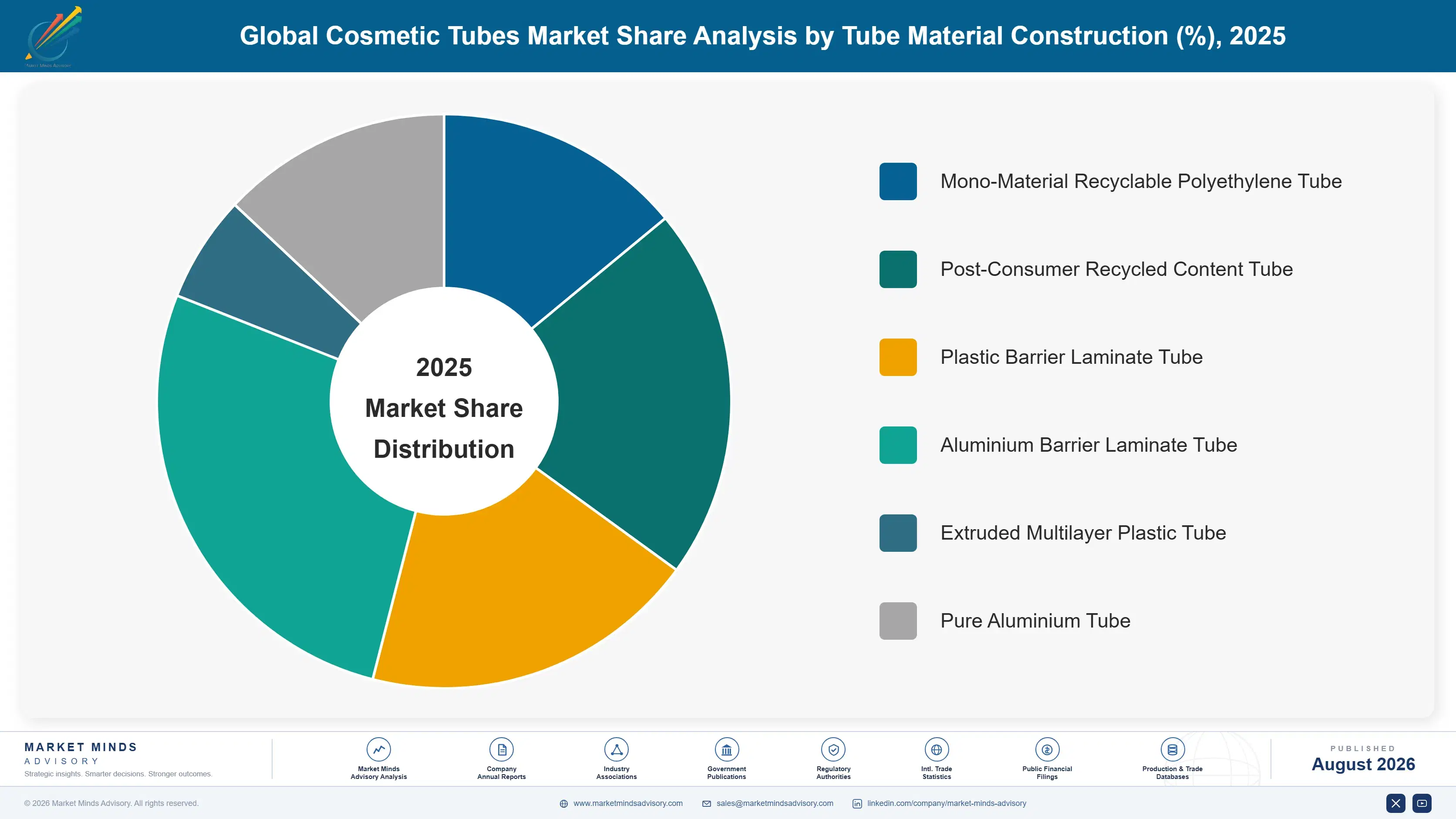
Segmentation follows tube material construction, because what the wall is made from determines barrier performance, recyclability, decoration options, unit cost and which formulations the tube can legally and practically carry. Tube diameter, closure choice, decoration technique and order quantity all sit downstream of that material decision, and every one of them is priced directly against it.
global-cosmetic-tubes-market-2025-2035-market-share-analysis-1787322147676

Mono-Material Recyclable Polyethylene Tube

The fastest segment at 9.6%, a full 1.50 times the market rate, covering tubes built entirely from polyethylene with no aluminium foil or dissimilar polymer layer, so the whole article enters a recycling stream that accepts it. Regulation created this segment outright. European rules arriving in 2030 require recyclability across all packaging, and a laminate tube containing aluminium simply does not qualify regardless of how well it performs. Construction adds roughly 14% to tube cost through high-barrier layers, coatings and thicker walls compensating for the foil that has been removed. What limits adoption is barrier performance, since the most sensitive formulations still need protection that no polymer construction currently matches across a full shelf life.
CAGR 9.6%

Post-Consumer Recycled Content Tube

Growing at 8.0% on tubes incorporating post-consumer recycled polyethylene, generally blended with virgin material to hit brand or regulatory content targets without compromising appearance or processing. Supply rather than demand is what constrains this segment entirely. Cosmetic-grade recycled resin must meet purity, odour and colour consistency standards that most post-consumer material never reaches, and qualified volume is a small fraction of what recycling produces. The premium runs well above virgin resin as a direct consequence. Brand commitments and regulatory targets both push adoption harder than supply can currently support, which is exactly why converters holding contracted recycled resin positions carry a genuine commercial advantage over anybody buying on the spot market.
CAGR 8.0%
Full segment breakdown across 6 segments available in the complete report.

Regional Architecture and Country Demand Map

East Asia holds 36% of global value on the largest converting base anywhere, combined with consumption that has grown faster than any Western market. Western Europe follows on regulation-driven specification value, while growth runs fastest across South Asia and Pacific on category penetration rather than premiumisation.

East Asia

Note: East Asia holds 36% against a 22 to 30% band because the region combines the largest cosmetic tube manufacturing base anywhere with consumption that has been growing faster than any Western market for a decade. Korean skincare routines run to many more steps than Western equivalents, and each step is frequently a separate tube, which drives per-capita consumption well above what income alone would predict. Chinese converters around Guangdong and Zhejiang supply domestic brands and export heavily into Europe and North America. Japanese demand is mature but premium, with decoration and finish quality standards that set the reference for the whole industry. Manufacturing and consumption reinforce each other here.
Share: 36% | CAGR: 7.6% (2026 to 2036)

Western Europe

Regulation shapes this region more than volume does. The Packaging and Packaging Waste Regulation requires all packaging to be recyclable by 2030 and sets recycled content targets alongside, which has forced brand owners to reformulate tube specifications on a timetable nobody can negotiate. Mono-material polyethylene construction has advanced furthest here as a direct result. Albéa and Hoffmann Neopac both hold deep technical positions built on that transition. Premium skincare and luxury cosmetic brands headquartered across France, Germany and Italy specify decoration and finish quality that carries realised pricing well above the global average for otherwise comparable tubes. Regulation rather than consumer demand is what actually drives specification change across this region.
Share: 22% | CAGR: 4.9% (2026 to 2036)
Regional intelligence for 5 additional markets available in the complete report: North America, South Asia and Pacific, Latin America, Middle East and Africa, Eastern Europe. Contact sales@marketmindsadvisory.com.
global-cosmetic-tubes-market-2025-2035-country-cagr-analysis-1787322148198

Where Cosmetic Tube Margin Is Won

Four commercial positions separate the converters earning genuine margin from those extruding plain tubes at outright commodity rates: contracting cosmetic-grade recycled resin before demand outruns supply, holding barrier technology that mono-material construction genuinely needs, serving the independent brands that large volume converters routinely decline, and owning decoration and finishing capability outright rather than subcontracting any of it away.

Contract Cosmetic-Grade Recycled Resin Before Supply Tightens

Recycled polyethylene meeting cosmetic purity, odour and colour standards is a small fraction of total recycled volume, and the premium already runs 45% above virgin resin with brand commitments pushing demand harder than supply can follow. Converters holding multi-year contracted positions quote recycled content confidently while competitors decline enquiries entirely, and they realise 20% to 27% higher pricing on that work. The commitment carries genuine volume risk, which is exactly why so few converters anywhere have actually made it yet. Nobody can quote what they are unable to source in the first place.
Market Impact: Realises 27% higher pricing on recycled content tubes

Hold Barrier Technology Mono-Material Construction Genuinely Needs

Removing the aluminium layer from a tube cuts its oxygen barrier by roughly 60%, and brand owners with sensitive formulations need that performance recovered before they can convert at all. Converters holding proprietary high-barrier polymer layers, coating processes and validated stability data win those specifications at 22% to 30% higher pricing than standard mono-material construction commands. The development takes years and considerable stability testing, which is precisely why the capability concentrates among the converters who started before the regulation had even been finalised. Validated stability data is genuinely the whole asset here.
Market Impact: Commands 30% higher pricing on barrier tube construction

Serve Independent Brands That Volume Converters Decline

Independent and direct-to-consumer beauty brands need runs around 20,000 units that traditional converting economics rejected outright, and digital decoration has made those runs genuinely viable. Converters serving that demand realise 35% to 48% higher price per tube than volume contracts deliver, because the buyer values speed, flexibility and design freedom rather than cost per thousand. The investment required is digital decoration equipment and order handling systems rather than extrusion capacity, which makes it achievable without committing to any major capital programme. The whole segment barely existed a decade ago at all.
Market Impact: Realises 48% higher price on every tube shipped

Own Decoration Capability Rather Than Subcontracting Printing

Decoration accounts for roughly 19% of manufactured cost and considerably more of what the brand owner is actually buying, since a tube's appearance is the product's shelf presence. Converters holding printing, foiling and finishing in house capture 11 to 16 points of additional margin per tube and control the lead time that independent brands care about most. Subcontracting surrenders both the margin and the schedule at once, and it makes the short-run business carrying the best pricing considerably harder to serve properly. Lead time frequently matters more than price to these customers.
Market Impact: Captures 16 additional margin points on each tube

Who Controls the Margin Pool

Concentration sits at 34% for the top five measured on tube shipment volume, the basis used throughout this section, and it is low because tubes are mostly air and expensive to ship far, which keeps regional converting sensible. Albéa leads on European premium work, EPL manufactures at genuine global scale from an Indian base, and Berry, Amcor and Huhtamaki hold positions built across wider packaging portfolios rather than tubes alone.
Competitive activity runs on three fronts. Barrier technology for mono-material construction is the first and the most consequential, since it determines which converters can serve sensitive formulations after the aluminium layer is removed. Contracted recycled resin supply is the second, and it separates converters who can quote recycled content from those declining the enquiry. The third is short-run capability, where independent brand demand carries pricing volume contracts never approach.

Pressure arrives from two directions. Chinese and Indian converters compete at delivered costs Western operations cannot approach on simple decoration work. Separately, brand owners facing a 2030 deadline are consolidating supply toward converters who can demonstrate compliant construction now rather than promising it later. Rankings will shift on who holds validated barrier performance once stability testing completes across major brand portfolios.
global-cosmetic-tubes-market-2025-2035-company-positioning-matrix-1787322148714

Competitive Moat and Risk Dimensions

ALBÉA GROUP

Moat: Premium decoration and barrier development

Deep decoration capability serving European luxury and premium skincare brands supports pricing that commodity converting never reaches, and long relationships with those brand owners mean specification conversations happen during development rather than through a tender. Early investment in mono-material barrier construction also positions the business for exactly the regulatory transition now forcing every European specification to change.
ALBÉA GROUP

Risk: European cost base exposure

A manufacturing footprint weighted toward Western Europe carries labour and energy costs that Asian competitors do not, and the premium decoration work justifying that position is a smaller share of total volume than the group needs. Asian converters improving decoration quality steadily narrow the technical gap that currently protects the pricing.
EPL LIMITED

Moat: Global scale from low-cost base

Manufacturing at genuine global scale from an Indian cost base while operating plants across several continents gives the business both delivered cost advantage and local supply capability, which tube economics reward heavily. Oral care volumes provide a stable base load that supports investment in the cosmetic work carrying better margins.
EPL LIMITED

Risk: Oral care volume concentration

Substantial dependence on oral care tube volumes ties results to a small number of very large multinational customers whose procurement is ruthless and whose volumes move on their own strategic decisions. Cosmetic and personal care diversification is progressing but the concentration remains a genuine exposure that pricing pressure repeatedly demonstrates.

Players Tracked

Prominent Players

Albéa Group
EPL Limited
Berry Global
Amcor
Huhtamaki

Other Key Players

CCL Industries
Hoffmann Neopac
Alltub
Auber Packaging
Linhardt
Perfektup Ambalaj
Antilla Propack
Tubopress Italia
Montebello Packaging
Cosmopak
Shanghai Zijiang Enterprise
Lageen Tubes
Unette Corporation
Pirlo GmbH
IntraPac International

Recent Developments

FEBRUARY 2025

High-barrier mono-material tube qualified for sensitive formulation

A European tube converter completed full stability qualification for a mono-material polyethylene tube carrying an unstable vitamin C formulation, recovering enough oxygen barrier through engineered polymer layers and coating to match the aluminium laminate construction it replaces across a genuinely full three year shelf life.
Signal: Barrier recovery in mono-material construction determines which formulations can actually convert at all before the deadline
JULY 2025

Multi-year cosmetic-grade recycled resin supply agreement signed

A European tube converter signed a multi-year supply agreement covering cosmetic-grade recycled polyethylene during the year, which secures qualified volume at contracted pricing while its competitors continued declining recycled content enquiries which they had no reliable way of fulfilling at all from the spot market.
Signal: Contracted recycled resin access rather than converting capability now determines who can quote recycled content work
OCTOBER 2025

Digital decoration line commissioned for short run production

A European tube converter commissioned a new digital tube decoration line dedicated entirely to short run decoration production, which cuts its minimum order quantities toward twenty thousand units and opens the independent brand segment that traditional setup economics had excluded from proper decorated tube packaging entirely.
Signal: Digital decoration is opening a short run segment that carries considerably better pricing than volume contracts

What Drives Cosmetic Tube Cost

Polymer resin and laminate structure account for roughly 42% of manufactured tube cost, and the mix matters enormously because cosmetic-grade recycled polyethylene carries a substantial premium over virgin material. Decoration, including printing, foiling and finishing, contributes around 19%. Caps and closures add about 14%, extrusion and conversion energy roughly 9%, and tooling amortisation a further 6% across a typical production run, though that last figure rises sharply on short runs.
Polymer pricing moved sharply through 2021 and 2022 on feedstock and energy costs across Europe particularly, and converters on annually negotiated contracts absorbed increases they could not pass through to brand owners holding fixed pricing. Recycled resin moved differently but no more helpfully, since scarcity rather than feedstock keeps its premium elevated. Amcor Annual Report 2025 identifies raw material and energy cost as continuing factors across its operations.

The disadvantage mechanism is recycled resin access rather than virgin polymer purchasing. A converter without contracted cosmetic-grade recycled supply simply cannot quote work that specifies it, which removes them from an increasing share of tenders regardless of price competitiveness. Exposure varies by region too: European converters face the regulatory requirement and the highest energy costs at once.
global-cosmetic-tubes-market-2025-2035-cost-volatility-analysis-1787322148909

Contract recycled resin supply on multi-year committed terms

Cosmetic-grade recycled polyethylene is scarce enough that spot buying means declining enquiries rather than paying more. Multi-year contracted positions convert that into a genuine competitive advantage, since a converter able to quote recycled content wins tenders competitors cannot even bid. The cost is volume commitment against demand brand owners have promised more firmly than ordered.

Design tube structures around available recycled grades

Recycled resin varies in colour, odour and processing behaviour, and structures engineered to tolerate that variation use far more of it than designs assuming virgin consistency. Placing recycled material in inner layers where appearance matters less, with virgin skin outside, raises achievable content substantially. The engineering is straightforward and most converters simply have not done it systematically yet.

Recover extrusion process heat into building and drying loads

Extrusion rejects substantial heat that most plants vent, and European energy pricing has made that waste genuinely expensive rather than merely untidy. Recovery into building heating, material drying or wash water cuts net consumption on a cost line that has moved considerably faster than resin. Payback runs a few years at European rates and much longer where power remains cheap.

Portfolio Architecture for Margin Defence

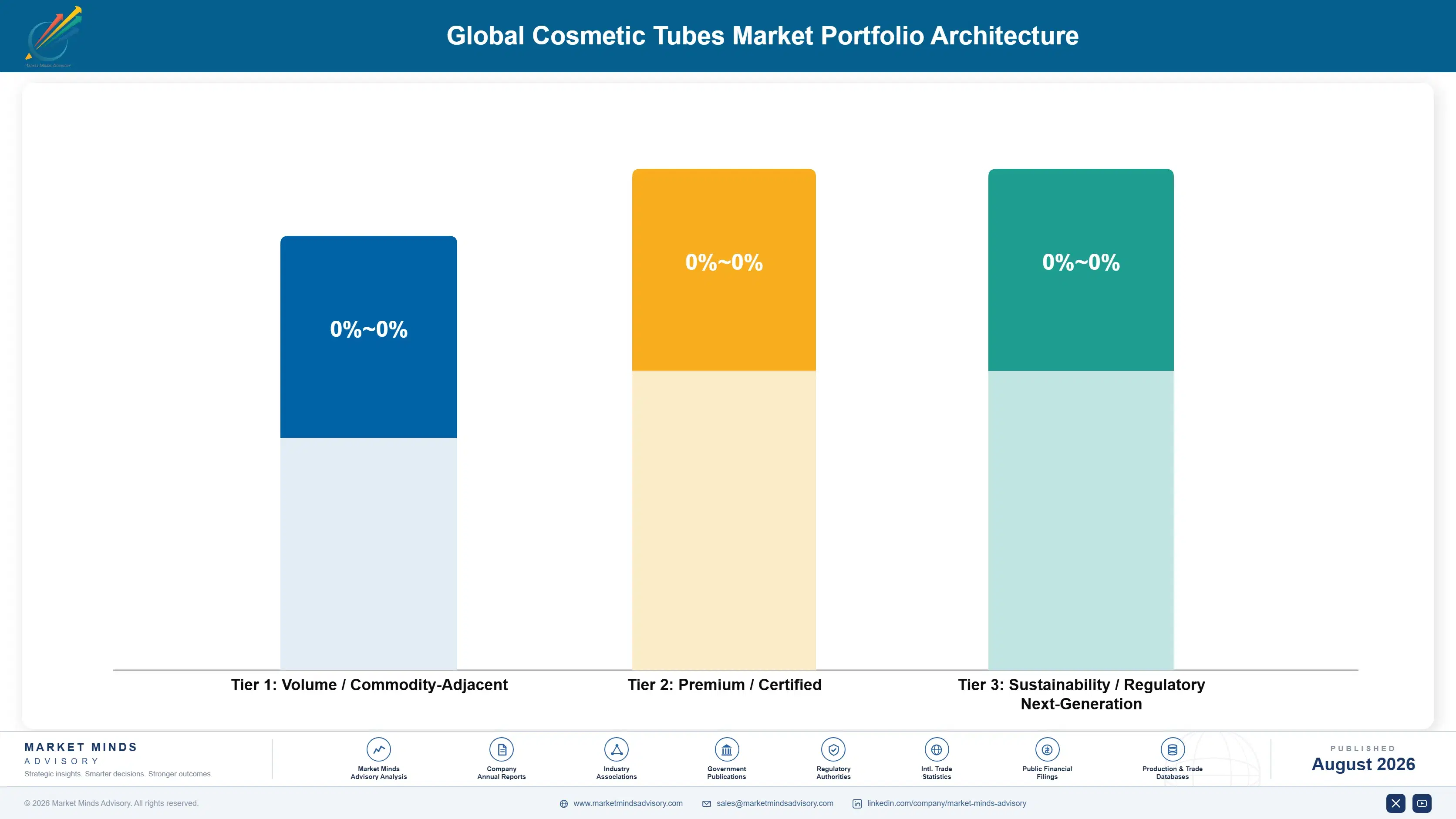
Portfolio economics here divide on decoration and material specification rather than on tube size or format. Standard extruded tubes with simple decoration sold into mass-market personal care contracts earn gross margins in the mid teens, because the specification is straightforward, several converters bid comparably and the brand owner negotiates hard against volumes measured in tens of millions. Volume secures the relationship rather than any real margin.
The premium tier is high-decoration tubes for premium skincare and colour cosmetics. Printing quality, foiling, soft-touch finishes and tight colour matching all demand capability that commodity converting lacks, and the tube is the product's shelf presence rather than merely its container. Margins run in the high twenties to mid thirties. Finishing capability decides where in that range a converter lands.

Above both sits validated mono-material barrier construction and short-run digital work. Barrier-recovered mono-material tubes solve a regulatory problem brand owners cannot solve themselves, while short runs serve independent brands buying on speed and flexibility rather than price. Margins reach the high thirties on both, and each depends on capability that took years to build rather than on any pricing decision.

Volume / Commodity-Adjacent

Standard extruded tubes with simple decoration for mass-market personal care. Straightforward specification, several comparable bidders and volumes in the tens of millions together hold margin very close to the floor across this whole segment.
Gross Margin: 13 to 19%

Premium / Certified

High-decoration tubes supplied for premium skincare and colour cosmetics brands. The range reflects decoration complexity and how much printing and finishing capability a converter genuinely holds internally rather than subcontracting out.
Gross Margin: 27 to 35%

Sustainability / Regulatory / Next-Generation

Validated mono-material barrier construction together with short-run digital decoration production work. The wide range spans standard recyclable tubes through to fully validated barrier structures carrying stability data for sensitive formulations.
Gross Margin: 35 to 43%
global-cosmetic-tubes-market-2025-2035-portfolio-architecture-1787322149401

High-value Sub-segments and Strategic Watch-out

Validated Mono-Material Barrier Tubes

High value and high growth sitting squarely together. Brand owners facing a 2030 deadline cannot solve the barrier problem themselves, validation takes a full eighteen months of stability testing to complete, and converters holding proven validated structures win specifications that delivered price alone would never have decided.
Gross Margin: 37 to 44%

Short Run Digital Decoration Work

High value running on genuinely rapid growth. Independent brands buy on speed, flexibility and design freedom rather than cost per thousand, minimum quantities have fallen toward twenty thousand units, and traditional volume converters were simply never structured to serve that kind of demand at all.
Gross Margin: 36 to 43%

Premium Decorated Skincare Tubes

The quality core that carries most of this industry's realised value today. A tube is a premium product's entire shelf presence rather than merely its container, and printing, foiling and colour matching capability separate converters far more decisively than any manufacturing scale advantage ever does.
Gross Margin: 27 to 35%

Mass Market Standard Tube Supply

The strategic watch-out sitting squarely inside this particular portfolio. Volumes here are enormous and they keep extrusion lines properly loaded, but the specifications are straightforward, several converters bid comparably against each other, and low-cost imports simply set the price at the simpler decoration end of the range.
Gross Margin: 13 to 19%

How Cosmetic Tube Demand Repeats

The repeat business is the product listing rather than any individual order. A tube qualified for a formulation ships against that product for as long as the brand keeps selling it, which for an established skincare line means years of steady repeat volume, and requalifying a different tube means repeating stability testing that takes eighteen months. Winning the original specification therefore secures far more than the first order suggests it does.
Stickiness varies considerably by brand type. Large multinational personal care companies are moderately sticky, holding qualified suppliers but retendering volume contracts regularly and playing converters against each other on price. Premium skincare brands are considerably stickier because decoration quality and colour consistency are difficult to replicate exactly across suppliers. Independent brands are stickiest of all in practice, since they lack the resources to requalify and value a converter who answers the telephone.

The buyer profile has shifted noticeably. Tube specification once sat with packaging engineers evaluating barrier, fill compatibility and line performance. Today it increasingly involves sustainability and regulatory teams weighing recyclability, recycled content and compliance deadlines alongside, which favours converters who can answer regulatory questions as convincingly as technical ones and provide the documentation to support them.
global-cosmetic-tubes-market-2025-2035-end-use-penetration-index-1787322149887

Where To Compete And Why

These are among the four positions where our research anticipates prominent divergence between winners and laggards over the coming forecast period. Each is grounded in the demand model, the regulatory perimeter, and the announced capacity pipeline.
01 / RECYCLED RESIN CONTRACTING

Access decides who can even quote

Cosmetic-grade recycled polyethylene meeting purity, odour and colour standards is a small fraction of total recycled volume, and the premium already runs 45% above virgin resin while brand commitments push demand harder than supply follows. Converters holding multi-year contracted positions quote recycled content confidently while competitors decline enquiries outright, and they realise 20% to 27% higher pricing on that work as a direct result. The commitment carries genuine volume risk, which is exactly why so few converters anywhere have actually made it.
02 / BARRIER TECHNOLOGY OWNERSHIP

Removing foil created the real opportunity

Taking the aluminium layer out of a tube cuts oxygen barrier by roughly 60%, and brand owners with sensitive formulations need that performance recovered before they can convert anything at all. Converters holding proprietary high-barrier layers, coating processes and validated stability data win those specifications at 22% to 30% higher pricing than standard mono-material construction commands. Development takes years of stability testing, which is precisely why the capability concentrates among converters who started well before the regulation had even been finalised.
03 / SHORT RUN CHANNEL BUILDING

Independent brands pay for flexibility

Independent and direct-to-consumer beauty brands need runs around 20,000 units that traditional converting economics rejected outright, and digital decoration has finally made those runs viable to serve. Converters doing so realise 35% to 48% higher price per tube than volume contracts deliver, because the buyer values speed, flexibility and design freedom rather than cost per thousand. The investment required is digital equipment and order handling systems rather than extrusion capacity, which makes it achievable considerably more quickly than anything else here.
04 / DECORATION CAPABILITY OWNERSHIP

The tube is the product's shelf presence

Decoration accounts for roughly 19% of manufactured cost and considerably more of what a brand owner is actually buying, since appearance is what sells a premium product from a crowded shelf. Converters holding printing, foiling and finishing in house capture 11 to 16 points of additional margin per tube and control the lead time independent brands care most about. Subcontracting surrenders both the margin and the schedule at once, and it makes short-run work considerably harder to serve properly at all.

Engagement Snapshot From the Field

A live engagement with an industry participant carrying material or product regulatory and market exposure ahead of a defining policy shift, showing how our research translates into a defensible multi-year portfolio strategy.
MARKET MINDS ADVISORY · CLIENT ENGAGEMENT SUMMARY
Global Cosmetic Tubes Producer Strategic Portfolio Review and Transition Roadmap 2026·Investment Scenario on Global Cosmetic Tubes Exposure Evaluation 2025-26
CLIENT PROFILE
A European cosmetic tube converter operating three plants with annual revenue near $148 million (client-reported, unverified by MMA), roughly 79% of it from standard extruded and laminate tubes supplied to mid-market personal care brands. The business held solid extrusion capability and long customer relationships but subcontracted decoration, held no contracted recycled resin supply, and had no validated mono-material barrier structure.
STRATEGIC CHALLENGE
Brand owners were consolidating supply toward converters able to demonstrate compliant construction ahead of the 2030 recyclability deadline, and the client had been excluded from several requalification tenders on that basis. Management needed to decide between developing barrier technology, contracting recycled resin supply, or investing in decoration and digital capability to serve independent brands instead.
MMA APPROACH
MMA mapped requalification timing across 54 brand owner product portfolios, quantified cosmetic-grade recycled resin availability against contracted and spot positions, and assessed the development and capital requirements for barrier, decoration and digital capability separately. Twenty-two expert interviews with brand packaging engineers, sustainability leads and resin suppliers tested where specifications would actually be decided.
KEY FINDINGS
  1. Requalification tenders were being awarded 24 to 30 months ahead of the deadline, which meant the window for the client to establish compliant capability was considerably narrower than management had assumed.
  2. Contracted recycled resin availability was the binding constraint on quoting recycled content work, and the client had been declining enquiries it could otherwise have won on price and quality.
  3. Subcontracted decoration cost the client roughly 13 points of margin per tube and added two weeks of lead time that independent brand enquiries consistently found unacceptable.
  4. Barrier technology development would take approximately 28 months to validated stability data, which was achievable but only if started immediately rather than after other investments.
CLIENT PROFILE
A European cosmetic tube converter operating three plants with annual revenue near $148 million (client-reported, unverified by MMA), roughly 79% of it from standard extruded and laminate tubes supplied to mid-market personal care brands. The business held solid extrusion capability and long customer relationships but subcontracted decoration, held no contracted recycled resin supply, and had no validated mono-material barrier structure.
STRATEGIC CHALLENGE
Brand owners were consolidating supply toward converters able to demonstrate compliant construction ahead of the 2030 recyclability deadline, and the client had been excluded from several requalification tenders on that basis. Management needed to decide between developing barrier technology, contracting recycled resin supply, or investing in decoration and digital capability to serve independent brands instead.
MMA APPROACH
MMA mapped requalification timing across 54 brand owner product portfolios, quantified cosmetic-grade recycled resin availability against contracted and spot positions, and assessed the development and capital requirements for barrier, decoration and digital capability separately. Twenty-two expert interviews with brand packaging engineers, sustainability leads and resin suppliers tested where specifications would actually be decided.
KEY FINDINGS
  1. Requalification tenders were being awarded 24 to 30 months ahead of the deadline, which meant the window for the client to establish compliant capability was considerably narrower than management had assumed.
  2. Contracted recycled resin availability was the binding constraint on quoting recycled content work, and the client had been declining enquiries it could otherwise have won on price and quality.
  3. Subcontracted decoration cost the client roughly 13 points of margin per tube and added two weeks of lead time that independent brand enquiries consistently found unacceptable.
  4. Barrier technology development would take approximately 28 months to validated stability data, which was achievable but only if started immediately rather than after other investments.
RECOMMENDED STRATEGY
Phase 1: Phase one: contract cosmetic-grade recycled resin supply immediately, since it opens tenders the client is currently declining and requires no development work at all. Phase 2: Phase two: bring decoration in house, recovering margin and lead time while opening the independent brand segment that carries considerably better pricing. Phase 3: Phase three: begin barrier structure development in parallel, accepting the twenty-eight month timeline rather than deferring it behind the other two.
OUTCOME
The client contracted recycled resin within five months and won three requalification tenders it had previously declined (client-reported, unverified by MMA). Decoration was brought in house the following year, blended gross margin improved by roughly seven points, and barrier validation is proceeding on schedule toward 2028.

Frequently Asked Questions

Foundational context covering the market sizes, CAGR, scope, country, region and competition that inform every finding below. This section is provided to cover basics and most often pre-purchase conversations, answered from the MMA Primary Research Dataset.

What is the current size of the Global Cosmetic Tubes Market?

The global cosmetic tubes market was valued at $3.10 billion in 2025, reaching an estimated $3.30 billion in 2026. That covers squeeze tubes across skincare, haircare, oral care, colour cosmetics and sun care applications.

How large will the Global Cosmetic Tubes Market be by 2036?

MMA forecasts the market reaching $6.14 billion by 2036, an increase of $2.84 billion over the 2026 base. That represents an expansion multiple of 1.86 times across the forecast period.

What is the CAGR for the Global Cosmetic Tubes Market 2026 to 2036?

The base case compound annual growth rate is 6.4%, with a bull case of 7.6% and a bear case of 5.2%. Historical growth between 2020 and 2025 ran at 5.2% annually.

Which segment is growing fastest?

Mono-material recyclable polyethylene tubes grow at 9.6%, a full 1.50 times the market rate, as European recyclability rules force conversion. Post-consumer recycled content tubes follow at 8.0% annually.

Who are the major companies in the Global Cosmetic Tubes Market?

Albéa Group, EPL Limited, Berry Global, Amcor and Huhtamaki lead on tube shipment volume. Together they account for roughly 34% of global shipments, which is unusually fragmented for packaging.

Which country is growing fastest?

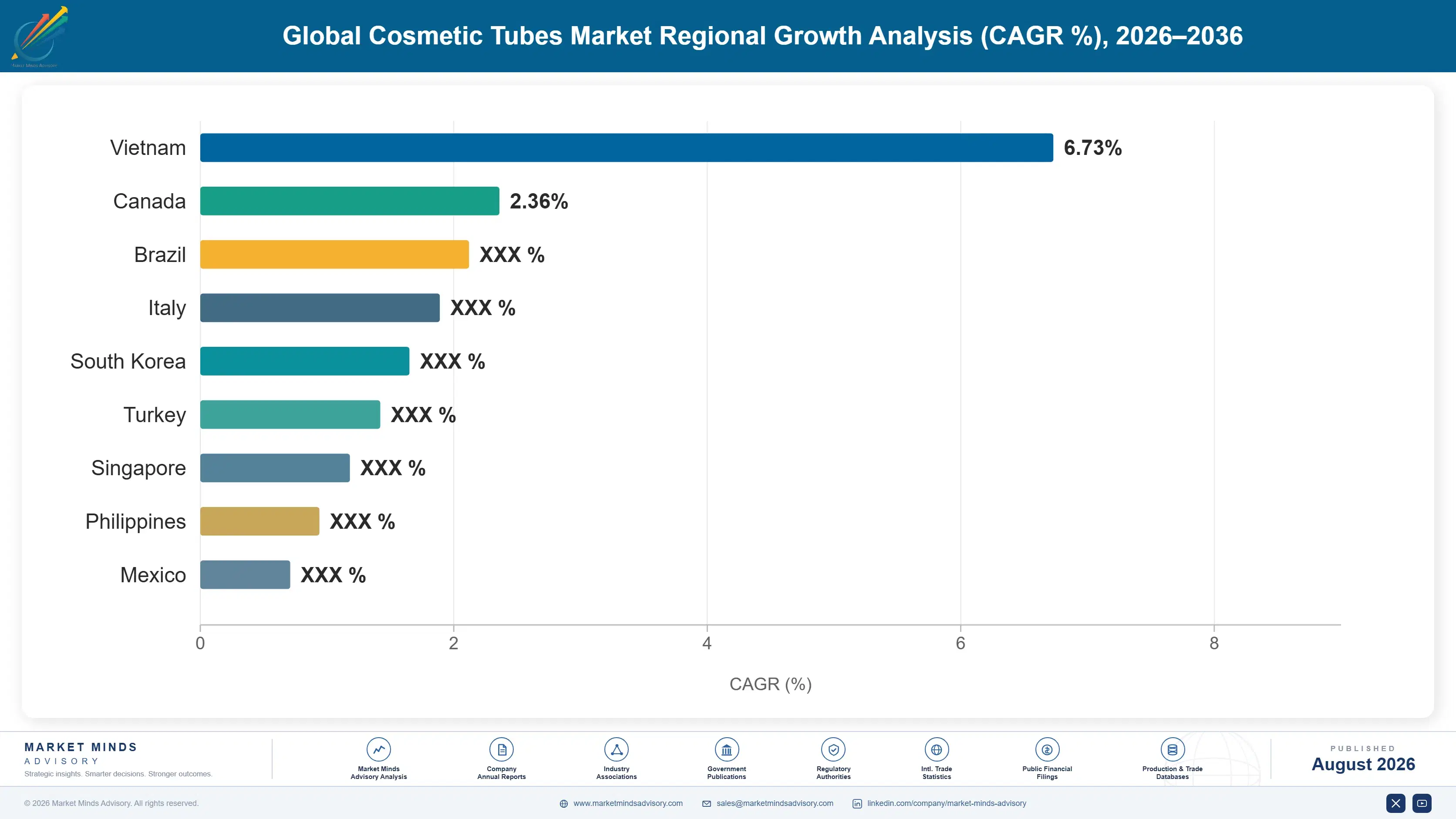
India grows fastest at 9.2% annually, driven by tube format products reaching consumers who previously used sachets across skincare, haircare and oral care. Indonesia and Vietnam follow closely.

Report Segmentation Architecture

The full report scope spans multiple orthogonal segmentation dimensions, with cross-tabulated demand data provided for each dimension pair. Coverage extends further to regional breakdowns, trend trajectories, and the competitive detail needed to support segment-level decision-making.

By Tube Material Construction

  • Mono-Material Recyclable Polyethylene Tube
  • Post-Consumer Recycled Content Tube
  • Plastic Barrier Laminate Tube
  • Aluminium Barrier Laminate Tube
  • Extruded Multilayer Plastic Tube
  • Pure Aluminium Tube

By End-Use Industry

  • Skincare and Facial Care
  • Haircare and Styling
  • Oral Care
  • Colour Cosmetics
  • Sun Care and Protection
  • Fragrance and Body Care

By Commercial Dimension

  • Multinational Brand Direct Supply
  • Contract Manufacturer and Filler Supply
  • Independent and Direct-to-Consumer Brand Supply
  • Private Label and Retailer Brand Supply
  • Distributor and Stock Tube Channel

By Region

  • North America
  • Western Europe
  • East Asia
  • South Asia and Pacific
  • Latin America
  • Middle East and Africa
  • Eastern Europe

Scope, Methodology, and Coverage

Every figure in this report is reproducible from documented input assumptions. The scope below maps the historical period, the forecast horizon, the segmentation dimensions, and the countries covered, alongside the underlying primary and qualitative methodology.
Historical Period
2020 to 2025
Forecast Period
2026 to 2036
Base Year
2025 (USD billions; MMA Primary Research Dataset, August 2026)
Market Definition
This report covers squeeze tubes for cosmetic and personal care products, spanning extruded multilayer plastic, aluminium barrier laminate, plastic barrier laminate, mono-material polyethylene, post-consumer recycled content and pure aluminium constructions, across skincare, haircare, oral care, colour cosmetics, sun care and body care applications. Rigid jars and bottles, airless pumps and dispensers, pharmaceutical and food tubes, caps and closures sold separately, applicators, and secondary cartons or outer packaging are excluded from the sizing.
Quantitative Units
USD billions at converter realised value; tube shipments in billions of units; average realised price in USD per tube.
Segmentation Dimensions
By tube material construction; by end-use industry; by commercial dimension; by region.
Regions Covered
North America, Western Europe, East Asia, South Asia and Pacific, Latin America, Middle East and Africa, Eastern Europe
Countries Covered
China, South Korea, Japan, India, Indonesia, Thailand, Vietnam, France, Germany, Italy, Spain, United Kingdom, Turkey, United States, Canada, Mexico, Brazil, United Arab Emirates, South Africa, Poland.
Key Companies Profiled
Albéa Group, EPL Limited, Berry Global, Amcor, Huhtamaki, CCL Industries, Hoffmann Neopac, Alltub, Linhardt, Perfektup Ambalaj, Montebello Packaging, Cosmopak, Shanghai Zijiang Enterprise, IntraPac International and others.
Quantitative Methodology
Primary survey, n=3,800 respondents, Q4 2025, six countries; demand-side model with trade association cross-validation
Qualitative Methodology
47 expert interviews, Q4 2025; applied to validate demand model assumptions, identify emerging dynamics, and assess competitive positioning
Report Format
PDF and XLSX data workbook (Word format preview document)
Publisher
Market Minds Advisory
Report Code
MMA-2026-PAC-040
Published
August 2026
Contact
sales@marketmindsadvisory.com | www.marketmindsadvisory.com

Purchase the full Global Cosmetic Tubes Market Report (2026 to 2036).

The full report sizes the global cosmetic tubes market across six material constructions, six end-use industries and seven regions, with unit shipment and realised pricing detail behind every value estimate. It profiles twenty converters on barrier technology, contracted recycled resin access and decoration capability. Regional chapters cover packaging regulation, recycled content requirements and converting capacity by market. Material analysis quantifies barrier performance trade-offs across mono-material and laminate construction. Cost analysis tracks virgin and recycled resin pricing alongside decoration and conversion energy exposure across converting regions.
Unit shipment and pricing detail by material construction
Recyclability regulation timelines across major markets
Mono-material conversion forecasts running through 2036
Cosmetic-grade recycled resin availability and premium tracking
Competitive position assessments across twenty global converters
Barrier performance comparison across tube constructions

Built For The People Who Decide

From boardroom strategy to bench-side execution, this report is read cover-to-cover by leaders shaping the next decade of their industry, turning demand scenarios, market dynamics and valuation benchmarks into decisions.
CXOs/ Presidents/ VPs/ Managers
M&A and Corporate Development
Strategy Teams and R&D Heads
Procurement and Product Directors
Regulatory and Compliance Leaders
Investor Relations and Equity Analysts