Market Minds Advisory
Global Compact Wheel Loaders Market

Global Compact Wheel Loaders Market: Electrification, Rental Fleet Growth, and Manufacturer Strategy Through 2036

Urban construction noise and emissions ordinances are pulling battery-electric compact wheel loaders out of pilot fleets and onto job sites at scale, even as diesel models still dominate unit volume across most infrastructure-heavy markets.

Lead Analyst

David Horsley

Published

September 2026

Make Smarter Decisions with Customized Research Insights

Request a free sample report and evaluate market opportunities, growth trends, and competitive dynamics relevant to your business needs.

2025 MARKET VALUE$6.8BMarket Size 2025
2036 FORECAST VALUE$12.9BBase Case , 2026 to 2036
CAGR 2026 TO 20366.0 %Bull 7.2% / Bear 4.8%
INCREMENTAL OPPORTUNITY$5.7BNet 10- year value creation
EXPANSION MULTIPLE1.79x2036 value over 2026 base
Strategic Levers
M&A Pipeline
Regional Outlook
Country Rankings
Competitive Intelligence
Segmental Deep-dive
Call-Us : 91 93563 13602

Executive Snapshot and Market Trajectory

Compact wheel loaders occupy the space between a skid steer and a full-size wheel loader, a versatility that has made them one of the fastest-adopted machine categories on job sites needing tight maneuverability without sacrificing lift capacity. That versatility explains why the category keeps expanding faster than construction spending alone.
Electric battery compact wheel loaders are absorbing the fastest growth as urban construction noise and emissions ordinances push contractors toward zero-emission equipment for indoor demolition and noise-sensitive municipal projects. East Asia anchors both the largest construction equipment manufacturing base and the fastest-scaling infrastructure investment cycle, with Chinese manufacturers exporting compact wheel loaders into South Asian and Southeast Asian markets years ahead of Western OEMs building comparable regional manufacturing scale.
Consolidation continues as established global OEMs extend electric and hybrid powertrain investment to defend share against Chinese manufacturers scaling aggressively on price and capacity. Rental fleet demand remains a stable, dependable revenue channel even as electric model adoption grows faster in percentage terms than the diesel base rental fleets still overwhelmingly depend on today. Neither dynamic looks likely to slow down soon. That gap is widening the fastest across regulated municipal markets specifically.
Market Definition
The global compact wheel loaders market covers diesel, electric battery, and hybrid power compact wheel loaders under roughly six tonnes operating weight sold into construction, landscaping, agriculture, and municipal applications through OEM dealer and rental channels. It excludes full-size wheel loaders above that weight class, skid steer loaders, and compact track loaders sold as separate equipment categories.
Base Year Value
$6.8B in 2025 (MMA Primary Research Dataset, August 2026)
Forecast Period
2026 to 2036, eleven discrete annual values
CAGR
6.0% base case. Bull 7.2%. Bear 4.8%.
Fastest Growth Segment
Electric Battery Compact Wheel Loaders: 14.0% CAGR
Fastest Growth Country
China: 8.5% CAGR
Fastest Growth Region
South Asia and Pacific: 8.0% CAGR
Largest Region
East Asia: 30% of 2025 global value
Market Leaders
Caterpillar, Volvo Construction Equipment, John Deere, Komatsu, and Liebherr lead by disclosed compact wheel loader shipment volume. Source: MMA Analysis based on company annual reports.
Primary Survey
n=3,800 procurement and R&D decision-makers, Q4 2025, six countries
Methodology
Demand-side build-up, cross-validated against public data, 47 expert interviews

Global Compact Wheel Loaders Market Forecast Scenarios

global-compact-wheel-loaders-market-size-forecast-scenario-1787316028915
Between 2020 and 2025 compact wheel loader demand grew steadily alongside global infrastructure investment, with diesel models dominating unit volume even as the first commercially viable electric compact wheel loaders reached limited production during that period. That gap between technology mix and volume growth set the pattern the current decade is now extending further. That contrast defined the decade's early trajectory.
The base case assumes continued infrastructure investment across East Asia and South Asia sustaining unit volume growth, expanding urban emissions and noise regulation pushing electric adoption into mainstream fleet purchasing decisions, and steady rental fleet expansion as contractors favor flexible equipment access over outright ownership. These three mechanisms together lift the market above what raw construction spending growth alone would suggest. Together these mechanisms lift the market well beyond what raw construction spending growth alone would suggest.
The bull case rests on electric compact wheel loader total cost of ownership reaching diesel parity faster than currently expected, accelerating fleet conversion. The bear case is a prolonged global construction spending slowdown that delays both new equipment purchases and rental fleet expansion, compressing unit volume growth across nearly every region simultaneously. across nearly every equipment category tracked in this study.

From Diesel Workhorse to Electrified Job Site Asset

A compact wheel loader earns its place on a job site by doing what neither a skid steer nor a full-size loader can, offering enough lift capacity for material handling while fitting through gates and around obstacles larger machines cannot navigate. That versatility has made the category a rental fleet staple, since contractors need the capability only intermittently rather than owning a dedicated unit outright.
MARKET CONCENTRATIONCR5 52%top five OEMs hold a substantial combined shipment share
AVERAGE SELLING PRICE$68,000 per unitblended average price across diesel and electric units
LEADING PRODUCTION COUNTRYChina, 27% shareoutput concentrated near domestic infrastructure demand hubs directly
CAPACITY UTILISATION71%assembly lines running comfortably below full production ceiling
RENTAL FLEET PENETRATION38% of unit salesrental channel share continues climbing across most markets
TRADE INTENSITY44% cross-borderequipment fabrication rarely co-located with end-use job sites
The market's commercial character splits between diesel models still dominating unit volume on cost and proven reliability, and a smaller but faster-growing electric segment specified for emissions-restricted urban and indoor applications. Buyers in the two segments evaluate purchases on different terms, since diesel buyers weigh purchase price and fuel cost while electric buyers increasingly factor total cost of ownership and site access eligibility into the decision.
The next decade will be shaped by electric powertrain cost curves falling toward diesel parity, by expanding urban emissions and noise ordinances that restrict diesel equipment on an increasing share of job sites, and by rental fleets continuing to grow as the primary channel through which contractors access newer, cleaner equipment without full ownership commitment.
"Contractors do not buy an electric loader because they love the planet. They buy it because a city ordinance just told them diesel equipment cannot run on that job site after 7pm, and that changes the purchase decision immediately."
Director, Construction Equipment Practice · MMA Construction and Industrial Equi

Market Trends

Urban Emissions Ordinances Pulling Electric Adoption Forward

Municipal noise and emissions ordinances restricting diesel equipment operating hours or job site access have expanded across a growing number of major cities since 2023, directly pushing contractors bidding on affected projects toward electric compact wheel loaders regardless of total cost of ownership economics alone. At least eight major metropolitan markets have adopted or announced diesel construction equipment restrictions since 2024, up from a handful of pilot programs five years earlier. Rental fleet operators report electric unit utilization rates climbing fastest in exactly these regulated urban markets, confirming that regulation rather than pure economics is currently the primary adoption driver.
Market Impact: Sustains volume across 3 government
Chinese Manufacturers Scaling Export Capacity Aggressively

Chinese compact wheel loader manufacturers, led by SANY and XCMG, have expanded export-focused manufacturing capacity significantly since 2023, targeting South Asian and Southeast Asian markets with pricing meaningfully below established Western and Japanese OEM equivalents. This expansion has affected competitive dynamics at dealers across multiple export markets since 2024, forcing established OEMs toward more aggressive regional pricing or faster local manufacturing investment. The shift favors manufacturers with flexible regional pricing strategies over those maintaining uniform global price positioning regardless of local competitive intensity. Manufacturers responding fastest report holding share better than those maintaining uniform global pricing regardless of local pressure.
Market Impact: Expands buyer base, up 38 pct

Market Opportunities and Growth Drivers

Infrastructure Investment Sustaining Unit Volume Growth

Government infrastructure spending across East Asia, South Asia, and parts of Latin America continues expanding, directly sustaining compact wheel loader demand for road construction, utility work, and municipal maintenance applications that represent the category's largest addressable use case by unit volume. At least three major Asian governments have announced expanded infrastructure funding commitments since 2024, reinforcing equipment demand that shows little correlation with the electric adoption trend reshaping the category's technology mix. This driver alone sustains meaningful unit volume growth even as electrification captures an increasing share of total category revenue.
Market Impact: Leaves electric 40 pct above diesel

Rental Fleet Expansion Broadening the Buyer Base

Rental fleet penetration continues climbing as contractors increasingly favor flexible equipment access over outright ownership, particularly for smaller contractors who cannot justify the capital cost of owning a compact wheel loader used only intermittently across a project calendar. Rental fleet operators have expanded compact wheel loader inventory since 2023, both to meet growing demand and to capture the electric transition ahead of contractor purchasing decisions. This driver broadens the effective buyer base well beyond direct equipment purchasers to include the rental operators serving them. Rental operators now represent roughly 38 percent of total unit sales across the broader category.
Market Impact: Limits deployment on 40 pct sites

Market Restraints and Challenges

Electric Total Cost of Ownership Still Trails Diesel

Electric compact wheel loaders still carry meaningfully higher upfront purchase price than diesel equivalents, a root cause tied to battery pack cost that has not yet fallen far enough to offset lower fuel and maintenance expenses across a typical equipment ownership period for most contractors. The commercial impact confines electric adoption primarily to regulated urban markets and environmentally motivated buyers willing to accept a longer payback period than pure economics would otherwise justify. Manufacturers are pursuing battery cost reduction and expanded charging infrastructure partnerships as a mitigation path, with several targeting total cost of ownership parity with diesel by 2029.
Market Impact: Restricts diesel in 8 metro markets

Charging Infrastructure Gaps Limit Job Site Deployment

Many construction job sites lack the electrical infrastructure needed to charge electric compact wheel loaders overnight or during shift breaks, a root cause tied to the temporary, often remote nature of construction sites that were never designed with equipment charging in mind. The commercial impact limits electric adoption to job sites with either permanent grid access or contractors willing to invest in temporary charging infrastructure, a cost that further compounds the total cost of ownership gap electric models already face relative to diesel. Manufacturers are pursuing mobile battery swap solutions to expand viable deployment sites.
Market Impact: Expands share across 2 major region
3 additional market trends, 3 additional growth drivers, and 4 additional restraints and challenges are covered in the full report. Contact sales@marketmindsadvisory.com to access the complete intelligence.

Segment CAGR and Growth Architecture

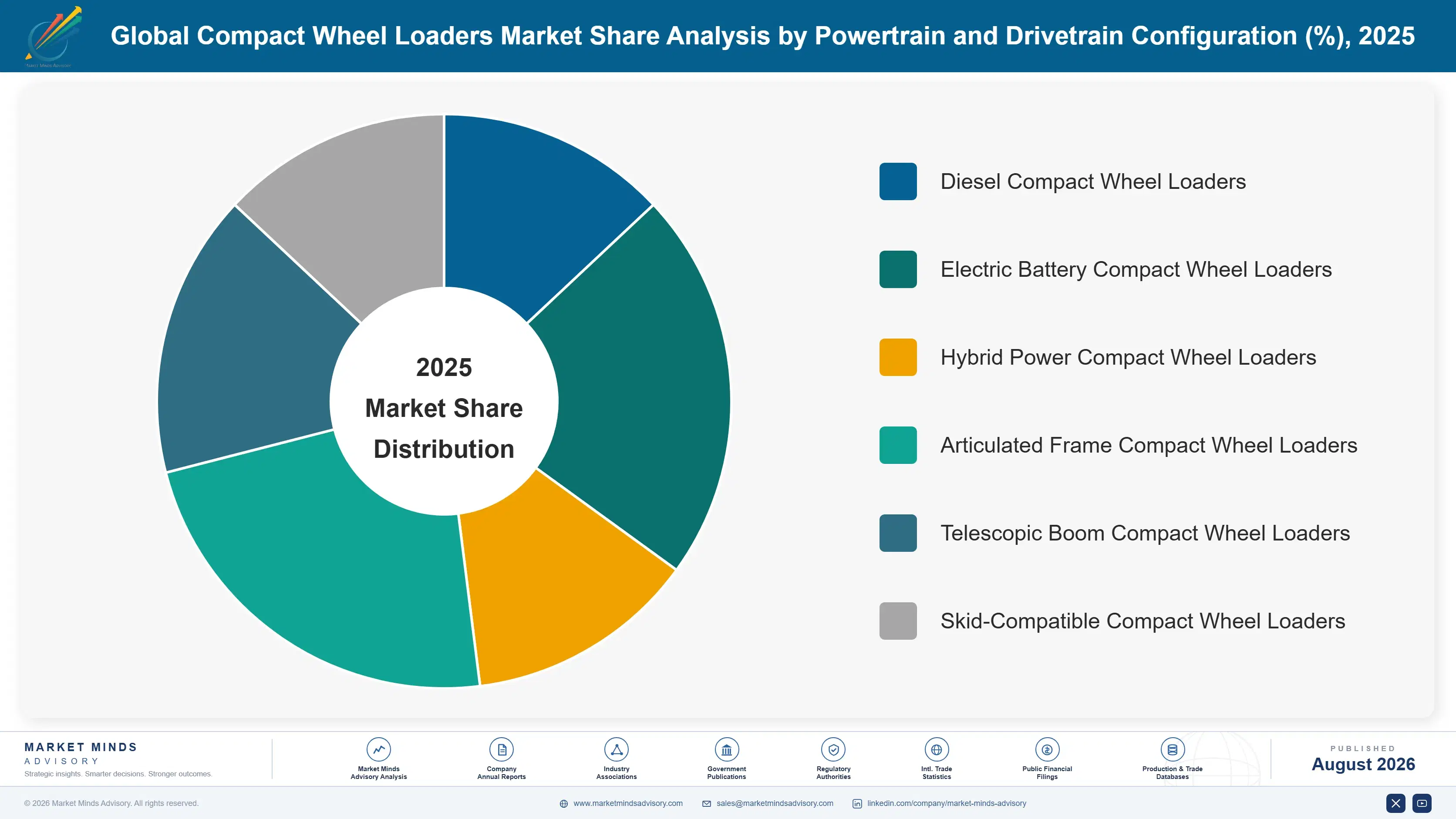
Segmentation follows powertrain and drivetrain configuration rather than end-use application, since manufacturers engineer and price compact wheel loaders by power source first and buyers specify application-specific attachments as a downstream purchasing decision. Buyers weigh cost, regulatory access, and total cost of ownership very differently across each category. That distinction shapes procurement more than end-use application ever does.
global-compact-wheel-loaders-market-market-share-analysis-1787316029942

Electric Battery Compact Wheel Loaders

Electric battery compact wheel loaders are growing fastest by a wide margin as urban emissions and noise ordinances push contractors toward zero-emission equipment for regulated job sites, a shift showing no sign of slowing as more municipalities adopt similar restrictions. The segment requires battery pack and thermal management engineering diesel-focused manufacturers historically never needed, favoring OEMs who invested early over legacy diesel-only competitors. Adoption is spreading fastest in regulated urban markets and among environmentally motivated municipal buyers, though total cost of ownership still trails diesel for most contractors outside those contexts. Competitive intensity remains lower than in the diesel segment, since fewer manufacturers can deliver validated electric units at commercial reliability standards, keeping this the category's highest-margin pocket.
CAGR 14.0%

Hybrid Power Compact Wheel Loaders

Hybrid power compact wheel loaders are growing faster than the broader market as manufacturers offer a transitional option for contractors wanting fuel savings and reduced emissions without the charging infrastructure dependency full electric models require on remote job sites. The segment benefits from bridging both diesel-familiar and electric-curious buyer segments, since hybrid models retain diesel refueling flexibility while capturing meaningful fuel efficiency gains that appeal to cost-conscious fleet operators. Growth is concentrated among rental fleet operators seeking a lower-risk stepping stone toward full electrification, since hybrid models let them build electric powertrain service and maintenance familiarity before committing fully to battery-only equipment across their broader inventory. Manufacturers report hybrid models generating stronger repeat-order rates than either pure alternative alone.
CAGR 9.5%
Full segment breakdown across 6 segments available in the complete report.

Regional Architecture and Country Demand Map

East Asia leads on the combined strength of construction equipment manufacturing capacity and sustained infrastructure investment, with North America and Western Europe following at a more measured pace shaped by mature construction cycles and rental market depth. and where infrastructure spending is expanding fastest today.

North America

The United States drives the bulk of regional demand, supported by one of the deepest equipment rental markets anywhere in the world and steady infrastructure spending tied to federal and state-level transportation and utility investment programs. Domestic contractors have been slower than European peers to adopt electric compact wheel loaders broadly, though several major metropolitan markets have begun introducing diesel equipment restrictions following European precedent. Canada contributes a modest, stable share tied to similar infrastructure and rental market dynamics as its southern neighbor. Mexico's role centers on component fabrication for export rather than domestic demand. Regional growth trails East Asia, reflecting a mature equipment market with less infrastructure-driven volume growth remaining.
Share: 22% | CAGR: 5.5% (2026 to 2036)

Western Europe

Germany anchors regional demand through its large construction equipment manufacturing base and dense contractor network, supported by some of the most aggressive urban emissions ordinances driving electric compact wheel loader adoption anywhere in this study. France, Italy, and the UK contribute meaningful volume across a broader range of construction applications, with electric adoption spreading fastest in dense urban markets facing the strictest noise and emissions restrictions. The region's growth rate sits below the global average partly because construction spending growth itself trails East Asia and South Asia considerably, even as the region leads on electric powertrain adoption rate as a share of total unit sales specifically. Poland-adjacent manufacturing capacity increasingly supports finished equipment production across the wider region.
Share: 19% | CAGR: 4.5% (2026 to 2036)
Regional intelligence for 5 additional markets available in the complete report: East Asia, South Asia and Pacific, Latin America, Middle East and Africa, Eastern Europe. Contact sales@marketmindsadvisory.com.
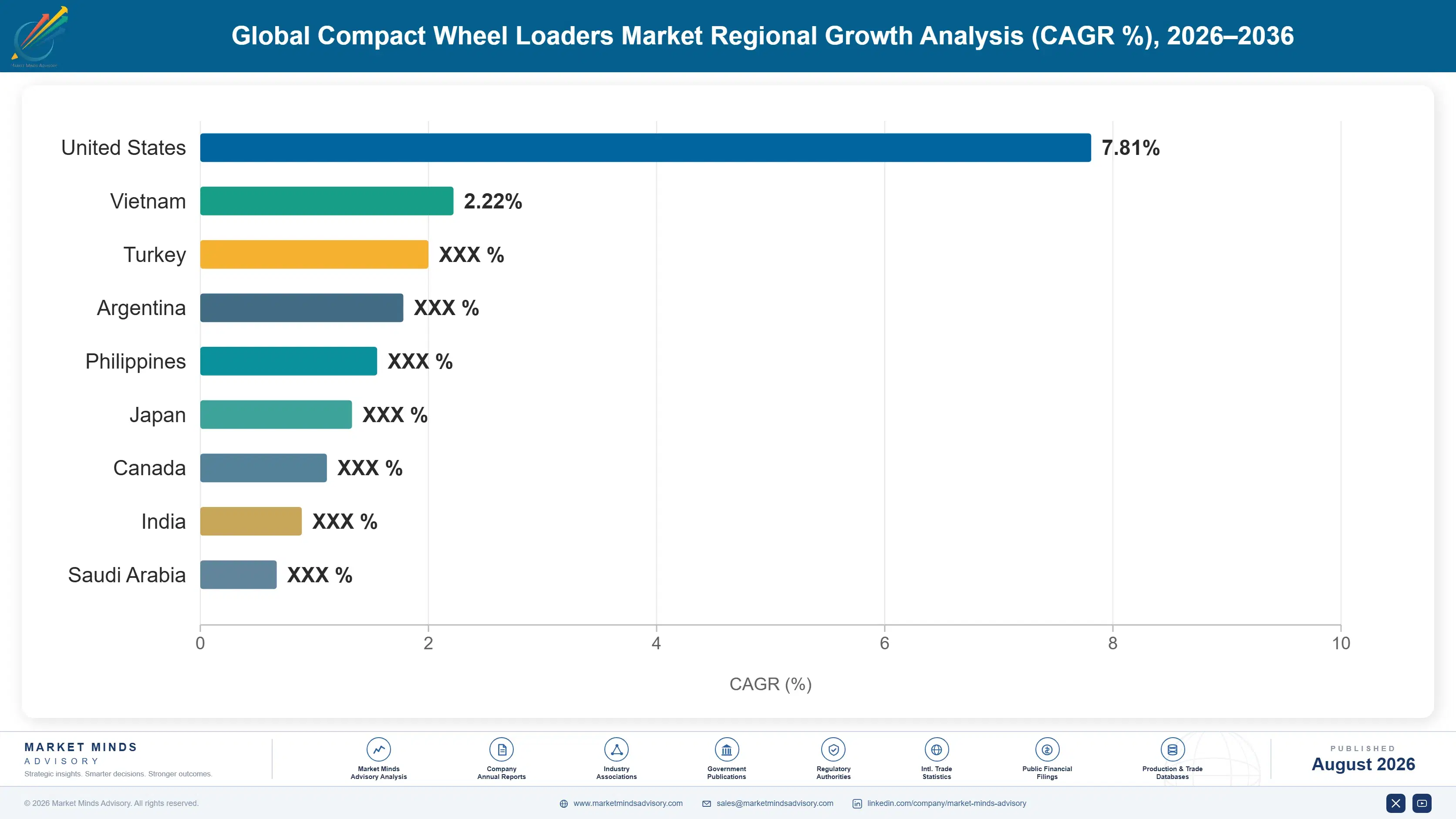
global-compact-wheel-loaders-market-country-cagr-analysis-1787316030880

Where Equipment Manufacturers Can Expand Margin

Four commercial levers separate manufacturers capturing premium value from those competing purely on diesel unit price, spanning electric powertrain capability, rental fleet channel relationships, regional manufacturing positioning, and total cost of ownership financing programs. Each pulls margin from a different point in the commercial stack. Suppliers ignoring any lever cede ground to more diversified rivals.

Build Electric Powertrain and Battery Capability Now

Manufacturers that invest in battery pack and thermal management engineering capture materially higher unit pricing on electric compact wheel loader sales than diesel equivalents ever commanded, since regulated urban markets are willing to pay a premium for equipment that maintains job site access regardless of local emissions restrictions. Electric units carry roughly 1.5 to 2 times the unit price of comparable diesel models, reflecting both battery cost and the regulatory access value that pricing captures directly. Manufacturers without this capability are increasingly excluded from the fastest-growing regulated urban market segment entirely, regardless of how competitive their diesel pricing remains elsewhere.
Market Impact: Captures roughly 1.5 to 2 times die

Build Direct Rental Fleet Operator Relationships

Manufacturers that establish direct supply relationships with major rental fleet operators, rather than selling primarily through independent dealers, capture larger multi-unit orders and more predictable demand visibility than dealer-dependent competitors serving fragmented individual contractor purchases. Rental fleet contracts typically carry meaningfully better payment terms and forecast visibility than scattered dealer network sales, reducing working capital strain for manufacturers managing capital-intensive production planning. Manufacturers with established rental relationships are winning platform-level fleet standardization decisions as major operators consolidate sourcing across their broader national footprint. These contracts typically carry order volumes 3 to 5 times larger than an individual purchase.
Market Impact: Captures orders 3 to 5 times indivi

Localize Manufacturing Near South Asian Demand Growth

Compact wheel loaders are costly to ship internationally relative to their value, so manufacturers locating assembly near growing South Asian and Southeast Asian infrastructure markets capture freight and import duty advantages that distant competitors cannot match, alongside meaningfully reduced working capital tied up in transit inventory. This proximity advantage is becoming more valuable as regional governments favor domestically assembled equipment in public infrastructure procurement decisions across multiple countries simultaneously. Manufacturers co-locating with these demand centers are winning preferred bidder status on government infrastructure contracts. Localized manufacturers report winning government contracts at rates roughly 20 percent higher than import-dependent competitors.
Market Impact: Wins roughly 20 pct more government

Offer Total Cost of Ownership Financing Programs

Manufacturers and dealers offering financing programs structured around total cost of ownership economics, rather than upfront purchase price alone, help contractors overcome the higher initial cost of electric equipment by spreading the payback across the equipment's operating life where fuel and maintenance savings actually materialize. These financing programs typically lift electric conversion rates by 15 to 20 percent among otherwise hesitant contractors, expanding the addressable buyer base beyond regulation-driven purchases alone. Manufacturers without financing programs cede these conversion opportunities to competitors who can structure the payback schedule around actual fuel and maintenance savings realized over time.
Market Impact: Lifts electric conversion by 15 to

Who Controls the Margin Pool

CR5 sits at 52 percent, reflecting a market where established global OEMs hold substantial combined share even as Chinese manufacturers reshape the competitive landscape from outside the traditional Western and Japanese equipment supply base entirely. That gap is most visible in who can credibly bid on new regulated urban market design programs today.
Current competitive activity centers on electric powertrain capacity expansion to serve growing urban regulatory demand, rental fleet channel partnerships between manufacturers and major operators, and continued price competition as Chinese manufacturers expand export capacity targeting South Asian and Southeast Asian markets specifically. These moves are reshaping vendor shortlists at nearly every major rental operator across multiple regions. directly.

Emerging pressure comes from Chinese manufacturers whose domestic scale and government-backed manufacturing investment are closing the technology and quality gap with established Western and Japanese OEMs faster than most incumbents expected just a few years ago. Specialist electric powertrain suppliers entering from outside the traditional equipment manufacturing base are also gaining ground on battery and charging infrastructure partnerships. Neither trend looks likely to reverse over the coming several years given current investment patterns. Both trends are reshaping who wins the largest fleet contracts going forward.
global-compact-wheel-loaders-market-company-positioning-matrix-1787316031826

Competitive Moat and Risk Dimensions

CATERPILLAR INC

Moat: Deep dealer and rental network

Caterpillar's extensive global dealer and rental network, built over decades of consistent investment, gives it service and parts availability advantages that newer entrants cannot replicate quickly regardless of the capital they have available to deploy in any single market. Contractors cite parts availability directly when justifying premium pricing over lesser-known alternatives.
CATERPILLAR INC

Risk: Chinese price competition intensifying

Rapidly scaling Chinese manufacturing capacity is compressing the price premium Caterpillar has historically commanded in export markets, forcing a shift toward electric and service differentiation where its dealer network still matters more than raw unit cost. Caterpillar is investing in electric capability to defend against this pricing pressure over time.
VOLVO CONSTRUCTION EQUIPMENT

Moat: Early electric powertrain leadership

Volvo's early and sustained investment in electric compact wheel loader development, built over roughly a decade, gives it production experience and regulatory relationship depth that newer electric entrants cannot replicate quickly regardless of the capital they have available. Regulators and rental operators alike cite Volvo's track record when evaluating newer electric entrants.
VOLVO CONSTRUCTION EQUIPMENT

Risk: Smaller scale than largest rivals

Volvo's smaller overall scale relative to Caterpillar and John Deere limits its ability to subsidize electric investment the way better-capitalized competitors with larger balance sheets and broader equipment portfolios consistently can across multiple product lines. Volvo is pursuing partnerships to extend its effective scale without matching that capital spending directly.

Players Tracked

Prominent Players

Caterpillar Inc
Volvo Construction Equipment
John Deere
Komatsu Ltd
Liebherr Group

Other Key Players

SANY Group
XCMG Construction Machinery
LiuGong Machinery
Hyundai Doosan Infracore
JCB
Case Construction Equipment
Kubota Corporation
Bobcat Company
Wacker Neuson
Yanmar Holdings
Hitachi Construction Machinery
Kramer-Werke
Zoomlion Heavy Industry
Takeuchi Manufacturing
Terex Corporation

Recent Developments

MARCH 2025

Volvo Expands Electric Compact Wheel Loader Line in Sweden

Volvo Construction Equipment commissioned an expanded electric compact wheel loader assembly line at its Swedish facility, adding capacity to serve growing regulated urban market demand from multiple European rental fleet customers. The expansion represents Volvo's largest dedicated electric capacity addition to date. The line focuses on regulated-market unit configurations.
Signal: Confirms electric compact wheel loader dem
AUGUST 2025

Caterpillar and a Major Rental Operator Sign Fleet Supply Agreement

Caterpillar signed a multi-year supply agreement with a major North American rental fleet operator covering both diesel and electric compact wheel loader units across its national branch network, structured as a supply contract rather than a joint venture. The agreement covers multiple equipment categories through 2031.
Signal: Shows manufacturers consolidating rental f
JANUARY 2026

SANY Acquires a Regional European Distribution Specialist

SANY acquired a mid-sized European equipment distribution company, adding dealer network access ahead of expanding its compact wheel loader export volume across the region. The acquisition was SANY's first dedicated move into European distribution ownership rather than relying on third-party importers. Terms of the transaction were not disclosed.
Signal: Shows Chinese manufacturers building direc

Steel Chassis and Battery Pack Exposure

Steel chassis and hydraulic components together account for roughly 42 percent of finished diesel compact wheel loader cost, with electric models carrying substantially higher exposure to lithium-ion battery pack pricing that diesel equivalents do not face at all in their cost structure. This cost structure differs meaningfully from most other equipment categories carrying lower electronics exposure.
Steel prices, which track broader industrial commodity markets, rose noticeably through 2023 and 2024 according to industry pricing data referenced in multiple manufacturer annual reports, squeezing margins at equipment manufacturers without long-term steel supply agreements in place at the time. Several manufacturers reported temporary cost pass-through negotiations with dealer and rental customers during that period, a disruption still referenced in current supplier risk disclosures. That volatility is expected to persist as broader industrial demand keeps recovering unevenly.

The competitive disadvantage falls hardest on smaller regional manufacturers without long-term steel and battery supply agreements, since spot-market purchasing leaves them exposed to price swings that larger, vertically integrated competitors with direct supplier relationships can partially absorb through scale and hedging. Smaller manufacturers without hedging programs carry meaningfully higher earnings volatility from this exposure than larger, better-capitalized competitors.
global-compact-wheel-loaders-market-cost-volatility-analysis-1787316032186

Long-Term Steel and Battery Supply Agreements

Larger manufacturers are locking in multi-year steel and lithium-ion battery cell supply contracts with fixed or collared pricing to reduce exposure to spot market volatility, trading some cost upside for predictability that smaller competitors without negotiating leverage cannot access on comparable terms. Several major manufacturers signed new multi-year agreements during 2024 specifically to address this exposure.

Modular Battery Platform Standardization

Manufacturers are standardizing battery pack designs across multiple equipment categories, reducing the number of distinct cell configurations needed and making battery capacity easier to secure and allocate efficiently during periods of tight supply. Fewer configurations also shortens qualification cycles when manufacturers request mid-cycle capacity changes. for both manufacturers and their downstream supply chain partners in the assembly process.

Regional Steel Sourcing Diversification

Manufacturers are qualifying steel from multiple regional sources rather than depending on a single supplier or geography, reducing the risk that any one region's price spike or supply disruption stalls production across the assembly line. Larger manufacturers with greater purchasing scale are better positioned to negotiate favorable multi-year terms. keeping production schedules stable through periods of volatility.

Portfolio Architecture for Margin Defence

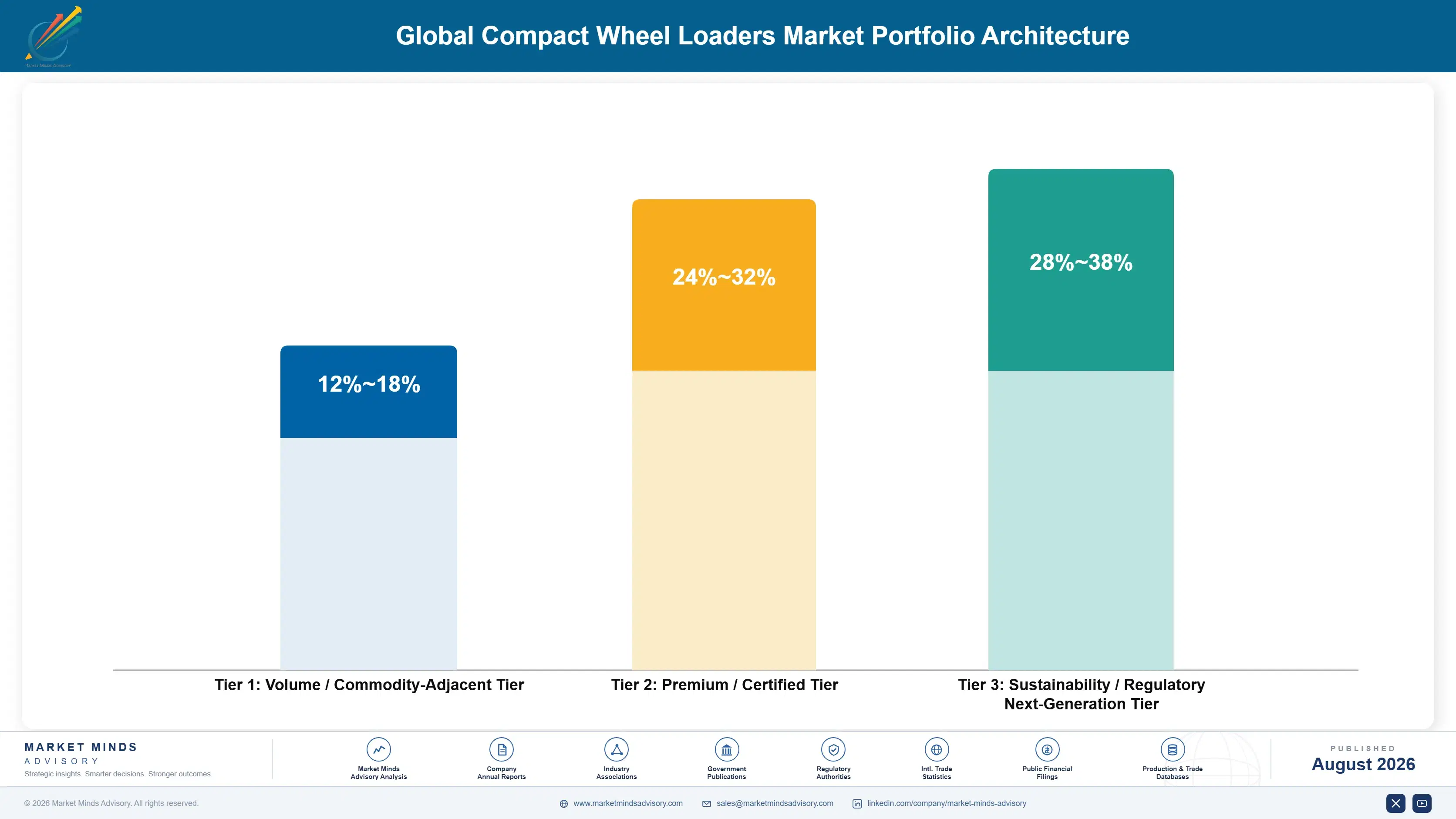
The portfolio splits into three tiers running on distinct economics: a volume tier built on standard diesel compact wheel loaders sold near cost parity across competing manufacturers, a premium tier of hybrid and electric models carrying meaningfully higher margin, and an emerging next-generation tier built on fully validated regulatory-compliant electric fleets that commands a technology premium beyond pure powertrain differentiation alone. Manufacturers rarely compete meaningfully across more
The tension between volume and premium is not simply about margin, since diesel buyers are extremely price-sensitive and switch manufacturers readily at the point of purchase, while electric and hybrid buyers are paying for genuine regulatory access and total cost of ownership differentiation and tolerate meaningfully less price sensitivity as long as the site-access benefit holds up against realistic alternatives. That difference in buyer behavior shapes how each manufacturer structures its sales approach.

High-value margin pools concentrate in electric powertrains and rental fleet standardization contracts, both of which combine technical differentiation with regulatory and channel tailwinds that commodity diesel sales simply cannot generate, giving manufacturers positioned in either pool meaningfully more pricing power than the broader market average would otherwise suggest.

Volume / Commodity-Adjacent Tier

Standard diesel compact wheel loaders for general construction and municipal applications, priced to compete directly against other manufacturers on cost and dealer availability across most programs. Competition here centers almost entirely on cost and dealer availability.
Gross Margin: 12-18%

Premium / Certified Tier

Hybrid and electric compact wheel loaders meeting regulatory and rental fleet standardization requirements, sold into regulated urban markets at a meaningful margin premium over diesel designs. Manufacturers here compete on regulatory compliance and total cost data.
Gross Margin: 24-32%

Sustainability / Regulatory / Next-Generation Tier

Fully validated zero-emission electric fleets combining advanced battery technology and regulatory compliance certification, commanding a technology premium as municipalities tighten equipment standards. This tier draws the strongest interest from municipal fleet programs.
Gross Margin: 28-38%
global-compact-wheel-loaders-market-portfolio-architecture-1787316033170

High-value Sub-segments and Strategic Watch-out

Electric Battery Compact Wheel Loaders

Combines the fastest growth rate in the market with premium technology pricing, making it the single most valuable pool for manufacturers with battery and thermal management engineering capability built up over several years of dedicated investment. Few competitors currently hold both battery engineering and commercial certification at once.
Gross Margin: 30-38%

Hybrid Power Compact Wheel Loaders

Growing steadily as a transitional option for cost-conscious fleet operators, offering manufacturers with hybrid powertrain expertise a durable margin premium over pure diesel competitors facing structural regulatory pressure. Manufacturers without hybrid capability are increasingly locked out of this category. Suppliers investing early are capturing disproportionate share of new sales.
Gross Margin: 24-32%

Standard Diesel Compact Wheel Loaders

The steady volume core of the market, growing roughly in line with overall infrastructure investment and offering predictable but noticeably thinner margin than either the electric or hybrid tiers discussed above. It remains the segment most exposed to continued Chinese price competition. Margin compression here has been gradual but persistent.
Gross Margin: 12-18%

Legacy Non-Compliant Diesel Fleet Units

A strategic watch-out segment facing declining resale value and job site access as urban emissions ordinances expand, leaving fleet operators dependent on older diesel units exposed to accelerating equipment turnover pressure. Operators still reliant on this fleet should plan for continued value erosion. Trade-in values have fallen sharply since 2023.
Gross Margin: 8-14%

From Fleet Standardization to Replacement Cycle

Equipment supply relationships behave closer to annuities than one-off transactional sales once a manufacturer wins rental fleet standardization status, since switching to an alternative manufacturer mid-fleet disrupts parts inventory, technician training, and service network alignment operators are reluctant to repeat across their full national footprint. Operators treat a fleet standardization win as effectively locked in once service network alignment is complete.
Adoption depth varies sharply by end-use vertical: municipal and regulated urban contractors have pushed electric and hybrid models deep into standard fleet configurations, while rural infrastructure and agricultural applications still rely largely on diesel with minimal electrification pressure given lower regulatory exposure. Mining and quarry applications lag furthest behind in electrification, prioritizing proven durability and continuous duty cycle reliability over the emissions profile municipal buyers increasingly require.

A generational shift is underway in buyer expectations as younger fleet managers, comfortable evaluating total cost of ownership models rather than purchase price alone, increasingly factor electrification readiness into procurement decisions even outside directly regulated markets, a change reshaping how manufacturers position equipment across their broader product lineup. Manufacturers slow to adapt risk losing relevance with exactly the buyers driving procurement decisions forward.
global-compact-wheel-loaders-market-end-use-penetration-index-1787316034007

Electric Powertrain Decides the Next Decade

These are among the four positions where our research anticipates prominent divergence between winners and laggards over the coming forecast period. Each is grounded in the demand model, the regulatory perimeter, and the announced capacity pipeline.
01 / POWERTRAIN INVESTMENT FOCUS

Build electric powertrain capability now

Electric compact wheel loaders carry meaningfully higher unit pricing than diesel and require battery engineering capability only a subset of manufacturers currently possess at commercial reliability standards. Manufacturers without this capability are increasingly excluded from regulated urban markets as more municipalities adopt emissions and noise ordinances following early-mover examples. Manufacturers should direct capital toward electric powertrain development rather than expanding diesel-only capacity, since that path offers shrinking differentiation against regulation-driven demand shifts already underway, and delay only widens that gap further across most major metropolitan markets.
02 / RENTAL CHANNEL STRATEGY

Build direct rental fleet operator relationships now

Rental fleet operators represent a growing and increasingly consolidated buyer base that manufacturers with direct relationships can serve more profitably than those dependent on fragmented dealer channel sales alone. Manufacturers with established rental partnerships are capturing multi-unit standardization contracts that dealer-dependent competitors cannot easily win on comparable terms or timelines. Building or strengthening these relationships now positions manufacturers to capture a channel that continues growing as a share of total category unit volume across nearly every region covered in this study.
03 / GEOGRAPHIC POSITIONING STRATEGY

Localize manufacturing in South Asia now

South Asia and Pacific combines the fastest regional growth with substantial remaining infrastructure investment headroom, giving manufacturers with capacity there durable volume other mature regions increasingly cannot match. This is a materially different calculus than a decade ago when mature-market volume alone justified most capacity investment decisions industry-wide across the category. Manufacturers still concentrated in legacy mature-market locations should evaluate South Asian capacity additions as a near-term priority rather than a longer-term option to revisit only after volume has already shifted.
04 / INPUT COST RISK MANAGEMENT

Secure long-term steel and battery agreements now

Steel and battery costs, tied closely to broader industrial and commodity markets, remain the largest source of margin volatility across the category specifically, and manufacturers without long-term supply agreements are structurally disadvantaged relative to vertically integrated competitors with direct feedstock access. The 2023 to 2024 steel price increase demonstrated how quickly this exposure can compress margins for unhedged manufacturers operating on thin working capital. Manufacturers should prioritize locking in multi-year agreements before the next material price disruption arrives, since delay only exposes suppliers to greater risk as demand accelerates further.

Engagement Snapshot From the Field

A live engagement with an industry participant carrying material or product regulatory and market exposure ahead of a defining policy shift, showing how our research translates into a defensible multi-year portfolio strategy.
MARKET MINDS ADVISORY · CLIENT ENGAGEMENT SUMMARY
Global Compact Wheel Loaders Producer Strategic Portfolio Review and Transition Roadmap 2026·Investment Scenario on Global Compact Wheel Loaders Exposure Evaluation 2025-26
CLIENT PROFILE
The client was a regional compact wheel loader manufacturer with roughly $340 million in annual revenue (client-reported, unverified by MMA), supplying primarily diesel equipment to contractors and rental operators across Western Europe, seeking to build electric powertrain capability ahead of expanding urban emissions regulation. The client had no prior electric powertrain engineering experience internally. The client had no prior electric experience.
STRATEGIC CHALLENGE
The client's diesel-focused business faced sustained pressure as regulated urban markets increasingly excluded diesel equipment from job site access, while larger competitors had already begun winning electric fleet contracts the client lacked engineering capability to bid on competitively. Leadership set a two-year window to build credible electric powertrain capability before losing further regulated-market customer relationships.
MMA APPROACH
MMA conducted a competitive technology capability assessment against electric powertrain leaders, modeled the capital investment case for battery and thermal management engineering against projected regulated-market design-win volume, and benchmarked rental fleet partnership structures to identify a realistic path forward for the client. MMA also reviewed licensing options against fully in-house engineering development for comparison purposes.
KEY FINDINGS
  1. Electric fleet contracts carried roughly 1.7 times the margin of the client's existing diesel portfolio, based on comparable disclosed program economics across regional peers.
  2. Electric powertrain investment payback fell within three product generations given the client's existing rental fleet relationships and manufacturing footprint already established. under standard product ramp assumptions provided by the client.
  3. The client's existing hydraulics and chassis engineering expertise transferred meaningfully to electric platform development, reducing the investment required relative to starting from scratch.
  4. A licensing partnership for core battery management technology could accelerate market entry faster than fully in-house engineering development from the ground up.
CLIENT PROFILE
The client was a regional compact wheel loader manufacturer with roughly $340 million in annual revenue (client-reported, unverified by MMA), supplying primarily diesel equipment to contractors and rental operators across Western Europe, seeking to build electric powertrain capability ahead of expanding urban emissions regulation. The client had no prior electric powertrain engineering experience internally. The client had no prior electric experience.
STRATEGIC CHALLENGE
The client's diesel-focused business faced sustained pressure as regulated urban markets increasingly excluded diesel equipment from job site access, while larger competitors had already begun winning electric fleet contracts the client lacked engineering capability to bid on competitively. Leadership set a two-year window to build credible electric powertrain capability before losing further regulated-market customer relationships.
MMA APPROACH
MMA conducted a competitive technology capability assessment against electric powertrain leaders, modeled the capital investment case for battery and thermal management engineering against projected regulated-market design-win volume, and benchmarked rental fleet partnership structures to identify a realistic path forward for the client. MMA also reviewed licensing options against fully in-house engineering development for comparison purposes.
KEY FINDINGS
  1. Electric fleet contracts carried roughly 1.7 times the margin of the client's existing diesel portfolio, based on comparable disclosed program economics across regional peers.
  2. Electric powertrain investment payback fell within three product generations given the client's existing rental fleet relationships and manufacturing footprint already established. under standard product ramp assumptions provided by the client.
  3. The client's existing hydraulics and chassis engineering expertise transferred meaningfully to electric platform development, reducing the investment required relative to starting from scratch.
  4. A licensing partnership for core battery management technology could accelerate market entry faster than fully in-house engineering development from the ground up.
RECOMMENDED STRATEGY
Phase 1: Phase 1 (0-9 months): License core battery management technology and begin pilot production validation. ahead of the next platform award cycle. Phase 2: Phase 2 (9-24 months): Bid electric fleet programs on two upcoming regulated-market rental contracts. to build a credible track record quickly. Phase 3: Phase 3 (24-42 months): Build independent engineering capability to reduce long-term licensing dependence. to reduce dependence on external licensors. across the broader engineering organization.
OUTCOME
The client won electric fleet contracts with one of two targeted rental operators within twenty months of the licensing partnership launch, adding an estimated $28 million in annual contracted revenue (client-reported, unverified by MMA) at materially higher margin than its legacy diesel business had previously generated.

Frequently Asked Questions

Foundational context covering the market sizes, CAGR, scope, country, region and competition that inform every finding below. This section is provided to cover basics and most often pre-purchase conversations, answered from the MMA Primary Research Dataset.

What is the current size of the Global Compact Wheel Loaders Market?

The global compact wheel loaders market is valued at approximately $6.8 billion in 2025, spanning diesel, electric battery, and hybrid power configurations across construction and municipal applications.

How large will the Global Compact Wheel Loaders Market be by 2036?

The market is projected to reach approximately $12.9 billion by 2036, driven primarily by urban emissions ordinances and expanding electric compact wheel loader adoption. Regulatory expansion is accelerating that adoption curve.

What is the CAGR for the Global Compact Wheel Loaders Market 2026 to 2036?

The market is projected to grow at a compound annual rate of 6.0 percent between 2026 and 2036, with electric battery models growing fastest within that total figure.

Which segment is growing fastest?

Electric battery compact wheel loaders are growing fastest at 14.0 percent annually, roughly 2.33 times the overall market rate, driven by expanding urban emissions and noise regulation.

Who are the major companies in the Global Compact Wheel Loaders Market?

Caterpillar, Volvo Construction Equipment, John Deere, Komatsu, and Liebherr lead the market by disclosed shipment volume, alongside fifteen other significant global manufacturers. Fifteen additional manufacturers round out the field.

Which country is growing fastest?

China is growing fastest among major markets at 8.5 percent annually, supported by sustained infrastructure investment and rapidly expanding domestic manufacturing export capacity. Domestic infrastructure investment is the primary driver there.

Report Segmentation Architecture

The full report scope spans multiple orthogonal segmentation dimensions, with cross-tabulated demand data provided for each dimension pair. Coverage extends further to regional breakdowns, trend trajectories, and the competitive detail needed to support segment-level decision-making.

By Powertrain and Drivetrain Configuration

  • Diesel Compact Wheel Loaders
  • Electric Battery Compact Wheel Loaders
  • Hybrid Power Compact Wheel Loaders
  • Articulated Frame Compact Wheel Loaders
  • Telescopic Boom Compact Wheel Loaders
  • Skid-Compatible Compact Wheel Loaders

By End-Use Application

  • General Construction
  • Municipal and Utility Work
  • Agriculture and Landscaping
  • Mining and Quarry Operations
  • Rental Fleet Deployment

By Sales Channel

  • Direct OEM Dealer Sales
  • Equipment Rental Fleet
  • Government Procurement

By Region

  • North America
  • Western Europe
  • East Asia
  • South Asia and Pacific
  • Latin America
  • Middle East and Africa
  • Eastern Europe

Scope, Methodology, and Coverage

Every figure in this report is reproducible from documented input assumptions. The scope below maps the historical period, the forecast horizon, the segmentation dimensions, and the countries covered, alongside the underlying primary and qualitative methodology.
Historical Period
2020 to 2025
Forecast Period
2026 to 2036
Base Year
2025 (USD billions; MMA Primary Research Dataset, August 2026)
Market Definition
This report covers diesel, electric battery, and hybrid power compact wheel loaders under roughly six tonnes operating weight sold into construction, landscaping, agriculture, and municipal applications through OEM dealer and rental channels. It excludes full-size wheel loaders above that weight class, skid steer loaders, and compact track loaders sold as separate equipment categories.
Quantitative Units
USD billions (current prices); thousand units shipped where applicable
Segmentation Dimensions
By Powertrain and Drivetrain Configuration; By End-Use Application; By Sales Channel; By Region
Regions Covered
North America, Western Europe, East Asia, South Asia and Pacific, Latin America, Middle East and Africa, Eastern Europe
Countries Covered
USA, China, Germany, France, UK, Japan, South Korea, India, Australia, Canada, Brazil, Mexico, Indonesia, Vietnam, Thailand, Malaysia, UAE, Saudi Arabia, South Africa, Nigeria, Turkey, Poland, Netherlands, Italy, Spain, Sweden, Switzerland, Argentina, Colombia, Singapore, and additional markets relevant to this sector
Key Companies Profiled
Caterpillar Inc, Volvo Construction Equipment, John Deere, Komatsu Ltd, Liebherr Group, SANY Group, XCMG Construction Machinery, LiuGong Machinery, Hyundai Doosan Infracore, JCB, Case Construction Equipment, Kubota Corporation, Bobcat Company, Wacker Neuson, Yanmar Holdings, Hitachi Construction Machinery, Kramer-Werke, Zoomlion Heavy Industry, Takeuchi Manufacturing, Terex Corporation
Quantitative Methodology
Primary survey, n=3,800 respondents, Q4 2025, six countries; demand-side model with trade association cross-validation
Qualitative Methodology
47 expert interviews, Q4 2025; applied to validate demand model assumptions, identify emerging dynamics, and assess competitive positioning
Report Format
PDF and XLSX data workbook (Word format preview document)
Publisher
Market Minds Advisory
Report Code
MMA-2026-CON-201
Published
August 2026
Contact
sales@marketmindsadvisory.com | www.marketmindsadvisory.com

Purchase the full Global Compact Wheel Loaders Market Report (2026 to 2036).

The full Global Compact Wheel Loaders Market report delivers a complete quantitative and qualitative assessment across all six powertrain segments, seven regions, and twenty profiled companies operating in this space. It includes detailed sizing and forecast models through 2036, competitive benchmarking on shipment volume, and a full regulatory tracker covering urban emissions ordinance adoption by city. Buyers receive segment-level and country-level data tables supporting the full analysis presented throughout this report. Analysts update the underlying dataset each quarter to reflect the latest manufacturer disclosures and regulatory developments.
Segment-level sizing across six powertrain configuration types
Country-level forecast data for thirty markets
Competitive benchmarking on shipment volume basis
Regulatory tracker for urban emissions ordinance adoption
Electric adoption curves by region and application type
Twenty-company competitive profile database, updated quarterly

Built For The People Who Decide

From boardroom strategy to bench-side execution, this report is read cover-to-cover by leaders shaping the next decade of their industry, turning demand scenarios, market dynamics and valuation benchmarks into decisions.
CXOs/ Presidents/ VPs/ Managers
M&A and Corporate Development
Strategy Teams and R&D Heads
Procurement and Product Directors
Regulatory and Compliance Leaders
Investor Relations and Equity Analysts