Market Minds Advisory
Global Cling Film Market

Global Cling Film Market: Chlorine Retreat, Mono-Material Conversion and the Food Waste Argument

Polyvinyl chloride keeps retreating from food contact on migration concerns, recyclability rules are forcing mono-material construction, and the food waste argument is the only defence this category has against single-use plastic sentiment.

Lead Analyst

Bilal Shaikh

Published

September 2026

Make Smarter Decisions with Customized Research Insights

Request a free sample report and evaluate market opportunities, growth trends, and competitive dynamics relevant to your business needs.

2025 MARKET VALUE$1.6BMarket Size 2025
2036 FORECAST VALUE$2.5BBase Case , 2026 to 2036
CAGR 2026 TO 20364.2 %Bull 5.4% / Bear 3.0%
INCREMENTAL OPPORTUNITY$0.8BNet 10- year value creation
EXPANSION MULTIPLE1.51x2036 value over 2026 base
Strategic Levers
M&A Pipeline
Regional Outlook
Country Rankings
Competitive Intelligence
Segmental Deep-dive
Call-Us : 91 93563 13602

Executive Snapshot and Market Trajectory

Cling film sits awkwardly in the sustainability conversation and the industry has never argued its case well. It is single-use plastic, which is unpopular. It also prevents food waste, and wasted food carries an environmental cost several times larger than the few grams of film that would have prevented it.
Recyclable mono-material polyethylene film grows at 6.3%, a full 1.50 times the market rate, because European recyclability requirements arriving in 2030 exclude mixed-material and chlorinated constructions, and converters have years rather than months in which to reformulate everything they sell into the region. East Asia holds 33% of global value, above the standard regional band, because Chinese food processing and retail overwrap consume film at volumes no other region approaches.
Concentration is extraordinarily low at just 21% for the top five, which reflects a product that is cheap, bulky and expensive to transport, so regional converting has always made economic sense. Household brands do hold genuine consumer recognition in some markets, but 58% of volume goes to foodservice and food processing, where nobody has ever cared about the brand printed on the carton at all.
Market Definition
This report covers cling film for food contact applications, spanning plasticised polyvinyl chloride, linear low-density polyethylene, polyolefin blend, polyvinylidene chloride high-barrier and recyclable mono-material polyethylene constructions, across household rolls, foodservice and catering rolls, and machine-grade retail and processing overwrap. Industrial pallet stretch wrap, vacuum pouches and shrink bags, flexible laminate packaging, aluminium foil, greaseproof and baking papers are excluded from the sizing.
Base Year Value
$1.6B in 2025 (MMA Primary Research Dataset, August 2026)
Forecast Period
2026 to 2036, eleven discrete annual values
CAGR
4.2% base case. Bull 5.4%. Bear 3.0%.
Fastest Growth Segment
Recyclable Mono-Material Polyethylene Film: 6.3% CAGR
Fastest Growth Country
India: 6.8% CAGR
Fastest Growth Region
South Asia and Pacific: 6.4% CAGR
Largest Region
East Asia: 33% of 2025 global value
Market Leaders
Berry Global, Amcor, Sealed Air, Reynolds Consumer Products and Anchor Packaging lead on converted film tonnage. Source: MMA Analysis, July 2026.
Primary Survey
n=3,800 procurement and R&D decision-makers, Q4 2025, six countries
Methodology
Demand-side build-up, cross-validated against public data, 47 expert interviews

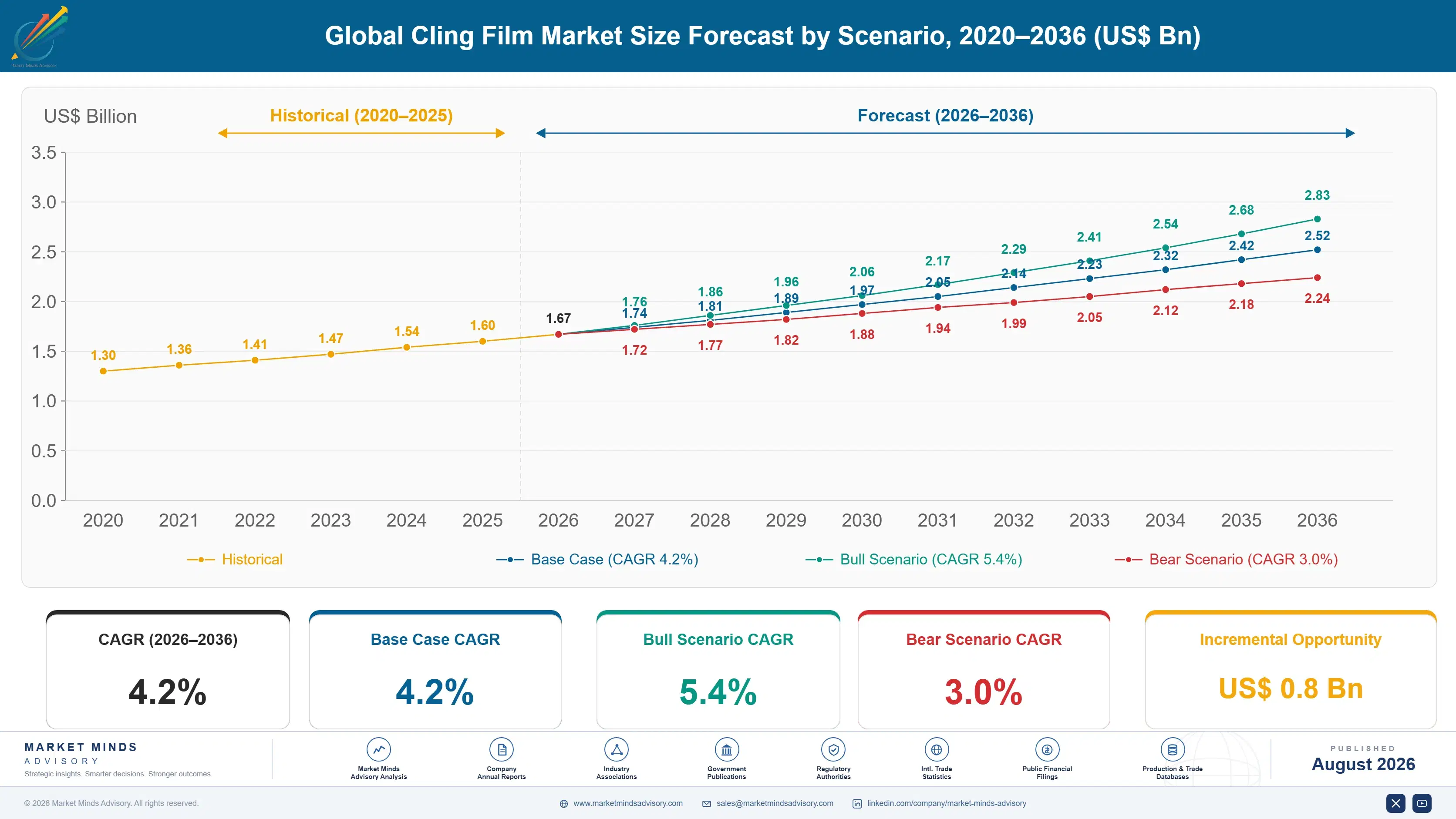
Global Cling Film Market Forecast Scenarios

global-cling-film-market-trends-growth-size-forecast-scenario-1787322126681
Between 2020 and 2025 the market compounded at 3.2%, and the two halves moved separately. Household consumption surged through 2020 as people cooked at home and then settled back toward trend, leaving little net gain. Foodservice collapsed and recovered, ending higher than it started as delivery formats consumed film at rates dine-in service never generated across any equivalent volume of meals.
The base case at 4.2% rests on three mechanisms. Retail formalisation across emerging markets converts loose selling into packaged fresh food, which consumes machine film continuously where traditional trade consumed none at all. Material transition toward recyclable mono-material and polyolefin constructions carries cost that flows through into realised price per tonne. Foodservice and delivery volume keeps growing across most markets, and that segment consumes film far more intensively per meal than household cooking ever does.
The bull case at 5.4% turns on food waste policy gaining ground against single-use plastic sentiment, which would reframe film as a waste prevention tool rather than a disposal problem. The bear case at 3.0% is the opposite: household bans or restrictions in significant markets, combined with reusable alternatives gaining consumer traction, would remove the segment where realised pricing is highest.

What Actually Determines Cling Film Value

This is a commodity that behaves like one. Resin is 56% of converted cost, film is mostly air by volume and expensive to transport, and the technical differences between competent producers are narrow enough that most buyers treat the product as interchangeable. Regional converting has always made obvious sense as a result of that combination.
TOP FIVE CONCENTRATION21%Share held by the five largest cling film producers globally
AVERAGE SELLING PRICE$2,840 per tonneTypical realised price for converted food contact film
FOODSERVICE VOLUME SHARE58%Portion of volume consumed by catering and food processing
RESIN COST SHARE56% of COGSPolymer feedstock as portion of converted film cost
TYPICAL FILM GAUGE9 micronsStandard thickness of household grade cling film supplied
RECYCLABLE FORMAT SHARE17%Share of volume in mono-material recyclable film formats
Two material transitions are reshaping it. Plasticised polyvinyl chloride, which clings beautifully and cuts cleanly on a dispenser, has been retreating from food contact for years on plasticiser migration concerns, particularly where fatty foods are involved. Polyethylene and polyolefin blends have taken that volume without ever quite matching the handling characteristics, which is why professional kitchens complain and why polyvinyl chloride survives longer in foodservice than in household rolls.
The second transition is recyclability. European rules arriving in 2030 require packaging to be recyclable, which excludes chlorinated and mixed-material constructions and pushes everything toward mono-material polyethylene. That conversion carries cost, and cost in a commodity flows straight through to price rather than being absorbed, which is the main reason value in this market grows faster than tonnage does. Cost passes through rather than being absorbed.
"This industry lets itself be discussed as a single-use plastic problem when the honest framing is that a few grams of film prevents a few hundred grams of food from being thrown away. Nobody has made that argument properly to regulators, and the category is paying for the silence."
Practice Director, Packaging and Converting, Market Minds Advisory · MMA Packaging Practice · August 2026

Market Trends

Chlorinated Film Retreats From Food Contact Applications Steadily

Plasticised polyvinyl chloride clings and cuts better than any alternative, which is why professional kitchens preferred it for decades, but plasticiser migration into fatty foods has driven regulatory and retailer pressure that keeps removing it from food contact. Polyethylene and polyolefin blends have taken the volume without matching the handling characteristics, and users notice. Retreat has been faster in Europe than North America and faster in household rolls than in foodservice, where handling performance matters more and purchasing is far less influenced by consumer sentiment. Foodservice will be the last holdout.
Market Impact: Adds 340,000 tonnes annually
Recyclability Rules Force Mono-Material Film Construction

European packaging regulation arriving in 2030 requires all packaging to be recyclable, which excludes chlorinated films and mixed-material constructions and pushes the category toward all-polyethylene film that recycling streams accept. Conversion adds roughly 9% to converted cost through resin selection and processing adjustment. The practical difficulty is cling performance, since the tackifier chemistry that makes polyethylene film adhere to itself must not compromise recyclability, and reformulating that chemistry took converters considerably longer than anybody in the industry expected. Several are still working on it. Adhesion chemistry was the genuinely unexpected obstacle.
Market Impact: Supplies 58% of volume

Market Opportunities and Growth Drivers

Retail Formalisation Converts Loose Selling Into Wrapped Food

Organised grocery retail displacing traditional loose trade across India, Southeast Asia, Africa and parts of Latin America converts food that was previously sold unwrapped into packaged fresh produce, meat and prepared items. Store-level overwrap consumes machine film continuously rather than in the intermittent pattern household rolls follow, which makes the demand both larger and considerably more predictable. That transition is the single largest source of genuine volume growth in this market, and it has decades left to run across the markets currently going through it. Nothing about that transition reverses.
Market Impact: Cuts household volume 3% yearly

Delivery And Foodservice Consume Film Far More Intensively

A meal prepared for delivery or takeaway is wrapped, sealed and frequently double-wrapped in ways that a meal eaten in a restaurant never is, and foodservice already accounts for 58% of film volume before that trend is counted. Delivery format growth across every major market therefore consumes film disproportionately relative to the meals involved. Commercial buyers also purchase on performance and price rather than on consumer sentiment, which insulates this segment almost entirely from the single-use plastic pressure that household rolls face directly. Film volume follows delivery format growth almost directly.
Market Impact: Consumes 56% of cost

Market Restraints and Challenges

Single-Use Plastic Sentiment Presses Household Consumption Downward

Consumers increasingly regard cling film as an avoidable plastic, and reusable silicone covers, beeswax wraps and simple container substitution have all taken household share in developed markets. The root cause is sentiment rather than regulation in most places, though restrictions are appearing. Commercially this attacks precisely the segment where realised pricing per tonne is highest and brand recognition exists. Participants are responding with recyclable formats, recycled content, paper-based alternatives and food waste messaging that this category has historically failed to make anywhere near convincingly enough. Household is the exposed segment.
Market Impact: Cuts chlorinated share 40%

Resin Cost Dominance Leaves Very Little Margin Buffer

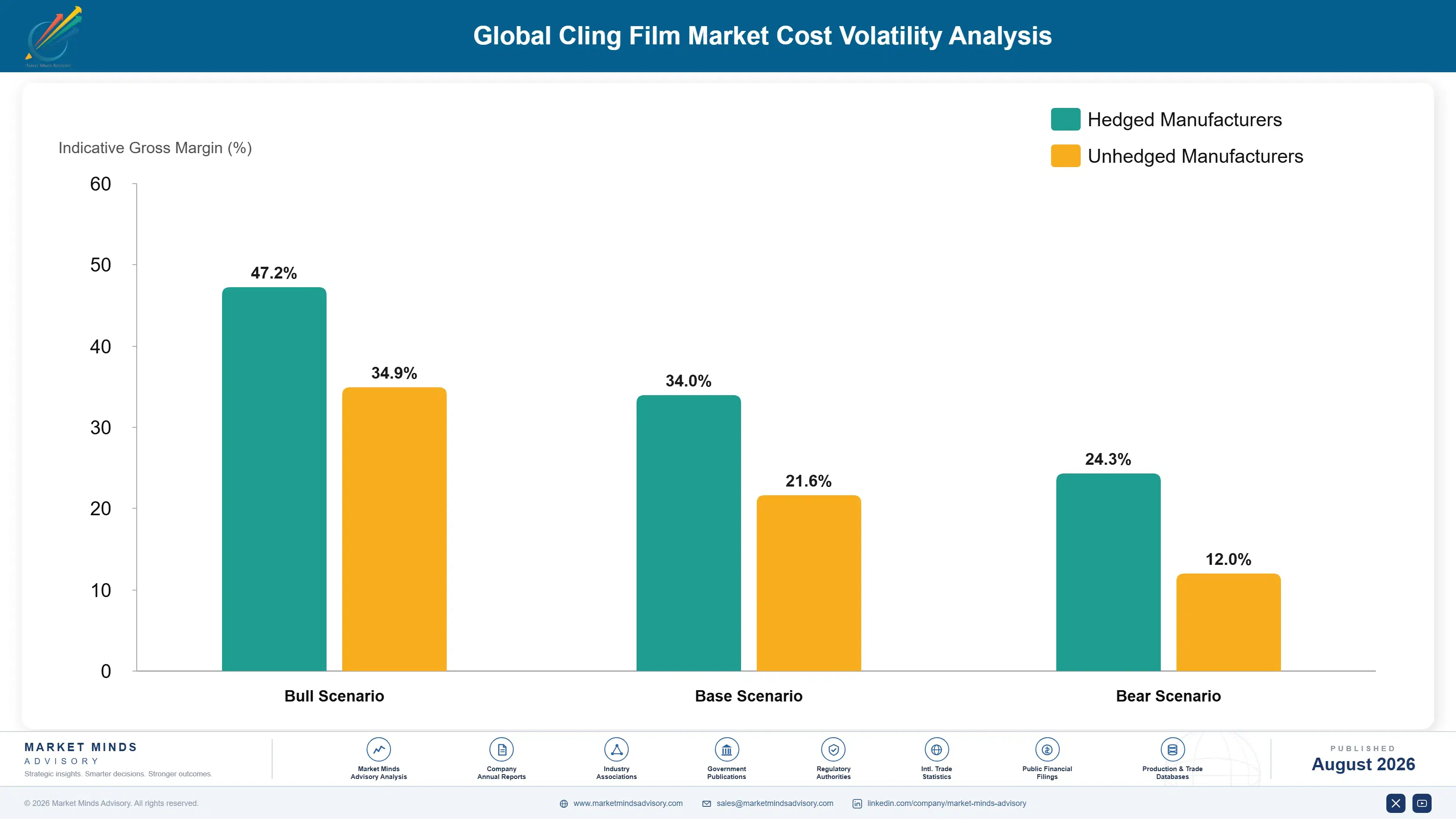
Polymer feedstock is 56% of converted cost, which means resin price movements swamp anything a converter can control operationally. The root cause is that film conversion adds relatively little value to a commodity input, and downgauging has already extracted most of the available savings. Commercially this makes margins genuinely fragile whenever resin moves faster than contracts allow recovery. Participants are responding with indexed pricing formulas, resin hedging where liquidity permits, and mix shift toward specialty and barrier grades where the conversion value added is considerably higher. Contract structure decides survival here.
Market Impact: Adds 9% to converted cost
4 additional market trends, 3 additional growth drivers, and 2 additional restraints and challenges are covered in the full report. Contact sales@marketmindsadvisory.com to access the complete intelligence.

Segment CAGR and Growth Architecture

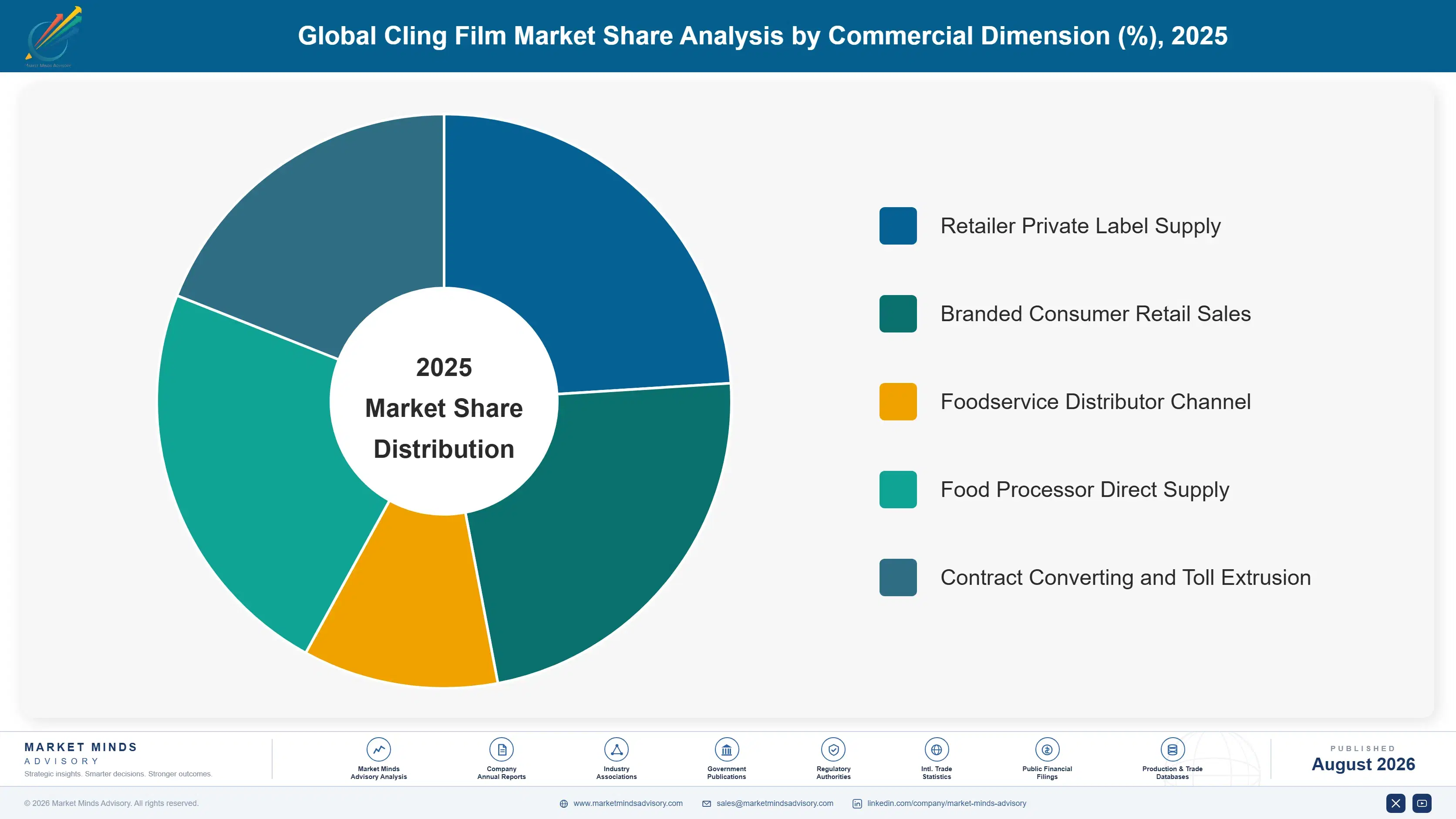
Segmentation follows film material, because the polymer chosen determines cling performance, cutting behaviour, barrier properties, food contact compliance, recyclability and the cost per square metre actually delivered. Film gauge, roll format, dispenser design, core specification and sales channel all sit downstream of that material decision, and every one of them is priced directly against it.
global-cling-film-market-trends-growth-market-share-analysis-1787322127218

Recyclable Mono-Material Polyethylene Film

The fastest segment at 6.3%, a full 1.50 times the market rate, covering film made entirely from polyethylene with no chlorinated layer or dissimilar polymer, so the material enters a recycling stream that will actually accept it. Regulation created this segment rather than any consumer preference. European rules arriving in 2030 require packaging recyclability, and chlorinated or mixed-material film simply does not qualify however well it performs on a dispenser. Conversion adds roughly 9% to converted cost through resin selection and processing changes. The genuine difficulty was cling itself, since the tackifier chemistry making polyethylene adhere to itself must not compromise recyclability, and solving that took converters considerably longer than anybody expected.
CAGR 6.3%

Polyolefin Blend Cling Film

Growing at 5.2% on blends combining polyethylene with metallocene and other polyolefin resins to recover the cling and cut characteristics that chlorinated film delivered naturally and that plain polyethylene does not. Handling is the whole argument. A professional kitchen wrapping several hundred items a shift notices immediately when film fails to cling or tears rather than cutting, and foodservice buyers will pay for performance in a way household purchasers generally will not. Blends also satisfy recyclability requirements perfectly well, provided every single component in them is a polyolefin. What limits the segment is cost, since metallocene resins carry a premium that only genuinely performance-sensitive users can justify paying for at all.
CAGR 5.2%
Full segment breakdown across 5 segments available in the complete report.

Regional Architecture and Country Demand Map

East Asia holds 33% of global value on Chinese food processing and retail overwrap volumes, combined with converting capacity concentrated in the same place. Western Europe follows on material transition value, while growth runs fastest across South Asia and Pacific on retail formalisation and foodservice expansion.

East Asia

Note: East Asia holds 33% against a 22 to 30% band because Chinese food processing and retail fresh food overwrap consume film at volumes no other region approaches, and the converting capacity supplying them is equally concentrated here. Wet market and supermarket fresh produce handling generates enormous machine wrap demand. Japanese consumption skews toward high-barrier polyvinylidene chloride formats that carry considerably higher realised value per tonne, and Japanese producers hold the technical positions in that chemistry globally. Korean demand tracks Japanese practice closely. Regional converters also export substantial household roll volume into North America and Europe at prices domestic producers cannot approach. Volume and converting capacity sit in the same place here.
Share: 33% | CAGR: 5.4% (2026 to 2036)

Western Europe

Regulation defines this region and it points in two directions at once. Single-use plastic rules and packaging waste requirements press against film consumption generally, while food waste policy points the other way, since wrapping fresh food extends shelf life and prevents waste that carries a considerably larger environmental cost. Plasticised polyvinyl chloride has been retreating from food contact for years on migration concerns, replaced by polyethylene and polyolefin blends. Recyclability requirements arriving in 2030 favour mono-material construction directly. Household consumption is declining slowly while foodservice and processing volumes hold steady, which shifts mix toward machine grades. Two regulatory forces genuinely point in opposite directions across this region, and nobody has reconciled them.
Share: 22% | CAGR: 2.7% (2026 to 2036)
Regional intelligence for 5 additional markets available in the complete report: North America, South Asia and Pacific, Latin America, Middle East and Africa, Eastern Europe. Contact sales@marketmindsadvisory.com.
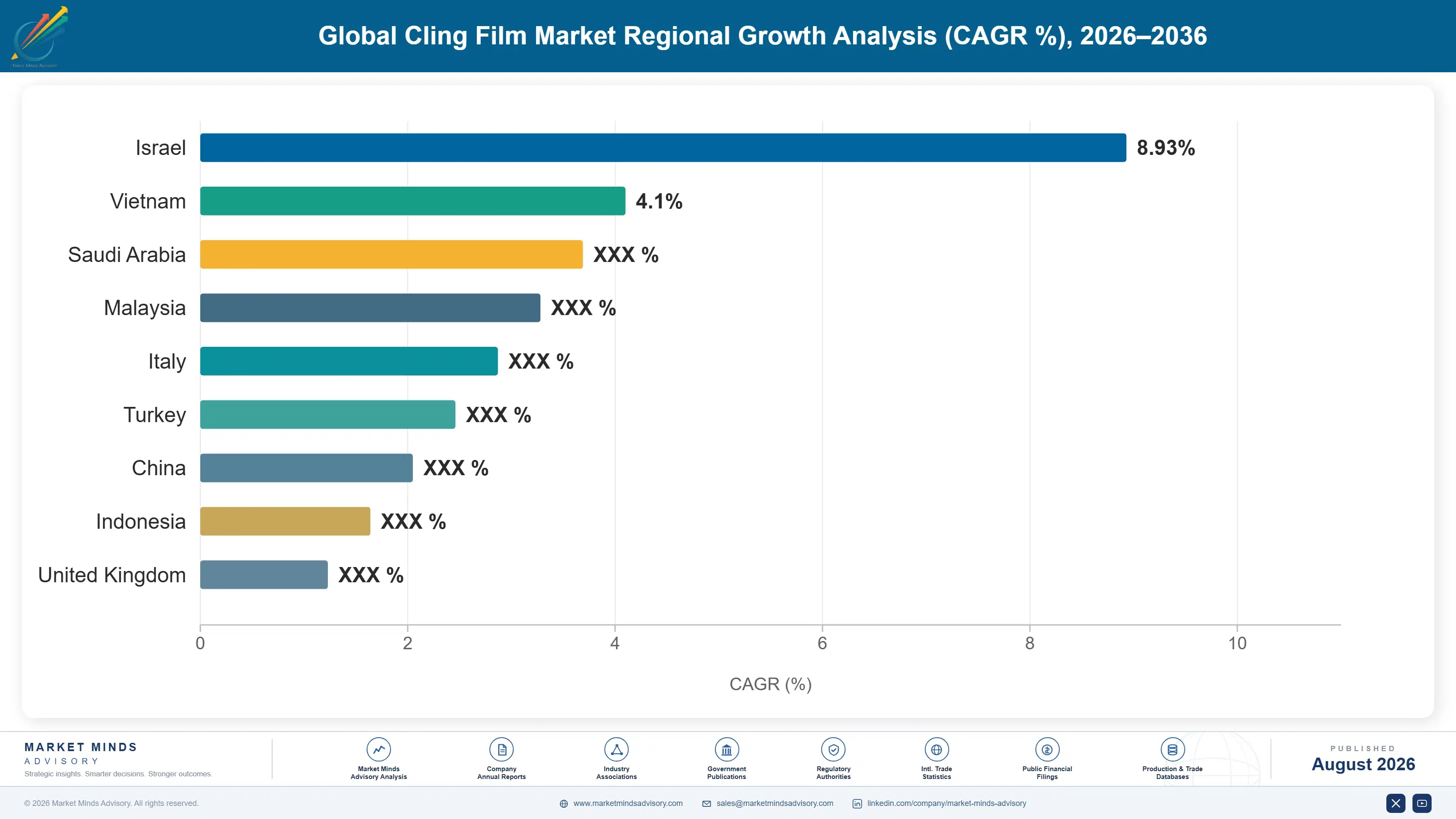
global-cling-film-market-trends-growth-country-cagr-analysis-1787322127735

Where Cling Film Margin Is Won

Four commercial positions separate the converters earning genuine margin from those extruding commodity film at resin cost plus a thin conversion charge: solving cling performance in recyclable construction, weighting mix toward foodservice where performance is paid for, indexing resin exposure properly, and making the food waste argument that this category has never made convincingly.

Solve Cling Performance In Recyclable Construction

Mono-material polyethylene film must adhere to itself without tackifier chemistry that compromises recyclability, and converters who have solved that properly now hold a genuine technical position in a category with almost no others at all. Those with validated formulations realise 18% to 25% higher pricing than commodity polyethylene film and win specifications from brand owners facing the 2030 deadline. Development took years longer than the whole industry expected, which is exactly why the capability has still not spread evenly across converters anywhere. Nobody without it can credibly quote those specifications at all.
Market Impact: Realises 25% higher pricing on recyclable cling film

Weight Mix Toward Foodservice Where Performance Is Paid For

Foodservice already takes 58% of volume and buys on cling, cut and dispenser behaviour rather than on consumer sentiment, which means performance improvements translate into price rather than being competed away immediately. Converters weighted toward that channel hold 12 to 18 points more gross margin than those dependent on household rolls facing private label pressure and single-use plastic sentiment simultaneously. The channel also grows with delivery formats, which consume film far more intensively per meal than dine-in service ever did. Consumer sentiment simply does not reach this particular buyer at all.
Market Impact: Holds 18 margin points above the household channel

Index Resin Exposure Rather Than Absorbing Price Movement

Polymer feedstock is 56% of converted cost, and a converter on fixed annual pricing absorbs every resin movement for the contract duration with no recovery route whatsoever. Contracts indexed to published polymer benchmarks move that volatility onto a formula both parties verify, and converters holding indexed terms across their book protect 8 to 14 points of margin that fixed-price competitors surrender during any upward move. Customers resist it, which is precisely why the negotiation is worth having properly rather than avoiding. A single bad resin year usually settles the argument permanently.
Market Impact: Protects 14 margin points against any resin movement

Make The Food Waste Argument This Category Never Made

Roughly 3 grams of film prevents several hundred grams of food from being discarded, and food waste carries an environmental cost several times larger than the packaging preventing it. Converters and brand owners presenting that arithmetic to regulators and retailers shift the conversation from single-use plastic toward waste prevention, which materially changes how any restrictions eventually get drafted. The cost is advocacy and evidence rather than capital, and the category's historical silence on this point has been genuinely expensive. The industry's silence on this has cost the whole category dearly.
Market Impact: Prevents 300 grams of food waste per wrap

Who Controls the Margin Pool

Concentration sits at 21% for the top five measured on converted film tonnage, the basis used throughout this section, and it is among the lowest figures in packaging. Berry Global and Amcor lead through breadth across film converting rather than cling film specialisation, Sealed Air holds strong food processing positions, Reynolds carries genuine household brand recognition in North America, and Anchor serves foodservice at scale.
Competitive activity runs on three fronts. Recyclable cling formulation is the first and the most consequential, since solving adhesion without compromising recyclability is the only genuine technical differentiator this category currently offers. Channel weighting is the second, with foodservice insulated from the consumer sentiment pressing on household rolls. The third is resin contracting, where indexed terms separate converters who survive price movement from those who absorb it.

Pressure comes from two directions. Regional converters compete on delivered cost within their own geographies, and film economics make defending against them genuinely difficult given transport costs. Separately, private label penetration keeps rising in household rolls, compressing the one segment where brand pricing exists. Rankings will shift on who holds validated recyclable formulations when the 2030 deadline forces specification change across Europe.
global-cling-film-market-trends-growth-company-positioning-matrix-1787322128255

Competitive Moat and Risk Dimensions

BERRY GLOBAL

Moat: Film converting scale and breadth

Enormous film converting capacity across many applications spreads resin purchasing and extrusion cost across volumes that cling film specialists cannot approach, and multi-site regional presence matches the transport economics that govern this product. That breadth also allows capacity to be moved between film applications as demand shifts, which specialist converters simply cannot do at all.
BERRY GLOBAL

Risk: Commodity exposure across portfolio

Scale in commodity film means resin price movement dominates results in ways operational improvement cannot offset, and cling film is one of many similar exposures across the portfolio rather than a differentiated position. Specialty and barrier grades carry better economics but represent a modest share of what a business built on volume actually produces.
REYNOLDS CONSUMER PRODUCTS

Moat: Household brand recognition premium

Genuine consumer brand recognition in a category most people regard as interchangeable supports shelf position and pricing that private label cannot match directly, which is a rare asset in commodity packaging. Retailer relationships built across a wider household products portfolio also protect distribution in ways a film specialist could not replicate.
REYNOLDS CONSUMER PRODUCTS

Risk: Private label share erosion

Household roll volume is exactly where private label penetration keeps rising and where single-use plastic sentiment presses hardest, which attacks the brand premium from two directions at once. Foodservice would balance that exposure but the channel values performance and price rather than the consumer brand equity the business has spent decades building.

Players Tracked

Prominent Players

Berry Global
Amcor
Sealed Air
Reynolds Consumer Products
Anchor Packaging

Other Key Players

SC Johnson
The Clorox Company
Coveris
Sigma Plastics Group
Inteplast Group
Wrap Film Systems
Nan Ya Plastics
Mitsui Chemicals Tohcello
Asahi Kasei
Kureha Corporation
Jiangsu Kingsun Packaging
Polyplex
Trioplast
Manuli Stretch
Fine Group

Recent Developments

JANUARY 2025

Recyclable cling formulation validated for retail overwrap

A European film converter validated a new mono-material polyethylene cling formulation for retail fresh food counter overwrap applications during the year, recovering the adhesion performance that earlier recyclable films had entirely failed to achieve, using tackifier chemistry that is fully compatible with existing polyethylene recycling streams.
Signal: Solving cling without compromising recyclability remains the only genuine technical differentiator that this category offers anybody
JUNE 2025

Major retailer removes chlorinated film from fresh food counters

A large European grocery group removed plasticised polyvinyl chloride film from every fresh food counter across its whole store estate during the year, citing plasticiser migration concerns around fatty food products, and switched entirely to polyolefin blends despite the handling compromise that decision plainly involved.
Signal: Retailer specification rather than any regulation is driving chlorinated film out of European food contact use
OCTOBER 2025

Indexed resin pricing adopted across foodservice supply contracts

A European converter moved its entire foodservice supply contract book onto polymer index pricing rather than the fixed annual terms used previously, which transfers resin volatility onto a formula both parties can verify, after several years spent absorbing movements the business could not recover at all.
Signal: Indexed contracting is spreading because fixed pricing on a commodity input has repeatedly destroyed converter margins

What Drives Cling Film Cost

Polymer resin dominates at roughly 56% of converted film cost, which is high even by commodity packaging standards and leaves converters with very little to control operationally. Additives, tackifiers and plasticisers add around 8%. Extrusion and conversion energy contributes about 12%, cores, cartons and dispensers roughly 9%, and labour with overhead the remaining share across a typical converting operation.
Polyethylene pricing moved sharply through 2021 and 2022 on feedstock and energy costs, and European converters faced the additional burden of gas prices that made extrusion itself considerably more expensive at the same moment. Converters on fixed annual contracts absorbed both. Amcor Annual Report 2025 identifies raw material and energy cost as continuing margin factors, and Plastics Europe tracks the underlying polymer supply position across the region.

The disadvantage mechanism is contract structure rather than purchasing scale. A converter holding indexed pricing recovers resin movement within a quarter while one on fixed annual terms absorbs it for the whole contract year, and on a cost base this resin-heavy that difference decides whether a year is profitable. Exposure also varies by region: European converters carry both the highest energy costs and the tightest regulatory requirements at once.
global-cling-film-market-trends-growth-cost-volatility-analysis-1787322128452

Index supply contracts to published polymer benchmarks

Contracts written against published polyethylene indices rather than fixed annual pricing move volatility onto a formula both parties can verify independently. Customers resist because it complicates their own planning. On a cost base where resin exceeds half the total, though, absorbing movements nobody forecast at signature routinely turns a profitable contract into a loss-making one.

Continue downgauging where performance genuinely permits

Reducing film thickness cuts resin consumption directly, and improvements in resin properties have allowed gauges to fall considerably over two decades. The remaining headroom is limited and each reduction risks tear and cling performance that users notice immediately. Careful application-specific downgauging still delivers real savings on the largest volume grades where performance margins exist.

Recover extrusion process heat into building and drying loads

Film extrusion rejects substantial heat that most plants simply vent, and European energy pricing has made that waste genuinely expensive rather than merely wasteful. Recovery into building heating or material conditioning cuts net consumption on a cost line that has moved faster than resin in some years. Payback runs a few years at European rates and considerably longer elsewhere.

Portfolio Architecture for Margin Defence

Portfolio economics here divide on channel and formulation rather than on anything about the converting process itself. Private label household rolls earn gross margins in the low teens, because retailers tender them ruthlessly, several converters bid comparably and the consumer buying them has already decided that price is the only variable worth considering. Volume here keeps capacity utilised rather than earning anything.
The premium tier is branded household film and standard foodservice grades. Brand recognition supports shelf pricing in a category most consumers regard as interchangeable, and foodservice buyers pay for cling and cut performance that affects how quickly a kitchen works. Margins run in the low twenties. Performance rather than brand decides the foodservice half.

Above both sits validated recyclable formulation and high-barrier specialty film. Solving cling without compromising recyclability is the only genuine technical differentiator this category currently offers, and barrier grades for extended shelf life carry conversion value that commodity film never approaches. Margins reach the low thirties, and both positions rest on formulation capability that took years to develop rather than on any pricing decision. Neither position can be bought quickly.

Volume / Commodity-Adjacent

Private label household rolls tendered by grocery retailers. Several converters bid comparably, the specification is straightforward, and the consumer buying the product treats delivered price as the only meaningful variable there is.
Gross Margin: 11 to 16%

Premium / Certified

Branded household film and standard foodservice grades. The range reflects brand strength across household channels and how much genuine cling and cut performance a foodservice grade actually delivers over the alternatives.
Gross Margin: 19 to 26%

Sustainability / Regulatory / Next-Generation

Validated recyclable mono-material cling formulations together with the high-barrier specialty film grades. The range spans standard recyclable cling grades through to barrier constructions engineered for genuinely extended shelf life applications.
Gross Margin: 28 to 36%
global-cling-film-market-trends-growth-portfolio-architecture-1787322128954

High-value Sub-segments and Strategic Watch-out

Validated Recyclable Cling Formulations

High value and high growth sitting squarely together. Solving adhesion without compromising recyclability took several years longer than the industry had expected, which has left the capability concentrated among very few converters indeed just as the 2030 deadline forces every European film specification to change regardless.
Gross Margin: 29 to 37%

Performance Foodservice Film Grades

High value running on genuinely steady growth. Professional kitchens notice immediately whenever film fails to cling or tears instead of cutting cleanly, and they pay for that performance in a way household purchasers simply never do, which insulates this segment from consumer sentiment almost entirely.
Gross Margin: 21 to 28%

Retail And Processing Machine Overwrap

The volume core that keeps extrusion lines properly loaded on a continuous rather than intermittent basis. Retail formalisation right across emerging markets keeps expanding this particular segment steadily, and the machine grades involved are bought purely on running performance rather than on any consumer-facing consideration whatsoever.
Gross Margin: 16 to 23%

Private Label Household Roll Supply

The strategic watch-out sitting squarely inside this particular portfolio. Volumes here are substantial and they do keep capacity properly utilised, but retailer tendering is genuinely ruthless, single-use plastic sentiment presses hardest right here, and reusable alternatives keep taking a little more share every single year.
Gross Margin: 11 to 16%

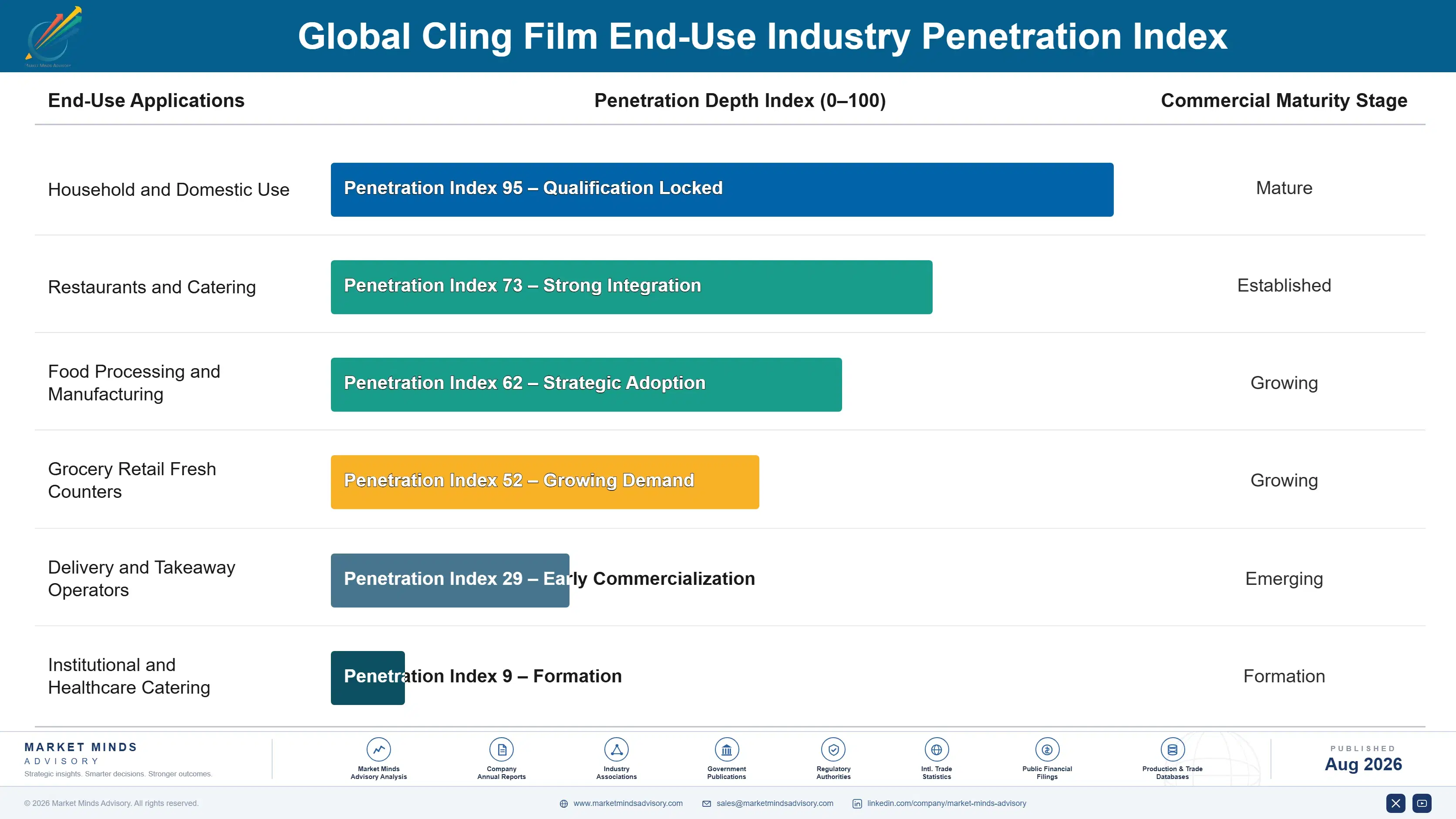
How Cling Film Demand Repeats

Repeat demand here is consumption rather than replacement, which makes it unusually steady. Film is used and discarded continuously, so a foodservice customer orders on a weekly cadence and a food processor orders against production volume, neither of which depends on any purchasing decision being revisited. That makes volume forecasting straightforward and it makes losing a customer genuinely painful, because the revenue disappears immediately rather than at some future replacement point.
Stickiness varies sharply by channel. Food processors are the stickiest, since film is qualified against their specific packing line and product, and requalifying means machine trials nobody wants to run. Foodservice distributors are moderately sticky, holding suppliers who deliver reliably but switching on price when margins tighten. Retail private label contracts are retendered regularly and switch on cost alone. Household consumers show brand loyalty in some markets and none whatsoever in others.

The buyer profile has shifted noticeably. Specification once sat with purchasing managers weighing price per roll and delivery reliability in isolation. Today it increasingly involves sustainability teams evaluating recyclability, recycled content and material declarations alongside, which favours converters who can supply documentation and validated recyclability evidence rather than only competitive pricing and reliable supply.
global-cling-film-market-trends-growth-end-use-penetration-index-1787322129445

Where To Compete And Why

These are among the four positions where our research anticipates prominent divergence between winners and laggards over the coming forecast period. Each is grounded in the demand model, the regulatory perimeter, and the announced capacity pipeline.
01 / RECYCLABLE FORMULATION CAPABILITY

Cling without chlorine is the differentiator

Mono-material polyethylene film must adhere to itself without tackifier chemistry that compromises recyclability, and solving that properly is the only genuine technical position available anywhere in a category otherwise devoid of them. Converters holding validated formulations realise 18% to 25% higher pricing than commodity polyethylene film, and they win specifications from brand owners facing a fixed 2030 deadline. Development took years longer than the whole industry expected, which is exactly why the capability has still not spread evenly across converters.
02 / FOODSERVICE CHANNEL WEIGHTING

Kitchens pay for performance consumers ignore

Foodservice already takes 58% of total volume and buys on cling, cut and dispenser behaviour rather than on any consumer sentiment, which means genuine performance improvements convert into price instead of being competed away almost immediately. Converters weighted toward that channel hold 12 to 18 points more gross margin than competitors dependent on household rolls facing private label pressure and plastic sentiment simultaneously. The channel also keeps growing with delivery formats that consume film far more intensively per meal actually served.
03 / RESIN INDEX CONTRACTING

Fixed pricing on a commodity destroys margin

Polymer feedstock is 56% of converted cost, and a converter on fixed annual pricing absorbs every resin movement for the whole contract with no recovery route at all. Contracts indexed to published polymer benchmarks move that volatility onto a formula that both parties can verify, and converters holding indexed terms protect 8 to 14 points of margin that fixed-price competitors surrender on any upward move. Customers resist it, which is precisely why the negotiation matters so much to converter results.
04 / FOOD WASTE ADVOCACY

Argue prevention not disposal

Roughly 3 grams of film prevents several hundred grams of food from being discarded, and wasted food carries an environmental cost several times larger than the packaging that would have prevented it. Converters and brand owners presenting that arithmetic to regulators and retailers shift the whole conversation from single-use plastic toward waste prevention, which materially changes how restrictions get drafted. The cost involved is advocacy and evidence rather than capital, and the industry's silence so far has been genuinely expensive.

Engagement Snapshot From the Field

A live engagement with an industry participant carrying material or product regulatory and market exposure ahead of a defining policy shift, showing how our research translates into a defensible multi-year portfolio strategy.
MARKET MINDS ADVISORY · CLIENT ENGAGEMENT SUMMARY
Global Cling Film Producer Strategic Portfolio Review and Transition Roadmap 2026·Investment Scenario on Global Cling Film Exposure Evaluation 2025-26
CLIENT PROFILE
A European cling film converter operating two extrusion sites with annual revenue near $94 million (client-reported, unverified by MMA), roughly 71% of it from private label household rolls supplied to grocery retailers across six countries. The business held efficient extrusion capability and long retailer relationships but no validated recyclable formulation, entirely fixed-price supply contracts, and minimal foodservice presence.
STRATEGIC CHALLENGE
Household roll volumes were declining under single-use plastic sentiment while retailer tendering compressed margins further, and resin movements through 2022 had been absorbed entirely because every contract was fixed price. Management needed to decide between developing recyclable cling formulation, building a foodservice channel, or renegotiating the contract book onto indexed terms.
MMA APPROACH
MMA modelled volume and margin by channel across the client's six markets, quantified resin absorption across the previous four contract years, and assessed the formulation development requirement for validated recyclable cling. Twenty expert interviews with retailer buyers, foodservice distributors and food processors tested where specification and pricing decisions were genuinely being made.
KEY FINDINGS
  1. Absorbed resin movement across four contract years exceeded the client's cumulative net profit for the same period, which made contract structure the single largest correctable problem in the business.
  2. Household roll volumes had declined 11% across the period while foodservice volumes in the same markets grew, and the client held almost no position in the growing channel.
  3. Recyclable cling formulation development would take roughly 20 months, and retailer buyers confirmed they would requalify suppliers on that basis well before the 2030 deadline arrived.
  4. Foodservice distributors valued delivery reliability and cut performance above price, which suited a converter with efficient extrusion and consistent quality considerably better than retailer tendering did.
CLIENT PROFILE
A European cling film converter operating two extrusion sites with annual revenue near $94 million (client-reported, unverified by MMA), roughly 71% of it from private label household rolls supplied to grocery retailers across six countries. The business held efficient extrusion capability and long retailer relationships but no validated recyclable formulation, entirely fixed-price supply contracts, and minimal foodservice presence.
STRATEGIC CHALLENGE
Household roll volumes were declining under single-use plastic sentiment while retailer tendering compressed margins further, and resin movements through 2022 had been absorbed entirely because every contract was fixed price. Management needed to decide between developing recyclable cling formulation, building a foodservice channel, or renegotiating the contract book onto indexed terms.
MMA APPROACH
MMA modelled volume and margin by channel across the client's six markets, quantified resin absorption across the previous four contract years, and assessed the formulation development requirement for validated recyclable cling. Twenty expert interviews with retailer buyers, foodservice distributors and food processors tested where specification and pricing decisions were genuinely being made.
KEY FINDINGS
  1. Absorbed resin movement across four contract years exceeded the client's cumulative net profit for the same period, which made contract structure the single largest correctable problem in the business.
  2. Household roll volumes had declined 11% across the period while foodservice volumes in the same markets grew, and the client held almost no position in the growing channel.
  3. Recyclable cling formulation development would take roughly 20 months, and retailer buyers confirmed they would requalify suppliers on that basis well before the 2030 deadline arrived.
  4. Foodservice distributors valued delivery reliability and cut performance above price, which suited a converter with efficient extrusion and consistent quality considerably better than retailer tendering did.
RECOMMENDED STRATEGY
Phase 1: Phase one: renegotiate the contract book onto polymer index terms at the next renewal round, since it corrects the largest single margin leak without any investment at all. Phase 2: Phase two: build a foodservice channel using existing extrusion capability, targeting distributors who value reliability and performance over the lowest delivered price. Phase 3: Phase three: develop a validated recyclable cling formulation in parallel, positioning for retailer requalification well ahead of the regulatory deadline.
OUTCOME
The client moved 68% of its contract book onto indexed pricing within one renewal cycle (client-reported, unverified by MMA). Foodservice revenue reached $14 million in the first full year against a $9 million plan, blended gross margin improved by roughly six points, and recyclable formulation validation is proceeding toward 2027.

Frequently Asked Questions

Foundational context covering the market sizes, CAGR, scope, country, region and competition that inform every finding below. This section is provided to cover basics and most often pre-purchase conversations, answered from the MMA Primary Research Dataset.

What is the current size of the Global Cling Film Market?

The global cling film market was valued at $1.60 billion in 2025, reaching an estimated $1.67 billion in 2026. That covers food contact cling film across household, foodservice and machine overwrap applications.

How large will the Global Cling Film Market be by 2036?

MMA forecasts the market reaching $2.52 billion by 2036, an increase of $0.85 billion over the 2026 base. That represents an expansion multiple of 1.51 times across the forecast period.

What is the CAGR for the Global Cling Film Market 2026 to 2036?

The base case compound annual growth rate is 4.2%, with a bull case of 5.4% and a bear case of 3.0%. Historical growth between 2020 and 2025 ran at 3.2% annually.

Which segment is growing fastest?

Recyclable mono-material polyethylene film grows at 6.3%, a full 1.50 times the market rate, as European recyclability rules exclude chlorinated construction. Polyolefin blend film follows at 5.2% annually.

Who are the major companies in the Global Cling Film Market?

Berry Global, Amcor, Sealed Air, Reynolds Consumer Products and Anchor Packaging lead on converted film tonnage. Together they account for roughly 21%, among the lowest concentration in packaging.

Which country is growing fastest?

India grows fastest at 6.8% annually, driven by organised grocery retail displacing loose selling and converting unwrapped food into packaged fresh produce. Indonesia and Vietnam follow on identical logic.

Report Segmentation Architecture

The full report scope spans multiple orthogonal segmentation dimensions, with cross-tabulated demand data provided for each dimension pair. Coverage extends further to regional breakdowns, trend trajectories, and the competitive detail needed to support segment-level decision-making.

By Film Material

  • Recyclable Mono-Material Polyethylene Film
  • Polyolefin Blend Cling Film
  • Linear Low-Density Polyethylene Film
  • Polyvinylidene Chloride High-Barrier Film
  • Plasticised Polyvinyl Chloride Cling Film

By End-Use Industry

  • Household and Domestic Use
  • Restaurants and Catering
  • Food Processing and Manufacturing
  • Grocery Retail Fresh Counters
  • Delivery and Takeaway Operators
  • Institutional and Healthcare Catering

By Commercial Dimension

  • Retailer Private Label Supply
  • Branded Consumer Retail Sales
  • Foodservice Distributor Channel
  • Food Processor Direct Supply
  • Contract Converting and Toll Extrusion

By Region

  • North America
  • Western Europe
  • East Asia
  • South Asia and Pacific
  • Latin America
  • Middle East and Africa
  • Eastern Europe

Scope, Methodology, and Coverage

Every figure in this report is reproducible from documented input assumptions. The scope below maps the historical period, the forecast horizon, the segmentation dimensions, and the countries covered, alongside the underlying primary and qualitative methodology.
Historical Period
2020 to 2025
Forecast Period
2026 to 2036
Base Year
2025 (USD billions; MMA Primary Research Dataset, August 2026)
Market Definition
This report covers cling film for food contact applications, spanning plasticised polyvinyl chloride, linear low-density polyethylene, polyolefin blend, polyvinylidene chloride high-barrier and recyclable mono-material polyethylene constructions, across household rolls, foodservice and catering rolls, grocery fresh counter overwrap and food processing machine grades. Industrial pallet stretch wrap, vacuum pouches and shrink bags, flexible laminate packaging, aluminium foil, greaseproof and baking papers, and reusable food covers are all excluded from the sizing.
Quantitative Units
USD billions at converter realised value; converted film volume in thousands of tonnes; average realised price in USD per tonne.
Segmentation Dimensions
By film material; by end-use industry; by commercial dimension; by region.
Regions Covered
North America, Western Europe, East Asia, South Asia and Pacific, Latin America, Middle East and Africa, Eastern Europe
Countries Covered
China, Japan, South Korea, India, Indonesia, Vietnam, Australia, Germany, France, United Kingdom, Italy, Spain, Poland, Turkey, United States, Canada, Mexico, Brazil, South Africa, United Arab Emirates.
Key Companies Profiled
Berry Global, Amcor, Sealed Air, Reynolds Consumer Products, Anchor Packaging, SC Johnson, The Clorox Company, Coveris, Sigma Plastics Group, Inteplast Group, Nan Ya Plastics, Asahi Kasei, Kureha Corporation, Trioplast and others.
Quantitative Methodology
Primary survey, n=3,800 respondents, Q4 2025, six countries; demand-side model with trade association cross-validation
Qualitative Methodology
47 expert interviews, Q4 2025; applied to validate demand model assumptions, identify emerging dynamics, and assess competitive positioning
Report Format
PDF and XLSX data workbook (Word format preview document)
Publisher
Market Minds Advisory
Report Code
MMA-2026-PAC-047
Published
August 2026
Contact
sales@marketmindsadvisory.com | www.marketmindsadvisory.com

Purchase the full Global Cling Film Market Report (2026 to 2036).

The full report sizes the global cling film market across five film materials, six end-use industries and seven regions, with converted tonnage and pricing detail behind every value estimate. It profiles twenty global converters on recyclable formulation capability, channel weighting and resin contracting structure across their books. Regional chapters cover packaging regulation, chlorinated film retreat and retail formalisation by market. Material analysis quantifies cling and cut performance trade-offs across polymer choices. Cost analysis tracks polymer feedstock and extrusion energy exposure against contract structures across the converting base.
Converted tonnage and pricing detail by film material
Chlorinated film retreat tracking across major markets
Recyclable format conversion forecasts through 2036
Channel margin comparison across household and foodservice
Competitive position assessments across twenty global converters
Resin index contracting adoption across the supply base

Built For The People Who Decide

From boardroom strategy to bench-side execution, this report is read cover-to-cover by leaders shaping the next decade of their industry, turning demand scenarios, market dynamics and valuation benchmarks into decisions.
CXOs/ Presidents/ VPs/ Managers
M&A and Corporate Development
Strategy Teams and R&D Heads
Procurement and Product Directors
Regulatory and Compliance Leaders
Investor Relations and Equity Analysts