Market Minds Advisory
Cat Litter Market

Cat Litter Market: Cat Litter Market. Premiumisation and Indoor-Cat Ownership Concentration to 2036

Rising indoor-cat ownership and health-monitoring litter innovation are pulling demand toward silica and tofu-based premium formats, even as bentonite clay cost swings and plastic packaging waste concerns reshape how manufacturers position commodity clumping litter.

Lead Analyst

Published

September 2026

Make Smarter Decisions with Customized Research Insights

Request a free sample report and evaluate market opportunities, growth trends, and competitive dynamics relevant to your business needs.

2025 MARKET VALUE$6.8BMarket Size 2025
2036 FORECAST VALUE$13.2BBase Case , 2026 to 2036
CAGR 2026 TO 20366.2 %Bull 7.5% / Bear 4.9%
INCREMENTAL OPPORTUNITY$6.0BNet 10- year value creation
EXPANSION MULTIPLE1.83x2036 value over 2026 base
Strategic Levers
M&A Pipeline
Regional Outlook
Country Rankings
Competitive Intelligence
Segmental Deep-dive
Call-Us : 91 93563 13602

Executive Snapshot and Market Trajectory.

Cat litter demand is shifting from basic clumping clay commodity formats toward premium silica, tofu-based, and health-monitoring litters, as indoor-cat ownership growth and rising owner willingness to pay for odor control and biodegradability push retailers toward higher-value shelf positioning, particularly across urban indoor-cat households.
Tofu-based litters are growing fastest as flushable, biodegradable formats gain traction with sustainability-conscious owners across Asia-Pacific markets, pulling volume toward premium plant-based formats over conventional clumping clay. North America absorbs by far the largest share of global demand given its uniquely high concentration of indoor cat ownership and litter box culture, a share well above what the region's population alone would typically generate, particularly across sustainability-conscious households in developed Asian and Western retail markets overall.
Competition sits between diversified global pet care majors offering broad litter portfolios across multiple material categories and specialty brands competing on odor control technology and sustainable material sourcing. Rising premiumization and health-monitoring litter innovation are accelerating demand for silica and tofu-based formats well beyond conventional clumping clay, while bentonite clay cost volatility and growing plastic packaging waste concerns continue to reshape how manufacturers position commodity litter lines.
Market Definition
Cat litter covers clumping clay, non-clumping clay, silica gel crystal, plant-based biodegradable, recycled paper, and tofu-based litter formats sold through retail, veterinary, and e-commerce channels. The market excludes litter boxes and disposal accessories, cat food, and unrelated pet care categories.
Base Year Value
$6.8B in 2025 (MMA Primary Research Dataset, August 2026)
Forecast Period
2026 to 2036, eleven discrete annual values
CAGR
6.2% base case. Bull 7.5%. Bear 4.9%.
Fastest Growth Segment
Tofu-Based Cat Litter: 10.5% CAGR
Fastest Growth Country
China: 8.8% CAGR
Fastest Growth Region
South Asia and Pacific: 8.5% CAGR
Largest Region
North America: 34% of 2025 global value
Market Leaders
The Clorox Company, Church & Dwight Co Inc, Nestle Purina PetCare, Oil-Dri Corporation of America, and Mars Petcare lead the field. Source: MMA Analysis based on company annual reports.
Primary Survey
n=3,800 procurement and R&D decision-makers, Q4 2025, six countries
Methodology
Demand-side build-up, cross-validated against public data, 47 expert interviews

Cat Litter Market Forecast Scenarios

global-cat-litter-market-size-forecast-scenario-1788167988100
Between 2020 and 2025 cat litter demand grew at roughly 5.5 percent a year, accelerating as pandemic-era pet adoption surged and indoor-cat ownership expanded rapidly across major developed markets. Bentonite clay price volatility during 2022 pushed manufacturer input costs higher, temporarily compressing margins, particularly as remote work trends kept more owners home to notice litter box maintenance needs directly.
The base case assumes continued growth as three mechanisms compound: indoor-cat ownership continuing to expand across urbanizing markets where apartment living favors litter box use over outdoor access; sustainability-conscious owners increasingly shifting toward tofu-based and plant-based biodegradable formats over conventional clay; and health-monitoring litter technology creating a premium category that positions litter as a diagnostic tool rather than a purely functional product, particularly as diagnostic sensor costs decline enough for mainstream product line integration across most markets nationwide.
The bull case turns on faster-than-expected premiumization pulling additional volume toward silica and tofu-based formats commanding higher margins. The bear case centers on a sustained bentonite clay cost spike, which has historically compressed manufacturer margins and intensified private-label price competition across mature retail channels, a risk manufacturers with diversified clay sourcing have so far managed better than smaller competitors.

Premiumisation Meets Clay Cost Economics

Cat litter sits at the intersection of indoor-cat ownership economics, sustainability-driven material innovation, and bentonite clay feedstock cost cycles. As premiumization spreads, manufacturers increasingly compete on odor control technology and material sourcing credibility rather than unit price alone, even where silica and tofu-based formats carry a substantial premium over conventional clumping clay.
MARKET CONCENTRATIONCR5: 58%Ownership concentrates heavily among pet care majors overall
AVERAGE SELLING PRICE$9 per bagPricing varies sharply by material and clumping technology
PRIVATE LABEL SHARE31% of retail volumeStore-brand alternatives compete heavily on price across most categories
INDOOR CAT OWNERSHIP SHARE68% of householdsLitter box dependency remains the dominant ownership pattern
TOP PRODUCER COUNTRY SHARETop 3 countries: 61%Production concentrates heavily near clay mining regions overall
CLAY COST SHARE35% of cost of goods soldBentonite clay sourcing dominates total production cost overall
Commercially the category splits between diversified global pet care majors offering broad litter portfolios across multiple material categories and specialty brands competing on odor control technology and sustainable material sourcing. Diversified majors compete on retail distribution scale and manufacturing cost, while specialty brands win on formulation credibility and premium positioning, since clumping, silica, and plant-based formats each demand distinct material and processing specifications.
The next decade will be shaped by continued indoor-cat ownership growth, rising demand for tofu-based and health-monitoring formats paired with sustainability expectations, and diversification of bentonite clay sourcing beyond concentrated mining regions facing periodic price volatility. Manufacturers that can pair premium material innovation with reliable, diversified sourcing stand to capture share from competitors still selling undifferentiated clay litter without comparable premium positioning, particularly across manufacturers weighing premium research investment against commodity volume retention.
"Litter used to be sold purely on clumping strength and price per pound; now a bag that changes color to flag a urinary tract infection sits on the shelf at nearly four times the price of plain clay, and owners increasingly treat that premium as a health investment rather than a luxury."
Director, Pet Care Consumables and Absorbent Materials Practice · MMA Pet Care Consumables and Absorbent Materials Practice · August 2026

Market Trends

Health-Monitoring Litter Technology Expands Premium Category

Manufacturers across North America and increasingly Europe are launching health-monitoring litters that use color-changing crystals or embedded sensors to flag potential urinary and kidney health issues, creating clearer commercial pathways for premium positioning than the conventional odor-control marketing the category previously relied on. Development has required manufacturers to invest in material science and, for sensor-based formats, companion app development, a process that can take twelve to eighteen months per product generation given veterinary validation requirements. Manufacturers with established health-monitoring credibility are capturing share from smaller competitors unable to invest in the required research.
Market Impact: Adds 5 percent ownership volume

Tofu-Based Litter Adoption Expands Beyond Asia-Pacific

Tofu-based flushable litter, pioneered in Asia-Pacific markets, is increasingly gaining retail placement in North America and Western Europe as sustainability-conscious owners seek biodegradable alternatives to clumping clay that traditional recycling and composting cannot easily process. Tofu-based formats require specialized processing to achieve reliable clumping performance comparable to bentonite clay, a technical capability that favors manufacturers with dedicated plant-based research over general commodity clay producers. Manufacturers investing in tofu-based production capacity are capturing premium retail shelf space faster than competitors relying on conventional biodegradable formats alone, particularly across premium pet retail chains serving affluent sustainability-focused shoppers.
Market Impact: Adds 6 percent volume from subscriptions

Market Opportunities and Growth Drivers

Expanding Indoor-Cat Ownership Sustains Broad Demand Growth

Urbanization and apartment living continue expanding indoor-cat ownership across major developed and increasingly emerging markets, sustaining steady baseline demand for litter independent of the faster-growing premium and health-monitoring segments driving overall category value growth. Households in dense urban housing show meaningfully higher litter box reliance than households with outdoor access, since indoor-only cats require consistent litter box provision throughout the day. Manufacturers with strong urban retail distribution benefit from this ownership-driven demand that runs ahead of any single product innovation cycle, and several urban retailers report meaningfully stronger litter category sales growth than suburban or rural counterparts.
Market Impact: Adds up to 19 percent cost

E-Commerce Subscription Models Sustain Recurring Purchase Volume

E-commerce subscription platforms are rapidly expanding recurring litter purchase relationships, reducing the friction of periodic in-store restocking that historically discouraged consistent brand loyalty among busy pet owners. Subscription customers show meaningfully higher repeat purchase rates and lower brand-switching behavior than one-time retail purchasers evaluating shelf options at the point of sale. Manufacturers investing in direct subscription channels are capturing margin previously lost to intermediary retail distributors across major consumer markets, and several subscription platforms report that customers who commit to recurring delivery rarely return to unpredictable in-store shelf availability once accustomed to automatic replenishment convenience.
Market Impact: Affects 31 percent of retail volume

Market Restraints and Challenges

Bentonite Clay Price Volatility Compresses Margin Predictability

Bentonite clay feedstock swings meaningfully with mining and energy cost cycles, creating margin volatility that manufacturers must manage through pricing mechanisms beyond what more stable material categories typically require across most production regions. Root causes include the tight linkage between clay mining and energy costs combined with limited manufacturer ability to pass through cost increases immediately given competitive retail pricing pressure. When clay costs spike, manufacturers either absorb margin compression or risk losing shelf space to private-label alternatives, both of which have historically strained margins during volatile pricing periods across most price-sensitive retail segments.
Market Impact: Shifts 11 percent volume to monitoring

Plastic Packaging Waste Concerns Pressure Commodity Positioning

Growing consumer awareness of plastic packaging waste is pressuring manufacturers of conventional clumping clay litter, which typically ships in heavy plastic containers, to justify continued commodity positioning against increasingly visible sustainability alternatives. The root cause is that clay litter's weight and moisture-barrier requirements make lightweight or biodegradable packaging technically more difficult than for drier plant-based formats. Manufacturers are addressing the pressure by introducing recyclable packaging formats and promoting bulk-purchase options that reduce total packaging waste per use, and several major retailers now require documented recyclability data before granting premium shelf placement to new commodity litter product lines.
Market Impact: Adds 9 percent tofu volume
4 additional market trends, 4 additional growth drivers, and 3 additional restraints and challenges are covered in the full report. Contact sales@marketmindsadvisory.com to access the complete intelligence.

Segment CAGR and Growth Architecture

Cat litter segments most usefully by material type, since clumping clay, non-clumping clay, silica, plant-based, paper, and tofu formats carry distinct absorption and clumping properties. This framework mirrors how manufacturers organise product lines and how retailers merchandise litter across different owner preferences today, particularly as owners increasingly weigh sustainability credentials against everyday clumping performance.
global-cat-litter-market-market-share-analysis-1788167988671

Tofu-Based Cat Litter

Tofu-based litter is the fastest-growing segment as flushable, biodegradable formats gain traction with sustainability-conscious owners across Asia-Pacific markets where the material was originally developed and commercialized. Tofu-based formats require specialized soybean pulp processing to achieve reliable clumping performance, a technical capability that favors manufacturers with dedicated plant-based research over general commodity clay producers. Growth concentrates among manufacturers with documented clumping performance credentials and premium retail placement, since owners increasingly expect comparable functional performance before paying a sustainability premium. Growth is fastest in East Asia and increasingly North America, where premium pet retail infrastructure continues expanding fastest, especially among owners already committed to broader household sustainability purchasing habits across daily consumer categories.
CAGR 10.5%

Plant-Based Biodegradable Cat Litter

Plant-based biodegradable litter, made from corn, wheat, or wood materials, forms the second-fastest-growing segment, benefiting from sustainability-conscious owners seeking compostable alternatives to conventional clay without the specialized processing tofu-based formats require. Cat litter's documented biodegradability and lighter weight position plant-based formats favorably within sustainability-focused retail compared with heavier clay alternatives. Growth is fastest in markets with well-developed sustainability-conscious pet retail infrastructure, particularly North America and Western Europe, where retailers increasingly dedicate shelf space to biodegradable formats, providing manufacturers new distribution channels beyond conventional clay placement. Manufacturers with documented compostability credentials command premium pricing as retailers standardize sustainability categories, particularly across households transitioning gradually away from conventional clay formats toward more sustainable everyday alternatives.
CAGR 8.5%
Full segment breakdown across 6 segments available in the complete report.

Regional Architecture and Country Demand Map

Cat litter demand concentrates where indoor-cat ownership culture and litter box dependency are most developed. North America accounts for by far the largest share of global demand given its uniquely high concentration of indoor cat ownership, a share well above what the region's population alone would typically generate.

North America

The United States' uniquely high indoor-cat ownership rate, tied to widespread apartment living and cultural preference for litter box use over outdoor access, drives by far the largest regional demand for cat litter, an out-of-band share reflecting the sheer concentration of litter-dependent cat ownership relative to the region's population. Rising premiumization and health-monitoring litter adoption are reshaping demand toward silica and tofu-based formats over conventional clumping clay specifically. Canada's pet retail sector, closely integrated with United States supply chains, mirrors American product specifications and ownership patterns. Growth is supported by continued premiumization and subscription channel expansion across the region's major pet retail markets, and several major retailers now dedicate expanded shelf space to premium and health-monitoring formats nationwide.
Share: 34% | CAGR: 5.5% (2026 to 2036)

Western Europe

Germany and France's well-developed pet care retail sectors, tied to strong consumer spending on premium pet products, drive substantial regional demand for silica and plant-based litter formats. The United Kingdom's pet retail sector contributes additional demand from owners increasingly favoring sustainability-conscious biodegradable formats. Italy and the Netherlands' pet retail sectors contribute meaningful additional demand, though premium format adoption there still lags the more advanced German and British retail infrastructure. Growth trails the fastest-growing regions because the region's premiumization transition is comparatively advanced already, with further gains depending on incremental format upgrades rather than new category adoption, and several sustainability-focused retailers are expanding dedicated shelf sections for plant-based and tofu formats.
Share: 22% | CAGR: 4.6% (2026 to 2036)
Regional intelligence for 5 additional markets available in the complete report: East Asia, South Asia and Pacific, Latin America, Middle East and Africa, Eastern Europe. Contact sales@marketmindsadvisory.com.
global-cat-litter-market-country-cagr-analysis-1788167989197

Health-Monitoring Technology and Subscription Premiumisation

Manufacturers can grow revenue per unit even where basic clumping clay volume growth is modest by shifting owners toward silica and tofu-based formats, securing direct subscription relationships, and expanding health-monitoring technology lines. The most durable gains come from capturing premiumization-driven demand rather than commodity clay price competition, particularly for manufacturers already serving established retail distribution channels.

Developing Health-Monitoring Litter Technology Lines Nationwide

Manufacturers investing in documented health-monitoring litter technology targeted at health-conscious owners capture a price premium of roughly 30 to 45 percent over conventional clumping clay, reflecting the material science and validation testing these products require. This technology investment requires meaningful research and veterinary validation work, but it pays back through access to premium retail placement that commands higher pricing and stronger owner loyalty among health-focused buyers. The approach works best for manufacturers already serving general clay channels seeking to extend into premium health-monitoring distribution, particularly among manufacturers already serving general clumping clay channels.
Market Impact: Commands a 30 to 45 percent price premium

Securing Direct Subscription Purchase Relationships Broadly

Manufacturers securing multi-year subscription relationships with cat owners gain revenue visibility uncommon in traditional one-time retail sales, since subscription customers rarely reverse a recurring purchase commitment once satisfied with a brand's clumping performance and odor control. These relationships also create durable switching barriers, since owners face inconvenience switching subscription providers absent a serious quality failure. Manufacturers with established subscription relationships report customer lifetime value roughly 3 times higher than comparable one-time retail purchasers, and several manufacturers report that subscription customers try premium formats more readily than one-time retail purchasers evaluating price-sensitive shelf options.
Market Impact: Lifts customer lifetime value by 3 times overall

Expanding Tofu-Based Production Capacity Across Regions

Manufacturers expanding tofu-based production capacity beyond concentrated Asia-Pacific facilities capture growing Western retail demand that previously went underserved by limited import volume, simplifying supply chain logistics for retailers seeking reliable domestic sourcing. This capacity investment requires meaningful manufacturing infrastructure development, but manufacturers who succeed report volume growth of roughly 26 percent compared with import-dependent distribution strategies. The approach works best for manufacturers with established sustainability-focused brand positioning seeking broader Western market presence, and several manufacturers report that Western retailers increasingly prefer domestic tofu-based supply over import-dependent alternatives facing longer lead times.
Market Impact: Lifts regional volume by 26 percent overall industry-wide

Offering Bundled Litter Box And Accessory Partnerships

Manufacturers partnering with smart litter box makers to offer bundled litter subscriptions optimized for automated box compatibility are capturing revenue that previously went to separate accessory retailers, simplifying procurement for owners investing in comprehensive litter box systems. This bundled partnership approach commands meaningfully higher average order values than standalone litter sales, and smart box makers increasingly prefer litter partners who can guarantee formulation compatibility rather than managing separate hardware and consumable relationships. Bundled partnerships lift average order value by roughly 19 percent compared with standalone litter purchases, particularly among owners investing in comprehensive automated litter systems.
Market Impact: Lifts average order value by 19 percent overall

Who Controls the Margin Pool

The cat litter market is moderately concentrated, with an estimated CR5 near 58 percent, reflecting a category where retail distribution scale and brand recognition matter more than manufacturing capability alone. The Clorox Company and Church & Dwight Co Inc lead on combined retail shelf presence and brand heritage, but the gap to specialty premium brands is narrower on basic clumping formats than on health-monitoring and tofu-based categories.
Competitive activity centers on three fronts: health-monitoring technology development aimed at capturing premium health-conscious demand, subscription relationship development to secure recurring-purchase-driven volume, and tofu-based production capacity expansion to reduce import dependency. Acquisitions of specialty sustainability-focused brands with established plant-based formulation capability have picked up as diversified majors seek to close innovation gaps organically.

Emerging pressure comes from direct-to-consumer subscription brands rapidly building loyal customer bases around health-monitoring and sustainability positioning, threatening established retail-distributed majors on customer relationship depth. Bentonite clay producers are also pushing further downstream into finished litter manufacturing through joint ventures, threatening to disintermediate manufacturers who purchase clay externally. Rankings could shift meaningfully if a subscription-first brand achieves comparable retail distribution scale with established majors across most markets.
global-cat-litter-market-company-positioning-matrix-1788167989718

Competitive Moat and Risk Dimensions

THE CLOROX COMPANY

Moat: Deep Multi-Brand Retail Distribution

Clorox's portfolio spanning Fresh Step and Scoop Away, built over decades of brand development, gives it shelf presence and distribution scale that smaller specialty competitors cannot easily match across mass-market channels. That distribution reach lets Clorox launch new premium and health-monitoring lines at scale where smaller competitors would need years to match.
THE CLOROX COMPANY

Risk: Exposure To Private Label Substitution

Clorox's substantial reliance on mass-market retail channels leaves it more exposed to private-label substitution pressure than specialty competitors focused on premium, differentiated segments where private label has not achieved comparable credibility. This has, at times, compressed Clorox's commodity clumping clay margins during periods of aggressive private-label retail expansion.
CHURCH & DWIGHT CO INC

Moat: Strong Arm & Hammer Trust

Church & Dwight's Arm & Hammer brand recognition, built through decades of household product trust extending beyond pet care, gives it consumer credibility that newer entrants struggle to replicate regardless of available marketing budget. That brand trust helps Church & Dwight command premium pricing for odor-control formulations where its baking-soda heritage carries direct functional relevance.
CHURCH & DWIGHT CO INC

Risk: Limited Health-Monitoring Category Presence

Church & Dwight's portfolio remains more concentrated in conventional odor-control formats than in the fastest-growing health-monitoring category, leaving it less positioned to capture premium health-conscious demand than specialty competitors with dedicated diagnostic technology investment. Newer, health-focused competitors have, at times, captured premium retail shelf space that Church & Dwight's conventional positioning left uncontested.

Players Tracked

Prominent Players

The Clorox Company
Church & Dwight Co Inc
Nestle Purina PetCare
Oil-Dri Corporation of America
Mars Petcare

Other Key Players

Kent Pet Group
Petmate
Dr. Elsey's
Ever Clean
Boxiecat
Okocat
sWheat Scoop
Feline Pine
PrettyLitter
Whisker
Van Ness
Cat's Pride
Yesterday's News
So Phresh
Naturally Fresh

Recent Developments

MARCH 2026

Clorox Launches Health-Monitoring Fresh Step Product Line

The Clorox Company launched a health-monitoring Fresh Step product line featuring color-changing crystals designed to flag potential urinary health concerns, aimed at directly capturing growing demand for documented health-monitoring performance across major retail channels, reducing lead times for retail replenishment programmes, with the line expected in full distribution by mid-2026.
Signal: Signals established manufacturers are increasingly prioritising health-monitoring technology investment over continued reliance on basic odor-control positioning.
SEPTEMBER 2025

Church & Dwight Announces Tofu-Based Production Expansion

Church & Dwight announced expanded tofu-based litter production capacity at a facility in North America, diversifying the company's material base beyond conventional clumping clay and reducing exposure to import-dependent supply that has periodically constrained availability of sustainability-focused formats across the industry, according to a company statement.
Signal: Confirms tofu-based capacity investment is quickly becoming a standard strategic priority among diversified pet care majors industry-wide.
JANUARY 2026

Oil-Dri Announces Diversified Bentonite Clay Sourcing Agreement

Oil-Dri Corporation announced a new multi-year bentonite clay sourcing agreement with mining operations across multiple states, diversifying the company's material base beyond its traditional regional sourcing and reducing exposure to localized supply disruption that has periodically compressed margins across the industry, according to a company statement.
Signal: Signals manufacturers are treating multi-region clay sourcing diversification as a competitive necessity rather than a contingency measure.

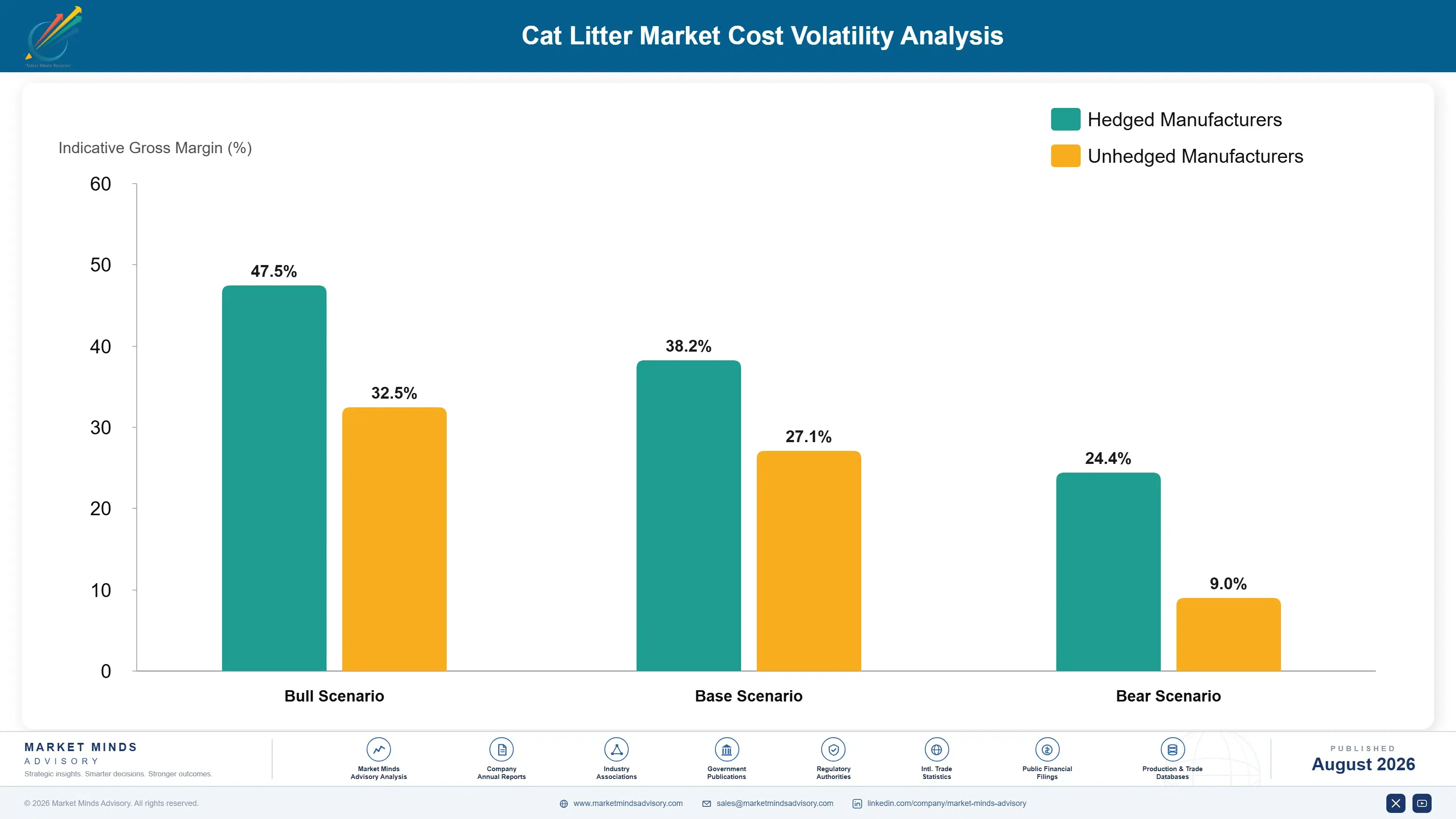
Bentonite Clay And Silica Sourcing Exposure

Bentonite clay and silica gel feedstock account for 35 percent of cost of goods sold across most cat litter production, with packaging, labor, and distribution costs making up most of the remainder. Material sourcing concentrates in the United States, China, and Turkey, tying production costs to clay mining and silica processing pricing rather than broader commodity markets subject to periodic global disruption.
Bentonite clay price increases across major mining regions during 2022, driven by energy price inflation affecting mining and processing operating costs, pushed manufacturer input costs up by more than 17 percent within months, according to USGS reporting, forcing manufacturers with fixed retail pricing to absorb margin compression. Manufacturers without diversified sourcing faced the sharpest impact, and smaller regional manufacturers reported delayed deliveries while sourcing alternative clay supply.

Exposure varies by player type: larger integrated manufacturers like Clorox, with direct mining relationships and diversified regional sourcing, weather price spikes with meaningfully less margin disruption than smaller manufacturers reliant on open-market spot purchases. Geographic exposure differs, since manufacturers sourcing from domestic United States clay deposits face different risk timing than those dependent on Chinese or Turkish mining operations, meaning cost impact varies across the industry overall.
global-cat-litter-market-cost-volatility-analysis-1788167989915

Diversifying Clay And Silica Sourcing Across Regions

Manufacturers are increasingly qualifying clay and silica suppliers across the United States, China, and Turkey simultaneously rather than relying on a single mining region, so a disruption or price spike in one region does not halt production entirely. This diversification raises logistics complexity modestly but significantly reduces the risk of the sharp, single-origin price spikes that hit under-diversified manufacturers hardest.

Securing Multi-Year Forward Purchasing Agreements With Mining Operations

Manufacturers are increasingly signing multi-year forward purchasing agreements directly with mining operations, securing guaranteed allocation ahead of the open market and capturing pricing stability that smaller manufacturers reliant on spot purchases cannot access. This approach requires committed volume most smaller manufacturers cannot guarantee, reinforcing a cost advantage for larger, established manufacturers across supplier negotiations.

Shifting Toward Plant-Based Non-Mineral Material Inputs

Manufacturers are increasingly incorporating plant-based material inputs into product lines, reducing dependency on volatile bentonite clay mining cycles while also meeting growing consumer sustainability expectations. This approach requires meaningful supply chain qualification investment most smaller manufacturers lack, reinforcing a durable cost and positioning advantage for scale players across product development cycles overall considerably worldwide.

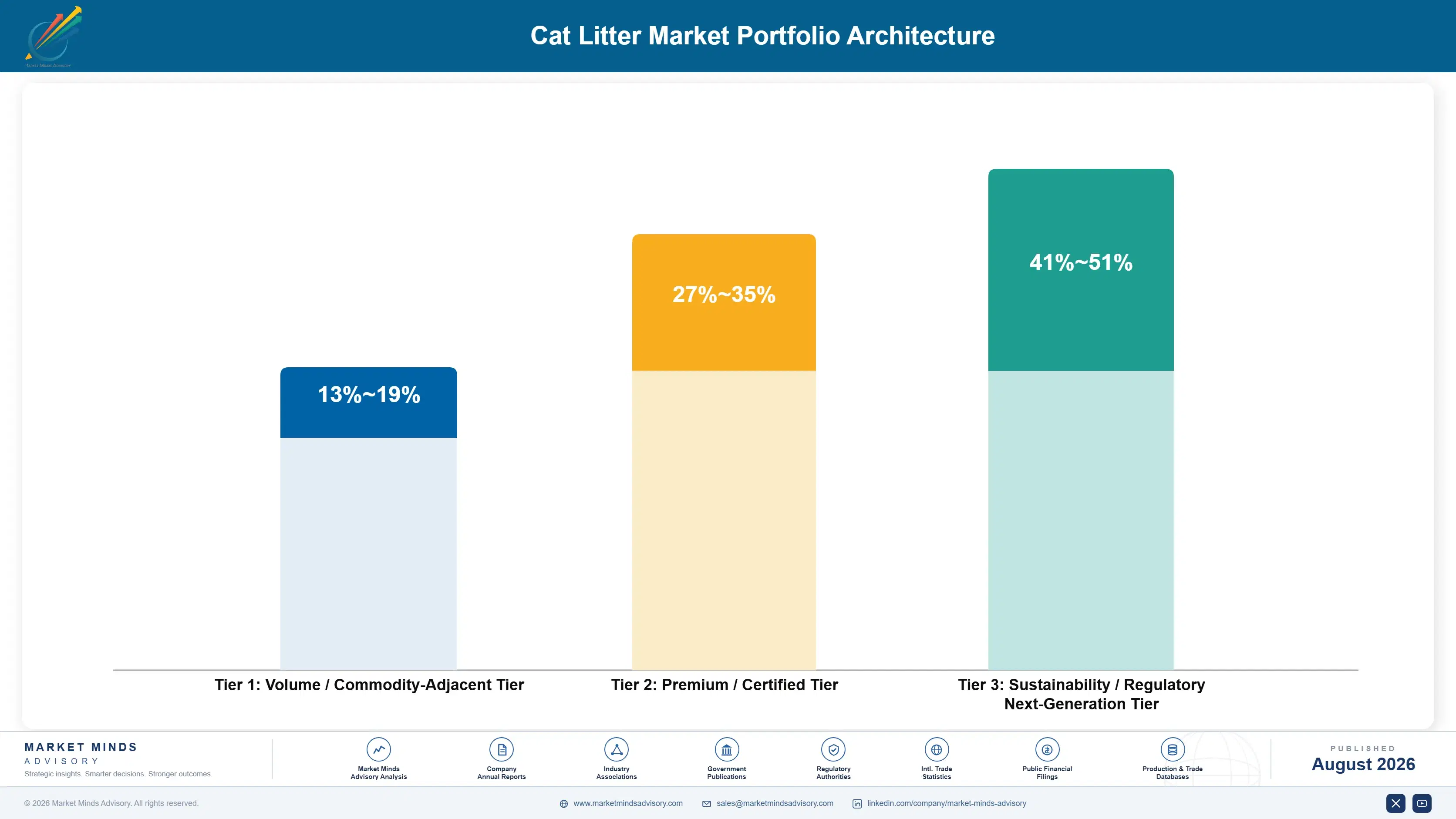
Portfolio Architecture for Margin Defence

Cat litter organises into three commercial tiers running from basic clumping clay commodity supply through certified plant-based and paper formats to premium silica and health-monitoring next-generation platforms. Gross margins widen sharply moving up the tiers, since commodity clay formats compete largely on unit cost and retail accessibility, while premium and health-monitoring formats capture value from documented performance, material sourcing, and diagnostic credibility rather than raw material cost alone.
The tension between commodity volume and premium format revenue shapes manufacturer strategy: basic clumping clay generates the retail scale that supports material purchasing power, but silica and health-monitoring formats generate the margin that justifies continued research investment. Manufacturers overweighted toward commodity-only sales face intensifying price competition from private-label alternatives, while premium-forward manufacturers carry steadier, higher-margin profitability less exposed to clay price cycles.

High-value pools concentrate among health-monitoring formats sold into health-conscious premium retail channels, and among tofu-based formats sold into sustainability-focused subscription channels commanding recurring revenue value. Both pools reward manufacturers who can pair documented performance credibility with reliable, diversified material sourcing rather than competing purely on commodity clay price alone, a distinction becoming more pronounced as premiumization deepens across major pet retail markets.

Volume / Commodity-Adjacent Tier

Basic clumping and non-clumping clay litter sold largely on unit cost and retail accessibility, competing on price sensitivity across broad mass-market retail channels, particularly across price-sensitive mass-market retail channels broadly worldwide.
Gross Margin: 13-19%

Premium / Certified Tier

Certified plant-based and paper formats backed by documented biodegradability, sold at a meaningful premium to sustainability-conscious owners, appealing especially to sustainability-conscious owners requiring documented biodegradability and compostability guarantees across major retail channels.
Gross Margin: 27-35%

Sustainability / Regulatory / Next-Generation Tier

Premium silica and health-monitoring platforms sold to health-conscious owners, priced on documented diagnostic performance rather than raw material cost, commanding the highest margins, and increasingly bundled with documented veterinary validation and diagnostic support.
Gross Margin: 41-51%
global-cat-litter-market-portfolio-architecture-1788167990425

High-value Sub-segments and Strategic Watch-out

Health-Monitoring Diagnostic Litter Formats

Health-monitoring formats sold into premium retail channels command the category's highest margins and fastest growth, concentrated among manufacturers with proven diagnostic material science capability and established veterinary validation reaching health-conscious owners across modern pet care markets today, with adoption accelerating fastest among health-conscious owners across major pet retail markets.
Gross Margin: 43-53%

Tofu-Based Sustainability Subscription Formats

Tofu-based formats sold through subscription channels carry strong margins tied to material sourcing credibility, though growth is more moderate than health-monitoring formats since adoption depends on individual manufacturer production capacity expansion across regional markets overall, with adoption pace varying considerably between sustainability-focused and price-sensitive owner segments.
Gross Margin: 29-37%

Basic Clumping Clay Commodity Litter

Basic clumping clay remains the largest volume category by far, generating steady retail revenue across cost-sensitive mass-market applications, even as growth increasingly shifts toward premium and health-monitoring formats elsewhere in the portfolio, particularly among manufacturers investing heavily in premium format development across most established global retail markets today.
Gross Margin: 12-18%

Clay Volatility And Packaging Waste Risk

Volatile bentonite clay pricing combined with intensifying plastic packaging waste scrutiny represents a meaningful ongoing risk, since manufacturers dependent heavily on commodity-only sales and single-region clay sourcing must monitor closely across supplier and retail relationships, particularly as sustainability expectations increase further overall in the years ahead.
Gross Margin: n/a

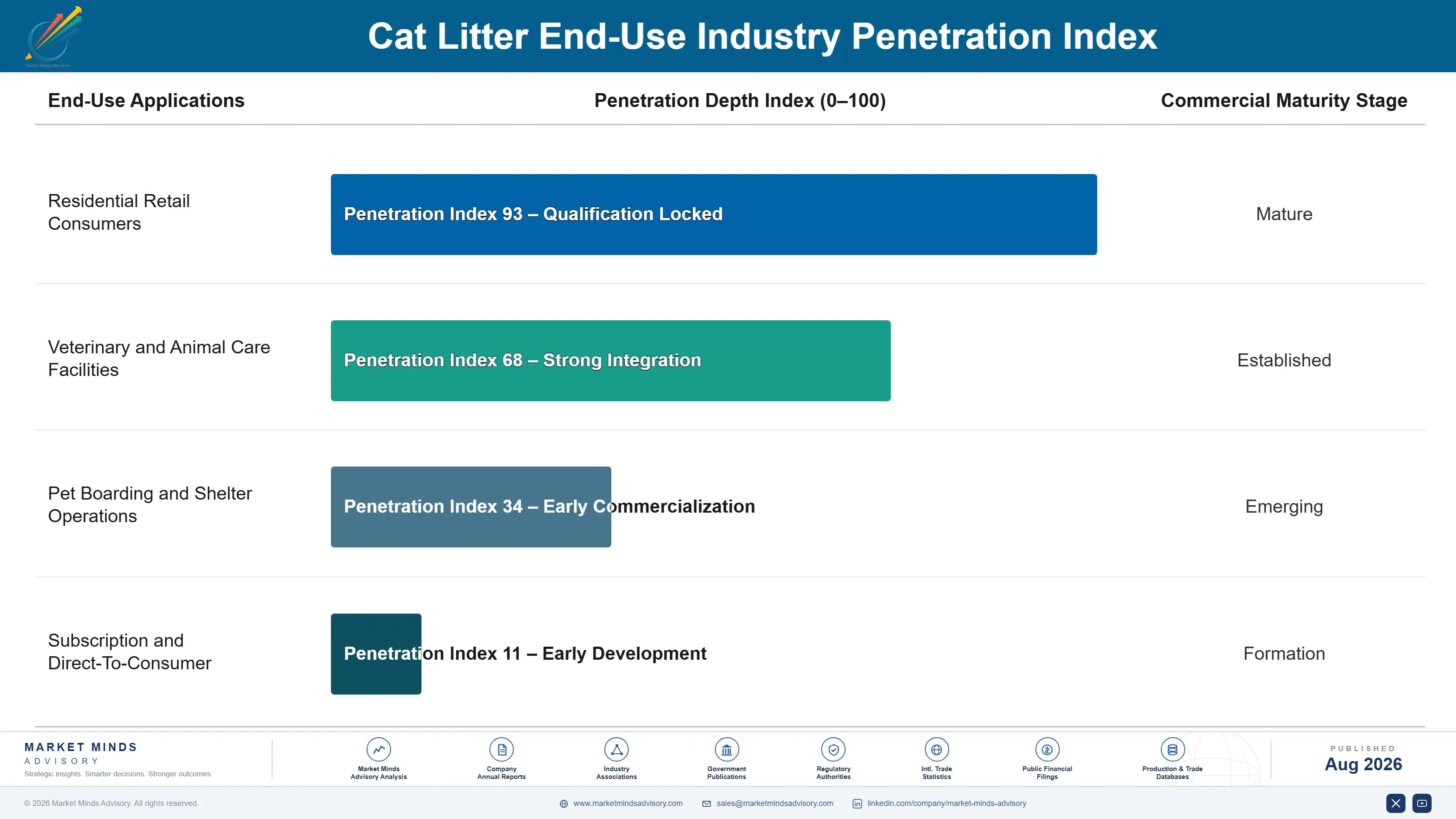
Ownership-Locked Repeat Purchase Economics

Cat litter demand behaves like an annuity once an owner establishes brand loyalty tied to clumping performance and odor control, since switching brands requires re-learning scooping habits and risking a cat's aversion to unfamiliar litter texture that most owners strongly prefer to avoid absent a serious quality failure. That loyalty shapes pricing and subscription structure, particularly for premium silica and health-monitoring formats where switching costs matter most.
Adoption depth varies sharply by end use: indoor-only cat households penetrate deepest into documented, brand-loyal purchasing relationships, often exclusively favoring a single trusted formulation across a cat's lifetime, while multi-pet or outdoor-access households adopt more transactionally, switching brands more readily based on price and availability. First-time cat owners sit between the two, balancing veterinary or retailer recommendations against personal preference discovery.

A generational shift in buyer profiles is underway as younger cat owners, exposed to sustainability and health content, demand documented sourcing credentials and diagnostic data before committing to a brand, replacing an older generation that selected litter primarily on price and clumping strength. Manufacturers slow to adapt risk losing share to premium-forward competitors, particularly among younger buyers who increasingly discover products through digital subscription channels rather than physical retail browsing.
global-cat-litter-market-end-use-penetration-index-1788167990920

Where To Focus Investment Next

These are among the four positions where our research anticipates prominent divergence between winners and laggards over the coming forecast period. Each is grounded in the demand model, the regulatory perimeter, and the announced capacity pipeline.
01 / HEALTH-MONITORING TECHNOLOGY INVESTMENT

Prioritise Diagnostic Innovation Over Commodity Volume

Health-monitoring litters command the category's widest margins and fastest growth, driven by owners prioritizing documented diagnostic value across most major pet retail markets. Manufacturers that invest in health-monitoring technology are capturing this premium demand at a faster rate than competitors still selling conventional clumping clay without comparable diagnostic positioning. Capital allocated toward material science and veterinary validation will likely generate better returns than commodity capacity expansion over the next several years, particularly for manufacturers serving premium health-conscious retail channels, spanning multiple product categories and retail formats simultaneously.
02 / SUBSCRIPTION RELATIONSHIP INVESTMENT

Secure Subscription Loyalty Ahead Of Retail Consolidation

E-commerce subscription platforms are expanding rapidly across major consumer markets, and manufacturers who secure early subscription relationships gain recurring revenue visibility and durable switching barriers uncommon in traditional one-time retail sales. This subscription-based revenue model requires sustained investment in customer relationship management and formulation consistency that smaller manufacturers cannot easily replicate. Manufacturers that delay building these relationships risk ceding fast-expanding recurring volume entirely to more established competitors already positioned with direct-to-consumer platforms across multiple regions and product categories, spanning multiple regional markets and distribution channels simultaneously.
03 / TOFU-BASED CAPACITY EXPANSION

Build Tofu-Based Production Ahead Of Western Demand

Tofu-based litter demand is expanding rapidly beyond its Asia-Pacific origin markets, and manufacturers who build dedicated Western production capacity capture share before competitors recognise the opportunity clearly. This capacity-based approach is already commanding stronger margin among manufacturers serving sustainability-focused subscription channels entering the category for the first time. Manufacturers that delay building this capability risk ceding substitution-driven volume entirely to more prepared competitors already established with major sustainability-focused retail partners across multiple regional markets simultaneously, spanning multiple production facilities and regional supply relationships simultaneously.
04 / CLAY SOURCING DIVERSIFICATION

Diversify Clay Sourcing Across Mining Regions

Clay price volatility periodically compresses margins across the industry, and manufacturers who diversify sourcing across the United States, China, and Turkey gain meaningfully more stable input availability than competitors reliant entirely on single-region supply during periods of commodity disruption. This diversification requires substantial coordination investment across multiple mining regions with different production economics that smaller manufacturers cannot easily replicate. Manufacturers that delay this diversification risk continued supply volatility that better-diversified competitors have already substantially reduced through geographic sourcing spread, spanning multiple mining regions and supplier relationships simultaneously.

Engagement Snapshot From the Field

A live engagement with an industry participant carrying material or product regulatory and market exposure ahead of a defining policy shift, showing how our research translates into a defensible multi-year portfolio strategy.
MARKET MINDS ADVISORY · CLIENT ENGAGEMENT SUMMARY
Cat Litter Producer Strategic Portfolio Review and Transition Roadmap 2026·Investment Scenario on Cat Litter Exposure Evaluation 2025-26
CLIENT PROFILE
The client is a regional pet retail chain operating an estimated 85 stores, evaluating a premium litter category expansion to capture growing health-monitoring and tofu-based demand (client-reported, unverified by MMA). The chain needed to determine optimal shelf allocation and supplier mix ahead of a planned category reset, built primarily around available shelf space and category productivity benchmarks.
STRATEGIC CHALLENGE
Merchandising and procurement leadership needed to evaluate premium category demand against limited shelf space, but lacked reliable data on regional owner willingness to pay for health-monitoring and sustainability-focused formats within the chain's specific market footprint Delaying the reset risked ceding premium category growth to a competing regional chain already piloting a comparable expansion nearby.
MMA APPROACH
MMA analysts benchmarked comparable regional pet retail category resets against documented sales performance data, modeling expected shelf productivity across representative premium format allocation scenarios. The engagement combined primary interviews with the chain's merchandising team, supplier capability comparison, and analysis against MMA's broader dataset of premium pet category expansion outcomes across comparable retail chains.
KEY FINDINGS
  1. The recommended shelf allocation increased projected premium category revenue per linear foot by roughly 23 percent compared with the chain's initial conservative allocation proposal, based on comparable retail benchmarks (client-reported, unverified by MMA).
  2. Two of six benchmarked suppliers lacked sufficient tofu-based production capacity to guarantee consistent regional distribution volume, limiting the chain's ability to guarantee consistent regional availability across all locations.
  3. Stores allocating dedicated health-monitoring shelf space showed meaningfully higher premium category conversion rates than stores integrating premium formats into general litter aisles.
  4. The recommended supplier mix included dedicated in-store staff training materials, reducing the chain's internal merchandising preparation burden compared with competing proposals considerably.
CLIENT PROFILE
The client is a regional pet retail chain operating an estimated 85 stores, evaluating a premium litter category expansion to capture growing health-monitoring and tofu-based demand (client-reported, unverified by MMA). The chain needed to determine optimal shelf allocation and supplier mix ahead of a planned category reset, built primarily around available shelf space and category productivity benchmarks.
STRATEGIC CHALLENGE
Merchandising and procurement leadership needed to evaluate premium category demand against limited shelf space, but lacked reliable data on regional owner willingness to pay for health-monitoring and sustainability-focused formats within the chain's specific market footprint Delaying the reset risked ceding premium category growth to a competing regional chain already piloting a comparable expansion nearby.
MMA APPROACH
MMA analysts benchmarked comparable regional pet retail category resets against documented sales performance data, modeling expected shelf productivity across representative premium format allocation scenarios. The engagement combined primary interviews with the chain's merchandising team, supplier capability comparison, and analysis against MMA's broader dataset of premium pet category expansion outcomes across comparable retail chains.
KEY FINDINGS
  1. The recommended shelf allocation increased projected premium category revenue per linear foot by roughly 23 percent compared with the chain's initial conservative allocation proposal, based on comparable retail benchmarks (client-reported, unverified by MMA).
  2. Two of six benchmarked suppliers lacked sufficient tofu-based production capacity to guarantee consistent regional distribution volume, limiting the chain's ability to guarantee consistent regional availability across all locations.
  3. Stores allocating dedicated health-monitoring shelf space showed meaningfully higher premium category conversion rates than stores integrating premium formats into general litter aisles.
  4. The recommended supplier mix included dedicated in-store staff training materials, reducing the chain's internal merchandising preparation burden compared with competing proposals considerably.
RECOMMENDED STRATEGY
Phase 1: Phase 1 (Months 1 to 2): Complete category reset planning and staff training across the chain's highest-volume flagship stores across all flagship locations. Phase 2: Phase 2 (Months 3 to 5): Extend the reset to remaining stores using sales performance data carried forward from the pilot phase. Phase 3: Phase 3 (Months 6 to 7): Finalise long-term supplier agreements with shelf allocation terms informed by reset outcomes across all remaining store locations.
OUTCOME
The chain completed its premium category reset across all stores within seven months, ahead of the planned holiday shopping season. Early sales data showed meaningful premium category revenue growth without cannibalizing commodity clay sales (client-reported, unverified by MMA), and merchandising leadership credited the phased approach with avoiding the shelf productivity declines that affected a comparable competing chain's earlier reset.

Frequently Asked Questions

Foundational context covering the market sizes, CAGR, scope, country, region and competition that inform every finding below. This section is provided to cover basics and most often pre-purchase conversations, answered from the MMA Primary Research Dataset.

What is the current size of the Cat Litter Market?

The global cat litter market was valued at approximately $6.8 billion in 2025. Demand is driven by indoor-cat ownership growth, premiumization, and health-monitoring litter innovation.

How large will the Cat Litter Market be by 2036?

MMA forecasts the market will reach approximately $13.18 billion by 2036, roughly 1.83 times its 2026 value. Growth is driven by continued premiumization and tofu-based format adoption.

What is the CAGR for the Cat Litter Market 2026 to 2036?

The market is projected to grow at a compound annual growth rate of 6.2 percent between 2026 and 2036. Bull and bear scenarios range from roughly 4.9 to 7.5 percent depending on clay cost trends.

Which segment is growing fastest?

Tofu-based cat litter is the fastest-growing segment, expanding at approximately 10.5 percent annually, driven by sustainability-conscious owners across Asia-Pacific markets across most major sustainability-focused pet retail markets.

Who are the major companies in the Cat Litter Market?

Leading manufacturers include The Clorox Company, Church & Dwight Co Inc, Nestle Purina PetCare, Oil-Dri Corporation of America, and Mars Petcare. Competition centers on retail distribution and premium formulation.

Which country is growing fastest?

China is the fastest-growing major market, driven by its rapidly expanding pet ownership and growing indoor-cat culture across dense urban housing developments domestically across expanding urban pet-owning populations.

Report Segmentation Architecture

The full report scope spans multiple orthogonal segmentation dimensions, with cross-tabulated demand data provided for each dimension pair. Coverage extends further to regional breakdowns, trend trajectories, and the competitive detail needed to support segment-level decision-making.

By Material Type

  • Clumping Clay Cat Litter
  • Non-Clumping Clay Cat Litter
  • Silica Gel Crystal Cat Litter
  • Plant-Based Biodegradable Cat Litter
  • Recycled Paper Cat Litter
  • Tofu-Based Cat Litter

By End-Use Industry

  • Residential Retail Consumers
  • Veterinary and Animal Care Facilities
  • Pet Boarding and Shelter Operations
  • Subscription and Direct-To-Consumer

By Commercial Dimension

  • Mass-Market Retail Distribution
  • Specialty Pet Retail
  • E-Commerce Subscription Distribution
  • Veterinary Channel Distribution

By Region

  • North America
  • Western Europe
  • East Asia
  • South Asia and Pacific
  • Latin America
  • Middle East and Africa
  • Eastern Europe

Scope, Methodology, and Coverage

Every figure in this report is reproducible from documented input assumptions. The scope below maps the historical period, the forecast horizon, the segmentation dimensions, and the countries covered, alongside the underlying primary and qualitative methodology.
Historical Period
2020 to 2025
Forecast Period
2026 to 2036
Base Year
2025 (USD billions; MMA Primary Research Dataset, August 2026)
Market Definition
The cat litter market covers clumping clay, non-clumping clay, silica gel crystal, plant-based biodegradable, recycled paper, and tofu-based litter formats sold through retail, veterinary, and e-commerce channels. It excludes litter boxes and disposal accessories, cat food, and unrelated pet care categories.
Quantitative Units
USD billions (current prices); volume in million tons where cited
Segmentation Dimensions
By Material Type; By End-Use Industry; By Commercial Dimension; By Region
Regions Covered
North America, Western Europe, East Asia, South Asia and Pacific, Latin America, Middle East and Africa, Eastern Europe
Countries Covered
USA, Canada, Germany, France, UK, Italy, Netherlands, China, Japan, South Korea, India, Australia, Singapore, Brazil, Mexico, Argentina, UAE, Saudi Arabia, South Africa, Poland, Russia, and additional markets relevant to this sector
Key Companies Profiled
The Clorox Company, Church & Dwight Co Inc, Nestle Purina PetCare, Oil-Dri Corporation of America, Mars Petcare, Kent Pet Group, Petmate, Dr. Elsey's, Ever Clean, Boxiecat, Okocat, sWheat Scoop, Feline Pine, PrettyLitter, Whisker, Van Ness, Cat's Pride, Yesterday's News, So Phresh, Naturally Fresh
Quantitative Methodology
Primary survey, n=3,800 respondents, Q4 2025, six countries; demand-side model with trade association cross-validation
Qualitative Methodology
47 expert interviews, Q4 2025; applied to validate demand model assumptions, identify emerging dynamics, and assess competitive positioning
Report Format
PDF and XLSX data workbook (Word format preview document)
Publisher
Market Minds Advisory
Report Code
MMA-2026-CHM-514
Published
August 2026
Contact
sales@marketmindsadvisory.com | www.marketmindsadvisory.com

Purchase the full Cat Litter Market Report (2026 to 2036).

The full report provides a quantitative and qualitative assessment of the global cat litter market through 2036, including regional sizing across all seven MMA-tracked geographies and material-level segmentation covering clumping clay, non-clumping clay, silica, plant-based, paper, and tofu-based categories. It profiles twenty leading manufacturers, benchmarking retail distribution, formulation innovation, and subscription channel capability across the competitive landscape. The report includes primary survey findings from 3,800 respondents and 47 expert interviews conducted in the fourth quarter of 2025, alongside clay cost and supply chain risk analysis. Buyers receive segment-level revenue models, editable data tables, and a framework for evaluating supplier and market entry decisions.
Seven-region market sizing with material-level revenue breakdowns
Twenty-company competitive profiles with moat and risk analysis
Primary survey data from 3,800 respondents across six countries
Forty-seven expert interviews on premiumization and adoption trends
Editable data tables for custom scenario and sensitivity modeling
Clay cost and supply chain risk assessment

Built For The People Who Decide

From boardroom strategy to bench-side execution, this report is read cover-to-cover by leaders shaping the next decade of their industry, turning demand scenarios, market dynamics and valuation benchmarks into decisions.
CXOs/ Presidents/ VPs/ Managers
M&A and Corporate Development
Strategy Teams and R&D Heads
Procurement and Product Directors
Regulatory and Compliance Leaders
Investor Relations and Equity Analysts