Market Minds Advisory
Blind Spot Detection Market

Blind Spot Detection Market: False Alerts, Spectrum Migration, and a Commercial Vehicle Mandate Nobody Modelled

Around 22% of drivers switch the warning off, almost always because it cries wolf at guardrails and parked cars. A system nobody trusts delivers no safety benefit at all to anybody.

Lead Analyst

David Horsley

Published

September 2026

Make Smarter Decisions with Customized Research Insights

Request a free sample report and evaluate market opportunities, growth trends, and competitive dynamics relevant to your business needs.

2025 MARKET VALUE$7.4BMarket Size 2025
2036 FORECAST VALUE$26.8BBase Case , 2026 to 2036
CAGR 2026 TO 203612.4 %Bull 13.7% / Bear 11.1%
INCREMENTAL OPPORTUNITY$18.4BNet 10- year value creation
EXPANSION MULTIPLE3.22x2036 value over 2026 base
Strategic Levers
M&A Pipeline
Regional Outlook
Country Rankings
Competitive Intelligence
Segmental Deep-dive
Call-Us : 91 93563 13602

Executive Snapshot and Market Trajectory

A blind spot system that warns on guardrails, parked cars, and its own trailer gets switched off, and around 22% of drivers do exactly that. Detection range is not the problem anybody needs solving. Discrimination is, and radar alone struggles with it. That distinction governs everything else in this market.
Commercial advantage belongs to suppliers who suppress nuisance warnings rather than those who extend detection distance, because a deactivated system delivers no safety benefit and no regulatory credit either. Sensor fusion blind spot systems grow fastest at 18.6%, roughly 1.50 times the market. East Asia holds the largest position at 32% of value, above the standard band, on vehicle production concentrated there.
Concentration is high at roughly 56% for the top five, sustained by radar module capability, homologation, and 31-month award cycles. Commercial vehicle turn assist mandates created something passenger car assistance never had: a genuine retrofit market, already 27% of commercial volume and applying to fleets already on the road. Coverage geometry, sensor count, and low-speed performance all differ enough that a passenger car product cannot simply be adapted to serve it at all.
Market Definition
The market comprises blind spot detection and lane change assistance systems supplied for road vehicles, covering 24 GHz radar systems, 77 GHz radar systems, camera-based and surround view systems, ultrasonic-assisted systems, sensor fusion blind spot systems, and commercial vehicle blind spot with turn assist. Value is measured at system supplier level across original equipment and retrofit. Adaptive cruise control and forward collision systems, parking sensors sold separately, mirrors and camera monitor systems replacing mirrors, driver monitoring, and full automated driving stacks fall outside scope.
Base Year Value
$7.4B in 2025 (MMA Primary Research Dataset, August 2026)
Forecast Period
2026 to 2036, eleven discrete annual values
CAGR
12.4% base case. Bull 13.7%. Bear 11.1%.
Fastest Growth Segment
Sensor Fusion Blind Spot Systems: 18.6% CAGR
Fastest Growth Country
India: 16.4% CAGR
Fastest Growth Region
South Asia and Pacific: 14.6% CAGR
Largest Region
East Asia: 32% of 2025 global value
Market Leaders
Bosch, Continental, Denso, Aptiv, and Valeo lead on blind spot detection system supply revenue. Source: company annual reports and MMA Analysis, July 2026.
Primary Survey
n=3,800 procurement and R&D decision-makers, Q4 2025, six countries
Methodology
Demand-side build-up, cross-validated against public data, 47 expert interviews

Blind Spot Detection Market Forecast Scenarios

global-blind-spot-detection-market-trends-size-forecast-scenario-1787551133784
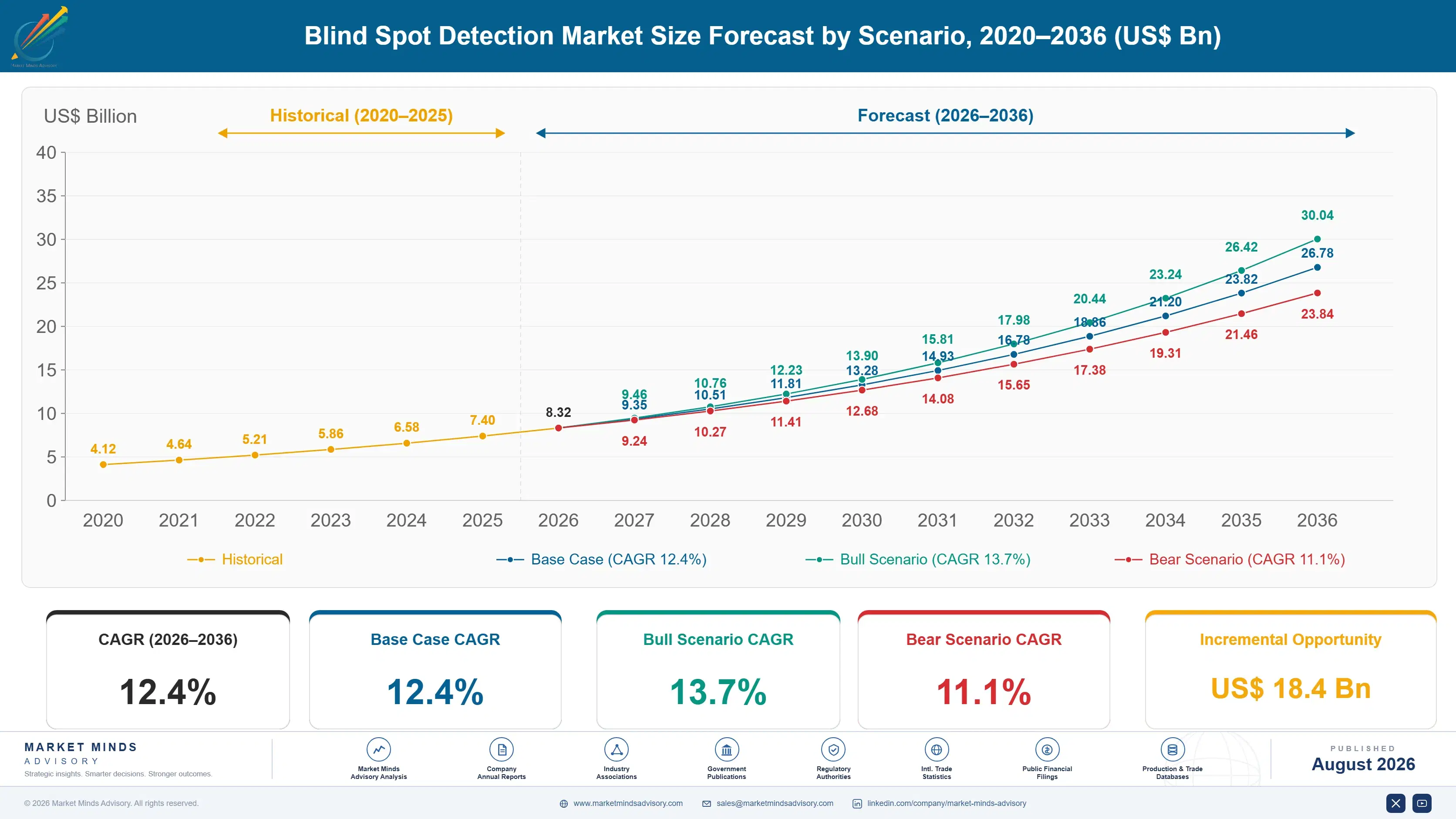
Between 2020 and 2025 two things reshaped this market and only one was demand. European regulation mandated blind spot systems on new heavy vehicles and several cities went further, creating a commercial segment that had barely existed. The 24 GHz spectrum used by early radar was withdrawn, stranding a hardware generation. The 11.0% historical rate reflects passenger fitment growth alongside a new commercial requirement.
The 12.4% base case rests on three mechanisms. Passenger car fitment keeps rising as safety rating schemes weight blind spot performance more heavily and mass-market vehicles adopt what premium models already carry. Commercial vehicle mandates continue expanding across jurisdictions and apply to existing fleets rather than only new builds. And sensor fusion adoption grows because it is the only credible answer to the false alert problem. None of the three depends on vehicle production volumes rising.
The 13.7% bull case assumes commercial mandates extend to more jurisdictions while fusion costs fall enough for mass-market passenger fitment. The 11.1% bear case reflects vehicle production weakness, mandate timetables slipping under industry pressure, and radar-only systems remaining good enough for regulatory compliance even where drivers continue switching them off. Fusion cost sits under both cases as the deciding variable.

Nobody Trusts a System That Cries Wolf

The engineering conversation in this market is about detection and the commercial problem is about discrimination. A radar-only system produces a nuisance warning roughly every 90 kilometres, triggered by guardrails, parked cars, roadside furniture, and its own vehicle's trailer. Around 22% of drivers respond by switching the function off entirely, at which point the system delivers no safety benefit and no rating credit.
TOP-FIVE CONCENTRATION56%Combined supply share held by leading system manufacturers
NEW VEHICLE FITMENT RATE62%Share of new passenger vehicles equipped with blind spot systems
FALSE ALERT RATE1 per 90 kmTypical nuisance warning frequency on radar-only production systems
SYSTEM DEACTIVATION RATE22%Portion of drivers who switch the warning function off
COMMERCIAL RETROFIT SHARE27%Portion of commercial vehicle volume fitted to existing fleets
PROGRAMME AWARD LEAD TIME31 monthsTypical gap between supplier selection and start of production
Sensor fusion is the answer and everybody knows it. Radar handles closing speed and works through spray and darkness while struggling to classify stationary objects. Camera handles classification and struggles in low light. Combining them resolves the failure modes of each, which is why fusion grows at 18.6% while radar-only fitment plateaus. Cost is what keeps it out of mass-market vehicles rather than any technical question.
The commercial vehicle side is a different market wearing the same name. Turn assist mandates driven by cyclist fatalities apply to existing fleets in several jurisdictions, which created a retrofit business already at 27% of commercial volume. Passenger car driver assistance has never had that. The sensors, coverage geometry, speeds, and buyers are all different from anything on a car.
"Suppliers keep quoting detection range and the fleet manager wants to know how often it will beep at a hedge. Those are not the same specification, and the second one determines whether the driver leaves it switched on, which is the only thing that actually matters."
Practice Director, Vehicle Safety Systems and Driver Assistance · MMA Automotive Safety and Driver Assistance Practice · August 2026

Market Trends

Sensor Fusion Answers the Nuisance Warning Problem

Radar handles closing speed and adverse weather while classifying stationary objects poorly, and camera does the reverse, which means each alone produces the false alerts that drive 22% of drivers to switch the system off. Fusing them resolves the failure modes of both and cuts nuisance warnings substantially. The segment grows at 18.6%, fastest here, and cost rather than capability is what keeps it out of mass-market vehicles. Safety rating schemes are beginning to test discrimination rather than only detection. Suppliers who invested early in discrimination are about to be rewarded for it.
Market Impact: Fitment already reaches 62% of vehicles
Commercial Turn Assist Mandates Create a Retrofit Market

Cyclist and pedestrian fatalities involving turning heavy vehicles produced European mandates and city-level requirements that apply to existing fleets rather than only to new registrations. That is unusual in driver assistance, where regulation almost always addresses new vehicles alone. Retrofit already represents 27% of commercial volume, sold to fleet operators and installers rather than to vehicle manufacturers. Coverage geometry, sensor count, and low-speed performance all differ substantially from anything fitted to a passenger car. Installation quality varies enormously between contractors and is the main determinant of whether a retrofitted system actually works at all.
Market Impact: East Asia holds 32% of value

Market Opportunities and Growth Drivers

Safety Rating Schemes Pull Mass-Market Fitment Upward

Consumer safety rating programmes weight blind spot and lane change assistance in overall scores, and a manufacturer chasing a top rating fits the system across the range rather than on premium variants alone. Fitment already reaches 62% of new passenger vehicles and the remaining gap sits mostly in entry segments where cost decides everything. Rating protocols are also beginning to penalise false alerts, which shifts the requirement from presence toward performance in a way suppliers have to answer. Entry segments remain the largest untapped fitment opportunity and the hardest to reach on cost.
Market Impact: Migration obsoleted 24 GHz hardware

Asian Vehicle Production Concentrates Programme Awards

China builds more light vehicles than any other country and domestic suppliers win a growing share of the driver assistance content within them, at prices international incumbents cannot approach on comparable cost bases. India grows fastest of any country at 16.4% as safety regulation tightens and content per vehicle rises from a low base. East Asia holds 32% of value, above the standard band, on production concentration rather than on fitment rates that remain below European levels. Those suppliers are now qualifying into export programmes rather than serving only domestic assembly.
Market Impact: Alerts appear every 90 kilometres

Market Restraints and Challenges

Spectrum Withdrawal Stranded an Earlier Hardware Generation

The 24 GHz ultra-wideband band that carried early blind spot radar was withdrawn across Europe and elsewhere, forcing migration to 77 and 79 GHz and obsoleting a generation of modules and the engineering behind them. The root cause was spectrum allocation policy rather than any performance question. Suppliers mitigated by writing off tooling early, by designing modules with clearer upgrade paths, and by tracking spectrum consultations far more closely than most had previously bothered to do. Spectrum allocation is now tracked as a commercial intelligence function rather than left to a compliance team somewhere.
Market Impact: Deactivation currently reaches 22%

Fusion Cost Keeps It Out of Mass-Market Vehicles

Adding a camera and the processing to fuse it with radar costs more than entry-segment programmes will carry, which confines the technology answering the false alert problem to vehicles where drivers were least likely to switch the system off anyway. The root cause is silicon and sensor cost rather than any development gap. Suppliers mitigate through processing consolidation onto shared domain controllers, through camera sharing with other functions, and by targeting rating protocols that reward discrimination directly. Rating protocols beginning to reward discrimination directly will change that arithmetic quite considerably.
Market Impact: Retrofit reaches 27% of commercial
4 additional market trends, 3 additional growth drivers, and 2 additional restraints and challenges are covered in the full report. Contact sales@marketmindsadvisory.com to access the complete intelligence.

Segment CAGR and Growth Architecture

Segmentation follows sensing technology and vehicle application, because each combination carries a distinct cost position, false alert profile, and regulatory pathway. Six categories cover commercial supply, and the divide between passenger car systems bought on rating performance and commercial systems bought against a legal mandate matters more than any sensor comparison between them. Sensor choice follows from that.
global-blind-spot-detection-market-trends-market-share-analysis-1787551134331

Sensor Fusion Blind Spot Systems

The fastest category at 18.6%, roughly 1.50 times the market, and the only credible answer to the nuisance warnings that drive 22% of drivers to disable the function. Radar contributes closing speed and all-weather reliability while camera contributes classification, and fusing them removes the failure modes each carries alone. Cost is the constraint rather than capability, which confines it largely to premium and mid-market programmes today. Processing consolidation onto shared domain controllers and camera sharing with other functions are both bringing the cost down steadily. Rating protocols beginning to test discrimination directly rather than detection presence will accelerate adoption considerably, since a manufacturer chasing a score now needs the fused system rather than any system at all.
CAGR 18.6%

Commercial Vehicle Blind Spot and Turn Assist

Second fastest at 16.2%, driven by mandates responding to cyclist and pedestrian fatalities involving turning heavy vehicles, several of which apply to existing fleets rather than only new registrations. That retrofit requirement is unusual in driver assistance and already accounts for 27% of commercial volume. Coverage geometry is wider, speeds are lower, sensor counts are higher, and the buyer is a fleet operator or installer rather than a vehicle manufacturer. Installation quality varies enormously and is the main determinant of whether these systems actually work. Fleet operators rather than vehicle manufacturers make the purchase, which requires distribution, installer training, and field support that no traditional tier one organisation currently possesses anywhere.
CAGR 16.2%
Full segment breakdown across 6 segments available in the complete report.

Regional Architecture and Country Demand Map

Regional shares follow vehicle production location weighted by fitment rates and mandate coverage. East Asia sits above the standard band for the reason stated below, and every other region falls inside its range across the forecast period. Fitment rates and production volumes diverge quite sharply in this market.

North America

Passenger car fitment is high and driven by safety rating schemes and manufacturer competition rather than by any federal mandate on blind spot systems specifically. Pickup and large sport utility programmes present harder detection geometry given vehicle length and trailer towing, which makes false alert suppression a more visible problem here than elsewhere. Aptiv, Bosch, and Continental hold established positions. Commercial vehicle turn assist regulation lags European practice considerably. Growth of 12.8% depends on mass-market fitment completing rather than on any new regulatory requirement arriving. Trailer towing on pickups presents a detection geometry that generates false alerts from the vehicle's own load, which is a problem European engineering programmes rarely encounter at scale.
Share: 23% | CAGR: 12.8% (2026 to 2036)

Western Europe

General safety regulation mandating blind spot information systems on heavy vehicles created a commercial segment that barely existed, and several cities went further with direct vision requirements applying to fleets already operating. Passenger car fitment is the highest anywhere under rating protocols that now begin testing discrimination rather than only detection. The 24 GHz spectrum withdrawal originated here and forced migration across the whole industry. Bosch, Continental, Valeo, and Forvia HELLA hold deep positions. Growth of 10.8% is the slowest anywhere on mature passenger fitment. Commercial retrofit through specialist installers is more developed here than anywhere, and the suppliers serving it are largely not the tier ones supplying vehicle assembly plants at all.
Share: 24% | CAGR: 10.8% (2026 to 2036)
Regional intelligence for 5 additional markets available in the complete report: East Asia, South Asia and Pacific, Latin America, Middle East and Africa, Eastern Europe. Contact sales@marketmindsadvisory.com.
global-blind-spot-detection-market-trends-country-cagr-analysis-1787551134850

Four Moves Worth Real Capital

Advantage here comes from suppressing false alerts, reaching a retrofit channel passenger assistance never had, and tracking spectrum and mandate decisions nobody in engineering usually follows. Four moves justify capital across the forecast period, and the first addresses why a fitted system frequently does nothing at all. Detection range appears nowhere among the four.

Compete on discrimination, not detection range

A radar-only system generates a nuisance warning roughly every 90 kilometres and 22% of drivers respond by switching the function off entirely, which removes the safety benefit and any rating credit with it. Fusion cuts that substantially and grows at 18.6% against a market rate of 12.4%. Rating protocols are beginning to test discrimination directly rather than only presence. Suppliers still quoting detection distance are answering a specification that stopped mattering to anybody several years ago. Demonstrating discrimination in a customer evaluation requires driving the scenarios rather than quoting a specification, which very few suppliers organise properly.
Market Impact: Addresses a driver deactivation rate now reaching 22%

Build a commercial retrofit channel deliberately

Turn assist mandates applying to existing fleets created something driver assistance has never had, and retrofit already accounts for 27% of commercial volume sold to operators and installers rather than to vehicle manufacturers. That channel requires distribution, installer training, and support capability that a tier one supplying assembly plants does not possess at all. Suppliers who build it reach demand entirely outside the 31-month award cycle governing everything else in this business. Installation quality varies enormously between contractors and determines whether the system works, which makes installer training a product requirement rather than a service add-on.
Market Impact: Reaches the 27% of commercial volume being retrofitted

Consolidate processing onto shared domain controllers

Fusion cost is what keeps the technology answering the false alert problem out of the entry segments where drivers most need it, and standalone processing per function is the largest part of that cost. Running blind spot fusion on a shared domain controller alongside other assistance functions removes duplicated silicon entirely. Camera sharing with parking and surround view does the same on the sensor side. Both require architecture decisions taken with the vehicle manufacturer years ahead. Shared processing typically removes 30 to 40% of the semiconductor cost per system, which is what brings fusion within reach of entry programmes.
Market Impact: Cuts cost across the 18.6% growth segment entirely

Track spectrum and mandate timetables systematically

The 24 GHz withdrawal obsoleted a hardware generation and the engineering behind it, and it was visible in regulatory consultation years before it took effect. Commercial turn assist mandates followed a similar published path. Suppliers who track spectrum allocation and safety regulation as a commercial function rather than a compliance one position ahead of conversions that arrive on known dates. Those who do not write off tooling and then explain the surprise to a board. The 24 GHz decision appeared in published consultation well before it took effect, and almost nobody in the industry was reading them at the time.
Market Impact: Anticipates the next withdrawal like 24 GHz did

Who Controls the Margin Pool

Concentration is high at roughly 56% for the top five on system supply revenue, sustained by radar module capability, multi-regime homologation, and award cycles running 31 months that reward incumbency heavily. Bosch and Continental lead across radar and fusion with the broadest programme positions. Denso holds strong Japanese and global positions, Aptiv is strong in North American architecture work, and Valeo brings sensing breadth across the assistance range.
Competition runs on three dimensions. False alert performance is the first and it decides whether a fitted system stays switched on. Architecture integration is the second, since fusion cost depends on whether processing is shared or duplicated. Channel reach is the third, because the commercial retrofit market is served by nobody's existing tier one organisation. None of the three is solved by better hardware.

Pressure is building from two directions. Chinese suppliers are taking driver assistance content at prices incumbents cannot match, and moving into export programmes. Semiconductor suppliers integrating more of the radar signal chain are capturing value that used to sit with the module maker. Rankings will shift toward suppliers holding fusion capability and genuine retrofit distribution together. Module manufacturing has stopped being a defensible position anywhere.
global-blind-spot-detection-market-trends-company-positioning-matrix-1787551135373

Competitive Moat and Risk Dimensions

BOSCH

Moat: Radar and fusion architecture depth

Bosch develops radar modules, camera systems, and the domain controllers that fuse them, which lets it propose an architecture rather than a component and take the duplicated silicon out of a vehicle manufacturer's cost model. That conversation happens years before any award. Homologation experience across every major regulatory regime supports global vehicle programmes without regional variants.
BOSCH

Risk: Chinese content price pressure

Domestic Chinese suppliers are winning driver assistance content at prices Bosch cannot match on a comparable cost base, and they are now qualifying into export programmes rather than serving only local assembly. Architecture depth defends premium and global platforms and not the mass-market volume underneath. Building a competing cost position requires local engineering scale that takes years to establish properly.
CONTINENTAL

Moat: Commercial vehicle sensing position

Continental holds genuine commercial vehicle sensing capability alongside its passenger car business, which reaches the turn assist mandates and the retrofit demand attached to them. Coverage geometry, sensor count, and low-speed performance requirements differ enough from passenger systems that passenger-only suppliers cannot simply adapt a product. Fleet and installer relationships add a channel most tier ones lack entirely.
CONTINENTAL

Risk: Semiconductor value migration upward

Chip suppliers integrating more of the radar signal chain onto single devices are capturing value that previously required module-level engineering, which compresses what a system supplier can charge for the hardware itself. Differentiation is moving toward software and architecture rather than the module. Competing there requires capability that a components organisation builds slowly and expensively over time.

Players Tracked

Prominent Players

Bosch
Continental
Denso
Aptiv
Valeo

Other Key Players

ZF
Magna International
Hyundai Mobis
Autoliv
Forvia HELLA
HL Mando
Nidec Mobility
NXP Semiconductors
Infineon Technologies
Texas Instruments
Bendix Commercial Vehicle Systems
Stoneridge
Brigade Electronics
Sensata Technologies
Ambarella

Recent Developments

JANUARY 2025

Rating protocol begins penalising false blind spot alerts

A consumer safety rating programme introduced test scenarios penalising nuisance warnings alongside the existing detection assessment, after research linked high false alert rates to drivers disabling the function entirely. Radar-only systems scored measurably worse than fused implementations across the new scenarios. Detection scores were unchanged throughout.
Signal: Rating schemes are now moving from testing mere presence toward testing whether the system remains usable
JUNE 2025

Logistics fleet retrofits turn assist across existing vehicles

A European logistics operator retrofitted blind spot and turn assist systems across several thousand vehicles already in service, driven by city access requirements rather than by any national mandate. Installation quality varied enough across contractors to require a second inspection programme. Nobody had budgeted for that.
Signal: Retrofit demand is genuinely real and installation quality is the single variable determining whether any of it works
OCTOBER 2025

Semiconductor supplier integrates full radar signal chain

A chip manufacturer released a device integrating transceiver, processing, and interface functions that previously required separate components and module-level engineering. System suppliers reported reduced bill of materials and correspondingly reduced scope for hardware differentiation between them. Software and architecture became the only remaining differentiation available.
Signal: Semiconductor integration is moving value from module engineering toward software and architecture rather than hardware itself

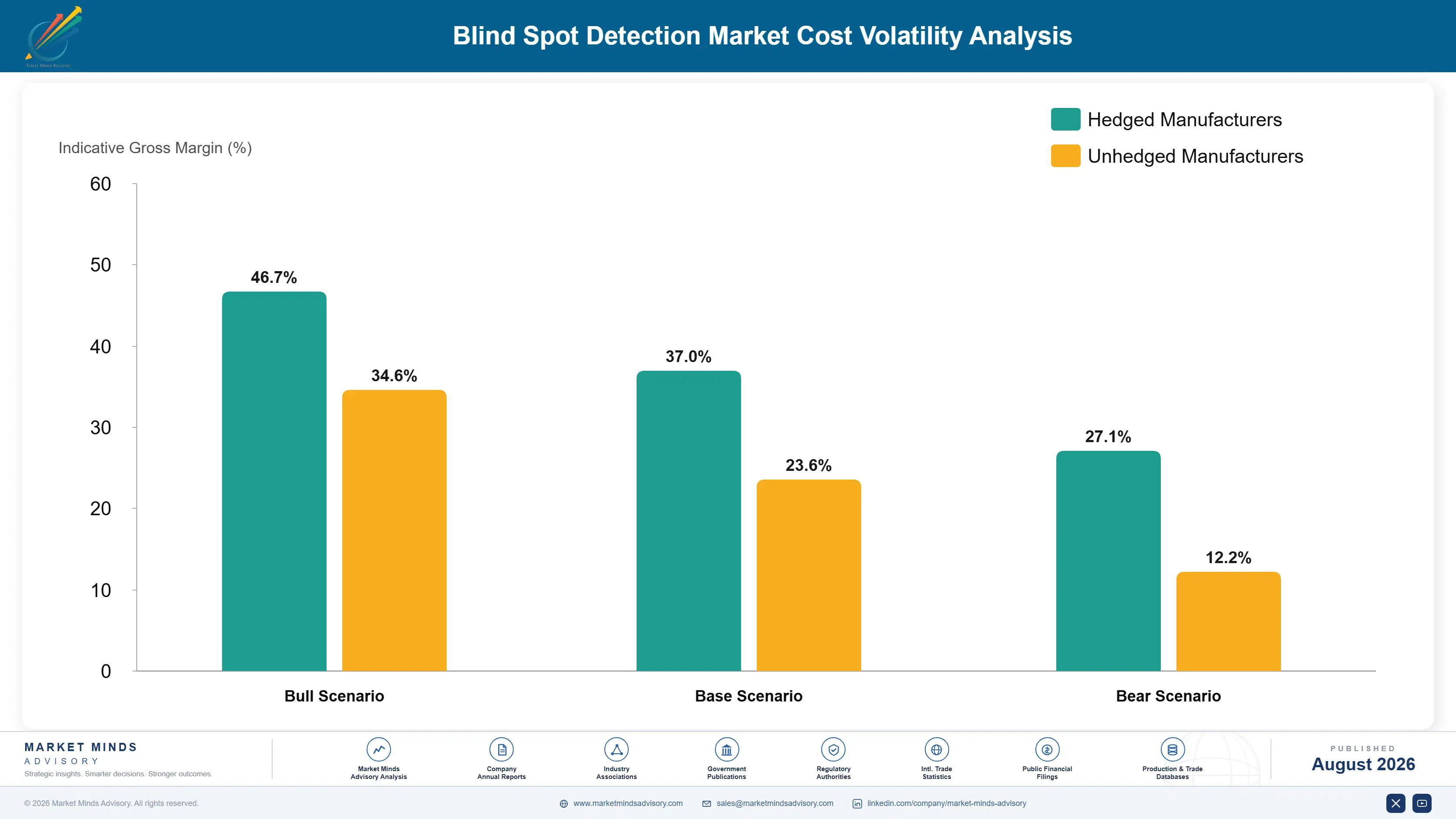
What Sets the System Cost

Radar transceiver and processing semiconductors dominate at roughly 34% of system cost, supplied by NXP, Infineon, and Texas Instruments with limited alternatives at automotive qualification. Camera modules and image sensors add 19% on fused systems and nothing on radar-only ones. Printed circuit boards, radomes, and housings take 14%. Software development and validation amortised across programme volume carries a substantial share of the remainder.
Automotive semiconductor availability constrained driver assistance output severely through 2021 and into 2023, and suppliers allocated across programmes rather than meeting demand anywhere. Bosch and Continental both discussed component availability and its production effects in their reporting for those years. Radome materials and specialised substrates tightened separately, which affected radar module output more than camera-based systems at the same time. Suppliers who had qualified second sources shipped while competitors allocated.

Exposure divides on architecture rather than on scale. Suppliers with standalone processing per function carry full semiconductor cost on every system shipped. Those running fusion on shared domain controllers spread that silicon across several functions and carry considerably less per system. Software validation cost is fixed per programme and falls per unit as volume rises, which rewards platform reuse rather than bespoke development for each vehicle.
global-blind-spot-detection-market-trends-cost-volatility-analysis-1787551135569

Share processing across assistance functions

Standalone processing per function carries full semiconductor cost on every system, while a shared domain controller spreads that silicon across several assistance functions at once. It is the single largest cost lever available and it requires an architecture conversation with the vehicle manufacturer years before any award. Suppliers quoting standalone modules are competing on a cost base they chose unnecessarily.

Reuse validated software across programmes

Software development and validation is fixed cost per programme and falls per unit as volume rises, which makes bespoke development for each vehicle an expensive habit rather than a customer requirement. Platform reuse across programmes cuts the amortisation burden substantially. Vehicle manufacturers accept it wherever the validation evidence transfers cleanly, which it usually does.

Qualify second semiconductor sources early

Radar transceiver and processing devices come from a narrow set of automotive-qualified suppliers, and availability rather than price constrained output through the recent shortage. Qualifying alternates costs engineering time and revalidation rather than capital. Suppliers who completed that work shipped programmes while competitors allocated output across customers who all needed it equally. Availability was the constraint, not price.

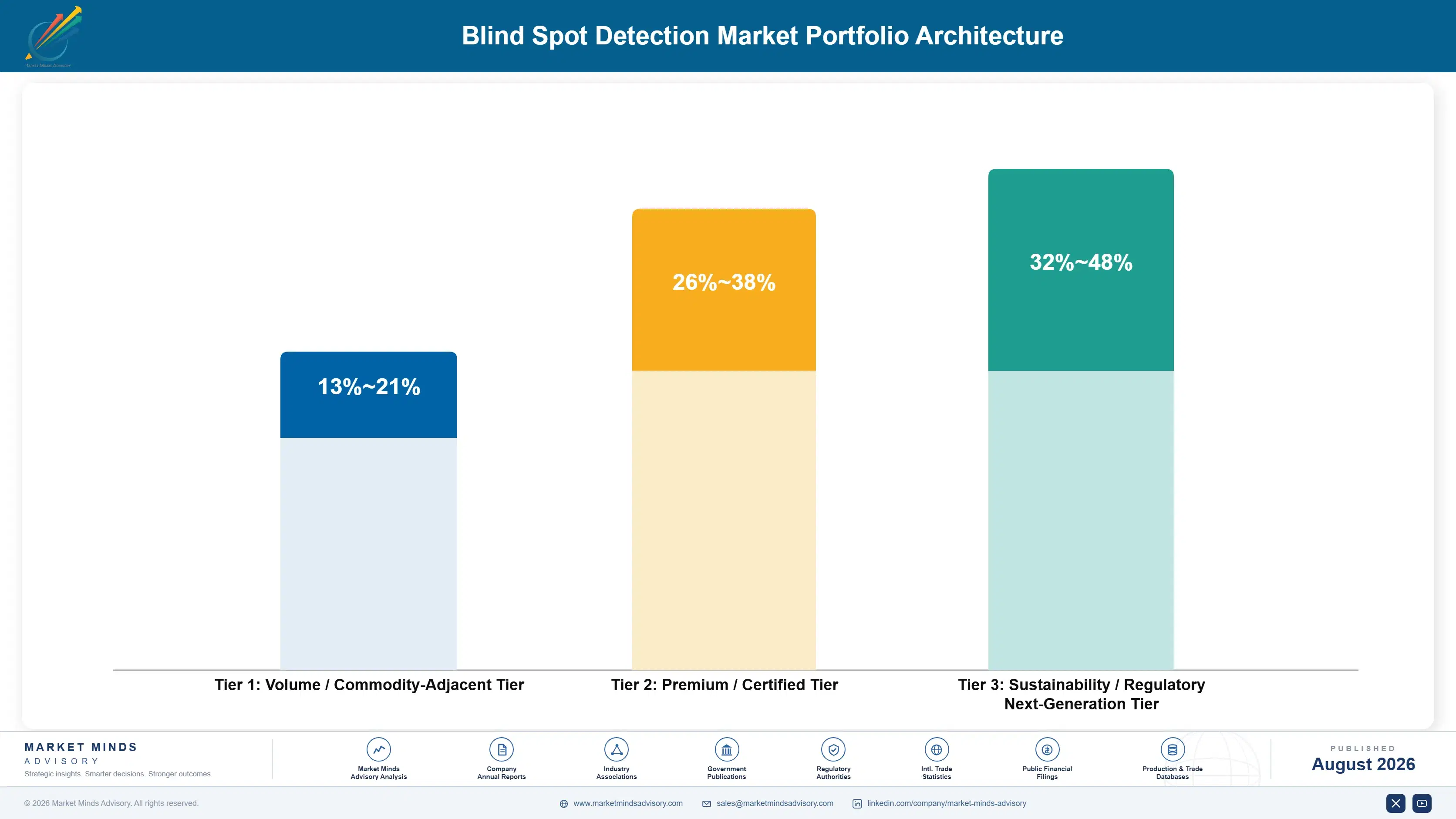
Portfolio Architecture for Margin Defence

Margin architecture follows whether the supplier owns the architecture or fills a slot in somebody else's. Standalone radar modules on mass-market programmes compete on semiconductor cost against Chinese suppliers with lower bases, and earn very little. Fused systems integrated into a domain controller earn considerably more because the supplier shaped the vehicle's cost model. Commercial retrofit earns best, since the channel has almost no competition.
The volume and premium tension shows in where suppliers put engineering effort. Detection range improvements are visible, easy to specify, and no longer decide anything. False alert suppression is harder to demonstrate in a brochure and determines whether the fitted system stays switched on. Rating protocols are only now catching up with that distinction, which means suppliers who invested early are about to be rewarded. That gap between brochure and behaviour has persisted for years.

High-value pools concentrate in fusion systems inside shared architectures, commercial turn assist with retrofit distribution attached, and software platforms reused across programmes. Each is defended by architecture position, channel reach, or validation reuse rather than by module manufacturing, which semiconductor integration is steadily commoditising anyway. Module manufacturing is being commoditised faster than anybody expected.

Volume / Commodity-Adjacent Tier

Standalone radar modules on mass-market passenger programmes built to a customer specification. Semiconductor cost decides outcomes and chip integration keeps reducing the engineering content that once differentiated suppliers here. Nothing defends it.
Gross Margin: 13%-21%

Premium / Certified Tier

Fused radar and camera systems integrated into shared domain controller architectures where the supplier shaped the vehicle cost model years before award. Architecture position defends pricing. The range reflects wide variation in integration depth between programmes.
Gross Margin: 26%-38%

Sustainability / Regulatory / Next-Generation Tier

Commercial vehicle turn assist with retrofit distribution, and software platforms validated once and reused across programmes. Mandate-driven demand and channel reach both defend pricing. The range is wide because retrofit and platform economics differ completely.
Gross Margin: 32%-48%
global-blind-spot-detection-market-trends-portfolio-architecture-1787551136065

High-value Sub-segments and Strategic Watch-out

Fused Systems in Shared Architectures

Growing at 18.6% and the only credible answer to the nuisance warnings disabling 22% of fitted systems, with cost falling as processing consolidates onto controllers serving several assistance functions at once. Rating protocols now testing discrimination directly should accelerate adoption considerably onward from this point.
Gross Margin: 28%-38%

Commercial Retrofit Distribution

Already 27% of commercial volume and sold to fleet operators and installers rather than vehicle manufacturers, which is a channel no tier one organisation currently possesses in any developed form. Installer training and field support are genuine product requirements here rather than optional service extras.
Gross Margin: 34%-48%

Reusable Validated Software Platforms

Validation cost is fixed per programme and falls per unit with volume, so platform reuse across vehicles cuts amortisation substantially where the evidence transfers cleanly between them, which it usually does. Vehicle manufacturers generally accept the reuse wherever validation evidence transfers cleanly between separate programmes.
Gross Margin: 36%-48%

Standalone Radar Module Supply

The strategic watch-out. Chinese suppliers set pricing, semiconductor integration keeps removing the module engineering that differentiated anybody, and detection range has stopped deciding any award at all. Chip integration also keeps removing the module engineering that once separated one supplier from any of the others entirely.
Gross Margin: 13%-21%

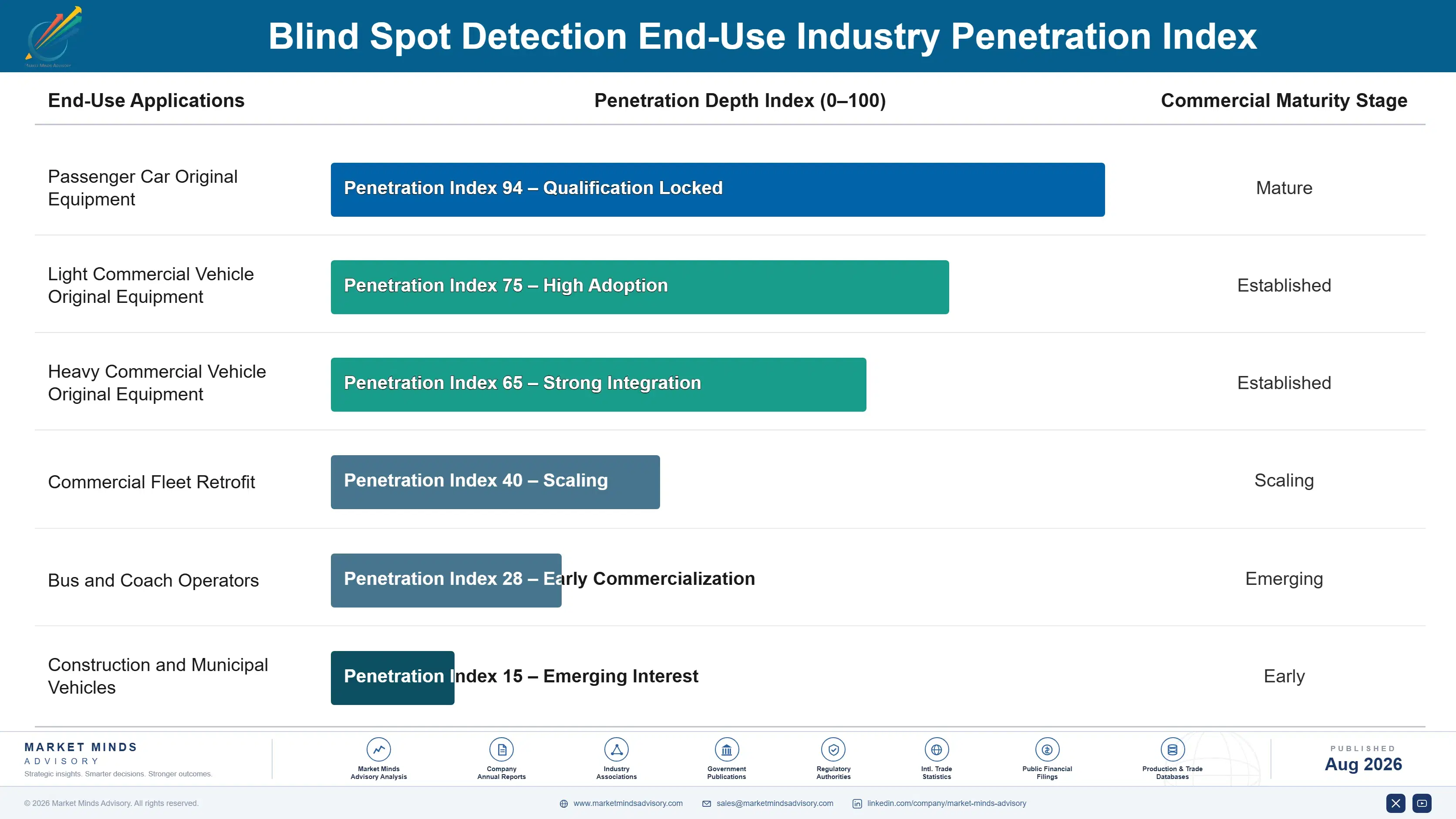
How Systems Get Onto Vehicles

Demand reaches suppliers through two entirely separate routes. Passenger car programmes run on architecture decisions taken with the vehicle manufacturer years ahead, followed by award roughly 31 months before start of production, with fitment driven by safety rating targets rather than by regulation in most markets. Commercial demand runs on legal mandates with published compliance dates, reaching both vehicle manufacturers and fleet operators retrofitting vehicles already in service. Those two routes share almost no commercial characteristics at all.
Stickiness follows architecture depth almost exactly. A supplier whose processing sits inside the vehicle's domain controller holds the programme completely. A standalone module supplier re-competes whenever a cheaper qualified alternative appears. Retrofit business holds through installer relationships and support rather than through anything technical. Nothing about the module itself holds a programme in place.

The deciding buyer differs completely between the two. Passenger programmes are decided by vehicle engineering weighing architecture and cost model. Commercial retrofit is decided by a fleet safety manager weighing compliance deadlines, installation disruption, and whether drivers will tolerate the alerts. Suppliers using one commercial approach for both are losing whichever they understand less well. Very few organisations are built to run both conversations properly.
global-blind-spot-detection-market-trends-end-use-penetration-index-1787551136553

What Actually Decides Awards

These are among the four positions where our research anticipates prominent divergence between winners and laggards over the coming forecast period. Each is grounded in the demand model, the regulatory perimeter, and the announced capacity pipeline.
01 / FALSE ALERT SUPPRESSION

Sell discrimination, because range decides nothing

A radar-only blind spot system produces a nuisance warning roughly every 90 kilometres from guardrails, parked cars, and the vehicle's own trailer, and around 22% of drivers respond by switching the function off completely. A disabled system delivers no safety benefit and earns no rating credit for the manufacturer who fitted it. Fusion addresses that directly and grows at 18.6% against a market rate of 12.4%, while rating protocols have finally begun testing discrimination rather than only detection presence at all.
02 / COMMERCIAL RETROFIT CHANNEL

Build distribution the tier one model never needed

Turn assist mandates responding to cyclist fatalities apply to fleets already operating in several jurisdictions, which is genuinely unusual in driver assistance where regulation almost always addresses new vehicles alone as a rule. Retrofit already represents 27% of commercial volume and reaches fleet operators and installers rather than assembly plants, requiring distribution, installer training, and field support no tier one organisation currently holds anywhere at all. Suppliers who build it access demand sitting entirely outside the 31-month award cycle entirely.
03 / ARCHITECTURE COST POSITION

Share the silicon or lose the entry segments

Fusion cost is what confines the technology answering the false alert problem to premium and mid-market vehicles, and standalone processing per assistance function is the largest single component of that total cost. Running blind spot fusion on a shared domain controller alongside other functions removes duplicated silicon entirely, and camera sharing with parking or surround view does the same on the sensing side. Both depend on architecture conversations held with the vehicle manufacturer years before any award decision is taken.
04 / REGULATORY TIMETABLE TRACKING

Read the consultations before the tooling write-off

Withdrawal of the 24 GHz ultra-wideband band obsoleted an entire generation of hardware and the engineering behind it, and the decision was visible in regulatory consultation years before it actually took effect anywhere at all. Commercial turn assist mandates followed a similarly published and predictable path toward eventual implementation everywhere. Suppliers treating spectrum allocation and safety regulation as a commercial intelligence function rather than a compliance chore position ahead of conversions arriving on dates that were entirely known in advance.

Engagement Snapshot From the Field

A live engagement with an industry participant carrying material or product regulatory and market exposure ahead of a defining policy shift, showing how our research translates into a defensible multi-year portfolio strategy.
MARKET MINDS ADVISORY · CLIENT ENGAGEMENT SUMMARY
Blind Spot Detection Producer Strategic Portfolio Review and Transition Roadmap 2026·Investment Scenario on Blind Spot Detection Exposure Evaluation 2025-26
CLIENT PROFILE
A European driver assistance supplier with blind spot system revenue near EUR 380 million (client-reported, unverified by MMA), supplying standalone radar modules to passenger vehicle programmes across several manufacturers. Fusion capability was limited, no commercial vehicle presence existed, and programme margins had compressed for four consecutive years running. Commercial vehicle capability had never been built.
STRATEGIC CHALLENGE
Standalone radar modules were losing awards to Chinese suppliers on price while semiconductor integration steadily removed the module engineering that had differentiated the business. Two customers had raised false alert complaints the client answered with detection range data. Commercial turn assist mandates had created a market the business could not serve.
MMA APPROACH
MMA analysed win and loss outcomes against architecture involvement and false alert performance, modelled shared domain controller economics against standalone module cost, and assessed commercial retrofit channel requirements. Forty-seven expert interviews with vehicle engineering teams, fleet safety managers, retrofit installers, and rating programme staff established how each decision genuinely gets taken.
KEY FINDINGS
  1. Every award won at full margin had involved architecture discussion with the customer well before request for quotation, and every award lost had been quoted as a standalone module against a specification.
  2. Customer false alert complaints had been answered with detection performance data on three separate occasions, which addressed a question nobody in those conversations had actually asked.
  3. Commercial retrofit demand in the client's own regions was being served entirely by specialist installers sourcing systems from two suppliers, neither of which was a traditional tier one.
  4. Software validation was being repeated almost from scratch for each programme, and the transferable proportion had never been assessed by anybody inside the engineering organisation.
CLIENT PROFILE
A European driver assistance supplier with blind spot system revenue near EUR 380 million (client-reported, unverified by MMA), supplying standalone radar modules to passenger vehicle programmes across several manufacturers. Fusion capability was limited, no commercial vehicle presence existed, and programme margins had compressed for four consecutive years running. Commercial vehicle capability had never been built.
STRATEGIC CHALLENGE
Standalone radar modules were losing awards to Chinese suppliers on price while semiconductor integration steadily removed the module engineering that had differentiated the business. Two customers had raised false alert complaints the client answered with detection range data. Commercial turn assist mandates had created a market the business could not serve.
MMA APPROACH
MMA analysed win and loss outcomes against architecture involvement and false alert performance, modelled shared domain controller economics against standalone module cost, and assessed commercial retrofit channel requirements. Forty-seven expert interviews with vehicle engineering teams, fleet safety managers, retrofit installers, and rating programme staff established how each decision genuinely gets taken.
KEY FINDINGS
  1. Every award won at full margin had involved architecture discussion with the customer well before request for quotation, and every award lost had been quoted as a standalone module against a specification.
  2. Customer false alert complaints had been answered with detection performance data on three separate occasions, which addressed a question nobody in those conversations had actually asked.
  3. Commercial retrofit demand in the client's own regions was being served entirely by specialist installers sourcing systems from two suppliers, neither of which was a traditional tier one.
  4. Software validation was being repeated almost from scratch for each programme, and the transferable proportion had never been assessed by anybody inside the engineering organisation.
RECOMMENDED STRATEGY
Phase 1: Phase one: rebuild the customer conversation around false alert performance and architecture integration, retiring detection range as the headline specification entirely. Phase 2: Phase two: develop fusion running on shared domain controllers rather than standalone processing, addressing the cost barrier keeping the technology out of volume programmes. Phase 3: Phase three: build a commercial retrofit channel through specialist installers, reaching mandate-driven demand that sits outside the vehicle manufacturer award cycle.
OUTCOME
The client won two architecture-integrated programmes within eighteen months after changing the customer conversation. Software platform reuse cut validation cost measurably, a retrofit distribution agreement was signed, and blended programme margin improved 6.6 percentage points (client-reported, unverified by MMA). Fusion development on a shared controller began immediately afterwards.

Frequently Asked Questions

Foundational context covering the market sizes, CAGR, scope, country, region and competition that inform every finding below. This section is provided to cover basics and most often pre-purchase conversations, answered from the MMA Primary Research Dataset.

What is the current size of the Blind Spot Detection Market?

The market was valued at USD 7.4 billion in 2025, rising to an estimated USD 8.32 billion in 2026. East Asia holds the largest regional share at 32% of value.

How large will the Blind Spot Detection Market be by 2036?

MMA forecasts USD 26.76 billion by 2036 under the base case, an expansion multiple of 3.22 times the 2026 value. That represents USD 18.44 billion of incremental value.

What is the CAGR for the Blind Spot Detection Market 2026 to 2036?

The base case CAGR is 12.4%, with a bull case of 13.7% and a bear case of 11.1%. The spread reflects uncertainty over mandate timetables and fusion cost reduction.

Which segment is growing fastest?

Sensor fusion blind spot systems grow fastest at 18.6%, roughly 1.50 times the market rate. Commercial vehicle turn assist follows at 16.2% on mandate-driven retrofit.

Who are the major companies in the Blind Spot Detection Market?

Bosch, Continental, Denso, Aptiv, and Valeo lead, holding roughly 56% between them. Radar capability, homologation, and award cycles sustain that concentration rather than manufacturing scale.

Which country is growing fastest?

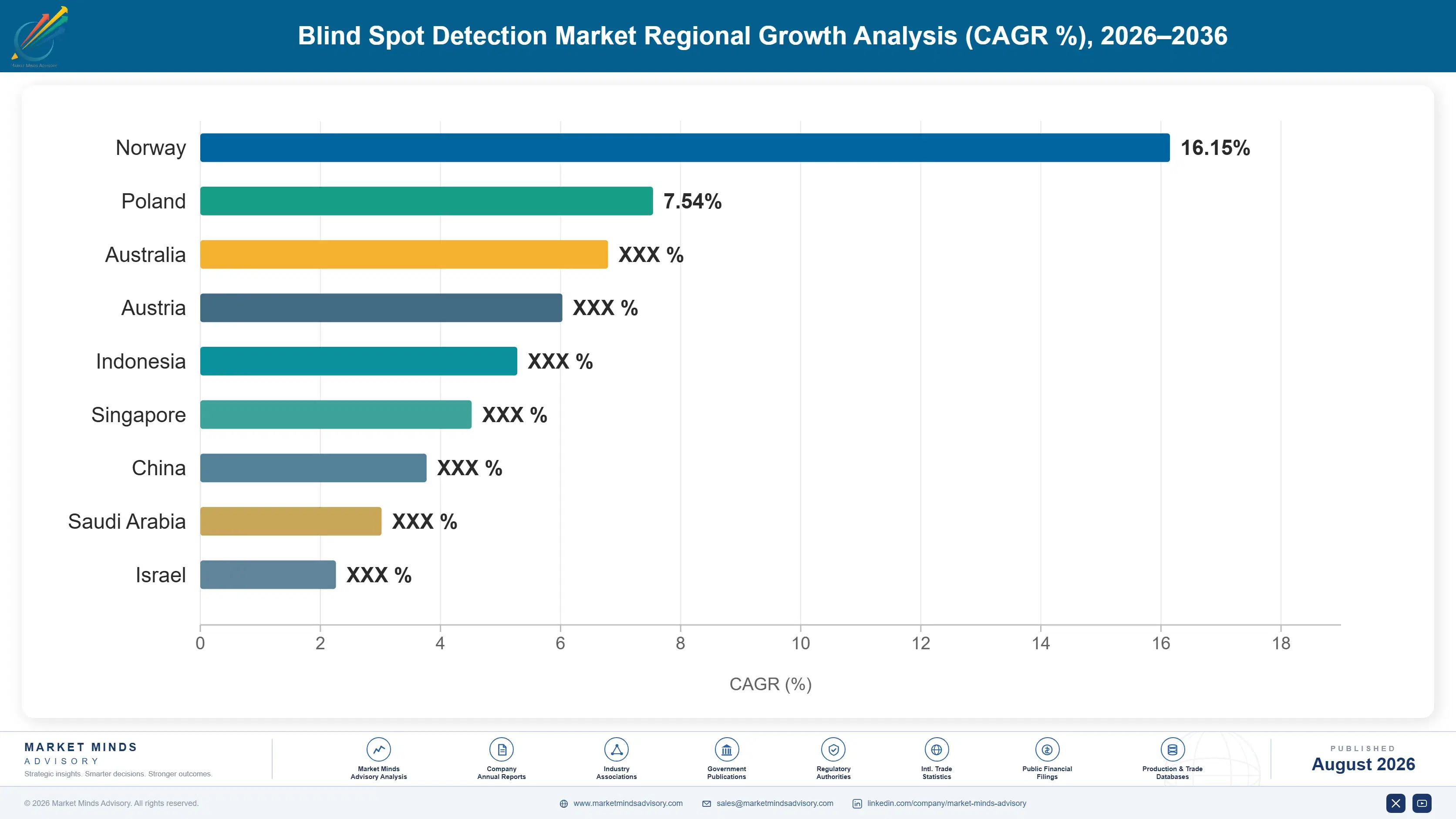
India grows fastest at 16.4%, as safety regulation tightens and driver assistance content per vehicle rises from a genuinely low starting base across entry passenger segments.

Report Segmentation Architecture

The full report scope spans multiple orthogonal segmentation dimensions, with cross-tabulated demand data provided for each dimension pair. Coverage extends further to regional breakdowns, trend trajectories, and the competitive detail needed to support segment-level decision-making.

By Sensing Technology and Application

  • 24 GHz Radar Systems
  • 77 GHz Radar Systems
  • Camera-Based and Surround View Systems
  • Ultrasonic-Assisted Systems
  • Sensor Fusion Blind Spot Systems
  • Commercial Vehicle Blind Spot and Turn Assist

By End-Use Industry

  • Passenger Car Original Equipment
  • Light Commercial Vehicle Original Equipment
  • Heavy Commercial Vehicle Original Equipment
  • Commercial Fleet Retrofit
  • Bus and Coach Operators
  • Construction and Municipal Vehicles

By Sales Model

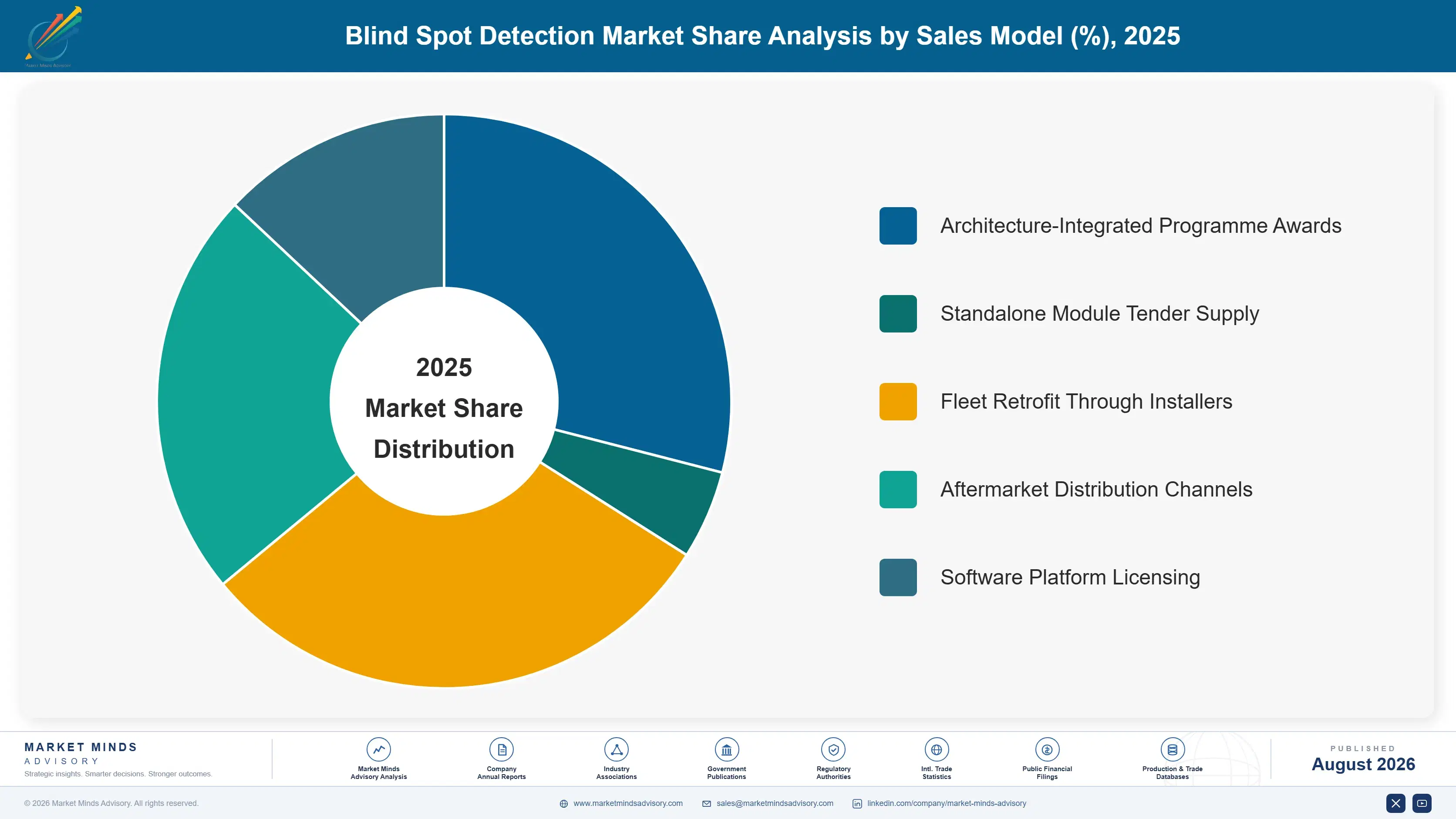
  • Architecture-Integrated Programme Awards
  • Standalone Module Tender Supply
  • Fleet Retrofit Through Installers
  • Aftermarket Distribution Channels
  • Software Platform Licensing

By Region

  • North America
  • Western Europe
  • East Asia
  • South Asia and Pacific
  • Latin America
  • Middle East and Africa
  • Eastern Europe

Scope, Methodology, and Coverage

Every figure in this report is reproducible from documented input assumptions. The scope below maps the historical period, the forecast horizon, the segmentation dimensions, and the countries covered, alongside the underlying primary and qualitative methodology.
Historical Period
2020 to 2025
Forecast Period
2026 to 2036
Base Year
2025 (USD billions; MMA Primary Research Dataset, August 2026)
Market Definition
The market comprises blind spot detection and lane change assistance systems supplied for road vehicles, covering 24 GHz radar systems, 77 GHz radar systems, camera-based and surround view systems, ultrasonic-assisted systems, sensor fusion blind spot systems, and commercial vehicle blind spot with turn assist. Value is measured at system supplier level across original equipment and retrofit channels. Adaptive cruise control and forward collision systems, parking sensors sold separately, mirrors and camera monitor systems replacing mirrors, driver monitoring systems, and full automated driving stacks fall outside scope.
Quantitative Units
USD billions (current prices); million systems shipped annually; USD content value per vehicle by sensing technology
Segmentation Dimensions
By Sensing Technology and Application; By End-Use Industry; By Sales Model; By Region
Regions Covered
North America, Western Europe, East Asia, South Asia and Pacific, Latin America, Middle East and Africa, Eastern Europe
Countries Covered
China, Japan, South Korea, Taiwan, India, Thailand, Indonesia, Vietnam, Australia, United States, Canada, Mexico, Germany, France, United Kingdom, Sweden, Spain, Italy, Netherlands, Belgium, Poland, Czechia, Slovakia, Hungary, Romania, Brazil, Argentina, Turkey, United Arab Emirates, South Africa
Key Companies Profiled
Bosch, Continental, Denso, Aptiv, Valeo, ZF, Magna International, Hyundai Mobis, Autoliv, Forvia HELLA, HL Mando, Nidec Mobility, NXP Semiconductors, Infineon Technologies, Texas Instruments, Bendix Commercial Vehicle Systems, Stoneridge, Brigade Electronics, Sensata Technologies, Ambarella
Quantitative Methodology
Primary survey, n=3,800 respondents, Q4 2025, six countries; demand-side model with trade association cross-validation
Qualitative Methodology
47 expert interviews, Q4 2025; applied to validate demand model assumptions, identify emerging dynamics, and assess competitive positioning
Report Format
PDF and XLSX data workbook (Word format preview document)
Publisher
Market Minds Advisory
Report Code
MMA-2026-AUT-277
Published
August 2026
Contact
sales@marketmindsadvisory.com | www.marketmindsadvisory.com

Purchase the full Blind Spot Detection Market Report (2026 to 2036).

The full report sizes blind spot detection demand across six sensing categories, six vehicle segments, and seven regions with 2026 to 2036 forecasts under base, bull, and bear cases. It treats false alert performance rather than detection range as the decisive commercial variable, since deactivation removes both the safety benefit and the rating credit. Competitive profiles cover twenty suppliers assessed consistently on system supply revenue, architecture integration depth, and channel reach. Cost analysis traces semiconductor, sensor, and validation exposure by architecture choice. Commercial guidance addresses alert suppression, retrofit channel building, architecture cost position, and regulatory timetable tracking.
Six sensing categories sized separately by region
False alert rates measured against driver deactivation behaviour
Commercial retrofit demand separated from original equipment supply
Mandate timetables tracked across jurisdictions and vehicle classes
Shared architecture economics compared against standalone modules
Spectrum allocation changes traced through hardware generation impact

Built For The People Who Decide

From boardroom strategy to bench-side execution, this report is read cover-to-cover by leaders shaping the next decade of their industry, turning demand scenarios, market dynamics and valuation benchmarks into decisions.
CXOs/ Presidents/ VPs/ Managers
M&A and Corporate Development
Strategy Teams and R&D Heads
Procurement and Product Directors
Regulatory and Compliance Leaders
Investor Relations and Equity Analysts