Market Minds Advisory
Glider Aircraft Market

Glider Aircraft Market: Glider Aircraft: Competing Against the Used Fleet and Selling Independence Instead

A refinished forty-year-old sailplane flies within a few percent of a new one at a fifth of the price, so manufacturers sell operational independence rather than performance to survive at all.

Lead Analyst

Published

September 2026

Make Smarter Decisions with Customized Research Insights

Request a free sample report and evaluate market opportunities, growth trends, and competitive dynamics relevant to your business needs.

2025 MARKET VALUE$1.1BMarket Size 2025
2036 FORECAST VALUE$1.8BBase Case , 2026 to 2036
CAGR 2026 TO 20364.6 %Bull 5.8% / Bear 3.4%
INCREMENTAL OPPORTUNITY$0.6BNet 10- year value creation
EXPANSION MULTIPLE1.50x2036 value over 2026 base
Strategic Levers
M&A Pipeline
Regional Outlook
Country Rankings
Competitive Intelligence
Segmental Deep-dive
Call-Us : 91 93563 13602

Executive Snapshot and Market Trajectory.

The competition in this market is not another manufacturer. It is a 1980s airframe with fresh paint. A well-refinished forty-year-old glider performs within a few percent of a new one at a fifth of the price, and that single fact caps new-build volume regardless of how many people fly.
So new aircraft sell on operational independence rather than on performance. A self-launching glider removes the need for a tow pilot, a winch driver and a club willing to organise around you, which is the problem buyers are actually solving. Self-launching motorgliders grow fastest at 6.9%, half again the market rate of 4.6%, and electric propulsion is accelerating it further every year.
Five manufacturers hold 68%, and almost all of them sit within a few hundred kilometres of each other in Germany and its neighbours. This is a hand-built composite product made by skilled laminators in high-cost locations, and nobody offshores it because the skill and the type certificate live in the same building. Labour is well over half of delivered cost, which is why the price gap against a refinished used aircraft never closes at all.
Market Definition
This report covers gliders and sailplanes together with the propulsion, refinishing and equipment content sold against them. Scope includes unpowered competition sailplanes, self-launching motorgliders, sustainer-equipped sailplanes, club and training two-seaters, ultralight and microlift gliders, and open class or two-seat performance sailplanes, plus retrofit propulsion, airframe refinishing, instruments and trailers. Excluded are powered light aircraft and tug aircraft, hang gliders and paragliders, ground launch winches and airfield infrastructure, flight training services, and club operating costs of any kind.
Base Year Value
$1.1B in 2025 (MMA Primary Research Dataset, September 2026)
Forecast Period
2026 to 2036, eleven discrete annual values
CAGR
4.6% base case. Bull 5.8%. Bear 3.4%.
Fastest Growth Segment
Self-Launching Motorgliders: 6.9% CAGR
Fastest Growth Country
Poland: 7.6% CAGR
Fastest Growth Region
South Asia and Pacific: 6.6% CAGR
Largest Region
Western Europe: 41% of 2025 global value
Market Leaders
Schempp-Hirth, Alexander Schleicher, DG Flugzeugbau, Jonker Sailplanes, Sportine Aviacija. Source: MMA Analysis based on unit deliveries and delivered content value, July 2026.
Primary Survey
n=3,800 procurement and R&D decision-makers, Q4 2025, six countries
Methodology
Demand-side build-up, cross-validated against public data, 47 expert interviews

Glider Aircraft Market Forecast Scenarios

glider-aircraft-market-size-forecast-scenario-1790026353789
Growth averaged 3.6% across 2020 to 2025 and the composition changed more than the total. New unpowered sailplane deliveries stayed broadly flat, as they have for two decades, while propulsion retrofit and refinishing work grew steadily and electric self-launch moved from experiment to a credible product line. Club activity recovered quickly after 2021 because gliding is an outdoor solo sport that suited the conditions better than most.
Base case growth of 4.6% rests on three mechanisms. Self-launch and sustainer propulsion continues converting buyers who would otherwise have bought nothing, since it solves an operational problem that performance never addressed. Refinishing demand rises mechanically as a very large fleet built in the 1980s reaches the age at which gelcoat fails. And club fleet renewal in Eastern Europe and the Asia Pacific adds two-seat training aircraft where membership is actually growing.
The bull case at 5.8% assumes electric self-launch reaches the reliability and range that makes it the default configuration rather than an option. The bear case at 3.4% follows from the used fleet holding its ground: refinishing extends forty-year-old airframes another two decades at a fraction of new aircraft cost, and every extension removes a potential new sale permanently.

The Used Fleet Sets the Price

Every commercial question here runs back to the used fleet. Glider performance improved rapidly into the 1980s and then flattened, so a forty-year-old airframe gives up only a few percent of performance to a current model. Refinished and re-certified, it sells at roughly 22% of new aircraft value. That price ratio, not pilot numbers, limits new deliveries and has done for two decades.
FIVE-FIRM CONCENTRATION68%Manufacture clusters in a single European industrial neighbourhood
AVERAGE NEW SAILPLANE PRICEUSD 156kBlended across competition, club and motorglider aircraft configurations
USED FLEET PRICE RATIO22%Refinished older airframe value against comparable new aircraft
FLEET AVERAGE AIRFRAME AGE31 yearsMean age of gliders in active club and private service
HAND LAYUP LABOUR SHARE54%Skilled composite labour within delivered new aircraft cost
SELF-LAUNCH ATTACH RATE47%New deliveries specified with sustainer or self-launch propulsion
Manufacturers responded by selling something the used fleet cannot offer. A self-launching or sustainer-equipped glider removes dependence on a tow pilot, a winch crew and a club willing to operate around a member's schedule, and that is the actual constraint on how much most owners fly. Around 47% of new deliveries now carry propulsion, and electric self-launch has made the proposition considerably more attractive to buyers who disliked the complexity of small combustion engines.
The cost base explains why the price gap never narrows. These are hand-laid composite aircraft built by skilled laminators, with labour at roughly 54% of delivered cost, produced almost entirely in high-wage European locations. Offshoring is not available because skill, tooling and type certificate exist together, and separating them means requalifying an airframe nobody can afford to requalify at these volumes.
"Manufacturers keep telling me about glide ratio. The buyer is comparing a new aircraft against a tidy 1984 airframe that costs a fifth as much and flies almost as well, and quite often the old one wins."
Director, Sport Aviation and Light Aircraft Practice · MMA Aerospace / Soaring and Sport Aviation Practice · September 2026

Market Trends

Electric Self-Launch Becomes A Credible Default Configuration

Electric self-launch has moved from demonstration to a product line that buyers specify routinely, because it removes the maintenance, noise and starting reliability problems that made small combustion sustainers tolerated rather than liked. Energy density still limits climb performance against petrol systems, but for the mission most owners actually fly it is sufficient. Around 47% of new deliveries now carry some form of propulsion, and the electric share within that has grown faster than anyone in the industry forecast five years ago. Buyers specify it routinely now rather than as an option.
Market Impact: Covers 2,900 retrofit installations
Refinishing Extends The Used Fleet Another Two Decades

Polyester gelcoat on gliders built in the 1970s and 1980s crazes and fails at around thirty years, and refinishing restores both appearance and surface accuracy for a fraction of new aircraft cost. A large number of airframes are passing through that work now, which produces genuine aftermarket revenue for specialist shops while removing potential new aircraft sales permanently. Manufacturers therefore compete against a refurbishment industry partly built on their own aircraft. Fleet average airframe age already sits near 31 years. Specialist refinishing shops capture most of that work at present today.
Market Impact: Adds 340 club training aircraft

Market Opportunities and Growth Drivers

Propulsion Retrofit Converts Owners Who Would Buy Nothing

Owners of unpowered gliders increasingly fit sustainer or self-launch systems rather than replacing the aircraft, which captures spending that would otherwise not have entered the market at all. Retrofit work suits manufacturers and specialist shops equally, and it generates engineering and certification revenue disproportionate to the hardware value. The commercial attraction is that it reaches an installed base far larger than annual new deliveries. Roughly 2,900 retrofit installations are expected across the forecast period on existing airframes. Certification and installation engineering earn well beyond the hardware value on every single job.
Market Impact: Used aircraft price at 22%

Club Fleet Renewal Follows Membership Growth Eastward

Gliding club membership is ageing in the traditional Western European and North American markets while growing in Poland, the Czech Republic, the Baltic states and parts of the Asia Pacific. Growing clubs buy two-seat training aircraft, which is the only part of this market where unit volume responds to participation rather than to individual purchasing decisions. Regional manufacturing in those same countries supports the trend with aircraft priced for club budgets. Around 340 club two-seaters are expected across growing markets during the period. Participation rather than purchasing decisions drives this segment alone.
Market Impact: Labour holds 54% of cost

Market Restraints and Challenges

Used Aircraft Pricing Caps New Delivery Volume Permanently

A refinished older airframe sells at roughly 22% of comparable new aircraft value while giving up only a few percent of performance, because glider aerodynamics improved rapidly until the 1980s and then flattened. The root cause is technological maturity rather than anything a manufacturer has done wrong. Commercially this means new sales depend on buyers who want the last few percent or who want propulsion, which is a small population. Manufacturers are responding through propulsion content, factory refurbishment programmes and finance packages that narrow the monthly cost comparison. Technological maturity is the cause, not any commercial failure.
Market Impact: Propulsion attaches to 47% of deliveries

Skilled Composite Labour Cannot Be Scaled Or Relocated

Hand layup of a competition glider requires laminators trained over years, and labour represents around 54% of delivered cost in locations where wages are high. The root cause is that surface accuracy on a sailplane wing exceeds what current automated processes deliver economically at these volumes. Commercially this caps output regardless of order book and keeps prices where the used fleet undercuts them. Participants are answering with apprenticeship programmes, partial automation of secondary components, and manufacturing in lower-cost European locations where the skill base exists. Skill depth rather than wage level decides where production can go.
Market Impact: Extends 31 year fleet further
3 additional market trends, 4 additional growth drivers, and 2 additional restraints and challenges are covered in the full report. Contact sales@marketmindsadvisory.com to access the complete intelligence.

Segment CAGR and Growth Architecture

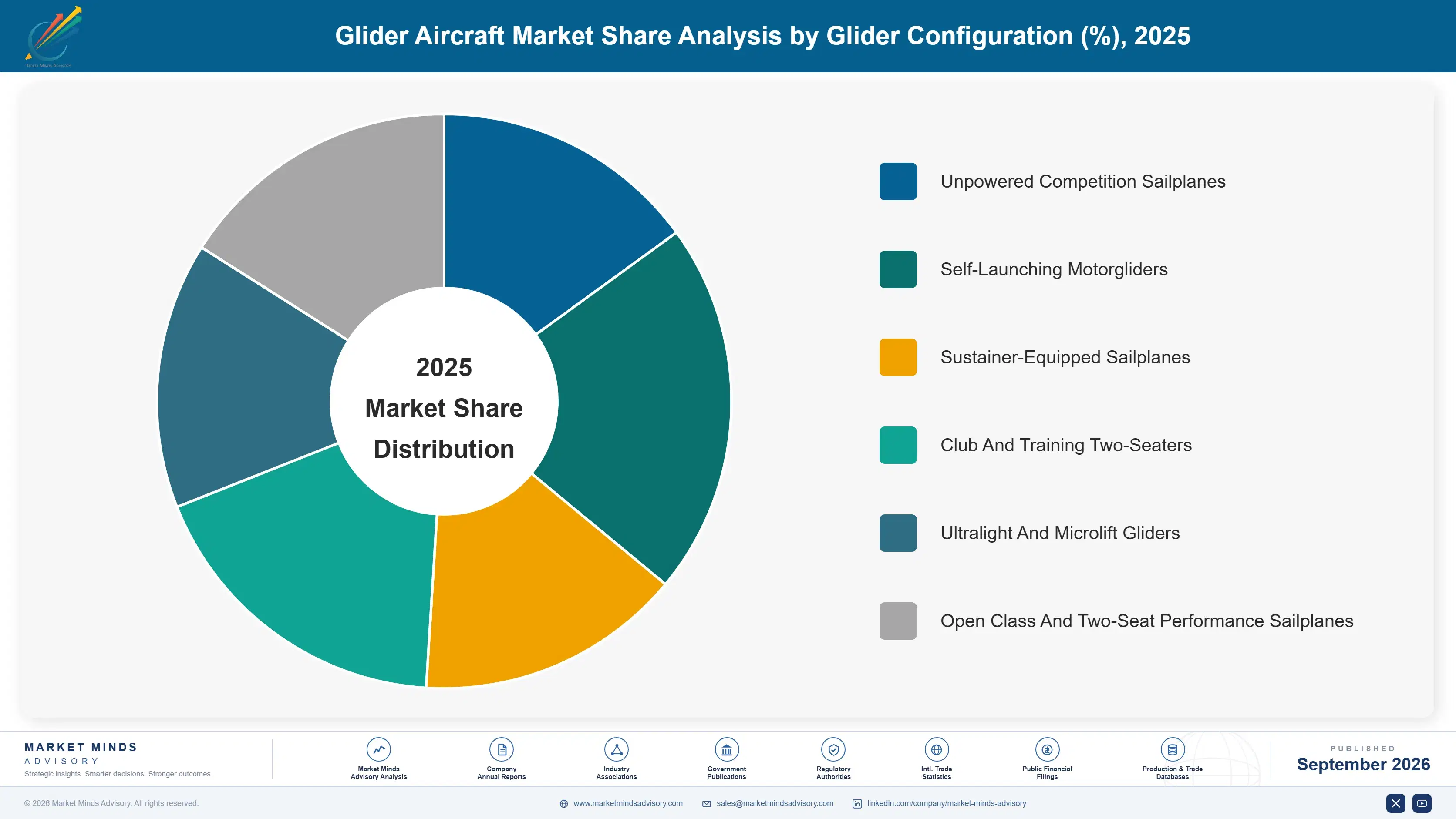
Gliders are segmented here by configuration, because configuration determines the buyer, the certification basis and how the aircraft is actually operated. Mixing configuration with competition class or wingspan produces categories that overlap on nearly every airframe. Six configurations cover the field from ultralight gliders through to open class sailplanes, and only one of them is genuinely growing.
glider-aircraft-market-market-share-analysis-1790026354388

Self-Launching Motorgliders

Growing at 6.9%, half again the market rate of 4.6%, this configuration is the only part of the market where new aircraft offer something the used fleet cannot supply. A self-launching glider needs no tow aircraft, no winch crew and no club operating around the owner's availability, which for most private owners is the real limit on flying hours rather than performance. Electric systems have made the proposition markedly more attractive by removing the starting reliability and maintenance problems that made small combustion engines tolerated rather than chosen. Prices carry a substantial premium over unpowered equivalents, and buyers pay it because they are purchasing independence. Independence, not climb rate, is what the premium actually buys.
CAGR 6.9%

Sustainer-Equipped Sailplanes

Sustainer-equipped aircraft grow at 5.8% and occupy a genuinely distinct position between unpowered gliders and self-launchers. A sustainer cannot launch the aircraft but will get it home from a field it could not otherwise reach, which removes the retrieve that deters owners from flying far from their home airfield. The systems are lighter, cheaper and less intrusive than self-launch installations, and they retrofit onto existing airframes far more readily. That retrofit capability is commercially important, because it reaches an installed base many times larger than annual new deliveries and captures spending from owners who had no intention of buying an aircraft. Owners with no intention of buying an aircraft spend money here instead.
CAGR 5.8%
Full segment breakdown across 6 segments available in the complete report.

Regional Architecture and Country Demand Map

Manufacture and demand both concentrate far more tightly than in any comparable aviation market. Western Europe dominates on both counts, with German production and the largest pilot population anywhere, while Eastern European manufacture and club growth together make that region far more significant than its usual weight suggests.

Western Europe

At 41%, far above the 18 to 26% band applied elsewhere in this report, Western Europe dominates this market on both manufacture and demand, which justifies the deviation on its own. German production accounts for the majority of high-performance sailplanes built anywhere, from firms clustered within a few hundred kilometres of one another, and Germany also holds the largest gliding population of any country by a wide margin. France, the United Kingdom, Switzerland and the Netherlands add substantial fleets and club networks. Growth of 3.2% sits below the market rate because both the fleet and the pilot population are mature and ageing, and refinishing substitutes for replacement. Manufacture clusters more tightly here than in any comparable aviation market.
Share: 41% | CAGR: 3.2% (2026 to 2036)

North America

At 18%, below the 22 to 32% band used elsewhere, North America holds a substantial fleet and a modest manufacturing position. United States soaring is concentrated in a small number of regions with reliable conditions, and the fleet is older on average than the European one because import costs and currency movement make new aircraft purchases harder to justify. A small domestic manufacturing sector focuses on ultralight and specialist designs rather than competing with European high-performance production. Growth of 4.2% is close to the market rate, driven by propulsion retrofit and refinishing more than by new aircraft, and helped by a small number of well-funded competition buyers. Currency movement makes European aircraft harder to justify.
Share: 18% | CAGR: 4.2% (2026 to 2036)
Regional intelligence for 5 additional markets available in the complete report: Eastern Europe, South Asia and Pacific, East Asia, Latin America, Middle East and Africa. Contact sales@marketmindsadvisory.com.
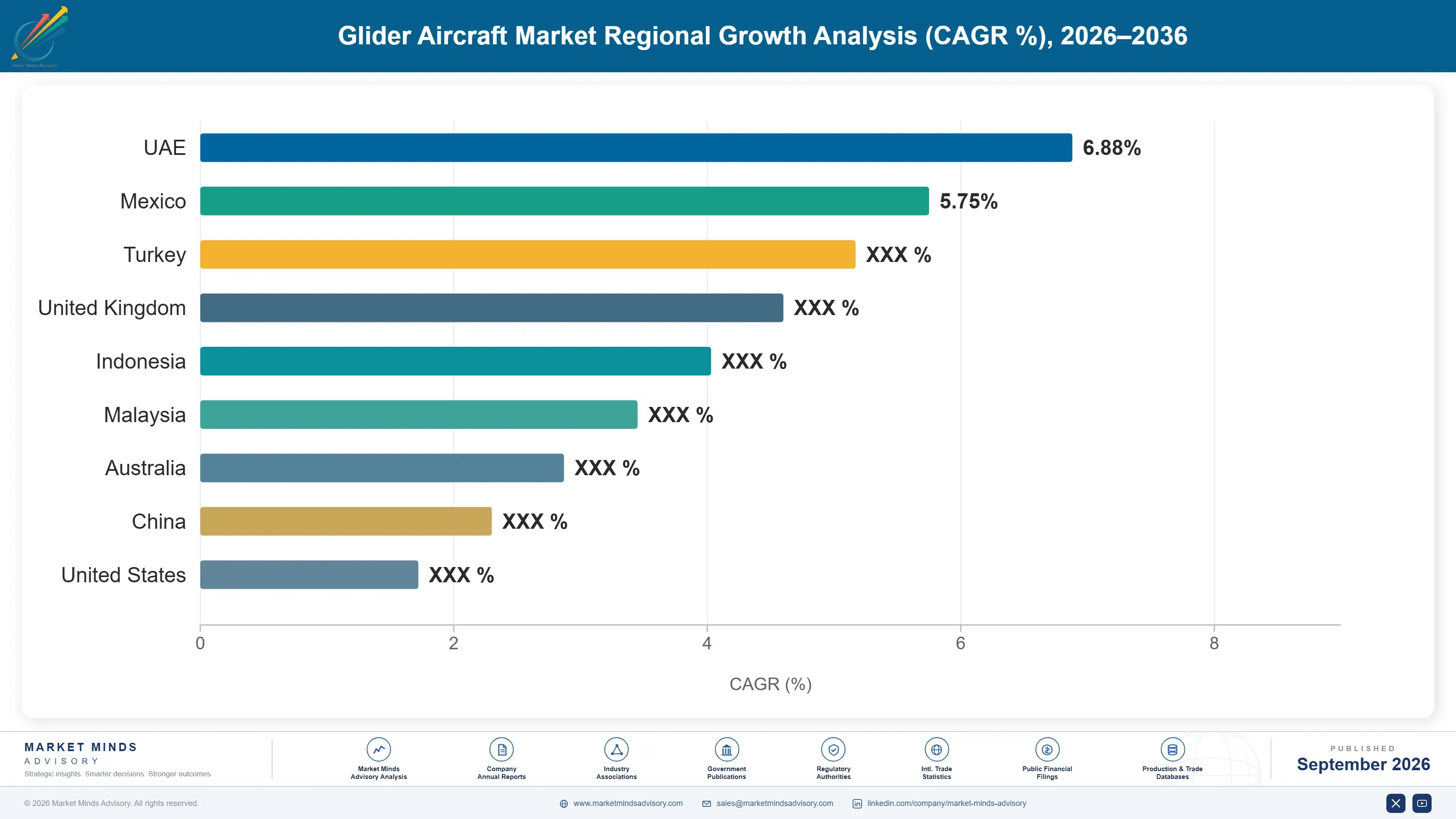
glider-aircraft-market-country-cagr-analysis-1790026354905

Where Glider Manufacturers Make Money

New airframe sales are the visible revenue in this market and the hardest to grow. Propulsion content, retrofit access and refinishing services decide economics instead. The four levers below reflect positions manufacturers have used to improve returns measurably rather than to lift delivery counts. Volume is not available here at any price. Deliveries will not rise.

Attach Propulsion To Every Aircraft You Sell

Propulsion is the only content in a new glider that the used fleet cannot match, and it carries a substantial price premium over the unpowered equivalent. Around 47% of new deliveries now include sustainer or self-launch systems, and manufacturers with strong propulsion offerings report average selling prices roughly 38% above those selling mainly unpowered aircraft. Buyers pay for independence from tow pilots and winch crews rather than for climb performance, which is a different sales argument entirely and one many manufacturers still make badly. Climb performance is not what anyone is buying here.
Market Impact: Average selling price rises roughly 38% higher overall

Sell Retrofit Propulsion Into The Installed Base

The installed fleet is many times larger than annual new deliveries, and owners fitting a sustainer to a twenty-year-old airframe spend money that would otherwise never enter this market. Retrofit generates engineering, certification and installation revenue disproportionate to hardware value, and roughly 2,900 installations are expected across the forecast period. Manufacturers treating their own older aircraft as a retrofit opportunity rather than as competition report aftermarket revenue roughly 2.4 times that of those focused on new deliveries alone. Owners of twenty-year-old airframes become customers again through exactly this route alone.
Market Impact: Aftermarket revenue runs roughly 2.4 times higher overall

Run Factory Refinishing As A Branded Programme

Gelcoat failure at around thirty years pushes a large fleet through refinishing, and independent shops currently capture most of that work. Manufacturers offering factory refinishing with recertification and warranty capture revenue on aircraft they sold decades ago, and the work carries margin above new aircraft assembly because it consumes less material and more chargeable labour. Factory programmes have achieved pricing roughly 29% above independent shops, because owners of valuable competition aircraft will pay for the original manufacturer's inspection and sign-off. The work consumes chargeable labour rather than any layup hours at all.
Market Impact: Factory refinishing prices roughly 29% higher than independents

Manufacture Where The Skill Costs Less

Labour is around 54% of delivered cost and cannot be automated at these volumes, but it can be located. Polish, Czech, Lithuanian and Slovenian composite workforces hold genuine sailplane skill at wage levels well below German equivalents, which is why several designs are now built there under licence or ownership. Manufacturers producing in those locations report unit costs roughly 24% below comparable Western European production. The constraint is that skill depth, not wage level, determines whether the option exists at all in a given country. Most nominally cheaper locations are ruled out entirely.
Market Impact: Unit costs run roughly 24% lower than Germany

Who Controls the Margin Pool

Concentration is 68% for the top five, measured on unit deliveries and delivered content value, the basis used throughout this section. What is unusual is the geography: almost all of that capacity sits within a few hundred kilometres in Germany and its immediate neighbours, sharing a supplier base, a labour pool and in several cases former employees. The gap to the next tier reflects design reputation and competition results more than manufacturing scale.
Competition currently turns on three dimensions. Propulsion capability decides who can sell against the used fleet at all. Competition results decide reputation, because this is a market where buyers genuinely read contest placings and a world championship win moves order books. And production location decides cost, since labour dominates and wage levels across the European manufacturing cluster differ substantially.

Positions will shift on propulsion and on production location rather than on aerodynamics. Airframe performance has advanced slowly for two decades and further gains are marginal, while electric self-launch is developing quickly and a manufacturer arriving late will find buyers already committed. Eastern European producers combining genuine design capability with lower cost bases represent the clearest competitive threat to the established German firms.
glider-aircraft-market-company-positioning-matrix-1790026355432

Competitive Moat and Risk Dimensions

SCHEMPP-HIRTH

Moat: Competition Reputation And Design Depth

Schempp-Hirth holds a competition record across classes that buyers in this market genuinely follow and weigh, because contest results are read as a direct proxy for design quality in a way few markets allow. That reputation supports pricing and shortens sales cycles among the performance buyers who account for most new high-value deliveries.
SCHEMPP-HIRTH

Risk: High-Cost Production Location

Manufacturing in Germany with labour at roughly 54% of delivered cost leaves the firm exposed to producers in Eastern Europe with comparable skill at materially lower wages. Relocating production means moving a skill base and requalifying processes against a type certificate, which is slow and carries quality risk in a market where reputation is the principal asset.
JONKER SAILPLANES

Moat: Cost Base Outside Europe Entirely

Jonker manufactures in South Africa with skilled composite labour at wage levels well below European producers, while competing successfully at world championship level, which is an unusual combination. That cost position lets the firm price competitively against German aircraft without sacrificing the competition credibility this market demands from any serious contender.
JONKER SAILPLANES

Risk: Distance From Principal Market

The great majority of buyers, clubs and service infrastructure sit in Europe, and operating from South Africa means freight, support logistics and a thinner local service network for customers. Building European support depth costs money and time, and a warranty or refinishing question answered slowly damages reputation faster in this market than in almost any other.

Players Tracked

Prominent Players

Schempp-Hirth
Alexander Schleicher
DG Flugzeugbau
Jonker Sailplanes
Sportine Aviacija

Other Key Players

Lange Aviation
Stemme
HpH Sailplanes
AMS Flight
Grob Aircraft
Diamond Aircraft
Pipistrel
Windward Performance
Allstar PZL Glider
Aeromot
GP Gliders
M and D Flugzeugbau
Binder Flugmotorenbau
LXNAV
Air Avionics

Recent Developments

MAY 2025

Electric self-launch system gains certification on additional airframe types

An electric self-launch propulsion system received certification for installation on further sailplane types, extending retrofit availability across a wider installed base. This was a certification approval rather than any corporate transaction, and it opens propulsion retrofit to owners of airframes previously excluded from any retrofit at all.
Signal: Widening retrofit approval reaches an installed fleet many times larger than annual new aircraft deliveries anywhere
SEPTEMBER 2024

Eastern European manufacturer expands production of high-performance sailplanes

An Eastern European sailplane manufacturer expanded production capacity for high-performance designs, citing demand and a skilled composite workforce at competitive wage levels. This was organic capacity investment rather than any acquisition, and it increases direct competition with the established German producers on their own high-performance ground.
Signal: Comparable skill at materially lower wages is the clearest competitive threat facing established German manufacturers today
FEBRUARY 2025

Manufacturer launches factory refinishing programme for legacy airframes

A sailplane manufacturer opened a factory refinishing and recertification programme covering aircraft it built decades ago, competing directly with independent refurbishment shops. The launch was organic investment rather than an acquisition of any shop, and it converts an ageing fleet from a competitor into aftermarket revenue.
Signal: Treating your own old aircraft as aftermarket rather than as competition changes the economics substantially for manufacturers

What Sets Delivered Aircraft Cost

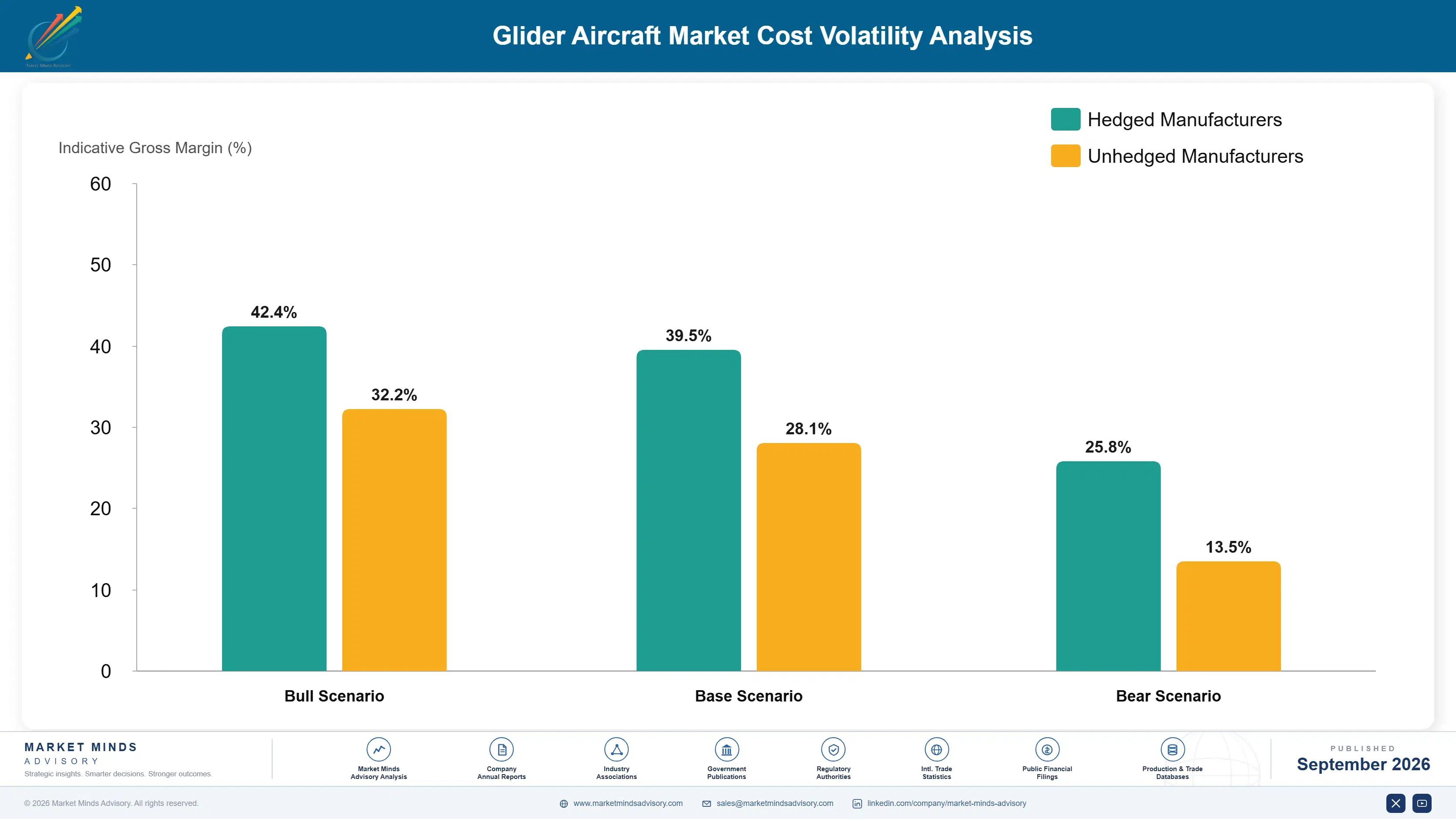
Labour dominates in a way few aerospace products match. Skilled hand layup and finishing runs roughly 54% of delivered aircraft cost, composite materials including glass, carbon and epoxy about 19%, propulsion and avionics close to 17%, and tooling amortisation with certification the remaining 10%. Materials come from European and Japanese producers, while the labour sits in a small number of European locations where the skill exists at all.
European energy and chemistry costs were the recent pressure. Resin and fibre pricing rose sharply from 2022 as energy costs moved, with EIA data showing the scale, while European chemicals regulation tightened around styrene and traditional gelcoat systems. The European Commission restriction process has made reformulation a live question for finishing shops. Manufacturers absorbed most of it, since order books are priced well ahead of delivery.

Exposure separates by where a manufacturer builds and what it sells. Producers in high-wage Western European locations carry the labour cost directly and cannot move it easily, while Eastern European and South African producers hold comparable skill at materially lower rates. Manufacturers weighted toward propulsion and retrofit carry component cost rather than layup hours, a smaller and more manageable exposure.
glider-aircraft-market-cost-volatility-analysis-1790026355630

Locate layup work where sailplane skill already exists cheaply

Labour cannot be automated at these volumes but it can be relocated, and Polish, Czech, Lithuanian and Slovenian composite workforces hold genuine sailplane experience at wages well below German levels. Several designs are now built there under licence or ownership. The constraint is that skill depth rather than wage level determines whether the option exists at all.

Qualify alternative resin and finishing chemistry early

European chemicals regulation is tightening around styrene and traditional gelcoat systems, and reformulating a finish on a certified airframe means requalification work nobody funds speculatively. Manufacturers who began qualifying alternatives before restriction timelines firmed up will hold approved processes while competitors are still testing. The cost is certification effort against a requirement that has not yet fully arrived.

Shift mix toward propulsion, retrofit and refinishing revenue

Propulsion content, retrofit installation and refinishing all carry component and chargeable labour cost rather than the full layup hours of a new airframe, which is a smaller and more controllable exposure. Moving mix that way hedges the labour concentration that dominates new aircraft economics. It also reaches an installed base many times larger than annual deliveries.

Portfolio Architecture for Margin Defence

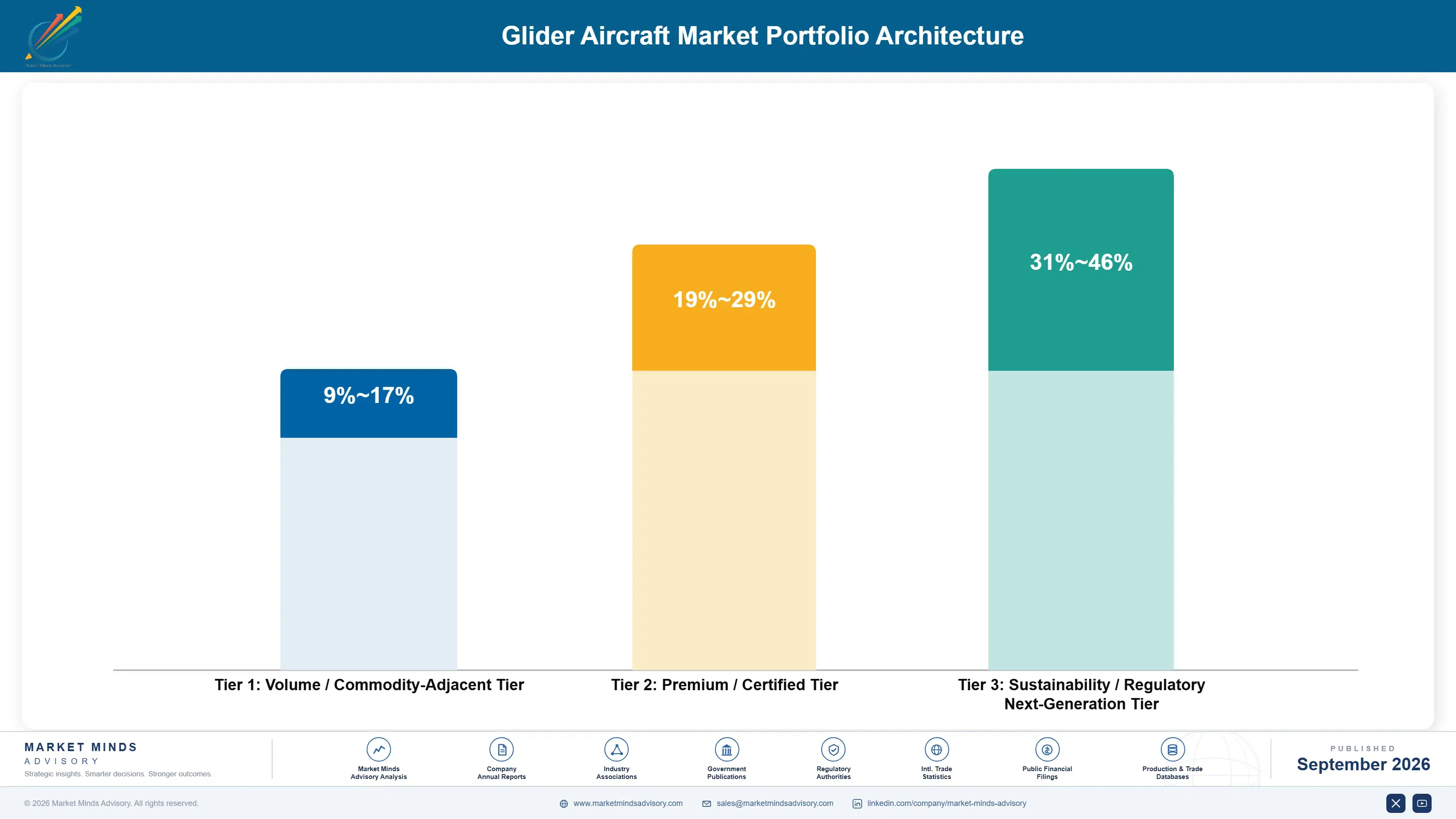
Margin architecture here inverts the obvious ranking. New unpowered airframes sit at the bottom, carrying the full weight of hand layup labour against a used fleet priced at roughly a fifth of new. Propulsion-equipped new aircraft sit in the middle at better economics, because the premium buyers pay for independence exceeds the cost of the system. Retrofit, refinishing and certification services sit at the top, consuming chargeable labour rather than layup hours.
The volume-versus-premium tension does not really exist, because volume is simply not available. Annual global new deliveries are measured in hundreds and have been for two decades, and no commercial strategy changes that while the used fleet performs as well as it does. What varies is whether a manufacturer captures spending from the installed fleet, which is many times larger, or confines itself to competing for the small number of buyers willing to fund a new airframe.

High-value pools concentrate in three places: propulsion retrofit that reaches owners who would otherwise buy nothing, factory refinishing that converts an ageing fleet from competitor into customer, and certification and engineering services attached to both. None of the three depends on persuading anybody to buy a new aircraft at all.

Volume / Commodity-Adjacent Tier

New unpowered club and training sailplanes competing against a used fleet priced at roughly a fifth of new. Full hand layup labour cost with no offsetting content. The eight point range reflects production location, since wage levels across European manufacturing differ substantially.
Gross Margin: 9-17%

Premium / Certified Tier

New competition sailplanes and propulsion-equipped aircraft where buyers pay a premium for performance or independence. Design reputation and contest results defend pricing here. The ten point range tracks propulsion content share, which materially changes the economics of an otherwise similar airframe.
Gross Margin: 19-29%

Sustainability / Regulatory / Next-Generation Tier

Propulsion retrofit, factory refinishing, recertification and engineering services on the existing fleet. Chargeable labour rather than layup hours, priced against the owner's alternative. The fifteen point range spans an installation business and a refinishing business with different economics.
Gross Margin: 31-46%
glider-aircraft-market-portfolio-architecture-1790026356134

High-value Sub-segments and Strategic Watch-out

Propulsion Retrofit Services

Best margins available and reaching an installed base many times larger than annual deliveries, with roughly 2,900 installations expected across the period. Engineering and certification revenue exceeds hardware value considerably. The twelve point range reflects how differently installation labour is charged across manufacturers and independent shops.
Gross Margin: 34-46%

Factory Refinishing Programmes

Converts an ageing fleet from competitor into customer, pricing roughly 29% above independent shops because owners pay for original manufacturer sign-off. Demand rises mechanically as 1980s airframes reach gelcoat failure. The eleven point range reflects how much recertification work each aircraft actually requires on inspection.
Gross Margin: 31-42%

Propulsion-Equipped New Aircraft

The only new aircraft category growing meaningfully, at 6.9%, because independence from tow pilots and winch crews is something no used airframe offers. Average selling prices run roughly 38% above unpowered equivalents. The ten point range reflects propulsion content share across different configurations and systems.
Gross Margin: 19-29%

New Unpowered Sailplanes

Thinnest margins in the market, carrying full hand layup labour against used aircraft at roughly 22% of new value and only a few percent behind on performance. Volume has been flat for two decades. The eight point range reflects production location and wage levels more than any efficiency difference.
Gross Margin: 9-17%

What Owners Keep Spending On

The annuity here belongs to the fleet rather than to new sales. A glider flies for fifty years or more, and across that life it consumes refinishing at around thirty years, instrument upgrades every decade or so, propulsion retrofit at some point for many owners, and continuous inspection and maintenance. That recurring spending on an installed fleet averaging 31 years old dwarfs annual new deliveries, and manufacturers who ignore it are competing for the smallest part of their own market.
Adoption depth varies sharply by owner type. Competition pilots buy new, upgrade instruments constantly, refinish on schedule and replace aircraft every several years, and they account for a large share of new high-value deliveries despite being a small population. Private recreational owners buy used, retrofit propulsion and refinish once, then fly the same aircraft for decades. Clubs buy two-seaters on long cycles, maintain them intensively and replace only when airframe hours or funding force the decision.

The buyer has aged along with the fleet. Gliding participation in traditional markets skews considerably older than it did, which raises purchasing power while shrinking the pipeline, and has pushed manufacturers toward products that reduce effort rather than toward pure performance.
glider-aircraft-market-end-use-penetration-index-1790026356625

Where Manufacturers Should Focus

These are among the four positions where our research anticipates prominent divergence between winners and laggards over the coming forecast period. Each is grounded in the demand model, the regulatory perimeter, and the announced capacity pipeline.
01 / PROPULSION CONTENT ATTACHMENT

Sell independence from the club, not glide performance

Propulsion is the only thing in a new glider that a refinished forty-year-old airframe cannot match, and around 47% of new deliveries now carry sustainer or self-launch systems. Manufacturers with strong propulsion offerings report average selling prices roughly 38% above those selling mainly unpowered aircraft. Buyers are purchasing freedom from tow pilots, winch crews and club schedules rather than climb performance, which is a fundamentally different sales argument, and one that many manufacturers in this market still make rather badly.
02 / INSTALLED FLEET ACCESS

Treat your own old aircraft as customers, not competitors

The installed fleet averages 31 years old and is many times larger than annual deliveries, and its owners spend continuously on retrofit, refinishing, instruments and certification whether or not they ever buy new. Manufacturers treating that fleet as an aftermarket opportunity report revenue roughly 2.4 times that of those focused on new deliveries alone. Roughly 2,900 propulsion retrofits are expected across the forecast period, every one of them on an airframe that a manufacturer might otherwise have written off entirely.
03 / REFINISHING REVENUE CAPTURE

Take back the gelcoat work from independent shops

Polyester gelcoat fails at around thirty years and a very large fleet built in the 1980s is passing through that work now, with independent refurbishment shops capturing most of it today. Factory programmes offering recertification and warranty have achieved pricing roughly 29% above independent alternatives, because owners of valuable competition aircraft pay for the original manufacturer's inspection and sign-off. The work also consumes chargeable labour rather than layup hours, which makes its margin considerably better than new aircraft assembly work.
04 / PRODUCTION LOCATION CHOICE

Build where sailplane skill exists at lower wages

Hand layup labour is roughly 54% of delivered cost and cannot be automated at these low volumes, but Polish, Czech, Lithuanian and Slovenian workforces hold genuine sailplane experience at wage levels well below German ones. Manufacturers producing there report unit costs roughly 24% below comparable Western European production, which is the only meaningful route to narrowing the gap against refinished used aircraft. The constraint is skill depth rather than wage level, which rules out most nominally cheaper manufacturing locations entirely.

Engagement Snapshot From the Field

A live engagement with an industry participant carrying material or product regulatory and market exposure ahead of a defining policy shift, showing how our research translates into a defensible multi-year portfolio strategy.
MARKET MINDS ADVISORY · CLIENT ENGAGEMENT SUMMARY
Glider Aircraft Producer Strategic Portfolio Review and Transition Roadmap 2026·Investment Scenario on Glider Aircraft Exposure Evaluation 2025-26
CLIENT PROFILE
A Western European sailplane manufacturer with roughly USD 41 million in annual revenue (client-reported, unverified by MMA), delivering fewer than seventy aircraft a year. New unpowered airframes accounted for most of its output, and the company had watched delivery numbers stay flat for a decade while an independent refurbishment industry built a business refinishing the aircraft it had sold in the 1980s.
STRATEGIC CHALLENGE
Management viewed refurbished older aircraft as a market problem and had responded by improving performance on the current model. Buyers were unmoved, because the performance gap the improvement addressed was already marginal. The board needed to decide whether to keep investing in aerodynamics or to pursue the installed fleet that competitors and independents were monetising instead.
MMA APPROACH
MMA sized refinishing, retrofit and instrument spending across the client's own installed fleet, modelled margin on factory refurbishment against new aircraft assembly, and assessed propulsion retrofit demand by airframe type and owner profile. Expert interviews with owners and independent shops established what would persuade them to bring work back to the factory.
KEY FINDINGS
  1. Annual spending across the client's own installed fleet on refinishing, retrofit and instruments exceeded its entire new aircraft revenue, and the company captured almost none of it.
  2. Owners consistently said they would pay a premium for factory refinishing with recertification, citing resale value and inspection confidence rather than workmanship quality concerns.
  3. Performance improvements on the current model had not moved order volume in either of the two previous model cycles, despite measurable gains against the aircraft being replaced.
  4. Propulsion retrofit demand existed across three of the client's older airframe types, none of which had ever been certified for any retrofit installation at all.
CLIENT PROFILE
A Western European sailplane manufacturer with roughly USD 41 million in annual revenue (client-reported, unverified by MMA), delivering fewer than seventy aircraft a year. New unpowered airframes accounted for most of its output, and the company had watched delivery numbers stay flat for a decade while an independent refurbishment industry built a business refinishing the aircraft it had sold in the 1980s.
STRATEGIC CHALLENGE
Management viewed refurbished older aircraft as a market problem and had responded by improving performance on the current model. Buyers were unmoved, because the performance gap the improvement addressed was already marginal. The board needed to decide whether to keep investing in aerodynamics or to pursue the installed fleet that competitors and independents were monetising instead.
MMA APPROACH
MMA sized refinishing, retrofit and instrument spending across the client's own installed fleet, modelled margin on factory refurbishment against new aircraft assembly, and assessed propulsion retrofit demand by airframe type and owner profile. Expert interviews with owners and independent shops established what would persuade them to bring work back to the factory.
KEY FINDINGS
  1. Annual spending across the client's own installed fleet on refinishing, retrofit and instruments exceeded its entire new aircraft revenue, and the company captured almost none of it.
  2. Owners consistently said they would pay a premium for factory refinishing with recertification, citing resale value and inspection confidence rather than workmanship quality concerns.
  3. Performance improvements on the current model had not moved order volume in either of the two previous model cycles, despite measurable gains against the aircraft being replaced.
  4. Propulsion retrofit demand existed across three of the client's older airframe types, none of which had ever been certified for any retrofit installation at all.
RECOMMENDED STRATEGY
Phase 1: Phase 1 (seven months): Establish a factory refinishing and recertification programme targeting the client's own aircraft built during the 1980s first. Phase 2: Phase 2 (16 months): Certify sustainer retrofit installations on the three older airframe types with demonstrated owner demand for them. Phase 3: Phase 3 (26 months): Redirect engineering effort from airframe aerodynamics toward propulsion integration and installed fleet support work across the range instead.
OUTCOME
Factory refinishing reached roughly 22% of revenue within eighteen months at margins above new aircraft assembly (client-reported, unverified by MMA). Retrofit certification on two airframe types generated orders from owners the company had lost contact with decades earlier, and new aircraft deliveries were unaffected by the shift in engineering priority.

Frequently Asked Questions

Foundational context covering the market sizes, CAGR, scope, country, region and competition that inform every finding below. This section is provided to cover basics and most often pre-purchase conversations, answered from the MMA Primary Research Dataset.

What is the current size of the Glider Aircraft Market?

The market was worth USD 1.1 billion in 2025 and reaches USD 1.2 billion in 2026. That covers new sailplanes and motorgliders plus propulsion retrofit, refinishing, instruments and trailers.

How large will the Glider Aircraft Market be by 2036?

MMA forecasts USD 1.8 billion by 2036, an increase of USD 0.6 billion over the 2026 base. That represents an expansion multiple of 1.50 times across the forecast period.

What is the CAGR for the Glider Aircraft Market 2026 to 2036?

The base case CAGR is 4.6%, with a bull case of 5.8% if electric self-launch becomes the default configuration. The bear case of 3.4% assumes refinishing keeps extending the used fleet instead.

Which segment is growing fastest?

Self-launching motorgliders grow at 6.9%, half again the market rate of 4.6%. They are the only configuration offering something a refinished used airframe cannot supply, namely independence from tow pilots and winch crews.

Who are the major companies in the Glider Aircraft Market?

Schempp-Hirth, Alexander Schleicher, DG Flugzeugbau, Jonker Sailplanes and Sportine Aviacija lead on unit deliveries and delivered content value. Lange Aviation, Stemme and HpH Sailplanes follow.

Which country is growing fastest?

Poland leads at 7.6%, combining growing club membership with manufacturing that builds both club aircraft and high-performance designs at competitive cost. Skilled composite labour there costs materially less than in Germany.

Report Segmentation Architecture

The full report scope spans multiple orthogonal segmentation dimensions, with cross-tabulated demand data provided for each dimension pair. Coverage extends further to regional breakdowns, trend trajectories, and the competitive detail needed to support segment-level decision-making.

By Glider Configuration

  • Unpowered Competition Sailplanes
  • Self-Launching Motorgliders
  • Sustainer-Equipped Sailplanes
  • Club And Training Two-Seaters
  • Ultralight And Microlift Gliders
  • Open Class And Two-Seat Performance Sailplanes

By End-Use Industry

  • Competition Soaring Pilots
  • Private Recreational Owners
  • Gliding Clubs And Associations
  • Flight Training Organisations
  • Air Cadet And Youth Programmes

By Commercial Dimension

  • New Aircraft Delivery
  • Propulsion Retrofit Installation
  • Refinishing And Recertification
  • Instruments And Equipment Supply

By Region

  • Western Europe
  • North America
  • Eastern Europe
  • South Asia and Pacific
  • East Asia
  • Latin America
  • Middle East and Africa

Scope, Methodology, and Coverage

Every figure in this report is reproducible from documented input assumptions. The scope below maps the historical period, the forecast horizon, the segmentation dimensions, and the countries covered, alongside the underlying primary and qualitative methodology.
Historical Period
2020 to 2025
Forecast Period
2026 to 2036
Base Year
2025 (USD billions; MMA Primary Research Dataset, September 2026)
Market Definition
This report covers gliders and sailplanes together with the propulsion, refinishing and equipment content sold against them. Scope includes unpowered competition sailplanes, self-launching motorgliders, sustainer-equipped sailplanes, club and training two-seaters, ultralight and microlift gliders, and open class or two-seat performance sailplanes, plus retrofit propulsion systems, airframe refinishing and recertification, instruments and flight computers, and trailers. Excluded are powered light aircraft and tug aircraft, hang gliders and paragliders, launch winches and airfield infrastructure, flight training services, and club operating costs.
Quantitative Units
USD billions (current prices); new aircraft deliveries; installed fleet counts; average aircraft pricing by configuration
Segmentation Dimensions
By Glider Configuration; By End-Use Industry; By Commercial Dimension; By Region
Regions Covered
Western Europe, North America, Eastern Europe, South Asia and Pacific, East Asia, Latin America, Middle East and Africa
Countries Covered
Germany, Poland, Czech Republic, Lithuania, Slovenia, France, UK, Switzerland, Netherlands, Austria, Italy, Spain, Sweden, Finland, USA, Canada, Australia, New Zealand, Japan, China, South Africa, Brazil, Argentina, Chile, India, Israel, and additional markets relevant to this sector
Key Companies Profiled
Schempp-Hirth, Alexander Schleicher, DG Flugzeugbau, Jonker Sailplanes, Sportine Aviacija, Lange Aviation, Stemme, HpH Sailplanes, AMS Flight, Grob Aircraft, Diamond Aircraft, Pipistrel, Windward Performance, Allstar PZL Glider, Aeromot, GP Gliders, M and D Flugzeugbau, Binder Flugmotorenbau, LXNAV, Air Avionics
Quantitative Methodology
Primary survey, n=3,800 respondents, Q4 2025, six countries; demand-side model with trade association cross-validation
Qualitative Methodology
47 expert interviews, Q4 2025; applied to validate demand model assumptions, identify emerging dynamics, and assess competitive positioning
Report Format
PDF and XLSX data workbook (Word format preview document)
Publisher
Market Minds Advisory
Report Code
MMA-2026-CON-919
Published
September 2026
Contact
sales@marketmindsadvisory.com | www.marketmindsadvisory.com

Purchase the full Glider Aircraft Market Report (2026 to 2036).

The full report sizes the glider aircraft market across six configurations and all seven regions, with delivery counts, installed fleet numbers and pricing behind every figure. It models the used fleet explicitly as a competing supply source, because a refinished older airframe at roughly a fifth of new price is the binding constraint on new deliveries and no demand analysis works without it. Competitive analysis covers 20 participants on unit deliveries and delivered content value, including propulsion capability and production location by manufacturer. Aftermarket spending across the installed fleet is sized separately, since it exceeds new aircraft revenue for most manufacturers. Refinishing demand is projected from airframe age distribution.
Six-configuration sizing with deliveries and fleet counts
Used fleet modelled as competing supply source
Aftermarket spending sized against new aircraft revenue
Propulsion capability and production location by manufacturer
Refinishing demand projected from airframe age
Retrofit opportunity quantified by airframe type

Built For The People Who Decide

From boardroom strategy to bench-side execution, this report is read cover-to-cover by leaders shaping the next decade of their industry, turning demand scenarios, market dynamics and valuation benchmarks into decisions.
CXOs/ Presidents/ VPs/ Managers
M&A and Corporate Development
Strategy Teams and R&D Heads
Procurement and Product Directors
Regulatory and Compliance Leaders
Investor Relations and Equity Analysts