Market Minds Advisory
Glassine Paper Market

Glassine Paper Market: Fluorochemical Substitution, Supercalender Scarcity, and Release Liner Recyclability

Glassine resists grease through mechanical fibre structure rather than through fluorochemicals, which turned a nineteenth century papermaking technique into the obvious answer when regulators banned the chemistry everyone else used.

Lead Analyst

Bilal Shaikh

Published

September 2026

Make Smarter Decisions with Customized Research Insights

Request a free sample report and evaluate market opportunities, growth trends, and competitive dynamics relevant to your business needs.

2025 MARKET VALUE$1.9BMarket Size 2025
2036 FORECAST VALUE$4.2BBase Case , 2026 to 2036
CAGR 2026 TO 20367.6 %Bull 8.9% / Bear 6.4%
INCREMENTAL OPPORTUNITY$2.2BNet 10- year value creation
EXPANSION MULTIPLE2.08x2036 value over 2026 base
Strategic Levers
M&A Pipeline
Regional Outlook
Country Rankings
Competitive Intelligence
Segmental Deep-dive
Call-Us : 91 93563 13602

Executive Snapshot and Market Trajectory

Glassine achieves grease resistance by refining and calendering fibre until the sheet is dense enough to stop oil passing through it. No fluorochemistry is involved anywhere, which matters enormously now that regulators have removed exactly that chemistry from food packaging. The barrier survives repulping intact.
Barrier-coated grades compound at 11.4%, a full 1.50x the market rate, replacing polyethylene-laminated papers in food and pharmaceutical packaging with a structure that enters ordinary paper recycling rather than a mixed-material stream. East Asia holds the largest share at 30%, on Chinese release base capacity supplying the world's largest label market and on regional food packaging conversion. Regional food packaging conversion is expanding alongside that base, which reinforces the position further.
Concentration sits at 46%, with UPM and Ahlstrom leading a small group of mills that can actually make this product. Supercalendering is energy-intensive, the equipment is old and almost nobody is adding capacity, so supply is genuinely scarce. Release liner accounts for roughly 58% of volume and recyclability arguments are pulling some of it back from filmic alternatives. Recyclability is pulling liner volume back from filmic alternatives. Allocation between grades matters far more than pricing.
Market Definition
This market covers glassine and closely related supercalendered greaseproof papers, spanning uncoated natural glassine, bleached glassine, machine-glazed coated grades, silicone-coated release glassine, barrier-coated grades using dispersion or extrusion coatings, and coloured or printed glassine. Measurement is at papermaker and converter revenue for base and coated glassine. Ordinary greaseproof and parchment papers produced without supercalendering, filmic release liners, coated fine papers, and finished labels or packaging converted from glassine are excluded.
Base Year Value
$1.9B in 2025 (MMA Primary Research Dataset, August 2026)
Forecast Period
2026 to 2036, eleven discrete annual values
CAGR
7.6% base case. Bull 8.9%. Bear 6.4%.
Fastest Growth Segment
Barrier-Coated Glassine: 11.4% CAGR
Fastest Growth Country
India: 11.6% CAGR
Fastest Growth Region
South Asia and Pacific: 9.8% CAGR
Largest Region
East Asia: 30% of 2025 global value
Market Leaders
UPM, Ahlstrom, Nordic Paper, Delfort Group, and Mondi. Source: MMA Primary Research Dataset, July 2026.
Primary Survey
n=3,800 procurement and R&D decision-makers, Q4 2025, six countries
Methodology
Demand-side build-up, cross-validated against public data, 47 expert interviews

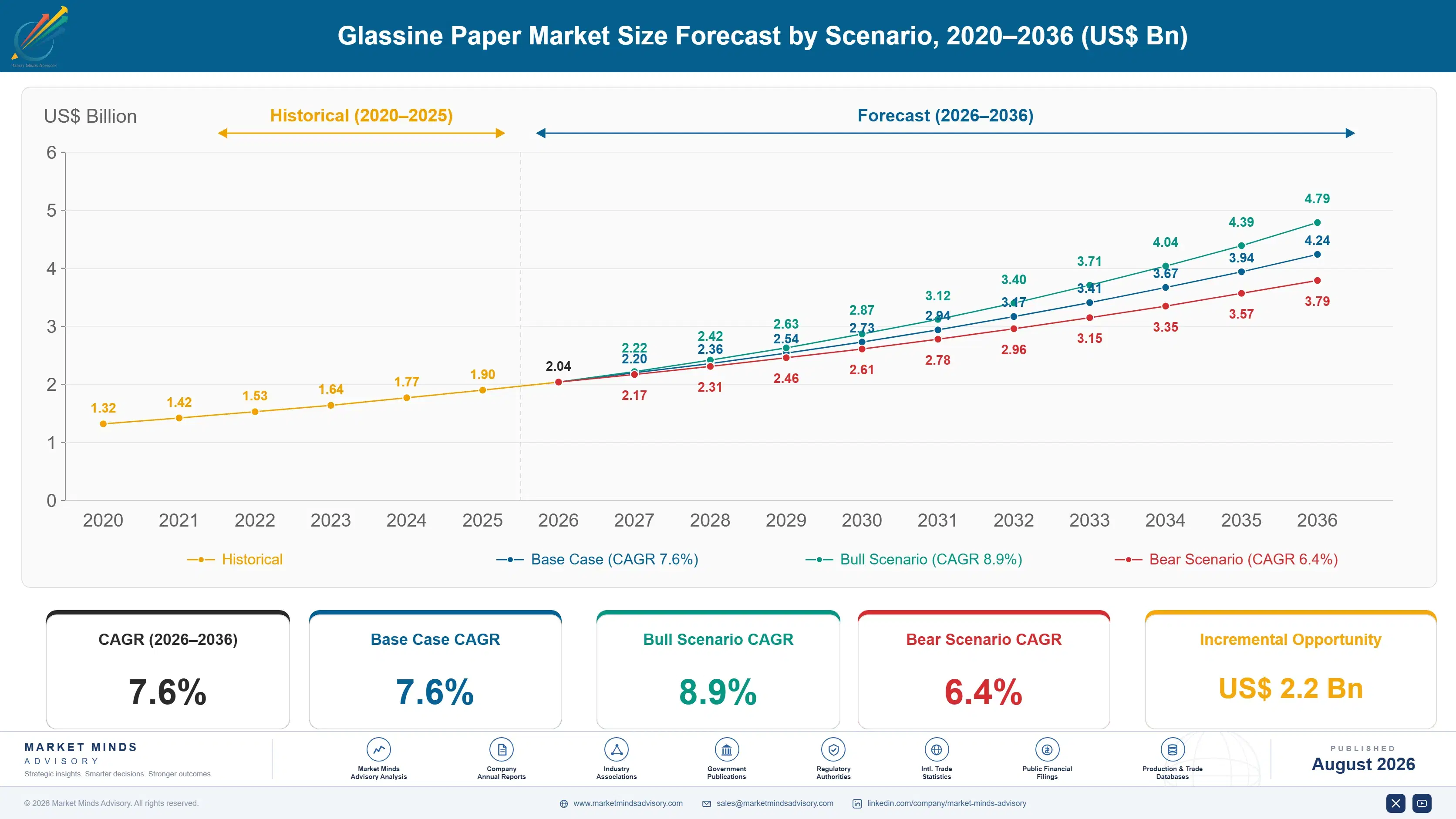
Glassine Paper Market Forecast Scenarios

glassine-paper-market-size-forecast-scenario-1787304240746
Growth ran at roughly 6.3% between 2020 and 2025, and regulation did more for the category than any commercial development. Fluorinated grease-proofing agents were restricted across the European Union and several American states, and food packaging converters needed a compliant alternative quickly. Glassine already was one, having never used it. Release liner demand grew with labelling volume while losing share to filmic alternatives.
Base case growth of 7.6% rests on three mechanisms. Fluorochemical restriction keeps widening across jurisdictions, and glassine is among the few grease-resistant substrates that complies without reformulation of any kind. Barrier-coated grades keep displacing polyethylene-laminated papers, because a dispersion coating enters ordinary paper recycling where a plastic laminate simply does not. And label volume keeps growing across every region MMA tracks, which carries release base demand along with it automatically.
The bull case at 8.9% assumes label converters and brand owners commit to paper release liners on recyclability grounds, reversing a decade of share loss to filmic liners. The bear case at 6.4% is a capacity case in reverse: supercalender capacity is scarce and ageing, and if mills close rather than reinvest, the category cannot supply the demand that regulation is creating for it.

Glassine: Mechanical Barrier and Calender Capacity

Glassine is made rather than treated, and that distinction now carries commercial weight it never previously had. Pulp is refined until the fibres are almost gelatinous, then supercalendered a dozen times under heat and pressure until dense, translucent and grease-resistant. Nothing is added. The barrier is the fibre structure itself, which is why it survives repulping and why no restricted chemistry is involved.
TOP FIVE CONCENTRATION46%Few mills worldwide operate supercalenders capable of producing glassine
RELEASE BASE SHARE58%Volume converted into silicone-coated liners for labels and tapes
AVERAGE PAPER PRICEUSD 1,450Blended price per tonne across natural, bleached and coated grades
SUPERCALENDER NIP COUNT12 nipsRoll passes required to develop transparency and grease resistance mechanically
GREASE RESISTANCE RATINGKit 10Typical resistance achieved without any fluorochemical treatment whatsoever
RECYCLABILITY ACCEPTANCE RATE74%Municipal paper streams accepting uncoated glassine without additional sorting
That property became valuable when regulators removed fluorinated grease-proofing from food contact packaging across the European Union and a growing list of American states. Converters who had relied on fluorochemical treatment needed a compliant substitute at short notice, and glassine required no reformulation because it had never used the chemistry. Demand moved faster than anyone in the category had planned for, and supply could not respond quickly.
Capacity is the binding constraint and it is not expanding. Supercalendering consumes considerable electricity, the machines involved are frequently decades old, and building new capability is a capital decision very few paper companies are willing to make for a specialty grade. Roughly 58% of volume goes into release liner base, where paper competes against filmic alternatives, and recyclability arguments have started pulling some of that volume back.
"This is a nineteenth century papermaking technique that regulators accidentally made strategic. Nobody built supercalenders in the last thirty years expecting a fluorochemical ban, and now the mills that kept theirs running are the only ones who can supply what the market suddenly needs."
Director, Specialty Papers and Packaging Substrates Practice · MMA Packaging Pra

Market Trends

Fluorochemical restriction drives substitution toward mechanical barriers

Regulators across the European Union and a widening set of American states have restricted fluorinated grease-proofing agents in food contact packaging, removing the chemistry that most greaseproof papers and moulded fibre products relied upon. Glassine achieves comparable grease resistance through fibre refining and supercalendering alone, so it required no reformulation, no new approval and no supply chain change. Converters moved quickly once compliance deadlines were confirmed, and demand arrived faster than the small number of capable mills could reasonably respond to. Remaining conversions are being decided now across jurisdictions still finalising their restriction timetables.
Market Impact: Release base at 58% of volume
Barrier coatings replace plastic laminates in recyclable structures

Dispersion and water-based barrier coatings applied to glassine deliver moisture and grease protection comparable to polyethylene lamination while remaining repulpable in ordinary paper recycling streams. A laminated structure requires separation that most municipal systems cannot perform, so it is generally rejected. Brand owners committed to recyclable packaging have moved a growing share of wrapping, pouching and interleaving onto coated glassine for exactly that reason, and European packaging regulation is accelerating the same substitution across the region. Coating capability preserving recycling acceptance is genuinely harder to develop than it looks from outside, which is why so few producers offer it.
Market Impact: Reverses share loss below 58%

Market Opportunities and Growth Drivers

Label volume growth carries release base demand with it

Pressure-sensitive labelling keeps expanding across food, beverage, logistics, pharmaceutical and e-commerce applications, and every label produced requires a release liner underneath it during converting and application. Glassine remains the traditional base for those liners and accounts for roughly 58% of category volume. That demand grows with global labelling activity rather than with any decision a papermaker makes, and it is unusually predictable because labelling volume tracks broader packaging and logistics activity closely. That makes release base the steadiest demand in the category and also the least differentiated part of it commercially.
Market Impact: Requires over 12 calender nips

Liner recycling schemes favour paper over filmic alternatives

Release liner has historically been discarded after label application, and the volumes involved made that increasingly difficult for large converters and brand owners to defend. Collection schemes now recover used liner for recycling, and paper liners enter ordinary repulping while filmic liners require separate polyester recovery streams that far fewer facilities operate. That difference has begun reversing share loss to filmic liners in applications where a brand owner rather than a converter specifies the material. Brand owners rather than converters are making those specification decisions, which changes who a supplier needs to reach.
Market Impact: Consumes roughly 40% more electrici

Market Restraints and Challenges

Supercalender capacity is scarce and nobody is adding it

True glassine requires extreme refining followed by a dozen or more calender nips under heat and pressure, and the machines capable of that are frequently decades old and concentrated in a small number of European and Asian mills. The root cause is that the equipment is capital-intensive, energy-hungry and specific to a specialty grade nobody expected to become strategic. Commercial impact is that regulation created demand the category cannot fully supply. Mills respond by debottlenecking, extending campaigns and prioritising higher-value grades. Allocation between grades matters more than pricing as a direct result.
Market Impact: Kit 10 resistance without fluoroche

Energy intensity exposes European producers to power cost

Refining pulp to glassine consistency and passing the web through a supercalender repeatedly consumes substantially more electricity per tonne than ordinary papermaking. The root cause is that the barrier is produced mechanically rather than chemically, which trades chemistry cost for energy cost directly. Commercial impact fell heavily on European mills during recent power price movements, since much of the world's glassine capacity sits there. Nordic producers with hydroelectric supply are considerably less exposed, and several have expanded output accordingly. Energy position rather than fibre position now decides competitiveness in this grade.
Market Impact: Accepted by 74% of streams
3 additional market trends, 4 additional growth drivers, and 2 additional restraints and challenges are covered in the full report. Contact sales@marketmindsadvisory.com to access the complete intelligence.

Segment CAGR and Growth Architecture

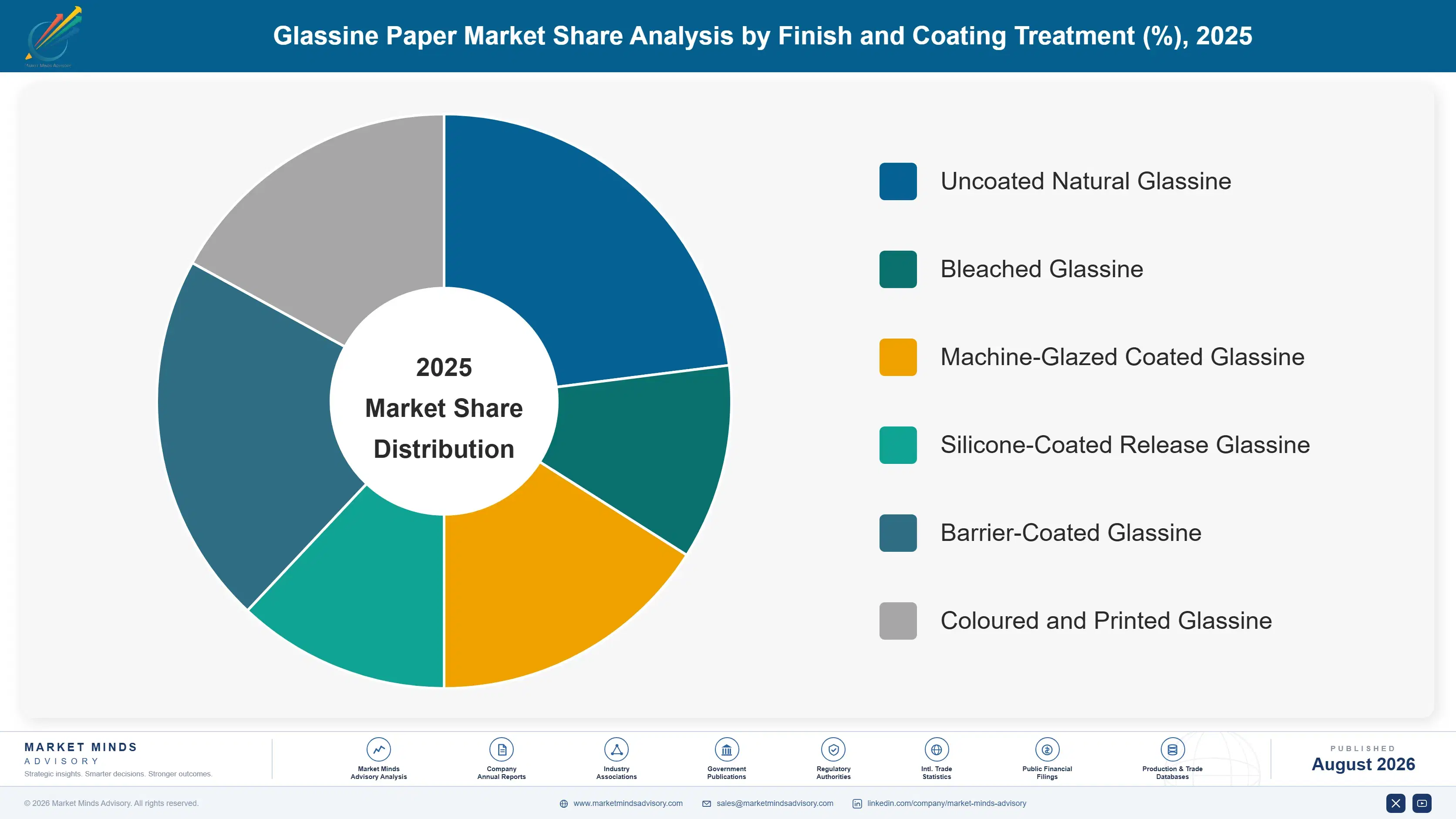
Segmentation follows finish and coating treatment, because treatment determines the barrier properties achieved, the recyclability of the finished structure, the conversion route and the price the grade commands. Six treatments cover glassine supply without overlap. End application, whether release liner, food wrap or pharmaceutical packaging, cuts across several treatments and is treated as an application attribute here.
glassine-paper-market-market-share-analysis-1787304241341

Barrier-Coated Glassine

Growing at 11.4%, a full 1.50x the market rate, barrier-coated grades apply water-based dispersion coatings that deliver moisture and grease protection comparable to polyethylene lamination while remaining repulpable in ordinary paper recycling. That distinction matters because municipal systems generally reject laminated structures they cannot separate, and roughly 74% of streams accept coated glassine without additional sorting. Brand owners with recyclable packaging commitments have moved wrapping, pouching and interleaving onto these grades deliberately. Coating adds cost above uncoated glassine and considerably less than the compliance and reputational exposure a plastic laminate now carries. Contribution per calendering hour here runs several times what commodity release base delivers from exactly the same machine time.
CAGR 11.4%

Silicone-Coated Release Glassine

Silicone-coated release grades grow at 8.8% and remain the largest single use of glassine, underlying pressure-sensitive labels across food, beverage, logistics and pharmaceutical applications. Filmic polyester liners took share over the past decade on dimensional stability and high-speed converting performance, and recyclability arguments have begun reversing part of that. Liner collection schemes recover paper into ordinary repulping while polyester requires separate recovery that far fewer facilities operate. Where a brand owner rather than a converter specifies the material, paper liners increasingly win on that basis alone rather than on any performance improvement. Chinese producers supply this grade at costs European mills cannot match, and their specification quality has improved steadily rather than remaining a barrier.
CAGR 8.8%
Full segment breakdown across 6 segments available in the complete report.

Regional Architecture and Country Demand Map

Regional value follows supercalender capacity and label converting activity together, and both are concentrated rather than distributed. A small number of mills supply the world, and the regions hosting them capture value well beyond their share of consumption. Consumption and production geography diverge quite considerably.

East Asia

East Asia takes the largest share at 30%, built on Chinese release base capacity supplying the world's largest pressure-sensitive label market alongside substantial export volume. Shandong Huatai and Zhejiang Kan Specialities operate glassine capacity at scale, and domestic label converting has grown with e-commerce and food packaging together. Japanese producers including Oji and Nippon Paper make high-specification grades for pharmaceutical and photographic applications where consistency requirements are severe. South Korean and Taiwanese converting demand is smaller and quality-driven. Growth at 8.6% reflects label volume expansion rather than any regulatory driver comparable to Europe's. Domestic converting and export capacity reinforce each other here in a way no other region matches. Release base specification quality keeps improving.
Share: 30% | CAGR: 8.6% (2026 to 2036)

Western Europe

Twenty-four per cent of value, growing at 6.2%, the slowest rate of the seven regions. The region hosts most of the world's specialist glassine capability, with UPM, Ahlstrom, Nordic Paper and Delfort all operating here and Nordic hydroelectric supply partially offsetting the energy intensity the process demands. European fluorochemical restriction created the substitution demand that reshaped this category, and European packaging regulation is now driving barrier-coated substitution for plastic laminates. Growth is slow precisely because capacity rather than demand constrains it, and mills are running at high utilisation with limited scope to add more. Capacity rather than demand is what constrains this region entirely. Mills are running at high utilisation with very limited scope to add more.
Share: 24% | CAGR: 6.2% (2026 to 2036)
Regional intelligence for 5 additional markets available in the complete report: North America, South Asia and Pacific, Latin America, Middle East and Africa, Eastern Europe. Contact sales@marketmindsadvisory.com.
glassine-paper-market-country-cagr-analysis-1787304242236

Where Glassine Value Actually Accumulates

Capacity is scarce, regulation created demand nobody planned for, and the barrier property that matters is inherent rather than applied. Value accrues to whoever holds calendering capability, whoever can coat without breaking recyclability, and whoever reaches converters before they qualify an alternative substrate. Tonne price wins nothing at all here, and capacity allocation decides considerably more than any commercial argument.

Prioritise scarce calender capacity toward highest-value grades

Supercalendering requires over 12 nips under heat and pressure on equipment that is frequently decades old, and almost nobody is building more of it. When demand exceeds what a mill can produce, the allocation decision matters more than any pricing decision. Barrier-coated and pharmaceutical grades earn substantially more per tonne than commodity release base, and a mill running its calenders on the lowest-value grade in its book is destroying margin it cannot recover. Allocation discipline is the single clearest lever available here. Most producers have never measured their order book on contribution per calendering hour at all.
Market Impact: Requires over 12 calender nips on e

Coat for barrier without breaking repulpability

Water-based dispersion coatings deliver moisture and grease protection close to polyethylene lamination while keeping the structure repulpable, and roughly 74% of municipal paper streams accept the result without additional sorting. A laminated alternative is generally rejected. Brand owners with recyclability commitments pay for that difference and will specify it into long-term supply arrangements. Coating capability that preserves recycling acceptance is genuinely harder to develop than it appears, and it is where the category's growth is concentrated. Very few producers currently offer that capability at commercial scale. Brand owners with recyclability commitments specify it into long-term supply arrangements directly.
Market Impact: Accepted by 74% of all municipal pa

Reach converters before alternative substrates get qualified

Fluorochemical restriction forced food packaging converters to find compliant substrates quickly, and a converter qualifying moulded fibre, a coated board or a different paper grade will not revisit that decision for years afterwards. Glassine required no reformulation and was available immediately, which is why it captured substitution volume. The remaining conversions are being decided now across jurisdictions still finalising restriction timetables, and suppliers absent from those conversations lose the volume permanently rather than temporarily. Glassine achieves Kit 10 grease resistance without any reformulation, which is why it captured the first wave of substitution volume so completely.
Market Impact: Achieves Kit 10 resistance without

Secure low-cost power for an inherently energy-intensive process

Producing the barrier mechanically rather than chemically consumes roughly 40% more electricity per tonne than ordinary papermaking, which is the trade the process makes. European power price movements hit glassine producers harder than most paper grades as a direct result. Nordic mills with hydroelectric supply carry a genuine and durable cost advantage, and several have expanded output on exactly that basis. Energy position rather than fibre position determines competitiveness in this grade, which is unusual in paper. Fibre position matters considerably less here than it does in any other paper grade.
Market Impact: Consumes roughly 40% more electrici

Who Controls the Margin Pool

Concentration sits at 46% across the top five, measured on annual revenue from glassine and supercalendered greaseproof base paper, the single basis applied throughout. UPM and Ahlstrom lead through scale and specification breadth, Nordic Paper through a focused greaseproof position with hydroelectric power behind it, Delfort through high-specification thin papers, and Mondi through European converting integration. Very few other companies operate the equipment at all.
Competition runs on capacity availability more than on price, which is unusual in paper. A converter needing compliant grease-resistant substrate at volume has a short list of possible suppliers and limited negotiating room, because the alternative is a different material entirely rather than a different mill. Coating capability that preserves repulpability forms the second dimension, and energy cost position the third.

Pressure builds from two directions. Chinese producers including Shandong Huatai supply release base at costs European mills cannot match and are improving specification steadily. Separately, alternative compliant substrates including moulded fibre and coated boards compete for the same fluorochemical substitution volume, and a converter qualifying one of those does not return. Rankings shift most where a producer adds coating capability that keeps a structure inside ordinary paper recycling.
glassine-paper-market-company-positioning-matrix-1787304242940

Competitive Moat and Risk Dimensions

UPM

Moat: Specialty capacity and fibre integration

UPM operates supercalendering capability at scale alongside integrated pulp supply and Nordic energy positions, which combines the three things this grade requires. Its release liner business gives it direct visibility into converter requirements and a route to market that pure papermakers reach only through intermediaries, and the equipment involved cannot be replicated quickly by anybody.
UPM

Risk: Release liner substrate competition

Filmic polyester liners took substantial share over the past decade and continue to hold advantages in high-speed converting and dimensional stability. Chinese release base producers compete on cost the company cannot match. Energy intensity leaves the grade exposed to power price movements even with Nordic supply partially offsetting the position.
AHLSTROM

Moat: Food contact specification depth

Ahlstrom holds deep food contact regulatory expertise and approval documentation across multiple jurisdictions, which converters facing fluorochemical restriction need immediately and cannot generate themselves. That documentation, combined with barrier coating capability that preserves repulpability, makes the company a practical answer to a compliance problem rather than simply a paper supplier.
AHLSTROM

Risk: Alternative substrate qualification

Moulded fibre, coated boards and other compliant substrates compete for the same substitution volume, and a converter that qualifies one of them will not revisit the decision for years. Capacity constraints limit how much substitution demand the company can actually capture. Energy intensity and European power costs weigh on the whole position.

Players Tracked

Prominent Players

UPM
Ahlstrom
Nordic Paper
Delfort Group
Mondi

Other Key Players

Sappi
Stora Enso
Oji Holdings
Nippon Paper Industries
Daio Paper
Shandong Huatai Paper
Zhejiang Kan Specialities Material
Jiangsu Zhongshun Paper
Pudumjee Paper Products
Seaman Paper
Twin Rivers Paper
Griff Paper and Film
Cheever Specialty Paper
Gascogne Papier
Lecta

Recent Developments

JANUARY 2025

European food contact restrictions on fluorinated substances take full effect

European restrictions on fluorinated grease-proofing substances in food contact materials took full effect, removing the treatment that most greaseproof papers and moulded fibre products had relied upon and pushing converters toward substrates achieving grease resistance without any added chemistry. Converters had limited time to qualify alternatives.
Signal: Regulation rather than any product develop
JUNE 2025

Nordic Paper expands greaseproof capacity on hydroelectric power position

Nordic Paper expanded greaseproof and glassine output at its Nordic mills, an organic debottlenecking rather than a new machine, using hydroelectric supply that materially reduces exposure to the electricity intensity this grade demands compared with continental European producers. No new paper machine was involved at any stage.
Signal: Energy position rather than fibre position
FEBRUARY 2026

Label converters extend liner collection schemes toward paper substrates

European label converters widened their used release liner collection and recycling schemes, which favour paper liners entering ordinary repulping over polyester liners that require separate recovery streams considerably fewer facilities anywhere are equipped to operate. Brand owners rather than the converters themselves drove those particular extensions forward.
Signal: Recyclability is now reversing release lin

Pulp, Electricity and Coating Cost Exposure

Cost structures here differ from ordinary papermaking in one decisive respect. Bleached and unbleached chemical pulp accounts for roughly 44% of glassine cost of goods, which is normal for a specialty paper. Electricity for extreme refining and repeated supercalendering contributes around 21%, which is far above typical paper grades, and dispersion coating chemistry adds a further amount on coated grades specifically.
European electricity price movements through 2022 and 2023 demonstrated the exposure clearly. Power costs rose sharply across continental Europe where much of the world's glassine capacity sits, and UPM and Ahlstrom both documented energy cost pressure and its effect on specialty paper margins in their annual reporting across those years. Contracts written annually with converters could not absorb it, and mills with hydroelectric supply gained a visible relative advantage.

The disadvantage falls hardest on continental European producers without their own power position. A Nordic mill with hydroelectric supply carries an energy cost a German or Austrian competitor cannot match on the same grade. Geography compounds it further: Chinese producers hold both power and labour cost positions European mills cannot approach, and their specification quality on release base grades has improved steadily rather than remaining a barrier.
glassine-paper-market-cost-volatility-analysis-1787304243152

Secure long-term power supply or hydroelectric generation position

Electricity is an unusually large cost line in this grade because the barrier is produced mechanically rather than chemically. Long-term power purchase agreements or owned hydroelectric capacity convert a volatile input into a fixed one, and several producers have expanded output specifically on the strength of that position rather than on any papermaking advantage.

Extend calender campaign lengths to reduce changeover energy losses

Supercalenders consume substantial energy during heating and stabilisation after every grade change, and short campaigns waste much of it. Consolidating orders into longer runs of fewer grades cuts specific energy consumption measurably. It requires order book discipline that specialty mills serving many small customers find genuinely difficult to impose. Order book discipline is the real requirement.

Develop dispersion coating capability rather than buying laminated structures

Barrier-coated grades are the fastest-growing part of the category and coating in-house captures margin that outsourced lamination gives away entirely. Water-based dispersion systems also preserve repulpability, which polyethylene lamination destroys. Building the capability requires coating equipment and formulation work most base paper mills have never previously needed. Outsourced lamination gives that margin away entirely.

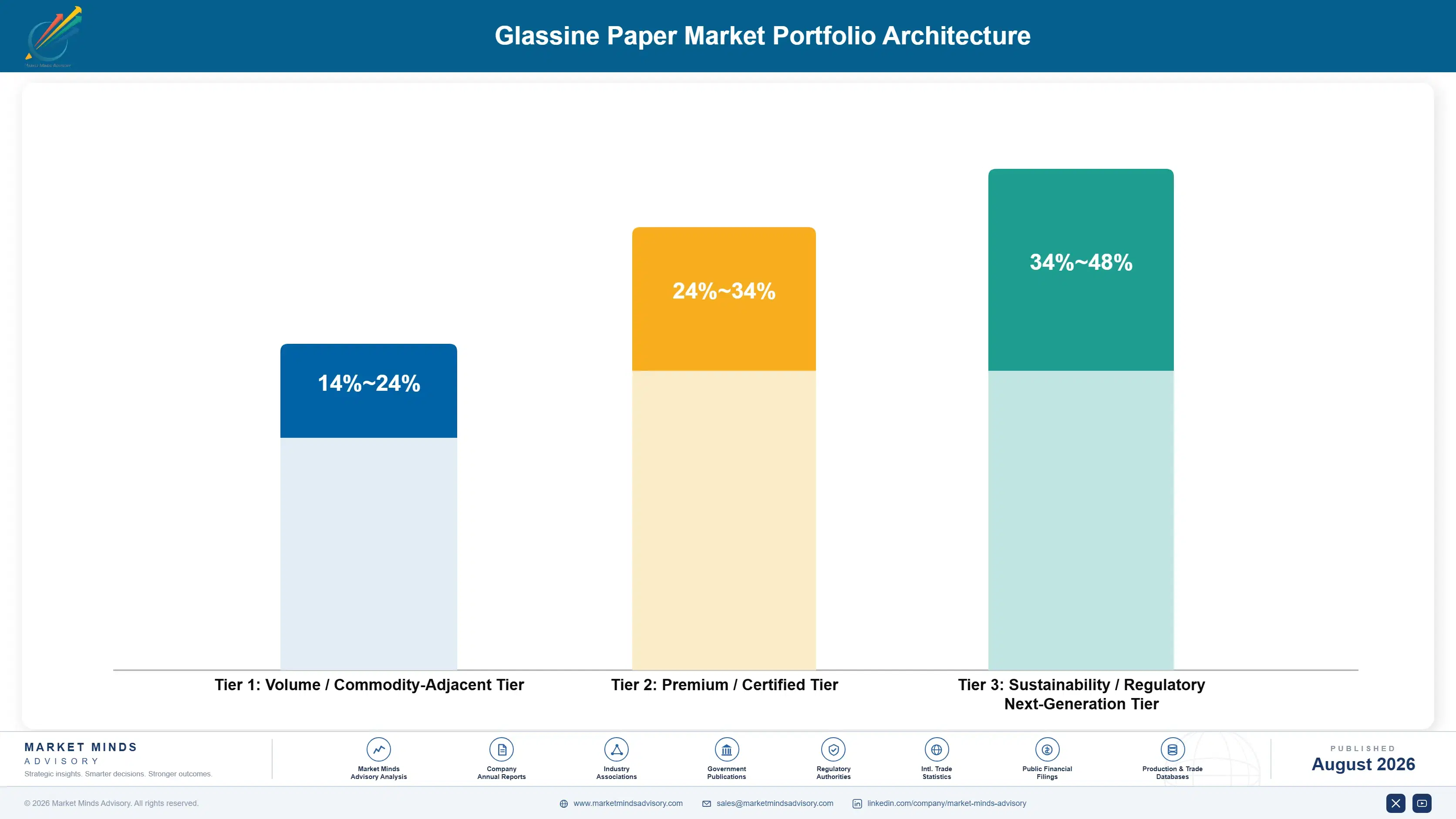
Portfolio Architecture for Margin Defence

Margin architecture divides on whether a grade is specification-constrained. Uncoated natural glassine sold into general interleaving and protective applications competes on delivered price against several producers and against ordinary greaseproof papers. Release base earns better because specification consistency matters to silicone coating operations. Barrier-coated and pharmaceutical grades earn most, because coating capability, food contact documentation and repulpability all restrict the q
The volume versus premium tension is a calender allocation problem rather than a pricing one. Release base consumes the largest share of scarce calendering hours at the lowest margin per tonne, while barrier-coated and pharmaceutical grades earn several times as much from the same machine time. A mill filling its calenders with commodity release base is making a choice most producers have not examined properly, and capacity scarcity makes that choice expensive.

High-value pools sit where documentation or coating restricts entry. Pharmaceutical grades requiring extractables data and regulatory files, food contact grades with multi-jurisdiction approval dossiers, and barrier-coated structures preserving recycling acceptance all price on qualification rather than on tonne cost. Commodity interleaving glassine sold on delivered price sits at the opposite extreme, competing against ordinary greaseproof grades that were never supercalendered at all.

Volume / Commodity-Adjacent Tier

Uncoated natural and bleached glassine sold into general interleaving, protective wrapping and low-specification applications, competing on delivered price against several producers and against ordinary greaseproof papers. Delivered price decides essentially every order here.
Gross Margin: 14-24%

Premium / Certified Tier

Silicone-coated release grades and machine-glazed coated glassine, where specification consistency matters to converting operations and qualification with silicone coaters restricts the supplier field meaningfully. Chinese producers compete hard on cost across this whole tier.
Gross Margin: 24-34%

Sustainability / Regulatory / Next-Generation Tier

Barrier-coated grades preserving repulpability, pharmaceutical papers carrying extractables documentation, and multi-jurisdiction food contact approved grades. Best margins available and the most restricted supplier field anywhere in the category. Qualification rather than price decides these awards.
Gross Margin: 34-48%
glassine-paper-market-portfolio-architecture-1787304243685

Qualification Cycles Against Substrate Substitution

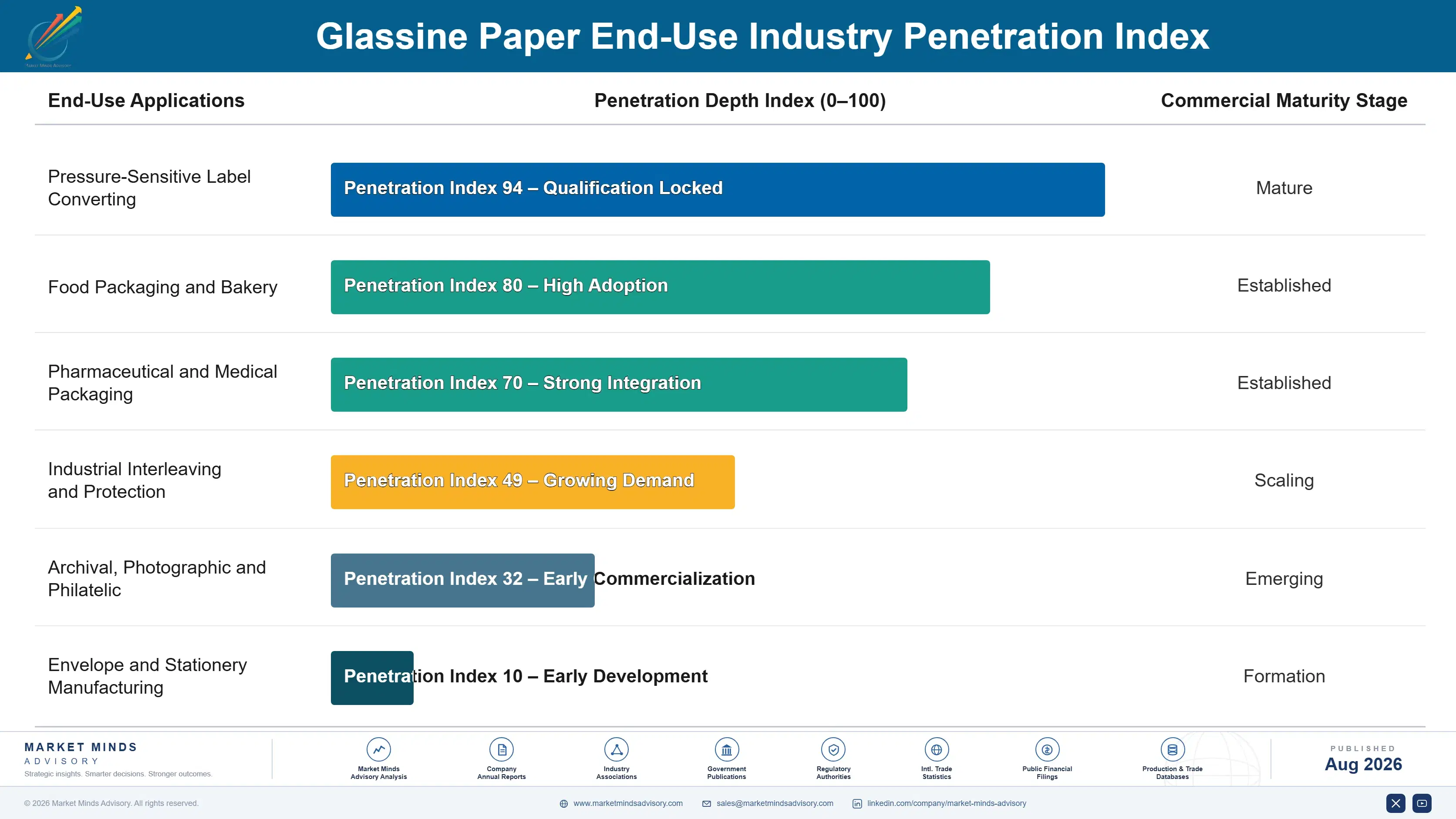
Demand attaches to a qualified substrate rather than to a supplier relationship. A converter or brand owner tests a grade for grease resistance, machinability, food contact compliance and, increasingly, recycling acceptance, then writes it into a specification that stays in place for years. Winning that qualification is worth far more than any individual order, and losing it removes the volume for the packaging format's whole life.
Stickiness is unusually strong once a grade is specified. Changing substrate means repeating compliance documentation, retesting on converting equipment, potentially revalidating a food contact dossier and, where recycling claims appear on pack, confirming stream acceptance again. That cost far exceeds any plausible price difference on paper, which is why converters rarely switch on cost. Commodity interleaving grades show much weaker attachment and turn on delivered price.

Buyer profiles have shifted from converters toward brand owners. A decade ago a label or packaging converter selected substrate on machinability and price and the brand owner never saw the decision. Today brand sustainability teams specify recyclability, food contact compliance and fluorochemical absence directly, and the converter buys to that specification. Suppliers selling only to converters increasingly find the decision was taken somewhere they were not present.
glassine-paper-market-end-use-penetration-index-1787304244220

Where Glassine Strategy Must Land

These are among the four positions where our research anticipates prominent divergence between winners and laggards over the coming forecast period. Each is grounded in the demand model, the regulatory perimeter, and the announced capacity pipeline.
01 / CALENDER ALLOCATION DISCIPLINE

Scarce machine hours belong on the highest-value grades

Supercalendering demands over twelve nips under heat and pressure on equipment that is decades old and which almost nobody is replacing, so calendering hours rather than fibre are the genuinely constrained resource in this whole business. Barrier-coated and pharmaceutical grades earn several times what commodity release base does from exactly the same machine time. A mill filling its calenders with the lowest-margin grade in its order book is destroying value that capacity scarcity then makes impossible to recover later on.
02 / REPULPABLE COATING CAPABILITY

A barrier that survives recycling is the whole argument

Water-based dispersion coatings deliver moisture and grease protection very close to polyethylene lamination while keeping the finished structure repulpable, and roughly 74% of municipal paper streams will accept the result without any additional sorting. Laminated alternatives are generally rejected outright by those very same municipal systems. Brand owners carrying recyclability commitments pay for that difference and specify it directly into long-term supply arrangements, and the coating capability involved is considerably harder to develop than it appears from outside the business.
03 / SUBSTITUTION WINDOW TIMING

Converters qualify one substrate and never revisit it

Fluorochemical restriction forced food packaging converters everywhere to find compliant substrates at very short notice, and glassine captured that volume because it required no reformulation at all and was available immediately. A converter that instead qualifies moulded fibre, coated board or some other paper grade will not reopen that decision for several years afterwards. The remaining conversions are being decided right now across jurisdictions still finalising their restriction timetables, and absence from those conversations loses that volume permanently rather than temporarily.
04 / ENERGY POSITION PRIORITY

Power cost decides competitiveness more than fibre does

Producing the barrier mechanically rather than chemically consumes roughly 40% more electricity per tonne than ordinary papermaking, which is precisely the trade this process makes in exchange for using no restricted chemistry. European power price movements therefore hit glassine producers considerably harder than they hit most other paper grades. Nordic mills with hydroelectric supply hold a durable cost advantage on exactly the same product, and several have expanded output specifically on that basis rather than on any papermaking edge at all.

Engagement Snapshot From the Field

A live engagement with an industry participant carrying material or product regulatory and market exposure ahead of a defining policy shift, showing how our research translates into a defensible multi-year portfolio strategy.
MARKET MINDS ADVISORY · CLIENT ENGAGEMENT SUMMARY
Glassine Paper Producer Strategic Portfolio Review and Transition Roadmap 2026·Investment Scenario on Glassine Paper Exposure Evaluation 2025-26
CLIENT PROFILE
A continental European specialty paper producer operating two supercalendered glassine machines alongside conventional greaseproof and packaging paper capacity, with annual glassine revenue of approximately USD 130 million (client-reported, unverified by MMA). Roughly 70% of calendering hours were committed to commodity release base supplied to silicone coaters. The company held no dispersion coating capability and purchased grid electricity at continental prices.
STRATEGIC CHALLENGE
Fluorochemical restriction had created substitution demand the company could not fully serve because its calenders were already fully committed, while Chinese release base producers were undercutting its largest volume contracts. The board needed to decide whether to invest in a third calender line, or to reallocate existing capacity toward higher-value grades and add dispersion coating capability instead.
MMA APPROACH
MMA conducted 47 expert interviews across food packaging converters, label converters, silicone coating operators, brand sustainability leads and recycling stream operators in six countries. A quantitative survey of 3,800 respondents established substrate selection criteria, qualification behaviour and recyclability requirements across converter and brand owner buyer types. We then modelled contribution per calendering hour under both options against observed substitution demand and energy cost trajectories.
KEY FINDINGS
  1. Contribution per calendering hour on barrier-coated and pharmaceutical grades ran several times that of commodity release base, and the client had never measured its order book on that basis.
  2. Brand sustainability leads specified recycling stream acceptance directly and rejected laminated structures outright, while converters interviewed had no authority to override those specifications.
  3. Food packaging converters that had already qualified alternative compliant substrates reported no intention of re-evaluating for at least a full packaging format cycle, typically several years.
  4. Chinese release base specification quality had improved to the point where European converters were qualifying it for standard label applications without any performance reservation.
CLIENT PROFILE
A continental European specialty paper producer operating two supercalendered glassine machines alongside conventional greaseproof and packaging paper capacity, with annual glassine revenue of approximately USD 130 million (client-reported, unverified by MMA). Roughly 70% of calendering hours were committed to commodity release base supplied to silicone coaters. The company held no dispersion coating capability and purchased grid electricity at continental prices.
STRATEGIC CHALLENGE
Fluorochemical restriction had created substitution demand the company could not fully serve because its calenders were already fully committed, while Chinese release base producers were undercutting its largest volume contracts. The board needed to decide whether to invest in a third calender line, or to reallocate existing capacity toward higher-value grades and add dispersion coating capability instead.
MMA APPROACH
MMA conducted 47 expert interviews across food packaging converters, label converters, silicone coating operators, brand sustainability leads and recycling stream operators in six countries. A quantitative survey of 3,800 respondents established substrate selection criteria, qualification behaviour and recyclability requirements across converter and brand owner buyer types. We then modelled contribution per calendering hour under both options against observed substitution demand and energy cost trajectories.
KEY FINDINGS
  1. Contribution per calendering hour on barrier-coated and pharmaceutical grades ran several times that of commodity release base, and the client had never measured its order book on that basis.
  2. Brand sustainability leads specified recycling stream acceptance directly and rejected laminated structures outright, while converters interviewed had no authority to override those specifications.
  3. Food packaging converters that had already qualified alternative compliant substrates reported no intention of re-evaluating for at least a full packaging format cycle, typically several years.
  4. Chinese release base specification quality had improved to the point where European converters were qualifying it for standard label applications without any performance reservation.
RECOMMENDED STRATEGY
Phase 1: Phase one: reallocate calendering hours away from the lowest-contribution commodity release base contracts and accept the volume loss those exits create. Phase 2: Phase two: install dispersion coating capability rather than a third calender line, since coated grades were capacity-constrained by coating rather than by calendering. Phase 3: Phase three: engage brand sustainability teams directly rather than selling only to converters, since substrate specification decisions were being taken there.
OUTCOME
The client exited its two lowest-contribution release base contracts and commissioned dispersion coating within fifteen months (client-reported, unverified by MMA). Barrier-coated grades reached roughly a fifth of glassine volume, contribution per calendering hour improved by about a third, and three brand owners specified the coated grade directly into long-term packaging formats.

Frequently Asked Questions

Foundational context covering the market sizes, CAGR, scope, country, region and competition that inform every finding below. This section is provided to cover basics and most often pre-purchase conversations, answered from the MMA Primary Research Dataset.

What is the current size of the Glassine Paper Market?

The global glassine paper market was valued at USD 1.9 billion in 2025, covering uncoated, bleached, machine-glazed, silicone-coated release and barrier-coated grades. Ordinary greaseproof papers produced without supercalendering and filmic release liners fall outside this definition.

How large will the Glassine Paper Market be by 2036?

MMA forecasts the market at USD 4.25 billion by 2036, expanding 2.08 times from the 2026 base of USD 2.04 billion. That represents roughly USD 2.21 billion of incremental value across the forecast decade.

What is the CAGR for the Glassine Paper Market 2026 to 2036?

The base case compound annual growth rate is 7.6%, with a bull case of 8.9% and a bear case of 6.4%. The bear case reflects ageing supercalender capacity closing rather than being reinvested in.

Which segment is growing fastest?

Barrier-coated glassine grows at 11.4%, a full 1.50x the overall market rate. Water-based dispersion coatings replace plastic lamination while keeping the structure repulpable in ordinary paper recycling streams.

Who are the major companies in the Glassine Paper Market?

UPM, Ahlstrom, Nordic Paper, Delfort Group and Mondi together hold 46% of revenue. Very few other producers operate supercalendering equipment capable of making genuine glassine at commercial scale.

Which country is growing fastest?

India grows fastest at 11.6%, as label converting expands with organised retail, pharmaceutical packaging and food processing. East Asia is the largest region at 30% of value on Chinese release base capacity.

Report Segmentation Architecture

The full report scope spans multiple orthogonal segmentation dimensions, with cross-tabulated demand data provided for each dimension pair. Coverage extends further to regional breakdowns, trend trajectories, and the competitive detail needed to support segment-level decision-making.

By Finish and Coating Treatment

  • Uncoated Natural Glassine
  • Bleached Glassine
  • Machine-Glazed Coated Glassine
  • Silicone-Coated Release Glassine
  • Barrier-Coated Glassine
  • Coloured and Printed Glassine

By End-Use Industry

  • Pressure-Sensitive Label Converting
  • Food Packaging and Bakery
  • Pharmaceutical and Medical Packaging
  • Industrial Interleaving and Protection
  • Archival, Photographic and Philatelic
  • Envelope and Stationery Manufacturing

By Commercial Dimension

  • Direct Mill Supply Contracts
  • Converter and Coater Supply Agreements
  • Brand Owner Specified Arrangements
  • Paper Merchant and Distributor Channels
  • Export and Import Trading
  • Long-Term Capacity Reservation Agreements

By Region

  • East Asia
  • Western Europe
  • North America
  • South Asia and Pacific
  • Latin America
  • Middle East and Africa
  • Eastern Europe

Scope, Methodology, and Coverage

Every figure in this report is reproducible from documented input assumptions. The scope below maps the historical period, the forecast horizon, the segmentation dimensions, and the countries covered, alongside the underlying primary and qualitative methodology.
Historical Period
2020 to 2025
Forecast Period
2026 to 2036
Base Year
2025 (USD billions; MMA Primary Research Dataset, August 2026)
Market Definition
This market comprises glassine and closely related supercalendered greaseproof papers, measured at papermaker and converter revenue across direct mill supply, converter agreements, brand-specified arrangements, merchant distribution and export channels. Coverage spans uncoated natural glassine, bleached glassine, machine-glazed coated grades, silicone-coated release glassine supplied as liner for pressure-sensitive labels and tapes, barrier-coated grades using water-based dispersion or extrusion coatings, and coloured or printed glassine, across label converting, food packaging, pharmaceutical, industrial interleaving, archival and envelope applications. Ordinary greaseproof and vegetable parchment papers produced without supercalendering, filmic polyester and polypropylene release liners, coated fine and label face papers, moulded fibre packaging, waxed papers, and finished labels, pouches or packaging converted from glassine fall outside scope.
Quantitative Units
USD billions (current prices); glassine tonnage by treatment grade; price per tonne by grade; supercalender capacity and utilisation; recycling stream acceptance rates
Segmentation Dimensions
By Finish and Coating Treatment; By End-Use Industry; By Commercial Dimension; By Region
Regions Covered
East Asia, Western Europe, North America, South Asia and Pacific, Latin America, Middle East and Africa, Eastern Europe
Countries Covered
China, Japan, South Korea, Taiwan, Germany, Sweden, Finland, Norway, Austria, France, United Kingdom, Italy, Spain, United States, Canada, Mexico, India, Australia, Indonesia, Vietnam, Thailand, Brazil, Argentina, Chile, Turkey, Saudi Arabia, United Arab Emirates, Egypt, South Africa, Poland, Czechia, Hungary, and additional markets relevant to specialty paper supply analysis
Key Companies Profiled
UPM, Ahlstrom, Nordic Paper, Delfort Group, Mondi, Sappi, Stora Enso, Oji Holdings, Nippon Paper Industries, Daio Paper, Shandong Huatai Paper, Zhejiang Kan Specialities Material, Jiangsu Zhongshun Paper, Pudumjee Paper Products, Seaman Paper, Twin Rivers Paper, Griff Paper and Film, Cheever Specialty Paper, Gascogne Papier, Lecta
Quantitative Methodology
Primary survey, n=3,800 respondents, Q4 2025, six countries; demand-side model with trade association cross-validation
Qualitative Methodology
47 expert interviews, Q4 2025; applied to validate demand model assumptions, identify emerging dynamics, and assess competitive positioning
Report Format
PDF and XLSX data workbook (Word format preview document)
Publisher
Market Minds Advisory
Report Code
MMA-2026-PAC-213
Published
August 2026
Contact
sales@marketmindsadvisory.com | www.marketmindsadvisory.com

Purchase the full Glassine Paper Market Report (2026 to 2036).

The full MMA report examines how fluorochemical restriction turned an old papermaking technique into a scarce strategic substrate, and quantifies the calendering capacity that now constrains supply. It sizes six treatment grades and seven regions to 2036, modelling tonnage, pricing by grade, capacity utilisation and recycling stream acceptance separately so that regulation-driven substitution can be distinguished from underlying label growth. Competitive assessment covers twenty producers on one consistent revenue basis. Input cost exposure is traced through pulp, electricity intensity and dispersion coating chemistry. Four commercial levers and a strategic verdict close the report, grounded in 47 expert interviews and a 3,800-respondent survey.
Six treatment grades sized separately to 2036
Supercalender capacity mapped against regulation-driven substitution demand
Contribution per calendering hour modelled across the grade portfolio
Twenty producers assessed on one consistent basis
Recycling stream acceptance quantified for coated and laminated structures
Anonymised client engagement with tested strategic recommendations

Built For The People Who Decide

From boardroom strategy to bench-side execution, this report is read cover-to-cover by leaders shaping the next decade of their industry, turning demand scenarios, market dynamics and valuation benchmarks into decisions.
CXOs/ Presidents/ VPs/ Managers
M&A and Corporate Development
Strategy Teams and R&D Heads
Procurement and Product Directors
Regulatory and Compliance Leaders
Investor Relations and Equity Analysts