Market Minds Advisory
Germany Tower Mounted Amplifier Market

Germany Tower Mounted Amplifier Market: Germany Tower Mounted Amplifier Market: Antenna Line Devices for Feeder-Fed, Public Safety and Campus Networks, 2026 to 2036

The device compensates for feeder loss that modern radio architecture removes entirely. What sustains German demand is the 31% of sites nobody has rebuilt yet, plus networks that never adopted active antennas.

Lead Analyst

Published

September 2026

Make Smarter Decisions with Customized Research Insights

Request a free sample report and evaluate market opportunities, growth trends, and competitive dynamics relevant to your business needs.

2025 MARKET VALUE$0.2BMarket Size 2025
2036 FORECAST VALUE$0.3BBase Case , 2026 to 2036
CAGR 2026 TO 20364.2 %Bull 5.4% / Bear 3.0%
INCREMENTAL OPPORTUNITY$0.1BNet 10- year value creation
EXPANSION MULTIPLE1.50x2036 value over 2026 base
Strategic Levers
M&A Pipeline
Regional Outlook
Country Rankings
Competitive Intelligence
Segmental Deep-dive
Call-Us : 91 93563 13602

Executive Snapshot and Market Trajectory.

A tower mounted amplifier exists to recover signal lost in the coaxial run between a radio and its antenna. Put the radio at the antenna, as every modern site does, and the loss disappears along with the reason for the device. This market is defined by what nobody rebuilt.
About 31% of German cell sites still feed antennas over coaxial cable, concentrated in low-band rural coverage where economics never justified a rebuild. Integrated remote-controlled amplifier units grow at 6.3%, half again the market rate of 4.2%, because operators managing shrinking feeder-fed estates want remote diagnosis rather than tower climbs. Western Europe supplies 30% of the equipment reaching German sites. Rural subscriber density never justified a rebuild at those locations. Operators want remote diagnosis.
Five suppliers hold 68% of shipment value, and the concentration reflects a category nobody new wants to enter rather than any competitive advantage. Growth sits in two places that resist active antenna architecture: the federal public safety radio network, which runs narrowband at low frequency, and campus networks built with passive antennas on constrained budgets. Both resist active antenna integration on physical grounds. Neither is large. Both persist.
Market Definition
This market covers tower mounted amplifiers and related antenna line devices supplied to networks in Germany, including single-band and dual-band units, multiband antenna line devices, integrated remote-controlled amplifier units, ruggedised public safety band amplifiers, and compact campus and indoor amplifier modules. It excludes base station radios, active antenna units with integrated radio, passive antennas, coaxial feeder cable, tower steelwork, and distributed antenna system head-end equipment.
Base Year Value
$0.2B in 2025 (MMA Primary Research Dataset, September 2026)
Forecast Period
2026 to 2036, eleven discrete annual values
CAGR
4.2% base case. Bull 5.4%. Bear 3.0%.
Fastest Growth Segment
Integrated Remote-Controlled Amplifier Units: 6.3% CAGR
Fastest Growth Country
Bavaria: 6.1% CAGR
Fastest Growth Region
South Asia and Pacific: 6.2% CAGR
Largest Region
Western Europe: 30% of 2025 global value
Market Leaders
CommScope, Ericsson, Radio Frequency Systems, Huber+Suhner, and Amphenol lead the field. Source: MMA Primary Research Dataset, July 2026.
Primary Survey
n=3,800 procurement and R&D decision-makers, Q4 2025, six countries
Methodology
Demand-side build-up, cross-validated against public data, 47 expert interviews

Germany Tower Mounted Amplifier Market Forecast Scenarios

germany-tower-mounted-amplifier-market-size-forecast-scenario-1790006575740
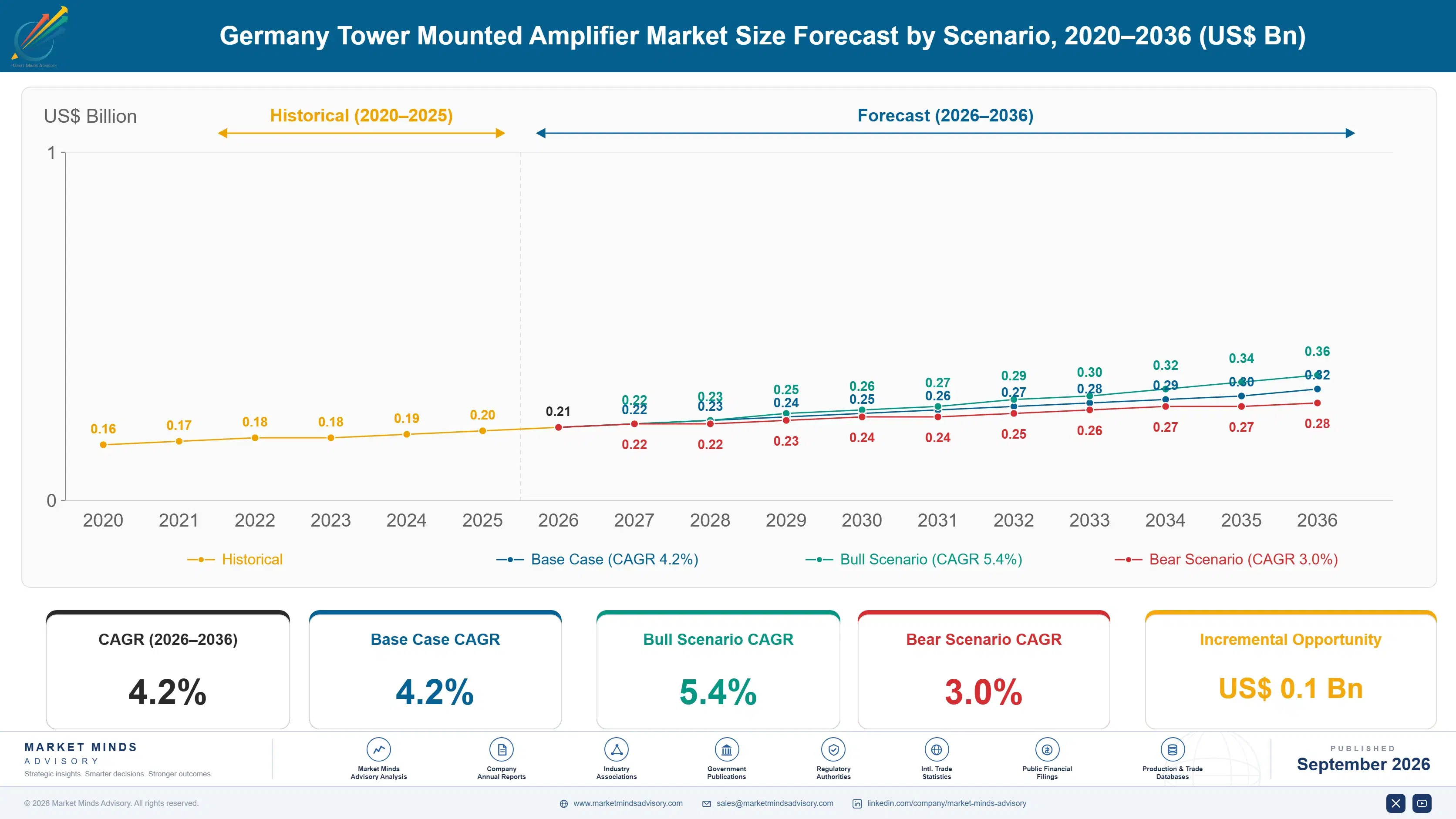
Between 2020 and 2025 the market shrank in its original application and grew in new ones, which roughly cancelled out. Every site rebuilt with radios at the antenna removed a requirement permanently, while public safety expansion and the first campus licences created demand that had not existed. Historical growth of 3.2% is the arithmetic of those two opposing movements rather than any single trend.
The base case at 4.2% rests on three mechanisms. Rural low-band coverage obligations keep feeder-fed sites in service where a rebuild cannot be justified against subscriber density. The federal public safety radio network operates at frequencies and bandwidths where active antenna architecture offers no advantage, so amplifiers remain part of every site design. And campus network licences keep being issued to manufacturers building passive installations at modest budgets. All three sit outside commercial cellular modernisation entirely.
The bull case at 5.4% depends on rural coverage obligations tightening enough to force upgrades on sites currently left alone, which would add amplifier content to installations nobody planned to touch. The bear case at 3.0% is faster site modernisation: if operators rebuild feeder-fed estates faster than expected, the base application disappears before the remaining ones can replace it.

A Device Architecture Made Optional

This is a component whose necessity was engineered away. Feeder loss between a ground-mounted radio and a tower-top antenna costs uplink sensitivity, and an amplifier at the antenna recovers about 2.4 dB of it. Move the radio to the antenna and there is no feeder, no loss, and no amplifier. Roughly 31% of German sites have not made that move. They are the ones that were never worth touching.
TOP FIVE CONCENTRATION68%Share of shipment value held by the leading suppliers
FEEDER FED SITE SHARE31%German cell sites still running coaxial cable to antennas
UPLINK SENSITIVITY GAIN2.4 dBTypical improvement over an equivalent unamplified feeder configuration
AVERAGE SELLING PRICEEUR 340Typical delivered price for a dual-band tower unit
FIELD FAILURE RATE1.7%Annual proportion requiring replacement following installation on towers
CAMPUS NETWORK LICENCES480Local spectrum assignments held by German industrial operators
The remaining sites are not randomly distributed. They cluster in rural low-band coverage where subscriber density never justified rebuild capital, and they are precisely the sites carrying regulatory coverage obligations. That combination keeps a small, stable demand base alive: operators must maintain the coverage, cannot economically modernise the site, and therefore keep buying amplifiers for it. Obsolescence and coverage obligation are propping each other up.
Two applications sit outside that decline. The federal public safety radio network operates narrowband at low frequency, where active antenna integration offers nothing, and industrial campus networks are frequently built with passive antennas because the installation budget was set by a plant manager rather than a network operator. Around 480 campus licences are in issue. Both buyers behave nothing like a carrier.
"We are looking at a market whose product solves a problem the industry stopped having. That sounds terminal and it is not, because the sites that still have the problem are exactly the ones nobody will spend money to fix. Obsolescence and coverage obligation are holding each other up."
Practice Director, Wireless Infrastructure and Site Equipment · MMA Technology Practice · September 2026

Market Trends

Remote Diagnosis Replaces Tower Climbs On Shrinking Estates

An operator maintaining a declining population of feeder-fed sites will not staff a climbing team for it, so amplifier faults that once triggered a routine visit now trigger an expensive one. Integrated units reporting gain, current draw, and alarm state over the antenna interface let a fault be diagnosed and frequently deferred to a scheduled visit. That segment grows at 6.3%. The commercial logic is entirely about the cost of getting a person onto a tower, which in Germany runs several times the price of the device being replaced. Operators price the avoided visits directly.
Market Impact: Protects 31% of sites

Campus Network Licences Create Passive Antenna Installations

Around 480 local spectrum assignments are held by German industrial operators, and the installations built under them look nothing like carrier sites. Budgets are set by plant engineering rather than network operations, which favours passive antennas on coaxial runs over active units, and that architecture brings amplifiers with it. Coverage requirements inside large halls and across yards make uplink sensitivity genuinely limiting. The buyer is unfamiliar, buys once, and evaluates on installed cost rather than on lifetime network economics. Suppliers reaching these buyers do so through industrial systems integrators rather than through any telecommunications channel.
Market Impact: Refresh cycles exceed 10 years

Market Opportunities and Growth Drivers

Rural Coverage Obligations Keep Feeder-Fed Sites In Service

German spectrum awards carry population and area coverage conditions that oblige operators to maintain service in places where subscriber revenue would not otherwise justify it. Those are the same locations where feeder-fed architecture survives, because rebuild capital follows traffic and traffic is elsewhere. The obligation therefore protects the installed base an amplifier serves. Roughly 31% of sites remain in this configuration, and the proportion falls slowly rather than sharply, because each remaining site is harder to justify rebuilding than the last one was. Coverage obligation and poor rebuild economics reinforce each other neatly.
Market Impact: Limits base to 31% of sites

Public Safety Network Design Excludes Active Antenna Integration

The federal public safety radio network operates narrowband channels at low frequency, where the physics that makes integrated radio and antenna units attractive simply does not apply. Antennas are large, radios are not, and separating them remains the sensible design. Amplifiers are therefore part of every site specification rather than a legacy accommodation. Network refresh cycles are long and procurement is centralised, which produces infrequent but substantial orders and gives suppliers holding the specification a position lasting a decade or more. Environmental requirements exclude most commercial suppliers before pricing is discussed.
Market Impact: Access exceeds EUR 340 unit

Market Restraints and Challenges

Active Antenna Architecture Removes The Requirement Entirely

Every site rebuilt with radios at the antenna eliminates the feeder run and with it the amplifier, and the root cause is not competitive but architectural: the problem the device solves no longer exists at that site. Commercially this caps the addressable base at the 31% of German sites still feeder-fed and shrinks it with every modernisation. Suppliers respond by targeting applications where active integration offers no benefit, by selling remote diagnosis into estates too small to staff, and by accepting the category as a managed decline. Nobody pretends otherwise internally.
Market Impact: Grows at 6.3% annually

Tower Access Costs Exceed The Device Being Replaced

Getting a technician onto a German tower with the required safety provision costs several times the EUR 340 a dual-band unit sells for, and the root cause is labour regulation and rigging requirements rather than anything about the product. Commercially this means field failure rates near 1.7% annually generate replacement cost dominated by access, not hardware, and operators specify accordingly. Suppliers respond with extended reliability specifications, remote diagnosis that avoids unnecessary visits, and packaging designs allowing replacement during scheduled antenna work. Procurement departments verify this against their own maintenance records, which makes the argument unusually easy to land.
Market Impact: Covers 480 local licences
2 additional market trends, 3 additional growth drivers, and 2 additional restraints and challenges are covered in the full report. Contact sales@marketmindsadvisory.com to access the complete intelligence.

Segment CAGR and Growth Architecture

Segmentation follows device configuration. Six categories cover the market: single-band tower mounted amplifiers, dual-band units, multiband antenna line devices, integrated remote-controlled amplifier units, ruggedised public safety band amplifiers, and compact campus and indoor amplifier modules. Single-band units are in genuine decline while the remainder hold or grow. Growth sits in three narrow places. Decline is uneven.
germany-tower-mounted-amplifier-market-market-share-analysis-1790006576274

Integrated Remote-Controlled Amplifier Units

Remote-controlled units grow at 6.3%, half again the market rate of 4.2%, and the argument is entirely about avoiding tower visits. An operator maintaining a shrinking feeder-fed estate cannot justify a dedicated climbing team, so every fault becomes an expensive contracted visit costing several times the EUR 340 the device itself is worth. Units reporting gain, current draw, and alarm state over the antenna interface let faults be diagnosed remotely and frequently deferred into scheduled antenna work. The engineering is modest and the commercial argument is unusually easy to make, since operators can price the avoided visits directly. Field reliability evidence matters more than warranty wording in these tenders. Nobody disputes the arithmetic.
CAGR 6.3%

Ruggedised Public Safety Band Amplifiers

Public safety amplifiers grow at 5.4% on a network whose design will not adopt active antenna integration. Narrowband channels at low frequency mean antennas are physically large and radios are not, so separating them stays sensible and the amplifier remains part of the site specification rather than a legacy accommodation. Environmental and availability requirements are considerably stricter than commercial cellular, which narrows the supplier field to those willing to qualify. Procurement is centralised and refresh cycles run beyond a decade, so a supplier holding the specification enjoys a position that no competitive review threatens for years at a time. Nothing about the architectural shift in commercial cellular affects this application.
CAGR 5.4%
Full segment breakdown across 6 segments available in the complete report.

Regional Architecture and Country Demand Map

Scope is limited to Germany, so this table records where the amplifiers and antenna line devices installed on German sites are manufactured rather than where they are used. Several shares fall outside the standard bands for that reason, and the table is flagged for operator ruling.

Western Europe

At 30% this origin sits above the standard band, and the justification is that antenna line equipment for German networks has long been designed and substantially built within the region, with German and Swiss manufacturers holding established positions in the public safety and carrier segments alike. Proximity matters for qualification and for the environmental testing German specifications demand. Growth of 2.7% is the slowest of the seven origins, reflecting a supply base tied to the declining feeder-fed application rather than to the growing niches, and manufacturing that has migrated eastward for cost reasons across the past decade. Design authority has stayed regional even where assembly has not. Public safety qualification anchors it.
Share: 30% | CAGR: 2.7% (2026 to 2036)

East Asia

Chinese and Korean manufacturers supply a large share of the amplifier assemblies and almost all of the radio frequency components inside them, which together account for 28% of value reaching German sites. Some arrives under European brand names after final assembly and test elsewhere. Growth of 5.2% runs above the market rate because cost pressure in a declining application pushes sourcing eastward regardless of anything else happening in the market. Procurement scrutiny of Chinese supply into German network infrastructure has increased since 2023, and it affects carrier sites considerably more than campus or industrial installations. Component content originates here almost regardless of the brand on the housing. Procurement scrutiny affects carriers most.
Share: 28% | CAGR: 5.2% (2026 to 2036)
Regional intelligence for 5 additional markets available in the complete report: North America, South Asia and Pacific, Eastern Europe, Latin America, Middle East and Africa. Contact sales@marketmindsadvisory.com.
germany-tower-mounted-amplifier-market-country-cagr-analysis-1790006576797

How Suppliers Manage A Shrinking Base

Four commercial moves matter in a category whose original application is disappearing by design. Each accepts that the feeder-fed carrier estate will keep shrinking and looks instead at applications where the architecture that removed the requirement offers no benefit at all. Carrier volume falls whatever anybody does, so the question is where else the device belongs.

Price Against Avoided Tower Visits Not Hardware

A German tower visit with required safety provision costs several times the EUR 340 a dual-band unit sells for, so an operator comparing devices on price is measuring the wrong thing. Remote diagnosis capability that avoids two unnecessary visits over a device lifetime pays for a 60% to 90% price premium outright. Suppliers making that arithmetic explicit in the sales conversation convert at materially higher rates than those competing on unit cost, and the argument works because operators can verify their own access cost immediately. Unit price competition misses the point entirely.
Market Impact: Supports price premiums of 60% to 90% overall

Qualify For Public Safety Environmental Specifications

The federal public safety network demands environmental and availability performance well beyond commercial cellular, and qualification takes time and money that most suppliers decline to spend. Those who complete it face a field of three or four rather than fifteen, on procurement that is centralised and refresh cycles running beyond a decade. Suppliers holding the specification report contract values roughly 2.6 times the commercial equivalent per unit shipped, with no competitive review for years at a time once the position is established. Nothing about active antenna architecture threatens it. Qualification is the whole barrier.
Market Impact: Earns 2.6 times more per unit shipped overall

Sell Through Industrial Integrators Not Network Operators

Around 480 German campus network licences are held by manufacturers whose installations are specified by plant engineering rather than by network departments, and those buyers are reached through industrial systems integrators rather than through carrier channels. Suppliers with integrator relationships win roughly 3.1 times more campus installations than those selling through telecommunications distribution. The buyer evaluates installed cost rather than network lifetime economics, which favours passive architecture and therefore favours this category directly. Amplifiers are a small line in these installations, so the supplier must be present in the integrator's catalogue before the project starts. Relationships decide it.
Market Impact: Wins 3.1 times more campus network installations overall

Specify Reliability Against Access Cost Not Warranty

Field failure near 1.7% annually produces replacement cost dominated by tower access rather than by hardware, so a device lasting twice as long is worth far more than its price difference suggests. Suppliers who quantify that, offering extended reliability specifications validated by field data rather than by warranty terms, achieve 25% to 40% higher realised prices on carrier tenders. The engineering cost of the additional margin is modest, and the argument is one procurement departments can check against their own maintenance records. Warranty terms answer a different question. Maintenance records settle it.
Market Impact: Achieves 25% to 40% higher realised selling prices

Who Controls the Margin Pool

Concentration is high and the reason is unflattering. Five suppliers hold 68% of shipment value, measured consistently on that basis across all participants, and the position reflects a category that new entrants have no reason to attack rather than any defensible advantage the incumbents built. The gap between the leader and the fifth is moderate and moves mainly through corporate consolidation elsewhere in the antenna business. Nobody is building a position here from scratch.
Competition currently turns on three things: remote diagnosis capability that reduces tower visits, qualification for public safety environmental specifications, and access to industrial integrators serving campus networks. Unit price matters less than suppliers assume, because the total cost of installing or replacing a device is dominated by getting a person onto the tower. Access dominates the total cost of any intervention.

Pressure comes from two directions. East Asian manufacturers continue taking cost-driven carrier volume in an application that is declining anyway. Meanwhile the growing niches reward qualification and channel access rather than manufacturing cost. Rankings will shift toward suppliers holding public safety specifications and industrial integrator relationships, which are the only positions with duration. Manufacturing cost decides only the part that is disappearing.
germany-tower-mounted-amplifier-market-company-positioning-matrix-1790006577316

Competitive Moat and Risk Dimensions

COMMSCOPE

Moat: Antenna Line Portfolio Breadth

Supplying antennas, feeder systems, and amplifiers together lets an operator qualify one supplier for the whole antenna line, which matters because interface and interoperability testing consumes time German operators would rather spend elsewhere. That breadth wins site-level decisions a component specialist cannot compete for on any single product.
COMMSCOPE

Risk: Declining Core Application Exposure

Most of the portfolio serves feeder-fed carrier sites, which shrink with every network modernisation and cannot be defended by any commercial action. Growth requires positions in public safety and campus applications where the required qualifications and channels differ substantially from the carrier business the company was built around.
RADIO FREQUENCY SYSTEMS

Moat: Public Safety Specification Qualification

Qualification against federal public safety environmental and availability requirements places the company in a field of three or four rather than fifteen, on centralised procurement with refresh cycles beyond a decade. That position is expensive to obtain and correspondingly durable once held, and it is unaffected by the architectural shift removing carrier demand.
RADIO FREQUENCY SYSTEMS

Risk: Campus Channel Presence Limited

Industrial campus installations are specified by plant engineering and reached through industrial systems integrators rather than telecommunications distribution, and the company's channel was built for carrier and public sector buyers. Building integrator relationships means competing for attention in a channel where amplifiers are a very small line item.

Players Tracked

Prominent Players

CommScope
Ericsson
Radio Frequency Systems
Huber+Suhner
Amphenol

Other Key Players

Rosenberger
Comba Telecom
Tongyu Communication
Mobi Antenna Technologies
KMW
Ace Technologies
Alpha Wireless
Jaybeam Wireless
Telnet Redes Inteligentes
Microlab
Westell Technologies
Bird Technologies
PCTEL
Sunwave Communications
Kaelus

Recent Developments

FEBRUARY 2026

CommScope Releases Remote-Controlled Multiband Antenna Line Device

CommScope released a multiband antenna line device reporting gain, current draw, and alarm state over the standard antenna control interface, allowing operators to diagnose faults without dispatching a climbing team to the tower. Alarm thresholds are configurable per site from the network management system. Retrofit is supported.
Signal: Suppliers are now pricing against avoided tower access rather than against competing hardware unit costs entirely.
AUGUST 2025

Radio Frequency Systems Awarded Public Safety Network Amplifier Supply

Radio Frequency Systems was selected to supply ruggedised amplifiers for a refresh phase of the federal public safety radio network, on environmental and availability specifications that only a handful of suppliers have qualified against. Delivery spans several years across successive regional refresh phases. Qualification evidence was reused.
Signal: Qualification narrows the field to three or four, and refresh cycles then run beyond a decade.
APRIL 2025

Rosenberger Expands Radio Frequency Assembly Capacity In Central Europe

Rosenberger completed an organic expansion of radio frequency assembly and environmental test capacity in central Europe, serving German network equipment demand where qualification requirements make manufacture closer to the customer commercially convenient. Component content continues to be sourced from established East Asian suppliers. Test capacity expanded alongside.
Signal: Final assembly keeps moving toward the customer while component content still originates entirely in East Asia.

What These Units Cost To Build

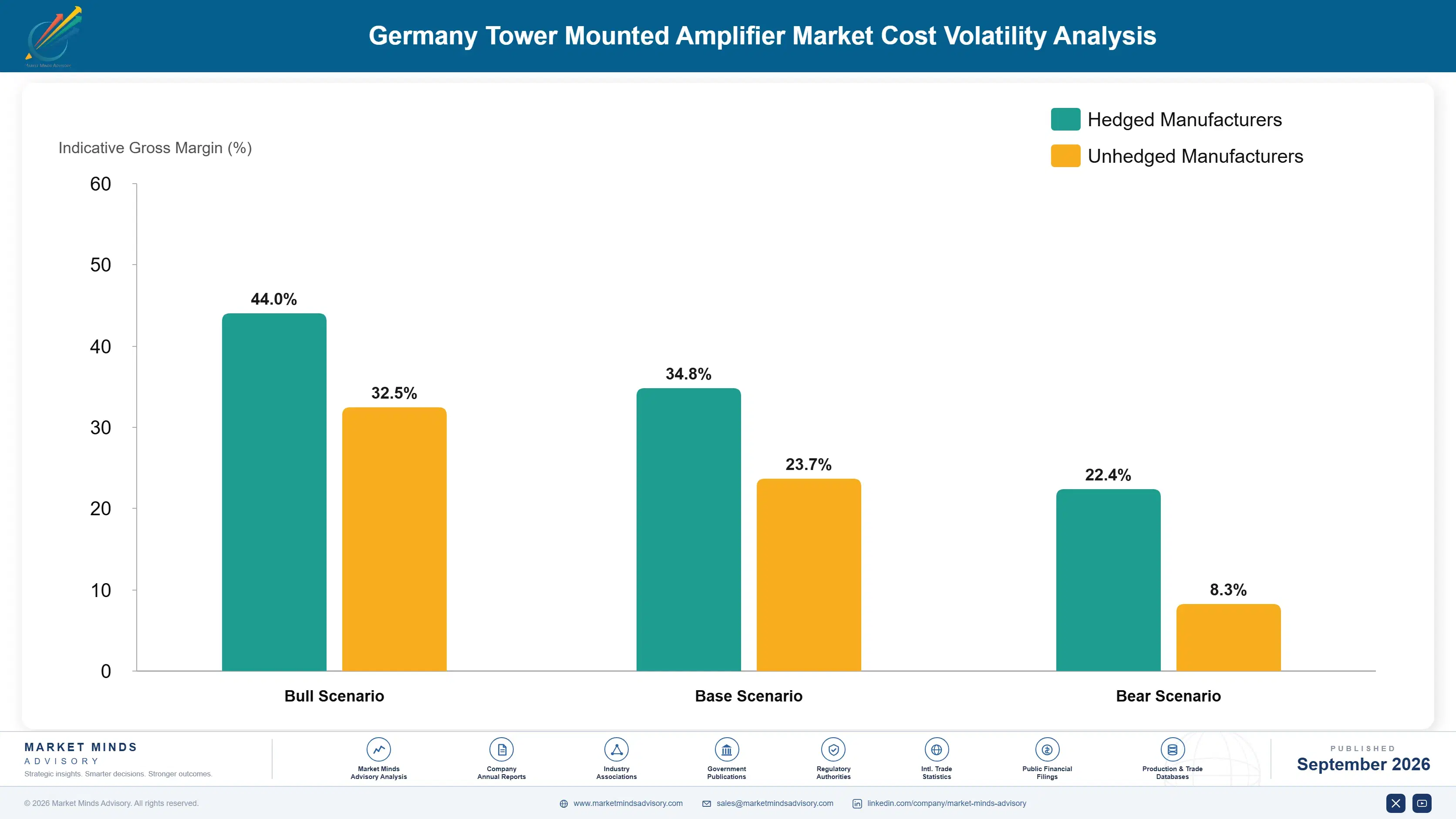
Three inputs dominate. Radio frequency components, principally low noise amplifiers, filters, and duplexers, run 30% to 38% of cost of goods sold. Mechanical housing with weatherproofing to the environmental grades German specifications demand takes 20% to 26%. Test and certification, including the environmental qualification public safety work requires, adds a further 10% to 15%. Filter and amplifier components originate overwhelmingly in East Asia.
Radio frequency component pricing moved unevenly through 2024 and 2025 as suppliers rationalised product lines serving declining applications, and several manufacturers described the resulting availability and cost pressure in their annual reports for those years. Long-lifecycle products in a shrinking category face component obsolescence faster than demand disappears, which is an uncomfortable combination for anybody holding a public safety specification. Requalification after substitution is expensive and slow.

The competitive disadvantage mechanism runs through qualification cost rather than through manufacturing. A supplier without public safety environmental qualification competes only in the declining carrier segment, where East Asian cost positions dominate and margins compress annually. Exposure varies by supplier type. Broad antenna line suppliers spread qualification across product families. Single-product specialists carry it against amplifier volume alone, which is small and falling.
germany-tower-mounted-amplifier-market-cost-volatility-analysis-1790006577511

Design Around Component Families Not Individual Parts

Long-lifecycle products in a shrinking category outlive the components inside them, and public safety specifications make substitution a requalification exercise. Designing against component families with multiple interchangeable sources, rather than against specific part numbers, removes most of that exposure at modest additional design cost and considerable later benefit. The design premium is small against the later saving.

Spread Qualification Cost Across Antenna Line Products

Environmental and availability qualification is expensive per product and considerably cheaper to extend across a family sharing housings and test evidence. Suppliers with broad antenna line portfolios amortise it accordingly, which is a genuine reason single-product amplifier specialists have withdrawn from public safety work over the past several years. Single-product specialists have withdrawn accordingly.

Locate Final Assembly Nearer The Qualification Authority

European qualification requirements make test and documentation easier to manage close to the customer, and central European assembly costs well below German levels while remaining inside the customs area. Suppliers who moved final assembly there report qualification cycle times shortening materially, with component content still sourced from East Asia as before. Documentation stays close to the authority.

Portfolio Architecture for Margin Defence

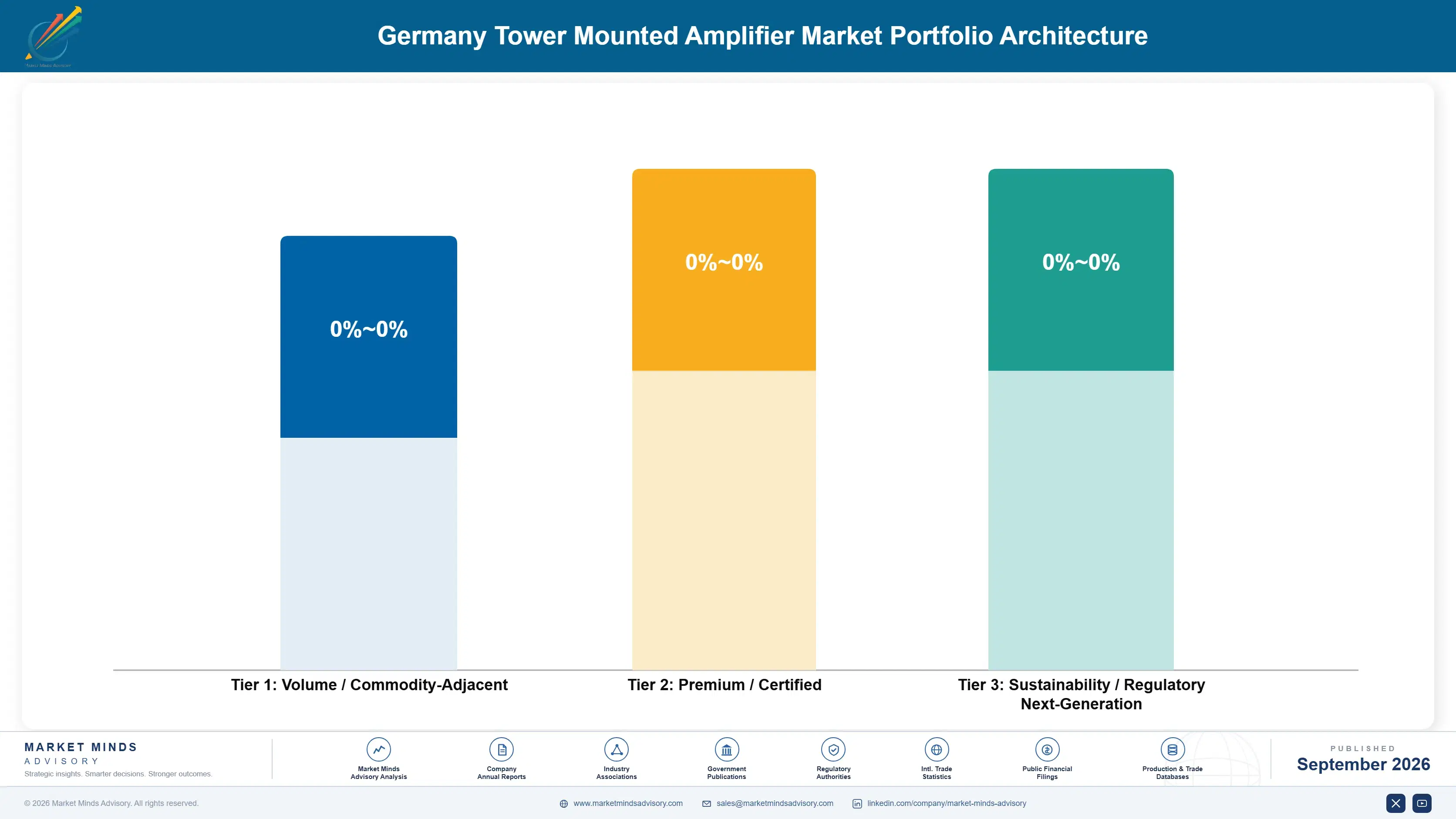
Margin follows how few suppliers can legitimately compete. Single-band and dual-band carrier units are close to commodity, competing against East Asian cost positions in an application that shrinks every year. Remote-controlled units earn considerably more, because the value argument is avoided tower access rather than hardware. Public safety qualified devices earn most, since the field is three or four suppliers on procurement that reviews once a decade.
The tension between volume and premium is unusual here because volume is disappearing. Carrier feeder-fed shipments still represent most units and the least value, and chasing that volume against East Asian manufacturing produces losses rather than scale. Premium public safety and campus work carries excellent margin on quantities too small to support a dedicated manufacturing footprint, which is the central awkwardness of the category.

High-value pools concentrate where active antenna architecture offers nothing: the public safety network operating narrowband at low frequency, and industrial campus installations specified by plant engineering on installed-cost grounds. These share a buyer for whom the alternative architecture is either physically unsuitable or financially out of reach. Everywhere else the category is being engineered out of existence, politely and permanently.

Volume / Commodity-Adjacent

Single-band and dual-band carrier units competing against East Asian cost positions in a shrinking application. Specifications are well understood and buyers compare unit price directly. The nine-point range reflects wide variation in whether suppliers manufacture in Europe or source from Asia.
Gross Margin: 17% to 26%

Premium / Certified

Multiband and integrated remote-controlled units sold on avoided tower access rather than on hardware cost. Operators can verify the access cost argument against their own maintenance records immediately. The nine-point range separates suppliers with credible field reliability data from those quoting warranty terms.
Gross Margin: 33% to 42%

Sustainability / Regulatory / Next-Generation

Public safety qualified amplifiers and campus network modules sold through industrial integrators. Qualification and channel access limit the field far more than any manufacturing capability does. The twelve-point range reflects how differently centralised public procurement and industrial channels price the same device.
Gross Margin: 46% to 58%
germany-tower-mounted-amplifier-market-portfolio-architecture-1790006578018

High-value Sub-segments and Strategic Watch-out

Public Safety Qualified Amplifiers

Highest value with growth at 5.4%, protected by environmental qualification that narrows the field to three or four suppliers. Centralised procurement and refresh cycles beyond a decade make positions durable. The ten-point range reflects how differently phases of the network refresh have been priced. Positions last years.
Gross Margin: 48% to 58%

Remote-Controlled Integrated Units

Fastest growth at 6.3%, sold against tower access costs several times the device price rather than against competing hardware. Operators verify the argument from their own records. The nine-point range separates suppliers with field reliability evidence from those relying on warranty terms alone. Evidence decides pricing.
Gross Margin: 36% to 45%

Campus Network Amplifier Modules

High value with steady growth, reaching roughly 480 licensed industrial operators through systems integrators rather than telecommunications distribution. Buyers evaluate installed cost, which favours passive architecture directly. Channel relationships rather than product capability decide most of these installations. Buyers purchase once and rarely return afterwards.
Gross Margin: 40% to 50%

Single-Band Carrier Replacement Supply

The strategic watch-out. The application disappears with every site modernisation, East Asian cost positions dominate what remains, and margins compress annually against falling volume. The ten-point range reflects the gap between European manufacture and Asian sourcing on otherwise comparable products. Volume falls every year. Harvest rather than invest.
Gross Margin: 14% to 24%

What Sustains This Demand

Demand recurs through replacement rather than growth, and the replacement rate is set by field failure near 1.7% annually across an installed base that is itself shrinking. That produces a predictable, declining carrier revenue stream that suppliers can forecast accurately and cannot expand. The public safety and campus applications behave completely differently, arriving as infrequent project orders with long gaps between them.
Depth of commitment varies sharply by buyer. Carrier operators treat these devices as consumables, buying on price against a specification anybody can meet, and switching suppliers freely. The public safety network is the opposite, having qualified a small number of suppliers whose position survives a decade untested. Industrial campus buyers make a single purchase, evaluate on installed cost, and generally never return.

The buyer profile has narrowed rather than shifted. Carrier radio planning teams once specified these devices routinely as part of site design; those teams now design sites that do not use them. What remains is maintenance procurement buying replacements, centralised public safety procurement buying rarely, and plant engineering buying once. None of the three resembles the customer this category was built to serve.
germany-tower-mounted-amplifier-market-end-use-penetration-index-1790006578508

Where This Market Rewards

These are among the four positions where our research anticipates prominent divergence between winners and laggards over the coming forecast period. Each is grounded in the demand model, the regulatory perimeter, and the announced capacity pipeline.
01 / ACCESS COST POSITIONING

The tower visit costs more than the device

A German tower visit with required safety provision costs several times the EUR 340 a dual-band unit sells for, so any operator comparing suppliers on hardware price is measuring the wrong quantity entirely. Remote diagnosis avoiding two unnecessary visits across a device lifetime supports price premiums of 60% to 90% on its own. Suppliers making that arithmetic explicit convert far better than those competing on unit cost, because operators verify it immediately from their own records, which almost no procurement department has done deliberately.
02 / QUALIFICATION BARRIER INVESTMENT

Public safety narrows fifteen suppliers to four

Federal public safety environmental and availability requirements demand qualification that most suppliers decline to fund, and those completing it face a field of three or four on centralised procurement with refresh cycles beyond a decade. Contract values run roughly 2.6 times the commercial equivalent per unit shipped. Crucially the position is unaffected by the architectural shift removing carrier demand, since narrowband low-frequency design gains nothing from integrating radio into the antenna, and the antennas involved are physically far too large to integrate.
03 / INDUSTRIAL CHANNEL ACCESS

Campus buyers are reached through plant engineering

Roughly 480 German campus network licences are held by manufacturers whose installations are specified by plant engineering and procured through industrial systems integrators rather than telecommunications distribution channels. Suppliers with integrator relationships win about 3.1 times more campus installations than those approaching through carrier channels. These buyers evaluate installed cost rather than lifetime network economics, which favours passive antenna architecture and therefore favours this category directly, and the supplier has to be in the integrator catalogue before any project begins.
04 / MANAGED DECLINE DISCIPLINE

Chasing carrier volume against Asian cost loses money

Feeder-fed carrier sites represent 31% of the German estate and fall with every modernisation, and East Asian manufacturers hold the cost position in exactly that shrinking application. Competing there produces losses rather than scale, however large the unit numbers look on a forecast. The defensible response is to treat carrier replacement as a declining annuity to be harvested efficiently while investing wherever active antenna architecture offers the buyer nothing at all, which is where the only durable positions in this category now sit.

Engagement Snapshot From the Field

A live engagement with an industry participant carrying material or product regulatory and market exposure ahead of a defining policy shift, showing how our research translates into a defensible multi-year portfolio strategy.
MARKET MINDS ADVISORY · CLIENT ENGAGEMENT SUMMARY
Germany Tower Mounted Amplifier Producer Strategic Portfolio Review and Transition Roadmap 2026·Investment Scenario on Germany Tower Mounted Amplifier Exposure Evaluation 2025-26
CLIENT PROFILE
A German mobile network operator running approximately 19,000 macro sites, of which around 5,900 remained feeder-fed with tower mounted amplifiers, and annual network operating expenditure above EUR 1.1 billion (client-reported, unverified by MMA). Amplifier replacement was managed reactively through a contracted rigging provider, and no analysis of the resulting cost had been performed in six years.
STRATEGIC CHALLENGE
Rigging contractor charges had risen substantially while the feeder-fed site count fell, so cost per intervention was climbing on both sides of the equation. The network team suspected many climbs were unnecessary but had no diagnostic data to confirm it. Rebuilding the affected sites was not economic against their traffic.
MMA APPROACH
MMA analysed three years of amplifier fault records against subsequent findings on site, quantified the proportion of climbs that found no fault or a fault diagnosable remotely, and modelled the cost of retrofitting remote-capable units against continued reactive maintenance across the remaining life of the feeder-fed estate. Retrofit timing against scheduled works was tested separately.
KEY FINDINGS
  1. Roughly 41% of amplifier-triggered tower visits found either no fault or a condition that a remote-capable device would have identified without any climb at all.
  2. Fully loaded cost per tower visit averaged 7.4 times the price of the dual-band unit typically replaced during it, once safety provision and contractor scheduling were included.
  3. Retrofitting remote-capable units during scheduled antenna work, rather than as a standalone programme, reduced incremental access cost to almost nothing across 62% of the estate.
  4. Feeder-fed site count was projected to fall by only 31% over ten years, considerably slower than the network modernisation plan had assumed when it was written.
CLIENT PROFILE
A German mobile network operator running approximately 19,000 macro sites, of which around 5,900 remained feeder-fed with tower mounted amplifiers, and annual network operating expenditure above EUR 1.1 billion (client-reported, unverified by MMA). Amplifier replacement was managed reactively through a contracted rigging provider, and no analysis of the resulting cost had been performed in six years.
STRATEGIC CHALLENGE
Rigging contractor charges had risen substantially while the feeder-fed site count fell, so cost per intervention was climbing on both sides of the equation. The network team suspected many climbs were unnecessary but had no diagnostic data to confirm it. Rebuilding the affected sites was not economic against their traffic.
MMA APPROACH
MMA analysed three years of amplifier fault records against subsequent findings on site, quantified the proportion of climbs that found no fault or a fault diagnosable remotely, and modelled the cost of retrofitting remote-capable units against continued reactive maintenance across the remaining life of the feeder-fed estate. Retrofit timing against scheduled works was tested separately.
KEY FINDINGS
  1. Roughly 41% of amplifier-triggered tower visits found either no fault or a condition that a remote-capable device would have identified without any climb at all.
  2. Fully loaded cost per tower visit averaged 7.4 times the price of the dual-band unit typically replaced during it, once safety provision and contractor scheduling were included.
  3. Retrofitting remote-capable units during scheduled antenna work, rather than as a standalone programme, reduced incremental access cost to almost nothing across 62% of the estate.
  4. Feeder-fed site count was projected to fall by only 31% over ten years, considerably slower than the network modernisation plan had assumed when it was written.
RECOMMENDED STRATEGY
Phase 1: Phase one: fit remote-capable amplifiers opportunistically during already scheduled antenna and site works, avoiding any dedicated access cost for the retrofit itself. Phase 2: Phase two: introduce remote fault triage before dispatching any climbing team, using the diagnostic data to defer non-urgent replacements into scheduled visits. Phase 3: Phase three: revise the feeder-fed estate retirement assumption used in network planning, which had understated how long these sites would remain in service.
OUTCOME
Sixteen months in, amplifier-related tower visits fell by 44% while service availability on the affected sites was unchanged (client-reported, unverified by MMA). Retrofit coverage reached 58% of the feeder-fed estate at negligible incremental access cost. Annual antenna line maintenance spending fell by roughly EUR 3.8 million.

Frequently Asked Questions

Foundational context covering the market sizes, CAGR, scope, country, region and competition that inform every finding below. This section is provided to cover basics and most often pre-purchase conversations, answered from the MMA Primary Research Dataset.

What is the current size of the Germany Tower Mounted Amplifier Market?

The market was worth USD 0.2 billion in 2025 and remains near USD 0.2 billion in 2026. Value covers amplifiers and related antenna line devices supplied to German networks.

How large will the Germany Tower Mounted Amplifier Market be by 2036?

MMA forecasts USD 0.3 billion by 2036, an increase of USD 0.1 billion across the forecast period. That represents 1.50 times the 2026 base of USD 0.2 billion.

What is the CAGR for the Germany Tower Mounted Amplifier Market 2026 to 2036?

The base case compound annual growth rate is 4.2%, with a bull case at 5.4% and a bear case at 3.0%. Historical growth from 2020 to 2025 ran at 3.2%.

Which segment is growing fastest?

Integrated remote-controlled amplifier units grow at 6.3%, half again the market rate of 4.2%. They are sold against tower access costs rather than against hardware price.

Who are the major companies in the Germany Tower Mounted Amplifier Market?

CommScope, Ericsson, Radio Frequency Systems, Huber+Suhner, and Amphenol lead, holding 68% of shipment value between them. New entrants have little reason to attack the category.

Which country is growing fastest?

Scope is limited to Germany, so growth is compared within it. Bavaria leads at 6.1%, on campus network licence density and a large rural coverage obligation.

Report Segmentation Architecture

The full report scope spans multiple orthogonal segmentation dimensions, with cross-tabulated demand data provided for each dimension pair. Coverage extends further to regional breakdowns, trend trajectories, and the competitive detail needed to support segment-level decision-making.

By Device Configuration

  • Single-Band Tower Mounted Amplifiers
  • Dual-Band Tower Mounted Amplifiers
  • Multiband Antenna Line Devices
  • Integrated Remote-Controlled Amplifier Units
  • Ruggedised Public Safety Band Amplifiers
  • Compact Campus and Indoor Amplifier Modules

By End-Use Industry

  • Mobile Network Operators
  • Federal Public Safety Radio Network
  • Industrial Campus Network Operators
  • Rail and Transport Communication Networks
  • Utility and Energy Sector Networks
  • Neutral Host and Tower Companies

By Commercial Dimension

  • Network Equipment Vendor Supply
  • Direct Operator Procurement
  • Industrial Systems Integrator Channel
  • Public Sector Framework Contract
  • Maintenance Replacement Supply
  • Distribution and Reseller Channel

By Region

  • Western Europe
  • East Asia
  • North America
  • South Asia and Pacific
  • Eastern Europe
  • Latin America
  • Middle East and Africa

Scope, Methodology, and Coverage

Every figure in this report is reproducible from documented input assumptions. The scope below maps the historical period, the forecast horizon, the segmentation dimensions, and the countries covered, alongside the underlying primary and qualitative methodology.
Historical Period
2020 to 2025
Forecast Period
2026 to 2036
Base Year
2025 (USD billions; MMA Primary Research Dataset, September 2026)
Market Definition
This market covers tower mounted amplifiers and related antenna line devices supplied to networks in Germany, including single-band and dual-band units, multiband antenna line devices, integrated remote-controlled amplifier units, ruggedised public safety band amplifiers, and compact campus and indoor amplifier modules. It excludes base station radios, active antenna units with integrated radio, passive antennas, coaxial feeder cable, tower steelwork, and distributed antenna system head-end equipment.
Quantitative Units
USD billions, delivered equipment value
Segmentation Dimensions
Device configuration, end-use industry, commercial dimension, supply origin
Regions Covered
Western Europe, East Asia, North America, South Asia and Pacific, Eastern Europe, Latin America, Middle East and Africa
Countries Covered
Germany; supply origin analysis covers Switzerland, Austria, France, Italy, Sweden, Finland, Netherlands, United Kingdom, China, South Korea, Japan, Taiwan, United States, Canada, India, Malaysia, Poland, Hungary, Romania, Czech Republic, Mexico, Brazil, Turkey, Morocco
Key Companies Profiled
CommScope, Ericsson, Radio Frequency Systems, Huber+Suhner, Amphenol, Rosenberger, Comba Telecom, Tongyu Communication, Mobi Antenna Technologies, KMW, Ace Technologies, Alpha Wireless, Jaybeam Wireless, Telnet Redes Inteligentes, Microlab, Westell Technologies, Bird Technologies, PCTEL, Sunwave Communications, Kaelus
Quantitative Methodology
Primary survey, n=3,800 respondents, Q4 2025, six countries; demand-side model with trade association cross-validation
Qualitative Methodology
47 expert interviews, Q4 2025; applied to validate demand model assumptions, identify emerging dynamics, and assess competitive positioning
Report Format
PDF and XLSX data workbook (Word format preview document)
Publisher
Market Minds Advisory
Report Code
MMA-2026-TEC-471
Published
September 2026
Contact
sales@marketmindsadvisory.com | www.marketmindsadvisory.com

Purchase the full Germany Tower Mounted Amplifier Market Report (2026 to 2036).

The full report sizes the German tower mounted amplifier market across six device configurations with forecasts to 2036 under base, bull, and bear cases. It examines why active antenna architecture removes the requirement these devices exist to serve, which sites nonetheless retain it, and where growth persists in applications that gain nothing from integration. Competitive analysis covers twenty participants evaluated consistently on delivered equipment value, with detailed treatment of public safety qualification and industrial campus channel access. Cost structure, margin architecture by configuration, and the supply origin map behind German installations are analysed in full. Primary research includes 3,800 survey responses and 47 expert interviews.
Six device configurations sized and forecast separately
Twenty participants evaluated on delivered equipment value
Supply origin mapping across seven global geographies
Margin architecture by configuration and qualification status
Tower access cost analysis against hardware replacement value
Feeder-fed estate retirement projections against operator planning

Built For The People Who Decide

From boardroom strategy to bench-side execution, this report is read cover-to-cover by leaders shaping the next decade of their industry, turning demand scenarios, market dynamics and valuation benchmarks into decisions.
CXOs/ Presidents/ VPs/ Managers
M&A and Corporate Development
Strategy Teams and R&D Heads
Procurement and Product Directors
Regulatory and Compliance Leaders
Investor Relations and Equity Analysts