Market Minds Advisory
Germany Structured Product Label Management Market

Germany Structured Product Label Management Market: Germany Structured Product Label Management Market: Regulatory Content, Structured Data and Electronic Product Information, 2026 to 2036

Regulators are moving to structured data while marketing authorisation holders still manage labelling as documents. The obstacle is not software: it is that this content was never authored as data in the first place.

Lead Analyst

Published

September 2026

Make Smarter Decisions with Customized Research Insights

Request a free sample report and evaluate market opportunities, growth trends, and competitive dynamics relevant to your business needs.

2025 MARKET VALUE$0.6BMarket Size 2025
2036 FORECAST VALUE$2.3BBase Case , 2026 to 2036
CAGR 2026 TO 203612.4 %Bull 13.6% / Bear 11.2%
INCREMENTAL OPPORTUNITY$1.6BNet 10- year value creation
EXPANSION MULTIPLE3.29x2036 value over 2026 base
Strategic Levers
M&A Pipeline
Regional Outlook
Country Rankings
Competitive Intelligence
Segmental Deep-dive
Call-Us : 91 93563 13602

Executive Snapshot and Market Trajectory.

About 71% of a typical German catalogue has to be re-authored before it can be published as structured data. Nobody budgets for that at the start. Every identification standard project therefore begins with an archaeology exercise nobody planned, and this single fact explains most of the delay in the category.
Structured data and identification standard compliance grows at 18.6%, half again the market rate of 12.4%, because European requirements do not accept documents where they now expect data fields. Electronic product information publishing follows. Western Europe supplies 29% of the software and services behind German labelling operations, with a large domestic vendor and consultancy base, while Indian delivery centres carry a share the headline figures rarely acknowledge.
Five vendors hold 43% of contracted spend, split between platform providers and regulatory service organisations selling quite different things to the same buyer. Translation is where the operational cost actually accumulates, since a single European authorisation carries 24 language variants and a safety variation must reach all of them inside a fixed window. That is why 46% of the work now sits with external providers. Cheaper delivery locations took that volume.
Market Definition
This market covers software and services managing structured regulatory product information for medicines placed on the German market, including labelling content authoring and version control, identification standard data compliance, electronic product information publishing, artwork and packaging component linkage, translation and multilingual variant management, and variation submission tracking. It excludes clinical trial management systems, pharmacovigilance case processing, manufacturing quality systems, and commercial promotional material review.
Base Year Value
$0.6B in 2025 (MMA Primary Research Dataset, September 2026)
Forecast Period
2026 to 2036, eleven discrete annual values
CAGR
12.4% base case. Bull 13.6%. Bear 11.2%.
Fastest Growth Segment
Structured Data And Identification Standard Compliance: 18.6% CAGR
Fastest Growth Country
Baden-Wurttemberg: 15.1% CAGR
Fastest Growth Region
South Asia and Pacific: 14.6% CAGR
Largest Region
Western Europe: 29% of 2025 global value
Market Leaders
Veeva Systems, Certara, IQVIA, ArisGlobal, and Freyr Solutions lead the field. Source: MMA Primary Research Dataset, July 2026.
Primary Survey
n=3,800 procurement and R&D decision-makers, Q4 2025, six countries
Methodology
Demand-side build-up, cross-validated against public data, 47 expert interviews

Germany Structured Product Label Management Market Forecast Scenarios

germany-structured-product-label-management-market-size-forecast-scenario-1790006556958
Between 2020 and 2025 spending rose steadily without any single event forcing it. Identification standard implementation timetables slipped repeatedly, which let authorisation holders defer the difficult work while buying content management capability that did not require it. Historical growth of 10.9% covers preparation rather than compliance, with companies buying platforms and then finding their content would not load.
The base case at 12.4% rests on three mechanisms. Identification standard obligations now carry dates that regulators have shown less willingness to move, which converts deferred projects into funded ones. Electronic product information moves from pilot toward routine use, requiring content that renders reliably across devices rather than as a printed leaflet. And German generics manufacturers face re-authoring costs disproportionate to per-product revenue, and are outsourcing accordingly. Each mechanism operates independently of the others.
The bull case at 13.6% depends on electronic product information replacing the printed leaflet in law rather than supplementing it, which would remove any option to defer. The bear case at 11.2% is another timetable extension: this category has been promised imminent structured data obligations for a decade, and each postponement has moved spending back toward document management that changes nothing fundamental.

Documents Where Data Is Required

The difficulty in this market is not the software and never has been. A label written as prose for a printed leaflet cannot be published as structured fields without somebody deciding what each sentence actually means, and roughly 71% of a typical German catalogue requires exactly that treatment. It is slow, senior work, and it is invisible in every business case. Sponsors discover it only after the platform arrives.
TOP FIVE CONCENTRATION43%Share of contracted spend held by the leading vendors
ANNUAL LABEL VARIATIONS5,400Labelling changes processed yearly by a large authorisation holder
LANGUAGE VARIANTS MAINTAINED24Official languages a single European authorisation must cover
LEGACY CONTENT RE-AUTHORING71%Share of catalogue requiring rework before structured publishing
VARIATION CYCLE TIME38 daysMedian period from safety decision through to approved label change
OUTSOURCED OPERATIONS SHARE46%Labelling work now delivered by external service providers
Volume makes it worse. A large authorisation holder processes around 5,400 labelling variations a year, each of which may touch 24 language variants, and every one has a regulatory clock attached. Median cycle time from safety decision to approved change runs 38 days. Adding a re-authoring programme on top of that operational load is why so many projects stall after the platform is purchased. Operational load leaves no capacity for a content programme.
The German generics sector feels this most acutely. Catalogues run to thousands of authorisations at margins per product that cannot absorb bespoke content rework, which is why 46% of labelling work now sits with external providers and why delivery has moved substantially to lower-cost locations. Originator companies with fewer, higher-value products face a much easier arithmetic.
"Every company we spoke to bought the platform before they understood the content problem. The ones doing well treated re-authoring as a separate, funded programme with its own timeline. The ones struggling treated it as a data migration, which is like calling a translation a photocopy."
Practice Director, Life Sciences Regulatory Operations · MMA Healthcare Practice · September 2026

Market Trends

Identification Standard Dates Convert Deferral Into Funded Work

European identification standard timetables slipped so often that deferral became the rational corporate response, and a decade of that behaviour left most German catalogues unprepared. Regulators have shown considerably less flexibility recently, and dates now carry consequences authorisation holders take seriously. Structured data compliance grows at 18.6% as deferred projects convert into funded programmes. What surfaces immediately is the 71% of catalogue content requiring re-authoring, which turns a compliance project into a content project and frequently doubles the budget somebody already approved. A compliance project becomes a content project overnight, and budgets approved months earlier stop making sense.
Market Impact: Outsources 46% of operations

Electronic Product Information Moves Beyond Pilot Use

Electronic product information has been piloted across European markets for several years and is now entering routine use for a growing share of authorisations. Publishing to a screen rather than a printed leaflet demands content that renders reliably at different sizes and in different languages, which printed-leaflet source material does not do. The segment grows at 15.8%. German companies are among the more advanced adopters, partly because domestic regulators have supported the work and partly because packaging cost reduction offers a genuine commercial return alongside compliance. Packaging cost reduction funds the work independently of compliance.
Market Impact: Covers 24 language variants

Market Opportunities and Growth Drivers

Generic Catalogues Make Re-Authoring Economically Impossible Internally

German generics manufacturers hold catalogues running to thousands of authorisations at margins per product that cannot absorb senior regulatory time for content rework. The arithmetic simply does not work: the re-authoring cost per authorisation is broadly similar whatever the product earns. That pushes work outward, and roughly 46% of labelling operations now sit with external providers. It also concentrates demand on providers who can deliver at volume and at cost, which favours organisations with large offshore delivery capability over specialist consultancies charging German rates. German rate consultancies cannot answer that economics.
Market Impact: Affects 71% of catalogue

Safety Variations Must Propagate Across Twenty-Four Languages

A single European authorisation carries labelling in 24 official languages, and a safety variation must reach every one within a regulatory window that does not extend for translation capacity. Median cycle time from decision to approved change runs 38 days across all variants. This is where the operational cost genuinely sits, far more than in authoring the original text, and it explains why translation management and linguistic validation have become the functions companies buy first when they finally decide to modernise the process. Translation capacity, not authoring effort, is the binding constraint.
Market Impact: Deferred across 10 years

Market Restraints and Challenges

Legacy Content Was Never Authored As Data

Roughly 71% of a typical catalogue must be re-authored before structured publishing is possible, and the root cause is historical: labelling was written as prose for a printed leaflet, so nobody recorded what each statement meant in any machine-readable sense. Commercially this means platform purchases deliver nothing until a content programme completes, budgets overrun visibly, and sponsors lose confidence. Participants respond by scoping re-authoring separately with its own funding, by prioritising authorisations with commercial value rather than treating the catalogue uniformly, and by using assisted extraction to draft structured content for human confirmation.
Market Impact: Requires 71% content re-authoring

Repeated Timetable Extensions Rewarded Deferral For A Decade

Identification standard obligations have been announced as imminent for roughly ten years and repeatedly moved, and companies that deferred were correct each time. The root cause is that the standard requires data quality across an entire European catalogue that regulators themselves were not ready to receive. Commercially this has trained boards to treat structured data spending as avoidable, which makes each new business case harder than the last. Vendors respond by anchoring on electronic product information and packaging cost savings, which deliver returns regardless of when the compliance date lands.
Market Impact: Segment grows at 15.8%
3 additional market trends, 4 additional growth drivers, and 2 additional restraints and challenges are covered in the full report. Contact sales@marketmindsadvisory.com to access the complete intelligence.

Segment CAGR and Growth Architecture

Segmentation follows the function performed on labelling content. Six segments cover the market: labelling content authoring and version control, structured data and identification standard compliance, electronic product information publishing, artwork and packaging component linkage, translation and multilingual variant management, and variation submission and change tracking. Authoring dominates spending while structured work grows fastest. Translation carries most hours.
germany-structured-product-label-management-market-market-share-analysis-1790006557559

Structured Data And Identification Standard Compliance

Structured data work grows at 18.6%, half again the market rate of 12.4%, and it is the segment where the money actually goes once a company stops deferring. European requirements expect data fields where German authorisation holders hold prose written for printed leaflets, so compliance begins with deciding what roughly 71% of the existing catalogue means in machine-readable terms. That is senior regulatory work, slow, and absent from every original business case. Vendors who scope it as a funded content programme rather than as a data migration deliver on time; those who treat it as a technical exercise produce the overruns this category is known for. Sequencing by commercial value is what keeps funding alive.
CAGR 18.6%

Electronic Product Information Publishing

Electronic product information grows at 15.8% and is the one part of this market with a commercial return that does not depend on any compliance date. Publishing to a screen removes printed leaflet volume from packaging, which reduces material cost, packaging line complexity, and the physical constraint that has shaped labelling text for decades. German companies are relatively advanced adopters, supported by domestic regulators willing to run pilots. The technical requirement differs from print: content must render reliably at different screen sizes and across 24 languages, which source material written for a folded paper leaflet reliably fails to do. Domestic regulators have supported pilot work, which is why German adoption runs ahead of several larger European markets.
CAGR 15.8%
Full segment breakdown across 6 segments available in the complete report.

Regional Architecture and Country Demand Map

Scope is limited to Germany, so this table records where the software and services supporting German labelling operations originate rather than where demand sits. Several shares fall outside the standard bands for that reason, and the whole table is flagged for operator ruling. Interpret it as a delivery map.

Western Europe

At 29% this origin sits above the standard band, and the justification is that German and neighbouring vendors and consultancies supply a large share of the work directly. Domestic regulatory software providers, translation and linguistic validation houses, and consultancies with German regulatory expertise account for most of it, and proximity to the national authorities matters when interpretation questions arise. Growth of 10.9% is the slowest of the seven origins, reflecting cost pressure that has pushed operational delivery elsewhere while retaining regulatory judgement locally. That split is the defining commercial pattern in this supply base. Judgement stays local while execution has moved steadily outward. Proximity to national authorities is the durable advantage.
Share: 29% | CAGR: 10.9% (2026 to 2036)

North America

Platform software originates overwhelmingly here, since the major regulatory content management systems used by German authorisation holders are developed by North American vendors, and that single dependency accounts for most of this 26% share. Consulting services around implementation add a smaller contribution. Growth of 11.8% tracks the market rate closely, following platform licence expansion as deferred structured data projects convert into funded ones. German buyers have raised data residency and sovereignty questions about this concentration more frequently since 2023, without any material change in supplier selection so far. Sovereignty questions have been raised repeatedly without changing supplier selection materially. Platform dependency remains almost complete across large German holders. Consulting adds a smaller share.
Share: 26% | CAGR: 11.8% (2026 to 2036)
Regional intelligence for 5 additional markets available in the complete report: South Asia and Pacific, East Asia, Eastern Europe, Latin America, Middle East and Africa. Contact sales@marketmindsadvisory.com.
germany-structured-product-label-management-market-country-cagr-analysis-1790006558102

How Vendors Deliver Without Overrunning

Four commercial moves separate providers that complete structured data programmes from those that stall after the platform goes in. Each addresses the same buried problem: labelling content was written as prose for paper, and no amount of software makes that content structured without somebody doing the interpretation work. Somebody has to do the interpretation work.

Scope Re-Authoring As A Separately Funded Programme

Treating content rework as a data migration inside a platform project is how these programmes overrun, because 71% of the catalogue requires interpretation rather than transfer. Providers who scope it separately, with its own budget, timeline, and regulatory staffing, complete on schedule roughly 2.9 times more often than those bundling it. The honest conversation costs the deal occasionally and saves the relationship reliably, and it is the single clearest predictor of whether a German structured data programme finishes at all. Sponsors who understand the shape early keep funding it. It is the clearest predictor of completion.
Market Impact: Completes on time 2.9 times more often overall

Prioritise Authorisations By Commercial Value First

Treating a catalogue uniformly means spending the same senior regulatory effort on an authorisation earning very little as on one carrying real revenue, which is how generics manufacturers arrive at costs their margins cannot support. Sequencing by product value delivers roughly 60% to 75% of catalogue revenue coverage within the first third of the programme. That changes the funding conversation entirely, because the sponsor sees commercially meaningful completion long before the catalogue finishes and can defend continued spending internally. Uniform catalogue treatment is how these budgets escape control. Sponsors need visible progress early.
Market Impact: Covers 60% to 75% of revenue early on

Anchor Business Cases On Packaging Cost Savings

Compliance dates in this category have moved repeatedly for a decade, and boards have learned to discount them. Electronic product information removes printed leaflet volume from packaging, which delivers material and line efficiency savings that arrive regardless of any regulatory timetable. Providers leading with that argument close roughly 40% faster than those leading with compliance obligation. It also positions the work as an investment rather than a cost, which materially changes who inside the company sponsors it and how the budget is classified. Compliance framing invites another round of deferral.
Market Impact: Closes deals roughly 40% faster than other providers

Combine German Judgement With Offshore Delivery Capacity

Regulatory interpretation for German authorities needs people close to those authorities, while variation processing across 24 languages at volume needs cost levels German operations cannot reach. Providers running both, with clear division between judgement and execution, deliver at 35% to 50% below single-location alternatives without the quality problems pure offshore arrangements produced a decade ago. Roughly 46% of labelling operations now sit with external providers, and this hybrid structure is what most of that work has settled into. Pure offshore arrangements failed on quality a decade ago, and buyers still remember it.
Market Impact: Delivers 35% to 50% below single-location cost levels

Who Controls the Margin Pool

Concentration is moderate and the field is genuinely mixed. Five participants hold 43% of contracted spend, measured consistently on that basis across all participants, and they sell quite different things: platform software, regulatory consulting, and outsourced operations delivery. A German authorisation holder frequently buys from all three at once, which makes market position harder to read than the concentration figure suggests. Buying from three categories at once is the normal arrangement here.
Competition currently turns on three things: willingness to scope content re-authoring honestly, German regulatory expertise close to the national authorities, and offshore delivery capacity for variation processing at volume. Platform functionality differentiates less than vendors believe, since the systems have converged and the failures happen in content work rather than in software. Systems have converged and the failures happen elsewhere. Content work decides outcomes.

Pressure comes from two directions. Service organisations with large Indian delivery centres are taking operational work from consultancies charging German rates. Meanwhile platform vendors are extending into services to capture the content programmes their software depends on. Rankings will shift toward providers combining local regulatory judgement with offshore execution capacity. That combination is scarce and difficult to assemble quickly.
germany-structured-product-label-management-market-company-positioning-matrix-1790006558630

Competitive Moat and Risk Dimensions

VEEVA SYSTEMS

Moat: Platform Incumbency Across Functions

Regulatory content management deployed alongside clinical and quality systems creates data and process dependencies that make replacement expensive well beyond the labelling function itself. German authorisation holders running several modules find that switching any one of them means unpicking integrations that took years to establish and validate.
VEEVA SYSTEMS

Risk: Content Programmes Sit Outside

The work that decides whether a structured data programme succeeds is content re-authoring, which service organisations perform and the platform vendor historically has not. That leaves the outcome dependent on parties the vendor does not control, and blame for overruns lands on the software that was purchased first and most visibly.
FREYR SOLUTIONS

Moat: Offshore Regulatory Operations Scale

Large Indian delivery capacity dedicated to regulatory operations matches the economics German generics manufacturers require, since re-authoring cost per authorisation is broadly fixed while product revenue is not. That underlying cost position is difficult for German or wider European consultancies to answer at the volumes involved.
FREYR SOLUTIONS

Risk: Local Authority Interpretation Depth

Questions requiring judgement about how German authorities will read specific labelling wording need people close to those authorities, and offshore scale does not supply that. Competing for the highest-value work means building German regulatory presence at cost levels that erode the delivery advantage the business was built on.

Players Tracked

Prominent Players

Veeva Systems
Certara
IQVIA
ArisGlobal
Freyr Solutions

Other Key Players

Parexel
ICON
Accenture
Capgemini
Cognizant
Tata Consultancy Services
Wipro
Lorenz Life Sciences
Extedo
Acolad
Schlafender Hase
Glemser Technologies
ProductLife Group
Ennov
Samarind

Recent Developments

FEBRUARY 2026

Veeva Systems Releases Identification Standard Data Module For European Holders

Veeva Systems released a module handling European identification standard data alongside existing labelling content management, addressing the gap between document-based systems and the structured data fields that regulators increasingly expect from authorisation holders. Data fields map to European submission requirements rather than to national formats.
Signal: Platform vendors are building toward structured data, though the content re-authoring problem itself remains entirely untouched.
SEPTEMBER 2025

Freyr Solutions Awarded Labelling Operations Contract By German Generics Manufacturer

Freyr Solutions was selected to run labelling variation processing and multilingual maintenance for a German generics manufacturer holding several thousand authorisations, on economics that internal German regulatory operations could not match at the catalogue size involved. Scope covers translation coordination across all European language variants.
Signal: Catalogue economics rather than raw capability now decide these awards, which favours offshore delivery scale decisively.
JUNE 2025

Certara Acquires Regulatory Content Authoring Specialist

Certara completed an acquisition of a regulatory content specialist, adding structured authoring capability aimed at the catalogue re-authoring work that identification standard compliance requires and that platform software alone has never been able to deliver. The acquired team works in regulatory authoring rather than in software.
Signal: Vendors are buying content capability because software cannot resolve a problem rooted in the original authoring.

What This Work Costs Providers

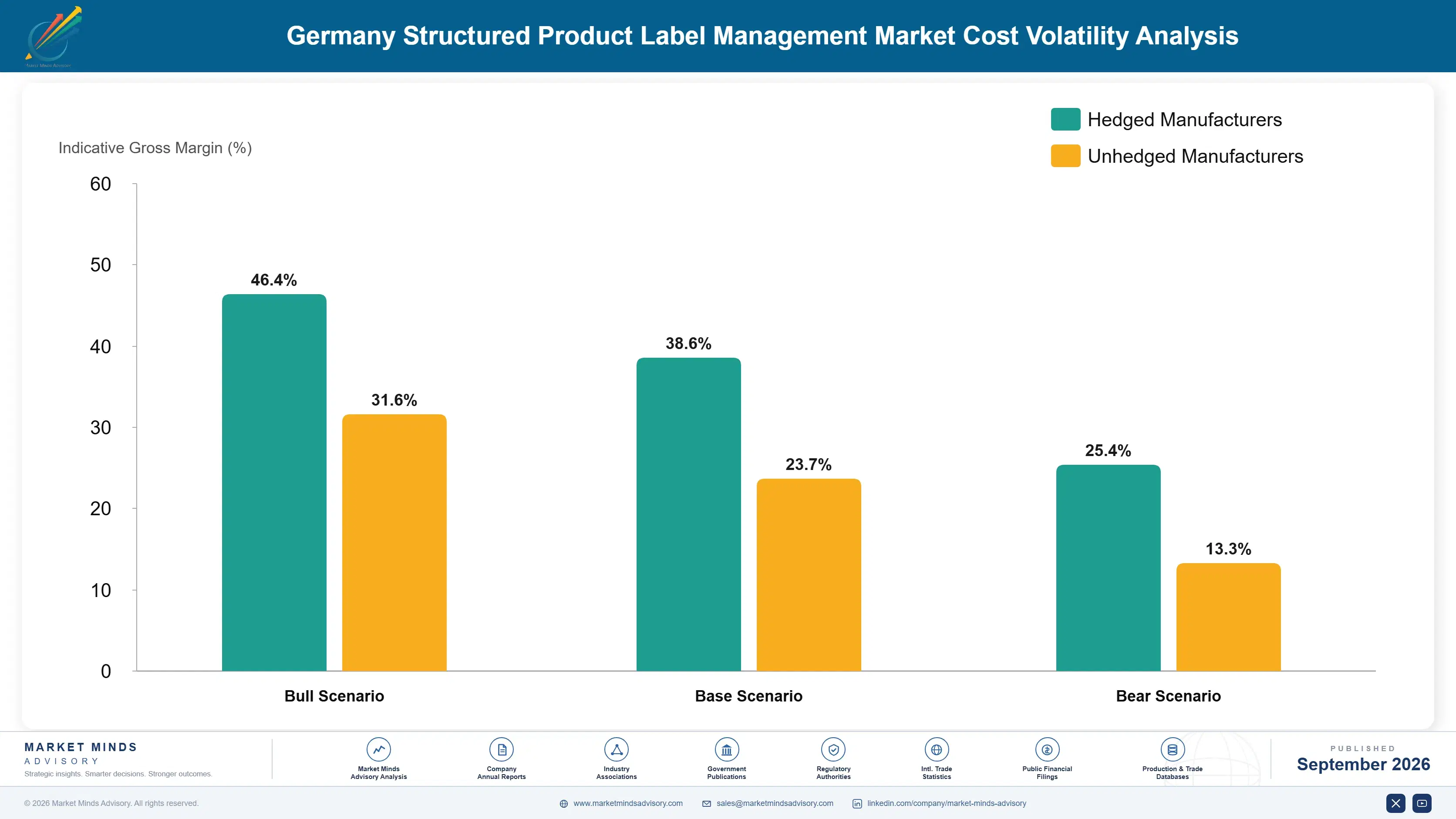
Delivery cost is dominated by people. Regulatory affairs specialists account for 40% to 48% of cost of goods sold, platform development and maintenance takes 16% to 22%, and translation with linguistic validation adds a further 14% to 20%. Qualified German regulatory staff are the constrained input, and the constraint is genuine rather than cyclical, since the training path runs through pharmaceutical employers who are themselves short of people.
German regulatory affairs salaries rose materially through 2024 and 2025 as authorisation holders and service providers competed for the same limited pool, and several providers described the resulting margin pressure in their annual reports for those years. Fixed-price re-authoring contracts signed before the movement absorbed it entirely, and rate review clauses have since become standard in multi-year agreements. Providers competing for the same pool bid rates upward.

The competitive disadvantage mechanism runs through delivery location rather than through software. A provider staffing variation processing entirely in Germany carries labour cost several times an offshore equivalent for work that requires execution rather than judgement, and cannot price against it on catalogue-scale contracts. Exposure varies by provider type. Hybrid organisations place each task where it belongs. Single-location consultancies carry German rates across every activity.
germany-structured-product-label-management-market-cost-volatility-analysis-1790006558826

Separate Regulatory Judgement From Processing Execution

Not all labelling work requires German regulatory expertise, and treating it as though it does is the largest avoidable cost in the category. Providers separating interpretation from execution place each task where it can be delivered properly, and report blended cost 35% to 50% below single-location alternatives without the quality problems earlier offshore arrangements produced.

Use Assisted Extraction To Draft Structured Content

Re-authoring prose into structured fields is slow senior work, but the first draft need not be. Automated extraction proposing structured content for regulatory confirmation cuts specialist hours per authorisation by roughly 40%, which matters most on generic catalogues where the number of authorisations makes manual authoring economically impossible from the outset. Manual authoring at that scale is simply impossible.

Build Translation Memory Across Client Portfolios

Labelling language repeats extensively across products and across companies, and translation memory accumulated over many portfolios reduces linguistic validation effort substantially on each new variation. The asset compounds with volume, which favours providers handling many catalogues and makes it difficult for new entrants to match delivered cost at comparable quality. New entrants cannot match delivered cost quickly.

Portfolio Architecture for Margin Defence

Margin follows how much regulatory judgement the work genuinely requires. Variation processing and translation coordination are close to commodity, executed at volume and priced against offshore delivery capability. Platform software earns considerably more once deployed. Structured content re-authoring and German authority interpretation earn most, because the people who can do it are scarce and the consequence of error is a rejected submission. Scarcity of judgement sets the whole ladder.
The tension between volume and premium runs directly through delivery location. Catalogue-scale processing is profitable only where execution sits offshore, and providers staffing it at German rates lose money on every authorisation. Premium interpretation work carries far better margin but scales only with qualified German regulatory staff, whose supply is genuinely constrained and cannot be expanded by spending alone. Qualified German staff cannot be recruited at speed.

High-value pools concentrate where a wrong answer costs a submission: identification standard data decisions, German authority interpretation questions, and electronic product information rendering across languages where an error reaches patients. These share a buyer paying for certainty. Routine variation processing across a large catalogue carries none of that, and pricing reflects exactly what it is. Certainty is what buyers actually pay for.

Volume / Commodity-Adjacent

Variation processing, translation coordination, and routine submission preparation delivered at catalogue scale. Work is execution rather than judgement and is priced against offshore delivery capability. The nine-point range reflects wide variation in how much of it providers deliver from lower-cost locations.
Gross Margin: 29% to 38%

Premium / Certified

Platform software licensing, artwork linkage, and electronic product information publishing once deployed and validated. Switching cost is real and integration dependencies extend beyond labelling. The nine-point range separates platform vendors from service providers reselling third-party software at thinner terms.
Gross Margin: 52% to 61%

Sustainability / Regulatory / Next-Generation

Structured content re-authoring, identification standard data decisions, and German authority interpretation. Qualified people are scarce and a wrong answer costs a submission. The eleven-point range reflects how differently providers price scarce regulatory judgement against commoditised delivery capacity.
Gross Margin: 63% to 74%
germany-structured-product-label-management-market-portfolio-architecture-1790006559330

High-value Sub-segments and Strategic Watch-out

Structured Content Re-Authoring Programmes

Highest value and fastest growth at 18.6%, covering the 71% of catalogue that cannot simply be migrated. Scarce regulatory judgement and submission consequence support the pricing. The ten-point range reflects how much assisted extraction each provider uses to reduce specialist hours. Scarce people set the price.
Gross Margin: 64% to 74%

Electronic Product Information Publishing

High value growing at 15.8%, and the only work here carrying a commercial return independent of any compliance date. Packaging cost savings fund it. The nine-point range separates providers handling multilingual rendering properly from those publishing what print source material happens to allow. Returns arrive regardless.
Gross Margin: 56% to 65%

Multilingual Variation Maintenance

The operational core, covering 24 language variants against a 38 day median cycle and consuming most delivered hours in the category. Growth tracks the market rate. Competitiveness depends almost entirely on delivery location and on accumulated translation memory across portfolios. Memory assets compound with volume.
Gross Margin: 34% to 43%

German Rate Processing Delivery

The strategic watch-out. Staffing execution work at German salary levels cannot compete on catalogue-scale contracts against hybrid or offshore alternatives. The thirteen-point range reflects the gap between providers with some offshore capacity and those operating entirely from a single high-cost location. Catalogue contracts are lost outright.
Gross Margin: 18% to 31%

Why This Spending Keeps Recurring

Labelling generates work permanently because the label is the part of a medicine a regulator can change without touching the product. Safety findings, packaging changes, shortage substitutions, and manufacturing site variations all produce label changes, around 5,400 a year at a large authorisation holder. That baseline never stops, which makes the operational side of this market genuinely annuity-like regardless of what happens to structured data timetables.
Depth of engagement varies sharply by company type. Generics manufacturers embed external providers deeply, because catalogue economics leave no alternative and the provider ends up holding operational knowledge the company no longer retains internally. Originators keep more work in house, having fewer and more valuable authorisations. Mid-sized German specialty companies are the least settled, moving between models as regulatory headcount fluctuates.

The buyer profile has moved upward. Regulatory operations managers once selected tooling and negotiated service contracts. Heads of regulatory affairs and, in structured data programmes, chief information officers now approve the spending, and they ask about catalogue completion timelines and total programme cost rather than about system features. Providers still selling on platform capability are addressing the wrong person entirely.
germany-structured-product-label-management-market-end-use-penetration-index-1790006559823

Where This Market Rewards

These are among the four positions where our research anticipates prominent divergence between winners and laggards over the coming forecast period. Each is grounded in the demand model, the regulatory perimeter, and the announced capacity pipeline.
01 / CONTENT PROGRAMME HONESTY

Re-authoring is the project, software is the tool

Roughly 71% of a typical German catalogue must be re-authored before structured publishing is possible, because labelling was written as prose for printed leaflets rather than as data anybody could parse. Providers scoping that as a separately funded programme with its own regulatory staffing complete on schedule 2.9 times more often than those bundling it into a platform deployment. The honest conversation occasionally costs the deal and reliably saves the relationship afterwards, because the alternative is an overrun that ends the sponsor's credibility.
02 / CATALOGUE SEQUENCING DISCIPLINE

Never treat a generics catalogue as uniform work

Re-authoring cost per authorisation is broadly fixed while product revenue is not, which is exactly why German generics manufacturers reach totals their margins cannot support when they process catalogues uniformly. Sequencing by commercial value delivers 60% to 75% of catalogue revenue coverage within the first third of the programme. That lets a sponsor defend continued funding internally long before completion, which is frequently what determines whether the work finishes, and that is usually what decides whether the work finishes at all.
03 / RETURN INDEPENDENT POSITIONING

Compliance dates have moved for a decade already

Identification standard obligations have been announced as imminent since roughly 2016 and postponed repeatedly, and every board that deferred was proved right each time. Anchoring business cases on packaging cost savings from electronic product information delivers a return whenever the compliance date eventually lands, and providers leading with that argument close roughly 40% faster. It also moves the sponsor from a compliance budget to an investment one, which changes who signs and how the spending is classified inside the business.
04 / DELIVERY LOCATION DESIGN

Separate German judgement from volume execution properly

Interpretation of how German authorities will read specific wording needs people close to those authorities, while processing 5,400 annual variations across 24 languages needs cost levels German operations cannot reach at all. Providers running both with a clear division deliver 35% to 50% below single-location alternatives, without the quality failures that pure offshore arrangements produced a decade ago. Roughly 46% of operations have already settled into that hybrid shape, and the remainder is heading there steadily without much resistance year by year.

Engagement Snapshot From the Field

A live engagement with an industry participant carrying material or product regulatory and market exposure ahead of a defining policy shift, showing how our research translates into a defensible multi-year portfolio strategy.
MARKET MINDS ADVISORY · CLIENT ENGAGEMENT SUMMARY
Germany Structured Product Label Management Producer Strategic Portfolio Review and Transition Roadmap 2026·Investment Scenario on Germany Structured Product Label Management Exposure Evaluation 2025-26
CLIENT PROFILE
A German generics manufacturer holding approximately 3,400 marketing authorisations across European markets, with annual revenue above EUR 1.6 billion (client-reported, unverified by MMA). Labelling operations ran on a regulatory content platform purchased three years earlier, and an identification standard readiness programme had stalled after eighteen months with under a tenth of the catalogue converted. The original plan had assumed straightforward data migration.
STRATEGIC CHALLENGE
The structured data programme had been scoped as a data migration, and the team discovered that most labelling content required interpretation rather than transfer. Costs had exceeded the approved budget while completion sat below ten percent. Management could not tell whether to continue, restart with a different approach, or outsource the work entirely.
MMA APPROACH
MMA sampled the catalogue to establish what proportion genuinely required re-authoring rather than migration, modelled completion cost and timeline under internal, outsourced, and hybrid delivery models, and sequenced authorisations by commercial value to test whether a partial programme could deliver meaningful coverage early enough to sustain funding. Assisted extraction was tested on a controlled sample.
KEY FINDINGS
  1. Roughly 74% of authorisations required content re-authoring rather than data migration, against the ten percent the original programme plan had assumed throughout.
  2. The top 340 authorisations by revenue represented 68% of catalogue turnover, so completing them first would cover most commercial exposure within about a third of the effort.
  3. Internal delivery at German regulatory rates would exceed the outsourced equivalent by roughly 3.1 times for the execution portion, while interpretation work showed no such gap.
  4. Assisted extraction reduced specialist authoring hours by 38% in a controlled sample, without any measurable increase in regulatory review findings on the output.
CLIENT PROFILE
A German generics manufacturer holding approximately 3,400 marketing authorisations across European markets, with annual revenue above EUR 1.6 billion (client-reported, unverified by MMA). Labelling operations ran on a regulatory content platform purchased three years earlier, and an identification standard readiness programme had stalled after eighteen months with under a tenth of the catalogue converted. The original plan had assumed straightforward data migration.
STRATEGIC CHALLENGE
The structured data programme had been scoped as a data migration, and the team discovered that most labelling content required interpretation rather than transfer. Costs had exceeded the approved budget while completion sat below ten percent. Management could not tell whether to continue, restart with a different approach, or outsource the work entirely.
MMA APPROACH
MMA sampled the catalogue to establish what proportion genuinely required re-authoring rather than migration, modelled completion cost and timeline under internal, outsourced, and hybrid delivery models, and sequenced authorisations by commercial value to test whether a partial programme could deliver meaningful coverage early enough to sustain funding. Assisted extraction was tested on a controlled sample.
KEY FINDINGS
  1. Roughly 74% of authorisations required content re-authoring rather than data migration, against the ten percent the original programme plan had assumed throughout.
  2. The top 340 authorisations by revenue represented 68% of catalogue turnover, so completing them first would cover most commercial exposure within about a third of the effort.
  3. Internal delivery at German regulatory rates would exceed the outsourced equivalent by roughly 3.1 times for the execution portion, while interpretation work showed no such gap.
  4. Assisted extraction reduced specialist authoring hours by 38% in a controlled sample, without any measurable increase in regulatory review findings on the output.
RECOMMENDED STRATEGY
Phase 1: Phase one: rescope the programme as content re-authoring with separate funding, formally abandoning the data migration framing that had produced the original estimates. Phase 2: Phase two: sequence by commercial value, completing the top 340 authorisations first to demonstrate meaningful coverage before requesting further budget approval. Phase 3: Phase three: move execution to an offshore delivery partner while retaining German regulatory interpretation internally, with assisted extraction supporting both.
OUTCOME
Fourteen months after rescoping, catalogue conversion reached 41% by authorisation count and 71% by revenue, against ten percent achieved in the previous eighteen months (client-reported, unverified by MMA). Blended delivery cost fell 44%. The programme retained board funding through two subsequent approval cycles without further escalation.

Frequently Asked Questions

Foundational context covering the market sizes, CAGR, scope, country, region and competition that inform every finding below. This section is provided to cover basics and most often pre-purchase conversations, answered from the MMA Primary Research Dataset.

What is the current size of the Germany Structured Product Label Management Market?

The market was worth USD 0.6 billion in 2025 and reaches USD 0.7 billion in 2026. Value covers software and services supporting German labelling operations.

How large will the Germany Structured Product Label Management Market be by 2036?

MMA forecasts USD 2.3 billion by 2036, an increase of USD 1.6 billion across the forecast period. That represents 3.29 times the 2026 base of USD 0.7 billion.

What is the CAGR for the Germany Structured Product Label Management Market 2026 to 2036?

The base case compound annual growth rate is 12.4%, with a bull case at 13.6% and a bear case at 11.2%. Historical growth from 2020 to 2025 ran at 10.9%.

Which segment is growing fastest?

Structured data and identification standard compliance grows at 18.6%, half again the market rate of 12.4%. Roughly 71% of catalogue content must be re-authored first.

Who are the major companies in the Germany Structured Product Label Management Market?

Veeva Systems, Certara, IQVIA, ArisGlobal, and Freyr Solutions lead, holding 43% of contracted spend between them. They sell platforms, consulting, and outsourced operations respectively rather than competing directly.

Which country is growing fastest?

Scope is limited to Germany, so growth is compared within it. Baden-Wurttemberg leads at 15.1%, on the concentration of regulatory affairs operations among originator companies there.

Report Segmentation Architecture

The full report scope spans multiple orthogonal segmentation dimensions, with cross-tabulated demand data provided for each dimension pair. Coverage extends further to regional breakdowns, trend trajectories, and the competitive detail needed to support segment-level decision-making.

By Functional Scope

  • Labelling Content Authoring and Version Control
  • Structured Data and Identification Standard Compliance
  • Electronic Product Information Publishing
  • Artwork and Packaging Component Linkage
  • Translation and Multilingual Variant Management
  • Variation Submission and Change Tracking

By End-Use Industry

  • Originator Pharmaceutical Companies
  • Generic Medicines Manufacturers
  • Biotechnology and Specialty Pharma
  • Consumer Health and Over-the-Counter
  • Veterinary Medicinal Products
  • Contract Regulatory Service Organisations

By Commercial Dimension

  • Platform Software Licence
  • Managed Regulatory Operations
  • Project Based Consulting Engagement
  • Offshore Delivery Centre Contract
  • Systems Integrator Implementation
  • Translation and Linguistic Validation Service

By Region

  • Western Europe
  • North America
  • South Asia and Pacific
  • East Asia
  • Eastern Europe
  • Latin America
  • Middle East and Africa

Scope, Methodology, and Coverage

Every figure in this report is reproducible from documented input assumptions. The scope below maps the historical period, the forecast horizon, the segmentation dimensions, and the countries covered, alongside the underlying primary and qualitative methodology.
Historical Period
2020 to 2025
Forecast Period
2026 to 2036
Base Year
2025 (USD billions; MMA Primary Research Dataset, September 2026)
Market Definition
This market covers software and services managing structured regulatory product information for medicines placed on the German market, including labelling content authoring and version control, identification standard data compliance, electronic product information publishing, artwork and packaging component linkage, translation and multilingual variant management, and variation submission and change tracking. It excludes clinical trial management systems, pharmacovigilance case processing, manufacturing quality systems, and promotional material review.
Quantitative Units
USD billions, contracted software and services value
Segmentation Dimensions
Functional scope, end-use industry, commercial dimension, supply origin
Regions Covered
Western Europe, North America, South Asia and Pacific, East Asia, Eastern Europe, Latin America, Middle East and Africa
Countries Covered
Germany; supply origin analysis covers Switzerland, Austria, Netherlands, Belgium, France, United Kingdom, Ireland, Denmark, Sweden, United States, Canada, India, Australia, Singapore, China, Japan, Poland, Czech Republic, Romania, Hungary, Brazil, Argentina, Egypt, South Africa
Key Companies Profiled
Veeva Systems, Certara, IQVIA, ArisGlobal, Freyr Solutions, Parexel, ICON, Accenture, Capgemini, Cognizant, Tata Consultancy Services, Wipro, Lorenz Life Sciences, Extedo, Acolad, Schlafender Hase, Glemser Technologies, ProductLife Group, Ennov, Samarind
Quantitative Methodology
Primary survey, n=3,800 respondents, Q4 2025, six countries; demand-side model with trade association cross-validation
Qualitative Methodology
47 expert interviews, Q4 2025; applied to validate demand model assumptions, identify emerging dynamics, and assess competitive positioning
Report Format
PDF and XLSX data workbook (Word format preview document)
Publisher
Market Minds Advisory
Report Code
MMA-2026-HLT-461
Published
September 2026
Contact
sales@marketmindsadvisory.com | www.marketmindsadvisory.com

Purchase the full Germany Structured Product Label Management Market Report (2026 to 2036).

The full report sizes the German structured product label management market across six functional scopes with forecasts to 2036 under base, bull, and bear cases. It examines why roughly 71% of a typical catalogue must be re-authored before structured publishing is possible, what that means for programme budgets, and why a decade of postponed compliance dates has trained boards to defer. Competitive analysis covers twenty participants evaluated consistently on contracted spend, spanning platform vendors, consultancies, and offshore delivery organisations. Cost structure, margin architecture by function, and the supply origin map behind German operations are analysed in full. Primary research includes 3,800 survey responses and 47 expert interviews.
Six functional scopes sized and forecast separately
Twenty participants evaluated on contracted spend consistently
Supply origin mapping across seven global geographies
Margin architecture by function and delivery location
Catalogue re-authoring cost analysis with sampled evidence
Delivery model benchmarks across internal, offshore and hybrid

Built For The People Who Decide

From boardroom strategy to bench-side execution, this report is read cover-to-cover by leaders shaping the next decade of their industry, turning demand scenarios, market dynamics and valuation benchmarks into decisions.
CXOs/ Presidents/ VPs/ Managers
M&A and Corporate Development
Strategy Teams and R&D Heads
Procurement and Product Directors
Regulatory and Compliance Leaders
Investor Relations and Equity Analysts