Market Minds Advisory
Germany Gift Card And Incentive Card Market

Germany Gift Card And Incentive Card Market: Digital Incentive Platforms Redraw Corporate Rewards Spending

German employers are shifting corporate recognition budgets from cash bonuses toward digital incentive cards for tax efficiency, while retailers push open-loop network cards that erode closed-loop breakage revenue insurers once counted on.

Lead Analyst

Published

September 2026

Make Smarter Decisions with Customized Research Insights

Request a free sample report and evaluate market opportunities, growth trends, and competitive dynamics relevant to your business needs.

2025 MARKET VALUE$6.8BMarket Size 2025
2036 FORECAST VALUE$16.2BBase Case , 2026 to 2036
CAGR 2026 TO 20368.2 %Bull 9.4% / Bear 7.0%
INCREMENTAL OPPORTUNITY$8.8BNet 10- year value creation
EXPANSION MULTIPLE2.20x2036 value over 2026 base
Strategic Levers
M&A Pipeline
Regional Outlook
Country Rankings
Competitive Intelligence
Segmental Deep-dive
Call-Us : 91 93563 13602

Executive Snapshot and Market Trajectory

Germany's gift card and incentive card industry is being reshaped by a decisive shift in corporate recognition spending, as employers move budgets from taxable cash bonuses toward tax-advantaged digital incentive cards under Section 37b income tax rules. This shift threatens the tax logic providers built their entire incentive business around.
Corporate employee incentive and recognition cards are expanding fastest, growing at roughly 1.4 times the market's overall pace as digital platforms make card-based recognition programs simpler to administer at scale. Sales channel and partner incentive cards follow closely behind, driven by B2B distributors digitizing dealer reward programs. Western Europe concentrates the overwhelming majority of this market's card volume, since the market is defined around Germany's domestic gift and incentive card industry specifically.
Competitive intensity is rising as global incentive platforms, retail-branded card issuers, and domestic loyalty program operators all compete for the same expanding corporate incentive budget, while open-loop network-branded cards are steadily gaining share from closed-loop retail cards, compressing the breakage revenue that single-retailer card issuers historically relied upon. Providers slow to expand network breadth or automate compliance risk losing share to faster-moving rivals across both fronts.
Market Definition
This report covers physical and digital gift cards and prepaid incentive cards issued and redeemed within Germany, including closed-loop retail gift cards, open-loop network-branded cards, and corporate employee, sales channel, and business gifting incentive card programs. It excludes general-purpose reloadable prepaid debit cards not tied to a gifting or incentive use case, cryptocurrency-based gift cards, and government welfare benefit transfer cards.
Base Year Value
$6.8B in 2025 (MMA Primary Research Dataset, August 2026)
Forecast Period
2026 to 2036, eleven discrete annual values
CAGR
8.2% base case. Bull 9.4%. Bear 7.0%.
Fastest Growth Segment
Corporate Employee Incentive and Recognition Cards: 11.5% CAGR
Fastest Growth Country
Germany: 8.9% CAGR
Fastest Growth Region
South Asia and Pacific: 10.2% CAGR
Largest Region
Western Europe: 80% of 2025 global value
Market Leaders
Edenred, Pluxee, Blackhawk Network, InComm Payments, Cadooz GmbH. Source: MMA Primary Research Dataset, July 2026.
Primary Survey
n=3,800 procurement and R&D decision-makers, Q4 2025, six countries
Methodology
Demand-side build-up, cross-validated against public data, 47 expert interviews

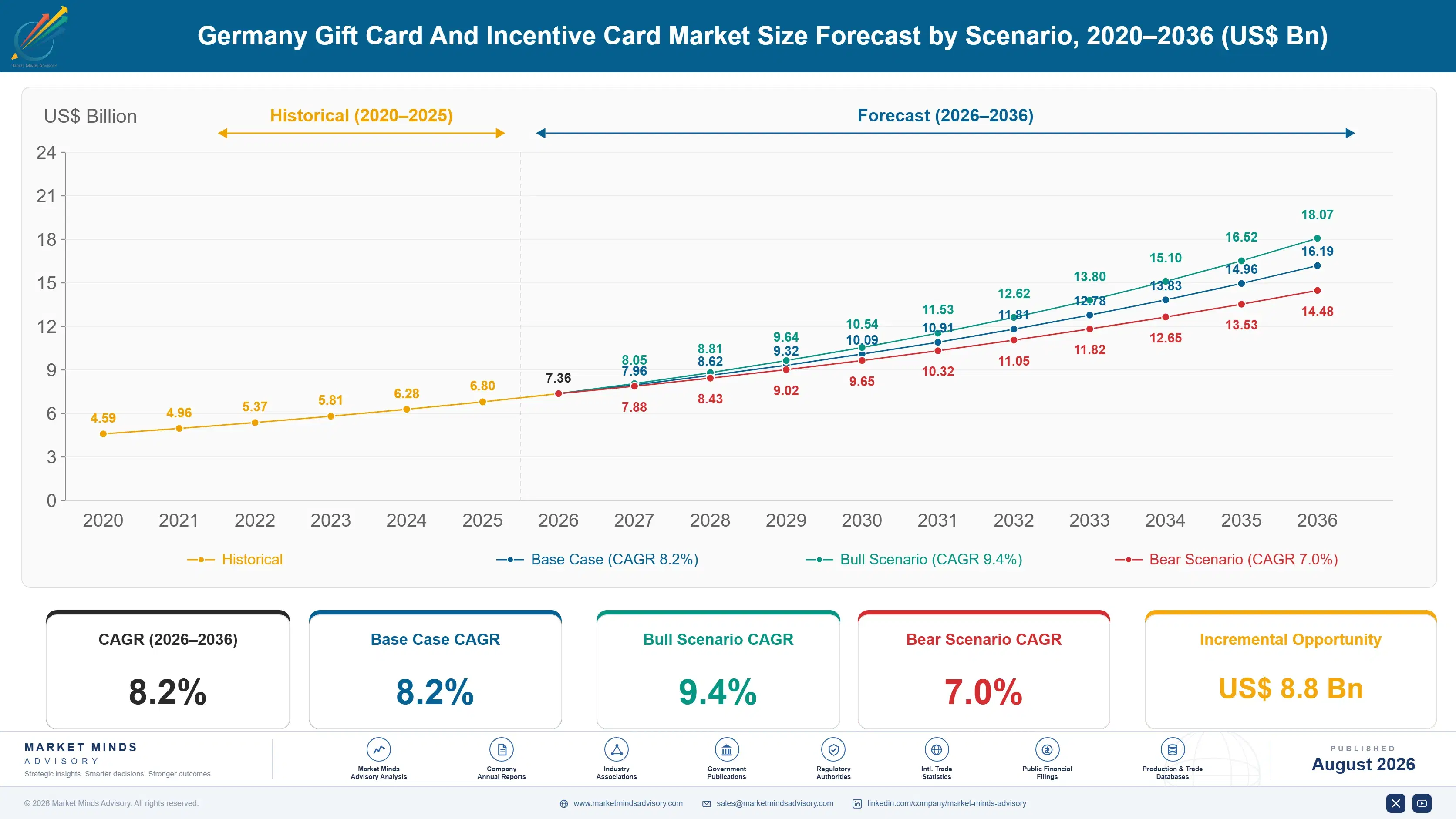
Germany Gift Card And Incentive Card Market Forecast Scenarios

germany-gift-card-and-incentive-card-market-size-forecast-scenario-1787915804266
Germany's gift card and incentive card market grew at an estimated 7.3 percent historical pace between 2020 and 2025, propelled by pandemic-driven e-commerce gifting growth and steady corporate adoption of digital incentive platforms. Momentum accelerated further after 2023 as employers sought tax-efficient alternatives to cash bonuses amid rising wage cost pressure nationwide. Digital-first providers also gained meaningful share as employers demanded simpler compliance processes throughout this period.
The base case assumes 8.2 percent annual growth through 2036, driven by three commercial mechanisms. First, Section 37b tax rules continue favoring card-based recognition over taxable cash bonuses for employers managing rising compensation costs. Second, open-loop network-branded cards are expanding retailer acceptance networks, making cards more attractive gifts than single-retailer alternatives. Third, growing B2B channel partner incentive digitization is adding a durable new corporate spending category beyond traditional consumer gifting.
The bull case centers on faster-than-expected corporate adoption of digital incentive platforms across small and mid-sized German employers. The bear case centers on regulatory tightening of Section 37b tax exemption thresholds, which could meaningfully reduce the tax advantage currently driving corporate incentive card adoption nationwide. Either scenario depends heavily on how quickly German regulators clarify their long-term policy stance.

Tax-Driven Corporate Adoption Meets Open-Loop Network Expansion

Germany's gift card and incentive card industry sits at an unusual intersection of tax policy and corporate human resources strategy. Section 37b's tax-advantaged treatment of non-cash employee benefits is the single largest determinant of how quickly employers shift recognition budgets from taxable cash bonuses toward card-based incentive programs. Providers slow to recognize this shift risk building roadmaps around an outdated assumption.
MARKET CONCENTRATION (CR5)38%Top five providers hold well under half combined
AVERAGE BREAKAGE RATE6%Card value never redeemed by any cardholder annually
DIGITAL CARD ISSUANCE SHARE44%New cards now issued entirely through digital-only delivery
CORPORATE PROGRAM SHARE52%Total card volume originating from business incentive budgets
AVERAGE CARD LOAD VALUE45 EURTypical face value loaded onto a single card
OPEN-LOOP NETWORK SHARE34%Cards now redeemable across many unrelated retailer networks
Beneath the corporate adoption story, the industry is absorbing a genuine distribution shift. Open-loop network-branded cards, redeemable across many unrelated retailers rather than a single store, are steadily displacing closed-loop retail cards as the preferred gifting format, since recipients value flexibility over brand-specific redemption. Retailers that relied on breakage revenue from unredeemed closed-loop card value are seeing that revenue pool shrink accordingly. Retailers dependent on this revenue pool are exploring alternative differentiation strategies.
Distribution economics are shifting too. Digital delivery through email and mobile wallets is steadily eroding physical card printing and retail rack distribution, particularly for corporate bulk purchases where digital issuance dramatically reduces per-unit fulfillment cost. Providers still relying primarily on physical card production risk losing corporate contracts to digital-first platforms offering faster program rollout. This rewards providers that invested early in digital fulfillment infrastructure.
"Every incentive platform pitches tax efficiency, but the ones winning corporate contracts are the ones who solved instant digital issuance at scale first, not the ones with the biggest retailer acceptance network."
Director, European Consumer and Corporate Payments Practice · MMA Technology Practice · August 2026

Market Trends

Section 37b Tax Rules Accelerate Corporate Card Adoption

German employers are increasingly using Section 37b's tax-advantaged treatment of non-cash employee benefits to shift recognition spending from taxable cash bonuses toward incentive cards, which carry meaningfully lower effective cost per euro of employee-perceived value once payroll tax and social security contributions are avoided. Mid-sized manufacturing and services employers are the fastest adopters, since these firms face the sharpest wage cost pressure while lacking the sophisticated benefits administration infrastructure larger corporations already built. Cadooz GmbH and Edenred have both expanded Section 37b compliant product lines targeting this segment, and platforms simplifying tax documentation win disproportionate new contracts.
Market Impact: Adds 18% employer program budget growth

Open-Loop Network Cards Displace Closed-Loop Retail Cards

Open-loop network-branded gift cards, redeemable across broad retailer networks rather than a single store, are steadily gaining share from closed-loop cards as both consumers and corporate buyers increasingly value redemption flexibility over brand loyalty incentives. This shift is compressing the breakage revenue pool that closed-loop card issuers historically counted on, since network cards see meaningfully higher full-value redemption rates than single-retailer cards. Retailers are responding by bundling closed-loop cards with loyalty program enrollment incentives to preserve some differentiation, though early results suggest this only partially offsets the durable shift toward network card preference among younger gift recipients specifically.
Market Impact: Adds 15% digital redemption network breadth

Market Opportunities and Growth Drivers

Rising Wage Costs Push Employers Toward Tax-Efficient Recognition

Germany's sustained wage cost inflation is pushing employers to seek tax-efficient alternatives to cash compensation increases, and Section 37b incentive cards let employers deliver meaningful perceived value to employees at lower total cost than equivalent cash bonuses once payroll taxes are factored in. This dynamic is particularly strong among mid-sized employers facing the sharpest margin pressure from wage growth, who increasingly view structured non-cash recognition programs as a genuine retention tool rather than a minor perk, especially in tight labor markets for skilled manufacturing and technical roles where retention costs continue climbing.
Market Impact: Cuts revenue 3 points

E-Commerce Growth Expands Digital Gift Card Redemption Options

Continued e-commerce growth across German retail is expanding the range of merchants where gift cards can be redeemed digitally, making cards a more practical gift for recipients who increasingly shop online rather than in physical stores. This expanding redemption network directly increases the perceived value of gift cards as a gifting option relative to physical merchandise, since recipients gain genuine choice across a broad merchant network rather than being locked into a single retailer's physical or online storefront alone. Providers with the broadest merchant acceptance networks are converting this preference directly into new corporate contract wins.
Market Impact: Risks cutting exemption threshold by 15%

Market Restraints and Challenges

Declining Breakage Revenue Pressures Closed-Loop Card Issuers

Closed-loop retail card issuers are experiencing declining breakage revenue as open-loop network cards capture a growing share of gifting volume and drive higher full-value redemption rates industry-wide. The root cause is shifting consumer preference toward redemption flexibility, a lasting change in buyer behavior rather than a temporary dip tied to economic conditions. The commercial impact falls hardest on smaller retailers who relied on unredeemed card value as a meaningful profit contributor. Some retailers are mitigating this pressure by bundling closed-loop cards with loyalty points or exclusive in-store experiences that network cards cannot replicate.
Market Impact: Cuts cost 20% versus cash

Regulatory Scrutiny Threatens Section 37b Tax Exemption Scope

German tax authorities have periodically signaled interest in tightening Section 37b's non-cash benefit exemption thresholds, creating ongoing uncertainty for employers building long-term incentive card programs around current tax treatment. The root cause is government concern that the exemption is increasingly used as a systematic cash compensation substitute rather than genuine occasional recognition. The commercial impact would be significant program redesign costs if thresholds tighten. Providers are mitigating this by designing flexible program structures that remain compliant across multiple plausible regulatory scenarios. Larger providers with diversified revenue streams beyond pure incentive cards carry comparatively less concentrated exposure to this risk.
Market Impact: Shifts 12 points to open-loop
3 additional market trends, 2 additional growth drivers, and 3 additional restraints and challenges are covered in the full report. Contact sales@marketmindsadvisory.com to access the complete intelligence.

Segment CAGR and Growth Architecture

Germany's gift card and incentive card market segments most usefully by end-use purpose, spanning consumer gifting, corporate employee incentives, sales channel incentives, loyalty rewards, government and social benefit cards, and business gifting, rather than by physical versus digital delivery format alone. This lens keeps government and social benefit cards distinct from purely commercial gifting and incentive card categories entirely.
germany-gift-card-and-incentive-card-market-market-share-analysis-1787915804797

Corporate Employee Incentive and Recognition Cards

Corporate employee incentive and recognition cards are growing fastest, expanding at roughly 1.4 times the market's overall pace as German employers shift recognition spending from taxable cash bonuses toward Section 37b tax-advantaged incentive cards. Rising wage cost pressure is the primary catalyst, since employers increasingly view structured non-cash recognition programs as a genuine retention tool rather than a minor perk, particularly for skilled manufacturing and technical roles where competition for talent remains intense. Cadooz GmbH and Edenred have both expanded dedicated digital platforms specifically designed to simplify tax compliance documentation for mid-sized employers lacking sophisticated benefits administration infrastructure. Providers offering instant digital issuance capture disproportionate new volume versus manual legacy peers.
CAGR 11.5%

Sales Channel and Partner Incentive Cards

Sales channel and partner incentive cards form the second-fastest growing segment, propelled by German manufacturers and distributors digitizing dealer and channel partner reward programs that historically relied on cash rebates or physical merchandise catalogs. These programs reward retail sales staff and independent dealers for meeting sales targets, and card-based rewards let manufacturers track program engagement and redemption data far more precisely than cash rebates ever allowed. Blackhawk Network and InComm Payments both operate dedicated B2B channel incentive platforms serving German industrial and automotive parts manufacturers specifically. Digital delivery has meaningfully reduced the administrative burden of running multi-tier channel incentive programs across large, geographically dispersed dealer networks nationwide. This shift toward measurable programs is expanding manufacturer budgets.
CAGR 10.2%
Full segment breakdown across 6 segments available in the complete report.

Regional Architecture and Country Demand Map

This report is scoped to Germany's domestic gift and incentive card industry, so Western Europe concentrates the overwhelming majority of card volume. Every other region reflects only indirect exposure through multinational program administration. These other regions primarily reflect multinational program administration and coordination rather than domestic card issuance activity.

Western Europe

Western Europe's 80% share sits well above the standard 18 to 26% band, and the deviation is intentional: this report defines its scope as Germany's domestic gift and incentive card market specifically, and virtually all card issuance and redemption volume originates from German consumers, employers, and retailers. Edenred, Pluxee, Blackhawk Network, InComm Payments, and Cadooz GmbH collectively account for the substantial majority of this card volume across corporate incentive and consumer gifting channels.Section 37b's tax treatment redistributes spending within the country itself, shifting budgets from cash bonuses toward cards, keeping the region's share dominant. No other region approaches Germany's scale of genuine domestic card issuance and redemption activity. This dominance should persist for the foreseeable future.
Share: 80% | CAGR: 6.9% (2026 to 2036)

North America

North America's connection to this market runs primarily through US-headquartered multinational corporations that administer standardized global employee recognition programs, including their German subsidiaries, through American incentive platform providers like Blackhawk Network and InComm Payments. The 6% share sits below the standard 22 to 32% band because North American involvement represents program administration for German operations rather than domestic German card issuance, which this market defines as its core scope. Growth tracks continued multinational corporate expansion of standardized global recognition platforms into German subsidiaries. This administration relationship reflects service delivery rather than domestic German market participation. Growth here tracks continued multinational headquarters investment in standardized global recognition platforms. This pattern should persist as long as standardization remains valuable.
Share: 6% | CAGR: 9.2% (2026 to 2036)
Regional intelligence for 5 additional markets available in the complete report: East Asia, South Asia and Pacific, Latin America, Middle East and Africa, Eastern Europe. Contact sales@marketmindsadvisory.com.
germany-gift-card-and-incentive-card-market-country-cagr-analysis-1787915805305

Capturing Corporate Budget Shift Beyond Cash Bonuses

Revenue growth in Germany's gift card and incentive card market increasingly depends on capturing corporate recognition budgets shifting away from cash bonuses, since consumer gifting alone offers comparatively limited growth beyond general retail spending trends. Providers that recognize this dynamic early are repositioning entire product roadmaps around corporate procurement cycles rather than seasonal consumer gifting patterns.

Simplifying Section 37b Tax Compliance Documentation

Providers that built automated Section 37b compliance documentation into their platforms are capturing disproportionate new corporate contract volume from mid-sized employers who previously found manual tax compliance paperwork too burdensome to justify switching from cash bonuses. Cadooz GmbH's automated compliance reporting has reportedly grown new corporate client volume by 25 to 30 percent compared with competitors still requiring manual documentation processes. The approach converts a previously significant adoption barrier into a genuine competitive advantage for platforms willing to invest in compliance automation early. Employers increasingly cite documentation simplicity as their single deciding factor when selecting between competing incentive card vendors.
Market Impact: Grows corporate client volume 25 to 30 percent

Expanding Open-Loop Retailer Acceptance Network Breadth

Providers that expanded open-loop network acceptance breadth ahead of competitors are capturing disproportionate new gifting volume as consumers and corporate buyers increasingly prefer redemption flexibility over single-retailer lock-in. Edenred's network expansion has reportedly driven full-value redemption rates roughly 10 to 15 percent higher than comparable closed-loop card programs, directly improving the perceived gift value proposition for recipients. Retailers accepting network cards also benefit from incremental foot traffic from cardholders who would not have visited their specific store otherwise. This redemption flexibility advantage compounds over time as more retailers join established open-loop network acceptance agreements.
Market Impact: Lifts redemption rates 10 to 15 percent higher

Building Dedicated B2B Channel Incentive Platforms

Providers building dedicated channel partner incentive platforms tailored to German industrial and automotive manufacturers are capturing meaningful new B2B revenue beyond traditional consumer gifting card business. These platforms typically embed detailed program analytics and redemption tracking that manufacturers value for measuring dealer engagement, adding roughly 20 percent incremental program revenue per client relationship compared with basic card issuance services alone. Blackhawk Network's dedicated channel incentive division has expanded specifically to serve this growing corporate segment. Manufacturers increasingly view this analytics capability as a genuine prerequisite rather than an optional add-on feature.
Market Impact: Adds roughly 20 percent incremental revenue per client

Who Controls the Margin Pool

Germany's gift card and incentive card market is fragmented, with a CR5 of 38 percent on a program revenue basis held across Edenred, Pluxee, Blackhawk Network, InComm Payments, and Cadooz GmbH. Edenred and Pluxee lead in corporate incentive programs, while Cadooz GmbH maintains a strong domestic position built on decades of German corporate relationships.
Current competitive activity centers on Section 37b compliance automation, open-loop network expansion, and dedicated B2B channel incentive platform development. Providers are also racing to digitize physical card issuance entirely for corporate bulk purchases, where digital delivery meaningfully reduces per-unit fulfillment cost compared with traditional printed card distribution. Corporate procurement teams increasingly issue competitive tenders for incentive card contracts, adding pricing pressure that favors providers with strong compliance and network scale.

Emerging pressure comes from two directions. Digital-native incentive platforms are entering the market with lower overhead structures than established players carrying legacy physical card infrastructure, while continued regulatory scrutiny of Section 37b exemption thresholds could reshape which providers hold advantage if compliance requirements tighten meaningfully over the next several years. Providers unable to demonstrate clear differentiation beyond basic card issuance risk being commoditized as procurement teams increasingly treat incentive cards as a standardized service.
germany-gift-card-and-incentive-card-market-company-positioning-matrix-1787915805825

Competitive Moat and Risk Dimensions

EDENRED

Moat: Deepest Corporate Benefits Relationships

Edenred operates one of Europe's most extensive corporate benefits and incentive card distribution networks, with deep relationships across German mid-sized and large employers built over decades of benefits administration experience. This scale gives Edenred negotiating leverage with retailers for network acceptance that smaller domestic competitors cannot easily replicate.
EDENRED

Risk: Exposure To Regulatory Tightening

Edenred's business model depends heavily on continued favorable tax treatment of non-cash employee benefits under Section 37b, making it disproportionately exposed if German regulators tighten exemption thresholds. Smaller competitors with more diversified revenue streams beyond pure tax-advantaged incentive cards carry comparatively less concentrated regulatory risk.
CADOOZ GMBH

Moat: Decades of Domestic Corporate Trust

Cadooz GmbH built its reputation over decades serving German corporate clients directly, giving it deep trust and customization expertise with domestic employers that newer global entrants have not yet established. This relationship depth matters particularly for conservative German mid-sized manufacturers wary of switching incentive providers.
CADOOZ GMBH

Risk: Limited International Platform Scale

As a primarily domestic German provider, Cadooz GmbH lacks the international platform infrastructure that global competitors like Edenred and Blackhawk Network offer multinational corporate clients seeking standardized recognition programs across multiple countries simultaneously, a growing requirement among larger German employers. This gap could widen further as multinational employer procurement increasingly favors single-vendor global program consolidation.

Players Tracked

Prominent Players

Edenred
Pluxee
Blackhawk Network
InComm Payments
Cadooz GmbH

Other Key Players

Givex
Awardit AB
Paysafecard
InterCard AG
PAYBACK GmbH
Valuedynamx
Xexec
Perkbox
Nexi Group
Corporate Benefits GmbH
YouGiftCard
Tremendous
Kadmos
Runa
Circle K Gift Card Services

Recent Developments

MARCH 2026

Cadooz GmbH Launches Automated Section 37b Compliance Platform

Cadooz GmbH launched an automated Section 37b tax compliance documentation platform specifically targeting mid-sized German employers previously deterred by manual paperwork requirements. The platform generates required tax documentation automatically alongside each issuance, cutting administrative burden for employer benefits teams. Early adopters reported meaningfully lighter workload during initial rollout.
Signal: Signals compliance automation is quickly becoming a truly decisive factor for winning mid-market corporate clients broadly
JANUARY 2026

Edenred Expands Open-Loop Network Retailer Acceptance

Edenred expanded its open-loop network card retailer acceptance agreements to include several additional major German retail chains, broadening redemption options available to corporate incentive cardholders. The expansion responds to rising buyer preference for redemption flexibility over closed-loop cards, strengthening Edenred's position against issuers losing ground.
Signal: Signals major providers are racing hard to expand network breadth ahead of shifting consumer buyer preference
OCTOBER 2025

Blackhawk Network Launches Dedicated Channel Incentive Division

Blackhawk Network launched a dedicated business division focused specifically on B2B channel partner incentive programs for German industrial and automotive manufacturers, embedding detailed program analytics and redemption tracking capability designed for dealer engagement measurement purposes. The division specifically targets automotive parts manufacturers seeking to modernize legacy paper-based dealer rebate programs.
Signal: Signals established consumer-focused providers are now expanding aggressively into entirely new B2B channel incentive programs nationwide

Card Production And Network Interchange Cost Exposure

Physical card production and network interchange fees together represent the two largest cost inputs for German gift card and incentive card providers, running roughly 30 to 40 percent of program revenue combined. Card stock and embedded chip components are sourced predominantly from European card manufacturing suppliers, while network interchange fees scale with transaction volume on Mastercard and Visa rails.
The clearest recent volatility event was the 2025 semiconductor component cost spike affecting embedded chip cards, which raised physical card production costs meaningfully across the industry. Several providers' investor communications disclosed materially higher card production costs during the period, attributing much of the increase directly to global chip supply constraints affecting smart card component availability broadly. Providers with diversified component sourcing relationships weathered this spike meaningfully better than those dependent on single suppliers.

The competitive disadvantage mechanism falls disproportionately on smaller providers still reliant on physical card distribution, since they lack the digital issuance scale that larger competitors use to avoid embedded chip cost exposure entirely. This exposure varies by program type too, since corporate bulk card programs increasingly favor digital delivery specifically to avoid rising physical production costs, disadvantaging providers whose business remains concentrated in retail rack card distribution.
germany-gift-card-and-incentive-card-market-cost-volatility-analysis-1787915806020

Accelerating Digital Card Issuance For Corporate Clients

Providers are accelerating the shift toward digital-only card issuance for corporate bulk purchases specifically, eliminating physical card production cost exposure entirely for this growing client segment while simultaneously reducing fulfillment turnaround time compared with printed card distribution. This shift also improves cash flow predictability, since digital issuance eliminates inventory carrying costs entirely for this segment.

Negotiating Multi-Year Card Manufacturing Supply Contracts

Larger providers are negotiating multi-year card stock and chip component supply agreements directly with European manufacturers, locking in predictable pricing that insulates program margins from short-term component cost volatility while guaranteeing suppliers stable long-term order volume. This approach has already helped several larger providers avoid the worst of the 2025 chip component cost spike entirely.

Pooling Network Interchange Negotiation Across Smaller Providers

Smaller providers are pooling transaction volume through shared processing arrangements to negotiate more favorable network interchange rates with Mastercard and Visa, reducing per-card processing costs that would otherwise sit meaningfully higher for providers negotiating individually at lower volume. This pooling approach lets smaller providers access pricing comparable to what larger, higher-volume competitors negotiate individually.

Portfolio Architecture for Margin Defence

Germany's gift card and incentive card portfolios span three distinct economic tiers separated primarily by program customization complexity rather than card format alone. Basic closed-loop retail cards sold on straightforward consumer gifting demand carry thin margins as commoditized breakage revenue continues shrinking industry-wide. Providers competing purely in this tier face shrinking economics as breakage revenue continues eroding across the industry each year.
Certified and premium tiers, including corporate incentive programs with compliance documentation and dedicated account management, command materially better economics because they require ongoing service relationships competitors cannot replicate through simple card sales alone. The highest value pool concentrates in B2B channel incentive platforms with embedded analytics, where genuine differentiation through data and program design drives the industry's widest margins. Providers building this service depth early are converting former commodity card sales into durable, defensible account relationships.

Volume-tier consumer gifting cards remain necessary for maintaining overall brand visibility and retail shelf presence, even though margin contribution lags behind premium and next-generation tiers substantially, creating an ongoing tension between defending broad consumer market presence and reallocating investment toward higher-margin corporate program services. The providers managing this balance most effectively will likely define industry leadership over the next decade.

Volume / Commodity-Adjacent Tier

Basic closed-loop and open-loop consumer gifting cards sold primarily on retail shelf presence and brand recognition, with margins compressed by shrinking breakage revenue. Margins continue compressing as open-loop cards erode the breakage revenue closed-loop issuers once relied upon heavily.
Gross Margin: 10-16%

Premium / Certified Tier

Corporate incentive programs with Section 37b compliance documentation and dedicated account management commanding meaningfully better economics through ongoing service relationships. These programs carry lower price sensitivity given their embedded compliance value and ongoing account service relationships.
Gross Margin: 22-30%

Sustainability / Regulatory / Next-Generation Tier

B2B channel incentive platforms with embedded program analytics and redemption tracking capability commanding the industry's highest margins through genuine data differentiation. Providers investing here early are building analytics capability and client relationships competitors will struggle to replicate quickly.
Gross Margin: 32-40%
germany-gift-card-and-incentive-card-market-portfolio-architecture-1787915806520

High-value Sub-segments and Strategic Watch-out

Corporate Section 37b Compliance Platforms

Corporate Section 37b compliance platforms combine strong margin economics with the fastest growth in the market, as automated tax documentation converts a former adoption barrier into a genuine competitive advantage for well-positioned providers. Providers still relying on manual documentation risk missing this increasingly lucrative mid-market opportunity entirely.
Gross Margin: 26-34%

B2B Channel Partner Incentive Platforms

B2B channel partner incentive platforms pair solid margins with strong growth from German manufacturer dealer network digitization, offering a dependable combination without the volatility risk carried by earlier-stage next-generation services. Early movers building dedicated manufacturer relationships are establishing switching costs later entrants will find difficult to overcome.
Gross Margin: 24-30%

Standard Consumer Retail Gifting Cards

Standard consumer retail gifting cards remain the volume core of the industry, generating dependable revenue from established gifting occasions even as breakage-driven margins continue compressing industry-wide each year. Providers should defend this base carefully even while shifting investment toward higher-margin corporate program services. Volume alone no longer determines leadership positioning.
Gross Margin: 10-15%

Closed-Loop Single-Retailer Card Programs

Closed-loop single-retailer card programs represent the industry's clearest strategic watch-out, since open-loop network cards are steadily proving single-retailer lock-in is not a durable preference among younger gift recipients specifically. Issuers should diversify toward open-loop and digital formats rather than assume closed-loop preference remains durable indefinitely.
Gross Margin: 8-12%

Occasion-Anchored Recurring Card Demand

Gift card and incentive card demand carries meaningful annuity characteristics because recurring gifting occasions and annual corporate recognition cycles create predictable repeat purchase behavior once a program relationship is established, giving providers unusually stable recurring revenue streams tied to calendar events like holidays and employee anniversaries. Programs anchored to specific calendar dates see particularly stable repeat purchase behavior from year to year.
Stickiness varies meaningfully by end-use vertical, though. Corporate incentive program relationships show the deepest retention since switching providers requires renegotiating compliance documentation and retraining benefits administration staff, while individual consumer gifting purchases show comparatively shallower loyalty, with buyers frequently switching between retailers and card formats based on convenience and momentary gifting occasion needs. First-time corporate buyers also show meaningfully more price sensitivity before program switching costs meaningfully increase over subsequent renewal cycles.

A generational buyer shift is also underway. Younger consumers increasingly prefer digital e-gift cards delivered instantly through mobile apps and messaging platforms over physical cards purchased in-store, prioritizing convenience and redemption flexibility over the tangible unwrapping experience that drove physical card preference among older generations of German gift givers. Providers slow to build strong mobile-first delivery capability risk losing this expanding younger buyer segment entirely.
germany-gift-card-and-incentive-card-market-end-use-penetration-index-1787915807011

Where German Card Providers Should Focus

These are among the four positions where our research anticipates prominent divergence between winners and laggards over the coming forecast period. Each is grounded in the demand model, the regulatory perimeter, and the announced capacity pipeline.
01 / COMPLIANCE AUTOMATION INVESTMENT

Automate Section 37b tax documentation for mid-market employers

Providers still requiring manual Section 37b compliance paperwork risk losing mid-sized corporate clients to competitors who automated tax documentation and made program adoption meaningfully simpler. Cadooz GmbH's automated platform shows substantially stronger new client growth than manual competitors, proving compliance friction was a genuine adoption barrier rather than a minor inconvenience. Providers that delay automation risk ceding this expanding mid-market segment permanently to faster-moving rivals already investing in this capability, a gap that widens further with every renewal cycle they miss.
02 / OPEN-LOOP NETWORK EXPANSION

Expand retailer acceptance to defend against closed-loop decline

Closed-loop retail card issuers face durably declining breakage revenue as consumers and corporate buyers increasingly prefer open-loop network cards offering redemption flexibility. Edenred's network expansion demonstrates meaningfully higher full-value redemption and stronger corporate program retention than comparable closed-loop offerings. Issuers that delay network expansion risk losing further share to competitors already broadening acceptance, compounding the revenue pressure each additional year of inaction creates and making eventual catch-up investment considerably more expensive to justify internally to skeptical leadership teams already wary of further capital spending.
03 / B2B CHANNEL PLATFORM DEVELOPMENT

Build dedicated channel incentive platforms for manufacturers

German industrial and automotive manufacturers are digitizing dealer incentive programs at a rapid pace, and providers without dedicated B2B channel platforms risk missing this expanding revenue category entirely. Blackhawk Network's dedicated division demonstrates the commercial viability of this specialized approach, embedding analytics manufacturers value highly for measuring engagement. Competitors that enter this segment later will likely face materially higher client acquisition costs once manufacturer relationships are already established, since dealer network trust and integration depth both take years of consistent engagement to build credibly.
04 / DIGITAL ISSUANCE TRANSITION

Shift corporate bulk card programs entirely to digital delivery

Providers still reliant on physical card production for corporate bulk purchases face rising embedded chip cost exposure that digital-first competitors avoid entirely. Digital issuance also dramatically reduces fulfillment turnaround time, a genuine competitive advantage for corporate clients running time-sensitive recognition programs around specific events. Providers that delay this transition risk losing corporate contracts to faster, lower-cost digital competitors as this shift continues accelerating across the industry, leaving latecomers with a shrinking base of physical-only clients and thinning program margins overall.

Engagement Snapshot From the Field

A live engagement with an industry participant carrying material or product regulatory and market exposure ahead of a defining policy shift, showing how our research translates into a defensible multi-year portfolio strategy.
MARKET MINDS ADVISORY · CLIENT ENGAGEMENT SUMMARY
Germany Gift Card And Incentive Card Producer Strategic Portfolio Review and Transition Roadmap 2026·Investment Scenario on Germany Gift Card And Incentive Card Exposure Evaluation 2025-26
CLIENT PROFILE
The client was a mid-sized German industrial manufacturing employer with approximately three thousand employees across multiple production facilities, historically relying on annual cash bonuses as its primary employee recognition mechanism amid rising wage cost pressure across its skilled technical workforce. Leadership had grown increasingly concerned that rising cash compensation costs were becoming unsustainable relative to industry peers.
STRATEGIC CHALLENGE
Leadership needed to determine whether shifting a meaningful portion of annual cash bonus spending toward Section 37b tax-advantaged incentive cards would improve employee retention economics without triggering compliance risk or employee dissatisfaction from what could be perceived as reduced take-home compensation. Leadership also needed employee union representatives to view the transition as additive rather than a disguised compensation cut.
MMA APPROACH
MMA benchmarked candidate incentive card providers' compliance automation capability, redemption network breadth, and employee satisfaction outcomes, drawing on primary interviews with benefits administrators at comparable German manufacturing employers who had already implemented similar recognition program transitions. The assessment also reviewed anonymized employee survey data from pilot programs at comparable manufacturing employers already underway.
KEY FINDINGS
  1. One candidate provider's automated compliance platform meaningfully reduced the client's internal administrative burden compared with manual alternatives (client-reported, unverified by MMA). This administrative saving freed meaningful benefits team capacity for other priorities.
  2. Employee satisfaction with card-based recognition matched or exceeded cash bonus satisfaction once redemption network breadth was sufficiently broad across daily retail needs.
  3. Providers with narrower retailer acceptance networks generated meaningfully more employee complaints during the initial rollout period than competitors with broader networks. Network breadth emerged as the single strongest predictor of program satisfaction.
  4. The tax savings from shifting a portion of bonus spending to cards were substantial enough to fund modest additional program value at equivalent total employer cost (client-reported, unverified by MMA).
CLIENT PROFILE
The client was a mid-sized German industrial manufacturing employer with approximately three thousand employees across multiple production facilities, historically relying on annual cash bonuses as its primary employee recognition mechanism amid rising wage cost pressure across its skilled technical workforce. Leadership had grown increasingly concerned that rising cash compensation costs were becoming unsustainable relative to industry peers.
STRATEGIC CHALLENGE
Leadership needed to determine whether shifting a meaningful portion of annual cash bonus spending toward Section 37b tax-advantaged incentive cards would improve employee retention economics without triggering compliance risk or employee dissatisfaction from what could be perceived as reduced take-home compensation. Leadership also needed employee union representatives to view the transition as additive rather than a disguised compensation cut.
MMA APPROACH
MMA benchmarked candidate incentive card providers' compliance automation capability, redemption network breadth, and employee satisfaction outcomes, drawing on primary interviews with benefits administrators at comparable German manufacturing employers who had already implemented similar recognition program transitions. The assessment also reviewed anonymized employee survey data from pilot programs at comparable manufacturing employers already underway.
KEY FINDINGS
  1. One candidate provider's automated compliance platform meaningfully reduced the client's internal administrative burden compared with manual alternatives (client-reported, unverified by MMA). This administrative saving freed meaningful benefits team capacity for other priorities.
  2. Employee satisfaction with card-based recognition matched or exceeded cash bonus satisfaction once redemption network breadth was sufficiently broad across daily retail needs.
  3. Providers with narrower retailer acceptance networks generated meaningfully more employee complaints during the initial rollout period than competitors with broader networks. Network breadth emerged as the single strongest predictor of program satisfaction.
  4. The tax savings from shifting a portion of bonus spending to cards were substantial enough to fund modest additional program value at equivalent total employer cost (client-reported, unverified by MMA).
RECOMMENDED STRATEGY
Phase 1: Phase one converted a modest share of the annual bonus pool to incentive cards for a single pilot facility. to test employee reception before wider rollout. Phase 2: Phase two expanded the program to all facilities once pilot employee satisfaction and compliance results were confirmed. once pilot feedback was reviewed thoroughly. Phase 3: Phase three increased the card-based share of total recognition spending gradually across subsequent annual review cycles. based on continued positive employee feedback.
OUTCOME
The client successfully transitioned a meaningful share of its annual recognition budget to incentive cards and reported improved employee satisfaction scores alongside measurable tax savings within the first full program year (client-reported, unverified by MMA). Union representatives ultimately endorsed the program after reviewing pilot feedback data directly.

Frequently Asked Questions

Foundational context covering the market sizes, CAGR, scope, country, region and competition that inform every finding below. This section is provided to cover basics and most often pre-purchase conversations, answered from the MMA Primary Research Dataset.

What is the current size of the Germany Gift Card And Incentive Card Market?

The German gift card and incentive card market reached an estimated 6.8 billion dollars in 2025. Growth has been propelled by corporate adoption of tax-advantaged incentive programs and steady consumer e-commerce gifting.

How large will the Germany Gift Card And Incentive Card Market be by 2036?

The market is projected to reach approximately 16.18 billion dollars by 2036. This reflects sustained corporate budget shifts toward card-based recognition through the forecast period.

What is the CAGR for the Germany Gift Card And Incentive Card Market 2026 to 2036?

The base case CAGR is 8.2 percent annually. Bull and bear scenarios range between 7.0 and 9.4 percent depending on the pace of corporate platform adoption.

Which segment is growing fastest?

Corporate employee incentive and recognition cards lead at 11.5 percent CAGR, roughly 1.4 times the overall market pace. Section 37b tax advantages are the primary driver behind this segment's acceleration.

Who are the major companies in the Germany Gift Card And Incentive Card Market?

Leading providers include Edenred, Pluxee, Blackhawk Network, InComm Payments, and Cadooz GmbH. These five providers hold a combined 38 percent share on a program revenue basis.

Which country is growing fastest?

Germany itself leads at an estimated 8.9 percent CAGR. Rising wage costs, corporate tax efficiency needs, and skilled labor retention pressure together are driving this above-average domestic pace.

Report Segmentation Architecture

The full report scope spans multiple orthogonal segmentation dimensions, with cross-tabulated demand data provided for each dimension pair. Coverage extends further to regional breakdowns, trend trajectories, and the competitive detail needed to support segment-level decision-making.

By Primary Market Dimension

  • Consumer Retail Gifting Cards
  • Corporate Employee Incentive and Recognition Cards
  • Sales Channel and Partner Incentive Cards
  • Customer Loyalty and Rewards Program Cards
  • Government and Social Benefit Prepaid Cards
  • Corporate Client and Business Gifting Cards

By End-Use Industry

  • Retail and E-Commerce
  • Manufacturing and Industrial Employers
  • Financial Services and Insurance
  • Automotive and Automotive Parts Distribution
  • Public Sector and Government Agencies
  • Technology and Professional Services

By Commercial Dimension

  • Direct Consumer Purchase
  • Corporate Bulk Procurement
  • Digital Platform Distribution
  • Retail Rack Distribution
  • Bancassurance and Financial Institution Sales
  • B2B Channel Partner Distribution

By Region

  • North America
  • Western Europe
  • East Asia
  • South Asia and Pacific
  • Latin America
  • Middle East and Africa
  • Eastern Europe

Scope, Methodology, and Coverage

Every figure in this report is reproducible from documented input assumptions. The scope below maps the historical period, the forecast horizon, the segmentation dimensions, and the countries covered, alongside the underlying primary and qualitative methodology.
Historical Period
2020 to 2025
Forecast Period
2026 to 2036
Base Year
2025 (USD billions; MMA Primary Research Dataset, August 2026)
Market Definition
This report covers physical and digital gift cards and prepaid incentive cards issued and redeemed within Germany, including closed-loop retail gift cards, open-loop network-branded cards, and corporate employee, sales channel, and business gifting incentive card programs. It excludes general-purpose reloadable prepaid debit cards not tied to a gifting or incentive use case, cryptocurrency-based gift cards, and government welfare benefit transfer cards.
Quantitative Units
USD billions (program revenue, current prices); card volume in millions of units where cited.
Segmentation Dimensions
Primary Market Dimension (end-use purpose); End-Use Industry; Commercial Dimension.
Regions Covered
North America, Western Europe, East Asia, South Asia and Pacific, Latin America, Middle East and Africa, Eastern Europe
Countries Covered
Germany, USA, UK, France, Japan, China, South Korea, India, Australia, Canada, Poland, Czech Republic, Brazil, Mexico, UAE.
Key Companies Profiled
Edenred, Pluxee, Blackhawk Network, InComm Payments, Cadooz GmbH.
Quantitative Methodology
Primary survey, n=3,800 respondents, Q4 2025, six countries; demand-side model with trade association cross-validation
Qualitative Methodology
47 expert interviews, Q4 2025; applied to validate demand model assumptions, identify emerging dynamics, and assess competitive positioning
Report Format
PDF and XLSX data workbook (Word format preview document)
Publisher
Market Minds Advisory
Report Code
MMA-2026-TEC-106
Published
August 2026
Contact
sales@marketmindsadvisory.com | www.marketmindsadvisory.com

Purchase the full Germany Gift Card And Incentive Card Market Report (2026 to 2036).

This report delivers a complete strategic assessment of the Germany gift card and incentive card market through 2036. It combines primary survey data from 3,800 respondents across six countries with 47 expert interviews conducted in the fourth quarter of 2025. Coverage spans market sizing, six-segment MECE end-use segmentation, competitive benchmarking across twenty profiled companies, and regional analysis across all seven global regions. The analysis is designed to support product positioning, compliance automation investment, and corporate channel program decisions. Buyers gain a structured basis for evaluating compliance automation investment against continued open-loop network expansion.
Six-segment MECE gift and incentive card end-use breakdown
Seven-region market sizing with country-level detail
Twenty-company competitive benchmarking and moat analysis
Section 37b tax impact quantification and scenarios
Open-loop network expansion and digital issuance guidance
Anonymized client case study with recommended strategy phases

Built For The People Who Decide

From boardroom strategy to bench-side execution, this report is read cover-to-cover by leaders shaping the next decade of their industry, turning demand scenarios, market dynamics and valuation benchmarks into decisions.
CXOs/ Presidents/ VPs/ Managers
M&A and Corporate Development
Strategy Teams and R&D Heads
Procurement and Product Directors
Regulatory and Compliance Leaders
Investor Relations and Equity Analysts