

Market Minds Advisory
Germany Auto Loan Market

Germany Auto Loan Market: Digital Underwriting, Captive Finance Incentives, and Electric Vehicle Bundling Through 2036

Rising captive finance electric vehicle incentive bundling, expanding digital-native point-of-sale lending, and tightening credit underwriting amid economic uncertainty are reshaping how lenders compete for German auto loan origination volume through 2036.

Lead Analyst

Published

September 2026

Make Smarter Decisions with Customized Research Insights

Request a free sample report and evaluate market opportunities, growth trends, and competitive dynamics relevant to your business needs.

2025 MARKET VALUE$62.0BMarket Size 2025
2036 FORECAST VALUE$111.7BBase Case , 2026 to 2036
CAGR 2026 TO 20365.5 %Bull 6.7% / Bear 4.3%
INCREMENTAL OPPORTUNITY$46.3BNet 10- year value creation
EXPANSION MULTIPLE1.71x2036 value over 2026 base
Strategic Levers
M&A Pipeline
Regional Outlook
Country Rankings
Competitive Intelligence
Segmental Deep-dive
Call-Us : 91 93563 13602

Executive Snapshot and Market Trajectory

Germany's auto loan market has shifted decisively toward digital-native point-of-sale lending and captive finance electric vehicle bundling, as fintech originators and OEM-affiliated banks race to capture underwriting volume once dominated almost entirely by traditional bank branches and dealership finance offices nationwide today and increasingly going forward.
Demand splits between traditional bank lending serving established prime borrowers across most vehicle purchase categories nationwide today, and captive finance and independent non-bank lending sold through dealership and direct-to-consumer channels where digital underwriting speed increasingly drives adoption directly across younger borrower segments and used vehicle purchases. Digital-native point-of-sale lending is gaining share fastest, since younger borrowers increasingly favor instant approval over traditional multi-day dealership financing timelines.
Competitive character splits between integrated captive finance arms controlling dealership relationships and manufacturer incentive programs across most major vehicle markets nationwide, and smaller independent lenders selling narrower used vehicle and digital-first formats through direct dealer networks across fewer geographic footprints overall today. Persistent economic uncertainty and tightening underwriting standards increasingly separate well-capitalized captive lenders from smaller independent originators unable to absorb rising loan loss provisioning and compliance costs across most lending programs nationwide.
Market Definition
The German auto loan market covers annual new and used vehicle loan origination volume provided by captive finance arms, banks, independent finance companies, and digital-native lenders through dealership and direct-to-consumer channels within Germany. It excludes vehicle leasing, commercial fleet leasing arrangements, and unsecured personal loans not collateralized by a vehicle.
Base Year Value
$62.0B in 2025 (MMA Primary Research Dataset, August 2026)
Forecast Period
2026 to 2036, eleven discrete annual values
CAGR
5.5% base case. Bull 6.7%. Bear 4.3%.
Fastest Growth Segment
Digital-Native and Fintech Point-of-Sale Lending: 11.0% CAGR
Fastest Growth Country
Bavaria: 6.5% CAGR
Fastest Growth Region
South Asia and Pacific: 7.5% CAGR
Largest Region
Western Europe: 76% of 2025 global value
Market Leaders
Volkswagen Financial Services, Mercedes-Benz Bank, BMW Bank, Santander Consumer Bank, Ford Bank. Source: MMA Analysis based on lender disclosures and estimated origination volume.
Primary Survey
n=3,800 procurement and R&D decision-makers, Q4 2025, six countries
Methodology
Demand-side build-up, cross-validated against public data, 47 expert interviews

Germany Auto Loan Market Forecast Scenarios

germany-auto-loan-market-size-forecast-scenario-1787917074095
Between 2020 and 2025, German auto loan origination grew steadily despite pandemic-era vehicle supply shortages, as pent-up demand and rising average transaction prices expanded financing needs across most major vehicle markets nationwide. Growth delivered a historical CAGR near 4.7 percent across the period, with digital-native point-of-sale lending expanding fastest across online and fintech origination platforms specifically.
MMA base case projects 5.5 percent CAGR through 2036, anchored in three commercial mechanisms: continued digital-native point-of-sale lending requiring dedicated instant underwriting infrastructure at increasing volume each year, expanding captive finance electric vehicle incentive bundling sustaining baseline new vehicle loan origination nationwide and across most manufacturer dealer networks and regional markets, and rising used vehicle financing demand pulling independent non-bank lending upward across most credit tier segments each year and lending cycle.
The bull case rests on accelerated digital underwriting adoption and electric vehicle incentive bundling pulling loan origination well ahead of current projections across the country's broader vehicle finance economy today. The bear case centers on an economic slowdown or rising interest rate environment, where delinquency and loan loss provisioning compress lender profitability faster than origination volume growth can offset it.

Prime Bank Lending Meets Digital-Native Grade

German auto loan lenders sell through two increasingly distinct commercial channels: bank lending feeding established prime vehicle purchase volume across most retail branch networks nationwide, and captive finance and independent non-bank lending sold through dealership and digital channels where instant underwriting speed drives adoption directly. That split now defines interest rate spread, dealer commission structure, and underwriting standards across the entire trade.
MARKET CONCENTRATION (CR5)61%Top five lenders hold a moderately concentrated origination base
AVERAGE INTEREST RATE SPREADWide credit tier bandAverage interest rate spread commands a wide credit tier band
CAPTIVE FINANCE LENDER SHARE54%Captive finance lenders supply well over half of all loans
DIGITAL UNDERWRITING UTILIZATION76%Digital underwriting channels approach near full processing capacity
ELECTRIC VEHICLE LOAN SHARE29%A meaningful share of loans finance electric vehicle purchases
PROVISIONING COST SHARE41%Loan loss provisioning consumes a meaningful cost share
Prime borrowers qualify traditional bank loans through extensive income verification and credit history review before committing to multi-year installment terms, since a mismatched rate structure can drive refinancing to a competing lender permanently. Near-prime dealership buyers care more about approval speed and monthly payment size than annual percentage rate, a split that keeps traditional and dealership-channel lending largely separate despite sharing similar underlying vehicle collateral structures.
Origination capacity concentrates among integrated captive finance arms who control dealership relationships and manufacturer incentive programs across most major vehicle markets, since near-prime buyers rarely qualify with new lenders without extensive underwriting history. Younger digital-native borrowers increasingly specify instant online approval directly in their vehicle shopping platform choice as more fintech originators standardize on point-of-sale underwriting, reshaping which lenders can even compete for the fastest-growing borrower segment.
"Borrowers don't switch lenders over a modest rate gap once a competitor's instant approval process proves years of underwriting reliability, because a slow dealership financing process can cost a buyer their preferred vehicle overnight in a way no rate advantage ever offsets. That approval speed moat is the entire origination story."
Director, Vehicle Financing and Consumer Credit Origination Practice · MMA Vehicle Financing and Consumer Credit Origination Practice · August 2026

Market Trends

Digital Native Point Of Sale Lending Trend Accelerates Younger Adoption

Fintech originators and digital lenders across most major German vehicle markets increasingly deploy instant point-of-sale underwriting, since documented approval speed lets younger borrowers meet vehicle purchase timing and dealership negotiation targets without relying on legacy multi-day bank branch application timelines across most online and dealership distribution channels nationwide today. This lending trend, pioneered by large digital-native origination platforms, has spread into smaller regional dealerships faster than most lenders initially anticipated when planning underwriting capacity. Lenders without established point-of-sale infrastructure increasingly lose younger borrowers unavailable to better-equipped competitors across most nationwide distribution channels and lending segments.
Market Impact: Adds 4 percent to loan volume

Electric Vehicle Incentive Bundling Trend Lifts Captive Finance Volume

Automakers and captive finance arms facing rising demand for electric vehicle affordability increasingly deploy bundled incentive financing packages, since documented rate subsidy and residual value guarantee structures let manufacturers meet electric vehicle sales and captive financing penetration targets across most dealer network and direct sales programs nationwide today and quite consistently overall indeed. This incentive trend, pioneered by large captive finance arms, has spread into smaller regional dealer networks faster than most manufacturers initially anticipated when planning subsidy structures. Lenders without established captive electric vehicle programs increasingly lose manufacturer-aligned volume unavailable to better-equipped competitors across most nationwide segments.
Market Impact: Adds 5 percent to loan volume

Market Opportunities and Growth Drivers

Rising Average Vehicle Transaction Prices Sustain Baseline Loan Growth

Consumers across most major German vehicle markets facing rising average new and used vehicle transaction prices continue driving baseline demand for auto loans that scales directly with vehicle price appreciation regardless of lender size or underlying credit tier depth across the category as a whole today. This expansion has been uneven across regions, with Bavaria and North Rhine-Westphalia outpacing most other regions on transaction price growth and pulling loan origination growth alongside it specifically and consistently. Lenders with established prime underwriting capability have captured a disproportionate share of this price-driven volume relative to competitors.
Market Impact: Cuts lender margin by 6 percent

Expanding Used Vehicle Financing Drives Origination Volume Growth

Consumers and dealers across most major German vehicle markets facing rising demand for affordable used vehicle financing increasingly deploy comprehensive used vehicle loan packages across most independent and franchise dealership programs nationwide today and quite consistently as well across most credit tier segments, lender types, and origination channels and markets. This shift has broadened from large franchise dealer networks into smaller independent used car lots faster than most lenders initially anticipated when planning underwriting infrastructure. Lenders who can deliver both new and used vehicle financing from the same platform increasingly win broader dealership relationships across multiple vehicle categories simultaneously today.
Market Impact: Delays near-prime approval by 5 days

Market Restraints and Challenges

Economic Uncertainty Constrains Lender Underwriting Standards Broadly

German auto loan lenders across most major vehicle markets face persistent economic uncertainty, since elevated energy costs and industrial slowdown risk increasingly create default risk across most near-prime and used vehicle lending programs nationwide and across most economic cycles. The root cause is that consumer disposable income has softened faster than underwriting standards could adapt, leaving lenders exposed to credit losses that erode profitability sharply during economic downturns and rate cycles. Lenders are responding by tightening credit tier assignment and by expanding early-warning collections analytics to reduce this exposure somewhat consistently.
Market Impact: Adds 8 percent to loan volume

Tightening Underwriting Regulation Constrains Near Prime Lending Growth

German auto loan lenders across most near-prime and used vehicle segments face persistent underwriting regulatory pressure, exposing lenders to origination volume compression tied to regulator scrutiny over ability-to-repay standards and add-on product disclosure requirements across major lending categories nationwide today and each review cycle. The root cause is that regulators have moved toward borrower-protective underwriting standards faster than lenders could rebuild origination volume through alternative credit tier expansion, leaving lenders exposed to volume compression. Lenders are responding by expanding prime tier focus and by growing digital underwriting analytics to reduce this exposure somewhat consistently.
Market Impact: Lifts captive finance penetration 11 percent
3 additional market trends, 2 additional growth drivers, and 3 additional restraints and challenges are covered in the full report. Contact sales@marketmindsadvisory.com to access the complete intelligence.

Segment CAGR and Growth Architecture

MMA segments the German auto loan market by lender or originator type rather than by vehicle type, borrower credit tier, or loan term used alone, since captive finance, bank, independent, digital-native, dealer-indirect, and leasing-adjacent lenders each underwrite against distinct risk, distribution, and dealer relationship specifications that shape which lenders can even bid for that specific borrower segment.
germany-auto-loan-market-market-share-analysis-1787917074628

Digital-Native and Fintech Point-of-Sale Lending

Digital-native and fintech point-of-sale lending forms the fastest-growing segment, expanding at 11.0 percent annually as younger borrowers increasingly deploy this category by name for its superior instant approval and mobile-first application benefit over traditional multi-day dealership financing timelines across most online and dealership distribution channels nationwide today and quite consistently overall indeed across the board and borrower base. Lenders entering this segment must add dedicated instant underwriting and digital identity verification infrastructure capacity, a capital bar that has kept the category concentrated among larger fintech origination platforms rather than small traditional lenders across most lending segments. Pricing carries a durable approval-speed premium over standard bank lending, reflecting the underwriting investment required.
CAGR 11.0%

Independent and Non-Bank Finance Company Lending

Independent and non-bank finance company lending ranks second at 7.5 percent CAGR, as dealership and direct-to-consumer channels increasingly specify this category by name to meet tightening near-prime borrower approval mandates while maintaining underwriting consistency across most used vehicle purchase corridors nationwide today and quite consistently across most borrower segments, dealer types, credit structures, distribution channels, and reporting periods overall. This segment demands extensive dealer relationship depth that smaller traditional lenders often cannot economically absorb, keeping the segment concentrated among larger independent lenders with established underwriting capability and collections infrastructure. Growth here tracks used vehicle demand closely, and lenders increasingly treat dealer relationship depth as a prerequisite for retaining volume today.
CAGR 7.5%
Full segment breakdown across 6 segments available in the complete report.

Regional Architecture and Country Demand Map

Since this report scopes the German auto loan market specifically, Western Europe holds the overwhelming majority share by definition of scope, while the other six regions represent foreign investor participation, cross-border captive finance activity, and international capital market exposure rather than domestic origination volume nationwide today.

North America

North America's share here reflects foreign investor participation rather than domestic origination volume, since this report's scope is defined specifically as the German auto loan market and North American lenders hold no material domestic origination presence nationwide today and consistently. What North America contributes is indirect: American institutional capital and private equity investors funding German captive finance securitization programs, and correspondent risk management technology arrangements that support underwriting infrastructure across most institutional programs. American credit scoring and fraud detection technology platforms are widely licensed by German lenders, giving North American technology vendors a modest but genuine commercial footprint despite the complete absence of direct domestic origination in this specifically scoped market.
Share: 6% | CAGR: 5.5% (2026 to 2036)

Western Europe

Western Europe holds the overwhelming majority share here by definition of this report's scope, since Germany sits within Western Europe and its auto loan market is the entire subject of this report specifically and directly and consistently and quite meaningfully overall. Volkswagen Financial Services, Mercedes-Benz Bank, and BMW Bank anchor the country's origination base, drawing on decades of dealer relationship and underwriting expertise built up domestically across the automotive sector and institutions. France and Italy add substantial cross-border captive finance demand tied to shared automotive manufacturing supply chains specifically. Regional lending capacity has expanded specifically to serve this rapidly growing scale of domestic demand across most nationwide borrower segments today.
Share: 76% | CAGR: 4.0% (2026 to 2036)
Regional intelligence for 5 additional markets available in the complete report: East Asia, South Asia and Pacific, Latin America, Middle East and Africa, Eastern Europe. Contact sales@marketmindsadvisory.com.
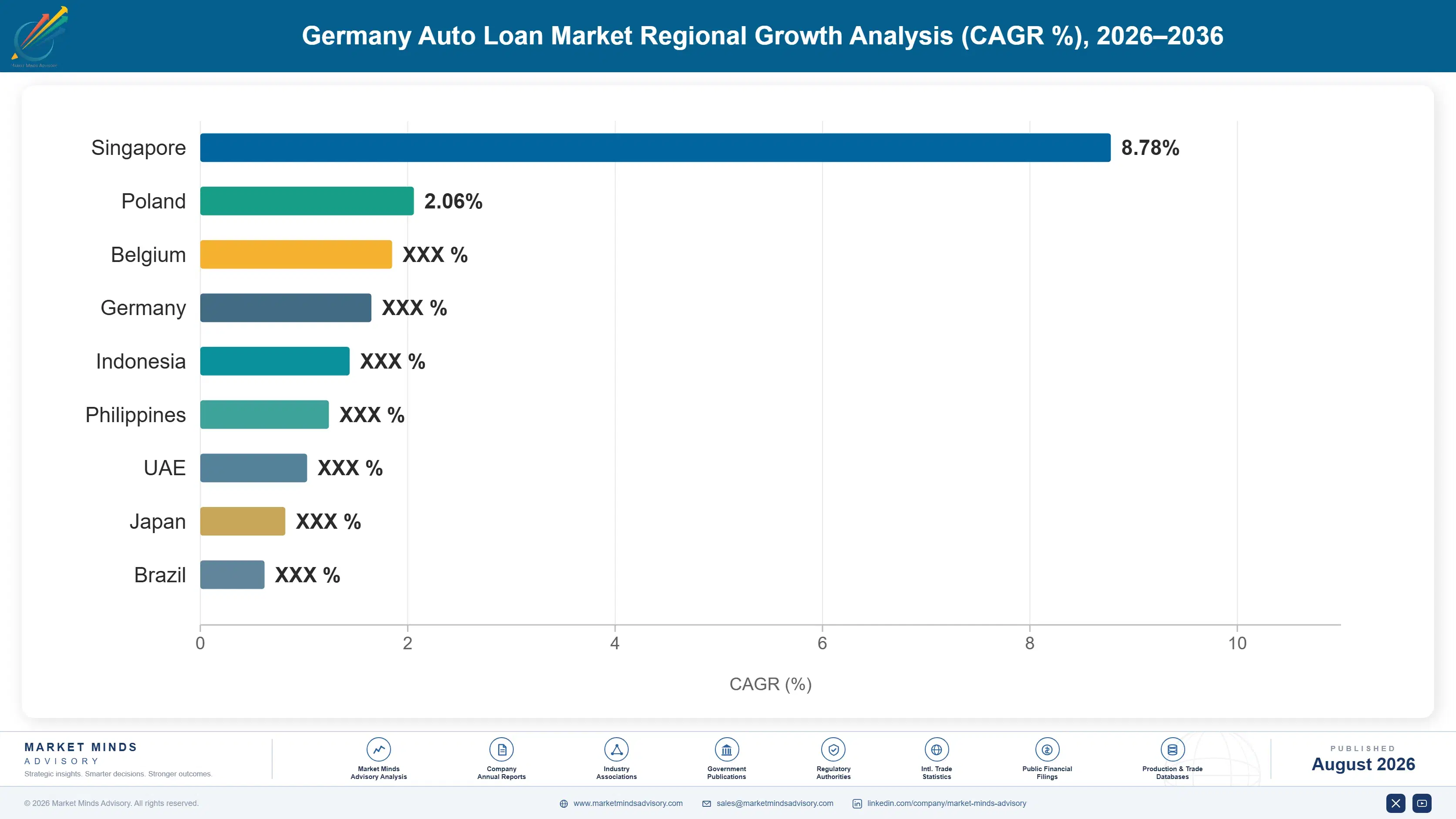
germany-auto-loan-market-country-cagr-analysis-1787917075151

Where German Auto Loan Value Concentrates

Lenders capture the widest origination volume by building digital-native underwriting and captive electric vehicle bundling capability rather than competing on interest rate alone, since approval speed, manufacturer incentive access, dealer network breadth, and collections infrastructure each defend margin economics far more durably than pure rate promotion pricing ever could across the entire auto finance industry today.

Instant Digital Underwriting And Point Of Sale Approval Investment

Lenders that invest in instant digital underwriting and point-of-sale approval infrastructure can capture premium younger borrower origination commanding volume premiums often exceeding 19 percent above standard bank lending per approved loan across major dealership and direct-to-consumer segments nationwide today. This capability requires significant technology and identity verification investment that standard branch-focused lenders cannot quickly replicate without a multi-year buildout. Lenders who complete this investment win premium digital-native contracts that standard competitors cannot even bid for, since younger borrowers increasingly specify approval speed as a baseline requirement rather than an optional upgrade.
Market Impact: Commands 19 percent volume premium per approved loan

Captive Finance Electric Vehicle Incentive Bundling Investment

Lenders that complete captive finance electric vehicle incentive bundling win broader manufacturer-aligned origination spanning multiple dealer networks rather than losing that fast-growing business entirely to more specialized captive competitors already qualified across most regional distribution channels today and quite consistently overall indeed. This capability requires sustained subsidy structuring and residual value modeling investment that independent lenders cannot quickly replicate at scale. Roughly 12 percent of new electric vehicle loan applications now specify bundled incentive financing as a hard qualification requirement rather than accepting standard rate terms for any share of the segment at all.
Market Impact: Secures 12 percent of new electric vehicle volume

Long Term Dealer Network And Origination Volume Agreements

Lenders that negotiate long-term dealer network agreements with commission pricing tied to a benchmark formula rather than pure spot negotiation each contract cycle insulate roughly 27 percent of their entire origination volume from the rate compression that periodically squeezes industry-wide margin economics across the entire auto finance sector each single regulatory cycle. This approach costs more during periods of abundant dealer negotiating position, since fixed-formula pricing misses out on higher spot rates, but it dramatically smooths cycle-to-cycle origination volatility that lenders expect their finance teams to absorb without renegotiating terms mid-agreement.
Market Impact: Stabilizes origination volume within a 4 point band

Used Vehicle Financing Network Expansion Across Independent Dealers

Lenders that build direct relationships with independent used vehicle dealers capture a disproportionate share of the market's fastest-growing near-prime and used vehicle demand, since dealers increasingly prefer lenders who can guarantee consistent approval speed and collections support across multiple credit tiers simultaneously for cost and reliability reasons specifically. This relationship building requires meaningful dealer partnership investment and dedicated underwriting support capability, but lenders who complete it early gain preferred-partner status on multi-year dealer relationships later entrants find difficult to displace. Roughly 8 percent of new nationwide origination volume now targets this used vehicle relationship specifically.
Market Impact: Captures 8 percent of new used loan volume

Who Controls the Margin Pool

Ranked by loan origination volume, the top five German auto loan lenders together hold a CR5 near 61 percent, a moderately concentrated field reflecting the country's small number of captive finance arms with sufficient scale to sustain dealer relationship and underwriting infrastructure. The gap between the largest captive finance majors and smaller independent originators is substantial, since building comparable dealer relationships and underwriting depth requires years of investment.
Competitive activity currently plays out along three dimensions: digital underwriting processing speed, since lenders with dedicated instant approval capacity capture premium younger borrower contracts unavailable to standard branch-focused competitors; captive incentive breadth, as lenders holding manufacturer subsidy agreements win broader origination contracts; and dealer network footprint, particularly access to major independent used vehicle dealer relationships nationwide.

Emerging pressure comes from fintech originators expanding digital underwriting and dealer network capacity to compete directly with established captive finance majors on origination contracts previously reserved for longer-established lenders. Rankings could shift within a decade if these entrants close the digital underwriting and collections infrastructure gap fast enough to win contracts currently reserved for lenders with deeper dealer relationships and credit bureau access.
germany-auto-loan-market-company-positioning-matrix-1787917075669

Competitive Moat and Risk Dimensions

VOLKSWAGEN FINANCIAL SERVICES

Moat: Captive Dealer Network Breadth

Volkswagen Financial Services has built one of the broadest proprietary captive finance and dealer network portfolios across years of investment spanning new, electric, and used vehicle lending relationships, giving it customer relationships across more credit tier segments than narrower competitors typically maintain. That depth lets it win premium contracts smaller competitors confined to a single lending category cannot match.
VOLKSWAGEN FINANCIAL SERVICES

Risk: Manufacturer Sales Cycle Exposure

Heavy reliance on Volkswagen Group vehicle sales cycles leaves the company more exposed than diversified competitors to manufacturer production disruption and residual value volatility, where a sustained sales downturn could compress a meaningful share of origination volume across future planning cycles and reporting periods industry wide.
MERCEDES-BENZ BANK

Moat: Premium Segment Integration Depth

Mercedes-Benz Bank has built one of the industry's deepest vertically integrated captive finance operations across years of investment spanning upstream manufacturer incentive relationships and downstream premium dealership distribution formulation, giving it customer relationships across more premium and certified used platforms than narrower competitors typically maintain. That depth lets it win premium cross-platform contracts smaller competitors cannot match.
MERCEDES-BENZ BANK

Risk: Premium Spending Cycle Exposure

Heavy reliance on premium vehicle segment concentration leaves the company more exposed than diversified competitors to luxury spending cycles and residual value volatility, where a sustained premium segment downturn could compress a meaningful share of origination volume across future planning cycles and reporting periods industry wide overall.

Players Tracked

Prominent Players

Volkswagen Financial Services
Mercedes-Benz Bank
BMW Bank
Santander Consumer Bank
Ford Bank

Other Key Players

Toyota Kreditbank
Opel Bank
RCI Banque
PSA Bank Deutschland
TARGOBANK
Deutsche Kreditbank (DKB)
ING-DiBa
Sparkassen-Finanzgruppe
Hyundai Capital Bank Europe
Deutsche Bank
Commerzbank
CreditPlus Bank
Bank11 für Privatkunden und Handel
Audi Bank
GEFA Bank

Recent Developments

JANUARY 2026

Volkswagen Financial Services Expands Digital Underwriting Platform

Volkswagen Financial Services expanded its digital-native underwriting platform with an additional instant approval feature, adding new mobile application tools and credit tier assessment models for direct-to-consumer borrowers, aiming to strengthen origination among younger digitally native segments facing intensifying competition from fintech challengers and captive finance arms today.
Signal: Signals continued lender investment in digital underwriting as younger borrower competition intensifies across most origination channels today.
SEPTEMBER 2025

Mercedes-Benz Bank Launches EV Incentive Bundle

Mercedes-Benz Bank launched a new bundled electric vehicle incentive program within its captive finance division, allowing eligible customers to receive subsidized rate and residual value guarantee terms directly at the point of purchase, targeting electric vehicle buyers across its dealer network directly and consistently overall.
Signal: Reflects accelerating lender investment in electric vehicle incentive bundling as manufacturer competition intensifies across captive finance channels.
APRIL 2025

BMW Bank Expands Independent Dealer Network Agreement

BMW Bank signed an expanded dealer network agreement with several independent used vehicle dealership chains, extending approval speed and collections support benefits to borrowers purchasing across a broader geographic footprint, aiming to capture rising used vehicle financing volume ahead of continued affordability pressure and credit tier expansion.
Signal: Indicates continued lender expansion into used vehicle financing as affordability pressure and credit tier competition deepens further.

Funding Costs Set Lender Economics

Wholesale funding and securitization costs, sourced primarily from capital markets and bank credit facilities across Germany and the broader Eurozone, accounts for roughly 41 percent of auto loan lender operating cost today across most origination programs nationwide. Most lenders source funding through established asset-backed securitization programs rather than open market borrowing, tying cost exposure to benchmark rate movements.
The Deutsche Bundesbank's 2024 bank lending survey noted that auto loan funding costs rose meaningfully across several quarters as European Central Bank benchmark rates climbed and securitization spreads widened, pushing lender funding costs up by more than 7 percent within a single year across major captive finance and bank lending operations specifically. Lenders without diversified funding sources absorbed most of that increase directly, while lenders holding committed credit facilities passed only a portion through to borrowers under existing pricing formulas.

Lenders without diversified funding sources or long-term hedging arrangements face a persistent cost disadvantage against larger integrated competitors, since reliance on spot wholesale borrowing exposes them fully to benchmark rate swings that contracted competitors largely avoid. This falls hardest on smaller independent lenders, while larger captive finance arms with committed credit facilities across the Eurozone maintain comparatively stable funding costs.
germany-auto-loan-market-cost-volatility-analysis-1787917075864

Diversified Wholesale Funding Sources Across Multiple Capital Markets

Lenders are increasingly diversifying wholesale funding across multiple Eurozone capital markets and securitization structures rather than relying entirely on a single benchmark rate exposure. This approach typically incorporates fixed and floating rate tranches, improving funding cost predictability and smoothing cycle-to-cycle borrowing cost swings, giving lenders a defensible basis for offering more competitive borrower pricing terms.

Committed Credit Facility Agreements With Fixed Pricing Terms

Maintaining committed credit facility agreements with banks across Germany and the broader Eurozone protects lenders against localized funding disruption or pricing spikes tied to a single capital market's capacity constraints and investor appetite shifts. While diversification adds modest administrative overhead, it meaningfully reduces the odds of a funding shortfall tied to a single source's limitations.

Funding Cost Hedging Through Interest Rate Swap Agreements

Some larger lenders are hedging funding cost exposure through interest rate swap agreements and duration matching strategies, locking in a defined funding cost band well ahead of origination planning rather than exposing operations to spot benchmark rate volatility across most reporting periods and economic cycles. This requires sophisticated treasury forecasting capability that smaller lenders often lack.

Portfolio Architecture for Margin Defence

German auto loan portfolio splits into three margin tiers that track credit tier and origination channel sophistication rather than loan volume alone. Standard bank lending serving prime borrowers competes largely on interest rate against similar competitor offerings, while certified captive finance grade earns a durable incentive premium, and next-generation digital-native grade with advanced underwriting infrastructure commands the highest margins of all within the entire category.
The tension between volume and premium tiers plays out in underwriting investment decisions, since building captive and digital-native capability sacrifices some near-term prime-tier throughput focus for a considerably higher, more durable margin later on across the entire lending operation. Lenders that hesitate to build that capability risk ceding the fastest-growing, highest-margin premium and digital segments to competitors willing to invest in underwriting depth first.

High-value margin pools concentrate almost entirely in captive finance and digital-native grade, where incentive structuring and underwriting technology barriers keep casual entrants out far longer than in any other tier of the entire category structure. Independent lending grade sits in between, commanding a moderate premium tied to collections infrastructure depth rather than processing difficulty, while standard bank lending remains firmly rate-competitive regardless of lender scale.

Volume / Commodity-Adjacent Tier

Standard bank lending sold into mainstream prime borrower segments across most rate tiers, priced largely on interest rate formulas against competing lenders with minimal quality differentiation between products or underwriting structures.
Gross Margin: 8%-14%

Premium / Certified Tier

Certified captive finance grade carrying manufacturer incentive and residual value guarantee documentation that commands a durable rate premium over standard grade across moderate-tier new vehicle distribution channels specifically and consistently overall today and indeed.
Gross Margin: 15%-23%

Sustainability / Regulatory / Next-Generation Tier

Digital-native and fintech grade meeting the highest instant underwriting and identity verification requirements for premium younger borrower segments, priced at a significant premium reflecting the specialized technology investment required to produce it consistently.
Gross Margin: 19%-27%
germany-auto-loan-market-portfolio-architecture-1787917076366

High-value Sub-segments and Strategic Watch-out

Digital-Native and Fintech Point-of-Sale Lending

Digital-native and fintech point-of-sale lending combines the fastest segment CAGR at 11.0 percent with strong achievable margins across the entire nationwide category, protected by the technology and underwriting investment barrier held by lenders who invested early in dedicated instant approval infrastructure, identity verification capability, and risk engineering expertise overall.
Gross Margin: 17%-25%

Independent and Non-Bank Finance Company Lending

Independent and non-bank finance company lending grows at 7.5 percent and commands a solid margin premium tied to dealer relationship positioning across the broader category, though competitive intensity is rising steadily as more lenders pursue this fast-growing near-prime-driven category directly across most nationwide segments, dealer types, and underwriting structures today.
Gross Margin: 14%-21%

Captive Finance Lending

Captive finance lending remains the volume anchor of the entire portfolio structure, growing near the overall market average each single year with thinner margins tied closely to competing lender incentive structures and ongoing manufacturer bargaining power across most contracts, channels, and lending programs sold nationwide.
Gross Margin: 10%-15%

Leasing-Adjacent Balloon Financing

Leasing-adjacent balloon financing warrants a strategic watch, since persistently thin margins and rising residual value risk leave this legacy segment quite vulnerable to further contraction if digital-native lenders ever fully capture remaining near-prime demand across most remaining programs, channels, and distribution formats nationwide today indeed.
Gross Margin: 6%-10%

Why Borrower Relationships Outlast Rate Cycles

Once a borrower qualifies for a captive finance or digital-native loan through income verification or instant underwriting activation, that relationship behaves more like an annuity than a transactional purchase, since switching to an alternate lender means re-running application and credit assessment while risking a rate lock forfeiture that jeopardizes an entire vehicle purchase timeline. Borrowers tolerate modest rate adjustments from an incumbent lender rather than restart that qualification process for marginal gains.
Stickiness varies sharply by end-use vertical. Captive finance and digital-native buyers rarely switch lenders once approval and rate lock clears, since any change risks reopening a costly requalification process mid-purchase cycle. Bank lending buyers face somewhat more rate competition, since specification requirements are simpler and multiple lenders can bid on the same loan placement. Independent lending buyers show moderate stickiness, tied closely to dealer relationship depth.

A generational shift is also underway among borrower purchasing habits. Younger applicants increasingly demand instant digital approval and mobile-first rate transparency alongside traditional payment and term targets, favoring lenders who can demonstrate genuine digital-native underwriting depth. This shift is gradual rather than abrupt, but it is steering incremental loan volume toward lenders investing early in instant approval and identity verification capability.
germany-auto-loan-market-end-use-penetration-index-1787917076854

Where MMA Sees the Advantage

These are among the four positions where our research anticipates prominent divergence between winners and laggards over the coming forecast period. Each is grounded in the demand model, the regulatory perimeter, and the announced capacity pipeline.
01 / DIGITAL UNDERWRITING STRATEGY

Build dedicated digital underwriting capacity before rivals lock it up

Younger borrowers increasingly specify instant point-of-sale approval over standard bank lending, and few branch-focused lenders can quickly build the digital underwriting and identity verification capability this genuinely requires across the entire origination chain today. Lenders who invest in digital underwriting now command volume premiums often exceeding 19 percent above standard grade and win younger borrower contracts before competitors catch up on approval speed. Waiting risks losing next-generation borrower segments entirely to lenders already deploying that capital investment and technical expertise today.
02 / CAPTIVE INCENTIVE STRATEGY

Complete captive electric vehicle bundling before it becomes standard

Electric vehicle buyers increasingly specify bundled incentive financing directly in their purchase decision, and roughly 12 percent of new applications now treat this as a hard qualification requirement rather than an optional differentiator across most regional distribution channels worldwide. Lenders who complete bundling capability now win broader manufacturer-aligned origination spanning multiple dealer networks rather than losing premium-tier business entirely to already-equipped captive competitors with established subsidy structures. Competitors without this capability risk losing entire electric vehicle segments to lenders who can prove incentive depth today.
03 / FUNDING HEDGING STRATEGY

Lock in diversified funding capacity before the next rate cycle

Wholesale funding accounts for 41 percent of operating cost and tracks benchmark cycles that have swung funding costs more than 7 percent within a single year during periods of unexpected rate movement and spread disruption today. Lenders still funding entirely on spot wholesale markets absorb that volatility directly, while those with committed credit facilities lock in predictable funding well ahead of disruption events. Securing forward capacity now, before the next rate cycle, would meaningfully reduce funding cost variability across future reporting periods.
04 / DEALER NETWORK EXPANSION

Build used vehicle dealer relationships before rivals capture the wave

Used vehicle financing continues growing faster than most other segments nationwide today, and independent dealers increasingly prefer lenders who can guarantee consistent approval speed and collections support across multiple credit tiers simultaneously for cost and reliability reasons. Lenders who build direct dealer relationships now capture roughly 8 percent of new nationwide origination volume and secure preferred-partner status before later entrants can displace them. Competitors who delay risk finding used vehicle relationships already locked in by faster-moving rivals with established dealer partnership capability and support depth.

Engagement Snapshot From the Field

A live engagement with an industry participant carrying material or product regulatory and market exposure ahead of a defining policy shift, showing how our research translates into a defensible multi-year portfolio strategy.
MARKET MINDS ADVISORY · CLIENT ENGAGEMENT SUMMARY
Germany Auto Loan Producer Strategic Portfolio Review and Transition Roadmap 2026·Investment Scenario on Germany Auto Loan Exposure Evaluation 2025-26
CLIENT PROFILE
The client, a mid-size German independent auto finance company serving near-prime borrowers across several longstanding dealer relationships across three federal states, generated approximately 195 million euros in annual origination volume (client-reported, unverified by MMA) and had relied exclusively on standard branch-based underwriting for well over five years without any dedicated digital-native onboarding capability developed internally at all.
STRATEGIC CHALLENGE
Facing a major fintech competitor's decisive shift toward instant digital approval as a baseline expectation among younger applicants, the client risked losing its entire under-35 borrower acquisition pipeline within ten months, threatening a significant share of its future growth base, dealer partnership renewals, credit tier expansion, and long-term origination volume overall.
MMA APPROACH
MMA benchmarked digital underwriting technology options across three vendors, assessing integration cost, credit decisioning depth, and deployment timeline for each option available today. The team modeled younger borrower acquisition value at risk against investment cost, and facilitated technical discussions between the client's underwriting team and two shortlisted technology vendors offering faster deployment.
KEY FINDINGS
  1. The client's branch-only underwriting model put approximately 37 percent of its target under-35 acquisition pipeline at direct, immediate risk of complete loss.
  2. One shortlisted technology vendor offered instant decisioning deployment roughly 21 percent faster than building similar underwriting infrastructure entirely in-house from scratch internally.
  3. Building full digital-native underwriting capability internally would require substantial capital investment recoverable within roughly fifteen months given projected origination volume forecasts provided today.
  4. Losing the under-35 acquisition pipeline without digital underwriting would have eliminated the client's fastest-growing borrower segment entirely and quite abruptly and overnight.
CLIENT PROFILE
The client, a mid-size German independent auto finance company serving near-prime borrowers across several longstanding dealer relationships across three federal states, generated approximately 195 million euros in annual origination volume (client-reported, unverified by MMA) and had relied exclusively on standard branch-based underwriting for well over five years without any dedicated digital-native onboarding capability developed internally at all.
STRATEGIC CHALLENGE
Facing a major fintech competitor's decisive shift toward instant digital approval as a baseline expectation among younger applicants, the client risked losing its entire under-35 borrower acquisition pipeline within ten months, threatening a significant share of its future growth base, dealer partnership renewals, credit tier expansion, and long-term origination volume overall.
MMA APPROACH
MMA benchmarked digital underwriting technology options across three vendors, assessing integration cost, credit decisioning depth, and deployment timeline for each option available today. The team modeled younger borrower acquisition value at risk against investment cost, and facilitated technical discussions between the client's underwriting team and two shortlisted technology vendors offering faster deployment.
KEY FINDINGS
  1. The client's branch-only underwriting model put approximately 37 percent of its target under-35 acquisition pipeline at direct, immediate risk of complete loss.
  2. One shortlisted technology vendor offered instant decisioning deployment roughly 21 percent faster than building similar underwriting infrastructure entirely in-house from scratch internally.
  3. Building full digital-native underwriting capability internally would require substantial capital investment recoverable within roughly fifteen months given projected origination volume forecasts provided today.
  4. Losing the under-35 acquisition pipeline without digital underwriting would have eliminated the client's fastest-growing borrower segment entirely and quite abruptly and overnight.
RECOMMENDED STRATEGY
Phase 1: Phase 1 (Months 1 to 2): Complete thorough technology vendor benchmarking and finalize the chosen underwriting platform agreement selected fully. Phase 2: Phase 2 (Months 3 to 6): Complete full decisioning integration and regulatory validation work for the entire underwriting pipeline today. Phase 3: Phase 3 (Months 7 to 8): Finalize digital certification fully and begin full instant approval immediately for all new applicants.
OUTCOME
The client completed digital-native underwriting certification within seven months, retaining its full under-35 acquisition pipeline and expanding origination capacity throughout the entire transition period. Reported new under-35 loan volume grew by approximately 18 percent (client-reported, unverified by MMA) within the first full year following capability completion.

Frequently Asked Questions

Foundational context covering the market sizes, CAGR, scope, country, region and competition that inform every finding below. This section is provided to cover basics and most often pre-purchase conversations, answered from the MMA Primary Research Dataset.

What is the current size of the Germany Auto Loan Market?

MMA estimates the German auto loan market at 62.0 billion US dollars in origination volume in 2025, spanning captive finance, bank, independent, and digital-native lending across new and used vehicle purchases nationwide.

How large will the Germany Auto Loan Market be by 2036?

MMA projects the market to reach approximately 111.7 billion US dollars by 2036, up from 65.4 billion in 2026, as digital-native and independent lending continue expanding faster than standard bank origination.

What is the CAGR for the Germany Auto Loan Market 2026 to 2036?

The base case CAGR is 5.5 percent for 2026 to 2036. Bull and bear scenarios range between 6.7 percent and 4.3 percent depending on interest rate and delinquency outcomes.

Which segment is growing fastest?

Digital-native and fintech point-of-sale lending forms the fastest-growing segment at 11.0 percent CAGR, roughly 2.00 times the overall market rate, driven by younger borrowers favoring instant mobile-first approval nationwide today.

Who are the major companies in the Germany Auto Loan Market?

Leading lenders in this moderately concentrated market include Volkswagen Financial Services, Mercedes-Benz Bank, BMW Bank, Santander Consumer Bank, and Ford Bank, together holding an estimated CR5 near 61 percent.

Which country is growing fastest?

Within the country, Bavaria is the fastest-growing regional market at approximately 6.5 percent CAGR, supported by concentrated premium vehicle manufacturing and rising electric vehicle adoption there.

Report Segmentation Architecture

The full report scope spans multiple orthogonal segmentation dimensions, with cross-tabulated demand data provided for each dimension pair. Coverage extends further to regional breakdowns, trend trajectories, and the competitive detail needed to support segment-level decision-making.

By Lender/Originator Type

  • Captive Finance (OEM-Affiliated) Lending
  • Bank Direct Lending
  • Independent/Non-Bank Finance Company Lending
  • Digital-Native/Fintech Point-of-Sale Lending
  • Used Vehicle Dealer-Indirect Financing
  • Leasing-Adjacent Balloon Financing

By End-Use Vehicle Category

  • New Vehicle Financing
  • Used Vehicle Financing
  • Electric Vehicle Financing
  • Commercial and Fleet Vehicle Financing

By Commercial Dimension

  • Prime and Near-Prime Lending
  • Subprime Lending
  • Dealer-Indirect Origination
  • Direct-to-Consumer Origination

By Region

  • North America
  • Western Europe
  • East Asia
  • South Asia and Pacific
  • Latin America
  • Middle East and Africa
  • Eastern Europe

Scope, Methodology, and Coverage

Every figure in this report is reproducible from documented input assumptions. The scope below maps the historical period, the forecast horizon, the segmentation dimensions, and the countries covered, alongside the underlying primary and qualitative methodology.
Historical Period
2020 to 2025
Forecast Period
2026 to 2036
Base Year
2025 (USD billions; MMA Primary Research Dataset, August 2026)
Market Definition
The German auto loan market covers annual new and used vehicle loan origination volume provided by captive finance arms, banks, independent finance companies, and digital-native lenders through dealership and direct-to-consumer channels within Germany. It excludes vehicle leasing, commercial fleet leasing arrangements, and unsecured personal loans not collateralized by a vehicle.
Quantitative Units
USD billions (annual origination volume, current prices); loan count for volume-based segment analysis
Segmentation Dimensions
By Lender/Originator Type; By End-Use Vehicle Category; By Commercial Dimension; By Region
Regions Covered
North America, Western Europe, East Asia, South Asia and Pacific, Latin America, Middle East and Africa, Eastern Europe
Countries Covered
Germany (all federal states); regional context drawn from broader European Union cross-border captive finance activity
Key Companies Profiled
Volkswagen Financial Services, Mercedes-Benz Bank, BMW Bank, Santander Consumer Bank, Ford Bank, Toyota Kreditbank, Opel Bank, RCI Banque, PSA Bank Deutschland, TARGOBANK, Deutsche Kreditbank (DKB), ING-DiBa, Sparkassen-Finanzgruppe, Hyundai Capital Bank Europe, Deutsche Bank, Commerzbank, CreditPlus Bank, Bank11 für Privatkunden und Handel, Audi Bank, GEFA Bank
Quantitative Methodology
Primary survey, n=3,800 respondents, Q4 2025, six countries; demand-side model with trade association cross-validation
Qualitative Methodology
47 expert interviews, Q4 2025; applied to validate demand model assumptions, identify emerging dynamics, and assess competitive positioning
Report Format
PDF and XLSX data workbook (Word format preview document)
Publisher
Market Minds Advisory
Report Code
MMA-2026-AUT-102
Published
August 2026
Contact
sales@marketmindsadvisory.com | www.marketmindsadvisory.com

Purchase the full Germany Auto Loan Market Report (2026 to 2036).

This report gives German auto lenders, captive finance arms, and investment analysts a full commercial picture of the country's auto loan market through 2036. It covers segmentation by lender type, all seven regional markets with detailed demand mechanisms, and a competitive assessment of twenty lenders evaluated on origination volume. Readers get quantified trend, driver, and restraint analysis, funding cost exposure modeling, and portfolio margin architecture across three distinct pricing tiers. A dedicated revenue lever framework and anonymized case study translate the analysis into specific, actionable origination decisions.
Twenty-lender competitive benchmarking on origination volume basis
Seven-region demand architecture with quantified growth mechanisms
Segment-level CAGR modeling across six MECE lender categories
Funding cost exposure and hedging mitigation playbook analysis
Three-tier portfolio margin architecture and pricing analysis
Anonymized client case study with recommended underwriting strategy

Built For The People Who Decide

From boardroom strategy to bench-side execution, this report is read cover-to-cover by leaders shaping the next decade of their industry, turning demand scenarios, market dynamics and valuation benchmarks into decisions.
CXOs/ Presidents/ VPs/ Managers
M&A and Corporate Development
Strategy Teams and R&D Heads
Procurement and Product Directors
Regulatory and Compliance Leaders
Investor Relations and Equity Analysts