Market Minds Advisory
Gemini Surfactants for Enhanced Oil Recovery Market

Gemini Surfactants for Enhanced Oil Recovery Market: Gemini Surfactants for Enhanced Oil Recovery Market: Adsorption Decides Everything

A surfactant that performs beautifully in a beaker and then sticks to the rock never reaches the oil. Adsorption loss decides this market, and almost nobody in it sells against that.

Lead Analyst

Published

September 2026

Make Smarter Decisions with Customized Research Insights

Request a free sample report and evaluate market opportunities, growth trends, and competitive dynamics relevant to your business needs.

2025 MARKET VALUE$0.3BMarket Size 2025
2036 FORECAST VALUE$1.1BBase Case , 2026 to 2036
CAGR 2026 TO 203612.6 %Bull 13.9% / Bear 11.3%
INCREMENTAL OPPORTUNITY$0.8BNet 10- year value creation
EXPANSION MULTIPLE3.26x2036 value over 2026 base
Strategic Levers
M&A Pipeline
Regional Outlook
Country Rankings
Competitive Intelligence
Segmental Deep-dive
Call-Us : 91 93563 13602

Executive Snapshot and Market Trajectory.

Two heads and two tails joined by a spacer give these molecules a critical micelle concentration one or two orders of magnitude below a conventional surfactant, which means far less chemical for the same interfacial tension. Whether that translates into cheaper oil depends entirely on the adsorption.
Cationic gemini surfactants for carbonate reservoirs grow at 18.9%, half again the market rate of 12.6%, because carbonate rock carries a positive surface charge that strips anionic chemistry out of solution before it ever reaches oil. East Asia holds 38% of demand, far above any normal band, and the reason is that Daqing and Shengli have run the largest chemical flooding programmes in the world for four decades. Nothing in the West approaches that scale.
Concentration is high at 58% of qualified trial volume, because a surfactant cannot be sold into a reservoir until it has survived a core flood, a phase behaviour study and usually a pilot, and that qualification takes years. The commercially decisive capability is not synthesis at all. It is holding data from reservoirs that resemble the customer's, and almost nobody publishes any. That secrecy slows the whole field down.
Market Definition
The gemini surfactants for enhanced oil recovery market covers dimeric surfactant chemistries carrying two hydrophilic head groups and two hydrophobic tails joined by a spacer, supplied for chemical flooding of oil reservoirs, spanning cationic gemini surfactants for carbonates, anionic sulfonate gemini surfactants, zwitterionic gemini surfactants, nonionic ethoxylated gemini surfactants, gemini-polymer hybrid systems, and bio-based sugar-derived gemini surfactants. Scope is measured as chemical supplied into field application and qualified pilot programmes. Excluded are conventional monomeric surfactants, polymer flooding agents supplied alone, alkali chemicals, thermal and gas injection recovery methods, and drilling or completion fluid surfactants.
Base Year Value
$0.3B in 2025 (MMA Primary Research Dataset, August 2026)
Forecast Period
2026 to 2036, eleven discrete annual values
CAGR
12.6% base case. Bull 13.9%. Bear 11.3%.
Fastest Growth Segment
Cationic Gemini Surfactants for Carbonates: 18.9% CAGR
Fastest Growth Country
India: 14.8% CAGR
Fastest Growth Region
South Asia and Pacific: 14.8% CAGR
Largest Region
East Asia: 38% of 2025 global value
Market Leaders
BASF, Sasol, Stepan Company, Syensqo and SNF Group. Source: MMA Analysis, July 2026.
Primary Survey
n=3,800 procurement and R&D decision-makers, Q4 2025, six countries
Methodology
Demand-side build-up, cross-validated against public data, 47 expert interviews

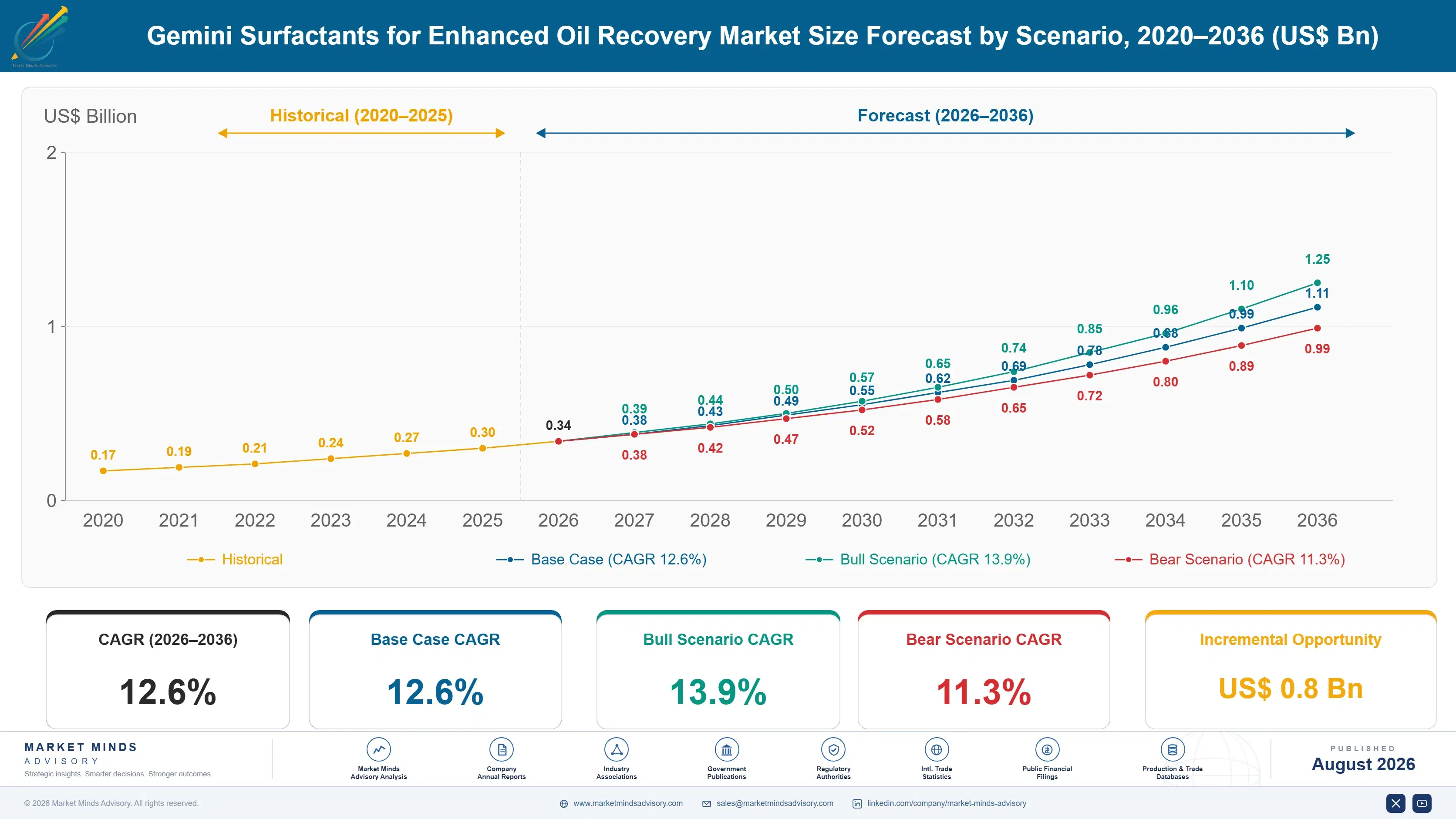
Gemini Surfactants for Enhanced Oil Recovery Market Forecast Scenarios

gemini-surfactants-for-enhanced-oil-recovery-marke-size-forecast-scenario-1788193647100
Between 2020 and 2025 the sector compounded at 11.4% from a base small enough that a single field programme moved the number. Chinese chemical flooding continued through the price collapse because the fields were already committed, while North American and European pilots stopped entirely and several never restarted. Laboratory publication ran far ahead of actual field deployment throughout the whole of that period.
The 12.6% base case rests on three mechanisms. Remaining candidate reservoirs are hotter and more saline than the ones already flooded, which conventional surfactant chemistry handles poorly and gemini structures handle considerably better. Chinese programmes at Daqing and Shengli continue to consume chemical at volumes nobody else approaches. And carbonate reservoirs across the Middle East, which hold enormous remaining oil, need cationic chemistry that only recently reached field qualification. None of the three depends on new discoveries.
The bull case at 13.9% turns on a Middle Eastern carbonate operator committing to full-field cationic gemini flooding, which would multiply category volume in a single decision. The bear case at 11.3% is oil price: chemical flooding is discretionary spending measured against a barrel, and every operator cancelled these programmes within weeks the last time prices fell.

What Reaches The Oil, Not The Rock

The molecular argument is strong and it is not the commercial argument. Joining two surfactant monomers through a spacer produces a critical micelle concentration around 0.04 millimolar, one or two orders below a conventional molecule, so a fraction of the dosage achieves the same interfacial tension. Synthesis is multi-step and the chemical costs several times more per kilogram. Whether the dosage saving covers that gap is the only question that matters.
TOP FIVE CONCENTRATION58%Share of qualified trial volume held by five suppliers
CRITICAL MICELLE CONCENTRATION0.04 mMConcentration at which micelles form, far below conventional surfactants
ROCK ADSORPTION LOSS0.7 mg/gChemical lost to reservoir rock rather than reaching oil
INCREMENTAL BARREL COSTUSD 21Chemical cost per additional barrel recovered from a flood
SALINITY TOLERANCE LIMIT180,000 ppmBrine concentration at which performance remains within design specification
FIELD TRIAL DURATION34 monthsMedian time from injection start to measurable production response
Adsorption is where the argument is usually lost. Chemical that binds to reservoir rock never reaches the oil, and a heavier molecule with two charged heads can adsorb more readily than the monomer it replaced, particularly on carbonate surfaces. Typical loss runs around 0.7 milligrams per gram of rock. A supplier quoting laboratory interfacial tension without core flood adsorption data is quoting the wrong number entirely.
Where these molecules genuinely win is heat and salt. Remaining candidate reservoirs are hotter and more saline than anything already flooded, and conventional sulfonate chemistry precipitates or loses activity well before 180,000 parts per million. Gemini structures hold performance through it. That is a narrow advantage and it happens to sit exactly where the remaining oil is, which is the whole commercial case.
"Every vendor in this business leads with interfacial tension because it is the number that looks best. Ask for the core flood adsorption data from a rock that resembles the customer's reservoir and most of the conversation stops immediately."
Director, Oilfield Chemistry Practice · MMA Chemicals and Materials Practice · August 2026

Market Trends

Remaining reservoirs are hotter and saltier than before

The reservoirs still available for chemical flooding are the ones nobody flooded first, which means higher temperature and brine salinity beyond what conventional sulfonate chemistry tolerates before it precipitates or loses activity. Gemini structures hold ultralow interfacial tension through salinity around 180,000 parts per million and at temperatures where monomeric surfactants degrade. That is a narrow technical advantage sitting exactly where the remaining recoverable oil happens to be, across Middle Eastern carbonates and mature Chinese and Indian fields. It is the reason this category exists commercially rather than only in journals.
Market Impact: Drives 38% of world demand
Carbonate reservoirs demand a different charge entirely

Carbonate rock carries a positive surface charge that binds anionic surfactant out of solution before it reaches oil, which is why decades of sandstone flooding experience transferred so badly into limestone and dolomite fields. Cationic gemini chemistry avoids that binding mechanism and reaches the oil at dosages that make the arithmetic work. That segment grows at 18.9% against a market rate of 12.6% as a result. Middle Eastern carbonates hold an enormous share of remaining conventional oil, which makes this the most commercially consequential technical shift in the category. Nobody has deployed it at scale.
Market Impact: Sustains programmes through 3 price cycles

Market Opportunities and Growth Drivers

Chinese field programmes consume most world volume

Daqing and Shengli have run commercial chemical flooding at a scale nobody else has attempted, across four decades and through oil price cycles that stopped every Western pilot programme dead. That continuity produced field data, operating experience and a domestic surfactant manufacturing base that no other market holds, and East Asia now takes 38% of category demand. Chinese research institutes have published extensively on gemini and betaine chemistries while Western operators were still deciding whether to fund a pilot. The knowledge gap is wider than the volume gap, and it compounds.
Market Impact: Loses 0.7 mg per gram rock

Recovery factor targets sit inside national policy

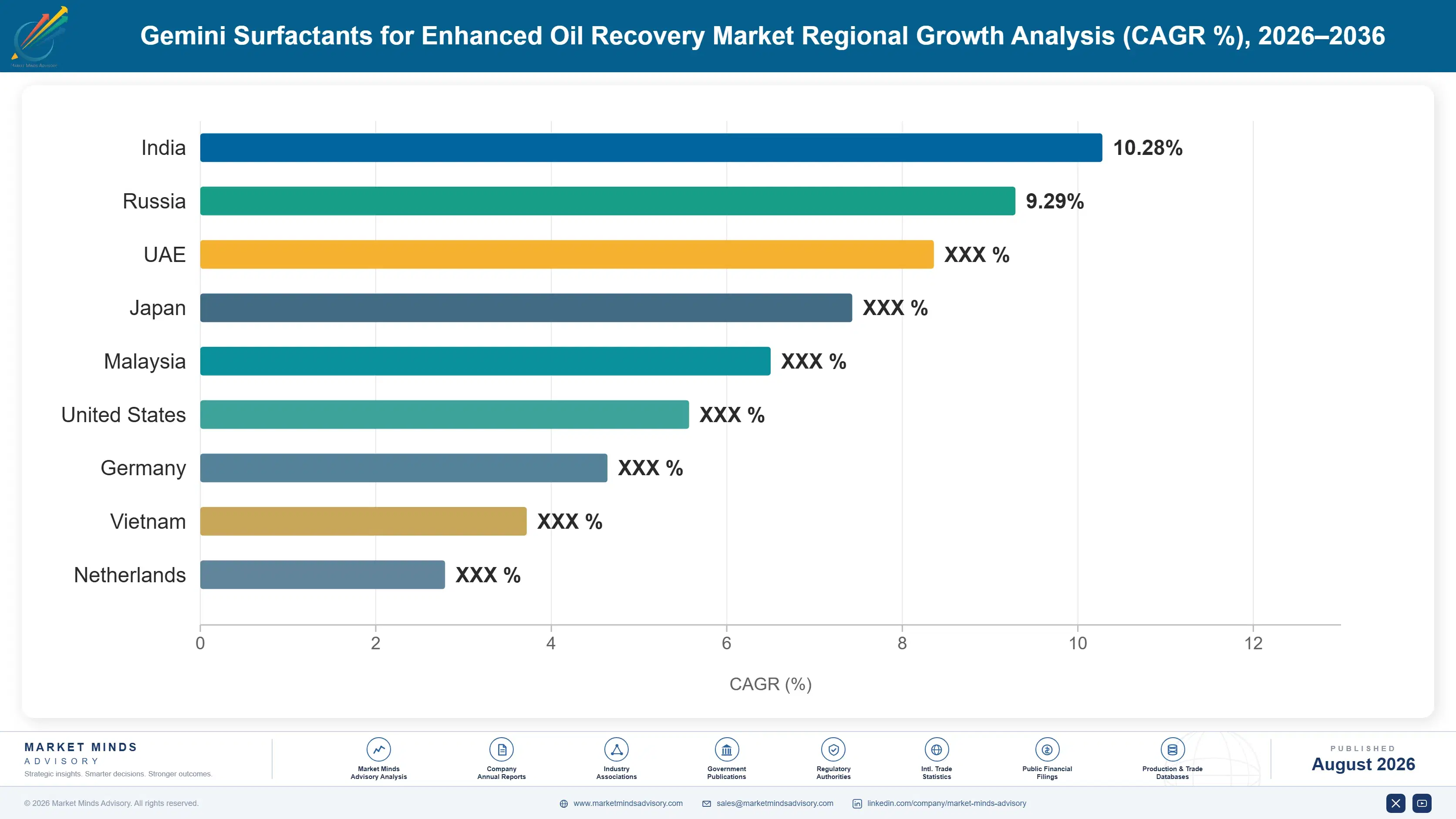
State oil companies across China, India and the Middle East operate under recovery factor targets set as national policy rather than as commercial optimisation, which changes the investment logic entirely. A private operator compares chemical cost against barrel price and stops when the arithmetic turns. A national company facing a mandate to raise recovery from mature fields continues through price cycles that would end a commercial programme. That policy layer is why Indian growth runs at 14.8%, the fastest of any country covered, and it is not a market signal at all.
Market Impact: Takes 34 months to response

Market Restraints and Challenges

Adsorption loss can void the entire dosage advantage

A gemini molecule carries higher molecular weight and two charged head groups, and on some rock surfaces it adsorbs more readily than the monomer it replaced, which means chemical paid for at several times conventional cost never reaches oil at all. The root cause is that adsorption depends on rock mineralogy, brine chemistry and temperature together, so laboratory results transfer poorly between reservoirs. Commercial impact is that a promising chemical fails in a specific field for reasons nobody predicted. Participants are responding with sacrificial agents, alkali co-injection, tailored spacer chemistry and reservoir-specific core flood programmes before any commitment.
Market Impact: Holds through 180,000 ppm salinity

Field qualification takes longer than most budgets

A surfactant reaches commercial supply only after phase behaviour screening, core flooding, a single well test and usually a multi-year pilot, and median time from injection start to measurable production response runs 34 months on its own. The root cause is that a reservoir cannot be sampled the way a process stream can, so the response is the experiment. Commercial impact is a development cycle longer than the planning horizon of most chemical businesses. Mitigation runs through operator-funded joint qualification, shared core libraries, single well chemical tracer tests and staged commercial terms tied to production response.
Market Impact: Grows at 18.9% against 12.6%
3 additional market trends, 4 additional growth drivers, and 2 additional restraints and challenges are covered in the full report. Contact sales@marketmindsadvisory.com to access the complete intelligence.

Segment CAGR and Growth Architecture

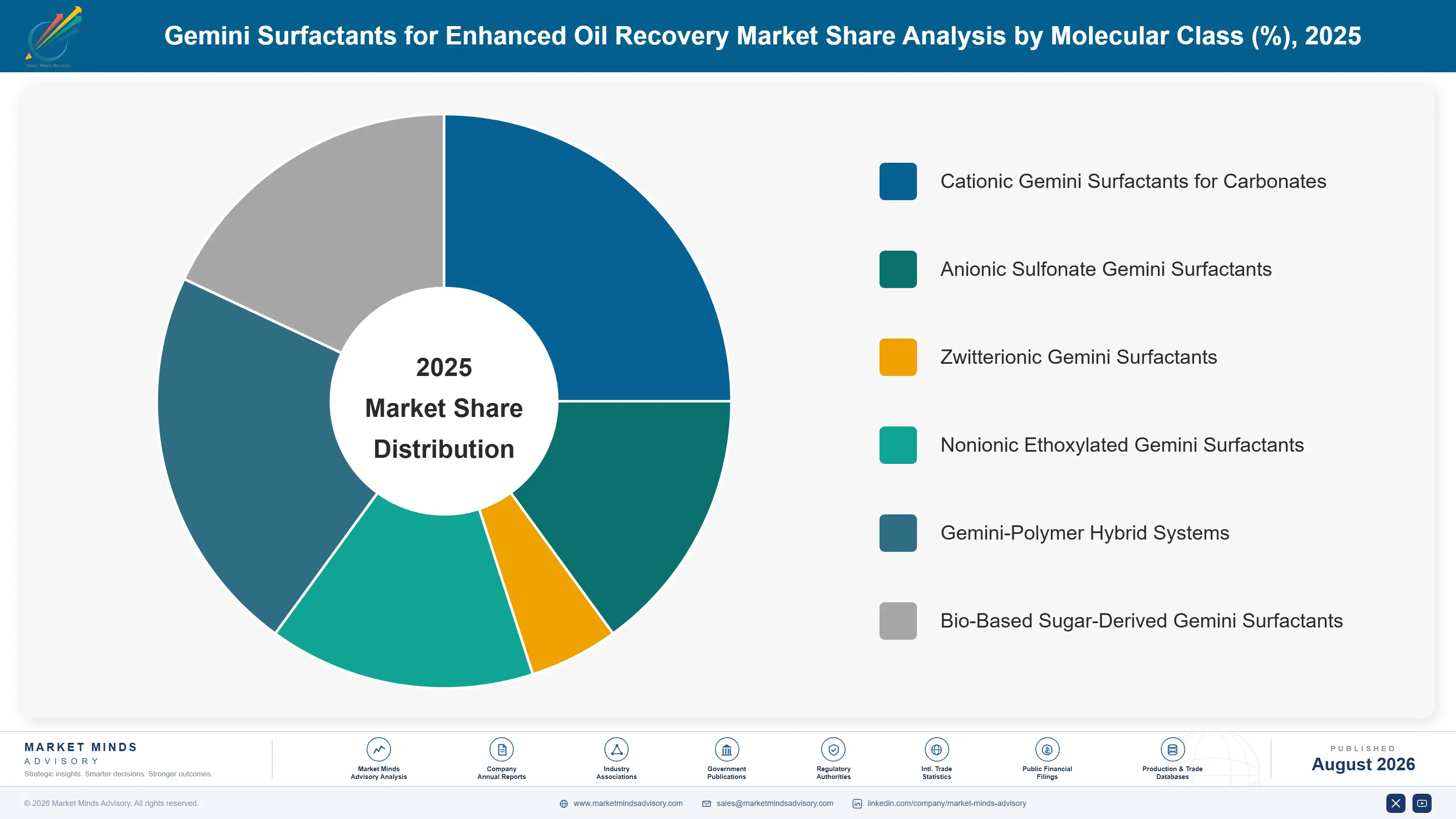
Segmentation follows molecular class, the dimension on which rock compatibility, salinity tolerance and synthesis cost all move together. Anionic and nonionic chemistries carry the volume in sandstone fields already under flood. Cationic and zwitterionic structures carry the growth, because both reach the carbonate and high-salinity reservoirs where the remaining recoverable oil actually sits. That is where the money is.
gemini-surfactants-for-enhanced-oil-recovery-marke-market-share-analysis-1788193647656

Cationic Gemini Surfactants for Carbonates

Cationic gemini surfactants grow at 18.9%, half again the market rate of 12.6%, and the reason is electrostatic rather than economic. Carbonate rock carries a positive surface charge that binds anionic surfactant out of solution before it reaches any oil, which is why decades of sandstone flooding experience translated so poorly into limestone and dolomite fields. A cationic head group avoids that binding entirely and reaches the oil at dosages the arithmetic can support. Middle Eastern carbonates hold an enormous share of remaining conventional oil and have barely been touched by chemical methods, which makes this the segment with the largest gap between technical readiness and deployed volume anywhere in the category.
CAGR 18.9%

Zwitterionic Gemini Surfactants

Zwitterionic gemini structures at 15.4% carry both a positive and a negative charge on the same molecule, which makes them unusually indifferent to brine composition and to divalent cations that precipitate conventional sulfonates outright. That tolerance matters because formation water in mature fields is far saltier and harder than the fresh water available for injection, and treating the brine is often more expensive than upgrading the chemical. Betaine-derived structures dominate commercial supply and Chinese producers hold most of the manufacturing base after decades of domestic field programmes. Synthesis cost sits above anionic chemistry and below cationic, which places the segment in a commercially comfortable position most participants underuse. Very few have priced it that way.
CAGR 15.4%
Full segment breakdown across 6 segments available in the complete report.

Regional Architecture and Country Demand Map

East Asia takes 38% and Middle East and Africa 18%, both far outside normal bands, because this market follows reservoir geology rather than economy size. Western shares sit low for the same reason. South Asia grows fastest. Nothing about this map resembles a normal chemicals market at all.

East Asia

The 38% share sits far above any normal band and one programme explains most of it: Daqing and Shengli have run commercial chemical flooding continuously for four decades, at a scale no other country has attempted and through price cycles that ended every Western pilot. That continuity built field data, operating experience and a domestic surfactant manufacturing base simultaneously. Chinese research institutes have published extensively on gemini and betaine chemistry while operators elsewhere were still deciding whether to fund a first pilot. State ownership removes the quarterly arithmetic that stops these programmes elsewhere. The knowledge advantage here is considerably wider than the volume figure suggests, and it keeps compounding. Volume alone understates it.
Share: 38% | CAGR: 13.6% (2026 to 2036)

Middle East and Africa

An 18% share far above the usual band follows directly from rock type rather than from any policy or spending decision. Carbonate reservoirs across Saudi Arabia, the UAE, Kuwait and Oman hold an enormous share of remaining conventional oil, and carbonate chemistry is exactly where cationic gemini structures have an advantage that conventional surfactants cannot match. Deployment is early and the pilots that exist are operator-funded and largely unpublished. North African fields in Algeria and Libya carry similar geology with far less capital behind them. If a single major carbonate operator commits to full field flooding, this region's share moves considerably again. Almost nobody is positioned for that decision yet.
Share: 18% | CAGR: 13.0% (2026 to 2036)
Regional intelligence for 5 additional markets available in the complete report: North America, Western Europe, South Asia and Pacific, Latin America, Eastern Europe. Contact sales@marketmindsadvisory.com.
gemini-surfactants-for-enhanced-oil-recovery-marke-country-cagr-analysis-1788193648176

Four Moves On Field Qualification

None of these four requires better molecules, which is fortunate, because the chemistry is already ahead of anything the field has deployed. Each works on the actual barrier, which is that an operator cannot buy a surfactant it has not qualified, and qualification takes years that nobody has budgeted for. Qualification is the whole barrier here.

Publish the adsorption data, not the tension

Every supplier leads with interfacial tension because it is the number that looks best, and every operator knows that a chemical adsorbing at 0.7 milligrams per gram of rock never reaches the oil regardless of what it does in a beaker. Publishing core flood adsorption results against named rock types converts a sales claim into evidence an operator can evaluate without running its own screening. It costs laboratory time already being spent. The suppliers who did this reached qualification lists two years ahead of those still quoting tension numbers. It is not a research problem.
Market Impact: Reports adsorption loss of 0.7 mg per gram

Build the carbonate case before anybody asks

Cationic gemini chemistry grows at 18.9% against a market rate of 12.6% because carbonate rock strips anionic surfactant out of solution, and Middle Eastern carbonates hold an enormous share of remaining conventional oil with almost no chemical flooding deployed against it. Operators there are early in evaluation and short of comparable field data. A supplier arriving with core flood results on representative carbonate, rather than sandstone results and an assurance, is answering the question actually being asked. Very few have done the carbonate work at all. That is the widest open position in this market.
Market Impact: Targets a carbonate segment now growing 18.9% annually

Share the qualification cost with the operator

Median time from injection to measurable response runs 34 months, which is longer than the planning horizon of most chemical businesses and longer than most operators want to fund alone. Joint qualification programmes, where the supplier contributes chemical and laboratory work against operator-funded field access, split a cost neither party wants to carry entirely. The supplier gains reservoir-specific data worth more than the chemical given away. Operators propose these arrangements readily once asked, and remarkably few suppliers ever ask them. The chemical given away costs less than a single failed evaluation does.
Market Impact: Splits a 34 month qualification cost two ways

Sell the salinity tolerance to brine handlers

Operators facing formation water at 180,000 parts per million usually cost the problem as water treatment, since conventional surfactant precipitates in it and the standard answer is softening or dilution with fresh water nobody has. A chemistry that works in the brine as produced removes a treatment plant from the project rather than adding a chemical to it. That reframes the purchase from a chemical cost against a barrel into an avoided capital cost, which reaches the project economist instead of the reservoir engineer. Nobody sells it that way. It reaches a different budget entirely.
Market Impact: Avoids treating produced brine at 180,000 ppm salinity

Who Controls the Margin Pool

CR5 stands at 58% of qualified field trial volume, which is the only defensible basis given that no participant reports gemini surfactant revenue separately from wider oilfield or surfactant businesses. Concentration is high because qualification rather than synthesis is the barrier, and an approved supplier stays approved. The gap between the leaders and the field is a gap in reservoir data held rather than chemistry mastered.
Competition runs on qualification status, reservoir data breadth and operator relationships. Qualification decides who can be specified at all, since a chemical unproven in comparable rock does not enter a tender. Data breadth decides who can answer a new reservoir quickly rather than beginning a two year programme. Relationships decide who hears about a field evaluation early enough to participate. Synthesis capability differentiates almost nothing.

Rankings will move on carbonate deployment in the Middle East, which is where the largest gap between technical readiness and field volume currently sits. A supplier holding cationic core flood data on representative carbonate is positioned for a commitment that would multiply category volume in one decision. The pressure comes from geology rather than from competitors, which rewards patience over commercial aggression entirely.
gemini-surfactants-for-enhanced-oil-recovery-marke-company-positioning-matrix-1788193648702

Competitive Moat and Risk Dimensions

BASF

Moat: Qualification breadth across reservoir types

Long involvement in enhanced recovery chemistry across sandstone and carbonate fields on several continents gives the group core flood and pilot data across a range of rock and brine conditions that a newer entrant cannot assemble quickly. That library answers an operator's first question immediately. Building an equivalent requires field access rather than laboratory capacity, and that is granted slowly.
BASF

Risk: Programme funding tracks oil price

Chemical flooding is discretionary expenditure measured against a barrel, and operator programmes stopped within weeks the last time prices fell sharply, taking supplier revenue with them. A large chemical group carries the research cost through those periods and earns nothing from it. That cyclicality is unavoidable and it makes internal capital allocation against this business genuinely difficult to defend.
STEPAN COMPANY

Moat: Surfactant synthesis depth and flexibility

Deep surfactant manufacturing capability across a wide range of chemistries allows the group to make and vary spacer length, head group and tail structure at commercial scale rather than only in a laboratory. That flexibility matters because gemini performance is reservoir-specific and the useful molecule differs. Few participants can synthesise a tailored variant at the volumes a pilot consumes.
STEPAN COMPANY

Risk: Limited direct operator access

Selling through service companies and distributors rather than directly to reservoir engineering functions means the group often learns of a field evaluation after the candidate list is set. Qualification decisions are made by people it does not meet. Building direct operator relationships in national oil companies takes years and a presence in regions where the group's commercial footprint is thin.

Players Tracked

Prominent Players

BASF
Sasol
Stepan Company
Syensqo
SNF Group

Other Key Players

ChampionX
Halliburton
SLB
Huntsman
Clariant
Dow
Kao Corporation
Croda International
Oil Chem Technologies
Nouryon
Evonik Industries
Zhejiang Zanyu Technology
Jiangsu Aoxin
Innospec
Lubrizol

Recent Developments

MARCH 2025

Middle Eastern carbonate pilot reported production response

A Gulf operator reported measurable incremental production from a cationic gemini surfactant pilot in a carbonate reservoir, the first published response of its kind from that rock type in the region. Evaluation programmes at neighbouring operators expanded within two quarters of the result becoming known.
Signal: One published carbonate response did more for this category than a decade of laboratory work had.
JULY 2025

Chinese producers expanded betaine gemini manufacturing capacity

Chinese surfactant producers brought additional betaine-derived gemini capacity into operation to serve continuing Daqing and Shengli flooding programmes, an organic capacity expansion rather than any acquisition or merger. The new plants also position domestic suppliers to export directly into the Middle Eastern and South Asian evaluation programmes now under way.
Signal: Domestic field demand is quietly funding an export capability that Western suppliers will meet in tenders.
NOVEMBER 2025

Indian operator committed to mature field chemical programme

An Indian national operator committed funding to chemical flooding across several mature onshore fields, driven by recovery factor targets set as national policy rather than by barrel arithmetic. The programme includes gemini surfactant evaluation alongside conventional chemistry, with domestic manufacturing preference attached to the supply.
Signal: A national policy target funds programmes through price cycles that would end any commercial equivalent immediately.

Amines, Alkyl Chains And Synthesis

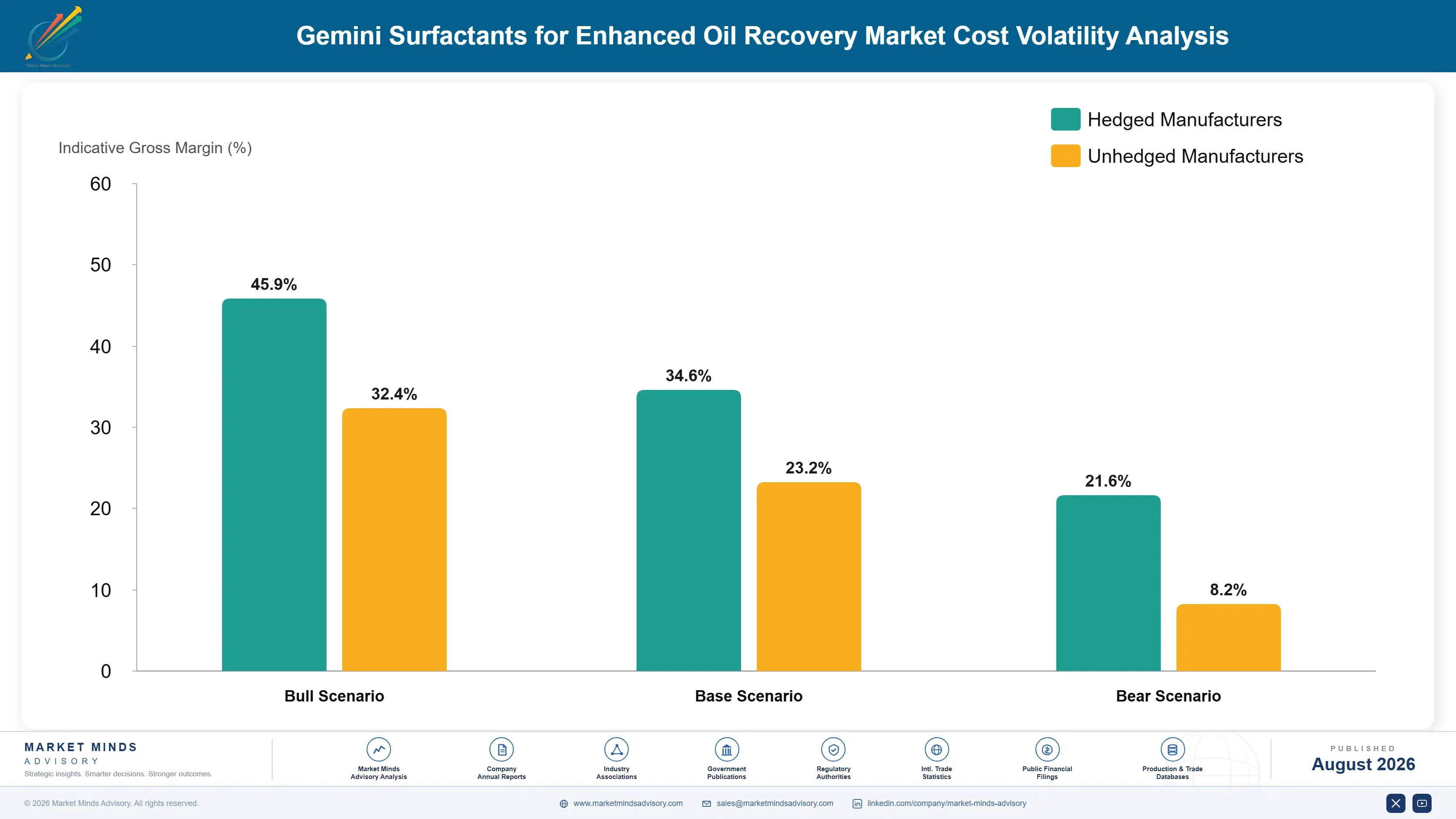
Fatty alcohols and alkyl chain feedstock account for roughly 31% of chemical cost, amine and spacer intermediates around 24%, and multi-step synthesis with purification a further 29% on a delivered basis. Alkyl chains derive from petrochemical and oleochemical routes in roughly equal measure. Amine intermediates come from a narrow set of producers, and the synthesis itself is where gemini chemistry becomes expensive.
Palm and coconut derived fatty alcohol pricing through 2022 demonstrated the oleochemical exposure directly. Feedstock moved sharply on harvest and export policy in producing countries, and USDA Foreign Agricultural Service reporting tracked the trade movement behind it. Suppliers with petrochemical alcohol routes switched feedstock and held pricing. Those committed to bio-based positioning absorbed the increase and discovered their sustainability claim carried a cost volatility nobody had priced into it.

The disadvantage falls on synthesis scale rather than on feedstock buying. Gemini production requires multiple steps with purification between them, and a participant running it at pilot volume carries a unit cost several times that of one operating a dedicated commercial train. Field programmes are intermittent, so most suppliers never reach the volume justifying a train. That is a genuine trap.
gemini-surfactants-for-enhanced-oil-recovery-marke-cost-volatility-analysis-1788193648899

Hold dual petrochemical and oleochemical feedstock routes

Alkyl chains come from both petrochemical and oleochemical sources and the two price on entirely different drivers, one on crude and one on harvest policy. Qualifying both routes into one product specification costs testing rather than capital and converts a feedstock exposure into a purchasing choice. Suppliers holding only the bio-based route learned this expensively.

Toll manufacture rather than build dedicated capacity

Multi-step gemini synthesis at pilot volume carries a unit cost several times commercial scale, and field programmes are intermittent enough that few suppliers justify a dedicated train. Toll agreements with contract manufacturers holding suitable reactor trains convert capital into variable cost. The margin given away is smaller than the penalty of running sub-scale, which most participants never calculate.

Price against the barrel, not against the kilogram

Operators compare chemical cost per kilogram against conventional surfactant and gemini loses that comparison every time, since it costs several times more to make. Pricing against incremental barrels at around USD 21 of chemical cost reframes the purchase and reflects the dosage advantage. It requires field data the supplier may not currently hold, which is the real obstacle here.

Portfolio Architecture for Margin Defence

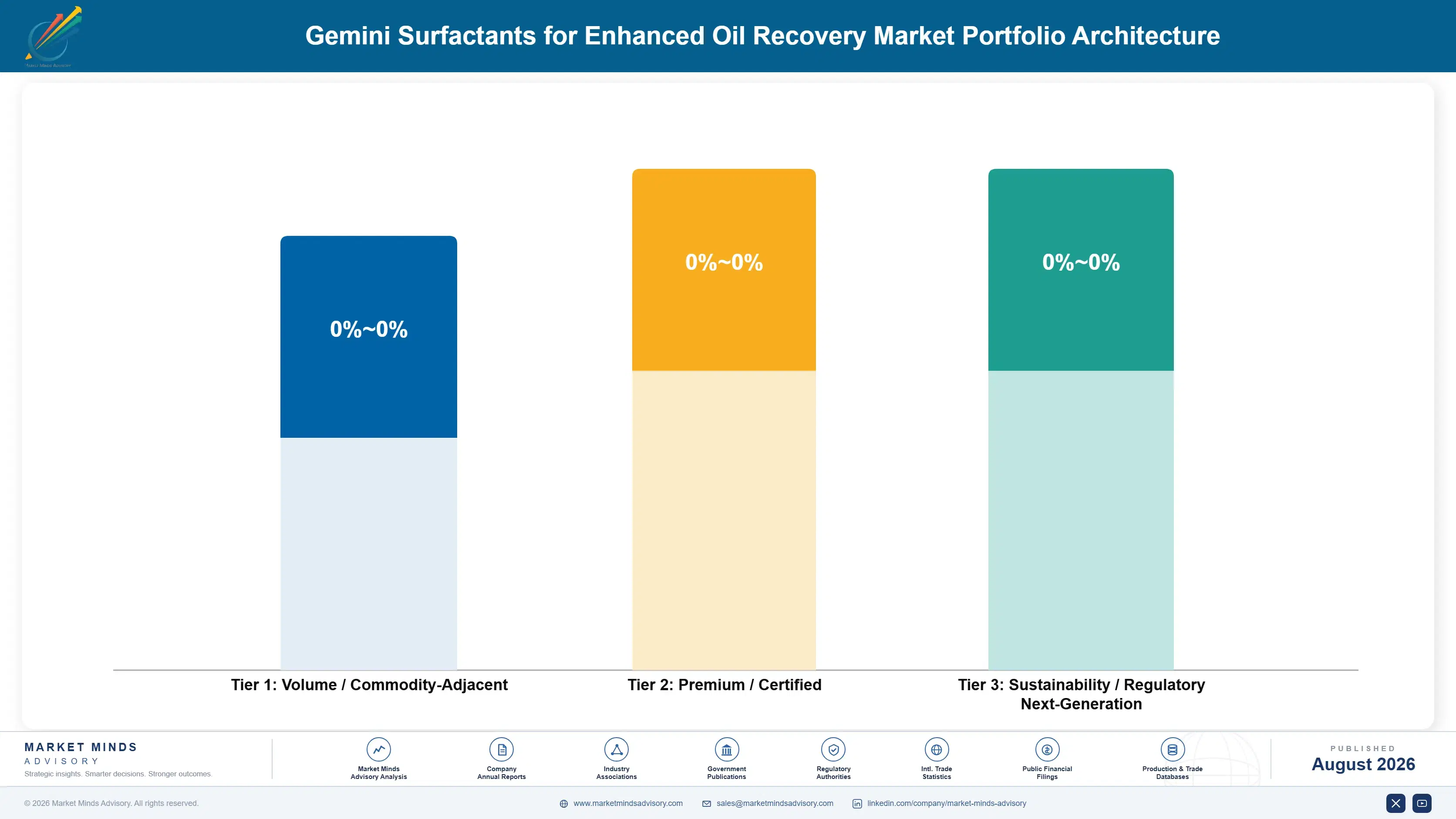
Margin here follows qualification status rather than molecular complexity, which is not how the chemistry is usually discussed. An unqualified chemical has no price at all because nobody can buy it, while a qualified one supplied into an active flood earns a margin that reflects switching cost rather than manufacturing cost. Participants costing by approval position rather than synthesis route run a different business from those pricing per kilogram.
Volume and premium pull against each other through the field programme rather than the plant. Anionic and nonionic chemistries supplied into existing sandstone floods carry the volume that keeps a supplier inside an operator's annual planning conversation. That position is what gets the cationic product evaluated when a carbonate field comes up. Dropping the volume tier saves margin and removes the access entirely.

High-value pools sit in cationic carbonate chemistry, in zwitterionic high-salinity systems and in reservoir data itself, which almost nobody treats as an asset. A supplier holding core flood results across many rock and brine conditions can answer a new operator in weeks rather than beginning a two year programme, and that speed decides who gets specified. Data is the product and the chemical is the delivery mechanism.

Volume / Commodity-Adjacent

Anionic sulfonate and nonionic ethoxylated gemini chemistries supplied into existing sandstone flooding programmes on established specifications. Competes against conventional surfactant on cost per barrel rather than per kilogram. The 9 point spread reflects whether synthesis runs at commercial scale or pilot volume.
Gross Margin: 18 to 27%

Premium / Certified

Zwitterionic and tailored gemini structures qualified against specific reservoir conditions of temperature, salinity and mineralogy. Qualification status rather than chemistry supports the price. The 9 point spread reflects how many reservoir types the product holds field data against.
Gross Margin: 36 to 45%

Sustainability / Regulatory / Next-Generation

Cationic carbonate chemistry, gemini-polymer hybrid systems and reservoir screening services sold alongside chemical supply. Margins are high because qualified alternatives barely exist. The 18 point spread separates chemical supply from screening and data services, which price on entirely different logic.
Gross Margin: 44 to 62%
gemini-surfactants-for-enhanced-oil-recovery-marke-portfolio-architecture-1788193649398

High-value Sub-segments and Strategic Watch-out

Cationic Gemini Surfactants for Carbonates

High value and high growth at 18.9%. Carbonate rock strips anionic chemistry from solution and cationic structures avoid that binding, which puts this segment where most remaining conventional oil sits. The 8 point spread reflects how much field data the supplier holds on representative carbonate.
Gross Margin: 48 to 56%

Zwitterionic Gemini Surfactants

High value with strong growth at 15.4%. Dual charge makes these structures indifferent to brine composition, which removes a water treatment plant from projects facing hard formation water. The 8 point spread reflects whether the supplier manufactures the betaine intermediate or simply buys it in.
Gross Margin: 40 to 48%

Anionic Sulfonate Gemini Surfactants

The volume core. It earns modestly and it holds the supply relationship that gets the premium chemistries evaluated when a difficult reservoir comes up for consideration. The 8 point spread reflects synthesis scale, since sub-scale production carries a unit cost penalty that pricing cannot recover.
Gross Margin: 20 to 28%

Bio-Based Sugar-Derived Gemini Surfactants

The strategic watch-out. Sustainability positioning carries no weight with an operator evaluating cost per incremental barrel, and the feedstock introduces harvest volatility the petrochemical route avoids. The 30 point spread separates niche premium placements from volumes competing directly against conventional chemistry. Operators do not pay for the label.
Gross Margin: 14 to 44%

Once Qualified, Rarely Replaced

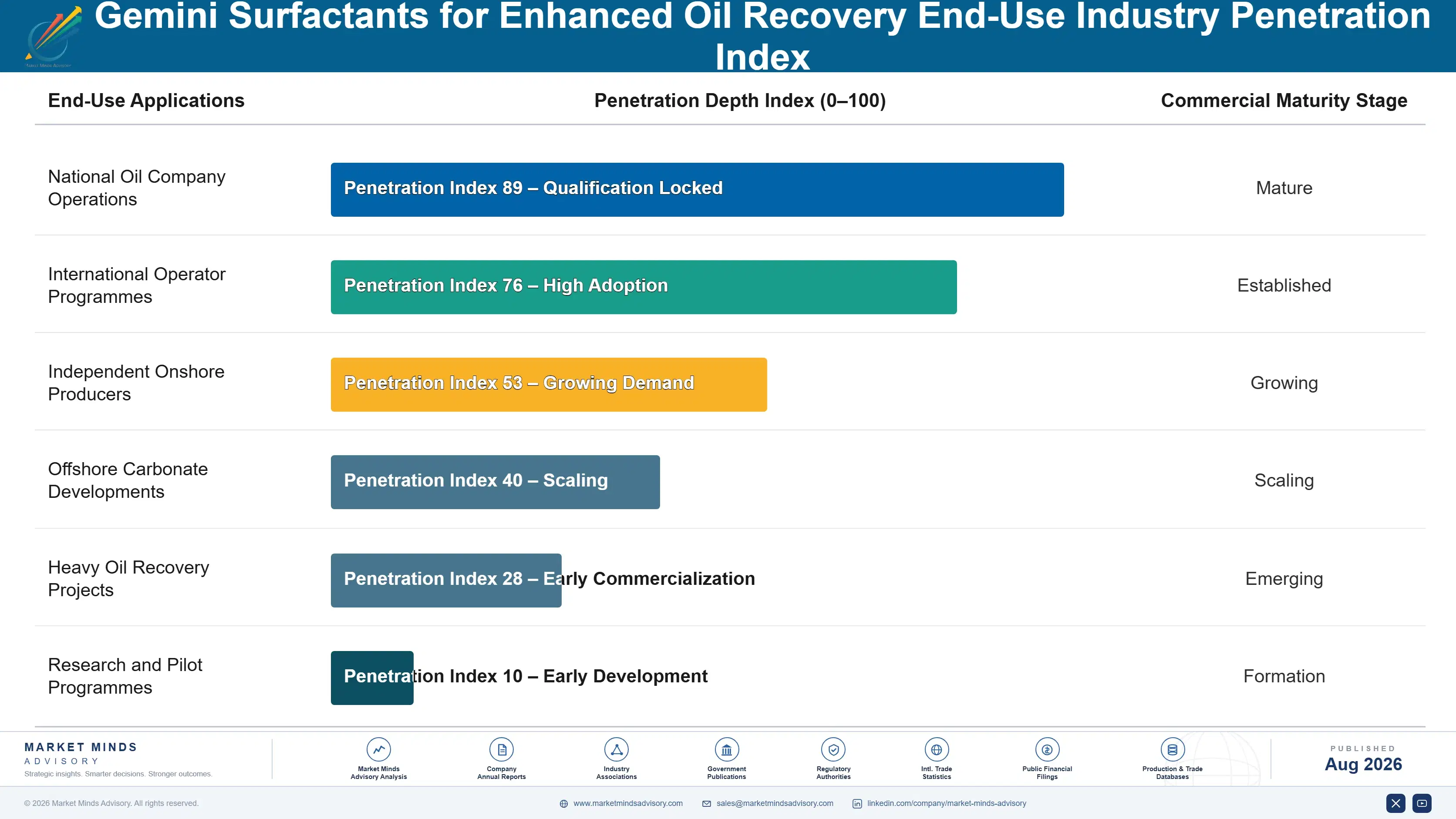
The annuity here is exceptionally strong and exceptionally hard to start. A flood consumes chemical continuously for years once injection begins, and nobody changes surfactant mid-programme because the reservoir response is the only test and it takes 34 months to read. A qualified supplier holds that volume until the flood ends. An unqualified one has no route in at all, however good the molecule.
Adoption depth varies enormously by operator type rather than by geography. A national oil company operating under a recovery factor target funds programmes through price cycles that would stop anybody else, and it accepts long qualification timelines because the mandate is not annual. A private operator compares chemical cost against barrel price quarterly and cancels within weeks when the arithmetic turns. Those are entirely different customers wearing the same job title.

Buyer profiles have shifted from reservoir engineers toward project economists, and the suppliers who noticed have repositioned their whole argument. An engineer asks about interfacial tension and adsorption isotherms. An economist asks what the chemical costs per incremental barrel and what capital it avoids elsewhere in the project. The second question decides the purchase and most technical sales organisations cannot answer it convincingly.
gemini-surfactants-for-enhanced-oil-recovery-marke-end-use-penetration-index-1788193649892

What Actually Gets Specified

These are among the four positions where our research anticipates prominent divergence between winners and laggards over the coming forecast period. Each is grounded in the demand model, the regulatory perimeter, and the announced capacity pipeline.
01 / ADSORPTION DATA PUBLICATION

Lead with what the rock takes, not the tension

Every supplier in this category opens with interfacial tension because it is the number that looks best on a slide, and every operator knows that a chemical adsorbing at 0.7 milligrams per gram of rock never reaches the oil regardless of beaker performance. Publishing core flood adsorption results against named rock types converts a sales claim into evidence an operator can evaluate without funding its own screening programme first. The suppliers who did this reached qualification lists roughly two years ahead of those still quoting tension.
02 / CARBONATE FIELD DATA

Do the limestone work before the tender opens

Cationic gemini chemistry grows at 18.9% against a market rate of 12.6% because carbonate rock strips anionic surfactant from solution, and Middle Eastern carbonates hold an enormous share of remaining conventional oil with almost no chemical flooding deployed against any of it. Operators there are early in evaluation and short of comparable field data from rock resembling their own reservoirs. A supplier arriving with representative carbonate core flood results answers the question being asked, and very few have done that work.
03 / JOINT QUALIFICATION FUNDING

Split the cost nobody wants to carry alone

Median time from injection start to measurable production response runs 34 months, which exceeds the planning horizon of most chemical businesses and exceeds what most operators want to fund on their own account. Joint programmes contributing chemical and laboratory work against operator-funded field access split a cost that neither party will carry entirely, and the supplier gains reservoir data worth considerably more than the chemical given away. Operators agree to these arrangements readily once asked, and remarkably few suppliers ask.
04 / BARREL BASED PRICING

Price against the barrel, never the kilogram

Gemini chemistry costs several times conventional surfactant per kilogram because synthesis runs multiple steps with purification between them, and it loses that comparison every single time an operator makes it. Pricing against incremental barrels recovered, at around USD 21 of chemical cost per barrel, reflects the dosage advantage that the kilogram comparison actively conceals from the buyer. It requires field data the supplier may not hold, which is the real obstacle here rather than any reluctance on the operator's part.

Engagement Snapshot From the Field

A live engagement with an industry participant carrying material or product regulatory and market exposure ahead of a defining policy shift, showing how our research translates into a defensible multi-year portfolio strategy.
MARKET MINDS ADVISORY · CLIENT ENGAGEMENT SUMMARY
Gemini Surfactants for Enhanced Oil Recovery Producer Strategic Portfolio Review and Transition Roadmap 2026·Investment Scenario on Gemini Surfactants for Enhanced Oil Recovery Exposure Evaluation 2025-26
CLIENT PROFILE
A European specialty chemical producer with an established oilfield surfactant business and a gemini portfolio developed over eight years of laboratory work, with annual enhanced recovery chemical revenue in the low tens of millions of euros (client-reported, unverified by MMA). The gemini products held excellent published interfacial tension data and almost no field volume anywhere.
STRATEGIC CHALLENGE
Eight years of research had produced molecules that outperformed everything in the laboratory and reached no commercial supply agreement at all. Management could not determine whether the problem was the chemistry, the pricing, the sales organisation or the market itself, and a further research budget had already been requested for the following year.
MMA APPROACH
MMA reconstructed every operator evaluation the client had entered across five years, identifying at which stage each one stopped and what the operator asked for immediately before it did. Forty-seven expert interviews with reservoir engineers, laboratory managers, procurement staff and competing suppliers established what actually decides a qualification list and what disqualifies a candidate early.
KEY FINDINGS
  1. Of 14 evaluations entered, 11 stopped at the same point, when the operator asked for core flood adsorption data on its own rock type.
  2. The client held adsorption data for 2 sandstone types and none at all for carbonate, while the growing opportunity was almost entirely carbonate.
  3. Competing suppliers reaching qualification had published adsorption results routinely, and operators confirmed they were using exactly those publications to build their candidate lists.
  4. Every operator interviewed priced chemical against incremental barrels, while the client's commercial team quoted a price per kilogram in every single case.
CLIENT PROFILE
A European specialty chemical producer with an established oilfield surfactant business and a gemini portfolio developed over eight years of laboratory work, with annual enhanced recovery chemical revenue in the low tens of millions of euros (client-reported, unverified by MMA). The gemini products held excellent published interfacial tension data and almost no field volume anywhere.
STRATEGIC CHALLENGE
Eight years of research had produced molecules that outperformed everything in the laboratory and reached no commercial supply agreement at all. Management could not determine whether the problem was the chemistry, the pricing, the sales organisation or the market itself, and a further research budget had already been requested for the following year.
MMA APPROACH
MMA reconstructed every operator evaluation the client had entered across five years, identifying at which stage each one stopped and what the operator asked for immediately before it did. Forty-seven expert interviews with reservoir engineers, laboratory managers, procurement staff and competing suppliers established what actually decides a qualification list and what disqualifies a candidate early.
KEY FINDINGS
  1. Of 14 evaluations entered, 11 stopped at the same point, when the operator asked for core flood adsorption data on its own rock type.
  2. The client held adsorption data for 2 sandstone types and none at all for carbonate, while the growing opportunity was almost entirely carbonate.
  3. Competing suppliers reaching qualification had published adsorption results routinely, and operators confirmed they were using exactly those publications to build their candidate lists.
  4. Every operator interviewed priced chemical against incremental barrels, while the client's commercial team quoted a price per kilogram in every single case.
RECOMMENDED STRATEGY
Phase 1: Phase one: run and publish core flood adsorption programmes on representative carbonate rock, before requesting any further synthesis research budget. Phase 2: Phase two: propose joint qualification programmes to at least 3 carbonate operators, contributing chemical and laboratory work against operator-funded field access. Phase 3: Phase three: reprice the entire portfolio on cost per incremental barrel and retrain the commercial team to argue it properly.
OUTCOME
Within five quarters the client held carbonate adsorption data, entered two joint qualification programmes and reached a first commercial supply agreement (client-reported, unverified by MMA). No new molecule was synthesised at any point in the process. The additional research budget was quietly not requested again the following year.

Frequently Asked Questions

Foundational context covering the market sizes, CAGR, scope, country, region and competition that inform every finding below. This section is provided to cover basics and most often pre-purchase conversations, answered from the MMA Primary Research Dataset.

What is the current size of the Gemini Surfactants for Enhanced Oil Recovery Market?

The global gemini surfactants for enhanced oil recovery market was valued at USD 0.3 billion in 2025, covering dimeric surfactant chemistries supplied for chemical flooding. The 2026 figure reaches USD 0.34 billion.

How large will the Gemini Surfactants for Enhanced Oil Recovery Market be by 2036?

MMA forecasts USD 1.11 billion by 2036, an increase of USD 0.77 billion over the 2026 base. That represents an expansion multiple of 3.26 times across the forecast period.

What is the CAGR for the Gemini Surfactants for Enhanced Oil Recovery Market 2026 to 2036?

The base case compound annual growth rate is 12.6%, with a bull case at 13.9% and a bear case at 11.3%. Historical growth between 2020 and 2025 ran at 11.4%.

Which segment is growing fastest?

Cationic gemini surfactants for carbonates grow at 18.9%, half again the market rate of 12.6%, because carbonate rock strips anionic chemistry from solution. Zwitterionic structures follow at 15.4%.

Who are the major companies in the Gemini Surfactants for Enhanced Oil Recovery Market?

BASF, Sasol, Stepan Company, Syensqo and SNF Group lead on qualified field trial volume, with combined CR5 of 58%. Concentration is high because qualification rather than synthesis is the barrier.

Which country is growing fastest?

India grows fastest at 14.8%, where national recovery factor targets fund mature field programmes through price cycles that would stop commercial operators. South Asia and Pacific leads regionally at 14.8%.

Report Segmentation Architecture

The full report scope spans multiple orthogonal segmentation dimensions, with cross-tabulated demand data provided for each dimension pair. Coverage extends further to regional breakdowns, trend trajectories, and the competitive detail needed to support segment-level decision-making.

By Molecular Class

  • Cationic Gemini Surfactants for Carbonates
  • Anionic Sulfonate Gemini Surfactants
  • Zwitterionic Gemini Surfactants
  • Nonionic Ethoxylated Gemini Surfactants
  • Gemini-Polymer Hybrid Systems
  • Bio-Based Sugar-Derived Gemini Surfactants

By End-Use Industry

  • National Oil Company Operations
  • International Operator Programmes
  • Independent Onshore Producers
  • Offshore Carbonate Developments
  • Heavy Oil Recovery Projects
  • Research and Pilot Programmes

By Commercial Dimension

  • Direct Operator Supply
  • Service Company Channels
  • Joint Qualification Programmes
  • Regional Distribution Agreements
  • Toll Manufacturing Arrangements
  • Technology Licensing Agreements

By Region

  • North America
  • Western Europe
  • East Asia
  • South Asia and Pacific
  • Latin America
  • Middle East and Africa
  • Eastern Europe

Scope, Methodology, and Coverage

Every figure in this report is reproducible from documented input assumptions. The scope below maps the historical period, the forecast horizon, the segmentation dimensions, and the countries covered, alongside the underlying primary and qualitative methodology.
Historical Period
2020 to 2025
Forecast Period
2026 to 2036
Base Year
2025 (USD billions; MMA Primary Research Dataset, August 2026)
Market Definition
The gemini surfactants for enhanced oil recovery market covers dimeric surfactant chemistries carrying two hydrophilic head groups and two hydrophobic tails joined by a spacer, supplied for chemical flooding of oil reservoirs, spanning cationic gemini surfactants for carbonates, anionic sulfonate gemini surfactants, zwitterionic gemini surfactants, nonionic ethoxylated gemini surfactants, gemini-polymer hybrid systems, and bio-based sugar-derived gemini surfactants. Scope is measured as chemical supplied into field application and qualified pilot programmes. Excluded are conventional monomeric surfactants, polymer flooding agents supplied alone, alkali chemicals, thermal and gas injection recovery methods, and drilling or completion fluid surfactants.
Quantitative Units
USD billion, 2025 base year, 2026 to 2036 forecast period
Segmentation Dimensions
Molecular class, operator type, commercial channel, region
Regions Covered
North America, Western Europe, East Asia, South Asia and Pacific, Latin America, Middle East and Africa, Eastern Europe
Countries Covered
United States, Canada, Germany, United Kingdom, Norway, Netherlands, Romania, Kazakhstan, China, Japan, Malaysia, India, Australia, Brazil, Venezuela, Saudi Arabia, United Arab Emirates, Oman
Key Companies Profiled
20 companies across chemical producers, oilfield service groups and regional manufacturers
Quantitative Methodology
Primary survey, n=3,800 respondents, Q4 2025, six countries; demand-side model with trade association cross-validation
Qualitative Methodology
47 expert interviews, Q4 2025; applied to validate demand model assumptions, identify emerging dynamics, and assess competitive positioning
Report Format
PDF and XLSX data workbook (Word format preview document)
Publisher
Market Minds Advisory
Report Code
MMA-2026-CHM-271
Published
August 2026
Contact
sales@marketmindsadvisory.com | www.marketmindsadvisory.com

Purchase the full Gemini Surfactants for Enhanced Oil Recovery Market Report (2026 to 2036).

The full MMA report on the gemini surfactants for enhanced oil recovery market runs to detailed chemistry and regional models across the 2026 to 2036 forecast period, with synthesis cost benchmarks separated by molecular class and feedstock route. It profiles 20 companies on a consistent qualified field trial volume basis, covering chemical producers, oilfield service groups and regional manufacturers. Adsorption performance and salinity tolerance are compared across chemistries and against named rock types. Regional chapters cover the seven MMA regions with country-level detail on the eighteen markets surveyed. Primary research draws on a quantitative survey of 3,800 respondents across six countries and 47 expert interviews conducted in Q4 2025.
Synthesis cost benchmarks by molecular class and feedstock
Adsorption performance compared across chemistries and named rock types
Cost per incremental barrel modelled across reservoir conditions
Twenty company profiles on consistent qualified trial volume basis
Field qualification timelines and pilot outcomes by region
Seven regional chapters with eighteen country detail tables

Built For The People Who Decide

From boardroom strategy to bench-side execution, this report is read cover-to-cover by leaders shaping the next decade of their industry, turning demand scenarios, market dynamics and valuation benchmarks into decisions.
CXOs/ Presidents/ VPs/ Managers
M&A and Corporate Development
Strategy Teams and R&D Heads
Procurement and Product Directors
Regulatory and Compliance Leaders
Investor Relations and Equity Analysts