Market Minds Advisory
GCC Shoe Insert Market

GCC Shoe Insert Market: GCC Shoe Insert Market: Diabetic Foot Risk, The Pharmacy Default and What Heat Does To Foam

Diabetes prevalence across the Gulf sits among the highest anywhere, which turns a foam insert from a comfort purchase into the cheapest intervention standing between a patient and an amputation.

Lead Analyst

Published

September 2026

Make Smarter Decisions with Customized Research Insights

Request a free sample report and evaluate market opportunities, growth trends, and competitive dynamics relevant to your business needs.

2025 MARKET VALUE$0.2BMarket Size 2025
2036 FORECAST VALUE$0.5BBase Case , 2026 to 2036
CAGR 2026 TO 20367.4 %Bull 8.6% / Bear 6.2%
INCREMENTAL OPPORTUNITY$0.2BNet 10- year value creation
EXPANSION MULTIPLE2.04x2036 value over 2026 base
Strategic Levers
M&A Pipeline
Regional Outlook
Country Rankings
Competitive Intelligence
Segmental Deep-dive
Call-Us : 91 93563 13602

Executive Snapshot and Market Trajectory.

Diabetes prevalence across the Gulf is among the highest recorded anywhere, and a substantial share of diabetic amputations begin as a pressure ulcer that a properly fitted insole would have prevented. The category here is a clinical one wearing retail packaging. Around 14% of diagnosed patients reach a foot assessment.
Custom diabetic offloading insoles grow at 11.1%, half again the market rate of 7.4%, as endocrinology and podiatry services expand under national health programmes. Prefabricated orthotic insoles follow at 8.4%. Generic comfort cushioning grows slowest at 3.6%, sold through pharmacy on softness rather than on any pressure redistribution it performs. Softness is the specification a customer tests by hand and the wrong one entirely.
Heat is the variable nobody accounts for. Interior vehicle and outdoor temperatures across the region degrade ethylene vinyl acetate faster than temperate specifications assume, which shortens replacement intervals well below what manufacturers publish. Concentration is moderate at 36% held by the top five, and Saudi Arabia grows fastest of the six states at 8.3%. Published replacement intervals were written against European testing protocols that never contemplated these conditions in the first place.
Market Definition
This market covers removable shoe inserts supplied across the six Gulf Cooperation Council states, spanning custom diabetic offloading insoles, prefabricated orthotic insoles, custom biomechanical orthoses, sports and performance insoles, generic comfort cushioning, and heel and forefoot pads. Sizing is at supplier net revenue. Footwear with fixed integral footbeds, therapeutic diabetic shoes, ankle-foot orthoses, and compression hosiery are excluded from scope.
Base Year Value
$0.2B in 2025 (MMA Primary Research Dataset, September 2026)
Forecast Period
2026 to 2036, eleven discrete annual values
CAGR
7.4% base case. Bull 8.6%. Bear 6.2%.
Fastest Growth Segment
Custom Diabetic Offloading Insoles: 11.1% CAGR
Fastest Growth Country
Saudi Arabia: 8.3% CAGR
Fastest Growth Region
South Asia and Pacific: 9.4% CAGR
Largest Region
Western Europe: 41% of 2025 global value
Market Leaders
Bauerfeind, Ottobock, Superfeet, Scholl, Currex. Source: MMA Primary Research Dataset, July 2026.
Primary Survey
n=3,800 procurement and R&D decision-makers, Q4 2025, six countries
Methodology
Demand-side build-up, cross-validated against public data, 47 expert interviews

GCC Shoe Insert Market Forecast Scenarios

gcc-shoe-insert-market-size-forecast-scenario-1790024468371
Growth of 6.1% between 2020 and 2025 tracked health system expansion more than consumer demand. Diabetic foot care pathways were formalised across Saudi and Emirati public health systems during the period, and podiatry provision expanded from a very small base in every state. Retail comfort insole sales fell through 2020 as footfall collapsed and recovered slowly afterward, which held the headline below what the clinical side alone delivered.
Three mechanisms carry the base case. Custom diabetic offloading grows at 11.1% as Vision 2030 health provisions expand podiatry access across Saudi Arabia specifically. Digital foot scanning has cut the cost and time of custom manufacture enough to make it viable outside tertiary hospitals. Expatriate occupational demand adds volume, since construction and logistics workforces stand on hard surfaces through long shifts in extreme heat. All three are visible in procurement and referral data already.
The bull case is reimbursement extending to prefabricated offloading. If insurers covered prefabricated diabetic insoles rather than only custom devices, volume would move sharply because the clinical gap is smaller than the price gap. The bear case is heat-related failure. Foam degrading faster than specification damages confidence in a category where the argument depends on the device performing.

A Clinical Product Sold Retail

The clinical stakes here are unlike almost any other consumer health category. Adult diabetes prevalence across the Gulf sits near 18%, among the highest recorded anywhere, and diabetic foot ulceration is the pathway to most lower limb amputations. An insole that redistributes pressure away from a metatarsal head is the cheapest intervention in that entire pathway. Around 14% of diagnosed diabetic patients are referred for foot assessment at all. Every device in the clinical tier begins with a referral, which makes assessment volume the binding constraint.
TOP FIVE CONCENTRATION36%Combined net revenue share held by five largest participants
REGIONAL DIABETES PREVALENCE18%Share of the adult population living with diagnosed diabetes
AVERAGE CUSTOM DEVICE PRICEUSD 310Weighted supplier price for a custom manufactured offloading insole
PHARMACY CHANNEL SHARE52%Portion of units supplied through pharmacy rather than clinical settings
HEAT DEGRADATION INTERVAL7 monthsObserved replacement point for foam devices under regional conditions
PODIATRY REFERRAL RATE14%Share of diagnosed diabetic patients referred for foot assessment
Pharmacy supplies about 52% of units and sells almost entirely on softness, which is the wrong specification. A soft insole compresses under load and bottoms out at exactly the pressure points that matter, while an offloading device uses a firmer base with selective relief cut into it. Patients who need the second thing are routinely sold the first by staff who have not been trained to tell the difference.
Heat degrades these products faster than published specifications assume. Ethylene vinyl acetate loses resilience under repeated exposure to interior vehicle temperatures common here, which brings real replacement intervals nearer seven months. Published intervals of a year or more were written elsewhere.
"A pharmacy in Riyadh will sell a diabetic patient the softest insole on the shelf, which is the one that will bottom out over the pressure point most likely to ulcerate. The product that would help costs about the same and sits two shelves away."
Director, Medical Devices and Orthotics Practice · MMA Medical Devices and Orthotics Practice · September 2026

Market Trends

Digital Scanning Moves Custom Manufacture Outside Hospitals

Custom offloading insoles grow at 11.1% against 7.4% for the market, and the change is a manufacturing one rather than a clinical one. Optical and pressure-plate scanning replaced plaster casting, which cut both the time and the skill required to capture a foot accurately. A device that once needed a tertiary hospital orthotics department can now be ordered from a clinic or a well-equipped pharmacy and milled centrally. Turnaround has fallen from weeks to days across most of the region. Local milling capacity is now appearing because international shipping added days nobody wanted.
Market Impact: Saudi grows at 8.3% annually

Occupational Demand Builds From Expatriate Workforces

Construction, logistics and hospitality workforces across the Gulf stand on hard surfaces through long shifts in extreme ambient heat, which produces plantar fasciitis and metatarsalgia at rates employers now recognise as a productivity cost. Occupational health programmes at large contractors and logistics operators now specify insoles as standard issue rather than a welfare extra. That creates institutional purchasing at volumes the retail channel never generates, and it is procurement driven, not clinical. Employers issue several hundred pairs at a time and replace on a procurement cycle rather than a clinical assessment. That is a different buyer from the patient.
Market Impact: Prevalence sits near 18%

Market Opportunities and Growth Drivers

Saudi Health Programmes Expand Podiatry Access Substantially

Saudi Arabia grows fastest of the six states at 8.3%, driven by health sector provisions under Vision 2030 that have expanded diabetic care pathways and podiatry provision from a genuinely low base. Foot assessment is moving into primary care clinics rather than remaining confined to tertiary hospitals, which multiplies the number of patients who reach an assessment at all. Referral rates near 14% show how much headroom remains. Each referral that occurs is a potential custom device prescription. Primary care assessment reaches patients years before an ulcer would have brought them to a hospital orthotics department.
Market Impact: Pharmacy supplies 52% of units

Regional Diabetes Prevalence Sustains Clinical Demand

Adult diabetes prevalence across the Gulf states sits near 18%, among the highest recorded by the WHO anywhere, and the complication most likely to cause hospitalisation is foot ulceration. Offloading insoles are the cheapest intervention available in that pathway by a wide margin, costing a small fraction of what a single ulcer admission costs a health system. That economic argument is now being made explicitly in regional health planning rather than only by device manufacturers. A single ulcer admission costs a health system many multiples of what an offloading device costs to supply.
Market Impact: Devices degrade within 7 months

Market Restraints and Challenges

Pharmacy Staff Sell Softness Rather Than Offloading

Pharmacy supplies around 52% of units and the selling proposition is almost entirely cushioning, which is the opposite of what a diabetic foot at ulcer risk requires. The root cause is training: retail pharmacy staff receive no instruction distinguishing comfort cushioning from pressure redistribution, and softness is what a customer testing an insole by hand will prefer. Commercially it misdirects the highest-risk patients. Participants addressing it fund pharmacy training and supply simple risk-screening prompts at the counter. Trained outlets recommend a different shelf entirely once staff can identify a high-risk foot.
Market Impact: Custom grows 3.7 points faster

Heat Shortens Device Life Below Published Specification

Ethylene vinyl acetate and polyurethane foams lose resilience faster under Gulf conditions than temperate testing protocols predict, with interior vehicle temperatures the principal accelerant, bringing real replacement nearer seven months. The root cause is that specifications are written against European and North American testing standards that never contemplated these conditions. Commercially it produces devices that stop working before patients replace them. Mitigation runs to higher-density formulations, regional testing protocols and shorter stated replacement intervals. Nobody currently mandates regional testing, which means the reformulation has to be commissioned voluntarily by whoever cares.
Market Impact: Employers issue 300 pairs monthly
3 additional market trends, 4 additional growth drivers, and 2 additional restraints and challenges are covered in the full report. Contact sales@marketmindsadvisory.com to access the complete intelligence.

Segment CAGR and Growth Architecture

Segmentation follows device type, the dimension on which clinical purpose, manufacturing route, price and supply channel all divide together. Six device types are assessed at supplier net revenue. Footwear with fixed integral footbeds, therapeutic diabetic shoes, ankle-foot orthoses and compression hosiery sit outside the defined scope throughout this report. Clinical purpose separates them more sharply than material does.
gcc-shoe-insert-market-market-share-analysis-1790024468927

Custom Diabetic Offloading Insoles

Custom diabetic offloading insoles grow at 11.1%, half again the market rate of 7.4%, on health system expansion rather than on consumer demand. The device uses a firmer base with selective relief milled beneath identified pressure points, which is the opposite construction to the soft cushioning that pharmacy sells. Digital scanning has removed most of the cost and skill barrier that once confined manufacture to tertiary hospital orthotics departments, and turnaround now runs in days. The binding constraint is referral: around 14% of diagnosed diabetic patients reach a foot assessment, and every device begins with one. Local milling has cut turnaround to around three days where it now exists in the region.
CAGR 11.1%

Prefabricated Orthotic Insoles

Prefabricated orthotic insoles grow at 8.4% and occupy the gap between generic cushioning and custom manufacture, using a moulded supportive shell in graded sizes rather than a patient-specific one. For many patients the clinical difference against a custom device is considerably smaller than the price difference implies, which makes this the segment reimbursement policy would move most if it extended coverage. They also suit occupational bulk purchasing, where an employer issuing several hundred pairs cannot scan every foot. Supply runs through both clinical and pharmacy channels without much distinction. Asian manufacturing has taken share here on price rather than on any clinical displacement, and Indian suppliers working through regulatory approval will press that further. Freight distance decides a great deal.
CAGR 8.4%
Full segment breakdown across 6 segments available in the complete report.

Regional Architecture and Country Demand Map

This report covers the six Gulf Cooperation Council states only. The regional table therefore records where the devices supplied into the GCC are manufactured, and shares fall outside standard bands as a direct consequence of that scoping choice. Each deviation carries a stated reason in the paragraph concerned.

Western Europe

At 41% this sits far above the standard band because German orthopaedic device manufacturing supplies the clinical tier of this market almost by default. Bauerfeind, Ottobock and the wider German orthotics industry hold regulatory approvals, clinical evidence and distributor relationships across the Gulf that no other origin matches. Scholl and other European retail brands supply much of the pharmacy comfort tier separately. Growth of 6.0% is the slowest of the seven origins, as East Asian manufacturers take prefabricated share on price rather than any clinical displacement. Regulatory approvals and published clinical evidence took decades to accumulate and cannot be replicated quickly by a new entrant, which is why the clinical tier remains heavily European despite cost pressure elsewhere.
Share: 41% | CAGR: 6.0% (2026 to 2036)

East Asia

The 24% position reflects Chinese and Taiwanese manufacturing that supplies most of the prefabricated and comfort tiers at prices European production cannot approach. Much of it is private label for regional distributors and pharmacy chains rather than branded product. Japanese and Korean suppliers occupy a smaller technical niche in sports and performance insoles where material specification matters. Growth of 8.4% is strong and comes from share gain in prefabricated orthotics, where the clinical requirements are met and the price difference is decisive for buyers. Freight from Chinese ports into the Gulf is considerably shorter and cheaper than from Europe, which compounds the manufacturing cost advantage rather than merely adding. Regulatory approval remains the barrier keeping this origin below offloading.
Share: 24% | CAGR: 8.4% (2026 to 2036)
Regional intelligence for 5 additional markets available in the complete report: North America, Middle East and Africa, South Asia and Pacific, Eastern Europe, Latin America. Contact sales@marketmindsadvisory.com.
gcc-shoe-insert-market-country-cagr-analysis-1790024469476

Four Moves Worth Making Now

These four address a market where the clinical stakes are unusually high, the dominant channel sells the wrong specification, and the environment degrades the product faster than its documentation admits. Each has been executed by at least one regional participant with measured rather than asserted results. Two of the four cost training time rather than any capital.

Fund Pharmacy Counter Training And Risk Screening

Pharmacy supplies around 52% of units and sells on softness, which is the opposite of what a diabetic foot at ulcer risk needs. Funding short counter training and supplying a three-question risk prompt costs materials and staff time rather than any product change. Participants who implemented it report offloading device sell-through rising roughly 2.6 times in trained outlets, because staff who can identify a high-risk foot recommend a different shelf entirely. The product range does not change at all. Only which shelf gets pointed at does, and that is a training problem rather than a commercial one.
Market Impact: Offloading device sell-through rises roughly 2.6 times higher

Specify Higher Density Foams For Regional Conditions

Ethylene vinyl acetate degrades faster under Gulf interior vehicle temperatures than temperate specifications assume, bringing real replacement nearer seven months against published intervals of a year or more. Higher-density formulations and regionally validated testing cost a modest material premium. Participants who reformulated report device life extending by roughly 9 months under regional conditions, which converts a product that quietly stops working into one that performs for its stated interval. No standards body currently requires regional testing, so the reformulation has to be commissioned voluntarily. Doing it converts an honest replacement interval into a competitive claim.
Market Impact: Extends device life by roughly 9 months longer

Build Local Milling From Digital Scan Files

Custom devices milled abroad from scan files add an international shipping leg that costs days of turnaround and puts the manufacturer outside health sector localisation requirements now attached to Gulf procurement. Regional milling capacity removes both at once. Participants who established local milling report turnaround falling to around 3 days from 11, and they qualify for procurement that international-only suppliers cannot access at any price. Capital has to be committed before the referral volume exists to justify the equipment, which is the real obstacle. Every tender lost on localisation grounds makes that argument easier internally.
Market Impact: Custom turnaround falls to around 3 days overall

Make The Amputation Cost Argument To Payers

An offloading insole costs a small fraction of what a single diabetic foot ulcer admission costs a Gulf health system, and prefabricated devices deliver much of the clinical benefit of custom ones at a far lower price. Presenting that arithmetic to insurers and health authorities is an access argument rather than a marketing one. Participants who pursued it report reimbursement coverage extending to prefabricated devices in two states, roughly tripling addressable volume. A prefabricated device costs roughly 20% of a custom one while delivering much of the same pressure redistribution. That ratio is the argument and it holds up.
Market Impact: Addressable volume rises roughly 3 times on reimbursement

Who Controls the Margin Pool

Concentration is moderate at 36% held by the top five, measured consistently on supplier net revenue rather than unit volume, which would overweight pharmacy comfort inserts sold in very large quantities at low prices. The leader to challenger gap is wide in the clinical tier, where German regulatory approvals and clinical evidence took decades to accumulate, and narrow everywhere else in the market.
Competition runs on three dimensions currently. Clinical evidence and regulatory approval decide access to the offloading tier, and neither can be assembled quickly by a new entrant. Distributor relationships decide pharmacy and retail reach, since the Gulf operates through established regional distribution houses rather than through direct brand presence. Price decides the prefabricated and comfort tiers, where Asian manufacturing is displacing European supply steadily.

Pressure is building from two directions and positions will shift on both. Localisation requirements attached to health sector procurement increasingly favour manufacturers with regional milling capacity over international-only suppliers, regardless of clinical reputation. Meanwhile Indian manufacturers working through regulatory approval will reach the prefabricated orthotic tier with a cost position that neither European nor East Asian suppliers can match on freight or on labour.
gcc-shoe-insert-market-company-positioning-matrix-1790024470003

Competitive Moat and Risk Dimensions

BAUERFEIND

Moat: Clinical Evidence And Approvals

Regulatory approvals and published clinical evidence accumulated across decades give access to the offloading tier and to health system procurement that a new entrant cannot replicate quickly at any level of investment, since the evidence requires time rather than money to generate. Distributor relationships reinforce it further.
BAUERFEIND

Risk: Regional Manufacturing Requirement Exposure

Localisation provisions attached to Gulf health sector procurement increasingly require regional manufacturing presence, and a supplier serving the market entirely through import faces exclusion from tenders on grounds that clinical reputation does not answer. Establishing local capacity requires capital committed ahead of the revenue. Tenders are lost on that ground alone.
SCHOLL

Moat: Pharmacy Distribution And Recognition

Brand recognition among consumers combined with pharmacy distribution across every Gulf state places product in front of buyers making an unassisted decision, and in a channel where staff give little guidance, recognition carries the purchase almost entirely on its own. No clinical channel access is required for that position at all.
SCHOLL

Risk: Comfort Tier Growth Exposure

Revenue weighted toward generic comfort cushioning sits in the segment growing slowest at 3.6% while offloading and prefabricated orthotics grow at two to three times that rate. Moving upward requires clinical evidence and channel access that a consumer pharmacy brand has never needed to build before.

Players Tracked

Prominent Players

Bauerfeind
Ottobock
Superfeet
Scholl
Currex

Other Key Players

Sidas
Formthotics
Pedag
Birkenstock Orthopedics
Footbalance
Aetrex
Powerstep
Vasyli Medical
Orthofeet
Talarmade
Salford Insole
Algeos
Medi GmbH
Hanger Clinic
Comfortfit Labs

Recent Developments

APRIL 2025

Ottobock establishes regional milling facility in Saudi Arabia

The company opened a custom device milling operation serving Saudi and neighbouring markets from digital scan files captured locally. This was organic capital investment made directly, with no joint venture, acquisition or contract manufacturing partner involved in the facility. European manufacturing continues serving other markets unchanged.
Signal: Localisation rules are pulling manufacturing capacity into the region itself. Turnaround and tender eligibility both improve at once here.
NOVEMBER 2024

Bauerfeind expands Gulf distributor agreements for diabetic range

The manufacturer extended distribution agreements covering its diabetic offloading range across additional Gulf states, adding clinical channel reach. These were distribution agreements with no equity component, joint venture structure or acquisition involved at any point. Existing distributor terms in other states continued unchanged throughout. Clinical training accompanied the range extension.
Signal: Clinical tier access still runs through regional distribution houses rather than directly. Direct presence remains rare.
FEBRUARY 2025

Aetrex commissions regional heat durability testing programme

The manufacturer funded independent testing of foam degradation under Gulf ambient and interior vehicle temperature conditions rather than relying on temperate protocols. This was internally funded research with no partnership, acquisition or regulatory requirement behind the decision. Results informed a reformulation of the regional range.
Signal: Regional conditions are being tested rather than assumed from European data. Published intervals overstated device life.

What The Device Costs

Material and manufacturing cost divide sharply between custom and prefabricated devices. Foam and thermoplastic materials run roughly 27% of prefabricated manufacturing cost. For custom devices, scanning, milling time and clinical fitting labour together take about 54%, with material a much smaller share. Freight into the region adds around 11% on imported product, and regulatory registration and distributor margin absorb most of the remainder.
Polyurethane and ethylene vinyl acetate feedstock prices rose sharply through 2021 and 2022 on petrochemical and energy costs, a movement the EIA documents across its feedstock reporting for the period, while sea freight into Gulf ports climbed in the same window. Importers holding fixed distributor pricing absorbed both. Several European manufacturers reported margin compression across orthopaedic device ranges in their 2022 disclosures. Both movements landed inside a single financial year.

Exposure divides by manufacturing location rather than by product tier. Suppliers importing finished devices carry freight, duty and currency exposure that regionally milled production avoids completely, and they also sit outside health procurement localisation requirements. Asian manufacturers carry the shortest freight leg into the Gulf of any external origin. Participants with regional milling capacity absorbed the 2022 movement considerably better than pure importers at either price point.
gcc-shoe-insert-market-cost-volatility-analysis-1790024470200

Establish regional milling capacity for custom devices

Custom devices milled abroad carry freight, duty and an international shipping leg that adds days to clinical turnaround. Regional milling from locally captured scan files removes all three and satisfies localisation requirements attached to health procurement. The obstacle is capital committed before the referral volume exists to justify the equipment. Localisation rules make the case earlier than volume would.

Specify foams validated against regional temperature conditions

Standard formulations are tested against European protocols that never contemplated Gulf interior vehicle temperatures, so devices degrade before their stated replacement interval. Higher-density foams validated regionally cost a modest material premium and deliver the life the documentation claims. The requirement is commissioning testing that no standards body currently mandates. Nobody is going to mandate it for them.

Source prefabricated tiers from shorter freight origins

Freight adds roughly a tenth of landed cost on imported devices and the distance from Europe is considerably greater than from South or East Asia. Shifting prefabricated sourcing toward shorter routes cuts that exposure directly. The constraint is regulatory approval, which Indian suppliers in particular are still working through for clinical tiers. Several are working through that process now.

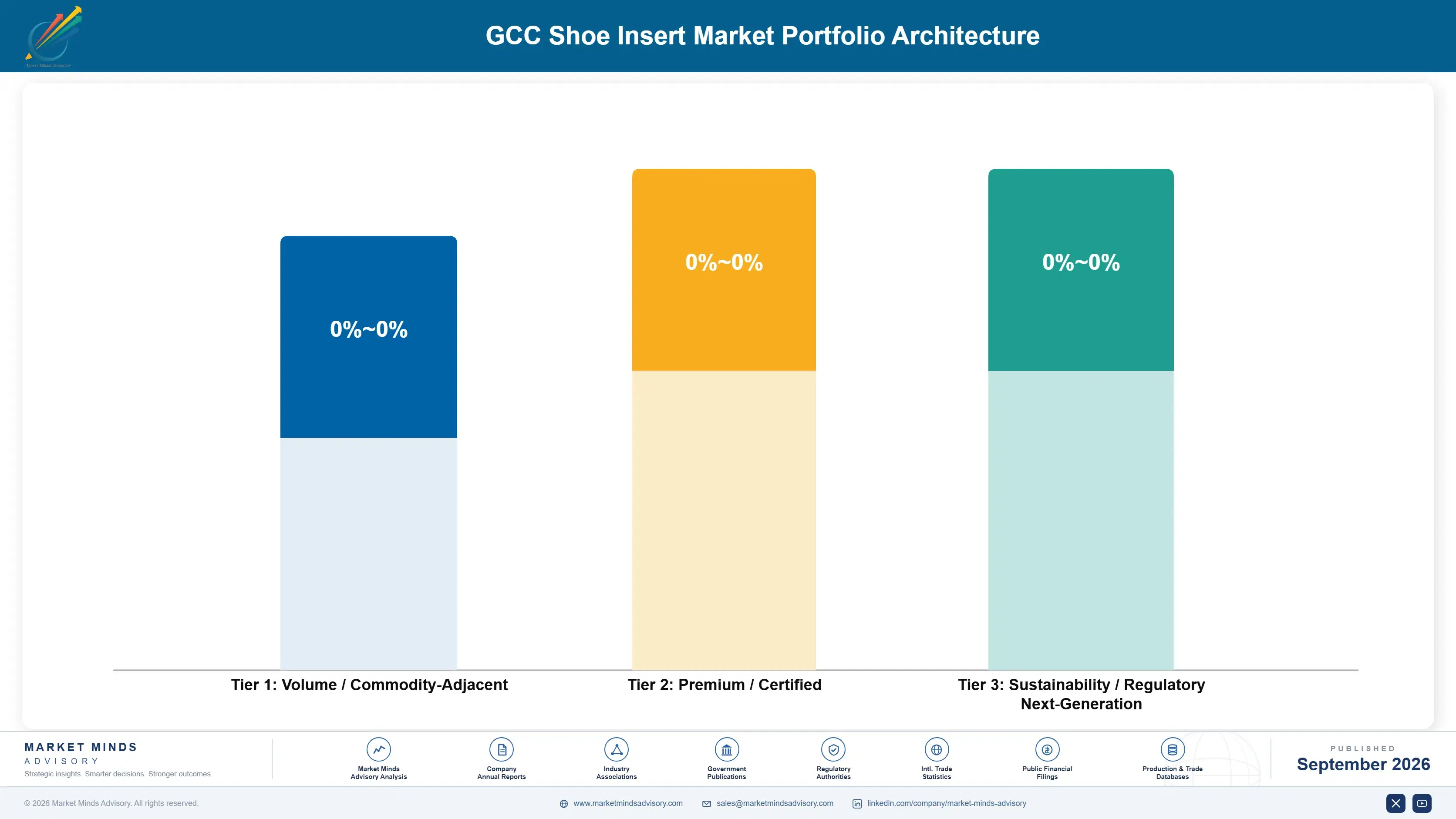
Portfolio Architecture for Margin Defence

Margin architecture divides by whether a clinician was involved in the sale, which is not what a product catalogue would suggest. Generic comfort cushioning sold through pharmacy runs at gross margins in the low thirties to low forties, chosen unassisted by customers testing softness with a thumb and competing against private label produced in the same Asian factories. Nothing at the counter distinguishes a comfort insert from an offloading device.
Prefabricated orthotics and sports insoles hold gross margins in the mid forties to mid fifties. The spread reflects how differently clinical and retail channels carry distribution and fitting cost. These devices deliver much of the clinical benefit of custom manufacture at a fraction of the price, which is precisely why extending reimbursement to them would move volume so sharply.

The highest-value pool is custom diabetic offloading and biomechanical orthoses, at margins in the high fifties to high sixties. Those devices require scanning, milling and clinical fitting, and the payer is frequently a health system rather than a patient. Comfort cushioning carries the unit volume and the pharmacy shelf space. It does not defend anything against a private label device. Shelf space and unit volume are the argument for keeping it.

Volume / Commodity-Adjacent

Generic comfort cushioning through pharmacy, chosen unassisted by customers testing softness by hand and competing against private label from the same factories. The ten point range reflects varying distributor terms.
Gross Margin: 32 to 42%

Premium / Certified

Prefabricated orthotics and sports insoles. These deliver much of the clinical benefit of custom manufacture at a fraction of the price, which is why reimbursement extension would move volume so sharply.
Gross Margin: 45 to 55%

Sustainability / Regulatory / Next-Generation

Custom diabetic offloading and biomechanical orthoses requiring scanning, milling and clinical fitting. The payer is frequently a health system rather than a patient, which changes the price conversation entirely. Clinical evidence rather than distribution decides access here.
Gross Margin: 57 to 68%
gcc-shoe-insert-market-portfolio-architecture-1790024470703

High-value Sub-segments and Strategic Watch-out

Custom Diabetic Offloading Insoles

High value and fastest growth at 11.1%. Digital scanning removed the manufacturing barrier, and the binding constraint is now referral volume, with only about 14% of diagnosed diabetic patients reaching a foot assessment. Every device in this segment begins with a referral that mostly does not happen.
Gross Margin: 58 to 68%

Prefabricated Orthotic Insoles

High value and strong growth at 8.4%. The clinical gap against custom devices is considerably smaller than the price gap suggests, which makes this the segment reimbursement policy would move most decisively. Occupational bulk purchasing also lands here, since employers cannot scan several hundred feet.
Gross Margin: 46 to 55%

Sports And Performance Insoles

Volume core in the retail specialty channel, supported by a fitting culture imported alongside the products. Growth is steady and the clinical argument that drives the rest of this market does not apply here. Specialty retail fitting culture arrived alongside the products rather than developing locally.
Gross Margin: 44 to 52%

Generic Comfort Cushioning

Strategic watch-out. Growing slowest at 3.6% and sold on the specification least suited to the region's highest-risk patients. The fourteen point range reflects how differently branded and private label product price. Private label from the same Asian factories competes on identical terms at the same counter.
Gross Margin: 30 to 44%

How Replacement Actually Happens

Replacement here should be clinical and is mostly accidental. A diabetic offloading device stops performing after roughly seven months under regional heat conditions, while patients and clinicians work to replacement intervals printed against temperate testing that assume a year or more. The gap between those two numbers is a period during which a device that looks fine is no longer redistributing pressure.
Stickiness varies sharply by who prescribed the device. Patients fitted through a podiatry clinic return to that clinic and the brand it dispenses, because the relationship is clinical and reassessment is built into their care. Pharmacy buyers have no attachment whatsoever and choose again from whatever is on the shelf. Occupational bulk purchasers are the steadiest of all, since replacement is a procurement cycle rather than a decision.

Buyer profiles are shifting as health system access widens. Patients who once reached an orthotics department only after an ulcer had formed are now assessed in primary care first, which changes the device they need and the price a system will pay. That group is growing fastest and almost none of the pharmacy-oriented supply chain is built to reach them.
gcc-shoe-insert-market-end-use-penetration-index-1790024471196

Where Access Decides Value

These are among the four positions where our research anticipates prominent divergence between winners and laggards over the coming forecast period. Each is grounded in the demand model, the regulatory perimeter, and the announced capacity pipeline.
01 / PHARMACY COUNTER CAPABILITY

Train the staff who see the patient first

Pharmacy supplies around 52% of units in this market and sells almost entirely on cushioning, which is the opposite of what a diabetic foot at ulcer risk actually requires from a device. Funding short counter training and a three-question risk prompt costs materials and staff time rather than any product change at all. Participants who implemented it report offloading sell-through rising roughly 2.6 times in trained outlets, because trained staff recommend a different shelf, and the product range itself requires no change whatsoever.
02 / REGIONAL MATERIAL SPECIFICATION

Build for the heat that exists here

Ethylene vinyl acetate degrades faster under Gulf interior vehicle temperatures than temperate specifications assume, bringing real replacement nearer seven months against published intervals of a full year or more. Higher-density formulations validated against regional conditions cost only a modest material premium on manufacture. Participants who reformulated report device life extending roughly 9 months under regional conditions, converting a product that quietly stops working into one that performs for its stated interval, and no standards body currently requires that testing from anybody.
03 / LOCAL MILLING CAPACITY

Mill the device inside the region

Custom devices milled abroad from digital scan files carry an international shipping leg that costs days of clinical turnaround and place the manufacturer outside the localisation requirements now attached to Gulf health procurement. Regional milling capacity removes both of those constraints simultaneously. Participants who have established local capacity report turnaround falling to around 3 days from 11, and they qualify for tenders that international-only suppliers simply cannot access at any price, and the capital commitment precedes the referral volume justifying it.
04 / PAYER ACCESS ARGUMENT

Price the insole against the amputation

An offloading insole costs a small fraction of what a single diabetic foot ulcer admission costs a Gulf health system, and prefabricated devices deliver much of the clinical benefit at a far lower price than custom manufacture. Presenting that arithmetic to insurers is an access argument rather than a marketing one. Participants who pursued it report reimbursement extending to prefabricated devices in two states, roughly tripling addressable volume, since a prefabricated device costs roughly a fifth of a custom one.

Engagement Snapshot From the Field

A live engagement with an industry participant carrying material or product regulatory and market exposure ahead of a defining policy shift, showing how our research translates into a defensible multi-year portfolio strategy.
MARKET MINDS ADVISORY · CLIENT ENGAGEMENT SUMMARY
GCC Shoe Insert Producer Strategic Portfolio Review and Transition Roadmap 2026·Investment Scenario on GCC Shoe Insert Exposure Evaluation 2025-26
CLIENT PROFILE
A Gulf orthotics distributor operating across four GCC states with net revenue near USD 19 million (client-reported, unverified by MMA), weighted approximately 61% to pharmacy comfort cushioning, 27% to prefabricated orthotics and 12% to custom devices. All custom devices were milled in Europe from locally captured scan files. No pharmacy training programme existed anywhere. Clinical tender losses had gone unexamined.
STRATEGIC CHALLENGE
Revenue had grown modestly while the clinical segments grew at three times the rate, and management attributed the gap to competitive pressure from European brands entering directly. A pricing reduction on the comfort range had been approved. Nobody had examined what pharmacy staff were recommending or why clinical tenders were being lost.
MMA APPROACH
MMA observed 240 pharmacy counter interactions across three states, coding what was recommended against what the customer described. Lost clinical tenders were reviewed against their stated qualification criteria. Custom turnaround was measured end to end, and returned devices were tested for foam resilience against their stated intervals. Findings were reconciled against distributor sales records.
KEY FINDINGS
  1. Pharmacy staff recommended the softest available insole in 84% of interactions, including 31 cases where the customer volunteered that they were diabetic.
  2. Every clinical tender lost in two years had failed on a regional manufacturing requirement rather than on price, clinical evidence or delivery capability.
  3. Custom turnaround averaged 11 days end to end, of which 6 were international shipping, against 3 days for competitors milling within the region.
  4. Returned devices tested at 41% below stated resilience at seven months, having been issued with a twelve month replacement interval printed on the packaging.
CLIENT PROFILE
A Gulf orthotics distributor operating across four GCC states with net revenue near USD 19 million (client-reported, unverified by MMA), weighted approximately 61% to pharmacy comfort cushioning, 27% to prefabricated orthotics and 12% to custom devices. All custom devices were milled in Europe from locally captured scan files. No pharmacy training programme existed anywhere. Clinical tender losses had gone unexamined.
STRATEGIC CHALLENGE
Revenue had grown modestly while the clinical segments grew at three times the rate, and management attributed the gap to competitive pressure from European brands entering directly. A pricing reduction on the comfort range had been approved. Nobody had examined what pharmacy staff were recommending or why clinical tenders were being lost.
MMA APPROACH
MMA observed 240 pharmacy counter interactions across three states, coding what was recommended against what the customer described. Lost clinical tenders were reviewed against their stated qualification criteria. Custom turnaround was measured end to end, and returned devices were tested for foam resilience against their stated intervals. Findings were reconciled against distributor sales records.
KEY FINDINGS
  1. Pharmacy staff recommended the softest available insole in 84% of interactions, including 31 cases where the customer volunteered that they were diabetic.
  2. Every clinical tender lost in two years had failed on a regional manufacturing requirement rather than on price, clinical evidence or delivery capability.
  3. Custom turnaround averaged 11 days end to end, of which 6 were international shipping, against 3 days for competitors milling within the region.
  4. Returned devices tested at 41% below stated resilience at seven months, having been issued with a twelve month replacement interval printed on the packaging.
RECOMMENDED STRATEGY
Phase 1: Phase one: cancel the comfort range price reduction and fund counter training with risk screening across all pharmacy accounts. Materials cost a fraction of the reduction. Phase 2: Phase two: establish regional milling capacity and requalify for clinical tenders under localisation criteria. Scan capture already happens locally across all four states. Phase 3: Phase three: specify regionally validated higher-density foams and reprint replacement intervals honestly. Honest intervals also increase legitimate replacement revenue considerably.
OUTCOME
Gross margin improved by nine points across four quarters as mix shifted toward clinical tiers (client-reported, unverified by MMA). Trained pharmacy accounts more than doubled offloading sell-through, and the regional milling facility won three tenders in its first year that the previous structure could not have bid for.

Frequently Asked Questions

Foundational context covering the market sizes, CAGR, scope, country, region and competition that inform every finding below. This section is provided to cover basics and most often pre-purchase conversations, answered from the MMA Primary Research Dataset.

What is the current size of the GCC Shoe Insert Market?

The market was valued at USD 0.21 billion in 2025, rising to USD 0.23 billion in 2026. Sizing is at supplier net revenue across six device types.

How large will the GCC Shoe Insert Market be by 2036?

MMA forecasts USD 0.47 billion by 2036, an increase of USD 0.24 billion over the 2026 base. That represents expansion of 2.04 times across the forecast period.

What is the CAGR for the GCC Shoe Insert Market 2026 to 2036?

The base case CAGR is 7.4%, with a bull case of 8.6% and a bear case of 6.2%. Historical growth between 2020 and 2025 ran at 6.1%.

Which segment is growing fastest?

Custom diabetic offloading insoles grow at 11.1%, half again the market rate, on health system expansion. Prefabricated orthotic insoles follow at 8.4% and generic comfort cushioning grows slowest at 3.6%.

Who are the major companies in the GCC Shoe Insert Market?

Bauerfeind, Ottobock, Superfeet, Scholl and Currex lead on supplier net revenue, holding a combined 36%. Clinical tier access runs through regional distribution houses, and direct brand presence remains rare.

Which country is growing fastest?

This report covers the six GCC states only. Within them, Saudi Arabia grows fastest at 8.3% as Vision 2030 health provisions expand podiatry access from a low base.

Report Segmentation Architecture

The full report scope spans multiple orthogonal segmentation dimensions, with cross-tabulated demand data provided for each dimension pair. Coverage extends further to regional breakdowns, trend trajectories, and the competitive detail needed to support segment-level decision-making.

By Device Type

  • Custom Diabetic Offloading Insoles
  • Prefabricated Orthotic Insoles
  • Custom Biomechanical Orthoses
  • Sports and Performance Insoles
  • Generic Comfort Cushioning
  • Heel and Forefoot Pads

By End-Use Setting

  • Diabetic Foot Care Clinics
  • Podiatry and Orthotics Practices
  • Hospital Outpatient Departments
  • Retail and Community Pharmacy
  • Sports and Specialty Retail
  • Occupational Health Programmes

By Commercial Dimension

  • Public Health System Procurement
  • Private Insurance Reimbursement
  • Direct Patient Purchase
  • Pharmacy Retail Sale
  • Employer Bulk Procurement
  • Specialist Retail Fitting

By Region

  • Western Europe
  • East Asia
  • North America
  • Middle East and Africa
  • South Asia and Pacific
  • Eastern Europe
  • Latin America

Scope, Methodology, and Coverage

Every figure in this report is reproducible from documented input assumptions. The scope below maps the historical period, the forecast horizon, the segmentation dimensions, and the countries covered, alongside the underlying primary and qualitative methodology.
Historical Period
2020 to 2025
Forecast Period
2026 to 2036
Base Year
2025 (USD billions; MMA Primary Research Dataset, September 2026)
Market Definition
This market covers removable shoe inserts supplied across the six Gulf Cooperation Council states, spanning custom diabetic offloading insoles, prefabricated orthotic insoles, custom biomechanical orthoses, sports and performance insoles, generic comfort cushioning, and heel and forefoot pads. Sizing is at supplier net revenue across public procurement, insurance, direct purchase, pharmacy, employer and specialist retail channels. Footwear with fixed integral footbeds, therapeutic diabetic shoes, ankle-foot orthoses and compression hosiery are excluded from scope throughout this report.
Quantitative Units
USD billions at supplier net revenue; volume in thousands of devices supplied; durability in months to resilience loss.
Segmentation Dimensions
Device type, end-use setting, commercial dimension, and manufacturing origin region.
Regions Covered
Western Europe, East Asia, North America, Middle East and Africa, South Asia and Pacific, Eastern Europe, Latin America
Countries Covered
Saudi Arabia, United Arab Emirates, Qatar, Kuwait, Oman, Bahrain
Key Companies Profiled
Bauerfeind, Ottobock, Superfeet, Scholl, Currex, Sidas, Formthotics, Pedag, Birkenstock Orthopedics, Footbalance, Aetrex, Powerstep, Vasyli Medical, Orthofeet, Talarmade, Salford Insole, Algeos, Medi GmbH, Hanger Clinic, Comfortfit Labs
Quantitative Methodology
Primary survey, n=3,800 respondents, Q4 2025, six countries; demand-side model with trade association cross-validation
Qualitative Methodology
47 expert interviews, Q4 2025; applied to validate demand model assumptions, identify emerging dynamics, and assess competitive positioning
Report Format
PDF and XLSX data workbook (Word format preview document)
Publisher
Market Minds Advisory
Report Code
MMA-2026-MED-802
Published
September 2026
Contact
sales@marketmindsadvisory.com | www.marketmindsadvisory.com

Purchase the full GCC Shoe Insert Market Report (2026 to 2036).

The full report sizes the GCC shoe insert market across six device types, six end-use settings and six commercial dimensions for all six member states through 2036. It observes and codes pharmacy counter recommendations against what customers actually describe, rather than relying on reported sales mix. Foam resilience is tested against regional ambient and interior vehicle temperature conditions rather than temperate protocols. Lost clinical tenders are reviewed against stated qualification criteria including localisation. Competitive assessment covers 20 participants on a consistent supplier net revenue basis.
Pharmacy counter recommendations observed and coded directly
Foam resilience tested under regional temperature conditions
Lost clinical tenders reviewed against qualification criteria
Custom device turnaround measured end to end
Six device types sized through 2036
Twenty participants assessed on supplier net revenue

Built For The People Who Decide

From boardroom strategy to bench-side execution, this report is read cover-to-cover by leaders shaping the next decade of their industry, turning demand scenarios, market dynamics and valuation benchmarks into decisions.
CXOs/ Presidents/ VPs/ Managers
M&A and Corporate Development
Strategy Teams and R&D Heads
Procurement and Product Directors
Regulatory and Compliance Leaders
Investor Relations and Equity Analysts