Market Minds Advisory
GCC Hydrochloric Acid Market

GCC Hydrochloric Acid Market: Well Stimulation Demand Meets a Desalination-Rooted Category

GCC hydrochloric acid producers now face accelerating well acidizing demand tied to upstream investment, expanding desalination capacity across Saudi Arabia and the UAE, and volatile chlor-alkali pricing squeezing commodity acid margins.

Lead Analyst

Bilal Shaikh

Published

September 2026

Make Smarter Decisions with Customized Research Insights

Request a free sample report and evaluate market opportunities, growth trends, and competitive dynamics relevant to your business needs.

2025 MARKET VALUE$0.8BMarket Size 2025
2036 FORECAST VALUE$1.6BBase Case , 2026 to 2036
CAGR 2026 TO 20366.0 %Bull 7.2% / Bear 4.7%
INCREMENTAL OPPORTUNITY$0.7BNet 10- year value creation
EXPANSION MULTIPLE1.79x2036 value over 2026 base
Strategic Levers
M&A Pipeline
Regional Outlook
Country Rankings
Competitive Intelligence
Segmental Deep-dive
Call-Us : 91 93563 13602

Executive Snapshot and Market Trajectory

Oilfield service companies are qualifying high-purity acidizing-grade hydrochloric acid faster than regional producers can reliably scale supply, creating a widening availability gap even as upstream well stimulation programs continue expanding across major GCC oil and gas fields. Producers unprepared for this shift risk losing qualification. today.
Oil and gas well acidizing and desalination water treatment applications are pulling category growth well ahead of conventional steel pickling and industrial cleaning uses, as oilfield operators and water utilities increasingly specify hydrochloric acid formulations for performance conventional alternatives cannot match. Saudi Arabia commands the largest share of category revenue given its dominant upstream oil and gas investment and expanding petrochemical manufacturing base, while the United Arab Emirates follows given its substantial desalination and downstream.
Competitive structure remains fairly concentrated among established regional petrochemical producers, with the top five holding a substantial combined share on a production capacity basis. Chlor-alkali feedstock price volatility is compounding margin pressure on commodity industrial acid applications, pushing producers toward higher-value acidizing-grade conversion rather than relying on lower-margin bulk industrial sales alone. Emerging regional producers are increasingly entering from adjacent oilfield services backgrounds. overall.
Market Definition
The GCC hydrochloric acid market covers production and downstream application of hydrochloric acid across oil and gas well acidizing, water treatment and desalination, steel pickling and metal processing, chemical manufacturing intermediates, food and pharmaceutical processing, and pH control and industrial cleaning within Saudi Arabia, the United Arab Emirates, Kuwait, Qatar, Oman, and Bahrain. It excludes hydrofluoric and other industrial acids and excludes finished petrochemical or water treatment products themselves beyond the acid material inputs.
Base Year Value
$0.8B in 2025 (MMA Primary Research Dataset, August 2026)
Forecast Period
2026 to 2036, eleven discrete annual values
CAGR
6.0% base case. Bull 7.2%. Bear 4.7%.
Fastest Growth Segment
Oil and Gas Well Acidizing: 8.0% CAGR
Fastest Growth Country
Saudi Arabia: 7.5% CAGR
Fastest Growth Region
South Asia and Pacific: 8.0% CAGR
Largest Region
Middle East and Africa: 52% of 2025 global value
Market Leaders
SABIC, Advanced Petrochemical Company, Sipchem, EQUATE Petrochemical Company, and Gulf Petrochemical Industries Company. Source: MMA Analysis based on company annual reports.
Primary Survey
n=3,800 procurement and R&D decision-makers, Q4 2025, six countries
Methodology
Demand-side build-up, cross-validated against public data, 47 expert interviews

GCC Hydrochloric Acid Market Forecast Scenarios

gcc-hydrochloric-acid-market-trends-size-forecast-scenario-1787552061838
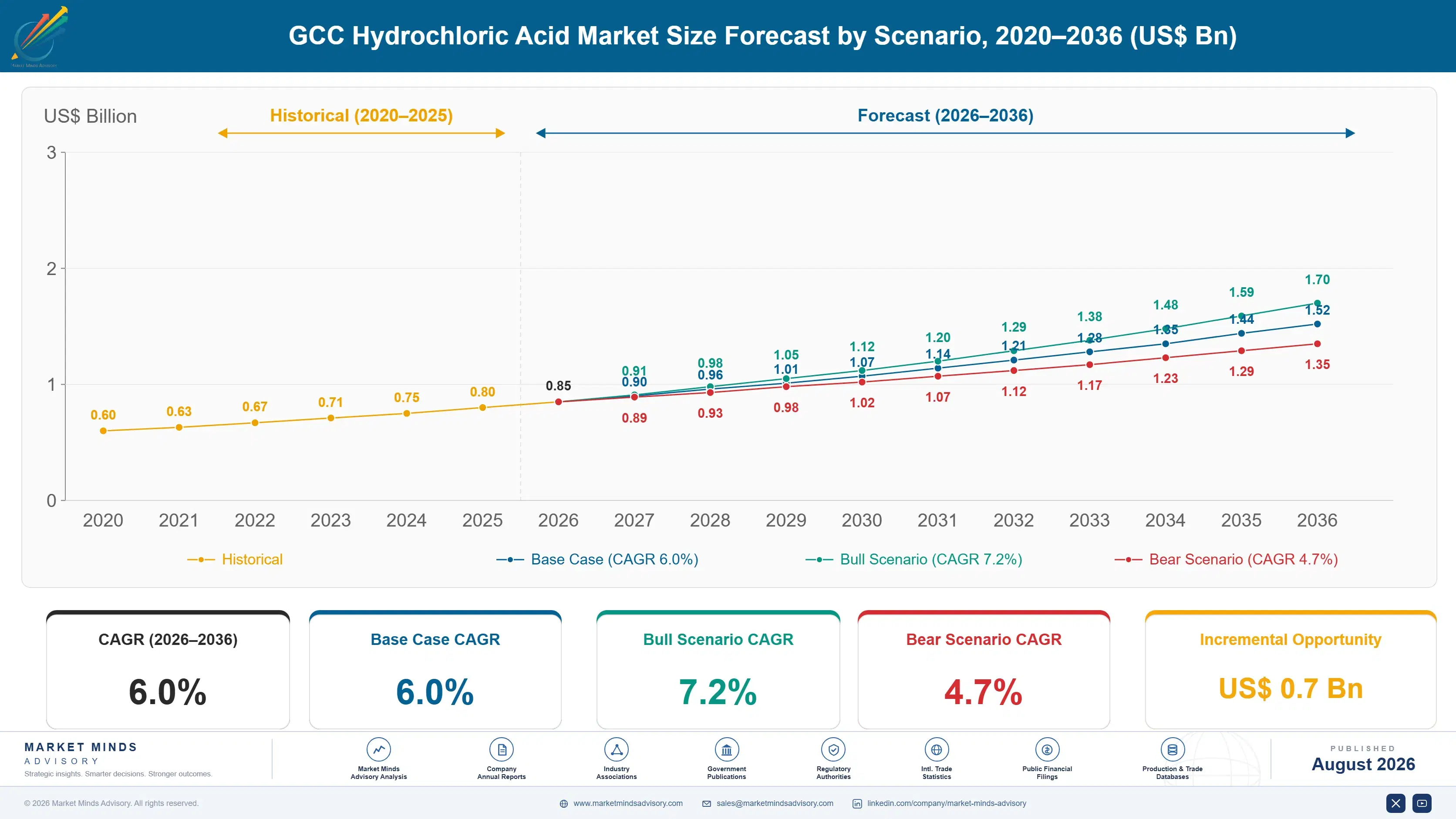
Between 2020 and 2025 the market grew at a historical pace of roughly 5.1 percent annually, as steel pickling and industrial cleaning applications provided steady baseline demand while well acidizing qualification accelerated meaningfully only in the final two years of the period as upstream operators expanded stimulation programs across major GCC oil fields. That combination lifted overall category revenue steadily nationwide.
The base case assumes growth near 6.0 percent annually through 2036, anchored in three commercial mechanisms: expanding well acidizing qualification among oilfield service companies seeking enhanced recovery performance, growing desalination capacity investment across Saudi Arabia and the United Arab Emirates requiring expanded water treatment chemical supply, and steady petrochemical manufacturing capacity expansion sustaining baseline industrial acid demand across the region. Purification investment is expanding steadily across the producer base to match this demand.
A bull scenario builds on faster upstream capital expenditure growth across additional GCC oil and gas fields requiring expanded acidizing chemical supply, while a bear scenario centers on volatile chlor-alkali feedstock pricing compressing producer margins faster than acidizing-grade premium pricing can offset the decline. Most analysts view the base case as the more probable outcome overall.

Upstream Demand Outpaces Acidizing-Grade Capacity

Three forces are converging on the category at once: oilfield service companies are qualifying acidizing-grade hydrochloric acid faster than regional production capacity can reliably scale, desalination water treatment demand is expanding as Saudi Arabia and the United Arab Emirates continue investing in capacity, and producers are racing to expand purity and consistency controls fast enough to meet accelerating downstream requirements across multiple industries simultaneously.
MARKET CONCENTRATIONCR5 55%top five producers hold a substantial combined share
ACIDIZING-GRADE PENETRATION29%share of production volume destined for oilfield stimulation applications
LEADING PRODUCING COUNTRYSaudi Arabialargest single national manufacturing and consumption base overall
AVERAGE SELLING PRICE TREND-2% annuallytypical yearly price decline as production capacity scales
DESALINATION CAPACITY GROWTH RATE9% annuallytypical yearly expansion in regional desalination plant capacity
CHLOR-ALKALI FEEDSTOCK COST SHARE38% of COGSchlorine and hydrogen inputs as portion of total cost
Commercially the category increasingly behaves like a specialty oilfield chemical business layered on top of traditional bulk industrial acid manufacturing, since a producer's ability to win oilfield service customer qualification now depends as much on purity consistency and delivery logistics as on raw production volume alone, a shift that is rewarding producers with dedicated oilfield chemistry capability over bulk industrial specialists.
Over the next decade, producers most likely to capture disproportionate value are those investing in acidizing-grade purification capability and logistics infrastructure ahead of broader upstream capital expenditure expansion, since building this capability after competitors have already established it takes considerably longer than building it in from initial capacity investment. Early movers in purification technology are already visible among the category's fastest growing producers today.
"Hydrochloric acid used to be a bulk industrial commodity nobody thought twice about in this region. Now oilfield operators specify purity levels down to the parts per million for well stimulation jobs, and the producers who invested in that consistency years ago are the ones winning the contracts."
Director, Industrial Chemicals and Oilfield Services Practice · MMA Industrial Chemicals / Oilfield and Water Treatment Acids Practice · August 2026

Market Trends

Oilfield Operators Standardizing High-Purity Acidizing Chemical Specification

Oilfield service companies across multiple GCC upstream operations are increasingly standardizing high-purity hydrochloric acid specification for well acidizing and stimulation jobs, moving beyond conventional industrial-grade acid into dedicated oilfield-grade formulations with tighter impurity controls. This shift follows several years of accumulating evidence that purity-controlled acid improves stimulation job consistency and reduces formation damage relative to conventional industrial-grade acid at meaningfully lower long-term well performance risk. Multiple oilfield service companies have expanded acidizing chemical qualification programs within the past two years, extending beyond premium offshore operations into broader onshore field development as well.
Market Impact: Lifts upstream-driven demand by 11%
Desalination Capacity Expansion Driving Water Treatment Chemical Demand

Saudi Arabia and the United Arab Emirates continue expanding desalination plant capacity to meet growing municipal and industrial water demand, directly increasing addressable demand for hydrochloric acid used in membrane cleaning and pretreatment processes across reverse osmosis facilities. This application requires consistent purity and reliable delivery logistics that differs somewhat from conventional bulk industrial applications. Several desalination plant operators have expanded chemical supply qualification programs within the past two years to support this capacity growth. Several desalination plant operators have expanded chemical supply testing programs to meet this rising demand across additional treatment facilities worldwide.
Market Impact: Adds 7% to petrochemical-driven demand

Market Opportunities and Growth Drivers

Expanding Upstream Capital Expenditure Across GCC Oil and Gas Fields

National oil companies and international operators continue expanding upstream capital expenditure across major GCC oil and gas fields, directly increasing addressable demand for well acidizing and stimulation chemicals as enhanced recovery programs expand across both mature and newly developed fields. This investment driver is occurring across multiple national oil companies simultaneously, broadening the addressable customer base for acidizing chemical producers considerably beyond the historically concentrated set of premium offshore operations that first drove early adoption of purity-controlled acidizing. Suppliers with regional flexibility increasingly capture disproportionate new customer volume across their operations.
Market Impact: Compresses industrial margins by 10%

Growing Petrochemical Manufacturing Capacity Across the Region

Petrochemical manufacturing capacity continues expanding across Saudi Arabia, the United Arab Emirates, and Qatar, directly increasing addressable demand for hydrochloric acid as a chemical manufacturing intermediate across multiple downstream production processes. This manufacturing driver provides demand visibility that differs from purely oilfield-cycle-driven growth, giving producers more predictable long-term volume planning than categories dependent entirely on upstream capital expenditure cycles alone. This manufacturing driver is expected to continue steadily across most major consuming markets for the foreseeable future. Companies increasingly build commercial capacity anticipating this durable demand tailwind across multiple regions worldwide.
Market Impact: Raises regional distribution costs by 9%

Market Restraints and Challenges

Chlor-Alkali Feedstock Price Volatility Compresses Industrial Margins

Chlorine and hydrogen feedstock prices fluctuate considerably based on broader chlor-alkali market dynamics, a volatility rooted in these inputs' dependence on electricity-intensive electrolysis production that producers cannot always pass through to price-sensitive commodity industrial customers operating under tight cost budgets. The commercial impact is that producers selling standalone commodity industrial acid face compressed margins relative to acidizing-grade contracts, pushing many toward higher-value oilfield conversion that better absorbs feedstock cost volatility. Several producers are pursuing long-term electricity supply agreements as a mitigation path to reduce this margin exposure over time. today.
Market Impact: Lifts acidizing demand by 13%

Transportation and Storage Logistics Constrain Regional Distribution

Hydrochloric acid's corrosive properties require specialized transportation and storage infrastructure that considerably extends distribution timelines relative to less hazardous industrial chemicals, a complexity rooted in the specialized tanker and containment equipment required across the region's often considerable transport distances between production facilities and end-use sites. The commercial impact is that producers face meaningfully higher logistics costs and longer delivery timelines when serving customers outside their immediate production region, limiting the geographic reach of smaller regional producers. Several producers are pursuing distributed regional storage terminal investment as a mitigation path to improve delivery reliability across the broader GCC region.
Market Impact: Adds 9% to desalination chemical demand
3 additional market trends, 3 additional growth drivers, and 3 additional restraints and challenges are covered in the full report. Contact sales@marketmindsadvisory.com to access the complete intelligence.

Segment CAGR and Growth Architecture

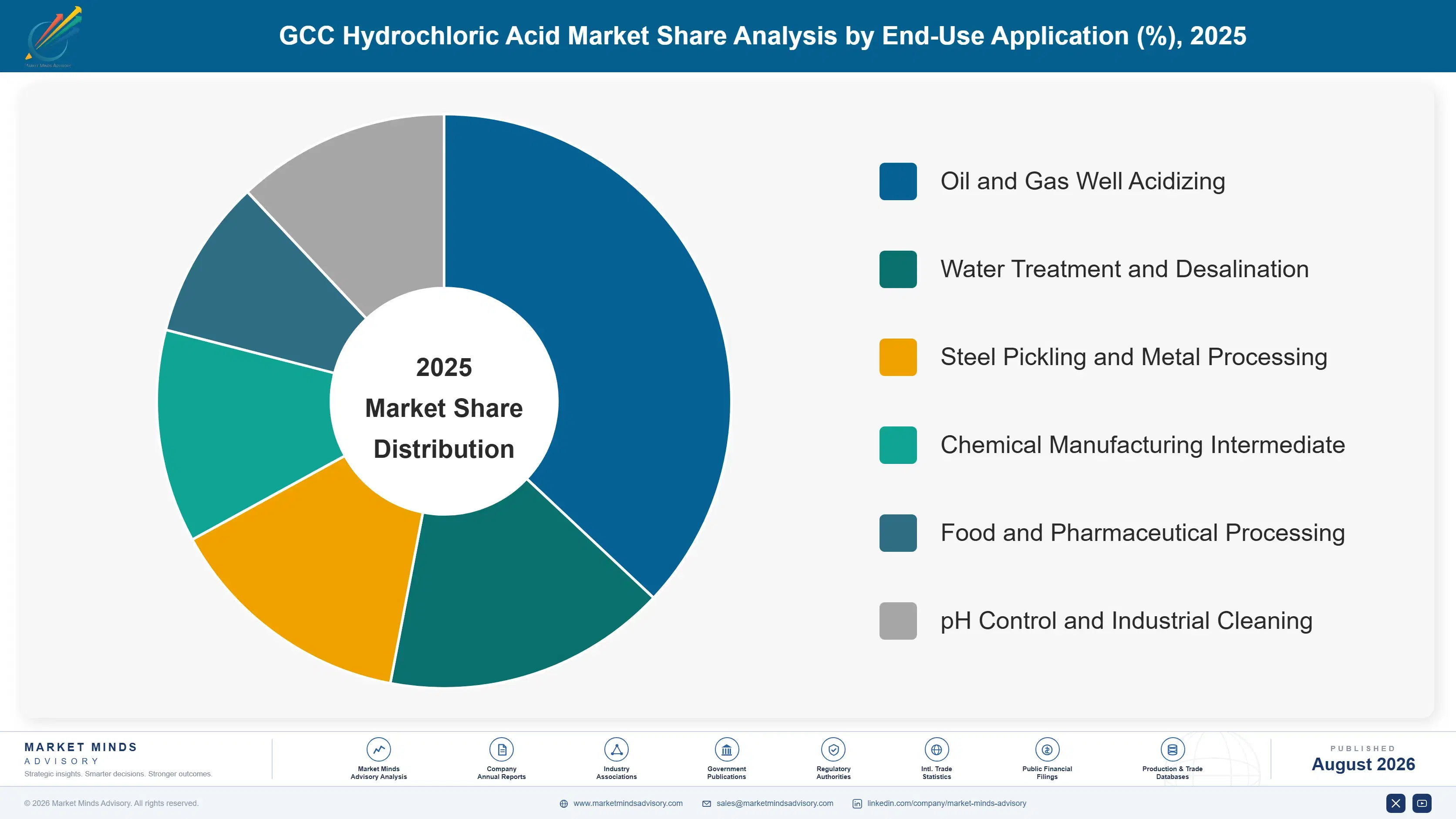
Segmentation follows end-use application, since well acidizing, desalination water treatment, steel pickling, chemical manufacturing intermediates, food and pharmaceutical processing, and industrial cleaning each carry distinct purity requirements and pricing structures despite sharing the same underlying hydrochloric acid production process across the GCC region today. These distinctions shape pricing and qualification decisions across the entire value chain today.
gcc-hydrochloric-acid-market-trends-market-share-analysis-1787552062365

Oil and Gas Well Acidizing

Oil and gas well acidizing is growing fastest as oilfield service companies increasingly standardize high-purity hydrochloric acid specification for well stimulation jobs across both mature and newly developed GCC oil and gas fields. This segment requires tightly controlled impurity levels and consistent purity documentation that limits qualified supply to a relatively small number of producers with established oilfield service relationships and rigorous quality control systems. Producers with early oilfield customer qualification are securing multi-year supply agreements as operators seek to lock in acidizing chemical supply ahead of anticipated continued upstream capital expenditure growth across the region. Continued expansion of qualified purification capacity remains the key constraint limiting how quickly this segment can scale further across the region.
CAGR 8.0%

Water Treatment and Desalination

Water treatment and desalination is the second fastest growing segment, benefiting from Saudi Arabia and the United Arab Emirates continuing to expand desalination plant capacity to meet growing municipal and industrial water demand across the region. This segment requires consistent purity and reliable delivery logistics that differs somewhat from conventional bulk industrial applications, concentrating supply among producers with dedicated water treatment customer relationships. Desalination plant operators are increasingly incorporating hydrochloric acid into standard membrane cleaning protocols, providing demand visibility that is accelerating producer investment in this specialized delivery capability. Operators increasingly request pilot documentation before committing to full formulation qualification programs across the region. Pilot programs typically run six months before broader commercial adoption follows.
CAGR 7.0%
Full segment breakdown across 6 segments available in the complete report.

Regional Architecture and Country Demand Map

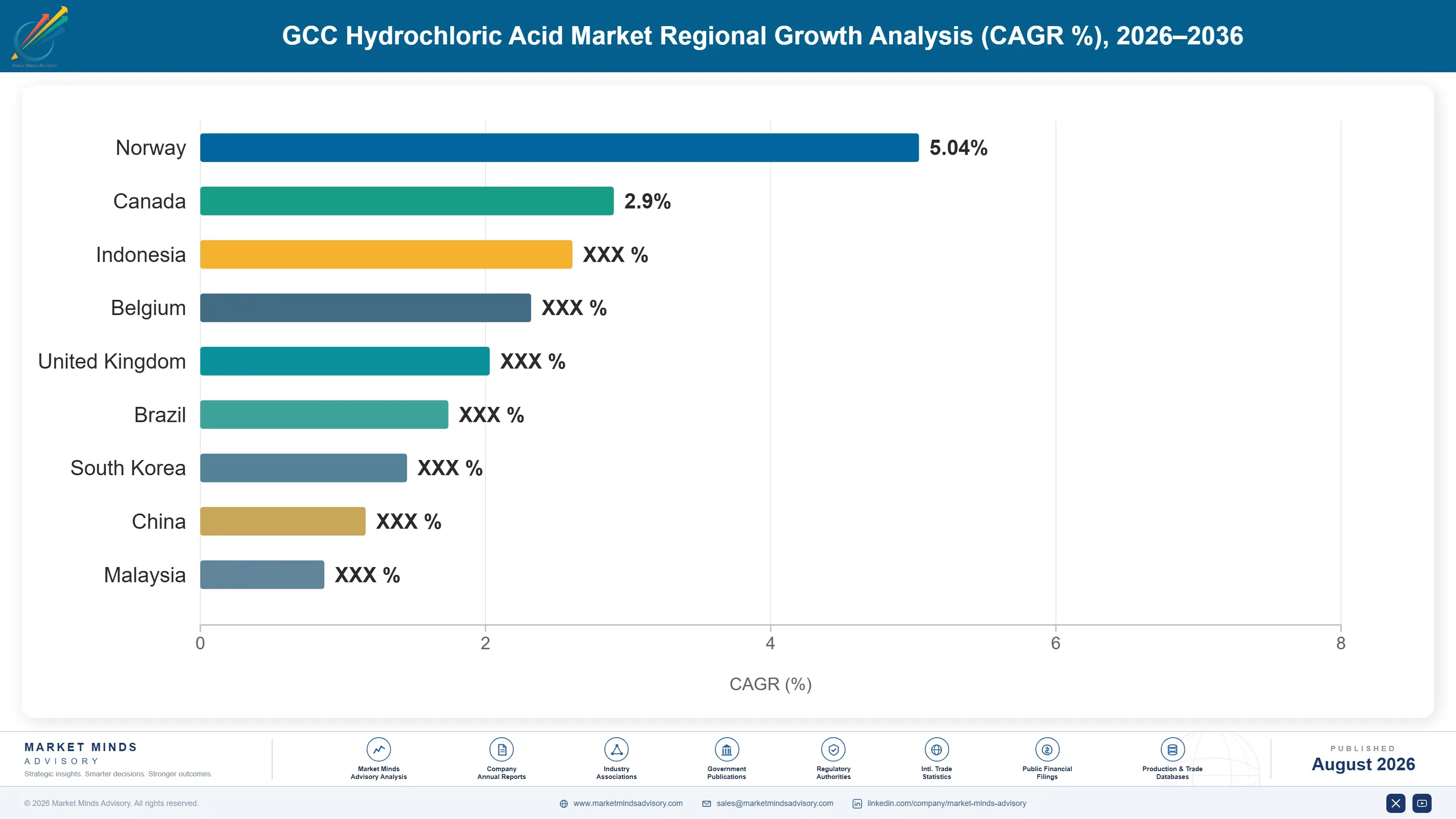
Saudi Arabia commands the largest share of category revenue given its dominant upstream oil and gas investment, while the United Arab Emirates follows given its substantial desalination capacity across the wider GCC region. Qatar and Kuwait contribute meaningful additional demand tied to their petrochemical bases.

North America

The United States shows modest comparative demand for this GCC-focused report, falling well below the typical share band applied to comparable industrial chemical categories since this analysis is explicitly scoped around Gulf Cooperation Council production and consumption rather than global demand. Domestic industrial chemical producers maintain limited direct exposure to GCC-specific acidizing and desalination applications, with most North American relevance tied to oilfield service companies operating in the Gulf region under international contracts. Canada's exposure remains similarly limited given its own domestic industrial acid supply chains. Venture capital investment in domestic oilfield services technology continues expanding, though direct exposure to this GCC-specific category remains limited. today. overall today. each year.
Share: 14% | CAGR: 6.4% (2026 to 2036)

Western Europe

Germany and the United Kingdom show comparative demand well below the typical share band applied to comparable categories, reflecting this report's explicit focus on Gulf Cooperation Council production and consumption rather than global demand patterns. European engineering and oilfield service companies maintain project relationships with GCC operators, indirectly influencing regional specification standards even without direct chemical production exposure. Germany's petrochemical engineering expertise continues informing GCC facility design and technology transfer arrangements. German and British engineering firms continue securing meaningful contract work supporting GCC petrochemical and desalination infrastructure development. Nordic engineering consultancies also maintain project relationships tied to GCC water treatment and industrial facility design work. overall today. each year. overall.
Share: 12% | CAGR: 4.5% (2026 to 2036)
Regional intelligence for 5 additional markets available in the complete report: East Asia, South Asia and Pacific, Latin America, Middle East and Africa, Eastern Europe. Contact sales@marketmindsadvisory.com.
gcc-hydrochloric-acid-market-trends-country-cagr-analysis-1787552062892

Acidizing Purity and Logistics Levers

Producers are pulling four commercial levers at once: acidizing-grade purification investment, desalination customer qualification programs, regional distribution terminal development, and diversified feedstock sourcing, each addressing a distinct margin opportunity created by the category's shift toward oilfield demand today. This combination is reshaping which producers win long-term oilfield customer contracts. across most producers today. overall.

Acidizing-Grade Purification Technology Investment Overall Today

Investing in advanced purification technology and consistent impurity control directly addresses the quality barrier separating commodity industrial acid sales from premium acidizing-grade conversion. This investment requires substantial capital and specialized chemistry talent but positions early movers to capture disproportionate share as oilfield service companies increasingly demand certified, purity-controlled acid rather than variable commodity product requiring in-house processing. Producers with established purification technology report customer qualification rates roughly 22 percent higher than competitors selling commodity industrial acid alone. Larger competitors are increasingly matching this approach to defend existing account relationships. today.
Market Impact: Lifts customer qualification rate by roughly 22 percent

Desalination Customer Qualification Program Investment Strategy

Establishing dedicated qualification programs with desalination plant operators, including joint chemical supply testing and long-term agreement negotiation, positions producers to capture the premium pricing and volume commitments desalination customers increasingly require before committing to a hydrochloric acid supplier. This program requires sustained technical support staffing and multi-year relationship investment but has enabled producers pursuing this strategy to secure supply agreements covering multiple facility expansions, lifting contracted volume by roughly 26 percent relative to producers selling on a purely transactional basis. Operators increasingly favor suppliers demonstrating this depth of commitment. today.
Market Impact: Lifts contracted desalination volume by roughly 26 percent

Regional Distribution Terminal Development Programs Overall

Establishing distributed regional storage and distribution terminals across the GCC directly addresses the logistics barrier constraining broader geographic reach for producers concentrated near a single production facility. This approach requires substantial capital investment in specialized tanker and containment infrastructure but has enabled producers pursuing this strategy to expand delivery reliability and geographic coverage meaningfully, cutting typical delivery timelines by roughly 19 percent relative to competitors without comparable distribution infrastructure. Established customers increasingly require proof of this distribution capability before granting even pilot orders. These relationships also provide valuable market intelligence supporting future infrastructure investment decisions.
Market Impact: Cuts delivery timelines by roughly 19 percent overall

Diversified Feedstock Sourcing Investment Beyond Single Suppliers

Establishing sourcing relationships across multiple chlor-alkali feedstock suppliers addresses growing customer demand for supply chain resilience and reduced single-source concentration risk among oilfield and desalination customers seeking reliable long-term supply security. This approach requires substantial relationship investment and technical qualification across each additional feedstock source but has enabled early movers to secure premium pricing and long-term contracts from customers prioritizing supply security, lifting realized pricing by roughly 15 percent relative to single-source benchmark pricing. Customers view this security as increasingly valuable across their sourcing decisions. Manufacturers view this investment as increasingly valuable.
Market Impact: Lifts realized pricing by roughly 15 percent overall

Who Controls the Margin Pool

Concentration remains fairly high, with the top five producers holding a combined 55 percent share on a production capacity basis, reflecting a market where established regional petrochemical companies with integrated chlor-alkali production compete alongside a smaller number of specialized acidizing chemical developers entering from adjacent oilfield services backgrounds. The gap between the leading producer and mid-tier challengers remains considerable, reflecting durable relationships with national oil companies and desalination operators built over multiple decades of regional operation.
Current competitive activity centers on three dimensions: acidizing-grade purification investment to capture premium oilfield demand, desalination customer qualification programs to secure long-term water treatment contracts, and regional distribution terminal development to expand geographic reach across the GCC. National oil company relationships built over decades continue to matter considerably in this competitive dynamic across the sector.

Emerging pressure comes from specialized acidizing chemical developers entering the category from adjacent oilfield services backgrounds, and from expanding regional petrochemical capacity investment, threatening to gradually redistribute share away from established producers reliant primarily on legacy commodity industrial acid manufacturing scale over the coming decade. Consolidation among mid-tier regional producers appears increasingly likely over the next several years.
gcc-hydrochloric-acid-market-trends-company-positioning-matrix-1787552063409

Competitive Moat and Risk Dimensions

SABIC

Moat: Broad Regional Petrochemical Portfolio

SABIC's broad regional petrochemical portfolio spanning multiple chemical categories beyond hydrochloric acid alone gives it customer relationships and cross-selling opportunities that narrower single-chemistry competitors cannot easily replicate across comparable account depth throughout the GCC region. Few narrower competitors can match this integrated commercial reach across the region.
SABIC

Risk: Diversified Portfolio Resource Allocation

SABIC's diversified petrochemical portfolio means hydrochloric acid receives resource allocation attention proportional to its relatively modest revenue contribution compared to larger polymer and fertilizer business lines, potentially disadvantaging this category relative to more narrowly focused competitors. Specialized competitors face fewer such internal resource allocation tradeoffs across their portfolios.
EQUATE PETROCHEMICAL COMPANY

Moat: Established Kuwait Production Base

EQUATE's established production base in Kuwait and long customer relationship history give it continued preference among regional industrial customers requiring consistent quality and reliable supply across both oilfield and industrial applications. Few competitors can match this depth of specialized regional credibility and customer trust. today.
EQUATE PETROCHEMICAL COMPANY

Risk: Single Country Production Concentration

EQUATE's production remains concentrated within a single national jurisdiction, meaning any domestic policy shift or operational disruption within Kuwait could disproportionately affect its regional supply position relative to producers with geographically diversified GCC manufacturing footprints. Geographically diversified competitors face considerably less exposure to this single-country risk.

Players Tracked

Prominent Players

SABIC
Advanced Petrochemical Company
Sipchem
EQUATE Petrochemical Company
Gulf Petrochemical Industries Company

Other Key Players

Saudi Chlorine and Chemicals Company
Muntajat
National Petrochemical Industrial Company
Petro Rabigh
Ma'aden
Borouge
OQ
ADNOC
Kuwait National Petroleum Company
Bahrain Petroleum Company
QAPCO
Emirates Global Aluminium
Gulf Chemical and Industrial Oils Company
Fujairah Natural Resources Corporation
Ras Laffan Industrial City Services

Recent Developments

MARCH 2026

SABIC Expands Acidizing-Grade Purification Capacity

SABIC commissioned expanded acidizing-grade hydrochloric acid purification capacity at its Saudi Arabian manufacturing facility, aimed at meeting rising oilfield service demand for purity-controlled well stimulation chemicals as upstream capital expenditure continues expanding across multiple GCC oil fields. The expansion is expected to meaningfully increase available supply for qualified oilfield customers.
Signal: Signals continued purification investment ahead of accelerating acidizing demand across the region across the broader producer landscape overall
SEPTEMBER 2025

EQUATE Signs Desalination Operator Supply Agreement

EQUATE Petrochemical Company signed a multi-year supply agreement with a major desalination plant operator for certified hydrochloric acid, securing contracted volume commitments covering multiple future facility expansions and treatment requirements. Industry observers view the agreement as an early signal of consolidating desalination supply relationships. nationwide.
Signal: Confirms long-term supply agreements becoming a standard commercial strategy across the region as more producers pursue comparable arrangements across the
MAY 2025

Sipchem Launches Regional Distribution Terminal Network

Sipchem launched a new regional distribution terminal network spanning multiple GCC countries, expanding its logistics capability to serve growing oilfield and desalination customer demand across a broader geographic footprint within the region. Analysts expect further distribution investment among competing regional producers. Growth in this segment continues broadly.
Signal: Demonstrates continued distribution investment strengthening regional delivery capability within the broader regional distribution landscape overall today

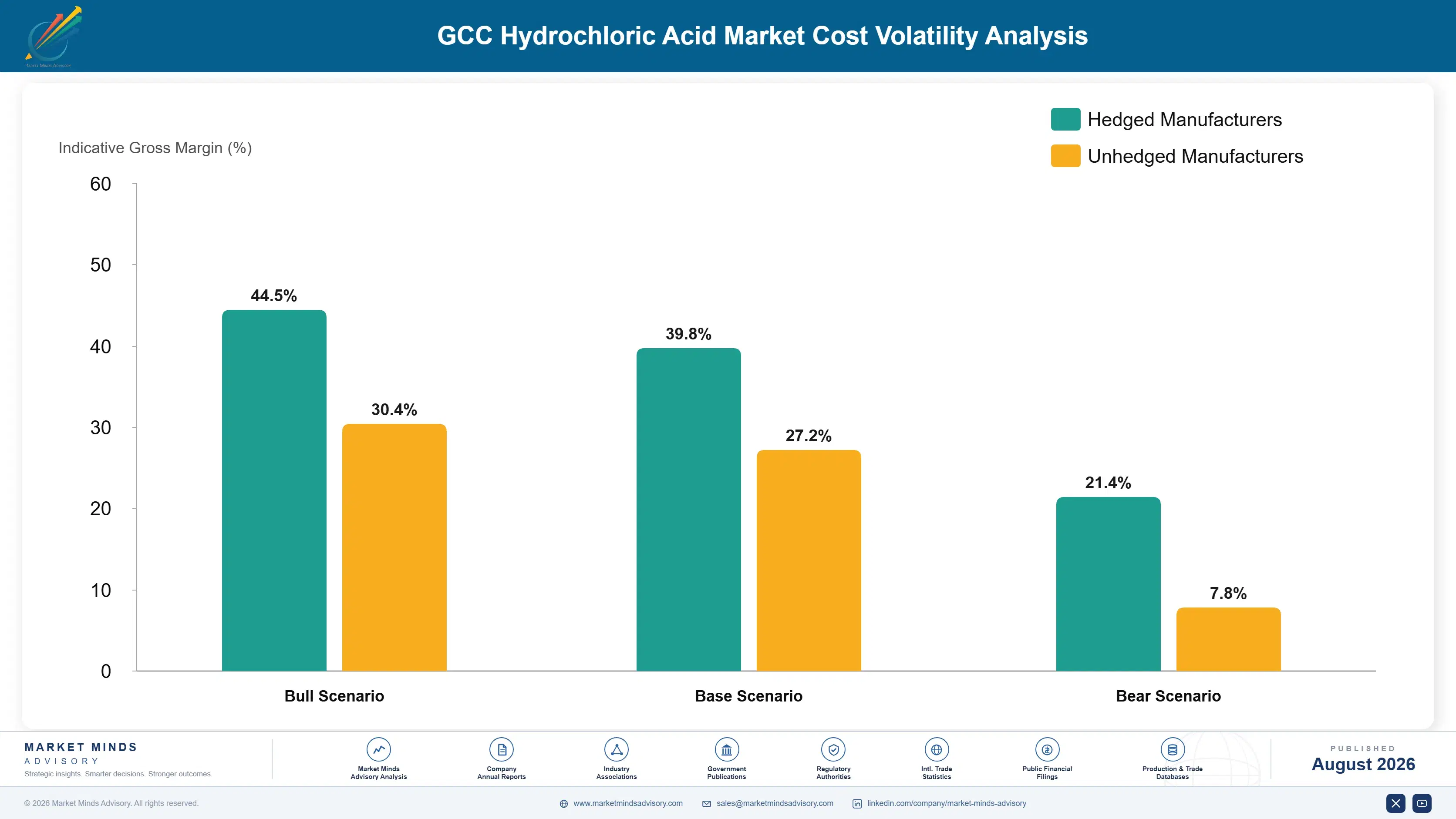
Chlor-Alkali Feedstock Exposure

Chlorine and hydrogen feedstock derived from chlor-alkali electrolysis represents roughly 38 percent of cost of goods sold for hydrochloric acid production, sourced primarily from regional chlor-alkali facilities in Saudi Arabia and the United Arab Emirates, with additional feedstock sourced from broader Middle Eastern petrochemical producers. Currency fluctuations further affect landed cost for internationally sourced feedstock volume.
Electricity and natural gas costs underpinning chlor-alkali production spiked considerably in 2022 following broader energy market disruption, a volatility event documented in International Energy Agency market reporting, temporarily compressing producer margins and forcing several producers to renegotiate customer pricing contracts before energy costs stabilized over the following year. Several producers report energy costs have only partially normalized since the disruption began. Contract producers have since added redundant capacity to reduce future exposure.

Exposure varies considerably by player type: large integrated petrochemical companies with direct chlor-alkali production capability have absorbed volatility more easily than smaller specialized acid producers reliant on purchased feedstock, a disadvantage that is accelerating consolidation of smaller producers into larger integrated petrochemical company operations. Smaller producers increasingly pursue merger or acquisition to gain comparable purchasing scale. nationwide today.
gcc-hydrochloric-acid-market-trends-cost-volatility-analysis-1787552063603

Direct Chlor-Alkali Production Integration

Larger producers are pursuing direct ownership or long-term supply agreements with chlor-alkali production facilities, protecting feedstock continuity and pricing stability, though this approach requires substantial capital investment that smaller producers typically cannot justify given current production scale. Larger companies with stronger balance sheets absorb this forecasting risk more comfortably than smaller rivals across the region.

Long-Term Electricity Supply Agreement Development

Securing long-term electricity supply agreements with regional utilities reduces exposure to short-term energy price volatility underpinning chlor-alkali production costs, though this flexibility requires specialized negotiation expertise that most producers pursue only gradually across multiple contract renewal cycles. Producers pursuing this path typically require several years to reach meaningful negotiation leverage across their supply base.

Multi-Source Feedstock Sourcing Diversification Programs

Qualifying feedstock relationships across multiple regional chlor-alkali producers reduces exposure to any single facility's capacity constraints or disruption, though it requires meaningful relationship investment across each additional sourcing region that smaller producers often cannot justify given current production volume. Most large producers now maintain at least two qualified feedstock sources per production facility. today

Portfolio Architecture for Margin Defence

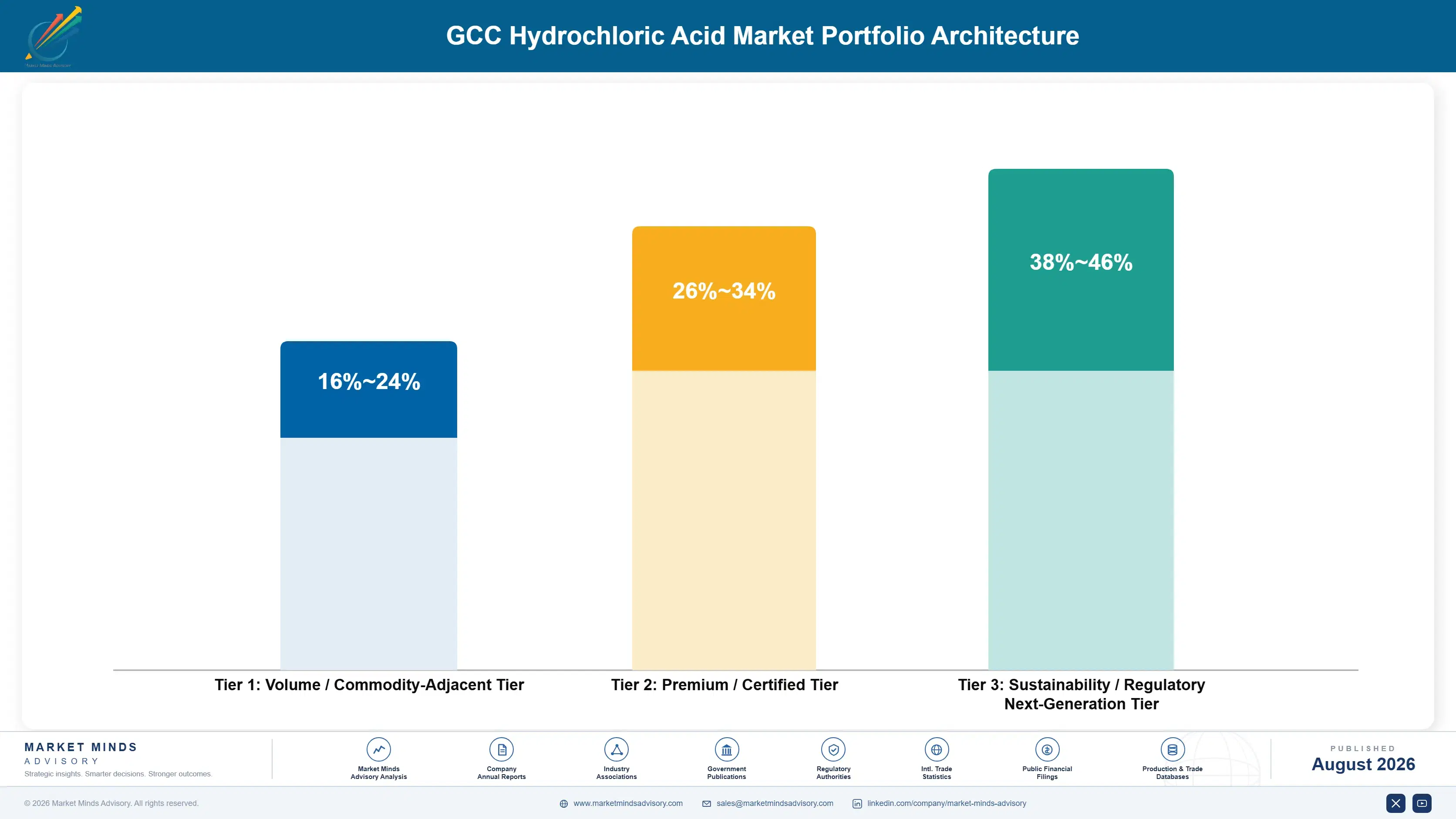
Portfolio economics split across three tiers: commodity industrial-grade hydrochloric acid competing largely on price and production scale, mid-tier steel pickling and chemical manufacturing products commanding meaningful premium pricing tied to formulation consistency, and premium acidizing-grade and desalination-grade products capturing the highest margin as customers pay for both purity specifications and dedicated logistics support. Customers increasingly negotiate bundled contracts spanning multiple tiers simultaneously to secure better overall terms with large suppliers.
The tension between volume and premium positioning is sharpest as oilfield and desalination customers increasingly demand purity-controlled consistency regardless of price sensitivity elsewhere in their supply chain, compressing commodity industrial-grade producers' pricing power even as premium acidizing-grade products command substantial price premiums tied to purification investment rather than raw material cost alone. Producers without a credible acidizing-grade offering increasingly struggle to defend even their traditional commodity accounts against new entrants.

High value margin pools concentrate in acidizing-grade and desalination-grade products sold with dedicated logistics and technical support, where purity specifications and customer qualification requirements limit meaningful competition to producers with established quality systems and sustained distribution investment. New entrants without established purification and distribution infrastructure find this tier especially difficult to penetrate meaningfully at scale.

Volume / Commodity-Adjacent Tier

Commodity industrial-grade hydrochloric acid competing primarily on price and production scale across mainstream industrial applications. Purchasing decisions here favor incumbents with the lowest delivered cost per unit nationwide. each year.
Gross Margin: 16-24%

Premium / Certified Tier

Steel pickling and chemical manufacturing products commanding premium pricing tied to formulation consistency and processing reliability. Buyers value proven formulation consistency over marginal cost savings alone today. across most fabricator accounts.
Gross Margin: 26-34%

Sustainability / Regulatory / Next-Generation Tier

Acidizing-grade and desalination-grade products serving premium oilfield and water treatment applications, commanding the strongest margins. Customers here view purity consistency as essential to qualification success overall. throughout the qualification process.
Gross Margin: 38-46%
gcc-hydrochloric-acid-market-trends-portfolio-architecture-1787552064106

High-value Sub-segments and Strategic Watch-out

Oil and Gas Well Acidizing

Scaling as upstream investment expands, this segment commands strong margins but remains constrained by purification capacity concentrated among a limited number of qualified producers across the region. Purification capacity remains the key variable determining pace of adoption growth here today. across major consuming markets across the region.
Gross Margin: 40-46%

Water Treatment and Desalination

Continued desalination capacity expansion supports durable volume growth for producers with established plant operator relationships over newer entrants still building delivery infrastructure. Operators increasingly request pilot samples before committing to full qualification programs across the region. Design cycles here run roughly every three to five years across leading operators nationwide.
Gross Margin: 32-38%

Steel Pickling and Metal Processing

The largest volume segment by shipment weight, competing primarily on price across mainstream industrial applications, with steady but unremarkable growth tied to manufacturing activity. Producers here compete heavily on logistics and delivery reliability rather than pure product differentiation. Volume scale remains the primary lever here.
Gross Margin: 20-26%

Chemical Manufacturing Intermediate

Facing steady but specialized demand as this mature category continues serving petrochemical intermediate applications requiring proven supply reliability rather than novel formulation approaches. Producers here increasingly diversify into higher-margin categories to escape this pricing pressure. Volume scale remains the primary lever for defending margin here.
Gross Margin: 22-28%

Upstream Program Qualification Economics

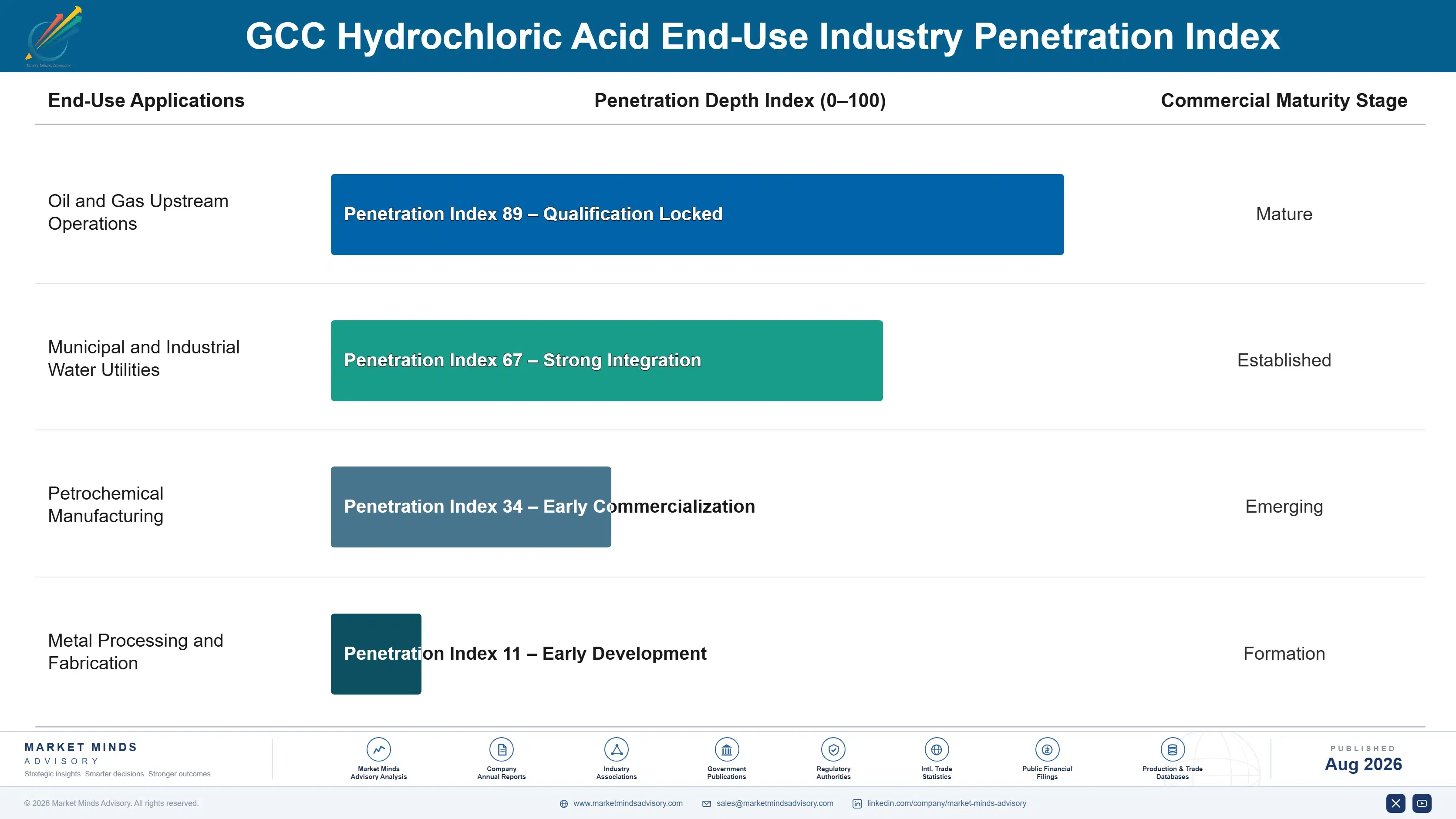
Demand in this category increasingly resembles a multi-year upstream program qualification relationship rather than a spot commodity purchase, since oilfield service companies and desalination operators require extensive purity testing and supply chain validation before committing to a hydrochloric acid supplier, creating durable multi-year revenue visibility for producers embedded early in an operator's field development roadmap. This dynamic increasingly resembles subscription-style economics more common in specialty software than in traditional bulk chemical manufacturing.
Adoption depth varies considerably by end use vertical: premium offshore and newly developed onshore oil fields show the deepest and most consistent adoption of purity-controlled acidizing chemicals, mainstream desalination and petrochemical manufacturing customers show moderate but accelerating adoption tied to capacity expansion programs, and traditional steel pickling buyers remain the shallowest adopters, still relying primarily on conventional industrial-grade acid to control formulation cost.

Younger reservoir engineers and water treatment specialists entering procurement roles increasingly treat purity-controlled hydrochloric acid specification as a baseline design consideration rather than a premium differentiator, a generational shift that is gradually normalizing broader adoption across a wider range of oilfield and industrial applications beyond the historically dominant premium segments.
gcc-hydrochloric-acid-market-trends-end-use-penetration-index-1787552064597

Where Producer Investment Should Concentrate

These are among the four positions where our research anticipates prominent divergence between winners and laggards over the coming forecast period. Each is grounded in the demand model, the regulatory perimeter, and the announced capacity pipeline.
01 / ACIDIZING PURIFICATION INVESTMENT

Build purification capability before oilfield customers standardize elsewhere

Oilfield service companies are increasingly standardizing formulation specifications around purity-controlled acidizing chemicals faster than producers relying on commodity industrial acid currently plan for within their commercial roadmaps and capital budgets across comparable production accounts. Producers with established purification technology already report meaningfully higher customer qualification rates than competitors selling commodity acid alone across comparable production volume. This advantage compounds as more operators require certified chemicals, a gap unlikely to close soon without deliberate and sustained investment across their production and purification pipelines.
02 / DESALINATION CUSTOMER QUALIFICATION

Secure desalination supply agreements before capacity expansion decisions lock in suppliers

Desalination plant operators typically finalize chemical supplier decisions well ahead of facility expansion completion, meaning producers without early engagement risk exclusion from multiple future capacity expansion phases entirely across their target account base. Producers with established desalination customer qualification already report securing contracted volume at meaningfully higher rates than producers pursuing certification independently. Building these relationships now, ahead of upcoming expansion decisions, costs considerably less than attempting entry after competitors have already locked in supply agreements across multiple facility expansions.
03 / REGIONAL DISTRIBUTION TERMINAL DEVELOPMENT

Build distribution infrastructure before geographic reach becomes a competitive disadvantage

Customers increasingly expect reliable delivery across the entire GCC region faster than producers relying on single-facility distribution can efficiently address within typical customer logistics expectations and delivery timelines. Producers pursuing regional distribution terminal development already report meaningfully faster delivery timelines than competitors relying on centralized distribution alone across comparable customer accounts. Producers delaying this investment risk losing geographic reach advantages permanently to competitors with stronger, more established distribution networks already firmly established across the region's petrochemical and oilfield services industry today.
04 / DIVERSIFIED FEEDSTOCK SOURCING

Diversify feedstock sourcing before the next energy price disruption

Regional energy markets have already demonstrated meaningful volatility this decade, and producers without diversified feedstock sourcing remain persistently exposed to the next disruption regardless of current feedstock availability across their supplier networks. Producers with diversified sourcing already report winning new customer contracts at meaningfully higher rates than single-source competitors still dependent on a narrow supply base. Building this resilience now, before the next disruption, costs considerably less than attempting to build it reactively during an active shortage rather than preparing for it in advance.

Engagement Snapshot From the Field

A live engagement with an industry participant carrying material or product regulatory and market exposure ahead of a defining policy shift, showing how our research translates into a defensible multi-year portfolio strategy.
MARKET MINDS ADVISORY · CLIENT ENGAGEMENT SUMMARY
GCC Hydrochloric Acid Producer Strategic Portfolio Review and Transition Roadmap 2026·Investment Scenario on GCC Hydrochloric Acid Exposure Evaluation 2025-26
CLIENT PROFILE
The client is a mid-sized GCC industrial chemical producer generating approximately 65 million dollars in annual revenue (client-reported, unverified by MMA), historically focused on commodity industrial-grade hydrochloric acid without dedicated acidizing-grade purification capability, facing declining margins as commodity pricing continued to compress across its traditional customer base. Its competitors were rapidly securing oilfield service contracts.
STRATEGIC CHALLENGE
Facing eroding commodity margins as regional production capacity expansion continued pressuring pricing, the client needed to evaluate whether to invest in acidizing-grade purification capability to access premium oilfield pricing, without clear visibility into oilfield service qualification requirements or realistic timelines for securing meaningful contracted volume. Leadership disagreed internally on the right path forward.
MMA APPROACH
MMA conducted an acidizing market entry feasibility assessment incorporating oilfield service qualification requirement interviews, capital investment modeling, and competitive benchmarking against established acidizing-grade suppliers, then developed a phased purification capability investment roadmap sequenced to the client's available capital and existing production infrastructure across the region. Interviews focused specifically on qualification timeline expectations.
KEY FINDINGS
  1. Oilfield service companies required a minimum of twelve months of purity testing before considering a new acidizing supplier for qualification and market entry.
  2. Two regional oilfield service companies expressed preliminary interest in evaluating the client's purified output once developed to specification and tested. once formulation adjustments were finalized
  3. Existing production infrastructure could be adapted for acidizing-grade purification with moderate capital investment rather than requiring an entirely new facility. rather than requiring an entirely new facility
  4. Competitive acidizing pricing offered meaningfully higher margins than the client's existing commodity industrial business despite higher production costs. despite meaningfully higher processing costs
CLIENT PROFILE
The client is a mid-sized GCC industrial chemical producer generating approximately 65 million dollars in annual revenue (client-reported, unverified by MMA), historically focused on commodity industrial-grade hydrochloric acid without dedicated acidizing-grade purification capability, facing declining margins as commodity pricing continued to compress across its traditional customer base. Its competitors were rapidly securing oilfield service contracts.
STRATEGIC CHALLENGE
Facing eroding commodity margins as regional production capacity expansion continued pressuring pricing, the client needed to evaluate whether to invest in acidizing-grade purification capability to access premium oilfield pricing, without clear visibility into oilfield service qualification requirements or realistic timelines for securing meaningful contracted volume. Leadership disagreed internally on the right path forward.
MMA APPROACH
MMA conducted an acidizing market entry feasibility assessment incorporating oilfield service qualification requirement interviews, capital investment modeling, and competitive benchmarking against established acidizing-grade suppliers, then developed a phased purification capability investment roadmap sequenced to the client's available capital and existing production infrastructure across the region. Interviews focused specifically on qualification timeline expectations.
KEY FINDINGS
  1. Oilfield service companies required a minimum of twelve months of purity testing before considering a new acidizing supplier for qualification and market entry.
  2. Two regional oilfield service companies expressed preliminary interest in evaluating the client's purified output once developed to specification and tested. once formulation adjustments were finalized
  3. Existing production infrastructure could be adapted for acidizing-grade purification with moderate capital investment rather than requiring an entirely new facility. rather than requiring an entirely new facility
  4. Competitive acidizing pricing offered meaningfully higher margins than the client's existing commodity industrial business despite higher production costs. despite meaningfully higher processing costs
RECOMMENDED STRATEGY
Phase 1: Phase 1 (Months 1 to 6): Invest in purification technology and begin internal acidizing-grade formulation development. across priority formulation targets Phase 2: Phase 2 (Months 7 to 12): Complete oilfield service qualification testing across target customer accounts. ahead of formal contract discussions Phase 3: Phase 3 (Months 13 to 18): Secure initial supply agreements and begin scaled acidizing-grade production. across its expanding customer base
OUTCOME
Within eighteen months of implementation, the client reported securing an initial acidizing supply agreement representing roughly 20 percent of projected future revenue and establishing durable purification capability beyond its historical commodity industrial business (client-reported, unverified by MMA). Leadership described the shift as validating its strategic pivot decision.

Frequently Asked Questions

Foundational context covering the market sizes, CAGR, scope, country, region and competition that inform every finding below. This section is provided to cover basics and most often pre-purchase conversations, answered from the MMA Primary Research Dataset.

What is the current size of the GCC Hydrochloric Acid Market?

The GCC Hydrochloric Acid Market is valued at approximately 0.85 billion dollars in 2025, spanning acidizing, desalination, and industrial application categories. This spans acidizing, desalination, and industrial application categories across the GCC region.

How large will the GCC Hydrochloric Acid Market be by 2036?

The market is projected to reach roughly 1.61 billion dollars by 2036, driven by expanding well acidizing demand and desalination capacity investment across the region.

What is the CAGR for the GCC Hydrochloric Acid Market 2026 to 2036?

The market is expected to grow at a compound annual growth rate of approximately 6.0 percent between 2026 and 2036, reflecting steady industrial chemical demand.

Which segment is growing fastest?

Oil and gas well acidizing is the fastest growing segment, expanding at roughly 1.3 times the overall market rate as oilfield operators standardize purity-controlled chemicals.

Who are the major companies in the GCC Hydrochloric Acid Market?

Leading companies include SABIC, Advanced Petrochemical Company, Sipchem, EQUATE Petrochemical Company, and Gulf Petrochemical Industries Company. each investing in purification technology and regional distribution infrastructure across the GCC

Which country is growing fastest?

Saudi Arabia is the fastest growing single country, supported by its dominant upstream oil and gas investment and expanding petrochemical manufacturing base. and rapidly expanding petrochemical manufacturing capacity nationwide today

Report Segmentation Architecture

The full report scope spans multiple orthogonal segmentation dimensions, with cross-tabulated demand data provided for each dimension pair. Coverage extends further to regional breakdowns, trend trajectories, and the competitive detail needed to support segment-level decision-making.

By End-Use Application

  • Oil and Gas Well Acidizing
  • Water Treatment and Desalination
  • Steel Pickling and Metal Processing
  • Chemical Manufacturing Intermediate
  • Food and Pharmaceutical Processing
  • pH Control and Industrial Cleaning

By End-Use Industry

  • Oil and Gas Upstream Operations
  • Municipal and Industrial Water Utilities
  • Petrochemical Manufacturing
  • Metal Processing and Fabrication

By Commercial Dimension

  • Direct Manufacturer Supply Agreements
  • Distributor and Terminal Channels
  • Joint Qualification Development Partnerships

By Region

  • North America
  • Western Europe
  • East Asia
  • South Asia and Pacific
  • Latin America
  • Middle East and Africa
  • Eastern Europe

Scope, Methodology, and Coverage

Every figure in this report is reproducible from documented input assumptions. The scope below maps the historical period, the forecast horizon, the segmentation dimensions, and the countries covered, alongside the underlying primary and qualitative methodology.
Historical Period
2020 to 2025
Forecast Period
2026 to 2036
Base Year
2025 (USD billions; MMA Primary Research Dataset, August 2026)
Market Definition
The GCC hydrochloric acid market covers production and downstream application of hydrochloric acid across oil and gas well acidizing, water treatment and desalination, steel pickling and metal processing, chemical manufacturing intermediates, food and pharmaceutical processing, and pH control and industrial cleaning within Saudi Arabia, the United Arab Emirates, Kuwait, Qatar, Oman, and Bahrain. It excludes hydrofluoric and other industrial acids and excludes finished petrochemical or water treatment products themselves beyond the acid material inputs.
Quantitative Units
USD billions (current prices); production volumes in metric tons for select operating metrics
Segmentation Dimensions
By End-Use Application; By End-Use Industry; By Commercial Dimension; By Region
Regions Covered
North America, Western Europe, East Asia, South Asia and Pacific, Latin America, Middle East and Africa, Eastern Europe
Countries Covered
Saudi Arabia, United Arab Emirates, Kuwait, Qatar, Oman, Bahrain, USA, Germany, UK, China, Japan, South Korea, India, Australia, Brazil, Mexico, Poland, Russia, and additional markets relevant to this sector
Key Companies Profiled
SABIC, Advanced Petrochemical Company, Sipchem, EQUATE Petrochemical Company, Gulf Petrochemical Industries Company, Saudi Chlorine and Chemicals Company, Muntajat, National Petrochemical Industrial Company, Petro Rabigh, Ma'aden, Borouge, OQ, ADNOC, Kuwait National Petroleum Company, Bahrain Petroleum Company, QAPCO, Emirates Global Aluminium, Gulf Chemical and Industrial Oils Company, Fujairah Natural Resources Corporation, Ras Laffan Industrial City Services
Quantitative Methodology
Primary survey, n=3,800 respondents, Q4 2025, six countries; demand-side model with trade association cross-validation
Qualitative Methodology
47 expert interviews, Q4 2025; applied to validate demand model assumptions, identify emerging dynamics, and assess competitive positioning
Report Format
PDF and XLSX data workbook (Word format preview document)
Publisher
Market Minds Advisory
Report Code
MMA-2026-CHM-323
Published
August 2026
Contact
sales@marketmindsadvisory.com | www.marketmindsadvisory.com

Purchase the full GCC Hydrochloric Acid Market Report (2026 to 2036).

The full report delivers a complete quantitative and qualitative assessment of the GCC hydrochloric acid market, including detailed segment level forecasts through 2036, regional analyses across all seven covered geographies, and profiles of twenty leading producers. It incorporates primary survey data from 3,800 respondents and 47 expert interviews conducted in the fourth quarter of 2025. Buyers receive editable data tables, a customizable Excel forecast model, and access to MMA analysts for follow up questions during a defined post purchase support window. The report also includes a detailed upstream capital expenditure landscape assessment calibrated to current regional benchmarks.
Detailed segment-level market forecasts through 2036
All seven regional market analyses included
Twenty profiled leading regional chemical producers
Editable Excel based forecast data model
Primary survey and expert interview data
Extended post-purchase analyst support access window

Built For The People Who Decide

From boardroom strategy to bench-side execution, this report is read cover-to-cover by leaders shaping the next decade of their industry, turning demand scenarios, market dynamics and valuation benchmarks into decisions.
CXOs/ Presidents/ VPs/ Managers
M&A and Corporate Development
Strategy Teams and R&D Heads
Procurement and Product Directors
Regulatory and Compliance Leaders
Investor Relations and Equity Analysts