Market Minds Advisory
Gasoline Turbochargers Market

Gasoline Turbochargers Market: Trends and Forecast 2026 to 2036

Automakers keep squeezing more power from smaller gasoline engines through turbocharging even as electrification accelerates, forcing suppliers to extend legacy engineering investment into a shrinking but still profitable combustion runway.

Lead Analyst

David Horsley

Published

September 2026

Make Smarter Decisions with Customized Research Insights

Request a free sample report and evaluate market opportunities, growth trends, and competitive dynamics relevant to your business needs.

2025 MARKET VALUE$9.8BMarket Size 2025
2036 FORECAST VALUE$18.6BBase Case , 2026 to 2036
CAGR 2026 TO 20366.0 %Bull 7.3% / Bear 4.7%
INCREMENTAL OPPORTUNITY$8.2BNet 10- year value creation
EXPANSION MULTIPLE1.79x2036 value over 2026 base
Strategic Levers
M&A Pipeline
Regional Outlook
Country Rankings
Competitive Intelligence
Segmental Deep-dive
Call-Us : 91 93563 13602

Executive Snapshot and Market Trajectory

Gasoline turbochargers remain the dominant path to engine downsizing, letting automakers meet emissions targets without abandoning combustion architecture entirely while hybrid integration extends the technology commercial runway well beyond what pure EV adoption timelines once suggested a decade ago across most global vehicle markets today.
Electrically assisted turbochargers are the fastest-growing category, expanding well ahead of conventional wastegate and variable geometry designs, as hybrid powertrain integration creates genuine demand for turbochargers that eliminate lag through electric motor assistance. China's massive vehicle production base and dominant turbocharger manufacturing capacity concentrate demand heavily in East Asia. Replacement demand remains modest since turbochargers typically last a vehicle's operating life, making OEM fitment the dominant revenue driver rather than aftermarket replacement volume.
Competitive dynamics favor suppliers with established OEM design partnerships and manufacturing scale across multiple engine platforms, since automakers rarely switch turbocharger suppliers mid-platform once a design passes validation testing and durability certification across the entire platform lifecycle and warranty period. Electric motor integration expertise is becoming a genuine differentiator rather than a specialty niche, as more automakers specify e-turbo technology for hybrid platforms across their vehicle lineups.
Market Definition
The gasoline turbochargers market covers turbocharger units designed specifically for gasoline internal combustion and hybrid engines, including wastegate, variable geometry, and electrically assisted designs. It excludes diesel turbochargers and non-turbocharger forced induction systems such as superchargers.
Base Year Value
$9.8B in 2025 (MMA Primary Research Dataset, August 2026)
Forecast Period
2026 to 2036, eleven discrete annual values
CAGR
6.0% base case. Bull 7.3%. Bear 4.7%.
Fastest Growth Segment
Electrically Assisted Turbochargers (E-Turbo): 9.0% CAGR
Fastest Growth Country
India: 7.8% CAGR
Fastest Growth Region
South Asia and Pacific: 8.0% CAGR
Largest Region
East Asia: 38% of 2025 global value
Market Leaders
Leading suppliers: BorgWarner, Garrett Motion, Mitsubishi Heavy Industries, IHI Corporation, and Vitesco Technologies. Source: MMA Primary Research Dataset, July 2026.
Primary Survey
n=3,800 procurement and R&D decision-makers, Q4 2025, six countries
Methodology
Demand-side build-up, cross-validated against public data, 47 expert interviews

Gasoline Turbochargers Market Forecast Scenarios

gasoline-turbochargers-market-size-forecast-scenario-1787550917505
Between 2020 and 2025 the market grew at an estimated 5.4% annually as automakers continued steadily downsizing gasoline engines to meet tightening global emissions standards worldwide, though early years saw growth moderate somewhat as EV adoption accelerated in several mature markets ahead of expectations across most vehicle segments and geographies during that entire time period.
The base case assumes 6.0% annual growth through 2036, anchored in three commercial mechanisms: continued gasoline engine downsizing requiring turbocharging to maintain performance, hybrid powertrain integration creating new e-turbo demand that pure combustion platforms never required, and China's and India's expanding vehicle production sustaining Asian OEM fitment volume across the entire forecast period. Electrically assisted turbochargers carry the base case forward fastest, reflecting where hybrid integration investment concentrates most heavily.
The bull case, 7.3%, assumes hybrid powertrain adoption accelerates faster than currently projected, pulling forward e-turbo demand across multiple vehicle segments simultaneously ahead of current expectations and forecasts. The bear case, 4.7%, reflects a scenario where battery electric vehicle adoption accelerates faster than currently projected, compressing the combustion and hybrid vehicle base that gasoline turbochargers depend on for OEM fitment volume.

Downsizing Keeps Turbochargers Relevant Longer Than Expected

Turbocharging penetration now covers 58% to 65% of new gasoline vehicle production, a meaningfully higher share than a decade ago, since automakers use smaller turbocharged engines to hit fuel economy and emissions targets without sacrificing the power output buyers still expect from their vehicles. This penetration rate has proven more durable than early EV adoption forecasts suggested it would be.
TOP-5 MANUFACTURER CONCENTRATION54%Reflects strong consolidation among established global turbocharger manufacturers
AVERAGE TURBOCHARGER ASP$225 per unitTracks typical pricing for a standard gasoline turbocharger unit
CHINA PRODUCTION SHARE42%Shows how concentrated global manufacturing capacity has become domestically
TURBOCHARGING PENETRATION RATE58% to 65%Captures how much of new gasoline vehicle production uses turbocharging
CASTING SHARE OF COGS35% to 45%Indicates how exposed margins are to metal casting material costs
PLATFORM VALIDATION CYCLE3 to 4 yearsMarks how long automakers typically take to approve new designs
Platform validation cycles run 3 to 4 years across most automaker relationships, creating a recurring qualification event that favors suppliers with established engineering relationships over newer entrants navigating approval processes for the first time. Average selling prices sit around 225 dollars per unit, though electrically assisted designs command meaningfully higher pricing than conventional wastegate turbochargers given the added motor and control electronics content.
Metal casting inputs represent 35% to 45% of cost of goods sold, exposing manufacturer margins to steel and specialty alloy pricing cycles that vary considerably depending on turbine housing design and thermal performance requirements. Manufacturers with in-house casting capability carry a meaningful cost advantage over those subcontracting precision casting work, particularly during periods when metal pricing runs volatile across major producing regions.
"Everyone keeps predicting the death of the combustion engine, but turbochargers keep finding new jobs, first downsizing, now hybrid assist. This technology has been remarkably good at reinventing its own reason to exist."
Principal Analyst, Automotive Powertrain Practice · MMA Automotive Practice · August 2026

Market Trends

Electrically Assisted Turbochargers Gain Ground in Hybrids

Electrically assisted turbocharger adoption has grown from roughly 5% of new hybrid platform launches in 2021 to an estimated 15% to 20% today, as automakers use electric motor assistance to eliminate turbo lag that pure exhaust-driven designs cannot avoid at low engine speeds. This technology commands meaningfully higher pricing than conventional wastegate turbochargers, reflecting the added motor and control electronics content embedded in every unit sold to hybrid platform customers. Suppliers with validated e-turbo integration are winning hybrid platform contracts faster than competitors still offering only conventional exhaust-driven designs without electric assistance.
Market Impact: Fuel consumption cut 20% by 2030

Variable Geometry Designs Replace Simple Wastegate Turbochargers

Variable geometry turbocharger adoption in gasoline applications has grown from roughly 20% of new platform launches in 2021 to an estimated 35% to 40% today, as automakers chase the broader torque band and improved throttle response variable geometry designs deliver over simple wastegate alternatives. This shift reflects gasoline turbocharger technology converging with design approaches long standard in diesel applications, now justified by tightening performance and efficiency expectations across mainstream vehicle segments. Suppliers with validated variable geometry manufacturing capability are winning premium platform contracts ahead of competitors still offering only simpler wastegate designs.
Market Impact: BS6 emissions rule reshapes engine choices

Market Opportunities and Growth Drivers

China's Fuel Consumption Standards Sustain Turbocharging Demand

China's corporate average fuel consumption standards require automakers to cut fleet-wide fuel consumption by roughly 20% between 2025 and 2030, directly sustaining demand for turbocharged engine downsizing as the most cost-effective compliance pathway available to domestic and international automakers alike. This regulatory framework keeps turbocharger suppliers investing in dedicated Chinese production capacity rather than treating the market as a temporary bridge technology before full electrification arrives. Domestic Chinese turbocharger makers with established local manufacturing scale are capturing the bulk of this sustained OEM fitment volume ahead of international competitors still scaling local production.
Market Impact: Casting prices swung over 18%

India's Bharat Stage Emissions Norms Drive Adoption

India's Bharat Stage VI emissions standards have pushed automakers toward turbocharged gasoline direct injection engines to meet particulate and nitrogen oxide limits without the cost penalty diesel aftertreatment systems require at comparable emissions performance. This shift has driven turbocharging penetration in new Indian gasoline vehicle production considerably higher than the pre-Bharat Stage VI baseline, sustaining demand growth even as overall vehicle sales growth moderates somewhat relative to prior years. Suppliers with established India manufacturing and distribution relationships are capturing the bulk of this compliance-driven demand ahead of international competitors still scaling local production capacity.
Market Impact: BEVs reach 18% to 22% share

Market Restraints and Challenges

Metal Casting Cost Volatility Compresses Manufacturer Margins

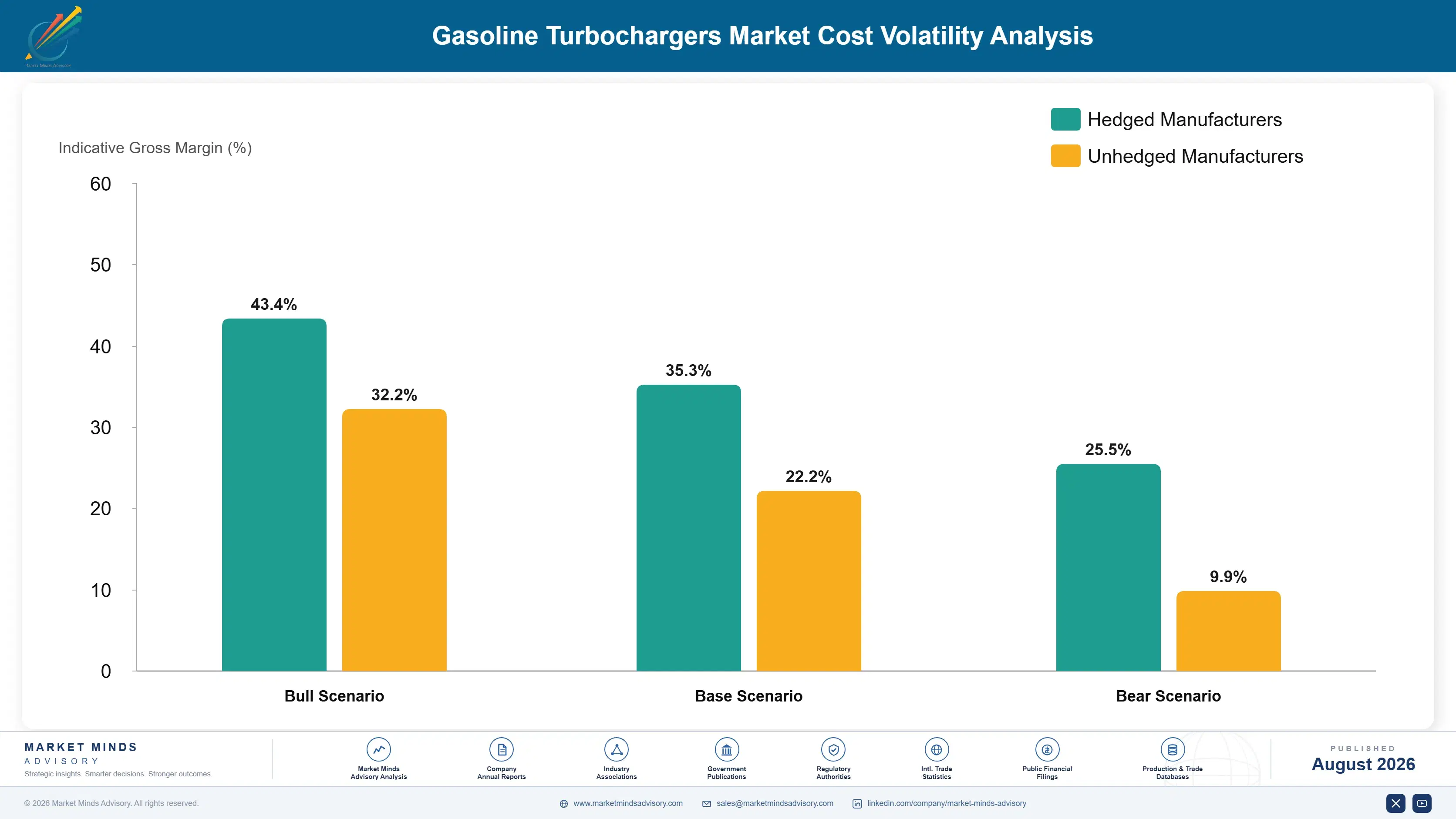
Steel and specialty alloy casting prices swung by more than 18% between 2023 and 2025, driven by upstream metals market volatility rather than turbocharger-specific demand shifts. The root cause is that most turbocharger manufacturers still purchase raw casting stock on the open market rather than under long-term contracts, leaving margins exposed every time metals pricing spikes unexpectedly. The commercial impact falls hardest on smaller manufacturers without pricing power to pass costs through to automaker contracts mid-cycle. Some larger manufacturers are exploring backward integration into casting production to dampen this exposure going forward.
Market Impact: 15% to 20% now e-turbo

EV Transition Shrinks the Addressable Combustion Engine Base

Battery electric vehicle sales already represent an estimated 18% to 22% of new vehicle sales in several mature markets, directly shrinking the combustion and hybrid vehicle base that gasoline turbochargers depend on for OEM fitment volume over the long term. The root cause is that full battery electric platforms require no turbocharger at all, unlike hybrid platforms that still integrate combustion engines alongside electric motors. Some manufacturers are mitigating this by diversifying into e-turbo technology for hybrid platforms and adjacent forced-induction applications beyond passenger vehicles, such as marine and industrial engines.
Market Impact: 35% to 40% now variable geometry
3 additional market trends, 4 additional growth drivers, and 2 additional restraints and challenges are covered in the full report. Contact sales@marketmindsadvisory.com to access the complete intelligence.

Segment CAGR and Growth Architecture

Segmentation follows turbocharger technology type, the classification automakers use when specifying engine platform requirements, since each technology addresses a distinct boost delivery and response characteristic through fundamentally different mechanical engineering rather than a shared design or manufacturing pathway, and each typically involves a separate qualification process and full validation timeline across all six categories.
gasoline-turbochargers-market-market-share-analysis-1787550918062

Electrically Assisted Turbochargers (E-Turbo)

Electrically assisted turbochargers are the fastest-growing segment, expanding at 9.0% annually as hybrid powertrain integration creates genuine demand for turbochargers that eliminate lag through electric motor assistance rather than relying purely on exhaust gas energy at low engine speeds across most driving conditions, load profiles, gear ratios, climates, and altitude ranges found worldwide today. These turbochargers embed a small electric motor within the turbocharger assembly, drawing power from the vehicle's hybrid battery system to spin the turbine before exhaust flow alone would generate sufficient boost pressure. Demand concentrates heavily among hybrid platform automakers, though the technology is gradually extending into performance-oriented conventional combustion vehicles as component costs decline over time.
CAGR 9.0%

Ball Bearing Turbochargers

Ball bearing turbochargers, the second-fastest segment at 7.5% annually, use ball bearing cartridges rather than traditional journal bearings to reduce internal friction and improve throttle response, a performance characteristic increasingly specified on both premium and mainstream vehicle platforms worldwide today and quite consistently overall across most regions, price tiers, and vehicle classes. This bearing design commands a meaningful price premium over journal bearing alternatives, reflecting the precision manufacturing tolerances ball bearing cartridges require compared to simpler journal bearing designs. Growth concentrates most heavily in performance and premium vehicle segments where throttle response commands genuine price premiums, though the technology is gradually extending into mainstream vehicle segments as manufacturing costs decline.
CAGR 7.5%
Full segment breakdown across 6 segments available in the complete report.

Regional Architecture and Country Demand Map

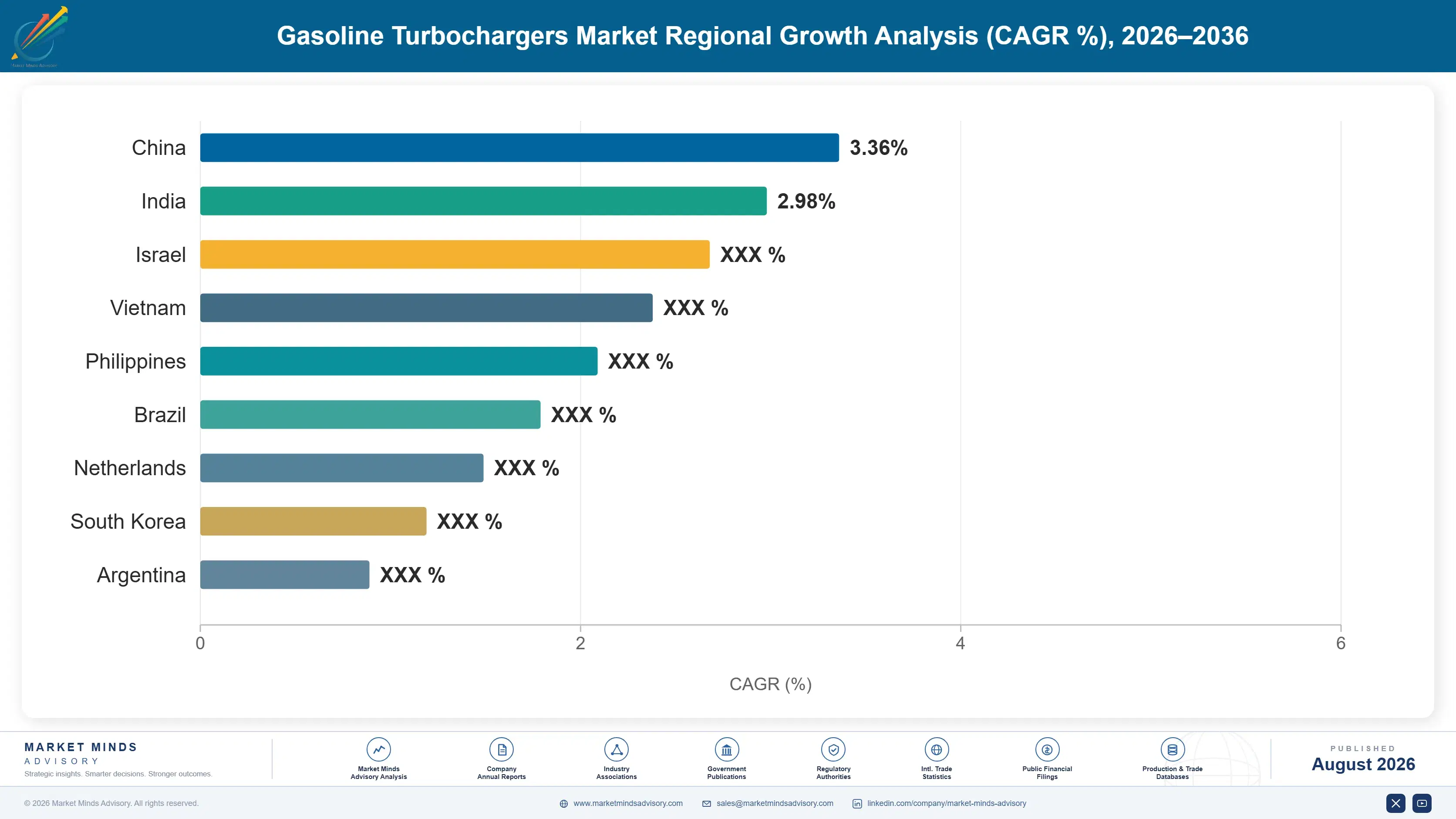
Demand concentrates heavily around China's massive vehicle production base and dominant turbocharger manufacturing capacity, with East Asia broadly commanding the largest regional share by a wide margin worldwide today, while North America holds a meaningful secondary position and Western Europe's smaller share trails accordingly overall.

East Asia

China anchors East Asian demand through the sheer scale of its vehicle production, the largest fleet in the world by a wide margin, combined with domestic turbocharger manufacturers scaling capacity fastest to serve both local automakers and export markets simultaneously and consistently, and this dominance pushes the region's share meaningfully above MMA's standard band, a deliberate house-rule deviation reflecting China's genuinely outsized position in both vehicle production and turbocharger manufacturing capacity relative to any other region on earth. Japan and South Korea contribute technically sophisticated production from established global suppliers, while Chinese domestic makers scale volume fastest across the region. Regional growth outpaces most mature markets as fuel consumption standards keep tightening.
Share: 38% | CAGR: 7.0% (2026 to 2036)

North America

Domestic gasoline vehicle production, alongside continued hybrid platform investment from legacy automakers, anchors North American demand even as overall EV adoption growth continues moderating relative to earlier projections across most vehicle segments, geographies, and price tiers nationwide and quite consistently today and reliably. Domestic and international turbocharger manufacturers with US production facilities compete closely for OEM fitment contracts, since automakers increasingly favor local supply chains to avoid tariff exposure on imported components across the region. E-turbo adoption runs ahead of most other regions here, reflecting the sophistication of hybrid platform engineering among American and Japanese automakers with US manufacturing presence nationwide. Canadian vehicle assembly adds a smaller, complementary regional contribution.
Share: 22% | CAGR: 5.5% (2026 to 2036)
Regional intelligence for 5 additional markets available in the complete report: Western Europe, South Asia and Pacific, Latin America, Middle East and Africa, Eastern Europe. Contact sales@marketmindsadvisory.com.
gasoline-turbochargers-market-country-cagr-analysis-1787550918571

Where Turbocharger Makers Can Capture Margin

Four commercial levers determine which turbocharger manufacturers capture disproportionate margin as the market shifts toward hybrid-integrated and performance-oriented demand: expanding into e-turbo production, building ball bearing manufacturing capability, localizing manufacturing inside China's rapidly expanding vehicle production base, and diversifying into marine and industrial forced-induction applications well beyond passenger vehicles entirely, broadly, and quite consistently.

Expand Into Electrically Assisted Turbocharger Production

Electrically assisted turbocharger adoption has grown from roughly 5% of new hybrid platform launches in 2021 to an estimated 15% to 20% today, and that share is expanding as automakers integrate hybrid powertrains across more vehicle segments. Suppliers already qualified on conventional wastegate turbocharger lines hold a natural advantage entering this adjacent category, since automakers prefer consolidating powertrain component sourcing with fewer, already-trusted suppliers rather than adding new qualification relationships. Entry requires meaningful investment in electric motor integration and control software, but the margin premium justifies that investment for suppliers with existing hybrid platform relationships.
Market Impact: Captures share of the 15% to 20% e-turbo segment

Build Ball Bearing Manufacturing Capability Early

Ball bearing turbochargers are growing at 7.5% annually as automakers chase improved throttle response on both premium and mainstream vehicle platforms, commanding meaningful price premiums over journal bearing alternatives given the precision manufacturing tolerances the technology requires. Suppliers with established ball bearing manufacturing capability are winning premium platform contracts ahead of competitors still offering only journal bearing designs across their product lines. Building or acquiring this capability now, before ball bearing designs extend further into mainstream vehicle segments, positions suppliers to capture disproportionate margin as manufacturing costs continue declining industry-wide.
Market Impact: Captures share of the 7.5% growth segment overall

Localize Manufacturing Inside China's Vehicle Production Base

East Asia holds 38% of global gasoline turbocharger demand and China's corporate average fuel consumption standards keep sustaining turbocharged engine downsizing demand through at least 2030, meaning suppliers without local production face rising tariff exposure and longer lead times relative to domestic Chinese competitors already firmly established there across the country. Establishing or expanding manufacturing footprint inside China captures a larger share of the world's largest vehicle production base directly, though this lever carries meaningful capital commitment and intellectual property considerations that suppliers must weigh carefully before proceeding with local joint ventures.
Market Impact: Captures share of China's 38% regional demand base

Diversify Into Marine and Industrial Applications

Battery electric vehicle sales already represent an estimated 18% to 22% of new vehicle sales in several mature markets, directly shrinking the combustion and hybrid vehicle base that gasoline turbochargers depend on for OEM fitment volume over the long term. Suppliers extending forced-induction engineering expertise into marine, industrial, and stationary generator engines capture incremental revenue from applications facing no comparable electrification pressure in the near term, diversifying away from passenger vehicle exposure alone. This diversification uses existing turbine and compressor engineering capability in adjacent applications experiencing genuine volume growth of their own.
Market Impact: Offsets exposure to 18% to 22% BEV share

Who Controls the Margin Pool

Concentration is high, with a CR5 near 54% on an annual revenue basis and a meaningful gap separating the five established leaders from a substantial tail of regional and specialty manufacturers still building comparable engineering scale, e-turbo integration capability, and long-term OEM relationships of their own across multiple regions.
Current competitive activity centers on three fronts: expanding e-turbo production to serve hybrid platform demand, building ball bearing manufacturing capability for premium platform contracts, and localizing manufacturing inside China to serve the world's largest vehicle production base directly and efficiently across most product categories. Several manufacturers are also diversifying into marine and industrial forced-induction applications to offset long-term EV exposure across their global portfolios and supply chains.

Emerging pressure comes from Chinese domestic manufacturers scaling production and engineering capability fast enough to challenge established Western and Japanese suppliers on OEM fitment contracts, particularly with domestic Chinese automakers. Rankings could shift meaningfully over the next several years if Chinese suppliers close the technical gap on e-turbo integration and ball bearing precision the way they have already done in conventional wastegate manufacturing scale, a transition several established suppliers are watching closely.
gasoline-turbochargers-market-company-positioning-matrix-1787550919084

Competitive Moat and Risk Dimensions

BORGWARNER

Moat: Broad Multi-Platform Engineering Portfolio

BorgWarner supplies turbochargers across dozens of engine platforms for nearly every major automaker, giving it manufacturing scale and engineering research depth that specialty competitors cannot easily replicate. This breadth lets BorgWarner introduce new e-turbo and ball bearing designs faster than narrower rivals working from a smaller platform base.
BORGWARNER

Risk: Slower on Chinese Domestic Accounts

BorgWarner's global manufacturing footprint is weighted more heavily toward North America and Europe than toward China specifically, leaving it comparatively slower to pursue the domestic Chinese automaker accounts now driving much of global vehicle production growth. Nimbler Chinese domestic suppliers focused specifically on these accounts are winning share BorgWarner's broader global sales teams sometimes overlook.
GARRETT MOTION

Moat: Deep OEM Platform Validation Heritage

Garrett Motion has held qualified turbocharger designs with major automakers for decades, spanning multiple engine platform generations before hybrid integration became a mainstream requirement across the industry. That accumulated validation history lets Garrett move new e-turbo designs through automaker testing faster than competitors lacking comparable existing relationships.
GARRETT MOTION

Risk: Limited Direct Presence in India

Garrett Motion has a comparatively limited direct manufacturing presence in India relative to domestic producers, leaving it more dependent on export shipments to capture the country's rapidly expanding Bharat Stage VI-driven turbocharging demand. This gap in local presence could cost Garrett meaningful share as Indian domestic capacity continues scaling.

Players Tracked

Prominent Players

BorgWarner
Garrett Motion
Mitsubishi Heavy Industries
IHI Corporation
Vitesco Technologies

Other Key Players

Bosch Mahle Turbo Systems
Cummins Turbo Technologies
Weifang Fuyuan Turbocharger
Kangyue Technology
Ningbo Fengmao
Jiangsu Wuzheng Group
Rotomaster International
Turbo Energy Private Limited
Sundaram-Clayton
Precision Turbo and Engine
Melett Limited
Shanghai Universal Turbo
Hunan Rener Technology
Wuxi Weifu Lida
Hangzhou Zhongzheng Turbocharger

Recent Developments

MARCH 2025

BorgWarner Expands E-Turbo Production Capacity in China

BorgWarner announced an expansion of its e-turbo production line in China, adding capacity specifically to serve growing domestic hybrid platform demand from both local and international automakers now operating in the region. The expansion was an organic capacity addition, not a joint venture or acquisition.
Signal: Confirms established suppliers are now actively prioritizing dedicated e-turbo capacity to meet accelerating hybrid platform demand.
AUGUST 2025

Chinese Manufacturer Signs Major Domestic OEM Supply Agreement

A leading Chinese turbocharger manufacturer signed a multi-year supply agreement with a major domestic automaker to provide turbochargers for its expanding gasoline and hybrid platform lineup nationwide and across multiple vehicle segments. The agreement was a direct commercial supply contract, not an equity stake or acquisition.
Signal: Shows domestic Chinese suppliers are securing long-term OEM contracts ahead of international competitors entering the market.
DECEMBER 2025

Garrett Motion Acquires Ball Bearing Technology Producer

Garrett Motion acquired a smaller specialty ball bearing manufacturing technology producer to add validated precision bearing capability to its entire existing turbocharger portfolio without building that capability internally from scratch first. The acquisition closed after a shortened regulatory review given the target's modest revenue scale.
Signal: Confirms acquisition is becoming a faster path into ball bearing technology than internal development for established suppliers.

Metal Casting and Alloy Cost Exposure

Metal casting inputs represent 35% to 45% of cost of goods sold for turbocharger manufacturers, sourced from specialty steel and nickel alloy casting producers concentrated in China, India, and increasingly Eastern Europe. Electric motor and control electronics components add a secondary but growing input cost as e-turbo units represent a larger share of total product mix.
Steel and specialty alloy casting prices swung by more than 18% between 2023 and 2025 as upstream metals market volatility moved with broader commodity pricing cycles largely unrelated to turbocharger-specific demand shifts entirely. Manufacturers without long-term casting supply contracts absorbed most of this swing directly, compressing gross margins meaningfully during the peak of the disruption before pricing gradually stabilized as metals markets settled into 2025.

Exposure varies meaningfully by player type: manufacturers integrated backward into casting production or holding long-term supply contracts absorb price swings far better than converters purchasing finished castings on the open market, and this gap becomes a genuine competitive disadvantage during volatile pricing periods. Geographic exposure differs too, since Chinese manufacturers sit closer to domestic casting production than European or North American competitors reliant on longer supply chains.
gasoline-turbochargers-market-cost-volatility-analysis-1787550919279

Secure Multi-Year Casting Supply Contracts

Negotiating multi-year fixed-price or banded-price casting supply agreements protects margin against the kind of feedstock volatility that hit prices hard through 2024, giving turbocharger manufacturers genuinely predictable input costs to plan production scheduling and automaker contract pricing around well in advance, rather than absorbing spot-market swings directly into gross margin unpredictably every single cycle.

Pursue Backward Integration Into Metal Casting Production

Larger turbocharger manufacturers with sufficient balance sheet capacity can integrate backward into metal casting production directly, capturing the margin that would otherwise flow entirely to third-party casting suppliers while also gaining much more predictable and genuinely reliable feedstock access during periods of much broader and sustained metals market tightness across the wider industry supply chain.

Diversify Casting Sourcing Across Multiple Geographic Regions

Sourcing castings from multiple geographic regions, rather than relying on a single producing country, reduces exposure to any one region's disruption, whether from trade policy, plant outages, or logistics delays affecting delivery timelines and schedules. Manufacturers already doing this reported smoother cost pass-through during the 2024 volatility spike than peers dependent on a single casting source.

Portfolio Architecture for Margin Defence

The portfolio splits into three tiers with meaningful margin separation tied to engineering complexity rather than raw casting cost alone. Standard wastegate turbochargers compete mainly on price and delivery reliability, while variable geometry and ball bearing designs command durable premiums tied to validated throttle response and precision manufacturing guarantees.
The tension between volume hardware and engineering premium is sharpening as hybrid powertrain integration and performance demand expand demand for premium and next-generation turbochargers faster than standard wastegate demand grows, pulling manufacturer investment toward these higher-margin tiers even though standard designs remain a meaningful and stable volume base globally. Manufacturers maintaining a foothold across all three tiers preserve optionality, while those chasing only premium contracts risk losing the steady OEM cash flow that standard wastegate turbochargers still reliably provide.

High-value margin pools concentrate specifically in electrically assisted and ball bearing turbochargers meeting the newest hybrid platform specifications, both requiring genuine engineering investment that conventional manufacturers must build or acquire rather than simply extend from existing wastegate production capability. Standard wastegate turbochargers, by contrast, remain a large but slower-growing volume base offering thinner, more commoditized margins for most participants going forward.

Volume / Commodity-Adjacent Tier

Standard wastegate turbochargers sold primarily on price and delivery reliability into mainstream global gasoline vehicle segments without variable geometry or ball bearing requirements yet, particularly across cost-sensitive markets worldwide today.
Gross Margin: 12%-18%

Premium / Certified Tier

Variable geometry and ball bearing turbochargers integrated into automaker-validated performance platforms commanding durable premiums tied to certified throttle response and a proven multi-year track record with buyers worldwide today and consistently.
Gross Margin: 22%-30%

Sustainability / Regulatory / Next-Generation Tier

Electrically assisted turbochargers built specifically for hybrid platform integration and evolving performance specifications, representing the newest and most technically demanding corner of the entire product portfolio sold globally today and consistently.
Gross Margin: 28%-36%
gasoline-turbochargers-market-portfolio-architecture-1787550919778

High-value Sub-segments and Strategic Watch-out

Electrically Assisted Turbochargers (E-Turbo)

High value with strong growth, tied directly to hybrid powertrain integration scaling independent of broader mainstream replacement cycles across most vehicle segments and price points worldwide today. Electric motor integration validation increasingly decides which supplier wins long-term hybrid platform contracts across most major automakers and regions worldwide.
Gross Margin: 28%-34%

Ball Bearing Turbochargers

High value with moderate growth, anchored in premium and performance vehicle platforms where automakers value proven throttle response over the fastest possible technical iteration across most vehicle segments and production regions today. Suppliers here compete on precision manufacturing depth and installed-base track record more than on price alone.
Gross Margin: 24%-30%

Wastegate Turbochargers

The volume core, serving mainstream gasoline vehicle segments across most global markets regardless of e-turbo or ball bearing adoption pace currently underway across the broader industry today. Steady growth tracks vehicle production volume rather than any specific technology transition emerging across the wider category today and going forward.
Gross Margin: 12%-16%

Twin-Scroll Turbochargers

The strategic watch-out, facing accelerating price competition as Chinese domestic manufacturers scale production for cost-sensitive gasoline vehicle segments worldwide across nearly every price tier and geography today. Remaining international supplier volume concentrates in accounts still requiring proven validation history and established track records built over many years.
Gross Margin: 10%-14%

The Platform Longevity Economics of Turbocharging

Turbocharger revenue behaves like an annuity tied to engine platform life rather than a one-time sale, since automakers standardize a validated turbocharger design across a vehicle generation lasting six to eight years rather than re-sourcing components for each individual model year, giving winning suppliers predictable volume through the entire production run and beyond.
Adoption depth varies by end-use vertical: premium and performance vehicle segments adopted ball bearing and variable geometry turbochargers earliest, while mainstream passenger vehicle segments in price-sensitive markets still often favor simpler wastegate designs without the added engineering content built into their platforms. Hybrid platform adoption of e-turbo technology remains the shallowest vertical by absolute volume, constrained by cost premiums that mainstream hybrid platforms have not yet fully absorbed at meaningful scale.

Buyer profiles are shifting generationally as hybrid powertrain engineers, rather than purely mechanical component buyers, now approve turbocharger sourcing decisions inside major automakers across most vehicle programs and price tiers today. This younger buyer cohort weighs electric motor integration compatibility and software calibration support alongside conventional durability metrics, reshaping which suppliers get invited to next-generation platform bids and long-term development partnerships.
gasoline-turbochargers-market-end-use-penetration-index-1787550920265

Priorities for Turbocharger Suppliers

These are among the four positions where our research anticipates prominent divergence between winners and laggards over the coming forecast period. Each is grounded in the demand model, the regulatory perimeter, and the announced capacity pipeline.
01 / PRODUCT PORTFOLIO STRATEGY

Prioritize e-turbo capability over legacy wastegate turbocharger volume

Electrically assisted turbochargers are growing at 9.0% annually, roughly 1.5 times the overall market's 6.0% pace, and that gap will widen further as hybrid powertrain integration expands across more vehicle segments through the entire forecast period. Suppliers still weighted toward legacy wastegate designs risk ceding the highest-margin hybrid platform contracts to competitors who invested early in electric motor integration and control software. The near-term priority is securing at least one e-turbo platform win before the next major model-generation sourcing cycle closes.
02 / REGIONAL MANUFACTURING FOOTPRINT

Expand East Asian production capacity ahead of demand acceleration

East Asia already commands 38% of global gasoline turbocharger demand and is growing at 7.0% annually, faster than the 6.0% global average, driven by China's fuel consumption standards and dominant manufacturing base across the region. Suppliers without meaningful East Asian production capacity face longer lead times and tariff exposure that domestic competitors do not carry into contract negotiations. Expanding regional footprint now, rather than after demand fully materializes, preserves negotiating leverage on platform contracts signed over the next several years.
03 / FEEDSTOCK RISK MANAGEMENT

Lock in casting supply contracts before the next price spike

Steel and specialty alloy casting prices swung by more than 18% between 2023 and 2025 as upstream metals market volatility moved with broader commodity cycles largely unrelated to turbocharger-specific demand shifts across the industry. Manufacturers still purchasing casting entirely on the open market remain exposed to the next feedstock shock in exactly the same way, eroding margin unpredictably each time it happens without warning. Securing multi-year contracts or backward integration now protects margin ahead of the next inevitable volatility cycle.
04 / APPLICATION DIVERSIFICATION STRATEGY

Expand into marine and industrial applications ahead of EV transition

Battery electric vehicle sales already represent an estimated 18% to 22% of new vehicle sales in several mature markets, directly shrinking the combustion and hybrid vehicle base that gasoline turbochargers depend on for OEM fitment volume over the long term. Suppliers still organized purely around passenger vehicle applications risk losing revenue as this base contracts further, while competitors diversifying into marine and industrial applications capture incremental growth elsewhere. Building diversified application expertise now positions suppliers ahead of continued passenger vehicle exposure risk.

Engagement Snapshot From the Field

A live engagement with an industry participant carrying material or product regulatory and market exposure ahead of a defining policy shift, showing how our research translates into a defensible multi-year portfolio strategy.
MARKET MINDS ADVISORY · CLIENT ENGAGEMENT SUMMARY
Gasoline Turbochargers Producer Strategic Portfolio Review and Transition Roadmap 2026·Investment Scenario on Gasoline Turbochargers Exposure Evaluation 2025-26
CLIENT PROFILE
The client is a mid-size tier-1 turbocharger supplier with annual revenue of approximately 580 million dollars (client-reported, unverified by MMA), supplying conventional wastegate turbochargers primarily to mainstream gasoline vehicle platforms across multiple established automaker relationships worldwide. The company had not yet secured an e-turbo platform contract with any major automaker at the time of engagement.
STRATEGIC CHALLENGE
Leadership faced a narrowing window to win an e-turbo platform slot before competitors locked in the next hybrid model-generation sourcing cycle, but internal debate over whether to invest ahead of confirmed hybrid platform demand delayed the capital allocation decision by nearly a full year, risking a missed cycle entirely and a multi-year setback.
MMA APPROACH
MMA combined primary interviews with automaker powertrain engineers and a comparative teardown of competitor e-turbo units to quantify the realistic contract window, then carefully modeled three separate capital allocation scenarios against projected hybrid platform CAGR of 9.0% to show leadership the concrete cost of further delay in board-ready financial terms.
KEY FINDINGS
  1. Automakers were finalizing hybrid platform supplier shortlists roughly fifteen months earlier than the client's internal sourcing calendar assumed, compressing the realistic bid window significantly.
  2. Two competing suppliers had already begun validation testing on e-turbo units, giving them a meaningful head start heading into the next sourcing round.
  3. Client-reported internal margin data (client-reported, unverified by MMA) showed e-turbo contracts carrying materially higher gross margin than existing wastegate business lines overall.
  4. Delaying capital commitment by even one additional fiscal quarter risked missing the entire model-generation cycle, pushing the next opportunity out several years.
CLIENT PROFILE
The client is a mid-size tier-1 turbocharger supplier with annual revenue of approximately 580 million dollars (client-reported, unverified by MMA), supplying conventional wastegate turbochargers primarily to mainstream gasoline vehicle platforms across multiple established automaker relationships worldwide. The company had not yet secured an e-turbo platform contract with any major automaker at the time of engagement.
STRATEGIC CHALLENGE
Leadership faced a narrowing window to win an e-turbo platform slot before competitors locked in the next hybrid model-generation sourcing cycle, but internal debate over whether to invest ahead of confirmed hybrid platform demand delayed the capital allocation decision by nearly a full year, risking a missed cycle entirely and a multi-year setback.
MMA APPROACH
MMA combined primary interviews with automaker powertrain engineers and a comparative teardown of competitor e-turbo units to quantify the realistic contract window, then carefully modeled three separate capital allocation scenarios against projected hybrid platform CAGR of 9.0% to show leadership the concrete cost of further delay in board-ready financial terms.
KEY FINDINGS
  1. Automakers were finalizing hybrid platform supplier shortlists roughly fifteen months earlier than the client's internal sourcing calendar assumed, compressing the realistic bid window significantly.
  2. Two competing suppliers had already begun validation testing on e-turbo units, giving them a meaningful head start heading into the next sourcing round.
  3. Client-reported internal margin data (client-reported, unverified by MMA) showed e-turbo contracts carrying materially higher gross margin than existing wastegate business lines overall.
  4. Delaying capital commitment by even one additional fiscal quarter risked missing the entire model-generation cycle, pushing the next opportunity out several years.
RECOMMENDED STRATEGY
Phase 1: Phase 1 (Months 1 to 3): Commission independent validation testing on an e-turbo prototype to close the technical gap against leading competitors. Phase 2: Phase 2 (Months 4 to 9): Approach two priority automaker accounts directly with validated test data ahead of formal shortlist announcements. Phase 3: Phase 3 (Months 10 to 15): Scale production capacity contingent on securing at least one confirmed e-turbo platform award from either account.
OUTCOME
The client secured an e-turbo platform contract with one of the two priority accounts within fourteen months, reporting an estimated 195 million dollars in contracted lifetime revenue (client-reported, unverified by MMA). Leadership credited the accelerated internal timeline directly to the comparative competitor analysis MMA delivered early in the engagement.

Frequently Asked Questions

Foundational context covering the market sizes, CAGR, scope, country, region and competition that inform every finding below. This section is provided to cover basics and most often pre-purchase conversations, answered from the MMA Primary Research Dataset.

What is the current size of the Gasoline Turbochargers Market?

The global gasoline turbochargers market reached an estimated 9.8 billion dollars in 2025. Growth is driven by continued engine downsizing and hybrid platform integration worldwide.

How large will the Gasoline Turbochargers Market be by 2036?

MMA projects the market will reach approximately 18.6 billion dollars by 2036. That represents roughly 1.79 times the 2026 market size over the forecast decade.

What is the CAGR for the Gasoline Turbochargers Market 2026 to 2036?

The base case CAGR is 6.0% annually across the 2026 to 2036 forecast period. Bull and bear scenarios range from 7.3% to 4.7% depending on EV adoption pace.

Which segment is growing fastest?

Electrically Assisted Turbochargers are the fastest-growing segment, expanding at 9.0% annually, roughly 1.5 times the overall market rate. This reflects accelerating hybrid powertrain integration worldwide.

Who are the major companies in the Gasoline Turbochargers Market?

Leading suppliers include BorgWarner, Garrett Motion, Mitsubishi Heavy Industries, IHI Corporation, and Vitesco Technologies, evaluated on an annual revenue basis. Together these five suppliers hold an estimated 54% combined share.

Which country is growing fastest?

India leads country-level growth at 7.8% annually, outpacing the broader South Asia and Pacific regional average. Bharat Stage VI emissions compliance requirements drive this acceleration.

Report Segmentation Architecture

The full report scope spans multiple orthogonal segmentation dimensions, with cross-tabulated demand data provided for each dimension pair. Coverage extends further to regional breakdowns, trend trajectories, and the competitive detail needed to support segment-level decision-making.

By Technology Type

  • Wastegate Turbochargers
  • Variable Geometry Turbochargers (VGT)
  • Twin-Scroll Turbochargers
  • Ball Bearing Turbochargers
  • Electrically Assisted Turbochargers (E-Turbo)
  • Twin-Turbo and Sequential Systems

By End-Use Industry

  • Passenger Cars
  • Light Commercial Vehicles
  • Performance and Sports Vehicles
  • Hybrid Electric Vehicles
  • Marine and Industrial Engines

By Commercial Dimension

  • OEM Original Equipment Sales
  • Aftermarket Replacement and Service
  • Direct Automaker Contracts
  • Tier-1 Supplier Distribution

By Region

  • East Asia
  • North America
  • Western Europe
  • South Asia and Pacific
  • Latin America
  • Middle East and Africa
  • Eastern Europe

Scope, Methodology, and Coverage

Every figure in this report is reproducible from documented input assumptions. The scope below maps the historical period, the forecast horizon, the segmentation dimensions, and the countries covered, alongside the underlying primary and qualitative methodology.
Historical Period
2020 to 2025
Forecast Period
2026 to 2036
Base Year
2025 (USD billions; MMA Primary Research Dataset, August 2026)
Market Definition
The gasoline turbochargers market covers turbocharger units designed specifically for gasoline internal combustion and hybrid engines, including wastegate, variable geometry, and electrically assisted designs. It excludes diesel turbochargers and non-turbocharger forced induction systems such as superchargers.
Quantitative Units
USD billions (current prices); unit shipment volume in millions where applicable
Segmentation Dimensions
By Technology Type; By End-Use Industry; By Commercial Dimension; By Region
Regions Covered
East Asia, North America, Western Europe, South Asia and Pacific, Latin America, Middle East and Africa, Eastern Europe
Countries Covered
USA, China, Germany, France, UK, Japan, South Korea, India, Australia, Canada, Brazil, Mexico, Indonesia, Vietnam, Thailand, Malaysia, UAE, Saudi Arabia, South Africa, Nigeria, Turkey, Poland, Netherlands, Italy, Spain, Sweden, Switzerland, Argentina, Colombia, Singapore, and additional markets relevant to this sector
Key Companies Profiled
BorgWarner, Garrett Motion, Mitsubishi Heavy Industries, IHI Corporation, Vitesco Technologies, Bosch Mahle Turbo Systems, Cummins Turbo Technologies, Weifang Fuyuan Turbocharger, Kangyue Technology, Ningbo Fengmao, Jiangsu Wuzheng Group, Rotomaster International, Turbo Energy Private Limited, Sundaram-Clayton, Precision Turbo and Engine, Melett Limited, Shanghai Universal Turbo, Hunan Rener Technology, Wuxi Weifu Lida, Hangzhou Zhongzheng Turbocharger
Quantitative Methodology
Primary survey, n=3,800 respondents, Q4 2025, six countries; demand-side model with trade association cross-validation
Qualitative Methodology
47 expert interviews, Q4 2025; applied to validate demand model assumptions, identify emerging dynamics, and assess competitive positioning
Report Format
PDF and XLSX data workbook (Word format preview document)
Publisher
Market Minds Advisory
Report Code
MMA-2026-AUT-213
Published
August 2026
Contact
sales@marketmindsadvisory.com | www.marketmindsadvisory.com

Purchase the full Gasoline Turbochargers Market Report (2026 to 2036).

This report provides a complete assessment of the global gasoline turbochargers market across the 2026 to 2036 forecast period, covering sizing, segmentation, and regional demand patterns. It profiles the five leading suppliers and fifteen additional participants on a consistent annual revenue basis, detailing competitive positioning, recent corporate developments, and moat and risk analysis for the top two players. The report also examines input cost exposure, portfolio margin architecture, and revenue lever opportunities tied to hybrid platform integration. A dedicated regional chapter breaks down demand across all seven MMA-tracked regions.
Ten-year market sizing and CAGR forecast model
Six-segment MECE technology type breakdown analysis
Seven-region demand and growth rate analysis
Twenty-company competitive benchmarking and positioning dataset
Input cost and margin exposure modeling detail
Anonymized client engagement case study with outcomes

Built For The People Who Decide

From boardroom strategy to bench-side execution, this report is read cover-to-cover by leaders shaping the next decade of their industry, turning demand scenarios, market dynamics and valuation benchmarks into decisions.
CXOs/ Presidents/ VPs/ Managers
M&A and Corporate Development
Strategy Teams and R&D Heads
Procurement and Product Directors
Regulatory and Compliance Leaders
Investor Relations and Equity Analysts